

SIST EN 4632-004:2014
(Main)Aerospace series - Weldability and brazeability of materials in aerospace constructions - Part 004: Welding and brazing of homogeneous assemblies of high alloyed steels
General Information
- Abstract
This European Standard specifies the weldability and brazeability of materials or material families used in the
aerospace industry.
It comprises a series of sheets, by materials or material family, which:
- indicate the main titles, the typical chemical composition and the main characteristics,
- contain recommendations for welding and brazing,
- indicate a degree of weldability or brazeability for a given process under defined conditions,
- indicate a value for the welded joint mechanical resistance coefficient for each welding process when
extracted from relevant bibliographical references. Joint coefficient is the ratio of stress resistance
transversally to welded joint over tensile strength of parent alloy.
It recommends ISO/TR 17671-3 and EN 1011-3 for pre-heating conditions specially for the welding of
martensitic steels. These conditions depend on the line energy of welding, thickness, arc welding process and
of hydrogen rate in filler metal.
It applies unreservedly to the manufacturing of new parts or for repair.
- Status
- Published
- Publication Date
- 10-Feb-2014
- Technical Committee
- I13 - Imaginarni 13
- Current Stage
- 6060 - National Implementation/Publication (Adopted Project)
- Start Date
- 10-Jan-2014
- Due Date
- 17-Mar-2014
- Completion Date
- 11-Feb-2014

Overview
EN 4632-004:2012 - "Aerospace series - Weldability and brazeability of materials in aerospace constructions - Part 004" - defines the weldability and brazeability criteria for homogeneous assemblies of high-alloyed steels used in aerospace manufacture and repair. The standard is one sheet in a series by material or material family that documents typical chemical composition, main characteristics and provides practical recommendations for welding and brazing processes. It applies unreservedly to both production of new parts and in-service repair.
Key topics and requirements
- Material sheets: each sheet in the series indicates main titles, typical chemical composition and key material characteristics for high-alloy steels.
- Welding and brazing recommendations: process-specific guidance and practical recommendations for arc and other welding/brazing methods.
- Degree of weldability / brazeability: the standard assigns a degree for a given process under defined conditions to help selection and process planning.
- Welded joint mechanical resistance coefficient: provides a joint coefficient (ratio of stress resistance transversally to welded joint over tensile strength of parent alloy) sourced from bibliographic references to estimate residual strength of welded joints.
- Pre‑heating guidance: recommends following ISO/TR 17671-3 and EN 1011-3 for pre‑heating, especially for martensitic steels. Pre‑heat conditions depend on welding line energy, material thickness, arc process and hydrogen content of filler metal.
- Normative cross‑references: the document references many aerospace material and consumable standards (stainless and heat‑resisting steels, filler metals, brazing fluxes) that support specification and qualification.
Practical applications
- Aerospace design and manufacturing: informs selection of high‑alloyed steels and compatible joining processes to meet structural and fatigue requirements.
- Repair and maintenance: provides guidance for in-service repairs where welding or brazing is required, including pre‑heat and process limitations.
- Welding procedure development: used by welding engineers to evaluate process suitability, set pre‑heat/energy parameters and estimate joint strength (joint coefficient).
- Quality and certification: supports procurement specifications, inspection planning and conformity checks for aerospace parts.
- Materials selection: helps materials and structural engineers compare weldability/brazeability across high‑alloy steel families.
Who uses this standard
- Welding and materials engineers, aerospace structural designers, maintenance/repair organizations, quality managers, procurement specialists and certification bodies involved with aerospace alloys and joining operations.
Related standards
- EN 4632-001 (General requirements)
- ISO/TR 17671-3, EN 1011-3 (pre‑heating recommendations)
- EN 10088 series, EN ISO 14343 and other aerospace material/filler metal standards cited within EN 4632-004:2012
Keywords: EN 4632-004:2012, weldability, brazeability, high‑alloyed steels, aerospace welding, brazing guidance, joint coefficient, pre‑heat recommendations.
Relations
- Effective Date
- 27-May-2026
- Effective Date
- 27-May-2026
- Effective Date
- 28-Jan-2026
- Refers
SIST EN 3889:2004 - Aerospace series - Steel FE-WM3801 (X5CrNiCu17-4) - Filler metal for welding - Effective Date
- 28-Jan-2026
- Effective Date
- 28-Jan-2026
- Effective Date
- 28-Jan-2026
- Effective Date
- 28-Jan-2026
- Effective Date
- 28-Jan-2026
- Effective Date
- 28-Jan-2026
- Effective Date
- 28-Jan-2026
- Effective Date
- 28-Jan-2026
- Effective Date
- 28-Jan-2026
- Effective Date
- 28-Jan-2026
- Effective Date
- 28-Jan-2026
- Effective Date
- 28-Jan-2026
Get Certified
Connect with accredited certification bodies for this standard

BUREAU VERITAS Certification Germany
Bureau Veritas certification in Germany.

DVS-ZERT GmbH
German welding certification society.

Element Materials Technology
Materials testing and product certification.
Sponsored listings
Frequently Asked Questions
SIST EN 4632-004:2014 is a standard published by the Slovenian Institute for Standardization (SIST). Its full title is "Aerospace series - Weldability and brazeability of materials in aerospace constructions - Part 004: Welding and brazing of homogeneous assemblies of high alloyed steels". This standard covers: This European Standard specifies the weldability and brazeability of materials or material families used in the aerospace industry. It comprises a series of sheets, by materials or material family, which: - indicate the main titles, the typical chemical composition and the main characteristics, - contain recommendations for welding and brazing, - indicate a degree of weldability or brazeability for a given process under defined conditions, - indicate a value for the welded joint mechanical resistance coefficient for each welding process when extracted from relevant bibliographical references. Joint coefficient is the ratio of stress resistance transversally to welded joint over tensile strength of parent alloy. It recommends ISO/TR 17671-3 and EN 1011-3 for pre-heating conditions specially for the welding of martensitic steels. These conditions depend on the line energy of welding, thickness, arc welding process and of hydrogen rate in filler metal. It applies unreservedly to the manufacturing of new parts or for repair.
This European Standard specifies the weldability and brazeability of materials or material families used in the aerospace industry. It comprises a series of sheets, by materials or material family, which: - indicate the main titles, the typical chemical composition and the main characteristics, - contain recommendations for welding and brazing, - indicate a degree of weldability or brazeability for a given process under defined conditions, - indicate a value for the welded joint mechanical resistance coefficient for each welding process when extracted from relevant bibliographical references. Joint coefficient is the ratio of stress resistance transversally to welded joint over tensile strength of parent alloy. It recommends ISO/TR 17671-3 and EN 1011-3 for pre-heating conditions specially for the welding of martensitic steels. These conditions depend on the line energy of welding, thickness, arc welding process and of hydrogen rate in filler metal. It applies unreservedly to the manufacturing of new parts or for repair.
SIST EN 4632-004:2014 is classified under the following ICS (International Classification for Standards) categories: 25.160.01 - Welding, brazing and soldering in general; 49.025.10 - Steels. The ICS classification helps identify the subject area and facilitates finding related standards.
SIST EN 4632-004:2014 has the following relationships with other standards: It is inter standard links to SIST EN 3161:2026, SIST EN 3160:2026, SIST EN 3469:2009, SIST EN 3889:2004, SIST EN 4470:2009, SIST EN 3531:2025, SIST EN 4627:2023, SIST EN 3532:2025, SIST EN 10088-3:2024, SIST EN 4642:2009, SIST EN 4630:2024, SIST EN 2467:2024, SIST EN 3361:2024, SIST EN 4628:2023, SIST EN 3678:2026. Understanding these relationships helps ensure you are using the most current and applicable version of the standard.
SIST EN 4632-004:2014 is available in PDF format for immediate download after purchase. The document can be added to your cart and obtained through the secure checkout process. Digital delivery ensures instant access to the complete standard document.
Standards Content (Sample)
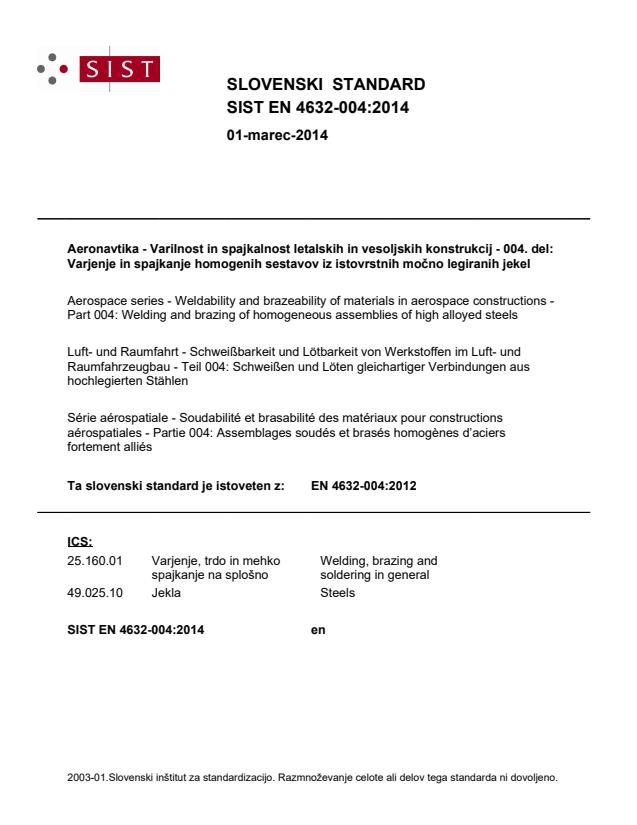
2003-01.Slovenski inštitut za standardizacijo. Razmnoževanje celote ali delov tega standarda ni dovoljeno.Luft- und Raumfahrt - Schweißbarkeit und Lötbarkeit von Werkstoffen im Luft- und Raumfahrzeugbau - Teil 004: Schweißen und Löten gleichartiger Verbindungen aus hochlegierten StählenSérie aérospatiale - Soudabilité et brasabilité des matériaux pour constructions aérospatiales - Partie 004: Assemblages soudés et brasés homogènes d’aciers fortement alliésAerospace series - Weldability and brazeability of materials in aerospace constructions - Part 004: Welding and brazing of homogeneous assemblies of high alloyed steels49.025.10JeklaSteels25.160.01Varjenje, trdo in mehko spajkanje na splošnoWelding, brazing and soldering in generalICS:Ta slovenski standard je istoveten z:EN 4632-004:2012SIST EN 4632-004:2014en01-marec-2014SIST EN 4632-004:2014SLOVENSKI
STANDARD
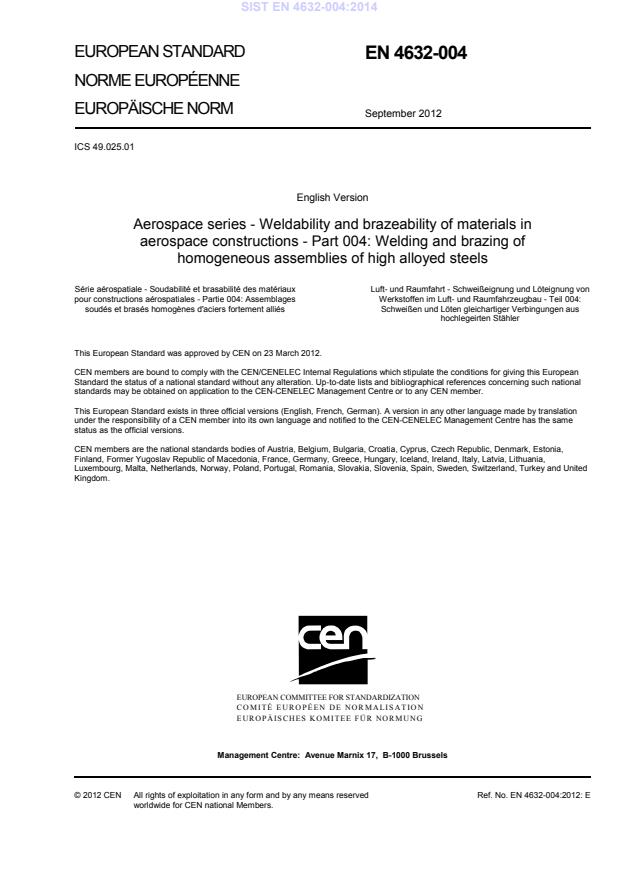
EUROPEAN STANDARD NORME EUROPÉENNE EUROPÄISCHE NORM
EN 4632-004
September 2012 ICS 49.025.01 English Version
Aerospace series - Weldability and brazeability of materials in aerospace constructions - Part 004: Welding and brazing of homogeneous assemblies of high alloyed steels
Série aérospatiale - Soudabilité et brasabilité des matériaux pour constructions aérospatiales - Partie 004: Assemblagessoudés et brasés homogènes d'aciers fortement alliés
Luft- und Raumfahrt - Schweißeignung und Löteignung von Werkstoffen im Luft- und Raumfahrzeugbau - Teil 004: Schweißen und Löten gleichartiger Verbingungen aus hochlegeirten Stähler This European Standard was approved by CEN on 23 March 2012.
CEN members are bound to comply with the CEN/CENELEC Internal Regulations which stipulate the conditions for giving this European Standard the status of a national standard without any alteration. Up-to-date lists and bibliographical references concerning such national standards may be obtained on application to the CEN-CENELEC Management Centre or to any CEN member.
This European Standard exists in three official versions (English, French, German). A version in any other language made by translation under the responsibility of a CEN member into its own language and notified to the CEN-CENELEC Management Centre has the same status as the official versions.
CEN members are the national standards bodies of Austria, Belgium, Bulgaria, Croatia, Cyprus, Czech Republic, Denmark, Estonia, Finland, Former Yugoslav Republic of Macedonia, France, Germany, Greece, Hungary, Iceland, Ireland, Italy, Latvia, Lithuania, Luxembourg, Malta, Netherlands, Norway, Poland, Portugal, Romania, Slovakia, Slovenia, Spain, Sweden, Switzerland, Turkey and United Kingdom.
EUROPEAN COMMITTEE FOR STANDARDIZATION
COMITÉ EUROPÉEN DE NORMALISATION EUROPÄISCHES KOMITEE FÜR NORMUNG
Management Centre:
Avenue Marnix 17,
B-1000 Brussels © 2012 CEN All rights of exploitation in any form and by any means reserved worldwide for CEN national Members. Ref. No. EN 4632-004:2012: ESIST EN 4632-004:2014
1) Published as ASD-STAN Prestandard at the date of publication of this standard (www.asd-stan.org). 2) Published as ASD-STAN Standard at the date of publication of this standard (www.asd-stan.org). SIST EN 4632-004:2014
EN 3510, Aerospace series — Heat resisting alloy FE-PA2602 (X4NiCrTiMoV26-15) — Solution treated and precipitation treated — Bar and section — De ≤ 100 mm 1) EN 3529, Aerospace series — Steel FE-PM2701 (X2NiCoMo18-8-5) — Vacuum induction melted and vacuum arc remelted — Solution treated and precipitation treated — Forgings — a or D ≤ 150 mm — 1 750 MPa ≤ Rm ≤ 2 000 MPa 1) EN 3531, Aerospace series — Steel FE-PM2701 (X2NiCoMo18-8-5) — Vacuum induction melted and vacuum arc remelted — Solution treated and precipitation treated — Sheet and strip — a ≤ 6 mm — 1 750 MPa ≤ Rm ≤ 2 000 MPa EN 3532, Aerospace series — Steel FE-PM-2701 (X2NiCoMo18-8-5) — Vacuum induction melted and vacuum arc remelted — Solution treated and precipitation treated — Plate — 6 mm < a ≤ 40 mm — 1 750 MPa ≤ Rm ≤ 2 000 MPa EN 3677, Aerospace series — Steel FE-PM3801 (X5CrNiCu17-4) — Air melted — Solution treated and precipitation treated — Forgings — a or D ≤ 200 mm — Rm ≥ 1 310 MPa SIST EN 4632-004:2014
EN 3889, Aerospace series — Steel FE-WM3801 (X5CrNiCu17-4) — Filler metal for welding EN 3890, Aerospace series — Steel FE-WM1502 (X11CrNiMoVN12-3) — Filler metal for welding EN 4264, Aerospace series — Heat resisting alloy FE-PA2501 (X4NiCrMoTi43-13) — As forged — Forging stock — a or D ≤ 200 mm 1) EN 4314, Aerospace series — Heat resisting alloy FE-PA2602 (X4NiCrTiMoV26-15) — Non heat treated, forging stock a or D ≤ 250 mm EN 4335, Aerospace series — Steel FE-WA2602 (X4NiCrTiMoV26-15) — Filler metal for welding — Wire and rod
EN 4346, Aerospace series — Steel FE-PM1505 (X1CrNiMoAlTi12-9-2) — Vacuum induction melted and consumable electrode remelted — Softened — Forging stock — a or D ≤ 300 mm
EN 4467, Aerospace series — Steel FE-PM1505 (X1CrNiMoAlTi12-9-2) — Vacuum induction melted and consumable electrode remelted — Solution treated and precipitation treated — Bar — a or D ≤ 150 mm — Rm ≥ 1 200 MPa
EN 4468, Aerospace series — Steel FE-PM1505 (X1CrNiMoAlTi12-9-2) — Vacuum induction melted and consumable electrode remelted — Solution treated and precipitation treated — Bar — a or D ≤ 150 mm — Rm ≥ 1 300 MPa EN 4469, Aerospace series — Steel FE-PM1505 (X1CrNiMoAlTi12-9-2) — Vacuum induction melted and consumable electrode remelted — Solution treated and precipitation treated — Bar — a or D ≤ 150 mm — Rm ≥ 1 400 MPa
EN 4470, Aerospace series — Steel FE-PM1505 (X1CrNiMoAlTi12-9-2) — Vacuum induction melted and consumable electrode remelted — Solution treated and precipitation treated — Forgings — a or D ≤ 150 mm — Rm ≥ 1 200 MPa EN 4471, Aerospace series — Steel FE-PM1505 (X1CrNiMoAlTi12-9-2) — Vacuum induction melted and consumable electrode remelted — Solution treated and precipitation treated — Forgings — a or D ≤ 150 mm — Rm ≥ 1 300 MPa EN 4472, Aerospace series — Steel FE-PM1505 (X1CrNiMoAlTi12-9-2) — Vacuum induction melted and consumable electrode remelted — Solution treated and precipitation treated — Forgings — a or D ≤ 150 mm —Rm ≥ 1 400 MPa EN 4570, Aerospace series — Heat resisting alloy FE-PA4901 (X12CrNiCoMoW21-20) — Solution treated — Forgings — De ≤ 100 mm 1) EN 4571, Aerospace series — Heat resisting alloy FE-PA4901 (X12CrNiCoMoW21-20) — Solution treated — Bar and section — De ≤ 100 mm 1) EN 4572, Aerospace series — Heat resisting alloy FE-PA4901 (X12CrNiCoMoW21-20) — Solution treated — Sheet and strip — a ≤ 3 mm 1) EN 4573, Aerospace series — Heat resisting alloy FE-PA4901 (X12CrNiCoMoW21-20) — Solution treated and precipitation treated — Bar and section — De ≤ 100 mm 1) SIST EN 4632-004:2014
3) Published by: Society of Automotive Engineers (SAE), (www.sae.org). 4) Published by: AWS, 550 N.W. LeJeune Road, Miami, Florida 33126, USA. SIST EN 4632-004:2014
PJHT : Post joining heat treatment PWHT : Post-weld heat treatment SIST EN 4632-004:2014
Current : Maraging 250 ASD-STAN : FE-PM2701
8.1.2 Chemical composition See Table 3. Table 3 — Typical chemical composition (w %) (on cast) Grade Fe C Ni Co Mo Ti Al Si Mn Zr P S B X2NiCoMo18-8-5 Base– 0,03 17,0 19,0 7,08,5 4,65,2 0,300,60 0,050,15 – 0,10 – 0,10 – 0,02 – 0,010 – 0,010– 0,003 8.1.3 Structure Martensitic with structural hardening 8.1.4 Particular characteristics High resisting steel for highly stressed parts Steel with good weldability 8.1.5 Forms Sheet and strip (EN 3531) – Forgings (EN 3529) – Plates (EN 3532). See Table 4. SIST EN 4632-004:2014
and corresponding EN ISO 4063 reference number Thickness range
mm State before welding PWHT Degree aof weldabilityJoint coefficientComments and
bibliographical references [ ] 141 ≤ 5 Solution treated Aged 480 °C during 4 h 1 1 [1] [2] Solution treated Solution treated and aged 1 1 [1] [8] Solution treated and aged Aged 480 °C during 4 h 1 – [8] Filler metal of same grade:
AMS 6501 PAW 15 pulsed ≤ 5 Solution treated Aged 480 °C during 4 h 1 1 [2] Compared with pulsed 141, this process allows to decrease proportions of retained austenite and to increase mechanical characteristics
Filler metal of same grade: AMS 6501 EBW 51 ≤ 2,5 Solution treated Aged 482 °C during 9 h 1 to 2 0,99 [9] ≤ 10 Solution treated Aged 480 °C during 4 h 1 to 2 1 [6]
Solution treated and aged Aged 480 °C during 4 h 1 to 2 –
FRW 42 ≤ 15 H2H3 b H3T2 c 1 1 [9] 522 ≤ 1 Solution treated Aged 480 °C during 4 h 1 to 2 1 – Solution treated and aged Aged 480 °C during 4 h 1 to 2 1
1 < t < 3 Solution treated Aged 480 °C during 4 h 1 to 2 0,92 [9] RSEW 22,
RSW 21 ≤ 4 Solution treated Aged 480°C during 4 h 1 – – Solution treated and aged Aged 480 °C during 4 h 1 –
FW 24 All Solution treated Solution treated and aged 1 – – T = 480 °C for 4 h. a If two degrees are indicated, the responsible person shall select the degree that is most appropriate for the definition of the assembly. b H2: 950 °C for 1 h – air cooled. c H3: 790 °C during 1 h – air cooled, T2: 455 °C for 9 h – air cooled.
EN 2821, EN 3361, EN 3469, EN 3479 : X5CrNiCu15-5 EN 10027-1 : Z5CNU15.05 ASD-STAN : FE-PM1802 EN 3160, EN 3161, EN 3162, EN 3677, EN 3678 : X5CrNiCu17-4 EN 10027-1 : Z5CNU17.04 ASD-STAN : FE-
...