

SIST EN 15219:2007+A1:2008
(Main)Water conditioning equipment inside buildings - Nitrate removal devices - Requirements for performance, safety and testing
General Information
- Abstract
This European Standard specifies requirements relating to the construction and mode of operation and relevant methods for testing automatic, salt-regenerated, anion exchange nitrate removal devices for drinking water installations inside buildings, which are permanently connected to the mains supply.
NOTE Products intended for use in water supply systems are to comply, when existing, with national regulations and testing arrangements that ensure fitness for contact with drinking water. The Member State’s relevant regulators and the EC Commission agreed on the principle for a future unique European Acceptance Scheme (EAS) which would provide a common testing and approval arrangement at European level.
If and when the EAS is adopted, European Standards on products will be amended by the addition of an Annex Z/EAS under Mandate M/136, which will contain formal references to the testing, certification and product marking requirements of the EAS. Until the EAS comes into force, the current national regulations remain applicable.
- Status
- Published
- Publication Date
- 07-Jan-2008
- Technical Committee
- IOVO - Water supply and waste water engineering
- Current Stage
- 6060 - National Implementation/Publication (Adopted Project)
- Start Date
- 17-Dec-2007
- Due Date
- 21-Feb-2008
- Completion Date
- 08-Jan-2008



Overview
EN 15219:2006+A1:2007 is a CEN European Standard for water conditioning equipment inside buildings, specifically covering salt‑regenerated anion exchange nitrate removal devices permanently connected to the mains for drinking water installations. The standard defines requirements for construction, mode of operation, performance, safety and the relevant testing methods for automatic nitrate removal units intended to protect drinking water quality.
Key topics and technical requirements
The standard addresses both design and verification aspects relevant to manufacturers, test labs and specifiers. Major topics include:
- Scope and device types
- Automatic, salt‑regenerated anion exchange nitrate removal devices (including duplex and mixed‑bed units where applicable).
- Materials and consumables
- Requirement that the anion exchange resin is certified as suitable for the intended application.
- Use of regenerating salt in accordance with EN 973 (sodium chloride commonly specified; some countries accept potassium chloride).
- Design and mechanical requirements
- Hydrostatic and cyclic pressure resistance tests, end‑connection standards and drain arrangements.
- Salt tank requirements (e.g., covered overflow, capacity for multiple regenerations).
- Electrical safety in line with EN 60335‑1 and noise limits per EN ISO 3822.
- Operating performance
- Automatic regeneration and manual override, monitoring devices (timers, flow integrators, exhaustion sensors).
- Continuity of water supply during regeneration (duplex or bypass arrangements).
- Operating range: permissible water and ambient temperature ranges and minimum supply pressure requirements.
- Safety and water quality protection
- Backflow prevention and brine infiltration controls (tests reference EN 1717; chloride infiltration limits specified).
- Testing and documentation
- Methods for measuring exchange capacity, brining efficiency, salt consumption, regeneration water volume, residual nitrate concentration and manufacturing tests. Annex A explains nitrate removal principles; Annex B covers installation, operation and maintenance.
Applications and who uses this standard
EN 15219 is practical for:
- Manufacturers of nitrate removal devices - to design and certify products for the European market.
- Testing laboratories and conformity assessors - to validate performance, safety and endurance.
- Plumbing designers, installers and consulting engineers - to specify compliant systems for buildings and ensure correct installation and maintenance.
- Water utilities and regulators - to assess fitness for contact with drinking water and ensure public health protection.
Related standards
Key referenced documents include:
- EN 973 (regenerating salt), EN 1717 (backflow protection), EN 14743 (combination softener devices), EN 60335‑1 (electrical safety), ISO/EN pipe thread and water quality test methods (EN ISO 228‑1, EN ISO 10304‑1, EN ISO 11885), EN ISO 3822 (noise).
Note: national regulations remain applicable until any future European Acceptance Scheme (EAS) is adopted.
Relations
- Effective Date
- 25-Aug-2026
- Effective Date
- 01-Apr-2026
- Effective Date
- 09-Feb-2026
- Effective Date
- 28-Jan-2026
- Effective Date
- 28-Jan-2026
- Effective Date
- 28-Jan-2026
- Effective Date
- 28-Jan-2026
- Effective Date
- 28-Jan-2026
- Effective Date
- 28-Jan-2026
- Effective Date
- 28-Jan-2026
- Effective Date
- 28-Jan-2026
- Effective Date
- 28-Jan-2026
- Effective Date
- 28-Jan-2026
- Effective Date
- 28-Jan-2026
- Effective Date
- 22-Dec-2008
Get Certified
Connect with accredited certification bodies for this standard

DIBt (Deutsches Institut für Bautechnik)
German Institute for Building Technology.
DIN CERTCO
DIN Group product certification.

Kiwa BDA Testing
Building and construction product certification.
Sponsored listings
Frequently Asked Questions
SIST EN 15219:2007+A1:2008 is a standard published by the Slovenian Institute for Standardization (SIST). Its full title is "Water conditioning equipment inside buildings - Nitrate removal devices - Requirements for performance, safety and testing". This standard covers: This European Standard specifies requirements relating to the construction and mode of operation and relevant methods for testing automatic, salt-regenerated, anion exchange nitrate removal devices for drinking water installations inside buildings, which are permanently connected to the mains supply. NOTE Products intended for use in water supply systems are to comply, when existing, with national regulations and testing arrangements that ensure fitness for contact with drinking water. The Member State’s relevant regulators and the EC Commission agreed on the principle for a future unique European Acceptance Scheme (EAS) which would provide a common testing and approval arrangement at European level. If and when the EAS is adopted, European Standards on products will be amended by the addition of an Annex Z/EAS under Mandate M/136, which will contain formal references to the testing, certification and product marking requirements of the EAS. Until the EAS comes into force, the current national regulations remain applicable.
This European Standard specifies requirements relating to the construction and mode of operation and relevant methods for testing automatic, salt-regenerated, anion exchange nitrate removal devices for drinking water installations inside buildings, which are permanently connected to the mains supply. NOTE Products intended for use in water supply systems are to comply, when existing, with national regulations and testing arrangements that ensure fitness for contact with drinking water. The Member State’s relevant regulators and the EC Commission agreed on the principle for a future unique European Acceptance Scheme (EAS) which would provide a common testing and approval arrangement at European level. If and when the EAS is adopted, European Standards on products will be amended by the addition of an Annex Z/EAS under Mandate M/136, which will contain formal references to the testing, certification and product marking requirements of the EAS. Until the EAS comes into force, the current national regulations remain applicable.
SIST EN 15219:2007+A1:2008 is classified under the following ICS (International Classification for Standards) categories: 13.060.20 - Drinking water; 91.140.60 - Water supply systems. The ICS classification helps identify the subject area and facilitates finding related standards.
SIST EN 15219:2007+A1:2008 has the following relationships with other standards: It is inter standard links to SIST ISO 7-1:1995, SIST EN 1717:2025+A1:2026, SIST EN IEC 60335-1:2024, SIST EN ISO 10304-1:2009, SIST EN ISO 228-1:2003, SIST EN 973:2009, oSIST prEN 15116:2005, SIST EN ISO 3822-1:1999, SIST EN 1717:2025, SIST EN ISO 3822-3:2018, SIST EN 15161:2007, SIST EN 14743:2006+A1:2007, SIST EN ISO 11885:2009, SIST EN 806-5:2012, SIST EN 15219:2007. Understanding these relationships helps ensure you are using the most current and applicable version of the standard.
SIST EN 15219:2007+A1:2008 is associated with the following European legislation: EU Directives/Regulations: 305/2011, 89/106/EEC, 98/83/EC. When a standard is cited in the Official Journal of the European Union, products manufactured in conformity with it benefit from a presumption of conformity with the essential requirements of the corresponding EU directive or regulation.
SIST EN 15219:2007+A1:2008 is available in PDF format for immediate download after purchase. The document can be added to your cart and obtained through the secure checkout process. Digital delivery ensures instant access to the complete standard document.
Standards Content (Sample)
2003-01.Slovenski inštitut za standardizacijo. Razmnoževanje celote ali delov tega standarda ni dovoljeno.Oprema za pitno vodo v stavbah - Naprave za odstranjevanje nitratov - Zahteve za delovanje, varnost in preskusne metodeAnlagen zur Behandlung von Trinkwasser innerhalb von Gebäuden - Nitratentfernungsanlagen - Anforderungen an Ausführung, Sicherheit und PrüfungAppareils de traitement d'eau à l'intérieur des bâtiments - Dispositifs de dénitratation - Exigences de performances, de sécurité et d'essaisWater conditioning equipment inside buildings - Nitrate removal devices - Requirements for performance, safety and testing91.140.60Sistemi za oskrbo z vodoWater supply systems13.060.20Pitna vodaDrinking waterICS:Ta slovenski standard je istoveten z:EN 15219:2006+A1:2007SIST EN 15219:2007+A1:2008en,fr,de01-februar-2008SIST EN 15219:2007+A1:2008SLOVENSKI
STANDARD
EUROPEAN STANDARD NORME EUROPÉENNE EUROPÄISCHE NORM
EN 15219:2006+A1
November 2007 ICS 91.140.60 Supersedes EN 15219:2006 English Version
Water conditioning equipment inside buildings - Nitrate removal devices - Requirements for performance, safety and testing
Appareils de traitement d'eau à l'intérieur des bâtiments - Dispositifs de dénitratation - Exigences de performances, de sécurité et d'essais
Anlagen zur Behandlung von Trinkwasser innerhalb von Gebäuden - Nitratentfernungsanlagen - Anforderungen an Ausführung, Sicherheit und Prüfung This European Standard was approved by CEN on 4 November 2006 and includes Amendment 1 approved by CEN on 21 October 2007.
CEN members are bound to comply with the CEN/CENELEC Internal Regulations which stipulate the conditions for giving this European Standard the status of a national standard without any alteration. Up-to-date lists and bibliographical references concerning such national standards may be obtained on application to the CEN Management Centre or to any CEN member.
This European Standard exists in three official versions (English, French, German). A version in any other language made by translation under the responsibility of a CEN member into its own language and notified to the CEN Management Centre has the same status as the official versions.
CEN members are the national standards bodies of Austria, Belgium, Bulgaria, Cyprus, Czech Republic, Denmark, Estonia, Finland, France, Germany, Greece, Hungary, Iceland, Ireland, Italy, Latvia, Lithuania, Luxembourg, Malta, Netherlands, Norway, Poland, Portugal, Romania, Slovakia, Slovenia, Spain, Sweden, Switzerland and United Kingdom.
EUROPEAN COMMITTEE FOR STANDARDIZATION
COMITÉ EUROPÉEN DE NORMALISATION EUROPÄISCHES KOMITEE FÜR NORMUNG
Management Centre: rue de Stassart, 36
B-1050 Brussels © 2007 CEN All rights of exploitation in any form and by any means reserved worldwide for CEN national Members. Ref. No. EN 15219:2006+A1:2007: ESIST EN 15219:2007+A1:2008
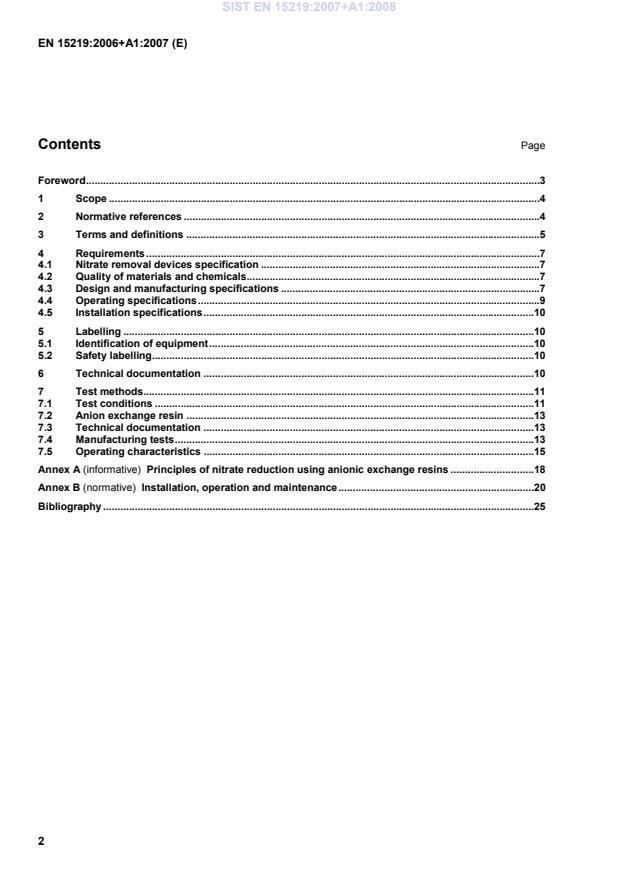
Principles of nitrate reduction using anionic exchange resins.18 Annex B (normative)
Installation, operation and maintenance.20 Bibliography.25
(ISO 3822-3:1984) EN ISO 10304-1, Water quality — Determination of dissolved fluoride, chloride, nitrite, orthophosphate, bromide, nitrate and sulphate ions, using liquid chromatography of ions — Part 1: Method for water with low contamination (ISO 10304-1:1992) EN ISO 11885, Water quality — Determination of 33 elements by inductively coupled plasma atomic emission spectroscopy (ISO 11885:1996) ISO 7-1, Pipe threads where pressure-tight joints are made on the threads — Part 1: Dimensions, tolerances and designation SIST EN 15219:2007+A1:2008
cycles per minute between 150 kPa and 1,3 times the maximum design pressure as defined in 7.4.2. SIST EN 15219:2007+A1:2008
1,5 mmol/l over that of the inlet water. 4.3.9 Noise level The nitrate removal unit shall conform to noise levels defined and measured in accordance with EN ISO 3822-1 and EN ISO 3822-3 for both the service and regeneration runs. 4.3.10 Air vent The design shall ensure that any trapped air shall be released in normal operating conditions (see 7.4.5). 4.3.11 End connections The fittings used to assemble the device and to connect it to existing pipework shall conform to the requirements of ISO 7-1 and EN ISO 228-1. 4.3.12 Drain connections The regeneration drain shall be independent from the salt tank overflow. SIST EN 15219:2007+A1:2008
maintaining the water supply to the end-user. 4.5.2 Drain The independent regenerant drain and brine tank overflow shall each incorporate a backflow prevention device which has an air gap of at least 20 mm. 4.5.3 Electrical connection The electrical connection of the nitrate removal unit shall conform to EN 60335-1. 5 Labelling 5.1 Identification of equipment The name of the manufacturer or supplier and trade mark, shall be clearly visible on the installation. A rating plate fixed on the nitrate removal unit shall give information on the type of equipment and serial number or manufacturing date. 5.2 Safety labelling A rating plate, fixed to the nitrate removal unit, combined with or separate from the one indicated in 5.1, shall give the following minimum information: a) class of pressure (PN); b) working temperature range; c) electrical connections: voltage, frequency; d) power rating; e) protection class; f) resin type (only for mixed beds). The rating plate shall indicate clearly to initiate an operation of full regeneration, in event of the device being out of service for periods longer than 96 h. 6 Technical documentation Each device shall be accompanied by technical documentation in the language of the country where it is installed. In addition to the information defined in Clause 5, this document shall give all the necessary information and instructions for sizing, installation, operation and maintenance, and at the very least: SIST EN 15219:2007+A1:2008
a) volume of resin; b) nominal flow rate; c) exchange capacity and brine efficiency in accordance with this European Standard, i.e. EN 15219 and EN 14743, if the device incorporates hardness reduction by cation exchange; d) dimensions, service weight; e) type and size of fitting/plumbing connections; f) maximum power rating; g) continuous
flow rate (for duplex appliances); h) salt and other reagent consumption; i) regeneration water; j) details of operation, safety devices, devices for backflow prevention; k) additional features (see 4.1, NOTE); l) instructions for sizing; m) instructions for installation; n) instructions for commissioning; o) instructions for shutting down and safe operation; p) instructions for maintenance. 7 Test methods 7.1 Test conditions 7.1.1 Ambient air The temperature of the environment in the immediate vicinity of the test rig shall be (20 ± 5) °C. 7.1.2 Water and salt The raw water supply used to verify compliance of a nitrate removal device with this European Standard shall comply with the following quality parameters:
temperature:
(15 ± 10) °C;
conductivity:
< 100 µS/cm;
chloride concentration:
< 1,5 x 10⁻³ mol/l;
total iron concentration:
< 0,2 mg/l. SIST EN 15219:2007+A1:2008
(150 ± 10) mg/l; - sulphate ion (SO−24):
(150 ± 10) mg/l. The test water may alternatively be prepared as a bulk solution that contains these nitrate and sulphate ion concentrations to avoid the use of doing pumps. The salt used for tests shall conform to the requirements of EN 973. 7.1.3 Test rig a) Test rig shall be equipped with a water meter and flow meter. Connect the device to the water supply, power supply (if appropriate) and drain in accordance with the manufacturer's instruction (see
Clause 6 m)). Include all of the components supplied that are appropriate for the installation including hoses, bypass valves, connectors etc. b) Commission the device in accordance with the manufacture
...