

oSIST prEN IEC 62271-3:2026
(Main)High-voltage switchgear and controlgear - Part 3: Digital interfaces based on IEC 61850
General Information
- Abstract
- Status
- Not Published
- Public Enquiry End Date
- 26-Feb-2026
- Technical Committee
- SKA - Switchgear and control gear
- Current Stage
- 4020 - Public enquire (PE) (Adopted Project)
- Start Date
- 09-Dec-2025
- Due Date
- 28-Apr-2026
- Completion Date
- 24-Feb-2026

Overview
oSIST prEN IEC 62271-3:2026 is a critical international standard developed by SIST for high-voltage switchgear and controlgear, specifically focusing on digital interfaces that are based on the IEC 61850 series. As Part 3 of the IEC 62271 standard series, this document defines key requirements for the integration, interoperability, and testing of digital interfaces within high-voltage switchgear systems.
The standard applies to equipment with rated voltage levels above 1 kV, including assemblies containing such switchgear and controlgear. Its principal aim is to ensure that digital communication, typically replacing traditional hardwired connections, is effectively and reliably implemented according to the IEC 61850 protocol family-enabling improved automation, monitoring, and control in power utilities.
Key Topics
Digital Interfaces Based on IEC 61850:
Specifies requirements for digital interfaces in high-voltage switchgear and controlgear, relying on Ethernet-based communication for seamless connection within power utility automation systems.Selection of Information Models:
Identifies relevant IEC 61850 information models to be supported by switchgear and controlgear, including models for circuit breakers, disconnectors, and associated assemblies.Communication Service Conformance:
Defines conformance classes for supported communication services, ensuring interoperability of devices within the automation network.Modifications and Extensions for Testing:
Details necessary adaptations to type and routine tests due to the integration of IEC 61850 interfaces within high-voltage equipment.Namespace and Data Model Management:
Outlines the structure and accessibility of the standard's data model namespace, including full and light code component versions for implementing and validating compliance.Exclusions:
Clearly demarcates aspects that fall outside the standard's scope, such as physical interface construction, human machine interface protocols, hardwired connections for certain equipment, and specific cybersecurity measures.
Applications
oSIST prEN IEC 62271-3:2026 is widely applicable to the specification, procurement, and testing of high-voltage switchgear with digital communication capabilities. Practical use cases include:
New Equipment Design and Integration:
Assists manufacturers and engineers in integrating IEC 61850-compliant digital interfaces directly into high-voltage switchgear and controlgear, allowing for enhanced diagnostics, remote monitoring, and automation.Retrofit of Existing Installations:
Supports the modernization of existing high-voltage systems by specifying how external digital communication equipment can bring legacy assemblies up to present-day standards for interoperability within IEC 61850 networks.Testing and Compliance Verification:
Provides a framework for conformance testing, ensuring that both newly developed and retrofitted devices meet interoperability and performance standards.Power Utility Automation Projects:
Facilitates the integration of high-voltage devices within substations and grid environments, supporting functions such as remote switching, operational status monitoring, and automated protection schemes.
Related Standards
To ensure comprehensive compliance and interoperability, oSIST prEN IEC 62271-3:2026 references and builds upon a number of other international standards, including:
IEC 61850 Series:
- IEC 61850-3 - General requirements for power utility automation communication networks
- IEC 61850-4, -5, -7, -8, -9, -10 - Covering system management, function modelling, device classes, and conformance testing
IEC 62271 Series:
- IEC 62271-1 - Common specifications for high-voltage switchgear
- IEC 62271-100 - Alternating current circuit-breakers
IEC 60255 Series:
- IEC 60255-1, -26, -27 - Measuring relays and protection equipment
IEC TR 61850-90-4:
- Network engineering guidelines for power utility automation
Conclusion
Adopting oSIST prEN IEC 62271-3:2026 supports the digital transformation of high-voltage switchgear and controlgear, enabling secure, standardized, and efficient integration into modern power utility automation systems. By defining the requirements for digital interfaces based on IEC 61850, this standard ensures long-term interoperability and flexibility as digitalization advances in electrical power systems.
Relations
- Effective Date
- 27-Feb-2024
Get Certified
Connect with accredited certification bodies for this standard

BSI Group
BSI (British Standards Institution) is the business standards company that helps organizations make excellence a habit.

IMQ S.p.A. (Certification)
Italian electrical product certification.

SLG Prüf- und Zertifizierungs GmbH
German testing and certification body.
Sponsored listings
Frequently Asked Questions
oSIST prEN IEC 62271-3:2026 is a draft published by the Slovenian Institute for Standardization (SIST). Its full title is "High-voltage switchgear and controlgear - Part 3: Digital interfaces based on IEC 61850". This standard covers: High-voltage switchgear and controlgear - Part 3: Digital interfaces based on IEC 61850
High-voltage switchgear and controlgear - Part 3: Digital interfaces based on IEC 61850
oSIST prEN IEC 62271-3:2026 is classified under the following ICS (International Classification for Standards) categories: 29.130.10 - High voltage switchgear and controlgear; 35.200 - Interface and interconnection equipment. The ICS classification helps identify the subject area and facilitates finding related standards.
oSIST prEN IEC 62271-3:2026 has the following relationships with other standards: It is inter standard links to SIST EN 62271-3:2015. Understanding these relationships helps ensure you are using the most current and applicable version of the standard.
oSIST prEN IEC 62271-3:2026 is available in PDF format for immediate download after purchase. The document can be added to your cart and obtained through the secure checkout process. Digital delivery ensures instant access to the complete standard document.
Standards Content (Sample)
SLOVENSKI STANDARD
01-februar-2026
Visokonapetostne stikalne in krmilne naprave - 3. del: Digitalni vmesniki, ki
temeljijo na IEC 61850
High-voltage switchgear and controlgear - Part 3: Digital interfaces based on IEC 61850
Hochspannungs-Schaltgeräte und -Schaltanlagen - Teil 3: Digitale Schnittstellen nach
IEC 61850
Appareillage à haute tension - Partie 3: Interfaces numériques basées sur l'IEC 61850
Ta slovenski standard je istoveten z: prEN IEC 62271-3:2025
ICS:
29.130.10 Visokonapetostne stikalne in High voltage switchgear and
krmilne naprave controlgear
35.200 Vmesniška in povezovalna Interface and interconnection
oprema equipment
2003-01.Slovenski inštitut za standardizacijo. Razmnoževanje celote ali delov tega standarda ni dovoljeno.
17/1189/CDV
COMMITTEE DRAFT FOR VOTE (CDV)
PROJECT NUMBER:
IEC 62271-3 ED3
DATE OF CIRCULATION: CLOSING DATE FOR VOTING:
2025-12-05 2026-02-27
SUPERSEDES DOCUMENTS:
17/1159/CD, 17/1170A/CC
IEC TC 17 : HIGH-VOLTAGE SWITCHGEAR AND CONTROLGEAR
SECRETARIAT: SECRETARY:
Sweden Mr Arjan Bronsveld
OF INTEREST TO THE FOLLOWING COMMITTEES: HORIZONTAL FUNCTION(S):
SC 17A, TC 38, TC 57, TC 77, TC 95
ASPECTS CONCERNED:
Electromagnetic Compatibility, Safety
SUBMITTED FOR CENELEC PARALLEL VOTING NOT SUBMITTED FOR CENELEC PARALLEL VOTING
Attention IEC-CENELEC parallel voting
The attention of IEC National Committees, members of CENELEC,
is drawn to the fact that this Committee Draft for Vote (CDV) is
submitted for parallel voting.
The CENELEC members are invited to vote through the CENELEC
online voting system.
This document is still under study and subject to change. It should not be used for reference purposes.
Recipients of this document are invited to submit, with their comments, notification of any relevant patent rights of which they are
aware and to provide supporting documentation.
Recipients of this document are invited to submit, with their comments, notification of any relevant “In Some Countries” clau ses to be
included should this proposal proceed. Recipients are reminded that the CDV stage is the final stage for submitting ISC c lauses. (SEE
AC/22/2007 OR NEW GUIDANCE DOC).
TITLE:
High-voltage switchgear and controlgear – Part 3: Digital interfaces based on IEC 61850
PROPOSED STABILITY DATE: 2032
NOTE FROM TC/SC OFFICERS:
electronic file, to make a copy and to print out the content for the sole purpose of preparing National Committee positions.
You may not copy or "mirror" the file or printed version of the document, or any part of it, for any other purpose without
permission in writing from IEC.
IEC CDV 62271-3 © IEC 2025
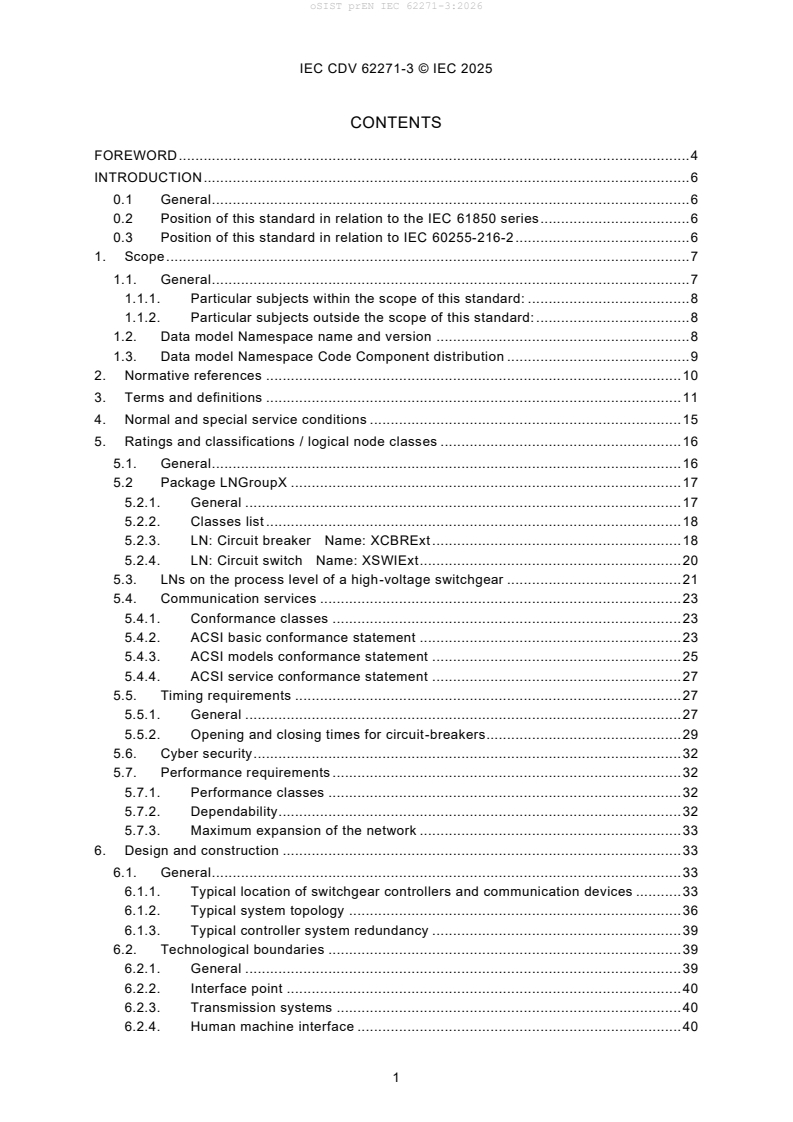
CONTENTS
FOREWORD . 4
INTRODUCTION . 6
0.1 General . 6
0.2 Position of this standard in relation to the IEC 61850 series . 6
0.3 Position of this standard in relation to IEC 60255-216-2 . 6
1. Scope . 7
1.1. General . 7
1.1.1. Particular subjects within the scope of this standard: . 8
1.1.2. Particular subjects outside the scope of this standard: . 8
1.2. Data model Namespace name and version . 8
1.3. Data model Namespace Code Component distribution . 9
2. Normative references . 10
3. Terms and definitions . 11
4. Normal and special service conditions . 15
5. Ratings and classifications / logical node classes . 16
5.1. General . 16
5.2 Package LNGroupX . 17
5.2.1. General . 17
5.2.2. Classes list . 18
5.2.3. LN: Circuit breaker Name: XCBRExt . 18
5.2.4. LN: Circuit switch Name: XSWIExt . 20
5.3. LNs on the process level of a high-voltage switchgear . 21
5.4. Communication services . 23
5.4.1. Conformance classes . 23
5.4.2. ACSI basic conformance statement . 23
5.4.3. ACSI models conformance statement . 25
5.4.4. ACSI service conformance statement . 27
5.5. Timing requirements . 27
5.5.1. General . 27
5.5.2. Opening and closing times for circuit-breakers. 29
5.6. Cyber security . 32
5.7. Performance requirements . 32
5.7.1. Performance classes . 32
5.7.2. Dependability. 32
5.7.3. Maximum expansion of the network . 33
6. Design and construction . 33
6.1. General . 33
6.1.1. Typical location of switchgear controllers and communication devices . 33
6.1.2. Typical system topology . 36
6.1.3. Typical controller system redundancy . 39
6.2. Technological boundaries . 39
6.2.1. General . 39
6.2.2. Interface point . 40
6.2.3. Transmission systems . 40
6.2.4. Human machine interface . 40
IEC CDV 62271-3 © IEC 2025
6.3. Mechanical requirements . 40
6.3.1. Mechanical stresses . 40
6.3.2. Degree of protection provided by enclosures . 40
6.3.3. Degree of protection for connectors . 40
6.3.4. Accessibility . 41
6.4. Electrical requirements . 41
6.5. EMC . 41
6.6. Electronic nameplates . 41
6.7. Implementation of IEC 61850 interface . 41
7. Type tests . 42
7.1. General . 42
7.2. Switchgear communication interface conformance tests . 42
7.3. Time measurement of switchgear . 43
7.3.1. Circuit-breakers . 43
7.3.2. Other switchgear . 46
8. Routine tests . 46
9. Information to be given with enquiries, tenders and orders . 47
10. Rules for transport, storage, installation, operation and maintenance . 47
11. Safety . 47
Annex A (normative) Test overview table . 48
Annex B (normative) Electronic nameplates . 49
B.1 General . 49
B.2 Electronic nameplate for circuit breaker . 49
B.3 Electronic nameplate for switchgear other than circuit breakers . 49
Annex C (informative) Test procedures . 52
C.1 Performance type testing – operation time . 52
C.2 Performance type testing – make and break time . 52
Annex D (informative) Communication device – use case examples. 54
Annex E (informative) Specific model to highlight the scope of standard IEC 62271-3 . 56
Annex F (informative) Treatment of three-position switches . 57
Annex G (informative) Data Model for Circuit Breaker . 59
Annex H (informative) Data Model for Disconnectors . 63
Bibliography . 66
Figure 1 – Scope of standard IEC 62271-3 . 7
Figure 2 – Class diagram LogicalNodes_62271_3: LogicalNodes_62271_3 . 16
Figure 3 – Class diagram LNGroupX::LNGroupX. 17
Figure 4 – Calculation of intelligent switchgear operating times (example 1) . 28
Figure 5 – Calculation of intelligent switchgear operating times (example 2) . 29
Figure 6 – Opening or closing signal to intelligent switchgear . 30
Figure 7 – Opening or closing signal to conventional switchgear . 30
Figure 8 – Opening operation of an intelligent circuit-breaker . 31
Figure 9 – Closing operation of an intelligent circuit-breaker . 32
Figure 10 – GIS (example 1) . 33
IEC CDV 62271-3 © IEC 2025
Figure 11 – Secondary system in medium voltage cubicle (example 2) . 34
Figure 12 – AIS circuit-breaker (example 3) . 35
Figure 13 – AIS circuit-breaker (example 4) . 36
Figure 14 – GIS (example 1) with Ethernet based communication network . 37
Figure 15 – GIS (example 2) with Ethernet based communication network . 38
Figure 16 – AIS circuit-breaker (example 3) with Ethernet based communication
network . 38
Figure 17 – AIS circuit-breaker (example 4) with Ethernet based communication
network . 39
Figure 18 – Performance test of an intelligent switchgear (configuration 1) . 43
Figure 19 – Performance test of an intelligent switchgear (configuration 2) . 45
Figure C.1 – Performance test of an intelligent switchgear operation time . 52
Figure C.2 – Performance test of an intelligent switchgear – CB make and break time . 53
Figure D.1 - Switchgear controllers connected to Com device via Ethernet link . 54
Figure D.2 - Switchgear controllers as part of communication device . 55
Figure E.1- Specific model to highlight the scope of standard IEC 62271-3 . 56
Figure F.1 – Combination of two instances of LN class XSWI. 57
Figure F.2 – Derivation of intermediate position . 57
Table 1 – Attributes of IEC 62271-3:2025A namespace . 9
Table 2 – Normative abbreviations for data object names . 15
Table 3 – List of classes defined in LNGroupX package . 18
Table 4 – Data objects of XCBRExt . 19
Table 5 – Data objects of XSWIExt . 21
Table 6 – LNs in switchgear communication interface . 22
Table 7 – ACSI basic conformance statement . 24
Table 8 – ACSI models conformance statement . 26
Table 9 – ACSI service conformance statement . 27
Table A.1 – Test overview table . 48
Table B.1 – Common data class VSD . 49
Table B.2 – Mapping of IEC 61850 data objects on IEC 62271 (1 of 2) . 50
Table B.3 – Mapping of IEC 61850 data objects on IEC 62271 (2 of 2) . 51
Table F.1 – Summary of all possible switching states . 58
Table G.1 – LN used for circuit breaker data model . 59
Table G.2 – Data model of phase segregated circuit breaker . 59
Table G.3 – Data model of circuit breaker with coupled poles . 61
Table H.1 – LN used for disconnector data model . 63
Table H.2 – Data model of phase segregated disconnector . 63
Table H.3 – Data model of disconnector with coupled poles . 64
IEC CDV 62271-3 © IEC 2025
INTERNATIONAL ELECTROTECHNICAL COMMISSION
____________
HIGH-VOLTAGE SWITCHGEAR AND CONTROLGEAR –
Part 3: Digital interfaces based on IEC 61850
FOREWORD
1) The International Electrotechnical Commission (IEC) is a worldwide organization for standardization comprising
all national electrotechnical committees (IEC National Committees). The object of IEC is to promote international
co-operation on all questions concerning standardization in the electrical and electronic fields. To this end and
in addition to other activities, IEC publishes International Standards, Technical Specifications, Technical Reports,
Publicly Available Specifications (PAS) and Guides (hereafter referred to as “IEC Publication(s)”). Their
preparation is entrusted to technical committees; any IEC National Committee interested in the subject dealt with
may participate in this preparatory work. International, governmental and non-governmental organizations liaising
with the IEC also participate in this preparation. IEC collaborates closely with the International Organization for
Standardization (ISO) in accordance with conditions determined by agreement between the two organizations.
2) The formal decisions or agreements of IEC on technical matters express, as nearly as possible, an international
consensus of opinion on the relevant subjects since each technical committee has representation from all
interested IEC National Committees.
3) IEC Publications have the form of recommendations for international use and are accepted by IEC National
Committees in that sense. While all reasonable efforts are made to ensure that the technical content of IEC
Publications is accurate, IEC cannot be held responsible for the way in which they are used or for any
misinterpretation by any end user.
4) In order to promote international uniformity, IEC National Committees undertake to apply IEC Publications
transparently to the maximum extent possible in their national and regional publications. Any divergence between
any IEC Publication and the corresponding national or regional publication shall be clearly indicated in the latter.
5) IEC itself does not provide any attestation of conformity. Independent certification bodies provide conformity
assessment services and, in some areas, access to IEC marks of conformity. IEC is not responsible for any
services carried out by independent certification bodies.
6) All users should ensure that they have the latest edition of this publication.
7) No liability shall attach to IEC or its directors, employees, servants or agents including individual experts and
members of its technical committees and IEC National Committees for any personal injury, property damage or
other damage of any nature whatsoever, whether direct or indirect, or for costs (including legal fees) and
expenses arising out of the publication, use of, or reliance upon, this IEC Publication or any other IEC
Publications.
8) Attention is drawn to the Normative references cited in this publication. Use of the referenced publications is
indispensable for the correct application of this publication.
9) Attention is drawn to the possibility that some of the elements of this IEC Publication may be the subject of patent
rights. IEC shall not be held responsible for identifying any or all such patent rights.
International Standard IEC 62271-3 has been prepared by IEC technical committee 17:
Switchgear and controlgear. This third edition cancels and replaces the second edition
published in 2015. This edition constitutes a technical revision.
This edition includes the following significant technical changes with respect to the previous
edition:
a) Scope of this standard is explained in more detail (subclauses 1.1.1 and 1.1.2)
b) Logical node classes, constructed classes structure and descriptions (subclause 5.2)
c) Definition of the term “communication devices” in the context of this standard has been
added (subclause 3.23)
d) an update to the latest edition(s) of IEC 61850 series
e) an update of normative references
f) the Annex C gives an additional simplified example for performance type testing
g) the definition of switchgear controller was improved (subclause 3.21)
IEC CDV 62271-3 © IEC 2025
h) attributes of data model Namespace name and version (subclause 1.2)
i) constructed class’s structure and descriptions are part of the Code Component of this IEC
standard (subclause 1.3)
j) a way of treatment of three-position switches is introduced (Annex F)
k) implementation of IEC 61850 interface (new subclause 0)
l) table B.2 – new data objects added to LN XCBR was replaced by Table 4 – Data objects of
XCBRExt (subclause 5.2.3)
m) table B.3 – new data objects added to LN XSWI was replaced by Table 5 – Data objects of
XSWIExt (subclause 5.2.4)
n) subclause B.4 – presence conditions for application of new data objects was deleted and
respective presence conditions were stated right away within respective subclause 5.2.3
and subclause 5.2.4
This standard has the status of a product family standard and may be used as a normative
reference in a dedicated product standard for high-voltage switchgear and controlgear.
The text of this standard is based on the following documents:
FDIS Report on voting
17/xxx/FDIS 17/xxx/RVD
Full information on the voting for the approval of this standard can be found in the report on
voting indicated in the above table.
This publication has been drafted in accordance with the ISO/IEC Directives, Part 2.
A list of all parts in the IEC 62271 series, published under the general title High voltage
switchgear and controlgear, can be found on the IEC website.
The committee has decided that the contents of this publication will remain unchanged until the
stability date indicated on the IEC web site under "http://webstore.iec.ch" in the data related to
the specific publication. At this date, the publication will be
• reconfirmed,
• withdrawn,
• replaced by a revised edition, or
• amended.
IMPORTANT – The 'colour inside' logo on the cover page of this publication indicates
that it contains colours which are considered to be useful for the correct understanding
of its contents. Users should therefore print this document using a colour printer.
IEC CDV 62271-3 © IEC 2025
1 INTRODUCTION
2 0.1 General
3 This standard is a product family standard for high-voltage switchgear and controlgear and
4 assemblies thereof. It provides an application of the horizontal standard series IEC 61850 which
5 details layered power utility communication architecture, in the world of high-voltage switchgear
6 and controlgear.
7 By providing tutorial material such as examples and explanations, it also gives an access for
8 switchgear experts to concepts and methods applied in the IEC 61850 series.
9 Compared to switchgear equipment, digital communication technology is subject to ongoing
10 changes which are expected to continue in the future. Profound experience with electronics
11 integrated directly into switchgear has yet to be gathered on a broader basis, as this type of
12 equipment is not widely spread in the industry and a change of approach has not yet occurred.
13 This situation is considered in this standard by setting an appropriate validity date and by
14 specifying several options to most of the communication-related requirements, such as
15 connectors or fibres.
16 0.2 Position of this standard in relation to the IEC 61850 series
17 The IEC 61850 series is a horizontal standard intended to be used for communication and
18 systems in the power utility. The most important parts of this series define:
19 1) information models for the power utility automation system.
20 These information models include both the models of the switchgear (like circuit -breakers
21 and disconnectors) and other process equipment (like instrument transformers), and the
22 models of the power utility automation system (like protection relays).
23 2) the communication between intelligent electronic devices (IEDs) of the power utility
24 automation system.
25 3) a configuration language used to describe the configuration aspects of the power utility
26 automation system.
27 4) conformance testing of the communication interfaces of the IEDs of the power utility
28 automation system including their data models.
29 Typically, IEDs like bay level controllers interface to switchgear. In that case, the data models
30 of the switchgear are implemented in these devices. However, this is not the only realization.
31 In the case where electronics are integrated direct into switchgear, the above-mentioned data
32 models should be implemented within the switchgear and the switchgear supports a
33 communication interface.
34 IEC 61850, being a horizontal standard series, leaves many options open in order to support
35 present and future requirements of all sizes of power utility automation system at all voltage
36 levels.
37 0.3 Position of this standard in relation to IEC 60255-216-2
38 The “hardwired connection" between the binary input / output IED (BIOI) or SCU to circuit
39 breaker is outside the scope of this standard. Annex E shows a detailed and more specific
40 model to highlight the scope of standard IEC 62271-3.
IEC CDV 62271-3 © IEC 2025
42 HIGH-VOLTAGE SWITCHGEAR AND CONTROLGEAR –
44 Part 3: Digital interfaces based on IEC 61850
48 1. Scope
49 1.1. General
50 This part of IEC 62271 is applicable to high-voltage switchgear and controlgear for all rated
51 voltage levels above 1 kV and assemblies thereof and specifies associated IEC 61850
52 interface with other parts of the power utility automation and its impact on testing. This
53 equipment for digital communication, replacing hardwired connection (e.g. metal parallel
54 wiring), can be integrated into the high-voltage switchgear, controlgear, and assemblies thereof,
55 or can be external equipment to provide compliance for existing switchgear and controlgear and
56 assemblies thereof with the standards of the IEC 61850 series.
59 Figure 1 – Scope of standard IEC 62271-3
60 This International Standard is a product standard based on the IEC 61850 series. It deals with
61 all relevant aspects of switchgear and controlgear, and assemblies thereof with digital
62 interfaces. In the context of this standard the digital interfaces are according to IEC 61850
63 standard which uses Ethernet based communication. The physical realization of a digital
64 interface in the context of this standard is not subject to this standard; e.g. a digital interface
65 may be a stand-alone unit or may be a built-in unit of any IED. Merging units as well as
66 protection IED’s are outside the scope of this standard.
IEC CDV 62271-3 © IEC 2025
67 1.1.1. Particular subjects within the scope of this standard:
68 This standard defines in particular:
69 a) a selection of the information models from the IEC 61850 series that are supported by such
70 switchgear and controlgear, and assemblies thereof
71 b) conformance classes for the set of communication services that are supported by the
72 switchgear and controlgear, and assemblies thereof
73 c) modifications and extensions to type and routine tests of switchgear and controlgear, and
74 assemblies thereof that are required due to the IEC 61850 interface
75 This standard specifies the requirements for digital communication equipment used within high-
76 voltage switchgear, controlgear, and assemblies thereof, as well as the relevant testing
77 requirements.
78 The relevant switchgear standards of the IEC 62271 series are applicable in general, with the
79 additional specifications described in this standard.
80 1.1.2. Particular subjects outside the scope of this standard:
81 In particular, the following subjects are outside the scope of this standard:
82 a) the connection of the HMI, the protocol applied and the link to service tools
83 b) the physical realization (optical or hardwired) of a digital interface in the context of this
84 standard; e.g. a digital interface may be a stand-alone unit or may be a built-in unit of any
85 IED.
86 c) the model regarding trip circuit supervision (ANSI 74TC) as well as the model regarding
87 pole discrepancy protection (PDP) is subject to standard IEC 61850-7-500 and will therefore
88 not be considered in this standard.
89 d) DC-switchgear and controlgear
90 e) cyber security including RBAC (role based access control)
91 f) the “hardwired connection" between Binary Input / Output IED (BIOI) or switchgear control
92 unit (SCU) to circuit breaker as shown within Figure C.2
94 NOTE 1 This standard intends to promote interoperability of communication interfaces. Interchangeability is outside
95 the scope of this standard, as there is no requirement for it. Interchangeability is also outside the scope of the
96 IEC 61850 series.
97 NOTE 2 For an introduction to power utility automation communication and the related terms, definitions and
98 models, refer to IEC 61850-1 which provides an overview of the objectives and requirements of the IEC 61850 series
99 in general. IEC 61850-7-1 provides an overview of modelling techniques.
100 1.2. Data model Namespace name and version
101 This subclause is mandatory for any IEC 61850 namespace (as defined by IEC 61850-7-
102 1:2011).
103 Table 1 – Attributes of IEC 62271-3:2025A namespaceshows all attributes of IEC 62271-
104 3:2025A namespace.
IEC CDV 62271-3 © IEC 2025
105 Table 1 – Attributes of IEC 62271-3:2025A namespace
Attribute Content
Namespace nameplate
Namespace Identifier IEC 62271-3
Version 2025
Revision A
Full Namespace Name IEC 62271-3:2025A
Full Code Component Name IEC_62271-3.NSD.2025A.Full
Light Code Component Name IEC_62271-3.NSD.2025A.Light
Namespace Type product
Namespace dependencies
extends IEC 61850-7-4:2010/AMD1:2020
106 NOTE 1 Version and revision entry will be updated prior to publishing FDIS
107 1.3. Data model Namespace Code Component distribution
108 The Code Components are in light and full version:
109 • The full version is named : IEC_62271-3.NSD.2025A.Full. It contains definition of the whole
110 data model defined in this standard with the documentation associated and access is
111 restricted to purchaser of this part
112 • The light version is named: IEC_62271-3.NSD.2025A.Light. It does not contain any
113 documentations but contains the whole data model as per full version, and this light version
114 is freely accessible on the IEC website for download at :
115 http://www.iec.ch/tc57/supportdocuments, but the usage remains under the licensing
116 conditions.
117 The Code Components for IEC 61850 data models are formatted in compliance with the NSD
118 format defined by the standard IEC 61850-7-7. Each Code Component is a ZIP package
119 containing:
120 • the electronic representation of the Code Component itself (possibly multiple files),
121 • the grammar files (XSD) enabling to check the consistency of the associated files against
122 the defined version of NSD, but also against the IEC 61850 flexibility rules in case of private
123 extensions
124 • a file describing the content of the package (IECManifest.xml).
125 The IEC Manifest contains different sections giving information on:
126 • The copyright notice
127 • The identification of the code component
128 • The publication related to the code component
129 • The list of the electronic files which compose the code component
130 • An optional list of history files to track changes during the evolution process of the code
131 component
132 The life cycle of a code component is not restricted to the life cycle of the related publication.
133 The publication life cycle goes through two stages, Version (corresponding to an edition) and
134 Revision (corresponding to an amendment). A third publication stage (Release) allows
135 publication of Code Component in case of urgent fixes of InterOp Tissues, thus without need to
136 publish an amendment.
IEC CDV 62271-3 © IEC 2025
137 Consequently new release(s) of the Code Component may be released, which supersede(s) the
138 previous release, and will be distributed through the IEC TC57 web site at:
139 http://www.iec.ch/tc57/supportdocuments.
140 The latest version/release of the document will be found by selecting the file named IEC_62271-
141 3.NSD.{VersionStateInfo}.Light or the file named IEC_62271-3.NSD.{VersionStateInfo}.full with
142 the filed VersionStateInfo of the highest value.
143 2. Normative references
144 The following documents are referred to in the text in such a way that some or all their content
145 constitutes requirements of this document. For dated references, only the edition cited applies.
146 For undated references, the latest edition of the referenced document (including any
147 amendments) applies.
148 IEC 60255-1, Measuring relays and protection equipment. Common requirements
149 IEC 60255-26, Measuring relays and protection equipment - Part 26: Electromagnetic
150 compatibility requirements
151 IEC 60255-27, Measuring relays and protection equipment - Part 27: Product safety
152 requirements
153 IEC 61850-3, Communication networks and systems for power utility automation –
154 Part 3: General requirements
155 IEC 61850-4, Communication networks and systems for power utility automation –
156 Part 4: System and project management
157 IEC 61850-5, Communication networks and systems for power utility automation –
158 Part 5: Communication requirements for functions and device models
159 IEC 61850-7-2, Communication networks and systems for power utility automation – Part 7-2:
160 Basic information and communication structure – Abstract communication service interface
161 (ACSI)
162 IEC 61850-7-3, Communication networks and systems for power utility automation – Part 7-3:
163 Basic communication structure – Common data classes
164 IEC 61850-7-4, Communication networks and systems for power utility automation – Part 7-4:
165 Basic communication structure – Compatible logical node classes and data object classes
166 IEC 61850-8-1, Communication networks and systems for power utility automation – Part 8-1:
167 Specific communication service mapping (SCSM) – Mappings to MMS (ISO 9506-1 and
168 ISO 9506-2) and to ISO/IEC 8802-3
169 IEC 61850-9-2, Communication networks and systems for power utility automation – Part 9-2:
170 Specific communication service mapping (SCSM) – Sampled values over ISO/IEC 8802-3
171 IEC 61850-10, Communication networks and systems for power utility automations – Part 10:
172 Conformance testing
173 IEC TR 61850-90-4, Communication networks and systems for power utility automation –
174 Part 90-4: Network engineering guidelines
IEC CDV 62271-3 © IEC 2025
175 IEC 62271-1, High-voltage switchgear and controlgear – Part 1: Common specifications
176 IEC 62271-100, High-voltage switchgear and controlgear – Part 100: Alternating current circuit-
177 breakers
179 3. Terms and definitions
180 For the purposes of this document, the following terms and definitions apply.
181 3.1.
182 time requirement
183 maximum acceptable time delay between source and destination
184 3.2.
185 mandatory data
186 data where coding is specified and the information always present
187 Note 1 to entry: Mandatory data ensures interoperability in power utility automation.
188 3.3.
189 optional data
190 data where the coding is specified but the information not necessarily present
191 3.4.
192 data integrity
193 ability of a communication system to deliver data from its originator to its destinations with an
194 acceptable residual error rate
195 Note 1 to entry: In the case of switchgear with a digital interface, data integrity concerns the probability of
196 undetected errors resulting in wrong information about actual process states in the monitoring direction or unintended
197 actions in the control direction of the system.
198 3.5.
199 interoperability
200 ability of two or more IEDs from the same vendor, or from different vendors, to exchange
201 information and use that information for correct execution of specified functions
202 [SOURCE: IEC TR 61850-1:2013, 3.1.8]
203 3.6.
204 logical node
205 LN
206 smallest part of a function that exchanges data
207 Note 1 to entry: A logical node is an object defined by its data and methods.
208 [SOURCE: IEC TR 61850-1:2013, 3.1.9]
209 3.7.
210 abstract communication service interface
211 ACSI
212 virtual interface to an IED providing abstract communication services, for example, connection,
213 variable access, unsolicited data transfer, device control and file transfer services, independent
214 of the actual communication stack and profiles used
215 [SOURCE: IEC TR 61850-1:2013, 3.1.1]
IEC CDV 62271-3 © IEC 2025
216 3.8.
217 intelligent electronic device
218 IED
219 any device incorporating one or more processors with the capability to receive or send
220 data/controls from or to an external source (for example, electronic multifunction meters, digital
221 relays, controllers)
222 [SOURCE: IEC TR 61850-1:2013, 3.1.6]
223 3.9.
224 protocol implementation conformance statements
225 PICS
226 summary of the capabilities of the system to be tested
227 Note 1 to entry: PICS contain information regarding the ACSI. This information could typically be optional parts,
228 specific restrictions, or add-ons (see IEC 61850-7-2:2010).
229 [SOURCE: adapted from ISO/IEC 8823-2:1997]
230 3.10.
231 model implementation conformance statement
232 MICS
233 statement which details the standard data object model elements supported by the system or
234 device
235 [SOURCE: IEC 61850-10:2012, 3.4]
236 3.11.
237 service
238 functional capability of a resource which can be modelled by a sequence of service primitives
239 Note 1 to entry: A resource in the context of this standard is an IED. A service primitive is an abstract,
240 implementation independent representation of an interaction between the service user and the service provider.
241 [SOURCE: IEC TS 61850-2:2003, 2.121, modified – addition of a new note to entry]
242 3.12.
243 configuration (of a system or device)
244 step in system design, for example, selecting functional units, assigning their locations and
245 defining their interconnections
246 [SOURCE: IEC TS 61850-2:2003, 2.14]
247 3.13.
248 data security
249 ability to avoid placing the controlled system in a potentially dangerous or unstable situation by
250 an undetected error
251 3.14.
252 reliability
253 measure of a system or equipment to perform its intended function under specified conditions
254 for a specified period of time
255 Note 1 to entry: It is a probability figure, based on failure data and length of operating time.
256 [SOURCE: adapted from IEC 60050-191:1990, 191-02-06]
IEC CDV 62271-3 © IEC 2025
257 3.15.
258 availability
259 the ability of an item to be in a state to perform a required function under given conditions at a
260 given instant of time or over a given time interval, assuming that the required external resources
261 are provided
262 Note 1 to entry: This ability depends on the combined aspects of the reliability performance, the maintainability
263 performance and the maintenance support performance.
264 Note 2 to entry: Required external resources, other than maintenance resources do not affect the availability
265 performance of the item.
266 Note 3 to entry: In French the term "disponibilité" is also used in the sense of "instantaneous availability".
267 3.16.
268 maintainability
269 the ability of an item under given conditions of use, to be retained in, or restored to, a state in
270 which it can perform a required function, when maintenance is performed under given conditions
271 and using stated procedures and resources
272 Note 1 to entry: The term "maintainability" is also used as a measure of maintainability performance.
273 3.17.
274 dependability
275 collective term used to describe the availability performance and its influencing factors:
276 reliability performance, maintainability performance, and maintenance support performance
277 [SOURCE: IEC 60050-191:1990, 191-02-03]
278 3.18.
279 communication conformance test
280 check of data flow on communication channels in accordance with the standard conditions
281 concerning access organization, formats and bit sequences, time synchronization, timing,
282 signal form and level and reaction to errors
283 Note 1 to entry: The conformance test can be carried out and certified to the standard or to specifically described
284 parts of the standard.
285 Note 2 to entry: The term "communication" has been added to "conformance test" in order to state that this test
286 refers to communication conformance.
287 3.19.
288 performance test
289 test on complete intelligent switchgear system to characterize it under operating conditions
290 3.20.
291 intelligent switchgear
292 switchgear composed of its primary part, its mechanism and one or more switchgear controllers
293 containing at a minimum set of logical nodes according to the IEC 61850 series
294 Note 1 to entry: Minimum set of logical nodes are as per 5.1. of this standard.
295 3.21.
296 switchgear controller
297 an IED used to operate, monitor or supervise switchgear (such as circuit breakers,
298 disconnectors.)
299 Note 1 to entry: A switchgear controller can be:
300 • a circuit-breaker controller (abbreviated as CBC in this standard);
301 • a disconnector controller (abbreviated as DCC in this standard);
IEC CDV 62271-3 © IEC 2025
302 • an earthing switch controller (abbreviated as ESC in
...