

SIST EN 14752:2025
(Main)Railway applications - Bodyside entrance systems for rolling stock
General Information
- Abstract
This document applies to passenger body side entrance systems of all newly designed railway vehicles such as tram, metro, suburban, main-line and high-speed trains that carry passengers. The requirements of this document also apply to existing vehicles undergoing refurbishment of the door equipment, as far as it is reasonably practicable.
This document also specifies the requirements for testing of entrance systems.
This document makes reference to manual and power operated entrance systems. For manual doors, clauses referring to power operation are not applicable.
This document does not apply to the following:
- Entrance systems for equipment access, inspection or maintenance purposes and for crew only use;
- Doors on freight wagons; and
- Doors or hatches specifically provided for escape under emergency conditions.
Where passenger bodyside entrance doors are to be used for staff access, EN 16116-1:2022, EN 16186-4:2019 and EN 16186-8:2022+A1:2024 provide the details for the staff access requirements.
- Status
- Published
- Public Enquiry End Date
- 30-Apr-2024
- Publication Date
- 13-Jul-2025
- Technical Committee
- IŽNP - Reilway applications
- Current Stage
- 6060 - National Implementation/Publication (Adopted Project)
- Start Date
- 01-Jul-2025
- Due Date
- 05-Sep-2025
- Completion Date
- 14-Jul-2025


Overview
EN 14752:2025 - Railway applications: Bodyside entrance systems for rolling stock is the CEN European standard that defines design, operational and testing requirements for passenger bodyside entrance systems on newly designed and refurbished railway vehicles (tram, metro, suburban, main‑line and high‑speed trains). It covers both manual and power‑operated doors, specifies test methods (type and routine tests) and applies to entrance systems used by passengers; crew‑only, freight wagon doors and emergency‑only hatches are excluded.
Keywords: EN 14752:2025, bodyside entrance systems, rolling stock doors, railway standards, door testing, passenger safety
Key Topics and Requirements
- Scope & applicability: New vehicles and door refurbishments “as far as reasonably practicable”; manual-door clauses excluded where power operation is referenced.
- Constructional requirements: throughway geometry, step design, door windows, water drainage, driver‑cab access doors, and anti‑train‑surfing considerations.
- Mechanical strength & interfaces: door and step load requirements, mechanical interfaces with vehicle structure, resistance to aerodynamic loads.
- Electrical/electronic requirements: hardware and software requirements for electronic door control systems including RAMS (reliability, availability, maintainability and safety) and protection against electrical hazards.
- Operational safety: door control logic, interlocking, single‑point failure avoidance, closing/opening safety, obstacle detection for movable steps, emergency egress and isolation for maintenance.
- Environmental performance: weather resistance, water tightness, pressure tightness (with prescriptive test methods).
- Testing & verification: categories include type tests, manufacturing routine tests, and tests on fully assembled vehicle/train consists. Normative annexes cover water tests, pressure tightness, measuring closing forces, aerodynamic loads and a prescriptive test plan.
Applications and Who Uses It
- Vehicle manufacturers and suppliers designing bodyside entrance systems and door components.
- Rolling stock designers, systems integrators and vehicle OEMs for vehicle specification and compliance.
- Railway operators and maintainers for refurbishment, maintenance procedures and acceptance testing.
- Certification bodies, safety assessors and testing laboratories performing type and routine tests.
- Infrastructure/operation planners concerned with vehicle/door interface and passenger accessibility.
Benefits include improved passenger safety, consistent interoperability, clearer maintenance/test procedures and regulatory compliance.
Related Standards
- For staff access specifics see EN 16116-1:2022, EN 16186-4:2019, EN 16186-8:2022+A1:2024 (referenced within the scope).
- EN 14752:2025 supersedes earlier editions (previously EN 14752:2019+A1:2021).
This standard is essential for professionals working on rolling stock door design, testing and certification seeking up‑to‑date, harmonized requirements for passenger bodyside entrance systems.
Relations
- Replaces
SIST EN 14752:2020+A1:2022 - Railway applications - Bodyside entrance systems for rolling stock - Effective Date
- 01-Sep-2025
- Refers
SIST EN IEC 61373:2026 - Railway applications - Rolling stock equipment - Shock and vibration tests - Effective Date
- 15-Sep-2026
- Effective Date
- 12-May-2026
- Effective Date
- 09-Feb-2026
- Effective Date
- 09-Feb-2026
- Effective Date
- 09-Feb-2026
- Effective Date
- 09-Feb-2026
- Effective Date
- 09-Feb-2026
- Effective Date
- 09-Feb-2026
- Effective Date
- 09-Feb-2026
- Effective Date
- 09-Feb-2026
- Effective Date
- 09-Feb-2026
- Effective Date
- 09-Feb-2026
- Effective Date
- 09-Feb-2026
- Effective Date
- 09-Feb-2026
Get Certified
Connect with accredited certification bodies for this standard

IRIS Certification (UNIFE)
International Railway Industry Standard certification.

TÜV SÜD Rail GmbH
TÜV SÜD railway certification services.

Bureau Veritas Railway Certification
Railway and transportation certification.
Sponsored listings
Frequently Asked Questions
SIST EN 14752:2025 is a standard published by the Slovenian Institute for Standardization (SIST). Its full title is "Railway applications - Bodyside entrance systems for rolling stock". This standard covers: This document applies to passenger body side entrance systems of all newly designed railway vehicles such as tram, metro, suburban, main-line and high-speed trains that carry passengers. The requirements of this document also apply to existing vehicles undergoing refurbishment of the door equipment, as far as it is reasonably practicable. This document also specifies the requirements for testing of entrance systems. This document makes reference to manual and power operated entrance systems. For manual doors, clauses referring to power operation are not applicable. This document does not apply to the following: - Entrance systems for equipment access, inspection or maintenance purposes and for crew only use; - Doors on freight wagons; and - Doors or hatches specifically provided for escape under emergency conditions. Where passenger bodyside entrance doors are to be used for staff access, EN 16116-1:2022, EN 16186-4:2019 and EN 16186-8:2022+A1:2024 provide the details for the staff access requirements.
This document applies to passenger body side entrance systems of all newly designed railway vehicles such as tram, metro, suburban, main-line and high-speed trains that carry passengers. The requirements of this document also apply to existing vehicles undergoing refurbishment of the door equipment, as far as it is reasonably practicable. This document also specifies the requirements for testing of entrance systems. This document makes reference to manual and power operated entrance systems. For manual doors, clauses referring to power operation are not applicable. This document does not apply to the following: - Entrance systems for equipment access, inspection or maintenance purposes and for crew only use; - Doors on freight wagons; and - Doors or hatches specifically provided for escape under emergency conditions. Where passenger bodyside entrance doors are to be used for staff access, EN 16116-1:2022, EN 16186-4:2019 and EN 16186-8:2022+A1:2024 provide the details for the staff access requirements.
SIST EN 14752:2025 is classified under the following ICS (International Classification for Standards) categories: 45.060.20 - Trailing stock; 45.140 - Metro, tram and light rail equipment. The ICS classification helps identify the subject area and facilitates finding related standards.
SIST EN 14752:2025 has the following relationships with other standards: It is inter standard links to SIST EN 14752:2020+A1:2022, SIST EN IEC 61373:2026, SIST EN 50155:2026, SIST EN IEC 61133:2022, SIST EN 50126-2:2018/A1:2025, SIST EN 60077-1:2018, SIST EN 50153:2014, SIST EN 61373:2010, SIST EN 50126-1:2018/A1:2025, SIST EN 50716:2024, SIST EN 50126-1:2018, SIST EN 50155:2021, SIST EN 50155:1998, SIST EN 50126-2:2018, SIST EN 50121-3-2:2017. Understanding these relationships helps ensure you are using the most current and applicable version of the standard.
SIST EN 14752:2025 is associated with the following European legislation: EU Directives/Regulations: 2016/797/EU, 2016/797/EU, 2016/797/EU, 2016/797/EU, 2016/797/EU, 2016/797/EU, 2016/797/EU, 2016/797/EU; Standardization Mandates: M/483, M/591. When a standard is cited in the Official Journal of the European Union, products manufactured in conformity with it benefit from a presumption of conformity with the essential requirements of the corresponding EU directive or regulation.
SIST EN 14752:2025 is available in PDF format for immediate download after purchase. The document can be added to your cart and obtained through the secure checkout process. Digital delivery ensures instant access to the complete standard document.
Standards Content (Sample)
SLOVENSKI STANDARD
01-september-2025
Nadomešča:
SIST EN 14752:2020+A1:2022
Železniške naprave - Vrata in zapiralni sistemi na železniških potniških vozilih
Railway applications - Bodyside entrance systems for rolling stock
Bahnanwendungen - Seiteneinstiegssysteme für Schienenfahrzeuge
Applications ferroviaires - Systèmes de porte d'accès pour matérial roulant
Ta slovenski standard je istoveten z: EN 14752:2025
ICS:
45.060.20 Železniški vagoni Trailing stock
45.140 Oprema za podzemne vlake, Metro, tram and light rail
tramvaje in lahka tirna vozila equipment
2003-01.Slovenski inštitut za standardizacijo. Razmnoževanje celote ali delov tega standarda ni dovoljeno.
EN 14752
EUROPEAN STANDARD
NORME EUROPÉENNE
June 2025
EUROPÄISCHE NORM
ICS 45.140 Supersedes EN 14752:2019+A1:2021
English Version
Railway applications - Bodyside entrance systems for
rolling stock
Applications ferroviaires - Systèmes de porte d'accès Bahnanwendungen - Seiteneinstiegssysteme für
pour matérial roulant Schienenfahrzeuge
This European Standard was approved by CEN on 28 April 2025.
CEN members are bound to comply with the CEN/CENELEC Internal Regulations which stipulate the conditions for giving this
European Standard the status of a national standard without any alteration. Up-to-date lists and bibliographical references
concerning such national standards may be obtained on application to the CEN-CENELEC Management Centre or to any CEN
member.
This European Standard exists in three official versions (English, French, German). A version in any other language made by
translation under the responsibility of a CEN member into its own language and notified to the CEN-CENELEC Management
Centre has the same status as the official versions.
CEN members are the national standards bodies of Austria, Belgium, Bulgaria, Croatia, Cyprus, Czech Republic, Denmark, Estonia,
Finland, France, Germany, Greece, Hungary, Iceland, Ireland, Italy, Latvia, Lithuania, Luxembourg, Malta, Netherlands, Norway,
Poland, Portugal, Republic of North Macedonia, Romania, Serbia, Slovakia, Slovenia, Spain, Sweden, Switzerland, Türkiye and
United Kingdom.
EUROPEAN COMMITTEE FOR STANDARDIZATION
COMITÉ EUROPÉEN DE NORMALISATION
EUROPÄISCHES KOMITEE FÜR NORMUNG
CEN-CENELEC Management Centre: Rue de la Science 23, B-1040 Brussels
© 2025 CEN All rights of exploitation in any form and by any means reserved Ref. No. EN 14752:2025 E
worldwide for CEN national Members.
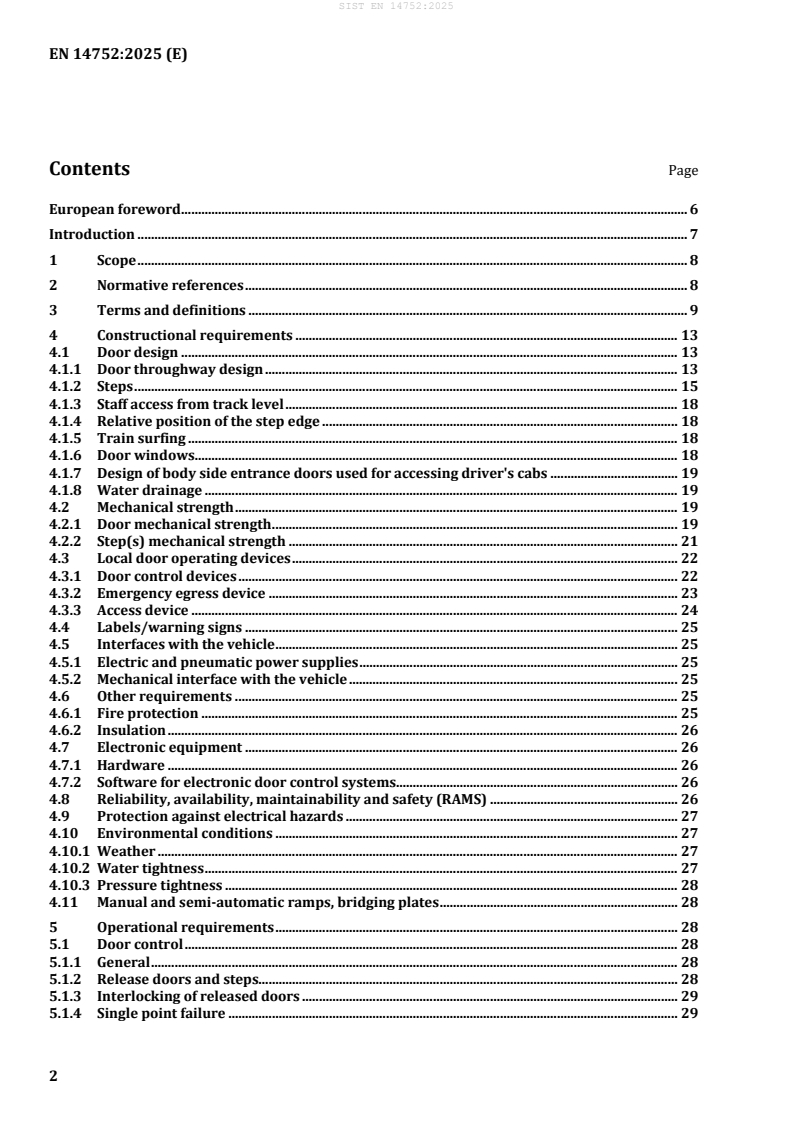
Contents Page
European foreword . 6
Introduction . 7
1 Scope . 8
2 Normative references . 8
3 Terms and definitions . 9
4 Constructional requirements . 13
4.1 Door design . 13
4.1.1 Door throughway design . 13
4.1.2 Steps . 15
4.1.3 Staff access from track level . 18
4.1.4 Relative position of the step edge . 18
4.1.5 Train surfing . 18
4.1.6 Door windows. 18
4.1.7 Design of body side entrance doors used for accessing driver's cabs . 19
4.1.8 Water drainage . 19
4.2 Mechanical strength . 19
4.2.1 Door mechanical strength . 19
4.2.2 Step(s) mechanical strength . 21
4.3 Local door operating devices . 22
4.3.1 Door control devices . 22
4.3.2 Emergency egress device . 23
4.3.3 Access device . 24
4.4 Labels/warning signs . 25
4.5 Interfaces with the vehicle . 25
4.5.1 Electric and pneumatic power supplies . 25
4.5.2 Mechanical interface with the vehicle . 25
4.6 Other requirements . 25
4.6.1 Fire protection . 25
4.6.2 Insulation . 26
4.7 Electronic equipment . 26
4.7.1 Hardware . 26
4.7.2 Software for electronic door control systems. 26
4.8 Reliability, availability, maintainability and safety (RAMS) . 26
4.9 Protection against electrical hazards . 27
4.10 Environmental conditions . 27
4.10.1 Weather . 27
4.10.2 Water tightness . 27
4.10.3 Pressure tightness . 28
4.11 Manual and semi-automatic ramps, bridging plates . 28
5 Operational requirements . 28
5.1 Door control . 28
5.1.1 General . 28
5.1.2 Release doors and steps. 28
5.1.3 Interlocking of released doors . 29
5.1.4 Single point failure . 29
5.1.5 Mechanical locking . 29
5.1.6 Out-of-service devices . 29
5.1.7 Isolation for maintenance purposes . 31
5.2 Closing and opening conditions. 31
5.2.1 Safety during closing . 31
5.2.2 Entrance system closed proving. 43
5.3 Opening conditions . 43
5.3.1 Safety during opening . 43
5.3.2 Limitation of opening . 43
5.4 Moveable step obstacle detection . 44
5.4.1 General . 44
5.4.2 Steps outside the vehicle . 44
5.4.3 Steps inside the vehicles . 44
5.5 Emergency operation . 44
5.5.1 Emergency egress . 44
5.5.2 Emergency windows in access doors. 47
5.5.3 Access device . 47
5.5.4 Powering up . 48
5.6 Other requirements . 48
5.6.1 Passenger access door area illumination . 48
5.6.2 Status indication . 48
6 Categories of tests . 48
6.1 General . 48
6.2 Type tests . 48
6.3 Routine tests during manufacture. 49
6.4 Routine tests on the fully assembled vehicle/train consist . 49
7 Documentation related to installation and maintenance of the entrance system . 49
Annex A (normative) Passenger operating devices . 50
A.1 Purpose . 50
A.2 Design of door control devices. 50
A.3 Labels on or near control devices . 51
A.4 Recommended emergency egress device . 52
A.5 Sample of labels . 53
Annex B (normative) Water test procedure . 54
B.1 Purpose . 54
B.2 Test arrangement . 54
B.3 Test procedure . 55
B.4 Test decision . 55
Annex C (normative) Specification and testing of the pressure tightness of door . 57
C.1 Purpose . 57
C.2 Calculation – Flowchart . 57
C.3 Example of pressure tightness requirement specification . 57
C.4 Pressure tightness testing . 58
C.4.1 General . 58
C.4.2 Variable pressure measurement method . 58
C.4.3 Variant: Constant pressure method of measurement. 60
Annex D (normative) Requirements for measuring the closing forces of power-operated
doors . 62
D.1 General . 62
D.2 Terms and definitions . 62
D.3 Measurements . 63
D.3.1 Conditions of measurement . 63
D.3.2 Measurement points . 63
D.3.3 Measuring method . 63
Annex E (normative) Test plan . 65
Annex F (normative) Load requirements for doors due to aerodynamic loads on passenger
trains . 67
Annex G (informative) Clauses in this document requiring clarification in the technical
specification . 68
Annex H (normative) RIC-KEY . 70
Annex I (informative) Calculation of kinetic energy . 71
Annex J (informative) Passenger flow detection . 77
J.1 General . 77
J.2 Light barrier . 77
J.3 Step sensors for external steps . 77
Annex K (informative) Full door throughway detection system. 78
K.1 General . 78
K.2 Full door throughway detection systems . 78
K.2.1 Full door throughway detection system near the door leaves . 78
K.2.2 Full door throughway detection on the door leaf . 83
Annex L (informative) Partial door throughway detection system . 84
L.1 General . 84
L.2 Partial door throughway detection . 84
L.2.1 General . 84
L.2.2 Detection area . 84
L.2.3 Testing . 85
Annex M (normative) Anti-Drag test belt material definition . 87
M.1 Test object dimension: . 87
M.2 Test belt fabric requirements . 87
Annex N (informative) Hazards, protection goals and related requirements . 88
N.1 General . 88
N.2 Relation to the risk management process . 88
Bibliography . 91
European foreword
This document (EN 14752:2025) has been prepared by Technical Committee CEN/TC 256 “Railway
applications”, the secretariat of which is held by DIN.
This European Standard shall be given the status of a national standard, either by publication of an
identical text or by endorsement, at the latest by December 2025, and conflicting national standards shall
be withdrawn at the latest by December 2025.
Attention is drawn to the possibility that some of the elements of this document may be the subject of
patent rights. CEN shall not be held responsible for identifying any or all such patent rights.
This document supersedes EN 14752:2019+A1:2021.
The main changes compared with EN 14752:2019+A1:2021 are as follows:
— References to EN 16584-1:2025 replace the previous requirements throughout the document;
— Door buttons changed to Door Control Device Local door control device changed to local door
operation device throughout the document;
— Figure 1 was added in 4.1.1.1 Minimum width;
— Requirement for structural integrity was added in 4.2.1.1 Passenger retention forces;
— 5.2.1.3 Closing and opening signals was reworded for clarity and precision;
— In 5.2.1.3.2 Audible signals, reference to EN 17285:2020 for sound pressure level was added and
figures for measurement sound pressure level were removed;
— 5.2.1.5 Anti Drag System subclause was updated and the definition of measurement criteria and test
objects were included;
— In Annex A, Figure A1 and A2 were updated;
— Annex J was renamed “Passenger flow detection” and a definition for step sensors for external steps
was added;
— Annex K, Annex L, Annex M and Annex N were added.
NOTE The technical changes referred to include the significant technical changes from the EN revised but are
not an exhaustive list of all modifications from the previous edition.
This document has been prepared under a standardization request addressed to CEN by the European
Commission. The Standing Committee of the EFTA States subsequently approves these requests for its
Member States.
Any feedback and questions on this document should be directed to the users’ national standards body.
A complete listing of these bodies can be found on the CEN website.
According to the CEN-CENELEC Internal Regulations, the national standards organisations of the
following countries are bound to implement this European Standard: Austria, Belgium, Bulgaria, Croatia,
Cyprus, Czech Republic, Denmark, Estonia, Finland, France, Germany, Greece, Hungary, Iceland, Ireland,
Italy, Latvia, Lithuania, Luxembourg, Malta, Netherlands, Norway, Poland, Portugal, Republic of North
Macedonia, Romania, Serbia, Slovakia, Slovenia, Spain, Sweden, Switzerland, Türkiye and the United
Kingdom.
Introduction
This document specifies the minimum requirements for construction and operation of railway passenger
access systems and covers:
— Safe access and egress from passenger trains through body side doors and steps;
— Usability for persons with reduced mobility;
— A minimum risk of injury to persons as a result of door and step operation;
— That the doors and moveable steps, ramps, bridging plates remain closed when the vehicle is in
motion; and
— Safe maintenance of the entrance systems.
Statutory legal obligations to minimize operational safety risks to ensure staff and passenger safety for
the intended door system may require enhancement to the minimum requirement’s detailed in this
document. Annex G stipulates clauses that are to be clarified and possibly enhanced within a technical
specification when referring to this document for the intended passenger service operation of the door
system.
1 Scope
This document applies to passenger body side entrance systems of all newly designed railway vehicles
such as tram, metro, suburban, main-line and high-speed trains that carry passengers. The requirements
of this document also apply to existing vehicles undergoing refurbishment of the door equipment, as far
as it is reasonably practicable.
This document also specifies the requirements for testing of entrance systems.
This document makes reference to manual and power operated entrance systems. For manual doors,
clauses referring to power operation are not applicable.
This document does not apply to the following:
— Entrance systems for equipment access, inspection or maintenance purposes and for crew only use;
— Doors on freight wagons; and
— Doors or hatches specifically provided for escape under emergency conditions.
Where passenger bodyside entrance doors are to be used for staff access, EN 16116-1:2022, EN 16186-
4:2019 and EN 16186-8:2022+A1:2024 provide the details for the staff access requirements.
2 Normative references
The following documents are referred to in the text in such a way that some or all of their content
constitutes requirements of this document. For dated references, only the edition cited applies. For
undated references, the latest edition of the referenced document (including any amendments) applies.
EN 12663-1, Railway applications — Structural requirements of railway vehicle bodies — Part 1:
Locomotives and passenger rolling stock (and alternative method for freight wagons)
EN 13032-1:2004+A1:2012, Light and lighting — Measurement and presentation of photometric data of
lamps and luminaires — Part 1: Measurement and file format
EN 13272 (all parts), Railway applications — Electrical lighting for rolling stock in public transport systems
EN 14067 (all parts), Railway applications — Aerodynamics
EN 16116-1:2022, Railway applications — Design requirements for steps, handrails and associated access
for staff — Part 1: Passenger vehicles, vans and locomotives
EN 16186-4:2019, Railway applications — Driver's cab — Part 4: Layout and access
EN 16186-8:2022+A1:2024, Railway applications — Driver’s cab — Part 8: Tram vehicle layout and access
EN 16584-1:— , Design for PRM Use — General requirements — Part 1: Contrast
EN 16585-1:— , Design for PRM Use — Equipment and components onboard rolling stock — Part 1: Toilets
Under preparation. Stage at the time of publication: FprEN 16584-1:2025.
Under preparation. Stage at the time of publication: FprEN 16585-1:2025.
EN 16586-2:— , Design for PRM Use — Accessibility of persons with reduced mobility to rolling stock —
Part 2: Boarding aids
EN 17285:2020, Railway applications — Acoustics — Measuring of door audible warnings
EN 45545-2, Railway applications — Fire protection on railway vehicles — Part 2: Requirements for fire
behaviour of materials and components
EN 50121-3-2, Railway applications — Electromagnetic compatibility — Part 3-2: Rolling stock —
Apparatus
EN 50126 (all parts), Railway applications — The specification and demonstration of Reliability,
Availability, Maintainability and Safety (RAMS)
EN 50153, Railway applications — Rolling stock — Protective provisions relating to electrical hazards
EN 50155, Railway applications — Rolling stock — Electronic equipment
EN 50716, Railway Applications — Requirements for software development
EN 60077-1:2017, Railway applications — Electric equipment for rolling stock — Part 1: General service
conditions and general rules (IEC 60077-1:2017)
EN 61373, Railway applications — Rolling stock equipment — Shock and vibration tests (IEC 61373)
EN ISO 10140-2, Acoustics — Laboratory measurement of sound insulation of building elements — Part 2:
Measurement of airborne sound insulation (ISO 10140-2)
EN ISO 12567-1, Thermal performance of windows and doors — Determination of thermal transmittance
by the hot-box method — Part 1: Complete windows and doors (ISO 12567-1)
EN IEC 61133, Railway applications — Rolling stock — Testing of rolling stock on completion of
construction and before entry into service (IEC 61133)
DIN 53362, Determining the flexural rigidity of plastic film and woven textile fabrics with or without plastic
coating by the cantilever method
DIN 5032-7, Photometry — Part 7: Classification of illuminance meters and luminance meters
3 Terms and definitions
For the purposes of this document, the following terms and definitions apply.
ISO and IEC maintain terminological databases for use in standardization at the following addresses:
• IEC Electropedia: available at https://www.electropedia.org/
• ISO Online browsing platform: available at https://www.iso.org/obp
Under preparation. Stage at the time of publication: FprEN 16586-2:2025.
3.1
access device
operating element used to unlock a locked door in order to allow for door opening from outside when the
door is not available for normal operation
3.2
bridging plate
retractable device integrated into the vehicle as close as possible to the door threshold level that enables
access for wheelchair users, fully automatic and activated/controlled in conjunction with the door
opening/closing sequences or semi-automatic on demand from passenger or staff
Note 1 to entry: It retains its strength without support on the station platform when extended.
[SOURCE: EN 16586-2:—, 3.2]
3.3
central closing
powered closing of the door by remote command without intervention by the passenger
3.4
contrast
perception of a difference visually between one surface or element of a building/rail vehicle and another
by reference to their light reflectance values (LRV) or luminance values
[SOURCE: EN 16584-1:—, 3.6]
3.5
door
body side panel available for passenger access and egress, including its components
3.6
door control device
device to initiate door opening or closing command
3.7
door/step out-of-service
door or step which is locked and not available for use
3.8
door/step isolated
door and/or step to which the pneumatic and/or electric power supply is isolated
3.9
door operation
all door operating sequences
3.10
emergency egress device
operating element used to unlock a locked door in order to allow for manual opening of the door from
inside in case of an emergency
3.11
entrance system
system to facilitate passenger entrance to vehicles including door, step/ramp/bridging plates and the
related drive and control devices
3.12
first step
step that is the first step for a passenger to use, to overcome a height change
Note 1 to entry: For the external access/egress steps this will normally be the step that is closest to the platform
edge (fixed or a movable step), therefore this is the first step when boarding and the last step when alighting.
Note 2 to entry: In the context of steps for internal height changes (other than the external access/egress steps)
this means the first usable step when ascending and the edge of the walking floor when descending.
[SOURCE: EN 16586-1:— , 3.5]
3.13
leading edge
edge of the door, leading during closing movement
3.14
local closing
powered closing by intervention of a person or by a local automatic device
3.15
locked door
closed door held closed by a mechanical device
3.16
manual door
door that is closed or opened exclusively by hand power
3.17
manual ramp
device designed for the passage from one level to another, which is compatible with the vehicle, which is
supported on the station platform when extended
Note 1 to entry: Deployment by train crew or platform staff is manual.
Note 2 to entry: The purpose of the manual ramp is to facilitate wheelchair access.
Note 3 to entry: See EN 16586-2:— for further details.
3.18
moveable step
retractable device integrated into the vehicle forming a step with the threshold, fully automatic and
activated/controlled in conjunction with the door opening/closing sequences to reduce the gap in width
and height between vehicle and platform
Note 1 to entry: The moveable step retains its strength without support on the station platform.
Under preparation. Stage at the time of publication: FprEN 16586-1:2025.
3.19
palm operated
operable by the palm or any part of the hand, not requiring fingers to be unclenched
Note 1 to entry: The design need is that passengers with painful conditions, which affect their joints such as
arthritis, may be unable to (and are likely to experience discomfort or pain if they do) exert any force with the tip
of a single finger. Many may not be able to unclench their fingers to do this or perform any pulling action.
[SOURCE: EN 16585-1:—, 3.6, modified — The original term was “palm operable”]
3.20
power operated door system
door system which operates doors in opening and closing direction by machine power
3.21
released door
door in a state in which it may be opened by a member of the public or train crew
3.22
RIC-KEY
key according to the agreement on mutual use of vehicles for persons and goods in international
transport (RIC = International coach regulations)
Note 1 to entry: See the requirements defined in Annex H.
3.23
routine test
test to which each entrance system equipment is subjected during or after manufacturing or assembly to
the vehicle
3.24
semi-automatic ramp
device designed for the passage from one level to another, which is integrated into the vehicle and which
is supported on the station platform when extended
Note 1 to entry: Deployment is locally activated and supervised.
Note 2 to entry: The purpose of the semi-automatic ramp is to facilitate wheelchair access.
Note 3 to entry: See EN 16586-2:— for further details.
3.25
slip resistant
surface finish that is sufficiently rough or otherwise specially formulated so that friction between the
surface and a person's footwear or mobility aid is maintained at an acceptable level in both wet and dry
conditions
Note 1 to entry: Snow and ice are outside this definition and this standard, therefore other special measures
(e.g. operational) should be taken for steps and platforms, etc. that are exposed to these weather conditions.
[SOURCE: EN 16584-3:— , 3.6]
Under preparation. Stage at the time of publication: FprEN 16584-3:2025.
3.26
tactile
information that is relayed through the physical sense of touch
Note 1 to entry: Tactile signs, controls, symbols, pictograms, guide path and Braille or raised characters are a
physical means by which tactile information is provided.
[SOURCE: EN 16584-1:—, 3.29]
Note 2 to entry: EN 16584-2:— , Annex B.
3.27
technical specification
document describing specific parameter and/or product requirements as an addition to the
requirements of this document
3.28
train crew
persons authorized to carry out the duties for door operation
3.29
type test
test of one entrance system and its components to prove that the design meets the standard and the
relevant specifications
3.30
unlocked door
door with mechanical door locking released
3.31
requested opening
function that enables passengers to submit an opening request for non released doors using at least one
control device of an entrance area
4 Constructional requirements
4.1 Door design
4.1.1 Door throughway design
4.1.1.1 Minimum width
Doors shall have an unrestricted clear usable width (see item 1 in Figure 2) of 800 mm minimum to allow
unimpeded access and egress of passengers (Figure 2 shows two examples of doors). Dedicated
wheelchair access doors shall have a minimum clear useable width of 1 000 mm when open.
Any interior features shall not encroach into the clear usable width, i.e. interior features or grab handles
to aid boarding.
The dimensions for the minimum height and shape are defined by Figure 1.
Under preparation. Stage at the time of publication: FprEN 16584-2:2025.
Key
l2: Clear usable width R2: ≤ 175 mm
l1: Clearway height R1: ≤ 50 mm
Figure 1 — Throughway height and shape
Key
1 Clear usable width 3 Vehicle
2 Door leaf 4 Leading edge
Figure 2 — Minimum width
4.1.1.2 Minimum height
Doors shall have an unrestricted vertical clearway height of l ≥ 1 900 mm minimum (see Figure 1 and 3
for the measuring method).
Key
l ≥ 1 900 mm
Figure 3 — Minimum height
4.1.2 Steps
4.1.2.1 Entrance area − General
External steps shall have at least a usable width of 95 % of the clear width of the door and be in line with
the usable width of the door.
Internal steps should have at least the same clear width as the door and be in line with the throughway
of the door.
Passenger access from the defined platform to the vestibule of the vehicle shall be achieved with a
maximum of four steps.
4.1.2.2 Step dimensions
4.1.2.2.1 Internal steps for external access
Internal steps for external access shall have a maximum height of l = 200 mm and a minimum depth of
l = 240 mm between the vertical edges of the step. The rising height of each step shall be equal.
The height of each step may be increased to a maximum of l = 230 mm if it can be demonstrated that this
achieves a reduction of one in the total number of steps required.
EXAMPLE If a vertical distance of 460 mm is to be traversed, it can be demonstrated that using steps of up to
l = 230 mm reduces the number of steps required from 3 to 2.
See Figure 4 for details.
4.1.2.2.2 External steps
An external access step, fixed or moveable, shall have a maximum height of l = 230 mm between steps
and a minimum depth of l = 150 mm.
Dimensions in millimetres
Key
1 Fixed steps inside the train l ≤ 200 or ≤ 230 l ≥ 240
1 4
2 External fixed or moveable step l ≤ 230
3 Door leaf l ≥ 150
Figure 4 — Step dimensions
A minimal drop in level, with a maximum of l = 60 mm (Figure 4), between the floor surface of the
vestibule/last step and that of the external step of the vehicle used to guide and seal the door is also
permissible and shall not be considered as a step so the minimum depth of l = 150 mm (Figure 4) does
not apply. See Figure 5 for the permissible position of the external extension of the door sill.
If the external step depth l is ≥ 150 mm the surface of the exterior step may be used as a reference for
defining the stepping height when stepping up from a lower platform whereas the floor surface of the
vestibule may be used when stepping down from a higher platform.
If a step is fitted and it is an extension of a door sill outside the vehicle, and there is no drop in level
between the floor surface of the vestibule and that of the external step of the vehicle, this shall not be
considered to be a step for the purposes of this specification. See Figure 5 for details.
Key
1 Floor surface vestibule l ≤ 60 mm
2 Extension of door sill
Figure 5 — Extension of door sill
The constructional requirements for boarding aids (moveable steps and ramps onboard rolling stock)
shall be carried out in accordance with EN 16586-2:—, 5.2, 5.3 and 5.5.
The maximum allowable vertical displacement at the unsupported end of the device under a load of 150 N
(as defined in J.3) applied in the middle of the device shall be less than 5 mm.
4.1.2.3 Step surface
Steps shall be provided with a slip resistant surface across the usable surface area.
The first and the last step inside the vehicle shall be indicated by a contrasting band with a depth of
45 mm to 55 mm extending the maximum useable width of the steps on the front and the top surfaces of
the step nosing.
The first and the last step outside the vehicle shall be indicated by a contrasting band with a depth of
45 mm to 55 mm extending the full width of the steps on the top surfaces of the step nosing.
NOTE See EN 16584-1:—, 5.3.7, 5.3.9 for further details.
4.1.2.4 Protection against water accumulation
The steps shall be arranged to allow water to drain away from the anti-slip surface. The design shall
prevent water accumulation.
4.1.2.5 Manual operation
If a retractable step fails to close and the deployed step exceeds the vehicle kinematic gauge, it shall be
possible to manually retract the step to a closed position, particularly from the platform it is intended for.
The instruction handbook shall include an instruction for the manual operation, including that the step
drive shall be isolated prior to manual operation, if this is necessary to avoid a possible injury due to the
activation of the automatic drive.
NOTE Stable closed position is realized when the step is fixed, automatically or manually, in the secured closed
position.
4.1.3 Staff access from track level
If re
...