

SIST EN 50155:2026
(Main)Railway applications - Rolling stock - Electronic equipment
General Information
- Abstract
This document is applicable to all electronic equipment for control, regulation, protection, diagnostic, energy supply installed on railway vehicles and any relevant elements of rolling stock subsystems (e.g. external doors, On-Board ETCS functionality, wheel slide protection).
For the purpose of this document, electronic equipment is defined as equipment composed of electronic components (e.g. resistors, capacitors, transistors, diodes, integrated circuits, hybrids, application specific integrated circuits, wound components and relays), and recognized associated components (e.g. connectors, mechanical parts). These components are mainly mounted on printed circuit boards.
Sensors (e.g. current, voltage, speed) and semiconductor drive units for power electronic devices are covered by this document. Complete semiconductor drive units and power converters are covered by EN 61287 1.
This document covers the requirements for operating conditions, design, documentation, testing and integration of electronic equipment, as well as hardware and software requirements considered necessary for compliant and reliable equipment.
Specific requirements related to practices necessary to ensure defined safety integrity level or functional safety are not covered by this document. Nevertheless, this document is applicable to the hardware of all rolling stock electronic equipment or systems performing safety-related functions.
The software development requirements for on-board railway equipment are specified by EN 50716.
- Status
- Published
- Public Enquiry End Date
- 24-Nov-2024
- Publication Date
- 21-May-2026
- Technical Committee
- ŽEN - Electrical applications for railways
- Current Stage
- 6060 - National Implementation/Publication (Adopted Project)
- Start Date
- 12-May-2026
- Due Date
- 17-Jul-2026
- Completion Date
- 22-May-2026

Overview
SIST EN 50155:2026 is a key European standard for the railway industry, detailing requirements and best practices for the design, testing, and maintenance of electronic equipment used on rolling stock. Published by SIST, this standard applies to all electronic systems installed on railway vehicles, including critical subsystems such as control, protection, diagnostics, energy supply, and passenger safety mechanisms (e.g. external doors, On-Board ETCS functionality, and wheel slide protection).
Electronic equipment, as defined by SIST EN 50155:2026, encompasses assemblies composed of electronic components like resistors, capacitors, transistors, integrated circuits, and relays, as well as associated hardware such as connectors and mechanical parts-typically mounted on printed circuit boards (PCBs). The standard also covers sensors (current, voltage, speed) and semiconductor drive units, ensuring robust requirements for operational reliability and performance.
Key Topics
- Scope of Application: Covers all electronic equipment for control, regulation, protection, diagnostics, and energy supply on railway rolling stock and subsystems.
- Component Definitions: Electronic equipment includes PCBs, discrete electronic components, sensors, and drive units. Complete semiconductor drive units and power converters are referenced under EN 61287-1.
- Environmental and Electrical Conditions: Addresses operational considerations such as temperature, humidity, altitude, shock, vibration, and electromagnetic compatibility.
- Design and Documentation: Outlines requirements for design methodologies, thorough documentation, and lifecycle management including installation, maintenance, and repair instructions.
- Hardware and Software Management: Specifies hardware standards and references software development requirements via EN 50716.
- Testing Procedures: Defines detailed test procedures for type, routine, and investigation tests to confirm performance and reliability throughout the service life.
- Reliability and Maintainability: Emphasizes predicted reliability, maintainability processes, and expected useful life of equipment to promote long-term dependability.
- Construction and Component Quality: Includes manufacturing recommendations such as construction methods, selection of materials, protective coatings, and identification protocols.
Applications
SIST EN 50155:2026 supports various stakeholders engaged in the design, production, and operation of electronic systems on railway rolling stock. Its applications include:
- Manufacturers: Ensures electronic assemblies are built for the challenging railway environment by specifying essential design, component, and testing requirements.
- Operators & Maintainers: Assists fleet operators and maintenance teams by providing clear documentation, diagnostic information, and maintenance guidelines to support safety and minimize downtimes.
- System Integrators: Guides integration of electronic subsystems such as control systems, diagnostics, train communication, and passenger information displays into new or existing rolling stock.
- Safety and Quality Assurance Teams: Offers a framework for testing programs and compliance verification, contributing to enhanced system safety and data management.
- Procurement: Facilitates transparent tendering and purchasing processes by standardizing requirements and documentation deliverables.
Related Standards
Electronic equipment for railway rolling stock is regulated by various international and European standards that complement SIST EN 50155:2026:
- EN 50716: Specifies software development requirements for on-board railway equipment.
- EN 61287-1: Details requirements for power electronic converters used in railway rolling stock.
- EN 45545-2: Covers fire protection requirements for railway vehicles, relevant for material selection.
- IEC 60571: International standard for electronic equipment on rail vehicles, forming the basis of EN 50155.
- IEC 61373: Specifies shock and vibration testing for railway applications.
By adhering to SIST EN 50155:2026 and its related standards, organizations can ensure the safety, reliability, and interoperability of electronic equipment used in modern railway systems, supporting efficient and secure rail transport across Europe and globally.
Relations
- Effective Date
- 01-Jul-2026
- Effective Date
- 15-Sep-2026
- Effective Date
- 26-May-2026
- Effective Date
- 12-May-2026
- Effective Date
- 12-May-2026
- Effective Date
- 12-May-2026
- Effective Date
- 12-May-2026
- Effective Date
- 12-May-2026
- Effective Date
- 12-May-2026
- Effective Date
- 12-May-2026
- Effective Date
- 12-May-2026
- Effective Date
- 12-May-2026
- Effective Date
- 12-May-2026
- Effective Date
- 12-May-2026
- Effective Date
- 12-May-2026
Get Certified
Connect with accredited certification bodies for this standard

IRIS Certification (UNIFE)
International Railway Industry Standard certification.

TÜV SÜD Rail GmbH
TÜV SÜD railway certification services.

Bureau Veritas Railway Certification
Railway and transportation certification.
Sponsored listings
Frequently Asked Questions
SIST EN 50155:2026 is a standard published by the Slovenian Institute for Standardization (SIST). Its full title is "Railway applications - Rolling stock - Electronic equipment". This standard covers: This document is applicable to all electronic equipment for control, regulation, protection, diagnostic, energy supply installed on railway vehicles and any relevant elements of rolling stock subsystems (e.g. external doors, On-Board ETCS functionality, wheel slide protection). For the purpose of this document, electronic equipment is defined as equipment composed of electronic components (e.g. resistors, capacitors, transistors, diodes, integrated circuits, hybrids, application specific integrated circuits, wound components and relays), and recognized associated components (e.g. connectors, mechanical parts). These components are mainly mounted on printed circuit boards. Sensors (e.g. current, voltage, speed) and semiconductor drive units for power electronic devices are covered by this document. Complete semiconductor drive units and power converters are covered by EN 61287 1. This document covers the requirements for operating conditions, design, documentation, testing and integration of electronic equipment, as well as hardware and software requirements considered necessary for compliant and reliable equipment. Specific requirements related to practices necessary to ensure defined safety integrity level or functional safety are not covered by this document. Nevertheless, this document is applicable to the hardware of all rolling stock electronic equipment or systems performing safety-related functions. The software development requirements for on-board railway equipment are specified by EN 50716.
This document is applicable to all electronic equipment for control, regulation, protection, diagnostic, energy supply installed on railway vehicles and any relevant elements of rolling stock subsystems (e.g. external doors, On-Board ETCS functionality, wheel slide protection). For the purpose of this document, electronic equipment is defined as equipment composed of electronic components (e.g. resistors, capacitors, transistors, diodes, integrated circuits, hybrids, application specific integrated circuits, wound components and relays), and recognized associated components (e.g. connectors, mechanical parts). These components are mainly mounted on printed circuit boards. Sensors (e.g. current, voltage, speed) and semiconductor drive units for power electronic devices are covered by this document. Complete semiconductor drive units and power converters are covered by EN 61287 1. This document covers the requirements for operating conditions, design, documentation, testing and integration of electronic equipment, as well as hardware and software requirements considered necessary for compliant and reliable equipment. Specific requirements related to practices necessary to ensure defined safety integrity level or functional safety are not covered by this document. Nevertheless, this document is applicable to the hardware of all rolling stock electronic equipment or systems performing safety-related functions. The software development requirements for on-board railway equipment are specified by EN 50716.
SIST EN 50155:2026 is classified under the following ICS (International Classification for Standards) categories: 45.060.01 - Railway rolling stock in general. The ICS classification helps identify the subject area and facilitates finding related standards.
SIST EN 50155:2026 has the following relationships with other standards: It is inter standard links to SIST EN 50155:2021, SIST EN 61373:2010, SIST EN 50163:2005, SIST EN 15220:2016, SIST-TS CEN/TS 13149-8:2014, SIST-TS CLC/TS 50502:2008, SIST-TP CEN/TR 17532:2020, SIST EN 50463:2008, SIST EN 15437-2:2014, SIST EN 15595:2019+A1:2023, SIST EN 15595:2019, SIST EN 14752:2025, SIST-TS CEN/TS 13149-8:2025, SIST EN 15152:2019, SIST EN 14033-3:2017. Understanding these relationships helps ensure you are using the most current and applicable version of the standard.
SIST EN 50155:2026 is associated with the following European legislation: EU Directives/Regulations: 2016/797/EU; Standardization Mandates: M/591. When a standard is cited in the Official Journal of the European Union, products manufactured in conformity with it benefit from a presumption of conformity with the essential requirements of the corresponding EU directive or regulation.
SIST EN 50155:2026 is available in PDF format for immediate download after purchase. The document can be added to your cart and obtained through the secure checkout process. Digital delivery ensures instant access to the complete standard document.
Standards Content (Sample)
SLOVENSKI STANDARD
01-julij-2026
Nadomešča:
SIST EN 50155:2021
Železniške naprave - Tirna vozila - Elektronska oprema
Railway applications - Rolling stock - Electronic equipment
Bahnanwendungen - Elektronische Einrichtungen auf Schienenfahrzeugen
Applications ferroviaires - Équipements électroniques utilisés sur le matériel roulant
Ta slovenski standard je istoveten z: EN 50155:2026
ICS:
45.060.01 Železniška vozila na splošno Railway rolling stock in
general
2003-01.Slovenski inštitut za standardizacijo. Razmnoževanje celote ali delov tega standarda ni dovoljeno.
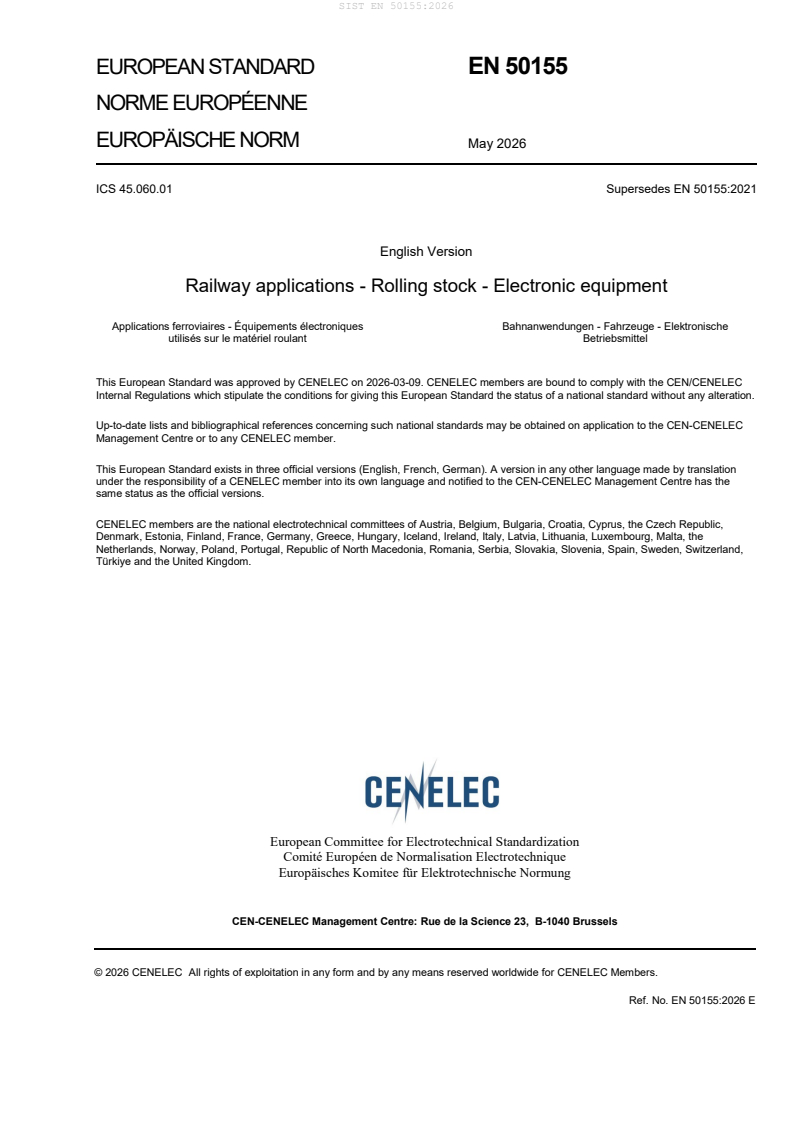
EUROPEAN STANDARD EN 50155
NORME EUROPÉENNE
EUROPÄISCHE NORM May 2026
ICS 45.060.01 Supersedes EN 50155:2021
English Version
Railway applications - Rolling stock - Electronic equipment
Applications ferroviaires - Équipements électroniques Bahnanwendungen - Fahrzeuge - Elektronische
utilisés sur le matériel roulant Betriebsmittel
This European Standard was approved by CENELEC on 2026-03-09. CENELEC members are bound to comply with the CEN/CENELEC
Internal Regulations which stipulate the conditions for giving this European Standard the status of a national standard without any alteration.
Up-to-date lists and bibliographical references concerning such national standards may be obtained on application to the CEN-CENELEC
Management Centre or to any CENELEC member.
This European Standard exists in three official versions (English, French, German). A version in any other language made by translation
under the responsibility of a CENELEC member into its own language and notified to the CEN-CENELEC Management Centre has the
same status as the official versions.
CENELEC members are the national electrotechnical committees of Austria, Belgium, Bulgaria, Croatia, Cyprus, the Czech Republic,
Denmark, Estonia, Finland, France, Germany, Greece, Hungary, Iceland, Ireland, Italy, Latvia, Lithuania, Luxembourg, Malta, the
Netherlands, Norway, Poland, Portugal, Republic of North Macedonia, Romania, Serbia, Slovakia, Slovenia, Spain, Sweden, Switzerland,
Türkiye and the United Kingdom.
European Committee for Electrotechnical Standardization
Comité Européen de Normalisation Electrotechnique
Europäisches Komitee für Elektrotechnische Normung
CEN-CENELEC Management Centre: Rue de la Science 23, B-1040 Brussels
© 2026 CENELEC All rights of exploitation in any form and by any means reserved worldwide for CENELEC Members.
Ref. No. EN 50155:2026 E
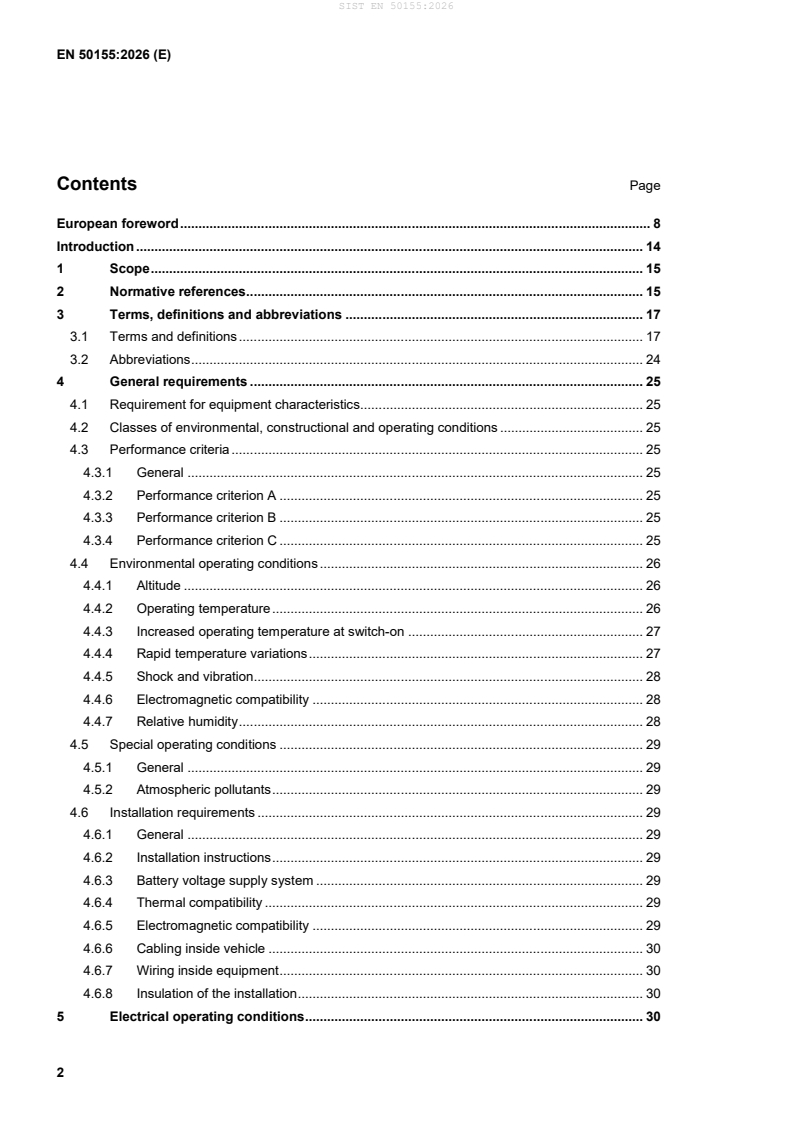
Contents Page
European foreword . 8
Introduction . 14
1 Scope . 15
2 Normative references . 15
3 Terms, definitions and abbreviations . 17
3.1 Terms and definitions . 17
3.2 Abbreviations . 24
4 General requirements . 25
4.1 Requirement for equipment characteristics. 25
4.2 Classes of environmental, constructional and operating conditions . 25
4.3 Performance criteria . 25
4.3.1 General . 25
4.3.2 Performance criterion A . 25
4.3.3 Performance criterion B . 25
4.3.4 Performance criterion C . 25
4.4 Environmental operating conditions . 26
4.4.1 Altitude . 26
4.4.2 Operating temperature . 26
4.4.3 Increased operating temperature at switch-on . 27
4.4.4 Rapid temperature variations . 27
4.4.5 Shock and vibration. 28
4.4.6 Electromagnetic compatibility . 28
4.4.7 Relative humidity . 28
4.5 Special operating conditions . 29
4.5.1 General . 29
4.5.2 Atmospheric pollutants . 29
4.6 Installation requirements . 29
4.6.1 General . 29
4.6.2 Installation instructions . 29
4.6.3 Battery voltage supply system . 29
4.6.4 Thermal compatibility . 29
4.6.5 Electromagnetic compatibility . 29
4.6.6 Cabling inside vehicle . 30
4.6.7 Wiring inside equipment . 30
4.6.8 Insulation of the installation . 30
5 Electrical operating conditions . 30
5.1 Typical supply systems .30
5.1.1 General .30
5.1.2 DC supply system .30
5.1.3 AC supply system .31
5.2 Battery voltage supply system .32
5.2.1 General .32
5.2.2 Supply voltage range .32
5.2.3 Temporary supply voltage variation .33
5.2.4 Interruption of supply voltage .33
5.2.5 Supply change-over .34
5.2.6 Grouping of supply voltages .34
5.2.7 DC ripple factor .34
5.2.8 Behaviour of system power supply during start of combustion engine .35
5.3 Supply by another source than the vehicle battery .35
5.3.1 Supply by a specific DC or AC source .35
5.3.2 Supply by an AC auxiliary power converter .35
5.3.3 Supply with overhead line or third rail .35
5.3.4 Design and test requirements for AC supply .36
6 Reliability, maintainability and expected useful life .36
6.1 Equipment reliability .36
6.1.1 Predicted reliability .36
6.1.2 Proof of reliability .36
6.2 Useful life .37
6.3 Maintainability .37
6.3.1 General .37
6.3.2 Preventive maintenance .37
6.3.3 Corrective maintenance .37
6.3.4 Built-in diagnostics .38
6.4 Automatic test equipment .38
6.5 Purpose-built test equipment and special tools .38
7 Design .39
7.1 General .39
7.1.1 Quality management .39
7.1.2 System life cycle model .39
7.2 Detailed practices - Hardware .39
7.2.1 Insulation coordination .39
7.2.2 Interfacing .39
7.2.3 Fault protection .40
7.2.4 Reference potential of power supplies .40
7.2.5 Interchangeability .41
7.2.6 Reduction of supply voltage and ON/OFF phases . 41
7.2.7 Reverse polarity protection . 41
7.2.8 Inrush currents . 41
7.2.9 Energetic transient pulses . 41
7.2.10 Capacitance to earth . 41
7.2.11 Spare capacity . 41
7.2.12 User Programmable Integrated Circuit . 41
7.3 Detailed practices - Software . 42
7.3.1 General . 42
7.3.2 Software life cycle model . 42
7.4 Features of software-controlled equipment . 42
7.4.1 General . 42
7.4.2 Self-test . 42
7.4.3 Watchdog . 42
7.4.4 Failure indication . 42
7.4.5 Recover from fault or error state . 42
8 Electronic equipment not designed for use on rolling stock . 42
9 Components . 43
9.1 Procurement . 43
9.2 Application . 43
10 Construction . 43
10.1 Equipment construction . 43
10.1.1 General . 43
10.1.2 Mechanical protection . 43
10.1.3 Polarization or coding. 44
10.1.4 Dimensional requirements . 44
10.2 Component mounting . 44
10.2.1 General . 44
10.2.2 Layout . 44
10.2.3 Fixing . 45
10.2.4 Component lead terminations . 45
10.2.5 Integrated circuit sockets and edge connectors . 45
10.2.6 Pre-set control . 45
10.2.7 Select-on-test components . 45
10.3 Electrical connections . 45
10.3.1 General . 45
10.3.2 Solder connections. 45
10.3.3 Crimped connections . 46
10.3.4 Wire wrap connections . 46
10.3.5 Other connections . 46
10.4 Internal flexible wiring (electrical and optical) .46
10.5 Flexible printed wiring .46
10.6 Printed circuit boards - flexible and rigid .46
10.6.1 General .46
10.6.2 Holes .47
10.6.3 Printed circuit board acceptability .47
10.6.4 Layout .47
10.6.5 Materials .47
10.7 Protective coatings for printed board assemblies .47
10.8 Identification .48
10.8.1 Bare PCB identification .48
10.8.2 Identification of subracks and printed board assemblies .48
10.8.3 Mounting position of subracks and printed board assemblies .48
10.8.4 Fuse and battery identification .48
10.9 Mounting .48
10.10 Cooling and ventilation .48
10.11 Materials and finishes .48
10.12 Reworking, modification and repair of electronic assemblies .49
11 Safety .49
11.1 General .49
11.2 Personnel safety .49
11.2.1 General .49
11.2.2 Personnel safety against electric shock .49
11.2.3 Personnel safety against effects of excessive temperature .49
11.3 Functional safety .49
11.4 Fire behaviour requirements .49
12 Documentation .50
12.1 General .50
12.2 Supply and storage of documentation .50
12.3 Datasheet .50
12.4 User and maintenance manual .50
12.5 Installation documentation .50
12.6 Commissioning documentation .51
12.7 Design documentation .51
12.7.1 Documentation – Hardware .51
12.7.2 Documentation – User Programmable Integrated Circuits .53
12.7.3 Documentation – Software .54
12.8 Manufacturing data .54
12.9 Repair documentation .54
12.9.1 General .54
12.9.2 Special tools . 54
12.9.3 Non-repairable items list . 54
12.10 Documentation – System . 55
13 Testing . 55
13.1 General . 55
13.2 Categories of tests . 56
13.2.1 General . 56
13.2.2 Type tests . 56
13.2.3 Routine tests . 56
13.2.4 Investigation tests . 57
13.3 List of tests and test conditions . 57
13.3.1 List of tests . 57
13.3.2 Conditions during testing . 57
13.4 Description of the tests . 58
13.4.1 Visual inspection . 58
13.4.2 Performance test . 58
13.4.3 DC Power supply test. 58
13.4.4 Low temperature test . 62
13.4.5 Dry heat test . 63
13.4.6 Low temperature storage test . 67
13.4.7 Insulation test . 67
13.4.8 Cyclic damp heat test . 69
13.4.9 Electromagnetic compatibility test . 71
13.4.10 Shock and vibration test . 71
13.4.11 Stress screening test. 72
13.4.12 Rapid temperature variation test . 72
13.4.13 Salt mist test . 73
Annex A (informative) List of default requirements of EN 50155 and related subclauses . 74
Annex B (informative) System testing approach . 75
B.1 General . 75
B.2 Situation of applicability . 75
B.3 General methodology . 75
B.3.1 General . 75
B.3.2 Item specific procedures . 76
B.3.3 Equipment specific steps . 76
B.4 Equipment integration design review . 77
B.5 Equipment integration type test . 77
B.6 Equipment installation design review . 77
B.7 Equipment installation type test . 77
B.8 Equipment installation routine test . 77
B.9 Equipment periodic re-verification .77
B.10 Replacement of items and ancillary components .77
Annex C (informative) Severity level of operating conditions in different vehicle locations .79
C.1 General .79
C.2 Severity of operating conditions in different rolling stock types .79
C.3 Intended use of rolling stock .79
C.4 Location of equipment on-board rolling stock .79
C.5 Severity of the operating conditions in different rolling stock locations .81
Annex D (informative) Example of an equipment tests compliance summary sheet .83
Annex E (informative) User programmable integrated circuit life cycle example .85
Annex F (informative) Design suggestions for electronic hardware used on rolling stock .86
F.1 Purpose of this annex .86
F.2 Design topics .86
F.2.1 Pollutants .86
F.2.2 Methods against ageing regarding energetic transient pulses .86
F.2.3 Capacitors to earth .87
F.2.4 Inside cabling for equipment .87
F.2.5 Earth configuration .88
F.2.6 Prototype testing .88
F.2.7 Interfacing .88
F.2.8 Solder joint on PBA .88
F.2.9 Derating .88
Annex G (informative) Electronic equipment not designed for use on rolling stock .96
Annex H (informative) Paragraphs with agreements between the involved parties .98
Annex I (informative) Typical content of datasheets .103
Annex J (informative) Insulation test and testing matrix example .106
Annex ZZ (informative) Relationship between this European Standard and the Essential
Requirements of EU Directive (EU) 2016/797 aimed to be covered .108
Bibliography .111
European foreword
This document (EN 50155:2026) has been prepared by CLC/SC 9XB, “Electrical, electronic and
electromechanical material on-board rolling stock, including associated software”.
The following dates are fixed:
• latest date by which this document has to be (dop) 2027-05-31
implemented at national level by publication of
an identical national standard or by
endorsement
• latest date by which the national standards (dow) 2029-05-31
conflicting with this document have to be
withdrawn
This document supersedes EN 50155:2021 and all of its amendments and corrigenda (if any).
a) Revision of Clause 1 Scope:
1) first sentence is modified as follows: “This document is applicable to all electronic equipment for control,
regulation, protection, diagnostic, energy supply installed on railway vehicles and any relevant elements
of rolling stock subsystems.”;
2) last sentence is modified as follows: “The software development requirements for on-board railway
equipment are specified by EN 50716.”.
b) Updating of Clause 2 Normative references.
c) Revision of Clause 3 Terms, definitions and abbreviations, new definitions and reorganization of
subclauses:
1) first part of definition text of “operating temperature” is changed by: “
temperature range in which the electronic equipment is operating as specified”;
2) definition of “performance classes” is deleted;
3) definition of “performance criterion (A, B or C)” is changed by “performance criterion
equipment> criterion specified for validation of the operation of the electronic equipment throughout the
test conditions”;
4) definition of “apparatus” is deleted;
5) definition of “commercial off-the-shelf equipment/components” is deleted;
6) definition of “ancillary component” is added;
7) definition of “life cycle” is added;
8) definition of “operational life” is added.
d) Improvement of Clause 4 General requirements, in terms of better wording and reorganization of
subclauses:
1) precision given about concept of performance for all operational conditions;
2) “Environmental service condition” in 4.4, and in general in the document is modified by “Environmental
operating conditions”;
3) wording improvements of 4.4.2 about “Operating temperature classes” and concept of temperature
(45 °C) to consider during its operation with its effects on unit material ageing;
4) Class ST2 with the test cycle C is the recommended default class to apply for the increased operating
temperature test at switch-on.
e) Improvement of Clause 5 Electrical operating conditions, with reorganization of subclauses:
1) 5.1.1: General”, is added before “5.1.2 DC supply system” and “5.1.3 AC supply system”;
2) nominal voltage (Un) of the electronic equipment “should” be selected amongst the following values:
24 V, 28 V, 36 V, 48 V, 72 V, 96 V, 110 V;
3) wording improvement of 5.2.2 “Equipment shall operate according to the performance criterion within
the voltage range and duration defined in Table 4, measured at its power input terminals”;
4) wording improvement of 5.2.3 “Electronic equipment shall also operate at the values of the DC supply
voltage, which are measured at the terminals of the equipment, within the entire range of temporary
supply voltage variation defined in Table 4.”;
5) wording improvement of 5.2.6 “EXAMPLE 3 Considering the maximum and minimum temporary supply
voltage for equipment designed to operate at nominal voltages from 24 V up to 110 V, the minimum
temporary voltage is 0,6 × 24 V and the maximum temporary voltage is 1,4 × 110 V”;
6) wording improvement of 5.2.8 “Starting the combustion engine by a starter motor powered by the battery
voltage supply system can cause voltage drops and fluctuations on the battery voltage supply system”;
7) 5.3.1: “Supply by a specific source” is renamed 5.3.1 “Supply by a specific DC or AC source”;
8) 5.3.2: “Supply by an AC auxiliary power converter”, the following sentence is added: “In some special
cases more restrictive requirements for the voltage characteristics can be specified between the
involved parties.”;
9) 5.3.4: “Design and test requirements for AC supply”, is an added subclause. The old informative Annex I
about “Electronic equipment supplied from AC supply system” is moved as normative requirements with
the applicability Table 7 into this 5.3.4 subclause.
10) 5.3.4: The following footnotes are added to Table 7:
“a Table 12 is applicable, except DC Power supply test”;
“b If AC voltage is derived from an “AC Auxiliary Power converter”, refer to EN 50533:2011 for
static voltage tolerances and for short dips/interruptions.”;
“c If AC voltage is derived from any other AC source the technical specification of this local source,
regarding tolerances and short dips/interruptions, shall be met. In the absence of information, EN
50160 for static voltage tolerances and EN IEC 61000-6-2 for short dips/interruptions should be used
as a guide.”;
“d Test voltages can be derived from EN 50124-1, EN 61287-1 or EN 60077-1.”.
f) Improvement of Clause 6 Reliability, maintainability and expected useful life:
1) 6.3.3.1: The following sentence is added: “Maintenance or diagnostic procedures at this level shall not
require the removal or replacement of any part of the defective LRU”;
2) 6.5: The following sentence is added: “The supplier shall provide information about purpose-built test
equipment and/or special tools are required to carry out the user's maintenance procedures.”;
3) 6.5: the following sentence “Where on-board electronic equipment has been developed or tested using
proprietary test equipment the supplier may offer this as an alternative for fault diagnosis within repair
centres, provided that such test equipment is easy to install and to use, and all support details are made
available to the user.”, is replaced by: “Purpose-built test equipment, used by the supplier for testing
onboard electronic equipment, may be offered to the customer for fault diagnosis. The related detailed
documentation shall be provided.”;
4) 6.5: The following sentence “Purpose-built test equipment does not necessarily have to comply with this
standard”, is replaced by “Purpose-built test equipment does not necessarily need to be in accordance
with the requirements of this document.”.
g) Wording improvements and precision added to Clause 7 Design:
1) 7.1.2: The sentence: “It is recommended to use the life cycle model given in EN 50126-1:2017”, is
replaced by: “The reference model given in EN 50126-1:2017, Clause 6.2, should be taken into account
for the implementation of the life cycle model.”;
2) 7.2.4: Rewording of the sentence about reference potential of galvanically isolated power supplies
outputs;
3) 7.2.6: The following sentence is added: “The equipment shall restart in normal operating mode when
the supply voltage is within the continuous voltage range (as specified in Table 4).”;
4) 7.4.4: The sentence “As far as possible, on detection of failure the processor shall record or indicate
that such an event has occurred. It shall then enter a recovery state.”, is replaced by: “Detected failures
shall be recorded or indicated.”.
h) Clause 9 Components:
1) 9.1: The acronym UPIC is used to identify the “user programmable integrated circuits”;
2) 9.2: Improvement of the text related to requirements that can be required at tender stage by the user
about: “reliability, the life duration of components and the documentation of the electronic equipment.”.
i) Wording improvements and precisions added for Clause 10 Construction:
1) 10.2.5: Added recommendation: “It is recommended to avoid integrated circuit sockets and/or edge
connectors as far as possible”;
2) 10.6.5: Applicable standard about defined flammability of rigid PCB: “The base material of the rigid PCB
shall be epoxy and woven glass fabric laminated sheet of defined flammability in accordance with
EN 45545-2:2020+A1:2023.”;
3) 10.7: Table 10: Sentence “Protective coating is also not required for equipment inside a sealed
enclosure which fulfils the requirements for IP 65 or better (according to EN 60529:1991).”, is replaced
by: For equipment inside a sealed enclosure which fulfils the requirements for IP65 or better (in
accordance with EN 60529:1991) and if condensation inside the enclosure is considered not possible,
a protective coating may be unnecessary. Special arrangements like 'breathing plug' or 'vent plug' can
be used to avoid the possibility of condensation. NOTE Presence of condensed water inside an IP65
sealed enclosure cannot be totally excluded when this enclosure could be impacted by a ‘breathing
effect’. The ‘breathing effect’ is the absorption of humid outside air by negative pressure resulting from
temperature variations inside the sealed enclosure.”;
4) 10.8.2: Sentence: “Means shall be provided on the subracks and PBAs to indicate any revision/change
in design or manufacturing.”, is replaced by “Identification of subracks and PBAs shall be adequate to
enable their correct identification including serial number and revision in design or manufacturing.”;
5) 10.10: Sentences: “The full performance shall be maintained until the related protective device operates.
The lifetime of the fans or pumps should be taken into account.”, is replaced by: “The electronic
equipment shall continue to operate as specified until the related protective device triggers (e.g.
overtemperature protection). The life expectancy (e.g. fans or pumps) should be taken into account”;
6) 10.11: Precision about “Materials and finishes”: “Potting to provide additional protection should only be
used if it is necessary for technical reasons” and “Coating and potting materials do not need to be
dimensionally stable as long as their thermal coefficient is considered to avoid high stress on
components or assemblies.”.
j) Revision of Clause 11 Safety:
1) 11.2.2: The following note is added: “Test voltages regarding electrical safety can differ from those in
Table 14.”.
k) Revision of Clause 12 Documentation:
1) 12.1: Added requirement about identification of documents or drawings submitted to the user: “shall be
identified by an appropriate and unambiguous reference, a date, a version or revision index, a record
of changes and an explanatory title of the presented item and of the type of document or drawing.”;
2) 12.3: Precision about the datasheet content: “This document shall contain all information which the user
needs to evaluate whether the electronic equipment fulfils the requirements covered by the scope of
this document.”;
3) 12.7: The design documentation structure is reorganised on the main topics: Hardware, User
Programmable Integrated Circuits (UPIC) and Software;
4) 12.7.1.6 Wiring di
...