

SIST-TP CEN/TR 17532:2020
(Main)Railway applications - Fire protection on railway vehicles - Assessment of fire containment and control systems for railway vehicles
General Information
- Abstract
This document specifies the assessment of Fire Containment and Control Systems (FCCS) and associated fire detection systems for railway vehicles as an alternative to the fire barriers specified in EN 45545-3.
This document describes:
- assessment of installation and capability of fire detection system;
- assessment of interaction between fire detection system and FCCS;
- application and limitations of assessment process (mock-up or real scale test).
This document considers any additional assessment requirements when vehicle designs which have already been assessed as acceptable to this document are modified, or when new design variants, which have an impact on FCCS, are made which are based on an existing design.
This document is applicable to any railway vehicle, where fire detection systems and/or Fire Control and Containment Systems are used.
This document defines performance requirements and verification and validation requirements for systems whose objective is to detect and control or contain the effect of fire in order to create a protected area within the railway vehicle until passengers and staff can be evacuated from the railway vehicle. It is additionally assumed that the new railway vehicles comply with EN 45545-2 (material properties) and EN 45545-4 (design rules) in order to achieve the safety requirements defined in the EN 45545 series.
- Status
- Published
- Publication Date
- 02-Sep-2020
- Technical Committee
- IŽNP - Reilway applications
- Current Stage
- 6060 - National Implementation/Publication (Adopted Project)
- Start Date
- 24-Aug-2020
- Due Date
- 29-Oct-2020
- Completion Date
- 03-Sep-2020


Overview
CEN/TR 17532:2020 - "Railway applications - Fire protection on railway vehicles - Assessment of fire containment and control systems for railway vehicles" - provides a technical-report method to assess Fire Containment and Control Systems (FCCS) and associated fire detection systems as an alternative to the full cross‑section fire barriers required by EN 45545‑3. The report defines performance, verification and validation requirements so FCCS can create a protected area long enough for safe evacuation of passengers and staff.
Key topics and requirements
- Scope and applicability: Applies to any railway vehicle where fire detection and/or FCCS are used; includes requirements for modifications and design variants based on previously assessed vehicles.
- Fire detection assessment: Verification of detector selection, siting and detection time using repeatable smoke sources (liquid tray, smoke generator or equivalent). Tests can be carried out in a mock‑up, real vehicle or validated simulations.
- FCCS assessment process: Defines vehicle/test parameters, test equipment, calibration, tenability/threshold values and test locations and procedures for validating containment and control functions. Mock‑up and full‑scale test limitations and application are described.
- Functional and interaction requirements: Assessment of interaction between fire detection systems and FCCS (activation, timing and control logic).
- Reassessment rules: Additional evaluation when previously approved designs are modified or new variants impact FCCS performance.
- Assumptions: New vehicles are assumed to comply with EN 45545‑2 (materials) and EN 45545‑4 (design rules) to meet EN 45545 safety objectives. The report also references EN 45545‑3 barrier requirements (e.g., full cross‑section partitions and 15‑minute resistance) as the baseline it offers an alternative to.
Applications and users
This technical report is practical for:
- Rolling stock manufacturers and designers assessing alternative fire protection strategies;
- System integrators and suppliers of FCCS and fire detection equipment;
- Test laboratories and validation teams conducting mock‑up or in‑service testing;
- Railway operators, safety assessors, Notified Bodies/NSBs and regulators (including ERA) evaluating conformity and modifications;
- Project managers defining fire safety requirements for new builds and retrofit projects.
Related standards
Key normative references and related standards:
- EN 45545‑1 / ‑2 / ‑3 / ‑4 / ‑6 (Railway fire protection series)
- EN 50155 (rolling stock electronic equipment)
- EN 50553 (running capability in case of fire)
- EN ISO 13943 / ISO 8421‑1 (fire vocabulary)
CEN/TR 17532:2020 is a practical guidance tool when adopting FCCS as an alternative to structural barriers, helping stakeholders validate detection, control and containment strategies to maintain passenger safety during evacuation.
Relations
- Refers
SIST ISO 8421-1:1995 - Fire protection -- Vocabulary -- Part 1: General terms and phenomena of fire - Effective Date
- 25-Aug-2026
- Effective Date
- 12-May-2026
- Effective Date
- 01-Apr-2026
- Effective Date
- 09-Feb-2026
- Effective Date
- 09-Feb-2026
- Effective Date
- 09-Feb-2026
- Effective Date
- 28-Jan-2026
- Refers
SIST EN 45545-1:2013 - Railway applications - Fire protection on railway vehicles - Part 1: General - Effective Date
- 28-Jan-2026
- Effective Date
- 28-Jan-2026
- Effective Date
- 28-Jan-2026
- Effective Date
- 28-Jan-2026
- Refers
SIST EN 14049:2004 - Water application intensity - Calculation principles and measurement methods - Effective Date
- 28-Jan-2026
- Effective Date
- 28-Jan-2026
Get Certified
Connect with accredited certification bodies for this standard

IRIS Certification (UNIFE)
International Railway Industry Standard certification.

TÜV SÜD Rail GmbH
TÜV SÜD railway certification services.

Bureau Veritas Railway Certification
Railway and transportation certification.
Sponsored listings
Frequently Asked Questions
SIST-TP CEN/TR 17532:2020 is a technical report published by the Slovenian Institute for Standardization (SIST). Its full title is "Railway applications - Fire protection on railway vehicles - Assessment of fire containment and control systems for railway vehicles". This standard covers: This document specifies the assessment of Fire Containment and Control Systems (FCCS) and associated fire detection systems for railway vehicles as an alternative to the fire barriers specified in EN 45545-3. This document describes: - assessment of installation and capability of fire detection system; - assessment of interaction between fire detection system and FCCS; - application and limitations of assessment process (mock-up or real scale test). This document considers any additional assessment requirements when vehicle designs which have already been assessed as acceptable to this document are modified, or when new design variants, which have an impact on FCCS, are made which are based on an existing design. This document is applicable to any railway vehicle, where fire detection systems and/or Fire Control and Containment Systems are used. This document defines performance requirements and verification and validation requirements for systems whose objective is to detect and control or contain the effect of fire in order to create a protected area within the railway vehicle until passengers and staff can be evacuated from the railway vehicle. It is additionally assumed that the new railway vehicles comply with EN 45545-2 (material properties) and EN 45545-4 (design rules) in order to achieve the safety requirements defined in the EN 45545 series.
This document specifies the assessment of Fire Containment and Control Systems (FCCS) and associated fire detection systems for railway vehicles as an alternative to the fire barriers specified in EN 45545-3. This document describes: - assessment of installation and capability of fire detection system; - assessment of interaction between fire detection system and FCCS; - application and limitations of assessment process (mock-up or real scale test). This document considers any additional assessment requirements when vehicle designs which have already been assessed as acceptable to this document are modified, or when new design variants, which have an impact on FCCS, are made which are based on an existing design. This document is applicable to any railway vehicle, where fire detection systems and/or Fire Control and Containment Systems are used. This document defines performance requirements and verification and validation requirements for systems whose objective is to detect and control or contain the effect of fire in order to create a protected area within the railway vehicle until passengers and staff can be evacuated from the railway vehicle. It is additionally assumed that the new railway vehicles comply with EN 45545-2 (material properties) and EN 45545-4 (design rules) in order to achieve the safety requirements defined in the EN 45545 series.
SIST-TP CEN/TR 17532:2020 is classified under the following ICS (International Classification for Standards) categories: 13.220.20 - Fire protection; 45.060.01 - Railway rolling stock in general. The ICS classification helps identify the subject area and facilitates finding related standards.
SIST-TP CEN/TR 17532:2020 has the following relationships with other standards: It is inter standard links to SIST ISO 8421-1:1995, SIST EN 50155:2026, SIST EN 45545-6:2025+A1:2026, SIST EN 50155:1998, SIST EN 50553:2012, SIST EN 50155:2021, SIST EN 45545-6:2025, SIST EN 45545-1:2013, SIST EN ISO 13943:2024, SIST EN 45545-4:2024, SIST EN 45545-3:2024, SIST EN 14049:2004, SIST EN 45545-2:2020+A1:2023. Understanding these relationships helps ensure you are using the most current and applicable version of the standard.
SIST-TP CEN/TR 17532:2020 is associated with the following European legislation: EU Directives/Regulations: 2008/57/EC; Standardization Mandates: M/483. When a standard is cited in the Official Journal of the European Union, products manufactured in conformity with it benefit from a presumption of conformity with the essential requirements of the corresponding EU directive or regulation.
SIST-TP CEN/TR 17532:2020 is available in PDF format for immediate download after purchase. The document can be added to your cart and obtained through the secure checkout process. Digital delivery ensures instant access to the complete standard document.
Standards Content (Sample)
SLOVENSKI STANDARD
01-november-2020
Železniške naprave - Požarna zaščita v železniških vozilih - Ocena sistemov za
obvladovanje in gašenje požara za železniška vozila
Railway applications - Fire protection on railway vehicles - Assessment of fire
containment and control systems for railway vehicles
Bahnanwendungen - Brandschutz in Schienenfahrzeugen - Bewertung von Systemen
zur Eindämmung und Bekämpfung von Bränden für Eisenbahnfahrzeuge
Applications ferroviaires - Protection contre les incendies dans les véhicules ferroviaires
- Evaluation des systèmes de lutte et de contrôle des incendies pour les véhicules
ferroviaires
Ta slovenski standard je istoveten z: CEN/TR 17532:2020
ICS:
13.220.20 Požarna zaščita Fire protection
45.060.01 Železniška vozila na splošno Railway rolling stock in
general
2003-01.Slovenski inštitut za standardizacijo. Razmnoževanje celote ali delov tega standarda ni dovoljeno.
CEN/TR 17532
TECHNICAL REPORT
RAPPORT TECHNIQUE
August 2020
TECHNISCHER BERICHT
ICS 13.220.20; 45.060.01
English Version
Railway applications - Fire protection on railway vehicles -
Assessment of fire containment and control systems for
railway vehicles
Applications ferroviaires - Protection contre les Bahnanwendungen - Brandschutz in
incendies dans les véhicules ferroviaires - Evaluation Schienenfahrzeugen - Bewertung von Systemen zur
des systèmes de lutte et de contrôle des incendies pour Eindämmung und Bekämpfung von Bränden für
les véhicules ferroviaires Eisenbahnfahrzeuge
This Technical Report was approved by CEN on 3 August 2020. It has been drawn up by the Technical Committee CEN/TC 256.
CEN members are the national standards bodies of Austria, Belgium, Bulgaria, Croatia, Cyprus, Czech Republic, Denmark, Estonia,
Finland, France, Germany, Greece, Hungary, Iceland, Ireland, Italy, Latvia, Lithuania, Luxembourg, Malta, Netherlands, Norway,
Poland, Portugal, Republic of North Macedonia, Romania, Serbia, Slovakia, Slovenia, Spain, Sweden, Switzerland, Turkey and
United Kingdom.
EUROPEAN COMMITTEE FOR STANDARDIZATION
COMITÉ EUROPÉEN DE NORMALISATION
EUROPÄISCHES KOMITEE FÜR NORMUNG
CEN-CENELEC Management Centre: Rue de la Science 23, B-1040 Brussels
© 2020 CEN All rights of exploitation in any form and by any means reserved Ref. No. CEN/TR 17532:2020 E
worldwide for CEN national Members.
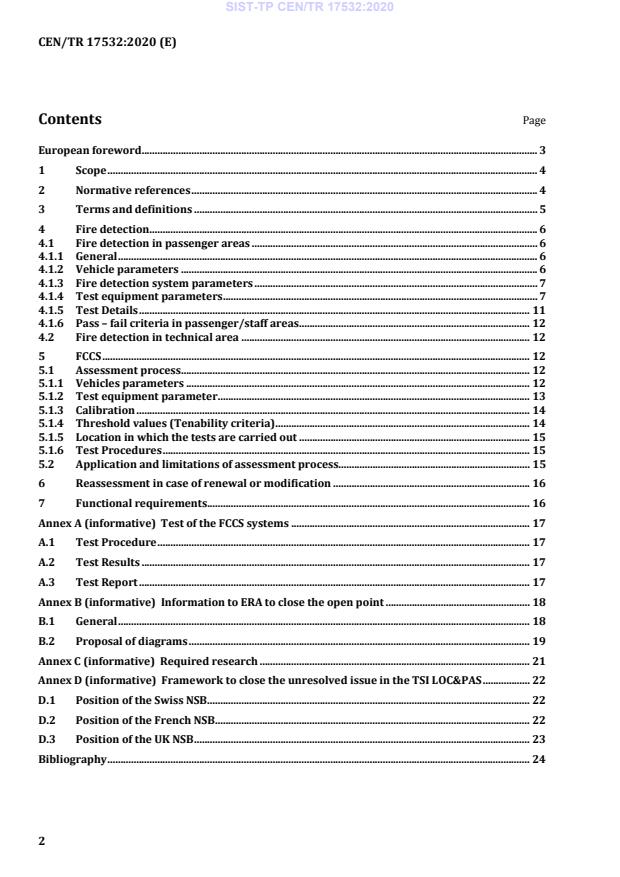
Contents Page
European foreword . 3
1 Scope . 4
2 Normative references . 4
3 Terms and definitions . 5
4 Fire detection . 6
4.1 Fire detection in passenger areas . 6
4.1.1 General . 6
4.1.2 Vehicle parameters . 6
4.1.3 Fire detection system parameters . 7
4.1.4 Test equipment parameters . 7
4.1.5 Test Details . 11
4.1.6 Pass – fail criteria in passenger/staff areas . 12
4.2 Fire detection in technical area . 12
5 FCCS . 12
5.1 Assessment process . 12
5.1.1 Vehicles parameters . 12
5.1.2 Test equipment parameter . 13
5.1.3 Calibration . 14
5.1.4 Threshold values (Tenability criteria) . 14
5.1.5 Location in which the tests are carried out . 15
5.1.6 Test Procedures . 15
5.2 Application and limitations of assessment process. 15
6 Reassessment in case of renewal or modification . 16
7 Functional requirements. 16
Annex A (informative) Test of the FCCS systems . 17
A.1 Test Procedure . 17
A.2 Test Results . 17
A.3 Test Report . 17
Annex B (informative) Information to ERA to close the open point . 18
B.1 General . 18
B.2 Proposal of diagrams . 19
Annex C (informative) Required research . 21
Annex D (informative) Framework to close the unresolved issue in the TSI LOC&PAS . 22
D.1 Position of the Swiss NSB . 22
D.2 Position of the French NSB . 22
D.3 Position of the UK NSB . 23
Bibliography . 24
European foreword
This document (CEN/TR 17532:2020) has been prepared by Technical Committee CEN/TC 256 “Railway
applications”, the secretariat of which is held by DIN.
Attention is drawn to the possibility that some of the elements of this document may be the subject of
patent rights. CEN shall not be held responsible for identifying any or all such patent rights.
This document has been developed in addition to EN 45545 series and EN 50553 to define an assessment
method for Fire Containment and Control Systems (FCCS) that may be installed in rolling stock as an
alternative to full cross-section partitions. The EN 45545-3 requirements are that full cross-section
partitions are required at a maximum separation of 30 metres within a train and each barrier is required
to achieve 15 minutes minimum Fire Resistance – Integrity and Insulation performance. This document
describes an alternative protection system - FCCS - that also protects passengers and staff from the effects
of fire until the train has been evacuated.
It is expected that the FCCS will be activated shortly after a fire that has ignited in a train has been
detected. At the same time, passengers and staff in the affected area may move to a non-affected area of
the train.
This document also defines requirements for the fire detection systems that activate FCCS systems on
board trains.
This document gives the last version of WI947 and comments of NSBs where the compromise is not
finalised.
This document provides information to ERA to close the open point.
This document contains information on research to be done to improve the state of the art. The cost of
the research should be also evaluated.
This document proposes the next steps with the goal of creating a standard that resolves the issues at
hand. This document does not give a cost-benefit-analysis, because such an analysis is not the task of
CEN/TC 256/WG 01 experts.
1 Scope
This document specifies the assessment of Fire Containment and Control Systems (FCCS) and associated
fire detection systems for railway vehicles as an alternative to the fire barriers specified in EN 45545-3.
This document describes:
— assessment of the installation and capability of fire detection systems;
— assessment of the interaction between fire detection systems and FCCS;
— application and limitations of the assessment process (mock-up or real scale test).
This document considers any additional assessment requirements when vehicle designs that have
already been assessed as acceptable to this document are modified, or when new design variants, which
have an impact on FCCS, are made which are based on an existing design.
This document is applicable to any railway vehicle where fire detection systems and/or Fire Control and
Containment Systems are used.
This document defines performance requirements and verification and validation requirements for
systems whose objective is to detect and control or contain the effect of fire in order to create a protected
area within the railway vehicle until the railway vehicle can be cleared of passengers and staff by way of
evacuation. It is additionally assumed that the new railway vehicles comply with EN 45545-2 (material
properties) and EN 45545-4 (design rules) in order to achieve the safety requirements defined in the
EN 45545 series.
2 Normative references
The following documents are referred to in the text in such a way that some or all of their content
constitutes requirements of this document. For dated references, only the edition cited applies. For
undated references, the latest edition of the referenced document (including any amendments) applies.
EN 45545-1, Railway applications - Fire protection on railway vehicles - Part 1: General
EN 45545-2, Railway applications - Fire protection on railway vehicles - Part 2: Requirements for fire
behaviour of materials and components
EN 45545-3, Railway applications - Fire protection on railway vehicles - Part 3: Fire resistance requirements
for fire barriers
EN 45545-4, Railway applications - Fire protection on railway vehicles - Part 4: Fire safety requirements for
rolling stock design
EN 45545-6, Railway applications - Fire protection on railway vehicles - Part 6: Fire control and
management systems
EN 50155, Railway applications – Rolling stock – Electronic equipment
EN 50553, Railway applications - Requirements for running capability in case of fire on board of rolling
stock
EN ISO 13943, Fire safety - Vocabulary (ISO 13943)
ISO 8421-1, Fire protection - Vocabulary - Part 1: General terms and phenomena of fire
3 Terms and definitions
For the purposes of this document, the terms and definitions given in EN 45545-1, EN ISO 13943,
ISO 8421-1, relevant Technical Specification for Interoperability (TSI) documents and the following
apply.
ISO and IEC maintain terminological databases for use in standardization at the following addresses:
— IEC Electropedia: available at http://www.electropedia.org/
— ISO Online browsing platform: available at https://www.iso.org/obp
3.1
fire containment
action of keeping the effects of fire in terms of heat, smoke and toxic gases within prescribed limits based
on avoiding critical thresholds for temperature rise, smoke and toxic gas flow
3.2
fire control
reduction of the effects of a fire to defined levels
Note 1 to entry: It is intended to have no significant risk of serious injury or threat to life.
3.3
detection time
time interval between ignition of a fire and its detection by an automatic or manual system
3.4
affected area
area where the fire should be contained and controlled by FCCS in the context of a fire incident
3.5
non-affected area
area outside the affected area on board of the rolling stock where passengers and staff are protected by
FCCS in the context of a fire incident
Note 1 to entry: This is also called protected area.
3.6
artificial smoke
artificial particulate matter to simulate smoke
3.7
basic module
part of the coach with one or several FCCS devices expected to contain and to control the fire source in
its area
4 Fire detection
4.1 Fire detection in passenger areas
4.1.1 General
The fire detection system should be assessed based on vehicle parameters as defined in 4.1.2 and the fire
detection system parameters defined in 4.1.3.
Fire detection systems should be tested with the equipment described in 4.1.4 at the test location defined
in 4.1.4.2. The pass-fail criteria are in 4.1.6. The test is based on the time it takes for the system to detect
smoke emission from a standard smoke generator that produces smoke at a fixed rate.
This subclause defines the verification requirements that are based on the detection system complying
with the following parameters:
— power and type of fire source for verification;
— detection time (refer to 3.3);
— adequate location of detectors.
The application of this subclause for the proof of specified functions serves the final proof of the detector
position and detector selection in terms of confirming compliance with the time limit for fire detection.
This verification can be carried out by test in a mock-up or in a real vehicle, or by simulations if input data
were validated by real test in a mock-up or in a real vehicle.
NOTE 1 This subclause is suitable only for validation of detection systems which use smoke detectors to
determine the presence of a fire.
NOTE 2 Validation of alternative fire detection technologies (such as cameras or thermal detection) is not yet
described in this document.
4.1.2 Vehicle parameters
Where the train being assessed is a new design, the vehicle or vehicle sub-element to be tested should be
fully defined prior to testing and documented in detail in the test report including the following details:
— definition and description of the individual rail vehicle or non-separable train set being tested, with
regard to operational use and the related environmental conditions (e.g. tunnel operation) and the
definition and location of any specific test objects;
— control and regulation concept for the air treatment units (for ventilation, heating, cooling) in the rail
vehicle or the train set and air routing concept (layout of air ducts and air inlet and air outlet
situations, dynamic or static exhaust air routes);
— information on door and window openings and their possible handling (e.g. open in normal service
or open only if ventilation equipment fails);
— information on ventilation concepts of control cabinets and machine rooms (e.g. static or dynamic
ventilation).
This situation should also be considered in terms of preconditions for system specification tests, e.g. at
older types of rolling stock.
As part of vehicle evaluation, the location of the smoke source during the test should use the demanding
case which is the situation which assumedly will create the longest detection time under normal
operating conditions. The justification for the demanding case should be fully explained in the technical
documentation of the FCCS.
The demanding case should be defined, based on the individual vehicle layout and location of the fire
detectors.
The validation tests of the fire detection sub-system should take place with the vehicle in standstill
condition under operating conditions.
4.1.3 Fire detection system parameters
The fire detection system should be in accordance with EN 50155. Fire detection devices should be
functionally suitable for the expected fire products.
For planning and performing the tests, the following information relating to the fire detector(s)
connected within the system should be recorded and included in the test report:
— description of the fire detection system concerning the fire detectors' function within the system;
— description of the fire detector types and their positions (including variations, if available) in the
vehicle or the monitored area;
— possible requirements deviating from standards should regarded (e.g. corresponding conditions
concerning operating and storage temperature).
4.1.4 Test equipment parameters
4.1.4.1 Fire source for test
4.1.4.1.1 General
For the test, one of the following smoke generator sources should be selected. Details of the smoke
generator source specification should be included in the test report:
— liquid tray;
— smoke generator;
— or equivalent source.
Definition of a repeatable and reliable fire source is the main topic. For choosing an equivalent source, it
should be clearly defined with quantitative requirements.
NOTE There is no consensus on the suitability of liquid tray/ TF4 cushion (open fire) for testing in a new
vehicle. There is no consensus on the possibility to test temperature detectors with the smoke generator. Infrared
detection has not yet been proven conclusively and needs more investigation.
4.1.4.1.2 Test with liquid tray
A fire source equivalent to Ignition Model 1/Fire type A according to EN 45545-1/EN 50553 is placed
underneath a tray of liquid.
EN 45545-1 Ignition model 1is defined as follows:
— flaming source of 3 minutes duration;
— average power output (7 ± 1) kW;
2 2
— 25 kW/m – 30 kW/m flux generation.
The liquid tray is made from galvanized or stainless steel with jointed sealed edges covered with a 10 mm
thick calcium silicate, a square trunk section and the following exterior dimensions (see Figure 1a)):
— bottom base: (160 ± 2) mm × (160 ± 2) mm;
— top base: (160 ± 2) mm × (160 ± 2) mm;
— height: (50 ± 2) mm;
— thickness of tray: (3,0 ± 0,1) mm.
Dimensions in millimetres
a) — Top view of the tray with dimensions in millimetres
b) — Metalwork and the calcium silicate
Figure 1b) shows the relative position of the metalwork and the calcium silicate.
Key
1a Calcium silicate 3b Open-ended steel tube
2a Open-ended steel tube A Cut A-A
1b Calcium silicate
2b Metalwork
Figure 1 — Liquid tray
The tray should be positioned at a height of 20 mm ± 10 mm from the floor; 1 hole is obtained in the
centre of the tray with the insertion of an open ended steel tube (height: (30 ± 2) mm – external diameter
(16,0 ± 0,1) mm) to permit air circulation around, beneath and in the centre of the tray (see Figure 2).
Dimensions in millimetres
Key
1 Calcium silicate
2 Metalwork
3 Space height
4 Open-ended steel tube
Figure 2 — Front view of the tray with dimensions in millimetres (Cut A-A)
The smoke producing liquid should be prepared as follows:
1) fill the tray with 70 ml of water;
2) add 80 ml of toluene (99,8 % purity);
3) add 20 ml of methanol (99,9 % purity).
For a future standard, toluene should be replaced by heptane because of health issues.
This liquid tray should be ignited within 2 min after preparation.
4.1.4.1.3 Test with smoke generator
The artificial smoke should be generated according to generally recognized codes of practice.
NOTE 1 Currently, ARGE guideline and UNI 11565 are the two known “Generally recognised codes of practice”.
NOTE 2 The test method for this subclause is not yet described in this document.
4.1.4.1.4 Equivalent source
The use of an equivalent source should be validated and compared with sources mentioned in 4.1.4.1.2
and 4.1
...