

SIST EN 45545-3:2024
(Main)Railway applications - Fire protection on railway vehicles - Part 3: Fire resistance requirements for fire barriers
General Information
- Abstract
This document specifies the fire resistance requirements and testing methods for fire barriers for railway vehicles.
The objective of the measures and requirements, specified in this document, is to protect passengers and staff in railway vehicles in the event of a developing fire on board.
Use of a Fire Containment and Control System, where permitted as an alternative to a fire barrier, is not in the scope of this document. It is not within the scope of this document to describe measures that ensure the preservation of the railway vehicles in the event of a fire.
- Status
- Published
- Public Enquiry End Date
- 28-Feb-2022
- Publication Date
- 20-Mar-2024
- Technical Committee
- IŽNP - Reilway applications
- Current Stage
- 6060 - National Implementation/Publication (Adopted Project)
- Start Date
- 21-Mar-2024
- Due Date
- 26-May-2024
- Completion Date
- 21-Mar-2024
- Directive
- 2016/797/EU - Directive (EU) 2016/797 of the European Parliament and of the Council of 11 May 2016 on the interoperability of the rail system within the European Union (Text with EEA relevance)OJ Ref: 2025/424, L 6.3.2025, OJ L OJ Date: 06-Mar-2025

Overview
EN 45545-3:2024 - Railway applications - Fire protection on railway vehicles - Part 3 specifies fire resistance requirements and testing methods for fire barriers used on railway vehicles. Published by CEN in March 2024, this standard aims to protect passengers and staff from a developing on‑board fire by defining where fire barriers are required, how they are classified (integrity E, insulation I, radiation W), and how they are tested. The standard does not cover the use of Fire Containment and Control Systems as alternatives, nor does it address measures for preserving the vehicle structure after a fire.
Key topics and technical requirements
- Scope and objective: Defines fire barrier requirements to protect people on board; excludes vehicle preservation and alternative containment systems.
- Classification parameters: Uses EN 13501-2 principles - integrity (E), insulation (I) and radiation (W). Example performance grades appear as E30, I15, etc.
- Testing methods: Fire resistance verification by standard tests based on EN 1363‑1:2020 and applicable element tests such as EN 1364‑1:2015 (walls), EN 1364‑2:2018 (ceilings), EN 1634‑1:2014+A1:2018 (doors). Classification follows EN 13501‑2.
- Location-based requirements: Table 1 in the standard specifies required fire barrier levels depending on fire origin (e.g., underfloor traction components, combustion engines, passenger areas) and operation categories. Some locations require E15 or E15/I15, others have no barrier requirement.
- Installation details: Vertical barriers must span structural floor to roof; where barriers meet side walls they extend to the body shell. Penetrations (ducts, cables) must not reduce barrier performance.
- Ventilation and closing devices: Ducts crossing barriers require closing devices unless the whole duct meets barrier resistance. Closing devices must meet same fire resistance level and activate on fire.
- Conformity and annexes: Includes requirements for test specimen mounting and installation (Annex A) and illustrative barrier locations (Annex B). Conformity evaluation is addressed.
Applications and users
EN 45545-3:2024 is intended for:
- Rolling stock designers and OEMs specifying barrier systems and component layout
- Railway operators and integrators ensuring compliance with fire safety requirements
- Test laboratories performing fire resistance tests and classification
- Regulatory bodies, certifiers and procurement teams referencing EN 45545 series requirements Practical applications include specifying doors, partitions, underfloor enclosures and duct closing devices to meet required E/I/W ratings and demonstrating compliance during type approval or refurbishment.
Related standards (selected)
- EN 45545-1 (General)
- EN 45545-2 (Reaction to fire of materials/components)
- EN 45545-5 (Electrical equipment / arc barriers)
- EN 1363‑1, EN 1364‑1, EN 1364‑2, EN 1634‑1, EN 13501‑2
Keywords: EN 45545-3:2024, fire barriers, fire resistance, railway vehicles, CEN, railway fire protection, EN 45545.
Relations
- Effective Date
- 01-May-2024
- Effective Date
- 28-Jan-2026
- Effective Date
- 28-Jan-2026
- Effective Date
- 28-Jan-2026
- Effective Date
- 28-Jan-2026
- Effective Date
- 28-Jan-2026
- Refers
SIST EN 45545-1:2013 - Railway applications - Fire protection on railway vehicles - Part 1: General - Effective Date
- 28-Jan-2026
- Effective Date
- 28-Jan-2026
- Refers
SIST EN 1364-2:2018 - Fire resistance for tests for non-loadbearing elements - Part 2: Ceilings - Effective Date
- 28-Jan-2026
- Effective Date
- 28-Jan-2026
- Effective Date
- 28-Jan-2026
- Effective Date
- 29-Jul-2026
- Effective Date
- 20-May-2026
- Referred By
SIST EN 50343:2014 - Railway applications - Rolling stock - Rules for installation of cabling - Effective Date
- 09-Feb-2026
- Referred By
SIST EN 50343:2025 - Railway applications - Rolling stock - Rules for installation of cabling - Effective Date
- 09-Feb-2026
Get Certified
Connect with accredited certification bodies for this standard

IRIS Certification (UNIFE)
International Railway Industry Standard certification.

TÜV SÜD Rail GmbH
TÜV SÜD railway certification services.

Bureau Veritas Railway Certification
Railway and transportation certification.
Sponsored listings
Frequently Asked Questions
SIST EN 45545-3:2024 is a standard published by the Slovenian Institute for Standardization (SIST). Its full title is "Railway applications - Fire protection on railway vehicles - Part 3: Fire resistance requirements for fire barriers". This standard covers: This document specifies the fire resistance requirements and testing methods for fire barriers for railway vehicles. The objective of the measures and requirements, specified in this document, is to protect passengers and staff in railway vehicles in the event of a developing fire on board. Use of a Fire Containment and Control System, where permitted as an alternative to a fire barrier, is not in the scope of this document. It is not within the scope of this document to describe measures that ensure the preservation of the railway vehicles in the event of a fire.
This document specifies the fire resistance requirements and testing methods for fire barriers for railway vehicles. The objective of the measures and requirements, specified in this document, is to protect passengers and staff in railway vehicles in the event of a developing fire on board. Use of a Fire Containment and Control System, where permitted as an alternative to a fire barrier, is not in the scope of this document. It is not within the scope of this document to describe measures that ensure the preservation of the railway vehicles in the event of a fire.
SIST EN 45545-3:2024 is classified under the following ICS (International Classification for Standards) categories: 13.220.20 - Fire protection; 45.060.01 - Railway rolling stock in general. The ICS classification helps identify the subject area and facilitates finding related standards.
SIST EN 45545-3:2024 has the following relationships with other standards: It is inter standard links to SIST EN 45545-3:2013, SIST EN 45545-5:2013+A1:2015, SIST EN 13501-2:2016, SIST EN ISO 13943:2017, SIST EN 1363-1:2020, SIST EN 1634-1:2014+A1:2018, SIST EN 45545-1:2013, SIST EN ISO 1716:2018, SIST EN 1364-2:2018, SIST EN 1364-1:2015, SIST EN ISO 1182:2020, SIST EN 45545-6:2025+A1:2026, SIST EN 14198:2026, SIST EN 50343:2014, SIST EN 50343:2025. Understanding these relationships helps ensure you are using the most current and applicable version of the standard.
SIST EN 45545-3:2024 is associated with the following European legislation: EU Directives/Regulations: 2016/797/EU; Standardization Mandates: M/483, M/591. When a standard is cited in the Official Journal of the European Union, products manufactured in conformity with it benefit from a presumption of conformity with the essential requirements of the corresponding EU directive or regulation.
SIST EN 45545-3:2024 is available in PDF format for immediate download after purchase. The document can be added to your cart and obtained through the secure checkout process. Digital delivery ensures instant access to the complete standard document.
Standards Content (Sample)
SLOVENSKI STANDARD
01-maj-2024
Železniške naprave - Požarna zaščita na železniških vozilih - 3. del: Zahteve za
požarno odpornost požarnih pregrad
Railway applications - Fire protection on railway vehicles - Part 3: Fire resistance
requirements for fire barriers
Bahnanwendungen - Brandschutz in Schienenfahrzeugen - Teil 3: Feuerwiderstand von
Feuerschutzabschlüssen
Applications ferroviaires - Protection contre les incendies dans les véhicules ferroviaires
- Partie 3: Exigences de résistance au feu des barrières au feu
Ta slovenski standard je istoveten z: EN 45545-3:2024
ICS:
13.220.20 Požarna zaščita Fire protection
45.060.01 Železniška vozila na splošno Railway rolling stock in
general
2003-01.Slovenski inštitut za standardizacijo. Razmnoževanje celote ali delov tega standarda ni dovoljeno.
EN 45545-3
EUROPEAN STANDARD
NORME EUROPÉENNE
March 2024
EUROPÄISCHE NORM
ICS 13.220.20; 45.060.01 Supersedes EN 45545-3:2013
English Version
Railway applications - Fire protection on railway vehicles -
Part 3: Fire resistance requirements for fire barriers
Applications ferroviaires - Protection contre les Bahnanwendungen - Brandschutz in
incendies dans les véhicules ferroviaires - Partie 3 : Schienenfahrzeugen - Teil 3: Feuerwiderstand von
Exigences de résistance au feu des barrières au feu Feuerschutzabschlüssen
This European Standard was approved by CEN on 22 October 2023.
CEN members are bound to comply with the CEN/CENELEC Internal Regulations which stipulate the conditions for giving this
European Standard the status of a national standard without any alteration. Up-to-date lists and bibliographical references
concerning such national standards may be obtained on application to the CEN-CENELEC Management Centre or to any CEN
member.
This European Standard exists in three official versions (English, French, German). A version in any other language made by
translation under the responsibility of a CEN member into its own language and notified to the CEN-CENELEC Management
Centre has the same status as the official versions.
CEN members are the national standards bodies of Austria, Belgium, Bulgaria, Croatia, Cyprus, Czech Republic, Denmark, Estonia,
Finland, France, Germany, Greece, Hungary, Iceland, Ireland, Italy, Latvia, Lithuania, Luxembourg, Malta, Netherlands, Norway,
Poland, Portugal, Republic of North Macedonia, Romania, Serbia, Slovakia, Slovenia, Spain, Sweden, Switzerland, Türkiye and
United Kingdom.
EUROPEAN COMMITTEE FOR STANDARDIZATION
COMITÉ EUROPÉEN DE NORMALISATION
EUROPÄISCHES KOMITEE FÜR NORMUNG
CEN-CENELEC Management Centre: Rue de la Science 23, B-1040 Brussels
© 2024 CEN All rights of exploitation in any form and by any means reserved Ref. No. EN 45545-3:2024 E
worldwide for CEN national Members.
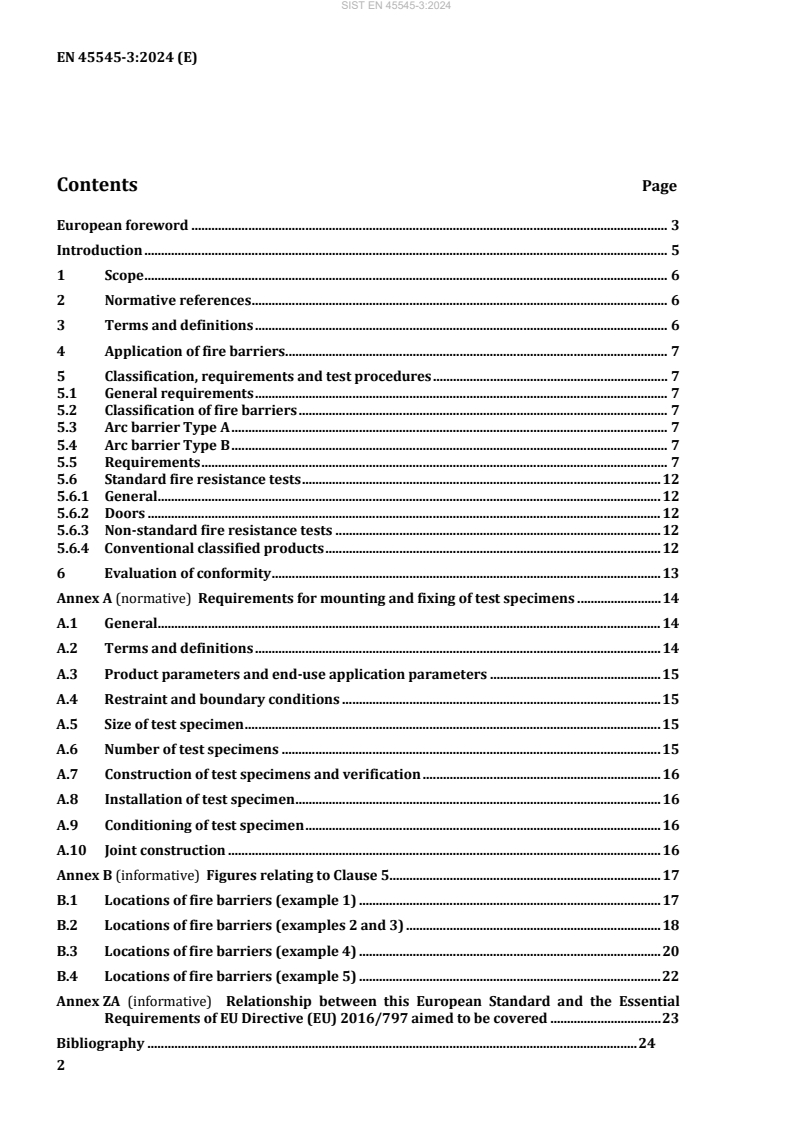
Contents Page
European foreword . 3
Introduction . 5
1 Scope . 6
2 Normative references . 6
3 Terms and definitions . 6
4 Application of fire barriers. 7
5 Classification, requirements and test procedures . 7
5.1 General requirements . 7
5.2 Classification of fire barriers . 7
5.3 Arc barrier Type A . 7
5.4 Arc barrier Type B . 7
5.5 Requirements . 7
5.6 Standard fire resistance tests . 12
5.6.1 General. 12
5.6.2 Doors . 12
5.6.3 Non-standard fire resistance tests . 12
5.6.4 Conventional classified products . 12
6 Evaluation of conformity . 13
Annex A (normative) Requirements for mounting and fixing of test specimens . 14
A.1 General. 14
A.2 Terms and definitions . 14
A.3 Product parameters and end-use application parameters . 15
A.4 Restraint and boundary conditions . 15
A.5 Size of test specimen . 15
A.6 Number of test specimens . 15
A.7 Construction of test specimens and verification . 16
A.8 Installation of test specimen . 16
A.9 Conditioning of test specimen . 16
A.10 Joint construction . 16
Annex B (informative) Figures relating to Clause 5. 17
B.1 Locations of fire barriers (example 1) . 17
B.2 Locations of fire barriers (examples 2 and 3) . 18
B.3 Locations of fire barriers (example 4) . 20
B.4 Locations of fire barriers (example 5) . 22
Annex ZA (informative) Relationship between this European Standard and the Essential
Requirements of EU Directive (EU) 2016/797 aimed to be covered . 23
Bibliography . 24
European foreword
This document (EN 45545-3:2024) has been prepared by Technical Committee CEN/TC 256 “Railway
applications”, the secretariat of which is held by DIN.
This European Standard shall be given the status of a national standard, either by publication of an
identical text or by endorsement, at the latest by August 2024, and conflicting national standards shall
be withdrawn at the latest by August 2024.
Attention is drawn to the possibility that some of the elements of this document may be the subject of
patent rights. CEN shall not be held responsible for identifying any or all such patent rights.
This document supersedes EN 45545-3:2013.
The main changes from EN 45545-3 are:
— Modification of the scope;
— Modification of dated references;
— Renumbering of 5.1 due to deletion of previous 5.1.1, 5.1.2, 5.1.3 and 5.1.4;
— Modification of 5.5;
— Modification of Table 1;
— Modification of 5.6.3;
— Modification of 5.6.4;
— Modification of Table 2;
— Modification of A.5;
— Modification of A.10;
— Addition of Annex B with elements of previous 5.5.2.
This series of European Standards Railway applications — Fire protection on railway vehicles consists
of:
— Part 1: General;
— Part 2: Requirements for fire behaviour of materials and components;
— Part 3: Fire resistance requirements for fire barriers;
— Part 4: Fire safety requirements for railway rolling stock design;
— Part 5: Fire safety requirements for electrical equipment including that of trolley buses, track
guided buses and magnetic levitation vehicles;
— Part 6: Fire control and management systems;
— Part 7: Fire safety requirements for flammable liquid and flammable gas installations.
This document has been prepared under a standardization request addressed to CEN by the European
Commission. The Standing Committee of the EFTA States subsequently approves these requests for its
Member States.
For the relationship with EU Legislation, see informative Annex ZA, which is an integral part of this
document.
Any feedback and questions on this document should be directed to the users’ national standards body.
A complete listing of these bodies can be found on the CEN website.
According to the CEN-CENELEC Internal Regulations, the national standards organisations of the
following countries are bound to implement this European Standard: Austria, Belgium, Bulgaria,
Croatia, Cyprus, Czech Republic, Denmark, Estonia, Finland, France, Germany, Greece, Hungary,
Iceland, Ireland, Italy, Latvia, Lithuania, Luxembourg, Malta, Netherlands, Norway, Poland, Portugal,
Republic of North Macedonia, Romania, Serbia, Slovakia, Slovenia, Spain, Sweden, Switzerland, Türkiye
and the United Kingdom.
Introduction
EN 45545-3 has been developed from existing fire safety regulations for railway vehicles from the
International Union of Railways (UIC) and different European countries.
In using the operation and design categories defined in EN 45545-1, the requirements laid down in
this part take into account the current operating conditions for European public rail transport.
1 Scope
This document specifies the fire resistance requirements and testing methods for fire barriers for
railway vehicles.
The objective of the measures and requirements, specified in this document, is to protect passengers
and staff in railway vehicles in the event of a developing fire on board.
Use of a Fire Containment and Control System, where permitted as an alternative to a fire barrier, is
not in the scope of this document. It is not within the scope of this document to describe measures that
ensure the preservation of the railway vehicles in the event of a fire.
2 Normative references
The following documents are referred to in the text in such a way that some or all of their content
constitutes requirements of this document. For dated references, only the edition cited applies. For
undated references, the latest edition of the referenced document (including any amendments)
applies.
EN 1363-1:2020, Fire resistance tests — Part 1: General requirements
EN 1364-1:2015, Fire resistance tests for non-loadbearing elements — Part 1: Walls
EN 1364-2:2018, Fire resistance tests for non-loadbearing elements — Part 2: Ceilings
EN 1634-1:2014+A1:2018, Fire resistance and smoke control tests for door and shutter assemblies,
openable windows and elements of building hardware — Part 1: Fire resistance test for door and shutter
assemblies and openable windows
EN 13501-2:2016, Fire classification of construction products and building elements — Part 2:
Classification using data from fire resistance tests, excluding ventilation services
EN 45545-1:2013, Railway applications — Fire protection on railway vehicles — Part 1: General
EN 45545-5:2013+A1:2015, Railway applications — Fire protection on railway vehicles — Part 5: Fire
safety requirements for electrical equipment including that of trolley buses, track guided buses and
magnetic levitation vehicles
EN ISO 1182:2020, Reaction to fire tests for products — Non-combustibility test (ISO 1182:2020)
EN ISO 1716:2018, Reaction to fire tests for products — Determination of the gross heat of combustion
(calorific value) (ISO 1716:2018)
EN ISO 13943:2017, Fire safety — Vocabulary (ISO 13943:2017)
3 Terms and definitions
For the purposes of this document, the terms and definitions given in EN 45545-1:2013 apply.
ISO and IEC maintain terminological databases for use in standardization at the following addresses:
— IEC Electropedia: available at https://www.electropedia.org/
— ISO Online browsing platform: available at https://www.iso.org/obp
4 Application of fire barriers
Railway vehicles shall be equipped with fire barriers at the locations specified in Table 1.
5 Classification, requirements and test procedures
5.1 General requirements
The use of the following parameters shall be in accordance with the principles described in
EN 13501-2:2016 integrity criterion E, insulation criterion I and radiation criterion W.
5.2 Classification of fire barriers
Fire barriers shall have fire resistance properties verified by:
— a fire resistance test based on the principles of EN 1363-1:2020; or
— assessment based on fire resistance testing.
Fire barriers shall have performance based on the three parameters (E, W, I) as specified in Table 1.
NOTE For example E30, I15, means integrity is maintained for 30 min and insulation is maintained for
15 min.
5.3 Arc barrier Type A
Type A arc barriers in accordance with EN 45545-5:2013+A1:2015 shall satisfy the requirements for
an E15 fire barrier.
5.4 Arc barrier Type B
Type B arc barriers in accordance with EN 45545-5:2013+A1:2015 shall satisfy the requirements for
an E60 fire barrier.
5.5 Requirements
The requirements for fire barriers depend upon the operation categories and their location in the
railway vehicle.
The fire barriers shall be located as specified in Table 1. Examples of the barriers in Table 1 are
described in Annex B, in Figures B.1 to B.4.
All vertical fire barriers in the cross section of a railway vehicle shall cover the entire area between the
structural floor and the structural roof. In this context, the middle floor of a double decked vehicle shall
be considered as a floor for the upper deck and as a roof for the lower deck. Where a vertical barrier
reaches the side wall, it shall be extended to the body shell.
Closing devices for ventilation ducts shall conform to the following requirements:
a) where a ventilation duct passes through a fire barrier, the duct shall have a closing device where
it passes through the barrier unless the complete duct meets the same level of fire resistance
requirements as the barrier for:
— its entire length;
— its length to the next fire barrier, the next closing device, or to the exterior of the vehicle;
b) closing devices shall meet the same fire resistance requirements as fire barriers;
c) closing devices shall operate on reaction to a fire.
Penetrations through fire barriers, for example for ducts or cables, shall not reduce the fire resistance
of the barrier.
Table 1 — Fire barrier requirements
No Fire origin Protected location Remarks Operation Requirements
category
1 Underfloor technical Passenger and staff area Tested in accordance with EN 1364-2:2018. 1, 2 and 4 E15
cabinet containing electrical including driver’s cab
Requirements are defined from underfloor to 3 E15, I15
high power components
the top of the floor covering.
(other than brake and
heating resistors and cables
between joints) and lithium
ion batteries for traction or
auxiliary supply
2 Underfloor traction Passenger and staff area Tested in accordance with EN 1364-2:2018. 1 and 2 E15
transformers, reactors and including driver’s cab
For vehicles without underfloor side skirts: 3 and 4 E15, I15
cooling components filled
Whole cross section and 1 m longer than the
with insulation fluid
fire origin in each longitudinal direction.
For vehicles with underfloor side skirts: the
section with underfloor side skirts shall meet
a
the requirement.
Requirements are defined from underfloor to
the top of the floor covering.
3 Underfloor combustion Passenger and staff area Tested in accordance with EN 1364-2:2018. 1 and 2 E15
engine or fuel cells including driver’s cab
For vehicles without underfloor side skirts: 3 and 4 E15, I15
(including heating
Whole cross section and 1 m longer than the
equipment, fuel tank and
fire origin in each longitudinal direction.
pipe work)
For vehicles with underfloor side skirts: the
section with underfloor side skirts shall meet
the requirement.
Requirements are defined from underfloor to
the top of the floor covering.
4 Underfloor area not covered Passenger and staff area b 1 to 4 No requirement
None
by positions 1-3 including driver’s cab
5 On the roof of carbody Passenger and staff area b 1 to 4 No requirement
None
including driver's cab
No Fire origin Protected location Remarks Operation Requirements
category
Adjacent passenger or staff Tested in accordance with EN 1364-1:2015
6 Passenger area 1, 2, 4 No requirements
area excluded driver cabs (walls).
3 E15 for the full cross
The full cross section shall be tested with all section.
elements positioned as they would be present
Elements shall be
in an actual railway vehicle.
located at a distanc
...