

SIST ISO 8528-10:2023
(Main)Reciprocating internal combustion engine driven alternating current generating sets - Part 10: Measurement of airborne noise
General Information
- Abstract
This document specifies noise test codes for determining the sound power level and the emission sound pressure level at the workstation of reciprocating internal combustion engine driven electrical power generating sets.
This document applies to constant and variable-speed reciprocating internal combustion (RIC) engine driven alternating current (AC) and direct current (DC) generating sets for fixed and mobile applications with rigid or flexible mountings. It is applicable for land and marine use, excluding generating sets used on aircraft or to propel land vehicles and locomotives.
NOTE 1 For some specific applications (e.g. essential hospital supplies, high-rise buildings) supplementary requirements can be necessary. The provisions of this document can be regarded as a basis.
NOTE 2 This document is referenced with regard to noise in ISO 8528-13:2016, which contains requirements concerning the design of generating sets, verification of noise levels and information related to noise in the operating and maintenance instructions.
- Status
- Published
- Publication Date
- 08-Mar-2023
- Current Stage
- 6060 - National Implementation/Publication (Adopted Project)
- Start Date
- 07-Mar-2023
- Due Date
- 12-May-2023
- Completion Date
- 09-Mar-2023
Buy Documents



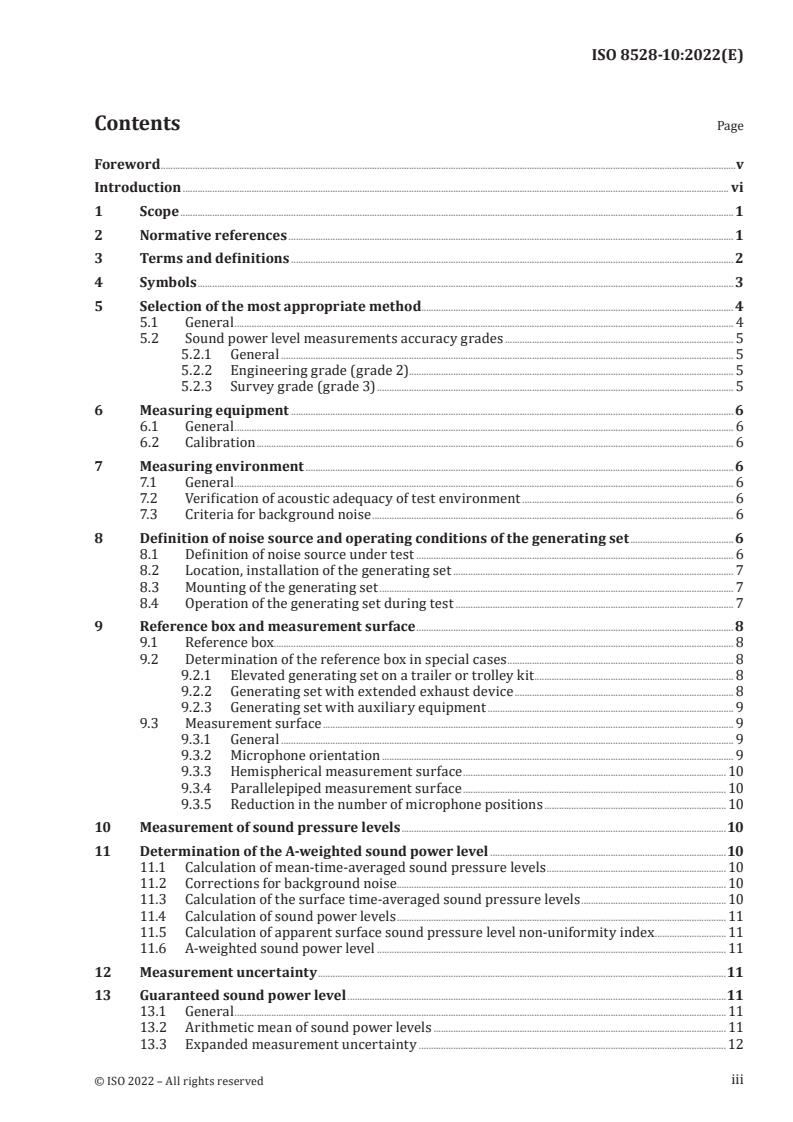
ISO 8528-10:2022 - Reciprocating internal combustion engine driven alternating current generating sets — Part 10: Measurement of airborne noise Released:21. 10. 2022

ISO 8528-10:2022 - Reciprocating internal combustion engine driven alternating current generating sets — Part 10: Measurement of airborne noise Released:21. 10. 2022
Overview
SIST ISO 8528-10:2023 specifies acoustic test codes for measuring airborne noise from reciprocating internal combustion (RIC) engine driven generating sets. It defines how to determine the sound power level of the generator set and the emission sound pressure level at the workstation for constant- and variable-speed RIC-driven AC and DC generating sets used in fixed and mobile land and marine applications (excluding aircraft and propulsion for vehicles/locomotives). The standard provides a consistent, auditable basis for declaring, verifying and comparing noise emissions for manufacturers, test laboratories, purchasers and safety professionals.
Key topics and technical requirements
- Scope and applicability - RIC engine driven generating sets with rigid or flexible mountings; supplementary requirements may be needed for critical applications (e.g., hospitals, high-rise buildings).
- Selection of measurement method and accuracy grades - guidance on choosing between engineering grade (grade 2) and survey grade (grade 3) sound power measurements.
- Measuring equipment & calibration - requirements for instrumentation, calibration procedures and verification of acoustic adequacy.
- Measuring environment & background noise - criteria to assess test environment suitability and methods for correcting background noise.
- Definition of noise source & operating conditions - specifying the source under test, mounting, installation and operating modes during measurement.
- Reference box & measurement surface - rules for defining the reference box around the source and measurement surfaces (hemispherical, parallelepiped) including microphone orientation and reduction of microphone positions where appropriate.
- Measurement procedures - measurement of sound pressure levels, calculation of time-averaged levels, A-weighted sound power level and surface non-uniformity index.
- Uncertainty & guaranteed sound power level - evaluation of measurement uncertainty, statistical treatment and calculation of guaranteed sound power declarations.
- Emission sound pressure level at the workstation - locating workstation(s), microphone positions (standing, bending, crouching), normalization to reference meteorological conditions and reporting requirements.
- Annexes - normative application of ISO 3744 and ISO 3746 for generating sets and informative sound intensity methods.
Practical applications
- Product noise declaration and certification for generator manufacturers.
- Acoustic compliance testing and verification by independent labs.
- Noise-abatement planning and building acoustic design (specifying generating sets to meet site limits).
- Occupational health & safety assessments for operator exposure.
- Selection and procurement of generator sets for sensitive environments (hospitals, residential towers, marine installations).
Who should use this standard
- Generator set manufacturers and R&D teams
- Accredited acoustical test laboratories
- Acoustic and mechanical engineers
- Health & safety officers and compliance managers
- Building services consultants and equipment specifiers
Related standards
- ISO 3744:2010 (Sound power determination - engineering methods)
- ISO 3746:2010 (Sound power determination - survey methods)
- ISO 12001:1996 (steady noise source considerations)
- ISO 8528-13:2016 (design and verification aspects related to noise)
Keywords: SIST ISO 8528-10:2023, sound power level, emission sound pressure level, noise measurement, generating set, reciprocating internal combustion engine, acoustic testing, measurement uncertainty.
Relations
- Effective Date
- 22-Apr-2026
- Effective Date
- 12-Feb-2026
- Effective Date
- 15-Dec-2017
Buy Documents
ISO 8528-10:2022 - Reciprocating internal combustion engine driven alternating current generating sets — Part 10: Measurement of airborne noise Released:21. 10. 2022
ISO 8528-10:2022 - Reciprocating internal combustion engine driven alternating current generating sets — Part 10: Measurement of airborne noise Released:21. 10. 2022
Get Certified
Connect with accredited certification bodies for this standard

DNV
DNV is an independent assurance and risk management provider.

Lloyd's Register
Lloyd's Register is a global professional services organisation specialising in engineering and technology.
DNV Energy Systems
Energy and renewable energy certification.
Sponsored listings
Frequently Asked Questions
SIST ISO 8528-10:2023 is a standard published by the Slovenian Institute for Standardization (SIST). Its full title is "Reciprocating internal combustion engine driven alternating current generating sets - Part 10: Measurement of airborne noise". This standard covers: This document specifies noise test codes for determining the sound power level and the emission sound pressure level at the workstation of reciprocating internal combustion engine driven electrical power generating sets. This document applies to constant and variable-speed reciprocating internal combustion (RIC) engine driven alternating current (AC) and direct current (DC) generating sets for fixed and mobile applications with rigid or flexible mountings. It is applicable for land and marine use, excluding generating sets used on aircraft or to propel land vehicles and locomotives. NOTE 1 For some specific applications (e.g. essential hospital supplies, high-rise buildings) supplementary requirements can be necessary. The provisions of this document can be regarded as a basis. NOTE 2 This document is referenced with regard to noise in ISO 8528-13:2016, which contains requirements concerning the design of generating sets, verification of noise levels and information related to noise in the operating and maintenance instructions.
This document specifies noise test codes for determining the sound power level and the emission sound pressure level at the workstation of reciprocating internal combustion engine driven electrical power generating sets. This document applies to constant and variable-speed reciprocating internal combustion (RIC) engine driven alternating current (AC) and direct current (DC) generating sets for fixed and mobile applications with rigid or flexible mountings. It is applicable for land and marine use, excluding generating sets used on aircraft or to propel land vehicles and locomotives. NOTE 1 For some specific applications (e.g. essential hospital supplies, high-rise buildings) supplementary requirements can be necessary. The provisions of this document can be regarded as a basis. NOTE 2 This document is referenced with regard to noise in ISO 8528-13:2016, which contains requirements concerning the design of generating sets, verification of noise levels and information related to noise in the operating and maintenance instructions.
SIST ISO 8528-10:2023 is classified under the following ICS (International Classification for Standards) categories: 17.140.20 - Noise emitted by machines and equipment; 27.020 - Internal combustion engines; 29.160.40 - Generating sets. The ICS classification helps identify the subject area and facilitates finding related standards.
SIST ISO 8528-10:2023 has the following relationships with other standards: It is inter standard links to SIST EN ISO 8528-13:2026, SIST EN ISO 8528-10:2023, SIST ISO 8528-10:2002. Understanding these relationships helps ensure you are using the most current and applicable version of the standard.
SIST ISO 8528-10:2023 is associated with the following European legislation: EU Directives/Regulations: 2006/42/EC. When a standard is cited in the Official Journal of the European Union, products manufactured in conformity with it benefit from a presumption of conformity with the essential requirements of the corresponding EU directive or regulation.
SIST ISO 8528-10:2023 is available in PDF format for immediate download after purchase. The document can be added to your cart and obtained through the secure checkout process. Digital delivery ensures instant access to the complete standard document.
Standards Content (Sample)
SLOVENSKI STANDARD
01-april-2023
Agregati za proizvodnjo izmeničnega toka, gnani z batnim motorjem z notranjim
zgorevanjem - 10. del: Merjenje hrupa
Reciprocating internal combustion engine driven alternating current generating sets -
Part 10: Measurement of airborne noise
Groupes électrogènes à courant alternatif entraînés par moteurs alternatifs à combustion
interne - Partie 10: Mesurage du bruit aérien
Ta slovenski standard je istoveten z: ISO 8528-10:2022
ICS:
17.140.20 Emisija hrupa naprav in Noise emitted by machines
opreme and equipment
27.020 Motorji z notranjim Internal combustion engines
zgorevanjem
29.160.40 Električni agregati Generating sets
2003-01.Slovenski inštitut za standardizacijo. Razmnoževanje celote ali delov tega standarda ni dovoljeno.
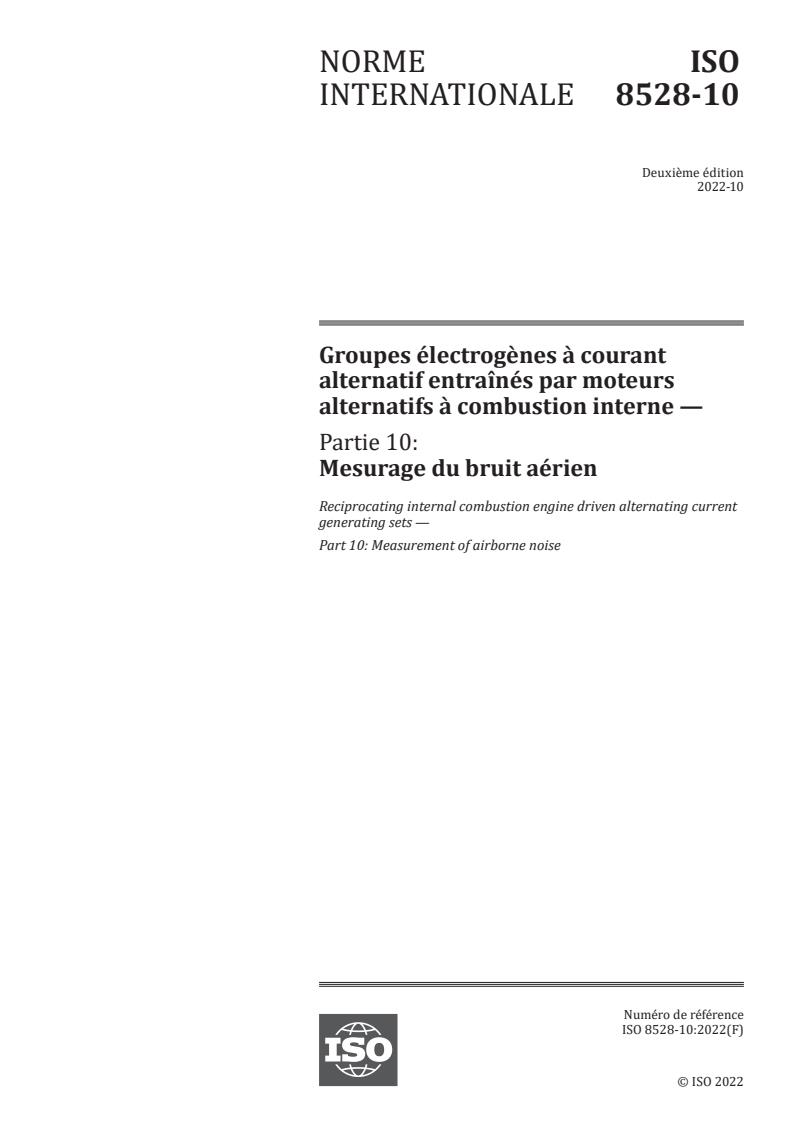
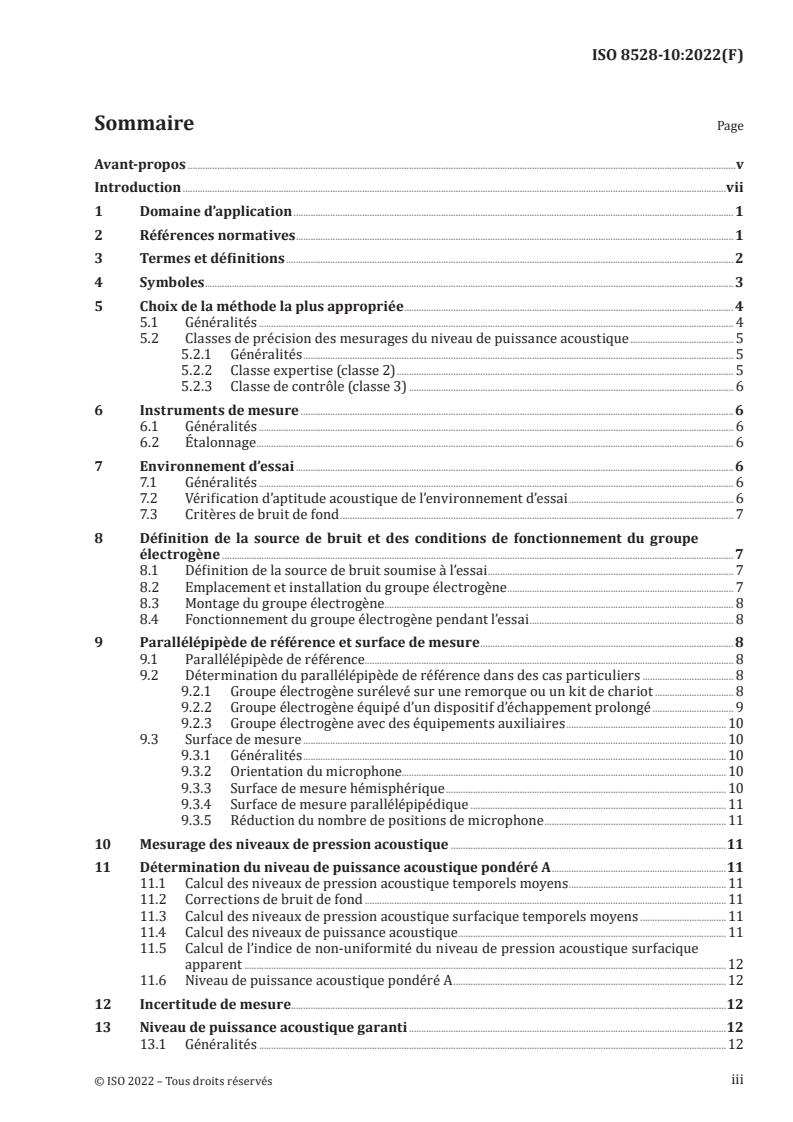
INTERNATIONAL ISO
STANDARD 8528-10
Second edition
2022-10
Reciprocating internal combustion
engine driven alternating current
generating sets —
Part 10:
Measurement of airborne noise
Groupes électrogènes à courant alternatif entraînés par moteurs
alternatifs à combustion interne —
Partie 10: Mesurage du bruit aérien
Reference number
© ISO 2022
All rights reserved. Unless otherwise specified, or required in the context of its implementation, no part of this publication may
be reproduced or utilized otherwise in any form or by any means, electronic or mechanical, including photocopying, or posting on
the internet or an intranet, without prior written permission. Permission can be requested from either ISO at the address below
or ISO’s member body in the country of the requester.
ISO copyright office
CP 401 • Ch. de Blandonnet 8
CH-1214 Vernier, Geneva
Phone: +41 22 749 01 11
Email: copyright@iso.org
Website: www.iso.org
Published in Switzerland
ii
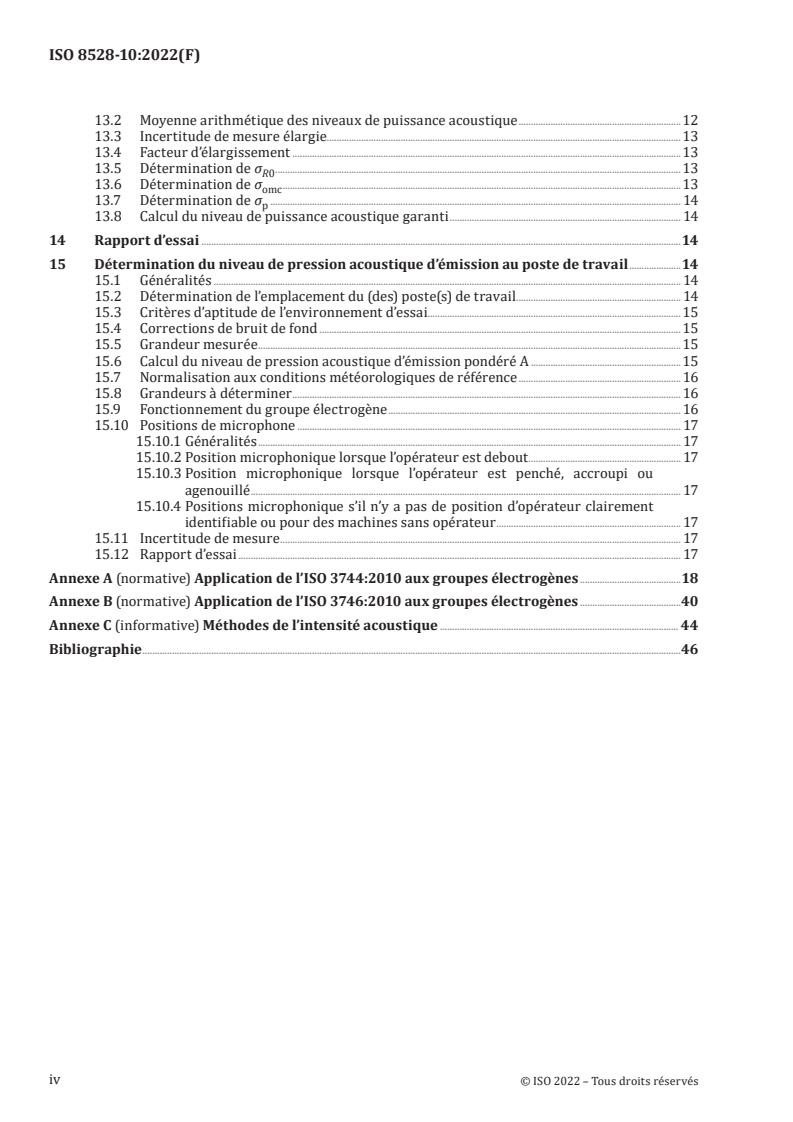
Contents Page
Foreword .v
Introduction . vi
1 Scope . 1
2 Normative references . 1
3 Terms and definitions . 2
4 Symbols . 3
5 Selection of the most appropriate method. 4
5.1 General . 4
5.2 Sound power level measurements accuracy grades . 5
5.2.1 General . 5
5.2.2 Engineering grade (grade 2). 5
5.2.3 Survey grade (grade 3) . 5
6 Measuring equipment . 6
6.1 General . 6
6.2 Calibration . 6
7 Measuring environment .6
7.1 General . 6
7.2 V erification of acoustic adequacy of test environment . 6
7.3 Criteria for background noise . 6
8 Definition of noise source and operating conditions of the generating set .6
8.1 Definition of noise source under test . 6
8.2 Location, installation of the generating set . 7
8.3 Mounting of the generating set . 7
8.4 Operation of the generating set during test . 7
9 Reference box and measurement surface . 8
9.1 Reference box. 8
9.2 Determination of the reference box in special cases . 8
9.2.1 Elevated generating set on a trailer or trolley kit . 8
9.2.2 Generating set with extended exhaust device . 8
9.2.3 Generating set with auxiliary equipment . 9
9.3 Measurement surface . 9
9.3.1 General . 9
9.3.2 Microphone orientation . 9
9.3.3 Hemispherical measurement surface . 10
9.3.4 Parallelepiped measurement surface . 10
9.3.5 Reduction in the number of microphone positions . 10
10 Measurement of sound pressure levels .10
11 Determination of the A-weighted sound power level .10
11.1 Calculation of mean-time-averaged sound pressure levels . 10
11.2 Corrections for background noise. 10
11.3 Calculation of the surface time-averaged sound pressure levels . 10
11.4 Calculation of sound power levels . 11
11.5 Calculation of apparent surface sound pressure level non-uniformity index . 11
11.6 A-weighted sound power level . 11
12 Measurement uncertainty .11
13 Guaranteed sound power level .11
13.1 General . 11
13.2 Arithmetic mean of sound power levels . 11
13.3 Expanded measurement uncertainty .12
iii
13.4 Coverage factor .12
13.5 Determination of σ . 12
R0
13.6 Determination of σ . 12
omc
13.7 Determination of σ . .13
p
13.8 Calculation of the guaranteed sound power level . 13
14 Test report .13
15 Determination of the emission sound pressure level at the workstation .13
15.1 General .13
15.2 Determination of location of the workstation(s) . 13
15.3 Criteria for the adequacy of the test environment . 14
15.4 Corrections for background noise. 14
15.5 Measured quantity . 14
15.6 Calculation of A-weighted emission sound pressure level . 14
15.7 Normalizing to reference meteorological conditions . 14
15.8 Quantities to be determined .15
15.9 Operation of the generating set . 15
15.10 Microphone positions .15
15.10.1 General .15
15.10.2 Microphone position for a standing operator. 16
15.10.3 Microphone position for a bending, crouching or kneeling operator . 16
15.10.4 Microphone positions if there is no clearly identifiable operator position or
for machines without operator . 16
15.11 Measurement uncertainty . 16
15.12 Test report . 16
Annex A (normative) Application of ISO 3744:2010 for generating sets .17
Annex B (normative) Application of ISO 3746:2010 for generating sets .37
Annex C (informative) Sound intensity methods .41
Bibliography .43
iv
Foreword
ISO (the International Organization for Standardization) is a worldwide federation of national standards
bodies (ISO member bodies). The work of preparing International Standards is normally carried out
through ISO technical committees. Each member body interested in a subject for which a technical
committee has been established has the right to be represented on that committee. International
organizations, governmental and non-governmental, in liaison with ISO, also take part in the work.
ISO collaborates closely with the International Electrotechnical Commission (IEC) on all matters of
electrotechnical standardization.
The procedures used to develop this document and those intended for its further maintenance are
described in the ISO/IEC Directives, Part 1. In particular, the different approval criteria needed for the
different types of ISO documents should be noted. This document was drafted in accordance with the
editorial rules of the ISO/IEC Directives, Part 2 (see www.iso.org/directives).
Attention is drawn to the possibility that some of the elements of this document may be the subject of
patent rights. ISO shall not be held responsible for identifying any or all such patent rights. Details of
any patent rights identified during the development of the document will be in the Introduction and/or
on the ISO list of patent declarations received (see www.iso.org/patents).
Any trade name used in this document is information given for the convenience of users and does not
constitute an endorsement.
For an explanation of the voluntary nature of standards, the meaning of ISO specific terms and
expressions related to conformity assessment, as well as information about ISO's adherence to
the World Trade Organization (WTO) principles in the Technical Barriers to Trade (TBT), see
www.iso.org/iso/foreword.html.
This document was prepared by Technical Committee ISO/TC 70, Internal combustion engines, in
collaboration with the European Committee for Standardization (CEN) Technical Committee CEN/
TC 270, Internal combustion engines, in accordance with the Agreement on technical cooperation
between ISO and CEN (Vienna Agreement).
This second edition cancels and replaces the first edition (ISO 8528-10:1998), which has been technically
revised.
The main changes are as follows:
— the normative references have been updated;
— the latest requirements of ISO 3744:2010 and ISO 3746:2010 have been included, respecting
ISO 12001:1996 requirements;
— the measurement surfaces have been updated;
— the definition of the reference box in special cases has been added;
— the guaranteed sound power level has been added;
— requirements concerning variable speed engine gensets, fans and lighting towers have been added;
— the requirements for welding generators have been updated;
— the determination of the emission sound pressure level at workstation has been updated.
A list of all parts in the ISO 8528 series can be found on the ISO website.
Any feedback or questions on this document should be directed to the user’s national standards body. A
complete listing of these bodies can be found at www.iso.org/members.html.
v
Introduction
This document specifies noise test codes for determining the basic noise emission descriptors.
For many manufacturers of generating sets, the control of noise is a major issue that requires
effective exchange of acoustical information, in particular on noise emission. The basic noise emission
descriptors are the sound power level of the generating set itself and the emission sound pressure level
at the workstation.
In this context, the main flow of information goes from the manufacturer to the purchaser. However,
installers and users of the generating sets also desire comprehensive information about the generating
sets' ability to generate airborne sound.
Thus, measuring the basic noise emission descriptors allows the generating set manufacturer to
determine, declare and verify the noise emission values.
Therefore, the sound power level, as the major parameter to characterize machines as sound sources,
is determined by measurements. The sound power level is a major parameter because it represents an
intrinsic characteristic of generating sets as noise sources. It is useful, for example, in noise-abatement
programmes or when designing a building where the generating set is intended to be used.
The emission sound pressure level at the workstation is also measured. This enables an assessment of
the risk of exposure to the airborne sound of the operators. This assessment is essential for health and
safety reasons.
In this document, the generating sets are considered as steady noise sources as per ISO 12001:1996.
The generating sets concerned and the extent to which noise is covered are indicated in this document.
This document allows measurements to be made in many different test environments. Clause 5 can be
used as a general guideline to assist in the selection of the right noise test code. The selection mainly
depends on the test environment and the desired grade of accuracy.
This document contains two methodologies for determining the measurement uncertainty. In
Clause 12, the uncertainty U is determined by considering measurements on a single generating set.
In Clause 13, the uncertainty K is determined by considering a batch of generating sets, which can be
useful for control of production purpose.
This document is a C-type standard as stated in ISO 12001:1996. When provisions of this C-type
standard are different from those stated in A or B standards, the provisions of this C-type standard
take precedence.
vi
INTERNATIONAL STANDARD ISO 8528-10:2022(E)
Reciprocating internal combustion engine driven
alternating current generating sets —
Part 10:
Measurement of airborne noise
1 Scope
This document specifies noise test codes for determining the sound power level and the emission sound
pressure level at the workstation of reciprocating internal combustion engine driven electrical power
generating sets.
This document applies to constant and variable-speed reciprocating internal combustion (RIC) engine
driven alternating current (AC) and direct current (DC) generating sets for fixed and mobile applications
with rigid or flexible mountings. It is applicable for land and marine use, excluding generating sets used
on aircraft or to propel land vehicles and locomotives.
NOTE 1 For some specific applications (e.g. essential hospital supplies, high-rise buildings) supplementary
requirements can be necessary. The provisions of this document can be regarded as a basis.
NOTE 2 This document is referenced with regard to noise in ISO 8528-13:2016, which contains requirements
concerning the design of generating sets, verification of noise levels and information related to noise in the
operating and maintenance instructions.
2 Normative references
The following documents are referred to in the text in such a way that some or all of their content
constitutes requirements of this document. For dated references, only the edition cited applies. For
undated references, the latest edition of the referenced document (including any amendments) applies.
ISO 3046-1:2002, Reciprocating internal combustion engines — Performance — Part 1: Declarations of
power, fuel and lubricating oil consumptions, and test methods — Additional requirements for engines for
general use
ISO 3744:2010, Acoustics — Determination of sound power levels and sound energy levels of noise sources
using sound pressure — Engineering methods for an essentially free field over a reflecting plane
ISO 3746:2010, Acoustics — Determination of sound power levels and sound energy levels of noise sources
using sound pressure — Survey method using an enveloping measurement surface over a reflecting plane
ISO 8528-1:2018, Reciprocating internal combustion engine driven alternating current generating sets —
Part 1: Application, ratings and performance
ISO 8528-2:2018, Reciprocating internal combustion engine driven alternating current generating sets —
Part 2: Engines
ISO 15619:2013, Reciprocating internal combustion engines — Measurement method for exhaust silencers
— Sound power level of exhaust noise and insertion loss using sound pressure and power loss ratio
IEC 60942:2017, Electroacoustics - Sound calibrators
IEC 60974-1:2021, Arc welding equipment - Part 1: Welding power sources
IEC 61260-1:2014, Electroacoustics - Octave-band and fractional-octave-band filters - Part 1: Specifications
IEC 61672-1:2013, Electroacoustics – Sound level meters – Part 1: specifications
3 Terms and definitions
For the purposes of this document, the terms and definitions given in ISO 3046-1:2002, ISO 8528-1:2018
and ISO 8528-2:2018 and the following apply.
ISO and IEC maintain terminology databases for use in standardization at the following addresses:
— ISO Online browsing platform: available at https:// www .iso .org/ obp
— IEC Electropedia: available at https:// www .electropedia .org/
3.1
emission
airborne sound radiated by the generating set under test
3.2
emission sound pressure
p
e
sound pressure, at a workstation or another specified position near a noise source, when the source is
in operation under specified operating and mounting conditions on a reflecting plane surface, excluding
the effects of background noise
Note 1 to entry: Emission sound pressure is expressed in pascals.
3.3
emission sound pressure level
L
pe
ten times the logarithm to the base 10 of the ratio of the square of the emission sound pressure, p , to
e
the square of a reference value, p , expressed in decibels by Formula (1):
p
e
L = 10 lg (1)
pe
p
where the reference value, p , is 20 µPa
3.4
time-averaged emission sound pressure level
L
pe,T
ten times the logarithm to the base 10 of the ratio of the time average of the square of the emission
sound pressure, p , during a stated time interval of duration, T (starting at t and ending at t ), to the
e 1 2
square of a reference value, p , expressed in decibels by Formula (2):
t
2
pt()dt
e
∫
t
T
L = 10 lg (2)
pe,T
p
where the reference value, p , is 20 µPa
Note 1 to entry: In general, the subscript “T” is omitted, since time-averaged sound pressure levels are necessarily
determined over a certain measurement time interval.
Note 2 to entry: L denotes the A-weighted emission sound pressure level.
peA
3.5
workstation
operator's position
position in the vicinity of the generating set under test which is intended for the operator
Note 1 to entry: This position is defined as the location in the vicinity of the device(s) mounted to the generating
set for work tasks.
Note 2 to entry: Such devices can be a control panel, an emergency stop button or the most likely device on the
equipment that an operator would interact with.
Note 3 to entry: A generating set can have more than one workstation.
3.6
operator
individual whose workstation is in the vicinity of a machine and who is performing a work task
associated with that machine
4 Symbols
cosϕ
power factor
d measurement distance, in metres
*
apparent directivity index, in decibels
D
Ii
i subscript denoting a particular measuring point
K expanded measurement uncertainty of the sound power level, or of the emission sound pressure
level at the workstation, for a batch of generating sets, in decibels
K A-weighted background noise correction, in decibels
1A
K A-weighted environmental correction, in decibels
2A
L sound pressure level, in decibels
p
surface time-averaged sound pressure level, in decibels
L
p
L emission sound pressure level, in decibels
pe
L A-weighted emission sound pressure level, in decibels
peA
L time-averaged emission sound pressure level, in decibels
pe,T
L time-averaged sound pressure level, for the ith microphone position on the measurement sur-
p,i T
face, in decibels
L time-averaged sound pressure level, in decibels
p,T
L sound power level, in decibels
W
L A-weighted sound power level, in decibels
WA
ΔL difference between the time-averaged sound pressure level of the background noise measured
p
and averaged over the microphone positions, and corresponding time-averaged sound pressure
level of the noise source under test when measured in the presence of this background noise,
in decibels
p sound pressure, in pascals
r measurement radius, in metres
S measurement surface, in square metres
T measurement time interval, in seconds
U expanded measurement uncertainty of the sound power level, or of the emission sound pressure
level at the workstation, for a single generating set, in decibels
*
apparent surface sound pressure level non-uniformity index, in decibels
V
I
5 Selection of the most appropriate method
5.1 General
Table 1 provides a detailed overview of the technical characteristics of the measurements methods in
this document. Table 1 describes noise test codes with two levels of accuracy (grades 2 and 3). It can
help in the selection of the appropriate noise test code.
Table 1 — Technical characteristics of this document
Measurement methods
Emission sound pressure
Sound power level meas- Sound power level meas-
level at the workstation
Parameters urement ISO 8528-10 urement ISO 8528-10
measurement ISO 8528-10
grade 2 grade 3
grade 2
Basic standards refer-
ISO 3744:2010 ISO 3746:2010 ISO 11201:2010
enced
Accuracy Grade 2 engineering Grade 3 survey Grade 2 engineering
Test environment Indoor or outdoor Indoor or outdoor Indoor or outdoor
Type of environment Dedicated to tests In situ Dedicated to tests
Hemi-anechoic rooms, Hemi-anechoic rooms,
Characteristics of envi- large rooms Not especially designed for large rooms
ronment or unobstructed outdoor acoustic tests or unobstructed outdoor
area area
Unspecified field with
Essentially free field over a Essentially free field over a
Acoustic field one or multiple reflecting
reflecting plane reflecting plane
plane(s)
Generating set volume Unlimited Unlimited Unlimited
Noise declaration Noise declaration
Applications as per
engineering study for noise Comparative tests engineering study for noise
ISO 12001:1996
reduction reduction
A-weighted sound power A-weighted sound pressure
level level
Frequency bands (octave) A-weighted sound power Frequency bands (octave)
Obtainable quantities
sound power level level sound pressure level
Frequency bands (one-third Frequency bands (one-third
octave) sound power level octave) sound pressure level
ΔL ≥ 6 dB ΔL ≥ 3 dB ΔL ≥ 6 dB
Criterion for back- p p p
ground noise
K ≤ 1,3 dB K ≤ 3 dB K ≤ 1,3 dB
1A 1A 1A
a
For indoor measurements only.
b
Specific studies carried out on generating sets can lead to lower values.
TTabablele 1 1 ((ccoonnttiinnueuedd))
Measurement methods
Emission sound pressure
Sound power level meas- Sound power level meas-
level at the workstation
Parameters urement ISO 8528-10 urement ISO 8528-10
measurement ISO 8528-10
grade 2 grade 3
grade 2
Criterion for acoustic
a
adequacy of test envi- K ≤ 4 dB K ≤ 7 dB K ≤ 4 dB
2A 2A 2A
ronment
Instrumentation Class 1 Class 2 Class 1
Typical upper bound
values of the standard
1,5 dB 4 dB 1,5 dB
deviation of reproduc-
b
ibility
a
For indoor measurements only.
b
Specific studies carried out on generating sets can lead to lower values.
5.2 Sound power level measurements accuracy grades
5.2.1 General
For sound power level measurements:
— Grade 2 provides more accurate results than grade 3 but involves greater measurement efforts.
— The grade 2 method is based on ISO 3744:2010. The requirements listed in Annex A shall be followed.
— Terms and definitions of ISO 3744:2010 applicable to generating sets are indicated in Table A.1.
— The grade 3 method is based on ISO 3746:2010. The requirements listed in Annex B shall be followed.
— Terms and definitions of ISO 3746:2010 applicable to generating sets are indicated in Table B.1.
— In this document, when the accuracy grade is not specified the requirements apply for grade 2 and
grade 3. The grade 3 method has many requirements in common with the grade 2 method.
5.2.2 Engineering grade (grade 2)
In this accuracy grade, the acoustic environment is analysed to determine its effect upon the
measurements. The environmental correction K shall be less than or equal to 4 dB. The background
2A
noise level is analysed too. Background noise correction K shall be less than or equal to 1,3 dB. The
1A
measuring points are selected according to the characteristics of the generating set. The engineering
method is the preferred method for noise declaration purposes. This method usually provides
information that is sufficient for taking engineering action in many situations, for example, in
connection with noise-abatement programmes.
5.2.3 Survey grade (grade 3)
This accuracy grade needs less time and equipment than grade 2. It may be used for comparison between
generating sets with similar characteristics. The measurements are made in situ with little effort
expended to control the acoustic environment in which the generating set operates. The environmental
correction K shall be less than or equal to 7 dB. The background noise correction K shall be less
2A 1A
than or equal to 3 dB. The survey method is generally of limited value if corrective measures to reduce
the noise are to be evaluated.
NOTE True comparisons can only be made between generating sets when the measurements are classified
in the same accuracy grade.
6 Measuring equipment
6.1 General
ISO 3744:2010, 5.1 and ISO 3746:2010, 5.1 are replaced by subclause A.2.1.
6.2 Calibration
ISO 3744:2010, 5.2 and ISO 3746:2010, 5.2 are replaced by subclause A.2.2.
7 Measuring environment
7.1 General
For accuracy grade 2, ISO 3744:2010, 1.3, and 4.1 apply.
For accuracy grade 3, ISO 3746:2010, 1.3, and 4.1 apply.
7.2 Verification of acoustic adequacy of test environment
For accuracy grade 2, the test environment shall meet the requirements of ISO 3744:2010, 4.3. In
addition, the following considerations shall be taken into account:
— Where it is decided to make measurements in frequency bands, the relevant environmental
correction K shall be determined in each band over the frequency range of interest in accordance
with A.6.
— In many cases, due to the reality of the acoustic properties of the measuring area and the test bench
conditions (this occurs predominantly with larger generating sets), sound power level grade 2 might
not be obtainable using the method described in this document. In special cases with the agreement
of the customer or the accepting company or authority, the accuracy may be improved with the use
of special measuring methods (e.g. sound intensity method in accordance with ISO 9614-1:1993 and
ISO 9614-2:1996, see Annex C).
For accuracy grade 3, the test environment shall meet the requirements of ISO 3746:2010, 8.1 and 4.3.
7.3 Criteria for background noise
For accuracy grade 2, the background noise shall meet the requirements of ISO 3744:2010, 4.2.
For accuracy grade 3, the background noise shall meet the requirements of ISO 3746:2010, 4.2.
In both cases, the following additional considerations shall be taken into account:
— Noise generated by air movement at the microphone itself is classified as background noise.
— For measuring out of doors, a microphone wind cover in accordance with the microphone
manufacturer's specifications shall be used.
— When measurements are done outside, the maximum speed of the wind shall not exceed 6 m/s.
8 Definition of noise source and operating conditions of the generating set
8.1 Definition of noise source under test
The noise of a generating set is defined as the total noise emitted by that generating set. This includes
the surface noise of the engine and the AC or DC alternator, the air intake and discharge noise, exhaust
noise (including the genset muffler, rain cap and tail pipe exhaust outlet), the noise emitted from the
cooling system of the power generator set, the radiator and other fans of the power generator, and the
noise which is emitted, for example, from the joining sections and the base frame, chassis and fuel tank.
In the case of totally or partially encapsulated generating sets, the surface noise is the noise emitted
from the enclosure.
If, as in special cases, one of the above-mentioned noise emissions is not in the measurement results,
then this shall be recorded in the measuring report. Such special cases include:
— in situ: when the exhaust and cooling systems are ducted to a remote site.
— in a test room: when the exhaust of the generating set is ducted out of the test room.
8.2 Location, installation of the generating set
For accuracy grade 2, the generalities in ISO 3744:2010, 6.1 apply.
For accuracy grade 3, the generalities in ISO 3746:2010, 6.1 apply.
For accuracy grade 2, ISO 3744:2010, 6.3, concerning noise source location, shall apply.
For accuracy grade 3, ISO 3746:2010, 6.3, concerning noise source location, shall apply.
In addition, the following considerations shall be taken into account:
— The generating set shall be prepared in accordance with the instructions given by the manufacturer.
— If simulated loading conditions are used, they shall be chosen such that the sound power levels of
the source under test are representative of normal use.
8.3 Mounting of the generating set
For accuracy grade 2, ISO 3744:2010, 6.4.1, concerning generalities about mounting of the noise source,
shall apply.
For accuracy grade 3, ISO 3746:2010, 6.4.1, concerning generalities about mounting of the noise source,
shall apply.
For accuracy grade 2, ISO 3744:2010, 6.4.3, concerning base-mounted, wall-mounted and tabletop
machinery and equipment, shall apply.
For accuracy grade 3, ISO 3746:2010, 6.4.3, concerning base-mounted, wall-mounted and tabletop
machinery and equipment, shall apply.
In addition, the following considerations shall be taken into account:
— For accuracy grade 2, the generating set shall be installed on a typical noise-reflecting ground plane
of concrete or non-porous asphalt, in an essentially free-field environment. Refer to the free-field
environment definition from ISO 3744:2010.
— For accuracy grade 2 and grade 3, the generating set shall be installed according to the manufacturer’s
recommendation, representative of a typical operational installation. This shall consider the
location of any discrete items (e.g. cooling, aftertreatment, exhaust) and mounting (e.g. trailer with
stabilizing jacks, skid).
8.4 Operation of the generating set during test
ISO 3744:2010, 6.6 and ISO 3746:2010, 6.5 are replaced by subclause A.3.
9 Reference box and measurement surface
9.1 Reference box
ISO 3744:2010, 7.1 and ISO 3746:2010, 7.1 are replaced by subclause A.4.
9.2 Determination of the reference box in special cases
9.2.1 Elevated generating set on a trailer or trolley kit
In cases where the generating set is elevated (e.g. on a trailer or a trolley kit) in normal customer use,
the reference box shall be delineated as per 9.1. An example is given in Figure 1.
Key
A generating set
B trailer
C reference box
D ground (reflecting plane)
Figure 1 — Example of a reference box for a generating set on a trailer
9.2.2 Generating set with extended exhaust device
In cases where the generating set is installed outdoors, with a vertical extended exhaust device, the
reference box shall be delineated depending on the value of m in the following cases. m is the distance
between the exhaust outlet of the generating set and the uppermost noise-emitting devices’ top surface.
Case 1: If m > 2 metres then a reduced reference box shall be used, including the uppermost noise emit-
ting devices’ top surface, but excluding the exhaust outlet. An example is given in Figure 2 a).
Case 2: If 1 metre ≤ m ≤ 2 metres, then the exhaust outlet shall be temporarily extended to have
m > 2 metres. Then a reduced reference box shall be used, including the uppermost noise emit-
ting devices’ top surface, but excluding the exhaust outlet. An example is given in Figure 2 a).
This extension is for measurement purposes only.
Case 3: If m < 1 metre then regular reference box shall be used, including the exhaust outlet. An example
is given in Figure 2 b).
With respect to cases 1 and 2, two components of sound power level (L ) shall be determined. The
WA
first component, L , shall be determined by taking into consideration the reduced reference box,
WA1
where sound power level emitted by the genset excluding the exhaust system is determined. The second
component, L , is the sound power level of the exhaust outlet. L shall be determined by using the
WA2 WA2
ISO 15619:2013 accuracy grade 2 method. Then Formula (3) shall be used.
LL//10 10
() ()
WA1 WA2
L = 10 lg 10 + 10 (3)
() ()
WA
In cases where the generating set is installed outdoors, with a remote exhaust device on the side, the
same requirements as detailed above shall apply.
a) b)
Key
A generating set E reference box
B cooling system F ground (reflecting plane)
C air intake G reduced reference box
D vertical extended exhaust device
Figure 2 — Example of reference boxes for generating sets with a vertical extended exhaust
device
9.2.3 Generating set with auxiliary equipment
In cases with auxiliary equipment that is necessary for the operation of the generating set but not part
of it (e.g. load banks), ISO 3744:2010, 6.2 or ISO 3746:2010, 6.2 shall apply.
In cases where there are auxiliary equipment that are necessary for the operation of the generating set
that are parts of it, ISO 3744:2010, 6.2, or ISO 3746:2010, 6.2 shall apply.
9.3 Measurement surface
9.3.1 General
ISO 3744:2010, 7.2.1 and ISO 3746:2010, 7.2.1 are replaced by subclause A.5.1.
9.3.2 Microphone orientation
For accuracy grade 2, ISO 3744:2010, 7.2.2 shall apply.
For accuracy grade 3, ISO 3746:2010, 7.2.2 shall apply.
In addition, the following considerations shall be taken into account:
— In an effort to reduce the influence on measured results due to people involved in the measuring
process, the microphone shall preferably be mounted statically.
— The measuring personnel shall remain at least 1,5 m from the microphone.
9.3.3 Hemispherical measurement surface
ISO 3744:2010, 7.2.3, 8.1.1, Annex B and Annex F and ISO 3746:2010, 7.2.3, 8.2.1, Annex B are replaced
by subclause A.5.2.
For accuracy grade 2, ISO 3744:2010, 8.4, concerning apparent directivity index and concentrated
microphone positions, can be used as an opportunity to reduce the measured sound power level.
9.3.4 Parallelepiped measurement surface
ISO 3744:2010, 7.2.4, 8.1.2 and Annex C and ISO 3746:2010, 7.2.4, 8.2.2 and Annex C are replaced by
subclause A.5.3.
For accuracy grade 2, ISO 3744:2010, 8.4, concerning apparent directivity index and concentrated
microphone positions, can be used as an opportunity to reduce the measured sound power level.
9.3.5 Reduction in the number of microphone positions
For accuracy grade 3 only, ISO 3746:2010, 8.2.3 is replaced by subclause B.2.
10 Measurement of sound pressure levels
For accuracy grade 2, ISO 3744:2010, 8.2.1, concerning measurement of sound pressure levels of the
generating set and of the background noise, applies.
For accuracy grade 3, ISO 3746:2010, 8.3.1, concerning measurement of sound pressure levels of t
...
INTERNATIONAL ISO
STANDARD 8528-10
Second edition
2022-10
Reciprocating internal combustion
engine driven alternating current
generating sets —
Part 10:
Measurement of airborne noise
Groupes électrogènes à courant alternatif entraînés par moteurs
alternatifs à combustion interne —
Partie 10: Mesurage du bruit aérien
Reference number
© ISO 2022
All rights reserved. Unless otherwise specified, or required in the context of its implementation, no part of this publication may
be reproduced or utilized otherwise in any form or by any means, electronic or mechanical, including photocopying, or posting on
the internet or an intranet, without prior written permission. Permission can be requested from either ISO at the address below
or ISO’s member body in the country of the requester.
ISO copyright office
CP 401 • Ch. de Blandonnet 8
CH-1214 Vernier, Geneva
Phone: +41 22 749 01 11
Email: copyright@iso.org
Website: www.iso.org
Published in Switzerland
ii
Contents Page
Foreword .v
Introduction . vi
1 Scope . 1
2 Normative references . 1
3 Terms and definitions . 2
4 Symbols . 3
5 Selection of the most appropriate method. 4
5.1 General . 4
5.2 Sound power level measurements accuracy grades . 5
5.2.1 General . 5
5.2.2 Engineering grade (grade 2). 5
5.2.3 Survey grade (grade 3) . 5
6 Measuring equipment . 6
6.1 General . 6
6.2 Calibration . 6
7 Measuring environment .6
7.1 General . 6
7.2 V erification of acoustic adequacy of test environment . 6
7.3 Criteria for background noise . 6
8 Definition of noise source and operating conditions of the generating set .6
8.1 Definition of noise source under test . 6
8.2 Location, installation of the generating set . 7
8.3 Mounting of the generating set . 7
8.4 Operation of the generating set during test . 7
9 Reference box and measurement surface . 8
9.1 Reference box. 8
9.2 Determination of the reference box in special cases . 8
9.2.1 Elevated generating set on a trailer or trolley kit . 8
9.2.2 Generating set with extended exhaust device . 8
9.2.3 Generating set with auxiliary equipment . 9
9.3 Measurement surface . 9
9.3.1 General . 9
9.3.2 Microphone orientation . 9
9.3.3 Hemispherical measurement surface . 10
9.3.4 Parallelepiped measurement surface . 10
9.3.5 Reduction in the number of microphone positions . 10
10 Measurement of sound pressure levels .10
11 Determination of the A-weighted sound power level .10
11.1 Calculation of mean-time-averaged sound pressure levels . 10
11.2 Corrections for background noise. 10
11.3 Calculation of the surface time-averaged sound pressure levels . 10
11.4 Calculation of sound power levels . 11
11.5 Calculation of apparent surface sound pressure level non-uniformity index . 11
11.6 A-weighted sound power level . 11
12 Measurement uncertainty .11
13 Guaranteed sound power level .11
13.1 General . 11
13.2 Arithmetic mean of sound power levels . 11
13.3 Expanded measurement uncertainty .12
iii
13.4 Coverage factor .12
13.5 Determination of σ . 12
R0
13.6 Determination of σ . 12
omc
13.7 Determination of σ . .13
p
13.8 Calculation of the guaranteed sound power level . 13
14 Test report .13
15 Determination of the emission sound pressure level at the workstation .13
15.1 General .13
15.2 Determination of location of the workstation(s) . 13
15.3 Criteria for the adequacy of the test environment . 14
15.4 Corrections for background noise. 14
15.5 Measured quantity . 14
15.6 Calculation of A-weighted emission sound pressure level . 14
15.7 Normalizing to reference meteorological conditions . 14
15.8 Quantities to be determined .15
15.9 Operation of the generating set . 15
15.10 Microphone positions .15
15.10.1 General .15
15.10.2 Microphone position for a standing operator. 16
15.10.3 Microphone position for a bending, crouching or kneeling operator . 16
15.10.4 Microphone positions if there is no clearly identifiable operator position or
for machines without operator . 16
15.11 Measurement uncertainty . 16
15.12 Test report . 16
Annex A (normative) Application of ISO 3744:2010 for generating sets .17
Annex B (normative) Application of ISO 3746:2010 for generating sets .37
Annex C (informative) Sound intensity methods .41
Bibliography .43
iv
Foreword
ISO (the International Organization for Standardization) is a worldwide federation of national standards
bodies (ISO member bodies). The work of preparing International Standards is normally carried out
through ISO technical committees. Each member body interested in a subject for which a technical
committee has been established has the right to be represented on that committee. International
organizations, governmental and non-governmental, in liaison with ISO, also take part in the work.
ISO collaborates closely with the International Electrotechnical Commission (IEC) on all matters of
electrotechnical standardization.
The procedures used to develop this document and those intended for its further maintenance are
described in the ISO/IEC Directives, Part 1. In particular, the different approval criteria needed for the
different types of ISO documents should be noted. This document was drafted in accordance with the
editorial rules of the ISO/IEC Directives, Part 2 (see www.iso.org/directives).
Attention is drawn to the possibility that some of the elements of this document may be the subject of
patent rights. ISO shall not be held responsible for identifying any or all such patent rights. Details of
any patent rights identified during the development of the document will be in the Introduction and/or
on the ISO list of patent declarations received (see www.iso.org/patents).
Any trade name used in this document is information given for the convenience of users and does not
constitute an endorsement.
For an explanation of the voluntary nature of standards, the meaning of ISO specific terms and
expressions related to conformity assessment, as well as information about ISO's adherence to
the World Trade Organization (WTO) principles in the Technical Barriers to Trade (TBT), see
www.iso.org/iso/foreword.html.
This document was prepared by Technical Committee ISO/TC 70, Internal combustion engines, in
collaboration with the European Committee for Standardization (CEN) Technical Committee CEN/
TC 270, Internal combustion engines, in accordance with the Agreement on technical cooperation
between ISO and CEN (Vienna Agreement).
This second edition cancels and replaces the first edition (ISO 8528-10:1998), which has been technically
revised.
The main changes are as follows:
— the normative references have been updated;
— the latest requirements of ISO 3744:2010 and ISO 3746:2010 have been included, respecting
ISO 12001:1996 requirements;
— the measurement surfaces have been updated;
— the definition of the reference box in special cases has been added;
— the guaranteed sound power level has been added;
— requirements concerning variable speed engine gensets, fans and lighting towers have been added;
— the requirements for welding generators have been updated;
— the determination of the emission sound pressure level at workstation has been updated.
A list of all parts in the ISO 8528 series can be found on the ISO website.
Any feedback or questions on this document should be directed to the user’s national standards body. A
complete listing of these bodies can be found at www.iso.org/members.html.
v
Introduction
This document specifies noise test codes for determining the basic noise emission descriptors.
For many manufacturers of generating sets, the control of noise is a major issue that requires
effective exchange of acoustical information, in particular on noise emission. The basic noise emission
descriptors are the sound power level of the generating set itself and the emission sound pressure level
at the workstation.
In this context, the main flow of information goes from the manufacturer to the purchaser. However,
installers and users of the generating sets also desire comprehensive information about the generating
sets' ability to generate airborne sound.
Thus, measuring the basic noise emission descriptors allows the generating set manufacturer to
determine, declare and verify the noise emission values.
Therefore, the sound power level, as the major parameter to characterize machines as sound sources,
is determined by measurements. The sound power level is a major parameter because it represents an
intrinsic characteristic of generating sets as noise sources. It is useful, for example, in noise-abatement
programmes or when designing a building where the generating set is intended to be used.
The emission sound pressure level at the workstation is also measured. This enables an assessment of
the risk of exposure to the airborne sound of the operators. This assessment is essential for health and
safety reasons.
In this document, the generating sets are considered as steady noise sources as per ISO 12001:1996.
The generating sets concerned and the extent to which noise is covered are indicated in this document.
This document allows measurements to be made in many different test environments. Clause 5 can be
used as a general guideline to assist in the selection of the right noise test code. The selection mainly
depends on the test environment and the desired grade of accuracy.
This document contains two methodologies for determining the measurement uncertainty. In
Clause 12, the uncertainty U is determined by considering measurements on a single generating set.
In Clause 13, the uncertainty K is determined by considering a batch of generating sets, which can be
useful for control of production purpose.
This document is a C-type standard as stated in ISO 12001:1996. When provisions of this C-type
standard are different from those stated in A or B standards, the provisions of this C-type standard
take precedence.
vi
INTERNATIONAL STANDARD ISO 8528-10:2022(E)
Reciprocating internal combustion engine driven
alternating current generating sets —
Part 10:
Measurement of airborne noise
1 Scope
This document specifies noise test codes for determining the sound power level and the emission sound
pressure level at the workstation of reciprocating internal combustion engine driven electrical power
generating sets.
This document applies to constant and variable-speed reciprocating internal combustion (RIC) engine
driven alternating current (AC) and direct current (DC) generating sets for fixed and mobile applications
with rigid or flexible mountings. It is applicable for land and marine use, excluding generating sets used
on aircraft or to propel land vehicles and locomotives.
NOTE 1 For some specific applications (e.g. essential hospital supplies, high-rise buildings) supplementary
requirements can be necessary. The provisions of this document can be regarded as a basis.
NOTE 2 This document is referenced with regard to noise in ISO 8528-13:2016, which contains requirements
concerning the design of generating sets, verification of noise levels and information related to noise in the
operating and maintenance instructions.
2 Normative references
The following documents are referred to in the text in such a way that some or all of their content
constitutes requirements of this document. For dated references, only the edition cited applies. For
undated references, the latest edition of the referenced document (including any amendments) applies.
ISO 3046-1:2002, Reciprocating internal combustion engines — Performance — Part 1: Declarations of
power, fuel and lubricating oil consumptions, and test methods — Additional requirements for engines for
general use
ISO 3744:2010, Acoustics — Determination of sound power levels and sound energy levels of noise sources
using sound pressure — Engineering methods for an essentially free field over a reflecting plane
ISO 3746:2010, Acoustics — Determination of sound power levels and sound energy levels of noise sources
using sound pressure — Survey method using an enveloping measurement surface over a reflecting plane
ISO 8528-1:2018, Reciprocating internal combustion engine driven alternating current generating sets —
Part 1: Application, ratings and performance
ISO 8528-2:2018, Reciprocating internal combustion engine driven alternating current generating sets —
Part 2: Engines
ISO 15619:2013, Reciprocating internal combustion engines — Measurement method for exhaust silencers
— Sound power level of exhaust noise and insertion loss using sound pressure and power loss ratio
IEC 60942:2017, Electroacoustics - Sound calibrators
IEC 60974-1:2021, Arc welding equipment - Part 1: Welding power sources
IEC 61260-1:2014, Electroacoustics - Octave-band and fractional-octave-band filters - Part 1: Specifications
IEC 61672-1:2013, Electroacoustics – Sound level meters – Part 1: specifications
3 Terms and definitions
For the purposes of this document, the terms and definitions given in ISO 3046-1:2002, ISO 8528-1:2018
and ISO 8528-2:2018 and the following apply.
ISO and IEC maintain terminology databases for use in standardization at the following addresses:
— ISO Online browsing platform: available at https:// www .iso .org/ obp
— IEC Electropedia: available at https:// www .electropedia .org/
3.1
emission
airborne sound radiated by the generating set under test
3.2
emission sound pressure
p
e
sound pressure, at a workstation or another specified position near a noise source, when the source is
in operation under specified operating and mounting conditions on a reflecting plane surface, excluding
the effects of background noise
Note 1 to entry: Emission sound pressure is expressed in pascals.
3.3
emission sound pressure level
L
pe
ten times the logarithm to the base 10 of the ratio of the square of the emission sound pressure, p , to
e
the square of a reference value, p , expressed in decibels by Formula (1):
p
e
L = 10 lg (1)
pe
p
where the reference value, p , is 20 µPa
3.4
time-averaged emission sound pressure level
L
pe,T
ten times the logarithm to the base 10 of the ratio of the time average of the square of the emission
sound pressure, p , during a stated time interval of duration, T (starting at t and ending at t ), to the
e 1 2
square of a reference value, p , expressed in decibels by Formula (2):
t
2
pt()dt
e
∫
t
T
L = 10 lg (2)
pe,T
p
where the reference value, p , is 20 µPa
Note 1 to entry: In general, the subscript “T” is omitted, since time-averaged sound pressure levels are necessarily
determined over a certain measurement time interval.
Note 2 to entry: L denotes the A-weighted emission sound pressure level.
peA
3.5
workstation
operator's position
position in the vicinity of the generating set under test which is intended for the operator
Note 1 to entry: This position is defined as the location in the vicinity of the device(s) mounted to the generating
set for work tasks.
Note 2 to entry: Such devices can be a control panel, an emergency stop button or the most likely device on the
equipment that an operator would interact with.
Note 3 to entry: A generating set can have more than one workstation.
3.6
operator
individual whose workstation is in the vicinity of a machine and who is performing a work task
associated with that machine
4 Symbols
cosϕ
power factor
d measurement distance, in metres
*
apparent directivity index, in decibels
D
Ii
i subscript denoting a particular measuring point
K expanded measurement uncertainty of the sound power level, or of the emission sound pressure
level at the workstation, for a batch of generating sets, in decibels
K A-weighted background noise correction, in decibels
1A
K A-weighted environmental correction, in decibels
2A
L sound pressure level, in decibels
p
surface time-averaged sound pressure level, in decibels
L
p
L emission sound pressure level, in decibels
pe
L A-weighted emission sound pressure level, in decibels
peA
L time-averaged emission sound pressure level, in decibels
pe,T
L time-averaged sound pressure level, for the ith microphone position on the measurement sur-
p,i T
face, in decibels
L time-averaged sound pressure level, in decibels
p,T
L sound power level, in decibels
W
L A-weighted sound power level, in decibels
WA
ΔL difference between the time-averaged sound pressure level of the background noise measured
p
and averaged over the microphone positions, and corresponding time-averaged sound pressure
level of the noise source under test when measured in the presence of this background noise,
in decibels
p sound pressure, in pascals
r measurement radius, in metres
S measurement surface, in square metres
T measurement time interval, in seconds
U expanded measurement uncertainty of the sound power level, or of the emission sound pressure
level at the workstation, for a single generating set, in decibels
*
apparent surface sound pressure level non-uniformity index, in decibels
V
I
5 Selection of the most appropriate method
5.1 General
Table 1 provides a detailed overview of the technical characteristics of the measurements methods in
this document. Table 1 describes noise test codes with two levels of accuracy (grades 2 and 3). It can
help in the selection of the appropriate noise test code.
Table 1 — Technical characteristics of this document
Measurement methods
Emission sound pressure
Sound power level meas- Sound power level meas-
level at the workstation
Parameters urement ISO 8528-10 urement ISO 8528-10
measurement ISO 8528-10
grade 2 grade 3
grade 2
Basic standards refer-
ISO 3744:2010 ISO 3746:2010 ISO 11201:2010
enced
Accuracy Grade 2 engineering Grade 3 survey Grade 2 engineering
Test environment Indoor or outdoor Indoor or outdoor Indoor or outdoor
Type of environment Dedicated to tests In situ Dedicated to tests
Hemi-anechoic rooms, Hemi-anechoic rooms,
Characteristics of envi- large rooms Not especially designed for large rooms
ronment or unobstructed outdoor acoustic tests or unobstructed outdoor
area area
Unspecified field with
Essentially free field over a Essentially free field over a
Acoustic field one or multiple reflecting
reflecting plane reflecting plane
plane(s)
Generating set volume Unlimited Unlimited Unlimited
Noise declaration Noise declaration
Applications as per
engineering study for noise Comparative tests engineering study for noise
ISO 12001:1996
reduction reduction
A-weighted sound power A-weighted sound pressure
level level
Frequency bands (octave) A-weighted sound power Frequency bands (octave)
Obtainable quantities
sound power level level sound pressure level
Frequency bands (one-third Frequency bands (one-third
octave) sound power level octave) sound pressure level
ΔL ≥ 6 dB ΔL ≥ 3 dB ΔL ≥ 6 dB
Criterion for back- p p p
ground noise
K ≤ 1,3 dB K ≤ 3 dB K ≤ 1,3 dB
1A 1A 1A
a
For indoor measurements only.
b
Specific studies carried out on generating sets can lead to lower values.
TTabablele 1 1 ((ccoonnttiinnueuedd))
Measurement methods
Emission sound pressure
Sound power level meas- Sound power level meas-
level at the workstation
Parameters urement ISO 8528-10 urement ISO 8528-10
measurement ISO 8528-10
grade 2 grade 3
grade 2
Criterion for acoustic
a
adequacy of test envi- K ≤ 4 dB K ≤ 7 dB K ≤ 4 dB
2A 2A 2A
ronment
Instrumentation Class 1 Class 2 Class 1
Typical upper bound
values of the standard
1,5 dB 4 dB 1,5 dB
deviation of reproduc-
b
ibility
a
For indoor measurements only.
b
Specific studies carried out on generating sets can lead to lower values.
5.2 Sound power level measurements accuracy grades
5.2.1 General
For sound power level measurements:
— Grade 2 provides more accurate results than grade 3 but involves greater measurement efforts.
— The grade 2 method is based on ISO 3744:2010. The requirements listed in Annex A shall be followed.
— Terms and definitions of ISO 3744:2010 applicable to generating sets are indicated in Table A.1.
— The grade 3 method is based on ISO 3746:2010. The requirements listed in Annex B shall be followed.
— Terms and definitions of ISO 3746:2010 applicable to generating sets are indicated in Table B.1.
— In this document, when the accuracy grade is not specified the requirements apply for grade 2 and
grade 3. The grade 3 method has many requirements in common with the grade 2 method.
5.2.2 Engineering grade (grade 2)
In this accuracy grade, the acoustic environment is analysed to determine its effect upon the
measurements. The environmental correction K shall be less than or equal to 4 dB. The background
2A
noise level is analysed too. Background noise correction K shall be less than or equal to 1,3 dB. The
1A
measuring points are selected according to the characteristics of the generating set. The engineering
method is the preferred method for noise declaration purposes. This method usually provides
information that is sufficient for taking engineering action in many situations, for example, in
connection with noise-abatement programmes.
5.2.3 Survey grade (grade 3)
This accuracy grade needs less time and equipment than grade 2. It may be used for comparison between
generating sets with similar characteristics. The measurements are made in situ with little effort
expended to control the acoustic environment in which the generating set operates. The environmental
correction K shall be less than or equal to 7 dB. The background noise correction K shall be less
2A 1A
than or equal to 3 dB. The survey method is generally of limited value if corrective measures to reduce
the noise are to be evaluated.
NOTE True comparisons can only be made between generating sets when the measurements are classified
in the same accuracy grade.
6 Measuring equipment
6.1 General
ISO 3744:2010, 5.1 and ISO 3746:2010, 5.1 are replaced by subclause A.2.1.
6.2 Calibration
ISO 3744:2010, 5.2 and ISO 3746:2010, 5.2 are replaced by subclause A.2.2.
7 Measuring environment
7.1 General
For accuracy grade 2, ISO 3744:2010, 1.3, and 4.1 apply.
For accuracy grade 3, ISO 3746:2010, 1.3, and 4.1 apply.
7.2 Verification of acoustic adequacy of test environment
For accuracy grade 2, the test environment shall meet the requirements of ISO 3744:2010, 4.3. In
addition, the following considerations shall be taken into account:
— Where it is decided to make measurements in frequency bands, the relevant environmental
correction K shall be determined in each band over the frequency range of interest in accordance
with A.6.
— In many cases, due to the reality of the acoustic properties of the measuring area and the test bench
conditions (this occurs predominantly with larger generating sets), sound power level grade 2 might
not be obtainable using the method described in this document. In special cases with the agreement
of the customer or the accepting company or authority, the accuracy may be improved with the use
of special measuring methods (e.g. sound intensity method in accordance with ISO 9614-1:1993 and
ISO 9614-2:1996, see Annex C).
For accuracy grade 3, the test environment shall meet the requirements of ISO 3746:2010, 8.1 and 4.3.
7.3 Criteria for background noise
For accuracy grade 2, the background noise shall meet the requirements of ISO 3744:2010, 4.2.
For accuracy grade 3, the background noise shall meet the requirements of ISO 3746:2010, 4.2.
In both cases, the following additional considerations shall be taken into account:
— Noise generated by air movement at the microphone itself is classified as background noise.
— For measuring out of doors, a microphone wind cover in accordance with the microphone
manufacturer's specifications shall be used.
— When measurements are done outside, the maximum speed of the wind shall not exceed 6 m/s.
8 Definition of noise source and operating conditions of the generating set
8.1 Definition of noise source under test
The noise of a generating set is defined as the total noise emitted by that generating set. This includes
the surface noise of the engine and the AC or DC alternator, the air intake and discharge noise, exhaust
noise (including the genset muffler, rain cap and tail pipe exhaust outlet), the noise emitted from the
cooling system of the power generator set, the radiator and other fans of the power generator, and the
noise which is emitted, for example, from the joining sections and the base frame, chassis and fuel tank.
In the case of totally or partially encapsulated generating sets, the surface noise is the noise emitted
from the enclosure.
If, as in special cases, one of the above-mentioned noise emissions is not in the measurement results,
then this shall be recorded in the measuring report. Such special cases include:
— in situ: when the exhaust and cooling systems are ducted to a remote site.
— in a test room: when the exhaust of the generating set is ducted out of the test room.
8.2 Location, installation of the generating set
For accuracy grade 2, the generalities in ISO 3744:2010, 6.1 apply.
For accuracy grade 3, the generalities in ISO 3746:2010, 6.1 apply.
For accuracy grade 2, ISO 3744:2010, 6.3, concerning noise source location, shall apply.
For accuracy grade 3, ISO 3746:2010, 6.3, concerning noise source location, shall apply.
In addition, the following considerations shall be taken into account:
— The generating set shall be prepared in accordance with the instructions given by the manufacturer.
— If simulated loading conditions are used, they shall be chosen such that the sound power levels of
the source under test are representative of normal use.
8.3 Mounting of the generating set
For accuracy grade 2, ISO 3744:2010, 6.4.1, concerning generalities about mounting of the noise source,
shall apply.
For accuracy grade 3, ISO 3746:2010, 6.4.1, concerning generalities about mounting of the noise source,
shall apply.
For accuracy grade 2, ISO 3744:2010, 6.4.3, concerning base-mounted, wall-mounted and tabletop
machinery and equipment, shall apply.
For accuracy grade 3, ISO 3746:2010, 6.4.3, concerning base-mounted, wall-mounted and tabletop
machinery and equipment, shall apply.
In addition, the following considerations shall be taken into account:
— For accuracy grade 2, the generating set shall be installed on a typical noise-reflecting ground plane
of concrete or non-porous asphalt, in an essentially free-field environment. Refer to the free-field
environment definition from ISO 3744:2010.
— For accuracy grade 2 and grade 3, the generating set shall be installed according to the manufacturer’s
recommendation, representative of a typical operational installation. This shall consider the
location of any discrete items (e.g. cooling, aftertreatment, exhaust) and mounting (e.g. trailer with
stabilizing jacks, skid).
8.4 Operation of the generating set during test
ISO 3744:2010, 6.6 and ISO 3746:2010, 6.5 are replaced by subclause A.3.
9 Reference box and measurement surface
9.1 Reference box
ISO 3744:2010, 7.1 and ISO 3746:2010, 7.1 are replaced by subclause A.4.
9.2 Determination of the reference box in special cases
9.2.1 Elevated generating set on a trailer or trolley kit
In cases where the generating set is elevated (e.g. on a trailer or a trolley kit) in normal customer use,
the reference box shall be delineated as per 9.1. An example is given in Figure 1.
Key
A generating set
B trailer
C reference box
D ground (reflecting plane)
Figure 1 — Example of a reference box for a generating set on a trailer
9.2.2 Generating set with extended exhaust device
In cases where the generating set is installed outdoors, with a vertical extended exhaust device, the
reference box shall be delineated depending on the value of m in the following cases. m is the distance
between the exhaust outlet of the generating set and the uppermost noise-emitting devices’ top surface.
Case 1: If m > 2 metres then a reduced reference box shall be used, including the uppermost noise emit-
ting devices’ top surface, but excluding the exhaust outlet. An example is given in Figure 2 a).
Case 2: If 1 metre ≤ m ≤ 2 metres, then the exhaust outlet shall be temporarily extended to have
m > 2 metres. Then a reduced reference box shall be used, including the uppermost noise emit-
ting devices’ top surface, but excluding the exhaust outlet. An example is given in Figure 2 a).
This extension is for measurement purposes only.
Case 3: If m < 1 metre then regular reference box shall be used, including the exhaust outlet. An example
is given in Figure 2 b).
With respect to cases 1 and 2, two components of sound power level (L ) shall be determined. The
WA
first component, L , shall be determined by taking into consideration the reduced reference box,
WA1
where sound power level emitted by the genset excluding the exhaust system is determined. The second
component, L , is the sound power level of the exhaust outlet. L shall be determined by using the
WA2 WA2
ISO 15619:2013 accuracy grade 2 method. Then Formula (3) shall be used.
LL//10 10
() ()
WA1 WA2
L = 10 lg 10 + 10 (3)
() ()
WA
In cases where the generating set is installed outdoors, with a remote exhaust device on the side, the
same requirements as detailed above shall apply.
a) b)
Key
A generating set E reference box
B cooling system F ground (reflecting plane)
C air intake G reduced reference box
D vertical extended exhaust device
Figure 2 — Example of reference boxes for generating sets with a vertical extended exhaust
device
9.2.3 Generating set with auxiliary equipment
In cases with auxiliary equipment that is necessary for the operation of the generating set but not part
of it (e.g. load banks), ISO 3744:2010, 6.2 or ISO 3746:2010, 6.2 shall apply.
In cases where there are auxiliary equipment that are necessary for the operation of the generating set
that are parts of it, ISO 3744:2010, 6.2, or ISO 3746:2010, 6.2 shall apply.
9.3 Measurement surface
9.3.1 General
ISO 3744:2010, 7.2.1 and ISO 3746:2010, 7.2.1 are replaced by subclause A.5.1.
9.3.2 Microphone orientation
For accuracy grade 2, ISO 3744:2010, 7.2.2 shall apply.
For accuracy grade 3, ISO 3746:2010, 7.2.2 shall apply.
In addition, the following considerations shall be taken into account:
— In an effort to reduce the influence on measured results due to people involved in the measuring
process, the microphone shall preferably be mounted statically.
— The measuring personnel shall remain at least 1,5 m from the microphone.
9.3.3 Hemispherical measurement surface
ISO 3744:2010, 7.2.3, 8.1.1, Annex B and Annex F and ISO 3746:2010, 7.2.3, 8.2.1, Annex B are replaced
by subclause A.5.2.
For accuracy grade 2, ISO 3744:2010, 8.4, concerning apparent directivity index and concentrated
microphone positions, can be used as an opportunity to reduce the measured sound power level.
9.3.4 Parallelepiped measurement surface
ISO 3744:2010, 7.2.4, 8.1.2 and Annex C and ISO 3746:2010, 7.2.4, 8.2.2 and Annex C are replaced by
subclause A.5.3.
For accuracy grade 2, ISO 3744:2010, 8.4, concerning apparent directivity index and concentrated
microphone positions, can be used as an opportunity to reduce the measured sound power level.
9.3.5 Reduction in the number of microphone positions
For accuracy grade 3 only, ISO 3746:2010, 8.2.3 is replaced by subclause B.2.
10 Measurement of sound pressure levels
For accuracy grade 2, ISO 3744:2010, 8.2.1, concerning measurement of sound pressure levels of the
generating set and of the background noise, applies.
For accuracy grade 3, ISO 3746:2010, 8.3.1, concerning measurement of sound pressure levels of the
generating set and of the background noise, applies.
In addition, the following considerations shall be taken into account for accuracy grades 2 and 3:
— The measurement time interval should be 20 s or longer but shall be at least 15 s for all frequency
bands or for A-weighting.
— The definition of the frequency range of interest, in ISO 3744:2010, 3.9 and ISO 3746:2010, 3.7, is
replaced by subclause A.6.
11 Determination of the A-weighted sound power level
11.1 Calculation of mean-time-averaged sound pressure levels
For accuracy grade 2, ISO 3744:2010, 8.2.2.1 shall apply.
For accuracy grade 3, ISO 3746:2010, 8.3.2 shall apply.
11.2 Corrections for background noise
For accuracy grade 2, ISO 3744:2010, 8.2.3 shall apply.
For accuracy grade 3, ISO 3746:2010, 8.3.3 shall apply.
11.3 Calculation of the surface time-averaged sound pressure levels
For accuracy grade 2, ISO 3744:2010, 8.2.4 shall apply.
For accuracy grade 3, ISO 3746:2010, 8.3.4 shall apply.
11.4 Calculation of sound power levels
For accuracy grade 2, ISO 3744:2010, 8.2.5 and Annex G shall apply.
For accuracy grade 3, ISO 3746:2010, 8.3.5 shall apply.
11.5 Calculation of apparent surface sound pressure level non-unifo
...
NORME ISO
INTERNATIONALE 8528-10
Deuxième édition
2022-10
Groupes électrogènes à courant
alternatif entraînés par moteurs
alternatifs à combustion interne —
Partie 10:
Mesurage du bruit aérien
Reciprocating internal combustion engine driven alternating current
generating sets —
Part 10: Measurement of airborne noise
Numéro de référence
DOCUMENT PROTÉGÉ PAR COPYRIGHT
© ISO 2022
Tous droits réservés. Sauf prescription différente ou nécessité dans le contexte de sa mise en œuvre, aucune partie de cette
publication ne peut être reproduite ni utilisée sous quelque forme que ce soit et par aucun procédé, électronique ou mécanique,
y compris la photocopie, ou la diffusion sur l’internet ou sur un intranet, sans autorisation écrite préalable. Une autorisation peut
être demandée à l’ISO à l’adresse ci-après ou au comité membre de l’ISO dans le pays du demandeur.
ISO copyright office
Case postale 401 • Ch. de Blandonnet 8
CH-1214 Vernier, Genève
Tél.: +41 22 749 01 11
E-mail: copyright@iso.org
Web: www.iso.org
Publié en Suisse
ii
Sommaire Page
Avant-propos .v
Introduction .vii
1 Domaine d’application . 1
2 Références normatives .1
3 Termes et définitions . 2
4 Symboles . 3
5 Choix de la méthode la plus appropriée . 4
5.1 Généralités . 4
5.2 Classes de précision des mesurages du niveau de puissance acoustique . 5
5.2.1 Généralités . 5
5.2.2 Classe expertise (classe 2) . 5
5.2.3 Classe de contrôle (classe 3) . 6
6 Instruments de mesure .6
6.1 Généralités . 6
6.2 Étalonnage . 6
7 Environnement d’essai .6
7.1 Généralités . 6
7.2 Vérification d’aptitude acoustique de l’environnement d’essai . 6
7.3 Critères de bruit de fond . 7
8 Définition de la source de bruit et des conditions de fonctionnement du groupe
électrogène . 7
8.1 Définition de la source de bruit soumise à l’essai . 7
8.2 Emplacement et installation du groupe électrogène . 7
8.3 Montage du groupe électrogène. 8
8.4 Fonctionnement du groupe électrogène pendant l’essai . 8
9 Parallélépipède de référence et surface de mesure . 8
9.1 Parallélépipède de référence. 8
9.2 Détermination du parallélépipède de référence dans des cas particuliers . 8
9.2.1 Groupe électrogène surélevé sur une remorque ou un kit de chariot . 8
9.2.2 Groupe électrogène équipé d’un dispositif d’échappement prolongé . 9
9.2.3 Groupe électrogène avec des équipements auxiliaires . 10
9.3 Surface de mesure . 10
9.3.1 Généralités . 10
9.3.2 Orientation du microphone. 10
9.3.3 Surface de mesure hémisphérique . 10
9.3.4 Surface de mesure parallélépipédique . 11
9.3.5 Réduction du nombre de positions de microphone . 11
10 Mesurage des niveaux de pression acoustique .11
11 Détermination du niveau de puissance acoustique pondéré A .11
11.1 Calcul des niveaux de pression acoustique temporels moyens . 11
11.2 Corrections de bruit de fond . 11
11.3 Calcul des niveaux de pression acoustique surfacique temporels moyens . 11
11.4 Calcul des niveaux de puissance acoustique . 11
11.5 Calcul de l’indice de non-uniformité du niveau de pression acoustique surfacique
apparent .12
11.6 Niveau de puissance acoustique pondéré A .12
12 Incertitude de mesure.12
13 Niveau de puissance acoustique garanti .12
13.1 Généralités .12
iii
13.2 Moyenne arithmétique des niveaux de puissance acoustique .12
13.3 Incertitude de mesure élargie. 13
13.4 Facteur d’élargissement .13
13.5 Détermination de σ . 13
R0
13.6 Détermination de σ .13
omc
13.7 Détermination de σ . 14
p
13.8 Calcul du niveau de puissance acoustique garanti . 14
14 Rapport d’essai .14
15 Détermination du niveau de pression acoustique d’émission au poste de travail .14
15.1 Généralités . 14
15.2 Détermination de l’emplacement du (des) poste(s) de travail . 14
15.3 Critères d’aptitude de l’environnement d’essai. 15
15.4 Corrections de bruit de fond . 15
15.5 Grandeur mesurée .15
15.6 Calcul du niveau de pression acoustique d’émission pondéré A . 15
15.7 Normalisation aux conditions météorologiques de référence . 16
15.8 Grandeurs à déterminer . 16
15.9 Fonctionnement du groupe électrogène . 16
15.10 Positions de microphone . 17
15.10.1 Généralités . 17
15.10.2 Position microphonique lorsque l’opérateur est debout . 17
15.10.3 Position microphonique lorsque l’opérateur est penché, accroupi ou
agenouillé . 17
15.10.4 Positions microphonique s’il n’y a pas de position d’opérateur clairement
identifiable ou pour des machines sans opérateur . 17
15.11 Incertitude de mesure . 17
15.12 Rapport d’essai . 17
Annexe A (normative) Application de l’ISO 3744:2010 aux groupes électrogènes .18
Annexe B (normative) Application de l’ISO 3746:2010 aux groupes électrogènes .40
Annexe C (informative) Méthodes de l’intensité acoustique . 44
Bibliographie .46
iv
Avant-propos
L'ISO (Organisation internationale de normalisation) est une fédération mondiale d'organismes
nationaux de normalisation (comités membres de l'ISO). L'élaboration des Normes internationales est
en général confiée aux comités techniques de l'ISO. Chaque comité membre intéressé par une étude
a le droit de faire partie du comité technique créé à cet effet. Les organisations internationales,
gouvernementales et non gouvernementales, en liaison avec l'ISO participent également aux travaux.
L'ISO collabore étroitement avec la Commission électrotechnique internationale (IEC) en ce qui
concerne la normalisation électrotechnique.
Les procédures utilisées pour élaborer le présent document et celles destinées à sa mise à jour sont
décrites dans les Directives ISO/IEC, Partie 1. Il convient, en particulier, de prendre note des différents
critères d'approbation requis pour les différents types de documents ISO. Le présent document a
été rédigé conformément aux règles de rédaction données dans les Directives ISO/IEC, Partie 2 (voir
www.iso.org/directives).
L'attention est attirée sur le fait que certains des éléments du présent document peuvent faire l'objet de
droits de propriété intellectuelle ou de droits analogues. L'ISO ne saurait être tenue pour responsable
de ne pas avoir identifié de tels droits de propriété et averti de leur existence. Les détails concernant
les références aux droits de propriété intellectuelle ou autres droits analogues identifiés lors de
l'élaboration du document sont indiqués dans l'Introduction et/ou dans la liste des déclarations de
brevets reçues par l'ISO (voir www.iso.org/brevets).
Les appellations commerciales éventuellement mentionnées dans le présent document sont données
pour information, par souci de commodité, à l’intention des utilisateurs et ne sauraient constituer un
engagement.
Pour une explication de la nature volontaire des normes, la signification des termes et expressions
spécifiques de l'ISO liés à l'évaluation de la conformité, ou pour toute information au sujet de l'adhésion
de l'ISO aux principes de l’Organisation mondiale du commerce (OMC) concernant les obstacles
techniques au commerce (OTC), voir www.iso.org/avant-propos.
Le présent document a été élaboré par le comité technique ISO/TC 70, Moteurs à combustion interne, en
collaboration avec le comité technique CEN/TC 270, Moteurs à combustion interne, du Comité européen
de normalisation (CEN) conformément à l’Accord de coopération technique entre l’ISO et le CEN (Accord
de Vienne).
Cette deuxième édition annule et remplace la première édition (ISO 8528-10:1998), qui a fait l’objet
d’une révision technique.
Les principales modifications sont les suivantes:
— mise à jour des références normatives;
— ajout des exigences les plus récentes de l’ISO 3744:2010 et de l’ISO 3746:2010, conformément aux
exigences de l’ISO 12001:1996;
— mise à jour des surfaces de mesure;
— ajout de la définition du parallélépipède de référence dans des cas particuliers;
— ajout du niveau de puissance acoustique garanti;
— ajout d’exigences concernant les groupes électrogènes à moteur à vitesse variable, les ventilateurs
et les tours d’éclairage;
— mise à jour des exigences relatives aux groupes électrogènes de soudage;
— mise à jour de la détermination du niveau de pression acoustique d’émission au poste de travail.
Une liste de toutes les parties de la série ISO 8528 se trouve sur le site web de l’ISO.
v
Il convient que l’utilisateur adresse tout retour d’information ou toute question concernant le présent
document à l’organisme national de normalisation de son pays. Une liste exhaustive desdits organismes
se trouve à l’adresse www.iso.org/fr/members.html.
vi
Introduction
Le présent document spécifie les codes d’essai acoustique pour déterminer les descripteurs de base de
l’émission sonore.
Pour de nombreux constructeurs de groupes électrogènes, la maîtrise du bruit représente un enjeu
de premier plan qui requiert l’échange effectif d’informations acoustiques, en particulier concernant
l’émission sonore. Les descripteurs de base de l’émission sonore sont le niveau de puissance acoustique
du groupe électrogène lui-même et le niveau de pression acoustique d’émission au poste de travail.
Dans ce contexte, le principal flux d’informations émane du constructeur à destination de l’acheteur.
Cependant, les installateurs et les utilisateurs des groupes électrogènes souhaitent également des
informations complètes concernant la capacité des groupes électrogènes à produire des bruits aériens.
Ainsi, le mesurage des descripteurs de base de l’émission sonore permet au constructeur de groupes
électrogènes de déterminer, déclarer et contrôler les valeurs d’émission sonore.
Par conséquent, le niveau de puissance acoustique, paramètre majeur de caractérisation des machines
comme sources sonores, est déterminé par des mesurages. Le niveau de puissance acoustique est un
paramètre majeur car il représente une caractéristique intrinsèque des groupes électrogènes en tant
que sources de bruit. Il est utile, par exemple, dans les programmes d’atténuation du bruit ou lors de la
conception d’un bâtiment où il est prévu que le groupe électrogène soit utilisé.
Le niveau de pression acoustique d’émission au poste de travail est également mesuré. Cela permet une
évaluation du risque d’exposition aux bruits aériens des opérateurs. Cette évaluation est essentielle
pour des raisons de santé et de sécurité.
Dans le présent document, les groupes électrogènes sont considérés comme des sources de bruit stable
selon l’ISO 12001:1996. Les groupes électrogènes concernés et la mesure dans laquelle le bruit est
couvert sont indiqués dans le présent document. Le présent document permet d’effectuer des mesurages
dans de nombreux environnements d’essai différents. L’Article 5 peut être utilisé comme une ligne
directrice générale pour aider au choix du bon code d’essai acoustique. Le choix dépend principalement
de l’environnement d’essai et de la classe de précision souhaitée.
Le présent document contient deux méthodologies pour déterminer l'incertitude de mesure. Dans
l'Article 12, l'incertitude U est déterminée en considérant les mesures sur un seul groupe électrogène.
Dans l'Article 13, l'incertitude K est déterminée en considérant un lot de groupes électrogènes, ce qui
peut être utile pour le contrôle de la production.
Le présent document est une norme de type C tel que défini dans l’ISO 12001:1996. Lorsque les
dispositions de la présente norme de type C diffèrent de celles indiquées dans des normes de type A
ou B, les dispositions de la présente norme de type C prévalent.
vii
NORME INTERNATIONALE ISO 8528-10:2022(F)
Groupes électrogènes à courant alternatif entraînés par
moteurs alternatifs à combustion interne —
Partie 10:
Mesurage du bruit aérien
1 Domaine d’application
Le présent document spécifie les codes d’essai acoustique pour la détermination du niveau de puissance
acoustique et du niveau de pression acoustique d’émission au poste de travail des groupes électrogènes
entraînés par moteurs alternatifs à combustion interne.
Le présent document s’applique aux groupes électrogènes à courant alternatif (CA) et courant continu
(CC) entraînés par moteurs alternatifs à combustion interne à vitesse constante et variable, pour
installation fixe et mobile à montage rigide ou élastique. Il est applicable aux groupes électrogènes pour
des applications terrestres ou marines à l’exclusion des groupes électrogènes utilisés sur les aéronefs
ou pour la propulsion des véhicules terrestres et des locomotives.
NOTE 1 Pour des applications particulières (par exemple alimentation principale d’hôpitaux, immeubles de
grande hauteur), des exigences supplémentaires peuvent être nécessaires. Les dispositions du présent document
peuvent être prises comme une base.
NOTE 2 Le présent document est référencé en ce qui concerne le bruit dans l’ISO 8528-13:2016, qui contient des
exigences concernant la conception des groupes électrogènes, la maîtrise des niveaux de bruit et les informations
relatives au bruit dans les instructions de fonctionnement et de maintenance.
2 Références normatives
Les documents suivants sont cités dans le texte de sorte qu’ils constituent, pour tout ou partie de leur
contenu, des exigences du présent document. Pour les références datées, seule l’édition citée s’applique.
Pour les références non datées, la dernière édition du document de référence s'applique (y compris les
éventuels amendements).
ISO 3046-1:2002, Moteurs alternatifs à combustion interne — Performances — Partie 1: Déclaration de la
puissance et de la consommation de carburant et d'huile de lubrification, et méthodes d'essai — Exigences
supplémentaires pour les moteurs d'usage général
ISO 3744:2010, Acoustique — Détermination des niveaux de puissance acoustique et des niveaux d'énergie
acoustique émis par les sources de bruit à partir de la pression acoustique — Méthodes d'expertise pour des
conditions approchant celles du champ libre sur plan réfléchissant
ISO 3746:2010, Acoustique — Détermination des niveaux de puissance acoustique et des niveaux d'énergie
acoustique émis par les sources de bruit à partir de la pression acoustique — Méthode de contrôle employant
une surface de mesure enveloppante au-dessus d'un plan réfléchissant
ISO 8528-1:2018, Groupes électrogènes à courant alternatif entraînés par moteurs alternatifs à combustion
interne — Partie 1: Application, caractéristiques et performances
ISO 8528-2:2018, Groupes électrogènes à courant alternatif entraînés par moteurs alternatifs à combustion
interne — Partie 2: Moteurs
ISO 15619:2013, Moteurs alternatifs à combustion interne — Méthode de mesure pour silencieux
d'échappement — Niveau de puissance acoustique du bruit à l'échappement et perte par insertion à partir
de la pression acoustique et du rapport de perte de puissance
IEC 60942:2017, Électroacoustique —Calibreurs acoustiques
IEC 60974-1:2021, Matériel de soudage à l’arc —Partie 1: Sources de courant de soudage
IEC 61260-1:2014, Électroacoustique —Filtres de bande d’octave et de bande d’une fraction d’octave —
Partie 1: Spécifications
IEC 61672-1:2013, Électroacoustique —Sonomètres —Partie 1: Spécifications
3 Termes et définitions
Pour les besoins du présent document, les termes et les définitions de l’ISO 3046-1:2002,
l’ISO 8528-1:2018 et l’ISO 8528-2:2018 ainsi que les suivants s’appliquent.
L’ISO et l’IEC tiennent à jour des bases de données terminologiques destinées à être utilisées en
normalisation, consultables aux adresses suivantes:
— ISO Online browsing platform: disponible à l’adresse https:// www .iso .org/ obp
— IEC Electropedia: disponible à l’adresse https:// www .electropedia .org/
3.1
émission
son aérien émis par le groupe électrogène soumis à l’essai
3.2
pression acoustique d’émission
p
e
pression acoustique à un poste de travail ou en un point spécifié à proximité d’une source sonore opérant
dans des conditions de fonctionnement et de montage spécifiées, sur une surface plane réfléchissante,
en excluant les effets du bruit de fond
Note 1 à l'article: La pression acoustique d’émission est exprimée en pascals.
3.3
niveau de pression acoustique d’émission
L
pe
dix fois le logarithme décimal du rapport du carré de la pression acoustique d’émission, p , au carré de
e
la pression acoustique de référence, p , exprimé en décibels par la Formule (1):
p
e
L = 10 lg (1)
pe
p
où la valeur de référence, p , est égale à 20 µPa
3.4
niveau de pression acoustique d’émission temporel moyen
L
pe,T
dix fois le logarithme décimal du rapport de la durée moyenne du carré de la pression acoustique
d’émission, p , pendant un intervalle de temps déterminé d’une durée T (commençant à t et finissant à
e 1
t ), au carré de la valeur de référence, p , exprimé en décibels par la Formule (2):
2 0
t
2
pt dt
()
e
∫
t
T
L = 10 lg (2)
pe,T
p
où la valeur de référence, p , est égale à 20 µPa
Note 1 à l'article: En général, l’indice «T» est omis, car les niveaux de pression acoustique temporels moyens sont
nécessairement déterminés sur une certaine durée de mesurage.
Note 2 à l'article: L désigne le niveau de pression acoustique pondéré A.
peA
3.5
poste de travail
position d’opérateur
emplacement conçu pour l’opérateur, situé au voisinage du groupe électrogène soumis à l’essai
Note 1 à l'article: Cette position est définie comme l’emplacement au voisinage du (des) dispositif(s) monté(s) sur
le groupe électrogène pour les tâches de travail.
Note 2 à l'article: Ces dispositifs peuvent être un panneau de commande, un bouton d’arrêt d’urgence ou le
dispositif avec lequel un opérateur interagirait le plus probablement.
Note 3 à l'article: Un groupe électrogène peut avoir plusieurs postes de travail.
3.6
opérateur
individu dont le poste de travail se situe au voisinage d’une machine et qui exécute une tâche associée à
cette machine
4 Symboles
cosφ facteur de puissance
d distance de mesurage, en mètres
*
indice de directivité apparent, en décibels
D
Ii
i indice indiquant une position de microphone particulière
K l'incertitude de mesure élargie du niveau de puissance acoustique, ou du niveau de pression
acoustique d'émission au poste de travail, pour un lot de groupes électrogènes, en décibels
K correction de bruit de fond pondérée A, en décibels
1A
K correction d’environnement pondérée A, en décibels
2A
L niveau de pression acoustique, en décibels
p
niveau de pression acoustique surfacique temporel moyen, en décibels
L
p
L niveau de pression acoustique d’émission, en décibels
pe
L niveau de pression acoustique d’émission pondéré A, en décibels
peA
L niveau de pression acoustique d’émission temporel moyen, en décibels
pe,T
L niveau de pression acoustique temporel moyen pour la ie position de microphone sur la sur-
p,i T
face de mesure, en décibels
L niveau de pression acoustique temporel moyen, en décibels
p,T
L niveau de puissance acoustique, en décibels
W
L niveau de puissance acoustique pondéré A, en décibels
WA
ΔL différence entre le niveau de pression acoustique temporel moyen du bruit de fond mesuré et
p
moyenné sur les positions de microphone, et le niveau correspondant de pression acoustique
temporel moyen de la source de bruit soumise à l’essai lorsqu’elle est mesurée en présence de
ce bruit de fond, en décibels
p pression acoustique, en pascals
r rayon de mesurage, en mètres
S surface de mesure, en mètres carrés
T durée de mesurage, en secondes
U incertitude de mesure élargie du niveau de puissance acoustique, ou du niveau de pression
acoustique d'émission au poste de travail, pour un seul groupe électrogène, en décibels
*
indice de non-uniformité du niveau de pression acoustique surfacique apparent, en décibels
V
I
5 Choix de la méthode la plus appropriée
5.1 Généralités
Le Tableau 1 fournit un aperçu détaillé des caractéristiques techniques des méthodes de mesure du
présent document. Le Tableau 1 décrit les codes d’essai acoustique selon deux niveaux de précision
(classes 2 et 3). Cela peut aider dans le choix du code d’essai acoustique approprié.
Tableau 1 — Caractéristiques techniques du présent document
Méthodes de mesure
Mesurage du niveau de
Mesurage du niveau de Mesurage du niveau de
pression acoustique
puissance acoustique puissance acoustique
Paramètres d’émission au poste de
selon la classe 2 de selon la classe 3 de
travail selon la classe 2 de
l’ISO 8528-10 l’ISO 8528-10
l’ISO 8528-10
Normes de base réfé-
ISO 3744:2010 ISO 3746:2010 ISO 11201:2010
rencées
Précision Classe 2 (expertise) Classe 3 (contrôle) Classe 2 (expertise)
Environnement d’essai Salle ou extérieur Salle ou extérieur Salle ou plein air
Type d’environnement Dédié aux essais In situ Dédié aux essais
Salles semi-anéchoïques, Salles semi-anéchoïques,
Non conçu spécifiquement
Caractéristiques de grandes salles grandes salles
pour des essais acous-
l’environnement ou zone dégagée en exté- ou zone dégagée en exté-
tiques
rieur rieur
Conditions approchant Champ indéfini avec un ou Conditions approchant
Champ acoustique celles du champ libre sur plusieurs plans réfléchis- celles du champ libre sur
plan réfléchissant sants plan réfléchissant
Volume du groupe élec-
Illimité Illimité Illimité
trogène
Déclaration de l’émission Déclaration de l’émission
Applications selon sonore, sonore,
Essais comparatifs
l’ISO 12001:1996 étude d’ingénierie pour la étude d’ingénierie pour la
réduction du bruit réduction du bruit
a
Pour des mesurages intérieurs uniquement.
b
Certaines études particulières menées sur des groupes électrogènes peuvent conduire à des valeurs inférieures.
TTabableleaauu 1 1 ((ssuuiitte)e)
Méthodes de mesure
Mesurage du niveau de
Mesurage du niveau de Mesurage du niveau de
pression acoustique
puissance acoustique puissance acoustique
Paramètres d’émission au poste de
selon la classe 2 de selon la classe 3 de
travail selon la classe 2 de
l’ISO 8528-10 l’ISO 8528-10
l’ISO 8528-10
Niveau de puissance acous- Niveau de pression acous-
tique pondéré A tique pondéré A
Niveau de puissance Niveau de pression acous-
acoustique par bandes de Niveau de puissance tique par bandes de fré-
Grandeurs atteignables
fréquences (octave) acoustique pondéré A quences (octave)
Niveau de puissance acous- Niveau de pression acous-
tique par bandes de fré- tique par bandes de fré-
quences (un tiers d’octave) quences (un tiers d’octave)
ΔL ≥ 6 dB ΔL ≥ 3 dB ΔL ≥ 6 dB
p p p
Critère de bruit de fond
K ≤ 1,3 dB K ≤ 3 dB K ≤ 1,3 dB
1A 1A 1A
Critère d’aptitude
a
acoustique de l’environ- K ≤ 4 dB K ≤ 7 dB K ≤ 4 dB
2A 2A 2A
nement d’essai
Instruments Classe 1 Classe 2 Classe 1
Valeurs supérieures
typiques de l’écart-type 1,5 dB 4 dB 1,5 dB
b
de reproductibilité
a
Pour des mesurages intérieurs uniquement.
b
Certaines études particulières menées sur des groupes électrogènes peuvent conduire à des valeurs inférieures.
5.2 Classes de précision des mesurages du niveau de puissance acoustique
5.2.1 Généralités
Pour les mesurages du niveau de puissance acoustique:
— La classe 2 fournit des résultats plus précis que la classe 3, mais elle implique des efforts de mesurage
plus importants.
— La méthode de classe 2 est basée sur l’ISO 3744:2010. Les exigences recensées dans l’Annexe A
doivent être suivies.
— Les termes et définitions de l'ISO 3744:2010 applicables aux groupes électrogènes sont indiqués
dans le Tableau A.1.
— La méthode de classe 3 est basée sur l’ISO 3746:2010. Les exigences recensées dans l’Annexe B
doivent être suivies.
— Les termes et définitions de l'ISO 3746:2010 applicables aux groupes électrogènes sont indiqués
dans le Tableau B.1.
— Dans le présent document, lorsque la classe de précision n’est pas spécifiée, les exigences s’appliquent
pour la classe 2 et la classe 3. La méthode de classe 3 comprend de nombreuses exigences communes
avec la méthode de classe 2.
5.2.2 Classe expertise (classe 2)
Dans cette classe de précision, l’environnement acoustique est analysé pour déterminer son effet sur les
mesurages. La correction d’environnement K doit être inférieure ou égale à 4 dB. Le niveau du bruit
2A
de fond est également analysé. La correction de bruit de fond K doit être inférieure ou égale à 1,3 dB.
1A
Les points de mesurage sont choisis selon les caractéristiques du groupe électrogène. La méthode
d’expertise est la méthode à privilégier pour la déclaration de l’émission sonore. Cette méthode fournit
généralement des informations suffisantes permettant de prendre des mesures techniques dans de
nombreuses situations, par exemple dans le cadre de programmes d’atténuation du bruit.
5.2.3 Classe de contrôle (classe 3)
Cette classe de précision nécessite moins de temps et d’instruments que la classe 2. Elle peut être
utilisée pour comparer des groupes électrogènes de caractéristiques similaires. Les mesurages sont
réalisés in situ avec peu d’efforts investis pour maîtriser l’environnement acoustique dans lequel le
groupe électrogène fonctionne. La correction d’environnement K doit être inférieure ou égale à 7 dB.
2A
La correction de bruit de fond K doit être inférieure ou égale à 3 dB. La méthode de contrôle est
1A
généralement d’intérêt limité lorsqu’il s’agit d’évaluer des mesures correctives d’atténuation du bruit.
NOTE Des comparaisons valables ne peuvent être effectuées qu’entre des groupes électrogènes pour
lesquels les mesurages sont classés selon la même classe de précision.
6 Instruments de mesure
6.1 Généralités
L’ISO 3744:2010, 5.1 et l’ISO 3746:2010, 5.1 sont remplacés par le paragraphe A.2.1.
6.2 Étalonnage
L’ISO 3744:2010, 5.2 et l’ISO 3746:2010, 5.2 sont remplacés par le paragraphe A.2.2.
7 Environnement d’essai
7.1 Généralités
Pour la classe de précision 2, l’ISO 3744:2010, 1.3 et 4.1 s’appliquent.
Pour la classe de précision 3, l’ISO 3746:2010, 1.3 et 4.1 s’appliquent.
7.2 Vérification d’aptitude acoustique de l’environnement d’essai
Pour la classe de précision 2, l’environnement d’essai doit satisfaire aux exigences de l’ISO 3744:2010,
4.3. En outre, les considérations suivantes doivent être prises en compte:
— Lorsqu’il est décidé d’effectuer les mesurages par bandes de fréquences, la correction
d’environnement pertinente K doit être déterminée dans chaque bande du domaine de fréquences
représentatif conformément à A.6.
— Dans beaucoup de cas, compte tenu des propriétés acoustiques réelles de la surface de mesure et des
conditions de banc d’essai (notamment pour les grands groupes électrogènes), il est possible que
la classe 2 de niveau de puissance acoustique ne puisse être atteinte à l’aide de la méthode décrite
dans le présent document. Dans des cas spéciaux et avec l’accord du client ou de son représentant
ou de l’autorité de contrôle, la précision peut être améliorée en utilisant des méthodes de mesure
particulières (par exemple, méthode de l’intensimétrie acoustique conformément à l’ISO 9614-1:1993
et à l’ISO 9614-2:1996, voir Annexe C).
Pour la classe de précision 3, l’environnement d’essai doit satisfaire aux exigences de l’ISO 3746:2010,
8.1 et 4.3.
7.3 Critères de bruit de fond
Pour la classe de précision 2, le bruit de fond doit satisfaire aux exigences de l’ISO 3744:2010, 4.2.
Pour la classe de précision 3, le bruit de fond doit satisfaire aux exigences de l’ISO 3746:2010, 4.2.
Dans les deux cas, les considérations supplémentaires suivantes doivent être prises en compte:
— Le bruit engendré par les mouvements de l’air autour du microphone lui-même est classé comme
bruit de fond.
— Pour les mesurages en extérieur, un écran anti-vent de microphone conforme aux spécifications du
fabricant de microphones doit être utilisé.
— Lorsque les mesurages sont effectués à l’extérieur, la vitesse du vent ne doit pas dépasser 6 m/s.
8 Définition de la source de bruit et des conditions de fonctionnement du
groupe électrogène
8.1 Définition de la source de bruit soumise à l’essai
Le bruit d’un groupe électrogène se définit comme le bruit total émis par le groupe électrogène. Il
comprend le bruit surfacique du moteur et de l’alternateur à courant alternatif ou continu, le bruit
à l’admission et à l’échappement d’air, le bruit à l’échappement (y compris le silencieux du groupe
électrogène, le clapet pare-pluie et le tuyau menant à la bouche d’échappement), le bruit émis par le
système de refroidissement du groupe électrogène, par le radiateur et d’autres ventilateurs du groupe
électrogène de puissance, ainsi que le bruit émis, par exemple, par les sections de raccordement et le
bâti, le châssis et le réservoir de carburant.
Lorsque le groupe électrogène est entièrement ou partiellement encapsulé, le bruit surfacique est le
bruit émis par l’enceinte.
Si, tel que dans des cas spéciaux, l’un des bruits mentionnés ci-dessus n’est pas repris dans les résultats
de mesure, mention doit en être faite dans le rapport d’essai. Ces cas spéciaux incluent:
— in situ: lorsque les systèmes d’échappement et de refroidissement se trouvent sur des sites éloignés;
— dans une salle d’essai: lorsque l’échappement du groupe électrogène se trouve à l’extérieur de la
salle d’essai.
8.2 Emplacement et installation du groupe électrogène
Pour la classe de précision 2, les généralités de l’ISO 3744:2010, 6.1 s’appliquent.
Pour la classe de précision 3, les généralités de l’ISO 3746:2010, 6.1 s’appliquent.
Pour la classe de précision 2, l’ISO 3744:2010, 6.3, concernant l’emplacement de la source de bruit, doit
s’appliquer.
Pour la classe de précision 3, l’ISO 3746:2010, 6.3, concernant l’emplacement de la source de bruit, doit
s’appliquer.
En outre, les considérations suivantes doivent être prises en compte:
— Le groupe électrogène doit être préparé selon les instructions données par le constructeur.
— Si des conditions de mise en charge simulées sont utilisées, elles doivent être choisies de sorte
que les niveaux de puissance acoustique de la source soumise à l’essai soient représentatifs d’une
utilisation normale.
8.3 Montage du groupe électrogène
Pour la classe de précision 2, l’ISO 3744:2010, 6.4.1, concernant les généralités sur le montage de la
source de bruit, doit s’appliquer.
Pour la classe de précision 3, l’ISO 3746:2010, 6.4.1, concernant les généralités sur le montage de la
source de bruit, doit s’appliquer.
Pour la classe de précision 2, l’ISO 3744:2010, 6.4.3, concernant les machines et les équipements montés
sur un support, sur une paroi ou sur table, doit s’appliquer.
Pour la classe de précision 3, l’ISO 3746:2010, 6.4.3, concernant les machines et les équipements montés
sur un support, sur une paroi ou sur table, doit s’appliquer.
En outre, les considérations suivantes doivent être prises en compte:
— Pour la classe de précision 2, le groupe électrogène doit être installé sur un sol réfléchissant le
bruit, en béton ou en asphalte non poreux, dans des conditions approchant celles du champ libre. Se
reporter à la définition d’un environnement en champ libre de l’ISO 3744:2010.
— Pour les classes de précision 2 et 3, le groupe électrogène doit être installé selon les recommandations
du constructeur, représentatives d’une installation de fonctionnement type. Ces recommandations
doivent tenir compte de l’emplacement de toutes les parties distinctes (par exemple refroidissement,
post-traitement, échappement) et du montage (par exemple remorque équipée de vérins de
stabilisation, plate-forme).
8.4 Fonctionnement du groupe électrogène pendant l’essai
L’ISO 3744:2010, 6.6 et l’ISO 3746:2010, 6.5 sont remplacés par l'Article A.3.
9 Parallélépipède de référence et surface de mesure
9.1 Parallélépipède de référence
L’ISO 3744:2010, 7.1 et l’ISO 3746:2010, 7.1 sont remplacés par l'Article A.4.
9.2 Détermination du parallélépipède de référence dans des cas particuliers
9.2.1 Groupe électrogène surélevé sur une remorque ou un kit de chariot
Lorsque le groupe électrogène est surélevé (par exemple sur une remorque ou un kit de chariot) en
condition d’utilisation normale par le client, le parallélépipède de référence doit être défini selon 9.1. Un
exemple est représenté à la Figure 1.
Légende
A groupe électrogène
B remorque
C parallélépipède de référence
D sol (plan réfléchissant)
Figure 1 — Exemple d’un parallélépipède de référence pour un groupe électrogène installé sur
une remorque
9.2.2 Groupe électrogène équipé d’un dispositif d’échappement prolongé
Lorsque le groupe électrogène est installé en extérieur avec un dispositif d’échappement vertical
prolongé, le parallélépipède de référence doit être défini en fonction de la valeur de m dans les cas
suivants. m correspond à la distance entre la sortie d’échappement du groupe électrogène et la face
supérieure des dispositifs émetteurs de bruit situés au sommet du groupe électrogène.
Cas 1: Si m > 2 mètres, alors un parallélépipède de référence réduit doit être utilisé, qui inclut la
face supérieure des dispositifs émetteurs de bruit situés au sommet du groupe électrogène,
mais exclut la sortie d’échappement. Un exemple est représenté à la Figure 2 a).
Cas 2: Si 1 mètre ≤ m ≤ 2 mètres, alors la sortie d’échappement doit être temporairement prolongée
pour avoir m > 2 m. Un parallélépipède de référence réduit doit être utilisé, qui inclut la face
supérieure des dispositifs émetteurs de bruit situés au sommet du groupe électrogène, mais
exclut la sortie d’échappement. Un exemple est représenté à la Figure 2 a).
La sortie d’échappement est prolongée à des fins de mesurage uniquement.
Cas 3: Si m < 1 m, alors le parallélépipède de référence standard doit être utilisé, qui inclut la sortie
d’échappement. Un exemple est représenté à l
...