


SIST EN 13155:2004
(Main)Cranes - Safety - Non-fixed load lifting attachments
Cranes - Safety - Non-fixed load lifting attachments
This European Standard specifies safety requirements for the following non-fixed load lifting attachments (called attachment in the rest of the standard) for cranes, hoists and manually controlled load manipulating devices (called cranes in the rest of the standard):
- Plate clamps;
- Vacuum lifters;
a) Self priming;
b) Non-self priming (pump, venturi, turbine);
- Electric lifting magnets (battery fed and main-fed);
- Permanent lifting magnets;
- Electro-permanent lifting magnets;
- Lifting beams;
- C-hooks;
- Lifting forks;
- Clamps (Tongs);
defined in clause 3.
This standard does not specify the additional requirements for :
- non fixed load lifting attachment in direct contact with food stuffs or pharmaceuticals requiring a high level of cleanliness for hygiene reasons;
- hazards resulting from handling specific hazardous materials (e.g. explosives, hot molten masses, radiating materials);
- hazards caused by operation in an explosive atmosphere;
- hazards caused by noise;
- electrical hazards;
- hazards due to hydraulic and pneumatic components.
This standard does not covers the hazards related to mechanical strength of structural elements of attachments designed for more than 20 000 lifting cycles.
NOTE : The safety coefficient specified in 5.1.1 ensures that no fatigue verification is needed for less than 20 000 cycles. This is in accordance with the well accepted calculation codes e.g. FEM 1001.
This standard does not cover attachments intended to lift above people.
This standard does not cover slings, ladles, expanding mandrels, buckets, grabs, grab buckets.
The significant hazards covered by this European Standard are identified in clause 4.
This European Standard does not cover hazards related to the lifting of persons
This European Standard is applicable to non-fixed load lifting attachment which are manufactured after the date of approval by CEN of this standard.
Krane - Lose Lastaufnahmemittel
Diese Norm legt Anforderungen fest für folgende lose Lastaufnahmemittel für Krane, Winden und von Hand gesteuerte Manipulatoren:
¾ Blechklemmen;
¾ Vakuumheber;
¾ Selbstansaugend,
¾ Nicht Selbstansaugend (Pumpe, Venturi, Gebläse);
¾ Elektromagnete (batteriegespeiste und netzgespeiste);
¾ Permanentmagnete;
¾ Elektropermanentmagnete;
¾ Traversen;
¾ C-Haken;
¾ Krangabeln;
¾ Klemmen (Zangen);
wie sie in Abschnitt 3 definiert sind.
Diese Norm legt keine zusätzlichen Anforderungen fest für:
¾ lose Lastaufnahmemittel, die in direktem Kontakt stehen mit Lebensmitteln oder pharmazeutischen Produkten, die aus Hygienegründen hohe Sauberkeitsanforderungen haben;
¾ Gefährdungen, die bei der Handhabung spezieller gefährlicher Materialien auftreten (z. B. Explosivstoffe, feuerflüssige Massen, radioaktive Materialien);
¾ Gefährdungen durch den Einsatz in explosionsfähiger Atmosphäre;
¾ Gefährdungen durch Lärm;
¾ Elektrische Gefährdungen;
¾ Gefährdungen durch hydraulische und pneumatische Komponenten.
Diese Norm deckt nicht die Gefährdungen ab im Zusammenhang mit der mechanischen Festigkeit von Lastaufnahmemitteln, die für mehr als 20000 Lastwechsel bestimmt sind.
ANMERKUNG Durch den in 5.1.1 festgelegten Belastungskoeffizienten ist eine Ermüdungsberechnung für Lastwechselzahlen unter 20000 nicht erforderlich. Dies steht im Einklang mit anerkannten Berechnungsverfahren, z. B. FEM 1001.
Diese Norm findet keine Anwendung auf Lastaufnahmemittel für den Transport über Personen hinweg.
Diese Norm gilt nicht für Anschlagmittel, Pfannen, Spreizdorne, Kübel, Greifer oder Kübelgreifer.
Die durch diese Europäische Norm abgedeckten Gefährdungen sind in Abschnitt 4 aufgeführt.
Diese Europäische Norm deckt nicht die Gefährdungen ab im Zusammenhang mit dem Heben von Personen.
Diese Norm findet Anwendung auf lose Lastaufnahmemittel, die nach dem Datum der Annahme durch CEN gefertigt werden.
Appareils de levage a charge suspendue - Equipements amovibles de prise de charge
La présente norme spécifie les exigences de sécurité pour les équipements amovibles de prise de charge suivants (dénommés équipements dans le reste de la norme) pour les appareils de levage à charge suspendue, les palans et les manipulateurs de charge à contrôle manuel (dénommés appareils de levage dans le reste de la norme) :
- Pinces à tôle ;
- Systèmes de préhension par le vide ;
a) à auto-amorçage ;
b) qui ne sont pas à auto-amorçage (pompe, venturi, centrale aspirante) ;
Electro-aimants de levage (alimentés par batterie ou par le réseau) ;
Aimants permanents ;
Aimants de levage électro-permanents ;
Palonniers ;
Cés de levage ;
Fourches de levage ;
Pinces ;
définis dans l'article 3.
Cette norme ne spécifie pas les exigences supplémentaires pour :
- équipements en contact direct avec des produits alimentaires ou pharmaceutiques nécessitant un degré élevé de propreté pour des raisons d'hygiène ;
- les phénomènes dangereux résultant de la manutention de produits dangereux spécifiques (par exemple, explosifs, produits radioactifs) ;
- les phénomènes dangereux causés par le fonctionnement en atmosphère explosible ;
- les phénomènes dangereux causés par le bruit ;
- les phénomènes dangereux électriques ;
- les phénomènes dangereux causés par les composants hydrauliques et pneumatiques.
Cette norme ne traite pas des phénomènes dangereux relatifs à la résistance mécanique des éléments de structure des équipements conçus pour plus de 20 000 cycles de levage.
NOTE les coefficients de sécurité spécifiés dans 5.1.1 permettent de ne pas réaliser de vérification à la fatigue lorsque le nombre de cycles est inférieur à 20 000. Ceci est conforme aux codes de calcul reconnus, par exemple FEM 1001.
Cette norme ne traite pas des équipements prévus pour le levage au-dessus des personnes.
Dvigala (žerjavi) – Varnost – Snemljiva dvigalna sredstva
General Information
- Status
- Withdrawn
- Publication Date
- 31-May-2004
- Withdrawal Date
- 30-Mar-2009
- Technical Committee
- DTN - Lift and transport appliances
- Current Stage
- 9900 - Withdrawal (Adopted Project)
- Start Date
- 31-Mar-2009
- Due Date
- 23-Apr-2009
- Completion Date
- 31-Mar-2009
- Directive
- 98/37/EC - Machinery
Relations
- Effective Date
- 01-May-2009
- Effective Date
- 18-Jan-2023
- Effective Date
- 22-Dec-2008

Frequently Asked Questions
SIST EN 13155:2004 is a standard published by the Slovenian Institute for Standardization (SIST). Its full title is "Cranes - Safety - Non-fixed load lifting attachments". This standard covers: This European Standard specifies safety requirements for the following non-fixed load lifting attachments (called attachment in the rest of the standard) for cranes, hoists and manually controlled load manipulating devices (called cranes in the rest of the standard): - Plate clamps; - Vacuum lifters; a) Self priming; b) Non-self priming (pump, venturi, turbine); - Electric lifting magnets (battery fed and main-fed); - Permanent lifting magnets; - Electro-permanent lifting magnets; - Lifting beams; - C-hooks; - Lifting forks; - Clamps (Tongs); defined in clause 3. This standard does not specify the additional requirements for : - non fixed load lifting attachment in direct contact with food stuffs or pharmaceuticals requiring a high level of cleanliness for hygiene reasons; - hazards resulting from handling specific hazardous materials (e.g. explosives, hot molten masses, radiating materials); - hazards caused by operation in an explosive atmosphere; - hazards caused by noise; - electrical hazards; - hazards due to hydraulic and pneumatic components. This standard does not covers the hazards related to mechanical strength of structural elements of attachments designed for more than 20 000 lifting cycles. NOTE : The safety coefficient specified in 5.1.1 ensures that no fatigue verification is needed for less than 20 000 cycles. This is in accordance with the well accepted calculation codes e.g. FEM 1001. This standard does not cover attachments intended to lift above people. This standard does not cover slings, ladles, expanding mandrels, buckets, grabs, grab buckets. The significant hazards covered by this European Standard are identified in clause 4. This European Standard does not cover hazards related to the lifting of persons This European Standard is applicable to non-fixed load lifting attachment which are manufactured after the date of approval by CEN of this standard.
This European Standard specifies safety requirements for the following non-fixed load lifting attachments (called attachment in the rest of the standard) for cranes, hoists and manually controlled load manipulating devices (called cranes in the rest of the standard): - Plate clamps; - Vacuum lifters; a) Self priming; b) Non-self priming (pump, venturi, turbine); - Electric lifting magnets (battery fed and main-fed); - Permanent lifting magnets; - Electro-permanent lifting magnets; - Lifting beams; - C-hooks; - Lifting forks; - Clamps (Tongs); defined in clause 3. This standard does not specify the additional requirements for : - non fixed load lifting attachment in direct contact with food stuffs or pharmaceuticals requiring a high level of cleanliness for hygiene reasons; - hazards resulting from handling specific hazardous materials (e.g. explosives, hot molten masses, radiating materials); - hazards caused by operation in an explosive atmosphere; - hazards caused by noise; - electrical hazards; - hazards due to hydraulic and pneumatic components. This standard does not covers the hazards related to mechanical strength of structural elements of attachments designed for more than 20 000 lifting cycles. NOTE : The safety coefficient specified in 5.1.1 ensures that no fatigue verification is needed for less than 20 000 cycles. This is in accordance with the well accepted calculation codes e.g. FEM 1001. This standard does not cover attachments intended to lift above people. This standard does not cover slings, ladles, expanding mandrels, buckets, grabs, grab buckets. The significant hazards covered by this European Standard are identified in clause 4. This European Standard does not cover hazards related to the lifting of persons This European Standard is applicable to non-fixed load lifting attachment which are manufactured after the date of approval by CEN of this standard.
SIST EN 13155:2004 is classified under the following ICS (International Classification for Standards) categories: 53.020.30 - Accessories for lifting equipment. The ICS classification helps identify the subject area and facilitates finding related standards.
SIST EN 13155:2004 has the following relationships with other standards: It is inter standard links to SIST EN 13155:2004+A2:2009, SIST EN 13155:2004+A2:2009, SIST EN 13155:2004/A1:2005. Understanding these relationships helps ensure you are using the most current and applicable version of the standard.
SIST EN 13155:2004 is associated with the following European legislation: EU Directives/Regulations: 98/37/EC, EUR-PUB; Standardization Mandates: M/BC/CEN/91/1. When a standard is cited in the Official Journal of the European Union, products manufactured in conformity with it benefit from a presumption of conformity with the essential requirements of the corresponding EU directive or regulation.
SIST EN 13155:2004 is available in PDF format for immediate download after purchase. The document can be added to your cart and obtained through the secure checkout process. Digital delivery ensures instant access to the complete standard document.
Standards Content (Sample)
SLOVENSKI STANDARD
01-junij-2004
Dvigala (žerjavi) – Varnost – Snemljiva dvigalna sredstva
Cranes - Safety - Non-fixed load lifting attachments
Krane - Lose Lastaufnahmemittel
Appareils de levage a charge suspendue - Equipements amovibles de prise de charge
Ta slovenski standard je istoveten z: EN 13155:2003
ICS:
53.020.30 Pribor za dvigalno opremo Accessories for lifting
equipment
2003-01.Slovenski inštitut za standardizacijo. Razmnoževanje celote ali delov tega standarda ni dovoljeno.
EUROPEAN STANDARD
EN 13155
NORME EUROPÉENNE
EUROPÄISCHE NORM
July 2003
ICS 53.020.30
English version
Cranes - Safety - Non-fixed load lifting attachments
Appareils de levage à charge suspendue - Equipements Krane - Sicherheit - Lose Lastaufnahmemittel
amovibles de prise de charge
This European Standard was approved by CEN on 17 November 2001.
CEN members are bound to comply with the CEN/CENELEC Internal Regulations which stipulate the conditions for giving this European
Standard the status of a national standard without any alteration. Up-to-date lists and bibliographical references concerning such national
standards may be obtained on application to the Management Centre or to any CEN member.
This European Standard exists in three official versions (English, French, German). A version in any other language made by translation
under the responsibility of a CEN member into its own language and notified to the Management Centre has the same status as the official
versions.
CEN members are the national standards bodies of Austria, Belgium, Czech Republic, Denmark, Finland, France, Germany, Greece,
Hungary, Iceland, Ireland, Italy, Luxembourg, Malta, Netherlands, Norway, Portugal, Slovakia, Spain, Sweden, Switzerland and United
Kingdom.
EUROPEAN COMMITTEE FOR STANDARDIZATION
COMITÉ EUROPÉEN DE NORMALISATION
EUROPÄISCHES KOMITEE FÜR NORMUNG
Management Centre: rue de Stassart, 36 B-1050 Brussels
© 2003 CEN All rights of exploitation in any form and by any means reserved Ref. No. EN 13155:2003 E
worldwide for CEN national Members.
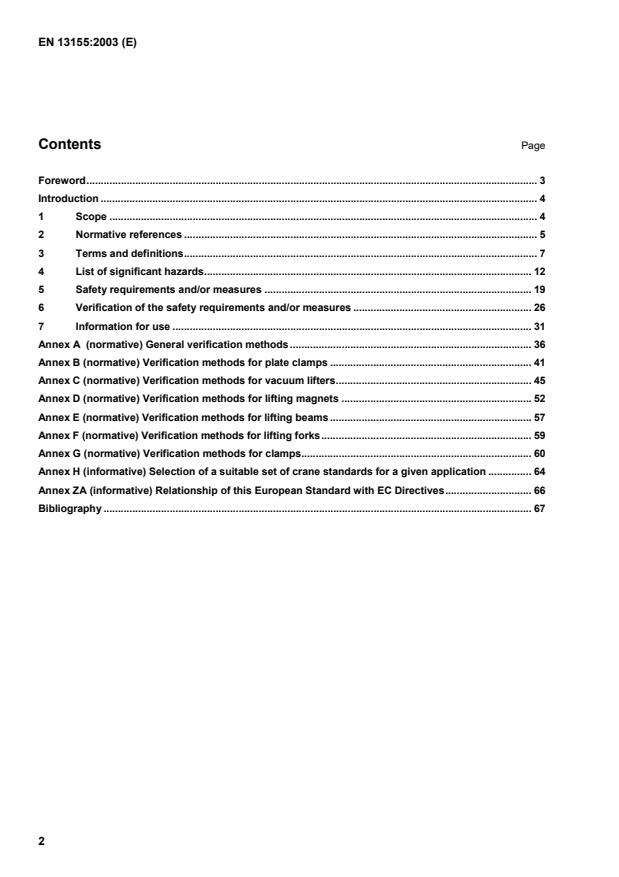
Contents Page
Foreword. 3
Introduction . 4
1 Scope . 4
2 Normative references . 5
3 Terms and definitions. 7
4 List of significant hazards. 12
5 Safety requirements and/or measures . 19
6 Verification of the safety requirements and/or measures . 26
7 Information for use . 31
Annex A (normative) General verification methods. 36
Annex B (normative) Verification methods for plate clamps . 41
Annex C (normative) Verification methods for vacuum lifters. 45
Annex D (normative) Verification methods for lifting magnets . 52
Annex E (normative) Verification methods for lifting beams .57
Annex F (normative) Verification methods for lifting forks. 59
Annex G (normative) Verification methods for clamps. 60
Annex H (informative) Selection of a suitable set of crane standards for a given application . 64
Annex ZA (informative) Relationship of this European Standard with EC Directives. 66
Bibliography . 67
Foreword
This document (EN 13155:2003) has been prepared by Technical Committee CEN/TC 147 “Cranes - Safety”,
the secretariat of which is held by BSI.
This European Standard shall be given the status of a national standard, either by publication of an identical
text or by endorsement, at the latest by January 2004, and conflicting national standards shall be withdrawn at
the latest by January 2004.
This document has been prepared under a mandate given to CEN by the European Commission and the
European Free Trade Association, and supports essential requirements of EC Directive(s).
For relationship with EC Directive, see informative Annex ZA, which is an integral part of this document.
According to the CEN/CENELEC Internal Regulations, the national standards organizations of the following
countries are bound to implement this European Standard: Austria, Belgium, Czech Republic, Denmark,
Finland, France, Germany, Greece, Hungary, Iceland, Ireland, Italy, Luxembourg, Malta, Netherlands,
Norway, Portugal, Slovakia, Spain, Sweden, Switzerland and the United Kingdom.
For the relationship with other European standards for cranes, see informative Annex H.
Introduction
This European Standard has been prepared to be a harmonized standard to provide one means for non-fixed
load lifting attachments used on cranes to conform with the essential health and safety requirements of the
Machinery Directive, as amended.
This European Standard is a type C standard as stated in EN 1070.
The machinery concerned and the extent to which hazards are covered are indicated in the scope of this
standard.
When provisions of this type C standard are different from those which are stated in type A or B standards, the
provisions of this type C standard take precedence over the provisions of the other standards, for non-fixed
load lifting attachments which have been designed and built according to the provisions of this type C
standard.
1 Scope
This European Standard specifies safety requirements for the following non-fixed load lifting attachments for
cranes, hoists and manually controlled load manipulating devices:
plate clamps;
vacuum lifters;
self priming,
non-self priming (pump, venturi, turbine);
electric lifting magnets (battery fed and main-fed);
permanent lifting magnets;
electro-permanent lifting magnets;
lifting beams;
C-hooks;
lifting forks;
clamps;
defined in clause 3.
This standard does not specify the additional requirements for :
non fixed load lifting attachments in direct contact with foodstuffs or pharmaceuticals requiring a high level
of cleanliness for hygiene reasons;
hazards resulting from handling specific hazardous materials (e.g. explosives, hot molten masses,
radiating materials);
hazards caused by operation in an explosive atmosphere;
hazards caused by noise;
electrical hazards;
hazards due to hydraulic and pneumatic components.
This standard does not cover the hazards related to mechanical strength of structural elements of attachments
designed for more than 20 000 lifting cycles.
NOTE The coefficient of utilization specified in clause 5.1.1 ensures that no fatigue verification is needed for less
than 20 000 cycles. This is in accordance with the well accepted calculation codes e.g. FEM 1001.
This standard does not cover attachments intended to lift above people.
This standard does not cover slings, ladles, expanding mandrels, buckets, grabs, or grab buckets.
The hazards covered by this European Standard are identified in clause 4.
This European Standard does not cover hazards related to the lifting of persons.
This European Standard is applicable to non-fixed load lifting attachments which are manufactured after the
date of approval by CEN of this standard.
2 Normative references
This European Standard incorporates, by dated or undated reference, provisions from other publications.
These normative references are cited at the appropriate places in the text and the publications are listed
hereafter. For dated references, subsequent amendments to, or revisions of, any of these publications apply
to this European Standard only when incorporated in it by amendment of revision. For undated references the
latest edition of the publication referred to applies.
EN 292-1: 1991, Safety of machinery — Basic concepts, general principles for design — Part 1: Basic
terminology, methodology
EN 292-2: 1991, Safety of machinery — Basic concepts, general principles for design — Part 2: Technical
principles and specifications
EN 292-2: 1991/A1:1995, Safety of machinery — Basic concepts, general principles for design — Part 2:
Technical principles and specifications (Amendment 1)
EN 287-1, Approval testing of welders for fusion welding — Part 1: Steels
EN 349: 1993, Safety of machinery — Minimum gaps to avoid crushing of parts of the human body
EN 457, Safety of machinery — Auditory danger signals — General requirements, design and testing
EN 818-4, Short link chain for lifting purposes — Safety — Part 4: Chain slings — Grade 8
EN 818-5, Short link chain for lifting purposes — Safety — Part 5: Chain slings —Grade 4
EN 842, Safety of machinery — Visual danger signals — General requirements, design and testing
EN 981, Safety of machinery - System of auditory and visual danger and information signals
EN 1070: 1998, Safety of machinery — Terminology
EN 1492-1, Textile slings — Safety — Part 1: Flat woven webbing slings, made of man-made fibres, for
general purpose use
EN 1492-2, Textile slings — Safety — Part 2: Roundslings, made of man-made fibres, for general purpose
use
ENV 1993-1-1: 1992, Eurocode 3: Design of steel structures — Part 1-1: General rules and rules for buildings
EN 10025, Hot-rolled products of non alloy structural steels — Technical delivery conditions
EN 10045-1, Metallic materials — Charpy impact test — Part 1: Test method
prEN 13414-1, Steel wire rope slings — Safety — Part 1: Slings for general lifting service
prEN 13557: 2003, Cranes — Controls and control stations
EN 25817, Arc-welded joints in steel — Guidance on quality levels for imperfections (ISO 5817:1992)
3 Terms and definitions
For the purposes of this European Standard, the terms and definitions given in EN 1070:1998 and the
following terms and definitions apply:
3.1
adhesion force
force required to remove the load from a vacuum lifter
3.2
building area
area where buildings, bridges, roads etc are being erected or renovated or demolished
NOTE In these areas the environment is permanently changing. Any risks are higher than in plants or warehouses.
3.3
C-hook
equipment in the form of a ‘C’ used for lifting hollow loads e.g. coils, pipes
Figure 1 — Example of a C-hook
3.4
coefficient of utilisation
arithmetic ratio between the maximum load held by the lifting attachment and its working load limit
3.5
clamp
equipment used to handle loads by clamping on a specific part of the load.
NOTE Clamps are also known as tongs. For definition of plate clamps see 3.12.
Figure 2 — Example of a clamp
3.6
individual verification
verification carried out on every item produced
3.7
lifting beam
equipment consisting of one or more members equipped with attachment points to facilitate the handling of
loads which require support at several points
Figure 3 — Example of a lifting beam
3.8
lifting forks
equipment consisting of two or more arms fixed to an upright with an upper arm, essentially to lift palletised or
similar loads
Figure 4 — Example of lifting forks
3.9
lifting magnet
Figure 5 — Example of a lifting magnet
3.9.1
electric lifting magnet
equipment with a magnetic field generated by an electric current creating sufficient force for gripping, holding
and handling loads with ferro-magnetic properties.
3.9.2
permanent lifting magnet
equipment with a permanent magnetic field which creates sufficient force for gripping, holding and handling
loads with ferro-magnetic properties. The magnetic field is controlled by mechanical means
3.9.3
electro-permanent lifting magnet
equipment with a permanent magnetic field which creates sufficient force for gripping, holding and handling
loads with ferro-magnetic properties. The magnetic field is controlled by an electric current which is not
required to sustain the magnetic field
NOTE Electro-permanent lifting magnets can be energized by the mains or by battery or stand-alone generator.
3.10
No-go area
area from which persons are excluded during normal operation
3.11
non-fixed load lifting attachment
lifting attachment which can be fitted directly or indirectly to the hook or any other coupling device of a crane,
hoist or manually controlled manipulating device by the user without affecting the integrity of the crane, hoist
or manually controlled manipulating device
3.12
plate clamps
non powered equipment used to handle steel plates by clamping them between jaws.
Figure 6 — Example of plate clamps
3.13
positive holding device
device making a direct mechanical connection to the load and which does not rely solely on friction, suction or
magnetic adhesion to the load
3.14
secondary positive holding device
device to hold loads if the primary holding means fails and which does not rely on friction, suction or magnetic
adhesion to the load
3.15
tear-off force
force applied at a right angle to the plane of the magnet poles which is required to detach the load from the
switched-on magnet
3.16
two-action control
control which, in order to be operative, requires the performance of two separate actions with one or two
hands, such as:
a) operation of two separate hold-to-run controls;
b) sequential operation of two movements of a control device;
c) previous unlocking of the control with self-locking in the neutral position.
3.17
type verification
verification carried out on one or more samples representative of a particular design and size of product
before it is first placed on the market
NOTE Although the term "type verification" is normally associated with series produced equipment, for the purpose
of this standard it also applies to single unit produced attachment.
3.18
vacuum lifter(suction pad)
equipment which includes one or several suction pads operating by vacuum
3.18.1
self priming vacuum lifter
vacuum lifter using the load to create the vacuum
Figure 7 — Example of a self priming vacuum lifter
3.18.2
non self priming vacuum lifter
vacuum lifter using an external source of energy
Figure 8 — Example of a non self priming vacuum lifter
3.19
working load limit
maximum load that the non-fixed load lifting attachment is designed to lift under the conditions specified by the
manufacturer
4 List of significant hazards
Tables 1 to 7 show a list of significant hazardous situations and hazardous events that could result in risks to
persons during normal use and foreseeable misuse. They also contain the relevant clauses in this standard
that are necessary to reduce or eliminate the risks associated with those hazards.
NOTE The numbers in the left hand columns correspond to those in annex A of EN 1050: 1996 ‘Safety of machinery
— Principles for risk assessment’.
Table 1 — Plate clamps - List of significant hazards and associated requirements
Hazard Relevant clause(s) in this standard
1 Mechanical hazards
Generated by machine parts or workpieces
caused, for example, by:
1 e) Inadequacy of mechanical strength 5.1.1.1, 5.1.1.2,
Fatigue is not dealt with
1 c) Stability 5.1.5, 7.1.1
1.1 Crushing hazard 5.1.3, 7.1.1, 7.1.2
1.2 Shearing hazard 5.1.3, 7.1.1, 7.1.2
8 Hazards generated by neglecting
ergonomic principles
8.1 Unhealthy postures 5.1.3
8.6 Human errors 5.2.1.2
15 Errors of fitting 5.2.1.4, 5.2.1.6
27 Mechanical hazards and hazardous events
27.1 From load falls, collisions, machine tipping
caused by:
27.1.1 Lack of stability 5.1.5
27.1.4 Unexpected/unintended movement of loads 5.2.1.1, 5.2.1.2, 5.2.1.3, 5.2.1.4,
27.1.5 Inadequate holding devices/accessories 5.2.1.4, 5.2.1.5, 7.1.1, 7.1.2
27.4 From insufficient mechanical strength of parts 5.1.1.1
Fatigue is not dealt with
27.6 From inadequate selection/integration into the 5.1.4, 5.2.1.6
machine of chains, ropes, lifting accessories
27.8 From abnormal conditions of 5.2.1.5, 5.2.1.6, 7.1 to 7.2
assembly/testing/use maintenance
Table 2 — Vacuum lifters - List of significant hazards and associated requirements
Hazard Relevant clause(s) in this standard
1 Mechanical hazards
Generated by machine parts or workpieces
caused, for example, by:
1 e) Inadequacy of mechanical strength 5.1.1.1, 5.1.1.2,
Fatigue is not dealt with
1 c) Stability 5.1.5, 7.1.1
1 h) The effect of vacuum 5.2.2
1.1 Crushing hazard 5.1.3, 7.1.1, 7.1.2
1.2 Shearing hazard 5.1.3, 7.1.1, 7.1.2
8 Hazards generated by neglecting
ergonomic principles
8.1 Unhealthy postures 5.1.3
8.2 Inadequate consideration of hand-arm 5.1.2
anatomy
8.6 Human errors 5.2.2.1 to 5.2.2.10
8.7 Inadequate design of manual controls 5.1.2
10 Unexpected start-up, unexpected 5.1.6
overrun/overspeed
13 Failure of the power supply 5.2.2.5, 5.2.2.6, 5.2.2.7
14 Failure of the control circuit 7.1.1, 7.1.2
15 Errors of fitting
7.1.1, 7.1.2
17 Falling objects 5.2.2.1, 5.2.2.2, 5.2.2.3,, 5.2.2.4
18 Loss of stability of machinery 5.1.5
27 Mechanical hazards and hazardous events
27.1 From load falls, collisions, machine tipping
caused by:
27.1.1 Lack of stability 5.1.1.2
27.1.2 Uncontrolled loading - overloading - 5.1.1.1, 7.1.1
overturning moments exceeded
27.1.3 Uncontrolled amplitude of movements 5.2.2.10
27.1.4 Unexpected/unintended movement of loads 5.2.2.1, 5.2.2.2, 5.2.2.3, 5.2.2.4, 5.2.2.5,
5.2.2.6, 5.2.2.9, 5.2.2.10, 7.2.3
27.1.5 Inadequate holding devices/accessories 5.2.2.1, 7.1.1, 7.1.2
27.4 From insufficient mechanical strength of parts 5.1.1.1 Fatigue is not dealt with
27.6 From inadequate selection/integration into the 5.1.4
machine of chains, ropes, lifting accessories
27.8 From abnormal conditions of 5.2.5, 5.2.6, 7.1, 7.2
assembly/testing/use maintenance
Table 3 — Lifting magnets - List of significant hazards and associated requirements
Hazard Relevant clause(s) in this standard
1 Mechanical hazards
Generated by machine parts or workpieces
caused, for example, by:
1 e) Inadequacy of mechanical strength 5.1.1.1, 5.1.1.2,
Fatigue is not dealt with
1 c) Stability 5.1.5, 7.1.1
1.1 Crushing hazard 5.1.3, 7.1.1, 7.1.2
1.2 Shearing hazard 5.1.3, 7.1.1, 7.1.2
8 Hazards generated by neglecting
ergonomic principles
8.1 Unhealthy postures 5.1.3
8.2 Inadequate consideration of hand-arm 5.1.2
anatomy
8.6 Human errors 5.2.2.1 to 5.2.2.10
8.7 Inadequate design of manual controls 5.1.2
13 Failure of the power supply 5.2.3.3, 5.2.3.4.2, 5.2.3.4.3, 5.2.2.7
14 Failure of the control circuit 7.1.1, 7.1.2
15 Errors of fitting 7.1.1, 7.1.2
17 Falling objects 5.2.3.3, 5.2.3.4, 5.2.3.5, 5.2.3.6
18 Loss of stability/overturning of machinery 5.1.5
27 Mechanical hazards and hazardous events
27.1 From load falls, collisions, machine tipping
caused by:
27.1.1 Lack of stability 5.1.1.2
27.1.2 Uncontrolled loading - overloading - 5.1.1.1, 7.1.1
overturning moments exceeded
27.1.4 Unexpected/unintended movement of loads 5.2.3.1, 5.2.3.3, 5.2.3.4, 5.2.3.5, 5.2.3.6,
7.2.3
27.1.5 Inadequate holding devices/accessories 5.2.3.2, 7.1.1, 7.1.2
27.4 From insufficient mechanical strength of parts 5.1.1.1
Fatigue is not dealt with
27.6 From inadequate selection/integration into the 5.1.4
machine of chains, ropes, lifting accessories
27.8 From abnormal conditions of 5.2.5, 5.2.6, 7.1, 7.2
assembly/testing/use maintenance
Table 4 — C-Hooks - List of significant hazards and associated requirements
Hazard Relevant clause(s) in this standard
1 Mechanical hazards
Generated by machine parts or workpieces
caused, for example, by:
1 e) Inadequacy of mechanical strength 5.1.1.1, 5.1.1.2,
Fatigue is not dealt with
1 c) Stability 5.1.5, 7.1.1
1.1 Crushing hazard 5.1.3, 7.1.1, 7.1.2
1.2 Shearing hazard 5.1.3, 7.1.1, 7.1.2
8 Hazards generated by neglecting
ergonomic principles
8.1 Unhealthy postures 5.1.3, 5.2.4.1
8.2 Inadequate consideration of hand-arm 5.1.2
anatomy
8.7 Inadequate design of manual controls 5.1.2
17 Falling objects 5.2.4.2
18 Loss of stability/overturning of machinery 5.1.5
27 Mechanical hazards and hazardous events
27.1 From load falls, collisions, machine tipping
caused by:
27.1.1 Lack of stability 5.1.1.2
27.1.2 Uncontrolled loading - overloading - 5.1.1.1, 7.1.1
overturning moments exceeded
27.1.4 Unexpected/unintended movement of loads 5.2.4.2
27.1.5 Inadequate holding devices/accessories 5.2.4.1, 7.1.1, 7.1.2, 7.2.3
27.4 From insufficient mechanical strength of parts 5.1.1.1
Fatigue is not dealt with
27.6 From inadequate selection/integration into the 5.1.4
machine of chains, ropes, lifting accessories
27.8 From abnormal conditions of 7.1, 7.2
assembly/testing/use maintenance
Table 5 — Lifting forks - List of significant hazards and associated requirements
Hazard Relevant clause(s) in this standard
1 Mechanical hazards
Generated by machine parts or workpieces
caused, for example, by:
1 e) Inadequacy of mechanical strength 5.1.1.1, 5.1.1.2, 5.2.5.6
Fatigue is not dealt with
1 c) Stability 5.1.5, 7.1.1
1.1 Crushing hazard 5.1.3, 7.1.1, 7.1.2
1.2 Shearing hazard 5.1.3, 7.1.1, 7.1.2
1.9 High pressure fluid ejection 5.1.7
8 Hazards generated by neglecting
ergonomic principles
8.1 Unhealthy postures 5.1.3, 5.2.5.1
8.2 Inadequate consideration of hand-arm 5.1.2
anatomy
8.7 Inadequate design of manual controls 5.1.2
17 Falling objects 5.2.5.2, 5.2.5.3, 5.2.5.4, 5.2.5.5,7.1.1,
7.2.3
18 Loss of stability/overturning of machinery 5.1.5
27 Mechanical hazards and hazardous events
27.1 From load falls, collisions, machine tipping
caused by:
27.1.1 Lack of stability 5.1.1.2
27.1.2 Uncontrolled loading - overloading - 5.1.1.1, 7.1.1
overturning moments exceeded
27.1.4 Unexpected/unintended movement of loads 5.2.5.2, 5.2.5.3, 5.2.5.4, 5.2.5.5
27.1.5 Inadequate holding devices/accessories 5.2.5.2, 5.2.5.3, 5.2.5.4, 5.2.5.5, 7.1.1,
7.1.2, 7.2.3
27.4 From insufficient mechanical strength of parts 5.1.1.1, 5.2.5.6
Fatigue is not dealt with
27.6 From inadequate selection/integration into the 5.1.4
machine of chains, ropes, lifting accessories
27.8 From abnormal conditions of 5.2.5.3, 5.2.5.4, 5.2.5.5, 7.1, 7.2
assembly/testing/use maintenance
Table 6 — Lifting beams - List of significant hazards and associated requirements
Hazard Relevant clause(s) in this standard
1 Mechanical hazards
Generated by machine parts or workpieces
caused, for example, by:
1 e) Inadequacy of mechanical strength 5.1.1.1, 5.1.1.2, 5.2.6.3.1
Fatigue is not dealt with
1 c) Stability 5.1.5, 7.1.1
1.1 Crushing hazard 5.1.3, 5.2.6.1.3, 5.2.6.2, 5.2.6.3.4, 7.1.1,
7.1.2
1.2 Shearing hazard 5.1.3, 5.2.6.1.3, 5.2.6.2, 5.2.6.3.4, 7.1.1,
7.1.2
1.3 Entanglement hazards 5.2.6.3.4, 7.1.1, 7.1.2
8 Hazards generated by neglecting
ergonomic principles
8.1 Unhealthy postures 5.1.3
8.2 Inadequate consideration of hand-arm 5.1.2
anatomy
8.7 Inadequate design of manual controls 5.1.2
10 Unexpected start-up, unexpected 5.2.6.3.3
overrun/overspeed
17 Falling objects
5.2.6.2, 5.2.6.3.2
18 Loss of stability/overturning of machinery
5.1.5
27 Mechanical hazards and hazardous events
27.1 From load falls, collisions, machine tipping 5.1.1.2, 5.2.6.1.3, 5.2.6.3.3
caused by:
27.1.1 Lack of stability 5.1.1.1, 7.1.1
27.1.2 Uncontrolled loading - overloading - 7.1, 7.2
overturning moments exceeded
27.1.4 Unexpected/unintended movement of loads 5.2.6, 7.2.3
27.1.5 Inadequate holding devices/accessories 5.1.4, 7.1.1, 7.1.2
27.4 From insufficient mechanical strength of parts 5.1.1.1
Fatigue is not dealt with
27.6 From inadequate selection/integration into the 5.1.4
machine of chains, ropes, lifting accessories
27.8 From abnormal conditions of 5.2.5, 5.2.6, 7.1, 7.2
assembly/testing/use maintenance
Table 7 — Clamps - List of significant hazards and associated requirements
Hazard Relevant clause(s) in this standard
1 Mechanical hazards
Generated by machine parts or workpieces
caused, for example, by:
1 e) Inadequacy of mechanical strength 5.1.1.1, 5.1.1.2, 5.2.7.6
Fatigue is not dealt with
1 c) Stability 5.1.5, 7.1.1
1.1 Crushing hazard 5.1.3, 7.1.1, 7.1.2
1.2 Shearing hazard 5.1.3, 7.1.1, 7.1.2
8 Hazards generated by neglecting
ergonomic principles
8.1 Unhealthy postures 5.1.3
8.2 Inadequate consideration of hand-arm 5.1.2
anatomy
8.6 Human errors 5.2.7.4, 5.2.7.5, 5.2.7.7
8.7 Inadequate design of manual controls 5.1.2, 5.2.7.4
15 Errors of fitting
5.2.7.2, 7.1.1, 7.1.2
17 Falling objects 5.2.7, 7.1.1, 7.2.3
18 Loss of stability of machinery 5.1.5
27 Mechanical hazards and hazardous events
27.1 From load falls, collisions, machine tipping
caused by:
27.1.1 Lack of stability 5.1.1.2
27.1.2 Uncontrolled loading - overloading - 5.1.1.1, 7.1.1, 7.2.1
overturning moments exceeded
27.1.4 Unexpected/unintended movement of loads 5.2.7.1, 5.2.7.2, 5.2.7.3, 5.2.7.4, 7.2.3
27.1.5 Inadequate holding devices/accessories 5.2.7.2, 5.2.7.3, 5.2.7.5, 5.2.7.7, 7.1.1,
7.1.2, 7.2.3
27.4 From insufficient mechanical strength of parts 5.1.1.1, 5.2.7.6
Fatigue is not dealt with
27.6 From inadequate selection/integration into the 5.1.4
machine of chains, ropes, lifting accessories
27.8 From abnormal conditions of 5.2.7.5, 7.1, 7.2
assembly/testing/use maintenance
5 Safety requirements and/or measures
5.1 General requirements
The attachment shall comply with the safety requirements and/or measures of this clause. In addition, the
attachment shall be designed according to the principles of EN 292 for hazards relevant but not significant
which are not dealt with by this standard.
5.1.1 Mechanical load bearing parts
5.1.1.1 The mechanical load bearing parts shall have a mechanical strength to fulfil the following
requirements:
1) the attachment shall be designed to withstand a static load of three times the working load limit
without releasing the load even if permanent deformation occurs;
2) the attachment shall be designed to withstand a static load of two times the working load limit without
permanent deformation.
5.1.1.2 Attachments intended to tilt shall be designed for an angle exceeding minimum 6 the maximum
working angle. Attachments not intended to tilt shall be designed for an angle of minimum 6.
5.1.2 Controls
The controls of the attachment shall be in accordance with the following clauses of prEN 13557:2003 where
applicable:
5.1.1, 5.1.10, 5.2.3.1.1, 5.2.3.1.2, 5.2.3.1.3, 5.2.3.2.1, 5.2.3.2.2, 5.2.3.2.3, 5.2.3.2.4, 5.2.3.2.5, 5.2.3.2.6
5.1.3 Handles
An attachment that is intended to be guided manually shall be equipped with handle(s), arranged so that
finger injuries are avoided. Handles are not required if features have been built in to provide natural
handholds.
5.1.4 Requirements for slings which are integrated
Slings which are an integrated part of the attachment shall be in accordance with the appropriate following
standards:
EN 818-4;
EN 818-5;
prEN 13414-1;
EN 1492-1;
EN 1492-2.
5.1.5 Stability during storage
When not required for use it shall be possible to set down the attachment so that it is stable during storage. To
be regarded as stable it shall not tip over when tilted to an angle of 10° in any direction. This shall be achieved
either by the shape of the attachment or by means of additional equipment such as a stand.
5.2 Specific requirements for each category of attachment
5.2.1 Plate clamps
5.2.1.1 Under the conditions specified by the manufacturer, it shall not be possible to unintentionally
release the load, in particular by the following influences:
a) contact of the plate clamp particularly the locking mechanisms with an obstacle;
b) weight of the crane hook, bottom block or other connections bearing down on the device;
c) intended tipping and/or turning.
5.2.1.2 Plate clamps intended to transport vertically suspended plate shall incorporate a device to
prevent the load from unintentional detachment when it is set down.
5.2.1.3 The safety factor to prevent the load from slipping shall be at least 2.
5.2.1.4 In the case of plate clamps where the range of thickness does not start at 0, a safety range in
which the gripping force does not fall below the value given in 5.2.1.3 is required below the smallest specified
thickness, in order to be able to compensate for the manufacturing tolerances, elastic deformation etc.
The following minimum safety ranges are required:
a) for a minimum thickness less than or equal to 50 mm: 10 % of the minimum thickness;
b) for a minimum thickness between 50 and 100 mm: 5 mm;
c) for a minimum thickness more than 100 mm: 5 % of the minimum thickness.
5.2.1.5 If the lifting attachment is designed to use more than one clamp, the working load limit of each
clamp shall take account of the share of the load which can foreseeably be imposed on it (including any
inequality of share due to the rigidity of the load) and any intermediate equipment between the clamps and the
crane e.g. a lifting beam.
5.2.1.6 The method of connecting to the crane or intermediate equipment shall ensure that the forces are
transmitted through the plate clamp in the correct alignment. Where this is not possible by design, the marking
and/or operating instructions shall clearly indicate how it should be connected.
5.2.2 Vacuum lifters
5.2.2.1 Vacuum lifters shall be dimensioned to hold at least a load corresponding to two times the
working load limit at the end of the working range and the beginning of the danger range respectively at all
intended angles of tilt. The maximum angles of tilt shall be increase in accordance with 5.1.1.2.
NOTE The pressure range with which it is possible to work is termed the working range. The danger range adjoins
the working range. In some vacuum lifting systems, in particular self-priming vacuum lifters, the pressure decrease arising
depends upon the weight of the load.
5.2.2.2 Non-self-priming vacuum lifters shall be equipped with a pressure measuring device showing the
working range and the danger range of the vacuum.
5.2.2.3 Self-priming vacuum lifters shall be equipped with an indicator showing to the operator that the
end of the working range is reached.
5.2.2.4 The measuring device or the indicator respectively shall be fully visible for the slinger or, if there is
no slinger, for the driver of the crane in his normal working position.
5.2.2.5 Means shall be provided to prevent the risks due to vacuum losses. This shall be:
a) in the case of vacuum lifters with a vacuum pump: a reserve vacuum with a non return valve between the
reserve vacuum and the pump, located as close as possible to the reserve vacuum;
b) in the case of vacuum lifters with Venturi-system: a pressure-reserve-tank or vacuum-reserve-tank with a
non return valve between the reserve vacuum and the Venturi system, located as close as possible to the
reserve vacuum;
c) in the case of turbine vacuum lifters: a supporting battery or an additional flywheel-mass;
d) in the case of self-priming vacuum lifters: a reserve-stroke at least equal to 5 % of the total stroke of the
piston.
NOTE Vacuum losses can occur for example, due to leaks, or in the case of non self-priming vacuum lifters, due to a
power failure.
5.2.2.6 There shall be a device to warn automatically that the danger range is reached, when vacuum
losses cannot be compensated. The warning signal shall be optical or acoustic, depending upon the
circumstances of use for the vacuum lifter, and in accordance with EN 981, EN 842 and EN 457. The warning
device shall work even if there is a power failure of the vacuum lifter.
NOTE The warning device is not the pressure measuring device of 5.2.2.2 or the indicator of 5.2.2.3.
5.2.2.7 In case of power failure, the vacuum lifter shall be able to hold the load for 5 minutes. This is not
necessary in no-go areas and this is not necessary for turbine vacuum lifters if all the following conditions are
met :
the operator maintains control of the load through steering handles which ensures that the operator is
outside the danger zone in case of the load falling;
in addition to clause 5.2.2.6 a warning device shall be activated as soon as the power fails;
the manufacturer shall prohibit lifting of the geometric centre of the suction pads above 1,8 m by marking
and instructions for use.
5.2.2.8 For vacuum lifters intended to be used in a building area a secondary positive holding device is
required or there shall be two vacuum reserves each fitted with non return valves. Each vacuum reserve shall
be connected to a separate set of vacuum pads. Each set of vacuum pads shall fulfil the requirement of the
clause 5.2.2.1.
5.2.2.9 The releasing of the load shall be actuated by a two action control. This is not necessary if the
release of the load is not possible until the load has been put down or in no-go areas.
5.2.2.10 Controls for tilting or turning movements shall be hold-to-run type.
5.2.2.11 The shape of the suction pad shall be matched to that of the intended load(s). If more than one
suction pad is used in conjunction with a lifting beam, the layout and working load limit of the suction pads
shall be matched to that of the intended load(s). The share of the load which can foreseeably be imposed on
each suction pad shall not exceed its working load limit taking account of the rigidity of both the load and the
vacuum lifter.
5.2.3 Lifting magnets
5.2.3.1 General
5.2.3.1.1 The releasing of the load shall be actuated by a two action control. This is not necessary if the
release of the load is not possible until the load has been put down or in no-go areas.
5.2.3.1.2 The shape of the magnet shall be matched to that of the intended load(s). If more than one
magnet is used in conjunction with a lifting beam, the layout and working load limit of the magnets shall be
matched to that of the intended load(s). The share of the load which can foreseeably be imposed on each
magnet shall not exceed its working load limit taking account of the rigidity of both the load and the lifting
beam.
5.2.3.2 Battery-fed electric lifting magnets
5.2.3.2.1 They shall provide a tear-off force corresponding to at least 2 times the working load limit under
the conditions specified by the manufacturer.
5.2.3.2.2 An automatic warning device shall be provided which monitors the power supply and provides a
warning at least 10 minutes before the supply reaches the level where the load will be release. The warning
device shall be optical or acoustic.
5.2.3.2.3 A safety device shall be provided, which, after the low power warning device has been activated
and the magnet has been switched off, prevents the magnet from being switched on again until the battery is
recharged to the minimum level at which the low power warning device is not activated.
5.2.3.2.4 An indicator shall be provided to show if the magnet is magnetised (ON/OFF).
NOTE The indicator does not necessarily indicate that there is sufficient magnetic field.
5.2.3.3 Mains-fed electric lifting magnets
5.2.3.3.1 They shall provide a tear-off force corresponding to at least 2 times the working load limit under
the conditions specified by the manufacturer.
5.2.3.3.2 An automatic warning device shall be provided to warn if the mains power supply fails. The
warning device may be optical or acoustic. This is not necessary in no-go areas.
5.2.3.3.3 A stand-by battery shall be provided to supply power in case the mains supply fails. It shall be
capable of providing the current needed to hold the working load limit for at least 10 minutes. This is not
necessary in no-go areas.
5.2.3.3.4 Requirements of clause 5.2.3.3.2 and 5.2.3.3.3 are not necessary if all the following requirements
are met:
The manufacturer shall prohibit lifting the pole geometric centre above 1,8 m by marking and instructions
for use;
The load mass is less than 20 kg.
5.2.3.3.5 In cases where it is difficult to leave the danger zone (e. g. in a building area or in ships during
loading and unloading) a redundancy of the flexible cables of the DC supply lines between the control cabinet
and the attachment (e.g. spreader beam or single magnet) and of the power control unit of the magnet system
is required. Alternatively a secondary positive holding device is required.
5.2.3.3.6 Magnets for lifting loads such as plates, sheets, or bars from the top of a stack, shall have
controls to reduce the power supply so as to facilitate the shedding of excess load. After the excess load has
been shed the controls shall permit restoration of full power.
5.2.3.3.7 The magnet system shall have an indicator to show when the magnet(s) are magnetized. For
magnets with variable power control, the indicator shall distinguish between full and partial magnetization.
NOTE The indicator does not necessarily indicate that there is sufficient magnetic field.
5.2.3.4 Permanent lifting magnets
5.2.3.4.1 They shall provide a tear-off force corresponding to at least 3 times the working load limit under
the conditions specified by the manufacturer;
5.2.3.4.2 The control shall clearly indicate whether the magnet is ON or OFF;
5.2.3.4.3 The control for operating the magnet shall be in accordance with EN 349: 1993 with regard to the
place for the operator’s hands.
5.2.3.5 Electro-permanent lifting magnets
5.2.3.5.1 They shall provide a tear-off force of at least 3 times the working load limit under the conditions
specified by the manufacturer.
5.2.3.5.2 The magnets shall have an indicator to show when the magnet(s) are magnetized. For magnets
with variable power control, the indicator shall distinguish between full and partial magnetisation.
5.2.4 C-hooks
5.2.4.1 The unloaded C-hook shall hang with the lower arm within 5° of horizontal to facilitate access to
the load.
5.2.4.2 One of the following means shall be provided to prevent the load from sliding on the lower arm, or
the load or part of the load from falling:
a) the C-hook tilted backwards with an angle greater or equal to 5° in the loaded position;
b) for the C-hook intended for handling single steel sheet coils the lower arm shall be horizontal or titled
backward in the loaded position;
c) a chain, strap or bar to close the C-hook opening;
d) a clamping system to secure the load;
e) an end stop on the lower arm.
5.2.5 Lifting forks
5.2.5.1 The unloaded lifting fork shall hang with the fork arms within 5° of horizontal to facilitate access to
the load.
5.2.5.2 Within the intended load range and position of the load centre of gravity, the fork arms shall be
tilted backwards with an angle greater or equal to 5° to prevent the load from sliding from the fork arms.
5.2.5.3 Lifting forks for loose material (e.g. bricks and tiles) to be used in a building area shall have a
secondary positive holding device (e.g. net, cage).
The secondary positive holding device shall prevent the release of the complete load or any loose parts of the
load.
For handling loose materials (e.g. bricks and tiles) the secondary positive holding device (e.g. nets or cages)
shall not have side and bottom openings of more than 50 mm square.
NOTE It is recommended that the secondary positive holding device is automatically activated.
5.2.5.4 Lifting forks fitted with a secondary positive holding device required in the clause 5.2.5.3 shall be
capable of holding a uniformly distributed load equal to 50% of the WLL in all four horizontal directions.
5.2.5.5 Lifting forks for unit load (e.g. plastic wrapped palletised load) to be used on building area shall
have a retaining device (e.g. chain, strap or bar) to prevent the unit load sliding off the forks.
5.2.5.6 Lifting forks with a retaining device as required in clause 5.2.5.5 shall be capable of holding a
uniformly distributed load equal to 50% of the WLL.
5.2.6 Lifting beams
5.2.6.1 Attaching the lifting beam to the crane
5.2.6.1.1 Any connection made by moving or removing a lifting beam component shall be such that it can
be locked before lifting so as to prevent any accidental uncoupling of this connection.
5.2.6.1.2 Means shall be provided to prevent any dangerous movement and damage to the suspended
parts of the lifting beam parts during storage, coupling or uncoupling from the crane.
5.2.6.2 Securing the load to the lifting beam
5.2.6.2.1 Lifting beams with load attachment points which move along the beam shall have the means to
prevent them falling off.
5.2.6.2.2 Load attachment points which move along the beam shall have the means to lock them in
positions when they are under load
5.2.6.2.3 If the means of locking the load attachment points is operated manually, the state of locking shall
be visible to the slinger.
5.2.6.3 Structure
5.2.6.3.1 If the lifting beam is intended to tilt, the manufacturer shall indicate the maximum permissible
angle of tilt from the horizontal. If the lifting beam is intended for horizontal use, the design shall tolerate a tilt
of up to 6° from the horizontal.
5.2.6.3.2 Moving parts of the structure shall have devices to hold them in position when loaded. These
devices shall be effective up to 6° from the maximum tilting angle permitted for the lifting beam. If these
devices operate on a friction basis the safety factor shall be at least 2.
5.2.6.3.3 If free movement presents a hazard, lifting beams fitted with a rotation or tilting mechanism shall
be equipped with a device to stop movement and to immobilise the load in its intended position.
5.2.6.3.4 When the spacing between moving parts of the beam is controlled by a power source, protection
devices shall be provided to avoid crushing and shearing hazards as specified in EN 349: 1993.
5.2.7 Clamps
5.2.7.1 The holding force of clamps holding by friction to prevent the load from slipping shall be at least 2
times the working load limit.
5.2.7.2 In the case of clamps holding by friction, where the range of thickness does not start at 0, a
safety range in which the holding force does not fall below the value given in clause 5.2.7.1 is required below
the smallest specified thickness, in order to be able to compensate for the manufacturing tolerances, elastic
deformation etc.
The following minimum safety ranges are required:
a) for a minimum thickness less than or equal to 50 mm: 10 % of the minimum thickness;
b) for a minimum thickness between 50 and 100 mm: 5 mm of the
...
Questions, Comments and Discussion
Ask us and Technical Secretary will try to provide an answer. You can facilitate discussion about the standard in here.
Loading comments...