

SIST EN 55016-4-2:2011
(Main)Specification for radio disturbance and immunity measuring apparatus and methods - Part 4-2: Uncertainties, statistics and limit modelling - Measurement instrumentation uncertainty
General Information
- Abstract
CISPR 16-4-2:2011 is a basic EMC publication. It specifies the method of applying Measurement Instrumentation Uncertainty (MIU) when determining compliance with CISPR disturbance limits. The material is also relevant to any EMC test when interpretation of the results and conclusions reached will be impacted by the uncertainty of the measurement instrumentation used during testing. This second edition includes significant technical additions about methods of conducted disturbance measurements on mains and communication ports and about methods of radiated disturbance measurements using a FAR in the ranges of 30 MHz to 1 000 MHz and of 1 GHz to 18 GHz. The annexes contain the background material used in providing the amount of MIU found in generating the CISPR values shown in the main document and hence provide valuable background material for those needing both initial and further information on MIU and how to take individual uncertainties in the measurement chain into account. The annexes, however, are not intended to be a tutorial or user manual or to be copied when making uncertainty calculations. For that purpose, the references shown in the bibliography, or other widely recognized documents, may be used. Measurement instrumentation specifications are given in the CISPR 16-1 series, while the methods of measurement are covered in the CISPR 16-2 series. Further information and background on CISPR and radio disturbances is given in CISPR 16-3. The other parts of the CISPR 16-4 series contain further information on uncertainties in general, statistics and limit modelling.
- Status
- Published
- Publication Date
- 13-Nov-2011
- Technical Committee
- EMC - Electromagnetic compatibility
- Current Stage
- 6060 - National Implementation/Publication (Adopted Project)
- Start Date
- 03-Nov-2011
- Due Date
- 08-Jan-2012
- Completion Date
- 14-Nov-2011

Overview
SIST EN 55016-4-2:2011 (CISPR 16-4-2:2011) is a foundational EMC publication that specifies how to apply Measurement Instrumentation Uncertainty (MIU) when assessing compliance with CISPR disturbance limits. This second edition (2011) updates and expands methods for both conducted and radiated disturbance measurements, and provides the uncertainty framework needed to interpret EMC test results reliably.
Key Topics and Technical Requirements
- Measurement Instrumentation Uncertainty (MIU): Defines the criterion and approach for including instrumentation uncertainty in compliance decisions. Emphasises transparent uncertainty accounting rather than prescriptive pass/fail adjustments.
- Conducted disturbance methods: Expanded procedures and uncertainty considerations for measurements on mains and telecommunication ports using:
- AMN (artificial mains network)
- VP (voltage probe)
- AAN / ISN (artificial antenna network / individual subscriber network)
- CVP (capacitive voltage probe)
- CP (current probe)
- Radiated disturbance methods: Uncertainty treatment for measurements in:
- Open-area test sites (OATS) and semi-anechoic chambers (SAC)
- Fully anechoic rooms (FAR / FSOATS) for 30 MHz–1 000 MHz and 1 GHz–18 GHz frequency ranges
- Uncertainty budgets and rationale: Annexes contain background material, example uncertainty budgets, and tabulated Ucispr values used in the main document. Annexes are informative background - not a step‑by‑step tutorial.
- Compliance assessment and statistics: Guidance on how to include MIU in conformity assessment; links to broader statistical and limit‑modelling topics covered in the CISPR 16-4 series.
Practical Applications and Who Should Use It
This standard is essential for:
- EMC test laboratories - to document and apply MIU when reporting compliance with CISPR limits.
- Certification and conformity assessment bodies - to interpret test results and audit measurement uncertainty practices.
- Product manufacturers and design engineers - to understand how measurement uncertainty may affect compliance conclusions and to design for robust EMC performance.
- Metrologists and standards developers - to build uncertainty budgets and validate measurement chains for radiated and conducted disturbance tests.
Practical benefits include improved confidence in pass/fail decisions, consistent reporting of uncertainty across test sites, and better-informed limit modelling for mass-produced products.
Related Standards and References
- CISPR 16-1 series: measurement instrumentation specifications
- CISPR 16-2 series: measurement methods (conducted and radiated)
- CISPR 16-3: technical reports and background
- Other CISPR 16-4 parts: general uncertainties, statistics and limit modelling (e.g., 16-4-1, 16-4-3)
- ISO/IEC Guide 98-3 (GUM) and VIM for uncertainty principles
Keywords: Measurement Instrumentation Uncertainty, CISPR 16-4-2, EN 55016-4-2, MIU, EMC testing, conducted disturbance, radiated disturbance, FAR, AMN, VP, AAN, CVP, uncertainty budget, Ucispr.
Relations
- Effective Date
- 01-Dec-2011
- Effective Date
- 20-Feb-2026
- Effective Date
- 09-Feb-2026
- Effective Date
- 03-Feb-2026
- Effective Date
- 03-Feb-2026
- Effective Date
- 03-Feb-2026
- Refers
SIST EN 60969:1996 - Self-ballasted lamps for general lighting services - Performance requirements - Effective Date
- 03-Feb-2026
- Effective Date
- 03-Feb-2026
- Effective Date
- 03-Feb-2026
- Effective Date
- 03-Feb-2026
- Effective Date
- 03-Feb-2026
- Effective Date
- 03-Feb-2026
- Effective Date
- 05-May-2026
- Effective Date
- 24-Mar-2026
- Referred By
SIST EN 55032:2012 - Electromagnetic compatibility of multimedia equipment - Emission requirements - Effective Date
- 03-Feb-2026
Get Certified
Connect with accredited certification bodies for this standard

ANCE
Mexican certification and testing association.

BSMI (Bureau of Standards, Metrology and Inspection)
Taiwan's standards and inspection authority.

Intertek Slovenia
Intertek testing, inspection, and certification services in Slovenia.
Sponsored listings
Frequently Asked Questions
SIST EN 55016-4-2:2011 is a standard published by the Slovenian Institute for Standardization (SIST). Its full title is "Specification for radio disturbance and immunity measuring apparatus and methods - Part 4-2: Uncertainties, statistics and limit modelling - Measurement instrumentation uncertainty". This standard covers: CISPR 16-4-2:2011 is a basic EMC publication. It specifies the method of applying Measurement Instrumentation Uncertainty (MIU) when determining compliance with CISPR disturbance limits. The material is also relevant to any EMC test when interpretation of the results and conclusions reached will be impacted by the uncertainty of the measurement instrumentation used during testing. This second edition includes significant technical additions about methods of conducted disturbance measurements on mains and communication ports and about methods of radiated disturbance measurements using a FAR in the ranges of 30 MHz to 1 000 MHz and of 1 GHz to 18 GHz. The annexes contain the background material used in providing the amount of MIU found in generating the CISPR values shown in the main document and hence provide valuable background material for those needing both initial and further information on MIU and how to take individual uncertainties in the measurement chain into account. The annexes, however, are not intended to be a tutorial or user manual or to be copied when making uncertainty calculations. For that purpose, the references shown in the bibliography, or other widely recognized documents, may be used. Measurement instrumentation specifications are given in the CISPR 16-1 series, while the methods of measurement are covered in the CISPR 16-2 series. Further information and background on CISPR and radio disturbances is given in CISPR 16-3. The other parts of the CISPR 16-4 series contain further information on uncertainties in general, statistics and limit modelling.
CISPR 16-4-2:2011 is a basic EMC publication. It specifies the method of applying Measurement Instrumentation Uncertainty (MIU) when determining compliance with CISPR disturbance limits. The material is also relevant to any EMC test when interpretation of the results and conclusions reached will be impacted by the uncertainty of the measurement instrumentation used during testing. This second edition includes significant technical additions about methods of conducted disturbance measurements on mains and communication ports and about methods of radiated disturbance measurements using a FAR in the ranges of 30 MHz to 1 000 MHz and of 1 GHz to 18 GHz. The annexes contain the background material used in providing the amount of MIU found in generating the CISPR values shown in the main document and hence provide valuable background material for those needing both initial and further information on MIU and how to take individual uncertainties in the measurement chain into account. The annexes, however, are not intended to be a tutorial or user manual or to be copied when making uncertainty calculations. For that purpose, the references shown in the bibliography, or other widely recognized documents, may be used. Measurement instrumentation specifications are given in the CISPR 16-1 series, while the methods of measurement are covered in the CISPR 16-2 series. Further information and background on CISPR and radio disturbances is given in CISPR 16-3. The other parts of the CISPR 16-4 series contain further information on uncertainties in general, statistics and limit modelling.
SIST EN 55016-4-2:2011 is classified under the following ICS (International Classification for Standards) categories: 17.220.20 - Measurement of electrical and magnetic quantities; 33.100.01 - Electromagnetic compatibility in general. The ICS classification helps identify the subject area and facilitates finding related standards.
SIST EN 55016-4-2:2011 has the following relationships with other standards: It is inter standard links to SIST EN 55016-4-2:2005, SIST-V ISO/IEC Vodilo 99:2012, SIST EN 1359:2004, SIST EN 55016-2-1:2014, SIST EN 55016-2-2:2011, SIST EN IEC 55012:2025, SIST EN 60969:1996, SIST EN 55022:2011, SIST EN IEC 55016-1-4:2026, SIST EN IEC 55016-1-1:2019, SIST EN 55016-2-3:2010, SIST EN 55016-1-3:2007, SIST EN IEC 61000-6-3:2026, SIST EN IEC 61400-40:2026, SIST EN 55032:2012. Understanding these relationships helps ensure you are using the most current and applicable version of the standard.
SIST EN 55016-4-2:2011 is associated with the following European legislation: EU Directives/Regulations: 2004/108/EC, 2004/108/EU, 2014/30/EU. When a standard is cited in the Official Journal of the European Union, products manufactured in conformity with it benefit from a presumption of conformity with the essential requirements of the corresponding EU directive or regulation.
SIST EN 55016-4-2:2011 is available in PDF format for immediate download after purchase. The document can be added to your cart and obtained through the secure checkout process. Digital delivery ensures instant access to the complete standard document.
Standards Content (Sample)
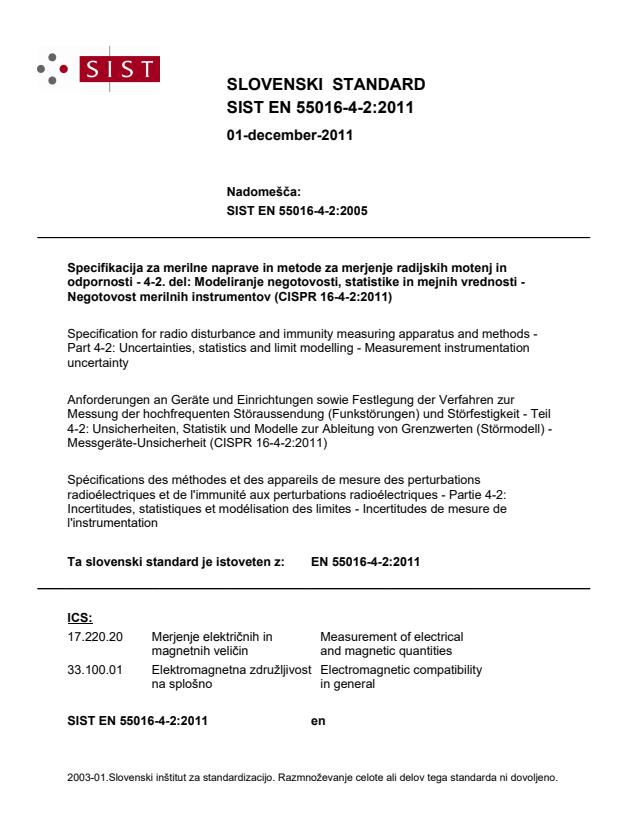
2003-01.Slovenski inštitut za standardizacijo. Razmnoževanje celote ali delov tega standarda ni dovoljeno.Specifikacija za merilne naprave in metode za merjenje radijskih motenj in odpornosti - 4-2. del: Modeliranje negotovosti, statistike in mejnih vrednosti - Negotovost merilnih instrumentov (CISPR 16-4-2:2011)Anforderungen an Geräte und Einrichtungen sowie Festlegung der Verfahren zur Messung der hochfrequenten Störaussendung (Funkstörungen) und Störfestigkeit - Teil 4-2: Unsicherheiten, Statistik und Modelle zur Ableitung von Grenzwerten (Störmodell) - Messgeräte-Unsicherheit (CISPR 16-4-2:2011)Spécifications des méthodes et des appareils de mesure des perturbations radioélectriques et de l'immunité aux perturbations radioélectriques - Partie 4-2: Incertitudes, statistiques et modélisation des limites - Incertitudes de mesure de l'instrumentationSpecification for radio disturbance and immunity measuring apparatus and methods - Part 4-2: Uncertainties, statistics and limit modelling - Measurement instrumentation uncertainty33.100.01Elektromagnetna združljivost na splošnoElectromagnetic compatibility in general17.220.20Measurement of electrical and magnetic quantitiesICS:Ta slovenski standard je istoveten z:EN 55016-4-2:2011SIST EN 55016-4-2:2011en01-december-2011SIST EN 55016-4-2:2011SLOVENSKI
STANDARDSIST EN 55016-4-2:20051DGRPHãþD
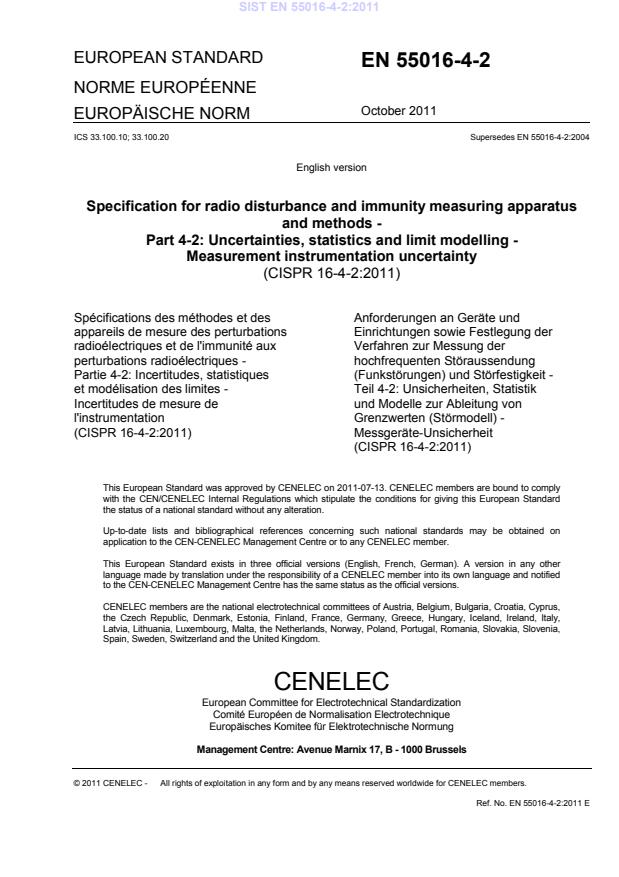
EUROPEAN STANDARD EN 55016-4-2 NORME EUROPÉENNE
EUROPÄISCHE NORM October 2011
CENELEC European Committee for Electrotechnical Standardization Comité Européen de Normalisation Electrotechnique Europäisches Komitee für Elektrotechnische Normung
Management Centre: Avenue Marnix 17, B - 1000 Brussels
© 2011 CENELEC -
All rights of exploitation in any form and by any means reserved worldwide for CENELEC members.
Ref. No. EN 55016-4-2:2011 E
ICS 33.100.10; 33.100.20 Supersedes EN 55016-4-2:2004
English version
Specification for radio disturbance and immunity measuring apparatus and methods -
Part 4-2: Uncertainties, statistics and limit modelling -
Measurement instrumentation uncertainty (CISPR 16-4-2:2011)
Spécifications des méthodes et des appareils de mesure des perturbations radioélectriques et de l'immunité aux perturbations radioélectriques -
Partie 4-2: Incertitudes, statistiques
et modélisation des limites -
Incertitudes de mesure de l'instrumentation (CISPR 16-4-2:2011)
Anforderungen an Geräte und Einrichtungen sowie Festlegung der Verfahren zur Messung der hochfrequenten Störaussendung (Funkstörungen) und Störfestigkeit -
Teil 4-2: Unsicherheiten, Statistik
und Modelle zur Ableitung von Grenzwerten (Störmodell) -
Messgeräte-Unsicherheit (CISPR 16-4-2:2011)
This European Standard was approved by CENELEC on 2011-07-13. CENELEC members are bound to comply with the CEN/CENELEC Internal Regulations which stipulate the conditions for giving this European Standard the status of a national standard without any alteration.
Up-to-date lists and bibliographical references concerning such national standards may be obtained on application to the CEN-CENELEC Management Centre or to any CENELEC member.
This European Standard exists in three official versions (English, French, German). A version in any other language made by translation under the responsibility of a CENELEC member into its own language and notified to the CEN-CENELEC Management Centre has the same status as the official versions.
CENELEC members are the national electrotechnical committees of Austria, Belgium, Bulgaria, Croatia, Cyprus, the Czech Republic, Denmark, Estonia, Finland, France, Germany, Greece, Hungary, Iceland, Ireland, Italy, Latvia, Lithuania, Luxembourg, Malta, the Netherlands, Norway, Poland, Portugal, Romania, Slovakia, Slovenia, Spain, Sweden, Switzerland and the United Kingdom.
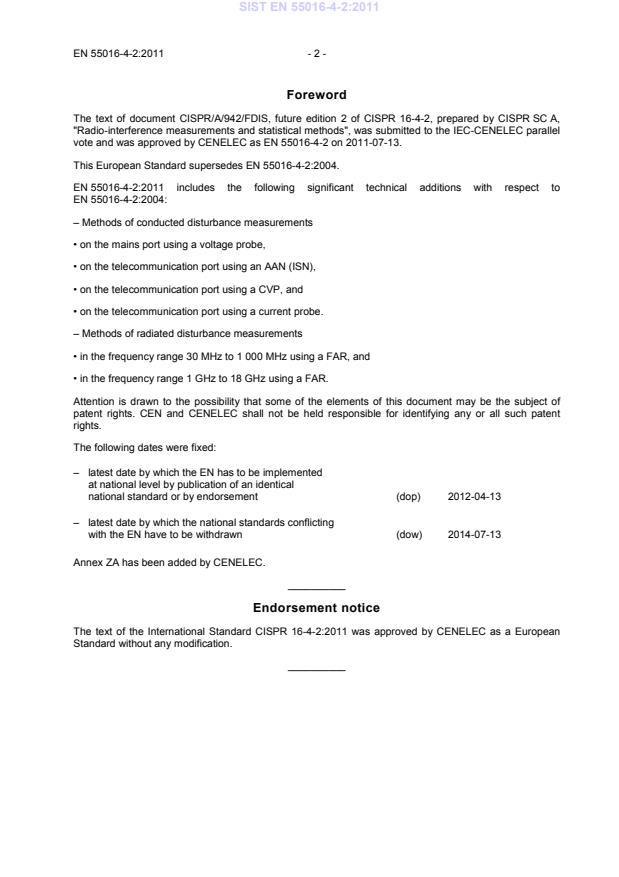
Foreword The text of document CISPR/A/942/FDIS, future edition 2 of CISPR 16-4-2, prepared by CISPR SC A, "Radio-interference measurements and statistical methods", was submitted to the IEC-CENELEC parallel vote and was approved by CENELEC as EN 55016-4-2 on 2011-07-13. This European Standard supersedes EN 55016-4-2:2004. EN 55016-4-2:2011 includes the following significant technical additions with respect to EN 55016-4-2:2004: – Methods of conducted disturbance measurements on the mains port using a voltage probe, on the telecommunication port using an AAN (ISN), on the telecommunication port using a CVP, and on the telecommunication port using a current probe. – Methods of radiated disturbance measurements in the frequency range 30 MHz to 1 000 MHz using a FAR, and in the frequency range 1 GHz to 18 GHz using a FAR. Attention is drawn to the possibility that some of the elements of this document may be the subject of patent rights. CEN and CENELEC shall not be held responsible for identifying any or all such patent rights. The following dates were fixed: – latest date by which the EN has to be implemented
at national level by publication of an identical
national standard or by endorsement
(dop)
2012-04-13 – latest date by which the national standards conflicting
with the EN have to be withdrawn
(dow)
2014-07-13 Annex ZA has been added by CENELEC. __________ Endorsement notice The text of the International Standard CISPR 16-4-2:2011 was approved by CENELEC as a European Standard without any modification. __________
- 3 - EN 55016-4-2:2011 Annex ZA (normative)
Normative references to international publications with their corresponding European publications
The following referenced documents are indispensable for the application of this document. For dated references, only the edition cited applies. For undated references, the latest edition of the referenced document (including any amendments) applies.
NOTE
When an international publication has been modified by common modifications, indicated by (mod), the relevant EN/HD applies.
Publication Year Title EN/HD Year
CISPR 11
- Industrial, scientific and medical equipment - Radio-frequency disturbance characteristics - Limits and methods of measurement EN 55011 -
CISPR 12 - Vehicles, boats and internal combustion engines - Radio disturbance characteristics - Limits and methods of measurement for the protection of off-board receivers EN 55012 -
CISPR 13 - Sound and television broadcast receivers and associated equipment - Radio disturbance characteristics - Limits and methods of measurement EN 55013 -
CISPR 16-1-1 - Specification for radio disturbance and immunity measuring apparatus and methods -Part 1-1: Radio disturbance and immunity measuring apparatus - Measuring apparatus EN 55016-1-1 -
CISPR 16-1-2 - Specification for radio disturbance and immunity measuring apparatus and methods -Part 1-2: Radio disturbance and immunity measuring apparatus - Ancillary equipment - Conducted disturbances EN 55016-1-2 -
CISPR 16-1-3 - Specification for radio disturbance and immunity measuring apparatus and methods -Part 1-3: Radio disturbance and immunity measuring apparatus - Ancillary equipment - Disturbance power EN 55016-1-3 -
CISPR 16-1-4 - Specification for radio disturbance and immunity measuring apparatus and methods -Part 1-4: Radio disturbance and immunity measuring apparatus - Antennas and test sites for radiated disturbance measurements EN 55016-1-4 -
CISPR 16-2-1 - Specification for radio disturbance and immunity measuring apparatus and methods -Part 2-1: Methods of measurement of disturbances and immunity - Conducted disturbance measurements EN 55016-2-1 -
CISPR 16-2-2 - Specification for radio disturbance and immunity measuring apparatus and methods -Part 2-2: Methods of measurement of disturbances and immunity - Measurement of disturbance power EN 55016-2-2 -
Publication Year Title EN/HD Year CISPR 16-2-3 2010 Specification for radio disturbance and immunity measuring apparatus and methods -Part 2-3: Methods of measurement of disturbances and immunity - Radiated disturbance measurements EN 55016-2-3 2010
CISPR 16-3 - Specification for radio disturbance and immunity measuring apparatus and methods -Part 3: CISPR technical reports - -
CISPR 16-4-1 - Specification for radio disturbance and immunity measuring apparatus and methods -Part 4-1: Uncertainties, statistics and limit modelling - Uncertainties in standardized EMC tests - -
CISPR 16-4-3 - Specification for radio disturbance and immunity measuring apparatus and methods -Part 4-3: Uncertainties, statistics and limit modeling - Statistical considerations in the determination of EMC compliance of mass-produced products - -
CISPR 22 (mod) 2008 Information technology equipment - Radio disturbance characteristics - Limits and methods of measurement EN 55022 2010
ISO/IEC Guide 98-3 - Uncertainty of measurement -
Part 3: Guide to the expression of uncertainty in measurement (GUM:1995) - -
ISO/IEC Guide 99 - International vocabulary of metrology - Basic and general concepts and associated terms (VIM) - -
CISPR 16-4-2 Edition 2.0 2011-06 INTERNATIONAL STANDARD NORME INTERNATIONALE Specification for radio disturbance and immunity measuring apparatus and methods –
Part 4-2: Uncertainties, statistics and limit modelling – Measurement instrumentation uncertainty
Spécifications des méthodes et des appareils de mesure des perturbations radioélectriques et de l'immunité aux perturbations radioélectriques –
Partie 4-2: Incertitudes, statistiques et modélisation des limites – Incertitudes de mesure de l’instrumentation
INTERNATIONAL ELECTROTECHNICAL COMMISSION COMMISSION ELECTROTECHNIQUE INTERNATIONALE XA ICS 33.100.10; 33.100.20 PRICE CODE CODE PRIX ISBN 978-2-88912-525-8
INTERNATIONAL SPECIAL COMMITTEE ON RADIO INTERFERENCE COMITÉ INTERNATIONAL SPÉCIAL DES PERTURBATIONS RADIOÉLECTRIQUES
BASIC EMC PUBLICATION PUBLICATION FONDAMENTALE EN CEM
– 2 – CISPR 16-4-2 IEC:2011 CONTENTS FOREWORD . 4 INTRODUCTION . 6 1 Scope . 7 2 Normative references . 7 3 Terms, definitions, symbols and abbreviations . 8 3.1 Terms and definitions . 8 3.2 Symbols . 9 3.3 Abbreviations . 10 4 Compliance criterion for the MIU . 10 4.1 General . 10 4.2 Compliance assessment . 11 5 Conducted disturbance measurements . 12 5.1 Conducted disturbance measurements at a mains port using an AMN
(see also B.1) . 12 5.2 Conducted disturbance measurements at a mains port using a VP
(see also B.2) . 12 5.3 Conducted disturbance measurements at a telecommunication port using an AAN (Y-network) (see also B.3) . 13 5.4 Conducted disturbance measurements at a telecommunication port using a CVP (see also B.4) . 14 5.5 Conducted disturbance measurements at a telecommunication port using a CP (see also B.5) . 15 6 Disturbance power measurements (see also C.1) . 15 6.1 Measurand for disturbance power measurements . 15 6.2 Symbols of input quantities specific for disturbance power measurements . 15 6.3 Input quantities to be considered for disturbance power measurements . 16 7 Radiated disturbance measurements in the frequency range 30 MHz to
1 000 MHz . 16 7.1 Radiated disturbance measurements at an OATS or in a SAC (see also D.1) . 16 7.2 Radiated disturbance measurements in a FAR (see also D.2) . 17 8 Radiated disturbance measurements in the frequency range 1 GHz to 18 GHz (see also E.1) . 18 8.1 Measurand for radiated disturbance measurements in a FAR (FSOATS) . 18 8.2 Symbols of input quantities specific for radiated disturbance measurements . 18 8.3 Input quantities to be considered for radiated disturbance measurements in a FAR . 18 Annex A (informative)
Basis for Ucispr values in Table 1, general information and
rationale for input quantities common to all measurement methods . 20 Annex B (informative)
Basis for Ucispr values in Table 1, uncertainty budgets and rationale for conducted disturbance measurements . 28 Annex C (informative)
Basis for Ucispr values in Table 1 – Disturbance power measurements . 37 Annex D (informative)
Basis for Ucispr values in Table 1 – Radiated disturbance measurements from 30 MHz to 1 000 MHz . 39 Annex E (informative)
Basis for Ucispr values in Table 1 – Radiated disturbance measurements from 1 GHz to 18 GHz . 52 Bibliography . 56 SIST EN 55016-4-2:2011
CISPR 16-4-2 IEC:2011 – 3 –
Figure A.1 – Deviation of the QP detector level indication from the signal level at receiver input for two cases, a sine-wave signal and an impulsive signal (PRF 100 Hz) . 23 Figure A.2 – Deviation of the peak detector level indication from the signal level at receiver input for two cases, a sine-wave signal and an impulsive signal (PRF 100 Hz) . 24 Figure A.3 – Illustration of system noise figure . 25 Figure D.1 – Effect of antenna directivity without tilting . 47 Figure D.2 – Effect of antenna directivity with optimum tilting . 47
Table 1 – Values of Ucispr . 11 Table B.1 – Conducted disturbance measurements from 9 kHz to 150 kHz
using a 50 Ω/50 µH + 5 Ω AMN . 28 Table B.2 – Conducted disturbance measurements from
150 kHz to 30 MHz using a 50 Ω/50 µH AMN . 29 Table B.3 – Conducted disturbance measurements
from 9 kHz to 30 MHz using a VP . 30 Table B.4 – Conducted disturbance measurements
from 150 kHz to 30 MHz using an AAN . 31 Table B.5 – Conducted disturbance measurements from 150 kHz to 30 MHz
using a capacitive voltage probe (CVP) . 32 Table B.6 – Conducted disturbance measurements
from 9 kHz to 30 MHz using a CP . 33 Table C.1 – Disturbance power from 30 MHz to 300 MHz . 37 Table D.1 – Horizontally polarized radiated disturbances from 30 MHz to 200 MHz using a biconical antenna at a distance of 3 m, 10 m, or 30 m. 40 Table D.2 – Vertically polarized radiated disturbances from 30 MHz to 200 MHz using a biconical antenna at a distance of 3 m, 10 m, or 30 m . 41 Table D.3 – Horizontally polarized radiated disturbances from 200 MHz to 1 GHz using an LPDA antenna at a distance of 3 m, 10 m, or 30 m . 42 Table D.4 – Vertically polarized radiated disturbances from 200 MHz to 1 GHz using an LPDA antenna at a distance of 3 m, 10 m, or 30 m . 43 Table D.5 – Radiated disturbance measurements from 30 MHz to 200 MHz using a biconical antenna in a FAR at a distance of 3 m . 44 Table D.6 – Radiated disturbance measurements from 200 MHz to 1 000 MHz using an LPDA antenna in a FAR at a distance of 3 m . 45 Table E.1 – Radiated disturbance measurements from 1 GHz to 6 GHz in a FAR (FSOATS) at a distance of 3 m . 52 Table E.2 – Radiated disturbance measurements from 6 GHz to 18 GHz in a FAR (FSOATS) at a distance of 3 m . 53 SIST EN 55016-4-2:2011
– 4 – CISPR 16-4-2 IEC:2011 INTERNATIONAL ELECTROTECHNICAL COMMISSION ____________
SPECIFICATION FOR RADIO DISTURBANCE AND IMMUNITY
MEASURING APPARATUS AND METHODS –
Part 4-2: Uncertainties, statistics and limit modelling –
Measurement instrumentation uncertainty
FOREWORD 1) The International Electrotechnical Commission (IEC) is a worldwide organization for standardization comprising all national electrotechnical committees (IEC National Committees). The object of IEC is to promote international co-operation on all questions concerning standardization in the electrical and electronic fields. To this end and in addition to other activities, IEC publishes International Standards, Technical Specifications, Technical Reports, Publicly Available Specifications (PAS) and Guides (hereafter referred to as “IEC Publication(s)”). Their preparation is entrusted to technical committees; any IEC National Committee interested in the subject dealt with may participate in this preparatory work. International, governmental and non-governmental organizations liaising with the IEC also participate in this preparation. IEC collaborates closely with the International Organization for Standardization (ISO) in accordance with conditions determined by agreement between the two organizations. 2) The formal decisions or agreements of IEC on technical matters express, as nearly as possible, an international consensus of opinion on the relevant subjects since each technical committee has representation from all interested IEC National Committees.
3) IEC Publications have the form of recommendations for international use and are accepted by IEC National Committees in that sense. While all reasonable efforts are made to ensure that the technical content of IEC Publications is accurate, IEC cannot be held responsible for the way in which they are used or for any misinterpretation by any end user. 4) In order to promote international uniformity, IEC National Committees undertake to apply IEC Publications transparently to the maximum extent possible in their national and regional publications. Any divergence between any IEC Publication and the corresponding national or regional publication shall be clearly indicated in the latter. 5) IEC itself does not provide any attestation of conformity. Independent certification bodies provide conformity assessment services and, in some areas, access to IEC marks of conformity. IEC is not responsible for any services carried out by independent certification bodies. 6) All users should ensure that they have the latest edition of this publication. 7) No liability shall attach to IEC or its directors, employees, servants or agents including individual experts and members of its technical committees and IEC National Committees for any personal injury, property damage or other damage of any nature whatsoever, whether direct or indirect, or for costs (including legal fees) and expenses arising out of the publication, use of, or reliance upon, this IEC Publication or any other IEC Publications.
8) Attention is drawn to the Normative references cited in this publication. Use of the referenced publications is indispensable for the correct application of this publication. 9) Attention is drawn to the possibility that some of the elements of this IEC Publication may be the subject of patent rights. IEC shall not be held responsible for identifying any or all such patent rights. International Standard CISPR 16-4-2 has been prepared by CISPR subcommittee A: Radio-interference measurements and statistical methods. This second edition cancels and replaces the first edition published in 2003. It constitutes a technical revision. This edition includes the following significant technical additions with respect to the previous edition: – Methods of conducted disturbance measurements • on the mains port using a voltage probe, • on the telecommunication port using an AAN (ISN), SIST EN 55016-4-2:2011
CISPR 16-4-2 IEC:2011 – 5 – • on the telecommunication port using a CVP, and • on the telecommunication port using a current probe. – Methods of radiated disturbance measurements • in the frequency range 30 MHz to 1 000 MHz using a FAR, and • in the frequency range 1 GHz to 18 GHz using a FAR. This publication has the status of a basic EMC standard in accordance with IEC Guide 107:2009, Electromagnetic compatibility – Guide to the drafting of electromagnetic compatibility publications. The text of this standard is based on the following documents: FDIS Report on voting CISPR/A/942/FDIS CISPR/A/952/RVD
Full information on the voting for the approval of this standard can be found in the report on voting indicated in the above table. This publication has been drafted in accordance with the ISO/IEC Directives, Part 2. A list of all parts of the CISPR 16 series can be found, under the general title Specification for radio disturbance and immunity measuring apparatus and methods, on the IEC website. The committee has decided that the contents of this publication will remain unchanged until the stability date indicated on the IEC web site under "http://webstore.iec.ch" in the data related to the specific publication. At this date, the publication will be
• reconfirmed, • withdrawn, • replaced by a revised edition, or • amended.
IMPORTANT – The “colour inside” logo on the cover page of this publication indicates that it contains colours which are considered to be useful for the correct understanding of its contents. Users should therefore print this publication using a colour printer.
– 6 – CISPR 16-4-2 IEC:2011 INTRODUCTION The CISPR 16-4 series, Specification for radio disturbance and immunity measuring apparatus and methods – Uncertainties, statistics and limit modelling, contains information related to uncertainties, statistics and limit modelling, and consists of the following five parts: • Part 4-1: Uncertainties in standardized EMC tests, • Part 4-2: Measurement instrumentation uncertainty, • Part 4-3: Statistical considerations in the determination of EMC compliance of mass-produced products, • Part 4-4: Statistics of complaints and a model for the calculation of limits for the protection of radio services, and • Part 4-5: Conditions for the use of alternative test methods. For practical reasons, standardized electromagnetic compatibility (EMC) tests are simplified representations of possible electromagnetic interference (EMI) scenarios that a product may encounter in practice. Consequently, in an EMC standard, the measurand, the limit, measurement instruments, measurement set-up, measurement procedure and measurement conditions are simplified but are still meaningful (representative). Here meaningful means that there is a statistical correlation between compliance of the product with a limit, based on a standardized EMC test using standardized test equipment, and a high probability of actual EMC of the same product during its life cycle. Part 4-4 provides methods based on statistics to derive meaningful disturbance limits to protect radio services. In general, a standardized EMC test should be developed such that reproducible results are obtained if different parties perform the same test with the same EUT. However, various uncertainty sources limit the reproducibility of a standardized EMC.
Part 4-1 is a technical report that consists of a collection of informative reports that address all relevant uncertainty sources that may be encountered during EMC compliance tests. Typical examples of uncertainty sources are the EUT itself, the measurement instrumentation, the set-up of the EUT, the test procedures and the environmental conditions. Part 4-2 describes a specific category of uncertainties, i.e. measurement instrumentation uncertainties. In this part, examples of MIU budgets are given for most of the CISPR measurement methods. Also in this part, normative requirements are given on how to apply the MIU when determining compliance of an EUT with a disturbance limit (i.e. conformity assessment decision). Part 4-3 is a technical report that describes the statistical treatment of test results when compliance tests are performed on samples of mass-produced products. This treatment is known as the 80 %/80 % rule. Part 4-4 is a technical report that contains CISPR recommendations for the collation of statistical data on interference complaints and for the classification of interference sources. Also, models for the calculation of limits for various modes of interference coupling are given. Part 4-5 is a technical report describing a method to enable product committees to develop limits for alternative test methods, using conversions from established limits. SIST EN 55016-4-2:2011
CISPR 16-4-2 IEC:2011 – 7 – SPECIFICATION FOR RADIO DISTURBANCE AND IMMUNITY
MEASURING APPARATUS AND METHODS –
Part 4-2: Uncertainties, statistics and limit modelling –
Measurement instrumentation uncertainty
1 Scope This part of CISPR 16-4 specifies the method of applying Measurement Instrumentation Uncertainty (MIU) when determining compliance with CISPR disturbance limits. The material is also relevant to any EMC test when interpretation of the results and conclusions reached will be impacted by the uncertainty of the measurement instrumentation used during testing.
NOTE In accordance with IEC Guide 107, CISPR 16-4-2 is a basic EMC standard for use by product committees of the IEC. As stated in Guide 107, product committees are responsible for determining the applicability of the EMC standard. CISPR and its sub-committees are prepared to co-operate with technical committees and product committees in the evaluation of the applicability of this standard for specific products. The annexes contain the background material used in providing the amount of MIU found in generating the CISPR values shown in Clauses 4 through 8 and hence provide valuable background material for those needing both initial and further information on MIU and how to take individual uncertainties in the measurement chain into account. The annexes, however, are not intended to be a tutorial or user manual or to be copied when making uncertainty calculations. For that purpose, the references shown in the bibliography, or other widely recognized documents, may be used. Measurement instrumentation specifications are given in the CISPR 16-1 series, while the methods of measurement are covered in the CISPR 16-2 series. Further information and background on CISPR and radio disturbances is given in CISPR 16-3. The other parts of the CISPR 16-4 series contain further information on uncertainties in general, statistics and limit modelling. See the introduction of this part for more information on the background and on the content of the CISPR 16-4 series. 2 Normative references The following referenced documents are indispensable for the application of this document. For dated references, only the edition cited applies. For undated references, the latest edition of the referenced document (including any amendments) applies. CISPR 11, Industrial, scientific and medical equipment – Radio-frequency disturbance characteristics – Limits and methods of measurement CISPR 12, Vehicles, boats and internal combustion engines – Radio disturbance characteristics – Limits and methods of measurement for the protection of off-board receivers CISPR 13, Sound and television broadcast receivers and associated equipment – Radio disturbance characteristics – Limits and methods of measurement CISPR 16-1-1, Specification for radio disturbance and immunity measuring apparatus and methods – Part 1-1: Radio disturbance and immunity measuring apparatus – Measuring apparatus SIST EN 55016-4-2:2011
– 8 – CISPR 16-4-2 IEC:2011 CISPR 16-1-2, Specification for radio disturbance and immunity measuring apparatus and methods – Part 1-2: Radio disturbance and immunity measuring apparatus – Ancillary equipment – Conducted disturbances CISPR 16-1-3, Specification for radio disturbance and immunity measuring apparatus and methods – Part 1-3: Radio disturbance and immunity measuring apparatus – Ancillary equipment – Disturbance power CISPR 16-1-4, Specification for radio disturbance and immunity measuring apparatus and methods – Part 1-4: Radio disturbance and immunity measuring apparatus – Antennas and test sites for radiated disturbance measurements CISPR 16-2-1, Specification for radio disturbance and immunity measuring apparatus and methods – Part 2-1: Methods of measurement of disturbances and immunity – Conducted disturbance measurements CISPR 16-2-2, Specification for radio disturbance and immunity measuring apparatus and methods – Part 2-2: Methods of measurement of disturbances and immunity – Measurement of disturbance power CISPR 16-2-3:2010, Specification for radio disturbance and immunity measuring apparatus and methods – Part 2-3: Methods of measurement of disturbances and immunity – Radiated disturbance measurements CISPR 16-3, Specification for radio disturbance and immunity measuring apparatus and methods – Part 3: CISPR technical reports CISPR 16-4-1, Specification for radio disturbance and immunity measuring apparatus and methods – Part 4-1: Uncertainties, statistics and limit modelling – Uncertainties in standardized EMC tests CISPR 16-4-3, Specification for radio disturbance and immunity measuring apparatus and methods – Part 4-3: Uncertainties, statistics and limit modelling – Statistical considerations in the determination of EMC compliance of mass-produced products CISPR 22:2008, Information technology equipment – Radio disturbance characteristics – Limits and methods of measurement ISO/IEC Guide 98-3, Uncertainty of measurement – Part 3: Guide to the expression of uncertainty in measurement (GUM:1995) ISO/IEC Guide 99, International vocabulary of metrology – Basic and general concepts and associated terms (VIM) 3 Terms, definitions, symbols and abbreviations 3.1 Terms and definitions For the purposes of this document, the terms and definitions given in ISO/IEC Guide 98-3 and ISO/IEC Guide 99, as well as the following apply.
NOTE General terms and definitions used in the expression of uncertainty are contained in ISO/IEC Guide 98-3.
General metrology definitions are contained in ISO/IEC Guide 99.
Relevant basic definitions are not repeated here. SIST EN 55016-4-2:2011
CISPR 16-4-2 IEC:2011 – 9 – 3.1.1
measurement instrumentation uncertainty MIU parameter, associated with the result of a measurement, that characterises the dispersion of the values that could reasonably be attributed to the measurand, induced by all relevant input quantities that are related to the measurement instrumentation 3.2 Symbols For the purposes of this document, the symbols given in Clauses 3, 5, 6, 7 and 8 apply, as well as the following. 3.2.1 General symbols Xi input quantity xi estimate of Xi δXi correction for input quantity u(xi) standard uncertainty of xi ci sensitivity coefficient y result of a measurement (the estimate of the measurand), corrected for all recognised significant systematic effects, in logarithmic units, e.g. dB(µV/m) uc(y) (combined) standard uncertainty of y, in dB U(y) expanded uncertainty of y, in dB Ucispr CISPR criterion for the expanded MIU evaluated in this standard for each specific measurement method, in dB Ulab expanded MIU determined by the test laboratory, in dB k coverage factor a+ upper abscissa of a probability distribution a- lower abscissa of a probability distribution
3.2.2 Symbols for measured quantities E disturbance electric field strength, in dB(µV/m) I disturbance current, in dB(µA) P disturbance power, in dB(pW) V disturbance voltage, in dB(µV)
3.2.3 Symbols for input quantities common to all disturbance measurements ac attenuation of the connection between the receiver and the ancillary equipment (e.g. AMN, antenna etc.), in dB δM correction for the error caused by mismatch, in dB Vr receiver voltage reading, in dB(µV) δVsw correction for receiver sine wave voltage inaccuracy, in dB δVpa correction for imperfect receiver pulse amplitude response, in dB δVpr correction for imperfect receiver pulse repetition rate response, in dB δVnf correction for the effect of the receiver noise floor, in dB
– 10 – CISPR 16-4-2 IEC:2011 3.3 Abbreviations For the purposes of this document, the following abbreviations apply.
NOTE Abbreviations not shown here are defined at their first occurrence in this document.
AAN asymmetric artificial network AE associated equipment (equipment connected to the AE port of the ancillary equipment; ancillary equipment is a transducer, e.g. an AAN; see definitions in CISPR 16-2-1) AF antenna factor AMN artificial mains network CP current probe CVP capacitive voltage probe EUT equipment under test FAR fully anechoic room FSOATS free-space OATS (refer to CISPR16-1-4) LCL longitudinal conversion loss LPDA logarithmic periodic (log-periodic) dipole array MIU measurement instrumentation uncertainty OATS open area test site PRF pulse repetition frequency RF radio frequency SAC semi-anechoic chamber S/N signal to noise ratio VDF voltage division factor VP voltage probe VSWR voltage standing wave ratio 4 Compliance criterion for the MIU 4.1 General MIU shall be taken into account, as described in this clause, when determining compliance or non-compliance of an EUT with a disturbance limit. The MIU for a test laboratory shall be evaluated for the measurements addressed in Clauses 5 through 8, taking into consideration each of the input quantities listed there. The standard uncertainty u(xi) in dB, and the sensitivity coefficient ci, shall be evaluated for the estimate xi of each quantity. The combined standard uncertainty uc(y) of the estimate y of the measurand shall be calculated using
∑=iiixucyu)()(22c (1) The expanded MIU Ulab for a test laboratory shall be calculated for each type of measurement using SIST EN 55016-4-2:2011
CISPR 16-4-2 IEC:2011 – 11 –
)(2)(clabyuyUU== (2) If Ulab is less than or equal to Ucispr in Table 1, then the test report may either state the value of Ulab or state that Ulab is less than Ucispr. If Ulab exceeds Ucispr of Table 1, then the test report shall contain the value of Ulab (in dB) for the measurement instrumentation actually used for the measurements. NOTE Equation (2) means that a coverage factor k = 2 is applied that yields approximately a 95 % level of confidence for the near-normal distribution typical of most measurement results.
Table 1 – Values of Ucispr Measurement Ucispr Table Conducted disturbance at mains port using AMN (9 kHz to 150 kHz) 3,8 dB B.1 (150 kHz to 30 MHz) 3,4 dB B.2 Conducted disturbance at mains port using voltage probe (9 kHz to 30 MHz) 2,9 dB B.3 Conducted disturbance at telecommunication port using AAN (150 kHz to 30 MHz) 5,0 dB B.4 Conducted disturbance at telecommunication port using CVP (150 kHz to 30 MHz) 3,9 dB B.5 Conducted disturbance at telecommunication port using CP (150 kHz to 30 MHz) 2,9 dB B.6 Disturbance power (30 MHz to 300 MHz) 4,5 dB C.1 Radiated disturbance
(electric field strength at an OATS or in a SAC) (30 MHz to 1 000 MHz) 6,3 dB D.1 to D.4 Radiated disturbance (electric field strength in a FAR) (30 MHz to 1 000 MHz) 5,3 dB D.5 to D.6 Radiated disturbance (electric field strength in a FAR) (1 GHz to 6 GHz) 5,2 dB E.1 Radiated disturbance (electric field strength in a FAR) (6 GHz to 18 GHz) 5,5 dB E.2 NOTE 1 The values of Ucispr are based on the expanded uncertainties in the annexes that were evaluated by considering uncertainties associated with the quantities listed in the measurement-specific subclause. If there are different values in the annexes, then the value taken as Ucispr is the maximum value (e.g. maximum of Tables D.1 through D.4). NOTE 2 In the frequency range below 1 GHz, the values of Ucispr were calculated for measurements using the quasi-peak detector, assuming that values for the average detector and r.m.s.-average detector would not exceed these values. Above 1 GHz, the value of Ucispr was calculated for measurements using the peak detector.
Nothing in this clause supersedes the requirement for measurement instrumentation to comply with specifications of the CISPR 16-1 series. Also, this clause does not replace the requirement to comply with CISPR 16-4-3. 4.2 Compliance assessment Compliance or non-compliance with a disturbance limit shall be determined in the following manner. If Ulab is less than or equal to Ucispr of Table 1, then: – compliance is deemed to occur if no measured disturbance level exceeds the disturbance limit; – non-compliance is deemed to occur if any measured disturbance level exceeds the disturbance limit. SIST EN 55016-4-2:2011
– 12 – CISPR 16-4-2 IEC:2011 If Ulab is greater than Ucispr of Table 1, then: – compliance is deemed to occur if no measured disturbance level, increased by (Ulab − Ucispr), exceeds the disturbance limit; – non-compliance is deemed to occur if any measured disturbance level, increased by
(Ulab − Ucispr), exceeds the disturbance limit. NOTE
For the compliance assessment procedure described in this subclause, both the measured disturbance level
5 Conducted disturbance measurements 5.1 Conducted disturbance measurements at a mains port using an AMN
(see also B.1) 5.1.1 Measurand for measurements using an AMN V Unsymmetric voltage, in dB(µV), measured at the EUT port of the AMN relative to the reference ground plane 5.1.2 Symbols of input quantities specific to measurements using an AMN FAMN Voltage division factor of the AMN, in dB /FAMNf Correction for voltage division factor (VDF) frequency interpolation error, in dB δDmains Correction for the error caused by mains disturbances, in dB δVenv Correction for the effect of the environment, in dB δZAMN Correction for imperfect AMN impedance, in dB 5.1.3 Input quantities to be considered for conducted disturbance measurements at a mains port using an AMN – Receiver reading – Attenuation of the connection between AMN and receiver – AMN voltage division factor – AMN VDF frequency interpolation – Receiver related input quantities: • Receiver sine-wave voltage accuracy • Receiver pulse amplitude response • Receiver pulse response variation with repetition frequency • Receiver noise floor – Mismatch effects between AMN receiver port and receiver – AMN impedance – Effect of mains disturbances – Effect of environment 5.2 Conducted disturbance measurements at a mains port using a VP
(see also B.2) 5.2.1 Measurand for measurements using a VP V Unsymmetric voltage, in dB(µV), measured at the EUT power port – loaded with an impedance of 1 500 Ω – relative to the reference ground SIST EN 55016-4-2:2011
CISPR 16-4-2 IEC:2011 – 13 – 5.2.2 Symbols of input quantities specific to measurements using a VP FVP Voltage division factor (VDF) of the voltage probe, in dB δFVPf Correction for the VDF frequency interpolation error, in dB δDmains Correction for the error caused by mains disturbances, in dB δVenv Correction for the effect of the environment, in dB δZVP Correction for imperfect voltage probe impedance, in dB δZmains Correction for the error caused by the mains impedance when compared with AMN, in dB 5.2.3 Input quantities to be considered for conducted disturbance measurements at a mains port using a VP – Receiver reading – Attenuation of the connection between VP and receiver – VP VDF – VP VDF frequency interpolation – Receiver related input quantities:
• Receiver sine-wave voltage accuracy • Receiver pulse amplitude response • Receiver pulse response variation with repetition frequency • Receiver noise floor – Mismatch effects between VP receiver port and receiver – VP impedance – Effect of mains disturbances – Effect of mains impedance when compared with AMN – Effect of environment 5.3 Conducted disturbance measurements at a telecommunication port using an AAN (Y-network) (see also B.3) NOTE The term “asymmetric artificial network (AAN)” is defined in CISPR 16-1-2. It is referred to as an impedance stabilization network (ISN) in CISPR 22. The term Y-network differentiates it from V- and û-networks. 5.3.1 Measurand for measurements using an AAN V Asymmetric (common mode) voltage, in dB(µV), measured at the EUT port of the AAN referred to the reference ground plane 5.3.2 Symbols of input quantities specific for measurements using an AAN FAAN Voltage division factor (VDF) of the AAN, in dB /FAANf Correction for the VDF frequency interpolation error, in dB δDAE Correction for the error caused by disturbances from the AE, in dB δVenv Correction for the effect of the environment, in dB δaLCL Correction for imperfect longitudinal conversion loss of the AAN, in dB δZAAN Correction for imperfect asymmetric (common mode) impedance of the AAN, in dB 5.3.3 Input quantities to be considered for conducted disturbance measurements at a telecommunication port using an AAN – Receiver reading SIST EN 55016-4-2:2011
– 14 – CISPR 16-4-2 IEC:2011 – Attenuation of the connection between AAN and receiver – AAN VDF – AAN VDF frequency interpolation – Receiver related input quantities:
• Receiver sine-wave voltage accuracy • Receiver pulse amplitude response • Receiver pulse response variation with repetition frequency • Receiver noise floor – Mismatch effects between AAN receiver port and receiver – Asymmetric impedance of the AAN – Longitudinal conversion loss (LCL) of the AAN – Effect of disturbances from the AE
– Effect of environment 5.4 Conducted disturbance measurements at a telecommunication port using a CVP (see also B.4) 5.4.1 Measurand for measurements using a CVP V Asymmetric (common mode) voltage, in dB(µV), measured at the telecommunication port referred to the reference ground 5.4.2 Symbols of input quantities specific for measurements using a CVP FCVP Voltage division factor (VDF) of the CVP, in dB /FCVPf Correction for the CVP VDF frequency interpolation error, in dB δDAE Correction for the error caused by disturbances from the AE, in dB δVenv Correction for the effect of the environment, in dB δFc pos Correction for the effect of cable position inside the CVP aperture on the voltage division factor, in dB δFc rad Correction for the effect of cable radius on voltage division factor, in dB
...