

SIST EN 16602-70-16:2021
(Main)Space engineering - Adhesive bonding for spacecraft and launcher applications
General Information
- Abstract
The scope of the document addresses the generic verification for all types of adhesive bonding for space applications including evaluation phases. It specifies all aspects of the adhesive bonding lifetime such as assembly, integration and testing, on-ground acceptance testing, storage, transport, pre-launch, launch and in-flight environments.
This standard does not cover requirements for:
- adhesive bonding used in EEE mounting on printed circuit boards (ECSS-Q-ST-70-61)
- adhesive bonding used in hybrid manufacturing (ESCC 2566000)
- adhesive bonding for cover-glass on solar cell assemblies (ECSS-E-ST-20-08)
- design of adhesive joint
- long term storage and long term storage sample testing
- performance of adhesive bond
- functional properties of adhesive joint
• co-curing processes
This standard may be tailored for the specific characteristics and constrains of a space project in conformance with ECSS-S-ST-00.
- Status
- Published
- Public Enquiry End Date
- 06-Apr-2019
- Publication Date
- 11-Nov-2021
- Technical Committee
- I13 - Imaginarni 13
- Current Stage
- 6060 - National Implementation/Publication (Adopted Project)
- Start Date
- 03-Nov-2021
- Due Date
- 08-Jan-2022
- Completion Date
- 12-Nov-2021


SIST EN 16602-70-16:2021 - Overview
SIST EN 16602-70-16:2021 is a European space-engineering standard that defines generic verification and assurance practices for adhesive bonding used in spacecraft and launcher applications. It covers the full adhesive-bonding lifetime relevant to space projects: assembly, integration and testing, on‑ground acceptance, storage, transport, pre‑launch, launch and in‑flight environments. The standard may be tailored to a project’s constraints in conformance with ECSS‑S‑ST‑00.
This standard is primarily a verification and process-control document; it does not cover adhesive joint design, long‑term storage performance, EEE mounting on PCBs (see ECSS‑Q‑ST‑70‑61), hybrid manufacturing (ESCC 2566000), cover‑glass on solar cells (ECSS‑E‑ST‑20‑08), co‑curing processes or detailed functional performance metrics.
Key technical topics and requirements
- Adhesive selection and application analysis - guidance on choosing adhesives and defining their intended use in space environments.
- Definition of adhesive bonding process - process requirements, bonding procedures, and process traceability to ensure repeatability and evidence for verification.
- Verification strategy and test program - test planning, test reports, configuration and identification of test items, and a verification sequence for on‑ground, launch and mission exposures.
- Environmental simulation and conditioning - procedures for simulating thermal cycling, humidity (hot‑wet), mechanical loads and other relevant environmental exposures during verification.
- Material and bonded assembly characterization - informative annexes outline bulk-material tests (rheology, DSC, TGA, DMA, outgassing) and bonded‑joint tests (lap shear, peel, fracture mechanics).
- Ageing and degradation - models and recommendations for natural and accelerated ageing, diffusion mechanisms and example hot‑wet exposure regimes for satellites and launchers.
- Quality assurance and traceability - procurement controls, incoming inspection, tooling/equipment control, workmanship, operator training and nonconformance handling.
- Personnel training and qualification - recommended system for training and qualification of adhesive bonding personnel (informative annex).
Practical applications and users
Who should use this standard:
- Spacecraft and launcher structural engineers and materials engineers selecting adhesives and defining bonding processes.
- Test engineers and verification managers responsible for environmental simulation, qualification tests and test reporting.
- Quality assurance, procurement and manufacturing teams managing supplier control, incoming inspection, traceability and operator qualifications.
- Suppliers of adhesives, bonded assemblies and special tooling seeking to align processes with space project requirements.
Practical benefits:
- Provides a structured verification sequence for adhesive bonds across lifecycle stages.
- Reduces program risk by standardizing test plans, traceability and QA for bonded assemblies used in spaceflight.
- Supports project tailoring consistent with ECSS requirements.
Related standards and exclusions
- Tailoring recommended in conformance with ECSS‑S‑ST‑00.
- Not applicable to: ECSS‑Q‑ST‑70‑61 (EEE on PCBs), ESCC 2566000 (hybrid manufacturing), ECSS‑E‑ST‑20‑08 (solar cell cover‑glass), co‑curing processes, joint design and long‑term storage performance.
Keywords: adhesive bonding, space engineering standard, spacecraft adhesives, launcher applications, verification, environmental testing, outgassing, ageing, quality assurance, traceability.
Relations
- Effective Date
- 09-Feb-2026
- Refers
SIST EN 15304:2010 - Determination of the freeze-thaw resistance of autoclaved aerated concrete - Effective Date
- 28-Jan-2026
- Effective Date
- 28-Jan-2026
- Effective Date
- 28-Jan-2026
Get Certified
Connect with accredited certification bodies for this standard

BUREAU VERITAS Certification Germany
Bureau Veritas certification in Germany.

Element Materials Technology
Materials testing and product certification.

AQMS Ltd.
AQMS provides ISO certification to SMEs across the UK.
Sponsored listings
Frequently Asked Questions
SIST EN 16602-70-16:2021 is a standard published by the Slovenian Institute for Standardization (SIST). Its full title is "Space engineering - Adhesive bonding for spacecraft and launcher applications". This standard covers: The scope of the document addresses the generic verification for all types of adhesive bonding for space applications including evaluation phases. It specifies all aspects of the adhesive bonding lifetime such as assembly, integration and testing, on-ground acceptance testing, storage, transport, pre-launch, launch and in-flight environments. This standard does not cover requirements for: - adhesive bonding used in EEE mounting on printed circuit boards (ECSS-Q-ST-70-61) - adhesive bonding used in hybrid manufacturing (ESCC 2566000) - adhesive bonding for cover-glass on solar cell assemblies (ECSS-E-ST-20-08) - design of adhesive joint - long term storage and long term storage sample testing - performance of adhesive bond - functional properties of adhesive joint • co-curing processes This standard may be tailored for the specific characteristics and constrains of a space project in conformance with ECSS-S-ST-00.
The scope of the document addresses the generic verification for all types of adhesive bonding for space applications including evaluation phases. It specifies all aspects of the adhesive bonding lifetime such as assembly, integration and testing, on-ground acceptance testing, storage, transport, pre-launch, launch and in-flight environments. This standard does not cover requirements for: - adhesive bonding used in EEE mounting on printed circuit boards (ECSS-Q-ST-70-61) - adhesive bonding used in hybrid manufacturing (ESCC 2566000) - adhesive bonding for cover-glass on solar cell assemblies (ECSS-E-ST-20-08) - design of adhesive joint - long term storage and long term storage sample testing - performance of adhesive bond - functional properties of adhesive joint • co-curing processes This standard may be tailored for the specific characteristics and constrains of a space project in conformance with ECSS-S-ST-00.
SIST EN 16602-70-16:2021 is classified under the following ICS (International Classification for Standards) categories: 49.025.50 - Adhesives; 49.140 - Space systems and operations. The ICS classification helps identify the subject area and facilitates finding related standards.
SIST EN 16602-70-16:2021 has the following relationships with other standards: It is inter standard links to SIST ISO 3696:1995, SIST EN 15304:2010, SIST EN ISO 15015:2026, SIST EN ISO 19065-2:2019. Understanding these relationships helps ensure you are using the most current and applicable version of the standard.
SIST EN 16602-70-16:2021 is associated with the following European legislation: Standardization Mandates: M/496. When a standard is cited in the Official Journal of the European Union, products manufactured in conformity with it benefit from a presumption of conformity with the essential requirements of the corresponding EU directive or regulation.
SIST EN 16602-70-16:2021 is available in PDF format for immediate download after purchase. The document can be added to your cart and obtained through the secure checkout process. Digital delivery ensures instant access to the complete standard document.
Standards Content (Sample)
SLOVENSKI STANDARD
01-december-2021
Vesoljska tehnika - Lepilno spajanje za vesoljska in nosilna plovila
Space engineering - Adhesive bonding for spacecraft and launcher applications
Raumfahrtproduktsicherung - Adhäsionskleben für Raumfahrt- und Trägeranwendungen
Assurance produit des projets spatiaux - Utilisations du collage pour les structure
satellites et lanceurs
Ta slovenski standard je istoveten z: EN 16602-70-16:2021
ICS:
49.025.50 Lepila Adhesives
49.140 Vesoljski sistemi in operacije Space systems and
operations
2003-01.Slovenski inštitut za standardizacijo. Razmnoževanje celote ali delov tega standarda ni dovoljeno.
EUROPEAN STANDARD
EN 16602-70-16
NORME EUROPÉENNE
EUROPÄISCHE NORM
October 2021
ICS 49.025.50; 49.140
English version
Space engineering - Adhesive bonding for spacecraft and
launcher applications
Assurance produit des projets spatiaux - Utilisations Raumfahrtproduktsicherung - Adhäsionskleben für
du collage pour les structure satellites et lanceurs Raumfahrt- und Trägeranwendungen
This European Standard was approved by CEN on 22 February 2021.
CEN and CENELEC members are bound to comply with the CEN/CENELEC Internal Regulations which stipulate the conditions for
giving this European Standard the status of a national standard without any alteration. Up-to-date lists and bibliographical
references concerning such national standards may be obtained on application to the CEN-CENELEC Management Centre or to
any CEN and CENELEC member.
This European Standard exists in three official versions (English, French, German). A version in any other language made by
translation under the responsibility of a CEN and CENELEC member into its own language and notified to the CEN-CENELEC
Management Centre has the same status as the official versions.
CEN and CENELEC members are the national standards bodies and national electrotechnical committees of Austria, Belgium,
Bulgaria, Croatia, Cyprus, Czech Republic, Denmark, Estonia, Finland, France, Germany, Greece, Hungary, Iceland, Ireland, Italy,
Latvia, Lithuania, Luxembourg, Malta, Netherlands, Norway, Poland, Portugal, Republic of North Macedonia, Romania, Serbia,
Slovakia, Slovenia, Spain, Sweden, Switzerland, Turkey and United Kingdom.
CEN-CENELEC Management Centre:
Rue de la Science 23, B-1040 Brussels
© 2021 CEN/CENELEC All rights of exploitation in any form and by any means Ref. No. EN 16602-70-16:2021 E
reserved worldwide for CEN national Members and for
CENELEC Members.
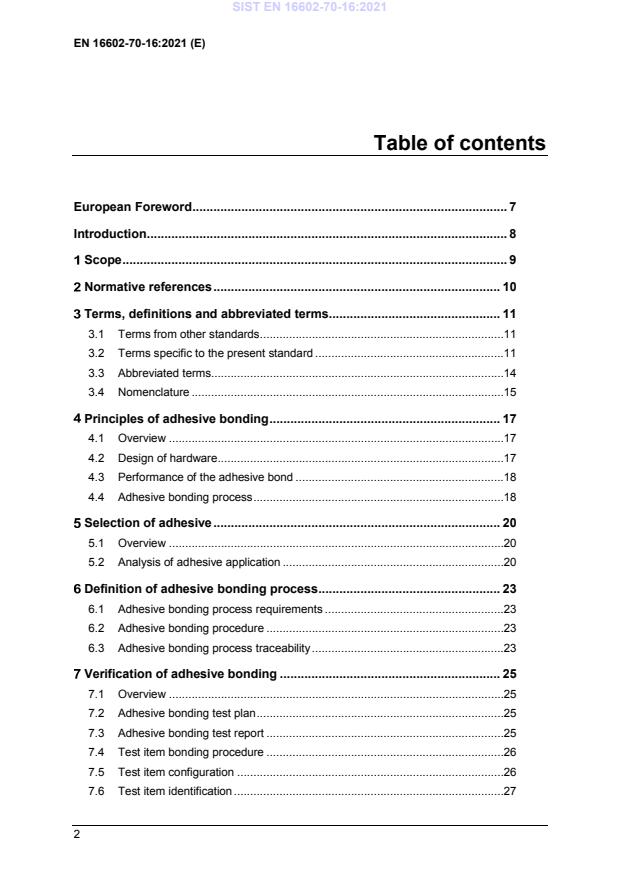
Table of contents
European Foreword . 7
Introduction . 8
Scope . 9
Normative references . 10
Terms, definitions and abbreviated terms . 11
3.1 Terms from other standards .11
3.2 Terms specific to the present standard .11
3.3 Abbreviated terms. 14
3.4 Nomenclature .15
Principles of adhesive bonding . 17
4.1 Overview .17
4.2 Design of hardware .17
4.3 Performance of the adhesive bond .18
4.4 Adhesive bonding process .18
Selection of adhesive . 20
5.1 Overview .20
5.2 Analysis of adhesive application .20
Definition of adhesive bonding process . 23
6.1 Adhesive bonding process requirements . 23
6.2 Adhesive bonding procedure .23
6.3 Adhesive bonding process traceability . 23
Verification of adhesive bonding . 25
7.1 Overview .25
7.2 Adhesive bonding test plan .25
7.3 Adhesive bonding test report .25
7.4 Test item bonding procedure .26
7.5 Test item configuration .26
7.6 Test item identification .27
7.7 Verification test sequence .27
General . 27
7.8 Test item manufacturing .28
7.9 Test item conditioning .29
7.10 Simulation of on-ground environmental exposure . 29
7.11 Simulation of launch environmental exposure . 31
Overview .31
Test definition .31
7.12 Simulation of mission environmental exposure . 31
Overview .31
Thermal cycling test conditions . 31
7.13 Inspection before, during and after environmental exposure . 33
7.14 Test before, during and after environmental exposure . 33
Quality assurance . 35
8.1 Overview .35
8.2 General .35
8.3 Procurement .35
8.4 Hazard, health and safety precautions . 36
8.5 Incoming inspection .36
8.6 Traceability .37
8.7 Tooling and equipment control .37
8.8 Workmanship . 38
8.9 Handling and storage .38
8.10 Inspection and bonding process control .39
8.11 Operator and inspector training.40
8.12 Nonconformance .41
Annex A (normative) Adhesive bonding procedure – DRD . 42
A.1 DRD identification . 42
A.1.1 Requirement identification and source document . 42
A.1.2 Purpose and objective .42
A.2 Expected response .42
A.2.1 Scope and content .42
A.2.2 Special remarks .43
Annex B (normative) Adhesive bonding test plan - DRD . 44
B.1 DRD identification . 44
B.1.1 Requirement identification and source document . 44
B.1.2 Purpose and objective .44
B.2 Expected response .44
B.2.1 Scope and content .44
B.2.2 Special remarks .44
Annex C (normative) Adhesive bonding test report -DRD . 45
C.1 DRD identification . 45
C.1.1 Requirement identification and source document . 45
C.1.2 Purpose and objective .45
C.2 Expected response .45
C.2.1 Scope and content .45
C.2.2 Special remarks .46
Annex D (informative) Examples of techniques used for adhesive material
characterization (bulk) . 47
D.1 Overview .47
D.2 Rheology .47
D.3 Adhesive density and shrinkage .48
D.4 Outgassing .48
D.5 Differential Scanning Calorimetry (DSC) . 49
D.6 Thermogravimetric analysis (TGA) .49
D.7 Dilatometry and Thermomechanical Analysis (TMA) . 50
D.8 Dynamic Mechanical Analysis (DMA) .50
D.9 Tensile strength and Young's modulus . 50
D.10 Shear strength and shear modulus (adhesive material) . 51
D.11 Compression strength and modulus .51
D.12 Electrical resistivity .52
D.13 Thermal conductivity .52
D.14 Thermo-optical properties .52
D.15 Transmittance .52
D.16 Water absorption .53
Annex E (informative) Characterisation of adhesive in bonded assembly
configuration . 55
E.1 Overview .55
E.2 Adhesive bonding test .55
E.3 Strength of bonded joints .56
E.3.1 Single Lap Shear Strength – thin adherends . 56
E.3.2 Lap shear –thick adherend test . 56
E.3.3 Peel strength test .56
E.3.4 Testing of peel strength on Pressure sensitive tapes (PSA) . 57
E.3.5 Tensile butt joint tests .57
E.3.6 Special tests.57
E.4 Fracture mechanics of adhesively bonded joints . 58
E.4.1 Fracture mechanics test methods . 58
E.5 Adhesive characteristics to be verified by test (in bonded assemblies) . 59
Annex F (informative) Ageing effects on adhesively bonded joints . 63
F.1 Introduction .63
F.2 Ageing of adhesively bonded joints .63
F.2.1 Natural ageing .63
F.2.2 Accelerated ageing .63
F.2.3 Fick’s law .64
F.2.4 Second Fick’s law .65
F.2.5 Water diffusion mechanisms and degradation models of adhesive
joints .67
F.2.6 Summary .73
F.3 Examples of hot-wet exposure conditions to be used in verification sequence
for spacecraft and launchers .74
F.3.1 Satellites, in-orbit units, probes . 74
F.3.2 The accelerated ageing of adhesively bonded assemblies for
launcher applications .77
F.3.3 Examples of hot-wet exposure tests . 78
Annex G (informative) System for training and qualification of adhesive
bonding personnel . 80
Bibliography . 83
Figures
Figure 4-1: Overview of the constrains linked to adhesive bonds for space applications
(not exhaustive) .17
Figure 4-2: Overview on some parameters influencing the adhesive bond and its
design .19
Figure 7-1: Flow chart with adhesive bonding verification sequence. 28
: Average strength and standard deviation in tension, compression and
shear for different angles of solicitation (0°, 30°, 60°, 90°, 120°) of EA9394
adhesive [ref Gregory Bresson, “Collage fiable pour l’espace : influence de
la qualité des procédés et dimensionnement des assemblages”, thèse
Université Bordeaux I, 2011] .58
: Examples of crack propagation modes and various test setups
(courtesy ArianeGroup) .59
: Example of non-linear evolution of Csat with RHeq for Glass fiber/epoxy
resin [courtesy Ariane group] .66
: Example of determination Deff and Csat parameters from absorption
curve; case of Glass fiber/epoxy resin with 65°C and RH=60% condition
[property Ariane group], follows Fickian behaviour [courtesy
ArianeGroup] .67
: Illustration of a non-Fickian behaviour and evolution with sorption cycles of
one component epoxy adhesive, (up) normalised mass uptake –various
models, (down) moisture uptake and de-sorption [Mubashar, I. A. et al.,
2009] .68
: The effect of ambient exposure in a controlled environment on single lap
shear strength of two component epoxy resin on aluminium as a function of
time [M. Chevalier, 2008] .71
: The effect of ambient exposure in a controlled environment on single lap
shear fracture mode as a function of time [M. Chevalier, 2008] . 72
: Evolution of single lap shear strength as a function of exposure duration in
an ambient controlled environment [IFAM Fraunhofer, 2017] . 73
: The International Training and Qualification system for Personnel
[Quintino L. et al.] .80
Tables
Table D-1 : Summary of relevant test standards for determination of bulk properties of
adhesive material .54
Table E-1 : Commonly applied test methods and related standards . 60
Table F-1 : Example of the classification of adhesive bonding process in spacecraft and
launcher applications based on its criticality . 75
Table F-2 : Examples of adhesive bonding applications and their sensitivity to on-
ground humidity exposure (based on their failure occurrence) . 76
Table F-3 : Example table with assessment for implementation of hot-wet exposure into
the verification sequence (step: simulation of on-ground exposure) . 77
Table F-4 : Examples of standard conditions for hot-wet exposures . 78
Table F-5 : Examples of standard durability tests (mechanical and humidity stress
combined) . 79
Table G-1 : The list of entities eligible to provide training for adhesive bonding* . 82
European Foreword
This document (EN 16602-70-16:2021) has been prepared by Technical Committee CEN-CENELEC/TC 5
“Space”, the secretariat of which is held by DIN.
This standard (EN 16602-70-16:2021) originates from ECSS-Q-ST-70-16C.
This European Standard shall be given the status of a national standard, either by publication of an
identical text or by endorsement, at the latest by April 2022, and conflicting national standards shall be
withdrawn at the latest by April 2022.
Attention is drawn to the possibility that some of the elements of this document may be the subject of
patent rights. CEN shall not be held responsible for identifying any or all such patent rights.
This document has been prepared under a standardization request given to CEN by the European
Commission and the European Free Trade Association.
This document has been developed to cover specifically space systems and has therefore precedence
over any EN covering the same scope but with a wider domain of applicability (e.g. : aerospace).
According to the CEN-CENELEC Internal Regulations, the national standards organizations of the
following countries are bound to implement this European Standard: Austria, Belgium, Bulgaria,
Croatia, Cyprus, Czech Republic, Denmark, Estonia, Finland, Former Yugoslav Republic of Macedonia,
France, Germany, Greece, Hungary, Iceland, Ireland, Italy, Latvia, Lithuania, Luxembourg, Malta,
Netherlands, Norway, Poland, Portugal, Romania, Serbia, Slovakia, Slovenia, Spain, Sweden,
Switzerland, Turkey and the United Kingdom.
Introduction
Adhesive materials have a wide range of uses within the space domain however
they are often qualified as a minor or negligible part of a large subsystem or
system. This frequently results in unforeseen effects arising directly from the
adhesive selection which impacts either the functionality, integrity or AIT
activities. As a consequence whilst the adhesive is often the lowest cost element
of the system it frequently has a high cost associated with the necessary recovery
and delta qualification activities need to ensure the system level functionality.
Both the system level qualification and any recovery actions are further
complicated by the intrinsic relationship between the adhesive performance, the
adherend and all the processes associated with the manufacture of the adhesive
bond.
European space agencies and the space industry at present have a general
handbook available for adhesive bonding (ECSS-E-HB-32-21) however there is
no fixed scheme detailing the minimum requirements for verification of adhesive
bonding process nor validation of an adhesive material.
Standardisation of the verification processes for adhesives and adhesive bonding
across the European space industry is allowing a harmonised and consistent
approach.
The generic approach facilitates the correct selection of data thus allowing
streamlining of the industrial development activities and enabling the validation
of adhesives and verification of adhesive bonding process at an early stage of a
programmes lifetime.
This standard is further justified because of the high level of non-conformances
(NCR) identified across industry due to limited early programmatic qualification
programmes related to adhesive bonding and characterisation of adhesive
materials.
Scope
The scope of the document addresses the generic verification for all types of
adhesive bonding for space applications including evaluation phases. This
standard covers all aspects of the adhesive bonding lifetime such as assembly,
integration and testing, on-ground acceptance testing, storage, transport, pre-
launch, launch and in-flight environments.
This standard does not cover requirements for:
• Adhesive bonding used in EEE mounting on printed circuit boards (for
this subject see ECSS-Q-ST-70-61)
• Adhesive bonding used in hybrid manufacturing (for this subject see
ESCC 2566000)
• Adhesive bonding for cover-glass on solar cell assemblies (for this subject
see ECSS-E-ST-20-08)
• Design of adhesive joints (for this subject see ECSS-E-ST-32)
• Long term storage and long term storage sample testing
• Performance of adhesive bonds
• Functional properties of adhesive joints
• Co-curing processes
• Life-time aging prediction, neither on ground (humidity) nor in-orbit
(thermal cycling)
This standard may be tailored for the specific characteristics and constrains of a
space project in conformance with ECSS-S-ST-00.
Normative references
The following normative documents contain provisions which, through
reference in this text, constitute provisions of this ECSS Standard. For dated
references, subsequent amendments to, or revision of any of these publications
do not apply. However, parties to agreements based on this ECSS Standard are
encouraged to investigate the possibility of applying the more recent editions of
the normative documents indicated below. For undated references, the latest
edition of the publication referred to applies.
EN reference Reference in text Title
EN 16601-00-01 ECSS-S-ST-00-01 ECSS system – Glossary of terms
EN 16603-32 ECSS-E-ST-32 Space engineering – Structural general requirements
EN 16602-10 ECSS-Q-ST-10 Space product assurance -Product assurance
management
EN 16602-10-09 ECSS-Q-ST-10-09 Space product assurance -Nonconformance control
system
EN 16602-20 ECSS-Q-ST-20 Space product assurance -Quality assurance
EN 16602-40 ECSS-Q-ST-40 Space product assurance - Safety
EN 16602-70 ECSS-Q-ST-70 Space product assurance – Materials, mechanical
parts and processes
EN 16602-70-02 ECSS-Q-ST-70-02 Space product assurance - Thermal vacuum
outgassing test for the screening of space materials
EN 16602-70-09 ECSS-Q-ST-70-09 Space product assurance - Measurements of thermo-
optical properties of thermal control materials
EN 16602-70-22 ECSS-Q-ST-70-22 Space product assurance - Control of limited shelf-
life materials
EN 16602-70-71 ECSS-Q-ST-70-71 Space product assurance - Materials, processes and
their data selection
ISO 472:2013/ Plastics - Vocabulary - Amendment 1: Additional
Amd 1:2018 items
ISO 3696:1987 Water for analytical laboratory use - Specification
and test methods
ISO 15785:2002 Technical drawings — Symbolic presentation and
indication of adhesive, fold and pressed joints
Terms, definitions and abbreviated terms
3.1 Terms from other standards
For the purpose of this Standard, the terms and definitions from ECSS-S-
ST-00-01 apply.
For the purpose of this Standard, the terms and definitions from ECSS-Q-
ST-70 apply, in particular for the following terms:
1. critical process
2. critical material
3. special process
4. request for approval
For the purpose of this Standard, the terms and definitions from ECSS-Q-
ST-40 apply, in particular for the following term:
1. criticality
3.2 Terms specific to the present standard
3.2.1 adherend
body that is, or is intended to be, held to another body
[ISO 472:2013/Amd 1:2018]
3.2.2 adhesion
state in which two surfaces are held together by interfacial forces which can
consist of chemical or mechanical or physical interfacial forces
3.2.3 adhesive bond
see “adhesive joint”
The term “adhesive joint” is commonly used,
but for the process the term “bonding”.
3.2.4 adhesive bonding procedure
detailed instructions, equipment and tools needed to perform the adhesive
bonding
Refer to Annex A for the detailed content.
3.2.5 adhesive bonding process
material joining process where an adhesive material is added in order to maintain
chemical, mechanical or physical interfacial forces between bonded parts
The joining mechanism between adhesive and
bonded parts, also called “adherend”, is
adhesion-based. According to ECSS-Q-ST-70,
adhesive bonding belongs to category of
“special processes”.
3.2.6 adhesive joint
joint of two or more parts of similar or different materials made using adhesives
[ISO 15785:2002]
The term “adhesive bond” is synonymous
3.2.7 adhesive material
substance with the capability of holding two surfaces together by either chemical,
physical or mechanical interfacial forces or a combination of them
The concept of adhesive materials is addressed
in ECSS-E-HB-32-21.
3.2.8 ambient exposure in a controlled environment
item is exposed to ambient air with temperature in the range of (22 ± 3) °C, and
relative humidity (55 ± 10) %
NOTE 1 Long term exposure to these conditions can
cause degradation of the adhesive joint’s
performance.
NOTE 2 Contributes to “intrinsic ageing” of the joints.
3.2.9 co-curing
earliest stage of the manufacturing process, resulting in a fully integrated
component
NOTE 1 The joining mechanism is chemical cross-
linking. Both adherends are undergoing
chemical reaction.
NOTE 2 This standard does not cover requirements for
the verification of co-curing processes.
3.2.10 co-bonding
intermediate stage of a manufacturing process when an uncured part is joined
with one or more cured parts, typically with an additional layer of uncured
adhesive
NOTE 1 The joining mechanism between the adhesive
and the cured part is adhesion. Between the un-
cured part and uncured adhesive layer chemical
cross-linking is taking place.
NOTE 2 Further text refers only to adhesive bonding or
co-bonding (uncured adhesive, cured adherend)
or to bonding with pressure sensitive tapes
(PSAs).
3.2.11 degradation
undesired change of property of interest in a given time interval
3.2.12 hot-wet exposure
exposure where the test item is subjected to synergistic effect of gaseous water
phase and temperature
NOTE 1 The test item is exposed to conditions where
temperature and water vapour pressure,
typically >25 °C and >65 % RH), are higher than
in a controlled environment
NOTE 2 Performed in frame of simulation of on-ground
environment within adhesive bonding
verification test sequence or as part of
independent hot-wet testing
NOTE 3 Inspection and verification of the test item before
and after hot-wet exposure is non-destructive
and does not prevent test item to be submitted
for further testing in frame of verification test
sequence
NOTE 3 Also known as “humidity exposure”
3.2.13 hot-wet testing
test where the test item is subjected to hot-wet exposure and the effect of hot-wet
exposure is verified after hot-wet exposure is performed
NOTE 1 Hot-wet exposure can be performed in
combination with other additional stresses, e.g.
mechanical, chemical or electrical
NOTE 2 Functional properties of test item can be verified
during hot-wet exposure “in-situ” conditions
NOTE 3 In hot-wet testing of the adhesively bonded
joints, hot-wet exposure is typically followed by
mechanical tests to verify degradation of the
joint and reduction factor associated with hot-
wet exposure
NOTE 4 Also known as “damp-heat” testing or
“humidity testing”
3.2.14 knock-down factor (KDF)
overall factor that is applied to the material property to account for variations in
material composition, service environment and structural geometry
It can consist of several reduction factors.
3.2.15 reduction factor
ratio between mean value of given material property of exposed test item set and
of reference (unexposed) test item sets
Can be expressed as fraction or as percentage of
initial reference value (remaining percentage of
the property of interest).
3.2.16 representativeness level of test item
definition of how well or accurately the test item reproduces the similarity to
flight model configuration
3.2.17 structural bond
bond which is capable of sustaining in a structure a specified strength level under
a combination of stresses for a specified period of time
NOTE 1 to entry: The combination of stresses can, for
example, include peel and shear forces,
fluctuating loads, environmental exposure and
steady load. An adhesive that is capable of
forming a structural bond is commonly referred
to as a “structural adhesive”.
NOTE 2 The term “structural joint” is synonymous
[ISO 472:2013]
3.2.18 test item
manufactured assembly undergoing verification test sequence
The test item can be standard test sample,
component or part fully representative to the
flight hardware.
3.2.19 test item population
group of test items sets manufactured to complete specific test sequence,
including all reference test items, on-ground simulation test items, mission
simulation test items and launch simulation test items and spare test items
Group of items with same manufacturing
history.
3.2.20 test item set
test items that follow an identical test sequence
3.3 Abbreviated terms
For the purpose of this Standard, the abbreviated terms and symbols from ECSS-
S-ST-00-01 and the following apply:
Abbreviation Meaning
AIT assembly, integration and test
coefficient of moisture expansion
CME
coefficient of thermal expansion
CTE
dynamic mechanical analysis
DMA
Abbreviation Meaning
AIT assembly, integration and test
declared process list
DPL
document requirements definition
DRD
differential scanning calorimetry
DSC
multi-layer insulation
MLI
materials, mechanical parts and processes
MMPP
non-destructive inspection
NDI
product assurance
PA
personal protective equipment
PPE
pressure sensitive adhesive
PSA
request for approval
RFA
relative humidity
RH
safety data sheet
SDS
glass transition temperature
Tg
technical data sheet
TDS
thermo-gravimetric analysis
TGA
thermo-mechanical analysis
TMA
thermal vacuum cycling
TVC
ultraviolet
UV
3.4 Nomenclature
The following nomenclature applies throughout this document:
The word “shall” is used in this Standard to express requirements. All the
requirements are expressed with the word “shall”.
The word “should” is used in this Standard to express recommendations.
All the recommendations are expressed with the word “should”.
It is expected that, during tailoring,
recommendations in this document are either
converted into requirements or tailored out.
The words “may” and “need not” are used in this Standard to express
positive and negative permissions, respectively. All the positive
permissions are expressed with the word “may”. All the negative
permissions are expressed with the words “need not”.
The word “can” is used in this Standard to express capabilities or
possibilities, and therefore, if not accompanied by one of the previous
words, it implies descriptive text.
In ECSS “may” and “can” have completely
different meanings: “may” is normative
(permission), and “can” is descriptive.
The present and past tenses are used in this Standard to express statements
of fact, and therefore they imply descriptive text.
Principles of adhesive bonding
4.1 Overview
Adhesive bonding for space hardware varies from bonding of for example cable
ties, to the complex structural bonding of load bearing parts. Some adhesive
bonds can be inside the spacecraft, while others are exposed to space conditions
including sometimes large temperature variations and radiation. Therefore the
lifetime of each adhesive bond is carefully assessed before starting the bonding
process. An overview of the different factors affecting the adhesive bonding
performance is given in Figure 4-1.
Figure 4-1: Overview of the constrains linked to adhesive bonds for space
applications (not exhaustive)
4.2 Design of hardware
The design of bonded hardware involves parameters such as load direction and
magnitude, CTEs, bonding gaps, accessibility. A detailed overview on how to
design an adhesive joint can be found in sections 8 to 11 of ECSS-E-HB-32-21.
Designers or sizing engineers have a good understanding of how stresses are
distributed across the joint when loads (mechanical and thermal) are applied to
it. Typically they consider the general guideline for adhesive bonds to:
• Maximize shear and minimize peeling and cleavage load
• Maximize compression and minimize tensile loads
• Optimize the bond length to width ratio for shear loading
Increase the bond width is more efficient than to
increase the bond length.
• In case of using fibre composite adherends the fibre orientation of the first
ply is taken into account to optimize the joint performance.
4.3 Performance of the adhesive bond
After having defined the basic design of the hardware and the parts that are
bonded, the analysis of the adhesive bond is performed. This analysis can focus
on joint design, adhesive material properties and environmental constraints, see
Figure 4-2.
The needed performance of the adhesive bond has an influence on the choice of
the adhesive itself, regarding for example strength, curing process, surface
treatment of the adherend and temperature stability.
More information on surface treatments of the adherends can be found in section
12 of ECSS-E-HB-32-21 and in ISO 17212:2012.
In case the needed performance cannot be achieved with the adhesives and
surface preparations available, the design is changed to generate a more bonding-
friendly setup (see Figure 4-2) or changed to another (for example mechanical)
joining method.
4.4 Adhesive bonding process
The adhesive bonding process is considered as a “special process” in accordance
with ECSS Q-ST-70 and generally taken into account in the early stages of the
project.
The amount of time and personnel needed to perform the bonding depends on
parameters like, the overall surface area, type of surface preparation, treatment,
possible primer application, pot life and curing of the adhesive.
The bonding process steps can be described in individual procedures. For
example the adhesive bonding procedure can refer to sub- procedures.
Examples of adhesive bonding process steps:
Preparation of bonded parts (degreasing, cleaning, ultrasonic bath with
organic solvents, drying condition)
Surface treatment (by mechanical, chemical and physical means)
Surface post-treatment (incl. final surface cleaning, surface protection and
conditions of storage if not bonded immediately)
Surface activation (by mechanical, chemical and physical means)
Adherends such as polymers can need a
dedicated surface treatment to increase their
surface energy.
Surface quality verification (for example surface energy, roughness,
wettability)
Positioning and alignment of adherends
Adherend priming (if any)
Adhesive preparation (including conditioning and mixing)
Adhesive application
Adhesive curing in bonded assembly
Bonded assembly verification (NDI inspection after cure – visual,
dimensional check, mechanical load proof test)
NOTE 1 The same process steps are applicable for in-
process samples.
NOTE 2 This list with examples is not exhaustive and
steps are not mentioned in a strict chronological
order.
In the case of adherends that are sensitive to ageing in storage conditions (UV,
humidity, temperature over time) a specific surface preparation process can be
applied to remove the affected surface layer.
Figure 4-2: Overview on some parameters influencing the adhesive bond and its
design
For a more detailed design chart see Figure 10.16-1 in ECSS-E-HB-32-21.
Selection of adhesive
5.1 Overview
The selection of an appropriate adhesive depends on a wide range of factors from
early stage of manufacturing over service life till the end of mission. The ECSS
Adhesive Bonding Handbook ECSS-E-HB-32-21 gives information about
adhesive characteristics and properties and adhesive selection.
5.2 Analysis of adhesive application
a. Selection of materials for adhesives shall be in compliance with
requirements from clause 5 of ECSS-Q-ST-70.
Requirements from clause 5 of ECSS-Q-ST-70
include: for example: vacuum, radiation,
moisture.
b. Selection of adhesives shall be in compliance with clause 4.2.11 of ECSS-
Q-ST-70-71.
c. Depending on the cured adhesive properties, selection of adhesives shall
be in compliance with requirements from clauses 4.2.17, 4.2.18 and 4.2.19
of ECSS-Q-ST-70-71.
Adhesive materials can be also grouped to
elastomers (clause 4.2.17), thermoplastic (4.2.18)
and thermosets (4.2.19).
d. Selection of adhesive tapes shall be in compliance with clause 4.2.12 of
ECSS-Q-ST-70-71.
e. The outgassing characteristics of selected adhesive material in cured state
shall be in compliance with requirements from clause 5 of ECSS-Q-ST-70-02.
For launcher applications when the adhesive
material is not facing the spacecraft (for example
lower stagers of launcher, ground segment
support applications), the requirements on
cleanliness and contamination and outgassing
specified in clause 5 of ECSS-Q-ST-70-02 can be
tailored.
f. An assessment of the bonding application shall be performed as basis for
the adhesive selection.
g. The assessment should include, but is not limited to:
1. Joints design
(a) Mechanical loads
(b) Thermo-mechanical loads
(c) Adherends
(d) Geometrical Configuration
(e) Shape of the bondline
(f) Need of NDI
2. Adhesives properties
(a) Mechanical properties
(b) Thermo-mechanical properties
(c) Offgassing
(d) Moisture sensitivity
(e) Appearance
(f) Specific properties
3. Processing
(a) Surface preparation of adherends
(b) Curing conditions: time to full cure, temperature, pressure,
humidity, time to handling strength
(c) Adhesive conditioning
(d) Viscosity
(e) Pot life
(f) Manual or machine processing
(g) Adhesive filet removal (excess adhesive)
(h) Packaging and storage
4. Ground, launch, and in-orbit environment
(a) Radiation
(b) Vacuum
(c) Temperature range
(d) Thermal cycling
(e) Chemical compatibility
(f) Storage time and storage conditions
5. Procurement
(a) Cost factors
(b) Lead time
(c) Export control
(d) Obsolescence risk
6. Health and safety
NOTE 1 For requirement 5.2g.1(e): The shape of the
bondline refers, for example, to the
presence/absence of an outer fillet (excess glue)
NOTE 2 For requirement 5.2g.2(d): Sensitivity can be
related to water absorption, water content in the
adhesive, water desorption, CME, water
diffusion.
NOTE 3 For requirement 5.2g.2(d): Accelerated hot-wet
tests can be performed within screening
activities in order to determine the moisture
sensitivity of representative assembly.
NOTE 4 For requirement 5.2g.2(e): Optical applications
can require either transparent or dark glues.
NOTE 5 For requirement 5.2g.2(f): Specific properties
include electrical, thermal, optical, thermo-
optical properties.
NOTE
...