

SIST EN 12159:2025
(Main)Builders hoists for persons and materials with vertically guided cages
General Information
- Abstract
1.1 This document specifies power operated temporarily installed builders’ hoists (referred to as “hoists” in this document) intended for use by persons who are permitted to enter sites of engineering and construction, serving landing levels, having a cage:
- designed for the transportation of persons or of persons and materials;
- guided;
- travelling vertically or along a path within 15° max. of the vertical;
- supported or sustained by rack and pinion;
- designed with and / or without support from separate structure.
1.2 This document specifies the significant hazards, hazardous situations or hazardous events relevant to the machine as listed in Annex C which arise during the various phases in the life of the machine and describes methods for the elimination or reduction of these hazards when it is used as intended and under conditions of misuse which are reasonably foreseeable by the manufacturer.
1.3 This document does not specify the additional requirements for:
- operation in severe conditions (e.g. extreme climates, strong magnetic fields);
- lightning protection;
- operation subject to special rules (e.g. potentially explosive atmospheres);
- electromagnetic compatibility (emission, immunity);
- handling of loads the nature of which could lead to dangerous situations (e.g. molten metal, acids/bases, radiating materials, fragile loads);
- the use of combustion engines;
- the use of remote controls;
- hazards occurring during manufacture;
- hazards occurring as a result of mobility;
- hazards occurring as a result of being erected over a public road;
- earthquakes;
- emission of airborne noise;
- dual (twin) cage hoists;
- twin masts hoists;
- combination hoists, e.g. an EN 12159 hoist with an EN 12158-1 hoist;
- counterweighted hoists, neither by separate counterweight nor counterweighted by another cage.
1.4 This document does not apply to:
- builders’ hoists for the transport of goods only EN 12158-1:2021 and EN 12158-2:2000+A1:2010;
- lifts according to EN 81-20:2020, EN 81-3:2000+A1:2008 and EN 81-43:2009;
- work cages suspended from lifting appliances;
- work platforms carried on the forks of fork trucks;
- work platforms according to EN 1495:1997+A2:2009 ;
- transport platforms according to EN 16719:2018;
- funiculars;
- lifts specially designed for military purposes;
- mine lifts;
- theatre elevators;
- hoists with hydraulic drive/braking systems and hydraulic safety devices.
1.5 This document specifies the hoist installation. It includes the base frame and base enclosure but excludes the design of any concrete, hard core, timber or other foundation arrangement. It includes the design of mast ties but excludes the design of anchor bolts to the supporting structure. It includes the landing gates and their frames but excludes the design of any anchorage fixing bolts to the supporting structure.
1.6 This document does not apply to builders’ hoists for persons and material with vertically guided cages which are manufactured before the date of publication of this document by CEN.
- Status
- Published
- Public Enquiry End Date
- 29-Nov-2020
- Publication Date
- 07-Jan-2025
- Technical Committee
- DTN - Lift and transport appliances
- Current Stage
- 6060 - National Implementation/Publication (Adopted Project)
- Start Date
- 14-Aug-2024
- Due Date
- 19-Oct-2024
- Completion Date
- 08-Jan-2025
- Directive
- 2006/42/EC - Directive 2006/42/EC of the European Parliament and of the Council of 17 May 2006 on machinery, and amending Directive 95/16/EC (recast)OJ Ref: 2025/1740, OJ L, OJ L 14.8.2025 OJ Date: 14-Aug-2025

Overview
SIST EN 12159:2025 is the European standard that specifies requirements for power-operated, temporarily installed builders’ hoists intended for transporting persons and materials with vertically guided cages at construction and engineering sites. Developed by SIST and aligned with EN 12159:2024, this standard enhances safety, reliability, and operational guidance for builders’ hoists with vertical or near-vertical travel, supported by rack and pinion mechanisms. By addressing significant hazards and providing methods to minimize risk throughout the hoist's lifecycle, this standard promotes safe and efficient operation in the construction industry.
Key Topics
SIST EN 12159:2025 covers the following essential areas for builders’ hoists with vertically guided cages:
Scope and Applicability
- Temporarily installed, power-operated hoists for sites where authorized persons may enter.
- Vertical travel or up to a 15° deviation from the vertical, supported by rack and pinion.
- Cages designed to transport persons or persons with materials.
Safety Requirements
- Identification and mitigation of significant hazards throughout all phases of use (installation, operation, maintenance, dismantling).
- Guidance on design, load combinations, structural integrity, and risk reduction measures.
- Requirements for overspeed protection, overload detection, and control systems.
Structural and Installation Considerations
- Specifications for base frames, masts, mast ties, and landing gates.
- Guidelines for the design of accessible cage roofs and maintenance access.
- Exclusion of certain foundations and anchorage fixings from scope.
Exclusions
- Does not cover builders’ hoists for goods only, permanent lifts, funiculars, military lifts, mine lifts, theatre elevators, or hoists with hydraulic drives.
- Excludes operation in extreme environmental or hazardous conditions, noise emission details, dual or twin-cage systems, and combination hoists with other types.
Applications
Builders’ hoists conforming to SIST EN 12159:2025 are vital equipment on construction and engineering sites where efficient vertical transportation of personnel and materials is required. The standard’s practical value includes:
Construction Sites
- Transporting workers and materials between different levels safely and efficiently.
- Temporary installation adapts to project timelines and workspace configurations.
Installation and Maintenance
- Ensuring hoists are erected, dismantled, and maintained in compliance with the latest safety standards.
- Use by trained and authorized personnel, following detailed guidance on operational limits and risk mitigation.
Regulatory Compliance
- Assisting manufacturers, site operators, and regulatory bodies in meeting mandatory safety directives.
- Demonstrating conformity with the essential requirements of the EU Machinery Directive 2006/42/EC.
Related Standards
For comprehensive safety and compatibility, reference the following standards in conjunction with SIST EN 12159:2025:
- EN 12158 Series: Builders’ hoists for goods only.
- EN 81 Series: Safety rules for the construction and installation of lifts.
- EN ISO 12100: General principles for machinery design and risk assessment.
- EN ISO 13849-1: Safety-related parts of control systems.
- EN 1495: Work platforms.
- EN 16719: Transport platforms.
- ISO 4302: Wind load assessment for cranes and lifting equipment.
- ISO 6336 Series: Load capacity of gears used in drive systems.
Practical Value
Complying with SIST EN 12159:2025 ensures safer construction sites by minimizing risks associated with suspended loads, hoist operation, and personnel transport. The standard provides clarity for manufacturers, contractors, and safety inspectors, supporting the adoption of robust safety measures and contributing to a safer working environment on temporary construction projects.
Keywords: builders’ hoists, construction hoists, vertical cages, rack and pinion hoist, construction site safety, material transport, personnel hoist, European Standard, machinery directive compliance, SIST EN 12159:2025.
Relations
- Effective Date
- 25-Aug-2026
- Effective Date
- 25-Aug-2026
- Effective Date
- 25-Aug-2026
- Effective Date
- 09-Feb-2026
- Effective Date
- 09-Feb-2026
- Effective Date
- 09-Feb-2026
- Effective Date
- 09-Feb-2026
- Effective Date
- 09-Feb-2026
- Effective Date
- 09-Feb-2026
- Effective Date
- 09-Feb-2026
- Refers
SIST EN ISO 14118:2018 - Safety of machinery - Prevention of unexpected start-up (ISO 14118:2017) - Effective Date
- 28-Jan-2026
- Effective Date
- 28-Jan-2026
- Effective Date
- 28-Jan-2026
- Effective Date
- 28-Jan-2026
- Effective Date
- 28-Jan-2026
Get Certified
Connect with accredited certification bodies for this standard

DIBt (Deutsches Institut für Bautechnik)
German Institute for Building Technology.
DIN CERTCO
DIN Group product certification.

Aboma Certification B.V.
Specialized in construction, metal, and transport sectors.
Sponsored listings
Frequently Asked Questions
SIST EN 12159:2025 is a standard published by the Slovenian Institute for Standardization (SIST). Its full title is "Builders hoists for persons and materials with vertically guided cages". This standard covers: 1.1 This document specifies power operated temporarily installed builders’ hoists (referred to as “hoists” in this document) intended for use by persons who are permitted to enter sites of engineering and construction, serving landing levels, having a cage: - designed for the transportation of persons or of persons and materials; - guided; - travelling vertically or along a path within 15° max. of the vertical; - supported or sustained by rack and pinion; - designed with and / or without support from separate structure. 1.2 This document specifies the significant hazards, hazardous situations or hazardous events relevant to the machine as listed in Annex C which arise during the various phases in the life of the machine and describes methods for the elimination or reduction of these hazards when it is used as intended and under conditions of misuse which are reasonably foreseeable by the manufacturer. 1.3 This document does not specify the additional requirements for: - operation in severe conditions (e.g. extreme climates, strong magnetic fields); - lightning protection; - operation subject to special rules (e.g. potentially explosive atmospheres); - electromagnetic compatibility (emission, immunity); - handling of loads the nature of which could lead to dangerous situations (e.g. molten metal, acids/bases, radiating materials, fragile loads); - the use of combustion engines; - the use of remote controls; - hazards occurring during manufacture; - hazards occurring as a result of mobility; - hazards occurring as a result of being erected over a public road; - earthquakes; - emission of airborne noise; - dual (twin) cage hoists; - twin masts hoists; - combination hoists, e.g. an EN 12159 hoist with an EN 12158-1 hoist; - counterweighted hoists, neither by separate counterweight nor counterweighted by another cage. 1.4 This document does not apply to: - builders’ hoists for the transport of goods only EN 12158-1:2021 and EN 12158-2:2000+A1:2010; - lifts according to EN 81-20:2020, EN 81-3:2000+A1:2008 and EN 81-43:2009; - work cages suspended from lifting appliances; - work platforms carried on the forks of fork trucks; - work platforms according to EN 1495:1997+A2:2009 ; - transport platforms according to EN 16719:2018; - funiculars; - lifts specially designed for military purposes; - mine lifts; - theatre elevators; - hoists with hydraulic drive/braking systems and hydraulic safety devices. 1.5 This document specifies the hoist installation. It includes the base frame and base enclosure but excludes the design of any concrete, hard core, timber or other foundation arrangement. It includes the design of mast ties but excludes the design of anchor bolts to the supporting structure. It includes the landing gates and their frames but excludes the design of any anchorage fixing bolts to the supporting structure. 1.6 This document does not apply to builders’ hoists for persons and material with vertically guided cages which are manufactured before the date of publication of this document by CEN.
1.1 This document specifies power operated temporarily installed builders’ hoists (referred to as “hoists” in this document) intended for use by persons who are permitted to enter sites of engineering and construction, serving landing levels, having a cage: - designed for the transportation of persons or of persons and materials; - guided; - travelling vertically or along a path within 15° max. of the vertical; - supported or sustained by rack and pinion; - designed with and / or without support from separate structure. 1.2 This document specifies the significant hazards, hazardous situations or hazardous events relevant to the machine as listed in Annex C which arise during the various phases in the life of the machine and describes methods for the elimination or reduction of these hazards when it is used as intended and under conditions of misuse which are reasonably foreseeable by the manufacturer. 1.3 This document does not specify the additional requirements for: - operation in severe conditions (e.g. extreme climates, strong magnetic fields); - lightning protection; - operation subject to special rules (e.g. potentially explosive atmospheres); - electromagnetic compatibility (emission, immunity); - handling of loads the nature of which could lead to dangerous situations (e.g. molten metal, acids/bases, radiating materials, fragile loads); - the use of combustion engines; - the use of remote controls; - hazards occurring during manufacture; - hazards occurring as a result of mobility; - hazards occurring as a result of being erected over a public road; - earthquakes; - emission of airborne noise; - dual (twin) cage hoists; - twin masts hoists; - combination hoists, e.g. an EN 12159 hoist with an EN 12158-1 hoist; - counterweighted hoists, neither by separate counterweight nor counterweighted by another cage. 1.4 This document does not apply to: - builders’ hoists for the transport of goods only EN 12158-1:2021 and EN 12158-2:2000+A1:2010; - lifts according to EN 81-20:2020, EN 81-3:2000+A1:2008 and EN 81-43:2009; - work cages suspended from lifting appliances; - work platforms carried on the forks of fork trucks; - work platforms according to EN 1495:1997+A2:2009 ; - transport platforms according to EN 16719:2018; - funiculars; - lifts specially designed for military purposes; - mine lifts; - theatre elevators; - hoists with hydraulic drive/braking systems and hydraulic safety devices. 1.5 This document specifies the hoist installation. It includes the base frame and base enclosure but excludes the design of any concrete, hard core, timber or other foundation arrangement. It includes the design of mast ties but excludes the design of anchor bolts to the supporting structure. It includes the landing gates and their frames but excludes the design of any anchorage fixing bolts to the supporting structure. 1.6 This document does not apply to builders’ hoists for persons and material with vertically guided cages which are manufactured before the date of publication of this document by CEN.
SIST EN 12159:2025 is classified under the following ICS (International Classification for Standards) categories: 53.020.99 - Other lifting equipment; 91.140.90 - Lifts. Escalators; 91.220 - Construction equipment. The ICS classification helps identify the subject area and facilitates finding related standards.
SIST EN 12159:2025 has the following relationships with other standards: It is inter standard links to SIST ISO 6336-3:2020, SIST ISO 6336-2:2020, SIST ISO 6336-1:2020, SIST EN IEC 60947-4-1:2019, SIST ISO 6336-5:2018, SIST EN 60947-5-1:2018, SIST EN 60529:1997, SIST EN 60529:1997/A2:2014, SIST EN 60529:1997/A1:2000, SIST EN 60204-1:2018, SIST EN ISO 14118:2018, SIST EN 1015-11:2020, SIST EN 81-50:2020, SIST EN ISO 14119:2014, SIST EN 894-1:2000+A1:2008. Understanding these relationships helps ensure you are using the most current and applicable version of the standard.
SIST EN 12159:2025 is associated with the following European legislation: EU Directives/Regulations: 2006/42/EC; Standardization Mandates: M/396. When a standard is cited in the Official Journal of the European Union, products manufactured in conformity with it benefit from a presumption of conformity with the essential requirements of the corresponding EU directive or regulation.
SIST EN 12159:2025 is available in PDF format for immediate download after purchase. The document can be added to your cart and obtained through the secure checkout process. Digital delivery ensures instant access to the complete standard document.
Standards Content (Sample)
SLOVENSKI STANDARD
01-februar-2025
Gradbena dvigala za osebe in tovor z navpično vodeno košaro
Builders hoists for persons and materials with vertically guided cages
Bauaufzüge zur Personen- und Materialbeförderung mit senkrecht geführten Fahrkörben
Ascenseurs de chantier pour personnes et matériaux avec cages guidées verticalement
Ta slovenski standard je istoveten z: EN 12159:2024
ICS:
53.020.99 Druga dvigalna oprema Other lifting equipment
91.220 Gradbena oprema Construction equipment
2003-01.Slovenski inštitut za standardizacijo. Razmnoževanje celote ali delov tega standarda ni dovoljeno.
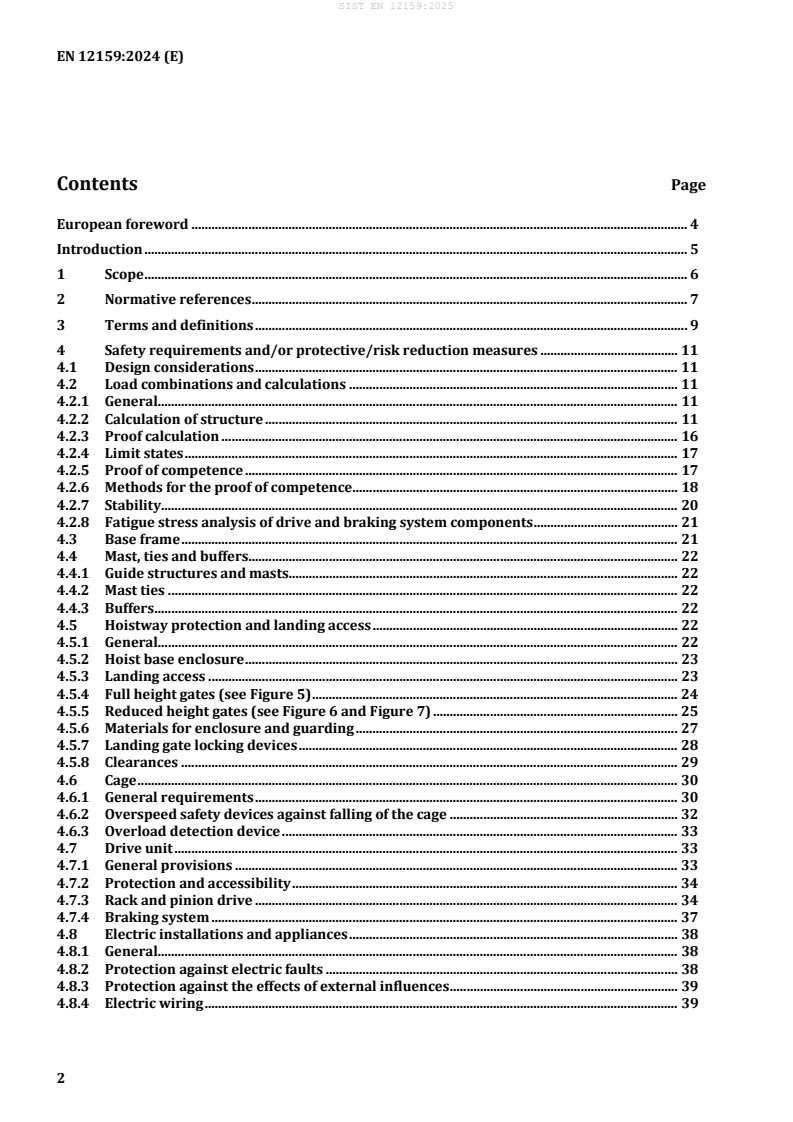
EN 12159
EUROPEAN STANDARD
NORME EUROPÉENNE
July 2024
EUROPÄISCHE NORM
ICS 91.140.90 Supersedes EN 12159:2012
English Version
Builders hoists for persons and materials with vertically
guided cages
Ascenseurs de chantier pour personnes et matériaux Bauaufzüge zur Personen- und Materialbeförderung
avec cages guidées verticalement mit senkrecht geführten Fahrkörben
This European Standard was approved by CEN on 3 June 2024.
CEN members are bound to comply with the CEN/CENELEC Internal Regulations which stipulate the conditions for giving this
European Standard the status of a national standard without any alteration. Up-to-date lists and bibliographical references
concerning such national standards may be obtained on application to the CEN-CENELEC Management Centre or to any CEN
member.
This European Standard exists in three official versions (English, French, German). A version in any other language made by
translation under the responsibility of a CEN member into its own language and notified to the CEN-CENELEC Management
Centre has the same status as the official versions.
CEN members are the national standards bodies of Austria, Belgium, Bulgaria, Croatia, Cyprus, Czech Republic, Denmark, Estonia,
Finland, France, Germany, Greece, Hungary, Iceland, Ireland, Italy, Latvia, Lithuania, Luxembourg, Malta, Netherlands, Norway,
Poland, Portugal, Republic of North Macedonia, Romania, Serbia, Slovakia, Slovenia, Spain, Sweden, Switzerland, Türkiye and
United Kingdom.
EUROPEAN COMMITTEE FOR STANDARDIZATION
COMITÉ EUROPÉEN DE NORMALISATION
EUROPÄISCHES KOMITEE FÜR NORMUNG
CEN-CENELEC Management Centre: Rue de la Science 23, B-1040 Brussels
© 2024 CEN All rights of exploitation in any form and by any means reserved Ref. No. EN 12159:2024 E
worldwide for CEN national Members.
Contents Page
European foreword . 4
Introduction . 5
1 Scope . 6
2 Normative references . 7
3 Terms and definitions . 9
4 Safety requirements and/or protective/risk reduction measures . 11
4.1 Design considerations . 11
4.2 Load combinations and calculations . 11
4.2.1 General. 11
4.2.2 Calculation of structure . 11
4.2.3 Proof calculation . 16
4.2.4 Limit states . 17
4.2.5 Proof of competence . 17
4.2.6 Methods for the proof of competence . 18
4.2.7 Stability . 20
4.2.8 Fatigue stress analysis of drive and braking system components . 21
4.3 Base frame . 21
4.4 Mast, ties and buffers . 22
4.4.1 Guide structures and masts. 22
4.4.2 Mast ties . 22
4.4.3 Buffers . 22
4.5 Hoistway protection and landing access . 22
4.5.1 General. 22
4.5.2 Hoist base enclosure . 23
4.5.3 Landing access . 23
4.5.4 Full height gates (see Figure 5) . 24
4.5.5 Reduced height gates (see Figure 6 and Figure 7) . 25
4.5.6 Materials for enclosure and guarding . 27
4.5.7 Landing gate locking devices . 28
4.5.8 Clearances . 29
4.6 Cage . 30
4.6.1 General requirements . 30
4.6.2 Overspeed safety devices against falling of the cage . 32
4.6.3 Overload detection device . 33
4.7 Drive unit . 33
4.7.1 General provisions . 33
4.7.2 Protection and accessibility . 34
4.7.3 Rack and pinion drive . 34
4.7.4 Braking system . 37
4.8 Electric installations and appliances . 38
4.8.1 General. 38
4.8.2 Protection against electric faults . 38
4.8.3 Protection against the effects of external influences . 39
4.8.4 Electric wiring . 39
4.8.5 Contactors, relay-contactors . 39
4.8.6 Electrical safety devices . 39
4.8.7 Safety contacts . 41
4.8.8 Lighting . 41
4.9 Control and limiting devices . 41
4.9.1 General . 41
4.9.2 Travel limit switches . 41
4.9.3 Erection accessories . 42
4.9.4 Stopping devices . 42
4.9.5 Stopping the hoist . 42
4.9.6 Control modes . 42
4.10 Breakdown conditions . 44
4.10.1 Alarm device . 44
4.10.2 Emergency escape . 44
4.10.3 Emergency operation by a competent person . 44
5 Verification of safety requirements and/or protective/risk reduction measures . 44
5.1 Verification of design . 44
5.2 Verification tests . 47
5.2.1 Introduction . 47
5.2.2 Locking devices for cage and landing gates . 48
5.2.3 Overspeed safety device and overspeed governors . 49
5.2.4 Energy accumulation type buffers with buffered return movement and energy dissipation
buffers . 50
5.3 Verification tests on each hoist before first use . 50
6 Information for use . 51
6.1 Instruction handbook . 51
6.1.1 Comprehensive information. 51
6.1.2 Contents of the instruction handbook . 51
6.2 Markings . 56
6.2.1 General . 56
6.2.2 Rating plate . 56
6.2.3 Mast or guide section identification label . 56
6.2.4 Basic user information label. 56
6.2.5 Label in the cage . 57
6.2.6 Label on the roof . 57
6.2.7 Label at ground level . 57
6.2.8 Label at overspeed safety device and/or overspeed governors . 57
6.2.9 Drive motor label . 57
6.2.10 Marking of control elements . 57
Annex A (informative) European storm wind map . 58
Annex B (normative) Electrical safety devices . 60
Annex C (informative) List of significant hazards . 62
Annex ZA (informative) Relationship between this European Standard and the essential
requirements of Directive 2006/42/EC aimed to be covered . 64
Bibliography . 68
European foreword
This document (EN 12159:2024) has been prepared by Technical Committee CEN/TC 10 “Lifts,
escalators and moving walks”, the secretariat of which is held by AFNOR.
This European Standard shall be given the status of a national standard, either by publication of an
identical text or by endorsement, at the latest by January 2025, and conflicting national standards shall
be withdrawn at the latest by January 2025.
Attention is drawn to the possibility that some of the elements of this document may be the subject of
patent rights. CEN shall not be held responsible for identifying any or all such patent rights.
This document supersedes EN 12159:2012.
— hydraulic driven hoists, drum driven hoists, counterweighted hoists and expanding linkage
mechanism are removed from the scope of the standard;
— noise has been removed from the scope of the standard;
— additional clarifications of the scope concerning multiple hoists;
— limit state method added;
— out of service wind calculation updated;
— introducing performance levels for safety functions according to EN ISO 13849-1:2023;
— modified the definition of overload;
— normative references are updated.
This document has been prepared under a standardisation request addressed to CEN by the European
Commission. The Standing Committee of the EFTA States subsequently approves these requests for its
Member States.
For the relationship with EU Legislation, see informative Annex ZA, which is an integral part of this
document.
Any feedback and questions on this document should be directed to the users’ national standards body.
A complete listing of these bodies can be found on the CEN website.
According to the CEN-CENELEC Internal Regulations, the national standards organisations of the
following countries are bound to implement this European Standard: Austria, Belgium, Bulgaria, Croatia,
Cyprus, Czech Republic, Denmark, Estonia, Finland, France, Germany, Greece, Hungary, Iceland, Ireland,
Italy, Latvia, Lithuania, Luxembourg, Malta, Netherlands, Norway, Poland, Portugal, Republic of North
Macedonia, Romania, Serbia, Slovakia, Slovenia, Spain, Sweden, Switzerland, Türkiye and the United
Kingdom.
Introduction
This document is one of a series of standards produced by CEN/TC 10/SC 1 Building hoists as part of the
CEN programme of work to produce machinery safety standards.
The document is a C-standard relating to safety for builders’ hoist for persons and materials
This document is a type C standard as stated in EN ISO 12100:2010.
This document is of relevance, in particular, for the following stakeholder groups representing the market
players with regard to machinery safety:
— machine manufacturers (small, medium and large enterprises);
— health and safety bodies (regulators, accident prevention organizations, market surveillance, etc.).
Others can be affected by the level of machinery safety achieved with the means of the document by the
above-mentioned stakeholder groups:
— machine users/employers (small, medium and large enterprises);
— machine users/employees (e.g. trade unions, organizations for people with special needs);
— service providers, e.g. for maintenance (small, medium and large enterprises);
— consumers (in case of machinery intended for use by consumers).
The above-mentioned stakeholder groups have been given the possibility to participate at the drafting
process of this document.
When provisions of this type C standard are different from those which are stated in type A or B
standards, the provisions of this type C standard take precedence over the provisions of the other
standards, for machines that have been designed and built according to the provisions of this type C
standard.
The machinery concerned and the extent to which hazards, hazardous situations and events are covered
are indicated in the scope of this document.
1 Scope
1.1 This document specifies power operated temporarily installed builders’ hoists (referred to as
“hoists” in this document) intended for use by persons who are permitted to enter sites of engineering
and construction, serving landing levels, having a cage:
— designed for the transportation of persons or of persons and materials;
— guided;
— travelling vertically or along a path within 15° max. of the vertical;
— supported or sustained by rack and pinion;
— designed with and / or without support from separate structure.
1.2 This document specifies the significant hazards, hazardous situations or hazardous events relevant
to the machine as listed in Annex C which arise during the various phases in the life of the machine and
describes methods for the elimination or reduction of these hazards when it is used as intended and
under conditions of misuse which are reasonably foreseeable by the manufacturer.
1.3 This document does not specify the additional requirements for:
— operation in severe conditions (e.g. extreme climates, strong magnetic fields);
— lightning protection;
— operation subject to special rules (e.g. potentially explosive atmospheres);
— electromagnetic compatibility (emission, immunity);
— handling of loads the nature of which could lead to dangerous situations (e.g. molten metal,
acids/bases, radiating materials, fragile loads);
— the use of combustion engines;
— the use of remote controls;
— hazards occurring during manufacture;
— hazards occurring as a result of mobility;
— hazards occurring as a result of being erected over a public road;
— earthquakes;
— emission of airborne noise;
— dual (twin) cage hoists;
— twin masts hoists;
— combination hoists, e.g. an EN 12159 hoist with an EN 12158-1 hoist;
— counterweighted hoists, neither by separate counterweight nor counterweighted by another cage.
1.4 This document does not apply to:
— builders’ hoists for the transport of goods only EN 12158-1:2021 and EN 12158-2:2000+A1:2010;
— lifts according to EN 81-20:2020, EN 81-3:2000+A1:2008 and EN 81-43:2009;
— work cages suspended from lifting appliances;
— work platforms carried on the forks of fork trucks;
— work platforms according to EN 1495:1997+A2:2009 ;
— transport platforms according to EN 16719:2018;
— funiculars;
— lifts specially designed for military purposes;
— mine lifts;
— theatre elevators;
— hoists with hydraulic drive/braking systems and hydraulic safety devices.
1.5 This document specifies the hoist installation. It includes the base frame and base enclosure but
excludes the design of any concrete, hard core, timber or other foundation arrangement. It includes the
design of mast ties but excludes the design of anchor bolts to the supporting structure. It includes the
landing gates and their frames but excludes the design of any anchorage fixing bolts to the supporting
structure.
1.6 This document does not apply to builders’ hoists for persons and material with vertically guided
cages which are manufactured before the date of publication of this document by CEN.
2 Normative references
The following documents are referred to in the text in such a way that some or all of their content
constitutes requirements of this document. For dated references, only the edition cited applies. For
undated references, the latest edition of the referenced document (including any amendments) applies.
EN 81-20:2020, Safety rules for the construction and installation of lifts — Lifts for the transport of persons
and goods — Part 20: Passenger and goods passenger lifts
EN 81-50:2020, Safety rules for the construction and installation of lifts — Examinations and tests — Part
50: Design rules, calculations, examinations and tests of lift components
EN 894-1:1997+A1:2008, Safety of machinery — Ergonomics requirements for the design of displays and
control actuators — Part 1: General principles for human interactions with displays and control actuators
EN 60204-1:2018, Safety of machinery — Electrical equipment of machines — Part 1: General
requirements
As impacted by EN 1495:1997+A2:2009/AC:2010.
EN 60529:1991, Degrees of protection provided by enclosures (IP-Code) (IEC 60529:1989)
EN 60947-5-1:2017, Low-voltage switchgear and controlgear — Part 5-1: Control circuit devices and
switching elements — Electromechanical control circuit devices (IEC 60947-5-1:2016)
EN IEC 60947-4-1:2019, Low-voltage switchgear and controlgear — Part 4-1: Contactors and motor-
starters — Electromechanical contactors and motor-starters (IEC 60947-4-1:2018)
EN ISO 12100:2010, Safety of machinery — General principles for design — Risk assessment and risk
reduction (ISO 12100:2010)
EN ISO 13849-1:2023, Safety of machinery — Safety-related parts of control systems — Part 1: General
principles for design (ISO 13849-1:2023)
EN ISO 13849-2:2012, Safety of machinery — Safety-related parts of control systems — Part 2: Validation
(ISO 13849-2:2012)
EN ISO 13850:2015, Safety of machinery — Emergency stop function — Principles for design
(ISO 13850:2015)
EN ISO 13854:2019, Safety of machinery — Minimum gaps to avoid crushing of parts of the human body
(ISO 13854:2017)
EN ISO 13857:2019, Safety of machinery — Safety distances to prevent hazard zones being reached by
upper and lower limbs (ISO 13857:2019)
EN ISO 14118:2018, Safety of machinery — Prevention of unexpected start-up (ISO 14118:2017)
EN ISO 14119:2013, Safety of machinery — Interlocking devices associated with guards — Principles for
design and selection (ISO 14119:2013)
EN ISO 14120:2015, Safety of machinery — Guards — General requirements for the design and
construction of fixed and movable guards (ISO 14120:2015)
ISO 2394:2015, General principles on reliability for structures
ISO 4302:2016, Cranes — Wind load assessment
ISO 6336-1:2019, Calculation of load capacity of spur and helical gears — Part 1: Basic principles,
introduction and general influence factors
ISO 6336-2:2019, Calculation of load capacity of spur and helical gears — Part 2: Calculation of surface
durability (pitting)
ISO 6336-3:2019, Calculation of load capacity of spur and helical gears — Part 3: Calculation of tooth
bending strength
ISO 6336-5:2016, Calculation of load capacity of spur and helical gears — Part 5: Strength and quality of
materials
As impacted by EN 60529:1991/AC:2006-12, EN 60529:1991/A1:2000, EN 60529:1991/A2:2013 and
EN 60529:1991/A2:2013/AC:2019-02.
3 Terms and definitions
For the purposes of this document, the terms and definitions given in EN ISO 12100:2010 and the
following apply.
ISO and IEC maintain terminological databases for use in standardization at the following addresses:
— IEC Electropedia: available at https://www.electropedia.org/
— ISO Online browsing platform: available at https://www.iso.org/obp
3.1
builders’ hoist
temporary lifting machine serving landing levels on sites of engineering and construction with cage which
is guided
3.2
working load
rated load
maximum load which the hoist has been designed to carry in service
3.3
rated speed
speed of the cage for which the equipment has been designed
3.4
positive drive
drive using means other than friction
3.5
rack and pinion hoist
hoist which uses a toothed rack and pinion as the load suspension system
3.6
base frame
lowest framework of the hoist, upon which all other components are mounted
3.7
guide
rigid element which determines the travel way of the cage
3.8
mast
structure that supports and guides the cage
3.9
mast section
indivisible piece of mast, between two adjacent mast joints
3.10
mast tie
connection system between the mast and any building structure, providing lateral support for the mast
3.11
hoistway
total space which is travelled by the cage and its load
3.12
cage
carrier including the floor, walls, gates and roof
3.13
stopping distance
distance the cage moves from the moment when the control or safety circuit is broken until the cage has
come to a full stop
3.14
overspeed safety device
mechanical device for stopping and maintaining stationary the cage in the event of overspeed in the
downward direction
3.15
slack rope
rope, normally under tension, from which all external loads have been removed
3.16
wire rope termination
adaptation at the end of a wire rope permitting attachment
3.17
landing
level in a building or construction intended for loading and unloading the cage
3.18
safety distance
minimum acceptable distance between any moving part of a hoist and any point of access
3.19
guard rail
fixed equipment, other than gates, which is used to prevent people from falling or from reaching
hazardous areas
3.20
normal operation
usual operating conditions for the hoist when in use for carrying loads, but excluding routine
maintenance, erection, dismantling, etc.
3.21
in service
condition during use of the hoist when the cage is in any position, laden or unladen, moving or stationary
3.22
out of service
installed condition when the cage is empty and positioned such that it is provided with the most shelter
from the wind (normally, but not necessarily, ground level)
3.23
competent person
person, suitably trained, qualified by knowledge and practical experience, provided with necessary
instructions to safely carry out the required operations for maintaining or inspecting the hoist, or
rescuing users
Note 1 to entry: National Regulation may require certification of competence.
3.24
authorized person
person with the permission of the natural or legal person who has the responsibility for the operation
and use of the hoist, to access restricted areas (cage roof and hoistway) for maintenance, inspection or
rescue operations
Note 1 to entry: Authorized persons should be competent for the tasks they have been authorized for (see also
3.23).
4 Safety requirements and/or protective/risk reduction measures
4.1 Design considerations
The design of the hoist shall consider safe use, erection, dismantling, disposal and maintenance. It shall
be possible to erect the hoist using safe access methods such as those offered by the roof of the cage or
equivalent facilities.
The design of all components that have to be handled during erection e.g. mast sections, shall have their
weight assessed against manual handling. Where the permissible weight for manual handling is exceeded,
the manufacturer shall make available suitable lifting equipment. All removable and detachable covers
shall be retained by captive fastenings.
The builders’ hoist shall comply with the safety requirements and/or protective measures of this clause.
In addition, the machine shall be designed according to the principles of EN ISO 12100:2010 for relevant
but not significant hazards, which are not dealt with by this document.
4.2 Load combinations and calculations
4.2.1 General
The structure of the hoist shall be designed and constructed in such a way that its strength is satisfactory
under all intended operating conditions, including erection and dismantling and e.g. temperature of the
environment.
The design of the structure as a whole and each part of it shall be based on the effects of any possible
combination of loads as specified in this 4.2. The load combinations shall consider the least favourable
locations of the cage and load relative to the mast and its ties, both during the vertical passage of the cage
and any horizontal movement, e.g. swivelling of the cage. Ties between the mast and the supporting
structure are considered to be part of the hoist structure.
In cases not covered by this standard (e.g. where two hoist cages are running on one mast tower or
multiple machines are running on one or more mast towers), the load cases may be combined based on
state of the art approaches which are taking probabilities of occurrence into consideration.
4.2.2 Calculation of structure
When calculating the hoist structure and every related component, the following forces and loads shall
be taken into account:
a) all dead weights with the exception of the cage and equipment which moves together with the cage;
b) dead weights of the unladen cage and all equipment which moves together with the cage;
c) dead weight of landing platforms and gates, if supported by the hoist;
d) rated load in the cage.
The effect of the forces on the cage and mast resulting from the application of the rated load shall be
allowed for in one of the two following ways, which reflect the chosen density of loading on the cage
floor:
m
r
1) if < 400 kg/ m
A ⋅08,
where
m is the rated load [kg] and
r
A is the total floor area [m ]
then the rated load shall be assumed to be distributed over a reduced area (A ) which results in a
distribution of 400 kg/m . The format and the location of this area shall be taken as that which gives
the least favourable stress for the mast and also for the cage. One example is shown in Figure 1;
Key
A total floor area [m ]
A reduced area [m ] = m / 400
r
Figure 1 — One example of loading according to 4.2.2 d) 1)
2) if
m
r 2
≥ 400 kg/m
A⋅ 08,
then the rated load shall be assumed to be distributed over an area (A ) equivalent to 80 % of the
total floor area of the cage. The format and the location of this area shall be taken as that which gives
the least favourable stress for the mast and also for the cage. One example is shown in Figure 2;
Key
A = 0,8 A
Figure 2 — One example of loading according to 4.2.2 d) 2)
e) where the uniform distribution of the rated load over the full area of the cage floor is less than
2 2
400 kg/m , then, for calculation purposes a minimum of 400 kg/m shall be placed over the whole
area (A ) of the cage floor. See Figure 3;
Key
A3 total floor area [m ]
Figure 3 — Evenly distributed load case according to 4.2.2 e)
f) forces during loading and unloading for any cage entrance (see Figure 4) shall be considered as the
concurrent effect of a vertical force and a horizontal force, each calculated as follows:
— a vertical force F with an amplitude of
V
F = m ⋅ g
V V
where
F is the vertical force [N];
V
g is the gravitational acceleration (9,81 m/s );
m is a mass [kg] used for vertical force and is calculated as a function of the rated load (m ):
V
r
If m < 400 kg
r
m = 200 kg
v
If m > 2 000 kg
r
m = 400 + 0,3 ⋅ m
v r
other load ratings
m = 0,5 ⋅ m
v r
— a horizontal force F shall be applied in the direction of loading and with an amplitude of
H
F = m ⋅ g
H h
where
F is the horizontal force [kN];
H
g is the gravitational acceleration (9,81 m/s );
m is a mass [kg] used for horizontal force and is calculated as a function of the rated load (m ):
h r
If m < 250 kg
r
m = 50 kg
h
If m > 1 300 kg
r
m = 260 kg
h
other load ratings
m = 0,2 ⋅ m
h r
Both forces acting at 1/3 of the width of the cage entrance, at floor level; the stresses in the mast and
also in the cage shall be calculated for at least the following application points of the loading and
unloading forces:
— the cage threshold;
— the leading edge of any ramp or other extension, which is not supported by the landing.
At the same time, any remaining part of the rated load shall be applied in the centre of the cage floor
(F = (m - m ) ⋅ g).
V1
r v
Equivalent forces shall be used to design the landing threshold and all relevant supporting structures.
Information shall be given in the instruction handbook with regard to these forces.
Key
FV1 vertical force resulting from the remaining part of the rated load applied in the centre of the cage [kN]
FV vertical force [kN]
F horizontal force [kN]
H
Figure 4 — One example of forces during loading and unloading
g) the effect of moving loads shall be determined by taking the weight of all actual loads (cage, rated
load etc.) and multiplying them by an impact factor µ = (1,1 + 0,264v) where v is the rated speed in
m/s. Alternative factors may be used if they can be proved to be more accurate;
h) to determine the forces produced by an operation of the overspeed safety device, the sum total of the
travelling load shall be multiplied by an impact factor µ = 2,5.
A lower factor, but not less than 1,2 can be used if it can be verified by test under all conditions of
loading up to 1,3 times rated load including any inertia effects of the drive system;
i) the cage roof, if intended to be accessible for erection, dismantling, maintenance or emergency
escape, shall be designed to withstand a load of at least 300 kg placed on the least favourable square
area of 1,0 m . The roof shall also withstand a load of 120 kg applied on any area of 0,1 m × 0,1 m as
well as the full allowed load (see 6.2.6) applied on the full roof area;
j) the cage roof intended not to be used as support for persons shall be designed for a load of 100 kg
applied on an area of 0,1 m × 0,1 m;
k) the cage floor surface shall be designed to withstand, without permanent deformation, a static load
of 150 kg or 25 % of the rated load, whichever is the greater, but in no case more than 300 kg. The
load shall be applied on the least favourable square area of 0,1 m × 0,1 m;
l) Design wind conditions: the aerodynamic pressure q is given by the general formula:
v
w
q=
16,
where
q is the pressure in N/m and v is the wind velocity in m/s.
w
In all cases, it shall be assumed that the wind can blow horizontally in any direction, and the least
favourable direction shall be taken into account. The calculation shall be done according to
ISO 4302:2016 with the exception of the following:
1) action of the wind on the cage when calculating wind pressure on the cage, it shall be assumed
that the cage walls are solid and an aerodynamic coefficient of c = 1,2 shall be applied. The factor
1,2 covers both the shape factor and the shielding factor;
2) wind pressure: three design wind conditions shall be taken into account when calculating wind
pressure on hoists:
i. in service wind: irrespective of height, the minimum value for wind pressure shall be
q = 250 N/m which corresponds to a wind velocity of v = 20 m/s;
w
ii. out of service wind: out of service wind pressure is according to ISO 4302:2016 with a
recurrence interval R = 10 and depends on the height above ground and the location. The
recommended minimum out of service wind pressure for general use is given in Table 1
(values based on Formula (11) in ISO 4302:2016). The minimum design wind pressures
shall be taken into account.
Table 1 — Minimum design wind pressure
Height H of parts of hoist Wind pressure q for geographical Region
above ground level A to E
N/m
m A/B C D E
0 < H ≤ 10 527 718 938 1 187
10 < H ≤ 20 607 826 1 079 1 366
20 < H ≤ 50 735 1 000 1 307 1 654
50 < H ≤ 100 853 1 161 1 516 1 919
100 < H ≤ 150 932 1 268 1 657 2 097
The regions A – E are taken from the European Storm wind Map (See Annex A).
Local terrain factors and detailed reference wind speed maps are allowed to use if such detailed
information is available;
iii. erection and dismantling wind: irrespective of height, the minimum value for wind pressure
shall be q = 100 N/m , which corresponds to a wind velocity of v = 12,5 m/s;
w
m) an error of erection of 0,5° is included in the safety factors of this document;
n) forces created by the buffers shall be calculated allowing for a retardation of 1 g unless a lower value
of retardation can be verified.
4.2.3 Proof calculation
The proof of competence according to this document shall be carried out by using the general principles
and methods appropriate for this purpose and corresponding with the recognized state of the art in
mechanical design. For guidance governing analysis of structural members and their connections (e.g.
fatigue, welding, bolts), EN 13001-3-1:2012+A2:2018 is recommended. For aluminium, consider
EN 1999-1-1:2007 .
Alternatively, advanced and recognized theoretical or experimental methods may be used in general,
provided that they conform to the principles of this document.
4.2.4 Limit states
During analysis of the hoist, its components or materials, two different limit states need to be considered
(ultimate limit state which concerns safety of people and structure, serviceability limit state which
concerns function and appearance of the structure as well as the comfort of the user).
There is a distinction between ultimate limit states and serviceability limit states as follows:
a) ultimate limit states, given by:
1) plastic deformations from the effect of nominal stresses or sliding of frictional connections;
2) failure of components or connections (e.g. static failure, failure by fatigue or formation of critical
cracks);
3) elastic instability of the hoist or its parts (e.g. buckling, bulging);
4) rigid body instability of the hoist or its parts (e.g. tilting, shifting);
b) serviceability limit states, examples of which are:
1) deformations which impair the intended utilization of the hoist (e.g. function of moving
components, clearances of parts);
2) exceeding temperature limits (e.g. overheating of motors and brakes).
4.2.5 Proof of competence
The proof of competence shall contain validation proving that the stresses or forces do not exceed the
structural limitations of components.
Loads in 4.2.2. shall be superimposed in such a way that the resulting load effects attain their
instantaneous extreme values for the considered situation of use. Such superimpositions are called load
combinations. Load combinations containing dynamic effects may be treated as quasi static by the use of
appropriate dynamic factors. Basic load combinations are given in Table 3.
For the proof of fatigue strength, the number and magnitude of significant stress cycles shall be specified.
The limit states applicable to the combination of material selection, manufacturing techniques and the
specified service conditions shall be stated in the proof of competence. For the verification that the
ultimate limit states are not exceeded, the following proofs shall be established:
— proof of strength of members, connections and components:
— under static and quasi-static loading;
— under cyclic loading (fatigue);
— proof of elastic stability of the hoist and its parts;
As impacted by EN 1999-1-1:2007/A1:2009 and EN 1999-1-1:2007/A2:2013.
— proof of hoist stability.
For the verification that the serviceability limit states are not exceeded, the following aspects shall be
considered
...