


SIST ISO 21542:2012
Building construction - Accessibility and usability of the built environment
Building construction - Accessibility and usability of the built environment
ISO 21542:2011 specifies a range of requirements and recommendations for many of the elements of construction, assemblies, components and fittings which comprise the built environment. These requirements relate to the constructional aspects of access to buildings, to circulation within buildings, to egress from buildings in the normal course of events and evacuation in the event of an emergency. It also deals with aspects of accessibility management in buildings.
ISO 21542:2011 contains provisions with respect to features in the external environment directly concerned with access to a building or group of buildings from the edge of the relevant site boundary or between such groups of buildings within a common site. It does not deal with those elements of the external environment, such as public open spaces, whose function is self-contained and unrelated to the use of one specific building, nor does it deal with single family dwellings, other than those circulation spaces and fittings that are common to two or more such dwellings.
Gebäude - Barrierefreiheit von Gebäuden und sonstigen Bauwerken
Construction immobilière - Accessibilité et facilité d'utilisation de l'environnement bâti
L'ISO 21542:2011 spécifie un certain nombre d'exigences et de recommandations concernant la plupart des éléments de construction, assemblages, composants et accessoires qui constituent l'environnement bâti. Ces exigences portent sur les aspects constructifs liés à l'accès aux bâtiments, sur la circulation à l'intérieur des bâtiments, sur les moyens de sortie des bâtiments dans le cadre normal des événements et sur l'évacuation en cas d'urgence. Une annexe informative est également incluse. Elle aborde les aspects liés à la gestion de l'accessibilité dans les bâtiments.
L'ISO 21542:2011 comprend des dispositions relatives aux caractéristiques de l'environnement extérieur associées directement à l'accès à un bâtiment ou à un groupe de bâtiments depuis l'extrémité des limites correspondantes du site concerné ou entre les groupes de bâtiments d'un site commun. La présente Norme internationale ne traite cependant pas des éléments de l'environnement extérieur, tels que les espaces publics libres, dont la fonction est autonome et n'est pas liée à l'utilisation d'un bâtiment spécifique, ni des logements individuels, autres que les espaces de circulation et les accessoires communs à deux logements de ce type ou plus.
Gradnja stavb - Dostopnost in uporabnost grajenega okolja
Ta mednarodni standard določa zahteve in priporočila za številne elemente konstrukcij, sestave, komponente in priključke, ki obsegajo grajeno okolje. Te zahteve so povezane s konstrukcijskimi vidiki dostopa do stavb, kroženja znotraj stavb, izstopa iz stavb v običajnem poteku dogodkov in evakuacije v nujnem primeru. Priložena je tudi informativna priloga, ki se ukvarja z vidiki upravljanja dostopnosti v stavbah. Ta mednarodni standard vsebuje določila glede značilnosti v zunanjem okolju, ki so neposredno povezana z dostopom do stavbe ali skupine stavb z roba ustreznega mesta ali med takimi skupinami stavb znotraj skupnega mesta. Ta mednarodni standard se ne ukvarja z elementi zunanjega okolja, kot so javni odprti prostori, katerih funkcija je izolirana in nepovezana z uporabo ene posamezne stavbe, niti se ne ukvarja z enodružinskimi hišami, razen če imajo dve ali več takih hiš skupni komunikacijski prostor in priključke. Trenutno so v pripravi dodatni deli tega mednarodnega standarda, ki bodo opredelili zgoraj opisana zunanja okolja in enodružinske hiše. Za obstoječe stavbe so v nekaterih odstavkih vključene možnosti, navedene kot »izjemna obravnava obstoječih stavb v državah v razvoju« (glejte »Guidance on the Implications of the ISO Global Relevance Policy for CEN Standardization«, 2005) in kot „izjemna obravnava za obstoječe stavbe“, ki določajo, da je pri novih stavbah nižji standard od pričakovanj sprejemljiv samo v primeru posebnih tehničnih in gospodarskih okoliščin. Mere v tem mednarodnem standardu, ki se nanašajo na uporabo invalidskih vozičkov, veljajo za tloris najpogosteje uporabljanih velikosti invalidskih vozičkov in njihovih uporabnikov. Tloris invalidskega vozička v tem mednarodnem standardu temelji na standardih ISO 7176-5 in ISO/TR 13570-21) ter je širok 800 mm in dolg 1 300 mm. Za večje invalidske vozičke in skuterje je treba upoštevati ustrezne mere.
General Information
- Status
- Withdrawn
- Publication Date
- 13-Sep-2012
- Withdrawal Date
- 14-Mar-2022
- Technical Committee
- ISS SPL.GPO - Building construction
- Current Stage
- 9900 - Withdrawal (Adopted Project)
- Start Date
- 15-Mar-2022
- Due Date
- 07-Apr-2022
- Completion Date
- 15-Mar-2022
Relations
- Effective Date
- 01-Nov-2012
- Replaced By
SIST ISO 21542:2022 - Building construction - Accessibility and usability of the built environment - Effective Date
- 01-Apr-2022


ISO 21542:2011 - Building construction -- Accessibility and usability of the built environment

ISO 21542:2011 - Construction immobiliere -- Accessibilité et facilité d'utilisation de l'environnement bâti

Frequently Asked Questions
SIST ISO 21542:2012 is a standard published by the Slovenian Institute for Standardization (SIST). Its full title is "Building construction - Accessibility and usability of the built environment". This standard covers: ISO 21542:2011 specifies a range of requirements and recommendations for many of the elements of construction, assemblies, components and fittings which comprise the built environment. These requirements relate to the constructional aspects of access to buildings, to circulation within buildings, to egress from buildings in the normal course of events and evacuation in the event of an emergency. It also deals with aspects of accessibility management in buildings. ISO 21542:2011 contains provisions with respect to features in the external environment directly concerned with access to a building or group of buildings from the edge of the relevant site boundary or between such groups of buildings within a common site. It does not deal with those elements of the external environment, such as public open spaces, whose function is self-contained and unrelated to the use of one specific building, nor does it deal with single family dwellings, other than those circulation spaces and fittings that are common to two or more such dwellings.
ISO 21542:2011 specifies a range of requirements and recommendations for many of the elements of construction, assemblies, components and fittings which comprise the built environment. These requirements relate to the constructional aspects of access to buildings, to circulation within buildings, to egress from buildings in the normal course of events and evacuation in the event of an emergency. It also deals with aspects of accessibility management in buildings. ISO 21542:2011 contains provisions with respect to features in the external environment directly concerned with access to a building or group of buildings from the edge of the relevant site boundary or between such groups of buildings within a common site. It does not deal with those elements of the external environment, such as public open spaces, whose function is self-contained and unrelated to the use of one specific building, nor does it deal with single family dwellings, other than those circulation spaces and fittings that are common to two or more such dwellings.
SIST ISO 21542:2012 is classified under the following ICS (International Classification for Standards) categories: 11.180.01 - Aids for disabled and handicapped persons in general; 91.060.01 - Elements of buildings in general. The ICS classification helps identify the subject area and facilitates finding related standards.
SIST ISO 21542:2012 has the following relationships with other standards: It is inter standard links to SIST ISO/TR 9527:2002, SIST ISO 21542:2022. Understanding these relationships helps ensure you are using the most current and applicable version of the standard.
SIST ISO 21542:2012 is available in PDF format for immediate download after purchase. The document can be added to your cart and obtained through the secure checkout process. Digital delivery ensures instant access to the complete standard document.
Standards Content (Sample)
2003-01.Slovenski inštitut za standardizacijo. Razmnoževanje celote ali delov tega standarda ni dovoljeno.Gradnja stavb - Dostopnost in uporabnost grajenega okoljaConstruction immobilière - Accessibilité et facilité d'utilisation de l'environnement bâtiBuilding construction - Accessibility and usability of the built environment91.060.01Stavbni elementi na splošnoElements of buildings in general11.180.01VSORãQRAids for disabled and handicapped persons in generalICS:Ta slovenski standard je istoveten z:ISO 21542:2011SIST ISO 21542:2012en,fr01-november-2012SIST ISO 21542:2012SLOVENSKI
STANDARDSIST ISO/TR 9527:20021DGRPHãþD
Reference numberISO 21542:2011(E)© ISO 2011
INTERNATIONAL STANDARD ISO21542First edition2011-12-15Building construction — Accessibility and usability of the built environment Construction immobilière — Accessibilité et facilité d'utilisation de l'environnement bâti
©
ISO 2011 All rights reserved. Unless otherwise specified, no part of this publication may be reproduced or utilized in any form or by any means, electronic or mechanical, including photocopying and microfilm, without permission in writing from either ISO at the address below or ISO's member body in the country of the requester. ISO copyright office Case postale 56 CH-1211 Geneva 20 Tel.
+ 41 22 749 01 11 Fax
+ 41 22 749 09 47 E-mail
copyright@iso.org Web
www.iso.org Published in Switzerland
ii © ISO 2011 – All rights reserved
Tactile walking surface indicators (TWSIs) . 110 Annex B (informative)
Human abilities and associated design considerations . 118 Annex C (informative)
Circulation spaces at doorways . 132 Annex D (informative)
Fire safety and assisted evacuation for all in buildings . 144 Annex E (informative)
Management and maintenance issues . 146 Bibliography . 149
INTERNATIONAL STANDARD ISO 21542:2011(E) © ISO 2011 – All rights reserved 1
Building construction — Accessibility and usability of the built environment 1 Scope This International Standard specifies a range of requirements and recommendations for many of the elements of construction, assemblies, components and fittings which comprise the built environment. These requirements relate to the constructional aspects of access to buildings, to circulation within buildings, to egress from buildings in the normal course of events and evacuation in the event of an emergency. An informative annex is also included which deals with aspects of accessibility management in buildings. This International Standard contains provisions with respect to features in the external environment directly concerned with access to a building or group of buildings from the edge of the relevant site boundary or between such groups of buildings within a common site. This International Standard does not deal with those elements of the external environment, such as public open spaces, whose function is self-contained and unrelated to the use of one specific building, nor does it deal with single family dwellings, other than those circulation spaces and fittings that are common to two or more such dwellings. At present, consideration is being given to the development and publication of additional parts to this International Standard to deal with the types of external environments described above and single family dwellings. For existing buildings there are options included in some paragraphs which appear as ‘‘exceptional considerations for existing buildings in developing countries’’ (see “Guidance on the Implications of the ISO Global Relevance Policy for CEN Standardization”, 2005) and as ‘‘exceptional considerations for existing buildings’’ where a lesser standard than expected in new developments is accepted on the grounds of technical and economic circumstances only. The dimensions stated in this International Standard, relevant to the use of wheelchairs, are related to the footprint of commonly used wheelchair sizes and users. The footprint for a wheelchair within this International Standard is based on ISO 7176-5 and ISO/TR 13570-21) and is 800 mm wide and 1 300 mm long. For larger wheelchairs and scooters, dimensions will have to be considered accordingly. NOTE This International Standard is primarily written for adults with disabilities but it includes some specifications regarding the specific accessibility requirements that would suit children with disabilities. However, it is envisaged that more detailed requirements will be included in future revisions of this International Standard. 2 Normative references The following referenced documents are indispensable for the application of this document. For dated references, only the edition cited applies. For undated references, the latest edition of the referenced document (including any amendments) applies. ISO 4190-1:2010, Lift (Elevator) installation — Part 1: Class I, II, III and VI lifts ISO 4190-5:2006, Lift (Elevator) installation — Part 5: Control devices, signals and additional fittings 1) Under preparation. SIST ISO 21542:2012
...
INTERNATIONAL ISO
STANDARD 21542
First edition
2011-12-15
Building construction — Accessibility
and usability of the built environment
Construction immobilière — Accessibilité et facilité d'utilisation de
l'environnement bâti
Reference number
©
ISO 2011
© ISO 2011
All rights reserved. Unless otherwise specified, no part of this publication may be reproduced or utilized in any form or by any means,
electronic or mechanical, including photocopying and microfilm, without permission in writing from either ISO at the address below or
ISO's member body in the country of the requester.
ISO copyright office
Case postale 56 CH-1211 Geneva 20
Tel. + 41 22 749 01 11
Fax + 41 22 749 09 47
E-mail copyright@iso.org
Web www.iso.org
Published in Switzerland
ii © ISO 2011 – All rights reserved
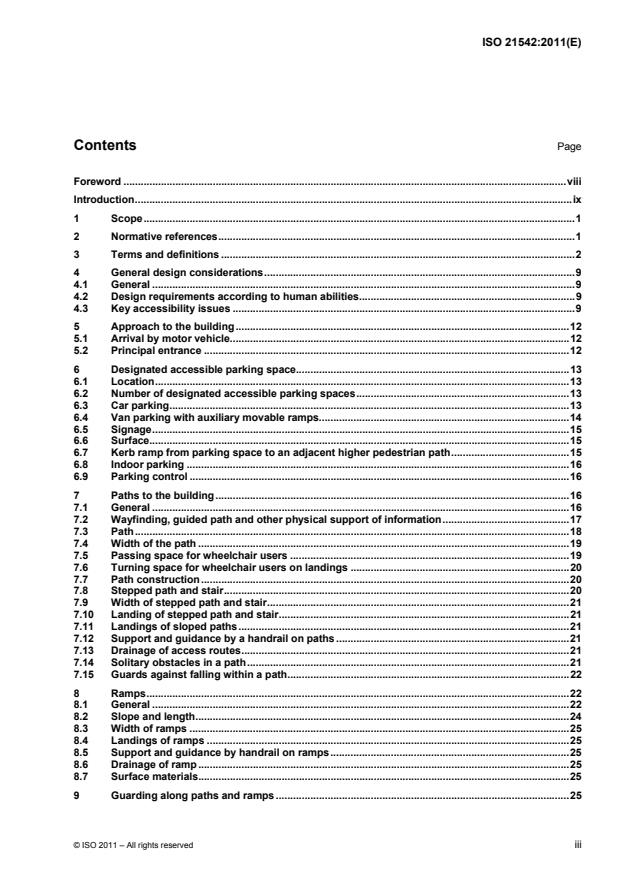
Contents Page
Foreword . viii
Introduction . ix
1 Scope . 1
2 Normative references . 1
3 Terms and definitions . 2
4 General design considerations . 9
4.1 General . 9
4.2 Design requirements according to human abilities . 9
4.3 Key accessibility issues . 9
5 Approach to the building . 12
5.1 Arrival by motor vehicle . 12
5.2 Principal entrance . 12
6 Designated accessible parking space . 13
6.1 Location . 13
6.2 Number of designated accessible parking spaces . 13
6.3 Car parking . 13
6.4 Van parking with auxiliary movable ramps. 14
6.5 Signage . 15
6.6 Surface. 15
6.7 Kerb ramp from parking space to an adjacent higher pedestrian path . 15
6.8 Indoor parking . 16
6.9 Parking control . 16
7 Paths to the building . 16
7.1 General . 16
7.2 Wayfinding, guided path and other physical support of information . 17
7.3 Path . 18
7.4 Width of the path . 19
7.5 Passing space for wheelchair users . 19
7.6 Turning space for wheelchair users on landings . 20
7.7 Path construction . 20
7.8 Stepped path and stair . 20
7.9 Width of stepped path and stair . 21
7.10 Landing of stepped path and stair . 21
7.11 Landings of sloped paths . 21
7.12 Support and guidance by a handrail on paths . 21
7.13 Drainage of access routes . 21
7.14 Solitary obstacles in a path . 21
7.15 Guards against falling within a path . 22
8 Ramps . 22
8.1 General . 22
8.2 Slope and length . 24
8.3 Width of ramps . 25
8.4 Landings of ramps . 25
8.5 Support and guidance by handrail on ramps . 25
8.6 Drainage of ramp . 25
8.7 Surface materials . 25
9 Guarding along paths and ramps . 25
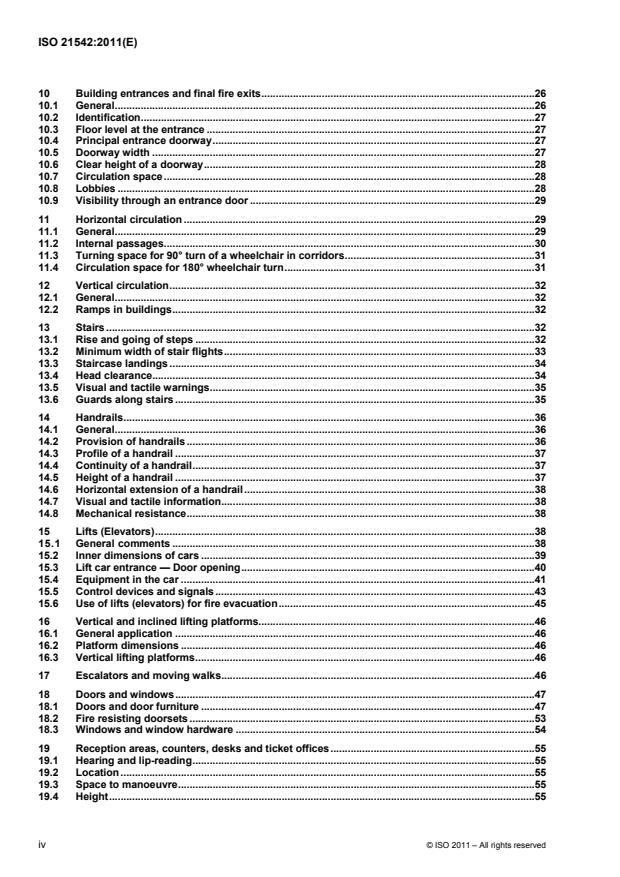
10 Building entrances and final fire exits .26
10.1 General .26
10.2 Identification .27
10.3 Floor level at the entrance .27
10.4 Principal entrance doorway .27
10.5 Doorway width .27
10.6 Clear height of a doorway .28
10.7 Circulation space .28
10.8 Lobbies .28
10.9 Visibility through an entrance door .29
11 Horizontal circulation .29
11.1 General .29
11.2 Internal passages .30
11.3 Turning space for 90° turn of a wheelchair in corridors .31
11.4 Circulation space for 180° wheelchair turn .31
12 Vertical circulation .32
12.1 General .32
12.2 Ramps in buildings .32
13 Stairs .32
13.1 Rise and going of steps .32
13.2 Minimum width of stair flights .33
13.3 Staircase landings .34
13.4 Head clearance .34
13.5 Visual and tactile warnings .35
13.6 Guards along stairs .35
14 Handrails .36
14.1 General .36
14.2 Provision of handrails .36
14.3 Profile of a handrail .37
14.4 Continuity of a handrail .37
14.5 Height of a handrail .37
14.6 Horizontal extension of a handrail .38
14.7 Visual and tactile information .38
14.8 Mechanical resistance .38
15 Lifts (Elevators) .38
15.1 General comments .38
15.2 Inner dimensions of cars .39
15.3 Lift car entrance — Door opening .40
15.4 Equipment in the car .41
15.5 Control devices and signals .43
15.6 Use of lifts (elevators) for fire evacuation .45
16 Vertical and inclined lifting platforms.46
16.1 General application .46
16.2 Platform dimensions .46
16.3 Vertical lifting platforms .46
17 Escalators and moving walks .46
18 Doors and windows .47
18.1 Doors and door furniture .47
18.2 Fire resisting doorsets .53
18.3 Windows and window hardware .54
19 Reception areas, counters, desks and ticket offices .55
19.1 Hearing and lip-reading .55
19.2 Location .55
19.3 Space to manoeuvre .55
19.4 Height .55
iv © ISO 2011 – All rights reserved
19.5 Lighting. 56
19.6 Ticket systems . 56
20 Cloakroom . 56
21 Auditoriums, concert halls, sports arenas and similar seating . 57
21.1 Hearing enhancement systems . 57
21.2 Lighting for sign language interpretation . 57
21.3 Designated seating areas for wheelchair users . 57
21.4 Access to stage and backstage . 57
21.5 Row and seat numbers . 57
21.6 Accessible changing rooms . 57
22 Conference rooms and meeting rooms . 58
23 Viewing spaces in assembly areas . 58
23.1 Floor area . 58
23.2 Sight lines . 59
24 Bars, pubs, restaurants, etc. . 59
25 Terraces, verandas and balconies . 59
26 Toilet rooms and sanitary rooms . 60
26.1 General . 60
26.2 WC compartments for ambulant disabled people . 60
26.3 Wheelchair user accessible toilet rooms . 61
26.4 Dimensions for wheelchair user accessible toilet rooms . 61
26.5 Toilet room doors . 66
26.6 Toilet seat . 66
26.7 Grab rails . 67
26.8 Toilet paper . 68
26.9 Washbasin . 69
26.10 Water supply . 70
26.11 Taps . 71
26.12 Urinals. 71
26.13 Other fittings . 71
26.14 Alarm . 71
26.15 Emergency warning alarm . 72
26.16 Shower . 72
26.17 Individual shower room . 73
26.18 Bathrooms . 74
27 Accessible bedrooms in non-domestic buildings . 77
28 Kitchen areas . 79
29 Storage areas . 79
30 Facilities for guide dogs and other assistance dogs . 79
30.1 General . 79
30.2 Relief facilities for guide dogs and assistance dogs . 79
31 Floor and wall surfaces . 80
32 Acoustic environment . 80
32.1 General . 80
32.2 Acoustic requirements . 80
32.3 Hearing enhancement systems . 81
33 Lighting. 82
33.1 General . 82
33.2 External lighting . 82
33.3 Natural lighting . 82
33.4 Artificial lighting . 82
33.5 Lighting to facilitate wayfinding . 82
33.6 Controllable and adjustable lighting . 83
33.7 Light levels in different areas . 83
33.8 Lighting in auditoriums .83
33.9 Glare and shadows .83
34 Fire emergency warning systems, signals and information .84
34.1 General .84
34.2 Light warning signals .84
34.3 Acoustic warning systems .84
35 Visual contrast .84
35.1 General .84
35.2 Choice of colours and patterns .85
36 Equipment, controls and switches .86
36.1 General .86
36.2 Location, heights and distances .86
36.3 Location of controls from walls, corners and opening doors .88
36.4 Operation .89
36.5 Identification .90
36.6 Usability .90
36.7 Telephones .90
36.8 Card access, dispensing machines and automatic teller machines (ATMs), etc. .91
36.9 Security access systems .93
36.10 Drinking fountains .93
36.11 Refuse bins .93
37 Furnishing .93
37.1 General .93
37.2 Seating in waiting areas .93
37.3 Seating at desks, tables, etc. .94
38 Fire safety, protection and evacuation for all .95
38.1 Fire engineering design objectives.95
38.2 Principles of fire evacuation for all .95
38.3 Assisted fire evacuation .96
38.4 Evacuation chairs .97
38.5 Emerging fire evacuation technologies .97
38.6 Fire defence plans .97
39 Orientation and information .98
39.1 General .98
39.2 Principle of two senses .99
39.3 Audible information .99
39.4 Levels of information .99
40 Signage .99
40.1 General .99
40.2 Main types of signs. 100
40.3 Placement of signs . 100
40.4 Height and location of signs . 101
40.5 Font and size of lettering . 102
40.6 Differences in LRVs . 102
40.7 Glare free . 103
40.8 Illumination . 103
40.9 Understandable . 103
40.10 Provision of raised tactile and Braille signs . 103
40.11 Tactile letters, figures, signs and graphical symbols . 103
40.12 Braille . 104
40.13 Tactile symbols . 104
40.14 Tactile maps and floor plans . 104
40.15 Information displays . 105
41 Graphical symbols . 105
42 Management and maintenance issues . 109
vi © ISO 2011 – All rights reserved
Annex A (informative) Tactile walking surface indicators (TWSIs) . 110
Annex B (informative) Human abilities and associated design considerations . 118
Annex C (informative) Circulation spaces at doorways . 132
Annex D (informative) Fire safety and assisted evacuation for all in buildings . 144
Annex E (informative) Management and maintenance issues . 146
Bibliography . 149
Foreword
ISO (the International Organization for Standardization) is a worldwide federation of national standards bodies
(ISO member bodies). The work of preparing International Standards is normally carried out through ISO
technical committees. Each member body interested in a subject for which a technical committee has been
established has the right to be represented on that committee. International organizations, governmental and
non-governmental, in liaison with ISO, also take part in the work. ISO collaborates closely with the
International Electrotechnical Commission (IEC) on all matters of electrotechnical standardization.
International Standards are drafted in accordance with the rules given in the ISO/IEC Directives, Part 2.
The main task of technical committees is to prepare International Standards. Draft International Standards
adopted by the technical committees are circulated to the member bodies for voting. Publication as an
International Standard requires approval by at least 75 % of the member bodies casting a vote.
Attention is drawn to the possibility that some of the elements of this document may be the subject of patent
rights. ISO shall not be held responsible for identifying any or all such patent rights.
ISO 21542 was prepared by Technical Committee ISO/TC 59, Buildings and civil engineering works,
Subcommittee SC 16, Accessibility and usability of the built environment.
This first edition cancels and replaces ISO/TR 9527:1994.
viii © ISO 2011 – All rights reserved
Introduction
This International Standard provides building users, architects, designers, engineers, builders, building owners
and managers, manufacturers, policy makers and legislators with requirements and recommendations to
create a sustainable built environment which is accessible.
The purpose of this International Standard is to define how the built environment should be designed,
constructed and managed to enable people to approach, enter, use, egress from and evacuate a building
independently, in an equitable and dignified manner and to the greatest extent possible.
The intention of this International Standard is to meet the needs of the majority of people. This goal is
achieved by agreement on minimum standards of provision which are generally accepted to accommodate the
diversities of age and of human condition. This agreement has been reached by consensus between different
countries all over the world.
In some countries a higher level of technical specifications has been achieved due to their long history in
developing accessible building standards and regulations. The requirements of this International Standard are
not intended to replace more demanding requirements defined in those national standards or national
regulations.
These principles are supported by Preamble (g) and Articles 9, 10 and 11 of the United Nations Convention
on the Rights of Persons with Disabilities.
NOTE 1 The Convention on the Rights of Persons with Disabilities, with its Optional Protocol, was adopted by the
General Assembly of the United Nations on 13 December 2006. It came into force, i.e. became an international legal
instrument, on 3 May 2008. Furthermore, information about the Convention and its text can be found on the United
Nations website: http://www.un.org/disabilities/. The Convention is serviced by a joint secretariat, consisting of staff from
both the United Nations Department of Economic and Social Affairs (DESA), based in New York, and the Office of the
High Commissioner for Human Rights (OHCHR) in Geneva.
This International Standard sets out the objectives, design considerations, requirements and
recommendations that ISO expects to result in accessible and usable buildings when fully implemented.
This International Standard should be applied to new and existing buildings.
If these design requirements are taken into consideration in the early stages of building design, the costs of
providing accessibility and usability measures are minimal and raise the value of the property in terms of
sustainability. Where alterations and refurbishment occur, the additional cost depends on the size and
complexity of the particular building and its adaptations.
NOTE 2 For further information on costs of accessible buildings see ETH-Study from
Switzerland: http://www.hindernisfrei-bauen.ch/kosten_f.php.
This International Standard contains a combination of essential requirements, i.e. provisions which are
essential for accessibility and usability of the built environment, and recommendations for an improved
environment. The essential requirements are preceded by the word “shall”. For recommendations which are
desirable, the provisions are preceded by the word “should”.
This International Standard may be applied in accordance with the National Regulations of the Member
Bodies who have adopted this International Standard and stated in their National Foreword the terms under
which it is to be applied.
This International Standard may be used by
a) national authorities to determine a specific programme of implementation, and
b) building owners to fulfil their responsibilities according to anti-discrimination and equity legislation, or on a
voluntary basis.
As most buildings are subject to refurbishment, upgrade or change of use at some stage during their life cycle,
national regulations can require all or part of this International Standard to be applied.
National building regulations may include considerations of legislation on equality, particular building and site
constraints, different types of buildings, and the costs and benefits to society generally. It is also important to
ensure that existing buildings of historical, architectural and cultural importance are accessible. In such cases
it might be necessary for national authorities to allow some exceptions to this International Standard, as well
as recommending appropriate alternative accessibility measures.
This International Standard should lead to continuous improvement in the built environment. Whilst the
objectives always remain unchanged, the means of achieving them is part of a continuing process of change,
i.e. as human knowledge and building technology improve and as the relationship between generally accepted
building practice and technology alters.
ISO/IEC Guide 71 and its guidance document ISO/TR 22411 should be used to augment and assist in
understanding the requirements of this International Standard.
Within the figures all dimensions are given in millimetres and measured from finished surfaces, unless
otherwise stated. All figures are provided as examples.
x © ISO 2011 – All rights reserved
INTERNATIONAL STANDARD ISO 21542:2011(E)
Building construction — Accessibility and usability of the built
environment
1 Scope
This International Standard specifies a range of requirements and recommendations for many of the elements
of construction, assemblies, components and fittings which comprise the built environment. These
requirements relate to the constructional aspects of access to buildings, to circulation within buildings, to
egress from buildings in the normal course of events and evacuation in the event of an emergency. An
informative annex is also included which deals with aspects of accessibility management in buildings.
This International Standard contains provisions with respect to features in the external environment directly
concerned with access to a building or group of buildings from the edge of the relevant site boundary or
between such groups of buildings within a common site. This International Standard does not deal with those
elements of the external environment, such as public open spaces, whose function is self-contained and
unrelated to the use of one specific building, nor does it deal with single family dwellings, other than those
circulation spaces and fittings that are common to two or more such dwellings.
At present, consideration is being given to the development and publication of additional parts to this
International Standard to deal with the types of external environments described above and single family
dwellings.
For existing buildings there are options included in some paragraphs which appear as ‘‘exceptional
considerations for existing buildings in developing countries’’ (see “Guidance on the Implications of the ISO
Global Relevance Policy for CEN Standardization”, 2005) and as ‘‘exceptional considerations for existing
buildings’’ where a lesser standard than expected in new developments is accepted on the grounds of
technical and economic circumstances only.
The dimensions stated in this International Standard, relevant to the use of wheelchairs, are related to the
footprint of commonly used wheelchair sizes and users. The footprint for a wheelchair within this International
1)
Standard is based on ISO 7176-5 and ISO/TR 13570-2 and is 800 mm wide and 1 300 mm long. For larger
wheelchairs and scooters, dimensions will have to be considered accordingly.
NOTE This International Standard is primarily written for adults with disabilities but it includes some specifications
regarding the specific accessibility requirements that would suit children with disabilities. However, it is envisaged that
more detailed requirements will be included in future revisions of this International Standard.
2 Normative references
The following referenced documents are indispensable for the application of this document. For dated
references, only the edition cited applies. For undated references, the latest edition of the referenced
document (including any amendments) applies.
ISO 4190-1:2010, Lift (Elevator) installation — Part 1: Class I, II, III and VI lifts
ISO 4190-5:2006, Lift (Elevator) installation — Part 5: Control devices, signals and additional fittings
1) Under preparation.
ISO 7176-5, Wheelchairs — Part 5: Determination of dimensions, mass and manoeuvring space
ISO 9386-1, Power-operated lifting platforms for persons with impaired mobility — Rules for safety,
dimensions and functional operation — Part 1: Vertical lifting platforms
ISO 9386-2, Power-operated lifting platforms for persons wi
...
NORME ISO
INTERNATIONALE 21542
Première édition
2011-12-15
Construction immobilière — Accessibilité
et facilité d'utilisation de l'environnement
bâti
Building construction — Accessibility and usability of the built
environment
Numéro de référence
©
ISO 2011
DOCUMENT PROTÉGÉ PAR COPYRIGHT
© ISO 2011
Droits de reproduction réservés. Sauf prescription différente, aucune partie de cette publication ne peut être reproduite ni utilisée sous
quelque forme que ce soit et par aucun procédé, électronique ou mécanique, y compris la photocopie et les microfilms, sans l'accord écrit
de l'ISO à l'adresse ci-après ou du comité membre de l'ISO dans le pays du demandeur.
ISO copyright office
Case postale 56 CH-1211 Geneva 20
Tel. + 41 22 749 01 11
Fax + 41 22 749 09 47
E-mail copyright@iso.org
Web www.iso.org
Version française parue en 2012
Publié en Suisse
ii © ISO 2011 – Tous droits réservés
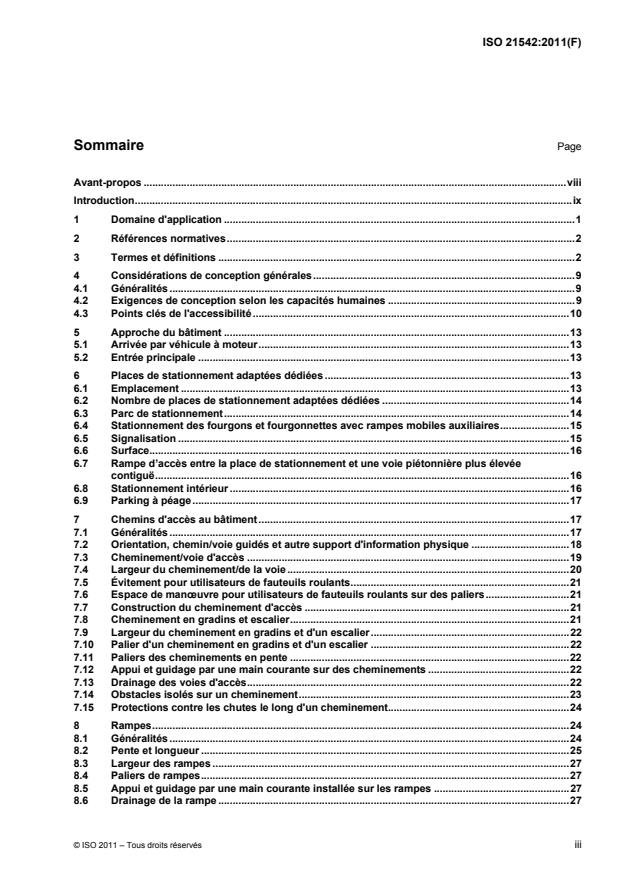
Sommaire Page
Avant-propos . viii
Introduction . ix
1 Domaine d'application . 1
2 Références normatives . 2
3 Termes et définitions . 2
4 Considérations de conception générales . 9
4.1 Généralités . 9
4.2 Exigences de conception selon les capacités humaines . 9
4.3 Points clés de l'accessibilité . 10
5 Approche du bâtiment . 13
5.1 Arrivée par véhicule à moteur . 13
5.2 Entrée principale . 13
6 Places de stationnement adaptées dédiées . 13
6.1 Emplacement . 13
6.2 Nombre de places de stationnement adaptées dédiées . 14
6.3 Parc de stationnement . 14
6.4 Stationnement des fourgons et fourgonnettes avec rampes mobiles auxiliaires . 15
6.5 Signalisation . 15
6.6 Surface. 16
6.7 Rampe d’accès entre la place de stationnement et une voie piétonnière plus élevée
contiguë . 16
6.8 Stationnement intérieur . 16
6.9 Parking à péage . 17
7 Chemins d'accès au bâtiment . 17
7.1 Généralités . 17
7.2 Orientation, chemin/voie guidés et autre support d'information physique . 18
7.3 Cheminement/voie d'accès . 19
7.4 Largeur du cheminement/de la voie . 20
7.5 Évitement pour utilisateurs de fauteuils roulants . 21
7.6 Espace de manœuvre pour utilisateurs de fauteuils roulants sur des paliers . 21
7.7 Construction du cheminement d'accès . 21
7.8 Cheminement en gradins et escalier . 21
7.9 Largeur du cheminement en gradins et d'un escalier . 22
7.10 Palier d'un cheminement en gradins et d'un escalier . 22
7.11 Paliers des cheminements en pente . 22
7.12 Appui et guidage par une main courante sur des cheminements . 22
7.13 Drainage des voies d'accès . 22
7.14 Obstacles isolés sur un cheminement . 23
7.15 Protections contre les chutes le long d'un cheminement. 24
8 Rampes . 24
8.1 Généralités . 24
8.2 Pente et longueur . 25
8.3 Largeur des rampes . 27
8.4 Paliers de rampes . 27
8.5 Appui et guidage par une main courante installée sur les rampes . 27
8.6 Drainage de la rampe . 27
8.7 Matériaux de surface .27
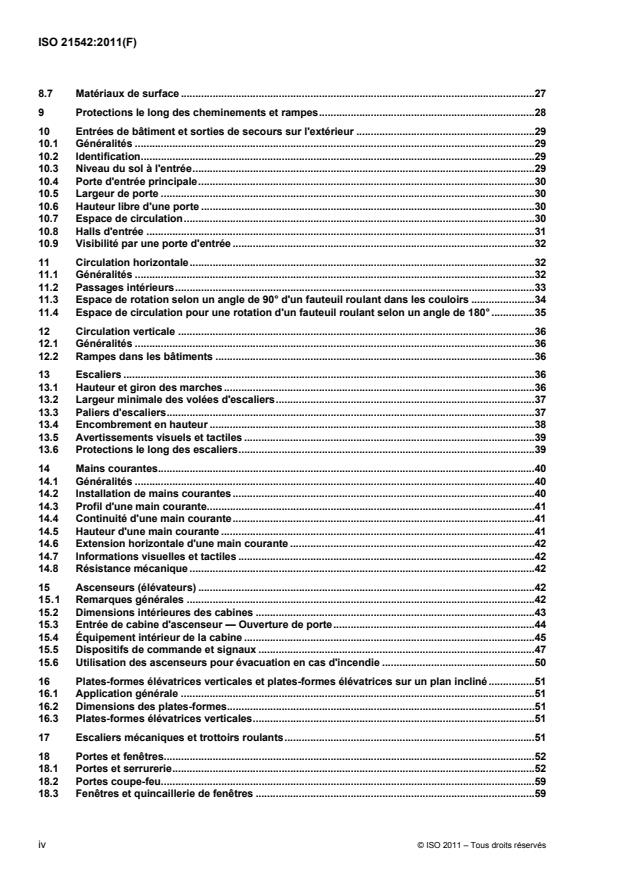
9 Protections le long des cheminements et rampes .28
10 Entrées de bâtiment et sorties de secours sur l'extérieur .29
10.1 Généralités .29
10.2 Identification .29
10.3 Niveau du sol à l'entrée .29
10.4 Porte d'entrée principale .30
10.5 Largeur de porte .30
10.6 Hauteur libre d'une porte .30
10.7 Espace de circulation .30
10.8 Halls d'entrée .31
10.9 Visibilité par une porte d'entrée .32
11 Circulation horizontale .32
11.1 Généralités .32
11.2 Passages intérieurs .33
11.3 Espace de rotation selon un angle de 90° d'un fauteuil roulant dans les couloirs .34
11.4 Espace de circulation pour une rotation d'un fauteuil roulant selon un angle de 180° .35
12 Circulation verticale .36
12.1 Généralités .36
12.2 Rampes dans les bâtiments .36
13 Escaliers .36
13.1 Hauteur et giron des marches .36
13.2 Largeur minimale des volées d'escaliers .37
13.3 Paliers d'escaliers .37
13.4 Encombrement en hauteur .38
13.5 Avertissements visuels et tactiles .39
13.6 Protections le long des escaliers .39
14 Mains courantes .40
14.1 Généralités .40
14.2 Installation de mains courantes .40
14.3 Profil d'une main courante .41
14.4 Continuité d'une main courante .41
14.5 Hauteur d'une main courante .41
14.6 Extension horizontale d'une main courante .42
14.7 Informations visuelles et tactiles .42
14.8 Résistance mécanique .42
15 Ascenseurs (élévateurs) .42
15.1 Remarques générales .42
15.2 Dimensions intérieures des cabines .43
15.3 Entrée de cabine d'ascenseur — Ouverture de porte .44
15.4 Équipement intérieur de la cabine .45
15.5 Dispositifs de commande et signaux .47
15.6 Utilisation des ascenseurs pour évacuation en cas d'incendie .50
16 Plates-formes élévatrices verticales et plates-formes élévatrices sur un plan incliné .51
16.1 Application générale .51
16.2 Dimensions des plates-formes .51
16.3 Plates-formes élévatrices verticales .51
17 Escaliers mécaniques et trottoirs roulants .51
18 Portes et fenêtres .52
18.1 Portes et serrurerie .52
18.2 Portes coupe-feu .59
18.3 Fenêtres et quincaillerie de fenêtres .59
iv © ISO 2011 – Tous droits réservés
19 Zones d'accueil, guichets, réceptions et billetteries . 60
19.1 Audition et lecture labiale . 60
19.2 Emplacement . 61
19.3 Espace de manœuvre . 61
19.4 Hauteur . 61
19.5 Éclairage . 62
19.6 Systèmes de billetterie . 62
20 Vestiaire . 62
21 Auditoriums, salles de concert, stades et lieux similaires avec spectateurs assis . 62
21.1 Dispositifs d'amélioration de l'écoute . 62
21.2 Éclairage pour l'interprétation gestuelle . 62
21.3 Nombre de sièges dédiés pour les utilisateurs de fauteuils roulants . 62
21.4 Accès à la scène et aux coulisses . 63
21.5 Numérotation des rangées et des sièges . 63
21.6 Vestiaires accessibles . 63
22 Salles de conférence et salles de réunion . 64
23 Espaces d'observation dans les zones de rassemblement . 64
23.1 Surface de plancher . 64
23.2 Lignes de visibilité . 65
24 Bars, pubs, restaurants, etc. . 65
25 Terrasses, vérandas et balcons . 65
26 Cabinets d'aisances et sanitaires . 65
26.1 Généralités . 65
26.2 Cabinets d'aisances pour personnes handicapées autonomes . 66
26.3 Cabinets d'aisances accessibles aux utilisateurs en fauteuils roulants . 67
26.4 Dimensions des cabinets d'aisances accessibles aux utilisateurs en fauteuils roulants . 67
26.5 Portes des cabinets d'aisances . 72
26.6 Siège de toilette . 72
26.7 Barres d'appui . 73
26.8 Papier toilette . 74
26.9 Lavabo . 75
26.10 Alimentation en eau . 76
26.11 Robinets . 76
26.12 Urinoirs . 76
26.13 Autres accessoires . 77
26.14 Alarme. 77
26.15 Alarme d'urgence . 78
26.16 Douche. 78
26.17 Salle de douche individuelle . 80
26.18 Salles de bains . 80
27 Chambres accessibles dans les bâtiments à usage non résidentiel . 84
28 Coins cuisine . 86
29 Zones de stockage . 86
30 Aménagements pour les chiens-guide et autres chiens d'assistance . 87
30.1 Généralités . 87
30.2 Zone aménagée pour les chiens-guide et chiens d'assistance . 87
31 Surfaces au sol et surfaces murales . 87
32 Environnement acoustique . 87
32.1 Généralités . 87
32.2 Exigences en termes d'acoustique . 88
32.3 Systèmes d'amélioration de l'écoute . 88
33 Éclairage .89
33.1 Généralités .89
33.2 Éclairage extérieur .89
33.3 Éclairage naturel .90
33.4 Éclairage artificiel .90
33.5 Éclairage permettant de faciliter l'orientation .90
33.6 Éclairage contrôlable et réglable .90
33.7 Niveaux d'éclairement dans les différentes zones .91
33.8 Éclairage dans les auditoriums .91
33.9 Éblouissement et ombres .91
34 Systèmes, signaux et information d'alarme de sécurité incendie .92
34.1 Généralités .92
34.2 Signaux d'alerte lumineux .92
34.3 Systèmes d'alerte sonore .92
35 Contraste visuel .92
35.1 Généralités .92
35.2 Choix des couleurs et motifs .94
36 Appareils, commandes et interrupteurs .94
36.1 Généralités .94
36.2 Emplacement, hauteurs et distances .94
36.3 Emplacement des commandes par rapport aux parois, angles et ouverture de portes .96
36.4 Fonctionnement .98
36.5 Identification .99
36.6 Usage .99
36.7 Téléphones .99
36.8 Accès par carte, distributeurs et guichets automatiques bancaires, etc. . 100
36.9 Systèmes d'accès sécurisé . 102
36.10 Fontaines à eau . 102
36.11 Poubelles . 102
37 Mobilier . 103
37.1 Généralités . 103
37.2 Places assises dans les zones d'attente . 103
37.3 Position assise devant des bureaux, tables, etc. . 104
38 Sécurité incendie, protection et évacuation pour tous. 104
38.1 Objectifs de conception technique de sécurité incendie . 104
38.2 Principes d'évacuation pour tous en cas d'incendie . 105
38.3 Évacuation assistée en cas d'incendie . 105
38.4 Chaises d'évacuation . 107
38.5 Technologies pour l'évacuation en cas d'incendie . 107
38.6 Plans de lutte contre l'incendie . 107
39 Orientation et information . 108
39.1 Généralités . 108
39.2 Principe de deux moyens sensoriels. 109
39.3 Information sonore . 109
39.4 Niveaux d'information . 109
40 Signalisation . 109
40.1 Généralités . 109
40.2 Principaux types de panneaux . 110
40.3 Emplacement des panneaux . 110
40.4 Hauteur et emplacement des panneaux . 111
40.5 Police et taille des lettres . 112
40.6 Différences des indices de réflectance à la lumière LRV . 112
40.7 Antireflet . 113
40.8 Éclairage . 113
vi © ISO 2011 – Tous droits réservés
40.9 Facilité d'utilisation . 113
40.10 Installation de signaux tactiles en relief et en Braille . 113
40.11 Lettres tactiles, chiffres, panneaux et symboles graphiques . 113
40.12 Braille . 114
40.13 Symboles tactiles . 114
40.14 Plans d'orientation et plans d'étages tactiles . 114
40.15 Écrans d'information . 115
41 Symboles graphiques . 115
42 Questions liées à la gestion et à la maintenance . 119
Annexe A (informative) Avertisseurs de surfaces podotactiles. 120
Annexe B (informative) Capacités humaines et considérations de conception associées . 128
Annexe C (informative) Espaces de circulation au niveau des entrées de porte . 143
Annexe D (informative) Sécurité incendie pour tous dans les bâtiments et évacuation assistée . 155
Annexe E (informative) Questions relatives à la gestion et à la maintenance . 158
Bibliographie . 161
Avant-propos
L'ISO (Organisation internationale de normalisation) est une fédération mondiale d'organismes nationaux de
normalisation (comités membres de l'ISO). L'élaboration des Normes internationales est en général confiée
aux comités techniques de l'ISO. Chaque comité membre intéressé par une étude a le droit de faire partie du
comité technique créé à cet effet. Les organisations internationales, gouvernementales et non
gouvernementales, en liaison avec l'ISO participent également aux travaux. L'ISO collabore étroitement avec
la Commission électrotechnique internationale (CEI) en ce qui concerne la normalisation électrotechnique.
Les Normes internationales sont rédigées conformément aux règles données dans les Directives ISO/CEI,
Partie 2.
La tâche principale des comités techniques est d'élaborer les Normes internationales. Les projets de Normes
internationales adoptés par les comités techniques sont soumis aux comités membres pour vote. Leur
publication comme Normes internationales requiert l'approbation de 75 % au moins des comités membres
votants.
L'attention est appelée sur le fait que certains des éléments du présent document peuvent faire l'objet de
droits de propriété intellectuelle ou de droits analogues. L'ISO ne saurait être tenue pour responsable de ne
pas avoir identifié de tels droits de propriété et averti de leur existence.
L'ISO 21542 a été élaborée par le comité technique ISO/TC 59, Bâtiments et ouvrages de génie civil,
sous-comité SC 16, Accessibilité et fonctionnalité des environnements construits.
Cette première édition de l'ISO 21542 annule et remplace l'ISO/TR 9527:1994.
viii © ISO 2011 – Tous droits réservés
Introduction
La présente Norme internationale est un document offrant aux utilisateurs du bâtiment, aux architectes, aux
concepteurs, aux ingénieurs, aux constructeurs, aux maîtres d'ouvrage et aux gestionnaires, aux fabricants,
aux dirigeants et législateurs, toutes les exigences et recommandations en matière de création d'un
environnement bâti durable accessible.
La présente Norme internationale a pour objet de définir la méthode de conception, de construction et de
gestion de l'environnement bâti qu'il convient d'utiliser afin de permettre à toute personne d'approcher un
bâtiment, d'y entrer, de l'utiliser, de le quitter et de l'évacuer en toute indépendance, de manière équitable et
digne et dans la plus large mesure possible.
La présente Norme internationale a pour but de répondre aux besoins de la majorité des personnes. Cet
objectif est atteint en se mettant d'accord sur les dispositions minimales qui sont généralement acceptées
pour s'adapter aux diversités d'âge et de condition. Cet accord a été obtenu par consensus entre les différents
pays du monde entier.
Dans certains pays, un plus haut niveau de spécifications techniques a été atteint en raison de leur longue
expérience dans le développement de normes et réglementations relatives aux bâtiments accessibles. Les
exigences de la présente Norme internationale n'ont pas pour but de remplacer les exigences plus strictes
définies dans ces normes ou réglementations nationales.
Ces principes sont énoncés dans le préambule (g) et dans les Articles 9, 10 et 11 de la Convention des
Nations Unies relative aux droits des personnes handicapées.
NOTE 1 La Convention des Nations Unies relative aux droits des personnes handicapées, avec son Protocole facultatif,
a été adoptée par l'Assemblée générale des Nations Unies du 13 décembre 2006. Elle est entrée en vigueur le
3 mai 2008, et est donc devenue un instrument juridique international. Des informations supplémentaires relatives à la
Convention et à son texte sont disponibles sur le site Web des Nations Unies: http://www.un.org/disabilities/. La
Convention fait l'objet d'un secrétariat commun, composé du Département des affaires économiques et sociales des
Nations Unies (UNDESA), installé à New York, et du Haut Commissariat des Nations Unies aux droits de l'homme
(OHCHR) installé à Genève.
La présente Norme internationale établit les objectifs, les considérations en matière de conception, les
exigences et les recommandations dont l'ISO attend qu'elles donnent lieu à des bâtiments accessibles et
utilisables suite à leur mise en place intégrale.
Il convient d'appliquer la présente Norme internationale aux bâtiments neufs et existants.
Si ces exigences de conception sont prises en compte dès les premières étapes de la conception des
bâtiments, les coûts liés à l'accessibilité et à la facilité d'utilisation sont limités, et augmentent la valeur de la
propriété en termes de durabilité. En cas de modification et de réhabilitation, les coûts supplémentaires
dépendent de la taille et de la complexité du bâtiment et de ses adaptations.
NOTE 2 De plus amples informations relatives aux coûts des bâtiments accessibles sont disponibles auprès d'ETH-
Study, en Suisse: http://www.hindernisfrei-bauen.ch/kosten_f.php.
La présente Norme internationale comporte un ensemble d'exigences essentielles, c'est-à-dire des
dispositions essentielles à l'accessibilité et à la qualité d'usage dans l'environnement bâti, et les
recommandations relatives à un environnement amélioré. Ces exigences essentielles sont précédées du
terme «doit/doivent». Pour les recommandations souhaitables, les dispositions sont précédées de
l'expression «il convient de».
La présente Norme internationale peut être appliquée conformément aux règlements nationaux des comités
membres qui ont adopté la présente Norme internationale et établi, dans leur Avant-propos national, les
termes selon lesquels elle doit être appliquée.
La présente Norme internationale peut être utilisée par
a) les autorités nationales afin de déterminer un programme spécifique de mise en œuvre, et
b) les propriétaires de bâtiments, afin qu'ils remplissent leurs responsabilités en matière de législation anti-
discrimination et d'équité ou sur la base du volontariat.
Étant donné que les bâtiments font l'objet d'une réhabilitation, d'une évolution ou d'un changement d'utilisation
à certains stades de leur cycle de vie, des règlements nationaux peuvent exiger l'application de tout ou partie
de la présente Norme internationale.
Les règlements nationaux relatifs aux bâtiments peuvent comprendre des considérations liées à la législation
sur l'égalité, aux contraintes des bâtiments et sites particuliers, aux différents types de bâtiments, ainsi que
les avantages et inconvénients pour la société d'un point de vue général. Il est également important d'assurer
l'accessibilité aux bâtiments existants présentant une importance historique, architecturale et culturelle. Dans
de tels cas, il peut s'avérer nécessaire que les autorités nationales autorisent certaines dérogations à la
présente Norme internationale, en recommandant d'autres mesures d'accessibilité appropriées.
Il convient que la présente Norme internationale donne lieu à des améliorations continues de l'environnement
bâti. Bien que les objectifs demeurent toujours inchangés, les moyens de les atteindre entrent dans le cadre
du processus continu de modification, c'est-à-dire au fur et à mesure des améliorations des connaissances
humaines et de la technologie du bâtiment, et de la modification des relations entre les pratiques
généralement acceptées du bâtiment et la technologie.
Il convient d'utiliser l'ISO/CEI Guide 71 et son document d'orientation l'ISO/TR 22411 pour améliorer et aider à
la compréhension des exigences de la présente Norme internationale.
Dans les figures, et sauf indication contraire, toutes les dimensions sont exprimées en millimètres et
mesurées à partir des surfaces finies. Toutes les figures sont fournies à titre d'exemple.
x © ISO 2011 – Tous droits réservés
NORME INTERNATIONALE ISO 21542:2011(F)
Construction immobilière — Accessibilité et facilité d'utilisation
de l'environnement bâti
1 Domaine d'application
La présente Norme internationale spécifie un certain nombre d'exigences et de recommandations concernant
la plupart des éléments de construction, assemblages, composants et accessoires qui constituent
l'environnement bâti. Ces exigences portent sur les aspects constructifs liés à l'accès aux bâtiments, sur la
circulation à l'intérieur des bâtiments, sur les moyens de sortie des bâtiments dans le cadre normal des
événements et sur l'évacuation en cas d'urgence. Une annexe informative est également incluse. Elle aborde
les aspects liés à la gestion de l'accessibilité dans les bâtiments.
La présente Norme internationale comprend des dispositions relatives aux caractéristiques de
l'environnement extérieur associées directement à l'accès à un bâtiment ou à un groupe de bâtiments depuis
l'extrémité des limites correspondantes du site concerné ou entre les groupes de bâtiments d'un site commun.
La présente Norme internationale ne traite cependant pas des éléments de l'environnement extérieur, tels que
les espaces publics libres, dont la fonction est autonome et n'est pas liée à l'utilisation d'un bâtiment
spécifique, ni des logements individuels, autres que les espaces de circulation et les accessoires communs à
deux logements de ce type ou plus.
Il est actuellement envisagé de développer et de publier des parties supplémentaires à la présente Norme
internationale afin de traiter des types d'environnements extérieurs décrits ci-dessus et des logements
individuels.
Certains paragraphes comportent des options, spécifiques aux bâtiments existants, qui apparaissent comme
«des éléments exceptionnels à prendre en considération pour les bâtiments existants dans les pays en
développement» (voir «Guide sur les implications de la politique de pertinence mondiale de l'ISO pour la
normalisation du CEN», 2005) et comme «des éléments exceptionnels à prendre en considération pour les
bâtiments existants» lorsque des dispositions moins restrictives que celles attendues pour de nouvelles
constructions sont admises uniquement du fait de circonstances techniques et économiques.
Les dimensions énoncées dans la présente Norme internationale et associées à l'utilisation des fauteuils
roulants concernent l'encombrement de la taille des fauteuils roulants communément utilisés et des
utilisateurs. L'encombrement d'un fauteuil roulant dans la présente Norme internationale est fondé sur
1)
l'ISO 7176-5 et l'ISO/TR 13570-2 et est de 800 mm de large et de 1 300 mm de long. Pour les fauteuils
roulants et scooters de plus grandes dimensions, les dimensions devront être considérées en conséquence.
NOTE La présente Norme internationale est principalement destinée à des personnes adultes présentant un ou
plusieurs handicaps, mais comporte certaines spécifications concernant les exigences d'accessibilité spécifiques qui
s'appliqueraient aux enfants présentant également un ou plusieurs handicaps. Il est toutefois prévu d'inclure des
exigences plus détaillées dans les révisions futures de la présente Norme internationale.
1) En cours d'élaboration.
------------
...
SLOVENSKI SIST ISO 21542
STANDARD
november 2012
Gradnja stavb – Dostopnost in uporabnost grajenega okolja
Building construction – Accessibility and usability of the built environment
Construction immobilière – Accessibilité et facilité d'utilisation de l'environnement
bâti
Gebäude – Barrierefreiheit von Gebäuden und sonstigen Bauwerken
Referenčna oznaka
ICS 11.180.01; 91.060.01 SIST ISO 21542:2012 (sl)
Nadaljevanje na straneh od 2 do 158
© 2016-06. Standard je založil in izdal Slovenski inštitut za standardizacijo. Razmnoževanje celote ali delov tega standarda ni dovoljeno.
SIST ISO 21542 : 2012
NACIONALNI UVOD
Standard SIST ISO 21542 (sl), Gradnja stavb – Dostopnost in uporabnost grajenega okolja, 2012, ima
status slovenskega standarda in je istoveten mednarodnemu standardu ISO 21542 (en, de, fr),
Building construction – Accessibility and usability of the built environment, 2011.
Ta standard nadomešča tehnično poročilo SIST ISO/TR 9527:2002
NACIONALNI PREDGOVOR
Mednarodni standard ISO 21542:2011 je pripravil tehnični odbor ISO/TC 59 Stavbe in gradbeni
inženirski objekti, pododbor SC 16 Dostopnost in uporabnost grajenega okolja. Slovenski standard
besedila slovenskega prevoda v tem standardu je odločilen izvirni mednarodni standard v angleškem
jeziku.
Ker se talne taktilne oznake in metode za njihovo namestitev razlikujejo od države do države, so
podrobnejše informacije o uporabi v Republiki Sloveniji zbrane v nacionalnem standardu.
Odločitev za izdajo tega prevoda standarda je dne 12. julija 2012 sprejel Strokovni svet SIST za
splošno področje.
ZVEZE S STANDARDI
S privzemom tega mednarodnega standarda veljajo za omejeni namen referenčnih standardov vsi
standardi, navedeni v izvirniku, razen tistih, ki so že sprejeti v nacionalno standardizacijo:
SIST ISO 4190-1:2012 Dvigala (lifti) – 1. del: Dvigala razredov I, II, III in VI
SIST ISO 4190-5:2012 Dvigala (lifti) – 5. del: Krmilja, signali in pripadajoča oprema
OSNOVA ZA IZDAJO STANDARDA
– privzem standarda ISO 21542:2011
PREDHODNA IZDAJA
– SIST ISO/TR 9527:2002, Gradnja objektov – Potrebe invalidov in drugih funkcionalno oviranih
ljudi v stavbah – Smernice za projektiranje
OPOMBI
– Povsod, kjer se v besedilu standarda uporablja izraz "mednarodni standard", v SIST ISO 21542:2012
to pomeni "slovenski standard".
– Uvod in nacionalni predgovor nista sestavni del standarda.
POMEMBNO: Logotip "v barvah" na platnicah te publikacije opozarja, da vsebuje barve, ki so
potrebne za pravilno razumevanje njene vsebine. Uporabniki morajo zato tiskati ta dokument z
barvnim tiskalnikom.
SIST ISO 21542 : 2012
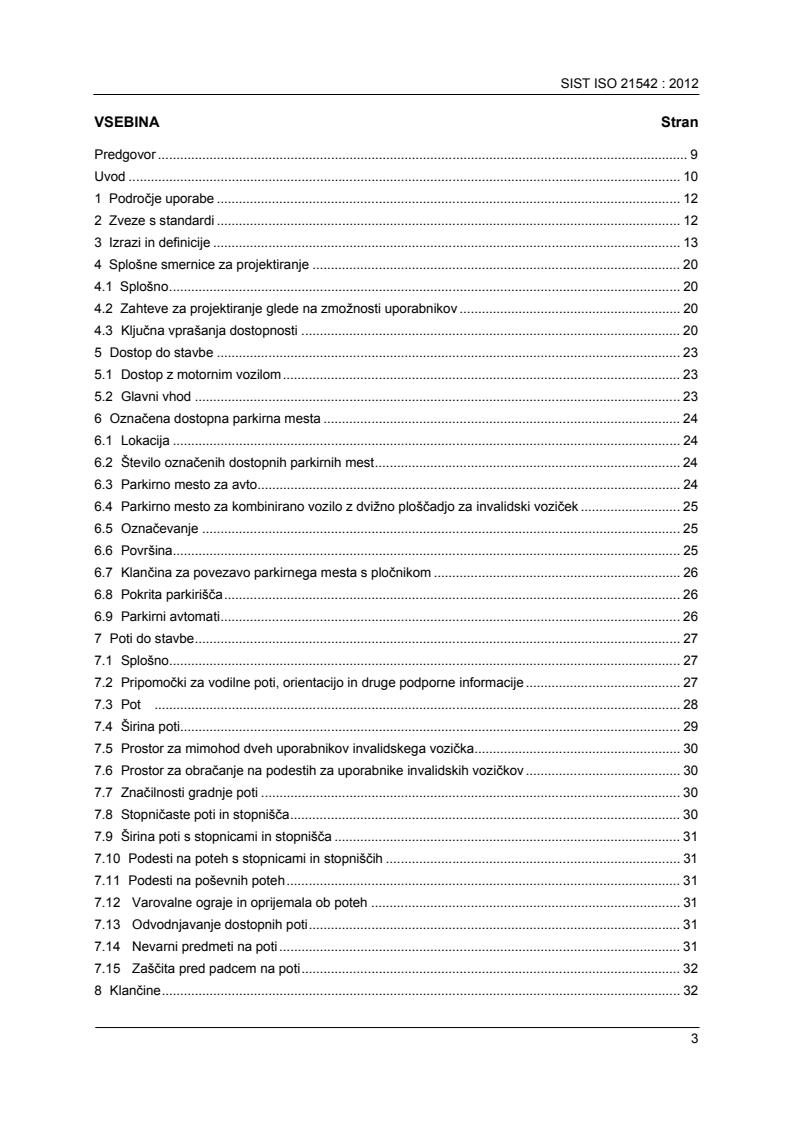
VSEBINA Stran
Predgovor . 9
Uvod . 10
1 Področje uporabe . 12
2 Zveze s standardi . 12
3 Izrazi in definicije . 13
4 Splošne smernice za projektiranje . 20
4.1 Splošno . 20
4.2 Zahteve za projektiranje glede na zmožnosti uporabnikov . 20
4.3 Ključna vprašanja dostopnosti . 20
5 Dostop do stavbe . 23
5.1 Dostop z motornim vozilom . 23
5.2 Glavni vhod . 23
6 Označena dostopna parkirna mesta . 24
6.1 Lokacija . 24
6.2 Število označenih dostopnih parkirnih mest . 24
6.3 Parkirno mesto za avto . 24
6.4 Parkirno mesto za kombinirano vozilo z dvižno ploščadjo za invalidski voziček . 25
6.5 Označevanje . 25
6.6 Površina. 25
6.7 Klančina za povezavo parkirnega mesta s pločnikom . 26
6.8 Pokrita parkirišča . 26
6.9 Parkirni avtomati . 26
7 Poti do stavbe . 27
7.1 Splošno. 27
7.2 Pripomočki za vodilne poti, orientacijo in druge podporne informacije . 27
7.3 Pot . 28
7.4 Širina poti. 29
7.5 Prostor za mimohod dveh uporabnikov invalidskega vozička . 30
7.6 Prostor za obračanje na podestih za uporabnike invalidskih vozičkov . 30
7.7 Značilnosti gradnje poti . 30
7.8 Stopničaste poti in stopnišča . 30
7.9 Širina poti s stopnicami in stopnišča . 31
7.10 Podesti na poteh s stopnicami in stopniščih . 31
7.11 Podesti na poševnih poteh . 31
7.12 Varovalne ograje in oprijemala ob poteh . 31
7.13 Odvodnjavanje dostopnih poti . 31
7.14 Nevarni predmeti na poti . 31
7.15 Zaščita pred padcem na poti . 32
8 Klančine . 32
SIST ISO 21542 : 2012
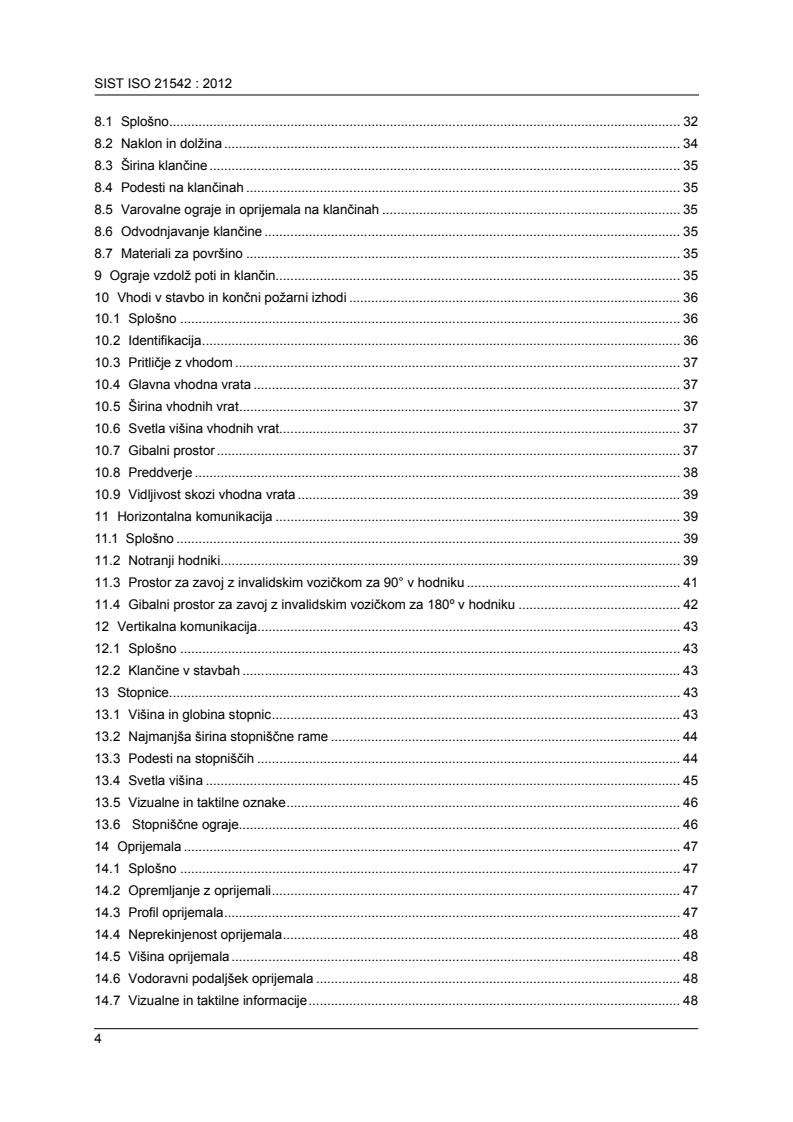
8.1 Splošno. 32
8.2 Naklon in dolžina . 34
8.3 Širina klančine . 35
8.4 Podesti na klančinah . 35
8.5 Varovalne ograje in oprijemala na klančinah . 35
8.6 Odvodnjavanje klančine . 35
8.7 Materiali za površino . 35
9 Ograje vzdolž poti in klančin. 35
10 Vhodi v stavbo in končni požarni izhodi . 36
10.1 Splošno . 36
10.2 Identifikacija . 36
10.3 Pritličje z vhodom . 37
10.4 Glavna vhodna vrata . 37
10.5 Širina vhodnih vrat . 37
10.6 Svetla višina vhodnih vrat. 37
10.7 Gibalni prostor . 37
10.8 Preddverje . 38
10.9 Vidljivost skozi vhodna vrata . 39
11 Horizontalna komunikacija . 39
11.1 Splošno . 39
11.2 Notranji hodniki . 39
11.3 Prostor za zavoj z invalidskim vozičkom za 90° v hodniku . 41
11.4 Gibalni prostor za zavoj z invalidskim vozičkom za 180º v hodniku . 42
12 Vertikalna komunikacija . 43
12.1 Splošno . 43
12.2 Klančine v stavbah . 43
13 Stopnice. 43
13.1 Višina in globina stopnic . 43
13.2 Najmanjša širina stopniščne rame . 44
13.3 Podesti na stopniščih . 44
13.4 Svetla višina . 45
13.5 Vizualne in taktilne oznake . 46
13.6 Stopniščne ograje. 46
14 Oprijemala . 47
14.1 Splošno . 47
14.2 Opremljanje z oprijemali . 47
14.3 Profil oprijemala . 47
14.4 Neprekinjenost oprijemala . 48
14.5 Višina oprijemala . 48
14.6 Vodoravni podaljšek oprijemala . 48
14.7 Vizualne in taktilne informacije . 48
SIST ISO 21542 : 2012
14.8 Mehanska odpornost . 48
15 Dvigala . 48
15.1 Splošne opombe . 48
15.2 Notranja velikost kabine dvigala . 49
15.3 Vhod v dvigalo – vratna odprtina . 50
15.4 Oprema v dvigalu . 51
15.5 Naprave za upravljanje in signali . 53
15.6 Uporaba dvigal za evakuacijo ob požaru . 55
16 Navpične in poševne dvižne ploščadi . 56
16.1 Splošna uporaba . 56
16.2 Velikost ploščadi . 56
16.3 Navpične dvižne ploščadi . 56
17 Tekoče stopnice in tekoče steze . 56
18 Vrata in okna . 57
18.1 Vrata in oprema za vrata . 57
18.2 Požarno odporna vrata . 63
18.3 Okna in oprema za okna . 63
19 Sprejemni prostori, sprejemna okenca, informacijski pulti in mesta z upravljanjem čakanja . 64
19.1 Poslušanje in branje z ustnic . 64
19.2 Lokacija . 64
19.3 Manevrski prostor . 64
19.4 Višina . 64
19.5 Razsvetljava . 65
19.6 Sistemi za upravljanje čakanja . 65
20 Garderoba . 65
21 Avditoriji, koncertne dvorane, športne dvorane in podobni prostori . 66
21.1 Sistemi za lažje poslušanje . 66
21.2 Razsvetljava za tolmača znakovnega jezika . 66
21.3 Označena sedežna mesta za uporabnike invalidskih vozičkov . 66
21.4 Dostop do odra in zaodrja . 66
21.5 Številke vrst in sedežev . 66
21.6 Prostori za preoblačenje. 66
22 Konferenčni in sejni prostori . 67
23 Sedežna mesta v konferenčnih prostorih . 67
23.1 Talna površina . 67
23.2 Vidni prostor . 68
24 Bari, gostilne, restavracije itd. . 68
25 Terase, verande in balkoni . 68
26 Toaletni in sanitarni prostori . 69
26.1 Splošno . 69
26.2 Straniščni prostori za gibalno ovirane/invalidne ljudi . 69
SIST ISO 21542 : 2012
26.3 Toaletni prostori, dostopni za uporabnike invalidskih vozičkov. 70
26.4 Dimenzije toaletnih prostorov, dostopnih za uporabnike invalidskih vozičkov . 70
26.5 Vrata toaletnega prostora . 75
26.6 Straniščna školjka . 75
26.7 Oprijemala . 75
26.8 Toaletni papir . 76
26.9 Umivalnik . 77
26.10 Oskrba z vodo . 78
26.11 Pipe . 78
26.12 Pisoarji . 79
26.13 Druga oprema . 79
26.14 Alarm . 79
26.15 Opozorilni alarm v izrednih razmerah . 80
26.16 Tuši . 80
26.17 Individualni tuši . 81
26.18 Kopalnice . 82
27 Spalnice v nestanovanjskih objektih . 85
28 Kuhinje . 87
29 Shrambe . 87
30 Prostor za pse vodiče in druge spremljevalne pse . 87
30.1 Splošno . 87
30.2 Prostor za olajšanje psov vodičev in spremljevalnih psov . 88
31 Talne in stenske površine . 88
32 Akustično okolje . 88
32.1 Splošno . 88
32.2 Akustične zahteve . 88
32.3 Sistemi za lažje poslušanje . 89
33 Razsvetljava . 90
33.1 Splošno . 90
33.2 Zunanja razsvetljava . 90
33.3 Naravna razsvetljava . 90
33.4 Umetna razsvetljava . 90
33.5 Razsvetljava za lažje vodenje . 91
33.6 Krmiljena in nastavljiva razsvetljava . 91
33.7 Nivo osvetljenosti različnih območij . 91
33.8 Razsvetljava avditorijev . 91
33.9 Bleščanje in sence . 92
34 Požarni opozorilni sistemi, oznake in informacije . 92
34.1 Splošno . 92
34.2 Svetlobne opozorilne oznake . 92
34.3 Zvočni opozorilni sistemi . 93
SIST ISO 21542 : 2012
35 Vizualni kontrast . 93
35.1 Splošno . 93
35.2 Izbira barv in oznak . 94
36 Oprema, naprave za upravljanje in stikala . 94
36.1 Splošno . 94
36.2 Lokacije, višine in razdalje. 95
36.3 Lokacija elementov za upravljanje glede na vogale sten in vrata . 97
36.4 Delovanje . 98
36.5 Identifikacija . 99
36.6 Uporabnost . 99
36.7 Telefoni . 99
36.8 Dostopanje s kartico, avtomati za izdajanje in bančni avtomati (bankomati) itd. . 100
36.9 Varnostni sistemi za dostopanje . 101
36.10 Fontane za pitje . 101
36.11 Smetnjaki . 102
37 Pohištvo . 102
37.1 Splošno . 102
37.2 Prostor za sedenje v čakalnicah . 102
37.3 Sedenje ob pultih, mizah itd. . 103
38 Požarna varnost, zaščita in evakuacija za vse. 103
38.1 Cilji požarnega inženiringa . 103
38.2 Načela evakuacije ob požaru za vse . 104
38.3 Evakuacija z asistenco ob požaru . 104
38.4 Evakuacijski sedeži . 105
38.5 Razvijajoče se tehnologije za evakuacijo ob požaru . 106
38.6 Obrambni požarni načrti . 106
39 Orientacija in informacije . 106
39.1 Splošno . 106
39.2 Načelo dveh čutov . 107
39.3 Zvočne informacije . 107
39.4 Ravni informacij . 107
40 Označevanje . 107
40.1 Splošno . 107
40.2 Glavne vrste oznak . 108
40.3 Nameščanje oznak . 108
40.4 Višina in lokacija oznak . 109
40.5 Pisava in velikost črk . 110
40.6 Razlike v odsevnosti svetlobe . 110
40.7 Brez bleščanja . 110
40.8 Osvetlitev . 111
SIST ISO 21542 : 2012
40.9 Razumljivost . 111
40.10 Izbočene tipne in brajeve oznake . 111
40.11 Taktilne črke, številke, znaki in grafični simboli . 111
40.12 Brajica . 112
40.13 Tipni simboli . 112
40.14 Tipni zemljevidi in tlorisi nadstropij . 112
40.15 Prikazovalniki informacij . 112
41 Grafični simboli . 112
42 Upravljanje in vzdrževanje . 116
Dodatek A (informativni): Talni taktilni vodilni sistem (TTVS) .117
Dodatek B (informativni): Človekove zmožnosti in s tem povezani vidiki projektiranja .125
Dodatek C (informativni): Gibalni prostor pri vratih .138
Dodatek D (informativni): Požarna varnost in evakuacija z asistenco za vse uporabnike stavb .150
Dodatek E (informativni): Upravljanje in vzdrževanje .152
Literatura.155
SIST ISO 21542 : 2012
Predgovor
ISO (Mednarodna organizacija za standardizacijo) je svetovna zveza nacionalnih organov za standarde
(članov ISO). Mednarodne standarde po navadi pripravljajo tehnični odbori ISO. Vsak član, ki želi
delovati na določenem področju, za katero je bil ustanovljen tehnični odbor, ima pravico biti zastopan v
tem odboru. Pri delu sodelujejo mednarodne vladne in nevladne organizacije, povezane z ISO. V vseh
zadevah, ki so povezane s standardizacijo na področju elektrotehnike, ISO tesno sodeluje z
Mednarodno elektrotehniško komisijo (IEC).
Mednarodni standardi so pripravljeni v skladu s pravili, podanimi v 2. delu Direktiv ISO/IEC.
Glavna naloga tehničnih odborov je priprava mednarodnih standardov. Osnutki mednarodnih
standardov, ki jih sprejmejo tehnični odbori, se pošljejo vsem članom v glasovanje. Za objavo
mednarodnega standarda je treba pridobiti soglasje najmanj 75 odstotkov članov, ki se udeležijo
glasovanja.
Opozoriti je treba na možnost, da je lahko nekaj elementov tega mednarodnega standarda predmet
patentnih pravic. ISO ne prevzema odgovornosti za identifikacijo katerih koli ali vseh takih patentnih
pravic.
ISO 21542 je pripravil tehnični odbor ISO/TC 59 Stavbe in gradbeni inženirski objekti, pododbor SC 16
Dostopnost in uporabnost grajenega okolja.
Ta prva izdaja razveljavlja in nadomešča ISO/TR 9527:1994.
SIST ISO 21542 : 2012
Uvod
Ta mednarodni standard določa zahteve in priporočila za uporabnike, arhitekte, oblikovalce, inženirje,
gradbenike, lastnike stavb in menedžerje, proizvajalce, oblikovalce politike in zakonodajalce, da bi
ustvarili sprejemljivo, trajnostno grajeno okolje.
Namen tega mednarodnega standarda je opredeliti, kako naj bo grajeno okolje načrtovano, zgrajeno
in urejeno, da ljudje lahko samostojno, enakovredno in dostojanstveno ter v največji možni meri
dostopajo, vstopajo, uporabljajo, izstopajo in se evakuirajo iz stavbe.
Namen tega mednarodnega standarda je zadovoljiti potrebe večine ljudi. Ta cilj se doseže z
dogovorom o minimalnih standardih za predpise, ki so splošno sprejemljivi, saj upoštevajo različnost
ljudi glede na njihovo starost in fizično stanje. Ta dogovor je bil dosežen s konsenzom med različnimi
državami po vsem svetu.
V nekaterih državah so z njihovimi dolgoletnimi prizadevanji za razvoj dostopnejših gradbenih
standardov in predpisov že dosegli višjo raven tehničnih specifikacij. Zahteve tega mednarodnega
standarda niso namenjene temu, da bi zamenjale strožje zahteve, opredeljene v zadevnih nacionalnih
standardih ali nacionalnih predpisih.
Ta načela so podprta s preambulo (g) ter členi 9, 10 in 11 Konvencije ZN o pravicah invalidov.
OPOMBA 1: Konvencijo o pravicah invalidov in njen izbirni protokol je sprejela Generalna skupščina 13. decembra 2006.
Konvencija je stopila v veljavo, tj. postala mednarodni pravni instrument, 3. maja 2008. Več informacij o
konvenciji in njenem besedilu je na spletni strani Združenih narodov: http://www.un.orq/disabilities/. Konvencijo
ureja skupni sekretariat, sestavljen iz osebja Oddelka ZN za ekonomske in socialne zadeve (DESA) s sedežem
v New Yorku in Urada visokega komisarja ZN za človekove pravice (OHGHR) v Ženevi.
Ta mednarodni standard določa cilje, usmeritve za načrtovanje, zahteve in priporočila, od katerih ISO
pričakuje dostopnejše in prijaznejše stavbe, ko bo standard v celoti izvajan.
Ta mednarodni standard naj se uporablja za nove in obstoječe stavbe.
Če so te konstrukcijske zahteve upoštevane v zgodnjih fazah projektiranja, so stroški zagotavljanja
ukrepov za dostopnost in uporabnost manjši, obenem pa ti ukrepi povečajo vrednost nepremičnine v
smislu trajnostnosti. Pri spremembah in prenovi pa je dodatni strošek odvisen od velikosti in
zahtevnosti posameznega objekta in njegove prilagoditve.
OPOMBA 2: Za dodatne informacije o stroških dostopnih stavb glej študijo ETH iz Švice:
http://www.hindernisfrei-bauen.ch/kosten_f.php.
Ta mednarodni standard vsebuje kombinacijo bistvenih zahtev, tj. določila, ki so bistvenega pomena
za dostopnost in uporabnost grajenega okolja, in priporočila za izboljšave okolja. Bistvene zahteve
vsebujejo besedo "mora" ("je treba"). Priporočila, ki so zaželena, vsebujejo besedo "naj".
Ta mednarodni standard se lahko uporablja v skladu z nacionalnimi predpisi organov članic, ki so ta
mednarodni standard sprejele in v svojih nacionalnih predgovorih določile pogoje, pod katerimi se
uporablja.
Ta mednarodni standard lahko uporabljajo:
a) nacionalni organi oblasti, da določijo poseben program izvajanja, in
b) lastniki stavb, da izpolnijo svoje obveznosti po zakonodaji o nediskriminaciji in enakosti ali
prostovoljno.
Ker je večina stavb na neki stopnji v svojem življenjskem ciklu predmet prenove, nadgradnje ali
spremembe uporabe, lahko nacionalni predpisi zahtevajo, da se uporablja ta mednarodni standard v
celoti ali le njegov del.
SIST ISO 21542 : 2012
Nacionalni predpisi za gradnjo lahko vključujejo vidike zakonodaje o enakosti, omejitvah posameznih
stavb in lokacij, različne vrste objektov ter stroške in koristi za družbo na splošno. Zato je tudi
pomembno zagotoviti dostopnost obstoječih zgradb zgodovinskega, arhitekturnega in kulturnega
pomena. V takšnih primerih bodo morda nacionalni organi oblasti morali dovoliti nekatere izjeme glede
tega mednarodnega standarda in tudi priporočiti primerne alternativne ukrepe za dostopnost.
Ta mednarodni standard naj privede do nenehnega izboljševanja grajenega okolja. Medtem ko cilji
vedno ostajajo nespremenjeni, so sredstva za njihovo doseganje del stalnega procesa sprememb, na
primer zaradi spreminjanja znanja ljudi in tehnologije gradnje ter razmerja med splošno uveljavljeno
gradbeno prakso in tehnologijo.
Za izboljšanje in pomoč pri razumevanju zahtev tega mednarodnega standarda naj se uporabita vodilo
ISO/IEC Guide 71 in dokument z napotki ISO/TR 22411.
V slikah so vse mere podane v milimetrih in izmerjene od dokončanih površin, razen če ni navedeno
drugače. Vse slike so navedene kot primeri.
SIST ISO 21542 : 2012
Gradnja stavb – Dostopnost in uporabnost grajenega okolja
1 Področje uporabe
Ta mednarodni standard določa vrsto zahtev in priporočil za mnoge elemente gradnje, gradbene
sklope, komponente in opremo, ki sestavljajo grajeno okolje. Te zahteve se nanašajo na gradbene
vidike dostopa do stavb, za gibanje znotraj stavb, za izstop iz stavbe v normalnem poteku dogodkov in
za evakuacijo ob izrednem dogodku. Dodan je tudi informativni dodatek, ki se ukvarja z vidiki
dostopnosti in upravljanja stavb.
Ta mednarodni standard vsebuje določila v zvezi s funkcijami v odprtem prostoru, neposredno
povezanimi z dostopom do stavbe ali skupine stavb od roba ustrezne meje lokacije ali med takimi
skupinami stavb na skupni lokaciji. Ta mednarodni standard ne obravnava elementov odprtega
prostora, na primer javnih odprtih prostorov, katerih funkcija je samostojna in ni povezana z uporabo
posamične stavbe. Prav tako ne obravnava enodružinskih stanovanj, razen tistih prostorov in opreme,
ki je skupna za dve ali več takšnih stanovanj.
Trenutno se razmišlja o izdelavi in objavi dodatnih delov tega mednarodnega standarda, ki bi
obravnavali zgoraj opisani odprti prostor in enodružinska stanovanja.
Za obstoječe stavbe so v nekaterih odstavkih vključene možnosti, ki so predstavljene kot "premislek o
izjemah za obstoječe stavbe v državah v razvoju" (glej "Navodila o posledicah politike svetovnega
pomena ISO za standardizacijo CEN", 2005) in kot "premislek o izjemah za obstoječe stavbe", kjer je
zaradi tehničnih in ekonomskih okoliščin sprejemljiv nižji standard, kot je pričakovati za nov razvoj.
Dimenzije v tem mednarodnem standardu, ki so pomembne za uporabo invalidskih vozičkov, se
nanašajo na tloris pogosto uporabljene velikosti invalidskih vozičkov in na uporabnike. Tloris
invalidskih vozičkov v tem mednarodnem standardu temelji na ISO 7176-5 in ISO/TR 13570-2 ter je
širok 800 mm in dolg 1 300 mm. Za večje invalidske vozičke in skuterje je treba upoštevati ustrezne
dimenzije.
OPOMBA: Ta mednarodni standard je napisan predvsem za odrasle gibalno ovirane osebe, vendar vključuje nekatere
zahteve za dostopnost, ki ustrezajo tudi invalidnim otrokom. Predvideno je, da bodo podrobnejše zahteve
vključene v prihodnjih revizijah tega mednarodnega standarda.
2 Zveze s standardi
Za uporabo tega standarda so nujno potrebni spodaj navedeni referenčni dokumenti. Pri datiranih
sklicevanjih se uporablja le navedena izdaja. Pri nedatiranih sklicevanjih se uporablja zadnja izdaja
publikacije (vključno z dopolnili).
ISO 4190-1:2010 Dvigala (lifti) – 1. del: Dvigala razredov I, II, III in VI
ISO 4190-5:2006 Dvigala (lifti) – 5. del: Krmilja, signali in pripadajoča oprema
ISO 7176-5 Invalidski vozički – 5. del: Določanje dimenzij, mas in manevrskega prostora
ISO 9386-1 Električne dvižne ploščadi za osebe z okvaro mobilnosti – Pravila o varnosti,
dimenzijah in funkcionalnem delovanju – 1. del: Navpične dvižne ploščadi
ISO 9386-2 Električne dvižne ploščadi za osebe z okvaro mobilnosti – Pravila o varnosti,
dimenzijah in funkcionalnem delovanju – 2. del: Gnana stopniščna dvigala
za sedeče ali stoječe osebe ter invalidski vozički na poševni ravnini
V pripravi.
SIST ISO 21542 : 2012
ISO 13570-2 Invalidski vozički – 2. del: Tipične vrednosti in priporočene omejitve ali
dimenzije, mase in manevrski prostor, kot je določeno v standardu ISO
7176-5
ISO/
...
Questions, Comments and Discussion
Ask us and Technical Secretary will try to provide an answer. You can facilitate discussion about the standard in here.
Loading comments...