

SIST EN 10253-2:2021
(Main)Butt-welding pipe fittings - Part 2: Non alloy and ferritic alloy steels with specific inspection requirements
General Information
- Abstract
This document specifies the technical delivery requirements for seamless and welded butt welding fittings (elbows, concentric and eccentric reducers, equal and reducing tees, caps) made of carbon and alloy steel in two test categories which are intended for pressure purposes at room temperature, at low temperature or at elevated temperatures, and for the transmission and distribution of fluids and gases.
It specifies:
a) type of fittings;
type A: Butt-welding fittings with reduced pressure factor;
type B: Butt-welding fittings for use at full service pressure;
b) steel grades and their chemical compositions;
c) mechanical properties;
d) dimensions and tolerances;
e) requirements for inspection and testing;
f) inspection documents;
g) marking;
h) protection and packaging.
NOTE The selection of the appropriate fitting (material, thickness) is the ultimate responsibility of the manufacturer of the pressure equipment (see European Legislation for Pressure Equipment). In the case of a harmonized supporting standard for materials, presumption of conformity to the ESRs is limited to technical data of materials in the standard and does not presume adequacy of the material to a specific item of equipment. Consequently, it is essential that the technical data stated in the material standard be assessed against the design requirements of this specific item of equipment to verify that the ESRs of the PED are satisfied.
- Status
- Withdrawn
- Public Enquiry End Date
- 31-Jan-2018
- Publication Date
- 24-Aug-2021
- Withdrawal Date
- 04-Jan-2026
- Technical Committee
- IFEK - Ferrous metals
- Current Stage
- 9900 - Withdrawal (Adopted Project)
- Start Date
- 05-Jan-2026
- Due Date
- 28-Jan-2026
- Completion Date
- 05-Jan-2026

Overview
SIST EN 10253-2:2021 - Butt-welding pipe fittings (Part 2) defines the technical delivery requirements for seamless and welded butt-welding fittings made from non-alloy and ferritic alloy steels with specific inspection requirements. It applies to elbows, concentric and eccentric reducers, equal and reducing tees, and caps intended for pressure purposes at room, low or elevated temperatures and for the transmission and distribution of fluids and gases. The standard distinguishes two fitting types: Type A (reduced pressure factor) and Type B (full service pressure).
Key topics and technical requirements
This part of EN 10253 covers the full lifecycle of product specification and quality assurance for butt-welding fittings, including:
- Scope and classification: types of fittings, test categories and intended service conditions (pressure, temperature).
- Material requirements: permitted steel grades and declared chemical compositions (cast and product analysis).
- Mechanical properties: tensile, impact and hardness requirements, plus creep-rupture information where applicable.
- Manufacturing and heat treatment: permitted production routes, welding and post-weld heat treatment conditions.
- Dimensions and tolerances: detailed dimensional tables, wall thickness, out-of-roundness and bevel performance.
- Inspection & testing: sampling rules, test units, test-piece preparation and required test methods (tensile, impact, bend, hardness).
- Non-destructive testing (NDT): requirements for visual testing, radiographic/ultrasonic/other NDT of welds and formed parts, plus Positive Material Identification (PMI) where required.
- Inspection documents & marking: required certificates and traceability information.
- Protection and packaging: preservation, packing and identification for delivery.
Note: Final selection of material and thickness for a pressure item remains the responsibility of the pressure equipment manufacturer (see European Pressure Equipment legislation/PED). Material data in this harmonized standard must be assessed against the specific equipment design.
Practical applications and users
Who uses EN 10253-2:
- Manufacturers of butt-welding fittings (seamless and welded) for oil & gas, petrochemical, power and water industries.
- Pressure equipment designers and OEMs specifying fittings for piping systems operating at varied temperatures and pressures.
- Inspection and quality assurance teams, NDT providers and third-party certification bodies verifying compliance.
- Purchasers and procurement specifying delivery requirements, marking and documentation.
Keywords: butt-welding pipe fittings, EN 10253-2, non-alloy steels, ferritic alloy steels, inspection requirements, pressure fittings, NDT, PMI, pipe fittings standard.
Related standards
- Other parts of the EN 10253 series and relevant EN standards for materials, welding and pressure equipment (refer to normative references in EN 10253-2 for specific links).
Relations
- Effective Date
- 18-Aug-2021
- Effective Date
- 22-Oct-2025
- Effective Date
- 28-Jan-2026
- Effective Date
- 28-Jan-2026
- Effective Date
- 28-Jan-2026
- Effective Date
- 28-Jan-2026
- Effective Date
- 28-Jan-2026
- Effective Date
- 28-Jan-2026
- Effective Date
- 28-Jan-2026
- Effective Date
- 28-Jan-2026
- Effective Date
- 28-Jan-2026
- Effective Date
- 28-Jan-2026
- Effective Date
- 28-Jan-2026
- Effective Date
- 28-Jan-2026
- Effective Date
- 28-Jan-2026
Get Certified
Connect with accredited certification bodies for this standard

Element Materials Technology
Materials testing and product certification.

Inštitut za kovinske materiale in tehnologije
Institute of Metals and Technology. Materials testing, metallurgical analysis, NDT.
Institut za varilstvo d.o.o. (Welding Institute)
Slovenia's leading welding institute since 1952. ISO 3834, EN 1090, pressure equipment certification, NDT personnel, welder qualification. Only IIW Au
Sponsored listings
Frequently Asked Questions
SIST EN 10253-2:2021 is a standard published by the Slovenian Institute for Standardization (SIST). Its full title is "Butt-welding pipe fittings - Part 2: Non alloy and ferritic alloy steels with specific inspection requirements". This standard covers: This document specifies the technical delivery requirements for seamless and welded butt welding fittings (elbows, concentric and eccentric reducers, equal and reducing tees, caps) made of carbon and alloy steel in two test categories which are intended for pressure purposes at room temperature, at low temperature or at elevated temperatures, and for the transmission and distribution of fluids and gases. It specifies: a) type of fittings; type A: Butt-welding fittings with reduced pressure factor; type B: Butt-welding fittings for use at full service pressure; b) steel grades and their chemical compositions; c) mechanical properties; d) dimensions and tolerances; e) requirements for inspection and testing; f) inspection documents; g) marking; h) protection and packaging. NOTE The selection of the appropriate fitting (material, thickness) is the ultimate responsibility of the manufacturer of the pressure equipment (see European Legislation for Pressure Equipment). In the case of a harmonized supporting standard for materials, presumption of conformity to the ESRs is limited to technical data of materials in the standard and does not presume adequacy of the material to a specific item of equipment. Consequently, it is essential that the technical data stated in the material standard be assessed against the design requirements of this specific item of equipment to verify that the ESRs of the PED are satisfied.
This document specifies the technical delivery requirements for seamless and welded butt welding fittings (elbows, concentric and eccentric reducers, equal and reducing tees, caps) made of carbon and alloy steel in two test categories which are intended for pressure purposes at room temperature, at low temperature or at elevated temperatures, and for the transmission and distribution of fluids and gases. It specifies: a) type of fittings; type A: Butt-welding fittings with reduced pressure factor; type B: Butt-welding fittings for use at full service pressure; b) steel grades and their chemical compositions; c) mechanical properties; d) dimensions and tolerances; e) requirements for inspection and testing; f) inspection documents; g) marking; h) protection and packaging. NOTE The selection of the appropriate fitting (material, thickness) is the ultimate responsibility of the manufacturer of the pressure equipment (see European Legislation for Pressure Equipment). In the case of a harmonized supporting standard for materials, presumption of conformity to the ESRs is limited to technical data of materials in the standard and does not presume adequacy of the material to a specific item of equipment. Consequently, it is essential that the technical data stated in the material standard be assessed against the design requirements of this specific item of equipment to verify that the ESRs of the PED are satisfied.
SIST EN 10253-2:2021 is classified under the following ICS (International Classification for Standards) categories: 23.040.40 - Metal fittings; 77.140.20 - Stainless steels; 77.140.45 - Non-alloyed steels. The ICS classification helps identify the subject area and facilitates finding related standards.
SIST EN 10253-2:2021 has the following relationships with other standards: It is inter standard links to SIST EN 10253-2:2008, SIST EN 10253-2:2021+A1:2026, SIST EN 10028-2:2017, SIST EN 10160:2001, SIST EN ISO 14732:2013, SIST EN 10020:2000, SIST EN ISO 4885:2018, SIST EN ISO 10893-3:2011, SIST EN ISO 10893-8:2011, SIST EN ISO 4136:2013, SIST EN 10273:2016, SIST EN ISO 10893-10:2011, SIST EN 10028-4:2017, SIST EN ISO 377:2017, SIST EN 10217-1:2019. Understanding these relationships helps ensure you are using the most current and applicable version of the standard.
SIST EN 10253-2:2021 is associated with the following European legislation: EU Directives/Regulations: 2014/68/EU, 97/23/EC, EUR-PUB; Standardization Mandates: M/071. When a standard is cited in the Official Journal of the European Union, products manufactured in conformity with it benefit from a presumption of conformity with the essential requirements of the corresponding EU directive or regulation.
SIST EN 10253-2:2021 is available in PDF format for immediate download after purchase. The document can be added to your cart and obtained through the secure checkout process. Digital delivery ensures instant access to the complete standard document.
Standards Content (Sample)
SLOVENSKI STANDARD
01-oktober-2021
Nadomešča:
SIST EN 10253-2:2008
Cevni fitingi za soležne zvare - 2. del: Nelegirana in feritna legirana jekla s
posebnimi zahtevami kontrole
Butt-welding pipe fittings - Part 2: Non alloy and ferritic alloy steels with specific
inspection requirements
Formstücke zum Einschweißen - Teil 2: Unlegierte und legierte ferritische Stähle mit
besonderen Prüfanforderungen
Raccords à souder bout à bout - Partie 2 : Aciers non alliés et aciers ferritiques alliés
avec contrôle spécifique
Ta slovenski standard je istoveten z: EN 10253-2:2021
ICS:
23.040.40 Kovinski fitingi Metal fittings
77.140.20 Visokokakovostna jekla Stainless steels
77.140.45 Nelegirana jekla Non-alloyed steels
2003-01.Slovenski inštitut za standardizacijo. Razmnoževanje celote ali delov tega standarda ni dovoljeno.
EN 10253-2
EUROPEAN STANDARD
NORME EUROPÉENNE
August 2021
EUROPÄISCHE NORM
ICS 77.140.20; 23.040.40; 77.140.45 Supersedes EN 10253-2:2007
English Version
Butt-welding pipe fittings - Part 2: Non alloy and ferritic
alloy steels with specific inspection requirements
Raccords à souder bout à bout - Partie 2 : Aciers non Formstücke zum Einschweißen - Teil 2: Unlegierte und
alliés et aciers ferritiques alliés avec contrôle legierte ferritische Stähle mit besonderen
spécifique Prüfanforderungen
This European Standard was approved by CEN on 30 May 2021.
CEN members are bound to comply with the CEN/CENELEC Internal Regulations which stipulate the conditions for giving this
European Standard the status of a national standard without any alteration. Up-to-date lists and bibliographical references
concerning such national standards may be obtained on application to the CEN-CENELEC Management Centre or to any CEN
member.
This European Standard exists in three official versions (English, French, German). A version in any other language made by
translation under the responsibility of a CEN member into its own language and notified to the CEN-CENELEC Management
Centre has the same status as the official versions.
CEN members are the national standards bodies of Austria, Belgium, Bulgaria, Croatia, Cyprus, Czech Republic, Denmark, Estonia,
Finland, France, Germany, Greece, Hungary, Iceland, Ireland, Italy, Latvia, Lithuania, Luxembourg, Malta, Netherlands, Norway,
Poland, Portugal, Republic of North Macedonia, Romania, Serbia, Slovakia, Slovenia, Spain, Sweden, Switzerland, Turkey and
United Kingdom.
EUROPEAN COMMITTEE FOR STANDARDIZATION
COMITÉ EUROPÉEN DE NORMALISATION
EUROPÄISCHES KOMITEE FÜR NORMUNG
CEN-CENELEC Management Centre: Rue de la Science 23, B-1040 Brussels
© 2021 CEN All rights of exploitation in any form and by any means reserved Ref. No. EN 10253-2:2021 E
worldwide for CEN national Members.
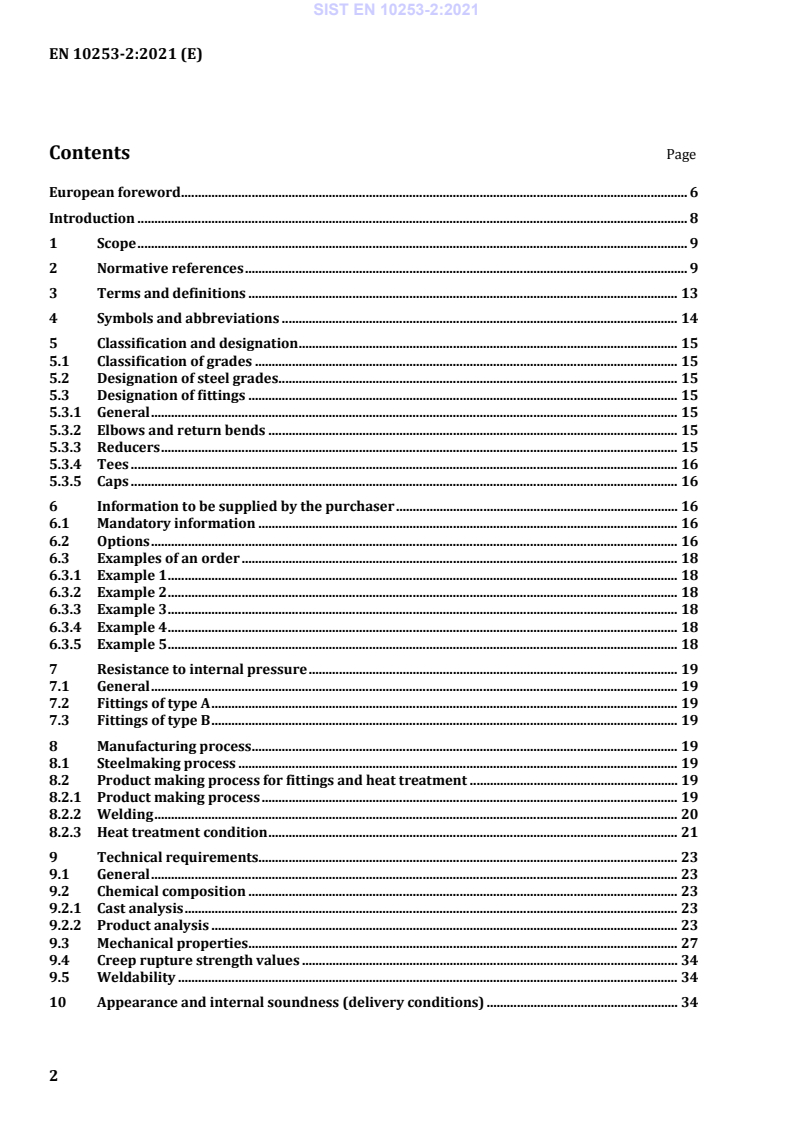
Contents Page
European foreword . 6
Introduction . 8
1 Scope . 9
2 Normative references . 9
3 Terms and definitions . 13
4 Symbols and abbreviations . 14
5 Classification and designation . 15
5.1 Classification of grades . 15
5.2 Designation of steel grades . 15
5.3 Designation of fittings . 15
5.3.1 General . 15
5.3.2 Elbows and return bends . 15
5.3.3 Reducers . 15
5.3.4 Tees . 16
5.3.5 Caps . 16
6 Information to be supplied by the purchaser . 16
6.1 Mandatory information . 16
6.2 Options . 16
6.3 Examples of an order . 18
6.3.1 Example 1 . 18
6.3.2 Example 2 . 18
6.3.3 Example 3 . 18
6.3.4 Example 4 . 18
6.3.5 Example 5 . 18
7 Resistance to internal pressure . 19
7.1 General . 19
7.2 Fittings of type A . 19
7.3 Fittings of type B . 19
8 Manufacturing process . 19
8.1 Steelmaking process . 19
8.2 Product making process for fittings and heat treatment . 19
8.2.1 Product making process . 19
8.2.2 Welding . 20
8.2.3 Heat treatment condition . 21
9 Technical requirements. 23
9.1 General . 23
9.2 Chemical composition . 23
9.2.1 Cast analysis . 23
9.2.2 Product analysis . 23
9.3 Mechanical properties . 27
9.4 Creep rupture strength values . 34
9.5 Weldability . 34
10 Appearance and internal soundness (delivery conditions) . 34
10.1 Definitions of surface imperfections . 34
10.2 Appearance . 36
10.3 Internal soundness . 36
11 Dimensions and tolerances . 36
11.1 Dimensions . 36
11.1.1 General . 36
11.1.2 Elbows . 37
11.1.3 Tees . 37
11.1.4 Reducers . 38
11.1.5 Caps . 39
11.1.6 Preferred diameters and wall thicknesses . 39
11.2 Dimensional tolerances . 41
11.2.1 Diameter . 41
11.2.2 Out of roundness . 41
11.2.3 Wall thickness tolerances . 42
11.2.4 Tolerances on specific dimensions and form . 42
11.2.5 Corrugation . 43
11.3 Performance of the end bevelling . 44
12 Inspection . 45
12.1 Type of inspection . 45
12.2 Inspection documents . 45
12.2.1 Type of inspection documents . 45
12.2.2 Content of inspection documents . 45
12.3 Summary of inspection and testing . 46
13 Sampling . 48
13.1 Frequency of tests . 48
13.1.1 Test unit . 48
13.1.2 Number of test pieces per test unit . 49
13.2 Preparation of samples and test pieces . 49
13.2.1 Samples for product analysis . 49
13.2.2 Samples and test pieces for mechanical tests. 50
13.2.3 Test piece for the tensile test on the base material. 50
13.2.4 Test piece for the tensile test transverse to the weld . 50
13.2.5 Test piece for the weld bend test . 50
13.2.6 Test piece for the impact test . 50
14 Test methods . 51
14.1 Chemical analysis . 51
14.2 Tensile test on the base material . 51
14.2.1 At room temperature . 51
14.2.2 At elevated temperature . 51
14.3 Transverse tensile test on the weld . 51
14.4 Hardness test . 51
14.5 Weld bend test . 52
14.6 Impact testing . 52
14.7 Dimensional testing . 53
14.8 Visual testing (VT) . 53
14.9 Non-destructive testing (NDT) . 53
14.9.1 Personnel . 53
14.9.2 NDT of the weld . 53
14.9.3 NDT of cold formed tees . 53
14.9.4 NDT for the detection of laminar imperfections . 54
14.9.5 NDT for the detection of longitudinal imperfections . 54
14.9.6 NDT for the detection of transverse imperfections . 54
14.9.7 NDT of bars and forgings . 54
14.10 Positive material identification (PMI) . 54
15 Marking . 55
16 Protection and packaging . 56
Annex A (normative) Dimensions . 57
A.1 General . 57
A.2 Elbows . 57
A.3 Tees . 59
A.4 Reducers . 61
A.5 Caps . 63
Annex B (normative) Determination of pressure factors and wall thickness . 65
B.1 General . 65
B.2 Symbols and units . 65
B.3 Minimal and nominal wall thickness . 68
B.4 Pressure factors of fittings of type A . 68
B.4.1 General . 68
B.4.2 Pressure factor . 68
B.4.3 Elbows . 69
B.4.4 Tees . 69
B.4.5 Reducers . 72
B.4.6 Caps . 77
B.5 Wall thicknesses of fittings of type B . 79
B.5.1 General . 79
B.5.2 Elbows . 79
B.5.3 Tees . 80
B.5.4 Reducers . 83
B.5.5 Caps . 87
Annex C (normative) Pressure factor tables for Fittings of type A . 89
C.1 General . 89
C.2 Elbows . 89
C.3 Tees . 92
C.4 Reducers . 99
C.5 Caps . 108
Annex D (informative) Wall thickness tables for fittings of type B . 109
D.1 General . 109
D.2 Elbows . 109
D.3 Tees . 112
D.4 Reducers . 121
D.5 Caps . 136
Annex E (informative) Recommended heat treatment temperatures. 137
Annex F (informative) Creep rupture strength values . 138
Annex ZA (informative) Relationship between this European Standard and the Essential
Requirements of EU Directive 2014/68/EU. 143
Bibliography . 145
European foreword
This document (EN 10253-2:2021) has been prepared by Technical Committee CEN/TC 459 “ECISS -
European Committee for Iron and Steel Standardization”, the secretariat of which is held by AFNOR.
This European Standard shall be given the status of a national standard, either by publication of an
identical text or by endorsement, at the latest by February 2022, and conflicting national standards
shall be withdrawn at the latest by February 2022.
Attention is drawn to the possibility that some of the elements of this document may be the subject of
patent rights. CEN shall not be held responsible for identifying any or all such patent rights.
This document supersedes EN 10253-2:2007.
The main changes compared to the previous edition are listed below:
a) Document technically and editorially revised;
b) Updating of Clause 2 “Normative References”;
c) Revision of chemical composition and steel grades;
d) Revision of permissible deviations of the product analysis from specified limits on cast analysis;
e) Revision of mechanical properties;
f) Revision of minimum proof strength including minimum wall thickness;
g) Revision of impact properties including minimum requirements;
h) Revision of fitting dimensions and moving to new Annex A;
i) Addition of creep rupture strength values;
j) Revision of inspection and tests;
k) Revision of pressure factors;
l) Updating of Annex ZA to follow new EU Directive 2014/68/EU for pressure equipment;
m) Updating of the Bibliography.
This document has been prepared under a mandate given to CEN by the European Commission and the
European Free Trade Association, and supports essential requirements of EU Directive 2014/68/EU.
For relationship with EU Directive, see informative Annex ZA, which is an integral part of this
document.
EN 10253 comprises a series of European Standards about Butt-welding pipe fittings, namely:
— Part 1: Wrought carbon steel for general use and without specific inspection requirements;
— Part 2: Non alloy and ferritic alloy steels with specific inspection requirements;
— Part 3: Wrought austenitic and austenitic-ferritic (duplex) stainless steels without specific inspection
requirements;
— Part 4: Wrought austenitic and austenitic-ferritic (duplex) stainless steels with specific inspection
requirements.
Any feedback and questions on this document should be directed to the users’ national standards body.
A complete listing of these bodies can be found on the CEN website.
According to the CEN-CENELEC Internal Regulations, the national standards organisations of the
following countries are bound to implement this European Standard: Austria, Belgium, Bulgaria,
Croatia, Cyprus, Czech Republic, Denmark, Estonia, Finland, France, Germany, Greece, Hungary, Iceland,
Ireland, Italy, Latvia, Lithuania, Luxembourg, Malta, Netherlands, Norway, Poland, Portugal, Republic of
North Macedonia, Romania, Serbia, Slovakia, Slovenia, Spain, Sweden, Switzerland, Turkey and the
United Kingdom.
Introduction
In writing this document the competent committee recognized that there are two broad types of
products commonly used, and decided to reflect these in the standard by differentiating between two
parts.
EN 10253-1 describes fittings without formal reference to the pressure resistance, which are not
intended to be used in applications, covered by the Pressure Equipment Directive (2014/68/EU)
categories I to IV.
EN 10253-2 defines two types of fittings: Type A fittings have the same wall thickness at the welding
ends and at the body of the fitting as a pipe having the same specified wall thickness. Their resistance to
internal pressure is, in general, less than that of a straight pipe with the same dimensions. Type B
fittings showing increased wall thickness at the body of the fitting are designed to resist the same
internal pressure as a straight pipe with same dimensions. These two types of fittings are intended to be
used in applications covered by the EU Directive 2014/68/EU. According to this Directive and further
interpretation guidelines (e.g. guideline G – 19), seamless fittings are considered as materials whereas
welded fittings are considered as components. Therefore, in some areas of this document, provisions for
seamless and welded fittings are different.
The selection of steel type and requirement level depend on many factors; the properties of the fluid to
be conveyed, the service conditions, the design code and any statutory requirements should all be taken
into consideration. Therefore this document gives no detailed guidelines for the application of different
fittings. It is the ultimate responsibility of the user to select the appropriate fitting for the intended
application.
1 Scope
This document specifies the technical delivery requirements for seamless and welded butt-welding
fittings (elbows, concentric and eccentric reducers, equal and reducing tees, caps) made of carbon and
alloy steel in two test-categories which are intended for pressure purposes at room temperature, at low
temperature or at elevated temperatures, and for the transmission and distribution of fluids and gases.
It specifies:
a) type of fittings;
type A: Butt-welding fittings with reduced pressure factor;
type B: Butt-welding fittings for use at full service pressure;
b) steel grades and their chemical compositions;
c) mechanical properties;
d) dimensions and tolerances;
e) requirements for inspection and testing;
f) inspection documents;
g) marking;
h) protection and packaging.
NOTE The selection of the appropriate fitting (material, thickness) is the ultimate responsibility of the
manufacturer of the pressure equipment (see European Legislation for Pressure Equipment). In the case of a
harmonized supporting standard for materials, presumption of conformity to the ESRs is limited to technical data
of materials in the standard and does not presume adequacy of the material to a specific item of equipment.
Consequently, it is essential that the technical data stated in the material standard be assessed against the design
requirements of this specific item of equipment to verify that the ESRs of the PED are satisfied.
2 Normative references
The following documents are referred to in the text in such a way that some or all of their content
constitutes requirements of this document. For dated references, only the edition cited applies. For
undated references, the latest edition of the referenced document (including any amendments) applies.
EN 10020:2000, Definition and classification of grades of steel
EN 10021:2006, General technical delivery conditions for steel products
EN 10027-1:2016, Designation systems for steels - Part 1: Steel names
EN 10027-2:2015, Designation systems for steels - Part 2: Numerical system
EN 10028-2:2017, Flat products made of steels for pressure purposes - Part 2: Non-alloy and alloy steels
with specified elevated temperature properties
EN 10028-3:2017, Flat products made of steels for pressure purposes - Part 3: Weldable fine grain steels,
normalized
EN 10028-4:2017, Flat products made of steels for pressure purposes - Part 4: Nickel alloy steels with
specified low temperature properties
EN 10160:1999, Ultrasonic testing of steel flat product of thickness equal or greater than 6 mm (reflection
method)
EN 10168:2004, Steel products - Inspection documents - List of information and description
EN 10204:2004, Metallic products - Types of inspection documents
EN 10217-1:2019, Welded steel tubes for pressure purposes - Technical delivery conditions - Part 1:
Electric welded and submerged arc welded non-alloy steel tubes with specified room temperature
properties
EN 10217-2:2019, Welded steel tubes for pressure purposes - Technical delivery conditions - Part 2:
Electric welded non-alloy and alloy steel tubes with specified elevated temperature properties
EN 10217-3:2019, Welded steel tubes for pressure purposes - Technical delivery conditions - Part 3:
Electric welded and submerged arc welded alloy fine grain steel tubes with specified room, elevated and
low temperature properties
EN 10217-4:2019, Welded steel tubes for pressure purposes - Technical delivery conditions - Part 4:
Electric welded non-alloy steel tubes with specified low temperature properties
EN 10217-5:2019, Welded steel tubes for pressure purposes - Technical delivery conditions - Part 5:
Submerged arc welded non-alloy and alloy steel tubes with specified elevated temperature properties
EN 10217-6:2019, Welded steel tubes for pressure purposes - Technical delivery conditions - Part 6:
Submerged arc welded non-alloy steel tubes with specified low temperature properties
EN 10220:2002, Seamless and welded steel tubes - Dimensions and masses per unit length
EN 10222-2:2017, Steel forgings for pressure purposes - Part 2: Ferritic and martensitic steels with
specified elevated temperatures properties
EN 10222-3:2017, Steel forgings for pressure purposes - Part 3: Nickel steels with specified low
temperature properties
EN 10222-4:2017, Steel forgings for pressure purposes - Part 4: Weldable fine grain steels with high proof
strength
EN 10228-3:2016, Non-destructive testing of steel forgings - Part 3: Ultrasonic testing of ferritic or
martensitic steel forgings
EN 10266:2003, Steel tubes, fittings and structural hollow sections - Symbols and definitions of terms for
use in product standards
EN 10273:2016, Hot rolled weldable steel bars for pressure purposes with specified elevated temperature
properties
EN 13480-2:2017, Metallic industrial piping - Part 2: Materials
EN 13480-3:2017, Metallic industrial piping - Part 3: Design and calculation
EN 13480-5:2017, Metallic industrial piping - Part 5: Inspection and testing
EN ISO 148-1:2016, Metallic materials - Charpy pendulum impact test - Part 1: Test method (ISO 148-
1:2016)
EN ISO 377:2017, Steel and steel products - Location and preparation of samples and test pieces for
mechanical testing (ISO 377:2017)
EN ISO 2566-1:1999, Steel - Conversion of elongation values - Part 1: Carbon and low alloy steels
(ISO 2566-1:1984)
EN ISO 3166-1:2020, Codes for the representation of names of countries and their subdivisions — Part 1:
Country code (ISO 3166-1:2020)
EN ISO 3183:2019, Petroleum and natural gas industries - Steel pipe for pipeline transportation systems
(ISO 3183:2019)
EN ISO 4136:2012, Destructive tests on welds in metallic materials - Transverse tensile test
(ISO 4136:2012)
EN ISO 4885:2018, Ferrous materials - Heat treatments - Vocabulary (ISO 4885:2018)
EN ISO 5173:2010, Destructive tests on welds in metallic materials - Bend tests (ISO 5173:2009)
EN ISO 5817:2014, Welding - Fusion-welded joints in steel, nickel, titanium and their alloys (beam welding
excluded) - Quality levels for imperfections (ISO 5817:2014)
EN ISO 6506-1:2014, Metallic materials - Brinell hardness test - Part 1: Test method (ISO 6506-1:2014)
EN ISO 6892-1:2019, Metallic materials - Tensile testing - Part 1: Method of test at room temperature
(ISO 6892-1:2019)
EN ISO 6892-2:2018, Metallic materials - Tensile testing - Part 2: Method of test at elevated temperature
(ISO 6892-2:2018)
EN ISO 9016:2012, Destructive tests on welds in metallic materials - Impact tests - Test specimen location,
notch orientation and examination (ISO 9016:2012)
EN ISO 9606-1:2017, Qualification testing of welders - Fusion welding - Part 1: Steels (ISO 9606-1:2012
including Cor 1:2012 and Cor 2:2013)
EN ISO 9712:2012, Non-destructive testing - Qualification and certification of NDT personnel
(ISO 9712:2012)
EN ISO 10893-3:2011, Non-destructive testing of steel tubes - Part 3: Automated full peripheral flux
leakage testing of seamless and welded (except submerged arc-welded) ferromagnetic steel tubes for the
detection of longitudinal and/or transverse imperfections (ISO 10893-3:2011)
As impacted by EN ISO 5173:2010/A1:2011.
As impacted by EN ISO 10893-3:2011/A1:2019 and EN ISO 10893-3:2011/A2:2020.
EN ISO 10893-4:2011, Non-destructive testing of steel tubes - Part 4: Liquid penetrant inspection of
seamless and welded steel tubes for the detection of surface imperfections (ISO 10893-4:2011)
EN ISO 10893-5:2011, Non-destructive testing of steel tubes - Part 5: Magnetic particle inspection of
seamless and welded ferromagnetic steel tubes for the detection of surface imperfections (ISO 10893-
5:2011)
EN ISO 10893-8:2011, Non-destructive testing of steel tubes - Part 8: Automated ultrasonic testing of
seamless and welded steel tubes for the detection of laminar imperfections (ISO 10893-8:2011)
EN ISO 10893-10:2011, Non-destructive testing of steel tubes - Part 10: Automated full peripheral
ultrasonic testing of seamless and welded (except submerged arc-welded) steel tubes for the detection of
longitudinal and/or transverse imperfections (ISO 10893-10:2011)
EN ISO 10893-11:2011, Non-destructive testing of steel tubes - Part 11: Automated ultrasonic testing of
the weld seam of welded steel tubes for the detection of longitudinal and/or transverse imperfections
(ISO 10893-11:2011)
EN ISO 14284:2002, Steel and iron - Sampling and preparation of samples for the determination of
chemical composition (ISO 14284:1996)
EN ISO 14732:2013, Welding personnel - Qualification testing of welding operators and weld setters for
mechanized and automatic welding of metallic materials (ISO 14732:2013)
CEN ISO/TR 15608:2017, Welding - Guidelines for a metallic materials grouping system (ISO/TR
15608:2017)
EN ISO 15614-1:2017, Specification and qualification of welding procedures for metallic materials -
Welding procedure test - Part 1: Arc and gas welding of steels and arc welding of nickel and nickel alloys
(ISO 15614-1:2017, Corrected version 2017-10-01)
EN ISO 17640:2018, Non-destructive testing of welds - Ultrasonic testing - Techniques, testing levels, and
assessment (ISO 17640:2018)
EN ISO 18265:2013, Metallic materials - Conversion of hardness values (ISO 18265:2013)
As impacted by EN ISO 10893-8:2011/A1:2020.
As impacted by EN ISO 10893-10:2011/A1:2020.
As impacted by EN ISO 10893-11:2011/A1:2020.
3 Terms and definitions
For the purposes of this document, the terms and definitions given in EN 10020:2000, EN 10021:2006,
EN ISO 377:2017 and EN ISO 4885:2018 and the following apply
ISO and IEC maintain terminological databases for use in standardization at the following addresses:
— ISO Online browsing platform: available at https://www.iso.org/obp
— IEC Electropedia: available at https://www.electropedia.org/
3.1
employer
organization for which a person works on a regular basis
Note 1 to entry: The employer may be either the fitting manufacturer or supplier or a third party organization
providing a service, e.g. NDT.
3.2
model
designation for elbows, return bends and reducers
Note 1 to entry: For elbows and return bends the model defines the bending diameter of the piece.
Note 2 to entry: For reducers the model defines concentric or eccentric shape of the piece.
3.3
purchaser
person or organization that orders products in accordance with this European Standard
Note 1 to entry: The purchaser is not necessarily, but may be, a manufacturer of pressure equipment in
accordance with the EU Directive listed in Annex ZA.
Note 2 to entry: Where a purchaser has responsibilities under this EU Directive, this standard will provide a
presumption of conformity with the essential requirements of the EU Directive so identified in Annex ZA.
3.4
weld during manufacture
weld made for obtaining a fitting
Note 1 to entry: This term does not include the tube welds when a tube is used as starting material.
3.5
seamless fitting
fitting manufactured without welding from starting material which is not welded
3.6
welded fitting
fitting made from welded starting material or fitting where welding is a part of the manufacturing
process
3.7
test category
classification that indicates their extent and level of inspection and testing
4 Symbols and abbreviations
For the purposes of this document, the symbols defined in EN 10266:2003 and the following apply:
A
S
Percentage of elongation at rupture, with reference to gauge length of 5,65
o
B Back to face distance for return bends, expressed in millimetres
C Centre to centre distance for return bends (C = 2R), expressed in millimetres
Specified outside diameter for elbows, return bends, equal tees, caps and the major outside
D
diameter for reducers and reducing tees, expressed in millimetres
D
Specified minor outside diameter for reducers and reducing tees, expressed in millimetres
D
Maximum diameter in one section, expressed in millimetres
max
D
Minimum diameter in the same section, expressed in millimetres
min
Distance from the axis of the branch outlet to the face of the centre body of tees, expressed
F
in millimetres
Distance from the axis of the centre line to the face of the branch outlet expressed in
G
millimetres
Inside diameter at the welding ends of elbows, return bends, equal tees and at the major
ID
welding end of reducers and reducing tees (ID = D − 2T)
ID Inside diameter at the minor welding end of reducers and reducing tees (ID = D − 2T )
1 1 1 1
K Total height for caps, expressed in millimetres
L Face to face distance for reducers, expressed in millimetres
P Tolerance on the form of elbows
R Bending radius of elbows and return bends, expressed in millimetres
R
Inside spherical radius of cap
R
Inside knuckle radius of cap
R
Upper yield strength or proof strength
eh
R
Tensile strength, expressed in megapascals
m
R
Minimum 0,2 % proof strength, plastic extension expressed in megapascals
p0,2
R
Minimum 0,5 % proof strength, total extension e
...