

SIST EN 16602-70-61:2022
(Main)Space product assurance - High-reliability soldering for surface mount, mixed technology and hand-mounted electrical connections
General Information
- Abstract
This standard defines:
- the basic requirements for the verification and approval of automatic machine w ave soldering for use in spacecraft hardware. The process requirements for w ave soldering of doublesided and multilayer boards are also defined.
- the technical requirements and quality assurance provisions for the manufacture and verification of manuallysoldered, high-reliability electrical connections.
- the technical requirements and quality assurance provisions for the manufacture and verification of high-reliability electronic circuits based on surface mounted device (SMD) and mixed technology.
- the acceptance and rejection criteria for high reliability manufacture of manually-soldered electrical connections intended to w ithstand normal terrestrial conditions and the vibrational g-loads and environment imposed by space flight.
- the proper tools, correct materials, design and w orkmanshipt. Workmanship standards are included to permit discrimination betw een proper and improper work.
SCOPE
This Standard defines the technical requirements and quality assurance provisions for the manufacture and verification of high-reliability electronic circuits of surface mount, through hole and solderless assemblies.
The Standard defines w orkmanship requirements, the acceptance and rejection criteria for high-reliability assemblies intended to withstand normal terrestrial conditions and the environment imposed by space flight.
The mounting and supporting of components, terminals and conductors specified in this standard applies only to assemblies designed to continuously operate over the mission w ithin the temperature limits of -55 °C to +85 °C at solder joint level.
Requirements related to printed circuit boards are contained in ECSS-Q-ST-70-60 (equivalent to EN 16602-70-60) and ECSS-Q-ST-70-12 (equivalent to EN 16602-70-12).
This Standard does not cover the qualification and acceptance of the EQM and FM equipment w ith high-reliability electronic circuits of surface mount, through hole and solderless assemblies.
This Standard does not cover verification of thermal properties for component assembly.
This Standard does not cover pressfit connectors.
The qualification and acceptance tests of equipment manufactured in accordance w ith this Standard are covered by ECSS-EST-10-03 (equivalent to EN 16603-10-03).
- Status
- Published
- Public Enquiry End Date
- 30-Nov-2021
- Publication Date
- 14-Nov-2022
- Technical Committee
- I13 - Imaginarni 13
- Current Stage
- 6060 - National Implementation/Publication (Adopted Project)
- Start Date
- 10-Nov-2022
- Due Date
- 15-Jan-2023
- Completion Date
- 15-Nov-2022



Overview
EN 16602-70-61:2022 - Space product assurance - High-reliability soldering for surface mount, mixed technology and hand-mounted electrical connections - is a CEN standard that defines technical requirements and quality assurance for manufacture and verification of high-reliability electronic assemblies used in spacecraft hardware. It covers soldering processes (including wave soldering, selective wave and reflow), surface mounted devices (SMD), mixed technology and manually‑soldered connections, plus workmanship, materials and inspection criteria needed to meet spaceflight environmental demands.
Key topics and requirements
- Scope of coverage
- Process requirements for automatic machine wave soldering of double-sided and multilayer PCBs.
- Technical and QA requirements for manual high‑reliability soldered electrical connections.
- Requirements for manufacture and verification of SMD and mixed-technology electronic circuits.
- Acceptance and rejection criteria for manually-soldered connections to withstand normal terrestrial conditions and the vibrational g-loads and environment imposed by space flight.
- Workmanship standards, proper tools, materials and design guidance to discriminate acceptable vs. unacceptable work.
- Environmental and operational limits
- Applies to assemblies designed to operate continuously within solder joint level temperature limits of -55 °C to +85 °C.
- Manufacturing controls and equipment
- Preparatory conditions: facility cleanliness, lighting, ESD protection, tooling and equipment lists (soldering irons, baking ovens, reflow and wave equipment, AOI/X‑ray inspection).
- Materials and handling
- Solder and flux selection, paste storage/handling, component moisture sensitivity, PCB substrate considerations.
- Process steps and workmanship
- Component mounting, lead forming, strain relief, solder fillet criteria, wire termination, connector solder cups, and inspection practices.
- Exclusions
- Does not cover qualification/acceptance of EQM/FM equipment, verification of thermal properties for component assembly, or pressfit connectors.
Practical applications
- Use this standard to develop manufacturing process controls, work instructions and acceptance criteria for aerospace PCBs and harness assemblies.
- Apply it when qualifying soldering processes (wave, selective, reflow) and manual soldering for flight hardware.
- Integrate its workmanship and inspection criteria into supplier quality agreements, in‑process inspections and final acceptance testing to ensure reliability under spaceflight vibration and environment.
Who should use it
- Aerospace and satellite manufacturers, electronic assemblers, QA/quality engineers, process engineers, soldering technicians, procurement and supplier quality teams working on spaceflight electronics and high‑reliability PCB assemblies.
Related standards
- ECSS‑Q‑ST‑70‑60 / EN 16602‑70‑60 (printed circuit board requirements)
- ECSS‑Q‑ST‑70‑12 / EN 16602‑70‑12
- ECSS‑EST‑10‑03 / EN 16603‑10‑03 (qualification and acceptance tests for equipment)
Keywords: EN 16602-70-61:2022, space product assurance, high-reliability soldering, surface mount, mixed technology, hand-mounted, wave soldering, SMD, workmanship standards, acceptance criteria.
Relations
- Effective Date
- 09-Nov-2022
- Effective Date
- 09-Nov-2022
- Effective Date
- 09-Nov-2022
Get Certified
Connect with accredited certification bodies for this standard

BUREAU VERITAS Certification Germany
Bureau Veritas certification in Germany.

DVS-ZERT GmbH
German welding certification society.

Element Materials Technology
Materials testing and product certification.
Sponsored listings
Frequently Asked Questions
SIST EN 16602-70-61:2022 is a standard published by the Slovenian Institute for Standardization (SIST). Its full title is "Space product assurance - High-reliability soldering for surface mount, mixed technology and hand-mounted electrical connections". This standard covers: This standard defines: - the basic requirements for the verification and approval of automatic machine w ave soldering for use in spacecraft hardware. The process requirements for w ave soldering of doublesided and multilayer boards are also defined. - the technical requirements and quality assurance provisions for the manufacture and verification of manuallysoldered, high-reliability electrical connections. - the technical requirements and quality assurance provisions for the manufacture and verification of high-reliability electronic circuits based on surface mounted device (SMD) and mixed technology. - the acceptance and rejection criteria for high reliability manufacture of manually-soldered electrical connections intended to w ithstand normal terrestrial conditions and the vibrational g-loads and environment imposed by space flight. - the proper tools, correct materials, design and w orkmanshipt. Workmanship standards are included to permit discrimination betw een proper and improper work. SCOPE This Standard defines the technical requirements and quality assurance provisions for the manufacture and verification of high-reliability electronic circuits of surface mount, through hole and solderless assemblies. The Standard defines w orkmanship requirements, the acceptance and rejection criteria for high-reliability assemblies intended to withstand normal terrestrial conditions and the environment imposed by space flight. The mounting and supporting of components, terminals and conductors specified in this standard applies only to assemblies designed to continuously operate over the mission w ithin the temperature limits of -55 °C to +85 °C at solder joint level. Requirements related to printed circuit boards are contained in ECSS-Q-ST-70-60 (equivalent to EN 16602-70-60) and ECSS-Q-ST-70-12 (equivalent to EN 16602-70-12). This Standard does not cover the qualification and acceptance of the EQM and FM equipment w ith high-reliability electronic circuits of surface mount, through hole and solderless assemblies. This Standard does not cover verification of thermal properties for component assembly. This Standard does not cover pressfit connectors. The qualification and acceptance tests of equipment manufactured in accordance w ith this Standard are covered by ECSS-EST-10-03 (equivalent to EN 16603-10-03).
This standard defines: - the basic requirements for the verification and approval of automatic machine w ave soldering for use in spacecraft hardware. The process requirements for w ave soldering of doublesided and multilayer boards are also defined. - the technical requirements and quality assurance provisions for the manufacture and verification of manuallysoldered, high-reliability electrical connections. - the technical requirements and quality assurance provisions for the manufacture and verification of high-reliability electronic circuits based on surface mounted device (SMD) and mixed technology. - the acceptance and rejection criteria for high reliability manufacture of manually-soldered electrical connections intended to w ithstand normal terrestrial conditions and the vibrational g-loads and environment imposed by space flight. - the proper tools, correct materials, design and w orkmanshipt. Workmanship standards are included to permit discrimination betw een proper and improper work. SCOPE This Standard defines the technical requirements and quality assurance provisions for the manufacture and verification of high-reliability electronic circuits of surface mount, through hole and solderless assemblies. The Standard defines w orkmanship requirements, the acceptance and rejection criteria for high-reliability assemblies intended to withstand normal terrestrial conditions and the environment imposed by space flight. The mounting and supporting of components, terminals and conductors specified in this standard applies only to assemblies designed to continuously operate over the mission w ithin the temperature limits of -55 °C to +85 °C at solder joint level. Requirements related to printed circuit boards are contained in ECSS-Q-ST-70-60 (equivalent to EN 16602-70-60) and ECSS-Q-ST-70-12 (equivalent to EN 16602-70-12). This Standard does not cover the qualification and acceptance of the EQM and FM equipment w ith high-reliability electronic circuits of surface mount, through hole and solderless assemblies. This Standard does not cover verification of thermal properties for component assembly. This Standard does not cover pressfit connectors. The qualification and acceptance tests of equipment manufactured in accordance w ith this Standard are covered by ECSS-EST-10-03 (equivalent to EN 16603-10-03).
SIST EN 16602-70-61:2022 is classified under the following ICS (International Classification for Standards) categories: 25.160.50 - Brazing and soldering; 49.140 - Space systems and operations. The ICS classification helps identify the subject area and facilitates finding related standards.
SIST EN 16602-70-61:2022 has the following relationships with other standards: It is inter standard links to SIST EN 16602-70-38:2019, SIST EN 16602-70-08:2015, SIST EN 16602-70-07:2015. Understanding these relationships helps ensure you are using the most current and applicable version of the standard.
SIST EN 16602-70-61:2022 is associated with the following European legislation: Standardization Mandates: M/496. When a standard is cited in the Official Journal of the European Union, products manufactured in conformity with it benefit from a presumption of conformity with the essential requirements of the corresponding EU directive or regulation.
SIST EN 16602-70-61:2022 is available in PDF format for immediate download after purchase. The document can be added to your cart and obtained through the secure checkout process. Digital delivery ensures instant access to the complete standard document.
Standards Content (Sample)
SLOVENSKI STANDARD
01-december-2022
Nadomešča:
SIST EN 16602-70-07:2015
SIST EN 16602-70-08:2015
SIST EN 16602-70-38:2019
Zagotavljanje varnih proizvodov v vesoljski tehniki - Visoko zanesljivo spajkanje
za površinsko namestitev, mešano tehnologijo in ročno pritrjene električne
priključke
Space product assurance - High-reliability soldering for surface mount, mixed technology
and hand-mounted electrical connections
Raumfahrtproduktsicherung - Hochzuverlässige Montage von Oberflächen-
Befestigungen und Durchgangslochverbindungen
Assurance produit des projets spatiaux - Soudure haute fiabilité pour les connexions
électriques à montage en surface, à technologie combinée et montées à la main
Ta slovenski standard je istoveten z: EN 16602-70-61:2022
ICS:
25.160.50 Trdo in mehko lotanje Brazing and soldering
49.140 Vesoljski sistemi in operacije Space systems and
operations
2003-01.Slovenski inštitut za standardizacijo. Razmnoževanje celote ali delov tega standarda ni dovoljeno.
EUROPEAN STANDARD EN 16602-70-61
NORME EUROPÉENNE
EUROPÄISCHE NORM
November 2022
ICS 25.160.50; 49.140
Supersedes EN 16602-70-07:2014, EN 16602-70-
08:2015, EN 16602-70-38:2019
English version
Space product assurance - High-reliability soldering for
surface mount, mixed technology and hand-mounted
electrical connections
Assurance produit des projets spatiaux - Soudure haute Raumfahrtproduktsicherung - Hochzuverlässige
fiabilité pour les connexions électriques à montage en Montage von Oberflächen-Befestigungen und
surface, à technologie combinée et montées à la main Durchgangslochverbindungen
This European Standard was approved by CEN on 29 August 2022.
CEN and CENELEC members are bound to comply with the CEN/CENELEC Internal Regulations which stipulate the conditions for
giving this European Standard the status of a national standard without any alteration. Up-to-date lists and bibliographical
references concerning such national standards may be obtained on application to the CEN-CENELEC Management Centre or to
any CEN and CENELEC member.
This European Standard exists in three official versions (English, French, German). A version in any other language made by
translation under the responsibility of a CEN and CENELEC member into its own language and notified to the CEN-CENELEC
Management Centre has the same status as the official versions.
CEN and CENELEC members are the national standards bodies and national electrotechnical committees of Austria, Belgium,
Bulgaria, Croatia, Cyprus, Czech Republic, Denmark, Estonia, Finland, France, Germany, Greece, Hungary, Iceland, Ireland, Italy,
Latvia, Lithuania, Luxembourg, Malta, Netherlands, Norway, Poland, Portugal, Republic of North Macedonia, Romania, Serbia,
Slovakia, Slovenia, Spain, Sweden, Switzerland, Türkiye and United Kingdom.
CEN-CENELEC Management Centre:
Rue de la Science 23, B-1040 Brussels
© 2022 CEN/CENELEC All rights of exploitation in any form and by any means Ref. No. EN 16602-70-61:2022 E
reserved worldwide for CEN national Members and for
CENELEC Members.
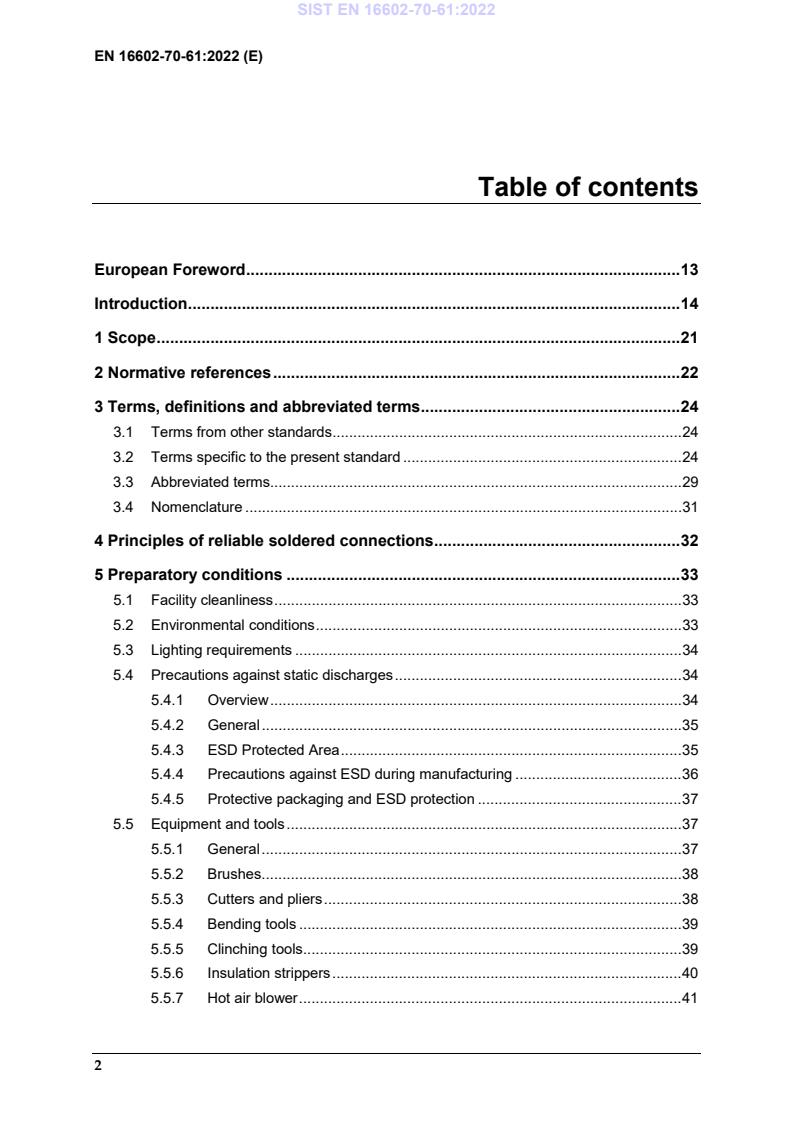
Table of contents
European Foreword . 13
Introduction . 14
1 Scope . 21
2 Normative references . 22
3 Terms, definitions and abbreviated terms . 24
3.1 Terms from other standards . 24
3.2 Terms specific to the present standard . 24
3.3 Abbreviated terms. 29
3.4 Nomenclature . 31
4 Principles of reliable soldered connections . 32
5 Preparatory conditions . 33
5.1 Facility cleanliness . 33
5.2 Environmental conditions . 33
5.3 Lighting requirements . 34
5.4 Precautions against static discharges . 34
5.4.1 Overview . 34
5.4.2 General . 35
5.4.3 ESD Protected Area . 35
5.4.4 Precautions against ESD during manufacturing . 36
5.4.5 Protective packaging and ESD protection . 37
5.5 Equipment and tools . 37
5.5.1 General . 37
5.5.2 Brushes . 38
5.5.3 Cutters and pliers . 38
5.5.4 Bending tools . 39
5.5.5 Clinching tools . 39
5.5.6 Insulation strippers . 40
5.5.7 Hot air blower . 41
5.5.8 Soldering tools . 41
5.5.9 Baking and curing ovens . 42
5.5.10 Solder deposition equipment . 43
5.5.11 Automatic component placement equipment . 43
5.5.12 Dynamic wave-solder machines . 43
5.5.13 Selective wave solder equipment . 44
5.5.14 Reflow process equipment . 45
5.5.15 Depanelization tool. 47
5.5.16 Cleanliness testing equipment . 47
5.5.17 Optical microscope . 47
5.5.18 Automatic Optical Inspection (AOI) equipment . 47
5.5.19 X-ray inspection equipment . 47
6 Material selection . 49
6.1 General . 49
6.2 Solder . 49
6.2.1 Form . 49
6.2.2 Composition . 50
6.2.3 Storage and handling of paste purity . 52
6.3 Fluxes . 52
6.3.1 Rosin based fluxes . 52
6.4 Solvents . 53
6.5 Flexible insulation materials . 54
6.6 Terminals . 54
6.6.1 Materials . 54
6.6.2 Tin, silver, and gold-plated terminals . 54
6.7 Wires . 55
6.8 Sculptured flex . 55
6.9 Printed circuits substrates . 55
6.9.1 Substrates selection . 55
6.9.2 Gold finish on PCBs footprint . 55
6.9.3 PCB design requirements for wave and selective wave soldering . 56
6.10 Components . 56
6.10.1 General . 56
6.10.2 Moisture sensitive components . 57
6.11 Adhesives, potting, underfill and conformal coatings . 57
7 Preparations prior to mounting and soldering . 58
7.1 General handling . 58
7.2 Storage . 58
7.2.1 Components. 58
7.2.2 PCBs. 58
7.2.3 Materials requiring segregation . 58
7.3 Baking conditions of PCBs . 59
7.4 Baking and storage of moisture sensitive components . 59
7.5 Preparation of components, wires, terminals, and solder cups. 60
7.5.1 Damage to insulation . 60
7.5.2 Damage to conductors and braid . 60
7.5.3 Cleaning before soldering . 61
7.5.4 Insulation clearance . 61
7.5.5 Wire lay . 61
7.6 Degolding and pretinning . 61
7.6.1 General . 61
7.6.2 Solder baths method for degolding and pretinning of components
terminations and terminals . 62
7.6.3 Solder iron method for degolding and pretinning . 64
7.6.4 Pretinning processes . 64
7.7 Preparation of the soldering tip . 65
8 Components mounting requirements prior to soldering . 67
8.1 General requirements . 67
8.2 Mounting of through hole components . 67
8.2.1 General . 67
8.2.2 Heavy components . 68
8.2.3 Metal-case components . 68
8.2.4 Glass-encased components . 68
8.2.5 Stress relief of components with bendable leads . 68
8.2.6 Stress relief of components with non-bendable leads . 71
8.2.7 Bending of component leads . 72
8.2.8 Lead attachment to PCBs . 73
8.2.9 Mounting of through hole connectors to PCBs . 76
8.2.10 Mounting of swage terminals to PCBs . 77
8.2.11 Mounting of components to terminals . 78
8.3 Mounting of surface mount components . 79
8.3.1 General . 79
8.3.2 Lead forming . 80
8.3.3 Inspection of solder paste deposition . 80
9 Attachment of conductors to terminals, solder cups and cables . 81
9.1 General . 81
9.2 Wire termination . 81
9.2.1 Breakouts from cables . 81
9.2.2 Insulation clearance . 82
9.3 Turret and straight-pin terminals . 82
9.4 Bifurcated terminals . 83
9.4.1 General . 83
9.4.2 Bottom route . 83
9.4.3 Side route . 84
9.4.4 Top route . 85
9.4.5 Combination of top and bottom routes. 86
9.4.6 Combination of side and bottom routes . 86
9.5 Hook terminals . 86
9.6 Pierced terminals . 87
9.7 Solder cups for connector . 87
9.8 Insulation sleeving . 88
9.9 Wire and cable interconnections . 89
9.9.1 General . 89
9.9.2 Preparation of wires . 89
9.9.3 Preparation of shielded wires and cables . 90
9.9.4 Pre-assembly of wires . 90
9.10 Connection of wires to PCBs . 91
9.11 Connection of coaxial cables to PCBs . 93
10 Assembly to terminals and to PCBs . 94
10.1 Overview . 94
10.2 General soldering conditions . 94
10.2.1 General . 94
10.2.2 Positioning . 95
10.2.3 Application of flux . 96
10.2.4 Flux controls for wave-soldering equipment . 97
10.2.5 Soldering temperatures . 97
10.2.6 Soldering of conductors in terminals . 99
10.3 Soldering of components, terminals, and wires into PCB through holes . 100
10.3.1 General . 100
10.3.2 Solder fillets for wires and terminations . 100
10.3.3 Solder fillets for component leads in plated or non-plated through
holes . 101
10.4 Soldering of surface mount components . 102
10.4.1 General . 102
10.4.2 Rectangular and square end-capped or end-metallized leadless chip . 104
10.4.3 Cylindrical and square end-capped components with cylindrical or
oval body . 106
10.4.4 Bottom terminated chip components . 107
10.4.5 L-Shape inwards components . 109
10.4.6 Leadless component with plane termination . 110
10.4.7 Leaded component with plane termination . 110
10.4.8 Leadless castellated ceramic chip carrier components . 112
10.4.9 No lead Quad Flat Pack . 113
10.4.10 Flat pack and gull-wing leaded components with round, rectangular,
ribbon leads . 115
10.4.11 Components with “J” leads . 116
10.4.12 Components with ribbon terminals without stress relief . 117
10.4.13 Stacked modules components with leads protruding vertically from
bottom . 119
10.4.14 Area array devices . 120
10.5 Rework and repair . 122
10.5.1 Removal of solder on unpopulated PCB . 122
10.5.2 Rework, repair and modifications . 122
10.6 High-voltage connections. 123
10.7 Solderless components . 125
11 Post soldering process requirements . 126
11.1 Cleaning of PCB assemblies . 126
11.1.1 General . 126
11.1.2 Verification of cleanliness . 127
11.1.3 Surface Insulation Resistance (SIR) testing . 127
11.1.4 Sodium chloride (NaCl) equivalent ionic contaminants testing . 128
11.1.5 Monitoring of cleanliness . 129
11.2 Staking and bonding . 129
11.3 Conformal coating, potting and underfill . 130
12 Final inspection . 132
12.1 General . 132
12.2 Visual acceptance criteria . 132
12.3 Visual rejection criteria . 133
12.4 X-ray rejection criteria . 135
12.5 Warp and twist of populated boards . 136
12.6 Inspection records . 136
13 Verification procedure. 137
13.1 Verification approval procedure . 137
13.1.1 Request for verification . 137
13.1.2 Technology sample . 137
13.1.3 Audit of assembly processing . 138
13.1.4 Verification programme documentation . 138
13.1.5 Verification samples and testing . 139
13.1.6 Final verification review . 140
13.1.7 Approval status of assembly line . 140
13.1.8 Withdrawal of approval status . 141
13.2 Verification programme . 141
13.2.1 General . 141
13.2.2 Verification for PTH manual soldering . 147
13.2.3 Additional verification for wave soldering . 147
13.2.4 Soldering log . 147
13.3 Special verification testing for ceramic area array components . 149
13.3.1 General . 149
13.3.2 Evaluation of AAD capability samples . 151
13.3.3 Electrical verification of AAD assembly . 151
13.4 Assembly verification with electrical testing procedure . 152
13.5 Verification programme with reduced temperature range . 155
13.6 Verification for solderless process . 156
13.7 Conditions for delta verification . 158
13.8 Verification by similarity . 160
13.8.1 General conditions for similarity . 160
13.8.2 Conditions for similarity for PTH components . 160
13.8.3 Conditions for similarity for SMD . 161
13.8.4 Conditions for similarity for solderless components . 164
14 Environmental tests conditions . 165
14.1 Overview . 165
14.2 Visual inspection . 165
14.3 X-ray inspection . 165
14.4 Cleanliness test . 165
14.5 Warp and twist of PCB . 165
14.6 Electrical continuity measurement . 166
14.7 Electrical continuity for wave soldered multilayers PCB . 166
14.8 Vibration . 167
14.9 Mechanical shock . 169
14.10 Damp heat test . 171
14.11 Temperature cycling test. 171
14.12 Temperature cycling test with reduced temperature range . 172
14.13 Life test . 174
14.14 Final visual inspection . 174
14.15 Microsection . 175
14.15.1 Microsection facilities . 175
14.15.2 Microsections location . 175
14.15.3 Microsection acceptance criteria . 176
14.15.4 Microsection acceptance criteria for ceramic chip capacitors . 189
14.16 Anomalies in PCB and sculptured flex during verification. 196
15 Outsourcing . 197
15.1 General . 197
16 Process identification document (PID) . 199
16.1 Overview . 199
16.2 Document preparation . 199
16.3 Approval . 199
16.4 Contact person . 199
16.5 Process identification document update . 199
17 Quality assurance . 200
17.1 General . 200
17.2 Data . 200
17.3 Nonconformance . 200
17.4 Calibration . 200
17.5 Traceability . 201
17.6 Workmanship standards . 201
17.7 Inspection points . 201
17.8 Operators, inspectors and instructors training and certification . 201
Annex A (normative) Verification programme - DRD . 203
A.1 DRD identification . 203
A.2 Expected response . 203
Annex B (normative) Verification report - DRD . 205
B.1 DRD identification . 205
B.2 Expected response . 205
Annex C (normative) Process Identification Documentation (PID) - DRD . 207
C.1 DRD identification . 207
C.2 Expected response . 207
Annex D (normative) Assembly Summary Table - DRD . 210
D.1 DRD identification . 210
D.2 Expected response . 210
Annex E (normative) Visual workmanship standards for through hole
component . 212
E.1 Soldered stud terminals . 212
E.2 Soldered turret terminals. 213
E.3 Soldered bifurcated terminals . 215
E.4 Soldered hook terminals . 216
E.5 Soldered cup terminals . 217
E.6 Miscellaneous examples of soldered wires . 218
E.7 Soldered wire to shielded cable interconnections . 219
E.8 Assembly of Dual in Line Package . 221
Annex F (informative) Visual and X-ray workmanship standards for SMDs . 222
F.1 Workmanship illustrations for standard SMDs . 222
F.2 X Ray Workmanship illustrations for solder flow and voids . 238
F.3 X Ray Workmanship illustrations for ball grid array devices . 239
F.4 Workmanship illustrations for column grid array devices . 240
Annex G (informative) Example of an SMT audit report. 242
Annex H (informative) Solder Alloys melting temperatures and choice. 251
H.1 Melting temperatures and choice . 251
Bibliography . 252
Figures
Figure 5-1: Profile of correct cutters for trimming leads. 39
Figure 5-2: Example of suitable mechanical strippers . 40
Figure 8-1: Assembly of TO-39 and CKR06 . 70
Figure 8-2: TO package with underfill . 70
Figure 8-3: Methods for incorporating stress relief with components having bendable
leads . 71
Figure 8-4: Methods for attaching wire extensions to non-bendable leads . 72
Figure 8-5: Minimum lead bend . 73
Figure 8-6: Stud leads . 74
Figure 8-7: Wires used to connect opposite sides of a PCB . 75
Figure 8-8: Clinching with stress relief for component in non-plated hole . 76
Figure 8-9: Types of terminal swaging . 78
Figure 8-10: Method of stress relieving components attached to terminals . 78
Figure 8-11: Exposed element . 79
Figure 9-1: Side route connections to turret terminals . 83
Figure 9-2: Bottom route connections to bifurcated terminal . 84
Figure 9-3: Side-route connection to bifurcated terminal . 85
Figure 9-4: Top route connection to bifurcated terminal . 85
Figure 9-5: Connections to hook terminals . 86
Figure 9-6: Connections to pierced terminals . 87
Figure 9-7: Connections to solder cups (connector type) . 88
Figure 9-8: Methods for securing wires . 91
Figure 9-9: Connection of solid or stranded wires to PCBs . 92
Figure 9-10: Connection of coaxial cables to PCBs . 93
Figure 10-1: Maximum tilt for assembled PTH component . 96
Figure 10-2: Maximum tilt for assembled SMD component . 96
Figure 10-3: Minimum acceptable wetting on component side. 102
Figure 10-4: Mounting of rectangular and square end-capped and end-metallized
components . 104
Figure 10-5: Mounting of cylindrical end-capped components . 106
Figure 10-6: Mounting of square end-capped components . 107
Figure 10-7: Mounting of bottom terminated chip component . 108
Figure 10-8: Mounting of components with “L-shape inwards” leads . 109
Figure 10-9: Mounting of leadless component with plane termination . 110
Figure 10-10: Mounting of leaded components with plane termination . 111
Figure 10-11: Mounting of leadless castellated ceramic chip carrier components . 112
Figure 10-12 Mounting of QFN . 114
Figure 10-13: Mounting of gull-wing leaded components with round, rectangular, ribbon
leads . 115
Figure 10-14: Mounting of component with “J” leads . 116
Figure 10-15: Mounting of components without stress relief . 117
Figure 10-16: Mounting of stacked module components with leads protruding vertically
from bottom . 119
Figure 10-17: Typical configuration of ceramic grid array component . 120
Figure 10-18: High voltage connection . 124
Figure 10-19: Solderless assembly configuration . 125
Figure 13-1 : Generic soldering verification flow . 146
Figure 13-2: Example of soldering log for joints discrepancy log . 148
Figure 13-3: Area Array component verification programme flow chart . 150
Figure 13-4: Assembly verification with electrical testing procedure . 154
Figure 13-5: Verification procedure for solderless technology. 157
Figure 14-1:Vibration test flow chart . 167
Figure D-1 : Example of component type preparation and mounting configuration . 211
Figure E-1 : Soldered stud terminals . 212
Figure E-2 : Soldered turret terminals with single conductors . 213
Figure E-3 : Soldered turret terminals with twin conductors . 214
Figure E-4 : Soldered bifurcated terminals. 215
Figure E-5 : Soldered hook terminals . 216
Figure E-6 : Soldered cup terminals . 217
Figure E-7 : Examples of unacceptable soldered wires . 218
Figure E-8 : Hand soldered wire to shielded cable interconnections . 219
Figure E-9 : Hand soldered wire to shielded wire interconnections . 220
Figure E-10 : Hand soldered wire interconnections - details of defects . 221
Figure F-1 : Examples of acceptable and not acceptable solder flow through and
maximum voids during X-ray . 238
Figure F-2 : Angled-transmission X-radiograph showing solder paste shadow due to
partial reflow: Reject . 239
Figure F-3 : Perpendicular transmission X-radiograph showing unacceptable defects . 239
Figure F-4 : Perpendicular transmission X-radiograph showing non-wetted footprint . 240
Figure F-5 : X-radiograph of CGA mounted on PCB showing solder bridge: Reject . 240
Figure F-6 : X-radiograph of CGA showing solder fillets at base of columns: acceptable . 241
Tables
Table 5-1: Particle concentrations classes 8 till 9 according to ISO 14644-1 (2015) . 34
Table 5-2: EPA requirements summary . 36
Table 6-1: Chemical composition of spacecraft solders . 51
Table 6-2: Fluxes . 53
Table 7-1: Clearances for insulation . 61
Table 7-2: Solder baths parameters for degolding and pretinning . 63
Table 8-1: Dimensions and tolerances for clinching component in non-plated hole . 76
Table 9-1: Dimensions for connections of solid or stranded wires to PCBs. 92
Table 9-2: Dimensions for connections of coaxial cables to PCBs . 93
Table 10-1: Dimensional and solder fillet for rectangul
...