

SIST EN 15427-2-1:2022
(Main)Railway applications - Wheel/Rail friction management - Part 2-1: Properties and Characteristics - Flange lubricants
General Information
- Abstract
This document specifies the properties and characteristics of lubricants applied to the interface between the wheel flange and the gauge face of the rail, and contact area between the check rail face and the back of the wheel (active interface), either directly or indirectly to the wheel flange or to the rail, and includes both trainborne and trackside solutions.
It outlines the information required for most approval procedures, the method of testing and routine control/monitoring of the lubricant.
- Status
- Published
- Public Enquiry End Date
- 23-Dec-2020
- Publication Date
- 25-May-2022
- Technical Committee
- IŽNP - Reilway applications
- Current Stage
- 6060 - National Implementation/Publication (Adopted Project)
- Start Date
- 26-May-2022
- Due Date
- 31-Jul-2022
- Completion Date
- 26-May-2022

Overview
EN 15427-2-1:2022 - Railway applications - Wheel/Rail friction management - Part 2-1: Properties and Characteristics - Flange lubricants - is a CEN European Standard published in 2022. It defines the required properties, characteristics and testing for lubricants applied at the active interface between the wheel flange and rail gauge face (including check rail/ wheel back contact). The scope covers both trainborne and trackside flange lubrication solutions and provides the technical information typically needed for product approval, routine control and monitoring.
Key topics and technical requirements
- Scope and definitions: clear terms for lubricant types (oil, grease, stick), active interface, trainborne and trackside equipment, batch and operating temperature.
- Design requirements: lubricants shall deliver measurable benefits such as reduced wear, reduced noise/vibration, and must not compromise railway safety (braking, signalling).
- Product specification & approval: information required for approvals including purpose, type-test conformity, environmental/fire/toxicity conformity, compatible application equipment, operating temperature and additional validation tests.
- Control and monitoring: manufacturing process control, lubricant composition reporting, routine tests and additional measures for quality assurance.
- Technical datasheet requirements: separate guidance for grease-based, oil-based and solid-based (stick) lubricants.
- Packaging, labelling & storage: requirements for safe and traceable handling.
- Testing annexes: normative and informative annexes describe test methods and performance checks - examples include water wash-off, corrosion, adhesion/behaviour at elevated temperature, volatile constituent measurement, peak forming/droop behaviour, functional equipment tests, stick testing and Mini Traction Machine creep tests.
Practical applications
- Reduce flange and rail wear and lower noise/vibration on curves and complex trackwork.
- Mitigate risk of flange climb derailment by managing wheel/rail friction at the flange/check-rail interface.
- Provide documented, tested lubricant products for network approvals and procurement.
- Support compatibility assessments with lubrication equipment and other on-rail materials (solid vs fluid).
Who should use this standard
- Railway infrastructure managers and operators specifying approved flange lubricants.
- Rolling stock and braking system engineers assessing safety impact.
- Lubricant manufacturers and suppliers preparing product specifications and approval dossiers.
- Testing and certification laboratories performing conformity and routine tests.
- Procurement teams and maintenance planners ensuring compliant storage, labelling and application.
Related standards
- EN 15427-1-1 (Equipment and Application – Flange lubrication)
- CEN/TS 15427-1-2, 1-3 and 2-2, 2-3 (other parts of the Wheel/Rail friction management series)
- Supersedes EN 16028:2012
Keywords: EN 15427-2-1:2022, flange lubricants, wheel/rail friction management, railway lubrication, trainborne, trackside, lubricant testing, product approval.
Relations
- Effective Date
- 25-May-2022
- Effective Date
- 25-Aug-2026
- Effective Date
- 25-Aug-2026
- Refers
SIST ISO 2176:1996 - Petroleum products -- Lubricating grease -- Determination of dropping point - Effective Date
- 25-Aug-2026
- Effective Date
- 25-Aug-2026
- Effective Date
- 25-Aug-2026
- Effective Date
- 28-Jan-2026
- Effective Date
- 28-Jan-2026
- Effective Date
- 28-Jan-2026
- Effective Date
- 28-Jan-2026
- Effective Date
- 28-Jan-2026
- Effective Date
- 28-Jan-2026
- Effective Date
- 28-Jan-2026
- Effective Date
- 28-Jan-2026
- Effective Date
- 28-Jan-2026
Get Certified
Connect with accredited certification bodies for this standard

Element Materials Technology
Materials testing and product certification.

IRIS Certification (UNIFE)
International Railway Industry Standard certification.

TÜV SÜD Rail GmbH
TÜV SÜD railway certification services.
Sponsored listings
Frequently Asked Questions
SIST EN 15427-2-1:2022 is a standard published by the Slovenian Institute for Standardization (SIST). Its full title is "Railway applications - Wheel/Rail friction management - Part 2-1: Properties and Characteristics - Flange lubricants". This standard covers: This document specifies the properties and characteristics of lubricants applied to the interface between the wheel flange and the gauge face of the rail, and contact area between the check rail face and the back of the wheel (active interface), either directly or indirectly to the wheel flange or to the rail, and includes both trainborne and trackside solutions. It outlines the information required for most approval procedures, the method of testing and routine control/monitoring of the lubricant.
This document specifies the properties and characteristics of lubricants applied to the interface between the wheel flange and the gauge face of the rail, and contact area between the check rail face and the back of the wheel (active interface), either directly or indirectly to the wheel flange or to the rail, and includes both trainborne and trackside solutions. It outlines the information required for most approval procedures, the method of testing and routine control/monitoring of the lubricant.
SIST EN 15427-2-1:2022 is classified under the following ICS (International Classification for Standards) categories: 21.260 - Lubrication systems; 45.040 - Materials and components for railway engineering; 75.100 - Lubricants, industrial oils and related products. The ICS classification helps identify the subject area and facilitates finding related standards.
SIST EN 15427-2-1:2022 has the following relationships with other standards: It is inter standard links to SIST EN 16028:2012, SIST ISO 760:1995, SIST ISO 2137:2021, SIST ISO 2176:1996, SIST ISO 3733:2014, SIST ISO 6743-99:2003, SIST EN ISO 3382-2:2008/AC:2009, SIST EN ISO 10140-3:2010/A1:2015, SIST EN ISO 12185:2024, SIST EN ISO 3146:2022, SIST EN ISO 7827:2013, SIST EN ISO 10707:1998, SIST EN ISO 1183-1:2025, SIST EN 10130:2007, SIST EN ISO 3675:1999. Understanding these relationships helps ensure you are using the most current and applicable version of the standard.
SIST EN 15427-2-1:2022 is associated with the following European legislation: EU Directives/Regulations: 2008/57/EC, 2016/797/EU; Standardization Mandates: M/483. When a standard is cited in the Official Journal of the European Union, products manufactured in conformity with it benefit from a presumption of conformity with the essential requirements of the corresponding EU directive or regulation.
SIST EN 15427-2-1:2022 is available in PDF format for immediate download after purchase. The document can be added to your cart and obtained through the secure checkout process. Digital delivery ensures instant access to the complete standard document.
Standards Content (Sample)
SLOVENSKI STANDARD
01-julij-2022
Nadomešča:
SIST EN 16028:2012
Železniške naprave - Trenje na stiku kolo-tirnica - 2-1. del: Lastnosti in značilnosti
- Maziva za prirobnice
Railway applications - Wheel/Rail friction management - Part 2-1: Properties and
Characteristics - Flange lubricants
Bahnanwendungen - Reibungsmanagement zwischen Rad und Schiene - Teil 2-1 :
Eigenschaften und Merkmale - Spurkranzschmierstoffe
Applications ferroviaires - Gestion des frottements roue/rail - Partie 2-1: Propriétés et
caractéristiques - Lubrification des boudins de roues
Ta slovenski standard je istoveten z: EN 15427-2-1:2022
ICS:
21.260 Mazalni sistemi Lubrication systems
45.040 Materiali in deli za železniško Materials and components
tehniko for railway engineering
2003-01.Slovenski inštitut za standardizacijo. Razmnoževanje celote ali delov tega standarda ni dovoljeno.
EN 15427-2-1
EUROPEAN STANDARD
NORME EUROPÉENNE
May 2022
EUROPÄISCHE NORM
ICS 45.040; 75.100 Supersedes EN 16028:2012
English Version
Railway applications - Wheel/Rail friction management -
Part 2-1: Properties and Characteristics - Flange lubricants
Applications ferroviaires - Gestion des frottements Bahnanwendungen - Reibungsmanagement zwischen
roue/rail - Partie 2-1: Propriétés et caractéristiques - Rad und Schiene - Teil 2 1: Eigenschaften und
Lubrification des boudins de roues Merkmale - Spurkranzschmierstoffe
This European Standard was approved by CEN on 17 January 2022.
CEN members are bound to comply with the CEN/CENELEC Internal Regulations which stipulate the conditions for giving this
European Standard the status of a national standard without any alteration. Up-to-date lists and bibliographical references
concerning such national standards may be obtained on application to the CEN-CENELEC Management Centre or to any CEN
member.
This European Standard exists in three official versions (English, French, German). A version in any other language made by
translation under the responsibility of a CEN member into its own language and notified to the CEN-CENELEC Management
Centre has the same status as the official versions.
CEN members are the national standards bodies of Austria, Belgium, Bulgaria, Croatia, Cyprus, Czech Republic, Denmark, Estonia,
Finland, France, Germany, Greece, Hungary, Iceland, Ireland, Italy, Latvia, Lithuania, Luxembourg, Malta, Netherlands, Norway,
Poland, Portugal, Republic of North Macedonia, Romania, Serbia, Slovakia, Slovenia, Spain, Sweden, Switzerland, Turkey and
United Kingdom.
EUROPEAN COMMITTEE FOR STANDARDIZATION
COMITÉ EUROPÉEN DE NORMALISATION
EUROPÄISCHES KOMITEE FÜR NORMUNG
CEN-CENELEC Management Centre: Rue de la Science 23, B-1040 Brussels
© 2022 CEN All rights of exploitation in any form and by any means reserved Ref. No. EN 15427-2-1:2022 E
worldwide for CEN national Members.
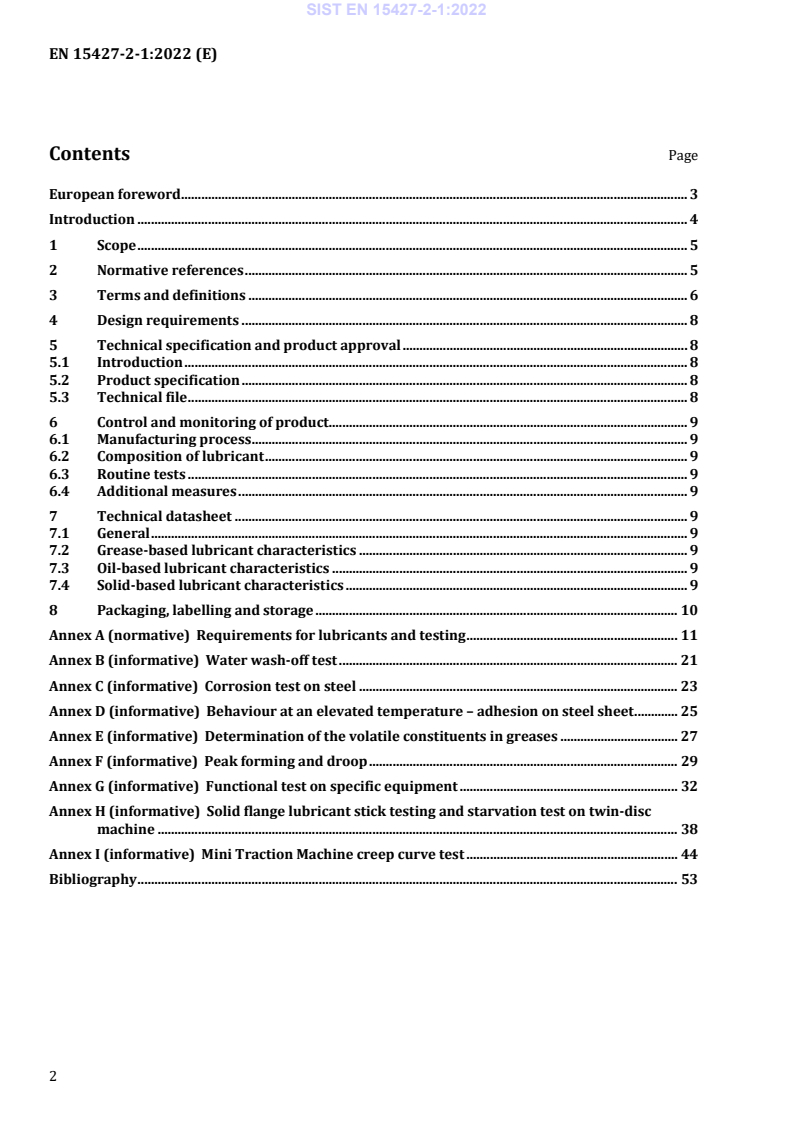
Contents Page
European foreword . 3
Introduction . 4
1 Scope . 5
2 Normative references . 5
3 Terms and definitions . 6
4 Design requirements . 8
5 Technical specification and product approval . 8
5.1 Introduction . 8
5.2 Product specification . 8
5.3 Technical file . 8
6 Control and monitoring of product. 9
6.1 Manufacturing process . 9
6.2 Composition of lubricant . 9
6.3 Routine tests . 9
6.4 Additional measures . 9
7 Technical datasheet . 9
7.1 General . 9
7.2 Grease-based lubricant characteristics . 9
7.3 Oil-based lubricant characteristics . 9
7.4 Solid-based lubricant characteristics . 9
8 Packaging, labelling and storage . 10
Annex A (normative) Requirements for lubricants and testing . 11
Annex B (informative) Water wash-off test . 21
Annex C (informative) Corrosion test on steel . 23
Annex D (informative) Behaviour at an elevated temperature – adhesion on steel sheet . 25
Annex E (informative) Determination of the volatile constituents in greases . 27
Annex F (informative) Peak forming and droop . 29
Annex G (informative) Functional test on specific equipment . 32
Annex H (informative) Solid flange lubricant stick testing and starvation test on twin-disc
machine . 38
Annex I (informative) Mini Traction Machine creep curve test . 44
Bibliography . 53
European foreword
This document (EN 15427-2-1:2022) has been prepared by Technical Committee CEN/TC 256 “Railway
Applciations”, the secretariat of which is held by DIN.
This European Standard shall be given the status of a national standard, either by publication of an
identical text or by endorsement, at the latest by November 2022, and conflicting national standards shall
be withdrawn at the latest by November 2022.
Attention is drawn to the possibility that some of the elements of this document may be the subject of
patent rights. CEN shall not be held responsible for identifying any or all such patent rights.
This document supersedes EN 16028:2012.
This document is part of the following series:
— EN 15427-1-1, Railway applications - Wheel/Rail friction management - Part 1-1: Equipment and
Application – Flange lubrication
— CEN/TS 15427-1-2, Railway applications - Wheel/Rail friction management - Part 1-2: Equipment and
Application – Top of Rail materials
— CEN/TS 15427-1-3, Railway applications - Wheel/Rail friction management - Part 1-3: Equipment and
Application – Adhesion materials
— EN 15427-2-1, Railway applications - Wheel/Rail friction management - Part 2-1: Properties and
Characteristics – Flange lubricants
— CEN/TS 15427-2-2, Railway applications - Wheel/Rail friction management - Part 2-2: Properties and
Characteristics – Top of Rail materials
— CEN/TS 15427-2-3, Railway applications - Wheel/Rail friction management - Part 2-3: Properties and
Characteristics – Adhesion materials
Any feedback and questions on this document should be directed to the users’ national standards body.
A complete listing of these bodies can be found on the CEN website.
According to the CEN-CENELEC Internal Regulations, the national standards organisations of the
following countries are bound to implement this European Standard: Austria, Belgium, Bulgaria, Croatia,
Cyprus, Czech Republic, Denmark, Estonia, Finland, France, Germany, Greece, Hungary, Iceland, Ireland,
Italy, Latvia, Lithuania, Luxembourg, Malta, Netherlands, Norway, Poland, Portugal, Republic of North
Macedonia, Romania, Serbia, Slovakia, Slovenia, Spain, Sweden, Switzerland, Turkey and the United
Kingdom.
Introduction
Friction management using solid or fluid (oil, grease, etc.) substances at the wheel-rail interface is a
complex subject and includes the following aspects:
— lubrication of the wheel flange / rail gauge corner interface, commonly referred to as “flange or rail
lubrication”;
— lubrication of the back of flange/ check rail interface; commonly referred to as “check rail
lubrication”;
— altering the level of friction at the interface between the top of rail and the wheel tread, commonly
referred to as “top of rail friction management”;
— altering the level of adhesion at the interface between the top of rail and the wheel tread.
This document sets out requirements for the lubricant for flange or rail lubrication. It specifies
requirements for the lubricant, how to test it and how to approve it.
Lubricants should be tested to confirm there is:
— compatibility with lubricating systems;
— no intolerable increased risk of fire;
— accordance with relevant environmental requirements;
— no incompatibility between the different lubricants in use, particularly between solid and fluid
systems;
— satisfactory and consistent product quality and performance;
— no degradation to the safety of the railway (braking, signalling).
The main purpose of the lubricant is to reduce friction and wear and reduce the risk of flange climb
derailment.
1 Scope
This document specifies the properties and characteristics of lubricants applied to the interface between
the wheel flange and the gauge face of the rail, and contact area between the check rail face and the back
of the wheel (active interface), either directly or indirectly to the wheel flange or to the rail, and includes
both trainborne and trackside solutions.
It outlines the information required for most approval procedures, the method of testing and routine
control/monitoring of the lubricant.
2 Normative references
The following documents are referred to in the text in such a way that some or all of their content
constitutes requirements of this document. For dated references, only the edition cited applies. For
undated references, the latest edition of the referenced document (including any amendments) applies.
EN 10130, Cold rolled low carbon steel flat products for cold forming - Technical delivery conditions
EN ISO 868, Plastics and ebonite - Determination of indentation hardness by means of a durometer (Shore
hardness) (ISO 868)
EN ISO 1183-1, Plastics - Methods for determining the density of non-cellular plastics - Part 1: Immersion
method, liquid pycnometer method and titration method (ISO 1183-1)
EN ISO 2592, Petroleum and related products - Determination of flash and fire points - Cleveland open cup
method (ISO 2592)
EN ISO 3146, Plastics - Determination of melting behaviour (melting temperature or melting range) of semi-
crystalline polymers by capillary tube and polarizing-microscope methods (ISO 3146)
EN ISO 3675, Crude petroleum and liquid petroleum products - Laboratory determination of density -
Hydrometer method (ISO 3675)
EN ISO 7827, Water quality - Evaluation of the “ready”, “ultimate” aerobic biodegradability of organic
compounds in an aqueous medium - Method by analysis of dissolved organic carbon (DOC) (ISO 7827)
EN ISO 9408, Water quality - Evaluation of ultimate aerobic biodegradability of organic compounds in
aqueous medium by determination of oxygen demand in a closed respirometer (ISO 9408)
EN ISO 9439, Water quality - Evaluation of ultimate aerobic biodegradability of organic compounds in
aqueous medium - Carbon dioxide evolution test (ISO 9439)
EN ISO 10707, Water quality - Evaluation in an aqueous medium of the “ultimate” aerobic biodegradability
of organic compounds - Method by analysis of biochemical oxygen demand (closed bottle test) (ISO 10707)
EN ISO 12185, Crude petroleum and petroleum products - Determination of density - Oscillating U-tube
method (ISO 12185)
EN ISO 20623, Petroleum and related products - Determination of the extreme-pressure and anti-wear
properties of lubricants - Four-ball method (European conditions) (ISO 20623)
ISO 760, Determination of water — Karl Fischer method (General method)
ISO 2137, Petroleum products and lubricants — Determination of cone penetration of lubricating greases
and petrolatum
ISO 2176, Petroleum products — Lubricating grease — Determination of dropping point
ISO 3733, Petroleum products and bituminous materials — Determination of water — Distillation method
ISO 22285, Petroleum products and lubricants — Determination of oil separation from grease — Pressure
filtration method
ISO 6072, Rubber — Compatibility between hydraulic fluids and standard elastomeric materials
ISO 6743-99, Lubricants, industrial oils and related products (class L) — Classification — Part 99: General
ISO 13737, Petroleum products and lubricants — Determination of low-temperature cone penetration of
lubricating greases
DIN 51631, Mineral spirits — Special boiling point spirits — Requirements
DIN 51807-1, Testing of lubricants — Test of the behaviour of lubricating greases in the presence of water
— Part 1: Static test
3 Terms and definitions
For the purposes of this document, the following terms and definitions apply.
ISO and IEC maintain terminological databases for use in standardization at the following addresses:
— ISO Online browsing platform: available at https://www.iso.org/obp
— IEC Electropedia: available at https://www.electropedia.org/
3.1
lubricant
substance designed to alter friction at the active interface
3.2
oil
liquid lubricant
Note 1 to entry: Oil can be mineral, natural or synthetic in origin and can have additives included.
3.3
grease
semi-solid lubricant
Note 1 to entry: Grease consists of a thickener and additives integrated in a lubricating oil.
3.4
stick
encapsulated solid lubricant
Note 1 to entry: Typically, the stick comprises a solid lubricant which is encapsulated in a polymeric binder/carrier.
The product is designed for direct contact with a rotating wheel flange; the polymeric binder has a sufficiently high
melting point such that it does not melt, but rather wears when in contact with the wheel flange to ensure
dimensional stability.
3.5
batch
entire content of a single identified production of lubricant from the same manufacturing process
3.6
active interface
contact area between wheel flange and the gauge face of the rail and contact area between the check rail
face and the back of the wheel
Note 1 to entry: For more information on this definition, see EN 15427-1-1.
3.7
flange lubrication
lubrication of the active interface by applying a lubricant to the wheel flange
3.8
rail lubrication
lubrication of the active interface by applying a lubricant to the rail gauge side face
3.9
trainborne equipment
system carried on the train that consists of one or more applicators, a storage unit and a means of control
3.10
trackside equipment
system installed on or adjacent to the track that consists of one or more applicators, storage containers
and a means of control
3.11
operating temperature
temperature range in which the lubricant can be applied effectively
3.12
creep
slip
measure of the relative displacement or motion of the wheel against the rail, usually caused by imperfect
steering of a bogie in a curve
Note 1 to entry: Creep is usually expressed as a percentage of the rolling displacement.
Note 2 to entry: Creep can be longitudinal, lateral or in a spin direction relative to the rail.
3.13
product specification
document prepared by the customer that describes the conditions and requirements for the adhesion
material to meet and the tests to validate it
4 Design requirements
The lubricant shall be designed to meet at least one of the following:
— reduction in noise and vibration;
— reduction in the rate of wear;
When applied within the specified limits, the lubricant shall not compromise the safety of the railway (i.e
braking distances, signalling systems, etc.).
NOTE Specified limits are normally understood and agreed between relevant parties before use of lubricant.
5 Technical specification and product approval
5.1 Introduction
This clause outlines the information required to gain product approval on most railway networks. It does
not cover its performance on the railway.
5.2 Product specification
The product specification shall be fully documented and shall consider the following information:
a) purpose of the lubricant;
b) conformity to the applicable type tests as set out in Tables A.1 to A.3;
c) conformance with other relevant local requirements, (such as environmental, fire, toxicity, etc.);
d) application data:
1) including equipment with which it can be used, (see Annex G - I);
2) operating temperatures;
e) additional validation tests, (see Table A.4);
f) any previous relevant experience, (i.e. use in other countries);
g) conditions for packaging and labelling, (see Clause 8);
h) environmental tests, as defined in Tables A.1 to A.3.
NOTE Where legislation and regulations (European, national or local) concerning ecological and
environmental compatibility of lubricants (biodegrability, toxicity, etc.) are applicable, consideration will need to
be given to the relevant requirements.
5.3 Technical file
A file of technical data showing compliance with the requirements in the product specification, and the
results of type tests and trials shall be provided. A technical datasheet shall also be provided (see
Clause 7).
A material safety data sheet for the product in the language of the interested customer or country shall
be included.
6 Control and monitoring of product
6.1 Manufacturing process
If the manufacturing process is changed in a way that can affect the properties or characteristics of the
lubricant, the new process shall be documented and the customer shall be notified.
NOTE In some cases, this leads to a new approval being required.
6.2 Composition of lubricant
If the composition of the lubricant is changed in any way that affects its properties or characteristics, it
shall be documented and the customer shall be notified.
NOTE In some cases, this leads to a new approval being required.
6.3 Routine tests
Routine tests ensure product consistency from batch to batch.
The routine tests are listed in Tables A1 to A3. If additional tests are required, (such as those not included
in the tables or a type test), these and their frequency should be agreed between the client and supplier.
The sample of lubricant assessed for quality testing shall have been manufactured in a regular production
batch. The entire sample of material used for the routine tests shall be taken from the same production
batch and delivered in a single consignment.
The results of the routine tests shall be recorded.
6.4 Additional measures
Retention of test records and samples, witnessing of tests, calibration of test equipment shall be
considered.
7 Technical datasheet
7.1 General
The technical datasheet shall include the individual identifying code or name of the lubricant, a
description of the product’s field of use and typical means of application. For each lubricant type, the
information in the following subclauses shall also be included.
7.2 Grease-based lubricant characteristics
The product shall be described by its consistency, its temperature range, the type of thickener and type
of base oil used. Where solid particulates are used, the type and content shall be reported. Further
technical data shall be provided as listed under the ‘Datasheet’ column in Table A.1.
7.3 Oil-based lubricant characteristics
The product shall be described by its viscosity, its temperature range and by the type of oil used. Where
solid particulates are used the type and content shall be reported. Further technical data shall be provided
as listed under the ‘Datasheet’ column in Table A.2.
7.4 Solid-based lubricant characteristics
The product shall be described by its melting point, hardness, dimensions and its temperature range.
Further technical data shall be provided as listed under the ‘Datasheet’ column in Table A.3.
The product shall be designed to minimize stick debris on the ballast.
8 Packaging, labelling and storage
The packaging shall protect the contents from contamination and damage.
The labelling shall include at least the following:
— supplier’s name;
— brand name and/or code of the lubricant;
— batch number and date of manufacture, uncoded or coded;
— net mass/quantity/volume.
NOTE Local regulatory requirements will apply.
The following additional information shall be included, if specified in the product specification:
— customer stock number;
— an indication that the batch has been accepted by the customer.
The storage conditions and, if necessary, the date limit of use of the lubricant shall be provided.
Annex A
(normative)
Requirements for lubricants and testing
A.1 Explanation of Tables A.1 to A.4
The tables have two purposes:
1) Tests to show the product can be used in the railway environment;
2) Product consistency.
For each required property of the lubricants, Tables A.1, A.2 and A.3 list the mandatory and optional tests
for grease, oil and sticks respectively, and the parameters for trainborne and trackside applications. The
optional tests required by the customer shall be listed in the product specification. Although used, oil–
based lubricants have not been included for trackside applications as the usage is low.
Table A.4 lists additional tests to check the performance characteristics of the lubricants and that the
lubricant will operate correctly with the equipment with which it is to be used.
A.2 Key to Tables A.1 to A.4, columns ‘Type’, ‘Routine’ and ‘Datasheet’
The key to the columns ‘Type’, ‘Routine’ and ‘Datasheet’ in Tables A.1 to A.4 is as follows:
— ‘Type’: This indicates the type tests required for the purpose of approval testing (see 6.1 and 6.2).
— ‘Routine’: This indicates the routine tests required for testing from approved mass-produced batches
(see 6.3).
— ‘Datasheet’: This indicates the characteristics to be listed in the product documentation.
In each column, a symbol is used to indicate the required test or information:
— ‘X’ indicates that the test or piece of information is mandatory;
— ‘O’ indicates that the test or piece of information is optional.
A.3 Key to Tables A.1 to A.4, column ‘Use’
Tables A.1 to A.4 include a column headed ‘Use’ and the letters used mean the following:
— A = Trainborne, using oil or grease–based lubricants;
— B = Trackside, using grease-based lubricants;
— C = Trainborne, using a solid lubricant.
This column identifies the most common systems in current use. Most trainborne equipment sprays the
lubricant in the form of a free-flowing grease or thin oil, and most trackside equipment pumps it in the
form of a thicker grease. However, where alternatives exist, careful consideration to the tests required is
needed.
Table A.1 — Requirements for greases
Item Property Use Unit Test method Values Type Routine Datasheet Comments
A.1.1 Appearance A and B - Visual Homogenous X X X Appearance is a general
assessment of the product
A.1.2 Colour A and B - Visual Homogenous X O X
A.1.3 Consistency A - ISO 6743-99 Typically 00–000 X X X
B - ISO 6743-99 Typically 1 X X X
Un-worked grease
A.1.4.1 A
penetration at:
a) 25 °C 0,1 mm ISO 2137 Typically 400 to X O
b) 0 °C 0,1 mm ISO 13737 ≥ 350 X O
c) −25 °C 0,1 mm ISO 13737 ≥ 300 X O
A.1.4.2 Un-worked grease B
penetration at:
a) 25 °C 0,1 mm ISO 2137 Informative – no X O
criteria
b) 0 °C 0,1 mm ISO 13737 Informative – no X O
criteria
c) −25 °C 0,1 mm ISO 13737 Informative – no X O
criteria
Item Property Use Unit Test method Values Type Routine Datasheet Comments
A.1.6 Drop point B °C ISO 2176 Higher than X X X
operating range
upper limit
A.1.7 Flash point A and B °C EN ISO 2592 ≥ 200 X X
A.1.8 Water content A and B % mass ISO 760 or Informative – no O O
ISO 3733 criteria
A.1.9 Water resistance at 40 °C A Level DIN 51807-1 1 O O O
B Level DIN 51807-1 1 X O X
A.1.10 Adhesion to sheet steel A Stage Annex D 1 O O O
(0,05 mm, 24 h at B Stage Annex D 1 O O O
temperature agreed
between client and
supplier)
A.1.11 Volatile components (24 h A and B % mass Annex E ≤ 10 O O O
at 60 °C)
A.1.12 Oil separation / “bleeding”
A.1.12.1 (18 h at 40 °C) A % mass ISO 22285 ≤ 5 X O With 100 g weight
A.1.12.2 (168 h [7 days] at B % mass ISO 22285 5 % maximum by X O With 100 g weight
40 °C) weight for NLGI
No.2 grease &
Item Property Use Unit Test method Values Type Routine Datasheet Comments
7 % maximum by
weight for a NLGI
No.1 grease
A.1.13 Corrosion test
a) Steel A Level Annex C 1 O O O
B Rating ISO 11007-1 and 0; 0 O O O
ISO 11007-2 using
water
b) Copper A and B Grade DIN 51811 1 O O O
24 h at 50 °C
A.1.14 Compatibility with A and B Where applicable
elastomers (60 °C for 168
h)
a) Change in volume for NBR1 % ISO 6072 +15/-0 O Other elastomer types may be
tested as necessary
b) Change in hardness for IRHD ISO 6072 ±8 O Other elastomer types may be
NBR1 tested as necessary
A.1.15 Identity testing: A and B Standard laboratory For routine tests X X Applicable standards:
method. compare with
Using Infrared, or DIN 51418-1
approved batch
(See comments for
Xray fluorescence, or DIN 51418-2
using same process
applicable standards)
Inductively coupled plasma DIN 51451
emission spectroscopy
DIN 51820-1
A.1.16 Apparent viscosity A
(1° cone, s = 300 s,
−1
D = 1 000 s ) at:
Item Property Use Unit Test method Values Type Routine Datasheet Comments
a) 25 °C mPa·s DIN 51810-1 ≥ 150 O O O
b) 0 °C ≥ 400 O O O
c) −25 °C ≤ 4 000 O O O
A.1.17 Four ball test A and B
a) Wear test rating (300 N, 1 mm EN ISO 20623 ≤ 0,8 X X
h at 1 500 r/min)
b) Extreme pressure daN EN ISO 20623 Weld load not less X
than 3000 N
A.1.18 Effect of water B visual Annex B No corrosion after O
(water wash-off test) 72 h
% loss ASTM D4049 at 83 kPa Informative – no O
criteria
A.1.19 Low temperature flow B mbar DIN 51805 Less than 500 mbar O O
pressure (pumpability) at −20 °C
A.1.20 Density at 15 °C A EN ISO 12185 Informative value X O X
kg/m
EN ISO 3675
A.1.21 Biodegradability A and B % EN ISO 7827 Informative value X X As defined in product
specification.
EN ISO 9408
Equivalent standards include
EN ISO 9439
OECD 301 suite
EN ISO 10707
Or equivalent
standards
Item Property Use Unit Test method Values Type Routine Datasheet Comments
A.1.22 Fire behaviour A and B As defined by the client O O
a) Smoke
b) Spread of flame
c) Toxicity
A.1.23 Bead size/droop/peaking B Example test in Sufficient bead size O
Annex F that peaks and does
not droop
A.1.24 Water pollution A and B As As defined in the Local conditions O For example, in Germany:
required product specification, may apply Verwaltungsvorschrift
see comment. wassergefährdender Stoffe
[German Administrative
Regulation on Substances
Hazardous to Water]
Table A.2 — Requirements of oil
Item Property Use Unit Test method Values Type Routine Datasheet Comments
A.2.1 Appearance A - Visual Homogenous X X O Appearance is a holistic
assessment of the product
A.2.2 Colour A - Visual Homogenous X O X
A.2.3 Flash point A °C EN ISO 2592 ≥ 200 X X
Item Property Use Unit Test method Values Type Routine Datasheet Comments
A.2.4 Corrosion test
a) Steel A level ISO 7120 1 O O O
b) Copper A grade EN ISO 2160 1b O O O
3 h at 50 °C
A.2.5 Compatibility with A Where applicable
elastomers (60 °C for 168
h)
a) Change in volume for NBR1 % ISO 6072 +15/-0 X Other elastomer types may be
tested as necessary
b) Change in hardness for IRHD ISO 6072 ±8 X Other elastomer types may be
NBR1 tested as necessary
A.2.6 Identity testing: A Standard laboratory For routine tests X X Applicable standards:
method. compare with
Using Infrared, or DIN 51418-1
approved batch
(See comments for
Xray fluorescence, or DIN 51418-2
using same process
applicable standards)
Inductively coupled plasma DIN 51451
emission spectroscopy
DIN 51820-1
A.2.7 Four ball test A
a) Wear test rating mm EN ISO 20623 0,45 X X
(400 N, 1 h at 1 500 r/min)
b) Extreme pressure kg EN ISO 20623 Weld load not less X
than 3000 N
Item Property Use Unit Test method Values Type Routine Datasheet Comments
A.2.8 Density at 15 °C A kg/m EN ISO 12185 Informative – no X O X
criteria
EN ISO 3675
A.2.9 Biodegradability A % Dependent upon test Informative value X X As defined in product
type from OECD 301 specification.
suite or its equivalent
See normative references in
standard
Clause 2.
A.2.10 Fire behaviour A As defined by the client O O
a) Smoke
b) Spread of flame
c) Toxicity
A.2.11 Pour point A °C ISO 3016 Lower than O
operating range
lower limit
A.2.12 Dynamic viscosity at 40 °C A mPa⋅s EN ISO 3104 Informative – no O O O
criteria
A.2.13 Brookfield viscosity at A mPa⋅s DIN 51398 Informative – no O O O
40 °C criteria
A.2.14 Water pollution A As As defined in the Local conditions O For example, in Germany:
required product specification, may apply Verwaltungsvorschrift
see comment wassergefährdender Stoffe
[German Administrative
Regulation on Substances
Hazardous to Water]
Table A.3 — Requirements for sticks
Item Property Use Unit Test method Values Type Routine Datasheet Comments
A.3.1 Appearance C - Visual For routine tests X X O Batch to batch comparison
compare with
approved batch
A.3.2 Colour C - Visual For routine tests X X X Batch to batch comparison
compare with
approved batch
A.3.3 Melting point C °C EN ISO 3146 Higher than X X
operating range
A.3.4 Friction value C Coefficient Twin disc test in ≤ 0,15 X O X
of Friction Annex H
A.3.6 Behaviour in fire C The following standards may be
used:
a) Smoke density - See comments O O EN ISO 5659-2
b) Spread of flame - See comments O O EN ISO 4589-1
EN ISO 4589-2
ISO 9772
A.3.8 Identity testing for C Standard laboratory For routine tests O O Common test methods include;
chemical analysis method compare with Inductively coupled plasma
approved batch emission spectroscopy or
using same process
X-ray fluorescence.
A.3.9 Density at 23 °C C EN ISO 1183-1 For routine tests X X See Note 1
kg/m
compare with
Method A
approved batch
Item Property Use Unit Test method Values Type Routine Datasheet Comments
A.3.10 Hardness C Shore EN ISO 868 For routine tests X X See Note 2
compare with
approved batch
A.3.11 Water pollution C As required As defined in the Local conditions O For example, in Germany:
product specification, might also apply Verwaltungsvorschrift
see comment wassergefährdender Stoffe
[German Administrative
Regulation on Substances
Hazardous to Water]
NOTE 1: Significant differences in density could indicate a change in composition or level of solid lubricants, or presence of voids in product.
NOTE 2: Different hardness value could lead to differing stick consumption values under similar operating conditions.
Table A.4 — Functional tests for all lubricant types
Item Property Use Unit Test method Values Type Routine Datasheet Comments
A.4.1 Functional tests using A and B Annex G O O
lubricating equipment (at
low, normal and high
temperature)
A.4.2 Retentivity test C Twin disc test in film retention O O
Annex H
A.4.3 On track verification and B See EN 15427-1-1 – O O
optimization test Annex B and Annex C
Annex B
(informative)
Water wash-off test
B.1 Purpose
This test serves to assess the ability of trackside lubricants to resist the effects of rain. This resistance to
being washed-off is indicated by a lack of corrosion on the steel plate at the end of the test.
B.2 Short description
A steel plate is coated with a layer of lubricant, which is then set at an angle. A steady stream of water is
then allowed to flow onto the plate. After a period of time the plate is inspected for signs of corrosion,
which will indicate whether or not the lubricant has been washed-off exposing the plate to the water.
B.3 Conditions for testing
B.3.1 Test conditions
The temperature of the laboratory and the water should be between 15 °C and 25 °C.
B.3.2 Required testing and measuring equipment
— steel sheet, 150 mm × 100 mm × 6 mm according to EN 10130 - DC04-B or similar, finish-ground
longitudinally with a surface finish of around 0,4 µm Ra measured across the plate;
— template, 130 mm x 80 mm, for a film thickness of (0,1 ± 0,01) mm;
— scraper, for levelling the lubricant;
— frame, inclined at about 70° to the horizontal;
— degreaser;
— water supply, where the flow can be varied.
B.4 Test process
B.4.1 Preparation of test piece
1) Degrease the steel sheet with degreaser and dry it;
2) Deposit a 0,1 mm thick film of the lubricant to be tested on the steel gauge plate, using a scraper and
template.
B.4.2 Performance of test
1) Lean the steel sheet against the frame and set a water drip of ordinary tap water to deliver
(15 ± 1) ml/min of water in 140 to 160 separate droplets from a height of about 300 mm above the
point at which the droplets strike the plate for 24 h, see Figure B.1;
2) Leave the sheet undisturbed for 48 h;
3) After this period, inspect the sheet for signs of corrosion.
B.4.3 Evaluation
The lubricant layer should not be ruptured and no corrosion should be visible after the test period of
72 h.
Dimensions in millimetres
Figure B.1 — Water wash-off test
Annex C
(informative)
Corrosion test on steel
C.1 General
This test serves to determine the corrosion protection ability of these lubricants at high moisture and
temperature loading. This helps to ensure that corrosion will not form in the lubrication system, which
could lead to blockage and malfunction.
C.2 Short description
The lubricant to be tested is applied to a steel sheet. The rear and edges of the steel sheet are sealed with
a suitable protective wax and the steel sheet is then suspended in a tank, which contains a small quantity
of water inside a heating cabinet. After 14 days, the percentage of the sheet surface which is corroded is
evaluated.
C.3 Conditions for testing
C.3.1 Test conditions
The test is carried out in a saturated water-vapour atmosphere at (60 ± 0,5) °C for 14 days. The conditions
for the tests are set in the heating cabinet.
C.3.2 Required testing and measuring equipment
— thermometer, with a measuring range of 0 °C to 100 °C and an accuracy of 0,5 °C;
— heating cabinet;
— scraper, for the levelling lubricant;
— spatula;
— steel sheet, (200 mm × 100 mm × 2 mm) according to EN 10130 - DC04-B or similar finish, ground
longitudinally with a surface finish of around 0,4 µm Ra measured across the plate;
— glass tank, 300 mm high × 400 mm long × 240 mm wide;
— brush, for applying the protective wax;
— spray flask, for the protective wax (corrosion-protection film);
— template, 180 mm × 80 mm, for a film thickness of 0,05 mm ± 0,01 mm.
C.3.3 Chemicals
— mineral spirit, (of type 2 according to DIN 51631 or equivalent, but see following). Regardless of
which mineral spirit is chosen, it is suggested that, in order to obtain consistent results, the same
spirit is used each time;
— protective wax.
C.4 Test process
C.4.1 Preparation of test piece
1) Degrease the steel sheet with mineral spirit and dry. Coat the rear of the steel sheet with protective
wax and allow to harden, (approximately two hours). Attach the template to the front of the steel
sheet.
2) Spread the lubricant to be tested on to the front of the steel sheet with a spatula and remove any
excess with a scraper to produce an even film of 0,05 mm. Remove the template. Seal the edges of the
lubricant film with protective wax and allow to harden.
C.4.2 Performance of test
1) Fill the glass tank with water to a depth of approximately 20 mm. Suspend the prepared steel sheet
in the glass tank, so that the sheet is not touching the water.
2) Cover the glass tank and place in the heating cabinet.
3) Carry out the test for 14 days and at the test temperature given above.
C.4.3 Evaluation and recording of test result
1) An assessment of the steel sheet is made after completion of testing.
2) Assess the corrosion spots that have occurred on the steel sheet, referring to the information in
Table C.1.
3) The result should be recorded as a stage value.
Table C.1 — Corrosion stages
Appearance of sheet Indication Stage
0 % of the sheet surface corroded no corrosion 1
< 0,5 % of the sheet surface corroded (e.g. a few, small slight corrosion 2
rust spots)
< 3 % of the sheet surface corroded moderate corrosion 3
> 5 % of the sheet surface corroded heavy corrosion 4
Annex D
(informative)
Behaviour at an elevated temperature – adhesion on steel sheet
D.1 Purpose
This test is used to assess the ability of the lubricant to adhere to a vertical surface (i.e. its adhesiveness)
at an elevated temperature. This test is more typically applied to greases.
D.2 Short description
The lubricant is applied as a defined film thickness onto a steel sheet, which is then placed vertically into
a heating cabinet set to the test temperature. Evaluation is performed after 24 h.
D.3 Conditions for test
D.3.1 Test conditions
The test is carried out at a temperature agreed between the client and the supplier for a duration of 24 h.
The conditions for the tests are set by a heating cabinet.
D.3.2 Required testing and measuring equipment
— thermometer, with a measuring range of 0 °C to 100 °C and accuracy of 0,5 °C;
— heating cabinet;
— steel sheet, (200 mm × 100 mm × 2 mm) according to EN 10130 DC04-B or similar finish, ground
longitudinally with a surface finish of around 0,4 µm Ra measured across the plate;
— template, for a film thickness of (0,05 ± 0,01) mm;
— scraper, for levelling the lubricant.
D.3.3 Chemicals
— mineral spirit, (to type 2 in DIN 51631 or equivalent, but see D.4). Regardless of which mineral spirit
is chosen, it is suggested that, in order to obtain consistent results, the same spirit is used each time.
D.4 Test process
D.4.1 Preparation of test
1) Degrease the steel sheet with mineral spirit and dry.
2) Attach the template firmly to the steel sheet in order to prevent lubricant intrusion.
3) Apply the lubricant with a spatula, and spread evenly with a scraper covering the entire width of the
plate surface inside the template to give a film thickness of 0,05 mm. Remove the template.
D.4.2 Performance of test
1) Place the lubricant-coated steel sheet vertically, [90 (0, −5)° to the horizontal] in the heating cabinet.
2) Carry out the test for the duration and at the test temperature given above.
D.4.3 Evaluation and recording of test result
1) An
...