

SIST EN 13880-2:2004
(Main)Hot applied joint sealants - Part 2: Test method for the determination of cone penetration at 25°C
General Information
- Abstract
This European Standard describes a method for determining the cone penetration of hot applied joint sealants using a standard penetrometer fitted with a suitable penetration cone. The initial and fuel immersed penetration values are recorded using this test method as required in prEN 14188-1.
- Status
- Published
- Publication Date
- 31-May-2004
- Technical Committee
- CES - Roads
- Current Stage
- 6060 - National Implementation/Publication (Adopted Project)
- Start Date
- 01-Jun-2004
- Due Date
- 01-Jun-2004
- Completion Date
- 01-Jun-2004


Overview
SIST EN 13880-2:2004 is a European Standard developed by CEN that specifies a test method for determining the cone penetration of hot applied joint sealants at 25°C. This standard is a critical part of the EN 13880 series, which addresses the testing and quality requirements for hot applied joint sealants used primarily in road construction and other infrastructure applications. The method involves a standardized penetrometer with a penetration cone to assess the sealant’s hardness or softness by measuring the depth of penetration under controlled conditions.
The test captures both initial penetration and penetration after exposure to fuel immersion, supporting the evaluation of sealants’ durability and resistance to typical service conditions. Adherence to this standard ensures reliable, comparable, and reproducible results for manufacturers, engineers, and quality control laboratories.
Key Topics
- Test Principle: A sample of hot applied joint sealant is poured into containers, cooled, conditioned in a water bath at 25°C, and tested with a penetrometer equipped with a specified penetration cone. Penetration depth after a defined time and load is measured.
- Apparatus:
- Standard penetrometer conforming to EN 1426
- Brass penetration cone with smooth polish and precise mass (150 g)
- Water bath maintaining 25 ± 0.3 °C
- Transfer dish for specimen handling
- Metal containers for preparing test samples
- Preparation: Specimens are prepared according to specified procedures (ref. prEN 13880-6), poured carefully to avoid contamination, and conditioned by air cooling and water immersion for set durations.
- Test Conditions: Constant temperature (25°C), applied load (150 g), and penetration duration (5 seconds) must be strictly maintained for accuracy.
- Procedure: Penetration tested within one minute after removal from water bath, with three measurements per specimen taken at defined spacing to ensure representative values.
- Fuel Immersion Test: An additional informative procedure exposes the sealant specimen to a standard fuel mixture (70% iso-octane, 30% toluene) for 24 hours to assess changes in penetration due to fuel contact. This simulates service environments involving fuel spillage.
- Reporting: Results are reported as the average penetration depth, rounded to the nearest 0.1 mm, along with sample and testing details for quality documentation.
Applications
SIST EN 13880-2:2004 is widely applied in industries involved with:
- Road Construction: Ensuring joint sealants used in pavement and joints meet performance standards for penetration and durability under temperature and fuel exposure.
- Infrastructure Maintenance: Assessing sealant condition and suitability for repairs where fuel resistance and flexible yet resilient joints are required.
- Quality Control: Used by manufacturers to verify product consistency and specification compliance before releasing hot applied joint sealants to the market.
- Material Research and Development: Supporting formulation improvements by quantifying material hardness and fuel resistance through standardized testing.
This standard provides a key technical benchmark to measure sealant properties that affect performance, longevity, and compatibility with other construction materials.
Related Standards
SIST EN 13880-2:2004 is part of a comprehensive testing framework for hot applied joint sealants, including:
- EN 13880-1 - Determination of density at 25 °C
- EN 13880-3 - Penetration and resilience testing
- EN 13880-4 - Heat resistance and change in penetration
- EN 13880-5 - Flow resistance
- EN 13880-6 - Sample preparation methods
- EN 13880-8 - Fuel resistance and weight change after immersion
- EN 13880-9 - Compatibility with asphalt pavements
- EN 13880-10 - Adhesion and cohesion testing under extension and compression
- prEN 14188-1 - Specifications for hot applied joint sealants
These standards collectively ensure comprehensive assessment and quality assurance for sealant products used in civil engineering and road infrastructure, promoting safer and more durable construction practices.
Keywords: SIST EN 13880-2:2004, hot applied joint sealants, cone penetration test, penetration depth, penetrometer, road construction sealants, fuel resistant sealants, CEN standards, joint sealant testing, sealant durability, penetration cone method, European standard sealants.
Relations
- Refers
SIST EN 14188-1:2005 - Joint fillers and sealants - Part 1: Specifications for hot applied sealants - Effective Date
- 28-Jan-2026
- Effective Date
- 28-Jan-2026
- Effective Date
- 28-Jan-2026
- Effective Date
- 28-Jan-2026
- Effective Date
- 28-Jan-2026
- Effective Date
- 28-Jan-2026
- Effective Date
- 28-Jan-2026
- Effective Date
- 28-Jan-2026
Get Certified
Connect with accredited certification bodies for this standard

DIBt (Deutsches Institut für Bautechnik)
German Institute for Building Technology.
DIN CERTCO
DIN Group product certification.
Zavod za gradbeništvo Slovenije (ZAG) - Inšpekcija
ZAG inspection body for construction products, structures, and materials.
Sponsored listings
Frequently Asked Questions
SIST EN 13880-2:2004 is a standard published by the Slovenian Institute for Standardization (SIST). Its full title is "Hot applied joint sealants - Part 2: Test method for the determination of cone penetration at 25°C". This standard covers: This European Standard describes a method for determining the cone penetration of hot applied joint sealants using a standard penetrometer fitted with a suitable penetration cone. The initial and fuel immersed penetration values are recorded using this test method as required in prEN 14188-1.
This European Standard describes a method for determining the cone penetration of hot applied joint sealants using a standard penetrometer fitted with a suitable penetration cone. The initial and fuel immersed penetration values are recorded using this test method as required in prEN 14188-1.
SIST EN 13880-2:2004 is classified under the following ICS (International Classification for Standards) categories: 91.100.50 - Binders. Sealing materials; 93.080.20 - Road construction materials. The ICS classification helps identify the subject area and facilitates finding related standards.
SIST EN 13880-2:2004 has the following relationships with other standards: It is inter standard links to SIST EN 14188-1:2005, SIST EN 1426:2025, SIST EN 13880-6:2019, SIST EN 13880-4:2024, SIST EN 13880-4:2004, SIST EN 13880-8:2004, SIST EN 13880-10:2004, SIST EN 13880-8:2019. Understanding these relationships helps ensure you are using the most current and applicable version of the standard.
SIST EN 13880-2:2004 is associated with the following European legislation: EU Directives/Regulations: 305/2011, 89/106/EEC; Standardization Mandates: M/124. When a standard is cited in the Official Journal of the European Union, products manufactured in conformity with it benefit from a presumption of conformity with the essential requirements of the corresponding EU directive or regulation.
SIST EN 13880-2:2004 is available in PDF format for immediate download after purchase. The document can be added to your cart and obtained through the secure checkout process. Digital delivery ensures instant access to the complete standard document.
Standards Content (Sample)
2003-01.Slovenski inštitut za standardizacijo. Razmnoževanje celote ali delov tega standarda ni dovoljeno.Toplo nanosljive tesnilne mase za stike – 2. del: Preskusna metoda za ugotavljanje penetracije (s stožcem) pri 25 °CHeiß verarbeitbare Fugenmassen - Teil 2: Prüfverfahren zur Bestimmung der Konus-Penetration bei 25°CProduits de scellement de joints appliqués a chaud - Partie 2: Méthode d'essai pour la détermination de la pénétration au cône a 25°CHot applied joint sealants - Part 2: Test method for the determination of cone penetration at 25°C93.080.20Materiali za gradnjo cestRoad construction materials91.100.50Veziva. Tesnilni materialiBinders. Sealing materialsICS:Ta slovenski standard je istoveten z:EN 13880-2:2003SIST EN 13880-2:2004en01-junij-2004SIST EN 13880-2:2004SLOVENSKI
STANDARD
EUROPEAN STANDARDNORME EUROPÉENNEEUROPÄISCHE NORMEN 13880-2August 2003ICS 93.080.20English versionHot applied joint sealants - Part 2: Test method for thedetermination of cone penetration at 25°CProduits de scellement de joints appliqués à chaud - Partie2: Méthode d'essai pour la détermination de la pénétrationau cône à 25°CHeiß verarbeitbare Fugenmassen - Teil 2: Prüfverfahrenzur Bestimmung der Konus-Penetration bei 25°CThis European Standard was approved by CEN on 2 May 2003.CEN members are bound to comply with the CEN/CENELEC Internal Regulations which stipulate the conditions for giving this EuropeanStandard the status of a national standard without any alteration. Up-to-date lists and bibliographical references concerning such nationalstandards may be obtained on application to the Management Centre or to any CEN member.This European Standard exists in three official versions (English, French, German). A version in any other language made by translationunder the responsibility of a CEN member into its own language and notified to the Management Centre has the same status as the officialversions.CEN members are the national standards bodies of Austria, Belgium, Czech Republic, Denmark, Finland, France, Germany, Greece,Hungary, Iceland, Ireland, Italy, Luxembourg, Malta, Netherlands, Norway, Portugal, Slovakia, Spain, Sweden, Switzerland and UnitedKingdom.EUROPEAN COMMITTEE FOR STANDARDIZATIONCOMITÉ EUROPÉEN DE NORMALISATIONEUROPÄISCHES KOMITEE FÜR NORMUNGManagement Centre: rue de Stassart, 36
B-1050 Brussels© 2003 CENAll rights of exploitation in any form and by any means reservedworldwide for CEN national Members.Ref. No. EN 13880-2:2003 ESIST EN 13880-2:2004
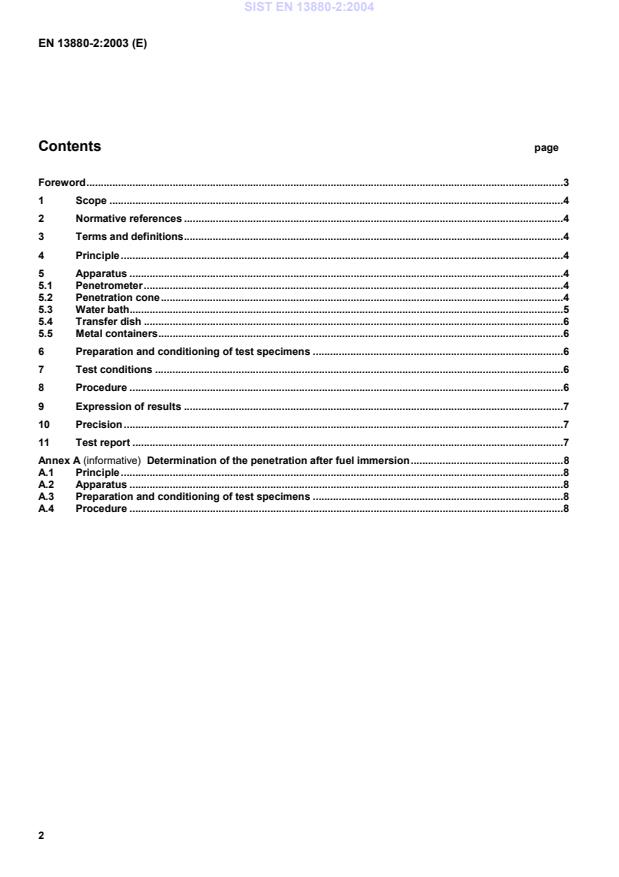
Determination of the penetration after fuel immersion.8A.1Principle.8A.2Apparatus.8A.3Preparation and conditioning of test specimens.8A.4Procedure.8SIST EN 13880-2:2004
...