

SIST EN 13880-11:2026
(Main)Hot applied joint sealants - Part 11: Method for the preparation of asphalt test blocks used in the function test and for the determination of compatibility with asphalt pavements
- Abstract
This document specifies a method for preparing asphalt test blocks intended for testing of hot applied joint sealants according to EN 13880-7 and EN 13880-9.
- Status
- Published
- Public Enquiry End Date
- 19-Dec-2024
- Publication Date
- 15-Jun-2026
- Technical Committee
- CES - Roads
- Current Stage
- 6060 - National Implementation/Publication (Adopted Project)
- Start Date
- 08-Jun-2026
- Due Date
- 13-Aug-2026
- Completion Date
- 16-Jun-2026

SIST EN 13880-11:2026 is the Slovenian standard that adopts EN 13880-11:2026 from SIST/CEN. It specifies how to prepare asphalt test blocks for function testing of hot applied joint sealants and for checking compatibility with asphalt pavements, so laboratories can make specimens that are prepared in the same way for EN 13880-7 and EN 13880-9.
What does SIST EN 13880-11:2026 specify?
SIST EN 13880-11:2026 specifies a preparation method for asphalt test blocks made from hot mix asphalt of asphalt concrete type. The document covers the full sequence from selecting and reheating the asphalt to compacting it, cooling it, sawing the blocks to specimen size, storing them, and recording the preparation data.
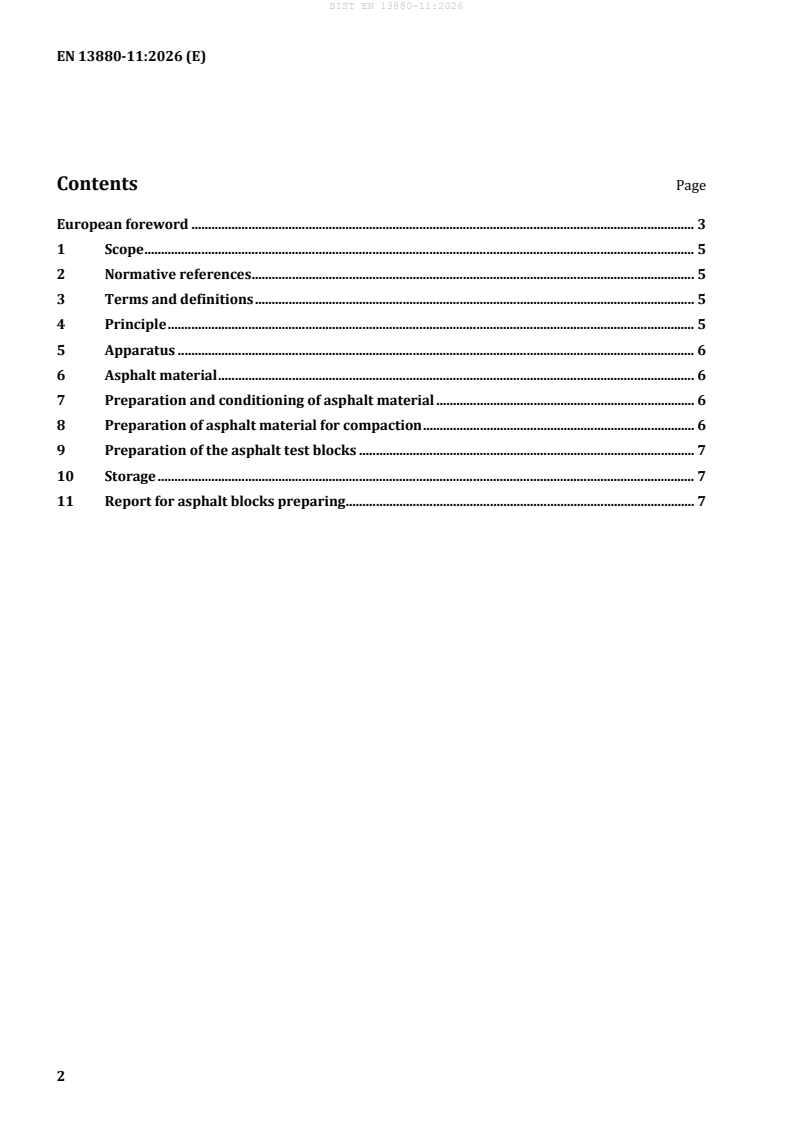
The standard is organized into Clauses 1 to 11:
- scope
- normative references
- terms and definitions
- principle
- apparatus
- asphalt material
- preparation and conditioning of asphalt material
- preparation for compaction
- preparation of the asphalt test blocks
- storage
- report for asphalt blocks preparing
In practice, this means the document is a preparation method, not a sealant performance test. Its purpose is to make the asphalt blocks that other EN 13880 tests need.
What are the key requirements of SIST EN 13880-11:2026?
Clause 4 sets out the preparation principle
SIST EN 13880-11:2026 requires hot mix asphalt, either laboratory mixed or taken directly from an asphalt plant, to be filled, reheated, transferred hot into a moulding box, compacted, cooled, and then sawn to the required specimen shapes. The practical effect is that the block must be homogeneous and suitable for later testing, so handling and compaction matter as much as the asphalt recipe.
Clause 5 defines the equipment needed
SIST EN 13880-11:2026 requires a heating chamber, a sturdy moulding box, and compaction equipment that follows EN 12697-32 or EN 12697-33. The moulding box depth is controlled, and the other dimensions depend on how many specimens are needed for EN 13880-7 or EN 13880-9. For users, this means the equipment must be suitable for repeatable block preparation, not just general asphalt handling.
Clause 6 fixes the asphalt material basis
SIST EN 13880-11:2026 bases the blocks on asphalt concrete in line with EN 13108-1, using either laboratory mixing to EN 12697-35 or asphalt taken directly from a plant. Clause 6 also links the material to a defined mix composition using paving grade bitumen and graded aggregate from EN 13043. In practice, the block preparation is tied to a specific asphalt concrete recipe, so the source materials and mix design have to be controlled.
Clauses 7 and 8 control reheating and compaction
SIST EN 13880-11:2026 requires the asphalt to be reheated in its delivery boxes, with the boxes kept closed during heating, and then placed in the moulding box once the declared mixing temperature is reached. The compacted specimen has to reach a defined air void content. This matters because the test blocks must represent a controlled asphalt structure, not an irregular mass with trapped air or overheating damage.
Clause 9 defines the finished block preparation
SIST EN 13880-11:2026 requires the cooled block to be removed and water-cooled sawing to the specimen sizes needed for EN 13880-7 and EN 13880-9. This means the block is only an intermediate product, and the final test pieces are made by cutting it after cooling.
Clauses 10 and 11 cover storage and reporting
SIST EN 13880-11:2026 requires storage in a refrigerator-like condition to prevent blocks from sticking together until specimens are prepared, and Clause 11 requires a report with the mix composition, mixing temperature, compaction method, porosity reference, production time, aggregate grading, bitumen origin, storage history, and the preparator and laboratory. For users, this is the traceability record that links each specimen back to how it was made.
What terms does SIST EN 13880-11:2026 define?
- asphalt concrete - asphalt in which the aggregate particles are continuously graded or gap-graded to form an interlocking structure.
- hot mix asphalt - the asphalt material used to make the blocks, either mixed in the laboratory or taken directly from an asphalt plant.
- moulding box - the box that receives the heated asphalt before compaction and shaping.
- vibratory compactor - the compaction equipment option referred to in EN 12697-32.
- roller compactor - the alternative compaction equipment option referred to in EN 12697-33.
- porosity - the air void content of the compacted asphalt specimen that must be controlled during preparation.
- test block - the asphalt block prepared as the starting material for specimens used in EN 13880-7 and EN 13880-9.
Who uses SIST EN 13880-11:2026?
SIST EN 13880-11:2026 is used by testing laboratories, asphalt laboratories, and asphalt plants that prepare specimens for joint sealant testing. It is also relevant to sealant manufacturers, road materials specialists, and quality managers who need the same specimen-preparation method across different sites or projects.
What changed in SIST EN 13880-11:2026 from the previous edition?
SIST EN 13880-11:2026 replaces EN 13880-11:2003. The foreword states two main technical changes: asphalt material specifications were introduced according to EN 13108-1, and alternative compaction rules were added according to EN 12697-32 or EN 12697-33. It also says Clause 6 was revised to clarify the asphalt mix type and mixture recipe for preparing hot mixed asphalt test specimens from a laboratory or an asphalt plant.
Which standards are used with SIST EN 13880-11:2026?
| Standard | What it contributes |
|---|---|
| EN 12591 | Paving grade bitumen specification used in the mix basis. |
| EN 12697-32 | Specimen preparation by vibratory compactor. |
| EN 12697-33 | Specimen preparation by roller compactor. |
| EN 12697-35 | Laboratory mixing method for preparing the asphalt. |
| EN 13043 | Aggregate specification for the asphalt mix. |
| EN 13108-1 | Asphalt concrete specification used as the material basis. |
| EN 13108-20 | Type testing report reference used when reporting porosity and material characteristics. |
| EN 13880-7 | Function test that uses the prepared asphalt blocks. |
| EN 13880-9 | Compatibility test with asphalt pavements that uses the prepared asphalt blocks. |
What does the SIST EN 13880-11:2026 document contain?
SIST EN 13880-11:2026 contains a step-by-step preparation method, equipment requirements, an asphalt material basis, conditioning instructions, compaction guidance, block cutting instructions, storage conditions, and a reporting checklist. It is written for preparing blocks that will later be used in EN 13880-7 and EN 13880-9, so its main value is in producing consistent test specimens rather than in evaluating sealant performance itself.
Relations
- Effective Date
- 01-Jul-2026
- Refers
SIST EN 12591:2009 - Bitumen and bituminous binders - Specifications for paving grade bitumens - Effective Date
- 08-Apr-2026
- Refers
SIST EN 13108-1:2016 - Bituminous mixtures - Material specifications - Part 1: Asphalt Concrete - Effective Date
- 08-Apr-2026
- Effective Date
- 08-Apr-2026
- Effective Date
- 08-Apr-2026
- Effective Date
- 08-Apr-2026
- Effective Date
- 08-Apr-2026
- Effective Date
- 08-Apr-2026
- Effective Date
- 08-Apr-2026
- Referred By
SIST EN 13880-7:2004 - Hot applied joint sealants - Part 7: Function testing of joint sealants - Effective Date
- 01-Apr-2026
- Referred By
SIST EN 13880-7:2019 - Hot applied joint sealants - Part 7: Function testing of joint sealants - Effective Date
- 01-Apr-2026
- Effective Date
- 28-Jan-2026
- Effective Date
- 28-Jan-2026
- Effective Date
- 28-Jan-2026
Get Certified
Connect with accredited certification bodies for this standard

DIBt (Deutsches Institut für Bautechnik)
German Institute for Building Technology.
DIN CERTCO
DIN Group product certification.
Zavod za gradbeništvo Slovenije (ZAG) - Inšpekcija
ZAG inspection body for construction products, structures, and materials.
Sponsored listings
Frequently Asked Questions
SIST EN 13880-11:2026 is a standard published by the Slovenian Institute for Standardization (SIST). Its full title is "Hot applied joint sealants - Part 11: Method for the preparation of asphalt test blocks used in the function test and for the determination of compatibility with asphalt pavements". This standard covers: This document specifies a method for preparing asphalt test blocks intended for testing of hot applied joint sealants according to EN 13880-7 and EN 13880-9.
This document specifies a method for preparing asphalt test blocks intended for testing of hot applied joint sealants according to EN 13880-7 and EN 13880-9.
SIST EN 13880-11:2026 is classified under the following ICS (International Classification for Standards) categories: 91.100.50 - Binders. Sealing materials; 93.080.20 - Road construction materials. The ICS classification helps identify the subject area and facilitates finding related standards.
SIST EN 13880-11:2026 has the following relationships with other standards: It is inter standard links to SIST EN 13880-11:2004, SIST EN 12591:2009, SIST EN 13108-1:2016, SIST EN 13043:2002, SIST EN 12697-32:2019, SIST EN 12697-33:2019+A1:2022, SIST EN 13043:2013, SIST EN 13880-9:2004, SIST EN 12697-35:2025, SIST EN 13880-7:2004, SIST EN 13880-7:2019, SIST EN ISO 11812:2024, SIST EN ISO 15085:2024, SIST EN ISO 10240:2024. Understanding these relationships helps ensure you are using the most current and applicable version of the standard.
SIST EN 13880-11:2026 is associated with the following European legislation: EU Directives/Regulations: 305/2011. When a standard is cited in the Official Journal of the European Union, products manufactured in conformity with it benefit from a presumption of conformity with the essential requirements of the corresponding EU directive or regulation.
SIST EN 13880-11:2026 is available in PDF format for immediate download after purchase. The document can be added to your cart and obtained through the secure checkout process. Digital delivery ensures instant access to the complete standard document.
Standards Content (Sample)
SLOVENSKI STANDARD
01-julij-2026
Nadomešča:
SIST EN 13880-11:2004
Toplo nanosljive tesnilne mase za stike – 11. del: Metoda za pripravo preskusnih
asfaltnih blokov za preskuse funkcionalnosti in za ugotavljanje združljivosti z
asfaltnimi vozišči
Hot applied joint sealants - Part 11: Method for the preparation of asphalt test blocks
used in the function test and for the determination of compatibility with asphalt
pavements
Heiß verarbeitbare Fugenmassen - Teil 11: Prüfverfahren zur Herstellung von Asphalt-
Probekörpern zur Verwendung in der Funktionsprüfung und zur Bestimmung der
Verträglichkeit mit Asphalten
Produits de scellement de joints appliqués à chaud - Partie 11 : Méthode d'essai pour la
préparation des blocs d'enrobés destinés au test fonctionnel et pour la détermination de
compatibilité avec les revêtements bitumineux
Ta slovenski standard je istoveten z: EN 13880-11:2026
ICS:
91.100.50 Veziva. Tesnilni materiali Binders. Sealing materials
93.080.20 Materiali za gradnjo cest Road construction materials
2003-01.Slovenski inštitut za standardizacijo. Razmnoževanje celote ali delov tega standarda ni dovoljeno.
EN 13880-11
EUROPEAN STANDARD
NORME EUROPÉENNE
March 2026
EUROPÄISCHE NORM
ICS 93.080.20 Supersedes EN 13880-11:2003
English Version
Hot applied joint sealants - Part 11: Method for the
preparation of asphalt test blocks used in the function test
and for the determination of compatibility with asphalt
pavements
Produits de scellement de joints appliqués à chaud - Heiß verarbeitbare Fugenmassen - Teil 11: Verfahren
Partie 11 : Méthode d'essai pour la préparation des zur Herstellung von Asphalt-Probekörpern zur
blocs d'enrobés destinés au test fonctionnel et pour la Verwendung in der Funktionsprüfung und zur
détermination de compatibilité avec les revêtements Bestimmung der Verträglichkeit mit Asphalten
bitumineux
This European Standard was approved by CEN on 9 February 2026.
CEN members are bound to comply with the CEN/CENELEC Internal Regulations which stipulate the conditions for giving this
European Standard the status of a national standard without any alteration. Up-to-date lists and bibliographical references
concerning such national standards may be obtained on application to the CEN-CENELEC Management Centre or to any CEN
member.
This European Standard exists in three official versions (English, French, German). A version in any other language made by
translation under the responsibility of a CEN member into its own language and notified to the CEN-CENELEC Management
Centre has the same status as the official versions.
CEN members are the national standards bodies of Austria, Belgium, Bulgaria, Croatia, Cyprus, Czech Republic, Denmark, Estonia,
Finland, France, Germany, Greece, Hungary, Iceland, Ireland, Italy, Latvia, Lithuania, Luxembourg, Malta, Netherlands, Norway,
Poland, Portugal, Republic of North Macedonia, Romania, Serbia, Slovakia, Slovenia, Spain, Sweden, Switzerland, Türkiye and
United Kingdom.
EUROPEAN COMMITTEE FOR STANDARDIZATION
COMITÉ EUROPÉEN DE NORMALISATION
EUROPÄISCHES KOMITEE FÜR NORMUNG
CEN-CENELEC Management Centre: Rue de la Science 23, B-1040 Brussels
© 2026 CEN All rights of exploitation in any form and by any means reserved Ref. No. EN 13880-11:2026 E
worldwide for CEN national Members.
Contents Page
European foreword . 3
1 Scope . 5
2 Normative references . 5
3 Terms and definitions . 5
4 Principle . 5
5 Apparatus . 6
6 Asphalt material . 6
7 Preparation and conditioning of asphalt material . 6
8 Preparation of asphalt material for compaction . 6
9 Preparation of the asphalt test blocks . 7
10 Storage . 7
11 Report for asphalt blocks preparing . 7
European foreword
This document (EN 13880-11:2026) has been prepared by Technical Committee CEN/TC 227 “Road
materials”, the secretariat of which is held by BSI.
This European Standard shall be given the status of a national standard, either by publication of an
identical text or by endorsement, at the latest by September 2026, and conflicting national standards shall
be withdrawn at the latest by September 2026.
Attention is drawn to the possibility that some of the elements of this document may be the subject of
patent rights. CEN shall not be held responsible for identifying any or all such patent rights.
This document supersedes EN 13880-11:2003.
EN 13880-11:2003:
— the major changes are the introduction of asphalt material specifications according to EN 13108-1
and the alternative compaction rules according to EN 12697-32 or EN 12697-33.
— revision of Clause 6 Asphalt, clarifying the asphalt mix type and mixture recipe for the preparation of
hot mixed asphalt test specimen (from laboratory or from an asphalt plant) for joint sealant tests was
implemented.
The EN 13880 series, under the general title Hot applied joint sealants, consists of the following parts:
— Part 1: Test method for the determination of density at 25 °C
— Part 2: Test method for the determination of cone penetration at 25 °C
— Part 3: Test method for the determination of penetration and recovery (resilience)
— Part 4: Test method for the characterization of heat resistance — Change in penetration value
— Part 5: Test method for the determination of flow resistance
— Part 6: Method for the preparation of samples for testing
— Part 7: Function testing of joint sealants
— Part 8: Test method for the determination of the change in weight of fuel resistance joint sea
...