

SIST EN 12697-35:2025
(Main)Bituminous mixtures - Test methods - Part 35: Laboratory mixing
General Information
- Abstract
This document describes the laboratory mixing of bituminous materials for the manufacture of specimens. This document specifies the reference compaction temperatures for mixtures and the reference installation temperature for mastic asphalt mixtures based on the grade of the binder for paving grade and hard paving grade bitumen.
Annex A describes the method for laboratory mixing using foamed bitumen.
Annex B describes the method for laboratory mixing using bitumen emulsion.
Annex C describes the preparation of mastic asphalt specimens after laboratory mixing.
- Status
- Published
- Public Enquiry End Date
- 19-Dec-2023
- Publication Date
- 03-Apr-2025
- Technical Committee
- CES - Roads
- Current Stage
- 6060 - National Implementation/Publication (Adopted Project)
- Start Date
- 13-Mar-2025
- Due Date
- 18-May-2025
- Completion Date
- 04-Apr-2025

Overview
SIST EN 12697-35:2025 is a European Standard developed by CEN that specifies procedures for the laboratory mixing of bituminous materials. This standard is a key reference for research, development, and quality control of bituminous mixtures used in road construction. It outlines the target and maximum mixing temperatures for various types of bitumen, including paving grade, hard paving grade, and mastic asphalt. Additionally, it describes methods for mixing with reclaimed asphalt, foamed bitumen, and bitumen emulsion, thus supporting innovative and environmentally sound construction practices.
Key Topics
- Laboratory Mixing Procedures: Defines precise steps for mixing aggregates, fillers, binders, and additives in the lab to produce homogenous bituminous mixtures for specimen manufacture.
- Reference Temperatures: Specifies reference compaction temperatures for bituminous mixtures and reference installation temperatures for mastic asphalt based on binder grade.
- Mixing Equipment & Apparatus: Lists specifications for mixers, ovens, balances, thermometers, and hot plates to guarantee accurate and consistent mixing.
- Additions & Modifications: Details procedures for incorporating reclaimed asphalt, proprietary additives, and modified binders for specialized mixture types.
- Special Mixing Methods:
- Annex A: Laboratory mixing using foamed bitumen.
- Annex B: Laboratory mixing using bitumen emulsion.
- Annex C: Preparation of mastic asphalt specimens after mixing.
- Documentation: Defines required items for the laboratory test report, including composition, temperatures, equipment used, procedures followed, and any deviations.
Applications
SIST EN 12697-35:2025 is widely used in:
- Research & Development: Enables researchers to prepare bituminous mixtures under standardized laboratory conditions for testing physical and mechanical properties.
- Quality Control & Assurance: Ensures consistency in manufacturing specimens for compliance testing, design validation, and performance assessment in road construction projects.
- Specimen Preparation: Underpins procedures for preparing laboratory specimens for subsequent testing such as compaction, durability, and performance evaluation.
- Innovative Asphalt Technologies: Supports the development and validation of low-temperature asphalts, recycled asphalt mixtures, and mixtures with modifiers or additives.
- Training & Education: Provides a reference for educators and students in civil engineering, materials science, and highway engineering fields.
Related Standards
Standards often referenced or used alongside SIST EN 12697-35:2025 include:
- EN 12591: Paving grade bitumen - Specifications
- EN 14023: Polymer modified bitumen - Requirements
- EN 13924-1 & EN 13924-2: Hard paving grade and multigrade bitumen
- EN 58: Sampling of bituminous binders
- EN 1097-5: Mechanical and physical properties of aggregates - Water content determination
- EN 12697-42: Test methods for reclaimed asphalt - Foreign matter content
- EN 13302 & EN 13702: Viscosity determination for bituminous binders
Practical Value
Adhering to SIST EN 12697-35:2025 offers several practical advantages:
- Reproducibility and Consistency: Standardizes laboratory procedures, enabling reliable comparison of test results across institutions and projects.
- Support for Sustainability: Facilitates the integration of reclaimed asphalt, reducing environmental impact and supporting circular construction practices.
- Adaptability: Accommodates new binder technologies and advanced mixture types, ensuring relevance for current and future engineering needs.
- Comprehensive Quality Assurance: Provides a robust framework for the evaluation of mixture performance prior to field application.
Integrating this standard into laboratory and project workflows helps ensure the performance, safety, and durability of asphalt pavements, contributing to the overall enhancement of road infrastructure quality in Europe and beyond.
Relations
- Effective Date
- 28-Jan-2026
- Effective Date
- 28-Jan-2026
- Effective Date
- 28-Jan-2026
- Effective Date
- 28-Jan-2026
- Effective Date
- 28-Jan-2026
- Effective Date
- 08-Apr-2026
- Effective Date
- 28-Jan-2026
- Effective Date
- 28-Jan-2026
- Effective Date
- 28-Jan-2026
- Effective Date
- 28-Jan-2026
- Referred By
SIST EN 13108-7:2016 - Bituminous mixtures - Material specifications - Part 7: Porous Asphalt - Effective Date
- 28-Jan-2026
- Effective Date
- 28-Jan-2026
- Effective Date
- 28-Jan-2026
- Effective Date
- 28-Jan-2026
- Effective Date
- 28-Jan-2026
Get Certified
Connect with accredited certification bodies for this standard

Zavod za gradbeništvo Slovenije (ZAG) - Inšpekcija
ZAG inspection body for construction products, structures, and materials.
Sponsored listings
Frequently Asked Questions
SIST EN 12697-35:2025 is a standard published by the Slovenian Institute for Standardization (SIST). Its full title is "Bituminous mixtures - Test methods - Part 35: Laboratory mixing". This standard covers: This document describes the laboratory mixing of bituminous materials for the manufacture of specimens. This document specifies the reference compaction temperatures for mixtures and the reference installation temperature for mastic asphalt mixtures based on the grade of the binder for paving grade and hard paving grade bitumen. Annex A describes the method for laboratory mixing using foamed bitumen. Annex B describes the method for laboratory mixing using bitumen emulsion. Annex C describes the preparation of mastic asphalt specimens after laboratory mixing.
This document describes the laboratory mixing of bituminous materials for the manufacture of specimens. This document specifies the reference compaction temperatures for mixtures and the reference installation temperature for mastic asphalt mixtures based on the grade of the binder for paving grade and hard paving grade bitumen. Annex A describes the method for laboratory mixing using foamed bitumen. Annex B describes the method for laboratory mixing using bitumen emulsion. Annex C describes the preparation of mastic asphalt specimens after laboratory mixing.
SIST EN 12697-35:2025 is classified under the following ICS (International Classification for Standards) categories: 93.080.20 - Road construction materials. The ICS classification helps identify the subject area and facilitates finding related standards.
SIST EN 12697-35:2025 has the following relationships with other standards: It is inter standard links to SIST EN 58:2012, SIST EN 12697-42:2021, SIST EN 13702:2018, SIST EN 1097-5:2008, SIST EN 13302:2018, SIST EN 13880-11:2026, SIST EN 12697-20:2012, SIST EN 12697-22:2004+A1:2007, SIST EN 13108-31:2019, SIST EN 12697-22:2020, SIST EN 13108-7:2016, SIST EN 13108-9:2016, SIST EN 13880-11:2004, SIST EN 12697-33:2019+A1:2022, SIST EN 12697-17:2004+A1:2007. Understanding these relationships helps ensure you are using the most current and applicable version of the standard.
SIST EN 12697-35:2025 is available in PDF format for immediate download after purchase. The document can be added to your cart and obtained through the secure checkout process. Digital delivery ensures instant access to the complete standard document.
Standards Content (Sample)
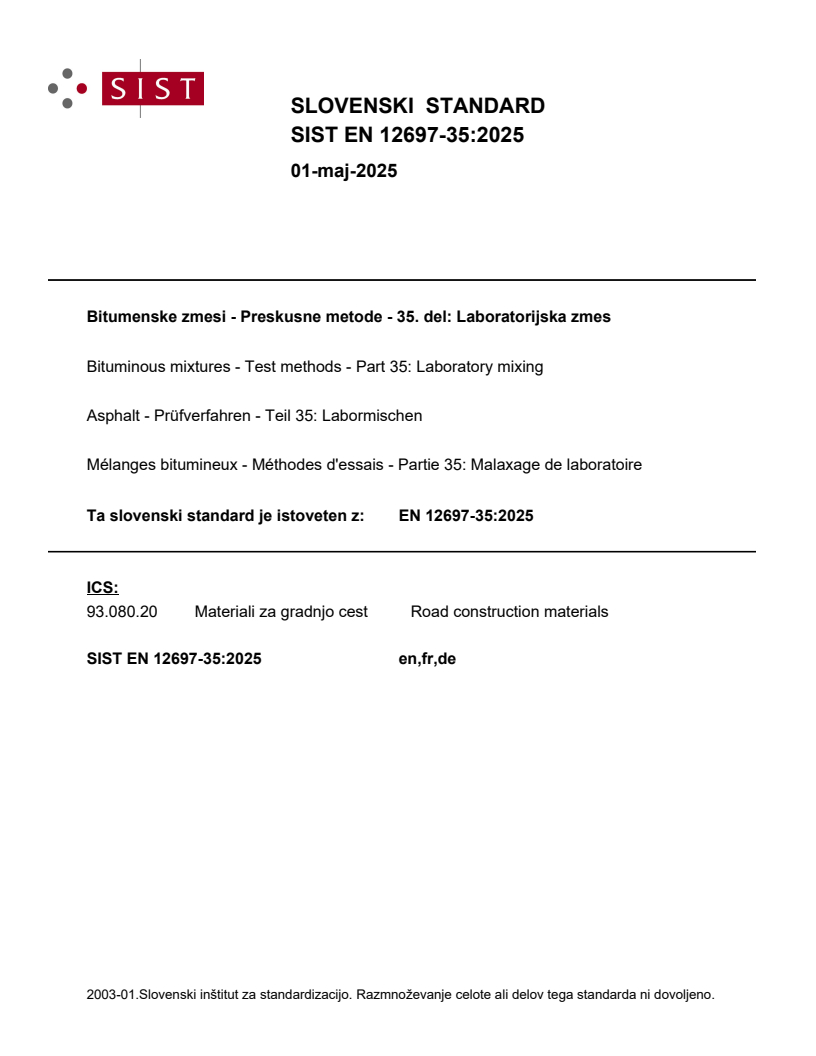
SLOVENSKI STANDARD
01-maj-2025
Bitumenske zmesi - Preskusne metode - 35. del: Laboratorijska zmes
Bituminous mixtures - Test methods - Part 35: Laboratory mixing
Asphalt - Prüfverfahren - Teil 35: Labormischen
Mélanges bitumineux - Méthodes d'essais - Partie 35: Malaxage de laboratoire
Ta slovenski standard je istoveten z: EN 12697-35:2025
ICS:
93.080.20 Materiali za gradnjo cest Road construction materials
2003-01.Slovenski inštitut za standardizacijo. Razmnoževanje celote ali delov tega standarda ni dovoljeno.
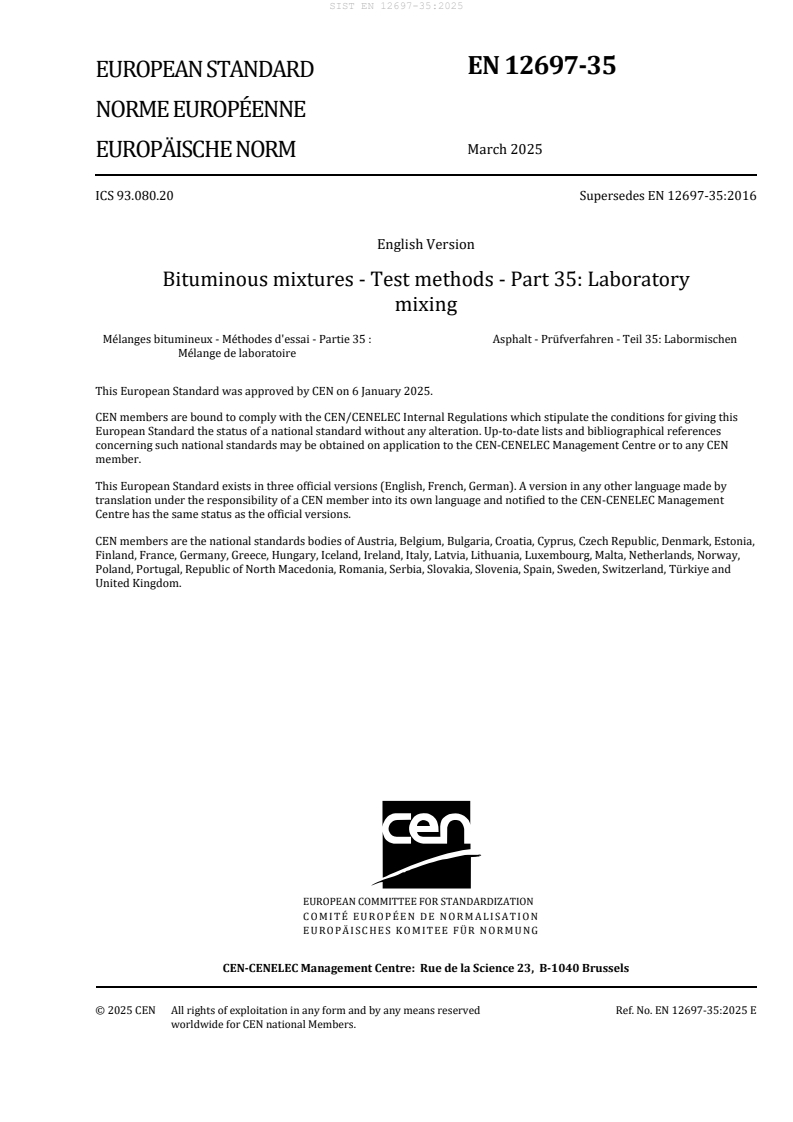
EN 12697-35
EUROPEAN STANDARD
NORME EUROPÉENNE
March 2025
EUROPÄISCHE NORM
ICS 93.080.20 Supersedes EN 12697-35:2016
English Version
Bituminous mixtures - Test methods - Part 35: Laboratory
mixing
Mélanges bitumineux - Méthodes d'essai - Partie 35 : Asphalt - Prüfverfahren - Teil 35: Labormischen
Mélange de laboratoire
This European Standard was approved by CEN on 6 January 2025.
CEN members are bound to comply with the CEN/CENELEC Internal Regulations which stipulate the conditions for giving this
European Standard the status of a national standard without any alteration. Up-to-date lists and bibliographical references
concerning such national standards may be obtained on application to the CEN-CENELEC Management Centre or to any CEN
member.
This European Standard exists in three official versions (English, French, German). A version in any other language made by
translation under the responsibility of a CEN member into its own language and notified to the CEN-CENELEC Management
Centre has the same status as the official versions.
CEN members are the national standards bodies of Austria, Belgium, Bulgaria, Croatia, Cyprus, Czech Republic, Denmark, Estonia,
Finland, France, Germany, Greece, Hungary, Iceland, Ireland, Italy, Latvia, Lithuania, Luxembourg, Malta, Netherlands, Norway,
Poland, Portugal, Republic of North Macedonia, Romania, Serbia, Slovakia, Slovenia, Spain, Sweden, Switzerland, Türkiye and
United Kingdom.
EUROPEAN COMMITTEE FOR STANDARDIZATION
COMITÉ EUROPÉEN DE NORMALISATION
EUROPÄISCHES KOMITEE FÜR NORMUNG
CEN-CENELEC Management Centre: Rue de la Science 23, B-1040 Brussels
© 2025 CEN All rights of exploitation in any form and by any means reserved Ref. No. EN 12697-35:2025 E
worldwide for CEN national Members.
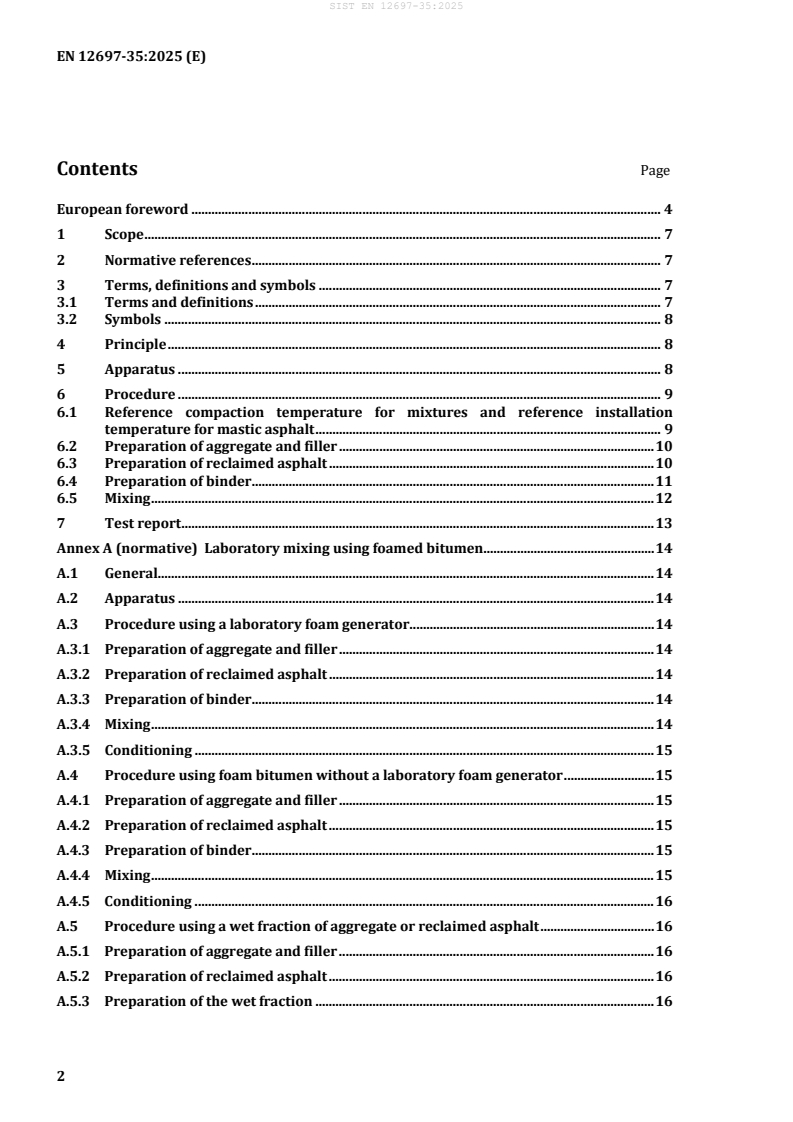
Contents Page
European foreword . 4
1 Scope . 7
2 Normative references . 7
3 Terms, definitions and symbols . 7
3.1 Terms and definitions . 7
3.2 Symbols . 8
4 Principle . 8
5 Apparatus . 8
6 Procedure . 9
6.1 Reference compaction temperature for mixtures and reference installation
temperature for mastic asphalt . 9
6.2 Preparation of aggregate and filler . 10
6.3 Preparation of reclaimed asphalt . 10
6.4 Preparation of binder . 11
6.5 Mixing . 12
7 Test report . 13
Annex A (normative) Laboratory mixing using foamed bitumen. 14
A.1 General. 14
A.2 Apparatus . 14
A.3 Procedure using a laboratory foam generator . 14
A.3.1 Preparation of aggregate and filler . 14
A.3.2 Preparation of reclaimed asphalt . 14
A.3.3 Preparation of binder . 14
A.3.4 Mixing . 14
A.3.5 Conditioning . 15
A.4 Procedure using foam bitumen without a laboratory foam generator . 15
A.4.1 Preparation of aggregate and filler . 15
A.4.2 Preparation of reclaimed asphalt . 15
A.4.3 Preparation of binder . 15
A.4.4 Mixing . 15
A.4.5 Conditioning . 16
A.5 Procedure using a wet fraction of aggregate or reclaimed asphalt . 16
A.5.1 Preparation of aggregate and filler . 16
A.5.2 Preparation of reclaimed asphalt . 16
A.5.3 Preparation of the wet fraction . 16
A.5.4 Preparation of binder . 16
A.5.5 Mixing . 16
A.5.6 Conditioning . 16
Annex B (normative) Laboratory mixing using bitumen emulsion . 17
B.1 General . 17
B.2 Procedure 1 with wet particles . 17
B.2.1 Preparation of aggregate and filler . 17
B.2.2 Preparation of reclaimed asphalt . 17
B.2.3 Preparation of binder (emulsion) . 17
B.2.4 Mixing . 18
B.3 Procedure 2 with dry particles . 18
B.3.1 Preparation of aggregate and filler . 18
B.3.2 Preparation of reclaimed asphalt . 18
B.3.3 Preparation of binder (emulsion) . 18
B.3.4 Mixing . 19
Annex C (normative) Preparation of mastic asphalt specimens . 20
Bibliography . 21
European foreword
This document (EN 12697-35:2025) has been prepared by Technical Committee CEN/TC 227 “Road
materials”, the secretariat of which is held by BSI.
This European Standard shall be given the status of a national standard, either by publication of an
identical text or by endorsement, at the latest by September 2025, and conflicting national standards shall
be withdrawn at the latest by September 2025.
Attention is drawn to the possibility that some of the elements of this document may be the subject of
patent rights. CEN shall not be held responsible for identifying any or all such patent rights.
This document supersedes EN 12697-35:2016.
35:2016:
— (Clause 1) Scope modified to be in line with subclause 6.1 and the amended titles for the Annexes;
— (Clause 2) deletion of normative references that are considered informative. Listed in the
Bibliography;
— (Clause 2) deletion of normative reference to EN 12697-38 as it is obsolete and will be deleted from
the EN 12697 series;
— (Clause 2) correction of title of EN 12697-42 by deletion of “for hot mix asphalt”;
— (Clause 4) NOTE completed with “of a mixture or for the reference installation temperature of mastic
asphalt” due to the amended subclause 6.1 and Table 1.
— (3.2) explanation of symbol p: completed with “expressed in %”;
— (5.1) NOTE reworded to normal text;
— (5.2) deletion of reference to EN 12697-38. Paragraph completed for clarity with « for mixtures or
the reference installation temperature for mastic asphalt due to the amended subclause 6.1 and
Table 1. Replacement of “accuracy” with “maximum permissible error of 5°C;
— (5.3) “measuring” altered to “weighing”. Deletion of reference to EN 12697-38. Replacement of
“accuracy” with “maximum permissible error at least 0,1 g for masses up to 5 kg, and 1 g for masses
over 5 kg;
— (5.4) introduction of new Clause with requirements for balance for the weighing of additives (smaller
amounts). Following Clauses re-numbered accordingly;
— (5.5) deletion of reference to EN 12697-38. Replacement of “accuracy” with “maximum permissible
error of 2°C. (Previously 5.4);
— (5.6) deletion of reference to EN 12697-38. Replacement of “accuracy” with “maximum permissible
error of 2°C. (Previously 5.5);
— (6.1) clause title “Mixing temperature” amended to read to read “Reference compaction temperature
for mixtures and reference installation temperature for mastic asphalt”;
— (6.1) paragraph amended for clarity. References to EN 12591, EN 13924-1, EN 14023, EN 13924-2
placed in new NOTE 1 and new NOTE 2. References to EN 13108-1 to −7 and −9 deleted and replaced
by new NOTE 3 for the guidance of calculations of the penetration or the softening point of the binder.
Existing NOTE re-numbered to NOTE 4;
— (6.1) Table 1: Title completed with “reference installation temperature for mastic asphalt mixtures”.
Table 1 completed with column for the reference installation temperature for mastic asphalt
mixtures;
— (6.1) completion with paragraphs for the reference to the respective normative Annexes A and B;
— (6.2.2) replacement of “accuracy” with “to the nearest”;
— (6.2.3) replacement of “accuracy of 1%” with “to the nearest 0,1 g”;
— (6.2.4) completion of paragraph to take into account additives such as pigments and fibres;
— (6.3.1) replacement of “accuracy” with “to the nearest”;
— (6.3.2) paragraph modified for clarity;
— (6.3.3, 6.3.4) text in clauses merged and reworded for clarity. Following clauses re-numbered;
— (6.3.3) NOTE with examples of precautions to avoid build-up pressure reworded to normal text;
— (6.3.4) (previously 6.3.5). Paragraph clarified regarding the introduction of reclaimed asphalt when
the reclaimed asphalt is note heated to the full target laboratory mixing temperature at the mixing
plant or when the procedure is not determined with the completion that the reclaimed asphalt
temperature shall be indicated in the test report;
— (6.3.4) (previously 6.3.5). NOTE deleted.
— (6.3.6) (previously 6.3.7). NOTE in 6.3.8 (previous version) reworded to normal text and introduced
in 6.3.6;
— (6.4) paragraph introduced for the preheating of binders for mastic asphalt. 1st paragraph of NOTE 2
has been altered to normal text;
— (6.5.2) introduction of new NOTE 2 with reference to EN 13043. “NOTE” renumbered to NOTE 1;
— (6.5.3) NOTE reworded to normal text;
— (6.5.6) addition of informative NOTE regarding laboratory mixing times for mastic asphalt;
— (6.5.8) paragraph added with recommendation to proceed with subsequent testing within 1 h after
completed mixing;
— (6.5.8) completion with paragraph for the reference to the normative Annex C.
— (Clause 7) introductory paragraph and list of bullets revised. Addition of bullet h) for temperature of
the added reclaimed asphalt;
— (Annex A) title amended to read “Laboratory mixing using foamed bitumen” for clarity;
— (A.1) completion with a general description for the procedure;
— (A.3.4.2) paragraph clarified regarding optimum water content for foamed bitumen. NOTE revised
for clarity;
— (A.4.4.2) paragraph revised for clarity. Addition of optimum water content;
— (A.5.3.2) replacement of “accuracy” with “to the nearest 0,1g;
— (Annex B) title amended to read “Laboratory mixing using bitumen emulsion” for clarity;
— (B.2.1.3) NOTE reworded to normal text;
— (B.2.2.4) introduction of new subclause for the measurement of the water content of the reclaimed
asphalt;
— (B.2.3.2) last paragraph transferred to new subclause B.2.3.3 for clarity and in line with B.3.3.2. NOTE
reworded to normal text;
— (B.2.4.4) deletion of Clause for waiting time after mixing. Following Clause re-numbered;
— (B.3.3.2) NOTE reworded to normal text and introduced in paragraph in line with B.3.3.2;
— (B.3.4.4) amendment of waiting time after mixing “(30 ± 5) s” to read (300 ± 5) s;
— (Annex C) title amended to read “Preparation of mastic asphalt specimens” for clarity;
— (C.1) NOTE revised to refer to EN 12697-20;
— (C.2) amendment of maximum temperature of the temperature ranges from 150°C to read 160°C.
NOTE reworded to normal text;
— (Bibliography) completed with references to documents that are referred to informatively in this
document. Deletion of reference to EN 12595 as not referred to in this document.
A list of all parts in a series can be found on the CEN website: www.cencenelec.eu.
Any feedback and questions on this document should be directed to the users’ national standards body.
A complete listing of these bodies can be found on the CEN website.
According to the CEN-CENELEC Internal Regulations, the national standards organisations of the
following countries are bound to implement this European Standard: Austria, Belgium, Bulgaria, Croatia,
Cyprus, Czech Republic, Denmark, Estonia, Finland, France, Germany, Greece, Hungary, Iceland, Ireland,
Italy, Latvia, Lithuania, Luxembourg, Malta, Netherlands, Norway, Poland, Portugal, Republic of North
Macedonia, Romania, Serbia, Slovakia, Slovenia, Spain, Sweden, Switzerland, Türkiye and the United
Kingdom.
1 Scope
This document describes the laboratory mixing of bituminous materials for the manufacture of
specimens. This document specifies the reference compaction temperatures for mixtures and the
reference installation temperature for mastic asphalt mixtures based on the grade of the binder for
paving grade and hard paving grade bitumen.
Annex A describes the method for laboratory mixing using foamed bitumen.
Annex B describes the method for laboratory mixing using bitumen emulsion.
Annex C describes the preparation of mastic asphalt specimens after laboratory mixing.
2 Normative references
The following documents are referred to in the text in such a way that some or all of their content
constitutes requirements of this document. For dated references, only the edition cited applies. For
undated references, the latest edition of the referenced document (including any amendments) applies.
EN 58, Bitumen and bituminous binders — Sampling bituminous binders
EN 1097-5, Tests for mechanical and physical properties of aggregates — Part 5: Determination of the
water content by drying in a ventilated oven
EN 12697-42, Bituminous mixtures — Test methods — Part 42: Amount of foreign matter in reclaimed
asphalt
EN 13302, Bitumen and bituminous binders — Determination of dynamic viscosity of bituminous binder
using a rotating spindle apparatus
EN 13702, Bitumen and bituminous binders — Determination of dynamic viscosity of bitumen and
bituminous binders by the cone and plate method
3 Terms, definitions and symbols
3.1 Terms and definitions
For the purposes of this document, the following terms and definitions apply.
ISO and IEC maintain terminology databases for use in standardization at the following addresses:
— ISO Online browsing platform: available at https://www.iso.org/obp/
— IEC Electropedia: available at https://www.electropedia.org/
3.1.1
reference compaction temperature
target value at which compaction (or installation for mastic asphalt) of an asphalt mixture starts
Note 1 to entry: The term “reference compaction temperature” is used here for mastic asphalt despite mastic
asphalt not being compacted.
3.1.2
target laboratory mixing temperature
value at which component materials are mixed to form an asphalt mixture
3.1.3
maximum laboratory mixing temperature
value that an asphalt mixture shall not exceed during the mixing process
3.1.4
reclaimed asphalt temperature
target value to which a reclaimed asphalt shall be heated before mixing
3.2 Symbols
θ is the reference compaction temperature
RCT
θ is the target laboratory mixing temperature
TLMT
θ is the reclaimed asphalt temperature
RA
θ is the temperature to which the fresh aggregate shall be heated
FA
p is the proportion of reclaimed asphalt expressed in %
4 Principle
The bituminous mixture is prepared at a target laboratory mixing temperature within a time that is
limited in order to reduce mechanical degradation of the aggregates and thermal degradation of the
binder.
NOTE The target laboratory mixing temperature for mixing is related to the grade of binder and to the
reference compaction temperatures used for its subsequent compaction of a mixture or for the reference
installation temperature of mastic asphalt.
5 Apparatus
5.1 Laboratory mixer capable of entirely coating all mineral substances in not more than 5 min.
The mixer shall be of the whisk or other type that is not so rigid that it can damage either the aggregate
particles or the bowl.
The mixer can be equipped with a thermostatically controlled heating system, a mechanical speed
control; and a mixing time programmer.
5.2 Ventilated oven, for heating aggregates and bitumen up to a temperature at least 20 °C above the
relevant reference compaction temperature for mixtures or the reference installation temperature for
mastic asphalt indicated in Table 1 with a maximum permissible error of 5 °C.
5.3 Balance, capable of weighing mass of the intended mixture with a maximum permissible error of
not more than 0,1g for masses up to 5 kg, and 1 g for masses over 5 kg.
5.4 Balance, capable of weighing additives with a maximum permissible error of 0,05 g.
5.5 Device, capable of measuring the target laboratory mixing temperature with a maximum
permissible error of 2 °C.
5.6 Adjustable hot plate, capable of maintaining the target laboratory mixing temperature during the
manual mixing with a maximum permissible error of 2 °C.
6 Procedure
6.1 Reference compaction temperature for mixtures and reference installation
temperature for mastic asphalt
The reference compaction temperature for mixture or reference installation temperature for mastic
asphalt shall be either:
— for mixtures with paving grade bitumen or hard paving grade bitumen, the temperatures given in
Table 1, or
— for mixtures with modified binders or other additives or with polymer modified bitumen in
accordance with EN 14023 or multigrade bitumen in accordance with EN 13924-2, a temperature at
which the binder has a viscosity similar to the binders at the temperature provided in Table 1 or the
temperature at which the binder has a dynamic viscosity of (0,28 ± 0,03) Pa·s measured to EN 13702
or EN 13302, or the temperatures indicated by the supplier, or
— for asphalts designed to be produced at lower temperatures, the temperature at which compaction
is intended for the asphalt during normal production, or
— for mixtures with reclaimed asphalt, the temperature shall be calculated in accordance with the
relevant product standard using the overall penetration or softening point or viscosity calculated
from the penetrations or softening points or viscosities and proportions of both the added binder
and the binder recovered from the reclaimed asphalt.
NOTE 1 Paving grade bitumen is covered by EN 12591, and hard paving grade bitumen is covered by EN 13924-
1.
NOTE 2 Polymer modified bitumen is covered by EN 14023, and multigrade bitumen is covered by EN 13924-2.
NOTE 3 Guidance for the calculations of the penetration or the softening point of the binder of a mixture when
reclaimed asphalt is used can be found in relevant product standards in the EN 13108 series.
Table 1 — Reference compaction temperatures for mixtures and reference installation
temperature for mastic asphalt mixtures with paving grade and hard paving grade bitumen
Reference
Reference
installation
compaction
Reference compaction
temperature
Paving Paving
temperature for
temperature for mixtures
for mastic
grade of grade of
mixtures other than
other than mastic asphalt
asphalt
bitumen bitumen
mastic asphalt
(in °C)
mixtures
(in °C)
(in °C)
10/20 to
180 230 250/330 130
20/30
30/45 175 220 330/430 125
35/50 165 210 500/650 120
40/60 155 200 650/900 115
50/70 150 - V12000 115
70/100 145 - V6000 110
100/150 140 - V3000 100
Reference
Reference
installation
compaction
Reference compaction
temperature
Paving Paving
temperature for
temperature for mixtures
for mastic
grade of grade of
mixtures other than
other than mastic asphalt
asphalt
bitumen bitumen
mastic asphalt
(in °C)
mixtures
(in °C)
(in °C)
160/220 135 - V1500 90
The maximum laboratory mixing temperature reached shall not be more than 20 °C above the reference
compaction temperature or the reference installation temperature of mastic asphalt mixtures. The target
laboratory mixing temperature shall be selected so that the mixture will have cooled to the reference
compaction temperature ± 5 °C when compaction is due to commence but shall not be greater than the
maximum laboratory mixing temperature. For mastic asphalt, the target lab
...