

SIST EN 13880-9:2004
(Main)Hot applied joint sealants - Part 9: Test method for the determination of compatibility with asphalt pavements
- Abstract
This European Standard describes a method for determining the compatibility of hot applied joint sealants applied to a saw asphalt joint slot
- Status
- Published
- Publication Date
- 31-May-2004
- Technical Committee
- CES - Roads
- Current Stage
- 6060 - National Implementation/Publication (Adopted Project)
- Start Date
- 01-Jun-2004
- Due Date
- 01-Jun-2004
- Completion Date
- 01-Jun-2004

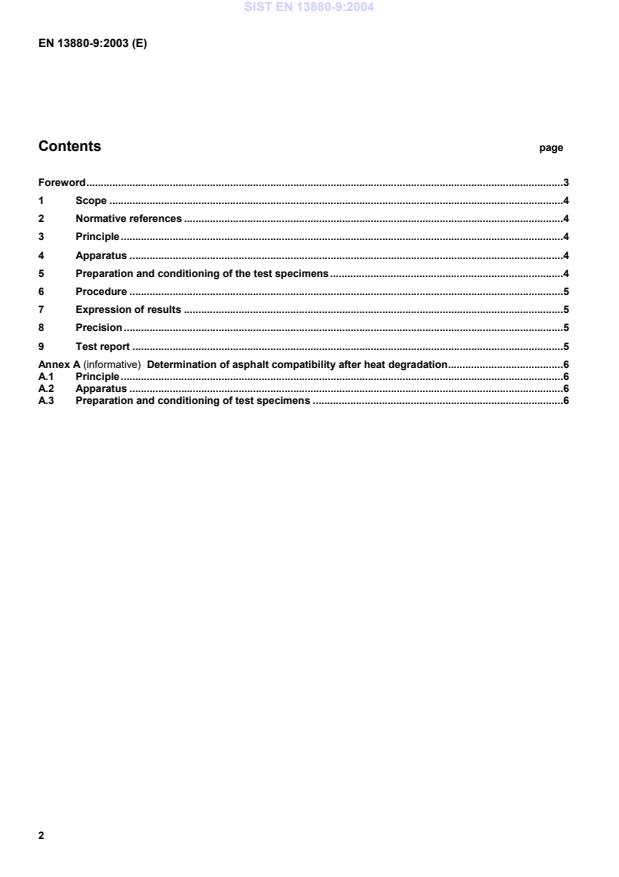
SIST EN 13880-9:2004 is the Slovenian adoption of EN 13880-9:2003, issued by SIST as a European Standard for road materials. It specifies a laboratory method for checking the compatibility of hot applied joint sealants with asphalt pavements, so manufacturers, test laboratories and specifiers can judge whether a sealant behaves acceptably in a saw-cut asphalt joint slot.
What does SIST EN 13880-9:2004 specify?
SIST EN 13880-9:2004 covers one test method: determining the compatibility of hot applied joint sealants applied to a saw asphalt joint slot. In practice, the standard is about whether the sealant and asphalt remain stable together after conditioning, not about general sealant performance.
The document is organized into clauses for scope, normative references, principle, apparatus, preparation and conditioning of test specimens, procedure, expression of results, precision and test report. It also includes one informative annex for a heat-degradation variant of the same compatibility check.
| Annex | What it covers |
|---|---|
| A | Determination of asphalt compatibility after heat degradation |
What are the key requirements of SIST EN 13880-9:2004?
SIST EN 13880-9:2004 bases the assessment on visible signs of incompatibility. Clause 3 says to look for adhesion failure, cohesion failure, oily exudate or softening between the sealant and the asphalt specimen after the specified conditioning period. That matters because the result is a pass/fail style observation, so the examiner must inspect the joint carefully and consistently.
Clause 4 lists the apparatus needed for a controlled test. The key items are a power driven masonry saw, a stiff-bristle brush, cloth backed adhesive tape, a fan circulated oven meeting the ISO 188 temperature condition, and a knife. In practice, the equipment controls the groove shape, specimen cleaning, heat exposure and final leveling of the sealant.
Clause 5 sets out how to prepare the asphalt test blocks. The standard uses two asphalt test blocks in accordance with EN 13880-11:2003, and each block gets a groove that is wet sawn to a defined length, width and depth. The grooves are then scrubbed clean, dried, returned to room temperature and reinforced to prevent slumping during the test.
Clause 6 describes the filling and conditioning step. Two test specimens are prepared in accordance with prEN 13880-6, the grooves are caulked at the ends, filled with laboratory sample sealant and trimmed flush after cooling. The blocks are then kept in a fan circulated oven at the stated temperature for the stated time, with daily inspection to prevent collapse, and examined immediately when removed.
Clause 7 tells the user how to record the outcome. Any evidence of adhesion and cohesion failure, oily exudate or softening between the sealant and the asphalt specimen is reported according to prEN 14188-1. In practice, the reader needs a clear and consistent way to document visible incompatibility, not just a general statement that the sample was heated.
Clause 8 is important for quality decisions because it notes that repeatability and reproducibility estimates are not yet available. That means the method is defined, but the document does not give precision data for comparing laboratory results.
Clause 9 defines the minimum test report content. The report confirms that the test followed the standard and includes the sample name, source, batch information or expiry date where relevant, test date and results, and the analyst and laboratory name. This is the information a buyer or quality manager would need to trace the test back to a specific material and lab.
Annex A gives an alternative compatibility check after heat degradation. It uses the same general apparatus and specimen preparation, but extends the heating period to 6 h at the manufacturer’s maximum recommended safe heating temperature. That variant is useful when the question is how the sealant behaves after prolonged heating before use.
What terms does SIST EN 13880-9:2004 define?
- Hot applied joint sealants - Sealants applied in a heated state so they can be poured or placed into joints and then cool in service.
- Compatibility - In this standard, the ability of the sealant to remain acceptable in contact with asphalt without visible failure or damaging interaction.
- Adhesion failure - Separation between the sealant and the asphalt surface, which shows poor bonding in the joint.
- Cohesion failure - Breakage within the sealant itself, showing that the material can no longer hold together under the test conditions.
- Oily exudate - An oil-like material appearing between the sealant and the asphalt, indicating an undesirable interaction.
- Saw asphalt joint slot - The cut groove in the asphalt specimen that simulates the joint geometry used for the compatibility test.
Who uses SIST EN 13880-9:2004?
SIST EN 13880-9:2004 is used by laboratories that test road materials, by manufacturers of hot applied joint sealants, and by quality teams checking product consistency. It is also relevant to specifiers, purchasers and road-material engineers who need a documented compatibility check before approving a sealant for asphalt joints. The standard supports product testing, qualification and routine quality control.
What changed in SIST EN 13880-9:2004 from the previous edition?
SIST EN 13880-9:2004 is the Slovenian national adoption of EN 13880-9:2003.
Which standards are used with SIST EN 13880-9:2004?
- prEN 13880-6 - Provides the sample preparation method used before filling the test grooves.
- EN 13880-11:2003 - Provides the asphalt test block preparation used for the compatibility test.
- prEN 14188-1 - Provides the specification used when reporting the observed compatibility result.
- ISO 188 - Provides the oven-related heat resistance conditions used for conditioning the specimens.
What does the SIST EN 13880-9:2004 document contain?
The document contains a principle, an apparatus list, specimen preparation steps, a test procedure, a result statement, a note on precision and a test report clause. It also includes an informative annex that adapts the method for compatibility after prolonged heating. For a reader, the useful content is the defined groove preparation, filling, trimming, oven conditioning and visual inspection steps used to judge asphalt compatibility.
Relations
- Refers
SIST EN 14188-1:2005 - Joint fillers and sealants - Part 1: Specifications for hot applied sealants - Effective Date
- 28-Jan-2026
- Effective Date
- 28-Jan-2026
- Effective Date
- 08-Apr-2026
- Effective Date
- 09-Feb-2026
- Effective Date
- 09-Feb-2026
- Effective Date
- 09-Feb-2026
- Effective Date
- 09-Feb-2026
- Effective Date
- 28-Jan-2026
Get Certified
Connect with accredited certification bodies for this standard

DIBt (Deutsches Institut für Bautechnik)
German Institute for Building Technology.
DIN CERTCO
DIN Group product certification.
Zavod za gradbeništvo Slovenije (ZAG) - Inšpekcija
ZAG inspection body for construction products, structures, and materials.
Sponsored listings
Frequently Asked Questions
SIST EN 13880-9:2004 is a standard published by the Slovenian Institute for Standardization (SIST). Its full title is "Hot applied joint sealants - Part 9: Test method for the determination of compatibility with asphalt pavements". This standard covers: This European Standard describes a method for determining the compatibility of hot applied joint sealants applied to a saw asphalt joint slot
This European Standard describes a method for determining the compatibility of hot applied joint sealants applied to a saw asphalt joint slot
SIST EN 13880-9:2004 is classified under the following ICS (International Classification for Standards) categories: 91.100.50 - Binders. Sealing materials; 93.080.20 - Road construction materials. The ICS classification helps identify the subject area and facilitates finding related standards.
SIST EN 13880-9:2004 has the following relationships with other standards: It is inter standard links to SIST EN 14188-1:2005, SIST EN 13880-6:2019, SIST EN 13880-11:2026, SIST EN 60695-1-11:2010, SIST EN 60695-5-1:2003, SIST EN 60695-1-40:2014, SIST EN IEC 60695-5-1:2022, SIST EN 13880-11:2004. Understanding these relationships helps ensure you are using the most current and applicable version of the standard.
SIST EN 13880-9:2004 is associated with the following European legislation: EU Directives/Regulations: 305/2011, 89/106/EEC; Standardization Mandates: M/124. When a standard is cited in the Official Journal of the European Union, products manufactured in conformity with it benefit from a presumption of conformity with the essential requirements of the corresponding EU directive or regulation.
SIST EN 13880-9:2004 is available in PDF format for immediate download after purchase. The document can be added to your cart and obtained through the secure checkout process. Digital delivery ensures instant access to the complete standard document.
Standards Content (Sample)
2003-01.Slovenski inštitut za standardizacijo. Razmnoževanje celote ali delov tega standarda ni dovoljeno.Heiß verarbeitbare Fugenmassen - Teil 9: Prüfverfahren zur Bestimmung der Verträglichkeit mit AsphaltenProduits de scellement de joints appliqués a chaud - Partie 9 : Méthode d'essai pour la détermination de la compatibilité avec les revetements bitumineuxHot applied joint sealants - Part 9: Test method for the determination of compatibility with asphalt pavements93.080.20Materiali za gradnjo cestRoad construction materials91.100.50Veziva. Tesnilni materialiBinders. Sealing materialsICS:Ta slovenski standard je istoveten z:EN 13880-9:2003SIST EN 13880-9:2004en01-junij-2004SIST EN 13880-9:2004SLOVENSKI
STANDARD
EUROPEAN STANDARDNORME EUROPÉENNEEUROPÄISCHE NORMEN 13880-9June 2003ICS 93.080.20English versionHot applied joint sealants - Part 9: Test method for thedetermination of compatibility with asphalt pavementsProduits de scellement de joints appliqués à chaud - Partie9: Méthode d'essai pour la détermination de la compatibilitéavec les revêtements bitumineuxHeiß verarbeitbare Fugenmassen - Teil 9: Prüfverfahrenzur Bestimmung der Verträglichkeit mit AsphaltenThis European Standard was approved by CEN on 25 March 2003.CEN members are bound to comply with the CEN/CENELEC Internal Regulations which stipulate the conditions for giving this EuropeanStandard the status of a national standard without any alteration. Up-to-date lists and bibliographical references concerning such nationalstandards may be obtained on application to the Management Centre or to any CEN member.This European Standard exists in three official versions (English, French, German). A version in any other language made by translationunder the responsibility of a CEN member into its own language and notified to the Management Centre has the same status as the officialversions.CEN members are the national standards bodies of Austria, Belgium, Czech Republic, Denmark, Finland, France, Germany, Greece,Hungary, Iceland, Ireland, Italy, Luxembourg, Malta, Netherlands, Norway, Portugal, Slovakia, Spain, Sweden, Switzerland and UnitedKingdom.EUROPEAN COMMITTEE FOR STANDARDIZATIONCOMITÉ EUROPÉEN DE NORMALISATIONEUROPÄISCHES KOMITEE FÜR NORMUNGManagement Centre: rue de Stassart, 36
B-1050 Brussels© 2003 CENAll rights of exploitation in any form and by any means reservedworldwide for CEN national Members.Ref. No. EN 13880-9:2003 ESIST EN 13880-9:2004
Determination of asphalt compatibility after heat degradation.6A.1Principle.6A.2Apparatus.6A.3Preparation and conditioning of test specimens.6SIST EN 13880-9:2004
...