

SIST-TP CEN/TR 18341:2026
(Main)District heating and cooling systems - Supplementary information on usage of CEN/TC 107 documents
- Abstract
This document provides an overview of the standardization deliverables published and under development under the responsibility of CEN/TC 107. It defines the temperature ranges applicable to the intended use of these documents and establishes a classification system linking each document to its corresponding temperature range. Furthermore, it describes how estimation of service life of pipe systems is conducted based on the average operating temperature within service pipes, taking into account additional influencing conditions.
- Status
- Published
- Public Enquiry End Date
- 19-Apr-2026
- Publication Date
- 12-Jul-2026
- Technical Committee
- I13 - Imaginarni 13
- Current Stage
- 6060 - National Implementation/Publication (Adopted Project)
- Start Date
- 09-Jul-2026
- Due Date
- 13-Sep-2026
- Completion Date
- 13-Jul-2026

SIST-TP CEN/TR 18341:2026 is the Slovenian identical version of CEN/TR 18341:2026, a CEN Technical Report from CEN/TC 107 on district heating and cooling systems. It gives supplementary guidance on how to use the CEN/TC 107 documents, linking each document family to a temperature range and showing how pipe-system service life is estimated from operating temperature and other influencing conditions. It is aimed at people selecting, designing, installing, monitoring or assessing district heating and cooling pipe systems.
What does SIST-TP CEN/TR 18341:2026 specify?
SIST-TP CEN/TR 18341:2026 provides an overview of the CEN/TC 107 deliverables published and under development, and it classifies them by intended temperature range. The report is organized around the document family, temperature ranges TR1 to TR5, and service-life estimation.
The technical core is in Clauses 4 to 6:
- Clause 4 maps the CEN/TC 107 deliverables by topic and pipe-system type.
- Clause 5 defines the temperature-range logic and links documents to the ranges they are intended for.
- Clause 6 explains service-life estimation for pipe systems, based on average operating temperature and other influencing conditions.
Table 1 links the deliverables to TR1 to TR5, so users can quickly check which standard fits their application.
What are the key requirements of SIST-TP CEN/TR 18341:2026?
SIST-TP CEN/TR 18341:2026 is mainly a guidance document, but it gives several practical rules for choosing and using the right CEN/TC 107 documents.
Structure of the document family
Clause 4 groups the deliverables into general references, surveillance systems, design and installation, joint casing assemblies, qualification testing, bonded rigid pipe systems, and factory-made flexible pipe systems. In practice, this gives engineers and buyers a route map before they specify a network or check a product standard.
Clause 4.2 points to EN 17248 for shared terminology in district heating and cooling pipe systems. That matters because contracts, drawings and inspection records need the same language.
Clause 4.3 points to EN 14419 for surveillance systems used to monitor pipe integrity. This is the document family to consult when monitoring and maintenance functions are part of the specification.
Clause 4.4 uses the EN 13941 series for design and installation of thermal insulated bonded single and twin pipe systems for directly buried hot water networks. EN 13941-1 covers design and EN 13941-2 covers installation, so the series connects calculation and site practice.
Product families and system types
Clauses 4.7 to 4.11 map the main product families:
- bonded rigid single pipe systems for district heating
- bonded rigid twin pipe systems for district heating
- bonded rigid single pipe systems for district cooling
- factory-made flexible pipe systems for district heating
- factory-made flexible pipe systems for district cooling
These clauses help a user match the service pipe material - steel, plastic, plastic reinforced or metallic - to the relevant standard family. That is important when comparing offers or preparing technical specifications.
Clause 4.6 uses the EN 18213 series for qualification testing of fitters and PE-welders. For practice, this supports training records and installer approval for bonded single and twin pipe systems in directly buried hot and cold water networks.
Temperature ranges
Clause 5 defines the temperature-range logic used across the CEN/TC 107 documents. TR1 corresponds to district cooling, while TR5 applies to district heating systems with the highest permissible design temperatures.
The same clause shows that documents in TR2 to TR5 can also be used in lower ranges, including TR1 to TR4, where their construction and temperature limits allow it. That matters because temperature affects design stress, material choice and whether a document applies to a project.
Service life
Clause 6 explains that service life is estimated from average operating temperature within service pipes together with other influencing conditions. For steel service pipes, the report points to design-life values in EN 13941-1 and EN 253, including 30 years at 120 °C and 50 years at 115 °C.
The clause also notes that service life is affected by thermal load cycles, installation conditions, operational practice, construction quality, qualified personnel and water quality. For plastic service pipes, it points to Miner's rule in EN ISO 13760 and guidance in the EN 15632, EN 17878 and EN 17414 series, plus CEN/TS 17889. In practice, service life must be assessed from actual operating conditions, not treated as a fixed number for every network.
Who uses SIST-TP CEN/TR 18341:2026?
SIST-TP CEN/TR 18341:2026 is used by designers, specifiers, installers, network operators, quality managers, buyers and test personnel in district heating and district cooling. They use it to choose the relevant pipe-system standard, check temperature-range applicability, plan installation and surveillance, and support service-life assessment and personnel qualification.
Which standards are used with SIST-TP CEN/TR 18341:2026?
| Related standard | What it contributes |
|---|---|
| EN 17248 | Terms and definitions for district heating and district cooling pipe systems. |
| EN 14419 | Requirements and installation of surveillance systems. |
| EN 13941 series | Design and installation of thermal insulated bonded single and twin pipe systems for directly buried hot water networks. |
| EN 489 series | Joint casing systems for district heating and cooling applications. |
| EN 18213 series | Qualification testing of fitters and PE-welders. |
| EN 253, EN 448, EN 488-1, EN 488-2 | Core components for bonded rigid single pipe systems for directly buried hot water networks. |
| EN 15698 series | Bonded rigid twin pipe systems for directly buried hot water networks. |
| EN 17415 series | Bonded rigid single pipe systems for directly buried cold water networks. |
| EN 15632 series, EN 17878 series, CEN/TS 17889 | Factory-made flexible pipe systems for district heating, including lower-temperature profile and TRSP systems. |
| EN 17414 series | Factory-made flexible pipe systems for district cooling. |
| EN ISO 13760 | Cumulative-damage calculation method used in service-life estimation for plastic service pipes. |
What does the SIST-TP CEN/TR 18341:2026 document contain?
The document contains a structural overview figure for the CEN/TC 107 deliverables, a temperature-range figure for TR1 to TR5, and a table that maps deliverables to temperature ranges and pipe types. It also includes a service-life figure for metallic service pipes with PUR foam insulation as a function of average operating temperature. The bibliography lists the EN, EN ISO and CEN/TS documents cited throughout the report.
Relations
- Effective Date
- 28-Jan-2026
- Effective Date
- 28-Jan-2026
- Effective Date
- 28-Jan-2026
- Effective Date
- 28-Jan-2026
Get Certified
Connect with accredited certification bodies for this standard

Institut za varilstvo d.o.o. (Welding Institute)
Slovenia's leading welding institute since 1952. ISO 3834, EN 1090, pressure equipment certification, NDT personnel, welder qualification. Only IIW Au
Sponsored listings
Frequently Asked Questions
SIST-TP CEN/TR 18341:2026 is a technical report published by the Slovenian Institute for Standardization (SIST). Its full title is "District heating and cooling systems - Supplementary information on usage of CEN/TC 107 documents". This standard covers: This document provides an overview of the standardization deliverables published and under development under the responsibility of CEN/TC 107. It defines the temperature ranges applicable to the intended use of these documents and establishes a classification system linking each document to its corresponding temperature range. Furthermore, it describes how estimation of service life of pipe systems is conducted based on the average operating temperature within service pipes, taking into account additional influencing conditions.
This document provides an overview of the standardization deliverables published and under development under the responsibility of CEN/TC 107. It defines the temperature ranges applicable to the intended use of these documents and establishes a classification system linking each document to its corresponding temperature range. Furthermore, it describes how estimation of service life of pipe systems is conducted based on the average operating temperature within service pipes, taking into account additional influencing conditions.
SIST-TP CEN/TR 18341:2026 is classified under the following ICS (International Classification for Standards) categories: 23.040.07 - Pipeline and its parts for district heat; 23.040.99 - Other pipeline components. The ICS classification helps identify the subject area and facilitates finding related standards.
SIST-TP CEN/TR 18341:2026 has the following relationships with other standards: It is inter standard links to SIST EN ISO 17829:2025, SIST EN ISO 17831-1:2025, SIST EN ISO 17831-2:2025, SIST EN ISO 17225-8:2023. Understanding these relationships helps ensure you are using the most current and applicable version of the standard.
SIST-TP CEN/TR 18341:2026 is available in PDF format for immediate download after purchase. The document can be added to your cart and obtained through the secure checkout process. Digital delivery ensures instant access to the complete standard document.
Standards Content (Sample)
SLOVENSKI STANDARD
01-september-2026
Sistemi daljinskega ogrevanja in hlajenja - Dodatne informacije o uporabi
dokumentov CEN/TC 107
District heating and cooling systems - Supplementary information on usage of CEN/TC
107 documents
Fernwärme- und Fernkälteverteilsysteme - Ergänzende Information zur Anwendung der
Dokumente des CEN/TC 107 "Fernwärme- und Fernkältesysteme"
Systèmes de chauffage urbain et de froid urbain - Informations supplémentaires relatives
à l'utilisation des documents du CEN/TC 107
Ta slovenski standard je istoveten z: CEN/TR 18341:2026
ICS:
23.040.07 Cevovodi za daljinsko Pipeline and its parts for
ogrevanje in njihovi deli district heat
2003-01.Slovenski inštitut za standardizacijo. Razmnoževanje celote ali delov tega standarda ni dovoljeno.
CEN/TR 18341
TECHNICAL REPORT
RAPPORT TECHNIQUE
July 2026
TECHNISCHER REPORT
ICS 23.040.99; 23.040.07
English Version
District heating and cooling systems - Supplementary
information on usage of CEN/TC 107 documents
Canalisations pour le chauffage urbain et réseaux d'eau Fernwärme- und Fernkälteverteilsysteme -
glacée - Informations supplémentaires sur l'utilisation Ergänzende Information zur Anwendung der
des documents du CEN/TC 107 Dokumente des CEN/TC 107 "Fernwärme- und
Fernkältesysteme"
This Technical Report was approved by CEN on 31 May 2026. It has been drawn up by the Technical Committee CEN/TC 107.
CEN members are the national standards bodies of Austria, Belgium, Bulgaria, Croatia, Cyprus, Czech Republic, Denmark, Estonia,
Finland, France, Germany, Greece, Hungary, Iceland, Ireland, Italy, Latvia, Lithuania, Luxembourg, Malta, Netherlands, Norway,
Poland, Portugal, Republic of North Macedonia, Romania, Serbia, Slovakia, Slovenia, Spain, Sweden, Switzerland, Türkiye and
United Kingdom.
EUROPEAN COMMITTEE FOR STANDARDIZATION
COMITÉ EUROPÉEN DE NORMALISATION
EUROPÄISCHES KOMITEE FÜR NORMUNG
CEN-CENELEC Management Centre: Rue de la Science 23, B-1040 Brussels
© 2026 CEN All rights of exploitation in any form and by any means reserved Ref. No. CEN/TR 18341:2026 E
worldwide for CEN national Members.
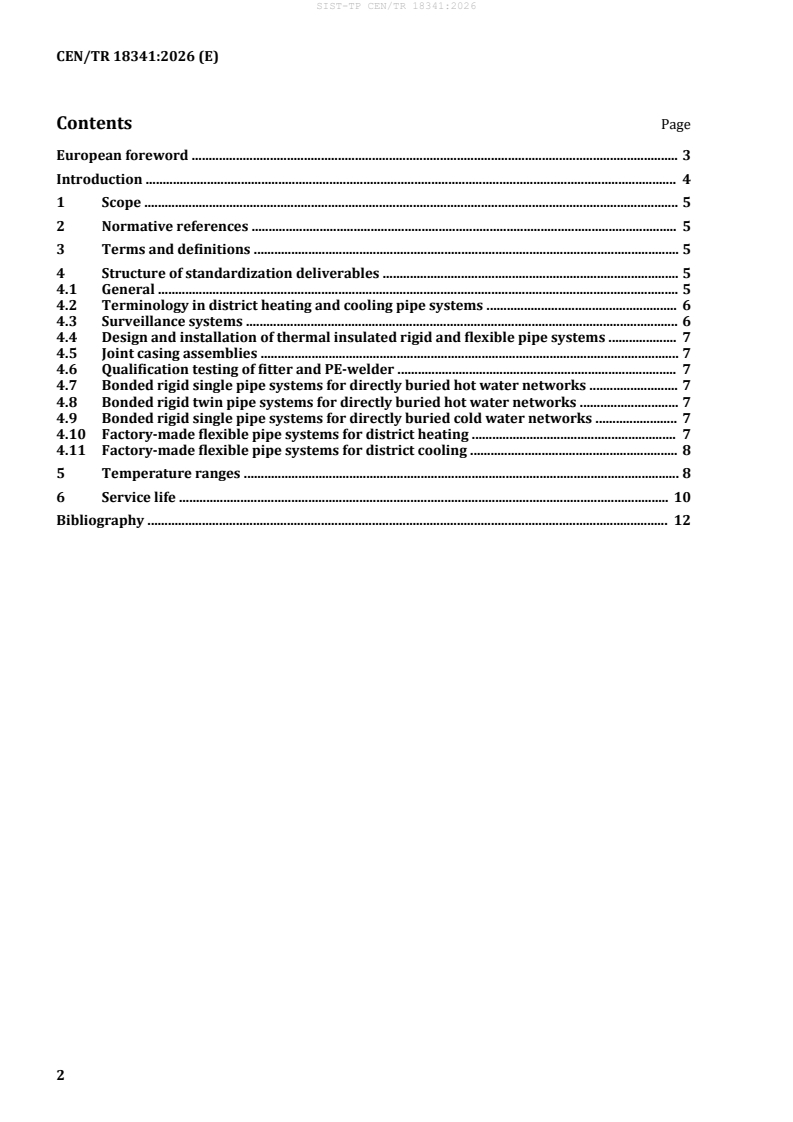
Contents Page
European foreword . 3
Introduction . 4
1 Scope . 5
2 Normative references . 5
3 Terms and definitions . 5
4 Structure of standardization deliverables . 5
4.1 General . 5
4.2 Terminology in district heating and cooling pipe systems . 6
4.3 Surveillance systems . 6
4.4 Design and installation of thermal insulated rigid and flexible pipe systems . 7
4.5 Joint casing assemblies . 7
4.6 Qualification testing of fitter and PE-welder . 7
4.7 Bonded rigid single pipe systems for directly buried hot water networks . 7
4.8 Bonded rigid twin pipe systems for directly buried hot water networks . 7
4.9 Bonded rigid single pipe systems for directly buried cold water networks . 7
4.10 Factory-made flexible pipe systems for district heating . 7
4.11 Factory-made flexible pipe systems for district cooling . 8
5 Temperature ranges . 8
6 Service life . 10
Bibliography . 12
European foreword
This document (CEN/TR 18341:2026) has been prepared by Technical Committee CEN/TC 107 "District
heating and cooling systems", the secretariat of which is held by DS.
Attention is drawn to the possibility that some of the elements of this document may be the subject of
patent rights. CEN shall not be held responsible for identifying any or all such patent rights.
Any feedback and questions on this document should be directed to the users’ national standards body.
A complete listing of these bodies can be found on the CEN website.
Introduction
CEN/TC 107 is responsible for the development, revision, and adaptation of standardization
deliverables within the domain of district heating and cooling systems. These deliverables include
European Standards (EN), Technical Spécifications (TS), and Technical Reports (TR). Since the
publication of its first standard, EN 253, in 1990, the committee has produced more than 26 deliverables
addressing various aspects of the sector.
In 2023, the scope of CEN/TC 107 was expanded to address emerging requirements in district heating
and cooling, with particular attention to system optimization, environmental considerations, and sector
coupling. This expansion also aligns with the activities of ISO/TC 341, thereby facilitating opportunities
for joint development of standards under the framework of the Vienna Agreement or through adoption.
Given the growing number of deliverables, there is a recognized need to provide clear guidance to users
regarding the availability and applicability of standards, technical spécifications, and technical reports
for district heating and cooling pipes, including the conditions under which these documents are used.
1 Scope
This document provides an overview of the standardization deliverables published and under
development under the responsibility of CEN/TC 107. It définés the temperature ranges applicable to
the intended use of these documents and establishes a classification system linking each document to
its corresponding temperature range. Furthermore, it describes how estimation of service life of pipe
systems is conducted based on the average operating temperature within service pipes, taking into
account additional influéncing conditions.
2 Normative references
There are no normative references in this document.
3 Terms and definitions
No terms and définitions are listed in this document.
— ISO Online browsing platform: available at http://www.iso.org/obp
— IEC Electropedia: available at http://www.electropedia.org/
4 Structure of standardization deliverables
4.1 General
Figure 1 illustrates the standardization deliverables published and currently under development by
CEN/TC 107. It further indicates:
— which deliverables are of a superordinate nature and therefore generally applicable;
— the deliverables applicable to district heating pipelines and those applicable to district cooling
pipelines;
— the deliverables relevant to rigid pipe systems and those relevant to fléxiblé pipe systems.
Key
WI work item
EN European standard
TS technical spécification
SPS single pipe systems
TPS twin pipe systems
Figure 1 — Structure of standardization deliverables under the scope of CEN/TC 107
4.2 Terminology in district heating and cooling pipe systems
EN 17248 [1] provides a comprehensive set of terms and définitions related to district heating and
district cooling pipe systems. It serves as a reference to ensure consistent and clear communication
within the industry.
4.3 Surveillance systems
EN 14419 [2] spécifiés the requirements and installation of surveillance systems to monitor and
maintain the integrity of the district heating infrastructure.
4.4 Design and installation of thermal insulated rigid and flexible pipe systems
The EN 13941 series [3] provides requirements for the design and installation of directly buried bonded
pipe systems in district heating networks. EN 13941-1 [4] définés design principles, while EN 13941-2
[5] spécifiés installation practices.
NOTE Information on district cooling is being integrated into the current revision process.
4.5 Joint casing assemblies
The EN 489 series [6] provides spécifications for joint casing systems in district heating and cooling
applications. EN 489-1 [7] définés requirements for joint casing assemblies and thermal insulation in
bonded pipe systems, while EN 489-2 [8] spécifiés joint casing systems for factory-made fléxiblé pipe
systems.
4.6 Qualification testing of fitter and PE-welder
The EN 18213 (series) [9] establishes qualification requirements for personnel involved in the
installation of bonded single and twin pipe systems used in directly buried hot and cold water
networks, with EN 18213-1 [10] specifying the procedures and criteria for the qualification testing of
fittérs, EN 18213-2 [11] défining the requirements for the qualification testing of polyethylene (PE)
welders.
4.7 Bonded rigid single pipe systems for directly buried hot water networks
These are a category of standards providing spécifications for bonded single pipe systems in directly
buried district heating networks. EN 253 [12] définés requirements for factory-made pipe assemblies
with steel service pipes, polyurethane foam thermal insulation, and a polyethylene casing. EN 448 [13]
spécifiés fitting assemblies, EN 488-1 [14] covers shut-off valve assemblies, and EN 488-2 [15] définés
service valve assemblies.
4.8 Bonded rigid twin pipe systems for directly buried hot water networks
The EN 15698 series [16] provides spécifications for bonded twin pipe systems in directly buried district
heating networks. EN 15698-1 [17] définés requirements for factory-made twin pipe assemblies with
steel service pipes, polyurethane foam thermal insulation, and a polyethylene casing, while EN 15698-2
[18] spécifiés fitting and valve assemblies with the same construction.
4.9 Bonded rigid single pipe systems for directly buried cold water networks
The EN 17415 series [19] spécifiés requirements for factory-made components used in bonded single
pipe systems for directly buried cold water networks in district cooling applications. EN 17415-1 [20]
définés the requirements for pipe assemblies, EN 17415-2 [21] covers fitting assemblies, and EN
17415-3 [22] spécifiés the requirements for steel valve assemblies, ensuring that all components are
suitable for the spécific conditions of cold water distribution.
4.10 Factory-made flexible pipe systems for district heating
The standards on factory-made fléxiblé pipe systems for district heating cover classifications,
requirements, and test methods for both bonded and non-bonded systems with plastic or metal service
pipes.
The EN 15632 series [23] provides spécifications for fléxiblé pre-insulated pipe systems used in district
heating applications. EN 15632-1 [24] définés general requirements and system components, EN
Under preparation. Stage at the time of publication: prEN 489-2:2025.
Under preparation. Stage at the time of publication: prEN 18213-1:2025.
Under preparation. Stage at the time of publication: prEN 18213-2:2025.
15632-2 [25], spécifiés requirements for bonded systems, EN 15632-3 [26] covers non-bonded
systems, and EN 15632-4 [27] outlines test methods applicable to both configurations.
The EN 17878 series provides further spécifications for fléxiblé pipe systems with a lower temperature
profilé. EN 17878-1 [28] définés general requirements, EN 17878-2 [29] spécifiés performance criteria
and product characteristics, and EN 17878-3 [30]outlines applicable test methods.
NOTE For lower temperature profilé, see Figure 1 and Figure 2 .
CEN/TS 17889 [31] complements these standards by offering technical spécifications that support
harmonization in the design and application of fléxiblé pipe systems for district heating and
...