

SIST EN 12430:2013
(Main)Thermal insulating products for building applications - Determination of behaviour under point load
- Abstract
This European Standard specifies equipment and procedures for determining the behaviour of products under a force applied to a small area of a test specimen at a given speed. It is applicable to thermal insulating products.
This European Standard can be used to determine whether the products have sufficient strength to withstand forces applied directly to them either during installation or during application, mainly caused by pedestrian traffic.
NOTE The test methods given in the main body of the standard and in Annex A are reported and interpreted in different ways. The similarities that exist between the methods are not sufficient to permit reasonable comparisons to be made.
- Status
- Published
- Public Enquiry End Date
- 29-Sep-2012
- Publication Date
- 05-Jun-2013
- Technical Committee
- TOP - Thermal insulation
- Current Stage
- 6060 - National Implementation/Publication (Adopted Project)
- Start Date
- 27-Mar-2013
- Due Date
- 01-Jun-2013
- Completion Date
- 06-Jun-2013



SIST EN 12430:2013 is the Slovenian adoption of EN 12430:2013 from CEN. It specifies equipment and procedures for determining how thermal insulating products for building applications behave when a force is applied to a small area at a given speed. Engineers, laboratories, quality managers and buyers use it to check whether these products can withstand direct loads during installation or use, especially pedestrian traffic.
What does SIST EN 12430:2013 specify?
SIST EN 12430:2013 covers a test method for thermal insulating products and the way the results are reported. It also includes a special normative annex for cellular glass products.
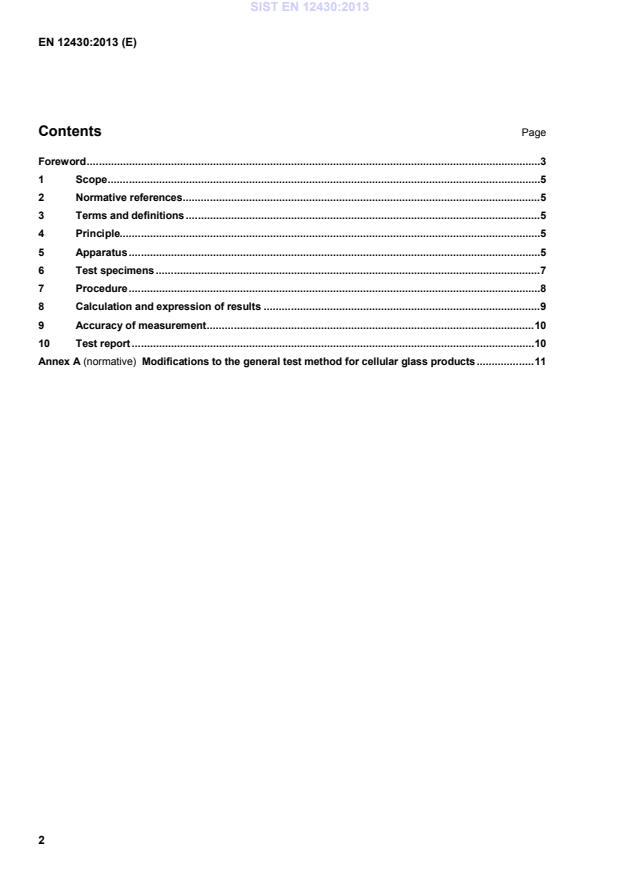
The standard is organized into clauses 1 to 10, covering scope, references, terms, principle, apparatus, test specimens, procedure, calculation and expression of results, accuracy of measurement, and the test report.
| Annex | What it covers |
|---|---|
| Annex A | Modifications to the general test method for cellular glass products |
A note in the scope says the main method and Annex A are reported and interpreted differently, so their results are not suitable for direct comparison. In practice, that matters when choosing the right method for the product type.
What are the key requirements of SIST EN 12430:2013?
SIST EN 12430:2013 requires a point load test that presses on a small area of a square test specimen in the direction normal to its major faces. The result is the compressive force at the critical point and/or the force at a specified deformation.
Test principle and equipment
Clause 4 applies the load with an indentor moving at a given speed, perpendicular to the major faces. Clause 5 specifies a compression testing machine, a cylindrical steel indentor of 79.8 mm diameter, displacement measurement, force measurement and a recording device for the force-deformation curve. In practice, the setup must let you record both force and displacement continuously.
Test specimens
Clause 6 requires specimens at the original product thickness, with skins, facings and coatings retained. The usual specimen size is 300 mm x 300 mm, unless a relevant product standard or other European Technical Specification says otherwise. If no number is given, use at least three specimens. This matters because specimen preparation can change the measured behaviour.
The same clause also requires the specimen to be cut so the base is normal to the direction of compression in use, and stored for at least 6 h at 23 °C ± 5 °C. For disputes, the conditioning atmosphere is 23 °C ± 2 °C and 50 % ± 5 % relative humidity.
Procedure and stopping point
Clause 7 sets the test conditions at 23 °C ± 5 °C, or the dispute conditions above. The test uses a preload of 2.5 N ± 0.25 N, a constant speed of 50 mm/min ± 5 mm/min, and continues until the critical point can be determined and/or the deformation reaches 20 %. In practice, this means the operator must capture the full force-deformation response, not only a single load value.
Results, accuracy and report
Clause 8 says results are mean values, expressed to two significant figures, and not extrapolated to other thicknesses. The standard allows reporting force at the critical point, point load at a chosen deformation such as 5 mm, or the full force-deformation curve when there is no yield point. Clause 9 gives estimated repeatability and reproducibility from round robin experience, using ISO 5725-2 terms. Clause 10 lists what the test report must include, especially product identification, sampling and conditioning details, deviations, and all individual and mean results.
Cellular glass products
Annex A replaces parts of the general method for cellular glass. It adds a positioning device, uses full-size products or quarter sections, changes the preload and loading rate, requires testing both major faces, and defines a deformation result based on the net displacement between 100 N and 1 000 N. For cellular glass, this is the method to follow if you need the product-specific result.
What terms does SIST EN 12430:2013 define?
- Point load - a compressive force applied by a circular indentor with a 50 cm2 cross section.
- Critical point - the point on the force-deformation curve where a tangent separates from the curve.
- Force-deformation curve - the recorded relationship between applied force and resulting displacement during the test.
- Compressional force at the critical point, Fp - the force value taken at the critical point and reported in kilonewtons.
- Deformation at the critical point, εFp - the deformation measured at the critical point, reported in millimetres.
- Pd - the deformation result used in Annex A for cellular glass products, based on the net displacement under 100 N and 1 000 N.
Who uses SIST EN 12430:2013?
SIST EN 12430:2013 is used by testing laboratories, manufacturers of thermal insulating products, and specifiers of building insulation. Quality managers use it for product control and comparison of test results, while buyers and technical reviewers use it to check whether a product can resist direct point loads in service. It is especially relevant for products used in building applications and for cases where pedestrian traffic may apply local loads.
What changed in SIST EN 12430:2013 from the previous edition?
SIST EN 12430:2013 supersedes EN 12430:1998. The foreword states that the revision contains no major changes, only minor editorial corrections and clarifications.
Which standards are used with SIST EN 12430:2013?
- EN 12085 - used for measuring the linear dimensions of test specimens before testing.
- ISO 5725-2 - used for the accuracy terms applied to repeatability and reproducibility.
- Relevant product standard or other European Technical Specification - used where the standard allows the number of specimens, special dimensions, test conditions, or result expression to be specified.
What does the SIST EN 12430:2013 document contain?
The document contains the test principle, apparatus details, specimen preparation rules, test procedure, calculation rules, accuracy information and a reporting checklist. It includes figures for the test setup, the specimen and the cylindrical indentor, plus force-deformation curve examples. Table 1 gives estimated accuracy values, and Annex A includes figures showing indentor positions for cellular glass products and a modified procedure for that product family. The report clause is practical for laboratories because it shows exactly which product, sampling and result details should be recorded.
Relations
- Effective Date
- 01-Jul-2013
- Effective Date
- 01-Jul-2013
- Effective Date
- 25-Aug-2026
- Effective Date
- 28-Jan-2026
- Effective Date
- 28-Jan-2026
- Effective Date
- 28-Jan-2026
- Effective Date
- 28-Jan-2026
- Effective Date
- 28-Jan-2026
- Effective Date
- 28-Jan-2026
- Effective Date
- 28-Jan-2026
- Effective Date
- 28-Jan-2026
- Effective Date
- 28-Jan-2026
- Effective Date
- 28-Jan-2026
- Effective Date
- 28-Jan-2026
- Effective Date
- 28-Jan-2026
Get Certified
Connect with accredited certification bodies for this standard

DIBt (Deutsches Institut für Bautechnik)
German Institute for Building Technology.
DIN CERTCO
DIN Group product certification.

Aboma Certification B.V.
Specialized in construction, metal, and transport sectors.
Sponsored listings
Frequently Asked Questions
SIST EN 12430:2013 is a standard published by the Slovenian Institute for Standardization (SIST). Its full title is "Thermal insulating products for building applications - Determination of behaviour under point load". This standard covers: This European Standard specifies equipment and procedures for determining the behaviour of products under a force applied to a small area of a test specimen at a given speed. It is applicable to thermal insulating products. This European Standard can be used to determine whether the products have sufficient strength to withstand forces applied directly to them either during installation or during application, mainly caused by pedestrian traffic. NOTE The test methods given in the main body of the standard and in Annex A are reported and interpreted in different ways. The similarities that exist between the methods are not sufficient to permit reasonable comparisons to be made.
This European Standard specifies equipment and procedures for determining the behaviour of products under a force applied to a small area of a test specimen at a given speed. It is applicable to thermal insulating products. This European Standard can be used to determine whether the products have sufficient strength to withstand forces applied directly to them either during installation or during application, mainly caused by pedestrian traffic. NOTE The test methods given in the main body of the standard and in Annex A are reported and interpreted in different ways. The similarities that exist between the methods are not sufficient to permit reasonable comparisons to be made.
SIST EN 12430:2013 is classified under the following ICS (International Classification for Standards) categories: 91.100.60 - Thermal and sound insulating materials. The ICS classification helps identify the subject area and facilitates finding related standards.
SIST EN 12430:2013 has the following relationships with other standards: It is inter standard links to SIST EN 12430:1999/A1:2007, SIST EN 12430:1999, SIST ISO 5725-2:2003, SIST EN ISO 29768:2022, SIST ENV 14237:2002, SIST EN 14305:2010+A1:2013, SIST EN 13169:2013+A1:2015, SIST EN 16069:2013+A1:2015, SIST EN 13162:2013+A1:2015, SIST EN 14305:2010, SIST EN 14305:2016, SIST EN 13170:2013+A1:2015, SIST EN 13168:2013+A1:2015, SIST EN 13167:2013+A1:2015, SIST EN 13171:2013+A1:2015. Understanding these relationships helps ensure you are using the most current and applicable version of the standard.
SIST EN 12430:2013 is associated with the following European legislation: EU Directives/Regulations: 305/2011, 89/106/EEC. When a standard is cited in the Official Journal of the European Union, products manufactured in conformity with it benefit from a presumption of conformity with the essential requirements of the corresponding EU directive or regulation.
SIST EN 12430:2013 is available in PDF format for immediate download after purchase. The document can be added to your cart and obtained through the secure checkout process. Digital delivery ensures instant access to the complete standard document.
Standards Content (Sample)
2003-01.Slovenski inštitut za standardizacijo. Razmnoževanje celote ali delov tega standarda ni dovoljeno.Wärmedämmstoffe für das Bauwesen - Bestimmung des Verhaltens unter PunktlastProduits isolants thermiques destinés aux applications du bâtiment - Détermination du comportement sous charge ponctuelleThermal insulating products for building applications - Determination of behaviour under point load91.100.60Thermal and sound insulating materialsICS:Ta slovenski standard je istoveten z:EN 12430:2013SIST EN 12430:2013en,fr,de01-julij-2013SIST EN 12430:2013SLOVENSKI
STANDARDSIST EN 12430:1999/A1:2007SIST EN 12430:19991DGRPHãþD
EUROPEAN STANDARD NORME EUROPÉENNE EUROPÄISCHE NORM
EN 12430
March 2013 ICS 91.100.60 Supersedes EN 12430:1998English Version
Thermal insulating products for building applications - Determination of behaviour under point load
Produits isolants thermiques destinés aux applications du bâtiment - Détermination du comportement sous charge ponctuelle
Wärmedämmstoffe für das Bauwesen - Bestimmung des Verhaltens unter Punktlast This European Standard was approved by CEN on 15 December 2012.
CEN members are bound to comply with the CEN/CENELEC Internal Regulations which stipulate the conditions for giving this European Standard the status of a national standard without any alteration. Up-to-date lists and bibliographical references concerning such national standards may be obtained on application to the CEN-CENELEC Management Centre or to any CEN member.
This European Standard exists in three official versions (English, French, German). A version in any other language made by translation under the responsibility of a CEN member into its own language and notified to the CEN-CENELEC Management Centre has the same status as the official versions.
CEN members are the national standards bodies of Austria, Belgium, Bulgaria, Croatia, Cyprus, Czech Republic, Denmark, Estonia, Finland, Former Yugoslav Republic of Macedonia, France, Germany, Greece, Hungary, Iceland, Ireland, Italy, Latvia, Lithuania, Luxembourg, Malta, Netherlands, Norway, Poland, Portugal, Romania, Slovakia, Slovenia, Spain, Sweden, Switzerland, Turkey and United Kingdom.
EUROPEAN COMMITTEE FOR STANDARDIZATION
COMITÉ EUROPÉEN DE NORMALISATION EUROPÄISCHES KOMITEE FÜR NORMUNG
Management Centre:
Avenue Marnix 17,
B-1000 Brussels © 2013 CEN All rights of exploitation in any form and by any means reserved worldwide for CEN national Members. Ref. No. EN 12430:2013: ESIST EN 12430:2013
Modifications to the general test method for cellular glass products . 11
The revision of this standard contains no major changes, only minor corrections and clarifications of an editorial nature. This European Standard is one of a series of standards which specify test methods for determining dimensions and properties of thermal insulating materials and products. It supports a series of product standards for thermal insulating materials and products which derive from the Council Directive of 21 December 1988 on the approximation of laws, regulations and administrative provisions of the Member States relating to construction products (Directive 89/106/EEC) through the consideration of the essential requirements. This European Standard has been drafted for applications in buildings but it may also be used in other areas where it is relevant. This European test standard is one of the following group of interrelated standards on test methods for determining dimensions and properties of thermal insulation materials and products, all of which fall within the scope of CEN/TC 88: EN 822, Thermal insulating products for building applications — Determination of length and width EN 823, Thermal insulating products for building applications — Determination of thickness EN 824, Thermal insulating products for building applications — Determination of squareness EN 825, Thermal insulating products for building applications — Determination of flatness EN 826, Thermal insulating products for building applications — Determination of compression behaviour EN 1602, Thermal insulating products for building applications — Determination of the apparent density EN 1603, Thermal insulating products for building applications — Determination of dimensional stability under constant normal laboratory conditions (23 °C/50 % relative humidity) EN 1604, Thermal insulating products for building applications — Determination of dimensional stability under specified temperature and humidity conditions EN 1605, Thermal insulating products for building applications — Determination of deformation under specified compressive load and temperature conditions EN 1606, Thermal insulating products for building applications — Determination of compressive creep SIST EN 12430:2013
...