

SIST EN 16382:2026
(Main)Thermal insulation products for building applications - Determination of the pull-through resistance of plate and spiral plate anchors through thermal insulation
General Information
- Abstract
This document specifies equipment and procedures for determining the pull-through resistance of plate and spiral anchors through thermal insulation.
- Status
- Published
- Public Enquiry End Date
- 23-Jan-2025
- Publication Date
- 05-Feb-2026
- Technical Committee
- TOP - Thermal insulation
- Current Stage
- 6060 - National Implementation/Publication (Adopted Project)
- Start Date
- 29-Jan-2026
- Due Date
- 05-Apr-2026
- Completion Date
- 06-Feb-2026

Overview
SIST EN 16382:2026 is the latest European standard specifying the methods for determining the pull-through resistance of plate and spiral plate anchors through thermal insulation products used in building applications. Published by the Slovenian Institute for Standardization (SIST), this document replaces the 2017 version and brings updated procedures and requirements aligned with EN 16382:2026. The standard ensures that thermal insulation systems with mechanical fixings, such as plate anchors and spiral anchors, meet the necessary performance criteria for building safety and durability.
This standard principally applies to construction and civil engineering fields involving thermal insulation materials, ensuring that mechanical anchors provide secure attachment while maintaining the integrity and efficiency of insulation systems.
Key Topics
- Purpose: Assessment and verification of pull-through resistance for plate and spiral anchors in various types of thermal insulation.
- Scope: Specifies test equipment, specimen preparation, and step-by-step test procedures for determining anchor resistance.
- Test Configurations: Includes methods for testing in middle area, joint, and edge/corner positions of insulation boards.
- Statistical Analysis: Guidance on calculating failure loads and pull-through resistance values using standardized methods.
- Reporting Requirements: Details necessary documentation, including component information, test setup, test results, and observations.
By following SIST EN 16382:2026, manufacturers, laboratories, and quality control personnel can ensure accurate and repeatable measurements of anchor resistance, supporting reliability in insulated facade and cladding systems.
Applications
SIST EN 16382:2026 is vital for professionals working with thermal insulation products for building applications. Its practical uses include:
- System Certification: Ensuring compliance of thermal insulation systems with European regulations for mechanical fastening.
- Product Evaluation: Determining the suitability of anchors and insulation combinations for specific construction projects.
- Quality Control: Supporting manufacturers in routine testing for product reliability and consistency.
- Installation Guidance: Informing best practices for mechanical fixing solutions, especially with plate and spiral anchors in exterior insulation systems.
- Research and Development: Assisting R&D teams to develop insulation solutions and anchors tailored to different building requirements.
Typical stakeholders include construction material suppliers, facade system designers, building contractors, testing laboratories, and regulatory bodies operating in the thermal insulation industry.
Related Standards
For comprehensive implementation, refer to the following standards commonly cited in conjunction with SIST EN 16382:2026:
- EN 206: Concrete – Specification, performance, production and conformity
- EN 1990:2023: Eurocode – Basis of structural and geotechnical design
- EN ISO 9229: Thermal insulation – Vocabulary (ISO 9229)
- EN ISO 29466: Thermal insulating products for building applications – Determination of thickness (ISO 29466)
- ISO 12491: Statistical methods for quality control of building materials and components
- ISO 29765: Thermal insulating products – Determination of tensile strength perpendicular to faces
Aligning with these standards ensures that the determination of pull-through resistance is accurate, internationally recognized, and compatible with other key structural and performance criteria.
Thermal insulation pull-through resistance testing is critical for ensuring strong, durable, and safe building envelopes. SIST EN 16382:2026 delivers a structured framework for such assessments, crucial for modern energy-efficient and sustainable construction practices.
Relations
- Effective Date
- 01-Mar-2026
- Effective Date
- 11-Mar-2026
- Effective Date
- 11-Mar-2026
- Effective Date
- 28-Jan-2026
- Effective Date
- 28-Jan-2026
- Effective Date
- 28-Jan-2026
- Effective Date
- 28-Jan-2026
- Effective Date
- 28-Jan-2026
Get Certified
Connect with accredited certification bodies for this standard

DIBt (Deutsches Institut für Bautechnik)
German Institute for Building Technology.
DIN CERTCO
DIN Group product certification.

Aboma Certification B.V.
Specialized in construction, metal, and transport sectors.
Sponsored listings
Frequently Asked Questions
SIST EN 16382:2026 is a standard published by the Slovenian Institute for Standardization (SIST). Its full title is "Thermal insulation products for building applications - Determination of the pull-through resistance of plate and spiral plate anchors through thermal insulation". This standard covers: This document specifies equipment and procedures for determining the pull-through resistance of plate and spiral anchors through thermal insulation.
This document specifies equipment and procedures for determining the pull-through resistance of plate and spiral anchors through thermal insulation.
SIST EN 16382:2026 is classified under the following ICS (International Classification for Standards) categories: 91.100.60 - Thermal and sound insulating materials. The ICS classification helps identify the subject area and facilitates finding related standards.
SIST EN 16382:2026 has the following relationships with other standards: It is inter standard links to SIST EN 16382:2017, SIST EN 206-2:2026, SIST EN 206-1:2026, SIST EN 480-13:2003, SIST EN 206:2013+A2:2021, SIST EN ISO 9229:2020, SIST EN ISO 29466:2023, kSIST FprEN 1990:2022. Understanding these relationships helps ensure you are using the most current and applicable version of the standard.
SIST EN 16382:2026 is available in PDF format for immediate download after purchase. The document can be added to your cart and obtained through the secure checkout process. Digital delivery ensures instant access to the complete standard document.
Standards Content (Sample)
SLOVENSKI STANDARD
01-marec-2026
Nadomešča:
SIST EN 16382:2017
Toplotnoizolacijski proizvodi za uporabo v gradbeništvu - Ugotavljanje odpornosti
sider proti potegu skozi toplotnoizolacijske proizvode
Thermal insulation products for building applications - Determination of the pull-through
resistance of plate and spiral plate anchors through thermal insulation
Wärmedämmstoffe für das Bauwesen - Bestimmung des Durchzugwiderstandes von
Teller- und Spiraldübeln durch Wärmedämmstoffe
Produits isolants thermiques destinés aux applications du bâtiment - Détermination de la
résistance au déboutonnage des chevilles à rosace plane ou hélicoïdales dans les
produits isolants thermiques
Ta slovenski standard je istoveten z: EN 16382:2026
ICS:
91.100.60 Materiali za toplotno in Thermal and sound insulating
zvočno izolacijo materials
2003-01.Slovenski inštitut za standardizacijo. Razmnoževanje celote ali delov tega standarda ni dovoljeno.
EN 16382
EUROPEAN STANDARD
NORME EUROPÉENNE
January 2026
EUROPÄISCHE NORM
ICS 91.100.60 Supersedes EN 16382:2016
English Version
Thermal insulation products for building applications -
Determination of the pull-through resistance of plate and
spiral plate anchors through thermal insulation
Produits isolants thermiques destinés aux applications Wärmedämmstoffe für das Bauwesen - Bestimmung
du bâtiment - Détermination de la résistance au des Durchzugwiderstandes von Teller- und
déboutonnage des chevilles à rosace plane ou Spiraldübeln durch Wärmedämmstoffe
hélicoïdales dans les produits isolants thermiques
This European Standard was approved by CEN on 24 November 2025.
CEN members are bound to comply with the CEN/CENELEC Internal Regulations which stipulate the conditions for giving this
European Standard the status of a national standard without any alteration. Up-to-date lists and bibliographical references
concerning such national standards may be obtained on application to the CEN-CENELEC Management Centre or to any CEN
member.
This European Standard exists in three official versions (English, French, German). A version in any other language made by
translation under the responsibility of a CEN member into its own language and notified to the CEN-CENELEC Management
Centre has the same status as the official versions.
CEN members are the national standards bodies of Austria, Belgium, Bulgaria, Croatia, Cyprus, Czech Republic, Denmark, Estonia,
Finland, France, Germany, Greece, Hungary, Iceland, Ireland, Italy, Latvia, Lithuania, Luxembourg, Malta, Netherlands, Norway,
Poland, Portugal, Republic of North Macedonia, Romania, Serbia, Slovakia, Slovenia, Spain, Sweden, Switzerland, Türkiye and
United Kingdom.
EUROPEAN COMMITTEE FOR STANDARDIZATION
COMITÉ EUROPÉEN DE NORMALISATION
EUROPÄISCHES KOMITEE FÜR NORMUNG
CEN-CENELEC Management Centre: Rue de la Science 23, B-1040 Brussels
© 2026 CEN All rights of exploitation in any form and by any means reserved Ref. No. EN 16382:2026 E
worldwide for CEN national Members.
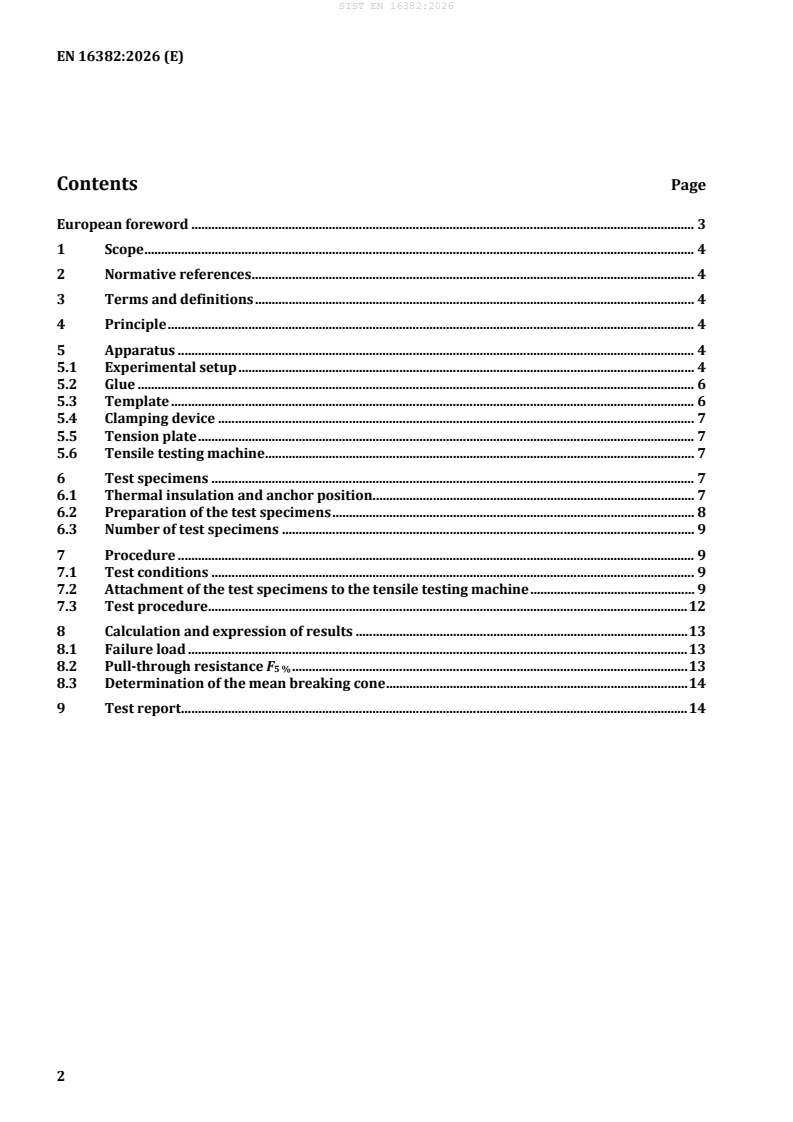
Contents Page
European foreword . 3
1 Scope . 4
2 Normative references . 4
3 Terms and definitions . 4
4 Principle . 4
5 Apparatus . 4
5.1 Experimental setup . 4
5.2 Glue . 6
5.3 Template . 6
5.4 Clamping device . 7
5.5 Tension plate . 7
5.6 Tensile testing machine . 7
6 Test specimens . 7
6.1 Thermal insulation and anchor position . 7
6.2 Preparation of the test specimens . 8
6.3 Number of test specimens . 9
7 Procedure . 9
7.1 Test conditions . 9
7.2 Attachment of the test specimens to the tensile testing machine . 9
7.3 Test procedure . 12
8 Calculation and expression of results . 13
8.1 Failure load . 13
8.2 Pull-through resistance F . 13
5 %
8.3 Determination of the mean breaking cone . 14
9 Test report . 14
European foreword
This document (EN 16382:2026) has been prepared by Technical Committee CEN/TC 88 “Thermal
insulating materials and products”, the secretariat of which is held by DIN.
This European Standard shall be given the status of a national standard, either by publication of an
identical text or by endorsement, at the latest by July 2026, and conflicting national standards shall be
withdrawn at the latest by July 2026.
Attention is drawn to the possibility that some of the elements of this document may be the subject of
patent rights. CEN shall not be held responsible for identifying any or all such patent rights.
This document supersedes EN 16382:2016.
This document includes the following significant technical changes with respect to EN 16382:2016:
— supplementary regulations for the implementation, evaluation and documentation of tests when
using spiral anchors.
Any feedback and questions on this document should be directed to the users’ national standards body.
A complete listing of these bodies can be found on the CEN website.
Any feedback and questions on this document should be directed to the users’ national standards body.
A complete listing of these bodies can be found on the CEN website.
According to the CEN-CENELEC Internal Regulations, the national standards organisations of the
following countries are bound to implement this European Standard: Austria, Belgium, Bulgaria, Croatia,
Cyprus, Czech Republic, Denmark, Estonia, Finland, France, Germany, Greece, Hungary, Iceland, Ireland,
Italy, Latvia, Lithuania, Luxembourg, Malta, Netherlands, Norway, Poland, Portugal, Republic of North
Macedonia, Romania, Serbia, Slovakia, Slovenia, Spain, Sweden, Switzerland, Türkiye and the United
Kingdom.
1 Scope
This document specifies equipment and procedures for determining the pull-through resistance of plate
and spiral anchors through thermal insulation.
2 Normative references
The following documents are referred to in the text in such a way that some or all of their content
constitutes requirements of this document. For dated references, only the edition cited applies. For
undated references, the latest edition of the referenced document (including any amendments) applies.
EN 206, Concrete — Specification, performance, production and conformity
EN 1990:2023, Eurocode — Basis of structural and geotechnical design
EN ISO 9229, Thermal insulation — Vocabulary (ISO 9229)
EN ISO 29466, Thermal insulating products for building applications — Determination of thickness (ISO
29466)
ISO 12491:1997, Statistical methods for quality control of building materials and components
ISO 29765, Thermal insulating products for building applications — Determination of tensile strength
perpendicular to faces
3 Terms and definitions
For the purposes of this document, the terms and definitions given in EN ISO 9229 apply.
ISO and IEC maintain terminology databases for use in standardization at the following addresses:
— ISO Online browsing platform: available at https://www.iso.org/obp
— IEC Electropedia: available at https://www.electropedia.org/
4 Principle
The pull-through resistance of a plate or spiral anchor through thermal insulation is determined by a
direct tensile load perpendicular to the surface of the thermal insulation. The tensile load is applied by
means of a tension plate glued to the test area of the thermal insulation.
5 Apparatus
5.1 Experimental setup
Figure 1 shows the principle of the test setup when using a plate anchor (Figure 1 a) or a spiral anchor
(Figure 1 b).
NOTE In Clause 5, the numbers between brackets refer to the keys of Figure 1 to Figure 3.
The plate or spiral anchor (1) which is to be tested is pulled through the thermal insulation (3). The edges
of the thermal insulation are fixed by two square templates with a centric circular opening (2) and clamps
(7). The anchor is positioned in the centre of the sample according to the manufacturer's instructions.
The circular tension plate (5) is glued (6) onto the thermal insulation. The anchor is covered previously
with a non-adhesive foil. The tension load is introduced to the thermal insulation by the circular tension
plate which fits into the circular opening of the template. The anchorage area of the plate anchor is fixed
by a suitable device. The tension load is exerted until failure.
Dimensions in millimetres
a) Plate anchor b) Spiral anchor
Key
1 plate anchor (left figure) or spiral anchor (right figure) covered with a suitable non-adhesive foil
2 template
3 thermal insulation
4 suitable device for fixation the anchorage area of the anchor
5 tension plate
6 glue
7 clamp
b width of the square template
d plate diameter of the plate anchor including additional washers, if used, or spiral diameter of the spiral
p
anchor
ds diameter of the circular recess in the template
d diameter of the tension plate
z
F tensile load
tI thickness of the thermal insulation
tfix thickness of the fixture
Figure 1 — Principle of the test arrangement
Figure 2 shows schematically the condition after the pull-through test with the insulation material
breaking cone. Figure 3 shows how the maximum distance r at the breaking cone from the insulation
material is determined after the pull-through test.
Dimensions in millimetres
Key
F tensile load
r distance from the centre of the anchor sleeve to the remotest point of the breaking cone
Figure 2 — Schematic presentation of a failure with a breaking cone of the thermal insulation
after pull-through testing
Key
r distance from the centre of the anchor sleeve to the remotest point of the breaking cone
Figure 3 — Determination of the distance r by a breaking cone
5.2 Glue
The glue shall be suitable for the thermal insulation and for the tension plate (e. g. solvent-free epoxy or
polyurethane based). The glue shall not influence the mechanical properties of the insulation.
5.3 Template
The square templates with circular openings shall be rigid. Test results are valid if every distance of the
circular recess to the breaking cone is at least 25 mm.
...