

oSIST prEN IEC 62109-2:2025
(Main)Safety of power converters for use in photovoltaic power systems - Part 2: Particular requirements for inverters
General Information
- Abstract
- Status
- Not Published
- Public Enquiry End Date
- 09-Nov-2025
- Technical Committee
- PVS - Solar photovoltaic energy systems
- Current Stage
- 4020 - Public enquire (PE) (Adopted Project)
- Start Date
- 26-Aug-2025
- Due Date
- 13-Jan-2026
- Completion Date
- 10-Nov-2025



Overview
oSIST prEN IEC 62109-2:2025 is a CLC-adopted international standard developed by IEC technical committee 82, Solar Photovoltaic Energy Systems. This standard specifies the particular safety requirements for inverters in photovoltaic (PV) power systems, supplementing the general requirements of IEC 62109-1. Its primary aim is to ensure that the design and construction of PV inverters protect users and the environment from electrical, mechanical, thermal, fire, and chemical hazards.
This second edition introduces significant technical revisions over the previous issue, aligning inverter safety requirements with the evolving needs of PV installations and incorporating feedback from global stakeholders in the solar energy sector.
Key Topics
- Scope: Addresses PV inverters and DC-to-AC power conversion equipment (PCE) within PV power systems, focusing on equipment with input/output limits up to 1500 V DC and 1000 V AC.
- Safety Protections: Covers protections against electric shock, energy, fire, mechanical, temperature, chemical, sonic pressure, and explosion hazards.
- Testing and Performance: Establishes testing protocols under single fault conditions, with requirements for voltage, frequency, and waveform quality of inverter output.
- Current Limitation: Defines requirements for output current limitation and functional safety for stand-alone inverters, including documentation and performance under normal and fault conditions.
- Design Requirements: Includes marking and documentation standards, environmental protection measures, use of compliant components, and requirements for software/electronics performing safety functions.
- Application of Standards: Specifies the design and operational limits for inverters used in different PV system configurations (stand-alone, grid-interactive, multi-mode).
Applications
IEC 62109-2:2026 is essential for:
- PV inverter manufacturers: As a benchmark for product development, safety qualification, and conformity assessments. Application of these requirements enables certification and global market access for PV inverters.
- Solar project engineers and installers: Provides clear guidelines on inverter selection, installation, and documentation, ensuring safe deployment in residential, commercial, and utility-scale solar energy systems.
- Testing and certification bodies: Used as a reference for safety evaluations, type testing and routine verification of PV inverters.
- AHJs and regulatory agencies: Supports regulatory frameworks for safe integration of PV power generation equipment, particularly for compliance with local installation codes and grid interconnection requirements.
ISO 62109-2 is particularly relevant for grid-tied and stand-alone inverters, including those with integrated battery storage or multiple operating modes. It ensures consistent safety standards across a rapidly innovating solar power market.
Related Standards
- IEC 62109-1: Safety of Power Converters for Use in Photovoltaic Power Systems – General requirements. Forms the foundation; Part 2 is applied in conjunction.
- IEC 63112: Addresses inverter isolation and array grounding for PV earth fault protection.
- IEC 61439-8: Applies to stand-alone PV combiners.
- IEC 60947-6-1, IEC 62310-1, IEC 62991: Reference standards for switchgear, transfer, and source switching equipment used with or integrated in PV inverters.
- Relevant grid codes: EN 50549-1, IEEE 1547, DIN VDE-AR-N 4105, AS/NZS 4777.2 specify additional grid interconnection requirements for PV inverters operating in different jurisdictions.
Note: EMC requirements and functional reliability beyond safety are outside the scope of IEC 62109-2 and are addressed by other applicable standards and codes.
Keywords: IEC 62109-2, photovoltaic inverters, PV inverter safety, solar power system standards, inverter current limitation, inverter testing, CLC, solar energy engineering, PV system protection
Relations
- Effective Date
- 26-Jan-2023
- Effective Date
- 28-Sep-2021
Get Certified
Connect with accredited certification bodies for this standard

DNV
DNV is an independent assurance and risk management provider.

Lloyd's Register
Lloyd's Register is a global professional services organisation specialising in engineering and technology.
DNV Energy Systems
Energy and renewable energy certification.
Sponsored listings
Frequently Asked Questions
oSIST prEN IEC 62109-2:2025 is a draft published by the Slovenian Institute for Standardization (SIST). Its full title is "Safety of power converters for use in photovoltaic power systems - Part 2: Particular requirements for inverters". This standard covers: Safety of power converters for use in photovoltaic power systems - Part 2: Particular requirements for inverters
Safety of power converters for use in photovoltaic power systems - Part 2: Particular requirements for inverters
oSIST prEN IEC 62109-2:2025 is classified under the following ICS (International Classification for Standards) categories: 27.160 - Solar energy engineering; 29.200 - Rectifiers. Convertors. Stabilized power supply. The ICS classification helps identify the subject area and facilitates finding related standards.
oSIST prEN IEC 62109-2:2025 has the following relationships with other standards: It is inter standard links to SIST EN 62109-2:2011, SIST EN 62109-2:2011. Understanding these relationships helps ensure you are using the most current and applicable version of the standard.
oSIST prEN IEC 62109-2:2025 is associated with the following European legislation: EU Directives/Regulations: 2014/35/EU; Standardization Mandates: M/511. When a standard is cited in the Official Journal of the European Union, products manufactured in conformity with it benefit from a presumption of conformity with the essential requirements of the corresponding EU directive or regulation.
oSIST prEN IEC 62109-2:2025 is available in PDF format for immediate download after purchase. The document can be added to your cart and obtained through the secure checkout process. Digital delivery ensures instant access to the complete standard document.
Standards Content (Sample)
SLOVENSKI STANDARD
01-november-2025
Varnost močnostnih pretvornikov, ki se uporabljajo v fotonapetostnih sistemih - 2.
del: Posebne zahteve za razsmernike
Safety of power converters for use in photovoltaic power systems - Part 2: Particular
requirements for inverters
Sicherheit von Leistungsumrichtern zur Anwendung in photovoltaischen
Energiesystemen - Teil 2: Besondere Anforderungen an Wechselrichter
Sécurité des convertisseurs de puissance utilisés dans les systèmes photovoltaïques -
Partie 2: Exigences particulières pour les onduleurs
Ta slovenski standard je istoveten z: prEN IEC 62109-2:2025
ICS:
27.160 Sončna energija Solar energy engineering
29.200 Usmerniki. Pretvorniki. Rectifiers. Convertors.
Stabilizirano električno Stabilized power supply
napajanje
2003-01.Slovenski inštitut za standardizacijo. Razmnoževanje celote ali delov tega standarda ni dovoljeno.
82/2460/CDV
COMMITTEE DRAFT FOR VOTE (CDV)
PROJECT NUMBER:
IEC 62109-2 ED2
DATE OF CIRCULATION: CLOSING DATE FOR VOTING:
2025-08-22 2025-11-14
SUPERSEDES DOCUMENTS:
82/2214/CD, 82/2251A/CC
IEC TC 82 : SOLAR PHOTOVOLTAIC ENERGY SYSTEMS
SECRETARIAT: SECRETARY:
United States of America Mr George Kelly
OF INTEREST TO THE FOLLOWING COMMITTEES: HORIZONTAL FUNCTION(S):
ASPECTS CONCERNED:
Safety
SUBMITTED FOR CENELEC PARALLEL VOTING NOT SUBMITTED FOR CENELEC PARALLEL VOTING
Attention IEC-CENELEC parallel voting
The attention of IEC National Committees, members of
CENELEC, is drawn to the fact that this Committee Draft
for Vote (CDV) is submitted for parallel voting.
The CENELEC members are invited to vote through the
CENELEC online voting system.
This document is still under study and subject to change. It should not be used for reference purposes.
Recipients of this document are invited to submit, with their comments, notification of any relevant patent rights of
which they are aware and to provide supporting documentation.
Recipients of this document are invited to submit, with their comments, notification of any relevant “In Some
Countries” clauses to be included should this proposal proceed. Recipients are reminded that the CDV stage is
the final stage for submitting ISC clauses. (SEE AC/22/2007 OR NEW GUIDANCE DOC).
TITLE:
Safety of power converters for use in photovoltaic power systems - Part 2: Particular
requirements for inverters
PROPOSED STABILITY DATE: 2031
NOTE FROM TC/SC OFFICERS:
This project was discussed and supported by WG6 during their meeting in 2025-05.
electronic file, to make a copy and to print out the content for the sole purpose of preparing National Committee positions.
You may not copy or "mirror" the file or printed version of the document, or any part of it, for any other purpose without
permission in writing from IEC.
IEC CDV 62109-2 Ed 2 IEC 2025
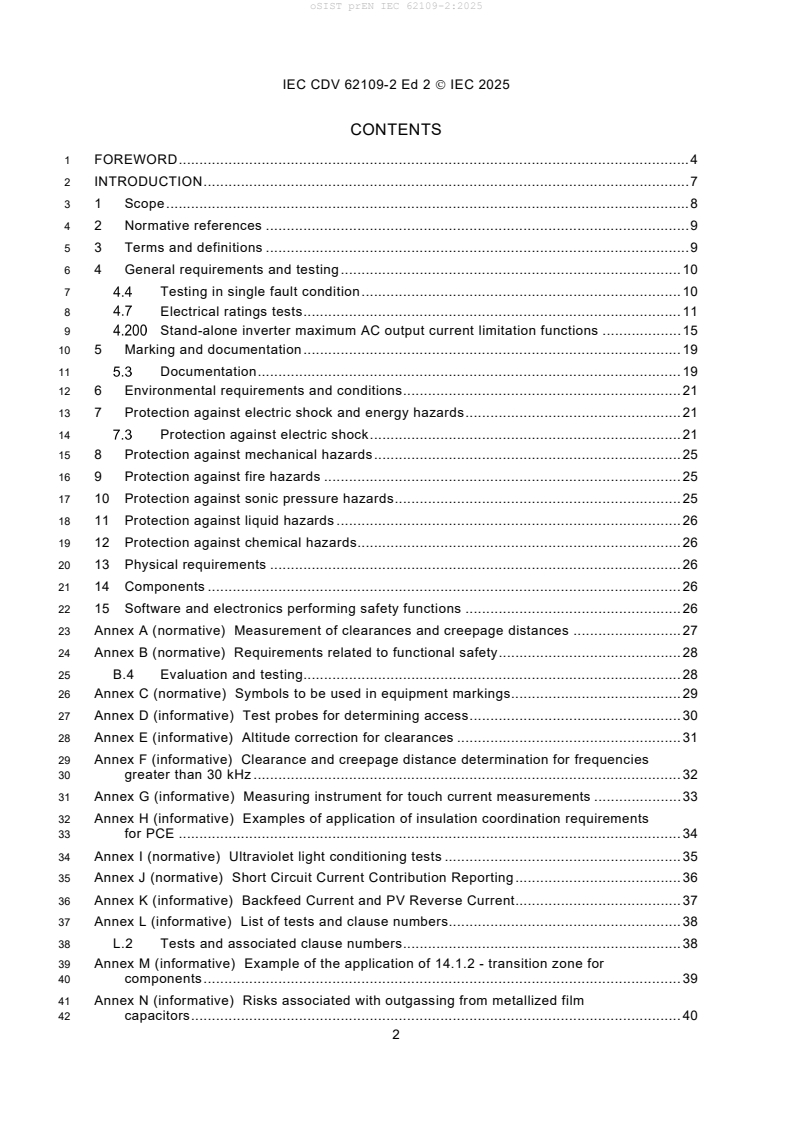
CONTENTS
1 FOREWORD . 4
2 INTRODUCTION . 7
3 1 Scope . 8
4 2 Normative references . 9
5 3 Terms and definitions . 9
6 4 General requirements and testing . 10
7 Testing in single fault condition . 10
8 Electrical ratings tests . 11
9 Stand-alone inverter maximum AC output current limitation functions . 15
10 5 Marking and documentation . 19
11 Documentation . 19
12 6 Environmental requirements and conditions . 21
13 7 Protection against electric shock and energy hazards . 21
14 Protection against electric shock . 21
15 8 Protection against mechanical hazards . 25
16 9 Protection against fire hazards . 25
17 10 Protection against sonic pressure hazards . 25
18 11 Protection against liquid hazards . 26
19 12 Protection against chemical hazards. 26
20 13 Physical requirements . 26
21 14 Components . 26
22 15 Software and electronics performing safety functions . 26
23 Annex A (normative) Measurement of clearances and creepage distances . 27
24 Annex B (normative) Requirements related to functional safety . 28
25 B.4 Evaluation and testing. 28
26 Annex C (normative) Symbols to be used in equipment markings. 29
27 Annex D (informative) Test probes for determining access . 30
28 Annex E (informative) Altitude correction for clearances . 31
29 Annex F (informative) Clearance and creepage distance determination for frequencies
30 greater than 30 kHz . 32
31 Annex G (informative) Measuring instrument for touch current measurements . 33
32 Annex H (informative) Examples of application of insulation coordination requirements
33 for PCE . 34
34 Annex I (normative) Ultraviolet light conditioning tests . 35
35 Annex J (normative) Short Circuit Current Contribution Reporting . 36
36 Annex K (informative) Backfeed Current and PV Reverse Current. 37
37 Annex L (informative) List of tests and clause numbers. 38
38 L.2 Tests and associated clause numbers . 38
39 Annex M (informative) Example of the application of 14.1.2 - transition zone for
40 components . 39
41 Annex N (informative) Risks associated with outgassing from metallized film
42 capacitors . 40
IEC CDV 62109-2 Ed 2 IEC 2025
43 Annex 200.A (informative) Background, rationale, and example regarding the
44 protection against DC shock hazard on the AC mains for grid-interactive inverters . 41
45 Bibliography . 44
Figures
46 Figure 4-200 – Concept of cumulative overvoltage duration . 14
47 Figure 200.A.1 – Example system discussed in 200.A.3 . 42
Tables
48 Table 4-200 – – Cumulative Overvoltage Duration Limits . 12
49 Table B.2 – Example PCE safety functions and control function classes . 28
50 Table L.1 – List of tests and clause numbers . 38
IEC CDV 62109-2 Ed 2 IEC 2025
INTERNATIONAL ELECTROTECHNICAL COMMISSION
____________
PHOTOVOLTAIC POWER SYSTEMS - SAFETY- POWER CONVERSION
EQUIPMENT
Part 2: Particular requirements for inverters
FOREWORD
1) The International Electrotechnical Commission (IEC) is a worldwide organization for standardization comprising
all national electrotechnical committees (IEC National Committees). The object of IEC is to promote international
co-operation on all questions concerning standardization in the electrical and electronic fields. To this end and
in addition to other activities, IEC publishes International Standards, Technical Specifications, Technical Reports,
Publicly Available Specifications (PAS) and Guides (hereafter referred to as “IEC Publication(s)”). Their
preparation is entrusted to technical committees; any IEC National Committee interested in the subject dealt with
may participate in this preparatory work. International, governmental and non-governmental organizations liaising
with the IEC also participate in this preparation. IEC collaborates closely with the International Organization for
Standardization (ISO) in accordance with conditions determined by agreement between the two organizations.
2) The formal decisions or agreements of IEC on technical matters express, as nearly as possible, an international
consensus of opinion on the relevant subjects since each technical committee has representation from all
interested IEC National Committees.
3) IEC Publications have the form of recommendations for international use and are accepted by IEC National
Committees in that sense. While all reasonable efforts are made to ensure that the technical content of IEC
Publications is accurate, IEC cannot be held responsible for the way in which they are used or for any
misinterpretation by any end user.
4) In order to promote international uniformity, IEC National Committees undertake to apply IEC Publications
transparently to the maximum extent possible in their national and regional publications. Any divergence between
any IEC Publication and the corresponding national or regional publication shall be clearly indicated in the latter.
5) IEC itself does not provide any attestation of conformity. Independent certification bodies provide conformity
assessment services and, in some areas, access to IEC marks of conformity. IEC is not responsible for any
services carried out by independent certification bodies.
6) All users should ensure that they have the latest edition of this publication.
7) No liability shall attach to IEC or its directors, employees, servants or agents including individual experts and
members of its technical committees and IEC National Committees for any personal injury, property damage or
other damage of any nature whatsoever, whether direct or indirect, or for costs (including legal fees) and
expenses arising out of the publication, use of, or reliance upon, this IEC Publication or any other IEC
Publications.
8) Attention is drawn to the Normative references cited in this publication. Use of the referenced publications is
indispensable for the correct application of this publication.
9) Attention is drawn to the possibility that some of the elements of this IEC Publication may be the subject of patent
rights. IEC shall not be held responsible for identifying any or all such patent rights.
IEC 62109-2 has been prepared by Working Group 6 of IEC technical committee 82: Solar
photovoltaic energy systems. It is an International Standard.
nd st
This 2 edition cancels and replaces the 1 edition published in 2011. This edition constitutes
a technical revision.
This edition includes the following significant technical changes with respect to the previous
edition:
51 – Applicable requirements changes given in the similar list in Part 1 Ed. 2, insofar as they
52 apply in this document
53 – Removal of transportable and handheld equipment from the Scope, and of specifically-
54 related requirements
55 – Addition of requirements for transfer switches and source switching equipment, including
56 addition of a load transfer test
IEC CDV 62109-2 Ed 2 IEC 2025
57 – Changes to the requirements for transient output voltage variations including added
58 cumulative overvoltage duration limits
59 – Changes to the requirements for steady state output frequency
60 – Removal of allowances for intentionally non-sinusoidal output waveforms
61 – Removal of requirements regarding inverter isolation and array grounding related to PV
62 earth fault protection (now changed and covered in Part 1 Ed. 2 with reference to IEC 63112)
63 – Addition of requirements for stand-alone inverter maximum AC output current limitation
64 functions including Functional Safety aspects
65 – Changes to the requirements for fault tolerance of automatic disconnecting means (also
66 moved into cl. 7.3.201 and re-titled as “Protection against DC shock hazard on the AC mains
67 for grid-interactive inverters”) including Functional Safety aspects
68 – Removal of requirements for inverter backfeed current onto the PV array (now covered in
69 Part 1 Ed. 2)
70 – Removal of requirements for fault indication (now covered in Part 1 Ed. 2)
The text of this International Standard is based on the following documents:
FDIS Report on voting
82/XXX/FDIS 82/XXXA/RVD
Full information on the voting for the approval can be found in the report on voting indicated in
the above table.
The language used for the development of this International Standard is English.
This document was drafted in accordance with ISO/IEC Directives, Part 2, and developed in
accordance with ISO/IEC Directives, Part 1 and ISO/IEC Directives, IEC Supplement, available
at www.iec.ch/members_experts/refdocs. The main document types developed by IEC are
described in greater detail at www.iec.ch/publications.
A list of all parts of IEC 62109 series, under the general title Photovoltaic power systems -
Safety - Power conversion equipment, can be found on the IEC website.
The requirements in this Part 2 of the IEC 62109 series are to be used with the requirements
in Part 1, and supplement, modify, or replace clauses in Part 1 as follows:
71 – When a particular clause or subclause of Part 1 is not mentioned in this Part 2, that clause
72 of Part 1 applies;
73 – When this Part 2 contains clauses that add to or modify clauses in Part 1, the relevant text
74 of Part 1 is to be applied with the required changes; and
75 – When this Part 2 contains clauses that replace clauses in Part 1, the associated clause in
76 Part 1 does not apply: only the replacement clause in Part 2 applies.
Subclauses, figures and tables additional to those in Part 1 are numbered starting from 200 to
indicate that they are introduced in this Part 2. Annexes added in this Part 2 are numbered
starting from 200.A.
NOTE: For example, new level 2 subclauses in clause 5 would be numbered 5.200, 5.201, etc. New level 4 subclauses
in subclause 7.3.4 would be numbered 7.3.4.200, 7.3.4.201, etc.
All references to “Part 1”in this Part 2 shall be taken as dated references to
IEC 62109-1:20XX Edition 2 (in preparation).
IEC CDV 62109-2 Ed 2 IEC 2025
The committee has decided that the contents of this publication will remain unchanged until the
stability date indicated on the IEC web site under "http://webstore.iec.ch" in the data related to
the specific publication. At this date, the publication will be
• reconfirmed,
• withdrawn,
• replaced by a revised edition, or
• amended.
IEC CDV 62109-2 Ed 2 IEC 2025
77 INTRODUCTION
78 This Part 2 of IEC 62109 specifies the safety requirements for photovoltaic grid-interactive,
79 multi-mode, and stand-alone inverters. This equipment has potentially hazardous input sources
80 and output circuits, internal components, and features and functions, which demand different
81 or additional requirements for safety than those given in Part 1.
IEC CDV 62109-2 Ed 2 IEC 2025
83 PHOTOVOLTAIC POWER SYSTEMS - SAFETY - POWER CONVERSION
84 EQUIPMENT
86 Part 2: Particular requirements for inverters
88 1 Scope
89 This Part 2 of IEC 62109 covers the particular safety requirements relevant to DC to AC power
90 conversion equipment (PCE) intended for use in photovoltaic power systems, herein referred
91 to as “PV inverters” or simply “inverters”. This Part 2 is also applicable to PCE that have or
92 perform inverter functions in addition to other functions.
93 This standard defines the minimum requirements for the design and manufacture of inverters
94 for protection against electric shock, energy, fire, mechanical and other hazards.
95 This standard covers PV inverters with inputs and outputs not exceeding the low voltage limits
96 of 1 500 V DC and 1 000 V AC, line to line and line to earth, including PV, battery, mains and
97 non-mains AC systems, or other sources. This standard may also be used for accessories for
98 use with PV inverters, except where more appropriate standards exist. Where a PV combiner
99 is integrated into an inverter, the combiner is considered a part of the inverter and this document
100 applies.
101 NOTE 1 Stand-alone PV combiners are the subject of IEC 61439-8, in preparation
102 Inverters with multiple functions or modes shall be judged against all applicable requirements
103 for each of those functions and modes.
104 NOTE 1 Throughout this document, where terms such as “inverter” are used, the meaning is either a PCE that is
105 an inverter or an inverter operating mode of a multi-mode PCE.
106 This standard does not address grid interconnection requirements for grid-interactive inverters.
107 NOTE 2 Users of this standard should be aware that in most jurisdictions there are national or local requirements
108 that must be met by systems using grid-interactive inverters. Examples include EN 50549-1, IEEE 1547, DIN VDE-
109 AR-N 4105, and AS/NZS 4777.2
110 Aspects included in scope:
111 The purpose of the requirements of this part of IEC 62109 is to ensure that the design and
112 methods of construction used provide adequate protection for the operator and the surrounding
113 area against:
114 a) electric shock and energy hazards;
115 b) mechanical hazards;
116 c) excessive temperature hazards;
117 d) spread of fire from the equipment;
118 e) chemical hazards;
119 f) sonic pressure hazards;
120 g) liberated fluids, gases and explosion hazards.
121 NOTE 3 Servicing personnel are expected to have the necessary knowledge and skill to use reasonable care in
122 dealing with hazards associated with the operation, repair and maintenance of this equipment. Based upon this
123 premise, this standard provides only limited requirements (for example markings or guarding) intended to protect
124 service personnel from hazards that may not be apparent even to trained personnel.
IEC CDV 62109-2 Ed 2 IEC 2025
128 Aspects excluded from scope: Aspects not covered by this standard include, but are not limited
129 to, the following:
130 i) functional reliability, performance or other properties of the equipment not related to
131 safety;
132 ii) ability to withstand expected storage and transportation environments;
133 iii) EMC requirements except where related to Functional Safety;
134 iv) installation requirements, which are covered by local and national installation codes.
135 NOTE 4 This standard does provide requirements intended to ensure that the inverter can be installed in a safe
136 manner by skilled persons, including requirements for installation instructions provided with the product.
137 v) transportable and handheld equipment
138 NOTE 5 The term transportable refers to equipment intended to be regularly moved between various operating
139 sites. The term handheld refers to equipment intended to be held during operation. Neither of these conditions
140 is typical for PV PCE.
141 vi) characteristics of power sources other than photovoltaic systems, such as wind turbines,
142 fuel cells, rotating machine sources, etc.
143 vii) requirements for special installation environments such as explosive atmospheres (see
144 IEC 60079), aircraft, marine installations, or electromedical applications (see IEC 60601)
146 2 Normative references
147 This clause of Part 1 is applicable except as follows:
148 Additions:
149 IEC 60947-6-1, Low-voltage switchgear and controlgear – Part 6-1: Multiple function equipment
150 – Transfer switching equipment
151 IEC 62109-1:20XX, Edition 2 (in preparation) - Photovoltaic Power Systems - Safety - Power
152 Conversion Equipment - Part 1: General requirements
153 IEC 62310-1, Static transfer systems (STS) Part 1: General and safety requirements
154 IEC 62991, Particular requirements for source switching equipment (SSE)
155 3 Terms and definitions
156 This clause of Part 1 is applicable except as follows:
157 Additions:
IEC CDV 62109-2 Ed 2 IEC 2025
159 critical load(s)
160 AC loads that are supplied from a multi-mode inverter in its backup (stand-alone) mode, and
161 may also be supplied from the AC mains at other times
163 separated inverter
164 inverter with at least simple separation between the mains and PV circuits
165 NOTE 1 to entry: In an inverter connecting to more than two external circuits, there can be separation between some
166 pairs of circuits and no separation between others. For example, an inverter with PV, battery, and mains circuits can
167 provide separation between the mains circuit and the PV circuit, but no separation between the PV and battery
168 circuits. In this standard, the term separated inverter is used as defined above – referring to separation between the
169 mains and PV circuits. If two circuits other than the mains and PV circuits are being discussed, additional wording is
170 used to clarify the meaning.
171 NOTE 2 to entry: This term refers to an inverter with integral separation or with separation provided externally by a
172 transformer with at least simple separation
175 non-separated inverter
176 inverter without at least simple separation between the AC mains and PV circuits
177 Note 1 to entry See notes under 3.201
179 4 General requirements and testing
180 This clause of Part 1 is applicable except as follows:
181 Testing in single fault condition
182 Single fault conditions to be applied
183 Additional subclauses:
184 4.4.4.200 Stand-alone inverters – Load transfer test
185 NOTE As used throughout this document, and as defined in Part 1, the terms “stand-alone” and “stand-alone
186 inverter” (etc.) refer to a stand-alone mode of operation, whether that is the only mode of operation the inverter has
187 or whether it is one mode in a multi-mode inverter.
188 A stand-alone inverter with a transfer switch to transfer AC loads from the mains or other AC
189 bypass source to the inverter output shall not present a risk of fire or shock as the result of an
190 out-of-phase transfer.
191 Compliance is checked by the following test. The bypass AC source is to be displaced 180°
192 from the AC output of a single-phase inverter and 120° for a 3-phase supply. The transfer switch
193 is to be subjected to one operation of switching the load from the AC output of the inverter to
194 the bypass AC source. The load is to be adjusted to draw maximum rated AC power.
195 For an inverter employing a bypass switch having a control preventing switching between two
196 AC sources out of synchronization, the test is to be conducted under the condition of a
197 component malfunction when such a condition could result in an out-of-phase transfer between
198 the two AC sources of supply.
IEC CDV 62109-2 Ed 2 IEC 2025
199 Electrical ratings tests
200 Additional subclauses:
202 Measurement requirements for AC output ports for stand-alone inverters
203 Measurements of the AC output voltage and current on a stand-alone inverter shall be made
204 with a meter that indicates the true RMS value.
205 Stand-alone inverter AC output voltage and frequency
206 4.7.201.1 General
207 This section does not apply to grid-forming inverters which supply AC voltage in parallel with
208 AC mains circuits.
209 NOTE As defined in Part 1, stand-alone inverters supply AC voltage to power an output circuit that is not connected
210 to the AC mains. For grid-forming inverters, requirements for AC output voltage and frequency are the subject of grid
211 codes (grid interconnection standards).
212 The AC output voltage and frequency of a stand-alone inverter, shall comply with the
213 requirements of 4.7.201.2 to 4.7.201.5.
214 For an inverter with more than one nominal AC output voltage and/or frequency (e.g. settable
215 in firmware or with transformer taps etc.) the requirements apply to all voltage and frequency
216 settings. Where tests are required in this clause, testing may be reduced if analysis shows one
217 or more setting or settings to be worst-case.
218 4.7.201.2 Steady state output voltage at nominal DC input
219 The RMS steady-state AC output voltage shall not be less than 90 % or more than 110 % of the
220 rated nominal voltage under test with the inverter supplied with its nominal value of DC input
221 voltage.
222 Compliance is checked by measuring the RMS AC output voltage with the inverter supplying no
223 load, and again with the inverter supplying a resistive load equal to the inverters rated maximum
224 continuous output power in stand-alone mode. The AC output voltage is measured after any
225 transient effects from the application or removal of the load have ceased.
226 4.7.201.3 Steady state output voltage across the DC input range
227 The RMS steady-state AC output voltage shall not be less than 85 % or more than 110 % of the
228 rated nominal voltage under test with the inverter supplied with any value within the rated range
229 of DC input voltage.
230 Compliance is checked by measuring the RMS AC output voltage under four sets of conditions:
231 with the inverter supplying no load and supplying a resistive load equal to the inverters rated
232 maximum continuous output power in stand-alone mode, both at the minimum rated DC input
233 voltage and at the maximum rated DC input voltage. The AC output voltage is measured after
234 any transient effects from the application or removal of the load and from adjustment of DC
235 input voltage have ceased.
IEC CDV 62109-2 Ed 2 IEC 2025
236 4.7.201.4 Transient output voltage
237 4.7.201.4.1 General
238 When tested according to 4.7.201.4.2, the inverter’s transient AC output voltage on all phases
239 shall:
240 a) have an RMS value not less than 90% or more than 110% of the rated nominal AC output
241 voltage under test for times exceeding 10s from the application of a load step change;
242 b) have an RMS value not less than 85% or more than 110% of the rated nominal AC output
243 voltage under test for the times exceeding 0,5 s up to 10s after application of a load step
244 change; and
245 c) have a cumulative overvoltage duration (see 4.7.201.4.3) of the peak instantaneous voltage
246 not exceeding the limits in Table 4-200 for cumulative duration greater than 0,1 ms.
248 Table 4-200 – – Cumulative Overvoltage Duration Limits
Maximum cumulative
Per unit voltage threshold
duration (ms)
2,0 < V 0,1
1,7 < V ≤ 2 1,6
1,4 < V ≤ 1,7 3
1,3 < V ≤1,4 16
V ≤ 1,3 no limit
Per unit based on the peak value of the inverter rated
nominal output voltage under test
No requirements apply for transients with cumulative
duration of 0,1 ms or less, as transients with such short
duration are considered adequately covered by impulse
testing requirements in product standards
250 4.7.201.4.2 Transient output voltage test procedure
251 Compliance with 4.7.201.4.1 is checked by measuring:
252 a) the instantaneous and RMS AC output voltage on all phases after resistive load step
253 changes from full rated maximum continuous output power to zero power (no load), and
254 b) the RMS AC output voltage on all phases after resistive load step changes from zero power
255 (no load) to full power.
256 NOTE Instantaneous voltage measurement is only used for compliance with overvoltage requirements, not
257 undervoltage. The load step from zero to full power in b) is considered likely to create undervoltage, not significant
258 overvoltage.
259 Each load step test, a) and b), shall be repeated 3 times.
260 The load step changes shall be implemented by switching of resistive load elements in or out
261 of the inverter output circuit using relays, contactors, switch-disconnectors etc. Use of an
262 electronic load in place of passive resistive elements is acceptable if the load steps are applied
263 by a switching device to ensure a step change (as opposed to ramping).
IEC CDV 62109-2 Ed 2 IEC 2025
264 The instantaneous (in a)) and RMS (in both a) and b)) voltage measurements shall be recorded
265 from the instant the load step change is applied, and continue until the RMS voltage reaches
266 and remains within the limits in 4.7.201.4.1a), but in no case less than 11 s.
267 For instantaneous voltage measurements, the sampling rate shall not be less than 10kHz.
268 The RMS value shall be computed for each complete line frequency cycle.
269 Criteria: For all 3 iterations of each load step test a) and b) above:
270 – The RMS measurements for all cycles after t = 10s shall comply with the limits in
271 4.7.201.4.1a).
272 – The RMS measurements for all cycles from t = 0,5 s to the last complete cycle before t =
273 10s shall comply with the limits in 4.7.201.4.1b).
274 Additionally for the 3 iterations of load step test b) above:
275 – The instantaneous measurements shall be used to calculate cumulative overvoltage
276 durations for each phase for each of the voltage thresholds in Table 4-200. Each phase
277 shall individually comply with the cumulative overvoltage duration limit for each threshold in
278 the table, in accordance with 4.7.201.4.1c).
279 4.7.201.4.3 Concept of cumulative overvoltage duration
280 The cumulative overvoltage duration for a given voltage threshold is the sum of the durations
281 for which the peaks of the instantaneous voltage exceed the threshold in question, as illustrated
282 in Figure 4-200.
283 As noted in Table 4-200, the thresholds are based on the peak value of the nominal RMS
284 voltage (i.e. 1,414 times the nominal RMS value) under test. Only one example threshold is
285 shown in the Figure.
IEC CDV 62109-2 Ed 2 IEC 2025
Voltage
t1 t3 t5
Waveform remains between
+/- threshold limits
+V
th
Time
t
-V
th
t4
t2
Cumulative overvoltage duration = t + t + t + t + t
1 2 3 4 5
V = voltage threshold under consideration
th
t0 = time of application of load step
287 Figure 4-200 – Concept of cumulative overvoltage duration
288 4.7.201.5 Steady state output frequency
289 The steady-state AC output frequency shall not vary from the rated nominal value under test by
290 more than +/-7% as a result of variations of loading or DC input voltage conditions as in the
291 following test.
292 Compliance is checked by measuring the AC output frequency under four sets of conditions:
293 with the inverter supplying no load and supplying a resistive load equal to the inverters rated
294 maximum continuous output power in stand-alone mode, at both the minimum rated DC input
295 voltage and at the maximum rated DC input voltage. The AC output frequency is measured after
296 any transient effects from the application or removal of the load have ceased.
297 Stand-alone inverter output voltage waveform
298 This section does not apply to grid-forming inverters which supply AC voltage in parallel with
299 AC mains circuits.
300 NOTE As defined in Part 1, stand-alone inverters supply AC voltage to power an output circuit that is not connected
301 to the AC mains. For grid-forming inverters, requirements for AC output voltage distortion are the subject of grid
302 codes (grid interconnection standards).
303 4.7.202.1 General
304 The AC output voltage waveform of a stand-alone inverter, shall be sinusoidal within the
305 distortion limits of 4.7.202.2
306 For an inverter with more than one nominal AC output voltage and/or frequency (e.g. settable
307 in firmware or with transformer taps etc.) the requirements apply to all voltage and frequency
IEC CDV 62109-2 Ed 2 IEC 2025
308 settings. Where tests are required in this clause, testing may be reduced if analysis shows one
309 or more setting or settings to be worst-case.
310 4.7.202.2 Sinusoidal output voltage waveform requirements
311 The AC output waveform of a stand-alone inverter shall have a total harmonic voltage distortion
312 (THD) not exceeding of 10 % and no individual voltage harmonic at a level exceeding 6 %.
313 Compliance is checked by measuring the THD and the individual harmonic voltages with the
314 inverter delivering 5 % power or the lowest continuous available output power greater than 5 %,
315 and 50 % and 100 % of its continuous rated output power, into a resistive load, with the inverter
316 supplied with nominal DC input voltage.
317 The limits above are relative to the magnitude of the fundamental component of the voltage at
318 each of the load levels above. The THD measuring instrument shall measure the sum of the
319 harmonics from n=2 to n=40 as a percentage of the fundamental (n=1) component.
320 Stand-alone inverter maximum AC output current limitation functions
321 General
322 The requirements of this clause are in addition to those in 4.7.
323 This clause applies to stand-alone inverters or groups of such inverters for which the
324 manufacturer specifies that AC output current is limited to a maximum value, and specifies that
325 the installation may use the limited current value(s) for the selection of downstream equipment
326 and to omit overcurrent protective devices.
327 The requirements in this clause are not intended for current limit features that are only for self-
328 protection of the inverter.
329 The term “limited current rating” refers to the maximum rated AC output current under overload
330 or short-circuit conditions in the external AC output load circuit, without an internal fault applied
331 to the inverter.
332 NOTE Compared to the inverter’s rated output current under normal conditions (i.e. without an applied overload
333 or short circuit in the load circuit), the limited current rating may be higher (e.g. a stand-alone inverter may be rated
334 for 40A and have a current limit at some higher value such as 50A) or may be the same.
335 The limited current rating applies to the output of a single inverter or to the AC bus formed by
336 connection of a group of inverters where such a system is specified by the manufacturer. The
337 limitation may be set and controlled by the individual inverter(s), by the group, or by an
338 additional controlling device evaluated with the inverter or group.
339 The documentation for the inverter shall comply with 5.3.2.203 and any additional requirements
340 in the following.
341 Where the inverter or group limited current rating has more than one selectable or adjustable
342 value, the evaluation and testing in 4.200.4 and 4.200.5 shall be adequate to confirm that the
343 limitation function complies for all values for which it can be set.
344 Current limitation functional safety:
345 The AC output current limitation function shall be considered to be a safety function and shall
346 comply with Annex B.
IEC CDV 62109-2 Ed 2 IEC 2025
347 For an AC output current limitation function the defined state shall be one in which the AC
348 output current of the inverter does not exceed the limits in 4.200.4 under normal conditions and
349 4.200.5 under single fault conditions.
350 Current limit requirements under normal conditions:
352 In this section, “normal conditions” refers to the inverter, group, or controlling device being free
353 of internal faults, but includes faults and overloads in the external output circuit (e.g.
354 conductors, downstream PCE, loads) supplied by the inverter or group output.
356 The documentation for the inverter shall specify the overcurrent vs. time behaviour of the
357 inverter or group output current, in accordance with 5.3.2.203.
359 The limited current rating may be
361 a) a constant value independent of duration, or
363 b) a curve or set of values giving overcurrent levels and respective durations.
365 For a limited current rating according to a):
366 – the AC output current of the inverter or group shall not exceed the manufacturer’s specified
367 limited current rating for more than 2 s, or the inverter or group shall cease to supply output
368 current;
369 – if the inverter or group ceases to supply output current it shall not be capable of
370 automatically restarting; and
371 – the documentation in 5.3.2.203 shall state the limited current rating and that it is
372 independent of the duration of the overload condition.
373 For a limited current rating according to b):
374 – the AC output current of the inverter or group shall be limited so as to not exceed the
375 manufacturer’s specified current versus time characteristic or the inverter or group shall
376 cease to supply output current at a current magnitude and duration in accordance with that
377 characteristic;
378 – if the inverter or group ceases to supply output current it shall not be capable of
379 automatically restarting;
380 – the inverter manufacturer shall determine and state the equivalence of the curve to the time-
381 current characteristics of a selected rated current value (In) of a standard overcurrent
382 protective device (fuse or circuit breaker) according to a relevant IEC standard;
383 – the documentation in 5.3.2.203 shall include the type and nominal rating (In) of the selected
384 equivalent overcurrent protective device; and
385 – the time response of the inverter or group current limit shall not exceed the conventional
386 time of the stated equivalent device when tested at the conventional fusing or tripping
387 current.
388 The terms “conventional time” and “fusing current” (I ) refer to the IEC 60269 series for fuses,
f
389 and “conventional time” and “tripping current” refer to IEC 60947-2 or IEC 60898-2 for circuit
390 breakers. The fusing and tripping current are given in terms of the rated current (I ) of the fuse
n
391 or circuit breaker.
393 NOTE The selected equivalent device is intended to be generic, not make and model specific. For example, an
394 inverter limited current rating could be declared by the inverter manufacturer to be equivalent to a type gK fuse
395 according to IEC 60269-1 with I = 32A. The inverter or group current limit vs. time behaviour would then be designed
n
396 to not exceed the conventional time at the conventional fusing current specified by IEC 60269-1 for a 32A type gK
397 fuse.
IEC CDV 62109-2 Ed 2 IEC 2025
399 Current limit requirements under single fault conditions:
400 NOTE Fault conditions in the external circuit supplied by the output of the inverter or group are considered under
401 the normal conditions requirements in 4.200.3 because no faults in the current limiting circuit(s) are considered.
402 Conversely, the following addresses faults in the current limiting circuit(s) of the inverter, group, or controlling device
403 that are excluded from 4.200.3.
405 Single faults in the limited current function’s circuitry or controls, or in related inverter, group or
406 controller circuits, shall result in the system entering or remaining in the defined state as follows:
408 a) the inverter or group ceases to produce output current within 15s and the system indicates
409 a fault in accordance with Part 1,
411 b) the inverter or group continues to produce output current, with the current limit still
412 functioning within it’s specified limits, and the system indicates a fault in accordance with
413 Part 1 within 24 h, or
415 c) one or more inverters within a group ceases to produce output current, but the group overall
416 continues to produce output current with the current limit still functioning within it’s specified
417 limits, and the system indicates a fault in accordance with Part 1 within 24 h
419 In all cases, for a group system, in addition to the above output current requirements, the
420 applied fault shall not result in excessive current from one or more inverters in the group
421 causing overload conditions on conductors within the group.
423 NOTE The 15s limit in a) is considered short enough to prevent damage to protected conductors and equipment
424 downstream of the inverter, given the expected levels of overcurrent possible when faults are applied to the
425 current limit circuit. Such currents are limited by the capabilities of devices in the inverter and by the typical
426 available power and current on the input of the inverter.
428 Compliance with the defined state requirements above is verified by the testing of 4.200.5.3
429 and in accordance with cl. 15 and Annex B.
430 Current limitation tests:
431 4.200.5.1 General
432 Compliance with 4.200.3 and 4.200.4 is verified by testing in accordance with cl.15 and
433 Annex B, along with the following:
434 In the following, the EUT refers to the inverter, any inverter in the group, or where another
435 device sets or controls the voltage limitation, such a device.
436 The EUT shall be configured in accordance with the manufacturer’s instructions, including the
437 following where applicable:
438 – for a group rating the specified max. number of inverters shall be connected, except during
439 fault testing as noted below
440 – where another inverter or other device sets or cont
...