

oSIST prEN IEC 62109-1:2025
(Main)Safety of power converters for use in photovoltaic power systems - Part 1: General requirements
General Information
- Abstract
- Status
- Not Published
- Public Enquiry End Date
- 10-Nov-2025
- Technical Committee
- PVS - Solar photovoltaic energy systems
- Current Stage
- 4020 - Public enquire (PE) (Adopted Project)
- Start Date
- 26-Aug-2025
- Due Date
- 13-Jan-2026
- Completion Date
- 10-Nov-2025

Overview
oSIST prEN IEC 62109-1:2025 is the foundational international standard that defines the general safety requirements for power converters used in photovoltaic (PV) power systems. Published by CLC and based on work by the IEC Technical Committee 82 for solar photovoltaic energy systems, this second edition supersedes earlier versions and aligns with advances in PV technology and safety engineering. The standard establishes robust guidelines to ensure that PV power conversion equipment-including inverters and related devices-operates safely, protecting users, installers, and property throughout the equipment lifecycle.
Gateways for solar energy systems are increasingly complex and must meet high reliability and safety benchmarks. oSIST prEN IEC 62109-1:2025 supports manufacturers, installers, certification bodies, and regulators with a clear framework for safety, addressing risks such as electric shock, energy hazards, fire, mechanical danger, and environmental stressors.
Key Topics
oSIST prEN IEC 62109-1:2025 covers a wide range of safety aspects for PV power conversion equipment:
- General Safety and Testing Requirements
Describes the baseline prescriptions for construction, testing under normal and fault conditions, and marking/documentation for PV power converters. - Protection Against Electrical Hazards
Articulates protection measures against electric shock, energy hazards, and faults, with updated definitions for insulation, grounding, and current limitations. - Environmental Considerations
Specifies environmental test categories, pollution degrees, ingress protection (IP) ratings, and UV exposure conditions to ensure safe outdoor and indoor operation. - Fire and Mechanical Safety
Includes resistance to fire, limitation of combustible materials, safe enclosure design, mechanical stability, and handling measures. - Liquid and Chemical Hazards
Adds requirements and testing related to liquid ingress, exposure to chemicals, and material selection to prevent corrosion or hazardous leaks. - Marking and Documentation
Details mandatory product markings and supporting documentation to facilitate safe installation, usage, and maintenance.
Shifting regulatory expectations and the prevalence of grid and battery integration have driven further technical revisions, such as requirements related to PV Earth Fault Protection Equipment (EFPE), arc fault protection, intentional and unintentional backfeed scenarios, and functional safety for both software and hardware.
Applications
This standard is crucial for:
- Photovoltaic System Manufacturers
Ensuring that inverters and other PV power converters meet harmonized, internationally recognized safety requirements. - System Integrators and Installers
Guaranteeing compliant installations that reduce operational and maintenance risks. - Certification and Testing Bodies
Providing a framework for conformity assessment, product certification, and quality assurance processes. - Regulators and Inspectors
Verifying compliance with the latest guidelines for the safe deployment of solar energy systems. - Component and Equipment Designers
Creating reliable products that address electrical, mechanical, and environmental safety from concept to deployment.
PV power systems including residential, commercial, and utility-scale installations benefit directly from adherence to oSIST prEN IEC 62109-1:2025, supporting the rapid, safe growth of renewable energy infrastructure.
Related Standards
- IEC 62109-2: Safety of power converters for use in photovoltaic power systems - Part 2: Particular requirements for inverters.
- IEC 63112: Reference for PV Earth Fault Protection Equipment (PV EFPE) requirements.
- IEC 63027: Arc fault protection in photovoltaic systems.
- IEC 62477-1: Safety requirements for power electronic converter systems and equipment.
- IEC 60990: Methods for measuring touch current.
- IEC 60076: Liquid-immersed power transformers, referenced for transformer requirements.
- IEC 60664-3: Insulation coordination - Coating materials.
oSIST prEN IEC 62109-1:2025 supports the unified, market-driven development of safe, reliable photovoltaic power systems worldwide-enabling solar energy expansion with confidence in safety and durability.
Relations
- Effective Date
- 23-Jan-2023
- Effective Date
- 28-Sep-2021
Get Certified
Connect with accredited certification bodies for this standard

DNV
DNV is an independent assurance and risk management provider.

Lloyd's Register
Lloyd's Register is a global professional services organisation specialising in engineering and technology.
DNV Energy Systems
Energy and renewable energy certification.
Sponsored listings
Frequently Asked Questions
oSIST prEN IEC 62109-1:2025 is a draft published by the Slovenian Institute for Standardization (SIST). Its full title is "Safety of power converters for use in photovoltaic power systems - Part 1: General requirements". This standard covers: Safety of power converters for use in photovoltaic power systems - Part 1: General requirements
Safety of power converters for use in photovoltaic power systems - Part 1: General requirements
oSIST prEN IEC 62109-1:2025 is classified under the following ICS (International Classification for Standards) categories: 27.160 - Solar energy engineering; 29.200 - Rectifiers. Convertors. Stabilized power supply. The ICS classification helps identify the subject area and facilitates finding related standards.
oSIST prEN IEC 62109-1:2025 has the following relationships with other standards: It is inter standard links to SIST EN 62109-1:2011, SIST EN 62109-1:2011. Understanding these relationships helps ensure you are using the most current and applicable version of the standard.
oSIST prEN IEC 62109-1:2025 is associated with the following European legislation: EU Directives/Regulations: 2014/35/EU; Standardization Mandates: M/511. When a standard is cited in the Official Journal of the European Union, products manufactured in conformity with it benefit from a presumption of conformity with the essential requirements of the corresponding EU directive or regulation.
oSIST prEN IEC 62109-1:2025 is available in PDF format for immediate download after purchase. The document can be added to your cart and obtained through the secure checkout process. Digital delivery ensures instant access to the complete standard document.
Standards Content (Sample)
SLOVENSKI STANDARD
01-november-2025
Varnost močnostnih pretvornikov, ki se uporabljajo v fotonapetostnih sistemih - 1.
del: Splošne zahteve
Safety of power converters for use in photovoltaic power systems - Part 1: General
requirements
Sicherheit von Wechselrichtern zur Anwendung in photovoltaischen Energiesystemen -
Teil 1: Allgemeine Anforderungen
Sécurité des convertisseurs de puissance utilisés dans les systèmes photovoltaïques -
Partie 1: Exigences générales
Ta slovenski standard je istoveten z: prEN IEC 62109-1:2025
ICS:
27.160 Sončna energija Solar energy engineering
29.200 Usmerniki. Pretvorniki. Rectifiers. Convertors.
Stabilizirano električno Stabilized power supply
napajanje
2003-01.Slovenski inštitut za standardizacijo. Razmnoževanje celote ali delov tega standarda ni dovoljeno.
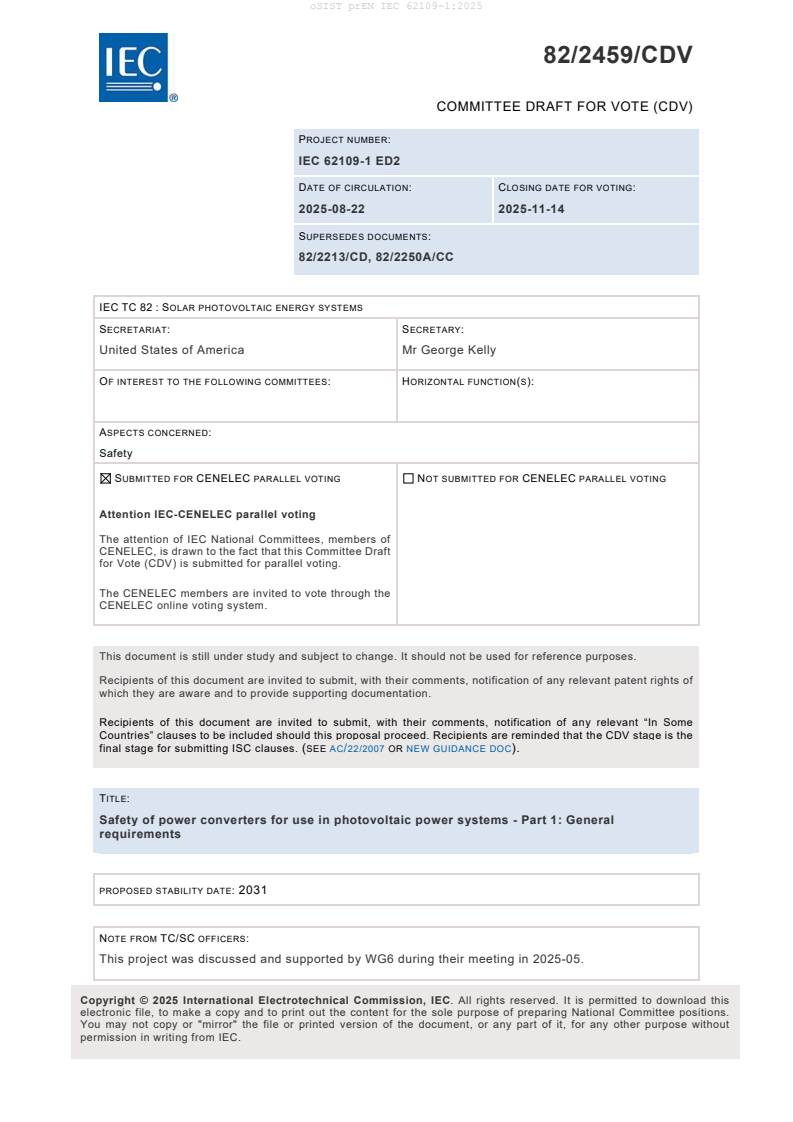
82/2459/CDV
COMMITTEE DRAFT FOR VOTE (CDV)
PROJECT NUMBER:
IEC 62109-1 ED2
DATE OF CIRCULATION: CLOSING DATE FOR VOTING:
2025-08-22 2025-11-14
SUPERSEDES DOCUMENTS:
82/2213/CD, 82/2250A/CC
IEC TC 82 : SOLAR PHOTOVOLTAIC ENERGY SYSTEMS
SECRETARIAT: SECRETARY:
United States of America Mr George Kelly
OF INTEREST TO THE FOLLOWING COMMITTEES: HORIZONTAL FUNCTION(S):
ASPECTS CONCERNED:
Safety
SUBMITTED FOR CENELEC PARALLEL VOTING NOT SUBMITTED FOR CENELEC PARALLEL VOTING
Attention IEC-CENELEC parallel voting
The attention of IEC National Committees, members of
CENELEC, is drawn to the fact that this Committee Draft
for Vote (CDV) is submitted for parallel voting.
The CENELEC members are invited to vote through the
CENELEC online voting system.
This document is still under study and subject to change. It should not be used for reference purposes.
Recipients of this document are invited to submit, with their comments, notification of any relevant patent rights of
which they are aware and to provide supporting documentation.
Recipients of this document are invited to submit, with their comments, notification of any relevant “In Some
Countries” clauses to be included should this proposal proceed. Recipients are reminded that the CDV stage is the
final stage for submitting ISC clauses. (SEE AC/22/2007 OR NEW GUIDANCE DOC).
TITLE:
Safety of power converters for use in photovoltaic power systems - Part 1: General
requirements
PROPOSED STABILITY DATE: 2031
NOTE FROM TC/SC OFFICERS:
This project was discussed and supported by WG6 during their meeting in 2025-05.
electronic file, to make a copy and to print out the content for the sole purpose of preparing National Committee positions.
You may not copy or "mirror" the file or printed version of the document, or any part of it, for any other purpose without
permission in writing from IEC.
IEC CDV 62109-1 Ed 2 © IEC 2025
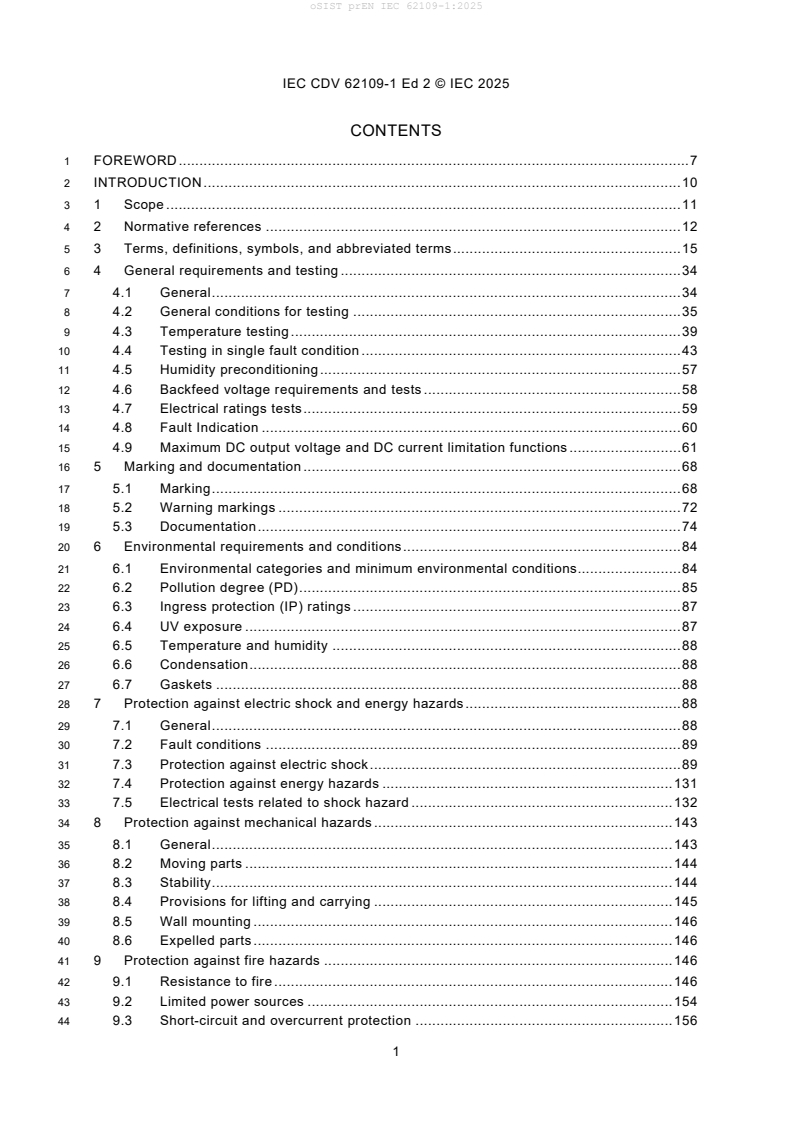
CONTENTS
1 FOREWORD . 7
2 INTRODUCTION . 10
3 1 Scope . 11
4 2 Normative references . 12
5 3 Terms, definitions, symbols, and abbreviated terms . 15
6 4 General requirements and testing . 34
7 4.1 General . 34
8 4.2 General conditions for testing . 35
9 4.3 Temperature testing . 39
10 4.4 Testing in single fault condition . 43
11 4.5 Humidity preconditioning . 57
12 4.6 Backfeed voltage requirements and tests . 58
13 4.7 Electrical ratings tests . 59
14 4.8 Fault Indication . 60
15 4.9 Maximum DC output voltage and DC current limitation functions . 61
16 5 Marking and documentation . 68
17 5.1 Marking . 68
18 5.2 Warning markings . 72
19 5.3 Documentation . 74
20 6 Environmental requirements and conditions . 84
21 6.1 Environmental categories and minimum environmental conditions. 84
22 6.2 Pollution degree (PD) . 85
23 6.3 Ingress protection (IP) ratings . 87
24 6.4 UV exposure . 87
25 6.5 Temperature and humidity . 88
26 6.6 Condensation . 88
27 6.7 Gaskets . 88
28 7 Protection against electric shock and energy hazards . 88
29 7.1 General . 88
30 7.2 Fault conditions . 89
31 7.3 Protection against electric shock . 89
32 7.4 Protection against energy hazards . 131
33 7.5 Electrical tests related to shock hazard . 132
34 8 Protection against mechanical hazards . 143
35 8.1 General . 143
36 8.2 Moving parts . 144
37 8.3 Stability . 144
38 8.4 Provisions for lifting and carrying . 145
39 8.5 Wall mounting . 146
40 8.6 Expelled parts . 146
41 9 Protection against fire hazards . 146
42 9.1 Resistance to fire . 146
43 9.2 Limited power sources . 154
44 9.3 Short-circuit and overcurrent protection . 156
IEC CDV 62109-1 Ed 2 © IEC 2025
45 Protection against sonic pressure hazards . 157
46 10.1 General . 157
47 10.2 Sonic pressure level . 157
48 11 Protection against liquid hazards . 157
49 11.1 General . 157
50 11.2 Design requirements . 158
51 11.3 Risks of liquid leakage, spills, and coolant loss . 160
52 11.4 Oil and grease . 160
53 12 Chemical hazards . 161
54 12.1 General . 161
55 13 Physical requirements . 161
56 13.1 Handles and manual controls . 161
57 13.2 Securing of parts . 162
58 13.3 Provisions for field wiring connections. 162
59 13.4 Internal wiring and connections . 177
60 13.5 Openings in enclosures . 178
61 13.6 Polymeric materials . 180
62 13.7 Mechanical resistance to deflection, impact, or drop . 183
63 13.8 Thickness requirements for metal enclosures . 184
64 14 Components . 187
65 14.1 General . 187
66 14.2 Components bridging simple or protective separation . 188
67 14.3 Motor overtemperature protection . 190
68 14.4 Overtemperature protection devices or systems . 190
69 14.5 Fuses . 190
70 14.6 Fuse holders . 190
71 14.7 Switches, switch-disconnectors, and disconnectors: . 190
72 14.8 Circuit Breakers: . 193
73 14.9 Printed circuit boards . 197
74 14.10 Circuits or components used as transient overvoltage limiting devices . 197
75 14.11 Batteries . 197
76 14.12 PV Earth Fault Protection Equipment (PV EFPE) and Functions . 199
77 14.13 PV Arc Fault Protection . 200
78 15 Software and electronics performing safety functions . 201
79 15.1 General . 201
80 15.2 Defined state requirements . 201
81 Annex A (normative) Measurement of clearances and creepage distances . 202
82 Annex B (normative) Requirements related to functional safety . 208
83 B.1 Scope . 208
84 B.2 Terms, definitions, symbols and abbreviated terms . 208
85 B.3 General . 208
86 B.4 Evaluation and testing . 209
87 B.5 Electromagnetic compatibility (EMC) requirements – Immunity . 211
88 B.6 Safety related circuits using software . 215
89 B.7 Verification of safety function performance related to conditioning tests . 215
90 Annex C (normative) Symbols to be used in equipment markings . 217
91 C.1 General . 217
IEC CDV 62109-1 Ed 2 © IEC 2025
Annex D (informative) Test probe for determining access . 220
93 Annex E (informative) Altitude correction for clearances . 221
94 Annex F (informative) Clearance and creepage distance determination for frequencies
95 greater than 30 kHz . 223
96 F.1 Clearances . 223
97 F.2 Creepage distances . 224
98 Annex G (informative) Measuring instrument for touch current measurements . 226
99 G.1 Measuring instrument for limits of 2mA and less . 226
100 G.2 Measuring instrument for limits exceeding 2mA . 226
101 Annex H (informative) Examples of application of insulation coordination requirements
102 for PCE. 228
103 H.1 Example 1 - Separated PCE. 228
104 H.2 Example 2 - PCE without separation . 229
105 H.3 Examples 3 and 4: Transient voltage reduction means . 230
106 Annex I (normative) Ultraviolet light conditioning tests . 232
107 I.1 General . 232
108 I.2 Xenon-arc light-exposure according to ISO 4892-2 . 232
109 I.3 Xenon-arc light-exposure according to ASTM G155 . 232
110 Annex J (normative) Short Circuit Current Contribution Reporting . 233
111 J.1 General . 233
112 J.2 SC current contribution reporting examples . 234
113 Annex K (informative) Backfeed Current and PV Reverse Current . 240
114 K.1 General . 240
115 K.2 Illustrated Examples . 240
116 Annex L (informative) List of tests and clause numbers . 244
117 L.1 Introduction . 244
118 L.2 Tests and associated clause numbers . 244
119 Annex M (informative) Example of the application of 14.1.2 - transition zone for
120 components . 247
121 M.1 Introduction . 247
122 M.2 Application of the requirements . 247
123 M.3 Detailed example . 247
124 Annex N (informative) Risks associated with outgassing from metallized film
125 capacitors . 249
126 N.1 Introduction . 249
127 N.2 Technical background . 250
128 N.3 Factors useful in conducting risk analysis . 250
129 N.4 Explosion testing . 254
130 N.5 Further Information . 258
131 Bibliography . 260
IEC CDV 62109-1 Ed 2 © IEC 2025
Figures
132 Figure 1 – Limited voltage outputs: Voltage-time limits under single fault conditions . 63
133 Figure 2 – Functional summary of protective measures against electric shock . 90
134 Figure 3 – Short term AC voltage limits for 7.3.2.3 . 92
135 Figure 4 – Short term DC voltage limits for 7.3.2.3 . 92
136 Figure 5 – Typical waveform for AC working voltage . 96
137 Figure 6 – Typical waveform for DC working voltage . 97
138 Figure 7 – Typical waveform for pulsating working voltage . 97
139 Figure 8 – Examples for protection against direct contact for DVC C circuits . 101
140 Figure 9 – Example of protection by DVC A with protective separation . 102
141 Figure 10 – Example of protection by means of protective impedance . 103
142 Figure 11 – Example of protection by limitation of discharge energy through protective
143 impedance . 104
144 Figure 12 – Example of protective voltage limitation . 105
145 Figure 13 – Examples of protective bonding and earthing . 107
146 Figure 14 – Fire enclosure bottom openings below an unenclosed or partially enclosed
147 component . 152
148 Figure 15 – Fire enclosure baffle construction . 153
149 Figure 16 – Examples of cross-sections of designs of openings preventing vertical
150 access . 179
151 Figure 17 – Examples of louver design . 179
152 Figure 18 – Top and side enclosure openings . 180
153 Figure A.1 – Narrow groove . 202
154 Figure A.2 – Wide groove . 203
155 Figure A.3 V-shaped groove . 203
156 Figure A.4 – Rib . 203
157 Figure A.5 – Uncemented joint with grooves less than X . 204
158 Figure A.6 – Uncemented joint with grooves equal to or more than X . 204
159 Figure A.7 – Uncemented joint with narrow and wide grooves . 204
160 Figure A.8 – Creepage distance and clearance through an uncemented joint . 205
161 Figure A.9 – Creepage distance and clearance in the case of a cemented joint and
162 wide grooves . 205
163 Figure A.10 – Head of screw in a wide recess . 205
164 Figure A.11 – Head of screw in a narrow recess . 206
165 Figure A.12 – Intervening, unconnected conductive part . 206
166 Figure A.13 – Distances for multilayer PWBs . 206
167 Figure A.14 – Transition zone for components per 14.1.2 . 207
168 Figure D.1 – Test finger . 220
169 Figure F.1 – Clearance distance determination for frequencies greater than 30 kHz . 223
170 Figure F.2 – Creepage distance determination for frequencies greater than 30 kHz . 224
171 Figure G.1 – Measuring instrument for limits ≤ 2mA RMS or 2.8mA peak . 226
172 Figure G.2 – Alternative measuring instrument . 227
IEC CDV 62109-1 Ed 2 © IEC 2025
Figure H.1 – PCE with separation . 229
174 Figure H.2 – PCE without separation . 230
175 Figure J.1 – AC short circuit general case . 234
176 Figure J.2 – AC short circuit with continuous current . 235
177 Figure J.3 – AC short circuit with low initial current spike . 236
178 Figure J.4 – AC short circuit with fast current interruption . 237
179 Figure J.5 – DC short circuit with current interruption . 238
180 Figure J.6 – DC short circuit with continuous current . 239
181 Figure K.1 – Example backfeed from inverter with single PV input and internal battery . 241
182 Figure K.2 – Example inverter with multiple PV inputs and external battery . 242
183 Figure K.3 – Example backfeed where subarrays are combined externally to PCE . 243
Tables
184 Table 1 – Alphabetical Index of Terms . 16
185 Table 2 – Total temperature limits for transformers, inductors, and other coils and their
186 insulation systems . 41
187 Table 3 – Total temperature limits for materials and components where manufacturer’s
188 ratings and component standards do not exist (see 4.3.2.2.2) . 42
189 Table 4 – Total touch temperature limits for accessible surfaces . 42
190 Table 5 – Environmental categories, environmental conditions, and test requirements . 85
191 Table 6 – Reduction of the pollution degree of internal environment through the use of
192 additional protection. 86
193 Table 7 – Summary of the limits of the decisive voltage classes . 91
194 Table 8 – Examples of application of insulation and separation . 94
195 Table 9 – Values of accessible capacitance and charging voltage (threshold of pain) . 104
196 Table 10 – Protective earthing conductor cross-section . 110
197 Table 11 – Insulation voltage for low voltage circuits . 118
198 Table 12 – Clearance distances . 121
199 Table 13 – Creepage Distances (mm) . 124
200 Table 14 – Impulse voltage test . 134
201 Table 15 – Impulse test voltage . 135
202 Table 16 – AC or DC test voltage for circuits connected directly to the mains . 138
203 Table 17 – AC or DC test voltage for circuits not connected directly to the mains . 139
204 Table 18 – Partial discharge test . 142
205 Table 19 – Summary of material flammability requirements . 151
206 Table 20 – Allowable openings in fire enclosure bottoms . 153
207 Table 21 – Limits for inherently limited power sources . 155
208 Table 22 – Limits for power sources not inherently limited . 155
209 Table 23 – Sizes of conductors . 166
210 Table 24 – Physical tests on power supply cords . 167
211 Table 25 – Wire bending space from terminals to obstructions . 170
212 Table 26 – Isolation means with load breaking: . 171
213 Table 27 – Minimum property retention limits after UV exposure . 182
IEC CDV 62109-1 Ed 2 © IEC 2025
Table 28 – Thickness of sheet metal for enclosures: Carbon steel or stainless steel . 186
215 Table 29 – Thickness of sheet metal for enclosures: aluminium, copper or brass . 187
216 Table A.1 – Value of X . 202
217 Table B.1 – Required parameters/conditions for circuits performing safety critical
218 functions . 209
219 Table B.2 – Example PCE safety functions and control function classes . 210
220 Table B.3 - EMC immunity requirements for EMC Class A PCE. 213
221 Table B.4 - EMC immunity requirements for EMC Class B PCE. 214
222 Table C.1 – Symbols . 217
223 Table E.1 – Correction factor for clearances at altitudes above 2 000 m . 221
224 (see 7.3.7.4.1) . 221
225 Table E.2 – Test voltages for verifying clearances at different altitudes. 221
226 Table F.1 – Minimum values of clearances in air at atmospheric pressure for
227 inhomogeneous field conditions (Table 1 of IEC 60664-4) . 224
228 Table F.2 – Minimum values of creepage distances for different frequency ranges
229 (Table 2 of IEC 60664-4) . 225
230 Table L.1 – List of tests and clause numbers . 244
IEC CDV 62109-1 Ed 2 © IEC 2025
INTERNATIONAL ELECTROTECHNICAL COMMISSION
_____________
PHOTOVOLTAIC POWER SYSTEMS - SAFETY - POWER CONVERSION
EQUIPMENT
Part 1: General requirements
FOREWORD
1) The International Electrotechnical Commission (IEC) is a worldwide organization for standardization comprising
all national electrotechnical committees (IEC National Committees). The object of IEC is to promote international
co-operation on all questions concerning standardization in the electrical and electronic fields. To this end and in
addition to other activities, IEC publishes International Standards, Technical Specifications, Technical Reports,
Publicly Available Specifications (PAS) and Guides (hereafter referred to as “IEC Publication(s)”). Their
preparation is entrusted to technical committees; any IEC National Committee interested in the subject dealt with
may participate in this preparatory work. International, governmental and non-governmental organizations liaising
with the IEC also participate in this preparation. IEC collaborates closely with the International Organization for
Standardization (ISO) in accordance with conditions determined by agreement between the two organizations.
2) The formal decisions or agreements of IEC on technical matters express, as nearly as possible, an international
consensus of opinion on the relevant subjects since each technical committee has representation from all
interested IEC National Committees.
3) IEC Publications have the form of recommendations for international use and are accepted by IEC National
Committees in that sense. While all reasonable efforts are made to ensure that the technical content of IEC
Publications is accurate, IEC cannot be held responsible for the way in which they are used or for any
misinterpretation by any end user.
4) In order to promote international uniformity, IEC National Committees undertake to apply IEC Publications
transparently to the maximum extent possible in their national and regional publications. Any divergence between
any IEC Publication and the corresponding national or regional publication shall be clearly indicated in the latter.
5) IEC itself does not provide any attestation of conformity. Independent certification bodies provide conformity
assessment services and, in some areas, access to IEC marks of conformity. IEC is not responsible for any
services carried out by independent certification bodies.
6) All users should ensure that they have the latest edition of this publication.
7) No liability shall attach to IEC or its directors, employees, servants or agents including individual experts and
members of its technical committees and IEC National Committees for any personal injury, property damage or
other damage of any nature whatsoever, whether direct or indirect, or for costs (including legal fees) and expenses
arising out of the publication, use of, or reliance upon, this IEC Publication or any other IEC Publications.
8) Attention is drawn to the Normative references cited in this publication. Use of the referenced publications is
indispensable for the correct application of this publication.
9) Attention is drawn to the possibility that some of the elements of this IEC Publication may be the subject of patent
rights. IEC shall not be held responsible for identifying any or all such patent rights.
IEC 62109-1 has been prepared by Working Group 6 of IEC technical committee 82: Solar
photovoltaic energy systems. It is an International Standard.
nd st
This 2 edition cancels and replaces the 1 edition published in 2010. This edition constitutes
a technical revision.
This edition includes the following significant technical changes with respect to the previous
edition:
– Removal of transportable and handheld equipment from the Scope, and of specifically-
232 related requirements
233 – Changes to requirements regarding backfeed current and PV reverse current
234 – Addition of requirements for PV Earth Fault Protection functions or equipment in PCE, by
235 reference to IEC 63112
IEC CDV 62109-1 Ed 2 © IEC 2025
– Addition of requirements for PV Arc Fault Protection functions or equipment in PCE, by
237 reference to IEC 63027
238 – Addition of a PCE output load dump withstand test
239 – Addition of requirements related to intentional voltage backfeed
240 – Changes to requirements for unintentional voltage backfeed
241 – Addition of requirements for fault indication
242 – Addition of requirements for limitation of DC output current or voltage where relied on for
243 safety in the installation
244 – Changes to requirements for switches, disconnectors, and circuit breakers
245 – Correction from an external environment of PD3 to PD4 for outdoor equipment
246 – Changes to requirements for ingress protection ratings and testing
247 – Addition of requirements for gaskets
248 – Clarification of the physiological basis underlying the requirements for shock protection
249 – Changes to the short-term limits for DVC A and accessible parts
250 – Changes to requirements for components bridging protective separation
251 – Changes to access probe criteria related to access to live parts
252 – Changes to the allowed touch current values under normal conditions for protective
253 impedance
254 – Changes to the requirements for rating of protective equipotential bonding by reference to
255 IEC 62477-1
256 – Changes to the requirements for coatings used for insulation coordination in accordance
257 with IEC 60664-3
258 – Addition of requirements for cemented joints with respect to clearance and creepage
259 distances
260 – Changes to the limits for a hazardous energy level
261 – Addition of tests for determining the attenuation of impulse levels provided across
262 separation and provided by transient reduction means
263 – Changes to the measurement instrument used for touch current measurements in
264 accordance with IEC 60990
265 – Changes to requirements for liquid containment systems and related testing
266 – Addition of requirements for liquid-immersed transformers by reference to IEC 60076
267 – Changes to requirements for field wiring connection provisions for power ports
268 – Changes for requirements for isolation from supply sources, including addition of system
269 approaches for coordinating load-breaking and isolation and including use of electronic
270 means
271 – Changes to the requirements for connectors used for connection of field wiring
272 – Addition of requirements for insulation coordination for components
273 – Addition of requirements for selection and ratings of switches, switch-disconnectors,
274 disconnectors, and circuit breakers, including requirements specific to devices used in PV
275 and battery circuits
276 – Changes to requirements for batteries
277 – Changes to requirements regarding Functional Safety including increased coverage to
278 include hardware (not only software) and expanded details regarding use of IEC 60730-1
279 Annex H
280 – Addition of an informative Annex relating to potential outgassing from metallized film
281 capacitors, the possible build-up of volatile gas in sealed or partly sealed enclosures, and
282 the resulting potential explosion risk
IEC CDV 62109-1 Ed 2 © IEC 2025
283 NOTE Many of the above changes have related changes or additions to testing, marking and/or documentation
284 requirements.
The text of this International Standard is based on the following documents:
FDIS Report on voting
82/XXX/FDIS 82/XXX/RVD
Full information on the voting for approval can be found in the report on voting indicated in the
above table.
The language used for the development of this International Standard is English.
This document was drafted in accordance with ISO/IEC Directives, Part 2, and developed in
accordance with ISO/IEC Directives, Part 1 and ISO/IEC Directives, IEC Supplement, available
at www.iec.ch/members_experts/refdocs. The main document types developed by IEC are
described in greater detail at www.iec.ch/publications.
A list of all parts of IEC 62109 series, under the general title Photovoltaic power systems -
Safety - Power conversion equipment, can be found on the IEC website.
The committee has decided that the contents of this publication will remain unchanged until the
stability date indicated on the IEC web site under webstore.iec.ch in the data related to the
specific publication. At this date, the document will be
• reconfirmed,
• withdrawn,
• replaced by a revised edition, or
• amended.
IMPORTANT – The 'colour inside' logo on the cover page of this publication indicates that it
contains colours which are considered to be useful for the correct understanding of its
contents. Users should therefore print this document using a colour printer.
IEC CDV 62109-1 Ed 2 © IEC 2025
INTRODUCTION
287 This Part 1 of IEC 62109 specifies the safety requirements that are generally applicable to all
288 equipment within its scope. For certain types of equipment, these requirements will be
289 supplemented or modified by the special requirements of one or more subsequent Parts (for
290 example IEC 62109-2, IEC 62109-3, etc.) of the IEC 62109 series which must be read in
291 conjunction with these Part 1 requirements.
IEC CDV 62109-1 Ed 2 © IEC 2025
294 PHOTOVOLTAIC POWER SYSTEMS - SAFETY - POWER CONVERSION
295 EQUIPMENT
297 Part 1: General requirements
300 1 Scope
301 This Part 1 of the IEC 62109 series provides general requirements applicable to all types of
302 power conversion equipment (PCE) for use in Photovoltaic (PV) systems where a uniform
303 technical level with respect to safety is necessary. This standard defines the minimum
304 requirements for the design and manufacture of PCE for protection against electric shock,
305 energy, fire, mechanical and other hazards.
306 Equipment included in scope:
307 This document covers PCE with inputs and outputs with system voltages not exceeding the low
308 voltage limits of 1 500 V DC and 1 000 V AC, line to line and line to earth, including PV, battery,
309 mains and non-mains AC systems, or other sources. Where a PV combiner is integrated into a
310 PCE, the combiner is considered a part of the PCE and this document applies.
311 NOTE 1 Stand-alone PV combiners are the subject of IEC 61439-8, in preparation
312 This document may also be used for accessories for use with PV PCE, except where more
313 appropriate standards exist.
314 PCE with multiple functions or modes (multi-mode PCE) shall be judged against all applicable
315 requirements for each of those functions and modes.
316 NOTE 2 Throughout this document, where terms such as “inverter” are used, the meaning is either a PCE that is an
317 inverter or an inverter operating mode of a multi-mode PCE.
318 Aspects included in scope:
319 The purpose of the requirements of this Part 1 of IEC 62109 is to ensure that the design and
320 methods of construction used in PV PCE provide adequate protection for the operator and the
321 surrounding area against:
322 a) electric shock and energy hazards;
323 b) mechanical hazards;
324 c) excessive temperature hazards;
325 d) spread of fire from the equipment;
326 e) chemical hazards;
327 f) sonic pressure hazards;
328 g) liberated fluids, gases and explosion hazards.
329 NOTE 3 Servicing personnel are expected to have the necessary knowledge and skill to use reasonable care in
330 dealing with hazards associated with the operation, repair and maintenance of this equipment. Based upon this
331 premise, this standard provides only limited requirements (for example markings or guarding) intended to protect
332 service personnel from hazards that may not be apparent even to trained personnel.
333 Aspects not covered by this standard include, but are not limited to, the following:
334 i) functional reliability, performance or other properties of the equipment not related to
335 safety;
IEC CDV 62109-1 Ed 2 © IEC 2025
ii) ability to withstand expected storage and transportation environments;
337 iii) EMC requirements except where related to Functional Safety;
338 iv) installation requirements, which are covered by local and national installation codes.
339 NOTE 4 This standard does provide requirements intended to ensure that the PCE can be installed in a safe
340 manner by skilled persons, including requirements for installation instructions provided with the product.
341 v) requirements for transportable and handheld equipment
342 NOTE 5 The term transportable refers to equipment intended to be regularly moved between various operating
343 sites. The term handheld refers to equipment intended to be held during operation. Neither of these conditions
344 is typical for PV PCE.
345 vi) ch
...