

SIST EN 1198:2005
(Main)Chemicals for treatment of water intended for human consumption - Sodium dihydrogen orthophosphate
General Information
- Abstract
This document is applicable to sodium dihydrogen orthophosphate used for treatment of water intended for human consumption. It describes the characteristics and specifies the requirements and the corresponding test methods for sodium dihydrogen orthophosphate. It gives information on its use in water treatment.
- Status
- Published
- Publication Date
- 30-Jun-2005
- Technical Committee
- IOVO - Water supply and waste water engineering
- Current Stage
- 6060 - National Implementation/Publication (Adopted Project)
- Start Date
- 01-Jul-2005
- Due Date
- 01-Jul-2005
- Completion Date
- 01-Jul-2005



Overview - EN 1198:2005 (Sodium dihydrogen orthophosphate)
EN 1198:2005 is a CEN (European) standard that applies to sodium dihydrogen orthophosphate used for the treatment of water intended for human consumption. The document defines the chemical identity, commercial forms, physical and chemical properties, minimum purity criteria, impurity limits, and the corresponding test and sampling methods. It also provides information on labelling, transport and storage and notes regulatory considerations for use in drinking-water treatment.
Key topics and technical requirements
- Scope and identification
- Chemical name: sodium dihydrogen orthophosphate (NaH2PO4), CAS 7558-80-7, relative molecular mass 120.0.
- Commercial forms: solid (white powder, granules, crystals) or liquid (clear solution).
- Physical properties
- Solubility ≈ 850 g/L at 25 °C; 1% solution pH ≈ 4.5.
- Typical bulk density for solids: 900–1 200 g/dm3.
- Composition requirements
- Phosphate content (as P2O5): (59 ± 2.0) % (dry basis).
- Sodium content (as Na2O): (26 ± 1.0) % (dry basis).
- Impurity limits (selected)
- Sulfate (SO4 2–): max 500 mg/kg
- Fluoride (F–): max 10 mg/kg
- Antimony, arsenic, cadmium, selenium: max 3 mg/kg each
- Chromium, nickel, lead: max 10 mg/kg
- Mercury: max 1 mg/kg
- Test and sampling methods
- Sampling guidance for solids, drums, tanks and tankers (ISO/EN sampling standards referenced).
- Determination of P2O5 and Na2O by alkalimetric titration (pH endpoints at 4.45 and 9.22).
- Heavy metals and trace elements by atomic absorption or ICP methods; fluoride and sulfate by referenced ISO methods.
- Labelling, transport and storage
- Standard includes requirements and recommendations for safe handling, marking and storage of commercial forms.
Practical applications
- EN 1198:2005 is used to ensure that sodium dihydrogen orthophosphate supplied for potable water treatment meets defined purity and safety requirements.
- The standard supports consistent quality control by water utilities, chemical suppliers and analytical laboratories when sourcing, testing or certifying phosphate products for drinking-water applications.
- It aids regulatory and procurement teams in assessing suitability of chemical products for human-consumption water treatment.
Who uses this standard
- Water utility and distribution engineers
- Chemical manufacturers and suppliers of phosphate products
- Analytical and testing laboratories performing compliance testing
- Regulatory authorities and procurement officials responsible for drinking-water chemicals
Related standards
EN 1198:2005 references and aligns with multiple analytical and sampling standards, for example:
- EN 1483, EN ISO 3696, EN ISO 11885, EN ISO 11969
- ISO 2997, ISO 3360, ISO 3165, ISO 8213, ISO 6206 EN 1198:2005 supersedes EN 1198:1997 and was approved by CEN in March 2005.
Keywords: EN 1198:2005, sodium dihydrogen orthophosphate, chemicals for treatment of water, water treatment, drinking water standard, purity criteria, test methods, sampling, phosphate for potable water.
Relations
- Effective Date
- 22-Dec-2008
- Effective Date
- 11-Mar-2026
- Effective Date
- 11-Mar-2026
- Effective Date
- 11-Mar-2026
- Effective Date
- 11-Mar-2026
- Effective Date
- 11-Mar-2026
- Effective Date
- 11-Mar-2026
- Effective Date
- 09-Feb-2026
- Effective Date
- 28-Jan-2026
- Effective Date
- 28-Jan-2026
- Refers
SIST EN 14847:2006 - Aerosol containers - Tinplate containers - Dimensions of the 25,4 mm aperture - Effective Date
- 28-Jan-2026
- Effective Date
- 28-Jan-2026
- Effective Date
- 28-Jan-2026
- Effective Date
- 28-Jan-2026
- Effective Date
- 28-Jan-2026
Get Certified
Connect with accredited certification bodies for this standard

ECOCERT
Organic and sustainability certification.

CIS Institut d.o.o.
Personal Protective Equipment (PPE) certification body. Notified Body NB-2890 for EU Regulation 2016/425 PPE.

Eurofins Food Testing Global
Global leader in food, environment, and pharmaceutical product testing.
Sponsored listings
Frequently Asked Questions
SIST EN 1198:2005 is a standard published by the Slovenian Institute for Standardization (SIST). Its full title is "Chemicals for treatment of water intended for human consumption - Sodium dihydrogen orthophosphate". This standard covers: This document is applicable to sodium dihydrogen orthophosphate used for treatment of water intended for human consumption. It describes the characteristics and specifies the requirements and the corresponding test methods for sodium dihydrogen orthophosphate. It gives information on its use in water treatment.
This document is applicable to sodium dihydrogen orthophosphate used for treatment of water intended for human consumption. It describes the characteristics and specifies the requirements and the corresponding test methods for sodium dihydrogen orthophosphate. It gives information on its use in water treatment.
SIST EN 1198:2005 is classified under the following ICS (International Classification for Standards) categories: 13.060.20 - Drinking water; 71.100.80 - Chemicals for purification of water. The ICS classification helps identify the subject area and facilitates finding related standards.
SIST EN 1198:2005 has the following relationships with other standards: It is inter standard links to SIST EN 1198:1999, SIST ISO 6206:1995, SIST ISO 8288:1996, SIST ISO 6703-1:1996, SIST ISO 3165:1995, SIST ISO 9174:1999, SIST ISO 9965:1998, SIST ISO 8213:1995, SIST EN ISO 5961:1996, SIST EN ISO 3696:1998, SIST EN 14847:2006, SIST EN ISO 12846:2012, SIST EN 1998-6:2005, SIST EN 1371-2:2000, SIST EN 13445-5:2002/A10:2009. Understanding these relationships helps ensure you are using the most current and applicable version of the standard.
SIST EN 1198:2005 is associated with the following European legislation: EU Directives/Regulations: 305/2011, 89/106/EEC, TP262. When a standard is cited in the Official Journal of the European Union, products manufactured in conformity with it benefit from a presumption of conformity with the essential requirements of the corresponding EU directive or regulation.
SIST EN 1198:2005 is available in PDF format for immediate download after purchase. The document can be added to your cart and obtained through the secure checkout process. Digital delivery ensures instant access to the complete standard document.
Standards Content (Sample)
2003-01.Slovenski inštitut za standardizacijo. Razmnoževanje celote ali delov tega standarda ni dovoljeno.Kemikalije, ki se uporabljajo za pripravo pitne vode – Natrijev dihidrogen fosfatProdukte zur Aufbereitung von Wasser für den menschlichen Gebrauch - MononatriumdihydrogenphosphatProduits chimiques utilisés pour le traitement de l'eau destinée a la consommation humaine - Dihydrogénophosphate de sodiumChemicals for treatment of water intended for human consumption - Sodium dihydrogen orthophosphate71.100.80Chemicals for purification of water13.060.20Pitna vodaDrinking waterICS:Ta slovenski standard je istoveten z:EN 1198:2005SIST EN 1198:2005en01-julij-2005SIST EN 1198:2005SLOVENSKI
STANDARDSIST EN 1198:19991DGRPHãþD
EUROPEAN STANDARD NORME EUROPÉENNE EUROPÄISCHE NORM
EN 1198
March 2005 ICS 71.100.80 Supersedes EN 1198:1997 English version
Chemicals used for treatment of water intended for human consumption - Sodium dihydrogen orthophosphate
Produits chimiques utilisés pour le traitement de l'eau destinée à la consommation humaine - Dihydrogénophosphate de sodium
Produkte zur Aufbereitung von Wasser für den menschlichen Gebrauch - Mononatriumdihydrogenphosphat This European Standard was approved by CEN on 3 February 2005.
CEN members are bound to comply with the CEN/CENELEC Internal Regulations which stipulate the conditions for giving this European Standard the status of a national standard without any alteration. Up-to-date lists and bibliographical references concerning such national standards may be obtained on application to the Central Secretariat or to any CEN member.
This European Standard exists in three official versions (English, French, German). A version in any other language made by translation under the responsibility of a CEN member into its own language and notified to the Central Secretariat has the same status as the official versions.
CEN members are the national standards bodies of Austria, Belgium, Cyprus, Czech Republic, Denmark, Estonia, Finland, France, Germany, Greece, Hungary, Iceland, Ireland, Italy, Latvia, Lithuania, Luxembourg, Malta, Netherlands, Norway, Poland, Portugal, Slovakia, Slovenia, Spain, Sweden, Switzerland and United Kingdom.
EUROPEAN COMMITTEE FOR STANDARDIZATION COMITÉ EUROPÉEN DE NORMALISATION EUROPÄISCHES KOMITEE FÜR NORMUNG
Management Centre: rue de Stassart, 36
B-1050 Brussels © 2005 CEN All rights of exploitation in any form and by any means reserved worldwide for CEN national Members. Ref. No. EN 1198:2005: ESIST EN 1198:2005
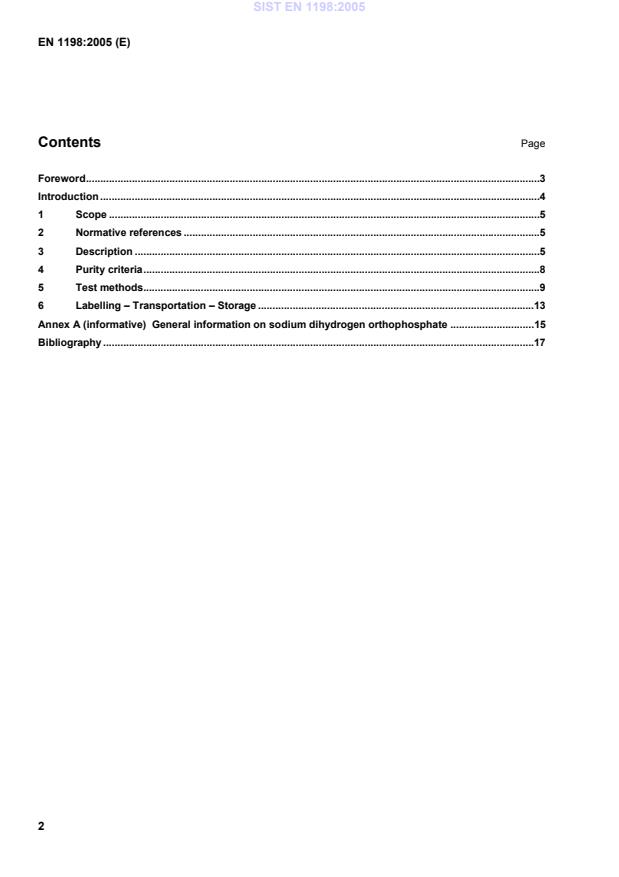
General information on sodium dihydrogen orthophosphate.15 Bibliography.17
in order to take into account of the last Directive in force (see [1]); b) replacement of ISO 5666-1 by EN 1483 and of
EN 26595 by EN ISO 11969. According to the CEN/CENELEC Internal Regulations, the national standards organizations of the following countries are bound to implement this European Standard: Austria, Belgium, Cyprus, Czech Republic, Denmark, Estonia, Finland, France, Germany, Greece, Hungary, Iceland, Ireland, Italy, Latvia, Lithuania, Luxembourg, Malta, Netherlands, Norway, Poland, Portugal, Slovakia, Slovenia, Spain, Sweden, Switzerland and United Kingdom. SIST EN 1198:2005
- Determination of arsenic- Atomic absorption spectrometric method (hydride technique) (ISO 11969:1996). ISO 2997, Phosphoric acid for industrial use – Determination of sulfate content – Method by reduction and titrimetry. ISO 3165, Sampling of chemical products for industrial use – Safety in sampling. ISO 3360, Phosphoric acid and sodium phosphates for industrial use (including foodstuffs) - Determination of fluorine content – Alizarin complexone and lanthanum nitrate photometric method. ISO 6206, Chemical products for industrial use – Sampling – Vocabulary. ISO 6703-1, Water quality – Determination of cyanide – Part 1 : Determination of total cyanide. ISO 8213, Chemical products for industrial use – Sampling techniques – Solid chemical products in the form of particles varying from powders to coarse lumps. ISO 8288, Water quality – Determination of cobalt, nickel, copper, zinc, cadmium and lead – Flame atomic absorption spectrometric methods. ISO 9174, Water quality – Determination of chromium – Atomic absorption spectrometric methods. ISO 9965, Water quality – Determination of selenium – Atomic absorption spectrometric method (hydride technique). 3 Description 3.1 Identification 3.1.1 Chemical name Sodium dihydrogen orthophosphate. SIST EN 1198:2005
1) Chemical Abstracts Service Registry Number. 2) European Inventory of Existing Commercial Chemical Substances. SIST EN 1198:2005
3) 100 kPa = 1 bar. SIST EN 1198:2005
; sodium content expressed as Na2O : mass fraction of (26 ± 1,0) % . 4.3 Impurities and main by-products The product shall conform to the requirements specified in Table 1. Table 1 — Impurities Impurity
Limit
mg/kg of dry product Sulfate (SO42-) max. 500 Fluoride (F-) max.
10 4.4 Chemical parameters Content of various chemical parameters depends on the origin of the raw materials, most of these elements are present only as traces. SIST EN 1198:2005
Limit
mg/kg of dry product Antimony (Sb) max. 3 Arsenic (As) max. 3 Cadmium (Cd) max. 3 Chromium (Cr) max. 10 Cyanide (CN) max. 5 Lead (Pb) max. 10 Mercury (Hg) max. 1 Nickel (Ni) max. 10 Selenium (Se) max. 3 NOTE : Pesticides and polycyclic aromatic hydrocarbons are not relevant in sodium dih
...