

SIST EN 1993-6:2007
(Main)Eurocode 3 - Design of steel structures - Part 6: Crane supporting structures
General Information
- Abstract
Complementary to Part 1. Varied general rules and additional detailed rules for the structural design of steel supporting structures including runway beams for overhead travelling cranes and underslung cranes and monorail runway beams for hoist blocks for locations inside and outside buildings.
- Status
- Published
- Publication Date
- 10-Jun-2007
- Technical Committee
- KON - Structures
- Current Stage
- 6060 - National Implementation/Publication (Adopted Project)
- Start Date
- 15-May-2007
- Due Date
- 20-Jul-2007
- Completion Date
- 11-Jun-2007

Overview
EN 1993-6:2007 - Eurocode 3: Design of steel structures - Part 6: Crane supporting structures is a CEN European Standard that complements Eurocode 3 Part 1. It provides general and detailed rules for the structural design of steel crane supporting systems, including runway beams for overhead travelling cranes, underslung cranes and monorail runway beams for hoist blocks, for locations both inside and outside buildings.
Key topics and technical requirements
The standard addresses the full design chain for steel crane supports, including:
- Basis of design: conformity with limit state design principles, verification by the partial factor method, design working life, durability and robustness.
- Materials: requirements for structural and rail steels, stainless steels, fasteners, welds and bearings.
- Structural analysis: modelling assumptions, joint modelling, ground–structure interaction, global and local analysis, effects of deformed geometry and stability.
- Runway beam behaviour: effects of crane wheel loads, local web and flange stresses, secondary moments and classification of cross-sections.
- Limit states:
- Ultimate limit states (ULS) - cross‑section resistance, member buckling, plate buckling, wheel‑load resistance.
- Serviceability limit states (SLS) - deflection limits, web “breathing”, reversible behaviour and vibration criteria for bottom flanges.
- Connections and rails: bolt/weld rules, surge connectors, rail materials, selection, fixings and joints.
- Fatigue assessment: when fatigue assessment is required, partial factors for fatigue, stress spectra and simplified approaches for wheel- and trolley-induced stresses.
- Testing and verification: provisions for crane and runway testing, clearances and special considerations for underslung cranes and hoist blocks.
Applications and practical value
EN 1993-6:2007 is used to design safe, durable and serviceable steel runway systems that carry cranes. Typical applications include:
- Design and verification of runway beams for overhead travelling cranes in factories, warehouses and shipyards.
- Design of underslung crane rails and monorail systems for hoists and trolleys.
- Assessment and retrofitting of existing crane supports for fatigue, serviceability and robustness.
- Specification of rails, fixings and welding/bolting practices for crane manufacturers and fabricators.
Using EN 1993-6 helps ensure compliance with European design practice and facilitates harmonised, auditable designs for safety-critical crane infrastructure.
Who should use this standard
- Structural and mechanical engineers designing crane supports and runway beams
- Crane and hoist manufacturers and component suppliers
- Fabricators, welding supervisors and bolting contractors
- Inspection bodies, certifiers and facility owners responsible for crane safety and maintenance
Related standards
- Eurocode 3 Part 1 (general rules for design of steel structures) - EN 1993-1 (complementary basis)
- National annexes and CEN member body implementations that set Nationally Determined Parameters (NDPs) for EN 1993-6:2007
Keywords: EN 1993-6:2007, Eurocode 3, crane supporting structures, runway beams, overhead travelling cranes, underslung cranes, steel structures, fatigue assessment, structural design.
Relations
- Replaces
SIST ENV 1993-6:2001 - Eurocode 3: Design of steel structures - Part 6: Crane supporting structures - Effective Date
- 01-Jul-2007
- Effective Date
- 25-Mar-2026
- Refers
kSIST FprEN 1991-1-6:2025 - Eurocode 1 - Actions on structures - Part 1-6: Actions during execution - Effective Date
- 25-Mar-2026
- Effective Date
- 25-Mar-2026
- Effective Date
- 25-Mar-2026
- Effective Date
- 28-Jan-2026
- Effective Date
- 28-Jan-2026
- Effective Date
- 28-Jan-2026
- Effective Date
- 28-Jan-2026
- Effective Date
- 28-Jan-2026
- Effective Date
- 28-Jan-2026
- Refers
SIST EN 1991-1-4:2005 - Eurocode 1: Actions on structures - Part 1-4: General actions - Wind actions - Effective Date
- 28-Jan-2026
- Effective Date
- 28-Jan-2026
- Effective Date
- 28-Jan-2026
- Effective Date
- 28-Jan-2026
Get Certified
Connect with accredited certification bodies for this standard

DIBt (Deutsches Institut für Bautechnik)
German Institute for Building Technology.
DIN CERTCO
DIN Group product certification.

Aboma Certification B.V.
Specialized in construction, metal, and transport sectors.
Sponsored listings
Frequently Asked Questions
SIST EN 1993-6:2007 is a standard published by the Slovenian Institute for Standardization (SIST). Its full title is "Eurocode 3 - Design of steel structures - Part 6: Crane supporting structures". This standard covers: Complementary to Part 1. Varied general rules and additional detailed rules for the structural design of steel supporting structures including runway beams for overhead travelling cranes and underslung cranes and monorail runway beams for hoist blocks for locations inside and outside buildings.
Complementary to Part 1. Varied general rules and additional detailed rules for the structural design of steel supporting structures including runway beams for overhead travelling cranes and underslung cranes and monorail runway beams for hoist blocks for locations inside and outside buildings.
SIST EN 1993-6:2007 is classified under the following ICS (International Classification for Standards) categories: 53.020.20 - Cranes; 91.010.30 - Technical aspects; 91.080.13 - Steel structures. The ICS classification helps identify the subject area and facilitates finding related standards.
SIST EN 1993-6:2007 has the following relationships with other standards: It is inter standard links to SIST ENV 1993-6:2001, kSIST FprEN 1998-1-2:2025, kSIST FprEN 1991-1-6:2025, kSIST FprEN 1991-3:2025, kSIST FprEN 1991-1-4:2025, SIST EN 1337-11:2001, SIST EN ISO 1461:2022, kSIST FprEN 1998-3:2025, SIST EN 1337-2:2004, SIST EN 1337-8:2008, kSIST FprEN 1993-1-1:2022, SIST EN 1991-1-4:2005, SIST EN 1991-3:2006, SIST EN 1337-9:2001, SIST EN 1337-10:2003. Understanding these relationships helps ensure you are using the most current and applicable version of the standard.
SIST EN 1993-6:2007 is associated with the following European legislation: EU Directives/Regulations: 2005-01-4408, 305/2011, 89/106/EEC; Standardization Mandates: M/265, M/BC/CEN/89/11. When a standard is cited in the Official Journal of the European Union, products manufactured in conformity with it benefit from a presumption of conformity with the essential requirements of the corresponding EU directive or regulation.
SIST EN 1993-6:2007 is available in PDF format for immediate download after purchase. The document can be added to your cart and obtained through the secure checkout process. Digital delivery ensures instant access to the complete standard document.
Standards Content (Sample)
2003-01.Slovenski inštitut za standardizacijo. Razmnoževanje celote ali delov tega standarda ni dovoljeno.Eurocode 3 - Design of steel structures - Part 6: Crane supporting structuresEvrokod 3: Projektiranje jeklenih konstrukcij - 6 del: Žerjavne progeEurocode 3 - Calcul des structures en acier - Partie 6: Chemins de roulementEurocode 3 - Bemessung und Konstruktion von Stahlbauten - Teil 6: KranbahnenTa slovenski standard je istoveten z:EN 1993-6:2007SIST EN 1993-6:2007en91.080.10Kovinske konstrukcijeMetal structures91.010.30Technical aspects53.020.20DvigalaCranesICS:SIST ENV 1993-6:20011DGRPHãþDSLOVENSKI
STANDARDSIST EN 1993-6:200701-julij-2007
EUROPEAN STANDARDNORME EUROPÉENNEEUROPÄISCHE NORMEN 1993-6April 2007ICS 53.020.20; 91.010.30; 91.080.10Supersedes ENV 1993-6:1999
English VersionEurocode 3 - Design of steel structures - Part 6: Cranesupporting structuresEurocode 3 - Calcul des structures en acier - Partie 6:Chemins de roulementEurocode 3 - Bemessung und Konstruktion vonStahlbauten - Teil 6: KranbahnenThis European Standard was approved by CEN on 12 June 2006.CEN members are bound to comply with the CEN/CENELEC Internal Regulations which stipulate the conditions for giving this EuropeanStandard the status of a national standard without any alteration. Up-to-date lists and bibliographical references concerning such nationalstandards may be obtained on application to the CEN Management Centre or to any CEN member.This European Standard exists in three official versions (English, French, German). A version in any other language made by translationunder the responsibility of a CEN member into its own language and notified to the CEN Management Centre has the same status as theofficial versions.CEN members are the national standards bodies of Austria, Belgium, Bulgaria, Cyprus, Czech Republic, Denmark, Estonia, Finland,France, Germany, Greece, Hungary, Iceland, Ireland, Italy, Latvia, Lithuania, Luxembourg, Malta, Netherlands, Norway, Poland, Portugal,Romania, Slovakia, Slovenia, Spain, Sweden, Switzerland and United Kingdom.EUROPEAN COMMITTEE FOR STANDARDIZATIONCOMITÉ EUROPÉEN DE NORMALISATIONEUROPÄISCHES KOMITEE FÜR NORMUNGManagement Centre: rue de Stassart, 36
B-1050 Brussels© 2007 CENAll rights of exploitation in any form and by any means reservedworldwide for CEN national Members.Ref. No. EN 1993-6:2007: E
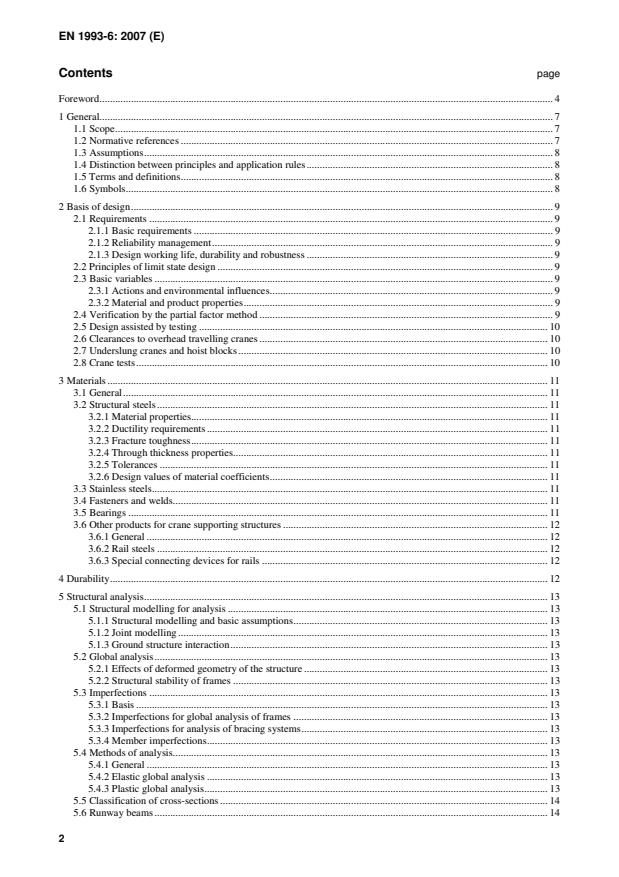
EN 1993-6: 2007 (E) 2 Contents page Foreword.4 1 General.7 1.1 Scope.7 1.2 Normative references.7 1.3 Assumptions.8 1.4 Distinction between principles and application rules.8 1.5 Terms and definitions.8 1.6 Symbols.8 2 Basis of design.9 2.1 Requirements.9 2.1.1 Basic requirements.9 2.1.2 Reliability management.9 2.1.3 Design working life, durability and robustness.9 2.2 Principles of limit state design.9 2.3 Basic variables.9 2.3.1 Actions and environmental influences.9 2.3.2 Material and product properties.9 2.4 Verification by the partial factor method.9 2.5 Design assisted by testing.10 2.6 Clearances to overhead travelling cranes.10 2.7 Underslung cranes and hoist blocks.10 2.8 Crane tests.10 3 Materials.11 3.1 General.11 3.2 Structural steels.11 3.2.1 Material properties.11 3.2.2 Ductility requirements.11 3.2.3 Fracture toughness.11 3.2.4 Through thickness properties.11 3.2.5 Tolerances.11 3.2.6 Design values of material coefficients.11 3.3 Stainless steels.11 3.4 Fasteners and welds.11 3.5 Bearings.11 3.6 Other products for crane supporting structures.12 3.6.1 General.12 3.6.2 Rail steels.12 3.6.3 Special connecting devices for rails.12 4 Durability.12 5 Structural analysis.13 5.1 Structural modelling for analysis.13 5.1.1 Structural modelling and basic assumptions.13 5.1.2 Joint modelling.13 5.1.3 Ground structure interaction.13 5.2 Global analysis.13 5.2.1 Effects of deformed geometry of the structure.13 5.2.2 Structural stability of frames.13 5.3 Imperfections.13 5.3.1 Basis.13 5.3.2 Imperfections for global analysis of frames.13 5.3.3 Imperfections for analysis of bracing systems.13 5.3.4 Member imperfections.13 5.4 Methods of analysis.13 5.4.1 General.13 5.4.2 Elastic global analysis.13 5.4.3 Plastic global analysis.13 5.5 Classification of cross-sections.14 5.6 Runway beams.14
EN 1993-6: 2007(E)
3 5.6.1 Effects of crane loads.14 5.6.2 Structural system.14 5.7 Local stresses in the web due to wheel loads on the top flange.15 5.7.1 Local vertical compressive stresses.15 5.7.2 Local shear stresses.17 5.7.3 Local bending stresses in the web due to eccentricity of wheel loads.17 5.8 Local bending stresses in the bottom flange due to wheel loads.18 5.9 Secondary moments in triangulated components.20 6 Ultimate limit states.22 6.1 General.22 6.2 Resistance of cross-section.22 6.3 Buckling resistance of members.22 6.3.1 General.22 6.3.2 Lateral-torsional buckling.23 6.4 Built up compression members.23 6.5 Resistance of the web to wheel loads.23 6.5.1 General.23 6.5.2 Length of stiff bearing.24 6.6 Buckling of plates.24 6.7 Resistance of bottom flanges to wheel loads.24 7 Serviceability limit states.27 7.1 General.27 7.2 Calculation models.27 7.3 Limits for deformations and displacements.27 7.4 Limitation of web breathing.29 7.5 Reversible behaviour.30 7.6 Vibration of the bottom flange.30 8 Fasteners, welds, surge connectors and rails.31 8.1 Connections using bolts, rivets or pins.31 8.2 Welded connections.31 8.3 Surge connectors.31 8.4 Crane rails.32 8.4.1 Rail material.32 8.4.2 Design working life.32 8.4.3 Rail selection.32 8.5 Rail fixings.33 8.5.1 General.33 8.5.2 Rigid fixings.33 8.5.3 Independent fixings.33 8.6 Rail joints.33 9 Fatigue assessment.34 9.1 Requirement for fatigue assessment.34 9.2 Partial factors for fatigue.34 9.3 Fatigue stress spectra.34 9.3.1 General.34 9.3.2 Simplified approach.34 9.3.3 Local stresses due to wheel loads on the top flange.35 9.3.4 Local stresses due to underslung trolleys.35 9.4 Fatigue assessment.35 9.4.1 General.35 9.4.2 Multiple crane actions.35 9.5 Fatigue strength.36 Annex A [informative] – Alternative assessment method for lateral-torsional buckling.37
EN 1993-6: 2007 (E) 4 Foreword This European Standard EN 1993-6, “Eurocode 3: Design of steel structures: Part 6 Crane supporting srtuctures”, has been prepared by Technical Committee CEN/TC250 « Structural Eurocodes », the Secretariat of which is held by BSI.
CEN/TC250 is responsible for all Structural Eurocodes.
This European Standard shall be given the status of a National Standard, either by publication of an identical text or by endorsement, at the latest by October 2007, and conflicting National Standards shall be withdrawn at latest by March 2010.
This Eurocode supersedes ENV 1993-6. According to the CEN-CENELEC Internal Regulations, the National Standard Organizations of the following countries are bound to implement this European Standard: Austria, Belgium, Bulgaria, Cyprus, Czech Republic, Denmark, Estonia, Finland, France, Germany, Greece, Hungary, Iceland, Ireland, Italy, Latvia, Lithuania, Luxembourg, Malta, Netherlands, Norway, Poland, Portugal, Romania, Slovakia, Slovenia, Spain, Sweden, Switzerland and United Kingdom. Background of the Eurocode programme In 1975, the Commission of the European Community decided on an action programme in the field of construction, based on article 95 of the Treaty. The objective of the programme was the elimination of technical obstacles to trade and the harmonisation of technical specifications. Within this action programme, the Commission took the initiative to establish a set of harmonised technical rules for the design of construction works which, in a first stage, would serve as an alternative to the national rules in force in the Member States and, ultimately, would replace them. For fifteen years, the Commission, with the help of a Steering Committee with Representatives of Member States, conducted the development of the Eurocodes programme, which led to the first generation of European codes in the 1980’s.
In 1989, the Commission and the Member States of the EU and EFTA decided, on the basis of an agreement1 between the Commission and CEN, to transfer the preparation and the publication of the Eurocodes to the CEN through a series of Mandates, in order to provide them with a future status of European Standard (EN). This links de facto the Eurocodes with the provisions of all the Council’s Directives and/or Commission’s Decisions dealing with European standards (e.g. the Council Directive 89/106/EEC on construction products – CPD – and Council Directives 93/37/EEC, 92/50/EEC and 89/440/EEC on public works and services and equivalent EFTA Directives initiated in pursuit of setting up the internal market). The Structural Eurocode programme comprises the following standards generally consisting of a number of Parts: EN 1990 Eurocode:
Basis of structural design EN 1991 Eurocode 1: Actions on structures EN 1992 Eurocode 2: Design of concrete structures EN 1993 Eurocode 3: Design of steel structures EN 1994 Eurocode 4: Design of composite steel and concrete structures EN 1995 Eurocode 5: Design of timber structures EN 1996 Eurocode 6: Design of masonry structures EN 1997 Eurocode 7: Geotechnical design EN 1998 Eurocode 8: Design of structures for earthquake resistance EN 1999 Eurocode 9: Design of aluminium structures Eurocode standards recognise the responsibility of regulatory authorities in each Member State and have safeguarded their right to determine values related to regulatory safety matters at national level where these continue to vary from State to State.
1 Agreement between the Commission of the European Communities and the European Committee for Standardisation (CEN) concerning the work on EUROCODES for the design of building and civil engineering works (BC/CEN/03/89).
EN 1993-6: 2007(E)
5 Status and field of application of Eurocodes The Member States of the EU and EFTA recognise that Eurocodes serve as reference documents for the following purposes: as a means to prove compliance of building and civil engineering works with the essential requirements of Council Directive 89/106/EEC, particularly Essential Requirement N°1 - Mechanical resistance and stability - and Essential Requirement N°2 - Safety in case of fire; as a basis for specifying contracts for construction works and related engineering services; as a framework for drawing up harmonised technical specifications for construction products (ENs and ETAs) The Eurocodes, as far as they concern the construction works themselves, have a direct relationship with the Interpretative Documents2 referred to in Article 12 of the CPD, although they are of a different nature from harmonised product standard3. Therefore, technical aspects arising from the Eurocodes work need to be adequately considered by CEN Technical Committees and/or EOTA Working Groups working on product standards with a view to achieving a full compatibility of these technical specifications with the Eurocodes. The Eurocode standards provide common structural design rules for everyday use for the design of whole structures and component products of both a traditional and an innovative nature. Unusual forms of construction or design conditions are not specifically covered and additional expert consideration will be required by the designer in such cases. National Standards implementing Eurocodes The National Standards implementing Eurocodes will comprise the full text of the Eurocode (including any annexes), as published by CEN, which may be preceded by a National title page and National foreword, and may be followed by a National Annex. The National Annex may only contain information on those parameters which are left open in the Eurocode for national choice, known as Nationally Determined Parameters, to be used for the design of buildings and civil engineering works to be constructed in the country concerned, i.e. : values and/or classes where alternatives are given in the Eurocode, values to be used where a symbol only is given in the Eurocode, country specific data (geographical, climatic etc.) e.g. snow map, the procedure to be used where alternative procedures are given in the Eurocode, – references to non-contradictory complementary information to assist the user to apply the Eurocode.
2 According to Art. 3.3 of the CPD, the essential requirements (ERs) shall be given concrete form in interpretative documents for the creation of the necessary links between the essential requirements and the mandates for hENs and ETAGs/ETAs. 3 According to Art. 12 of the CPD the interpretative documents shall : a) give concrete form to the essential requirements by harmonising the terminology and the technical bases and indicating classes or levels for each requirement where necessary ; b) indicate methods of correlating these classes or levels of requirement with the technical specifications, e.g. methods of calculation and of proof, technical rules for project design, etc. ; c) serve as a reference for the establishment of harmonised standards and guidelines for European technical approvals. The Eurocodes, de facto, play a similar role in the field of the ER 1 and a part of ER 2.
EN 1993-6: 2007 (E) 6 Links between Eurocodes and harmonised technical specifications (ENs and ETAs) for products There is a need for consistency between the harmonised technical specifications for construction products and the technical rules for works4. Furthermore, all the information accompanying the CE Marking of the construction products which refer to Eurocodes should clearly mention which Nationally Determined Parameters have been taken into account. Additional information specific to EN 1993-6 EN 1993-6 is one of the six parts of EN 1993 ”Design of Steel Structures” and gives principles and application rules for the safety, serviceability and durability of crane supporting structures. EN 1993-6 gives design rules that supplement the generic rules in EN 1993-1. EN 1993-6 is intended for clients, designers, contractors and public authorities. EN 1993-6 is intended to be used with EN 1990, EN 1991 and EN 1993-1. Matters that are already covered in those documents are not repeated. Numerical values for partial factors and other reliability parameters are recommended as basic values that provide an acceptable level of reliability. They have been selected assuming that an appropriate level of workmanship and quality management applies. National Annex for EN 1993-6 This standard gives alternative procedures, values and recommendations for classes with notes indicating where national choices may be made. So the National Standard implementing EN 1993-6 should have a National Annex containing all Nationally Determined Parameters to be used for the design of crane-supporting members in steel structures to be constructed in the relevant country. National choice is allowed in EN 1993-6 through: 2.1.3.2(1)P Design working life. 2.8(2)P Partial factor
gF,test
for crane test loads. 3.2.3(1) Lowest service temperature for indoor crane supporting structures. 3.2.3(2)P Selection of toughness properties for members in compression. 3.2.4(1) table 3.2 Requirement
ZEd
for through-thickness properties. 3.6.2(1) Information on suitable rails and rail steels. 3.6.3(1) Information on special connecting devices for rails. 6.1(1) Partial factors
gMi
for resistance for ultimate limit states. 6.3.2.3(1) Alternative assessment method for lateral-torsional buckling 7.3(1) Limits for deflections and deformations. 7.5(1) Partial factor
gM,ser
for resistance for serviceability limit states. 8.2(4) Crane classes to be treated as “high fatigue”. 9.1(2) Limit for number of cycles
C0
without a fatigue assessment. 9.2(1)P Partial factors
gFf
for fatigue loads. 9.2(2)P Partial factors
gMf
for fatigue resistance. 9.3.3(1) Crane classes where bending due to eccentricity may be neglected. 9.4.2(5) Damage equivalence factors
ldup for multiple crane operation.
See Art.3.3 and Art.12 of the CPD, as well as clauses 4.2, 4.3.1, 4.3.2 and 5.2 of ID 1.
EN 1993-6: 2007(E)
7 1 General 1.1 Scope (1) This Part 6 of EN 1993 provides design rules for the structural design of runway beams and other crane supporting structures. (2) The provisions given in Part 6 supplement, modify or supersede the equivalent provisions given in EN 1993-1. (3) It covers overhead crane runways inside buildings and outdoor crane runways, including runways for: a) overhead travelling cranes, either: - supported on top of the runway beams; - underslung below the runway beams; b) monorail hoist blocks. (4) Additional rules are given for ancillary items including crane rails, structural end stops, support brackets, surge connectors and surge girders. However, crane rails not mounted on steel structures, and rails for other purposes, are not covered. (5) Cranes and all other moving parts are excluded. Provisions for cranes are given in EN 13001. (6) For seismic design, see EN 1998. (7) For resistance to fire, see EN 1993-1-2. 1.2 Normative references This European Standard incorporates by dated or undated reference, provisions from other publications. These normative references are cited at the appropriate places in the text and the publications are listed hereafter. For dated references, subsequent amendments to, or revisions of, any of these publications apply to this European Standard only when incorporated in it by amendment or revision. For undated references the latest edition of the publication referred to applies (including amendments).
EN 1090 Execution of steel structures and aluminium structures:
Part 2
Technical requirements for steel structures;
EN 1337 Structural bearings; EN ISO 1461 Hot dip galvanised coatings on fabricated iron and steel articles – specifications and test methods;
EN 1990
Eurocode: Basis of structural design;
EN 1991 Eurocode 1: Actions on structures:
Part 1-1
Actions on structures – Densities, self-weight and imposed loads for buildings;
Part 1-2
Actions on structures – Actions on structures exposed to fire;
Part 1-4
Actions on structures – Wind loads;
Part 1-5
Actions on structures – Thermal actions;
Part 1-6
Actions on structures – Construction loads;
Part 1-7
Actions on structures – Accidental actions;
Part
Actions on structures – Actions induced by cranes and machinery;
EN 1993-6: 2007 (E) 8
EN 1993
Eurocode 3: Design of steel structures:
Part 1-1
General rules and rules for buildings;
Part 1-2
Structural fire design;
Part 1-4
Stainless steels;
Part 1-5
Plated structural elements;
Part 1-8:
Design of joints;
Part 1-9:
Fatigue;
Part 1-10: Material toughness and through thickness properties;
EN 1998
Eurocode 8: Design provisions for earthquake resistance of structures; EN 10164
Steel products with improved deformation properties perpendicular to the surface of the product - Technical delivery conditions;
ISO/DIS 11660 Cranes - Access, guards and restraints:
Part 5
Bridge and gantry cranes.
TS 13001
Cranes - General design;
Part 3.3
Limit states and proof of competence of wheel/rail contacts; 1.3 Assumptions (1) In addition to the general assumptions of EN 1990 the following assumptions apply: – fabrication and erection complies with EN 1090-2. 1.4 Distinction between principles and application rules (1) See 1.4 in EN 1990. 1.5 Terms and definitions (1) See 1.5 in EN 1993-1-1. (2) Supplementary to EN 1991-3, for the purposes of this Part 6 the following terminology applies: 1.5.1 crane surge
Horizontal dynamic actions due to crane operation, acting longitudinally and/or laterally to the runway beams. NOTE: The transverse actions induced by cranes apply lateral forces to the runway beams.
1.5.2 elastomeric bearing pad
Resilient reinforced elastomeric bedding material intended for use under crane rails. 1.5.3 surge connector
Connection that transmits crane surge from a runway beam, or a surge girder, to a support. 1.5.4 surge girder
Beam or lattice girder that resists crane surge and carries it to the supports. 1.5.5 structural end stop. Component intended to stop a crane or hoist reaching the end of a runway. 1.6 Symbols (1) The symbols are defined in EN 1993-1-1 and where they first occur in this EN 1993-6. NOTE: The symbols used are based on ISO 3898: 1987.
EN 1993-6: 2007(E)
9 2 Basis of design 2.1 Requirements 2.1.1 Basic requirements
(1) See 2.1.1 of EN 1993-1-1. 2.1.2 Reliability management (1) See 2.1.2 of EN 1993-1-1. 2.1.3 Design working life, durability and robustness 2.1.3.1 General (1) See 2.1.3.1 of EN 1993-1-1. 2.1.3.2 Design working life (1)P The design working life of a crane supporting structure shall be specified as the period during which it is required to provide its full function.
The design working life should be documented (for example in the maintenance plan). NOTE: The National Annex may specify the relevant design working life. A design working life of 25 years is recommended for runway beams, but for runways that are not intensively used, 50 years may be appropriate. (2)P For temporary crane supporting structures, the design working life shall be agreed with the client and the public authority, taking account of possible re-use. (3) For structural components that cannot be designed to achieve the total design working life of the crane supporting structure, see 4(6). 2.1.3.3 Durability (1)P Crane supporting structures shall be designed for environmental influences, such as corrosion, wear and fatigue by appropriate choice of materials, see EN 1993-1-4 and EN 1993-1-10, appropriate detailing, see EN 1993-1-9, structural redundancy and appropriate corrosion protection. (2)P Where replacement or realignment is necessary (e.g. due to expected soil subsidence) such replacement or realignment shall be taken into account in the design by appropriate detailing and verified as a transient design situation. 2.2 Principles of limit state design (1) See 2.2 of EN 1993-1-1. 2.3 Basic variables 2.3.1 Actions and environmental influences (1)P The characteristic values of crane actions shall be determined by reference to EN 1991-3. NOTE 1: EN 1991-3 gives rules for determining crane actions in accordance with the provisions in EN 13001-1 and EN 13001-2 to facilitate the exchange of data with crane suppliers. NOTE 2: EN 1991-3 gives various methods to determine reliable actions, depending upon whether or not full information on crane specifications are available at the time of design of crane supporting structures. (2)P Other actions on crane supporting structures shall be determined by reference to EN 1991-1-1, EN 1991-1-2, EN 1991-1-4, EN 1991-1-5, EN 1991-1-6 or EN 1991-1-7 as appropriate. (3)P Partial factors and combination rules shall be taken from Annex A of EN 1991-3. (4) For actions during erection stages see EN 1991-1-6. (5) For actions from soil subsidence see 2.3.1(3) and (4) of EN 1993-1-1. 2.3.2 Material and product properties (1) See 2.3.2 of EN 1993-1-1. 2.4 Verification by the partial factor method (1) See 2.4 of EN 1993-1-1.
EN 1993-6: 2007 (E) 10 (2) For partial factors for static equilibrium and uplift of bearings see Annex A of EN 1991-3. 2.5 Design assisted by testing (1) See 2.5 of EN 1993-1-1. 2.6 Clearances to overhead travelling cranes (1) The clearances between all overhead travelling cranes and the crane supporting structure, and the dimensions of all access routes to the cranes for drivers or for maintenance personnel, should comply with ISO/DIS 11660-5. 2.7 Underslung cranes and hoist blocks (1) Where the flange of a runway beam directly supports wheel loads from an underslung crane or hoist block, a serviceability limit state stress check, see 7.5, should be carried out. (2) The ultimate limit state resistance of this flange should also be verified as specified in 6.7. 2.8 Crane tests (1) Where a crane or a hoist block is required to be tested after erection on its supporting structure, a serviceability limit state stress check, see 7.5, should be carried out on the supporting members affected, using the relevant crane test loads from 2.10 of EN 1991-3. (2)P The ultimate limit state verifications specified in 6 shall also be satisfied under the crane test loads, applied at the positions affected.
A partial factor
gF,test
shall be applied to these test loads. NOTE: The numerical value for
gF,test
may be defined in the National Annex.
The value of 1,1 is recommended.
EN 1993-6: 2007(E)
11 3 Materials 3.1 General (1) See 3.1 of EN 1993-1-1. 3.2 Structural steels 3.2.1 Material properties (1) See 3.2.1 of EN 1993-1-1. 3.2.2 Ductility requirements (1) See 3.2.2 of EN 1993-1-1. 3.2.3 Fracture toughness (1) See 3.2.3(1) and (2) of EN 1993-1-1. NOTE: The lowest service temperature to be adopted in design for indoor crane supporting structures may be given in the National Annex. (2)P For components under compression a suitable minimum toughness property shall be selected. NOTE: The National Annex may give information on the selection of toughness properties for members in compression. The use of table 2.1 of EN 1993-1-10 for sEd = 0,25 fy(t) is recommended. (3) For the choice of steels suitable for cold forming (e.g. for pre-cambering) and subsequent hot dip zinc coating see EN 1461. 3.2.4 Through thickness properties (1) See 3.2.4(1) of EN 1993-1-1. NOTE 1: Particular care should be given to welded beam-to-column connections and welded end plates with tension in the through-thickness direction. NOTE 2: The National Annex may specify the allocation of target values
ZEd
according to 3.2(3) of EN 1993-1-10 to the quality class in EN 10164. The allocation in table 3.2 is recommended for crane supporting structures. Table 3.2 Choice of quality class according to EN 10164 Target value of ZEd according to EN 1993-1-10 Required value of ZRd according to EN 10164 £ 10 11 to 20 21 to 30 > 30 — Z 15 Z 25 Z 35 3.2.5 Tolerances (1) See 3.2.5 of EN 1993-1-1. 3.2.6 Design values of material coefficients (1) See 3.2.6 of EN 1993-1-1. 3.3 Stainless steels (1) For stainless steels see the relevant provisions in EN 1993-1-4. 3.4 Fasteners and welds (1) See 3.3 of EN 1993-1-1. 3.5 Bearings (1) Bearings should comply with EN 1337.
EN 1993-6: 2007 (E) 12 3.6 Other products for crane supporting structures 3.6.1 General (1) Any semi-finished or finished structural product used in the structural design of a crane supporting structure should comply with the relevant EN Product Standard or ETAG or ETA. 3.6.2 Rail steels (1) Purpose-made crane rails and railway rails should both be made from special rail steels, with a specified minimum tensile strengths of between 500 N/mm² and 1200 N/mm².
NOTE: The National Annex may give information for suitable rails and rail steels, pending the issue of appropriate product specifications (EN product standards, ETAGs or ETAs).
(2) Square bars and other sections used as rails may also be of structural steels as specified in 3.2. 3.6.3 Special connecting devices for rails (1) Special connecting devices for rails, including purpose made fixings and elastomeric bearing pads should be suitable for their specific use according to the relevant product specifications. NOTE: The National Annex may give information for special connecting devices, where no appropriate product specification (EN product standard, ETAG or ETA) exists. 4 Durability (1) For durability of steel structures generally, see 4(1), 4(2) and 4(3) of EN 1993-1-1. (2) For crane supporting structures fatigue assessments should be carried out according to section 9. (3) Where crane rails are assumed to contribute to the strength or stiffness of a runway beam, appropriate allowances for wear should be made in determining the properties of the combined cross-section, see 5.6.2(2) and 5.6.2(3). (4) Where actions from soil subsidence or seismic actions are expected, tolerances for vertical and horizontal imposed deformations should be agreed with the crane supplier and included in the inspection and maintenance plans. (5) The expected values of imposed deformations should be taken into account by appropriate detailing for readjustment. (6) Structural components that cannot be designed with sufficient reliability to achieve the total design working life of the crane supporting structure, should be replaceable. Such parts may be: - expansion joints, - crane rails and their fixings, - elastomeric bearing pads, - surge connections.
EN 1993-6: 2007(E)
13 5 Structural analysis 5.1 Structural modelling for analysis 5.1.1 Structural modelling and basic assumptions (1) See 5.1.1(1), (2) and (3) of EN 1993-1-1. (2) See also EN 1993-1-5 for shear lag effects and plate buckling. 5.1.2 Joint modelling (1) See 5.1.2 (1), (2) and (3) of EN 1993-1-1. (2) The modelling of joints that are subject to fatigue should be such that sufficient fatigue life can be verified according to EN 1993-1-9. NOTE: In crane supporting structures, bolts acting in shear in bolted connections where the bolts are subject to forces that include load reversals, should either be fitted bolts or else be preloaded bolts designed to be slip-resistant at ultimate limit state, Category C of EN 1993-1-8. 5.1.3 Ground structure interaction (1) See 5.1.3 of EN 1993-1-1. 5.2 Global analysis 5.2.1 Effects of deformed geometry of the structure (1) See 5.2.1 of EN 1993-1-1. 5.2.2 Structural stability of frames (1) See 5.2.2 of EN 1993-1-1. 5.3 Imperfections 5.3.1 Basis
(1) See 5.3.1 of EN 1993-1-1. 5.3.2 Imperfections for global analysis of frames (1) See 5.3.2 of EN 1993-1-1. (2) The imperfections for global analysis need not be combined with the eccentricities given in 2.5.2.1(2) of EN 1991-3. 5.3.3 Imperfections for analysis of bracing systems (1) See 5.3.3 of EN 1993-1-1. 5.3.4 Member imperfections (1) See 5.3.4 of EN 1993-1-1. (2) The member imperfections need not be combined with the eccentricities given in 2.5.2.1(2) of EN 1991-3. 5.4 Methods of analysis 5.4.1 General (1) See 5.4.1 of EN 1993-1-1. (2) In crane supporting structures where fatigue resistance is required, elastic global analysis is recommended.
If plastic global analysis is used for the ultimate limit state verification of a runway beam, a serviceability limit state stress check should also be carried out, see 7.5. 5.4.2 Elastic global analysis (1) See 5.4.2 of EN 1993-1-1. 5.4.3 Plastic global analysis (1) See 5.4.3 and 5.6 of EN 1993-1-1.
EN 1993-6: 2007 (E) 14 5.5 Classification of cross-section
...