

SIST EN 1993-6:2026/oprA1:2026
(Amendment)Eurocode 3 - Design of steel structures - Part 6: Crane supporting structures
- Abstract
1.1 Scope of EN 1993-6
(1) EN 1993-6 provides rules for structural design of crane supporting structures.
(2) EN 1993-6 is applicable to crane supporting structures, especially to indoor and outdoor overhead crane runway beams, of:
a) overhead travelling cranes, either:
— top-mounted cranes;
— underslung cranes;
b) monorail hoist blocks.
NOTE The principles of the design rules can be applied to supporting structures of other types of cranes making due allowance for differences in the crane-induced actions, if exist. For example, the design rules for supporting structures of the cranes listed in (2) assume that the horizontal crane loads occur randomly scattered along the runways in general. This assumption does not apply to other cranes such as travelling wall jib cranes.
(3) EN 1993-6 does not apply to the tracks and suspensions of light crane systems conforming to EN 16851, see Figure 1.1.
NOTE The standardized tracks and suspensions of light crane systems are considered as parts of the crane.
[Figure 1.1 — Light crane system]
(4) Additional rules are given for ancillary runway items including crane rails, structural end stops, surge connectors and surge girders and for runway supporting structures.
(5) EN 1993-6 does not apply to cranes and all other moving parts.
NOTE Provisions for cranes are given in EN 13001 (all parts) in general and for bridge and gantry cranes in EN 15011 in particular.
1.2 Assumptions
(1) Unless specifically stated, EN 1990-1, EN 1991 (all parts) and EN 1993-1 (all parts) apply.
(2) The design methods given in EN 1993-6 are applicable if
— the execution quality and tolerances are as specified in EN 1090-2, and;
— the construction materials and products used are as specified in the relevant parts of EN 1993, or in the relevant material and product specifications.
(3) Following interfaces between hoisting device and its supporting structure are assumed:
a) the top of crane rail for top-mounted cranes;
b) the top of flange on which the crane or hoist block operates for underslung cranes and monorail hoist blocks;
c) the support points as shown in Figure 1.1 for light crane systems.
- Status
- Not Published
- Public Enquiry End Date
- 26-Nov-2026
- Technical Committee
- KON - Structures
- Current Stage
- 4020 - Public enquire (PE) (Adopted Project)
- Start Date
- 25-Sep-2026
- Due Date
- 12-Feb-2027

SIST EN 1993-6:2026/oprA1:2026 is the Slovenian listing of the CEN draft amendment EN 1993-6:2026/prA1:2026. It amends Eurocode 3, Part 6, which gives structural design rules for crane supporting structures, especially crane runway beams and related rail details. Engineers, quality managers and buyers use it to understand the current design rules for crane-supporting steelwork and the changes being proposed to them.
What does SIST EN 1993-6:2026/oprA1:2026 specify?
SIST EN 1993-6:2026/oprA1:2026 is a draft amendment to EN 1993-6, so it specifies changes to the Eurocode rules for crane supporting structures rather than a stand-alone design code. The underlying standard covers structural design of crane supporting structures, especially indoor and outdoor overhead crane runway beams for top-mounted cranes, underslung cranes and monorail hoist blocks.
The scope also points out what sits outside the document and where related provisions are found. Light crane systems conforming to EN 16851 are excluded for their tracks and suspensions, and cranes and other moving parts are covered by crane standards such as EN 13001 and EN 15011.
The amendment is organized into:
- a European foreword
- a modification to the Introduction
- modifications to Clause 7, “Structural analysis”
- modifications to Clause 11, “Fatigue”
- a modification to Annex A, “Design of crane rails with independent rail fixings”
| Annex | What it covers |
|---|---|
| Annex A | Design of crane rails with independent rail fixings |
What are the key requirements of SIST EN 1993-6:2026/oprA1:2026?
SIST EN 1993-6:2026/oprA1:2026 mainly updates how designers treat structural analysis, fatigue and crane rail design. In practice, it changes the reference basis, revises some stress checks and updates the crane rail formulas used for runway beam design.
Updated design basis in the Introduction
The amendment changes the Introduction so that the reference to EN 1990 is narrowed to EN 1990-1. In practice, this aligns the document with the part of EN 1990 that covers new structures, so users need to check the correct basis document when applying the Eurocode.
Structural analysis in Clause 7
Clause 7 changes the treatment of local bending stresses at the end of the beam and updates the way rail bending and local rail weld stresses are considered. This matters because runway beam ends and rail-to-flange contact details are common places for high local stresses in crane support structures.
Clause 7.8.1 also updates the formulas used for the rail-and-flange interaction. Designers should use the revised expressions when checking how wheel loads, rail geometry and support conditions affect the local forces and stresses.
Fatigue in Clause 11
Clause 11 revises the wording of the fatigue check in 11.3.2(3) so that the maximum and minimum stresses are identified directly with the stress symbols used in the clause. That helps keep fatigue calculations consistent when assessing repeated crane loading.
Crane rails with independent rail fixings in Annex A
Annex A updates the design formula for crane rails with independent rail fixings. The revised expression uses rail and beam section properties, wheel load, bedding stiffness where an elastomeric bearing pad exists, and related geometric terms.
For practice, this means designers need to identify whether an elastomeric bearing pad is present and use the correct rail, flange and stiffness values before checking rail stress and support behavior. The annex also updates symbol references and formula numbering to match the revised method.
What terms does SIST EN 1993-6:2026/oprA1:2026 define?
- CEN - The European Committee for Standardization, which prepared the amendment and issues the official European versions.
- CEN/TC 250 - The technical committee responsible for Structural Eurocodes.
- National Annexes - National documents used to set values related to regulatory safety matters at member-state level.
- EN 1990-1 - The Eurocode part for basis of structural and geotechnical design for new structures.
- EN 1991 (all parts) - The Eurocode series used for actions on structures.
- EN 1090-2 - The execution standard that sets required quality and tolerances for steel structures.
- EN 16851 - The standard for light crane systems, including the systems excluded from this document’s scope.
- EN 13001 (all parts) - The general crane standard family referred to for crane provisions.
- EN 15011 - The crane standard named for bridge and gantry cranes.
Who uses SIST EN 1993-6:2026/oprA1:2026?
SIST EN 1993-6:2026/oprA1:2026 is used by structural engineers, steelwork designers, crane system engineers and checking authorities working on crane supporting structures. It is relevant for indoor and outdoor overhead crane runway beams, monorail hoist block supports and related runway items such as crane rails, end stops, surge connectors and surge girders.
It also matters to quality managers, fabricators and buyers who need to confirm that the supporting steel structure, execution tolerances and related design basis are aligned with the Eurocode framework before fabrication, installation or acceptance.
What changed in SIST EN 1993-6:2026/oprA1:2026 from the previous edition?
SIST EN 1993-6:2026/oprA1:2026 amends EN 1993-6:2026. The stated changes are:
- the Introduction now refers to EN 1990-1 instead of EN 1990 (all parts)
- Clause 7 updates the local bending stress treatment at beam ends
- Clause 7.8.1 adds a note on rail bending and additional local rail weld stresses when rail-to-flange contact cannot be ensured
- Clause 7.8.1 revises the stress formulas for rail-and-flange interaction
- Clause 11 updates the fatigue wording for maximum and minimum stresses
- Annex A revises the crane rail design formulae, symbol references and formula numbering for independent rail fixings
Which standards are used with SIST EN 1993-6:2026/oprA1:2026?
The scope names the following standards as part of the design context:
- EN 1990-1 - basis of structural and geotechnical design for new structures
- EN 1991 (all parts) - actions on structures used with the crane support design rules
- EN 1993-1 (all parts) - general steel design rules used alongside Part 6
- EN 1090-2 - execution quality and tolerances required for the design methods to apply
- EN 16851 - defines light crane systems that are outside the scope for tracks and suspensions
- EN 13001 (all parts) - provides crane provisions for cranes in general
- EN 15011 - provides crane provisions for bridge and gantry cranes
What does the SIST EN 1993-6:2026/oprA1:2026 document contain?
The document contains the European foreword and a set of amendments to EN 1993-6:2026. The technical changes focus on the Introduction, Clause 7, Clause 11 and Annex A, with revised formulas and notes where crane runway beam stress checks and fatigue checks are affected.
Annex A contains the revised method for design of crane rails with independent rail fixings, including the related symbol definitions and formula updates. Clause 7 contains the updated structural analysis expressions, while Clause 11 contains the fatigue wording update that affects how maximum and minimum stresses are read in practice.
Relations
- Effective Date
- 24-Jun-2026
Get Certified
Connect with accredited certification bodies for this standard

DIBt (Deutsches Institut für Bautechnik)
German Institute for Building Technology.
DIN CERTCO
DIN Group product certification.

Aboma Certification B.V.
Specialized in construction, metal, and transport sectors.
Sponsored listings
Frequently Asked Questions
SIST EN 1993-6:2026/oprA1:2026 is a draft published by the Slovenian Institute for Standardization (SIST). Its full title is "Eurocode 3 - Design of steel structures - Part 6: Crane supporting structures". This standard covers: 1.1 Scope of EN 1993-6 (1) EN 1993-6 provides rules for structural design of crane supporting structures. (2) EN 1993-6 is applicable to crane supporting structures, especially to indoor and outdoor overhead crane runway beams, of: a) overhead travelling cranes, either: — top-mounted cranes; — underslung cranes; b) monorail hoist blocks. NOTE The principles of the design rules can be applied to supporting structures of other types of cranes making due allowance for differences in the crane-induced actions, if exist. For example, the design rules for supporting structures of the cranes listed in (2) assume that the horizontal crane loads occur randomly scattered along the runways in general. This assumption does not apply to other cranes such as travelling wall jib cranes. (3) EN 1993-6 does not apply to the tracks and suspensions of light crane systems conforming to EN 16851, see Figure 1.1. NOTE The standardized tracks and suspensions of light crane systems are considered as parts of the crane. [Figure 1.1 — Light crane system] (4) Additional rules are given for ancillary runway items including crane rails, structural end stops, surge connectors and surge girders and for runway supporting structures. (5) EN 1993-6 does not apply to cranes and all other moving parts. NOTE Provisions for cranes are given in EN 13001 (all parts) in general and for bridge and gantry cranes in EN 15011 in particular. 1.2 Assumptions (1) Unless specifically stated, EN 1990-1, EN 1991 (all parts) and EN 1993-1 (all parts) apply. (2) The design methods given in EN 1993-6 are applicable if — the execution quality and tolerances are as specified in EN 1090-2, and; — the construction materials and products used are as specified in the relevant parts of EN 1993, or in the relevant material and product specifications. (3) Following interfaces between hoisting device and its supporting structure are assumed: a) the top of crane rail for top-mounted cranes; b) the top of flange on which the crane or hoist block operates for underslung cranes and monorail hoist blocks; c) the support points as shown in Figure 1.1 for light crane systems.
1.1 Scope of EN 1993-6 (1) EN 1993-6 provides rules for structural design of crane supporting structures. (2) EN 1993-6 is applicable to crane supporting structures, especially to indoor and outdoor overhead crane runway beams, of: a) overhead travelling cranes, either: — top-mounted cranes; — underslung cranes; b) monorail hoist blocks. NOTE The principles of the design rules can be applied to supporting structures of other types of cranes making due allowance for differences in the crane-induced actions, if exist. For example, the design rules for supporting structures of the cranes listed in (2) assume that the horizontal crane loads occur randomly scattered along the runways in general. This assumption does not apply to other cranes such as travelling wall jib cranes. (3) EN 1993-6 does not apply to the tracks and suspensions of light crane systems conforming to EN 16851, see Figure 1.1. NOTE The standardized tracks and suspensions of light crane systems are considered as parts of the crane. [Figure 1.1 — Light crane system] (4) Additional rules are given for ancillary runway items including crane rails, structural end stops, surge connectors and surge girders and for runway supporting structures. (5) EN 1993-6 does not apply to cranes and all other moving parts. NOTE Provisions for cranes are given in EN 13001 (all parts) in general and for bridge and gantry cranes in EN 15011 in particular. 1.2 Assumptions (1) Unless specifically stated, EN 1990-1, EN 1991 (all parts) and EN 1993-1 (all parts) apply. (2) The design methods given in EN 1993-6 are applicable if — the execution quality and tolerances are as specified in EN 1090-2, and; — the construction materials and products used are as specified in the relevant parts of EN 1993, or in the relevant material and product specifications. (3) Following interfaces between hoisting device and its supporting structure are assumed: a) the top of crane rail for top-mounted cranes; b) the top of flange on which the crane or hoist block operates for underslung cranes and monorail hoist blocks; c) the support points as shown in Figure 1.1 for light crane systems.
SIST EN 1993-6:2026/oprA1:2026 is classified under the following ICS (International Classification for Standards) categories: 53.020.20 - Cranes; 91.010.30 - Technical aspects; 91.080.13 - Steel structures. The ICS classification helps identify the subject area and facilitates finding related standards.
SIST EN 1993-6:2026/oprA1:2026 has the following relationships with other standards: It is inter standard links to kSIST FprEN 1993-6:2025. Understanding these relationships helps ensure you are using the most current and applicable version of the standard.
SIST EN 1993-6:2026/oprA1:2026 is available in PDF format for immediate download after purchase. The document can be added to your cart and obtained through the secure checkout process. Digital delivery ensures instant access to the complete standard document.
Standards Content (Sample)
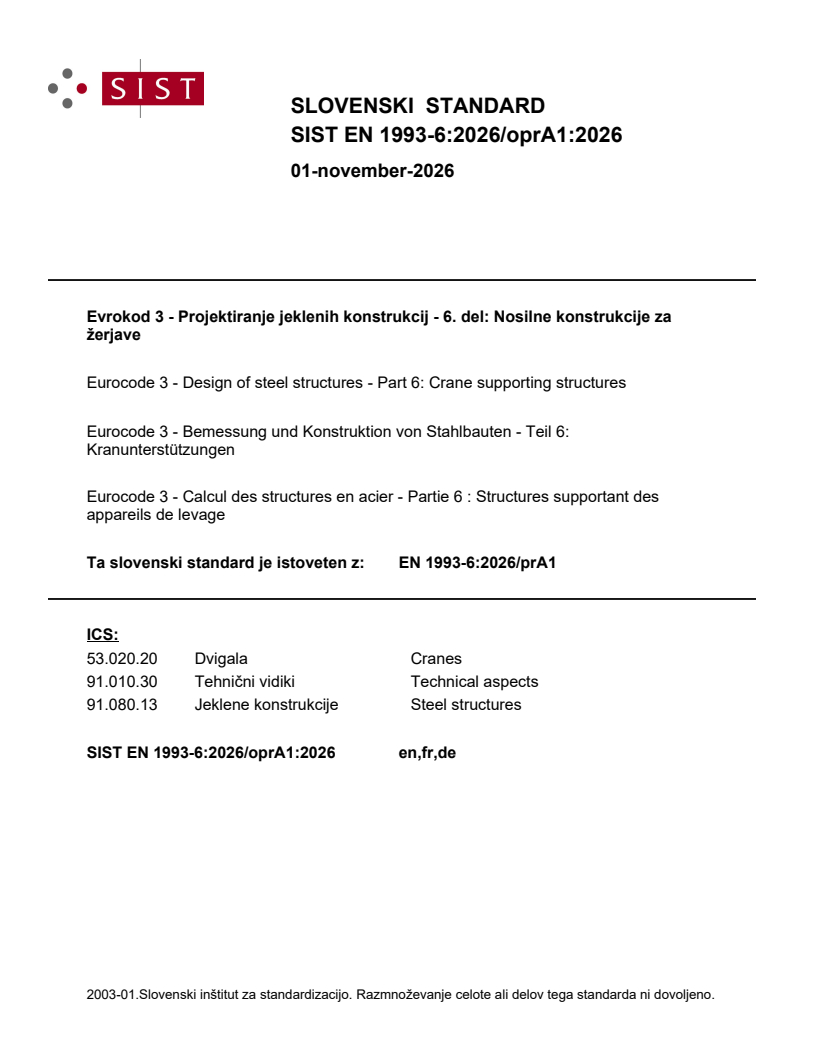
SLOVENSKI STANDARD
01-november-2026
Evrokod 3 - Projektiranje jeklenih konstrukcij - 6. del: Nosilne konstrukcije za
žerjave
Eurocode 3 - Design of steel structures - Part 6: Crane supporting structures
Eurocode 3 - Bemessung und Konstruktion von Stahlbauten - Teil 6:
Kranunterstützungen
Eurocode 3 - Calcul des structures en acier - Partie 6 : Structures supportant des
appareils de levage
Ta slovenski standard je istoveten z: EN 1993-6:2026/prA1
ICS:
53.020.20 Dvigala Cranes
91.010.30 Tehnični vidiki Technical aspects
91.080.13 Jeklene konstrukcije Steel structures
2003-01.Slovenski inštitut za standardizacijo. Razmnoževanje celote ali delov tega standarda ni dovoljeno.
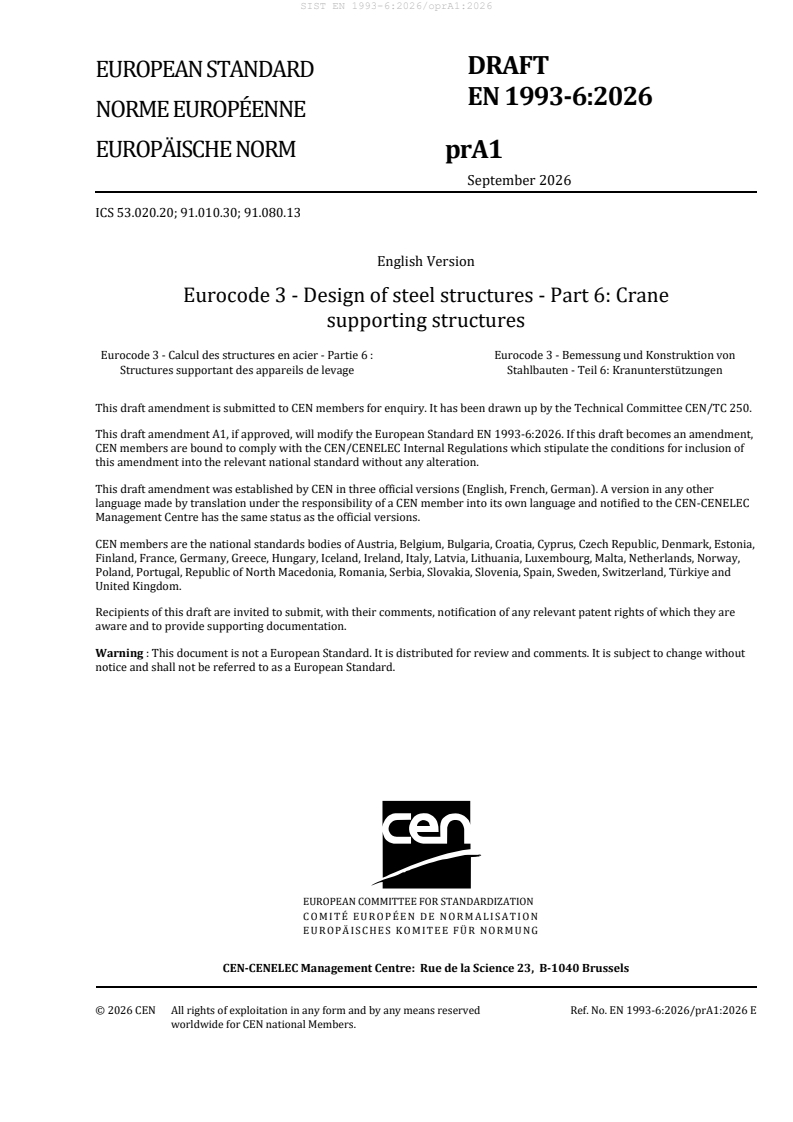
DRAFT
EUROPEAN STANDARD
EN 1993-6:2026
NORME EUROPÉENNE
EUROPÄISCHE NORM
prA1
September 2026
ICS 53.020.20; 91.010.30; 91.080.13
English Version
Eurocode 3 - Design of steel structures - Part 6: Crane
supporting structures
Eurocode 3 - Calcul des structures en acier - Partie 6 : Eurocode 3 - Bemessung und Konstruktion von
Structures supportant des appareils de levage Stahlbauten - Teil 6: Kranunterstützungen
This draft amendment is submitted to CEN members for enquiry. It has been drawn up by the Technical Committee CEN/TC 250.
This draft amendment A1, if approved, will modify the European Standard EN 1993-6:2026. If this draft becomes an amendment,
CEN members are bound to comply with the CEN/CENELEC Internal Regulations which stipulate the conditions for inclusion of
this amendment into the relevant national standard without any alteration.
This draft amendment was established by CEN in three official versions (English, French, German). A version in any other
language made by translation under the responsibility of a CEN member into its own language and notified to the CEN-CENELEC
Management Centre has the same status as the official versions.
CEN members are the national standards bodies of Austria, Belgium, Bulgaria, Croatia, Cyprus, Czech Republic, Denmark, Estonia,
Finland, France, Germany, Greece, Hungary, Iceland, Ireland, Italy, Latvia, Lithuania, Luxembourg, Malta, Netherlands, Norway,
Poland, Portugal, Republic of North Macedonia, Romania, Serbia, Slovakia, Slovenia, Spain, Sweden, Switzerland, Türkiye and
United Kingdom.
Recipients of this draft are invited to submit, with their comments, notification of any relevant patent rights of which they are
aware and to provide supporting documentation.
Warning : This document is not a European Standard. It is distributed for review and comments. It is subject to change without
notice and shall not be referred to as a European Standard.
EUROPEAN COMMITTEE FOR STANDARDIZATION
COMITÉ EUROPÉEN DE NORMALISATION
EUROPÄISCHES KOMITEE FÜR NORMUNG
CEN-CENELEC Management Centre: Rue de la Science 23, B-1040 Brussels
© 2026 CEN All rights of exploitation in any form and by any means reserved Ref. No. EN 1993-6:2026/prA1:2026 E
worldwide for CEN national Members.
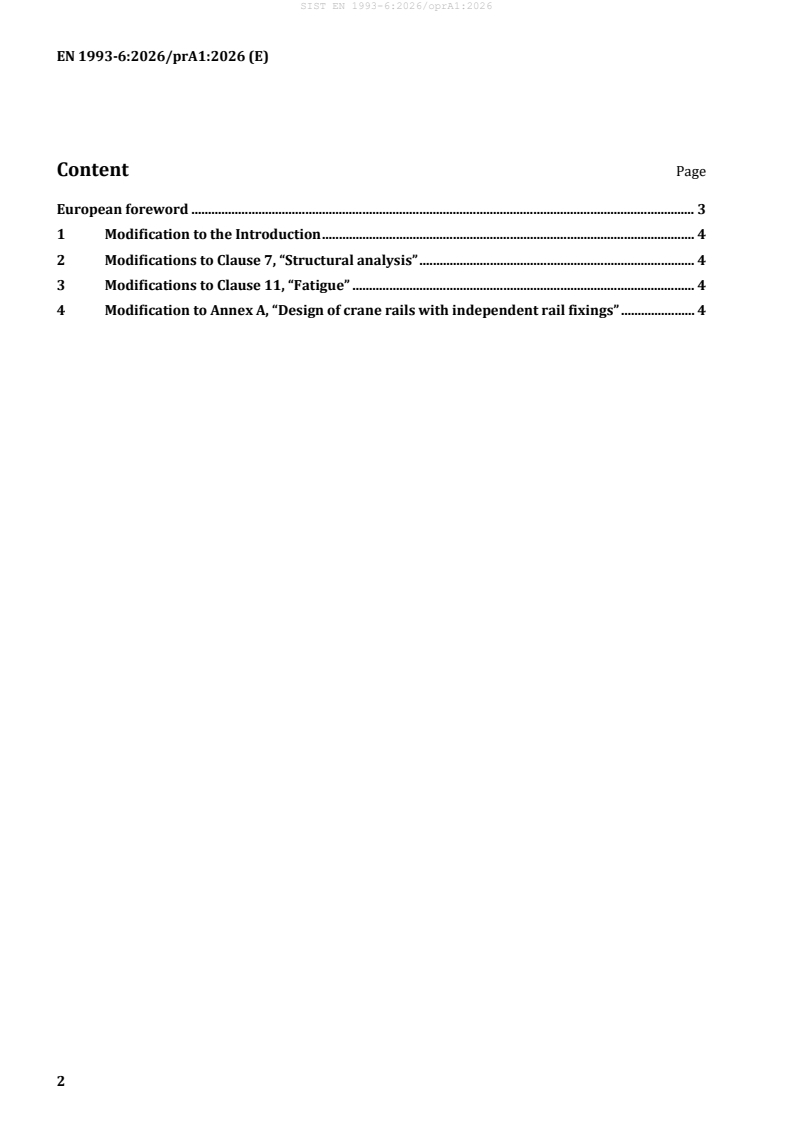
Content Page
European foreword . 3
1 Modification to the Introduction . 4
2 Modifications to Clause 7, “Structural analysis” . 4
3 Modifications to Clause 11, “Fatigue” . 4
4 Modification to Annex A, “Design of crane rails with independent rail fixings” . 4
European foreword
...