

SIST EN 17206-3:2026
(Main)Entertainment technology - Machinery for stages and other production areas - Part 3: Safety requirements and inspections for unmanned aircraft systems (UAS/Drones)
- Abstract
This document is applicable to UAS and groups of UAS used in staging and production facilities for events and theatrical productions (entertainment industry). Such facilities include: theatres, multi-purpose halls, exhibition halls; film, television and radio studios; concert halls, schools, bars, discotheques, open-air stages and other rooms for shows and events.
This document is applicable to all UAS used in the entertainment industry, indoors and outdoors. This document includes UAS that are excluded from the Commission Delegated Regulation (EU) 2020/1058 and (EU) 2019/945 specifically Article 2, 4 which excludes “UAS intended to be exclusively operated indoors”.
This document deals with all significant hazards, hazardous situations or hazardous events relevant to UAS, when they are used as intended and under conditions of misuse which are reasonably foreseeable by the manufacturer.
The document specifies the additional hazards and safety requirements for UAS categorized under the “open” category, the “specific” category, and the “certified” category, in particular, those that occur from the specific characteristics of the payload and the environment in the entertainment industry.
The principles in this document are also applicable to UAS based on new technologies or specially designed UAS which are not expressly mentioned here but which nevertheless operate in a similar manner or are meant for similar purposes to the equipment listed above.
- Status
- Published
- Public Enquiry End Date
- 30-Jul-2025
- Publication Date
- 20-Oct-2026
- Technical Committee
- I13 - Imaginarni 13
- Current Stage
- 6060 - National Implementation/Publication (Adopted Project)
- Start Date
- 19-Oct-2026
- Due Date
- 24-Dec-2026
- Completion Date
- 21-Oct-2026

SIST EN 17206-3:2026 is the Slovenian standard for entertainment technology machinery used on stages and in other production areas. It specifies safety requirements and inspections for unmanned aircraft systems (UAS/Drones) used in the entertainment industry, including indoor and outdoor use. The document is written for designers, manufacturers, installers, operators and safety assessors who need to manage the hazards created by drones, payloads and performance environments.
What does SIST EN 17206-3:2026 specify?
SIST EN 17206-3:2026 applies to UAS and groups of UAS used for events and theatrical productions in places such as theatres, studios, concert halls, halls, schools, bars, discotheques and open-air stages. It covers all UAS used in the entertainment industry, including UAS intended only for indoor operation.
The standard is organized around scope, normative references, terms and definitions, hazards, design requirements, safeguarding of hazardous areas, electrical equipment and control systems, user information, and testing. It is supported by three annexes that give hazard examples, use case definitions, and guidance on safety functions.
| Annex | What it covers |
|---|---|
| Annex A | Examples of hazards and risk origins associated with UAS |
| Annex B | Normative use case definitions for different UAS operating situations |
| Annex C | Informative guidance for designing safety functions for UAS |
What are the key requirements of SIST EN 17206-3:2026?
SIST EN 17206-3:2026 is built around hazard identification, risk reduction, safe control, and clear operating information. Its requirements matter in practice because they tell the reader when a UAS may be used near people, what protection must be built into the machine, and what must be documented for operators.
Risk assessment and operating limits
SIST EN 17206-3:2026 requires foreseeable hazards to be identified and a competent person to define intended use and perform the risk assessment. The document points to EN ISO 12100, and Annex A provides example hazards that can be used as a basis for that work.
For UAS with a maximum authorized mass (MAM) greater than 250 g, flying while persons are present in the hazard zone is only allowed after a risk assessment. If the risk reduction relies on electronic or software measures, the assessment must also consider EN 61508-5 and EN 61508-2, and the design assessment must include hardware redundancy and hardware fault tolerance.
Load assumptions, payloads and lifting
SIST EN 17206-3:2026 sets specific assumptions for lifting capacity and payload behaviour. The lifting capacity, called Entertainment Load Limit (ELL), is tied to the maximum take-off mass (MTOM), and dynamic loads and declared weather conditions must be included in the calculation.
For indoor use, the instructions have to cover venue ventilation conditions, and if no weather or ventilation conditions are declared, operation is limited to windless conditions. The manufacturer also has to define the maximum payload size so that it does not interfere with propellers or aerodynamics.
Design of the UAS and suspended equipment
SIST EN 17206-3:2026 requires sharp edges and points to be avoided, including uncaged propellers, and the design must prevent entrapment. Crash damage must not create injury risks from crushing, impact, fire or explosion.
The standard also controls how load bearing equipment and load carrying devices are integrated. Load attachments are part of the original design, must not reduce flying capability, and end terminations must be accessible for visual inspection. Any attachment points for load carrying devices must be positive, secure against loosening, and within the allowable payload size stated by the manufacturer.
Hazard zones and physical safeguarding
SIST EN 17206-3:2026 requires a clearly defined hazard zone when the UAS is not designed to fly over people. Physical barriers and warning notices are then needed to prevent access.
Crushing, shearing and trapping points should be avoided. If they cannot be avoided, the standard calls for fixed guards, netting or protective devices, and if those are not practical, the reader has to define alternative measures such as clearance, clear visibility of the travel area and hold-to-run control devices. Falling hazards also need protective measures, or, where artistic use prevents physical guarding, other suitable protective measures.
Electrical equipment, control and emergency stop
SIST EN 17206-3:2026 requires electrical and electronic equipment to be suitable for the expected environment, including electromagnetic compatibility (EMC), temperature, humidity and protection against electric shock. It also requires control circuits and safety-related control functions to be selected in line with EN 60204-1 and EN 61508-2.
The control system must prevent unintended motion, protect against unintentional or unauthorized actuation, and make the direction of movement clear to the operator. Cable-less control, groups of UAS, enabling devices, follow-me mode, and emergency stop behaviour are all specifically addressed. For UAS flying with people in the hazard zone, emergency stop must lead to a safe landing or controlled descent rather than simple power removal.
Outdoor functions, marking and information for use
SIST EN 17206-3:2026 requires outdoor UAS to comply with Direct Remote Identification and geo-awareness requirements, and lighting requirements apply according to the operating case. For indoor-only UAS, the standard allows different handling of geo-awareness and lighting, depending on the intended use.
The instructions for use must describe operating modes, including automatic, semi-automatic and manual direct piloting control, plus indoor or outdoor conditions and category limits. Marking must be clear and durable, include the use case from Annex B, and show the ELL.
What terms does SIST EN 17206-3:2026 define?
- Open category - a UAS operation category that does not require prior authorization or a declaration before the operation takes place.
- Specific category - a category that requires authorization before operation, except for certain standard scenarios where a declaration is enough.
- Certified category - a higher-risk category that requires certification of the unmanned aircraft, a licensed remote pilot and an approved operator.
- MAM, maximum authorized mass - the sum of the UAS self weight, approved attachments and the maximum declared ELL.
- ELL, Entertainment Load Limit - the maximum load that the lifting equipment is designed to raise, lower or sustain.
- MTOM, maximum take-off mass - the heaviest safe take-off mass configured by the manufacturer with accessories, payloads and batteries.
- UAS, unmanned aircraft system - the unmanned aircraft and its associated elements operated with no pilot on board.
- Geo-awareness - a function that detects a potential airspace breach and alerts the remote pilot so corrective action can be taken.
Who uses SIST EN 17206-3:2026?
SIST EN 17206-3:2026 is used by entertainment technology engineers, UAS manufacturers, stage machinery designers, event production companies, theater and studio operators, and safety managers. It is also relevant to installers, maintainers, inspectors and competent persons who perform the risk assessment or define the intended use.
In practice, these readers use the standard to choose safe operating modes, define hazard zones, design attachments and emergency functions, write instructions, and check whether a drone installation is suitable for a show or event environment.
Which standards are used with SIST EN 17206-3:2026?
- FprEN 4709-001 - provides product requirements and verification for UAS and is the base standard used for several design topics in this document.
- EN 4709-002 - provides Direct Remote Identification requirements for outdoor UAS.
- FprEN 4709-003 - provides geo-awareness requirements for outdoor UAS.
- FprEN 4709-004 - provides lighting requirements for UAS where those requirements apply.
- EN 17206:2020 - provides the general machinery safety framework for stages and other production areas, including user information and testing clauses used by this part.
- EN 60204-1 - contributes general requirements for electrical equipment of machines.
- EN 60204-32 - contributes requirements for hoisting machines, especially for enabling devices.
- EN 61326-3-1 - contributes EMC immunity requirements for safety-related systems.
- EN 61508-2 - provides requirements for electrical/electronic/programmable electronic safety-related systems.
- EN 61508-5:2010 - provides methods and examples for determining safety integrity levels.
- EN IEC 61000-6-2 - provides EMC immunity requirements for industrial environments.
- EN IEC 61000-6-4 - provides EMC emission limits for industrial environments.
- EN ISO 12100 - provides the general method for risk assessment and risk reduction.
- EN ISO 13850 - provides principles for emergency stop function design.
- EN 17206-1:2020 - is the companion part used repeatedly for general requirements on stages and production areas.
What does the SIST EN 17206-3:2026 document contain?
SIST EN 17206-3:2026 contains a hazard list in Clause 4, design rules in Clause 5, safeguarding measures in Clause 6, electrical and control requirements in Clause 7, user information rules in Clause 8, and testing requirements in Clause 9. Table 1 links major hazard types to the clauses that address them, so the reader can see where each risk is handled.
Annex A gives example hazard scenarios and risk origins, which is useful when building a practical risk assessment. Annex B defines operating use cases from UAS1 to UAS6 and adds indoor, outdoor and coordinated-use markings, which helps manufacturers classify the intended operating context. Annex C gives risk graph guidance for safety functions and explains how the document relates to safety integrity level selection for entertainment UAS.
Relations
- Effective Date
- 21-Oct-2026
- Effective Date
- 21-Oct-2026
- Effective Date
- 21-Oct-2026
- Effective Date
- 21-Oct-2026
- Effective Date
- 21-Oct-2026
- Effective Date
- 21-Oct-2026
- Effective Date
- 21-Oct-2026
- Effective Date
- 21-Oct-2026
- Effective Date
- 21-Oct-2026
- Effective Date
- 21-Oct-2026
- Effective Date
- 21-Oct-2026
- Effective Date
- 21-Oct-2026
- Effective Date
- 21-Oct-2026
- Effective Date
- 21-Oct-2026
- Effective Date
- 21-Oct-2026
Frequently Asked Questions
SIST EN 17206-3:2026 is a standard published by the Slovenian Institute for Standardization (SIST). Its full title is "Entertainment technology - Machinery for stages and other production areas - Part 3: Safety requirements and inspections for unmanned aircraft systems (UAS/Drones)". This standard covers: This document is applicable to UAS and groups of UAS used in staging and production facilities for events and theatrical productions (entertainment industry). Such facilities include: theatres, multi-purpose halls, exhibition halls; film, television and radio studios; concert halls, schools, bars, discotheques, open-air stages and other rooms for shows and events. This document is applicable to all UAS used in the entertainment industry, indoors and outdoors. This document includes UAS that are excluded from the Commission Delegated Regulation (EU) 2020/1058 and (EU) 2019/945 specifically Article 2, 4 which excludes “UAS intended to be exclusively operated indoors”. This document deals with all significant hazards, hazardous situations or hazardous events relevant to UAS, when they are used as intended and under conditions of misuse which are reasonably foreseeable by the manufacturer. The document specifies the additional hazards and safety requirements for UAS categorized under the “open” category, the “specific” category, and the “certified” category, in particular, those that occur from the specific characteristics of the payload and the environment in the entertainment industry. The principles in this document are also applicable to UAS based on new technologies or specially designed UAS which are not expressly mentioned here but which nevertheless operate in a similar manner or are meant for similar purposes to the equipment listed above.
This document is applicable to UAS and groups of UAS used in staging and production facilities for events and theatrical productions (entertainment industry). Such facilities include: theatres, multi-purpose halls, exhibition halls; film, television and radio studios; concert halls, schools, bars, discotheques, open-air stages and other rooms for shows and events. This document is applicable to all UAS used in the entertainment industry, indoors and outdoors. This document includes UAS that are excluded from the Commission Delegated Regulation (EU) 2020/1058 and (EU) 2019/945 specifically Article 2, 4 which excludes “UAS intended to be exclusively operated indoors”. This document deals with all significant hazards, hazardous situations or hazardous events relevant to UAS, when they are used as intended and under conditions of misuse which are reasonably foreseeable by the manufacturer. The document specifies the additional hazards and safety requirements for UAS categorized under the “open” category, the “specific” category, and the “certified” category, in particular, those that occur from the specific characteristics of the payload and the environment in the entertainment industry. The principles in this document are also applicable to UAS based on new technologies or specially designed UAS which are not expressly mentioned here but which nevertheless operate in a similar manner or are meant for similar purposes to the equipment listed above.
SIST EN 17206-3:2026 is classified under the following ICS (International Classification for Standards) categories: 97.200.10 - Theatre, stage and studio equipment. The ICS classification helps identify the subject area and facilitates finding related standards.
SIST EN 17206-3:2026 has the following relationships with other standards: It is inter standard links to SIST EN ISO 13850:2016, SIST EN IEC 61000-6-2:2019, SIST EN IEC 61000-6-4:2019, SIST EN 61326-3-1:2017, SIST EN 62745:2017, SIST EN 4709-002:2023, SIST EN ISO 12100:2011, SIST EN 61508-5:2011, SIST EN 60204-1:2018, SIST EN 4709-001:2026, SIST EN 4709-004:2026, SIST EN 4709-003:2026, SIST EN IEC 60204-32:2025, SIST EN 61508-2:2011, SIST EN 61508-3:2011. Understanding these relationships helps ensure you are using the most current and applicable version of the standard.
SIST EN 17206-3:2026 is associated with the following European legislation: EU Directives/Regulations: 2006/42/EC, 2019/945. When a standard is cited in the Official Journal of the European Union, products manufactured in conformity with it benefit from a presumption of conformity with the essential requirements of the corresponding EU directive or regulation.
SIST EN 17206-3:2026 is available in PDF format for immediate download after purchase. The document can be added to your cart and obtained through the secure checkout process. Digital delivery ensures instant access to the complete standard document.
Standards Content (Sample)
SLOVENSKI STANDARD
01-december-2026
Razvedrilna tehnologija - Stroji za odre in druge prireditvene prostore - 3. del:
Varnostne zahteve in pregledi za sisteme brez posadke (UAS/droni)
Entertainment technology - Machinery for stages and other production areas - Part 3:
Safety requirements and inspections for unmanned aircraft systems (UAS/Drones)
Veranstaltungstechnik - Maschinen für Bühnen und andere Produktionsbereiche - Teil 3:
Sicherheitstechnische Anforderungen und Prüfungen für unbemannte Luftfahrtsysteme
(UAS/Drohnen)
Technologies du spectacle - Machinerie pour scènes et autres zones de production -
Partie 3 : Exigences et inspections relatives à la sécurité pour le systèmes d'aéronefs
sans pilote (UAS/Drones)
Ta slovenski standard je istoveten z: EN 17206-3:2026
ICS:
97.200.10 Gledališka, odrska in Theatre, stage and studio
studijska oprema ter delovne equipment
postaje
2003-01.Slovenski inštitut za standardizacijo. Razmnoževanje celote ali delov tega standarda ni dovoljeno.
EN 17206-3
EUROPEAN STANDARD
NORME EUROPÉENNE
October 2026
EUROPÄISCHE NORM
ICS 97.200.10
English Version
Entertainment technology - Machinery for stages and
other production areas - Part 3: Safety requirements and
inspections for unmanned aircraft systems (UAS/Drones)
Technologies du spectacle - Machines pour scènes et Veranstaltungstechnik - Maschinen für Bühnen und
autres zones de production - Partie 3 : Exigences et andere Produktionsbereiche - Teil 3:
inspections relatives à la sécurité pour les aéronefs Sicherheitstechnische Anforderungen und Prüfungen
autopilotés (UAS/drones) für unbemannte Luftfahrtsysteme (UAS/Drohnen)
This European Standard was approved by CEN on 12 October 2026.
CEN members are bound to comply with the CEN/CENELEC Internal Regulations which stipulate the conditions for giving this
European Standard the status of a national standard without any alteration. Up-to-date lists and bibliographical references
concerning such national standards may be obtained on application to the CEN-CENELEC Management Centre or to any CEN
member.
This European Standard exists in three official versions (English, French, German). A version in any other language made by
translation under the responsibility of a CEN member into its own language and notified to the CEN-CENELEC Management
Centre has the same status as the official versions.
CEN members are the national standards bodies of Austria, Belgium, Bulgaria, Croatia, Cyprus, Czech Republic, Denmark,
Estonia, Finland, France, Germany, Greece, Hungary, Iceland, Ireland, Italy, Latvia, Lithuania, Luxembourg, Malta, Netherlands,
Norway, Poland, Portugal, Republic of North Macedonia, Romania, Serbia, Slovakia, Slovenia, Spain, Sweden, Switzerland, Türkiye
and United Kingdom.
EUROPEAN COMMITTEE FOR STANDARDIZATION
C O M I T É E U R O P É E N D E N O R M A L I S A T I O N
E U R O P Ä I S C H E S K O M I T E E F Ü R N O R M U N G
CEN-CENELEC Management Centre: Rue de la Science 23, B-1040 Brussels
© 2026 CEN All rights of exploitation in any form and by any means reserved Ref. No. EN 17206-3:2026 E
worldwide for CEN national Members.
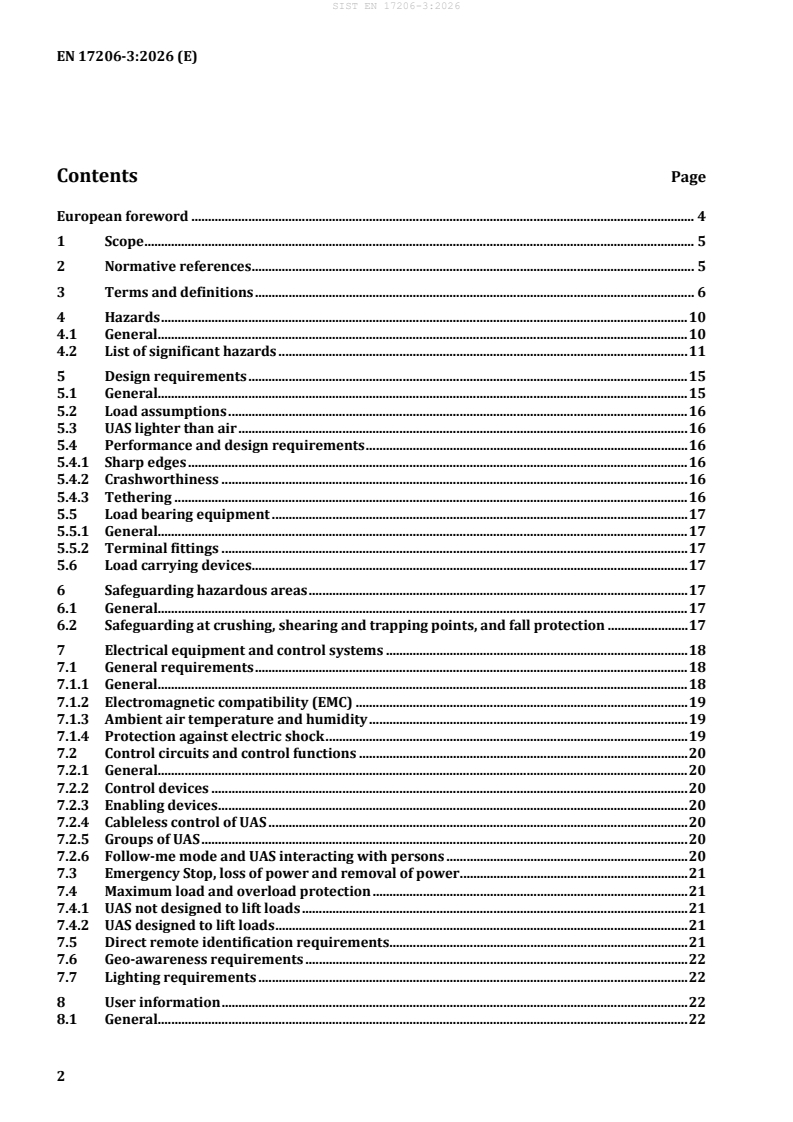
Contents Page
European foreword . 4
1 Scope . 5
2 Normative references . 5
3 Terms and definitions . 6
4 Hazards . 10
4.1 General. 10
4.2 List of significant hazards . 11
5 Design requirements . 15
5.1 General. 15
5.2 Load assumptions . 16
5.3 UAS lighter than air . 16
5.4 Performance and design requirements . 16
5.4.1 Sharp edges . 16
5.4.2 Crashworthiness . 16
5.4.3 Tethering . 16
5.5 Load bearing equipment . 17
5.5.1 General. 17
5.5.2 Terminal fittings . 17
5.6 Load carrying devices . 17
6 Safeguarding hazardous areas . 17
6.1 General. 17
6.2 Safeguarding at crushing, shearing and trapping points, and fall protection . 17
7 Electrical equipment and control systems . 18
7.1 General requirements . 18
7.1.1 General. 18
7.1.2 Electromagnetic compatibility (EMC) . 19
7.1.3 Ambient air temperature and humidity . 19
7.1.4 Protection against electric shock . 19
7.2 Control circuits and control functions . 20
7.2.1 General. 20
7.2.2 Control devices . 20
7.2.3 Enabling devices . 20
7.2.4 Cableless control of UAS . 20
7.2.5 Groups of UAS . 20
7.2.6 Follow-me mode and UAS interacting with persons . 20
7.3 Emergency Stop, loss of power and removal of power . 21
7.4 Maximum load and overload protection . 21
7.4.1 UAS not designed to lift loads . 21
7.4.2 UAS designed to lift loads . 21
7.5 Direct remote identification requirements . 21
7.6 Geo-awareness requirements . 22
7.7 Lighting requirements . 22
8 User information . 22
8.1 General. 22
8.2 Instructions for use . 22
8.2.1 General . 22
8.2.2 Intended use . 23
8.2.3 User information for safety functions . 23
8.2.4 Outdoor use . 23
8.2.5 Loss of synchronization/group operation . 23
8.2.6 Coordinated move . 23
8.2.7 Indoor use . 23
8.3 Marking . 24
8.4 Load-carrying device . 24
9 Testing . 24
Annex A (informative) Examples of hazards and risk origin associated with UAS . 25
Annex B (normative) Use case definitions . 34
Annex C (informative) Designing safety functions for UAS. 36
Bibliography . 40
European foreword
This document (EN 17206-3:2026) has been prepared by Technical Committee CEN/TC 433
“Entertainment Technology – Machinery, equipment and installations”, the secretariat of which is held
by DIN.
This European Standard shall be given the status of a national standard, either by publication of an
identical text or by endorsement, at the latest by April 2027, and conflicting national standards shall be
withdrawn at the latest by April 2027.
Attention is drawn to the possibility that some of the elements of this document may be the subject of
patent rights. CEN shall not be held responsible for identifying any or all such patent rights.
This document specifies safety requirements within the meaning of Directive 2006/42/EC, “Machinery
Directive”.
This is the third part of the EN 17206 series. At present the parts of the document are:
— Part 1: Safety requirements and inspections
— Part 2: Safety requirements for stands and truss lifts
— Part 3: Safety requirements and inspections for unmanned aircraft systems (UAS/Drones) (this
document)
The deviations from EN 17206-1 specified in this part are based on the particular operating conditions
for unmanned aircraft systems (UAS) and cannot be applied to other machinery.
Any feedback and questions on this document should be directed to the users’ national standards body.
A complete listing of these bodies can be found on the CEN website.
According to the CEN-CENELEC Internal Regulations, the national standards organisations of the
following countries are bound to implement this European Standard: Austria, Belgium, Bulgaria, Croatia,
Cyprus, Czech Republic, Denmark, Estonia, Finland, France, Germany, Greece, Hungary, Iceland, Ireland,
Italy, Latvia, Lithuania, Luxembourg, Malta, Netherlands, Norway, Poland, Portugal, Republic of North
Macedonia, Romania, Serbia, Slovakia, Slovenia, Spain, Sweden, Switzerland, Türkiye and the United
Kingdom.
Under development. Will replace EN 17206:2020.
1 Scope
This document is applicable to UAS and groups of UAS used in staging and production facilities for events
and theatrical productions (entertainment industry). Such facilities include: theatres, multi-purpose
halls, exhibition halls; film, television and radio studios; concert halls, schools, bars, discotheques, open-
air stages and other rooms for shows and events.
This document is applicable to all UAS used in the entertainment industry, indoors and outdoors. This
document includes UAS that are excluded from the Commission Delegated Regulation (EU) 2020/1058
and (EU) 2019/945 specifically Article 2, 4 which excludes “UAS intended to be exclusively operated
indoors”.
This document deals with all significant hazards, hazardous situations or hazardous events relevant to
UAS, when they are used as intended and under conditions of misuse which are reasonably foreseeable
by the manufacturer.
The document specifies the additional hazards and safety requirements for UAS categorized under the
“open” category, the “specific” category, and the “certified” category, in particular, those that occur from
the specific characteristics of the payload and the environment in the entertainment industry.
The principles in this document are also applicable to UAS based on new technologies or specially
designed UAS which are not expressly mentioned here but which nevertheless operate in a similar
manner or are meant for similar purposes to the equipment listed above.
2 Normative references
The following documents are referred to in the text in such a way that some or all of their content
constitutes requirements of this document. For dated references, only the edition cited applies. For
undated references, the latest edition of the referenced document (including any amendments) applies.
EN 4709-001:2026, Aerospace series — Unmanned Aircraft Systems — Part 001: Product requirements
and verification
EN 4709-002, Aerospace series — Unmanned Aircraft Systems — Part 002: Direct Remote Identification
EN 4709-003:2026, Aerospace series — Unmanned Aircraft Systems — Part 003: Geo-awareness
requirements
EN 4709-004, Aerospace series — Unmanned Aircraft Systems — Part 004: Lighting requirements
EN 17206:2020, Entertainment technology — Machinery for stages and other production areas — Safety
requirements and inspections
EN 60204-1, Safety of machinery — Electrical equipment of machines — Part 1: General requirements (IEC
60204-1)
EN IEC 60204-32, Safety of machinery — Electrical equipment of machines — Part 32: Requirements for
hoisting machines (IEC 60204-32)
EN IEC 61000-6-2, Electromagnetic compatibility (EMC) — Part 6-2: Generic standards — Immunity
standard for industrial environments (IEC 61000-6-2)
EN IEC 61000-6-4, Electromagnetic compatibility (EMC) — Part 6-4: Generic standards — Emission
standard for industrial environments (IEC 61000-6-4)
EN 61326-3-1, Electrical equipment for measurement, control and laboratory use — EMC requirements —
Part 3-1: Immunity requirements for safety-related systems and for equipment intended to perform safety-
related functions (functional safety) — General industrial applications (IEC 61326-3-1)
EN 61508-2, Functional safety of electrical/electronic/programmable electronic safety-related systems —
Part 2: Requirements for electrical/electronic/programmable electronic safety-related systems (IEC 61508-
2)
EN 61508-3, Functional safety of electrical/electronic/programmable electronic safety-related systems —
Part 3: Software requirements (IEC 61508-3)
EN 61508-5:2010, Functional safety of electrical/electronic/programmable electronic safety-related
systems — Part 5: Examples of methods for the determination of safety integrity levels (IEC 61508-5:2010)
EN 62745, Safety of machinery — Requirements for cableless control systems of machinery (IEC 62745)
EN ISO 12100, Safety of machinery — General principles for design — Risk assessment and risk
reduction(ISO 12100)
EN ISO 13850, Safety of machinery — Emergency stop function — Principles for design (ISO 13850)
3 Terms and definitions
For the purposes of this document, the terms and definitions given in EN 17206-1 and the following apply.
ISO and IEC maintain terminology databases for use in standardization at the following addresses:
— ISO Online browsing platform: available at https://www.iso.org/obp/
— IEC Electropedia: available at https://www.electropedia.org/
3.1
open category
category of UAS operation that, considering the risks involved, does not require a prior authorisation by
the competent authority nor a declaration by the UAS operator before the operation takes place
[SOURCE: EN 4709-001:2026]
3.2
specific category
category of UAS operation that, considering the risks involved, requires an authorization by the
competent authority before the operation takes place and takes into account the mitigation measures
identified in an operational risk assessment, except for certain standard scenarios where a declaration
by the operator is sufficient
[SOURCE: EN 4709-001:2026]
3.3
certified category
category of UAS operation that, considering the risks involved, requires the certification of the UA, a
licensed remote pilot and an operator approved by the competent authority, in order to ensure an
appropriate level of safety
[SOURCE: EN 4709-001:2026]
3.4
competent authority
authority responsible for the certification, authorization and oversight of UAS air operations where the
UAS operator has its principal place of business or place of residence
[SOURCE: EN 4709-001:2026]
3.5
automatic control operational mode
control operational mode where the UA altitude, speed and flight path are fully controlled by the flight
control system
Note 1 to entry: No pilot input is needed to address flight control and vehicle steering, other than to load or modify
the required flight plan or waypoint parameters. C2 link performance and latency are not an issue for control
stability and guidance, besides situation awareness and collision avoidance issues. Examples of automatic modes
are waypoint path navigation, waypoint holding (hovering/loitering), automatic take-off, automatic landing, follow-
me mode, return to home, etc.
[SOURCE: EN 4709-001:2026]
3.6
semi-automatic control operational mode
control operational mode where the remote pilot commands outer loop parameters such as altitude,
heading and UA speed in given values specified by the UA manufacturer
Note 1 to entry: The flight control system operates the UA controls to achieve the commanded outer loop
parameter value. Envelope flight protection and/or control decoupling functions should be in place in this control
operational mode. The flight manual shall clearly specify, for any possible/available control mode that is classified
as semi-automatic, for each degree of freedom, the level of involvement of the pilot to address control stability. For
assisted modes a higher latency on C2 link may be adequate (e.g. < 5 s) but vehicle steering is always pilot direct
responsibility. A wide range of flight control modes are semi-automatic, from low level attitude/rate control,
autopilot heading/speed/altitude control, velocity control; position control may be considered semi-automatic if
pilot input is transformed into position commands continuously (or an automatic mode if pilot inputs only modify
waypoint coordinates in on-board autopilot).
[SOURCE: EN 4709-001:2026]
3.7
manual direct piloting control operational mode
control operational mode where the remote pilot directly commands UA controls (e.g. aerodynamic
surfaces through servo-actuators and engine through electronic speed control)
Note 1 to entry: This control mode does not benefit (as a general rule) of autopilot aiding action
(e.g. stability/control augmentation systems SAS/CAS, flight envelope protection FEP) and the pilot is also directly
responsible for vehicle stability (no hand-off control is allowed). Link performance and latency is critical
(e.g. << 1 s).
[SOURCE: EN 4709-001:2026]
3.8
maximum authorized mass
MAM
sum of the self weight of the UAS plus the weight of any approved attachments plus the maximum
declared ELL
Note 1 to entry Figure 1 illustrates the terms and an example of a UAS.
Key
1 propeller
2 motor
3 electronics (battery, controller and transmitter)
Figure 1 — Example depiction of a UAS
3.9
load carrying device
part of the UAS which directly carries the intended load
3.10
load bearing equipment
assembly of load bearing elements
3.11
load bearing element
parts of the UAS between the load and the UAS anchor point
3.12
entertainment load limit
ELL
maximum load that an item of lifting equipment is designed to raise, lower or sustain
[SOURCE: EN 17206:2020]
3.13
safety integrity level
SIL
discrete level (one out of a possible four), corresponding to a range of safety integrity values, where safety
integrity level 4 has the highest level of safety integrity and safety integrity level 1 has the lowest
[SOURCE: EN 61508-4:2010, 3.5.8]
3.14
maximum take-off mass
MTOM
maximum take-off mass of the UA in the heaviest combination with accessories, payloads and batteries,
as specified by the manufacturer when placing the product on the market, at which the UA can be safely
operated
[SOURCE: EN 4709-001:2026]
3.15
return home
home
fail safe function that upon loss of data link will direct the UA back to predefined home position
[SOURCE: EN 4709-001:2026]
3.16
unmanned aircraft
UA
aircraft operating or designed to operate autonomously or to be piloted remotely without a pilot on board
[SOURCE: EN 4709-001:2026]
3.17
unmanned aircraft system
UAS
unmanned aircraft and its associated elements which are operated with no pilot on board
Note 1 to entry: ISO 21384-2.
[SOURCE: EN 4709-001:2026]
3.18
tether
mechanical device for the purpose of effectively restraining the UA within the range permitted by the
length of the tether as its primary function
Note 1 to entry: A tether in the sense of this document is not any cable linking the UA to the ground e.g. an electric
cable powering the UA, even if it was the only source of power and a loss of connection would inevitably lead to a
loss of flight. However, the tether may be used to transmit electrical power to the UA as a secondary function.
[SOURCE: EN 4709-001:2026]
3.19
holding
hovering for hovering capable aircraft, i.e., maintaining altitude and position; for fixed wing aircraft
holding corresponds to loitering, i.e., flying a minimum distance orbit around current position, at low
speed and holding altitude
[SOURCE: EN 4709-001:2026]
3.20
automatic landing
automatic mode where the UA attempts an automatic landing or an emergency landing at the current
position
[SOURCE: EN 4709-001:2026]
3.21
geo-awareness
function that, based on the data provided by Member States, detects a potential breach of airspace
limitations and alerts the remote pilots so that they can take immediate and effective action to prevent
that breach
[SOURCE: EN 4709-001:2026]
3.22
follow-me mode
mode of operation of a UAS where the unmanned aircraft constantly follows the remote pilot within a
predetermined radius
[SOURCE: EN 4709-001:2026]
4 Hazards
4.1 General
When designing and using UAS as in this document, all foreseeable hazards shall be identified.
Only competent persons shall be responsible for:
a) describing the intended use;
b) risk assessment.
After risk assessment has been carried out, the appropriate measures to be taken shall be established for
specific hazards. The risk assessment can be carried out on the basis of EN ISO 12100 or according to the
example hazards listed in Annex A, Table A.1. Suitable facilities and provisions to enable the recovery of
performers and other persons shall be provided in the event of any of the identified hazards occurring.
Hazards largely result from the respective design and mode of operation, in particular from:
— incorrect handling and operation;
— uncontrolled movements;
— concurrent motion of loads using more than one UAS, particularly involving differences in speed and
uneven load distribution;
— environmental hazards (e.g. weather conditions);
— hazard zones;
— limited visibility.
The following steps shall be taken when selecting protective measures:
a) specify the limits of the UAS (intended use, reasonably foreseeable misuse, space limits, the
foreseeable life limit, and wear factors);
b) identify hazards and estimate risks;
c) avoid hazards by means of inherently safe design measures and reduce risks as much as possible;
d) inform users of any residual risks (information for use).
4.2 List of significant hazards
Table 1 shows a list of significant hazards, hazardous situations and hazardous events that could result
in risks to persons during normal use and foreseeable misuse. It also contains the relevant clauses in this
document that are necessary to reduce or eliminate the risks associated with those hazards.
Table 1 — List of significant hazards
Relevant clause(s) in this
Hazards
document
The significant hazards below are based upon EN IEC 12100.
1 Mechanical hazards due to:
1.1 Acceleration, deceleration 5.1;
1.2 Angular parts 5.1; 5.4.1 5.4.2
1.3 Approach of moving element to a fixed part 5.1; 5.4.1 5.4.2
1.5 Elastic elements 5.1;
1.6 Falling objects 5.1; 5.4.2
1.7 Gravity 5.1; 5.4.2
1.8 Height from the ground 5.1; 5.4.2
1.9 High pressure 5.1; 5.3
1.10 Instability 5.1; 5.2; 5.5
1.11 Kinetic energy 5.1; 5.2; 5.5
1.12 Machinery mobility 5.1; 5.2; 5.3; 5.4; 5.5
1.13 Rotating elements 5.1; 5.4.1
1.14 Rough, slippery surface —
1.15 Sharp edges 5.1; 5.4.1
1.16 Stored energy 5.4.2
2 Electrical hazards due to:
2.1 Electromagnetic phenomena 7.1; 7.1.2
2.2 Electrostatic phenomena 7.1; 7.2.3; 7.2.4
2.3 Live parts 7.1; 7.1.4;
Relevant clause(s) in this
Hazards
document
2.4 Loss of power source 5.1
2.5 Overload 7.1; 7.3
2.6 Parts which have become live under fault conditions 7.1; 7.1.4
2.7 Short-circuit 7.1; 7.1.4
2.8 Thermal radiation 7.1; 5.1; 5.3
3 Thermal hazards due to:
3.1 Explosion 7.1; 5.1; 5.3
3.2 Flame 7.1; 5.1; 5.3
3.3 Objects or materials with high or low temperature —
3.4 Radiation from heat sources 7.1; 5.1; 5.3
4 Noise hazards due to:
4.1 Cavitation phenomena 5.1
4.2 Exhausting system 5.1
4.3 Gas leaking at high speed 5.1; 5.3
4.4 Manufacturing process (stamping, cutting, etc.) —
4.5 Moving parts 5.1
4.6 Scraping surfaces —
4.7 Unbalanced rotating parts 5.1
4.8 Whistling pneumatics —
4.9 Worn parts —
5 Vibration hazards due to:
5.1 Cavitation phenomena 5.1; 5.2
5.2 Misalignment of moving parts 5.1
5.3 Mobile equipment 5.1; 5.2
5.4 Scraping surfaces —
5.5 Unbalanced rotating parts 5.1
5.6 Vibrating equipment 5.1
5.7 Worn parts —
6 Radiation hazards
6.1 Low frequency, radio frequency radiation 5.1
6.2 Infrared, visible and ultraviolet lights 7.1.2
6.3 Lasers —
Relevant clause(s) in this
Hazards
document
7 Material and substances hazards
7.1 Hazards from contact with or inhalation of harmful 5.1; 5.3; 7.1
fluids, gases, mists, fumes and dust
7.2 Fire or explosion hazards 5.1; 5.3; 7.1
8 Ergonomic hazards
8.1 Access 6.1; 6.2;
8.2 Design or Location of indicators and visual display units 5.1
8.3 Design, location or identification of control devices 5.1; 7.7
8.4 Effort —
8.5 Human error, human behaviour —
8.6 Local lighting 5.1; 7.7
8.7 Mental overload/underload —
8.8 Posture —
8.9 Repetitive activity —
8.10 Visibility 5.1
9 Hazards associated with the environment in which
the machine is used
9.1 Dust and fog —
9.2 Electromagnetic disturbance 7.1
9.3 Lightning 7.1
9.4 Moisture 7.1.3
9.5 Pollution —
9.6 Snow 5.1
9.7 Temperature 5.1; 5.3; 7.1.3
9.8 Water 5.1
9.9 Wind 5.1; 5.3; 5.4.3; 8.2.3; 9
9.10 Lack of oxygen 5.3
9.11 Freezing rain 7.1.3
10 Combination of hazards
Additional hazards and hazardous events due to lifting procedures, load or machinery
collisions due to:
11 Unintentional movements hazards
11.1 Failure/malfunctioning of the control system 7.2.5
Relevant clause(s) in this
Hazards
document
11.2 Software errors 7.2.2; 7.3
11.3 Uncontrolled movements 5.1; 7.3
11.4 Unintentional movement due to mechanical failure 5.1; 7.3
12 Improper use hazards
12.1 Unauthorised start-up 7.2.2; 7.3
12.2 Unauthorised use 7.2.2; 7.3
12.3 Improper operation 8
12.4 Insufficient instructions for the operator 8
Additional hazards, hazardous situations and hazardous events due to lifting
13 Mechanical hazards and hazardous events
13.1 Lack of stability 5.1; 5.2
13.2 Uncontrolled loading – overloading – overturning 5.1; 5.2; 7.4
moments exceeded
13.3 Unexpected/unintended movement of loads 5.1; 5.2; 7.4
13.4 Inadequate holding devices/accessories 5.5; 5.6
13.5 Collision of more than one machine 7.2.2; 7.2.5; 8.2.4
13.6 From insufficient mechanical strength of parts 5.1
13.7 From inadequate design of pulleys, drums —
13.8 From unsuitable selection of chains, ropes, lifting and 5.5; 5.6
accessories and their inadequate integration into the
machine
13.9 From abnormal conditions of 8
assembly/testing/use/maintenance
13.10 From the effect of load on persons (impact by load or —
counterweight)
13.11 Incorrect arrangement of machinery parts 5.1
13.12 Incorrect installation, testing, use and maintenance 8; 9
Additional hazards, hazardous situations and hazardous events due to the lifting or moving of
persons
14 Mechanical and unintentional movement hazards
14.1 Inadequate mechanical strength – inadequate working 5.1; 5.2
coefficients
14.2 Failure/malfunctioning of the control system 7.3
14.3 Software errors 7.2.2; 7.2.3; 7.2.4; 7.2.5; 7.3
Relevant clause(s) in this
Hazards
document
14.4 Uncontrolled movements 5.1; 5.2; 7.3
Other significant hazards
15 Cybersecurity hazards
15.1 Hazards of hacking or malicious attack 7.1; 7.2; 7.6
15.2 GPS jamming 7.1; 7.2; 7.6
15.3 Frequency hacking 7.1; 7.2; 7.6
15.4 Cybersecurity intrusion 7.1; 7.2; 7.6
5 Design requirements
5.1 General
Unless otherwise specified in this document, the general requirements given in EN 4709-001 apply to the
design of indoor as well as to the design of outdoor UAS.
UAS with a maximum authorized mass (MAM) equal or higher than 250 g shall not be designed to fly
while persons are present in the hazard zone unless the factors of deployed energy (mv ), the size and
shape of the propellers, and the shape of the object in flight (blunt body) are considered within the
reduction measures listed in a risk assessment in accordance with EN ISO 12100. If the protective
measures within the risk assessment include electronic or software solutions, the risk assessment shall
be in accordance with EN 61508-5 and EN ISO 12100. Additionally, a design assessment in accordance
with EN 61508-2 shall take into account both hardware redundancy and hardware fault tolerance. The
minimum Hardware Fault Tolerance for Safety and Hardware Fault Tolerance for Availability of the
electrical/electronic/programmable electronic system (E/E/PES) shall be at least 1 for both of the
variables. For the purposes of clarification, this design requirement also applies when suspending or
lifting persons with UAS.
The design of a UAS installation shall ensure that unauthorised persons are located outside of the hazard
zone and that they are not exposed to risks.
When the UAS are flying above the audience or public, the maximum level of injuries and multiple
fatalities shall be taken into account as additional penalizing points in the risk assessment.
When the UAS are flying above the audience or public, the probability of avoidance shall be set to the
highest penalizing score.
When flying above persons the hazards related to battery burning, power failure, motor failure and signal
failure are of utmost importance and those hazards shall be reduced to an adequate level as per
EN ISO 12100.
The maximum speed of horizontal travel and the maximum allowed area of movement shall dictate the
limits of the hazardous zone.
The following EN 4709-001 requirements do not apply when using this document for UAS designed for
categories other than the open category:
— 4.2.1 (2) maximum speed;
— 4.2.3 (2) pass criteria for maximum speed.
The following EN 4709-001 requirements do not apply when designing UAS for indoor use only:
— weather conditions for example wind or snow.
5.2 Load assumptions
The lifting capacity (ELL) shall be half the calculated maximum take off mass (MTOM) as specified in
EN 4709-001. The calculation of the ELL shall include dynamic loads. The ELL shall also assume forces
related to maximum weather conditions, for example the load at the maximum wind declared in the
instructions for use. The ELL calculation for UAS for indoor use shall include maximum venue ventilation
conditions.
If no maximum venue ventilation conditions or weather conditions are declared by the manufacturer, the
UAS shall only operate under windless environmental circumstances.
It is permitted to declare different ELL for outdoor-use and indoor-use provided it is clearly indicated.
5.3 UAS lighter than air
Unmanned aerial systems lighter than air (e.g. balloons) shall make sure that the material used cannot be
pierced under regular conditions.
Non-flammable gases shall be used for UAS lighter than air.
NOTE 1 Regarding the indoor usage of the design of UAS lighter than air, local regulation and requirements can
apply.
NOTE 2 Attention is drawn to explosive atmosphere regulations and the ATEX directive.
The design of UAS lighter than air shall take into account thermal changes within the venue, ventilation
and behavioural changes when the venue is full.
When using UAS lighter than air outdoors the design shall accommodate a function to land the device in
any wind conditions to avoid escaping, even if this implies the destruction of the aircraft. This condition
shall be part of the risk assessment when considering injuries to the public.
When designing UAS lighter than air closer to public, audience and performers, the risk of suffocation
shall be reduced.
5.4 Performance and design requirements
5.4.1 Sharp edges
The requirements given in EN 4709-001 apply.
There shall be no sharp edges and points on the UA, including the propellers if they are uncaged. The UAS
shall be designed so that no entrapment is possible and propellers are exposed in such a way that they
should not make contact and they shall not create a severe injury.
5.4.2 Crashworthiness
The requirements given in EN 4709-001 apply.
Any damage or fault to the UAS during operation, including a possible crash, shall not lead to injuries to
persons due to crushing, impact, fire or explosion.
5.4.3 Tethering
UAS for the entertainment industry shall not be designed with tethering located permanently above the
fly path of the UAS. Machinery in full compliance with EN 17206-1 and designed specifically for the
entertainment industry shall be the preferred design principle for those cases.
The design of tethering equipment below the fly path of the UAS is permitted provided there are no
alternative solutions with equipment compliant with EN 17206-1 that could meet the design
requirements. The lower cost of the UAS tethered device or the lower cost of the installation shall not be
a factor to prefer the UAS tethered option.
Tension on the tethering equipment caused by the UAS or expected wind conditions shall not lead to
damages or injuries. Electrical hazards shall be considered when using tethered UAS.
5.5 Load bearing equipment
5.5.1 General
The requirements given in EN 17206:2020, 5.5, apply.
The design shall ensure that any allowed load-bearing equipment does not compromise the flying
capabilities of the UAS. The manufacturer shall ensure the user is not able to easily modify the UAS to
attach a load when it is not the original intended use. All load attachments shall be designed and provided
as part of the initial design by the manufacturer of the UAS.
5.5.2 Terminal fittings
End terminations of load-bearing equipment shall be accessible for visual inspection.
5.6 Load carrying devices
The requirements given in EN 17206:2020, 5.7, apply.
UAS may be designed so as to support different types of load-carrying devices. The points of attachment
for load-carrying devices are an integral part of the UAS and shall allow for a positive connection that is
safeguarded against unintentional loosening.
The design shall ensure that any allowed load-bearing devices does not compromise the flying
capabilities of the UAS and they are within the allowable payload size specified in the manufacturer
instructions.
6 Safeguarding hazardous areas
6.1 General
If the UAS is not designed to fly over people, the hazard zone shall be clearly specified, a physical barrier
shall be implemented to prevent persons from accessing the hazardous area and a notice message shall
be added near the access to the hazardous area.
Elements external to the UAS itself but required for the operation and storage of the UAS and the UAS
itself that pose hazards such as crushing, shearing, and trapping shall be avoided.
For the required risk assessment, manual handling and operation of the UAS and other related equipment
shall be considered.
6.2 Safeguarding at crushing, shearing and trapping points, and fall protection
Crushing, shearing and trapping points shall be avoided. Where such points are unavoidable, they shall
be safeguarded by means of a fixed guard, netting or protective devices as specified in EN ISO 12100.
Such devices include, for example, light beams, light curtains or netting to limit the access to the
hazardous area.
If the use of guards or protective devices is not practicable, protective measures shall be specified
including clearance, complete view to the travel area and hold-to-run control devices.
If heights from which a UAS might fall can create an injury, then protective measures shall be provided.
For artistic reasons it might not be possible to provide guarding or other physical measures to prevent
UAS from falling. In this case the risk of falling shall be addressed by suitable and sufficient additional
protective measures.
7 Electrical equipment and control systems
7.1 General requirements
7.1.1 General
NOTE 1 Regarding designing and installing electrical and electronic systems for UAS installations, including any
safety components, local regulations and requirements can apply.
In particular the following standards shall be used:
— for UAS containing higher voltages or for charging stations EN 60204-1 is applicable, especially in
regards of:
— selection of equipment;
— electrical supply;
— physical environment and operation conditions;
— terminal for connection to the external protective earthing system;
— supply disconnecting (isolating) devices;
— devices for switching off for prevention of unexpected start-up;
— devices for disconnecting electrical equipment;
— protection against unauthorised, inadvertent and/or mistaken connection;
— protection against phase failure or wrong phase sequence;
— equipotential bonding;
— control circuits and control functions;
— control and enabling devices;
— cableless control devices;
— safety functions and control functions in the event of failure;
— start and stop devices and indicators;
— devices for emergency switching off;
— conductors and cables;
— wiring practice;
— electric motors and associated equipment;
— technical documentation for electrical equipment;
— for functional safety related topics use EN 61508 series.
NOTE 2 In this document the term “electrical” includes both electrical and electronic matters (i.e. “electrical
equipment” means both the electrical and the electronic equipment). The equipment covered by this document
commences at the point of connection of the power supply to the UAS or the charging station.
NOTE 3 See Annex C, Table C.1 and Table C.2 for informative guidelines on how to design
...