

SIST EN 4709-001:2026
(Main)Aerospace series - Unmanned Aircraft Systems - Part 001: Product requirements and verification
General Information
- Abstract
This document provides technical specification and verification method to support compliance with the requirements defined by the product harmonisation legislation set by Chapter II of Commission Delegated Regulation (EU) 2019/945 of 12 March 2019 on unmanned aircraft systems and on thirdcountry operators of unmanned aircraft systems.
This document does not cover UAS lighter than air (e.g. airships and balloons).
This document is only applicable for UA with energy sources based on electro-chemical technologies.
- Status
- Published
- Public Enquiry End Date
- 30-Jul-2021
- Publication Date
- 08-Apr-2026
- Technical Committee
- I13 - Imaginarni 13
- Current Stage
- 6060 - National Implementation/Publication (Adopted Project)
- Start Date
- 31-Mar-2026
- Due Date
- 05-Jun-2026
- Completion Date
- 09-Apr-2026

Overview
SIST EN 4709-001:2026 - Aerospace series – Unmanned Aircraft Systems – Part 001: Product requirements and verification is a European Standard developed by CEN for manufacturers, operators, and stakeholders involved with Unmanned Aircraft Systems (UAS) in the ‘open’ category. This standard outlines comprehensive compliance requirements for UAS products intended for use within the European Union, ensuring these systems meet essential safety, reliability, and market access standards as detailed in Commission Delegated Regulation (EU) 2019/945.
The document provides guidance on how compliant design, construction, and verification contribute to eligibility for CE marking. It applies specifically to unmanned aircraft (UA) powered by electro-chemical energy sources and covers classes C0 to C4. The standard does not address ‘specific’ or ‘certified’ UAS categories, nor does it include hazards originating from unique payloads.
Key Topics
SIST EN 4709-001:2026 addresses multiple crucial aspects of product compliance and verification for UAS in the ‘open’ category, including:
- Physical and Mechanical Properties: Requirements to ensure structural soundness, safe operation, and minimization of injury risk.
- Flammability: Guidelines for material selection and design to reduce fire and ignition risks associated with electro-chemical energy sources.
- Electrical Properties: Standards for electrical safety, reliability, and system integration in UAS design.
- Functional Safety: Procedures to verify safe operation modes, fail-safes, performance under abnormal conditions, and system resilience.
- Electronic Identification System: Specifications for electronic identification to support monitoring and regulatory compliance.
- Class-specific Requirements: Detailed product conformity and verification criteria for UAS in classes C0, C1, C2, C3, and C4, including maximum take-off mass (MTOM), speed, controllability, and battery management.
- Verification Methods: Test procedures and pass/fail criteria to confirm compliance.
- Manufacturer’s Instructions & Notices: Documentation and user guidance for safe operation, maintenance, and regulatory awareness.
Applications
The standard delivers practical value for:
- UAS Manufacturers and Designers: Ensures product development aligns with European market requirements, facilitating CE marking and faster access to the EU market.
- Importers and Distributors: Provides a technical reference to assess compliance, mitigate liability, and streamline the supply chain for UAS products.
- Operators and Remote Pilots: Assures end-users that compliant products meet harmonized safety and performance benchmarks for legal ‘open’ category operation.
- Regulatory Authorities: Offers a clear, harmonized basis for certification, oversight, and enforcement related to unmanned aircraft systems within the EU.
Key practical applications include:
- Verifying design and construction against standardized safety and functional criteria for each UAS class.
- Integrating user information and safety features necessary for responsible operation in populated and controlled airspace.
- Supporting manufacturers through clear documentation and test methods for compliance and verification processes.
Related Standards
SIST EN 4709-001:2026 references and works in conjunction with several related standards relevant to UAS safety and market compliance, including:
- EN 4709-003:2026 - Aerospace series – Unmanned Aircraft Systems – Geo-awareness requirements
- EN 71-1:2014+A1:2018 - Safety of toys – Mechanical and physical properties
- EN IEC 62368-1:2024 - Audio/video, information and communication technology equipment – Safety requirements
- EN ISO 2307:2019 - Fibre ropes – Determination of physical and mechanical properties
By implementing SIST EN 4709-001:2026, organizations demonstrate robust compliance with European legal frameworks, enhance product safety and quality, and smooth the process for market entry and operation of unmanned aircraft systems in the ‘open’ category.
Relations
- Effective Date
- 20-May-2026
- Effective Date
- 20-May-2026
- Effective Date
- 20-May-2026
- Effective Date
- 20-May-2026
- Effective Date
- 20-May-2026
Get Certified
Connect with accredited certification bodies for this standard

BSI Group
BSI (British Standards Institution) is the business standards company that helps organizations make excellence a habit.

Bureau Veritas
Bureau Veritas is a world leader in laboratory testing, inspection and certification services.

DNV
DNV is an independent assurance and risk management provider.
Sponsored listings
Frequently Asked Questions
SIST EN 4709-001:2026 is a standard published by the Slovenian Institute for Standardization (SIST). Its full title is "Aerospace series - Unmanned Aircraft Systems - Part 001: Product requirements and verification". This standard covers: This document provides technical specification and verification method to support compliance with the requirements defined by the product harmonisation legislation set by Chapter II of Commission Delegated Regulation (EU) 2019/945 of 12 March 2019 on unmanned aircraft systems and on thirdcountry operators of unmanned aircraft systems. This document does not cover UAS lighter than air (e.g. airships and balloons). This document is only applicable for UA with energy sources based on electro-chemical technologies.
This document provides technical specification and verification method to support compliance with the requirements defined by the product harmonisation legislation set by Chapter II of Commission Delegated Regulation (EU) 2019/945 of 12 March 2019 on unmanned aircraft systems and on thirdcountry operators of unmanned aircraft systems. This document does not cover UAS lighter than air (e.g. airships and balloons). This document is only applicable for UA with energy sources based on electro-chemical technologies.
SIST EN 4709-001:2026 is classified under the following ICS (International Classification for Standards) categories: 49.020 - Aircraft and space vehicles in general. The ICS classification helps identify the subject area and facilitates finding related standards.
SIST EN 4709-001:2026 has the following relationships with other standards: It is inter standard links to SIST EN 71-1:2015+A1:2018, SIST EN IEC 62368-1:2024/A11:2024, SIST EN ISO 2307:2019, SIST EN IEC 62368-1:2024, SIST EN 4709-003:2026. Understanding these relationships helps ensure you are using the most current and applicable version of the standard.
SIST EN 4709-001:2026 is associated with the following European legislation: EU Directives/Regulations: 2019/945; Standardization Mandates: M/567. When a standard is cited in the Official Journal of the European Union, products manufactured in conformity with it benefit from a presumption of conformity with the essential requirements of the corresponding EU directive or regulation.
SIST EN 4709-001:2026 is available in PDF format for immediate download after purchase. The document can be added to your cart and obtained through the secure checkout process. Digital delivery ensures instant access to the complete standard document.
Standards Content (Sample)
SLOVENSKI STANDARD
01-maj-2026
Aeronavtika - Letalski sistemi brez posadke - 001. del: Zahteve za proizvod in
preverjanje proizvodov
Aerospace series - Unmanned Aircraft Systems - Part 001: Product requirements and
verification
Luft- und Raumfahrt - Unbemannte Luftfahrzeugsysteme - Teil 001: Anforderungen und
Prüfverfahren
Série aérospatiale - Aéronefs télépilotés - Partie 001 : Exigences produit et méthodes de
vérification
Ta slovenski standard je istoveten z: EN 4709-001:2026
ICS:
49.020 Letala in vesoljska vozila na Aircraft and space vehicles in
splošno general
2003-01.Slovenski inštitut za standardizacijo. Razmnoževanje celote ali delov tega standarda ni dovoljeno.
EN 4709-001
EUROPEAN STANDARD
NORME EUROPÉENNE
March 2026
EUROPÄISCHE NORM
ICS 49.020
English Version
Aerospace series - Unmanned Aircraft Systems - Part 001:
Product requirements and verification
Série aérospatiale - Aéronefs télépilotés - Partie 001 : Luft- und Raumfahrt - Unbemannte
Exigences produit et méthodes de vérification Luftfahrzeugsysteme - Teil 001: Anforderungen und
Prüfverfahren
This European Standard was approved by CEN on 22 September 2025.
CEN members are bound to comply with the CEN/CENELEC Internal Regulations which stipulate the conditions for giving this
European Standard the status of a national standard without any alteration. Up-to-date lists and bibliographical references
concerning such national standards may be obtained on application to the CEN-CENELEC Management Centre or to any CEN
member.
This European Standard exists in three official versions (English, French, German). A version in any other language made by
translation under the responsibility of a CEN member into its own language and notified to the CEN-CENELEC Management
Centre has the same status as the official versions.
CEN members are the national standards bodies of Austria, Belgium, Bulgaria, Croatia, Cyprus, Czech Republic, Denmark, Estonia,
Finland, France, Germany, Greece, Hungary, Iceland, Ireland, Italy, Latvia, Lithuania, Luxembourg, Malta, Netherlands, Norway,
Poland, Portugal, Republic of North Macedonia, Romania, Serbia, Slovakia, Slovenia, Spain, Sweden, Switzerland, Türkiye and
United Kingdom.
EUROPEAN COMMITTEE FOR STANDARDIZATION
COMITÉ EUROPÉEN DE NORMALISATION
EUROPÄISCHES KOMITEE FÜR NORMUNG
CEN-CENELEC Management Centre: Rue de la Science 23, B-1040 Brussels
© 2026 CEN All rights of exploitation in any form and by any means reserved Ref. No. EN 4709-001:2026 E
worldwide for CEN national Members.
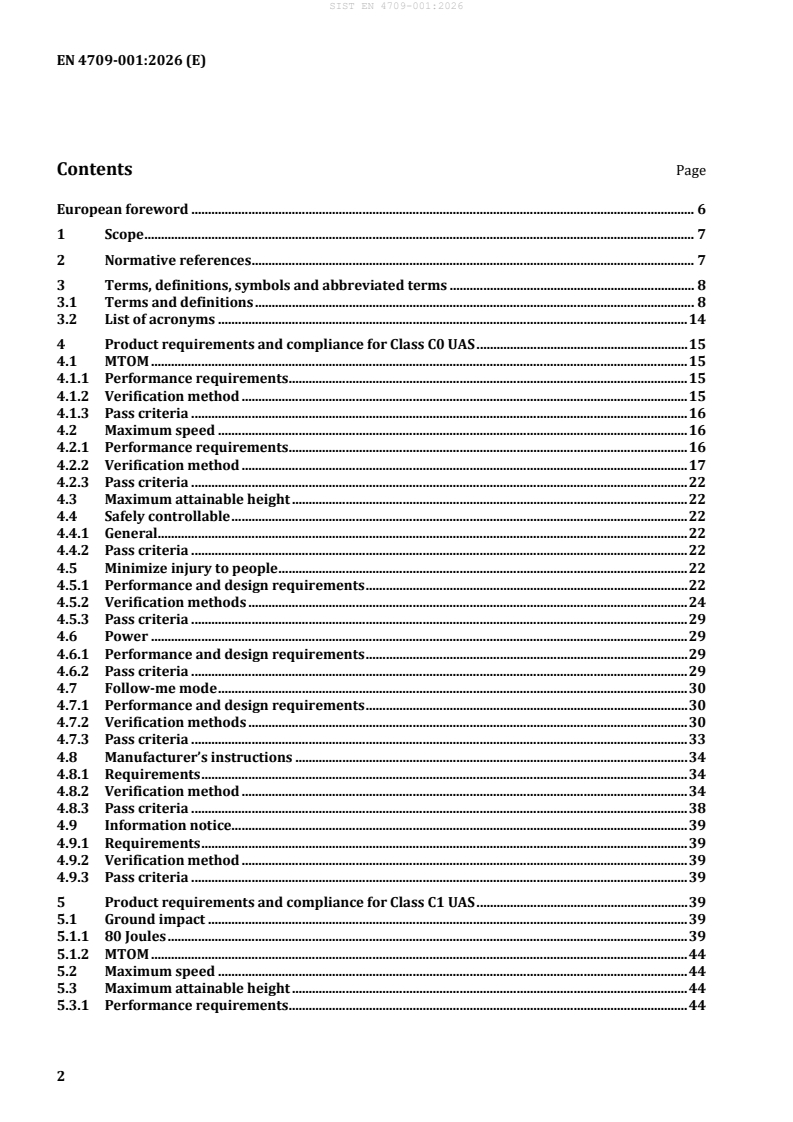
Contents Page
European foreword . 6
1 Scope . 7
2 Normative references . 7
3 Terms, definitions, symbols and abbreviated terms . 8
3.1 Terms and definitions . 8
3.2 List of acronyms . 14
4 Product requirements and compliance for Class C0 UAS . 15
4.1 MTOM . 15
4.1.1 Performance requirements . 15
4.1.2 Verification method . 15
4.1.3 Pass criteria . 16
4.2 Maximum speed . 16
4.2.1 Performance requirements . 16
4.2.2 Verification method . 17
4.2.3 Pass criteria . 22
4.3 Maximum attainable height . 22
4.4 Safely controllable . 22
4.4.1 General. 22
4.4.2 Pass criteria . 22
4.5 Minimize injury to people . 22
4.5.1 Performance and design requirements . 22
4.5.2 Verification methods . 24
4.5.3 Pass criteria . 29
4.6 Power . 29
4.6.1 Performance and design requirements . 29
4.6.2 Pass criteria . 29
4.7 Follow-me mode . 30
4.7.1 Performance and design requirements . 30
4.7.2 Verification methods . 30
4.7.3 Pass criteria . 33
4.8 Manufacturer’s instructions . 34
4.8.1 Requirements . 34
4.8.2 Verification method . 34
4.8.3 Pass criteria . 38
4.9 Information notice. 39
4.9.1 Requirements . 39
4.9.2 Verification method . 39
4.9.3 Pass criteria . 39
5 Product requirements and compliance for Class C1 UAS . 39
5.1 Ground impact . 39
5.1.1 80 Joules . 39
5.1.2 MTOM . 44
5.2 Maximum speed . 44
5.3 Maximum attainable height . 44
5.3.1 Performance requirements . 44
5.3.2 Verification method . 45
5.3.3 Pass criteria . 50
5.4 Safely controllable . 50
5.4.1 General . 50
5.4.2 Pass criteria . 50
5.5 Mechanical strength . 50
5.5.1 Performance and design requirements . 50
5.5.2 Verification methods . 52
5.5.3 Pass criteria . 62
5.6 Minimize injury to people . 62
5.7 Loss of data link . 62
5.8 Power . 62
5.9 Battery low level . 63
5.10 Follow-me mode . 63
5.11 Manufacturer’s instructions . 63
5.11.1 Requirements . 63
5.11.2 Verification method . 63
5.11.3 Pass criteria . 69
5.12 Information notice . 69
5.12.1 Requirements . 69
5.12.2 Verification method . 69
5.12.3 Pass criteria . 70
6 Product requirements and compliance for Class C2 UAS . 70
6.1 MTOM . 70
6.1.1 General . 70
6.1.2 Pass criteria . 70
6.2 Maximum attainable height . 70
6.3 Safely controllable . 70
6.3.1 Performance and design requirements . 70
6.3.2 Verification method . 73
6.3.3 Pass criteria . 80
6.4 Mechanical strength . 81
6.5 Tethered UA . 81
6.6 Minimize injury to people . 81
6.7 Command and control (C2) link . 81
6.7.1 Loss of C2 link . 81
6.7.2 C2 link protection . 84
6.8 Low-speed mode . 86
6.8.1 Performance requirements . 86
6.8.2 Verification method – Requirement (1) – Low-speed mode . 86
6.8.3 Pass criteria . 87
6.9 Power . 87
6.10 Battery low level . 87
6.10.1 Performance requirements . 87
6.10.2 Test methods . 88
6.10.3 Pass criteria . 89
6.11 Manufacturer’s instructions . 89
6.11.1 Requirements . 89
6.11.2 Verification method . 90
6.11.3 Pass criteria . 96
6.12 Information notice . 96
6.12.1 Requirements . 96
6.12.2 Verification method . 96
6.12.3 Pass criteria . 97
7 Product requirements and compliance for Class C3 UAS . 97
7.1 MTOM . 97
7.1.1 General. 97
7.1.2 Pass criteria . 97
7.2 Maximum characteristic dimension . 97
7.2.1 Design requirements . 97
7.2.2 Verification methods . 98
7.2.3 Pass criteria . 101
7.3 Maximum attainable height . 101
7.4 Safely controllable . 101
7.4.1 General. 101
7.4.2 Pass criteria . 101
7.5 Tethered UA . 102
7.5.1 Performance and design requirements . 102
7.5.2 Verification methods . 104
7.5.3 Pass criteria . 109
7.6 Loss of data link – Performance requirements . 109
7.7 Power . 109
7.8 Data link protection . 109
7.9 Battery low level . 109
7.10 Manufacturer’s instructions . 109
7.10.1 Requirements . 109
7.10.2 Verification method . 110
7.10.3 Pass criteria . 115
7.11 Information notice. 116
7.11.1 Requirements . 116
7.11.2 Verification method . 116
7.11.3 Pass criteria . 116
8 Product requirements and compliance for Class C4 UAS . 116
8.1 MTOM . 116
8.1.1 General. 116
8.1.2 Pass criteria . 117
8.2 Safely controllable . 117
8.2.1 Design and performance requirements . 117
8.2.2 Verification method . 117
8.2.3 Pass criteria . 124
8.3 Automatic control modes conditions . 124
8.3.1 Performance requirements . 124
8.3.2 Verification method . 124
8.3.3 Pass criteria . 126
8.4 Manufacturer’s instructions . 127
8.4.1 Requirements . 127
8.4.2 Verification method . 127
8.4.3 Pass criteria . 133
8.5 Information notice. 133
8.5.1 Requirements . 133
8.5.2 Verification method . 133
8.5.3 Pass criteria . 134
Annex A (informative) Recommendations for the design to reduce the probability and
effects of laceration by propellers . 135
A.1 Mechanical safeguard . 135
A.2 Operational safeguards . 136
A.2.1 Mechanical shock detection . 136
A.2.2 Emergency stop . 136
Annex B (informative) Validation procedure for onboard GNSS receiver . 137
Generality about on-board GNSS receiver validation process . 137
Annex ZA (informative) Relationship between this document and the essential
requirements of Delegated regulation (EU) 2019/945 of 12 March 2019 on
unmanned aircraft systems and on third-country operators of unmanned aircraft
systems aimed to be covered. 138
Bibliography . 141
European foreword
This document (EN 4709-001:2026) has been prepared by Technical Committee CEN/TC 471
“Unmanned Aircraft Systems”, the secretariat of which is held by BNAE.
This European Standard shall be given the status of a national standard, either by publication of an
identical text or by endorsement, at the latest by September 2026, and conflicting national standards
shall be withdrawn at the latest by September 2026.
Attention is drawn to the possibility that some of the elements of this document may be the subject of
patent rights. CEN shall not be held responsible for identifying any or all such patent rights.
This document has been prepared under a Standardization Request given to CEN by the European
Commission and the European Free Trade Association and supports essential requirements of
EU Directive(s)/Regulation(s).
For relationship with EU Directive(s)/Regulation(s), see informative Annex ZA, which is an integral part
of this document.
Any feedback and questions on this document should be directed to the users’ national standards body.
A complete listing of these bodies can be found on the CEN website.
According to the CEN-CENELEC Internal Regulations, the national standards organisations of the
following countries are bound to implement this European Standard: Austria, Belgium, Bulgaria,
Croatia, Cyprus, Czech Republic, Denmark, Estonia, Finland, France, Germany, Greece, Hungary, Iceland,
Ireland, Italy, Latvia, Lithuania, Luxembourg, Malta, Netherlands, Norway, Poland, Portugal, Republic of
North Macedonia, Romania, Serbia, Slovakia, Slovenia, Spain, Sweden, Switzerland, Türkiye and the
United Kingdom.
1 Scope
This document provides technical specification and verification method to support compliance with the
requirements defined by the product harmonisation legislation set by Chapter II of Commission
Delegated Regulation (EU) 2019/945 of 12 March 2019 on unmanned aircraft systems and on third-
country operators of unmanned aircraft systems.
This document does not cover UAS lighter than air (e.g. airships and balloons).
This document is only applicable for UA with energy sources based on electro-chemical technologies.
2 Normative references
The following documents are referred to in the text in such a way that some or all of their content
constitutes requirements of this document. For dated references, only the edition cited applies. For
undated references, the latest edition of the referenced document (including any amendments) applies.
EN 71-1:2014+A1:2018, Safety of toys - Part 1: Mechanical and physical properties
EN 4709-003:2026, Aerospace series — Unmanned Aircraft Systems — Part 003: Geo-awareness
requirements
EN IEC 62368-1:2024, Audio/video, information and communication technology equipment — Part 1:
Safety requirements
EN ISO 2307:2019, Fibre ropes — Determination of certain physical and mechanical properties
(ISO 2307:2019)
Document impacted by EN IEC 62368-1:2024/A11:2024.
3 Terms, definitions and acronyms
3.1 Terms and definitions
For the purposes of this document, the following terms and definitions apply.
ISO and IEC maintain terminology databases for use in standardization at the following addresses:
— ISO Online browsing platform: available at https://www.iso.org/obp/
— IEC Electropedia: available at https://www.electropedia.org/
3.1.1
automatic flight
flight following pre-programmed instructions, loaded in the unmanned aircraft (UA) flight control
system that the UA executes
3.1.2
open category
category of UAS operation that, considering the risks involved, does not require a prior authorization by
the competent authority nor a declaration by the UAS operator before the operation takes place
3.1.3
specific category
category of UAS operation that, considering the risks involved, requires an authorization by the
competent authority before the operation takes place and takes into account the mitigation measures
identified in an operational risk assessment, except for certain standard scenarios where a declaration
by the operator is sufficient
3.1.4
certified category
category of UAS operation that, considering the risks involved, requires the certification of the UA,
an operator approved by the competent authority, and where applicable, a licensed remote pilot in
order to ensure an appropriate level of safety
3.1.5
competent authority
one or more entities designated by a Member State and having the necessary powers and allocated
responsibilities for performing the tasks related to certification, oversight and enforcement in
accordance with this Regulation and with the delegated and implementing acts adopted on the basis
thereof, and with Regulation (EC) No 549/2004
3.1.6
direct remote identification
system that ensures the local broadcast of information about a unmanned aircraft in operation,
including the marking of the unmanned aircraft, so that this information can be obtained without
physical access to the unmanned aircraft
3.1.7
follow-me mode
mode of operation of a UAS where the unmanned aircraft constantly follows the remote pilot within a
predetermined radius
3.1.8
geo-awareness
function that, based on the data provided by Member States, detects a potential breach of airspace
limitations and alerts the remote pilots so that they can take immediate and effective action to prevent
that breach
3.1.9
hazard
condition or object with the potential to cause injuries, damage, loss of material or a reduction of the
ability to perform a prescribed function
3.1.10
maximum take-off mass
MTOM
maximum unmanned aircraft mass, including payload and fuel, as defined by the manufacturer or the
builder, at which the unmanned aircraft can be operated
Note 1 to entry: Fuel has to be considered as batteries for this document.
3.1.11
unmanned aircraft system operator
legal or natural person who operates or intends to operate one or more UAS
3.1.12
remote pilot
natural person responsible for safely conducting the flight of a UA by operating its flight controls, either
manually or, when the UA flies automatically, by monitoring its course and remaining able to intervene
and change its course at any time
3.1.13
standard scenario
type of UAS operation in the ‘specific’ category, as defined in Appendix 1 of the Annex to
Regulation (EU) 2019/947, for which a precise list of mitigating measures has been identified in such a
way that the competent authority can be satisfied with declarations in which operators declare that
they will apply the mitigating measures when executing this type of operation
3.1.14
unmanned aircraft
UA
aircraft operating or designed to operate autonomously or to be piloted remotely without a pilot
on board
3.1.15
unmanned aircraft system
UAS
unmanned aircraft and the equipment to control it remotely
[SOURCE: ISO/CD 21384-2]
3.1.16
visual line of sight
VLOS
type of UAS operation in which the remote pilot is able to maintain continuous unaided visual contact
with the unmanned aircraft, allowing the remote pilot to control the flight path of the unmanned
aircraft in relation to other aircraft, people and obstacles for the purpose of avoiding collisions
3.1.17
equipment to control unmanned aircraft remotely
any instrument, equipment, mechanism, apparatus, appurtenance, software or accessory that is
necessary for the safe operation of a UA other than a part and which is not carried on board that UA
3.1.18
payload
instrument, mechanism, equipment, part, apparatus, appurtenance or accessory, including
communications equipment, that is installed in or attached to the aircraft and is not used or intended to
be used in operating or controlling an aircraft in flight, and is not part of an airframe, engine,
or propeller
3.1.19
type of UA
basic design arrangement of the UA: fixed-wing, rotary wing
EXAMPLE Multicopter or helicopter.
3.1.20
list of items
list that identifies the UAS and all removable and adaptable items including payloads, accessories,
batteries and add-ons that are approved by the manufacturer to be attached to the main structure of the
UA and are provided in any packaging configurations in which the UAS is placed on the market
Note 1 to entry: The list is provided with the description of the UA in the technical documentation.
Note 2 to entry: The list includes all payloads and batteries but not spare parts.
Note 3 to entry: The list identifies the items by part number and mass.
3.1.21
UAS combination
UAS including a variable set of elements such as components, payloads or accessories, and different
types of batteries
3.1.22
primary structural elements
parts of the structure of the UA the failure of which would lead to a hazardous or more serious
failure condition
EXAMPLE Primary UA structure bearing aerodynamic, inertial and propulsion forces; control surface and
control system structural elements, control surface hinges; structural elements of systems used in launching and
recovery phases ([8]).
3.1.23
tether
mechanical device for the purpose of effectively restraining the UA within the range permitted by the
length of the tether as its primary function
Note 1 to entry: Not all cables linking the UA to the ground are considered as tether in the sense of this
document, e.g. an electric cable powering the UA, even if it was the only source of power and a loss of connection
would inevitably lead to a loss of flight. However, the tether may be used to transmit electrical power to the UA as
a secondary function.
3.1.24
mode of control
mode used to distinguish between different methods of exercising control over the direction of flight of
the UA
Note 1 to entry: This includes but is not limited to attitude, heading, track, speed, altitude, rate of climb. All flight
modes are clearly defined in the flight manual explaining how remote pilot input (e.g. sticks) are associated to air
vehicle degrees of freedom. Necessary conditions for each flight mode is also defined (e.g. GNSS coverage is
necessary for ground velocity or position control mode)
3.1.25
control operational modes
the UA can be operated in the following operational modes, according to STANAG4703 UL47.1
definition here rephrased. The expression “control operational modes” is used to address safety
relevant control categories
Note 1 to entry: Several flight control modes can be used for each category.
[SOURCE: STANAG4703 UL47.1]
3.1.26
automatic mode
control operational mode where UA attitude, speed and flight path are fully controlled by the flight
control system, however the remote plot is always able to take control, when needed.
Note 1 to entry: No remote pilot input is needed to address flight controls and vehicle steering, other than to
change the operational mode, load or modify the required flight plan or waypoint parameters.
EXAMPLE Examples of automatic modes are waypoint path navigation, waypoint holding (hovering/loitering),
automatic take-off, automatic landing, follow-me mode, or return to home.
3.1.27
semi-automatic mode
control operational mode where the remote pilot commands outer loop parameters such as altitude,
heading and air speed
Note 1 to entry: This is an assisted manual mode where the flight control system operates the UA controls to
achieve the commanded outer loop parameter value. Envelope flight protection and/or control decoupling
functions should be in place in this control operational mode. The flight manual clearly specifies, for any
possible/available control mode that is classified as semi-automatic, for each degree of freedom, the level of
involvement of the remote pilot to address control stability.
Note 2 to entry: A wide range of flight control modes are semi-automatic, from low level attitude/rate control,
autopilot heading/speed/altitude control, velocity control; position control may be considered semi-automatic if
remote pilot input is transformed into position commands continuously (or an automatic mode if remote pilot
inputs only modify waypoint coordinates in on-board autopilot).
3.1.28
manual direct mode
control operational mode where the remote pilot directly commands UA controls
EXAMPLE Aerodynamic surfaces through servo-actuators and engine through electronic speed control.
Note 1 to entry: This is an unassisted direct piloting manual mode. This control operational mode does not
benefit from autopilot aiding action (e.g. flight envelope protection FEP) in excess of stability augmentation.
3.1.29
manual mode
control operational mode where the remote pilot is using manipulators or similar inceptors to change
the trajectory of flight in real-time
Note 1 to entry: such as in manual direct piloting mode and semi-automatic mode, as opposed to automatic mode
where high level commands (such as setting waypoints or actuating an RTH button) are used to change the
trajectory.
3.1.30
automated mode
automatic mode and semi-automatic mode (as opposed to manual direct piloting mode) which depend
on automation in excess of stability augmentation to control the trajectory of flight
3.1.31
holding
hovering for hovering capable aircraft, i.e., maintaining altitude and position; for fixed wing aircraft
holding corresponds to loitering, i.e., flying a minimum distance orbit around current position, at low
speed and holding altitude
Note 1 to entry: Holding is used to address a flight condition where aircraft minimizes risks of flight path
deviation (to reduce the risk of collisions) and loss of control.
Note 2 to entry: Besides the general minimum speed and minimum displacement requirement, radius/turn
rate/bank angle/load factor and speed are specifically selected for each aircraft in order to provide a safe and
stable flight condition (e.g. proper margins with respect to stall speed and load factors).
3.1.32
command and control (C2) link loss recovery
automatic mode that the UA reverts as a fail-safe function in the event of a C2 link loss
Note 1 to entry: A non-exhaustive list of typical link loss recovery modes includes:
— holding;
— return to home (RTH);
— automatic landing.
3.1.33
flight termination function
function responsible for the termination of flight in a way that reduces the effect on third parties in the
air or on the ground
Note 1 to entry: The flight termination function may be an existing function such as landing or a succession of
existing functions such a holding with subsequent landing or a parachute deployment.
3.1.34
return to home
automatic mode intended for returning to a pre-defined, safe landing position (“home”)
EXAMPLE The take-off position is a type of pre-defined, safe landing position.
Note 1 to entry: This mode does not necessarily entail commence to land; typically includes climb or descent to
a safe height, following a predefined route, approaching the landing position.
3.1.35
automatic landing,
automatic mode where the UA attempts an automatic landing or an emergency landing
3.1.36
safely controllable
capability of the UAS to provide a general ability to the remote pilot to exercise control over the UA at
any time and to change the position of the UA as far as required to avoi
...