

SIST EN 4709-004:2026
(Main)Aerospace series - Unmanned Aircraft Systems - Part 004: Lighting requirements
- Abstract
This document will provide means of compliance to cover lighting related requirements for Parts 2 to 4 of the Annex to the Commission Delegated Regulation (EU) 2019/945 on unmanned aircraft and on third country UAS operators.
The purpose is to be able to verify that an UA is equipped with lights:
— for the controllability of the UA (the effectiveness of those lights is not part of the lighting requirement but is covered by the controllability requirement; therefore, its verification is covered by the clause addressing the controllability requirement of EN 4709 001:2026);
— that ensure conspicuity of the unmanned aircraft at night (see 3.45 of ISO 21384 4:2025), the design of the light shall allow a person on the ground to distinguish a UA from a manned aircraft.
This document addresses:
— definition of types, technical requirements, and technical parameters of UA lights (e.g. position of lights for different UA categories, intensity for different operation modes);
— definition of purpose, test procedures, requirements, and compliance rules to evaluate UA lights
- Status
- Published
- Public Enquiry End Date
- 24-Feb-2021
- Publication Date
- 20-Oct-2026
- Technical Committee
- I13 - Imaginarni 13
- Current Stage
- 6060 - National Implementation/Publication (Adopted Project)
- Start Date
- 19-Oct-2026
- Due Date
- 24-Dec-2026
- Completion Date
- 21-Oct-2026

SIST EN 4709-004:2026 is a SIST standard in the Aerospace series for unmanned aircraft systems (UAS). It specifies lighting requirements for unmanned aircraft (UA) so that manufacturers and operators can verify lights for controllability and conspicuity, especially for night operations and compliance work linked to Delegated Regulation (EU) 2019/945.
The standard focuses on what lights are needed, how they may be installed, what colours and performance levels are used, and how those lights are tested. It is aimed at people designing, supplying, checking, or operating UA lighting systems.
What does SIST EN 4709-004:2026 specify?
SIST EN 4709-004:2026 gives means of compliance for lighting-related requirements for Parts 2 to 4 of the Annex to Delegated Regulation (EU) 2019/945. It covers UA lights for controllability, conspicuity at night, and other purposes that may be fitted on the aircraft.
The document is organized into general technical specifications, controllability lights, conspicuity lights, and lights for other purposes, followed by informative guidance and a regulatory relationship annex.
| Annex | What it covers |
|---|---|
| Annex A | Reference implementations and example light layouts for different UA types and sizes |
| Annex ZA | Relationship between the document and the essential requirements of Delegated Regulation (EU) 2019/945 |
The scope also links the lighting verification to EN 4709-001 for controllability effectiveness, so the lighting standard does not stand alone in that area.
What are the key requirements of SIST EN 4709-004:2026?
General design and installation rules
Clause 4 states that lights for controllability, conspicuity, or other purposes shall be either fixed by the UAS manufacturer or fitted by the operator as add-on lights. This matters because the standard covers both built-in and retrofit lighting arrangements.
Clause 4 also requires the lights in Clauses 5 and 6 to comply with EN IEC 62368-1 to reduce the risk of eye or skin injury from optical energy. If a manufacturer implements an automatic night switch-off for part or all of the light system, the off time of the affected controllability and conspicuity lights shall not exceed 10 seconds.
For add-on lights, Clause 4 requires either an accessible electrical power interface or independent power equipment that does not affect controllability. Add-on lights are treated as equipment under prEN 4709-001:2019, so their installation can affect maximum take-off mass (MTOM) and must be handled within the required class limits.
Colour requirements
Clause 4 limits the proposed colours for controllability and conspicuity lights to aviation green, red, and white. The document gives chromaticity coordinates for each colour family.
In practice, this means the light colours should be consistent enough to support orientation and recognition. A clear colour definition helps the remote pilot interpret the aircraft attitude and heading, and helps observers distinguish the UA from other aircraft.
Controllability lights
Clause 5 says the purpose of controllability lights is to give the remote pilot enough information about position, attitude, heading, and the control mode. If the UA is operated at night, it shall be equipped with controllability lights according to its control mode.
For manual direct piloting control mode, the UA shall indicate attitude, heading, and position. For semi-automatic control mode, it shall indicate at least heading and position while hovering or loitering. Clause 5 also states that a UA with automatic control mode should be able to switch to semi-automatic or manual control mode.
This matters because the light arrangement has to match how the aircraft is flown. A pilot needs different visual cues depending on whether the UA is fully manual, semi-automatic, or automatic.
Conspicuity lights
Clause 6 states that conspicuity lights are intended to make the aircraft visible at night and allow a person on the ground to distinguish a UA from a manned aircraft. The standard allows green blinking or flashing lights, or green alternating with red or white lights used for controllability.
Clause 6 requires conspicuity lights to be recognizable from up to 120 m when the UA is flying. It also sets a field of coverage requirement extending at least 5° below the horizontal plane, with total obstructed visibility not exceeding 0.05 steradians.
For blinking and flashing modes, Clause 6 sets limits on cycle frequency and on-time. For alternating modes, it sets limits on the off interval and on-time as well.
In practice, this means the lighting has to be visible far enough away and from enough angles to support night recognition, not just straight ahead or directly below.
Other lights on the UA
Clause 7 covers lights used for other purposes, such as anti-collision, warning, caution and advisory, landing, and auxiliary lights. These lights shall not impair the remote pilot’s vision or distract from conspicuity lights.
Installed lights for other purposes should also reduce the likelihood of optical injury in line with EN IEC 62368-1, or they should be used only at a safe distance from people on the ground, or be placed above the horizontal plane of the UA. Add-on lights in this category must also comply with the payload installation and MTOM requirements from prEN 4709-001:2019.
Clause 7 also says these extra lights must be included in the test setups used for conspicuity, so their presence does not hide the required conspicuity signals.
What terms does SIST EN 4709-004:2026 define?
- Unmanned aircraft (UA) - The aircraft covered by the lighting requirements, including its lighting setup for controllability and conspicuity.
- Unmanned aircraft system (UAS) - The aircraft together with the supporting system, used here in connection with manufacturer-installed or operator-installed lights.
- Control operational modes - The safety control categories for operation: automatic, semi-automatic, and manual direct piloting.
- Automatic control operational mode - A mode where the flight control system fully controls attitude, speed, and flight path, with no pilot input needed for steering except to load or adjust the flight plan.
- Semi-automatic control operational mode - A mode where the remote pilot commands outer-loop parameters such as altitude, heading, and speed, while the flight control system carries out the control action.
- Manual direct piloting control operational mode - A mode where the remote pilot directly commands the UA controls and is directly responsible for vehicle stability.
- Effective frequency - The frequency at which the complete conspicuity light system is observed from a distance, including each sector and any overlaps.
Who uses SIST EN 4709-004:2026?
SIST EN 4709-004:2026 is used by UAS manufacturers, add-on light manufacturers, operators, and verification teams working on night-capable UA lighting. It is also relevant to engineering, quality, and conformity assessment staff who need to design, install, test, or review lighting systems against regulatory requirements.
It is particularly useful in aerospace and UAS development where the aircraft must support controllability cues for the remote pilot and conspicuity for people on the ground. Test engineers and compliance specialists use it to plan lighting checks and interpret the required test methods.
Which standards are used with SIST EN 4709-004:2026?
- prEN 4709-001:2019, Aerospace series - Unmanned Aircraft Systems - Part 001: Product requirements and verification - Provides the product requirements and verification basis for controllability, add-on equipment, payload installation, and MTOM-related considerations.
- EN IEC 62368-1:2020, Audio/video, information and communication technology equipment - Part 1: Safety requirements - Provides the optical energy safety requirements referenced for reducing the likelihood of painful effects and injury to eyes or skin.
What does the SIST EN 4709-004:2026 document contain?
The document contains clause-based technical requirements, defined terms, and test methods for UA lighting. It includes a colour section with aviation colour guidance and a figure showing colour representation in CIE1931 format.
It also contains test setups for conspicuity distance verification, field of coverage checking, and cycle-rate measurement. These include both outdoor video-based methods and an indoor direct test arrangement with specified viewing positions and measurement steps.
Annex A adds reference implementations with example light layouts for multicopters and fixed-wing UA. The examples show how controllability and conspicuity functions can be combined in a practical design, but they are guidance rather than verification by themselves.
Annex ZA links the document to the essential requirements of Delegated Regulation (EU) 2019/945. This makes the standard usable as a technical route for demonstrating conformity within its stated scope.
Relations
- Effective Date
- 21-Oct-2026
- Effective Date
- 21-Oct-2026
- Effective Date
- 28-Jan-2026
Get Certified
Connect with accredited certification bodies for this standard

BSI Group
BSI (British Standards Institution) is the business standards company that helps organizations make excellence a habit.

Bureau Veritas
Bureau Veritas is a world leader in laboratory testing, inspection and certification services.

DNV
DNV is an independent assurance and risk management provider.
Sponsored listings
Frequently Asked Questions
SIST EN 4709-004:2026 is a standard published by the Slovenian Institute for Standardization (SIST). Its full title is "Aerospace series - Unmanned Aircraft Systems - Part 004: Lighting requirements". This standard covers: This document will provide means of compliance to cover lighting related requirements for Parts 2 to 4 of the Annex to the Commission Delegated Regulation (EU) 2019/945 on unmanned aircraft and on third country UAS operators. The purpose is to be able to verify that an UA is equipped with lights: — for the controllability of the UA (the effectiveness of those lights is not part of the lighting requirement but is covered by the controllability requirement; therefore, its verification is covered by the clause addressing the controllability requirement of EN 4709 001:2026); — that ensure conspicuity of the unmanned aircraft at night (see 3.45 of ISO 21384 4:2025), the design of the light shall allow a person on the ground to distinguish a UA from a manned aircraft. This document addresses: — definition of types, technical requirements, and technical parameters of UA lights (e.g. position of lights for different UA categories, intensity for different operation modes); — definition of purpose, test procedures, requirements, and compliance rules to evaluate UA lights
This document will provide means of compliance to cover lighting related requirements for Parts 2 to 4 of the Annex to the Commission Delegated Regulation (EU) 2019/945 on unmanned aircraft and on third country UAS operators. The purpose is to be able to verify that an UA is equipped with lights: — for the controllability of the UA (the effectiveness of those lights is not part of the lighting requirement but is covered by the controllability requirement; therefore, its verification is covered by the clause addressing the controllability requirement of EN 4709 001:2026); — that ensure conspicuity of the unmanned aircraft at night (see 3.45 of ISO 21384 4:2025), the design of the light shall allow a person on the ground to distinguish a UA from a manned aircraft. This document addresses: — definition of types, technical requirements, and technical parameters of UA lights (e.g. position of lights for different UA categories, intensity for different operation modes); — definition of purpose, test procedures, requirements, and compliance rules to evaluate UA lights
SIST EN 4709-004:2026 is classified under the following ICS (International Classification for Standards) categories: 49.020 - Aircraft and space vehicles in general. The ICS classification helps identify the subject area and facilitates finding related standards.
SIST EN 4709-004:2026 has the following relationships with other standards: It is inter standard links to SIST EN 4709-001:2026, SIST EN 17206-3:2026, SIST EN ISO 5270:2022. Understanding these relationships helps ensure you are using the most current and applicable version of the standard.
SIST EN 4709-004:2026 is associated with the following European legislation: EU Directives/Regulations: 2019/945; Standardization Mandates: M/567. When a standard is cited in the Official Journal of the European Union, products manufactured in conformity with it benefit from a presumption of conformity with the essential requirements of the corresponding EU directive or regulation.
SIST EN 4709-004:2026 is available in PDF format for immediate download after purchase. The document can be added to your cart and obtained through the secure checkout process. Digital delivery ensures instant access to the complete standard document.
Standards Content (Sample)
SLOVENSKI STANDARD
01-december-2026
Aeronavtika - Letalski sistemi brez posadke - 004. del: Zahteve za razsvetljavo
Aerospace series - Unmanned Aircraft Systems - Part 004: Lighting requirements
Luft- und Raumfahrt - Unbemannte Luftfahrzeugsysteme - Teil 004: Anforderungen an
die zu führenden Lichter
Série aérospatiale - Aéronefs télépilotés - Partie 004 : Exigences de signalement
lumineux
Ta slovenski standard je istoveten z: EN 4709-004:2026
ICS:
49.020 Letala in vesoljska vozila na Aircraft and space vehicles in
splošno general
2003-01.Slovenski inštitut za standardizacijo. Razmnoževanje celote ali delov tega standarda ni dovoljeno.
EN 4709-004
EUROPEAN STANDARD
NORME EUROPÉENNE
October 2026
EUROPÄISCHE NORM
ICS 49.020
English Version
Aerospace series - Unmanned Aircraft Systems - Part 004:
Lighting requirements
Série aérospatiale - Aéronefs télépilotés - Partie 004 : Luft- und Raumfahrt - Unbemannte
Exigences de signalement lumineux Luftfahrzeugsysteme - Teil 004: Anforderungen an die
zu führenden Lichter
This European Standard was approved by CEN on 29 June 2026.
CEN members are bound to comply with the CEN/CENELEC Internal Regulations which stipulate the conditions for giving this
European Standard the status of a national standard without any alteration. Up-to-date lists and bibliographical references
concerning such national standards may be obtained on application to the CEN-CENELEC Management Centre or to any CEN
member.
This European Standard exists in three official versions (English, French, German). A version in any other language made by
translation under the responsibility of a CEN member into its own language and notified to the CEN-CENELEC Management
Centre has the same status as the official versions.
CEN members are the national standards bodies of Austria, Belgium, Bulgaria, Croatia, Cyprus, Czech Republic, Denmark, Estonia,
Finland, France, Germany, Greece, Hungary, Iceland, Ireland, Italy, Latvia, Lithuania, Luxembourg, Malta, Netherlands, Norway,
Poland, Portugal, Republic of North Macedonia, Romania, Serbia, Slovakia, Slovenia, Spain, Sweden, Switzerland, Türkiye and
United Kingdom.
EUROPEAN COMMITTEE FOR STANDARDIZATION
COMITÉ EUROPÉEN DE NORMALISATION
EUROPÄISCHES KOMITEE FÜR NORMUNG
CEN-CENELEC Management Centre: Rue de la Science 23, B-1040 Brussels
© 2026 CEN All rights of exploitation in any form and by any means reserved Ref. No. EN 4709-004:2026 E
worldwide for CEN national Members.
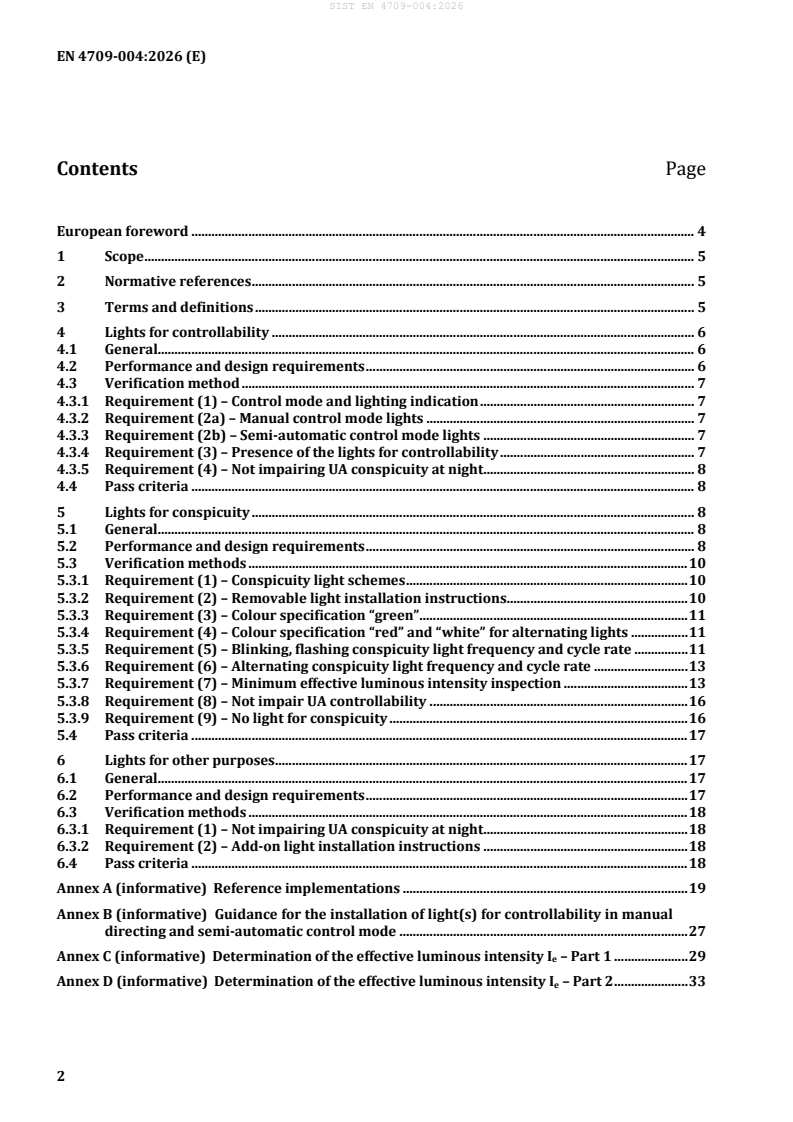
Contents Page
European foreword . 4
1 Scope . 5
2 Normative references . 5
3 Terms and definitions . 5
4 Lights for controllability . 6
4.1 General. 6
4.2 Performance and design requirements . 6
4.3 Verification method . 7
4.3.1 Requirement (1) – Control mode and lighting indication . 7
4.3.2 Requirement (2a) – Manual control mode lights . 7
4.3.3 Requirement (2b) – Semi-automatic control mode lights . 7
4.3.4 Requirement (3) – Presence of the lights for controllability . 7
4.3.5 Requirement (4) – Not impairing UA conspicuity at night. 8
4.4 Pass criteria . 8
5 Lights for conspicuity . 8
5.1 General. 8
5.2 Performance and design requirements . 8
5.3 Verification methods . 10
5.3.1 Requirement (1) – Conspicuity light schemes . 10
5.3.2 Requirement (2) – Removable light installation instructions . 10
5.3.3 Requirement (3) – Colour specification “green” . 11
5.3.4 Requirement (4) – Colour specification “red” and “white” for alternating lights . 11
5.3.5 Requirement (5) – Blinking, flashing conspicuity light frequency and cycle rate . 11
5.3.6 Requirement (6) – Alternating conspicuity light frequency and cycle rate . 13
5.3.7 Requirement (7) – Minimum effective luminous intensity inspection . 13
5.3.8 Requirement (8) – Not impair UA controllability . 16
5.3.9 Requirement (9) – No light for conspicuity . 16
5.4 Pass criteria . 17
6 Lights for other purposes . 17
6.1 General. 17
6.2 Performance and design requirements . 17
6.3 Verification methods . 18
6.3.1 Requirement (1) – Not impairing UA conspicuity at night. 18
6.3.2 Requirement (2) – Add-on light installation instructions . 18
6.4 Pass criteria . 18
Annex A (informative) Reference implementations . 19
Annex B (informative) Guidance for the installation of light(s) for controllability in manual
directing and semi-automatic control mode . 27
Annex C (informative) Determination of the effective luminous intensity I – Part 1 . 29
e
Annex D (informative) Determination of the effective luminous intensity I – Part 2 . 33
e
Annex ZA (informative) Relationship between this document and the essential
requirements of Delegated regulation (EU) 2019/945 of 12 March 2019 on
unmanned aircraft systems and on third-country operators of unmanned aircraft
systems aimed to be covered. 35
Bibliography . 36
European foreword
This document (EN 4709-004:2026) has been prepared by CEN/TC 471 “Unmanned aircraft systems”,
the secretariat of which is held by BNAE.
This European Standard shall be given the status of a national standard, either by publication of an
identical text or by endorsement, at the latest by April 2027, and conflicting national standards shall be
withdrawn at the latest by April 2027.
Attention is drawn to the possibility that some of the elements of this document may be the subject of
patent rights. CEN shall not be held responsible for identifying any or all such patent rights.
This document has been prepared under a Standardization Request given to CEN by the European
Commission and the European Free Trade Association, and supports essential requirements of EU
Regulation(s).
For relationship with EU Regulation(s), see informative Annex ZA, which is an integral part of this
document.
A list of all parts in the 4709 series can be found on the CEN website: www.cencenelec.eu.
Any feedback and questions on this document should be directed to the users’ national standards body.
A complete listing of these bodies can be found on the CEN website.
According to the CEN-CENELEC Internal Regulations, the national standards organisations of the
following countries are bound to implement this European Standard: Austria, Belgium, Bulgaria,
Croatia, Cyprus, Czech Republic, Denmark, Estonia, Finland, France, Germany, Greece, Hungary, Iceland,
Ireland, Italy, Latvia, Lithuania, Luxembourg, Malta, Netherlands, Norway, Poland, Portugal, Republic of
North Macedonia, Romania, Serbia, Slovakia, Slovenia, Spain, Sweden, Switzerland, Türkiye and the
United Kingdom.
1 Scope
This document will provide means of compliance to cover lighting related requirements for Parts 2 to 4
of the Annex to the Commission Delegated Regulation (EU) 2019/945 on unmanned aircraft and on
third country UAS operators.
The purpose is to be able to verify that an UA is equipped with lights:
— for the controllability of the UA (the effectiveness of those lights is not part of the lighting
requirement but is covered by the controllability requirement; therefore, its verification is covered
by the clause addressing the controllability requirement of EN 4709-001:2026);
— that ensure conspicuity of the unmanned aircraft at night (see 3.45 of ISO 21384-4:2025), the
design of the light shall allow a person on the ground to distinguish a UA from a manned aircraft.
This document addresses:
— definition of types, technical requirements, and technical parameters of UA lights (e.g. position of
lights for different UA categories, intensity for different operation modes);
— definition of purpose, test procedures, requirements, and compliance rules to evaluate UA lights.
2 Normative references
The following documents are referred to in the text in such a way that some or all of their content
constitutes requirements of this document. For dated references, only the edition cited applies. For
undated references, the latest edition of the referenced document (including any amendments) applies.
EN 4709-001:2026, Aerospace series — Unmanned Aircraft Systems — Part 001: Product requirements
and verification
ISO 21384-4:2025, Uncrewed Aircraft Systems — Part 4: Vocabulary
3 Terms and definitions
For the purposes of this document, the terms and definitions given in EN 4709-001:2026,
ISO 21384-4:2025 and the following apply.
ISO and IEC maintain terminology databases for use in standardization at the following addresses:
— ISO Online browsing platform: available at https://www.iso.org/obp/
— IEC Electropedia: available at https://www.electropedia.org/
3.1
effective frequency
frequency at which the UA complete light for conspicuity system is observed from a distance and
applies to each sector of flight including any overlaps that exist when the system consists of more than
one light source
Note 1 to entry: it is measured in cycle per minute.
3.2
on-time
time the conspicuity light emits light
Note 1 to entry: it is denoted as ton and is measured in seconds.
3.3
off-time
time the conspicuity light does not emit light
Note 1 to entry: it is denoted as toff and is measured in seconds.
3.4
add-on light
light for conspicuity that can be attached to the main structure of the UA and is provided in any
packaging configurations in which the UAS is placed on the market
4 Lights for controllability
4.1 General
Lights for controllability shall be provided when needed i.e. if at least one of the authorized flight
conditions requires their use.
They shall provide the remote pilot with sufficient information about the UA (e.g. position, attitude, and
heading) to ensure its controllability at night, in the control mode and flight conditions specified by the
manufacturer.
Lights for controllability can be removable but shall be provided in any packaging configurations in
which the UAS is placed on the market.
NOTE The requirement for the presence of controllability lights is defined by the manufacturer in accordance
with the controllability requirements in EN 4709-001:2026.
Annex A provides additional guidance of acceptable light positions according to types and size of UA.
Annex B provides guidance on how to install light(s) for controllability in manual direct piloting
control mode.
4.2 Performance and design requirements
(1) The manufacturer shall declare in the manufacturer’s instructions the mode(s) of control of the UA
in every authorized flight condition including the purpose of the lights installed on the UA to
support its controllability.
NOTE If the UA switches to manual mode in case of emergencies or abnormal function, lighting requirements
for manual mode are required even when the UA is operated in semi-automatic or automatic mode.
(2)
a. If the UA features a manual mode, the UA shall be equipped with lights for controllability to
indicate:
— attitude;
— heading; and
— position;
of the UA in every flight condition for which the lights for controllability are deemed necessary by
the manufacturer to ensure the controllability of the UA.
b. If the UA features a semi-automatic control mode, the UA shall be equipped with lights for
controllability to indicate at least:
— heading; and
— position;
of the UA in every flight condition for which the lights for controllability are deemed necessary by
the manufacturer to ensure the controllability of the UA.
(3) The UA shall be equipped with lights for controllability if any of the authorized flight conditions
deems these lights to be necessary.
(4) Lights for controllability shall not impair the UA conspicuity light system to maintain the
conspicuity of the UA at night given in 5.2 (7).
4.3 Verification method
4.3.1 Requirement (1) – Control mode and lighting indication
Verify in the manufacturer’s instructions that the mode of control for the UA for every flight condition,
including the purpose of the lights has been determined by the manufacturer.
4.3.2 Requirement (2a) – Manual control mode lights
For manual control mode UAS: verify in the manufacturer’s instruction that the lights for controllability
indicate:
— attitude;
— heading; and
— position;
of the UA.
4.3.3 Requirement (2b) – Semi-automatic control mode lights
For semi-automatic control mode UAS: verify in the manufacturer’s instruction that the lights for
controllability indicate:
— heading; and
— position;
of the UA.
4.3.4 Requirement (3) – Presence of the lights for controllability
In the event that any of the flight conditions authorized by the manufacturer in the manufacturer’s
instructions require the use of lights to ensure the safe controllability of the UA, verify by design that
lights for controllability as per 4.3.2 or 4.3.3 are integrated on the UA.
NOTE Annex A provides reference implementation of lights for controllability.
4.3.5 Requirement (4) – Not impairing UA conspicuity at night
Compliance of the requirement is verified by test, using one of the test methods given in 5.3.7 with the
UA controllability lights and UA conspicuity lights activated.
4.4 Pass criteria
(1) The mode(s) of control for the UA for every flight condition, including the purpose of the lights has
been determined by the manufacturer.
(2)
a. Compliance with the manual control mode lights requirement;
b. Compliance with the semi-automatic control mode lights requirement.
(3) Lights are present and installed according to 4.3.2 or 4.3.3.
(4) Performance of UA conspicuity light conforms with 5.2 (7).
5 Lights for conspicuity
5.1 General
The purpose of this type of lights is to ensure the conspicuity of the unmanned aircraft at night.
The design of the lights shall allow a person on the ground to distinguish an UA from a manned aircraft.
NOTE This excludes the purpose “to be seen by other air traffic” at night (e.g. night VFR) although the general
design of a green blinking, flashing or alternating light as described in this clause may be used in the future to
enable conspicuity of the UA to other air traffic at night.
Annex A provides additional guidance of acceptable light positions according to types and size of UA.
Lights for conspicuity can be removable but shall be provided in any packaging configurations in which
the UAS is placed on the market.
5.2 Performance and design requirements
(1) The UA shall be equipped with one light or more lights for conspicuity using one of the following
colour schemes:
— green flashing, blinking; or
— green alternating with red or white lights for controllability.
(2) If the UA is placed on the market with one or more removable lights for conspicuity, the
manufacturer shall declare in the manufacturers’ instructions how and where to install the
removable light(s) on the UA.
(3) Chromaticity coordinates x, y for colour “green” shall be within:
— ´x´ is not greater than 0,440 – 0,320 y;
— ´x´ is not greater than y – 0,170; and
— ´y´ is not less than 0,390 – 0,170 x.
NOTE see bibliography [3].
(4) If alternating lights are used:
a. chromaticity coordinates x, y for colour “white” shall be within:
— ´x´ is not less than 0,300 and not greater than 0,540;
— ´y´ is not less than “x – 0,040” or “y0 – 0,010,” whichever is the smaller; and
— ´y´ is not greater than “x + 0,020” nor “0,636 – 0,400 x”;
where ´y0´ is the y coordinate of the Planckian radiator for the value of ´x´;
NOTE see bibliography [3].
b. chromaticity coordinates x, y for colour “red” shall be within:
— ´y´ is not greater than 0,32; and
— 1-x-y = ´z´ is not greater than 0,02.
NOTE see bibliography [1].
(5) If green blinking or flashing lights are used as lights for conspicuity then:
a. each green light shall switch between on with the on-time t and off with the off-time t ,
on off
which is 1 cycle;
b. the effective frequency of the green light shall not be less than 30, nor more than be 100 cycles
per minute;
c. the conspicuity light shall have an on-time t for at least 200 ms per cycle and shall be on for
on
max. 50 % of the cycle.
(6) If green alternating lights are used as lights for conspicuity, then:
a. the green light shall alternate between green and either red or white lights and shall have an
interval in-between when all lights are off not more than 200 ms;
b. the effective frequency of the green light cycle shall not be less than 30, nor more than be
75 cycles per minute;
c. the green light shall have an on-time t for at least 200 ms per cycle and be on for max. 50 % of
on
the cycle.
(7) The conspicuity light system of the UA (in all possible configurations in which the UAS is placed on
the market) shall have a minimum effective luminous intensity of 0,3 cd from 15° below the
horizontal plane of the UA (Figure 1).
NOTE Beside the luminous intensity also other parameters influence the visibility of the lights for
conspicuity. These are e.g. signal colour, viewing angle (size of the conspicuity light), type of the light impulse,
surrounding luminance and presentation time (on-time). All parameters interact with each other in a
complex and nonlinear behaviour, see bibliography [5].
See IEC Electropedia reference 845-24-004.
If the conspicuity light system of the UA fails the minimum effective luminous intensity of 0,3 cd in any
direction 15° below the horizontal plane of the UA, the manufacturer shall perform a design analysis
and a visual inspection to prove visibility at night. The result of the design analysis and visual inspection
shall be documented by the manufacturer and shall be part of the technical documentation.
Key
1 UA horizontal plane
2 R = 120 m
3 UA vertical plane
Figure 1 — Visualization “field of coverage requirement”
(8) The conspicuity light system of the UA shall not impair UA controllability.
(9) If the UA is placed on the market with no light for conspicuity, it means that the UA cannot be
operated at night. Consequently, the UA manufacturer shall clearly indicate this restriction on the
UA packaging and declare in the manufacturer’s instructions that the UAS is designed for daylight
operation only.
5.3 Verification methods
5.3.1 Requirement (1) – Conspicuity light schemes
Compliance of the conspicuity light scheme requirement is verified by review of the technical
documentation (e.g. manufacturing drawings) or by visual inspection of the UA and payloads included
in the original packaging of the UA.
Alternatively:
Verify by review of the manufacturer’s instructions that the UAS is clearly forbidden to be operated at
night.
5.3.2 Requirement (2) – Removable light installation instructions
Verify that removable lights can be fixed securely on the UA following the manufacturer’s instructions.
5.3.3 Requirement (3) – Colour specification “green”
The test shall be conducted in a dark room with non-light-reflective walls. Ensure that all room lights
are turned off, and that light from equipment in the room, and reflections from surrounding objects
back to the diffuse reflectance standard are controlled such that they are at a negligible level, i.e. that
the illuminance onto the diffuse reflectance standard is lower than 0,1 lux.
The colour of each light is measured according to Figure 2.
Key
1 Diffuse reflectance standard (99 %)
2 Spectroradiometer
3 Light source under test
Figure 2 — Determination of the chromaticity coordinates of the light
(1) With the light source operated in continuous mode (no flashing or blinking) the light source is
directed onto a diffuse reflectance standard.
(2) Measure the chromaticity coordinates x, y with a spectroradiometer.
(3) Report the measured chromaticity coordinates.
(4) Compare the measured values with the requirements.
5.3.4 Requirement (4) – Colour specification “red” and “white” for alternating lights
Determine the colour(s) for the alternating conspicuity lights in accordance with 5.2 (4).
5.3.5 Requirement (5) – Blinking, flashing conspicuity light frequency and cycle rate
5.3.5.1 General
Verify by one of the following test methods that the UA blinking or flashing conspicuity lights are within
the technical parameters given in 5.2 (5).
See IEC Electropedia reference 845-23-053.
5.3.5.2 Option 1 – Direct measurement
The test shall be conducted in a dark room with non-light-reflective walls. Ensure that all room lights
are turned off.
Use the following test setup:
Key
1 Conspicuity light of the UA
2 Light intensity sensor
3 Amplifier (if needed)
4 Oscilloscope
Figure 3 — Setup 5.3.5.2 Option 1 – Direct measurement
The light intensity sensor e.g. a photodiode shall approximately be adapted to the human eye sensitivity
V(λ). The response time of the light intensity sensor (including amplifier, if needed) shall be less than
1 ms. All (modern) 1 or 2-channel oscilloscopes with an analogues bandwidth of > 100 MHz (digitizing
rate > 0,5 GSamples/sec) are suitable.
(1) Direct the light intensity sensor onto the conspicuity light of the UA.
(2) Activate the conspicuity light system of the UA.
(3) Choose a distance (or amplification) so that the light intensity sensor delivers a sufficient signal on
the oscilloscope and measure the on-time t and the off-time t .
on off
(4) Calculate the effective frequency in cycles per minute and determine the percentage of the on-time
t in relation to the cycle. Verify if the conspicuity light system of the UA complies with
on
performance requirements in 5.2 (5).
(5) Repeat the test minimum 1 time for each conspicuity light on the UA and verify if the flashing or
blinking conspicuity light of the UA complies with 5.2 (5).
5.3.5.3 Option 2 – Video recording test
Use the following test setup:
Key
1 Conspicuity light of the UA
2 Video camera
Figure 4 — Setup 5.3.5.3 Option 2 – Video recording test
(1) Place a video camera in a fixed position (e.g. on a pole or tripod) pointing at the conspicuity light of
the UA.
(2) Activate the conspicuity light system of the UA.
(3) Record the video of the conspicuity light of the UA in a timeframe of minimum 1 minute with min.
30 fps, 60 fps would be desired.
(4) Count the frames when the green light is on and verify if the conspicuity light system of the UA
complies with performance requirements in 5.2 (5) allowing ± 10 % deviation.
(5) Repeat the test minimum 1 time for each conspicuity light on the UA and verify if the flashing or
blinking conspicuity light of the UA complies with 5.2 (5) allowing ± 10 % deviation.
5.3.6 Requirement (6) – Alternating conspicuity light frequency and cycle rate
5.3.6.1 General
If applicable, verify by one of the following test methods that the UA alternating conspicuity lights are
within the technical parameters given in 5.2.
5.3.6.2 Option 1 – Direct measurement
Test method 5.3.5.2 applies.
5.3.6.3 Option 2 – Video recording test
Test method 5.3.5.3 applies.
5.3.7 Requirement (7) – Minimum effective luminous intensity inspection
5.3.7.1 General
Compliance of the requirement is verified by testing the minimum effective luminous intensity or, with
a verification of the documentation and a visual inspection.
5.3.7.2 Option 1 – Test of the minimum effective luminous intensity
The test shall be conducted in a dark room with non-light-reflective walls. Ensure that all room lights
are turned off, and that light from equipment in the room, and reflections from surrounding objects
back to the photometer head are controlled such that they are at a negligible level, i.e. that the
corresponding reflected illuminance is below 1/20 of the light source illuminance.
Use the following test setup:
Key
1 UA vertical plane
2 UA horizontal plane
3 Illuminance meter
4 UA front
5 UA
6 R = 100 cm
Figure 5 — Standard setup 5.3.7.2
The illuminance meter is a flash meter whose output voltage is proportional to the illuminance.
For measurement of flashing lights, it is connected to an oscilloscope. Alternative use an illuminance
...