


oSIST prEN IEC 61851-21-1:2025
(Main)Conductive power and energy transfer systems for electric vehicles - Part 21-1: Electric vehicle on-board charger EMC requirements for conductive connection to AC/DC supply
Konduktive Leistungs- und Energieübertragungssysteme für Elektrofahrzeuge – Teil 21-1 EMV-Anforderungen an On-Board-Ladegeräte von Elektrofahrzeugen für den konduktiven Anschluss an eine AC/DC-Versorgung
Systèmes de transfert d’énergie et de puissance conductive pour véhicules électriques - Partie 21-1: Exigences CEM relatives à la connexion conductive des chargeurs embarqués pour véhicules électriques à une alimentation en courant alternatif ou continu
Sistemi za prenos moči in energije za električna vozila - 21-1. del: Zahteve EMC za vgrajen napajalnik pri kabelski priključitvi na izmenično/enosmerno napajanje
General Information
- Status
- Not Published
- Public Enquiry End Date
- 30-Dec-2025
- Technical Committee
- CEV - Electric passenger and commercial vehicles
- Current Stage
- 4020 - Public enquire (PE) (Adopted Project)
- Start Date
- 16-Oct-2025
- Due Date
- 05-Mar-2026
- Completion Date
- 05-Jan-2026

Relations
- Effective Date
- 07-Jun-2022
- Effective Date
- 07-Jun-2022
Overview
oSIST prEN IEC 61851-21-1:2025 is a key international standard developed by SIST (Slovenian Institute for Standardization) that focuses on ensuring the electromagnetic compatibility (EMC) of electric vehicle (EV) on-board chargers connected via conductive methods to AC or DC power supplies. This standard is part of the broader IEC 61851 series, which provides guidelines for conductive charging systems for electric road vehicles, aiming to facilitate safe, efficient, and interference-free charging.
The 2025 edition of IEC 61851-21-1 provides updated requirements and test methods for evaluating electromagnetic emissions and immunity of on-board charging systems, considering the increasing complexity and use of electric vehicles in both road and industrial environments.
Key Topics
EMC Requirements for On-board Chargers:
- Defines EMC limits and test procedures for vehicle on-board chargers during connection to AC and DC supplies.
- Applies both at the host vehicle level and for individual charger components (ESA - electronic sub-assembly).
Charging Modes Covered:
- Charging mode 1 and 2: AC charging without/with communication
- Charging mode 3: AC charging with communication
- Charging mode 4: DC charging with communication
Test Methods and Setups:
- Detailed configurations for emission and immunity tests in all relevant charging modes.
- Includes required artificial networks, test circuits, and setups covering both low- and high-frequency disturbances up to 6 GHz.
Emission and Immunity Assessment:
- Encompasses harmonics, voltage fluctuations, flicker, surges, electrical fast transients, and electromagnetic fields.
- Lists maximum allowable radiated and conducted emissions for both vehicles and ESA units.
- Provides guidelines for immunity to various electrical disturbances.
Definitions and Terminology:
- Includes common terminology related to EV charging systems, such as RESS (Rechargeable Energy Storage System), voltage classes, and communication protocols.
Applications
The practical applications of IEC 61851-21-1:2025 are critical for:
EV Manufacturers and Suppliers:
- Ensuring that on-board chargers meet EMC requirements, supporting global market access.
Charging Infrastructure Providers:
- Designing and testing AC/DC charging points and compatibility with vehicle systems.
Automotive and Industrial Vehicle Designers:
- Applies to both public road vehicles (including plug-in hybrids) and industrial equipment like construction and forestry vehicles when in charging mode.
Test Laboratories:
- Utilizing standardized methods for EMC compliance testing of EV on-board charger systems and their components.
Note: This standard does not cover trolley buses, rail vehicles, or set requirements for the entire vehicle EMC, which are addressed by other standards such as CISPR 12 and ISO 11451.
Related Standards
The relevant standards related to oSIST prEN IEC 61851-21-1:2025 include:
- IEC 61851-1: General requirements for electric vehicle conductive charging systems.
- IEC 61851-21-2: EMC requirements for off-board EV charging systems.
- CISPR 12 & CISPR 25: EMC limits and methods for vehicles concerning radio disturbance characteristics.
- IEC 61000 Series: Electromagnetic compatibility standards for harmonic limits, immunity tests, and measurement methods.
- ISO 11451 and ISO 11452 Series: EMC testing methods for vehicles and electronic components.
- ISO 15118-3: Communication interface requirements for vehicle-to-grid integration.
Conclusion
Complying with oSIST prEN IEC 61851-21-1:2025 is essential for robust, interference-free operation of electric vehicle charging systems and contributes to a globally harmonized approach for EV EMC compliance. This brings practical benefits by improving safety, interoperability, and reliability for EV manufacturers, component suppliers, charging infrastructure providers, and testing organizations. For organizations working in electric mobility, understanding and applying this standard is key to supporting the rapid adoption of electric vehicles worldwide.
Get Certified
Connect with accredited certification bodies for this standard

TÜV Rheinland
TÜV Rheinland is a leading international provider of technical services.

TÜV SÜD
TÜV SÜD is a trusted partner of choice for safety, security and sustainability solutions.

DEKRA Certification Inc.
DEKRA US certification services.
Sponsored listings
Frequently Asked Questions
oSIST prEN IEC 61851-21-1:2025 is a draft published by the Slovenian Institute for Standardization (SIST). Its full title is "Conductive power and energy transfer systems for electric vehicles - Part 21-1: Electric vehicle on-board charger EMC requirements for conductive connection to AC/DC supply". This standard covers: Conductive power and energy transfer systems for electric vehicles - Part 21-1: Electric vehicle on-board charger EMC requirements for conductive connection to AC/DC supply
Conductive power and energy transfer systems for electric vehicles - Part 21-1: Electric vehicle on-board charger EMC requirements for conductive connection to AC/DC supply
oSIST prEN IEC 61851-21-1:2025 is classified under the following ICS (International Classification for Standards) categories: 43.120 - Electric road vehicles. The ICS classification helps identify the subject area and facilitates finding related standards.
oSIST prEN IEC 61851-21-1:2025 has the following relationships with other standards: It is inter standard links to SIST EN 61851-21-1:2018/AC:2018, SIST EN 61851-21-1:2018. Understanding these relationships helps ensure you are using the most current and applicable version of the standard.
oSIST prEN IEC 61851-21-1:2025 is associated with the following European legislation: Standardization Mandates: M/468. When a standard is cited in the Official Journal of the European Union, products manufactured in conformity with it benefit from a presumption of conformity with the essential requirements of the corresponding EU directive or regulation.
oSIST prEN IEC 61851-21-1:2025 is available in PDF format for immediate download after purchase. The document can be added to your cart and obtained through the secure checkout process. Digital delivery ensures instant access to the complete standard document.
Standards Content (Sample)
SLOVENSKI STANDARD
01-december-2025
Sistemi za prenos prevodne moči in energije za električna vozila - 21-1. del:
Zahteve EMC za vgrajen napajalnik pri kabelski priključitvi na
izmenično/enosmerno napajanje
Conductive power and energy transfer systems for electric vehicles - Part 21-1: Electric
vehicle on-board charger EMC requirements for conductive connection to AC/DC supply
Systèmes de transfert d’énergie et de puissance conductive pour véhicules électriques -
Partie 21-1: Exigences CEM relatives à la connexion conductive des chargeurs
embarqués pour véhicules électriques à une alimentation en courant alternatif ou continu
Ta slovenski standard je istoveten z: prEN IEC 61851-21-1:2025
ICS:
43.120 Električna cestna vozila Electric road vehicles
2003-01.Slovenski inštitut za standardizacijo. Razmnoževanje celote ali delov tega standarda ni dovoljeno.
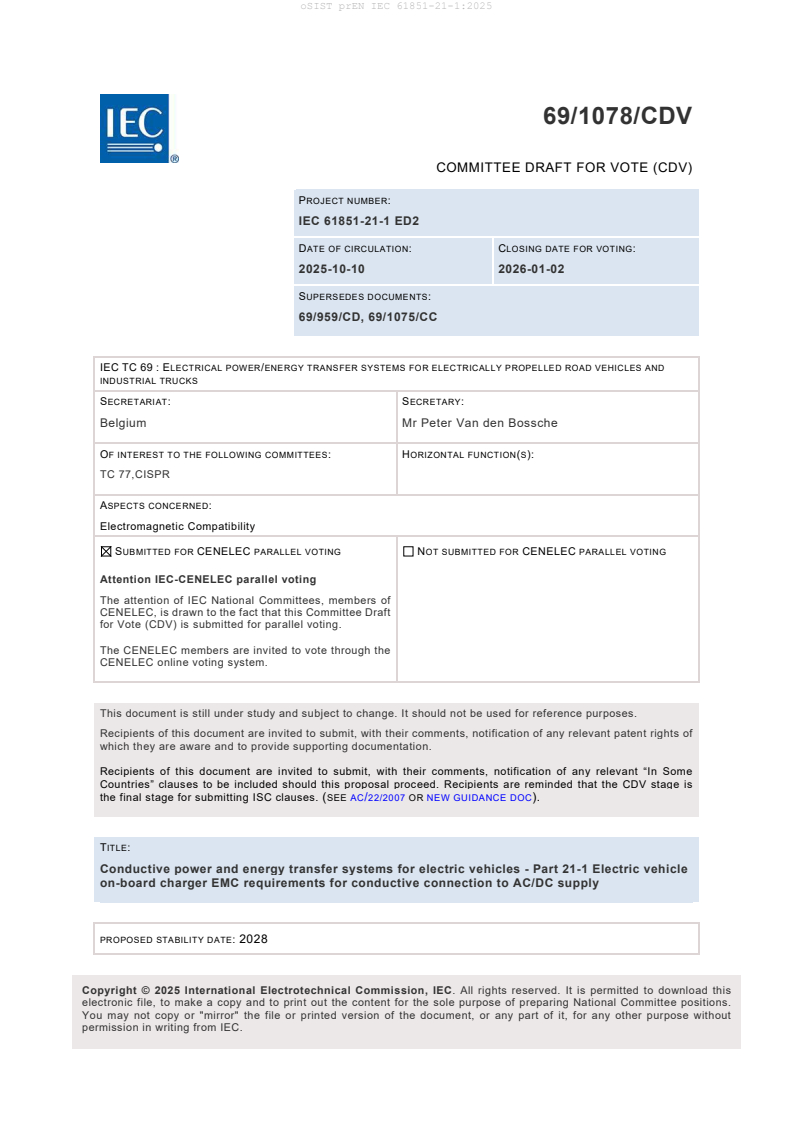
69/1078/CDV
COMMITTEE DRAFT FOR VOTE (CDV)
PROJECT NUMBER:
IEC 61851-21-1 ED2
DATE OF CIRCULATION: CLOSING DATE FOR VOTING:
2025-10-10 2026-01-02
SUPERSEDES DOCUMENTS:
69/959/CD, 69/1075/CC
IEC TC 69 : ELECTRICAL POWER/ENERGY TRANSFER SYSTEMS FOR ELECTRICALLY PROPELLED ROAD VEHICLES AND
INDUSTRIAL TRUCKS
SECRETARIAT: SECRETARY:
Belgium Mr Peter Van den Bossche
OF INTEREST TO THE FOLLOWING COMMITTEES: HORIZONTAL FUNCTION(S):
TC 77,CISPR
ASPECTS CONCERNED:
Electromagnetic Compatibility
SUBMITTED FOR CENELEC PARALLEL VOTING NOT SUBMITTED FOR CENELEC PARALLEL VOTING
Attention IEC-CENELEC parallel voting
The attention of IEC National Committees, members of
CENELEC, is drawn to the fact that this Committee Draft
for Vote (CDV) is submitted for parallel voting.
The CENELEC members are invited to vote through the
CENELEC online voting system.
This document is still under study and subject to change. It should not be used for reference purposes.
Recipients of this document are invited to submit, with their comments, notification of any relevant patent rights of
which they are aware and to provide supporting documentation.
Recipients of this document are invited to submit, with their comments, notification of any relevant “In Some
Countries” clauses to be included should this proposal proceed. Recipients are reminded that the CDV stage is
the final stage for submitting ISC clauses. (SEE AC/22/2007 OR NEW GUIDANCE DOC).
TITLE:
Conductive power and energy transfer systems for electric vehicles - Part 21-1 Electric vehicle
on-board charger EMC requirements for conductive connection to AC/DC supply
PROPOSED STABILITY DATE: 2028
NOTE FROM TC/SC OFFICERS:
electronic file, to make a copy and to print out the content for the sole purpose of preparing National Committee positions.
You may not copy or "mirror" the file or printed version of the document, or any part of it, for any other purpose without
permission in writing from IEC.
IEC CDV 61851-21-1 © IEC 2025
1 Conductive power and energy transfer systems for electric road
2 vehicles
3 – Part 21-1: Electric vehicle on-board charger EMC requirements
4 for conductive connection to an a.c./d.c. supply
IEC CDV 61851-21-1 © IEC 2025
6 CONTENTS
7 FOREWORD . 5
8 1 Scope . 7
9 2 Normative references . 7
10 3 Definitions . 9
11 4 General test conditions . 12
12 5 Test methods and requirements. 12
13 5.1 Test setup for vehicle in charging mode . 12
14 5.1.1 Host vehicle in charging mode 1 or mode 2 (AC power charging
15 without communication) . 12
16 5.1.2 Host vehicle in charging mode 3 (AC power charging with
17 communication) or mode 4 (DC power charging with communication) . 13
18 5.2 ESA test setup . 14
19 5.4 Immunity test methods . 14
20 5.4.1 General . 14
21 5.4.2 Function Performance Criteria . 15
22 5.4.3 Test Severity Levels . 15
23 5.4.4 Immunity to electrical fast transient/burst disturbances conducted
24 along a.c. and d.c. power lines . 15
25 5.4.5 Immunity to surges conducted along a.c. and d.c. power lines . 16
26 5.4.6 Immunity to electromagnetic radiated RF-fields . 19
27 5.4.7 Immunity to Pulses on Supply Lines . 24
28 5.5 Emission test methods . 29
29 5.5.1 Test conditions . 29
30 5.5.2 Emissions of Harmonics on a.c. power lines . 29
31 5.5.3 Emission of voltage changes, voltage fluctuations and flicker on a.c.
32 power lines . 31
33 5.5.4 High-frequency conducted disturbances on a.c. or d.c. power lines . 32
34 5.5.5 High-frequency radiated disturbances in the frequency range 30 –
35 1000 MHz . 37
36 5.5.6 High-frequency radiated disturbances in the frequency range 1000 –
37 6000 MHz . 41
38 5.5.7 Transient emission tests . 43
39 Annex A (normative) Artificial Network (AN), High Voltage Artificial Network (HV-AN),
40 Direct Current charging Artificial Networks (DC-charging-AN), Artificial Mains
41 Network (AMN) and Asymmetric Artificial Network (AAN). 44
42 A.1 General . 44
43 A.2 Artificial networks (AN) . 44
44 A.2.1 Component powered by LV . 44
45 A.2.2 Component powered by HV . 46
46 A.2.3 Direct Current charging Artificial Networks (DC-charging-AN) . 49
47 A.3 Artificial Mains networks (AMN) . 50
48 A.4 Asymmetric artificial networks (AAN) . 50
49 A.4.1 General . 50
50 A.4.2 Signal/control port with symmetric lines . 50
51 A.4.3 Wired network port with powerline communication on power lines . 51
52 A.4.4 Signal/control port with PLC on control pilot line . 52
53 A.4.5 Signal/control port with control pilot line . 53
IEC CDV 61851-21-1 © IEC 2025
54 Annex B (informative) Immunity of vehicles to low frequency phenomena conducted
55 along AC power lines . 55
56 B.1 General . 55
57 B.2 Electric vehicle charging equipment test . 56
58 B.3 ESA separated on-board charger test . 57
59 Annex C (informative) Spectral density of non-intentional emissions (NIE) in the
60 frequency range 9 kHz to 150 kHz . 58
61 C.1 Introduction of Integral Voltage Levels (IVL) for the limitation of the spectral
62 density of NIE . 58
63 C.2 Recommended maximum IVL for NIE . 59
67 List of Figures
68 Figure 1: Example for a typical test setup for electrical fast transient/ burst vehicle test . 16
69 Figure 2: Example for a typical test setup for vehicle in configuration “RESS charging
70 mode coupled to the power grid” - coupling between lines for a.c. (single phase) and
71 d.c. power lines. 17
72 Figure 3: Example for a typical test setup for vehicle in configuration “RESS charging
73 mode coupled to the power grid” - coupling between each line and earth for a. c.
74 (single phase) and d.c. power lines . 17
75 Figure 4: Example for a typical test setup for vehicle in configuration “RESS charging
76 mode coupled to the power grid” - coupling between lines for a c. (three phases) power
77 lines . 18
78 Figure 5: Example for a typical test setup for vehicle in configuration “RESS charging
79 mode coupled to the power grid” - coupling between each line and earth for a c. (three
80 phases) power lines . 18
81 Figure 6: Example for a typical test setup for vehicle with charging plug located at the
82 side of the vehicle (a.c./d.c. power charging without communication) . 20
83 Figure 7: Example for a typical test setup for vehicle with charging plug located at the
84 front / rear of the vehicle (a.c./ d.c. power charging without communication) . 21
85 Figure 8: Example for a typical test setup for vehicle with the charging plug located at
86 the side of the vehicle (a.c. or d.c. power charging with communication) . 22
87 Figure 9: Example for a typical test setup for vehicle with charging plug located at the
88 front / rear of the vehicle (a.c. or d.c. power charging with communication) . 23
89 Figure 10: Example for a typical test setup for vehicle in configuration “RESS charging
90 mode coupled to the power grid” - single phase charger test setup . 30
91 Figure 11: Example for a typical test setup for vehicle in configuration “RESS charging
92 mode coupled to the power grid” - three-phase charger test setup . 31
93 Figure 12: Example for a typical test setup for vehicle in configuration “RESS charging
94 mode coupled to the power grid” . 32
95 Figure 13: Example for a typical test setup for vehicle in configuration “RESS charging
96 mode coupled to the power grid” . 35
97 Figure 14: Example for a typical test setup for vehicle in configuration “RESS charging
98 mode coupled to the power grid” . 36
99 Figure 15: Example for a typical test setup for vehicle in configuration “RESS charging
100 mode coupled to the power grid” . 38
101 Figure 16: Example for a typical test setup for test configuration for ESAs involved in
102 RESS charging mode coupled to the power grid (example for biconical antenna) . 40
103 Figure 17: Example of a typical test setup for an ESA in RESS charging mode coupled
104 to the power grid in the frequency range 1000 – 6000 MHz . 43
IEC CDV 61851-21-1 © IEC 2025
105 Figure A. 1: Example of 5 µH AN schematic . 46
106 Figure A. 2: Characteristics of the AN impedance Z . 46
PB
107 Figure A. 3: Example of 5 μH HV-AN schematic . 48
108 Figure A. 4: Example of 5 μH HV-AN combination in a single shielded box . 49
109 Figure A. 5: Impedance matching network attached between HV-ANs and EUT . 50
110 Figure A. 6: Example of 5 μH / 50 Ω DC-charging-AN schematic . 51
111 Figure A. 7: Example of an AAN for signal/control port with symmetric lines (e.g. CAN) . 52
112 Figure A. 8: Example of AAN with wired network port with PLC on AC or DC powerlines. 53
113 Figure A. 9: Example of AAN circuit for signal/control port with PLC on control pilot . 54
114 Figure A. 10: Example of AAN circuit for pilot line . 55
115 Figure B. 1: Example for a typical test setup for immunity to harmonics . 57
116 Figure B. 2: Example for a typical test setup for immunity to supra-harmonics . 58
119 List of Tables
121 Table 1: Transient and surge immunity tests on both host vehicle and ESA level . 25
122 Table 2: Immunity tests on host vehicle level . 26
123 Table 3: Immunity tests on ESA level . 27
a)
124 Table 4: References for measuring harmonics . 29
a)
125 Table 5: References for measuring voltage fluctuations and flicker . 31
126 Table 6: Spectrum analyser parameters . 33
127 Table 7: Scanning receiver parameters . 33
128 Table 8: Maximum allowed radiofrequency conducted disturbances on a.c. power lines . 33
129 Table 9: Maximum allowed radiofrequency conducted disturbances on d.c. power lines . 34
130 Table 10: Conditional requirements for the frequency range on tests at the DC port . 34
131 Table 11: Maximum allowed vehicle high-frequency radiated disturbances . 37
132 Table 12: Maximum allowed ESA high-frequency radiated disturbances . 39
133 Table 13: Maximum allowed vehicle high-frequency radiated emissions in the
134 frequency range 1000 MHz to 6000 MHz . 41
135 Table 14: Maximum allowed ESA high-frequency radiated emissions in the frequency
136 range 1000 MHz to 6000 MHz . 44
137 Table 15: Required highest frequency for radiated measurement . 44
138 Table 16: Maximum allowed ESA radiated disturbances on supply lines . 44
139 Table A. 1: Magnitude of the AN impedance Z . 46
PB
140 Table B. 1: Immunity tests . 56
141 Table C. 1: Recommended maximum Integral Voltage Levels . 60
IEC CDV 61851-21-1 © IEC 2025
142 INTERNATIONAL ELECTROTECHNICAL COMMISSION
143 CONDUCTIVE POWER AND ENERGY TRANSFER SYSTEMS FOR
144 ELECTRIC ROAD VEHICLES –
145 Part 21-1: Electric vehicle on-board charger EMC requirements
146 for conductive connection to an a.c./d.c. supply
147 FOREWORD
148 1) The International Electrotechnical Commission (IEC) is a worldwide organization for standardization comprising
149 all national electrotechnical committees (IEC National Committees). The object of IEC is to promote international
150 co-operation on all questions concerning standardization in the electrical and electronic fields. To this end and
151 in addition to other activities, IEC publishes International Standards, Technical Specifications, Technical Reports,
152 Publicly Available Specifications (PAS) and Guides (hereafter referred to as “IEC Publication(s)”). Their
153 preparation is entrusted to technical committees; any IEC National Committee interested in the subject dealt with
154 may participate in this preparatory work. International, governmental and non-governmental organizations liaising
155 with the IEC also participate in this preparation. IEC collaborates closely with the International Organization for
156 Standardization (ISO) in accordance with conditions determined by agreement between the two organizations.
157 2) The formal decisions or agreements of IEC on technical matters express, as nearly as possible, an international
158 consensus of opinion on the relevant subjects since each technical committee has representation from all
159 interested IEC National Committees.
160 3) IEC Publications have the form of recommendations for international use and are accepted by IEC National
161 Committees in that sense. While all reasonable efforts are made to ensure that the technical content of IEC
162 Publications is accurate, IEC cannot be held responsible for the way in which they are used or for any
163 misinterpretation by any end user.
164 4) In order to promote international uniformity, IEC National Committees undertake to apply IEC Publications
165 transparently to the maximum extent possible in their national and regional publications. Any divergence between
166 any IEC Publication and the corresponding national or regional publication shall be clearly indicated in the latter.
167 5) IEC itself does not provide any attestation of conformity. Independent certification bodies provide conformity
168 assessment services and, in some areas, access to IEC marks of conformity. IEC is not responsible for any
169 services carried out by independent certification bodies.
170 6) All users should ensure that they have the latest edition of this publication.
171 7) No liability shall attach to IEC or its directors, employees, servants or agents including individual experts and
172 members of its technical committees and IEC National Committees for any personal injury, property damage or
173 other damage of any nature whatsoever, whether direct or indirect, or for costs (including legal fees) and
174 expenses arising out of the publication, use of, or reliance upon, this IEC Publication or any other IEC
175 Publications.
176 8) Attention is drawn to the Normative references cited in this publication. Use of the referenced publications is
177 indispensable for the correct application of this publication.
178 9) Attention is drawn to the possibility that some of the elements of this IEC Publication may be the subject of patent
179 rights. IEC shall not be held responsible for identifying any or all such patent rights.
180 International Standard IEC 61851-21-1 has been prepared by IEC technical committee 69:
181 Electrical power/energy transfer systems for electrically propelled road vehicles and industrial
182 trucks.
183 This second edition, cancels and replaces IEC 61851-21-1:2017. It constitutes a technical
184 revision.
185 This edition includes the following significant technical changes with respect to IEC 61851-21-
186 1:2017:
187 a) Clause 1: The Scope has been defined more precisely;
188 b) Clause 2: Normative references have been updated;
189 c) Clause 3: Some definitions have been added;
190 d) Clause 4: A bidirectional charging mode has been added;
191 e) Clause 5: The test setup for vehicle in charging mode has been described more precisely,
192 the figures and their keys have been updated and in table 1 pulse modulation test (1.2) has
IEC CDV 61851-21-1 © IEC 2025
193 been added as well as higher frequency range up to 6 GHz (1.3) and the emission test
194 operating conditions have been defined more precisely
195 f) Annex A (normative): DC-Charging-AN has been defined more precisely
196 g) Annex B (informative): “Immunity of vehicles to low frequency phenomena conducted along
197 AC power lines” has been added
198 h) Annex C (informative): “Spectral density of non-intentional emissions (NIE) in the frequency
199 range 9 kHz to 150 kHz” has been added
200 The text of this standard is based on the following documents:
FDIS Report on voting
69/XX/FDIS 69/XX/RVD
201 Full information on the voting for the approval of this standard can be found in the report on
202 voting indicated in the above table.
203 This publication has been drafted in accordance with the ISO/IEC Directives, Part 2.
204 A list of all parts of the IEC 61851 series, under the general title: Electric vehicle conductive charging
205 system, can be found on the IEC website.
206 The committee has decided that the contents of this publication will remain unchanged until the
1)
207 indicated on the IEC web site under "http://webstore.iec.ch" in the data related
stability date
208 to the specific publication. At this date, the publication will be
209 • reconfirmed,
210 • withdrawn,
211 • replaced by a revised edition, or
212 • amended.
)
The National Committees are requested to note that for this publication the stability date is 2024.
IEC CDV 61851-21-1 © IEC 2025
213 CONDUCTIVE POWER AND ENERGY TRANSFER SYSTEMS FOR ELECTRIC ROAD VEHICLES
214 –
215 Part 21-1: Electric vehicle on-board charger EMC requirements
216 for conductive connection to an a.c./ d.c. supply
217 1 Scope
218 This part of IEC 61851 covers Electromagnetic Compatibility (EMC) requirements for conductive
219 connection of an electric vehicle (EV) to an a.c. or d.c. supply. It applies only to on-board
220 charging systems either tested on a host vehicle or tested on the charging system component
221 level (ESA – electronic sub assembly). In case the onboard charger (OBC) is tested on host
222 vehicle level, it is important to note that this standard does not set any requirements for the
223 vehicle as a whole. Vehicle requirements are defined e.g. in CISPR 12 or the ISO 11451-series.
224 This part is also recommended for industrial trucks and vehicles designed primarily to be used
225 off-road, e.g. forestry and construction machines, in charging mode.
226 This part of the standard is not applicable to trolley buses and rail vehicles.
227 Bi-directional power transfer between EV RESS and the grid (for vehicle to grid in grid-following mode)
228 or a load/islanded installation (for vehicle to load or home in grid-forming mode) will be treated in a future
229 revision of this standard. Until then, vehicle in grid-following mode shall be treated as an additional
230 operating mode for emission requirements and the same requirements shall be applied.
231 NOTE 1 Specific safety requirements that apply to equipment on the vehicle during charging are treated in separate
232 documents as indicated in the corresponding clauses of this document.
233 NOTE 2 Electric vehicle (EV) includes pure electric vehicles as well as plug-in hybrid electric vehicles with additional
234 combustion engine.
235 NOTE 3 In the near future, due to new grid codes, the use of 61000-3-16 can be necessary for the reverse power
236 transfer mode. The measurement of DC-injection acc. to a future standard can be necessary as well.
237 2 Normative references
238 The following referenced documents are indispensable for the application of this document. For
239 dated references, only the edition cited applies. For undated references, the latest edition of
240 the referenced document (including any amendments) applies. For dated references,
241 subsequent amendments to, or revisions of, any of these publications do not apply. However,
242 parties to agreements based on this part of IEC 61851 are encouraged to investigate the
243 possibility of applying the most recent editions of the normative documents indicated below.
244 IEC 60038:2009/AMD1:2021, IEC standard voltages
245 IEC 61000-3-2: 2018+AMD1: 2020, Electromagnetic compatibility (EMC) – Part 3-2: Limits
246 – Limits for harmonic current emissions (equipment input current ≤16 A per phase)
247 IEC 61000-3-3: 2013+AMD1: 2017+AMD2: 2021+COR1: 2022, Electromagnetic
248 compatibility (EMC) – Part 3-3: Limits – Limitation of voltage changes, voltage fluctuation and
249 flicker in public low voltage supply systems for equipment with rated current ≤16 A per phase
250 and not subject to condition connection
251 IEC 61000-3-11: 2017, Electromagnetic compatibility (EMC) – Part 3-11 – Limits – Limitation
252 of voltage changes, voltage fluctuation and flicker in public low voltage supply systems for
253 equipment with rated current ≤ 75 A per phase and subject to conditional connection
254 IEC 61000-3-12: 2011+AMD1: 2021, Electromagnetic compatibility (EMC) – Part 3-12 –
255 Limits for harmonic current emissions produced by equipment connected to public low-voltage
256 systems with input current > 16 A and ≤ 75 A per phase”.
257 IEC 61000-4-4: 2012, Electromagnetic compatibility (EMC) – Part 4-4: Testing and
258 measurement techniques – Electrical fast transient/burst immunity test
259 IEC 61000-4-5: 2014+AMD1: 2017, Electromagnetic compatibility (EMC) – Part 4-5: Testing
260 and measurement techniques – Surge immunity test
IEC CDV 61851-21-1 © IEC 2025
261 IEC 61000-4-11: 2020, Electromagnetic compatibility (EMC) - Part 4-11: Testing and
262 measurement techniques - Voltage dips, short interruptions and voltage variations immunity
263 tests for equipment with input current up to 16 A per phase
264 IEC 61000-4-34: 2005/AMD1: 2009 Amendment 1, Electromagnetic compatibility (EMC) - Part
265 4-34: Testing and measurement techniques - Voltage dips, short interruptions and voltage
266 variations immunity tests for equipment with mains current more than 16 A per phase
267 IEC 61000-6-2: 2016, Electromagnetic compatibility (EMC) – Part 6-2: Generic standards –
268 Immunity for industrial environments
269 IEC 61000-6-3: 2020, Electromagnetic compatibility (EMC) – Part 6-3: Generic standards –
270 Emission standard for residential, commercial and light-industrial environments
271 IEC 61000-6-8: 2020, Electromagnetic compatibility (EMC) – Part 6-8: Generic standards -
272 Emission standard for professional equipment in commercial and light-industrial locations
273 IEC 61851-1: 2017, Electric vehicle conductive charging system – Part 1: General requirements
274 IEC 61851-21-2: 2018, Electric vehicle conductive charging system - Part 21-2: Electric vehicle
275 requirements for conductive connection to an AC/DC supply - EMC requirements for off board
276 electric vehicle charging systems
277 CISPR 12: 2007+AMD1: 2009, Vehicles, boats and internal combustion engines - Radio
278 disturbance characteristics - Limits and methods of measurement for the protection of off-board
279 receivers
280 CISPR 16-1-2: 2014+AMD1:2017, Specification for radio disturbance and immunity measuring
281 apparatus and methods – Part 1-2: Radio disturbance and immunity measuring apparatus –
282 Ancillary equipment – Conducted disturbances
283 CISPR 16-2-1: 2014+AMD1: 2017, Specification for radio disturbance and immunity measuring
284 apparatus and methods – Part 2-1: Methods of measurement of disturbances and immunity –
285 Conducted disturbance measurements
286 CISPR 16-2-3: 2016+AMD1: 2019+AMD2: 2023, Specification for radio disturbance and
287 immunity measuring apparatus and methods – Part 2-3: Methods of measurement of
288 disturbances and immunity - Radiated disturbance measurements
289 CISPR 25: 2021 Vehicles, boats and internal combustion engines – Radio disturbance
290 characteristics –Limits and methods of measurement for the protection of on-board receivers
291 CISPR 32: 2015+AMD1:2019, Electromagnetic compatibility of multimedia equipment -
292 Emission requirements
293 CISPR PAS 39:2024, Electromagnetic compatibility (EMC) - Conducted emission requirements
294 on the low voltage AC mains port in the frequency range 9 kHz to 150 kHz for equipment
295 intended to operate in residential environments
296 ISO 8713: 2019, Electrically propelled road vehicles – Vocabulary
297 ISO 11451, Road vehicles — Vehicle test methods for electrical disturbances from narrowband
298 radiated electromagnetic energy
299 Part 1: General principles and terminology (ISO 11451-1: 2025);
300 Part 2: Off-vehicle radiation source (ISO 11451-2: 2025);
301 Part 5: Reverberation chamber (ISO 11451-5:2023).
302 ISO 11452, Road vehicles — Component test methods for electrical disturbances from
303 narrowband radiated electromagnetic energy
304 Part 1: General principles and terminology (ISO 11452-1: 2025);
305 Part 2: Absorber-lined shielded enclosure (ISO 11452-2: 2019);
306 Part 4: Harness excitation methods (ISO 11452-4: 2020).
IEC CDV 61851-21-1 © IEC 2025
307 ISO 15118-3: 2015, Road vehicles – Vehicle to Grid Communication Interface - Part 3: Physical
308 and data link layer requirements
309 IEC 61000-4-13:2002+AMD1:2009+AMD2: 2015, Electromagnetic compatibility (EMC) - Part 4-
310 13: Testing and measurement techniques - Harmonics and interharmonics including mains
311 signalling at a.c. power port, low frequency immunity tests
312 IEC 61000-4-19: 2014, Electromagnetic compatibility (EMC) - Part 4-19: Testing and
313 measurement techniques - Test for immunity to conducted, differential mode disturbances and
314 signalling in the frequency range 2 kHz to 150 kHz at a.c. power ports
315 3 Definitions
316 IEC 61851-1 and ISO 8713 provide definitions and terminology of electrical propelled vehicles.
317 Additional definitions are listed below.
318 3.1
319 Rechargeable Energy Storage System (RESS)
320 the rechargeable energy storage system that provides electric energy for electric propulsion of
321 the vehicle
322 3.2
323 on-board EV charging system
324 all equipment in the charge power supply chain inside the vehicle including the plug and
325 charging cable if physically connected to the vehicle (charging cable cannot be removed without
326 any tool, i.e. case A as defined in IEC 61851-1)
327 3.3
328 off-board EV charging system
329 supplies a.c. or d.c. to the on-board EV charging system or vehicle battery. It includes
330 electronics for communications and control of charging system. This includes off-board
331 equipment covering modes 1, 2, 3 and 4 charging as defined in IEC 61851-1
332 3.4
333 electrical/electronic sub-assembly (ESA)
334 an electrical and/or electronic device or set(s) of devices intended to be part of a vehicle,
335 together with any associated electrical connections and wiring, which performs one or more
336 specialized functions
337 3.5
338 voltage class A
339 classification of an electric component or circuit with a maximum working voltage of ≤30 V
340 a.c.(rms) or ≤60 V d.c. respectively.
341 Note to entry: Master publication in ISO/TC 22/SC 37: ISO 6469-1:20xx), also defined in ISO 12405-4:2018, ISO
342 17409:2015 and ISO 6469-4:2015
343 3.6
344 voltage class A harness
345 low voltage harness with operating voltages of ≤30 V a.c.(rms) or ≤60 V d.c. respectively.
346 3.7
347 voltage class B
348 classification of an electric component or circuit with a maximum working voltage of (>30 and
349 ≤1 000) V a.c. (rms) or (>60 and ≤1 500) V d.c., respectively.
350 Note to entry: Master publication in ISO/TC 22/SC 37: ISO 6469-1:20xx), also defined in ISO 12405-4:2018, ISO
351 17409:2015 and ISO 6469-4:2015.
352 3.8
353 voltage class B harness
354 high voltage harness with operating voltages of (>30 and ≤1 000) V a.c. (rms) or (>60 and ≤1
355 500) V d.c., respectively.
IEC CDV 61851-21-1 © IEC 2025
356 3.9
357 vehicle to everything (V2X)
358 communication between a vehicle and any other device, e.g. another vehicle, traffic
359 infrastructure, power grid infrastructure, buildings, etc.
360 3.10
361 Rated charging/input current
362 of an on-board-charger will refer to the commonly used setpoints defined by the manufacturer,
363 e.g. 32A single-phase and 16A three-phase.
364 3.11
365 conductive power transfer port
366 CPT port
367 power output port of EV supply equipment for EVs serving conductive power transfer (CPT) of
368 LV AC or DC electrical energy to the secondary device of the charging system and also
369 providing all required signalling/controlling and/or communication functions.
370 EXAMPLE 1 Secondary device of the charging system can be. to the load to be charged or supplied with power.
371 EXAMPLE 2 Signalling/controlling and/or communication functions can be control pilot, CAN and private PLC/T.
372 3.12
373 rated current of the equipment
374 input current of the piece of equipment as described in the accompanying documents and marked as
375 such on the rating plate of the piece of equipment or stated in the product documents
376 3.13
377 rated power of the equipment
378 input power of the piece of equipment as described in the accompanying documents and marked as
379 such
380 on the rating plate of the piece of equipment or stated in the product documents
381 3.14
382 highest internal frequency
383 Fx
384 highest fundamental frequency generated or used within the EUT, or the highest frequency at which it
385 operates.
386 Note 1 to entry: The EUT in this document is the on-board charger whether it is tested on vehicle level or on the
387 charging system level.
388 Note 2 to entry: This includes frequencies which are solely used within an integrated circuit.
389 3.15
390 absorber lined shielded enclosure
391 ALSE
392 shielded enclosure or screened room with radio frequency absorbing material on its internal ceiling and
393 walls
394 3.16
395 open-area test site
396 OATS
397 facility for radiated disturbance measurements in which the ground reflection is made
398 reproducible by a large flat electrically conducting ground plane
399 Note 1 to entry: An OATS is an uncovered outdoor site, which is far enough away from buildings, electric lines, fences, trees and
400 other potentially reflective objects, so that the effects due to such objects are negligible. See CISPR 16-1-4 for guidance on the
401 construction of an OATS.
402 3.17
403 outdoor test site
404 OTS
405 radiated disturbance measurement site without metallic ground plane and with specific requirements
406 that are set out in this document
407 3.18
408 reverberation chamber
409 RC
IEC CDV 61851-21-1 © IEC 2025
410 high Q shielded room (cavity) whose boundary conditions are changed via one or several rotating tuners
411 or moving walls (including vibrating intrinsic reverberation chambers (VIRCs) with or without conductive
412 contact to the floor) or repositioning of the transmitting antenna(s)
413 Note 1 to entry: This results in a statistically uniform electromagnetic field
414 3.19
415 charging mode
416 method for connection of an EV to the supply network to supply energy to the vehicle
417 3.20
418 charging mode 1 / mode 1
419 Method for the connection of an EV to a standard socket-outlet of an AC supply network, utilizing a cable
420 and plug, both of which are not fitted with any supplementary pilot or auxiliary contacts
421 3.21
422 charging mode 2 / mode 2
423 Method for the connection of an EV to a standard socket-outlet of an AC supply network utilizing an AC
424 EV supply equipment with a cable and plug, with a control pilot function and system for personal
425 protection against electric shock placed between the standard plug and the EV
426 3.22
427 charging mode 3 / mode 3
428 Method for the connection of an EV to an AC EV supply equipment permanently connected to an AC
429 supply network, with a control pilot function that extends from the AC EV supply equipment to the EV
430 3.23
431 charging mode 4 / mode 4
432 Method for the connection of an EV to an AC or DC supply network utilizing a DC EV supply equipment,
433 with a control pilot function that extends from the DC EV supply equipment to the EV
434 Note 1 to entry: Mode 4 EV supply equipment is either permanently connected or connected by a cable and plug to the supply
435 network.
436 3.24
437 reverse power transfer
438 reverse energy transfer RPT, transfer of electric energy from an EV to the electrical installation
439 3.25
440 transfer of electric energy from an EV to the electrical installation
441 bidirectional power transfer
442 bidirectional energy transfer
443 DEPRECATED: bi-directional power transfer BPT combination of forward power transfer (FPT) and
444 reverse power transfer (RPT) [SOURCE: IEC 61851-23:2024, 3.3.127]
445 3.26
446 grid following mode
447 mode of reverse power transfer when the energy source follows operational parameters of the electrical
448 installation and operates in parallel either to the electric power network or to a grid forming source.
449 3.27
450 S
VSWR
451 site voltage standing wave ratio
IEC CDV 61851-21-1 © IEC 2025
452 4 General test conditions
453 The host vehicle systems shall operate correctly within +10 % / -15 % of the standard nominal
454 supply voltage. This takes into account variations that are induced by the installation as defined
455 in Annex A of IEC 60038. The rated value of the frequency is 50 Hz ± 1 % or 60 Hz ± 1 %.
456 NOTE IEC 60038 specifies the voltage at the delivery point. Annex A proposes to specify wider values to allow for
457 further voltage variations due to installations.
458 Test methods concern only the electric vehicle charging system with “RESS in (bidirectional)
459 charging mode coupled to the power grid or V2X”. Tests shall be performed either on separate
460 samples (ESA level) or on the whole vehicle as host at the vehicle manufacturer’s request as
461 defined in the test plan.
462 The host vehicle shall be in an unladen condition except for necessary test equipment.
463 The host vehicle shall be immobilized and in continuous charging mode. The engine(s) (ICE or
464 electrical engine) shall be OFF.
465 All other equipment which can be switched on permanently by the driver or passenger shall be
466 OFF.
467 The tests shall be carried out with the equipment under test (EUT) including its sensors and
468 actuators as defined in the test plan.
469 Unless otherwise specified, the tests shall be carried out at an ambient temperature of 23 °C ±
470 5 °C according to standards ISO 11451-1 and ISO 11452-1.
471 5 Test methods and requirements
472 5.1 Test setup for vehicle in charging mode
473 5.1.1 Host vehicle in charging mode 1 or mode 2 (AC power charging without
474 communication)
475 5.1.1.1 General
476 This configuration concerns only charging mode 1 and charging mode 2.
477 5.1.1.2 Artificial network
478 The artificial mains networks (AMN) for power supply to be used for these tests are described
479 in Annex A of this document.
480 5.1.1.3 Power charging cable
481 The power charging cable shall be laid out in a straight line between the AMN(s) and the vehicle
482 charging inlet and shall be routed perpendicularly to the vehicle's longitudinal axis (see Figure
483 6 to Figure 9). The projected cable length from the side of the AMN(s) to the side of the vehicle
484 shall be 800 (+200 / −0) mm as shown in Figure 6 to Figure 9.
485 For a longer cable, the extraneous length shall be “Z-folded” symmetrically. No contact or
486 overlap is allowed between windings. The width of the Z-folded cable shall be between 500 mm
487 and 1 000 mm. If it is impractical to do so because of cable bulk or stiffness, or because the
488 testing is being done at a user's installation, the disposition of the excess cable length shall be
489 precisely noted in the test report.
490 The charging cable at the vehicle side shall hang vertically at a distance of
491 (100 (+200 / −0)) mm from the vehicle body.
492 The whole cable shall be placed on a non-conductive, low relative permittivity (dielectric-
493 constant) material (ε ≤ 1,4), at (100 ± 25) mm above the ground plane (ALSE, reverberation
r
494 chamber or OATS) or floor (OTS).
495 Unless otherwise specified, the mode 1 or mode 2 charging cable provided by the manufacturer
496 shall be used and shall have a maximum length of 10 m.
IEC CDV 61851-21-1 © IEC 2025
497 If the vehicle manufacturer delivers more than one mode 1 or mode 2 cable, the measurements
498 may be performed with one representative cable for each mode only.
499 5.1.2 Host vehicle in charging mode 3 (AC power charging with communication) or mode
500 4 (DC power charging with communication)
501 5.1.2.1 General
502 This configuration concerns charging mode 3 and charging mode 4.
503 5.1.2.2 Charging station / Power mains
504 The charging station may be placed either in the test site or outside the test site.
505 If the communication between the host vehicle and the charging station can be simulated, the
506 charging station may be replaced by a power supply connected to the AC power mains network.
507 In both cases, power mains/supply and communication or signal lines socket(s) shall be placed
508 in the test site with the following conditions:
509 – the socket(s) shall be placed on the ground plane (ALSE, reverberation chamber or OATS)
510 or floor (OTS);
511 – the length of the cable between the power mains/supply socket
...