


SIST EN 17076:2021
(Main)Tower cranes - Anti-collision systems - Safety requirements
Tower cranes - Anti-collision systems - Safety requirements
This document specifies the requirements of anti-collision devices and systems installed on tower cranes (as defined in EN 14439) to avoid the risks of collision between several cranes in service, between a crane in use and fixed obstacles, and over prohibited zones.
It also specifies the requirements for working range limiting devices.
Anti-collision devices and systems and working range limiting devices according to this document are safety components.
It applies to anti-collision devices manufactured after the publication of this document.
NOTE For anti-collision systems used to avoid the risk of collision with power lines, additional requirements might be necessary.
This document defines the safety characteristics and requirements of anti-collision devices and systems intended for installation on self-erecting tower cranes and tower cranes erected from parts.
In particular:
- performance level;
- information to be provided by the sensors installed on the crane;
- operation, particularly in the event of failure, override and free jib slewing states of a crane;
- type of communication between devices;
- information for the crane operator and outside indicator.
It also specifies the requirements for marking the device or the system and the content of the instructions for use.
The significant hazards covered by this document are identified in Clause 4.
This document is not applicable to anti-collision devices and systems which are manufactured before the date of publication by CEN of this document.
Turmdrehkrane - Antikollisionssysteme - Sicherheitstechnische Anforderungen
Dieses Dokument legt die Anforderungen an Antikollisionseinrichtungen und -systeme fest, die in Turmdrehkranen für den Baubetrieb (wie in EN 14439:2006+A2:2009 definiert) installiert sind, um das Kollisionsrisiko zwischen mehreren Kranen in Betrieb, das Kollisionsrisiko zwischen einem Kran in Betrieb und feststehenden Hindernissen und das Fahren durch gesperrte Bereiche zu verhindern.
Es legt außerdem die Anforderungen an Arbeitsbereichsbegrenzer fest.
Antikollisionseinrichtungen und -systeme sowie Arbeitsbereichsbegrenzer in Übereinstimmung mit dem vorliegenden Dokument sind sicherheitstechnische Komponenten.
Dieses Dokument legt die sicherheitstechnischen Eigenschaften von und die Anforderungen an Antikollisionseinrichtungen und -systeme, die für den Einbau in Schnellmontage-Turmdrehkrane und in aus Komponenten zusammengesetzte Turmdrehkrane vorgesehen sind, fest.
Dazu zählen insbesondere folgende:
- Performance Level;
- Informationen, die von den am Kran installierten Sensoren zu liefern sind;
- Betriebsverhalten, besonders im Fehlerfall, bei Überbrückung und bei einem Kran in Windfreistellung;
- (Art der) Kommunikation zwischen den Einrichtungen;
- Informationen für den Kranführer und außen am Kran befindliche Anzeigen.
Dieses Dokument behandelt alle signifikanten Gefährdungen, Gefährdungssituationen und Gefährdungsereignisse, die für Antikollisionseinrichtungen und -systeme, die in Turmdrehkrane eingebaut sind, relevant sind, wenn diese bestimmungsgemäß und unter den vom Hersteller vorgesehenen Bedingungen verwendet werden. Dieses Dokument legt die zutreffenden technischen Maßnahmen fest, mit denen die Risiken, die sich aus den signifikanten Gefährdungen ergeben, beseitigt oder gemindert werden (siehe Abschnitt 4).
Dieses Dokument gilt nicht für Antikollisionseinrichtungen und -systeme, die vor dem Datum der Veröffentlichung dieses Dokuments durch CEN hergestellt worden sind.
Grues à tour - Systèmes anti-collision - Prescriptions de sécurité
Le présent document spécifie les prescriptions relatives aux dispositifs et systèmes anti-collision installés sur les grues à tour de chantier (telles qu’elles sont définies dans l’EN 144392006+A2:2009), afin d’éviter les risques de collision entre plusieurs grues en mouvement, entre une grue en mouvement et des obstacles fixes, ainsi que le déplacement au-dessus des zones interdites.
Il spécifie également les prescriptions relatives aux dispositifs de limitation de l’espace de travail.
Les dispositifs et systèmes anti-collision et les dispositifs de limitation de l’espace de travail conformes au présent document sont des composants de sécurité.
Le présent document définit les caractéristiques de sécurité et les prescriptions applicables aux dispositifs et systèmes anti-collision destinés à être installés sur les grues à tour à montage automatisé et sur les grues à tour à montage par éléments.
Elle définit notamment :
- le niveau de performance ;
- les informations à fournir par les capteurs installés sur la grue ;
- le fonctionnement, notamment en cas de défaut, de neutralisation et de mise en mode girouette d’une grue ;
- le type de communication entre les dispositifs ;
- les informations destinées à l’opérateur de grue et la signalisation extérieure.
Le présent document traite de tous les phénomènes dangereux, situations et évènements dangereux significatifs relatifs aux grues à tour, lorsque celles-ci sont utilisées pour l'usage prévu et dans les conditions prévues par le fabricant. Le présent document spécifie les mesures techniques appropriées destinées à réduire ou éliminer les risques émanant des phénomènes dangereux significatifs (voir Article 4).
Le présent document ne s’applique pas aux dispositifs et systèmes anti-collision fabriqués avant la date de publication du présent document par le CEN.
Stolpni žerjavi - Sistemi za preprečitev trka - Varnostne zahteve
General Information
- Status
- Withdrawn
- Public Enquiry End Date
- 02-Apr-2017
- Publication Date
- 26-Jan-2021
- Withdrawal Date
- 08-Sep-2025
- Technical Committee
- DTN - Lift and transport appliances
- Current Stage
- 9900 - Withdrawal (Adopted Project)
- Start Date
- 08-Sep-2025
- Due Date
- 01-Oct-2025
- Completion Date
- 09-Sep-2025
Relations
- Effective Date
- 14-Apr-2025
- Amended By
SIST EN 17076:2021/kprA1:2025 - Tower cranes - Anti-collision systems - Safety requirements - Effective Date
- 18-May-2022


Frequently Asked Questions
SIST EN 17076:2021 is a standard published by the Slovenian Institute for Standardization (SIST). Its full title is "Tower cranes - Anti-collision systems - Safety requirements". This standard covers: This document specifies the requirements of anti-collision devices and systems installed on tower cranes (as defined in EN 14439) to avoid the risks of collision between several cranes in service, between a crane in use and fixed obstacles, and over prohibited zones. It also specifies the requirements for working range limiting devices. Anti-collision devices and systems and working range limiting devices according to this document are safety components. It applies to anti-collision devices manufactured after the publication of this document. NOTE For anti-collision systems used to avoid the risk of collision with power lines, additional requirements might be necessary. This document defines the safety characteristics and requirements of anti-collision devices and systems intended for installation on self-erecting tower cranes and tower cranes erected from parts. In particular: - performance level; - information to be provided by the sensors installed on the crane; - operation, particularly in the event of failure, override and free jib slewing states of a crane; - type of communication between devices; - information for the crane operator and outside indicator. It also specifies the requirements for marking the device or the system and the content of the instructions for use. The significant hazards covered by this document are identified in Clause 4. This document is not applicable to anti-collision devices and systems which are manufactured before the date of publication by CEN of this document.
This document specifies the requirements of anti-collision devices and systems installed on tower cranes (as defined in EN 14439) to avoid the risks of collision between several cranes in service, between a crane in use and fixed obstacles, and over prohibited zones. It also specifies the requirements for working range limiting devices. Anti-collision devices and systems and working range limiting devices according to this document are safety components. It applies to anti-collision devices manufactured after the publication of this document. NOTE For anti-collision systems used to avoid the risk of collision with power lines, additional requirements might be necessary. This document defines the safety characteristics and requirements of anti-collision devices and systems intended for installation on self-erecting tower cranes and tower cranes erected from parts. In particular: - performance level; - information to be provided by the sensors installed on the crane; - operation, particularly in the event of failure, override and free jib slewing states of a crane; - type of communication between devices; - information for the crane operator and outside indicator. It also specifies the requirements for marking the device or the system and the content of the instructions for use. The significant hazards covered by this document are identified in Clause 4. This document is not applicable to anti-collision devices and systems which are manufactured before the date of publication by CEN of this document.
SIST EN 17076:2021 is classified under the following ICS (International Classification for Standards) categories: 53.020.20 - Cranes. The ICS classification helps identify the subject area and facilitates finding related standards.
SIST EN 17076:2021 has the following relationships with other standards: It is inter standard links to SIST EN 17076:2021+A1:2025, SIST EN 17076:2021/kprA1:2025. Understanding these relationships helps ensure you are using the most current and applicable version of the standard.
SIST EN 17076:2021 is associated with the following European legislation: EU Directives/Regulations: 2006/42/EC; Standardization Mandates: M/396. When a standard is cited in the Official Journal of the European Union, products manufactured in conformity with it benefit from a presumption of conformity with the essential requirements of the corresponding EU directive or regulation.
SIST EN 17076:2021 is available in PDF format for immediate download after purchase. The document can be added to your cart and obtained through the secure checkout process. Digital delivery ensures instant access to the complete standard document.
Standards Content (Sample)
SLOVENSKI STANDARD
01-april-2021
Stolpni žerjavi - Sistemi za preprečitev trka - Varnostne zahteve
Tower cranes - Anti-collision systems - Safety requirements
Turmdrehkrane - Antikollisionssysteme - Sicherheitstechnische Anforderungen
Grues à tour - Systèmes anti-collision - Prescriptions de sécurité
Ta slovenski standard je istoveten z: EN 17076:2020
ICS:
53.020.20 Dvigala Cranes
2003-01.Slovenski inštitut za standardizacijo. Razmnoževanje celote ali delov tega standarda ni dovoljeno.
EN 17076
EUROPEAN STANDARD
NORME EUROPÉENNE
December 2020
EUROPÄISCHE NORM
ICS 53.020.20
English Version
Tower cranes - Anti-collision systems - Safety
requirements
Grues à tour - Systèmes anti-collision - Prescriptions de Turmdrehkrane - Antikollisionssysteme -
sécurité Sicherheitstechnische Anforderungen
This European Standard was approved by CEN on 21 September 2020.
CEN members are bound to comply with the CEN/CENELEC Internal Regulations which stipulate the conditions for giving this
European Standard the status of a national standard without any alteration. Up-to-date lists and bibliographical references
concerning such national standards may be obtained on application to the CEN-CENELEC Management Centre or to any CEN
member.
This European Standard exists in three official versions (English, French, German). A version in any other language made by
translation under the responsibility of a CEN member into its own language and notified to the CEN-CENELEC Management
Centre has the same status as the official versions.
CEN members are the national standards bodies of Austria, Belgium, Bulgaria, Croatia, Cyprus, Czech Republic, Denmark, Estonia,
Finland, France, Germany, Greece, Hungary, Iceland, Ireland, Italy, Latvia, Lithuania, Luxembourg, Malta, Netherlands, Norway,
Poland, Portugal, Republic of North Macedonia, Romania, Serbia, Slovakia, Slovenia, Spain, Sweden, Switzerland, Turkey and
United Kingdom.
EUROPEAN COMMITTEE FOR STANDARDIZATION
COMITÉ EUROPÉEN DE NORMALISATION
EUROPÄISCHES KOMITEE FÜR NORMUNG
CEN-CENELEC Management Centre: Rue de la Science 23, B-1040 Brussels
© 2020 CEN All rights of exploitation in any form and by any means reserved Ref. No. EN 17076:2020 E
worldwide for CEN national Members.
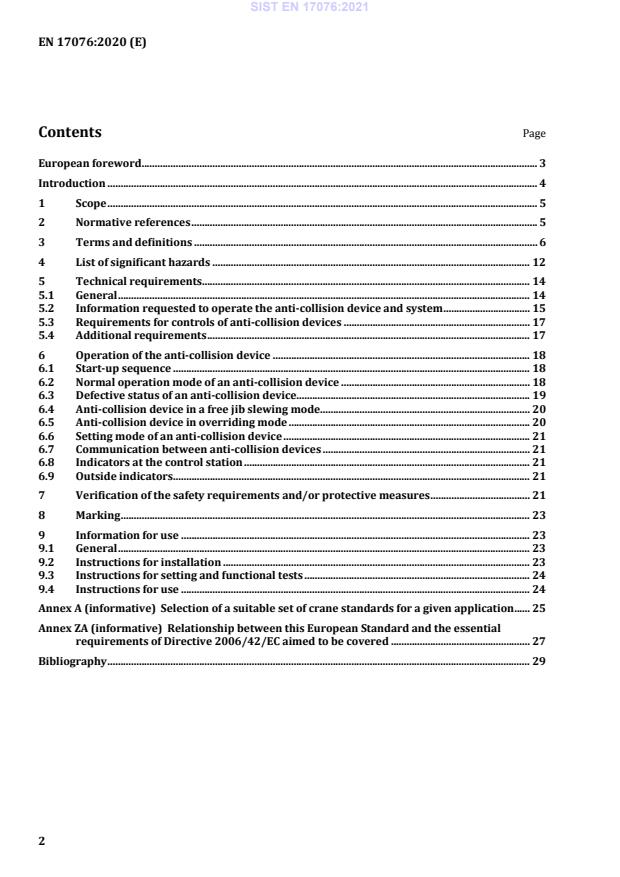
Contents Page
European foreword . 3
Introduction . 4
1 Scope . 5
2 Normative references . 5
3 Terms and definitions . 6
4 List of significant hazards . 12
5 Technical requirements. 14
5.1 General . 14
5.2 Information requested to operate the anti‐collision device and system . 15
5.3 Requirements for controls of anti‐collision devices . 17
5.4 Additional requirements . 17
6 Operation of the anti‐collision device . 18
6.1 Start‐up sequence . 18
6.2 Normal operation mode of an anti‐collision device . 18
6.3 Defective status of an anti‐collision device. 19
6.4 Anti‐collision device in a free jib slewing mode. 20
6.5 Anti‐collision device in overriding mode . 20
6.6 Setting mode of an anti‐collision device . 21
6.7 Communication between anti‐collision devices . 21
6.8 Indicators at the control station . 21
6.9 Outside indicators . 21
7 Verification of the safety requirements and/or protective measures . 21
8 Marking . 23
9 Information for use . 23
9.1 General . 23
9.2 Instructions for installation . 23
9.3 Instructions for setting and functional tests . 24
9.4 Instructions for use . 24
Annex A (informative) Selection of a suitable set of crane standards for a given application . 25
Annex ZA (informative) Relationship between this European Standard and the essential
requirements of Directive 2006/42/EC aimed to be covered . 27
Bibliography . 29
European foreword
This document (EN 17076:2020) has been prepared by Technical Committee CEN/TC 147 “Cranes -
Safety”, the secretariat of which is held by BSI.
This European Standard shall be given the status of a national standard, either by publication of an
identical text or by endorsement, at the latest by June 2021 and conflicting national standards shall be
withdrawn at the latest by June 2021.
Attention is drawn to the possibility that some of the elements of this document may be the subject of
patent rights. CEN shall not be held responsible for identifying any or all such patent rights.
This document has been prepared under a mandate given to CEN by the European Commission and the
European Free Trade Association, and supports essential requirements of EU Directive(s).
For relationship with EU Directive(s), see informative Annex ZA, which is an integral part of this
document.
To select a suitable set of standards for a given application, see Annex A.
According to the CEN-CENELEC Internal Regulations, the national standards organisations of the
following countries are bound to implement this European Standard: Austria, Belgium, Bulgaria, Croatia,
Cyprus, Czech Republic, Denmark, Estonia, Finland, France, Germany, Greece, Hungary, Iceland, Ireland,
Italy, Latvia, Lithuania, Luxembourg, Malta, Netherlands, Norway, Poland, Portugal, Republic of North
Macedonia, Romania, Serbia, Slovakia, Slovenia, Spain, Sweden, Switzerland, Turkey and the United
Kingdom.
Introduction
This document has been prepared to be a harmonized standard to provide one means for the mechanical
design and theoretical verification of cranes to conform with the essential health and safety requirements
of the Machinery Directive 2006/42/EC modified.
This document is a type C standard as stated in EN ISO 12100.
The machinery concerned and the extent to which hazards, hazardous situations and events are covered
are indicated in the scope of this standard.
When provisions of this type C standard are different from those which are stated in type A or B
standards, the provisions of this type C standard take precedence over the provisions of the other
standards, for machines that have been designed and built according to the provisions of this type C
standard.
1 Scope
This document specifies the requirements of anti-collision devices and systems installed on tower cranes
for construction work (as defined in EN 14439:2006+A2:2009) to avoid the risks of collision between
several cranes in service, to avoid the risks of collision between a crane in use and fixed obstacles, and to
avoid travelling over prohibited zones.
It also specifies the requirements for working range limiting devices.
Anti-collision devices and systems and working range limiting devices according to this document are
safety components.
This document defines the safety characteristics and requirements of anti-collision devices and systems
intended for installation on self-erecting tower cranes and tower cranes erected from parts.
In particular:
— performance level;
— information to be provided by the sensors installed on the crane;
— operation, particularly in the event of failure, override and free jib slewing states of a crane;
— type of communication between devices;
— information for the crane operator and outside indicator.
This document deals with all significant hazards, hazardous situations and events relevant to anti-
collision devices and systems installed on tower cranes, when used as intended and under conditions
foreseen by the manufacturer. This document specifies the appropriate technical measures to eliminate
or reduce risks arising from the significant hazards (see Clause 4).
This document is not applicable to anti-collision devices and systems which are manufactured before the
date of publication by CEN of this document.
2 Normative references
The following documents are referred to in the text in such a way that some or all of their content
constitutes requirements of this document. For dated references, only the edition cited applies. For
undated references, the latest edition of the referenced document (including any amendments) applies.
EN 13557:2003+A2:2008, Cranes — Controls and control stations
EN 14439:2006+A2:2009, Cranes — Safety — Tower cranes
EN 60204-32:2008, Safety of machinery — Electrical equipment of machines — Part 32: Requirements for
hoisting machines (IEC 60204-32:2008)
EN ISO 12100:2010, Safety of machinery — General principles for design — Risk assessment and risk
reduction (ISO 12100:2010)
EN ISO 13849-1:2015, Safety of machinery — Safety-related parts of control systems — Part 1: General
principles for design (ISO 13849-1:2015)
3 Terms and definitions
For the purposes of this document, the following terms and definitions apply.
ISO and IEC maintain terminological databases for use in standardization at the following addresses:
— IEC Electropedia: available at http://www.electropedia.org/
— ISO Online browsing platform: available at https://www.iso.org/obp
3.1
stop function
interruption of the crane's movement preceded by a deceleration phase (slowing down) monitored by
the anti-collision device
3.2
local fault
error related to the anti-collision device and/or the information coming from the crane on which it is
installed
3.3
normal operation mode
operation without any of the following conditions: local fault detected by the anti-collision device or free
jib slewing condition or overriding
3.4
working range limiting device
WRLD
set of components installed on the same crane whose combined actions enable management of prohibited
zones only
Note 1 to entry: Working range limiting device generally fulfils the same requirements as anti-collision device
limited to one crane without communication with other anti-collision devices.
3.5
anti‐collision device
ACD
set of components installed on the same crane whose combined actions enable management of
interference zones and/or prohibited zones
3.6
anti‐collision system
ACS
network of anti-collision devices that enable management of interference zones and/or prohibited zones,
in which each anti-collision device is an input device for the other anti-collision devices within this
network
3.7
working volume
zone or volume swept over by the hook and/or the rotating upper works of the crane
Note 1 to entry: See Figures 1 to 3.
Key
TC1 tower crane 1
TC2 tower crane 2
Figure 1 — Case of fixed base higher crane: working volume of TC2 (grey area)
Key
TC1 tower crane 1
TC2 tower crane 2
Figure 2 — Case of fixed base lower crane: working volume of TC1 (grey area)
Key
TC1 tower crane 1
TC2 tower crane 2
Figure 3 — Case of travelling lower crane: working volume of TC1 (grey area)
3.8
flyover volume
limited working volume for a tower crane opposite to a free slewing tower crane according to the
following:
— for a lower crane the flyover volume is equivalent to the working volume, in a defined position in
case of travelling crane;
— for a higher crane the flyover volume is equivalent to the working volume limited to a radius equal
to the trolley position
Note 1 to entry: See Figures 4 and 5.
Key
TC1 free slewing tower crane
TC2 in service tower crane
Figure 4 — Case of travelling lower crane (TC 1)
Key
TC1 in service tower crane
TC2 free slewing tower crane
Figure 5 — Case of travelling higher crane (TC 2)
3.9
prohibited volume
defined zone or volume in which the hook and/or the presence of a part of the rotating upper works of
the crane is prohibited
Note 1 to entry: See Figures 6, 7 and 8.
3.10
stop limit
limit at which all dangerous movements have to be stopped due to an action of the ACD
Note 1 to entry: See Figure 6.
3.11
approach limit
limit of the zone over-swept by the hook and/or the crane element at which it is necessary to slow down
the movements of the crane in order to stop at or before the stop limit
Note 1 to entry: See Figure 6.
Note 2 to entry: The approach limit can vary according to the movement speeds. At the determination of the
approach limit the braking characteristics of each tower crane has to be taken into account individually.
Key
1 safety distance
2 crane or prohibited zones
3 approach limit
4 stop limit
Figure 6 — Example of prohibited zone, stop limit and approach limit
Key
1 crane
2 prohibited zone
3 approach limit is reached
–––––––––- stop limit
approach limit
Figure 7 — Example of approach limit between a crane and a prohibited zone
Note 3 to entry: Prohibited zone can be over-swept by the rotating upper works of the crane.
Key
1 upper crane
2 lower crane
3 approach limit is reached for both cranes
–––––––––- stop limits
approach limits
Figure 8 — Example of approach limit between two cranes
Note 4 to entry: Example with a stationary crane approaching a prohibited volume that can be swept-over by the
jib.
Note 5 to entry: For clarification, the shapes of the approach limit and the stop limit are simplified.
3.12
interference zone
working volume where two or more cranes can collide (if it is not controlled by an anti-collision system)
Note 1 to entry: See Figures 9 and 10.
Key
TC1 tower crane 1
TC2 tower crane 2
Figure 9 — Case of fixed base cranes: interference zone (grey area)
Key
TC1 tower crane 1
TC2 tower crane 2
Figure 10 — Case of travelling lower crane: interference zone (grey area)
3.13
safety distance
distance between the stop limit and any potential interfering parts and/or from prohibited volume
Note 1 to entry: See Figures 6, 7 and 8.
3.14
setting mode
mode used to set the anti-collision or prohibited zone parameters prior to be used
3.15
override mode
operation mode bypassing the management of interference zone and/or prohibited zone
4 List of significant hazards
Table 1 contains all the significant hazards, hazardous situations and events, as far as they are dealt with
in this document, identified by risk assessment as significant for this type of machinery and which require
action to eliminate or reduce the risk.
Table 1 — List of significant hazards and associated requirements
Hazard Hazards Relevant clause(s)
reference no. in this document
1 Mechanical hazards due to:
— Machine parts or work pieces, e.g.
e) insufficient mechanical strength; 5.1.3
1.1 Crushing hazards 5.1.4
1.2 Shearing hazards 5.1.4
1.3 Cutting or severing hazards 5.1.2; 5.1.4
8 Hazards generated by neglecting ergonomic principles in
machinery design as, e.g. hazards from:
8.1 Unhealthy postures or excessive efforts 5.1.5
8.6 Human error, human behaviour 6.4; 6.5, 6.6
8.7 Inadequate design, location or identification of manual 5.1.5
controls
8.8 Inadequate design or location of visual display units 5.1.8, 6.8, 6.9
10 Unexpected start-up, unexpected overrun/overspeed (or
any similar malfunction) from:
10.1 Failure/disorder of the control system 5.1.6; 5.1.7; 5.1.9; 6.7
10.2 Restoration of energy supply after an interruption 6.1
10.3 External influences on electrical equipment 5.4
10.5 Error in the software 5.1.6; 5.1.7; 5.1.9
11 Impossibility of stopping the machine in a safe condition 6.2; 6.5
13 Failure of the power supply 6.1
14 Failure of the control circuit 5.4; 6.3
15 Errors of fitting 5.1.3
16 Break-up during operation 5.1.3
17 Falling or ejected objects or fluid 5.1.3
Additional hazards and hazardous events due to mobility:
25 From/to third persons
25.3 Lack or inadequacy of visual or acoustic warning means 6.9
26 Insufficient instructions for the driver/operator 9
Additional hazards and hazardous events due to lifting
27.1 From loads falls, collision, machine tipping 5.1.7; 5.1.9; 5.2
29 Hazards generated by neglecting ergonomic principles:
29.1 Insufficient visibility from the driving position 5.1.5; 9.1
5 Technical requirements
5.1 General
5.1.1 Components of anti‐collision devices and systems
The anti-collision device consists of a set of input devices, e.g. sensors, output devices and a logic module.
All output devices are already installed on the crane while some of the necessary input devices could need
to be retrofitted.
An anti-collision device and system shall include at least the following parts:
— processing unit;
— display for fixed control stations (for use by the crane operator);
— slewing sensors and, if necessary, hoisting, travelling, trolleying and luffing sensors;
— means of overriding;
— means of communication (radio, cable);
— outside indicators, see 6.9;
— interface with the tower crane.
Some of these parts may already be part of the crane, for example, the sensors.
5.1.2 Shape of the components of anti‐collision devices
For all the components of the anti-collision device installed near the control station,
EN 13557:2003+A2:2008, 5.2.1.9 shall apply.
5.1.3 Requirement for the mechanical installation of the components of anti‐collision devices on
the crane
When the anti-collision device requires having component(s) mechanically installed on the crane, they
shall be designed to be assembled and fixed in such a way to prevent errors of fitting, to prevent them
from inadvertent movement and from falling during normal operation.
The mechanical installation shall not affect the tower crane functions.
5.1.4 Crushing or shearing hazards between moving parts
When a component of the anti-collision device presents moving parts when installed on a crane, means
of guarding shall be provided in order to avoid any crushing or shearing hazards of the persons accessing
the crane with the moving parts.
5.1.5 Controls
When a component of the anti-collision device presents a means of control, it shall conform to
EN 13557:2003+A2:2008.
5.1.6 Cableless means of communication
When the anti-collision device is using a cableless means of communication for a safety function then this
safety function shall fulfil the requirements specified in 5.1.7.
5.1.7 Safety functions
An anti-collision device and the therein used safety related parts of the control system shall perform at
least the following safety function:
Limitation of a static or dynamic changing working range.
This safety function is intended to reduce the risk of a collision of all possible parts of interfering cranes
(e.g. hoist rope against jib or counter-jib of an adjacent crane) or the risk of entering into a prohibited
zone. Adapted to the characteristics of the cranes drives, the anti-collision device has to give control
commands to slow down and stop the motion prior to reaching the actual stop limit.
This safety function and the therein used safety related parts of the control system shall fulfil at least the
Performance Level PL c, category 2 according to EN ISO 13849-1:2015.
NOTE An emergency stop initiated at the crane affects only the crane at which it has been released. This
information can be transferred to the ACD but does not initiate a reaction at other cranes, which are part of the ACS.
In case of transmission of data related to safety functions between the ACDs over a server and/or
processing of the data on this server, this server should be a safety component and considered at the
calculation of the Performance Level.
5.1.8 Indicating functions
The anti-collision shall be designed with indicating devices to inform the crane operator (see 6.8) and the
jobsite environment (see 6.9).
5.1.9 Operating computation
To manage potential interfering parts and/or entering in prohibited zone, the anti-collision device
computing shall take into account all the relevant parameters, e.g. accuracy of sensors, control system
response time.
5.2 Information requested to operate the anti‐collision device and system
5.2.1 General
Information provided by sensors which may be part either of the anti-collision device or of the tower
crane shall fulfil the requirements of this document.
Depending on the design of the ACS respectively the ACD, some
...
Questions, Comments and Discussion
Ask us and Technical Secretary will try to provide an answer. You can facilitate discussion about the standard in here.
Loading comments...