

SIST EN 18069:2026
(Main)Water quality - Minimum requirements for the selection, installation, validation, and operation of continuous measuring devices
General Information
- Abstract
This document specifies requirements for the selection, installation, validation, and operation of continuous measuring devices CMDs as follows:
1) Selection: defining the user requirements, the purposes of the required measurements, associated data quality requirements, and choice of CMDs.
2) Installation: verifying a complete and correct delivery of the procured CMD and verifying a correctly functioning on-site installation, operation and communication of the CMD.
3) Validation: verifying that the correctly installed CMD meets all of the original defined user requirements.
4) Operation: implementing operating and maintenance procedures, processing of data and document traceability.
The overall objective is to obtain representative and reliable measurements when using CMDs to monitor water quality.
This document is applicable to CMDs for monitoring physical and chemical parameters in different types of water.
- Status
- Published
- Public Enquiry End Date
- 01-Apr-2025
- Publication Date
- 11-May-2026
- Technical Committee
- KAV - Water quality
- Current Stage
- 6060 - National Implementation/Publication (Adopted Project)
- Start Date
- 23-Apr-2026
- Due Date
- 28-Jun-2026
- Completion Date
- 12-May-2026

Overview
SIST EN 18069:2026 - Water Quality: Minimum Requirements for Continuous Measuring Devices is a European standard developed by CEN to provide a comprehensive framework for the selection, installation, validation, and operation of continuous measuring devices (CMDs) used in water quality monitoring. This standard outlines the necessary steps to ensure that CMDs deliver reliable, representative, and traceable real-time measurements of physical and chemical water parameters across a range of applications, including surface water, groundwater, and treated water.
Adhering to SIST EN 18069:2026 helps organizations ensure compliance with regulatory requirements, improve the accuracy of water quality data, and optimize long-term management of water resources.
Key Topics
Selection of CMDs:
The standard guides users through defining specific user requirements, determining measurement objectives, and establishing data quality and operation needs before choosing a CMD. Key considerations include the types of water bodies monitored, required parameter ranges, site conditions, data handling, and calibration capabilities.Installation Process:
Proper installation verifies that the procured CMD meets all technical requirements and is suitably integrated with communication and data management systems. The process ensures correct functioning according to both manufacturer and end-user criteria, including correct placement, environmental suitability, and readiness for operation.Validation:
Validation confirms that the installed CMD performs as specified, meeting the original user requirements under actual environmental conditions. This includes field testing for accuracy, response time, sensitivity, and robustness in real-world settings, often with reference to EN 17075 for performance test procedures.Operation and Maintenance:
The standard details procedures for routine and preventive maintenance, calibration, quality control, and data traceability. It emphasizes the need for skilled personnel, ongoing calibration (using traceable standards), and corrective actions if devices drift out of acceptable operational ranges.
Applications
SIST EN 18069:2026 is relevant for a wide array of organizations engaged in water monitoring, such as:
- Environmental Agencies: For compliance monitoring under national or EU water quality directives.
- Water Utilities: Ensuring reliable operation of treatment plants, distribution networks, and resource protection.
- Industrial Operators: Monitoring effluents and process waters to adhere to environmental permits and regulations.
- Research Institutions: Achieving high-quality data for studies on water resources, pollution events, and hydrological processes.
The standard supports continuous and automatic water quality monitoring systems, enabling rapid detection of pollution, optimization of maintenance cycles, and informed decision-making by providing real-time data on physical and chemical water characteristics.
Related Standards
Organizations referencing SIST EN 18069:2026 should also be aware of related standards, particularly:
- EN 17075:2018+A1:2023 - General requirements and performance test procedures for water monitoring equipment, including CMDs.
- ISO 5667 Series - Guidance on sampling protocols and quality assurance in water monitoring.
- Standardized terms and definitions - As maintained by ISO and IEC for consistency across metrological applications.
Implementing SIST EN 18069:2026 alongside these standards ensures a harmonized approach to quality assurance, legal compliance, and best practices in continuous water quality monitoring across Europe and internationally. This leads to improved environmental protection, operational efficiency, and confidence in water quality data.
Relations
- Effective Date
- 12-Aug-2026
Get Certified
Connect with accredited certification bodies for this standard

CIS Institut d.o.o.
Personal Protective Equipment (PPE) certification body. Notified Body NB-2890 for EU Regulation 2016/425 PPE.

Kiwa BDA Testing
Building and construction product certification.
Kmetijski inštitut Slovenije
Agricultural Institute of Slovenia. Soil testing, plant health, agricultural product analysis.
Sponsored listings
Frequently Asked Questions
SIST EN 18069:2026 is a standard published by the Slovenian Institute for Standardization (SIST). Its full title is "Water quality - Minimum requirements for the selection, installation, validation, and operation of continuous measuring devices". This standard covers: This document specifies requirements for the selection, installation, validation, and operation of continuous measuring devices CMDs as follows: 1) Selection: defining the user requirements, the purposes of the required measurements, associated data quality requirements, and choice of CMDs. 2) Installation: verifying a complete and correct delivery of the procured CMD and verifying a correctly functioning on-site installation, operation and communication of the CMD. 3) Validation: verifying that the correctly installed CMD meets all of the original defined user requirements. 4) Operation: implementing operating and maintenance procedures, processing of data and document traceability. The overall objective is to obtain representative and reliable measurements when using CMDs to monitor water quality. This document is applicable to CMDs for monitoring physical and chemical parameters in different types of water.
This document specifies requirements for the selection, installation, validation, and operation of continuous measuring devices CMDs as follows: 1) Selection: defining the user requirements, the purposes of the required measurements, associated data quality requirements, and choice of CMDs. 2) Installation: verifying a complete and correct delivery of the procured CMD and verifying a correctly functioning on-site installation, operation and communication of the CMD. 3) Validation: verifying that the correctly installed CMD meets all of the original defined user requirements. 4) Operation: implementing operating and maintenance procedures, processing of data and document traceability. The overall objective is to obtain representative and reliable measurements when using CMDs to monitor water quality. This document is applicable to CMDs for monitoring physical and chemical parameters in different types of water.
SIST EN 18069:2026 is classified under the following ICS (International Classification for Standards) categories: 13.060.45 - Examination of water in general. The ICS classification helps identify the subject area and facilitates finding related standards.
SIST EN 18069:2026 has the following relationships with other standards: It is inter standard links to SIST EN 17075:2019+A1:2023. Understanding these relationships helps ensure you are using the most current and applicable version of the standard.
SIST EN 18069:2026 is available in PDF format for immediate download after purchase. The document can be added to your cart and obtained through the secure checkout process. Digital delivery ensures instant access to the complete standard document.
Standards Content (Sample)
SLOVENSKI STANDARD
01-junij-2026
Kakovost vode - Minimalne zahteve za izbiro, namestitev, validacijo in delovanje
merilnikov za kontinuirano merjenje
Water quality - Minimum requirements for the selection, installation, validation, and
operation of continuous measuring devices
Richtlinien für die Installation und betriebliche Implementierung von kontinuierlichen
Messsystemen
Qualité de l'eau - Exigences minimales pour l'installation, la mise en service, la
maintenance et la mise en œuvre opérationnelle de dispositifs de mesure en continu
Ta slovenski standard je istoveten z: EN 18069:2026
ICS:
13.060.45 Preiskava vode na splošno Examination of water in
general
2003-01.Slovenski inštitut za standardizacijo. Razmnoževanje celote ali delov tega standarda ni dovoljeno.
EN 18069
EUROPEAN STANDARD
NORME EUROPÉENNE
April 2026
EUROPÄISCHE NORM
ICS 13.060.45
English Version
Water quality - Minimum requirements for the selection,
installation, validation, and operation of continuous
measuring devices
Qualité de l'eau - Exigences minimales pour le choix, Wasserbeschaffenheit - Mindestanforderungen für die
l'installation, la validation et l'exploitation de Auswahl, Installation, Validierung und den Betrieb von
dispositifs de mesure en continu kontinuierlichen Messgeräten
This European Standard was approved by CEN on 19 January 2026.
CEN members are bound to comply with the CEN/CENELEC Internal Regulations which stipulate the conditions for giving this
European Standard the status of a national standard without any alteration. Up-to-date lists and bibliographical references
concerning such national standards may be obtained on application to the CEN-CENELEC Management Centre or to any CEN
member.
This European Standard exists in three official versions (English, French, German). A version in any other language made by
translation under the responsibility of a CEN member into its own language and notified to the CEN-CENELEC Management
Centre has the same status as the official versions.
CEN members are the national standards bodies of Austria, Belgium, Bulgaria, Croatia, Cyprus, Czech Republic, Denmark, Estonia,
Finland, France, Germany, Greece, Hungary, Iceland, Ireland, Italy, Latvia, Lithuania, Luxembourg, Malta, Netherlands, Norway,
Poland, Portugal, Republic of North Macedonia, Romania, Serbia, Slovakia, Slovenia, Spain, Sweden, Switzerland, Türkiye and
United Kingdom.
EUROPEAN COMMITTEE FOR STANDARDIZATION
COMITÉ EUROPÉEN DE NORMALISATION
EUROPÄISCHES KOMITEE FÜR NORMUNG
CEN-CENELEC Management Centre: Rue de la Science 23, B-1040 Brussels
© 2026 CEN All rights of exploitation in any form and by any means reserved Ref. No. EN 18069:2026 E
worldwide for CEN national Members.
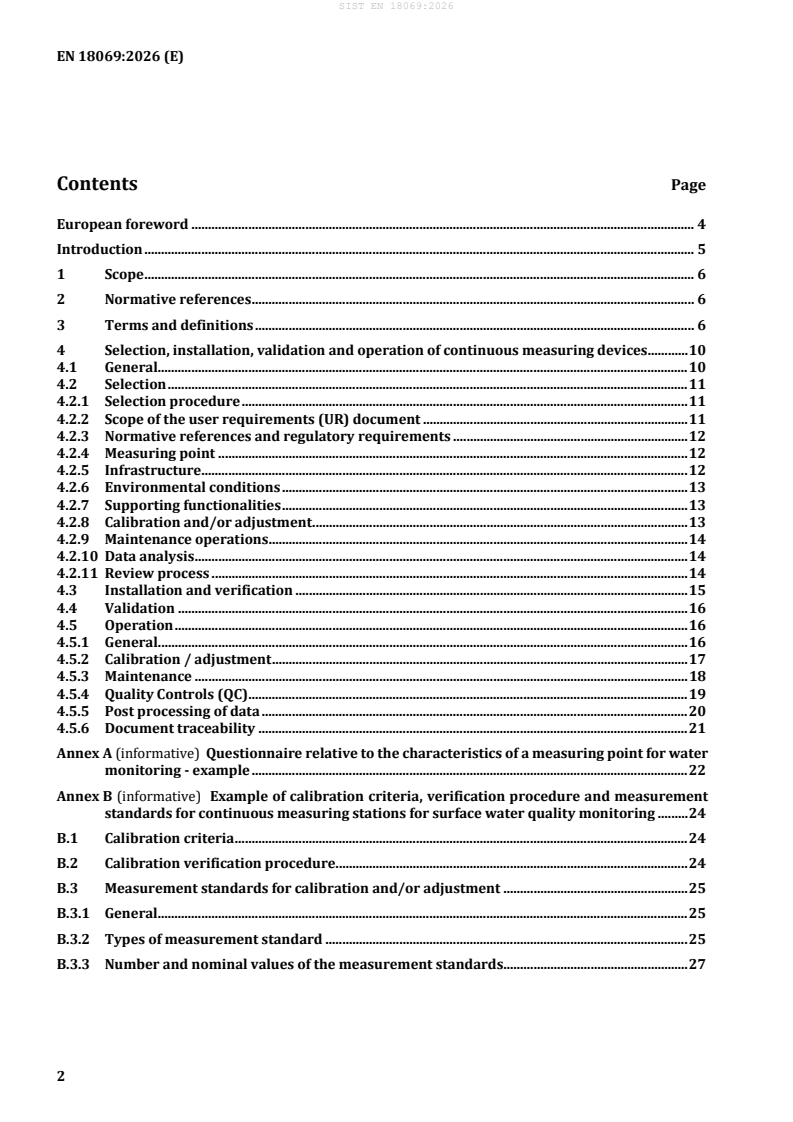
Contents Page
European foreword . 4
Introduction . 5
1 Scope . 6
2 Normative references . 6
3 Terms and definitions . 6
4 Selection, installation, validation and operation of continuous measuring devices . 10
4.1 General. 10
4.2 Selection . 11
4.2.1 Selection procedure . 11
4.2.2 Scope of the user requirements (UR) document . 11
4.2.3 Normative references and regulatory requirements . 12
4.2.4 Measuring point . 12
4.2.5 Infrastructure . 12
4.2.6 Environmental conditions . 13
4.2.7 Supporting functionalities . 13
4.2.8 Calibration and/or adjustment . 13
4.2.9 Maintenance operations . 14
4.2.10 Data analysis . 14
4.2.11 Review process . 14
4.3 Installation and verification . 15
4.4 Validation . 16
4.5 Operation . 16
4.5.1 General. 16
4.5.2 Calibration / adjustment . 17
4.5.3 Maintenance . 18
4.5.4 Quality Controls (QC) . 19
4.5.5 Post processing of data . 20
4.5.6 Document traceability . 21
Annex A (informative) Questionnaire relative to the characteristics of a measuring point for water
monitoring - example . 22
Annex B (informative) Example of calibration criteria, verification procedure and measurement
standards for continuous measuring stations for surface water quality monitoring . 24
B.1 Calibration criteria . 24
B.2 Calibration verification procedure . 24
B.3 Measurement standards for calibration and/or adjustment . 25
B.3.1 General. 25
B.3.2 Types of measurement standard . 25
B.3.3 Number and nominal values of the measurement standards. 27
Annex C (informative) Method of correcting drifts and examples of data post-processing . 28
C.1 Method of correcting drifts based on USGS (2006) . 28
C.2 Data confidence index . 29
Bibliography . 30
European foreword
This document (EN 18069:2026) has been prepared by Technical Committee CEN/TC 230 “Water
analysis”, the secretariat of which is held by DIN.
This European Standard shall be given the status of a national standard, either by publication of an
identical text or by endorsement, at the latest by October 2026, and conflicting national standards shall
be withdrawn at the latest by October 2026.
Attention is drawn to the possibility that some of the elements of this document may be the subject of
patent rights. CEN shall not be held responsible for identifying any or all such patent rights.
Any feedback and questions on this document should be directed to the users’ national standards body.
A complete listing of these bodies can be found on the CEN website.
According to the CEN-CENELEC Internal Regulations, the national standards organisations of the
following countries are bound to implement this European Standard: Austria, Belgium, Bulgaria, Croatia,
Cyprus, Czech Republic, Denmark, Estonia, Finland, France, Germany, Greece, Hungary, Iceland, Ireland,
Italy, Latvia, Lithuania, Luxembourg, Malta, Netherlands, Norway, Poland, Portugal, Republic of North
Macedonia, Romania, Serbia, Slovakia, Slovenia, Spain, Sweden, Switzerland, Türkiye and the United
Kingdom.
Introduction
The continuous monitoring of water quality parameters can provide real time information on temporal
variability compared with sampling campaigns conducted at fixed intervals which can miss significant
events such as a concentration peak during a flood or rainfall episode.
Moreover, in the event of pollution due to industrial accidents or transport on inland waterways for
example, it is vital to be able to detect these events as early as possible and react rapidly to limit their
impacts on the environment and possible drinking water resources.
Consequently, the choice of having recourse to continuous measuring devices (CMDs) is directly linked
to the advantages of obtaining a rapid measurement (a few seconds to a few minutes) at short time
intervals (from a few seconds to a few hours) and in most cases in real time. Furthermore, it is possible
to use the resulting measurements to automatically trigger actions, such as taking a sample for further
analysis and/or stopping pumping of a drinking water resource.
This document is associated with EN 17075 which specifies general requirements and performance test
procedures for portable and fixed position continuous measuring devices that are used in an in-line or
on-line operating position to measure physical and chemical measurands in water.
Continuous measuring devices are widely used for compliance monitoring purposes under national and
European regulations.
1 Scope
This document specifies requirements for the selection, installation, validation, and operation of
continuous measuring devices CMDs as follows:
1) Selection: defining the user requirements, the purposes of the required measurements, associated
data quality requirements, and choice of CMDs.
2) Installation: verifying a complete and correct delivery of the procured CMD and verifying a correctly
functioning on-site installation, operation and communication of the CMD.
3) Validation: verifying that the correctly installed CMD meets all of the original defined user
requirements.
4) Operation: implementing operating and maintenance procedures, processing of data and document
traceability.
The overall objective is to obtain representative and reliable measurements when using CMDs to monitor
water quality.
This document is applicable to CMDs for monitoring physical and chemical parameters in different types
of water.
2 Normative references
The following documents are referred to in the text in such a way that some or all of their content
constitutes requirements of this document. For dated references, only the edition cited applies. For
undated references, the latest edition of the referenced document (including any amendments) applies.
EN 17075:2018+A1:2023, Water quality — General requirements and performance test procedures for
water monitoring equipment — Continuous measuring devices
3 Terms and definitions
For the purposes of this document, the following terms and definitions apply.
ISO and IEC maintain terminology databases for use in standardization at the following addresses:
— ISO Online browsing platform: available at https://www.iso.org/obp
— IEC Electropedia: available at https://www.electropedia.org/
3.1
continuous measuring device
CMD
component or a group of components, used in an in-line or on-line operating position, which continuously
(or at a given frequency) gives an output signal proportional to the value of one or more measurands in
waters which it measures
Note 1 to entry: The device can be portable or fixed in position.
[SOURCE: EN 17075:2018+A1:2023, 3.1]
3.2
sensor
electronic device that senses a physical condition or chemical compound and delivers an electronic signal
proportional to the observed characteristic
[SOURCE: EN 17075:2018+A1:2023, 3.4]
3.3
in-line continuous measuring device
in-situ continuous measuring device
system of automatic measurement in which at least the sensor is sited in the body of water
[SOURCE: EN 17075:2018+A1:2023, 3.5]
3.4
on-line continuous measuring device
system of automatic measurement in which the sample is taken from the body of water by means of an
appropriate conduit to the CMD
Note 1 to entry: Sometimes referred to as an extractive continuous measuring device.
[SOURCE: EN 17075:2018+A1:2023, 3.6 modified – “through a probe to the measuring device” added, “to
the CMD” added at the end, Note to entry 1 “continuous” added]
3.5
measuring point
geographical location at which the measurement is taken
3.6
outlier
member of a set of values which is inconsistent with the other members of that set
[SOURCE: ISO 5725-1:2023, 3.7 modified – “value from” replaced by “member of”, “identified by a
statistical test” deleted, Note to entry has been deleted]
3.7
reference method
method, material or device to be used to obtain the measurand value of the test waters, against which the
readings from the CMD used can be compared
[SOURCE: EN 17075:2018+A1:2023, 3.26 modified – “material or device “ added, “under test” replace by
“used”]
3.8
calibration
operation that, under specified conditions, in a first step, establishes a relation between the quantity
values with measurement uncertainties provided by measurement standards and corresponding
indications with associated measurement uncertainties and, in a second step, uses this information to
establish a relation for obtaining a measurement result from an indication
Note 1 to entry: A calibration may be expressed by a statement, calibration function, calibration diagram,
calibration curve, or calibration table. In some cases, it may consist of an additive or multiplicative correction of the
indication with associated measurement uncertainty.
Note 2 to entry: Calibration should not be confused with adjustment of a measuring system, often mistakenly called
“self-calibration”, nor with verification of calibration.
[SOURCE: JCGM 200:2012, 2.39 modified – Note to entry 3 has been deleted]
3.9
adjustment of a measuring system
set of operations carried out on a measuring system so that it provides prescribed indications
corresponding to given values of a quantity to be measured
Note 1 to entry: Types of adjustment of a measuring system include zero adjustment of a measuring system, offset
adjustment, and span adjustment (sometimes called gain adjustment).
Note 2 to entry: Adjustment of a measuring system should not be confused with calibration, which is a prerequisite
for adjustment.
Note 3 to entry: After an adjustment of a measuring system, the measuring system must usually be recalibrated.
[SOURCE: JCGM 200:2012, 3.11]
3.10
verification
provision of objective evidence that a given item fulfils specified requirements
Note 1 to entry: When applicable, measurement uncertainty should be taken into consideration.
Note 2 to entry: The item may be, e.g. a process, measurement procedure, material, compound, or measuring
system.
Note 3 to entry: The specified requirements may be, e.g. that a manufacturer's specifications are met.
Note 4 to entry: Verification in legal metrology, as defined in OIML V1:2000 (International Vocabulary of Terms in
Legal Metrology), and in conformity assessment in general, pertains to the examination and marking and/or issuing
of a verification certificate for a measuring system.
Note 5 to entry: Verification should not be confused with calibration. Not every verification is a validation.
[SOURCE: JCGM 200:2012, 2.44 modified – Examples 1 to 3 have been deleted, note 6 to entry has been
deleted, reference VIML [53] replaced by OIML V1:2000]
3.11
validation
verification, where the specified requirements are adequate for an intended use
[SOURCE: JCGM 200:2012, 2.45 modified – Example has been deleted]
3.12
measurement standard
realization of the definition of a given quantity, with stated quantity value and associated measurement
uncertainty, used as a reference verification, where the specified requirements are adequate for an
intended use
[SOURCE: JCGM 200:2012, 5.1 modified – Examples and notes to entry have been deleted]
3.13
primary measurement standard
primary standard
measurement standard established using a primary reference measuring procedure or created as an
object by convention
[SOURCE: JCGM 200:2012, 5.4 modified – Examples and notes to entry have been deleted]
3.14
secondary measurement standard
secondary standard
measurement standard established through calibration with respect to a primary measurement standard
of a quantity of the same kind
[SOURCE: JCGM 200:2012, 5.5 modified – Notes to entry have been deleted]
3.15
working measurement standard
working standard
measurement standard that is used routinely to calibrate or verify measuring instruments or measuring
systems
[SOURCE: JCGM 200:2012, 5.7 modified – Notes from the definition in VIM (JCGM 200) were not included]
3.16
measurement uncertainty
uncertainty of measurement
uncertainty
non-negative parameter characterizing the dispersion of the quantity values being attributed to a
measurand, based on the information used
Note 1 to entry: Measurement uncertainty includes components arising from systematic effects, such as
components associated with corrections and the assigned quantity values of measurement standards, as well as the
definitional uncertainty. Sometimes estimated systematic effects are not corrected for but, instead, associated
measurement uncertainty components are incorporated.
Note 2 to entry: The parameter may be, for example, a standard deviation called standard measurement
uncertainty (or a specified multiple of it), or the half-width of an interval, having a stated coverage probability.
Note 3 to entry: Measurement uncertainty comprises, in general, many components. Some of these may be
evaluated by Type A evaluation of measurement uncertainty from the statistical distribution of the quantity values
from series of measurements and can be characterized by standard deviations. The other components, which may
be evaluated by Type B evaluation of measurement uncertainty, can also be characterized by standard deviations,
evaluated from probability density functions based on experience or other information.
Note 4 to entry: In general, for a given set of information, it is understood that the measurement uncertainty is
associated with a stated quantity value attributed to the measurand. A modification of this value results in a
modification of the associated uncertainty.
[SOURCE: JCGM 200:2012, 2.26]
3.17
Laboratory Information Management System
LIMS
software that allows managing samples, test results and associated data e.g. to improve lab productivity
3.18
Supervisory Control and Data Acquisition
SCADA
industrial computer system that monitors and controls a process
3.19
Computerized Maintenance Management System
CMMS
computer software system that supports maintenance management
3.20
Failure Mode and Effect Analysis
FMEA
systematic and proactive method for evaluating a process to identify where and how it may fail and how
to mitigate the potential failures
Note 1 to entry: It is a common tool in engineering and spreadsheet templates can be downloaded for free from the
internet to follow the systematic approach of this tool.
3.21
calibration drift error
result of an electronic drift in CMD reading from the last time the CMD was calibrated
Note 1 to entry: It is determined by the difference between CMD readings using standard solutions or buffers taken
after the CMD has been cleaned and the true, temperature-compensated, value of the standard solutions or buffers.
3.22
fouling error
error determined by the difference between CMD measurements in the environment before and after
cleaning
Note 1 to entry: Biological fouling, siltation, and scaling are the principal causes of fouling error.
3.23
confidence index
Classifications, based on the difference between data values recorded before any data corrections are
made and after the record has been evaluated and data corrections applied
4 Selection, installation, validation and operation of continuous measuring
devices
4.1 General
In order to obtain representative and reliable measurements when using CMDs, a procedure shall be
followed to address the minimum requirements specified for the four main steps listed below:
1) Selection: defining the user requirements, the purposes of the required measurements, associated
data quality requirements, and choice of CMDs.
2) Installation: verifying a complete and correct delivery of the procured CMD and verifying a correctly
functioning on-site installation, operation and communication of the CMD.
3) Validation: verifying that the correctly installed CMD meets all of the original defined requirements.
4) Operation: implementation of operating and maintenance procedures, processing of data and
document traceability.
4.2 Selection
4.2.1 Selection procedure
The selection procedure is a document prepared by the user that correlates the user requirement (UR)
with the information gathered by different potential suppliers with the objective to review the selected
CMD and verify how the CMD meets the UR.
The selection procedure can be done in a template form as a Requirement Traceability Matrix where one
dimension displays the UR including their tolerances (if applicable) and the other dimension displays the
appropriate specifications of the selected supplier systems and the rating about their correspondence
with the UR. User specific weighting factors can be used to give emphasis to most important
specifications.
A formal risk assessment (e.g. Failure Mode and Effect Analysis (FMEA)) shall assess additional risks that
can occur during the life cycle of a CMD. This assessment can identify the need to include the procurement
of consumables, accessories, service and spare parts. The results of this risk analysis shall be included in
the final selection of the CMD.
Annex A includes a questionnaire relative to the characteristics of a measuring point for water
monitoring.
4.2.2 Scope of the user requirements (UR) document
The objectives of the measurement shall be defined and documented in detail before selecting and
installing a continuous measuring device. The objectives should be expressed as quantifiable
requirements where appropriate.
The following considerations should be addressed:
— general purpose(s);
— targeted parameter(s);
— targeted application(s) and water characteristics to be measured:
— water compositions,
— temperature variations,
— presence of potential interfering factors (e.g. suspended matter, organic matter),
— water pressure and temperature in pipe works,
— expected performances;
— types of installation (in-line and/or on-line, monitoring station);
— maximum measurement frequency;
— duration of operation;
— reagents consumption depending on measurement frequency;
— ranges of concentration of the parameters to be measured (based on monitoring records);
— any sample pre-treatment requirements (if necessary).
4.2.3 Normative references and regulatory requirements
Standards (national, international) relevant to measurement methods, quality assurance, verification,
validation and data communication shall be identified.
Regulations (national or international) relevant to the application and final use of the monitoring data
shall be identified.
4.2.4 Measuring point
The selection of the measuring point at which to install and deploy a CMD shall meet the measurement
objectives and comply with the associated quality and safety requirements.
The following considerations should be addressed when selecting a measuring point:
— representativeness of water bodies to be measured;
— process and risk assessment requirements when installing a CMD;
— vertical stratifications (which can result in differing compositions between water layers in the water
body where exchange between the layers is poor);
— variations in the cross-section of water bodies;
— variations in the amplitude of the expected flow (low waters - floods);
— presence of turbulences that could affect the measurements;
— freezing conditions of water bodies;
— conditions that could favour biological fouling (large quantity of fine sediments, presence of algae,
invertebrates, etc.);
— means to limit fouling (e.g. self-cleaning such as mechanical brush, compressed air, ultrasound,
chemical reagents);
— ranges of concentration of the parameters to measure (based on monitoring records);
— infrastructure requirements to protect the measuring systems against debris (particularly during
floods) and vandalism.
4.2.5 Infrastructure
The following considerations should be addressed when installing a CMD at a selected measuring point:
— permits and authorisations required for construction and installation;
— process, environmental and safety risks associated with the construction and installation;
— types of configuration (in-line or on-line);
— power supply requirements;
— waste removal systems;
— means of automatically communicating/transmitting, recording and storing data;
— interfaces with external remote systems (e.g. LIMS, SCADA Systems), Computerized Maintenance
Management Systems (CMMS) and control system;
— installation costs.
4.2.6 Environmental conditions
The following considerations should be addressed:
— hydraulic regime (water in turbulent or laminar regime, high and low water levels, etc.);
— ambient temperature and humidity conditions;
— power supply conditions (e.g. stability, reliability, possible need of uninterruptible power supply
(UPS));
— confined and/or hazardous environment;
NOTE Attention is drawn to national, European and international rules and legislation governing the safety of
products.
— logistic aspects;
— accessibility and space required;
— sufficient and protected space to perform maintenance;
— lone worker protection if necessary;
— vibrations.
4.2.7 Supporting functionalities
The following considerations should be addressed:
— management of information (storage, backu
...