


SIST EN 14994:2007
(Main)Gas explosion venting protective systems
Gas explosion venting protective systems
This European Standard specifies the basic design requirements for the selection of a gas explosion venting protective system. This European Standard, EN 14797 and EN 14460 form a series of three standards which are used together.
NOTE 1 These three standards together represent the concept of gas explosion venting.
NOTE 2 To avoid transfer of explosions to other communicating equipment one should also consider applying prEN 15089.
This European Standard is applicable to:
vent sizing to protect against the internal pressure effects of a gas explosion;
flame and pressure effects outside the enclosure;
recoil forces;
influence of vent ducts;
influence of initial temperature and pressure.
This European Standard does not provide design and application rules against effects generated by detonation reactions or runaway exothermic reactions including decomposition in the gas phase.
This European Standard is not applicable to:
fire risks arising either from materials processed, used or released by the equipment or from materials that make up equipment and buildings;
design, construction and testing of explosion venting devices, which are used to achieve explosion venting );
protection against overpressures caused by events such as overfilling, overpressurisation, fire engulfment, overheating etc.
NOTE 3 Protection by venting against dust and hybrid explosions is specified in EN 14491.
Schutzsysteme zur Druckentlastung von Gasexplosionen
Diese Europäische Norm beschreibt die grundlegenden Gestaltungsanforderungen an die Schutzsysteme zur Druckentlastung bei Gasexplosionen. Diese Europäische Norm, prEN 14797 und EN 14460 bilden eine Reihe von drei Normen, die zusammen angewendet werden.
ANMERKUNG 1 Diese drei Normen stellen das Konzept der Druckentlastung von Gasexplosionen dar.
ANMERKUNG 2 Um das Übergreifen von Explosionen auf andere miteinander verbundene Einrichtungen zu vermeiden, sollte man auch die Anwendung des prEN 15089 in Betracht ziehen.
Diese Europäische Norm ist anwendbar auf:
- die Bemessung einer Entlastungsöffnung zum Schutz vor den inneren Druckauswirkungen bei einer Gasexplosion;
- die Flammen- und Druckauswirkungen außerhalb der Umschließung;
- die Rückstoßkräfte;
- den Einfluss der Abblaskanäle (Entlastungskanäle);
- den Einfluss der Ausgangstemperatur und des Ausgangsdruckes.
Diese Norm ist nicht dafür vorgesehen, Gestaltungs- und Anwendungsvorschriften hinsichtlich der Auswirkungen aufzustellen, die durch Detonationsreaktionen oder unkontrollierte (durchgehende) exotherme Reaktionen einschließlich der Zersetzung in der Gasphase erzeugt werden.
Diese Europäische Norm ist nicht anwendbar auf:
- Brandrisiken, die entweder aufgrund der von den Geräten verarbeiteten, verwendeten oder freigesetzten Materialien oder der Materialien, aus denen Ausrüstung und Gebäude bestehen, entstehen;
- konstruktive Gestaltung, Fertigung und Prüfung der zum Erzielen der Explosionsdruckentlastung verwendeten Einrichtungen zur Explosionsdruckentlastung );
- den Schutz gegenüber den durch Zwischenfälle wie Überfüllen, Anlegen zu hoher Drücke, Feuereinschlüsse, Überhitzen usw. hervorgerufenen Überdrücken.
ANMERKUNG 3 Der Schutz durch Druckentlastung bei Staub- und Hybridexplosionen ist in EN 14491 festgelegt
Systemes de protection par évent contre les explosions de gaz
La présente Norme européenne précise les exigences fondamentales de conception concernant le choix d’un système de protection par évent contre les explosions de gaz. La présente Norme européenne, le document prEN 14797 et le document EN 14460, forment une série de trois normes utilisées conjointement.
NOTE 1 Ces trois normes décrivent ensemble le concept d’évent contre les explosions de gaz.
NOTE 2 Pour éviter la propagation des explosions à d’autres appareils communicants, il convient d’envisager également l’application du document prEN 15089.
La présente Norme européenne est applicable :
au dimensionnement de l’évent pour assurer une protection contre les effets de pression interne d’une explosion de gaz ;
aux effets de flamme et de pression à l’extérieur de l’enceinte ;
aux forces de recul ;
à l’influence des conduits d’évent ;
à l’influence de la pression et de la température initiales.
La présente Norme européenne ne donne pas de règles de conception et d’application contre les effets produits par les réactions de détonation ou les réactions exothermiques d’emballement y compris la décomposition dans la phase gazeuse.
La présente Norme européenne n’est pas applicable :
aux risques d’incendie provenant soit des matériaux traités, utilisés ou dégagés par les appareils, soit des matériaux entrant dans la composition des appareils et des bâtiments ;
à la conception, à la réalisation et aux essais des dispositifs de décharge d’explosion, qui permettent d’obtenir une décharge d’explosion ) ;
à la protection contre les surpressions provoquées par des situations comme un sur-remplissage, une pressurisation excessive, une destruction par un incendie, une surchauffe, etc..
NOTE 3 La protection par évent contre les coups de poussières et les explosions hybrides est traitée dans le document EN 14491.
Sistemi za razbremenitev tlaka plinskih eksplozij
General Information
- Status
- Published
- Publication Date
- 20-Jun-2007
- Technical Committee
- EXP - Product for explosive atmospheres
- Current Stage
- 6060 - National Implementation/Publication (Adopted Project)
- Start Date
- 14-Jun-2007
- Due Date
- 19-Aug-2007
- Completion Date
- 21-Jun-2007
Overview
EN 14994:2007 - “Gas explosion venting protective systems” (CEN) defines the basic design requirements for selecting and applying gas explosion venting as a protective measure. It is part of a three‑standard series together with EN 14797 (explosion venting devices) and EN 14460 (vented enclosures), and is intended for use in the context of potentially explosive atmospheres. The standard covers vent sizing to limit internal explosion pressure and addresses external flame/pressure effects, recoil forces, vent ducts and the influence of initial temperature and pressure.
Key topics and technical requirements
- Venting concept and scope: Focuses on limiting overpressure inside enclosures by sized venting; does not cover detonations or runaway exothermic reactions, nor the detailed design/testing of venting devices (see EN 14797).
- Venting calculations: Provides a vent‑sizing method for compact and elongated enclosures using measured explosion characteristics such as the gas explosion constant (KG) and maximum explosion pressure (pmax), together with vent device parameters: effective vent area (Ae), venting efficiency (Ef) and static activation pressure (pstat).
- Enclosure classification: Distinguishes compact enclosures, elongated enclosures, and pipes, with specific guidance for each geometry and for interconnected enclosures.
- Turbulence and congestion: Addresses the effect of turbulence‑inducing elements (internal obstructions, congestion) and provides criteria and annex guidance when more intricate methods or experimental validation are required.
- External effects and ducting: Covers flame and pressure effects outside the enclosure, deflector considerations, influence of vent ducts and recoil forces on equipment and surroundings.
- Operating conditions: Considers the influence of initial temperature and pressure on venting performance.
- Normative references and compliance: Relies on EN 1127‑1, EN 13237, EN 13673‑1/2 and links to EU Directive 94/9/EC (informative Annex ZA).
Applications and users
EN 14994 is used by:
- Process and mechanical engineers sizing explosion vents for gas‑handling vessels and ducts
- Safety engineers conducting explosion protection studies and hazard assessments
- Equipment manufacturers, plant designers and integrators specifying venting arrangements
- Regulatory and compliance teams aligning with EU essential requirements for equipment in explosive atmospheres
Practical applications include vent sizing for reactors, storage vessels, ovens, piping systems and any enclosed equipment handling flammable gases or vapours where controlled venting is the selected protective measure.
Related standards
- EN 14797 - Explosion venting devices (device design, testing and performance)
- EN 14460 - Explosion vented enclosures (complements venting system selection)
- EN 14491 - Venting for dust and hybrid explosions
- prEN 15089 - Measures to avoid explosion transfer between communicating equipment
Keywords: EN 14994:2007, gas explosion venting, explosion venting protective systems, vent sizing, venting efficiency, KG, pmax, pstat, EN 14797, explosion protection.


Frequently Asked Questions
SIST EN 14994:2007 is a standard published by the Slovenian Institute for Standardization (SIST). Its full title is "Gas explosion venting protective systems". This standard covers: This European Standard specifies the basic design requirements for the selection of a gas explosion venting protective system. This European Standard, EN 14797 and EN 14460 form a series of three standards which are used together. NOTE 1 These three standards together represent the concept of gas explosion venting. NOTE 2 To avoid transfer of explosions to other communicating equipment one should also consider applying prEN 15089. This European Standard is applicable to: vent sizing to protect against the internal pressure effects of a gas explosion; flame and pressure effects outside the enclosure; recoil forces; influence of vent ducts; influence of initial temperature and pressure. This European Standard does not provide design and application rules against effects generated by detonation reactions or runaway exothermic reactions including decomposition in the gas phase. This European Standard is not applicable to: fire risks arising either from materials processed, used or released by the equipment or from materials that make up equipment and buildings; design, construction and testing of explosion venting devices, which are used to achieve explosion venting ); protection against overpressures caused by events such as overfilling, overpressurisation, fire engulfment, overheating etc. NOTE 3 Protection by venting against dust and hybrid explosions is specified in EN 14491.
This European Standard specifies the basic design requirements for the selection of a gas explosion venting protective system. This European Standard, EN 14797 and EN 14460 form a series of three standards which are used together. NOTE 1 These three standards together represent the concept of gas explosion venting. NOTE 2 To avoid transfer of explosions to other communicating equipment one should also consider applying prEN 15089. This European Standard is applicable to: vent sizing to protect against the internal pressure effects of a gas explosion; flame and pressure effects outside the enclosure; recoil forces; influence of vent ducts; influence of initial temperature and pressure. This European Standard does not provide design and application rules against effects generated by detonation reactions or runaway exothermic reactions including decomposition in the gas phase. This European Standard is not applicable to: fire risks arising either from materials processed, used or released by the equipment or from materials that make up equipment and buildings; design, construction and testing of explosion venting devices, which are used to achieve explosion venting ); protection against overpressures caused by events such as overfilling, overpressurisation, fire engulfment, overheating etc. NOTE 3 Protection by venting against dust and hybrid explosions is specified in EN 14491.
SIST EN 14994:2007 is classified under the following ICS (International Classification for Standards) categories: 13.230 - Explosion protection; 13.240 - Protection against excessive pressure. The ICS classification helps identify the subject area and facilitates finding related standards.
SIST EN 14994:2007 is associated with the following European legislation: EU Directives/Regulations: 2014/34/EU, 94/9/EC; Standardization Mandates: M/BC/CEN/92/46. When a standard is cited in the Official Journal of the European Union, products manufactured in conformity with it benefit from a presumption of conformity with the essential requirements of the corresponding EU directive or regulation.
SIST EN 14994:2007 is available in PDF format for immediate download after purchase. The document can be added to your cart and obtained through the secure checkout process. Digital delivery ensures instant access to the complete standard document.
Standards Content (Sample)
2003-01.Slovenski inštitut za standardizacijo. Razmnoževanje celote ali delov tega standarda ni dovoljeno.Gas explosion venting protective systemsSistemi za razbremenitev tlaka plinskih eksplozijSystemes de protection par évent contre les explosions de gazSchutzsysteme zur Druckentlastung von GasexplosionenTa slovenski standard je istoveten z:EN 14994:2007SIST EN 14994:2007en;fr;de13.240Varstvo pred previsokim tlakomProtection against excessive pressure13.230Varstvo pred eksplozijoExplosion protectionICS:SLOVENSKI
STANDARDSIST EN 14994:200701-julij-2007
EUROPEAN STANDARDNORME EUROPÉENNEEUROPÄISCHE NORMEN 14994February 2007ICS 13.240 English VersionGas explosion venting protective systemsSystèmes de protection par évent contre les explosions degazSchutzsysteme zur Druckentlastung von GasexplosionenThis European Standard was approved by CEN on 15 December 2006.CEN members are bound to comply with the CEN/CENELEC Internal Regulations which stipulate the conditions for giving this EuropeanStandard the status of a national standard without any alteration. Up-to-date lists and bibliographical references concerning such nationalstandards may be obtained on application to the CEN Management Centre or to any CEN member.This European Standard exists in three official versions (English, French, German). A version in any other language made by translationunder the responsibility of a CEN member into its own language and notified to the CEN Management Centre has the same status as theofficial versions.CEN members are the national standards bodies of Austria, Belgium, Bulgaria, Cyprus, Czech Republic, Denmark, Estonia, Finland,France, Germany, Greece, Hungary, Iceland, Ireland, Italy, Latvia, Lithuania, Luxembourg, Malta, Netherlands, Norway, Poland, Portugal,Romania, Slovakia, Slovenia, Spain, Sweden, Switzerland and United Kingdom.EUROPEAN COMMITTEE FOR STANDARDIZATIONCOMITÉ EUROPÉEN DE NORMALISATIONEUROPÄISCHES KOMITEE FÜR NORMUNGManagement Centre: rue de Stassart, 36
B-1050 Brussels© 2007 CENAll rights of exploitation in any form and by any means reservedworldwide for CEN national Members.Ref. No. EN 14994:2007: E
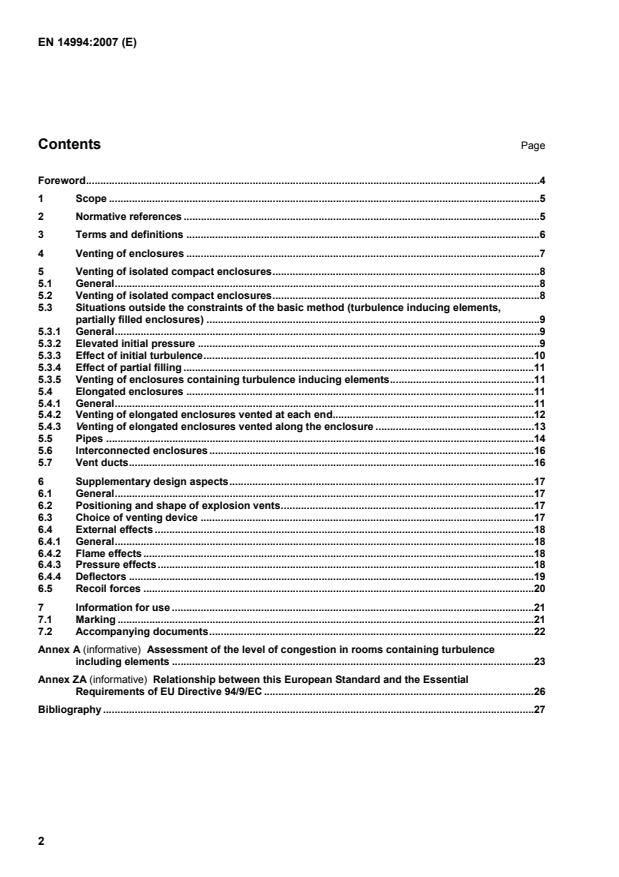
Assessment of the level of congestion in rooms containing turbulence including elements.23 Annex ZA (informative)
Relationship between this European Standard and the Essential Requirements of EU Directive 94/9/EC.26 Bibliography.27
— Value of exponent
as a function of AV/V2/3.10 Figure 2 — Pressure reduction of partially filled enclosures as a function of filling ratio.11 Figure 3 — Maximum pressure developed during deflagration of propane-air mixtures flowing at 2 m/s or less in a smooth, straight pipe closed at one end .14 Figure 4 — Vent spacing needed to keep pred from exceeding 0,2 bar for propane in pipes flowing at an initial velocity of between 2 m/s and 20 m/s.15 Figure 5 — Design of a flame deflector plate (basic principles).20 Tables Table A.1 — Values for the complexity factor c.24 Table ZA.1 — Correspondence between this European Standard and Directive 94/9/EC.26
1) This is covered by EN 14797.
NOTE It is the effective vent area that should be used in making up the vent area for explosion venting [EN 14797:2006, 3.2] 3.8 gas explosion constant KG maximum value of the pressure rise per unit time (dp/dt)max during the explosion of a specific explosive atmosphere in a closed vessel under specified test conditions normalised to a vessel volume of 1 m3 multiplied by V1/3 3.9 static activation pressure pstat differential pressure at which the retaining element activates such that the venting element is able to open [EN 14797:2006, 3.11] 3.10 turbulence motion of a fluid having local velocities and pressures that fluctuate randomly NOTE Turbulence is a very effective transporter and mixer, and generally causing an overall increase of combustion rates. 3.11 turbulence inducing elements obstructions inside protected enclosures at which during an explosion turbulence is generated increasing the combustion rate 3.12 venting efficiency Ef dimensionless number used to define the efficiency of the explosion venting device [EN 14797:2006, 3.14] 4 Venting of enclosures Explosion venting is a protective measure preventing unacceptable high explosion pressure build-up inside enclosures. Weak areas in the walls of the enclosure open at an early stage of the explosion, releasing un-burnt gas/vapour and combustion products from the opening so reducing the overpressure inside the enclosure. Normally the explosion venting is applied such that the maximum reduced explosion pressure shall not exceed the known design pressure of the enclosure. All parts of the enclosure e.g. valves, sight-glasses, man-holes and ducts, which are exposed to the explosion pressure shall be taken into account when estimating the design pressure of the enclosure. The vent area is the most important factor in determining the maximum reduced explosion pressure. Information required for calculation of the vent area includes the design pressure of the enclosure, the explosion characteristics of the gas, the shape and size of the enclosure, presence of turbulence inducing elements (including congestion) inside the enclosure, the static activation pressure and other characteristics of the venting device, and the condition of the explosive atmosphere inside the enclosure.
is the geometrical vent area (Ef = 1), in m²; Av
is the vent area of an explosion venting device with efficiency Ed < 1, in m²;
is the gas explosion constant, in bar·m·s-1; pred
is the reduced explosion overpressure, in bar; pstat
is the static activation pressure of explosion venting device, in bar; Ef
is the venting efficiency of explosion venting device; V
is the volume, in m³. Equations (1) and (2) are valid for: isolated enclosures essentially free from turbulence inducing elements; KG ≤ 550 bar·m/s; 0,1 bar ≤ pstat ≤ 0,5 bar; pred ≤ 2 bar; pred > pstat + 0,05 bar; V ≤ 1 000 m3; L/D ≤ 2; initial conditions: atmospheric; Ef = 1 for explosion venting devices with an area specific mass of less than 0,5 kg/m2; Ef = 1 for explosion venting devices with an area specific mass greater than 0,5 kg/m2 and smaller or equal to 10 kg/m2 provided Av/V0,753 < 0,07, where AV is the vent area and V the vessel volume. This is valid for pstat ≤ 0,1 bar and 0,1 bar < pred < 2 bar; for all other conditions and for explosion venting devices with an area specific mass greater than 10 kg/m2 the efficiency Ef has to be determined by tests (see EN 14797). 5.3 Situations outside the constraints of the basic method (turbulence inducing elements, partially filled enclosures) 5.3.1 General The methods proposed in 5.3.2 to 5.3.4 apply to isolated compact enclosures essentially free from turbulence inducing elements. 5.3.2 Elevated initial pressure The following equation shall be used for estimating reduced explosion pressures when the initial pressure is above atmospheric pressure: ()γ1212+=pppredred (3) where p2
is the elevated initial gauge pressure, in bar;
is the reduced explosion pressure calculated by the method given in 5.2 for atmospheric
conditions, in bar: pred2
is the actual reduced explosion pressure for elevated initial pressure p2, in bar;
is the exponent, a function of vent area and vessel volume. The value of the exponent
varies inversely with AV/V2/3, where AV is the vent area and V the vessel volume. Plots of
versus AV/V2/3 are given in Figure 1 for propane, ethylene and hydrogen.
Key 1 propane 2 ethylene 3 hydrogen
exponent Figure 12)
— Value of exponent
as a function of AV/V2/3 Figure 1 is valid for initial pressures of up to an overpressure of 3 bar. The solid lines for propane and hydrogen were developed from experimental data. The line for propane shall be used for gases that have KG-values no higher than 1,3 times that for propane. The line for ethylene represents an untested interpolation. The extension of broken lines represents extrapolation. In applying Equation (3) the value used for p2 shall be chosen to represent the maximum pressure at which the protected installation can be operating at the time of the ignition. 5.3.3 Effect of initial turbulence Experimental evidence shows that initial turbulence is important and its effect on the reduced explosion pressure cannot be ignored. However, at present there is insufficient information available to be able to quantify its effects for the type of practical applications for which explosion relief is used.
2) Reprinted with permission from NFPA 68 Guide for Venting of Deflagrations. Copyright 1998 National Fire Protection Association, Quincy, MA 02269. This reprinted material is not the complete and official position of the National Fire Protection Association, on the referenced subject, which is represented only by the standard in its entirety.
Key X degree of filling (%) Y ratio of maximum reduced overpressure to maximum reduced overpressure for 100 % filling Figure 2 — Pressure reduction of partially filled enclosures as a function of filling ratio 5.3.5 Venting of enclosures containing turbulence inducing elements The necessary venting requirements for enclosures containing turbulence inducing elements such as trays in drying ovens can normally not be calculated with the relationships mentioned above. The turbulence inducing elements may result in strong combustion rate increases during the explosion causing considerably higher pressures than anticipated on the basis of the relationship given in 5.2. To judge whether another more intricate method shall be applied than the one described in 5.2 one can use the guidance given in Annex A. 5.4 Elongated enclosures 5.4.1 General The equations given in this subclause apply to isolated elongated enclosures (with length to diameter/width ratios of between 2 and 10), containing quiescent gas mixtures that are essentially free of turbulence inducing elements (see 5.3.5) and do not contain any bends or changes of cross-section. The equations concern only gases or gas mixtures with a burning velocity close to that of methane or propane. The aim in designing explosion relief for elongated enclosures is to minimise the reduced explosion pressure. This is done by ensuring that explosion vent areas are as large as is practicable and the static activation pressure is as low as is practicable in the prevailing process conditions. Vents shall be positioned, as far as is practicable, to minimise the distance between any potential ignition sources and the nearest vent; this may mean that vents are evenly distributed along the enclosure. Where multiple vents are fitted, each vent shall have the same area and open at the same static activation pressure. The following equations for calculating the reduced explosion pressures are based on test results.
is the reduced explosion overpressure, in bar; pstat
is the static activation pressure, in bar; Sui
is the gas burning velocity, in m/s; K
is the vent coefficient (Acs/A) Acs
is the vessel cross sectional area, in m2; A
is the total area of all vents, in m2; W
is the weight per unit area of vent panel, in kg/m2; V
is the enclosure volume, in m3; L
is the enclosure length, in m; D
is the enclosure diameter, in m. bar06,0for;015,0≤=statredpKdp (5) bar06,0for;15,0015,0>+=statredpKdp (6) where pred
is the reduced explosion overpressure, in bar; d = x/D,
where x is the maximum possible distance that can exist between a potential ignition source
and the nearest vent, and D is the diameter of the enclosure; K
is the vent coefficient (Acs/A); Acs
is the vessel cross sectional area, in m2; A
is the total area of all vents, in m2. Equations (4) to (6) shall be used to estimate the vent areas and spacing necessary to limit the reduced explosion overpressure to given value. Equations (4) to (6) are only valid for: atmospheric conditions; burning velocity Su ≤ 0,46 m/s (i.e. burning velocity equal to or smaller than that of propane);
is the reduced explosion overpressure, in bar; d = x/D,
where x is the maximum possible distance that can exist between a potential ignition source
and the nearest vent, and D is the diameter of the enclosure; K
is the vent coefficient (Acs/A); Acs
is the vessel cross sectional area, in m2; A
is the total geometrical vent area, in m2. Equations (7) and (8) are only valid for: atmospheric conditions; burning velocity Su ≤ 0,46 m/s (i.e. burning velocity equal to or smaller than that of propane); volume V ≤ 200 m3; weight per unit area W: 0,5 kg/m2 ≤ W < 5 kg/m2; pstat ≤ 0,1 bar; pred ≤ 1 bar; 2 < L/D ≤ 10. For gases more reactive than propane, enclosures with bends or changes of cross-section, or situations where the g
...
Questions, Comments and Discussion
Ask us and Technical Secretary will try to provide an answer. You can facilitate discussion about the standard in here.
Loading comments...