

SIST EN IEC 60034-30-1:2026
(Main)Rotating electrical machines - Part 30-1: Efficiency classes of line operated AC motors (IE code) (IEC 60034-30-1:2025)
General Information
- Abstract
IEC 60034-30-1:2025 specifies efficiency classes for single-speed electric motors that are rated in accordance with IEC 60034‑1 or IEC 60079‑0 and are rated for operation on a sinusoidal either 50 Hz or 60 Hz, or both voltage supply.
The motors within this document:
- have a rated power PN from 0,12 kW to 1 000 kW;
- have a rated voltage UN from 50 V up to and including 1 000 V;
- have 2, 4, 6 or 8 poles;
- are capable of continuous operation at their rated power with a temperature rise within the specified insulation temperature class;
NOTE 1 Most motors covered by this document are rated for duty type S1 (continuous duty). However, some motors that are rated for other duty cycles are still capable of continuous operation at their rated power, and these motors are also covered by this document.
- are marked with any ambient temperature within the range of –30 °C to +60 °C;
NOTE 2 The rated efficiency and efficiency classes are based on 25 °C ambient temperature in accordance with IEC 60034‑2‑1.
NOTE 3 Motors exclusively rated for temperatures outside the range – 30 °C and +60 °C are considered to be of special construction and are consequently excluded from this document.
NOTE 4 Smoke extraction motors with a temperature class of up to and including 400 °C are covered by this document.
- are marked with an altitude up to 4 000 m above sea level.
NOTE 5 The rated efficiency and efficiency class are based on a rating for altitudes up to 1 000 m above sea level.
This document establishes a set of nominal efficiency values based on supply frequency, number of poles and motor output power. No distinction is made between motor technologies, supply voltage or motors with increased insulation designed specifically for converter operation even though not all motor technologies are capable of reaching the higher efficiency classes (see Table 1). This makes different motor technologies fully comparable with respect to their energy efficiency potential.
The efficiency of power-drive systems is not covered by this document. Motor losses due to harmonic content of the supply voltage, losses in cables, filters and frequency-converters, are not covered.
Motors with flanges, feet or shafts with mechanical dimensions different from IEC 60072‑1 are covered by this document.
Geared motors are covered by this document including those incorporating non-standard shafts and flanges.
This document does not apply to the following:
- Single-speed motors with 10 or more poles or multi-speed motors.
- Motors with mechanical commutators (such as DC motors).
- Motors completely integrated into a machine (for example pump, fan and compressor) that cannot be practically tested separately from the machine even with provision of a temporary end-shield and drive-end bearing. This means the motor: a) shares common components (apart from connectors such as bolts) with the driven unit (for example, a shaft or housing) and b) is not designed in such a way as to enable the motor to be separated from the driven unit as an entire motor that can operate independently of the driven unit. That is, for a motor to be excluded from this document, the process of separation shall render the motor inoperative.
- Totally enclosed air-over machines (TEAO, IC418), i.e. totally enclosed frame-surface cooled machines intended for exterior cooling by a ventilating means external to the machine. Efficiency testing of such motors can be performed with the fan removed and the cooling provided by an external blow
- Status
- Published
- Public Enquiry End Date
- 30-Oct-2024
- Publication Date
- 12-Apr-2026
- Technical Committee
- ERS - Rotating machinery
- Current Stage
- 6060 - National Implementation/Publication (Adopted Project)
- Start Date
- 27-Jan-2026
- Due Date
- 03-Apr-2026
- Completion Date
- 13-Apr-2026
Overview
SIST EN IEC 60034-30-1:2026 is a European standard specifying energy efficiency classes for single-speed, line-operated AC electric motors. Aligning with the global IEC 60034-30-1:2025, this standard applies to rotating electrical machines intended for direct connection to sinusoidal voltage supplies at 50 Hz, 60 Hz, or both. The document supports harmonized efficiency classification (IE codes) for motors, facilitating objective comparison and market adoption of high-efficiency products across regions.
The standard covers AC motors with:
- Rated power from 0.12 kW to 1000 kW
- Rated voltage from 50 V up to and including 1000 V
- 2, 4, 6, or 8 poles
- Operating capability at rated power and within prescribed temperature and altitude limits
By defining clear efficiency classes, SIST EN IEC 60034-30-1:2026 encourages energy savings, supports regulatory compliance, and guides equipment manufacturers and users in selecting efficient motor technologies.
Key Topics
1. Scope and Applicability
- Applies to single-speed AC motors in accordance with IEC 60034-1 or IEC 60079-0
- Motors must be able to operate continuously at rated load, within specified ambient temperatures (-30 °C to +60 °C) and altitudes (up to 4000 m)
- Covers motors with various mounting and mechanical configurations, including geared motors and those with non-standard flanges, feet, or shafts
2. Efficiency Classification (IE Codes)
- Establishes nominal efficiency values for motors, considering frequency, pole count, and output power
- Defines IE classes, from IE1 (standard efficiency) up to IE5 (highest efficiency)
- Efficiency classes are technology-neutral, enabling fair comparison across different motor types
3. Exclusions
- Motors with 10 or more poles, or multi-speed motors
- Motors with mechanical commutators (e.g., DC motors)
- Motors integrated into machines that cannot be tested separately
- Totally enclosed air-over (TEAO, IC418) motors, unless testing is feasible
- Motors designed solely for operation outside the -30 °C to +60 °C range, or above 400 °C for smoke extraction applications
4. Evaluation and Testing
- Specifies that motors must be tested for efficiency under standardized conditions (sinusoidal supply, specified temperature)
- Testing methods refer to IEC 60034-2-1, ensuring consistency and repeatability
Applications
SIST EN IEC 60034-30-1:2026 plays a vital role in numerous sectors where electric motors are fundamental to operations, including:
- Industrial automation and manufacturing
- HVAC systems (fans, pumps, compressors)
- Process industries (chemical, pharmaceutical, food and beverage)
- Infrastructure and building services
- Renewable energy plants and water treatment facilities
Practical benefits include:
- Assisting manufacturers in designing and labeling motors for compliance with European and global efficiency regulations
- Helping end-users and specifiers select energy-efficient motors based on objective classification
- Supporting market transformation towards higher efficiency, reducing operational costs, and helping organizations meet sustainability targets
Related Standards
For comprehensive compliance and interoperability, consider the following related standards:
- IEC 60034-1: General requirements for rating and performance of rotating electrical machines
- IEC 60034-2-1: Methods for determining motor losses and efficiency
- IEC 60072-1: Standardization of dimensions and output for rotating electrical machines
- IEC 60079-0: Equipment for explosive atmospheres
- IEC 61800-9-2: Energy efficiency of power drive systems (PDS), including frequency converters and system classification
Staying aligned with SIST EN IEC 60034-30-1:2026 and related international standards ensures that manufacturers, specifiers, and users benefit from increased energy efficiency, harmonized product documentation, and future-ready compliance in the increasingly regulated motor market.
Relations
- Effective Date
- 03-Feb-2026
- Effective Date
- 09-Feb-2026
- Effective Date
- 03-Feb-2026
- Effective Date
- 03-Feb-2026
- Referred By
SIST HD 60364-8-1:2015 - Low voltage electrical installations - Part 8-1: Energy efficiency - Effective Date
- 03-Feb-2026
- Effective Date
- 03-Feb-2026
- Effective Date
- 03-Feb-2026
- Effective Date
- 03-Feb-2026
- Effective Date
- 03-Feb-2026
- Effective Date
- 03-Feb-2026
- Effective Date
- 03-Feb-2026
- Effective Date
- 20-Feb-2024
Get Certified
Connect with accredited certification bodies for this standard

IMQ S.p.A. (Certification)
Italian electrical product certification.

SLG Prüf- und Zertifizierungs GmbH
German testing and certification body.

UL Solutions
Global safety science company with testing, inspection and certification.
Sponsored listings
Frequently Asked Questions
SIST EN IEC 60034-30-1:2026 is a standard published by the Slovenian Institute for Standardization (SIST). Its full title is "Rotating electrical machines - Part 30-1: Efficiency classes of line operated AC motors (IE code) (IEC 60034-30-1:2025)". This standard covers: IEC 60034-30-1:2025 specifies efficiency classes for single-speed electric motors that are rated in accordance with IEC 60034‑1 or IEC 60079‑0 and are rated for operation on a sinusoidal either 50 Hz or 60 Hz, or both voltage supply. The motors within this document: - have a rated power PN from 0,12 kW to 1 000 kW; - have a rated voltage UN from 50 V up to and including 1 000 V; - have 2, 4, 6 or 8 poles; - are capable of continuous operation at their rated power with a temperature rise within the specified insulation temperature class; NOTE 1 Most motors covered by this document are rated for duty type S1 (continuous duty). However, some motors that are rated for other duty cycles are still capable of continuous operation at their rated power, and these motors are also covered by this document. - are marked with any ambient temperature within the range of –30 °C to +60 °C; NOTE 2 The rated efficiency and efficiency classes are based on 25 °C ambient temperature in accordance with IEC 60034‑2‑1. NOTE 3 Motors exclusively rated for temperatures outside the range – 30 °C and +60 °C are considered to be of special construction and are consequently excluded from this document. NOTE 4 Smoke extraction motors with a temperature class of up to and including 400 °C are covered by this document. - are marked with an altitude up to 4 000 m above sea level. NOTE 5 The rated efficiency and efficiency class are based on a rating for altitudes up to 1 000 m above sea level. This document establishes a set of nominal efficiency values based on supply frequency, number of poles and motor output power. No distinction is made between motor technologies, supply voltage or motors with increased insulation designed specifically for converter operation even though not all motor technologies are capable of reaching the higher efficiency classes (see Table 1). This makes different motor technologies fully comparable with respect to their energy efficiency potential. The efficiency of power-drive systems is not covered by this document. Motor losses due to harmonic content of the supply voltage, losses in cables, filters and frequency-converters, are not covered. Motors with flanges, feet or shafts with mechanical dimensions different from IEC 60072‑1 are covered by this document. Geared motors are covered by this document including those incorporating non-standard shafts and flanges. This document does not apply to the following: - Single-speed motors with 10 or more poles or multi-speed motors. - Motors with mechanical commutators (such as DC motors). - Motors completely integrated into a machine (for example pump, fan and compressor) that cannot be practically tested separately from the machine even with provision of a temporary end-shield and drive-end bearing. This means the motor: a) shares common components (apart from connectors such as bolts) with the driven unit (for example, a shaft or housing) and b) is not designed in such a way as to enable the motor to be separated from the driven unit as an entire motor that can operate independently of the driven unit. That is, for a motor to be excluded from this document, the process of separation shall render the motor inoperative. - Totally enclosed air-over machines (TEAO, IC418), i.e. totally enclosed frame-surface cooled machines intended for exterior cooling by a ventilating means external to the machine. Efficiency testing of such motors can be performed with the fan removed and the cooling provided by an external blow
IEC 60034-30-1:2025 specifies efficiency classes for single-speed electric motors that are rated in accordance with IEC 60034‑1 or IEC 60079‑0 and are rated for operation on a sinusoidal either 50 Hz or 60 Hz, or both voltage supply. The motors within this document: - have a rated power PN from 0,12 kW to 1 000 kW; - have a rated voltage UN from 50 V up to and including 1 000 V; - have 2, 4, 6 or 8 poles; - are capable of continuous operation at their rated power with a temperature rise within the specified insulation temperature class; NOTE 1 Most motors covered by this document are rated for duty type S1 (continuous duty). However, some motors that are rated for other duty cycles are still capable of continuous operation at their rated power, and these motors are also covered by this document. - are marked with any ambient temperature within the range of –30 °C to +60 °C; NOTE 2 The rated efficiency and efficiency classes are based on 25 °C ambient temperature in accordance with IEC 60034‑2‑1. NOTE 3 Motors exclusively rated for temperatures outside the range – 30 °C and +60 °C are considered to be of special construction and are consequently excluded from this document. NOTE 4 Smoke extraction motors with a temperature class of up to and including 400 °C are covered by this document. - are marked with an altitude up to 4 000 m above sea level. NOTE 5 The rated efficiency and efficiency class are based on a rating for altitudes up to 1 000 m above sea level. This document establishes a set of nominal efficiency values based on supply frequency, number of poles and motor output power. No distinction is made between motor technologies, supply voltage or motors with increased insulation designed specifically for converter operation even though not all motor technologies are capable of reaching the higher efficiency classes (see Table 1). This makes different motor technologies fully comparable with respect to their energy efficiency potential. The efficiency of power-drive systems is not covered by this document. Motor losses due to harmonic content of the supply voltage, losses in cables, filters and frequency-converters, are not covered. Motors with flanges, feet or shafts with mechanical dimensions different from IEC 60072‑1 are covered by this document. Geared motors are covered by this document including those incorporating non-standard shafts and flanges. This document does not apply to the following: - Single-speed motors with 10 or more poles or multi-speed motors. - Motors with mechanical commutators (such as DC motors). - Motors completely integrated into a machine (for example pump, fan and compressor) that cannot be practically tested separately from the machine even with provision of a temporary end-shield and drive-end bearing. This means the motor: a) shares common components (apart from connectors such as bolts) with the driven unit (for example, a shaft or housing) and b) is not designed in such a way as to enable the motor to be separated from the driven unit as an entire motor that can operate independently of the driven unit. That is, for a motor to be excluded from this document, the process of separation shall render the motor inoperative. - Totally enclosed air-over machines (TEAO, IC418), i.e. totally enclosed frame-surface cooled machines intended for exterior cooling by a ventilating means external to the machine. Efficiency testing of such motors can be performed with the fan removed and the cooling provided by an external blow
SIST EN IEC 60034-30-1:2026 is classified under the following ICS (International Classification for Standards) categories: 29.160.01 - Rotating machinery in general; 29.160.30 - Motors. The ICS classification helps identify the subject area and facilitates finding related standards.
SIST EN IEC 60034-30-1:2026 has the following relationships with other standards: It is inter standard links to kSIST FprEN IEC 60034-1:2022, SIST EN 17038-2:2019, SIST EN 50598-2:2015, SIST EN IEC 60034-23:2019, SIST HD 60364-8-1:2015, SIST EN 61800-9-2:2017, SIST EN IEC 60034-2-1:2024, SIST-TS CLC IEC/TS 60034-31:2024, SIST-TS CLC IEC/TS 60034-30-2:2021, SIST EN IEC 60034-2-3:2024, SIST EN 60034-12:2018, SIST EN 60034-30-1:2014. Understanding these relationships helps ensure you are using the most current and applicable version of the standard.
SIST EN IEC 60034-30-1:2026 is available in PDF format for immediate download after purchase. The document can be added to your cart and obtained through the secure checkout process. Digital delivery ensures instant access to the complete standard document.
Standards Content (Sample)
SLOVENSKI STANDARD
01-maj-2026
Električni rotacijski stroji - 30-1. del: Razredi izkoristka enohitrostnih izmeničnih
motorjev za diektni priklop (koda IE) (IEC 60034-30-1:2025)
Rotating electrical machines - Part 30-1: Efficiency classes of line operated AC motors
(IE code) (IEC 60034-30-1:2025)
Drehende elektrische Maschinen - Teil 30-1: Wirkungsrad Klassifizierung von
netzgespeisten Drehstrommotoren (IE Code) (IEC 60034-30-1:2025)
Machines électriques tournantes - Partie 30-1: Classes de rendement pour les moteurs à
courant alternatif alimentés par le réseau (code IE) (IEC 60034-30-1:2025)
Ta slovenski standard je istoveten z: EN IEC 60034-30-1:2026
ICS:
29.160.30 Motorji Motors
2003-01.Slovenski inštitut za standardizacijo. Razmnoževanje celote ali delov tega standarda ni dovoljeno.
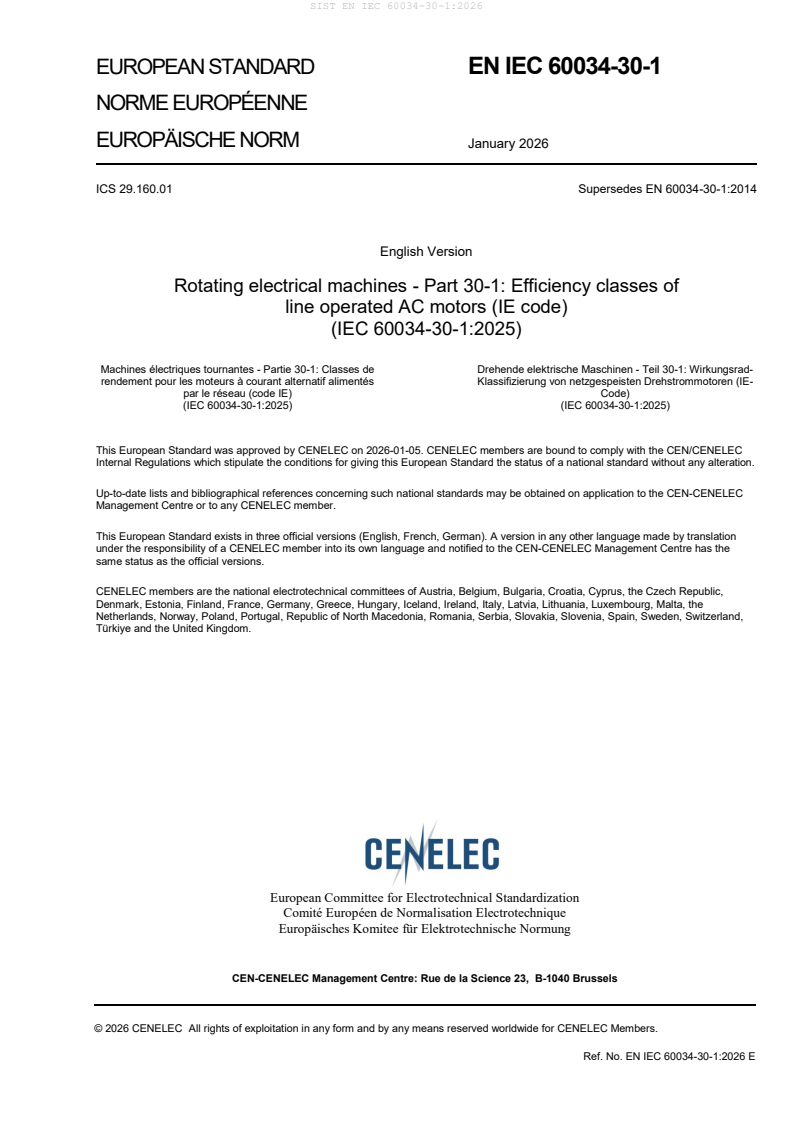
EUROPEAN STANDARD EN IEC 60034-30-1
NORME EUROPÉENNE
EUROPÄISCHE NORM January 2026
ICS 29.160.01 Supersedes EN 60034-30-1:2014
English Version
Rotating electrical machines - Part 30-1: Efficiency classes of
line operated AC motors (IE code)
(IEC 60034-30-1:2025)
Machines électriques tournantes - Partie 30-1: Classes de Drehende elektrische Maschinen - Teil 30-1: Wirkungsrad-
rendement pour les moteurs à courant alternatif alimentés Klassifizierung von netzgespeisten Drehstrommotoren (IE-
par le réseau (code IE) Code)
(IEC 60034-30-1:2025) (IEC 60034-30-1:2025)
This European Standard was approved by CENELEC on 2026-01-05. CENELEC members are bound to comply with the CEN/CENELEC
Internal Regulations which stipulate the conditions for giving this European Standard the status of a national standard without any alteration.
Up-to-date lists and bibliographical references concerning such national standards may be obtained on application to the CEN-CENELEC
Management Centre or to any CENELEC member.
This European Standard exists in three official versions (English, French, German). A version in any other language made by translation
under the responsibility of a CENELEC member into its own language and notified to the CEN-CENELEC Management Centre has the
same status as the official versions.
CENELEC members are the national electrotechnical committees of Austria, Belgium, Bulgaria, Croatia, Cyprus, the Czech Republic,
Denmark, Estonia, Finland, France, Germany, Greece, Hungary, Iceland, Ireland, Italy, Latvia, Lithuania, Luxembourg, Malta, the
Netherlands, Norway, Poland, Portugal, Republic of North Macedonia, Romania, Serbia, Slovakia, Slovenia, Spain, Sweden, Switzerland,
Türkiye and the United Kingdom.
European Committee for Electrotechnical Standardization
Comité Européen de Normalisation Electrotechnique
Europäisches Komitee für Elektrotechnische Normung
CEN-CENELEC Management Centre: Rue de la Science 23, B-1040 Brussels
© 2026 CENELEC All rights of exploitation in any form and by any means reserved worldwide for CENELEC Members.
Ref. No. EN IEC 60034-30-1:2026 E
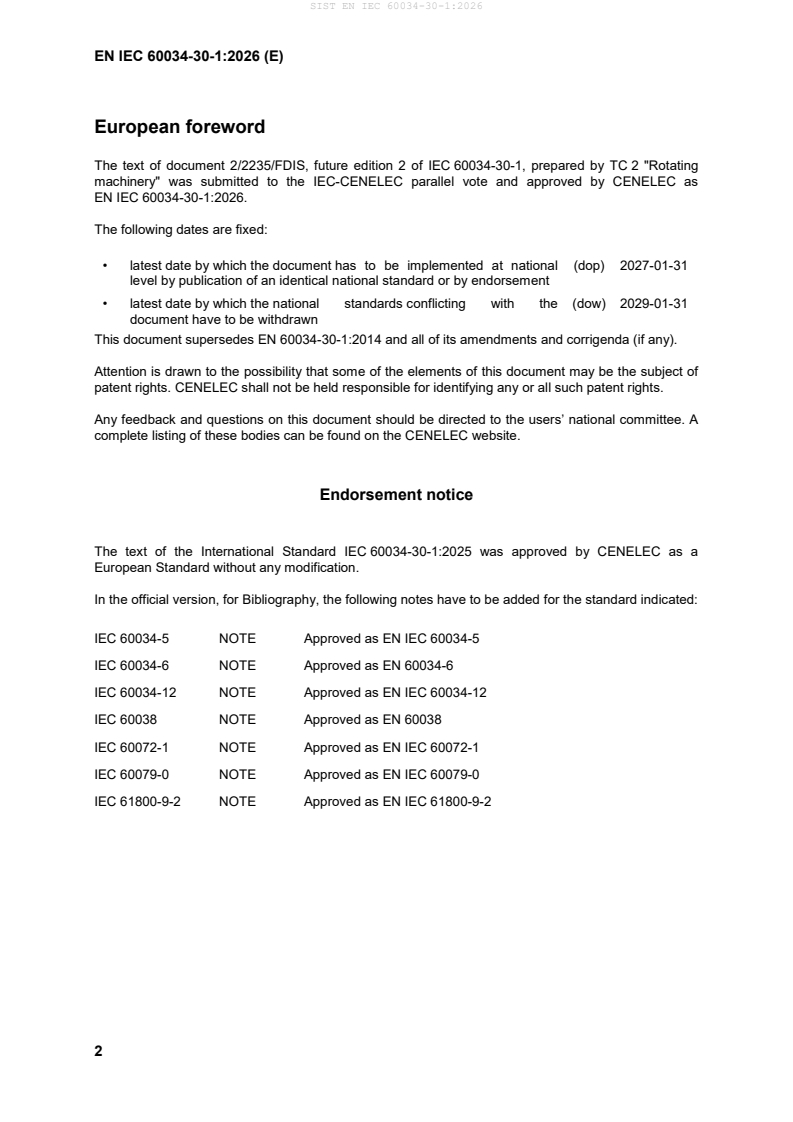
European foreword
The text of document 2/2235/FDIS, future edition 2 of IEC 60034-30-1, prepared by TC 2 "Rotating
machinery" was submitted to the IEC-CENELEC parallel vote and approved by CENELEC as
The following dates are fixed:
• latest date by which the document has to be implemented at national (dop) 2027-01-31
level by publication of an identical national standard or by endorsement
• latest date by which the national standards conflicting with the (dow) 2029-01-31
document have to be withdrawn
This document supersedes EN 60034-30-1:2014 and all of its amendments and corrigenda (if any).
Attention is drawn to the possibility that some of the elements of this document may be the subject of
patent rights. CENELEC shall not be held responsible for identifying any or all such patent rights.
Any feedback and questions on this document should be directed to the users’ national committee. A
complete listing of these bodies can be found on the CENELEC website.
Endorsement notice
The text of the International Standard IEC 60034-30-1:2025 was approved by CENELEC as a
European Standard without any modification.
In the official version, for Bibliography, the following notes have to be added for the standard indicated:
IEC 60034-5 NOTE Approved as EN IEC 60034-5
IEC 60034-6 NOTE Approved as EN 60034-6
IEC 60034-12 NOTE Approved as EN IEC 60034-12
IEC 60038 NOTE Approved as EN 60038
IEC 60072-1 NOTE Approved as EN IEC 60072-1
IEC 60079-0 NOTE Approved as EN IEC 60079-0
IEC 61800-9-2 NOTE Approved as EN IEC 61800-9-2
Annex ZA
(normative)
Normative references to international publications
with their corresponding European publications
The following documents are referred to in the text in such a way that some or all of their content
constitutes requirements of this document. For dated references, only the edition cited applies. For
undated references, the latest edition of the referenced document (including any amendments)
applies.
NOTE 1 Where an International Publication has been modified by common modifications, indicated by (mod),
the relevant EN/HD applies.
NOTE 2 Up-to-date information on the latest versions of the European Standards listed in this annex is available
here: www.cencenelec.eu.
Publication Year Title EN/HD Year
IEC 60034-1 - Rotating electrical machines - Part 1: - -
Rating and performance
IEC 60034-2-1 - Rotating electrical machines - Part 2-1: EN IEC 60034-2-1 -
Standard methods for determining losses
and efficiency from tests (excluding
machines for traction vehicles)
IEC 60034-30-1 ®
Edition 2.0 2025-12
INTERNATIONAL
STANDARD
Rotating electrical machines -
Part 30-1: Efficiency classes of line operated AC motors (IE code)
ICS 29.160.01 ISBN 978-2-8327-0823-1
IEC 60034-30-1:2025-12(en)
IEC 60034-30-1:2025 © IEC 2025
CONTENTS
FOREWORD . 3
INTRODUCTION . 5
1 Scope . 7
2 Normative references . 8
3 Terms, definitions and symbols . 8
3.1 Terms and definitions . 8
3.2 Symbols . 9
4 Fields of application . 9
5 Efficiency . 11
5.1 Determination . 11
5.1.1 General. 11
5.1.2 Rated voltages, rated frequencies and rated power . 11
5.1.3 Auxiliary devices . 11
5.2 Rating . 12
5.3 Classification and marking . 12
5.3.1 General. 12
5.3.2 Efficiency classification. 13
5.3.3 Motors below IE1 efficiency. 13
5.3.4 Marking. 13
5.4 Nominal limits for efficiency classes IE1, IE2, IE3, IE4 and IE5. 14
5.4.1 Nominal efficiency limits for IE1 . 14
5.4.2 Nominal efficiency limits for IE2 . 16
5.4.3 Nominal efficiency limits for IE3 . 18
5.4.4 Nominal efficiency limits for IE4 . 20
5.4.5 Nominal efficiency limits for IE5 . 22
5.4.6 Interpolation of nominal efficiency limits of intermediate rated output
powers for 50 Hz mains supply frequency . 23
5.4.7 Interpolation of nominal efficiency limits of intermediate rated powers
for 60 Hz mains supply frequency . 25
Annex A (informative) Nominal, rated (declared), minimum efficiency and tolerance . 26
Bibliography . 27
Figure A.1 – Nominal efficiency and tolerance . 26
Table 1 – Common motor technologies and their energy efficiency potential . 10
Table 2 – IE efficiency classification . 13
Table 3 – Nominal efficiency limits (%) for 50 Hz IE1. 14
Table 4 – Nominal efficiency limits (%) for 60 Hz IE1. 15
Table 5 – Nominal efficiency limits (%) for 50 Hz IE2. 16
Table 6 – Nominal efficiency limits (%) for 60 Hz IE2. 17
Table 7 – Nominal efficiency limits (%) for 50 Hz IE3. 18
Table 8 – Nominal efficiency limits (%) for 60 Hz IE3. 19
Table 9 – Nominal efficiency limits (%) for 50 Hz IE4. 20
Table 10 – Nominal efficiency limits (%) for 60 Hz IE4 . 21
Table 11 – Nominal efficiency limits (%) for 50 Hz IE5 . 22
IEC 60034-30-1:2025 © IEC 2025
Table 12 – Nominal efficiency limits (%) for 60 Hz IE5 . 23
Table 13 – Interpolation coefficients for 0,12 kW up to 0,55 kW . 24
Table 14 – Interpolation coefficients for 0,75 kW up to 200 kW . 25
IEC 60034-30-1:2025 © IEC 2025
INTERNATIONAL ELECTROTECHNICAL COMMISSION
____________
Rotating electrical machines -
Part 30-1: Efficiency classes of line operated AC motors (IE code)
FOREWORD
1) The International Electrotechnical Commission (IEC) is a worldwide organization for standardization comprising
all national electrotechnical committees (IEC National Committees). The object of IEC is to promote international
co-operation on all questions concerning standardization in the electrical and electronic fields. To this end and
in addition to other activities, IEC publishes International Standards, Technical Specifications, Technical Reports,
Publicly Available Specifications (PAS) and Guides (hereafter referred to as "IEC Publication(s)"). Their
preparation is entrusted to technical committees; any IEC National Committee interested in the subject dealt with
may participate in this preparatory work. International, governmental and non-governmental organizations liaising
with the IEC also participate in this preparation. IEC collaborates closely with the International Organization for
Standardization (ISO) in accordance with conditions determined by agreement between the two organizations.
2) The formal decisions or agreements of IEC on technical matters express, as nearly as possible, an international
consensus of opinion on the relevant subjects since each technical committee has representation from all
interested IEC National Committees.
3) IEC Publications have the form of recommendations for international use and are accepted by IEC National
Committees in that sense. While all reasonable efforts are made to ensure that the technical content of IEC
Publications is accurate, IEC cannot be held responsible for the way in which they are used or for any
misinterpretation by any end user.
4) In order to promote international uniformity, IEC National Committees undertake to apply IEC Publications
transparently to the maximum extent possible in their national and regional publications. Any divergence between
any IEC Publication and the corresponding national or regional publication shall be clearly indicated in the latter.
5) IEC itself does not provide any attestation of conformity. Independent certification bodies provide conformity
assessment services and, in some areas, access to IEC marks of conformity. IEC is not responsible for any
services carried out by independent certification bodies.
6) All users should ensure that they have the latest edition of this publication.
7) No liability shall attach to IEC or its directors, employees, servants or agents including individual experts and
members of its technical committees and IEC National Committees for any personal injury, property damage or
other damage of any nature whatsoever, whether direct or indirect, or for costs (including legal fees) and
expenses arising out of the publication, use of, or reliance upon, this IEC Publication or any other IEC
Publications.
8) Attention is drawn to the Normative references cited in this publication. Use of the referenced publications is
indispensable for the correct application of this publication.
9) IEC draws attention to the possibility that the implementation of this document may involve the use of (a)
patent(s). IEC takes no position concerning the evidence, validity or applicability of any claimed patent rights in
respect thereof. As of the date of publication of this document, IEC had not received notice of (a) patent(s), which
may be required to implement this document. However, implementers are cautioned that this may not represent
the latest information, which may be obtained from the patent database available at https://patents.iec.ch. IEC
shall not be held responsible for identifying any or all such patent rights.
IEC 60034-30-1 has been prepared by IEC Technical Committee 2: Rotating machinery. It is an
International Standard.
This second edition of IEC 60034-30-1 cancels and replaces the first edition of IEC 60034-30-1
published in 2014. This edition constitutes a technical revision.
This edition includes the following significant technical changes with respect to the previous
edition:
a) Table 1 in Clause 4 revised and IE5 efficiency introduced.
b) New efficiency tables (Table 11 and Table 12) added for IE5 nominal efficiency limits.
c) Table 13 for interpolation coefficients revised based on IE5 limits and the coefficients limited
from 0,12 kW to 0,75 kW 0,12 kW to 0,55 kW. A linear interpolation shall be applied to obtain
minimum efficiency between 0,55 kW and 0,75 kW.
IEC 60034-30-1:2025 © IEC 2025
d) Annex A revised and added Figure A.1 showing nominal, rated, minimum efficiency and
tolerance.
The text of this International Standard is based on the following documents:
Draft Report on voting
2/2235/FDIS 2/2279/RVD
Full information on the voting for its approval can be found in the report on voting indicated in
the above table.
The language used for the development of this International Standard are English and French.
This document was drafted in accordance with ISO/IEC Directives, Part 2, and developed in
accordance with ISO/IEC Directives, Part 1 and ISO/IEC Directives, IEC Supplement, available
at www.iec.ch/members_experts/refdocs. The main document types developed by IEC are
described in greater detail at www.iec.ch/publications.
NOTE A table of cross-references of all IEC TC 2 publications can be found on the IEC TC 2 dashboard on the IEC
website.
The committee has decided that the contents of this document will remain unchanged until the
stability date indicated on the IEC website under webstore.iec.ch in the data related to the
specific document. At this date, the document will be
– reconfirmed,
– withdrawn, or
– revised.
IEC 60034-30-1:2025 © IEC 2025
INTRODUCTION
This first part of the IEC 60034-30 series, IEC 60034-30-1, provides for the global
harmonization of energy efficiency classes of electric motors. It deals with all kinds of electric
motors that are rated for line operation (including starting at reduced voltage). This includes
either 50 Hz or 60 Hz, or both single- and three-phase low voltage induction motors, regardless
of their rated voltage, as well as line-start synchronous motors.
The second part of this standard series (IEC 60034-30-2) is prepared for motors rated for
variable voltage and frequency supply.
This second edition of IEC 60034-30-1 introduces a new efficiency class, IE5. It is important to
note that International Energy efficiency (IE) class definition is generally independent of the
output power – frame size assignment. As standardized dimensions and outputs in the
IEC 60072 series are based on today's technology (up to IE4), it can be challenging to
implement highest IE classes according to existing frame sizes.
It is possible that motors, especially those with lower output power ratings, are designed and
manufactured in one frame size bigger than frame size assigned in IEC 60072-1 to reach IE4
and IE5 efficiency levels.
For a given power and frame size it is generally easier to achieve a higher motor efficiency
when the motor is designed for and operated directly on-line with a 60 Hz supply frequency
rather than on 50 Hz as explained in Note 1.
NOTE 1 As the utilization and size of motors are related to torque rather than power the theoretical power of single-
speed motors increases linearly with supply frequency (and hence with speed), i.e. by 20 % from 50 Hz to 60 Hz.
I R winding-losses are dominant especially in small and medium sized induction motors. They basically remain
constant at 50 Hz and 60 Hz as long as the torque is kept constant. Although windage, friction and iron losses
increase with frequency, they play a minor role especially in motors with a number of poles of four and higher.
Therefore, at 60 Hz, the losses increase less than the 20 % power increase when compared to 50 Hz and
consequently, the efficiency is improved.
In practice, both 60 Hz and 50 Hz power designations of single-speed motors usually conform to standard power
levels in accordance with IEC 60072-1. Therefore, an increased rating of motor power by 20 % is not always possible.
However, the general advantage of 60 Hz still applies when the motor design is optimized for the respective supply
frequency rather than just re-rated.
The difference in efficiency between 50 Hz and 60 Hz varies with the number of poles and the size of the motor. In
general, the 60 Hz efficiency of three-phase, cage-induction motors in the power range from 0,75 kW up to 375 kW
is between 2,5 percentage points to less than 0,5 percentage points greater when compared to the 50 Hz efficiency.
Only large 2-pole motors can experience a reduced efficiency at 60 Hz due to their high share of iron, windage and
friction losses.
It is not expected that all manufacturers will produce motors for all efficiency classes, nor all
ratings of a given class.
Users should dimension motors to be suitable for the intended applications based on the load
profile, operating hours in order to maximize energy savings considering most energy efficient
solutions in addition that all other requirements set by the application are covered. It is possible
that selecting motors of a high efficiency class for intermittent or short time duty due to
increased inertia and start-up losses is not energy efficient.
NOTE 2 The application guide IEC TS 60034-31 gives further information on useful applications of high-efficient
electric motors.
IEC 60034-30-1:2025 © IEC 2025
In order to achieve a significant market share it is essential for high-efficiency motors to meet
national or regional standards for assigned powers in relation to mechanical dimensions (such
as frame-size, flanges). IEC 60072-1 defines the relationship between mechanical dimensions
and rated output as well. There are several national or regional frame assignment standards
(JIS C 4212, NBR 17094, NEMA MG13, SANS 1804 and others). As this document
(IEC 60034-30-1) defines energy efficiency classes independent of dimensional constraints, it
is possible that producing motors with higher efficiency classes, whilst maintaining the
mechanical dimensions of national or regional standards, will not be feasible in all markets.
To meet the demands of higher energy efficiency classes, the designs of components and
equipment and the selection of efficient materials should not be overlooked. There can be a
need to use more materials such as electrical steel, copper and aluminium to enable the design
of high efficiency motors. Consequently, the develop IE5 class motors using the same frames
sizes as IE4 class motors is not always possible. The higher efficiency class motors are likely
to be heavier. This will drive the need to re-design the application of the high efficiency motor.
IE codes are not limited only to motors and are used to classify other components such as
frequency converters (IEC 61800-9-2). The same standard defines also IES classes to
combinations of components (such as power drive systems).
However, it is anticipated that other components are rated with a comparable system: IE1
meaning low efficiency up to IE5 meaning the highest efficiency.
The efficiency levels in this document for 50 Hz and 60 Hz are not always entirely consistent
across all numbers of poles and over the whole power range.
NOTE 3 The efficiency levels for 60 Hz motors were assigned for compatibility with U.S. and North American legal
requirements.
IEC 60034-30-1:2025 © IEC 2025
1 Scope
This part of IEC 60034 specifies efficiency classes for single-speed electric motors that are
rated in accordance with IEC 60034-1 or IEC 60079-0 and are rated for operation on a
sinusoidal either 50 Hz or 60 Hz, or both voltage supply.
The motors within this document:
from 0,12 kW to 1 000 kW;
– have a rated power P
N
– have a rated voltage U from 50 V up to and including 1 000 V;
N
– have 2, 4, 6 or 8 poles;
– are capable of continuous operation at their rated power with a temperature rise within the
specified insulation temperature class;
NOTE 1 Most motors covered by this document are rated for duty type S1 (continuous duty). However, some
motors that are rated for other duty cycles are still capable of continuous operation at their rated power, and
these motors are also covered by this document.
– are marked with any ambient temperature within the range of –30 °C to +60 °C;
NOTE 2 The rated efficiency and efficiency classes are based on 25 °C ambient temperature in accordance
with IEC 60034-2-1.
NOTE 3 Motors exclusively rated for temperatures outside the range –30 °C and +60 °C are considered to be
of special construction and are consequently excluded from this document.
NOTE 4 Smoke extraction motors with a temperature class of up to and including 400 °C are covered by this
document.
– are marked with an altitude up to 4 000 m above sea level.
NOTE 5 The rated efficiency and efficiency class are based on a rating for altitudes up to 1 000 m above sea
level.
This document establishes a set of nominal efficiency values based on supply frequency,
number of poles and motor output power. No distinction is made between motor technologies,
supply voltage or motors with increased insulation designed specifically for converter operation
even though not all motor technologies are capable of reaching the higher efficiency classes
(see Table 1). This makes different motor technologies fully comparable with respect to their
energy efficiency potential.
The efficiency of power-drive systems is not covered by this document. Motor losses due to
harmonic content of the supply voltage, losses in cables, filters and frequency-converters, are
not covered.
Motors with flanges, feet or shafts with mechanical dimensions different from IEC 60072-1 are
covered by this document.
Geared motors are covered by this document including those incorporating non-standard shafts
and flanges.
Totally enclosed air-over machines (TEAO, IC418), i.e. totally enclosed frame-surface cooled
machines intended for exterior cooling by a ventilating means external to the machine, are
covered by this document. Efficiency testing of such motors can be performed with the fan
removed and the cooling provided by an external blower with a similar airflow rate as the original
fan.
This document does not apply to the following:
– Single-speed motors with 10 or more poles or multi-speed motors.
– Motors with mechanical commutators (such as DC motors).
IEC 60034-30-1:2025 © IEC 2025
– Motors completely integrated into a machine (for example pump, fan and compressor) that
cannot be practically tested separately from the machine even with provision of a temporary
end-shield and drive-end bearing. This means the motor: a) shares common components
(apart from connectors such as bolts) with the driven unit (for example, a shaft or housing)
and b) is not designed in such a way as to enable the motor to be separated from the driven
unit as an entire motor that can operate independently of the driven unit. That is, for a motor
to be excluded from this document, the process of separation shall render the motor
inoperative.
– Motors with integrated frequency converters (compact drives) when the motor cannot be
tested separately from the converter. Energy efficiency classification of compact drives is
based on the complete product (PDS, ie. Power Drive System) and is defined in
IEC 61800-9-2.
NOTE 6 A motor is not excluded when the motor and frequency-converter can be separated, and the motor can
be tested independently of the converter.
– Brake motors when the brake is an integral part of the inner motor construction and can
neither be removed nor supplied by a separate power source during the testing of motor
efficiency.
NOTE 7 Brake motors with a brake coil that is integrated into the flange of the motor are covered as long as it
is possible to test motor efficiency without the losses of the brake (for example by dismantling the brake or by
energizing the brake coil from a separate power source).
When the manufacturer offers a motor of the same design with and without a brake the test
of motor efficiency can be done on a motor without the brake. The determined efficiency
may then be used as the rating for a motor with or without the brake.
– Submersible motors specifically designed to operate wholly immersed in a liquid.
– Smoke extraction motors with a temperature class above 400 °C.
2 Normative references
The following documents are referred to in the text in such a way that some or all their content
constitutes requirements of this document. For
...