

SIST EN 60601-2-37:2008
(Main)Medical electrical equipment -- Part 2-37: Particular requirements for the basic safety and essential performance of ultrasonic medical diagnostic and monitoring equipment
General Information
- Abstract
Applies to the basic safety and essential performance of ultrasonic diagnostic equipment. The approach and philosophy used in drafting this particular standard for safety of ultrasonic diagnostic equipment are consistent with those in standards of the IEC 60601 2 xx series that apply to other diagnostic modalities, such as X-ray equipment and magnetic resonance systems. In each case, the safety standard is intended to require increasing sophistication of output display indicators and/or controls with increasing energy levels in the interrogating field of diagnosis. Thus, for all such diagnostic modalities, it is the responsibility of the operator to understand the risk of the output of the ultrasonic diagnostic equipment, and to act appropriately in order to obtain the needed diagnostic information with the minimum risk to the patient. This second edition cancels and replaces the first edition published in 2001 and its Amendment 1 (2004) and Amendment 2 (2005). This edition combines the previous edition and its amendments into a form compatible with the parent IEC 60601-1:2005.
- Status
- Published
- Publication Date
- 24-Feb-2008
- Technical Committee
- IEMO - Electrical equipment in medical practice
- Current Stage
- 6060 - National Implementation/Publication (Adopted Project)
- Start Date
- 14-Feb-2008
- Due Date
- 20-Apr-2008
- Completion Date
- 25-Feb-2008
- Directive
- 93/42/EEC - Medical devicesOJ Ref: C 22/02 OJ Date: 24-Jan-2013 Conflicting Date: 01-Oct-2010

Overview
EN 60601-2-37:2008 (based on IEC 60601-2-37:2007) is the European particular standard for the basic safety and essential performance of ultrasonic medical diagnostic and monitoring equipment. Published by CENELEC, this second edition supersedes the 2001 edition and amendments, and is aligned with the parent IEC/EN 60601‑1 safety standard. It establishes mandatory requirements, test methods, and documentation expectations that support conformity with the EC Directive 93/42/EEC for medical devices.
Key topics and technical requirements
- Scope and philosophy: Specifies additional safety requirements for ultrasonic diagnostic devices consistent with other diagnostic modalities (X‑ray, MRI) - increasing display/control sophistication with higher output energy.
- Acoustic output reporting: Requires standardized reporting of acoustic output parameters (see acoustic output reporting table). Emphasis on communicating Thermal Index (TI) and Mechanical Index (MI) to the operator.
- Measurement and test methods: Normative and informative test procedures, including field characterization references (e.g., IEC 62359) and example set-ups to measure transducer surface temperature (Annex DD).
- Protection and controls: Requirements for protection against electrical, mechanical, radiation, thermal and other hazards; accuracy of controls/instruments and fault-condition handling.
- Electromagnetic compatibility (EMC): EMC provisions for medical electrical equipment and systems (see clauses on EMC and Annex BB guidance).
- Documentation, marking and labelling: Identification, operator information, instructions, and labelling that communicate risk and safe use; links to Annex CC for interpreting TI/MI to inform operators.
- Guidance annexes: Informative annexes (AA, BB, CC, DD, ZA, ZZ) provide rationale, CISPR classification guidance, TI/MI interpretation, test examples, and mapping to EC Essential Requirements.
Practical applications and users
Who uses this standard:
- Medical device manufacturers - design, risk assessment, acoustic output reporting, labelling and compliance testing.
- Regulatory and quality teams - technical files for CE marking and conformity to EC Directive 93/42/EEC.
- Test laboratories and certification bodies - perform acoustic, thermal and EMC tests, transducer temperature measurements.
- Clinical and biomedical engineers - selection, safe operation, maintenance and verification of ultrasound systems.
- Product managers and technical writers - prepare instructions and operator information that include TI/MI and safety warnings.
Practical uses:
- Defining design requirements to minimize patient exposure while maintaining diagnostic performance.
- Preparing conformity documentation for regulatory submissions and audits.
- Implementing standard test methods for acoustic output and transducer safety.
Related standards
- IEC/EN 60601‑1 (general medical electrical safety) - parent standard compatibility.
- IEC 62359 - field characterization; test methods for TI/MI.
- CISPR standards referenced for EMC classification.
Keywords: EN 60601-2-37:2008, IEC 60601-2-37, ultrasonic medical diagnostic equipment, ultrasound safety, thermal index TI, mechanical index MI, acoustic output reporting, medical device compliance, CE marking.
Relations
- Effective Date
- 01-Apr-2008
- Effective Date
- 01-Apr-2008
- Effective Date
- 01-Apr-2008
- Official Journal Project Relation
SIST EN 60601-2-37:2002 - Medical electrical equipment -- Part 2-37: Particular requirements for the safety of ultrasonic medical diagnostic and monitoring equipment - Effective Date
- 18-May-2009
- Effective Date
- 01-Jan-2025
- Effective Date
- 03-Feb-2026
- Effective Date
- 03-Feb-2026
- Effective Date
- 03-Feb-2026
- Effective Date
- 01-Dec-2015
- Effective Date
- 11-Oct-2011
Get Certified
Connect with accredited certification bodies for this standard

BSI Group
BSI (British Standards Institution) is the business standards company that helps organizations make excellence a habit.

TÜV Rheinland
TÜV Rheinland is a leading international provider of technical services.

TÜV SÜD
TÜV SÜD is a trusted partner of choice for safety, security and sustainability solutions.
Sponsored listings
Frequently Asked Questions
SIST EN 60601-2-37:2008 is a standard published by the Slovenian Institute for Standardization (SIST). Its full title is "Medical electrical equipment -- Part 2-37: Particular requirements for the basic safety and essential performance of ultrasonic medical diagnostic and monitoring equipment". This standard covers: Applies to the basic safety and essential performance of ultrasonic diagnostic equipment. The approach and philosophy used in drafting this particular standard for safety of ultrasonic diagnostic equipment are consistent with those in standards of the IEC 60601 2 xx series that apply to other diagnostic modalities, such as X-ray equipment and magnetic resonance systems. In each case, the safety standard is intended to require increasing sophistication of output display indicators and/or controls with increasing energy levels in the interrogating field of diagnosis. Thus, for all such diagnostic modalities, it is the responsibility of the operator to understand the risk of the output of the ultrasonic diagnostic equipment, and to act appropriately in order to obtain the needed diagnostic information with the minimum risk to the patient. This second edition cancels and replaces the first edition published in 2001 and its Amendment 1 (2004) and Amendment 2 (2005). This edition combines the previous edition and its amendments into a form compatible with the parent IEC 60601-1:2005.
Applies to the basic safety and essential performance of ultrasonic diagnostic equipment. The approach and philosophy used in drafting this particular standard for safety of ultrasonic diagnostic equipment are consistent with those in standards of the IEC 60601 2 xx series that apply to other diagnostic modalities, such as X-ray equipment and magnetic resonance systems. In each case, the safety standard is intended to require increasing sophistication of output display indicators and/or controls with increasing energy levels in the interrogating field of diagnosis. Thus, for all such diagnostic modalities, it is the responsibility of the operator to understand the risk of the output of the ultrasonic diagnostic equipment, and to act appropriately in order to obtain the needed diagnostic information with the minimum risk to the patient. This second edition cancels and replaces the first edition published in 2001 and its Amendment 1 (2004) and Amendment 2 (2005). This edition combines the previous edition and its amendments into a form compatible with the parent IEC 60601-1:2005.
SIST EN 60601-2-37:2008 is classified under the following ICS (International Classification for Standards) categories: 11.040.55 - Diagnostic equipment; 17.140.50 - Electroacoustics. The ICS classification helps identify the subject area and facilitates finding related standards.
SIST EN 60601-2-37:2008 has the following relationships with other standards: It is inter standard links to SIST EN 60601-2-37:2002, SIST EN 60601-2-37:2002/A2:2006, SIST EN 60601-2-37:2002/A1:2005, SIST EN 60601-2-37:2002, SIST EN IEC 60601-2-37:2025, SIST EN 62359:2007, SIST EN 62359:2011, SIST EN 62359:2011/A1:2018, SIST EN 60601-2-37:2008/A1:2015, SIST EN 60601-2-37:2008/A11:2012. Understanding these relationships helps ensure you are using the most current and applicable version of the standard.
SIST EN 60601-2-37:2008 is associated with the following European legislation: EU Directives/Regulations: 93/42/EEC; Standardization Mandates: M/432. When a standard is cited in the Official Journal of the European Union, products manufactured in conformity with it benefit from a presumption of conformity with the essential requirements of the corresponding EU directive or regulation.
SIST EN 60601-2-37:2008 is available in PDF format for immediate download after purchase. The document can be added to your cart and obtained through the secure checkout process. Digital delivery ensures instant access to the complete standard document.
Standards Content (Sample)
2003-01.Slovenski inštitut za standardizacijo. Razmnoževanje celote ali delov tega standarda ni dovoljeno.Medical electrical equipment - Part 2-37: Particular requirements for the basic safety and essential performance of ultrasonic medical diagnostic and monitoring equipment (IEC 60601-2-37:2007)Appareils électromédicaux - Partie 2-37: Exigences particulières pour la sécurité de base et les performances essentielles des appareils de diagnostic et de surveillance médicaux à ultrasons (CEI 60601-2-37:2007)Medizinische elektrische Geräte - Teil 2-37: Besondere Festlegungen für die Sicherheit einschließlich der wesentlichen Leistungsmerkmale von Ultraschallgeräten für die medizinische Diagnose und Überwachung (IEC 60601-2-37:2007)Ta slovenski standard je istoveten z:EN 60601-2-37:2008SIST EN 60601-2-37:2008en,fr17.140.5011.040.55ICS:SIST EN 60601-2-37:2002/A1:2005SIST EN 60601-2-37:20021DGRPHãþDSLOVENSKI
STANDARDSIST EN 60601-2-37:200801-april-2008
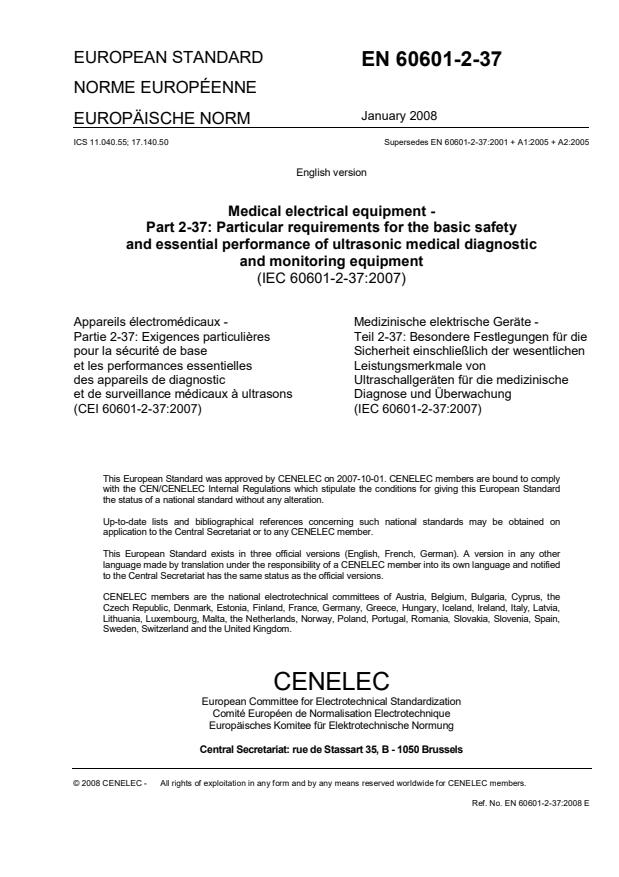
EUROPEAN STANDARD EN 60601-2-37 NORME EUROPÉENNE
EUROPÄISCHE NORM January 2008
CENELEC European Committee for Electrotechnical Standardization Comité Européen de Normalisation Electrotechnique Europäisches Komitee für Elektrotechnische Normung
Central Secretariat: rue de Stassart 35, B - 1050 Brussels
© 2008 CENELEC -
All rights of exploitation in any form and by any means reserved worldwide for CENELEC members.
Ref. No. EN 60601-2-37:2008 E
ICS 11.040.55; 17.140.50 Supersedes EN 60601-2-37:2001 + A1:2005 + A2:2005
English version
Medical electrical equipment -
Part 2-37: Particular requirements for the basic safety
and essential performance of ultrasonic medical diagnostic
and monitoring equipment (IEC 60601-2-37:2007)
Appareils électromédicaux -
Partie 2-37: Exigences particulières
pour la sécurité de base
et les performances essentielles
des appareils de diagnostic
et de surveillance médicaux à ultrasons (CEI 60601-2-37:2007)
Medizinische elektrische Geräte -
Teil 2-37: Besondere Festlegungen für die Sicherheit einschließlich der wesentlichen Leistungsmerkmale von Ultraschallgeräten für die medizinische Diagnose und Überwachung (IEC 60601-2-37:2007)
This European Standard was approved by CENELEC on 2007-10-01. CENELEC members are bound to comply with the CEN/CENELEC Internal Regulations which stipulate the conditions for giving this European Standard the status of a national standard without any alteration.
Up-to-date lists and bibliographical references concerning such national standards may be obtained on application to the Central Secretariat or to any CENELEC member.
This European Standard exists in three official versions (English, French, German). A version in any other language made by translation under the responsibility of a CENELEC member into its own language and notified to the Central Secretariat has the same status as the official versions.
CENELEC members are the national electrotechnical committees of Austria, Belgium, Bulgaria, Cyprus, the Czech Republic, Denmark, Estonia, Finland, France, Germany, Greece, Hungary, Iceland, Ireland, Italy, Latvia, Lithuania, Luxembourg, Malta, the Netherlands, Norway, Poland, Portugal, Romania, Slovakia, Slovenia, Spain, Sweden, Switzerland and the United Kingdom.
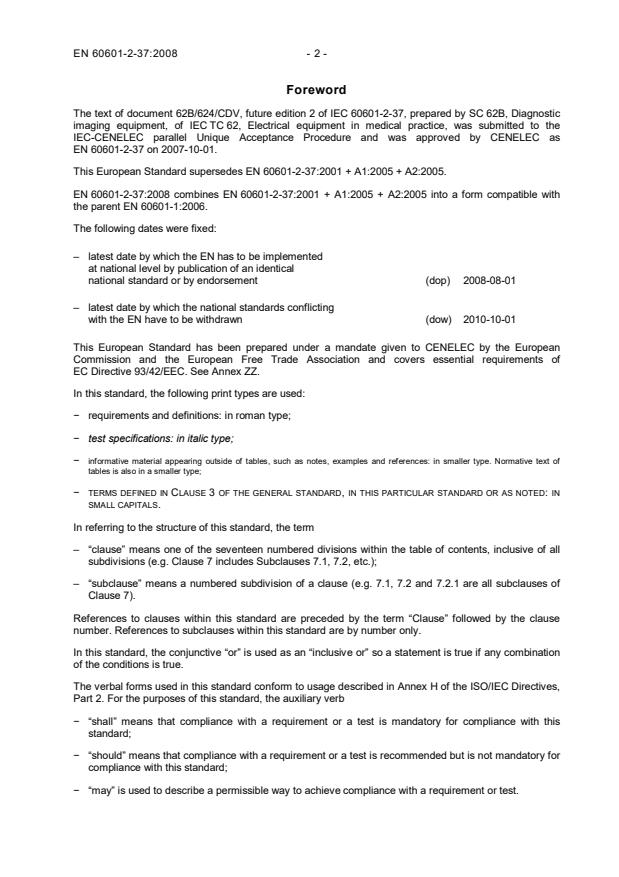
- 2 - Foreword The text of document 62B/624/CDV, future edition 2 of IEC 60601-2-37, prepared by SC 62B, Diagnostic imaging equipment, of IEC TC 62, Electrical equipment in medical practice, was submitted to the IEC-CENELEC parallel Unique Acceptance Procedure and was approved by CENELEC as EN 60601-2-37 on 2007-10-01. This European Standard supersedes EN 60601-2-37:2001 + A1:2005 + A2:2005. EN 60601-2-37:2008 combines EN 60601-2-37:2001 + A1:2005 + A2:2005 into a form compatible with the parent EN 60601-1:2006. The following dates were fixed: – latest date by which the EN has to be implemented
at national level by publication of an identical
national standard or by endorsement
(dop) 2008-08-01 – latest date by which the national standards conflicting
with the EN have to be withdrawn
(dow) 2010-10-01 This European Standard has been prepared under a mandate given to CENELEC by the European Commission and the European Free Trade Association and covers essential requirements of EC Directive 93/42/EEC. See Annex ZZ. In this standard, the following print types are used:
requirements and definitions: in roman type;
test specifications: in italic type;
informative material appearing outside of tables, such as notes, examples and references: in smaller type. Normative text of tables is also in a smaller type;
TERMS DEFINED IN CLAUSE 3 OF THE GENERAL STANDARD, IN THIS PARTICULAR STANDARD OR AS NOTED: IN SMALL CAPITALS. In referring to the structure of this standard, the term – “clause” means one of the seventeen numbered divisions within the table of contents, inclusive of all subdivisions (e.g. Clause 7 includes Subclauses 7.1, 7.2, etc.); –
“subclause” means a numbered subdivision of a clause (e.g. 7.1, 7.2 and 7.2.1 are all subclauses of Clause 7). References to clauses within this standard are preceded by the term “Clause” followed by the clause number. References to subclauses within this standard are by number only.
In this standard, the conjunctive “or” is used as an “inclusive or” so a statement is true if any combination of the conditions is true. The verbal forms used in this standard conform to usage described in Annex H of the ISO/IEC Directives, Part 2. For the purposes of this standard, the auxiliary verb
“shall” means that compliance with a requirement or a test is mandatory for compliance with this standard;
“should” means that compliance with a requirement or a test is recommended but is not mandatory for compliance with this standard;
“may” is used to describe a permissible way to achieve compliance with a requirement or test.
- 3 - EN 60601-2-37:2008 An asterisk (*) as the first character of a title or at the beginning of a paragraph or table title indicates that there is guidance or rationale related to that item in Annex AA. Annexes ZA and ZZ have been added by CENELEC. __________ Endorsement notice The text of the International Standard IEC 60601-2-37:2007 was approved by CENELEC as a European Standard without any modification. __________
- 4 -
Annex ZA
(normative)
Normative references to international publications with their corresponding European publications
Addition to Annex ZA of EN 60601-1:2006:
Publication
Year Title EN/HD Year IEC 62359 –1) Ultrasonics - Field characterization - Test methods for the determination of thermal and mechanical indices related to medical diagnostic ultrasonic fields EN 62359 20052)
__________
1) Undated reference. 2) Valid edition at date of issue.
- 5 - EN 60601-2-37:2008 Annex ZZ (informative) Coverage of Essential Requirements of EC Directives This European Standard has been prepared under a mandate given to CENELEC by the European Commission and the European Free Trade Association and within its scope the standard covers all relevant essential requirements as given in Annex I of the EC Directive 93/42/EEC. Compliance with this standard provides one means of conformity with the specified essential requirements of the Directive concerned. WARNING: Other requirements and other EC Directives may be applicable to the products falling within the scope of this standard. __________
IEC 60601-2-37Edition 2.0 2007-08INTERNATIONAL STANDARD NORME INTERNATIONALEMedical electrical equipment – Part 2-37: Particular requirements for the basic safety and essential performance of ultrasonic medical diagnostic and monitoring equipment
Appareils électromédicaux – Partie 2-37: Exigences particulières pour la sécurité de base et les performances essentielles des appareils de diagnostic et de surveillance médicaux à ultrasons
INTERNATIONAL ELECTROTECHNICAL COMMISSION COMMISSION ELECTROTECHNIQUE INTERNATIONALE XICS 11.040.55; 17.140.50 PRICE CODECODE PRIXISBN 2-8318-9266-X
– 2 – 60601-2-37 © IEC:2007 CONTENTS FOREWORD.4 INTRODUCTION.6
201.1 Scope, object and related standards.7 201.2 Normative references.8 201.3 Terminology and definitions.8 201.4 General requirements.11 201.5 General requirements for testing ME EQUIPMENT.12 201.6 Classification of ME EQUIPMENT and ME SYSTEMS.12 201.7 ME EQUIPMENT identification, marking and documents.12 201.8 Protection against electrical HAZARDS from ME EQUIPMENT.15 201.9 Protection against MECHANICAL HAZARDS of ME EQUIPMENT and ME SYSTEMS.16 201.10 Protection against unwanted and excessive radiation HAZARDS.16 201.11 Protection against excessive temperatures and other HAZARDS.17 201.12 Accuracy of controls and instruments and protection against hazardous outputs.21 201.13 Hazardous situations and fault conditions.22 201.14 PROGRAMMABLE ELECTRICAL MEDICAL SYSTEMS (PEMS).23 201.15 Construction of ME EQUIPMENT.23 201.16 ME SYSTEMS.23 201.17 *Electromagnetic compatibility of ME EQUIPMENT and ME SYSTEMS.23 202.6 ELECTROMAGNETIC COMPATIBILITY.23
Annex AA (informative)
Guidance and rationale for particular subclauses.26 Annex BB (informative)
Guidance in classification according to CISPR 11.31 Annex CC (informative)
Guidance to the MANUFACTURER on the interpretation of TI and MI
to be used to inform the OPERATOR.32 Annex DD (informative)
Example set-up to measure surface temperature
of externally applied TRANSDUCER ASSEMBLIES.35
Bibliography.38
Index of defined terms.41
Figure DD.1 – Set-up of an example test object to measure the surface temperature
of externally applied transducers.37
Table 201.101 – List of symbols.11 Table 201.102 – Distributed essential performance requirements.12 Table 201.103 –Acoustic output reporting table.15 Table 201.104 – Overview of the tests noted under 201.11.1.3.20 Table CC.1 – Relative importance of maintaining low exposure indices in various scanning situations.34
60601-2-37 © IEC:2007 – 3 –
Table DD.1 – Acoustic and thermal properties of tissues & materials.35 Table DD.2 – Weight % pure components.36
– 4 – 60601-2-37 © IEC:2007 INTERNATIONAL ELECTROTECHNICAL COMMISSION ______________
MEDICAL ELECTRICAL EQUIPMENT –
Part 2-37: Particular requirements for the basic safety and essential performance of ultrasonic medical diagnostic and monitoring equipment
FOREWORD 1) The International Electrotechnical Commission (IEC) is a worldwide organization for standardization comprising all national electrotechnical committees (IEC National Committees). The object of IEC is to promote international co-operation on all questions concerning standardization in the electrical and electronic fields. To this end and in addition to other activities, IEC publishes International Standards, Technical Specifications, Technical Reports, Publicly Available Specifications (PAS) and Guides (hereafter referred to as “IEC Publication(s)”). Their preparation is entrusted to technical committees; any IEC National Committee interested in the subject dealt with may participate in this preparatory work. International, governmental and non-governmental organizations liaising with the IEC also participate in this preparation. IEC collaborates closely with the International Organization for Standardization (ISO) in accordance with conditions determined by agreement between the two organizations. 2) The formal decisions or agreements of IEC on technical matters express, as nearly as possible, an international consensus of opinion on the relevant subjects since each technical committee has representation from all interested IEC National Committees.
3) IEC Publications have the form of recommendations for international use and are accepted by IEC National Committees in that sense. While all reasonable efforts are made to ensure that the technical content of IEC Publications is accurate, IEC cannot be held responsible for the way in which they are used or for any misinterpretation by any end user. 4) In order to promote international uniformity, IEC National Committees undertake to apply IEC Publications transparently to the maximum extent possible in their national and regional publications. Any divergence between any IEC Publication and the corresponding national or regional publication shall be clearly indicated in the latter. 5) IEC provides no marking procedure to indicate its approval and cannot be rendered responsible for any equipment declared to be in conformity with an IEC Publication. 6) All users should ensure that they have the latest edition of this publication. 7) No liability shall attach to IEC or its directors, employees, servants or agents including individual experts and members of its technical committees and IEC National Committees for any personal injury, property damage or other damage of any nature whatsoever, whether direct or indirect, or for costs (including legal fees) and expenses arising out of the publication, use of, or reliance upon, this IEC Publication or any other IEC Publications.
8) Attention is drawn to the Normative references cited in this publication. Use of the referenced publications is indispensable for the correct application of this publication. 9) Attention is drawn to the possibility that some of the elements of this IEC Publication may be the subject of patent rights. IEC shall not be held responsible for identifying any or all such patent rights. International standard IEC 60601-2-37 has been prepared by IEC subcommittee 62B: Diagnostic imaging equipment, of IEC technical committee 62: Electrical equipment in medical practice. This second edition cancels and replaces the first edition published in 2001 and its Amendment 1 (2004) and Amendment 2 (2005). This edition combines the previous edition and its amendments into a form compatible with the parent IEC 60601-1:2005. The text of this particular standard is based on the following documents: Enquiry draft Report on voting 62B/624/CDV 62B/657/RVC
Full information on the voting for the approval of this particular standard can be found in the report on voting indicated in the above table.
60601-2-37 © IEC:2007 – 5 –
This publication has been drafted in accordance with the ISO/IEC Directives, Part 2. In this standard, the following print types are used: – Requirements and definitions: roman type. – Test specifications: italic type. – Informative material appearing outside of tables, such as notes, examples and references: in smaller type. Normative text of tables is also in a smaller type. – TERMS DEFINED IN CLAUSE 3 OF THE GENERAL STANDARD, IN THIS PARTICULAR STANDARD OR AS NOTED: SMALL CAPITALS. In referring to the structure of this standard, the term – “clause” means one of the seventeen numbered divisions within the table of contents, inclusive of all subdivisions (e.g. Clause 7 includes subclauses 7.1, 7.2, etc.); – “subclause” means a numbered subdivision of a clause (e.g. 7.1, 7.2 and 7.2.1 are all subclauses of Clause 7). References to clauses within this standard are preceded by the term “Clause” followed by the clause number. References to subclauses within this particular standard are by number only.
In this standard, the conjunctive “or” is used as an “inclusive or” so a statement is true if any combination of the conditions is true. The verbal forms used in this standard conform to usage described in Annex H of the ISO/IEC Directives, Part 2. For the purposes of this standard, the auxiliary verb: – “shall” means that compliance with a requirement or a test is mandatory for compliance with this standard; – “should” means that compliance with a requirement or a test is recommended but is not mandatory for compliance with this standard; – “may” is used to describe a permissible way to achieve compliance with a requirement or test. An asterisk (*) as the first character of a title or at the beginning of a paragraph or table title indicates that there is guidance or rationale related to that item in Annex AA. A list of all parts of the IEC 60601 series, published under the general title: Medical electrical equipment, can be found on the IEC website The committee has decided that the contents of this publication will remain unchanged until the maintenance result date indicated on the IEC web site under "http://webstore.iec.ch" in the data related to the specific publication. At this date, the publication will be
• reconfirmed; • withdrawn; • replaced by a revised edition, or • amended.
– 6 – 60601-2-37 © IEC:2007 INTRODUCTION In this particular standard, safety requirements additional to those in the general standard are specified for ULTRASONIC DIAGNOSTIC EQUIPMENT. A general guidance and rationale for the requirements of this particular standard are given in Annex AA. Knowledge of the reasons for these requirements will not only facilitate the proper application of this particular standard but will, in due course, expedite any revision necessitated by changes in clinical practice or as a result of developments in technology. The approach and philosophy used in drafting this particular standard for safety of ULTRASONIC DIAGNOSTIC EQUIPMENT are consistent with those in standards of the IEC 60601-2-xx series that apply to other diagnostic modalities, such as X-ray equipment and magnetic resonance systems.
In each case, the safety standard is intended to require increasing sophistication of output display indicators and/or controls with increasing energy levels in the interrogating field of diagnosis. Thus, for all such diagnostic modalities, it is the responsibility of the OPERATOR to understand the risk of the output of the ULTRASONIC DIAGNOSTIC EQUIPMENT, and to act appropriately in order to obtain the needed diagnostic information with the minimum risk to the PATIENT.
60601-2-37 © IEC:2007 – 7 –
MEDICAL ELECTRICAL EQUIPMENT –
Part 2-37: Particular requirements for the basic safety and essential performance of ultrasonic medical diagnostic and monitoring equipment
The clauses and subclauses of the general standard apply except as follows: 201.1 Scope, object and related standards Clause 1 of the general standard applies, except as follows: 201.1.1 *Scope Addition: This International Standard applies to the BASIC SAFETY and ESSENTIAL PERFORMANCE of ULTRASONIC DIAGNOSTIC EQUIPMENT as defined in 201.3.217, hereinafter referred to as ME EQUIPMENT.
If a clause or subclause is specifically intended to be applicable to ME EQUIPMENT only, or to ME SYSTEMS only, the title and content of that clause or subclause will say so. If that is not the case, the clause or subclause applies both to ME EQUIPMENT and to ME SYSTEMS, as relevant. HAZARDS inherent in the intended physiological function of ME EQUIPMENT or ME SYSTEMS within the scope of this standard are not covered by specific requirements in this standard except in 7.2.13 and 8.4.1 of this standard. NOTE See also subclause 4.2 of this standard. This particular standard does not cover ultrasonic therapeutic equipment. Equipment used for the imaging or diagnosis of body structures by ultrasound in conjunction with other medical procedures is covered. 201.1.2 Object Replacement: The object of this particular standard is to establish particular BASIC SAFETY and ESSENTIAL PERFORMANCE requirements for ULTRASONIC DIAGNOSTIC EQUIPMENT as defined in 201.3.217. 201.1.4 Particular standards Replacement: In the IEC 60601 series, particular standards may modify, replace or delete requirements contained in the general standard as appropriate for the particular ME EQUIPMENT under consideration, and may add other BASIC SAFETY and ESSENTIAL PERFORMANCE requirements. A requirement of a particular standard takes priority over the general standard.
– 8 – 60601-2-37 © IEC:2007 For brevity, IEC 60601-1 is referred to in this particular standard as the general standard. Collateral standards are referred to by their document number. The numbering of sections, clauses and subclauses of this particular standard corresponds to that of the general standard with the prefix “201” (e.g. 201.1 in this particular standard addresses the content of Clause 1 of the general standard) or applicable collateral standard with the prefix “20x” where x is the final digit(s) of the collateral standard document number (e.g. 202.6 in this particular standard addresses the content of Clause 6 of the 60601-1-2 collateral standard, 203.4 in this particular standard addresses the content of Clause 4 of the 60601-1-3 collateral standard, etc.). The changes to the text of the general standard are specified by the use of the following words: "Replacement" means that the clause or subclause of the general standard or applicable collateral standard is replaced completely by the text of this particular standard. "Addition" means that the text of this particular standard is additional to the requirements of the general standard or applicable collateral standard. "Amendment" means that the clause or subclause of the general standard or applicable collateral standard is amended as indicated by the text of this particular standard. Subclauses, figures or tables which are additional to those of the general standard are numbered starting from 201.101, additional annexes are lettered AA, BB, etc., and additional items aa), bb), etc. Subclauses or figures which are additional to those of a collateral standard are numbered starting from 20x, where “x” is the number of the collateral standard, e.g. 202 for IEC 60601-1-2, 203 for IEC 60601-1-3, etc. The term "this standard" is used to make reference to the general standard, any applicable collateral standards and this particular standard taken together. Where there is no corresponding section, clause or subclause in this particular standard, the section, clause or subclause of the general standard or applicable collateral standard, although possibly not relevant, applies without modification; where it is intended that any part of the general standard or applicable collateral standard, although possibly relevant, is not to be applied, a statement to that effect is given in this particular standard. 201.2 Normative references Clause 2 of the general standard applies except as follows: Addition: IEC 62359, Ultrasonics – Field characterization – Test methods for the determination of thermal and mechanical indices related to medical diagnostic ultrasonic fields
201.3 Terminology and definitions For the purposes of this document, the terms and definitions given in the general standard and in IEC 62359, as well as the following additions apply: NOTE 1 An index of defined terms is given after the Bibliography.
NOTE 2 A list of symbols used in this particular standard is found in Table 201.101.
60601-2-37 © IEC:2007 – 9 –
201.3.201 BONE THERMAL INDEX THERMAL INDEX for applications, such as foetal (second and third trimester) or neonatal cephalic (through the fontanelle) applications, in which the ultrasound beam passes through soft tissue and there is bone close to a focal region Symbol: TIB Unit: None NOTE See IEC 62359 for methods of determining the BONE THERMAL INDEX. 201.3.202
COMBINED-OPERATING MODE mode of operation of ULTRASONIC DIAGNOSTIC EQUIPMENT that combines more than one DISCRETE-OPERATING MODE 201.3.203 CRANIAL-BONE THERMAL INDEX THERMAL INDEX for applications, such as paediatric and adult cranial applications, in which the ultrasound beam passes through bone near the beam entrance into the body Symbol: TIC Unit: None NOTE See IEC 62359 for methods of determining the CRANIAL-BONE THERMAL INDEX 201.3.204 DEFAULT SETTING specific state of control the ULTRASONIC DIAGNOSTIC EQUIPMENT will enter upon power-up, new PATIENT select, or change from non-foetal to foetal applications 201.3.205 DISCRETE-OPERATING MODE mode of operation of ULTRASONIC DIAGNOSTIC EQUIPMENT in which the purpose of the excitation of the ULTRASONIC TRANSDUCER or ULTRASONIC TRANSDUCER element group is to utilise only one diagnostic methodology 201.3.206 FULL SOFTWARE CONTROL OF ACOUSTIC OUTPUT means by which the ULTRASONIC DIAGNOSTIC EQUIPMENT manages the acoustic output independent of direct OPERATOR control
201.3.207 INVASIVE TRANSDUCER ASSEMBLY
a transducer which, in whole or in part, penetrates inside the body, either through a body orifice or through the surface of the body 201.3.208
MECHANICAL INDEX
the displayed parameter representing potential cavitation bioeffects Symbol: MI Unit: None NOTE See IEC 62359 for methods of determining the MECHANICAL INDEX. 201.3.209 MULTI-PURPOSE ULTRASONIC DIAGNOSTIC EQUIPMENT ULTRASONIC DIAGNOSTIC EQUIPMENT that is intended for more than one clinical application
– 10 – 60601-2-37 © IEC:2007 201.3.210 NON-SCANNING MODE mode of operation of ULTRASONIC DIAGNOSTIC EQUIPMENT that involves a sequence of ultrasonic pulses that give rise to ultrasonic scan lines that follow the same acoustic path 201.3.211 PRUDENT USE STATEMENT affirmation of the principle advising avoidance of high exposure levels and long exposure times while acquiring only information which is clinically required 201.3.212 SCANNING MODE mode of operation of ULTRASONIC DIAGNOSTIC EQUIPMENT that involves a sequence of ultrasonic pulses that give rise to scan lines that do not follow the same acoustic path 201.3.213 SOFT TISSUE THERMAL INDEX THERMAL INDEX related to soft tissues Symbol: TIS Unit: None NOTE 1 See IEC 62359 for methods of determination of the SOFT-TISSUE THERMAL INDEX. NOTE 2 For the purposes of this document, “soft tissue“ includes all body tissues and fluids but excludes skeletal tissues. 201.3.214 THERMAL INDEX ratio of attenuated acoustic power at a specified point to the attenuated acoustic power required to raise the temperature at that point in a specific tissue model by 1 °C.
Symbol: TI Unit: None
NOTE See IEC 62359 for methods of determining the THERMAL INDEX 201.3.215 TRANSDUCER ASSEMBLY the transducer housing (probe), any associated electronic circuitry, the active ultrasonic transducer module, and any liquids contained in the housing and the integral cable that connects the transducer probe to an ultrasound console 201.3.216 TRANSMIT PATTERN combination of a specific set of transducer beam-forming characteristics (determined by the transmit aperture size, apodisation shape, and relative timing/phase delay pattern across the aperture, resulting in a specific focal length and direction), and an electrical drive waveform of a specific fixed shape but variable amplitude 201.3.217 ULTRASONIC DIAGNOSTIC EQUIPMENT MEDICAL ELECTRICAL EQUIPMENT that is intended for ultrasonic medical examination 201.3.218 ULTRASONIC TRANSDUCER device capable of converting electrical energy to mechanical energy and/or mechanical energy to electrical energy, both within the ultrasonic frequency range
60601-2-37 © IEC:2007 – 11 –
Table 201.101 – List of symbols Symbol Term Reference Aaprt = -12dB OUTPUT BEAM AREA
IEC 62359, 3.25 deq = EQUIVALENT BEAM DIAMETER IEC 62359, 3.22 fawf
= ACOUSTIC WORKING FREQUENCY IEC 62359, 3.2 Ipa,. = ATTENUATED PULSE-AVERAGE INTENSITY IEC 62359, 3.5 Ipi = PULSE-INTENSITY INTEGRAL IEC 62359, 3.32 Ipi,. = ATTENUATED PULSE-INTENSITY INTEGRAL IEC 62359, 3.6 Ispta = SPATIAL-PEAK TEMPORAL-AVERAGE INTENSITY IEC 62359, 3.38 Ita, .(z) = ATTENUATED TEMPORAL-AVERAGE INTENSITY IEC 62359, 3.8 MI = MECHANICAL INDEX IEC 62359, 3.23 P = OUTPUT POWER IEC 62359, 3.27 P. = ATTENUATED OUTPUT POWER IEC 62359, 3.3 Pr,. = ATTENUATED PEAK-RAREFACTIONAL ACOUSTIC PRESSURE IEC 62359, 3.4 Pr = PEAK-RAREFACTIONAL ACOUSTIC PRESSURE IEC 62359, 3.28 prr = PULSE REPETITION RATE IEC 62359, 3.34 TI = THERMAL INDEX IEC 62359, 3.41 TIB = BONE THERMAL INDEX IEC 62359, 3.11 TIC = CRANIAL-BONE THERMAL INDEX IEC 62359, 3.15 TIS = SOFT-TISSUE THERMAL INDEX IEC 62359, 3.37 td = PULSE DURATION IEC 62359, 3.31 X, Y = -12dB OUTPUT BEAM DIMENSIONS IEC 62359, 3.26 zb = DEPTH FOR BONE THERMAL INDEX IEC 62359, 3.17 zbp = BREAK-POINT DEPTH IEC 62359, 3.13 zs = DEPTH FOR SOFT-TISSUE THERMAL INDEX IEC 62359, 3.18
201.4 General requirements Clause 4 of the general standard applies except as follows: 201.4.3 ESSENTIAL PERFORMANCE Addition: 201.4.3.101 Additional ESSENTIAL PERFORMANCE requirements Table 201.102 lists the potential sources of unacceptable risk identified to characterize the ESSENTIAL PERFORMANCE of ULTRASONIC DIAGNOSTIC EQUIPMENT and the subclauses in which the requirements are found.
– 12 – 60601-2-37 © IEC:2007 Table 201.102 – Distributed essential performance requirements Requirement Subclause Free from noise on a waveform or artefacts or distortion in an image or error of a displayed numerical value which cannot be attributed to a physiological effect and which may alter the diagnosis. 202.6.2.1.10 Free from the display of incorrect numerical values associated with the diagnosis to be performed a. 202.6.2.1.10 Free from the display of incorrect safety-related indications.a 201.12.4.2 202.6.2.1.10 Free from the production of unintended or excessive ultrasound output. 201.10.101 202.6.2.1.10 Free from the production of unintended or excessive TRANSDUCER ASSEMBLY surface temperature. 202.6.2.1.10 Free from the production of unintended or uncontrolled motion of TRANSDUCER ASSEMBLIES intended for intra-corporeal use. 202.6.2.1.10 a
“incorrect” in the sense that the displayed value differs from what is calculated (having been altered during data transfer), or the calculation itself is not correct.
NOTE In some circumstances the need for the repetition of an ultrasound examination should be evaluated as a potential hazard, for example, intra-corporeal investigation and stress testing for cardiopathic PATIENTS. 201.5 General requirements for testing ME EQUIPMENT Clause 5 of the general standard applies. 201.6 Classification of ME EQUIPMENT and ME SYSTEMS Clause 6 of the general standard applies. 201.7 ME EQUIPMENT identification, marking and documents Clause 7 of the general standard applies, except as follows:
201.7.2.9 IP classification Addition: If the specified IPX classification is applicable for only part of the TRANSDUCER ASSEMBLY, the marking of the IPX code on the TRANSDUCER ASSEMBLY is not required. 201.7.2.13 *Physiological effects (safety signs and warning statements) Addition: A description of the means used to limit the surface heating of INVASIVE TRANSDUCER ASSEMBLIES to no more than 43 °C in the event of a SINGLE FAULT CONDITION shall be provided in accordance with the requirements of Clause 12. 201.7.2.101 *Acoustic output For ULTRASONIC DIAGNOSTIC EQUIPMENT capable of generating output levels subject to 201.12.4.2 and which allows the OPERATOR to directly vary the output levels, the effect of
60601-2-37 © IEC:2007 – 13 –
adjusting the control which varies the output level shall be clear. The marking shall be of the nature of an active display. A display of THERMAL INDEX and MECHANICAL INDEX shall be provided in accordance with the requirements of Clause 201.12, together with the declaration of accuracy described in 201.7.9 and Clause 201.12. A display relevant to ultrasound output levels (Clause 201.12) shall be clearly visible from the OPERATOR’S position, with the full name(s) or abbreviation(s) of the index (indices) displayed. 201.7.9.2.2 *Warning and safety notices Addition: For ULTRASONIC DIAGNOSTIC EQUIPMENT capable of generating output levels subject to Clause 201.12, information shall be provided to the OPERATOR on how to interpret the displayed ultrasonic exposure parameters, THERMAL INDEX (TI) and MECHANICAL INDEX (MI) according to the guidance given in Annex CC. The procedures necessary for safe operation shall be provided, drawing attention to the safety hazards that may occur as a result of an inadequate electrical installation when the APPLIED PART of the ULTRASONIC DIAGNOSTIC EQUIPMENT is a TYPE B APPLIED PART. Instruction on the safe use of TRANSDUCER ASSEMBLIES shall be provided, and, in particular, instructions to ensure that the ULTRASONIC DIAGNOSTIC EQUIPMENT is of the correct type for its intended application; for TRANSDUCER ASSEMBLIES intended for intra-corporeal use, a warning in the instructions not to activate the TRANSDUCER ASSEMBLY outside the PATIENT’S body if the TRANSDUCER ASSEMBLY, when so activated, would not comply with electromagnetic compliance requirements and may cause harmful interference with other equipment in the environment. The identification of interference with other equipment and mitigation techniques shall be included in the ACCOMPANYING DOCUMENTS if the MANUFACTURER claims a reduction in test levels. A notice shall be provided if the ULTRASONIC DIAGNOSTIC EQUIPMENT or parts thereof are provided with protective means against burns to the PATIENT when used with high frequency (HF) surgical equipment. If no such means are incorporated, notice shall be given in the ACCOMPANYING DOCUMENTS and advice shall be given regarding the location and use of the TRANSDUCER ASSEMBLY to reduce the hazard of burns in the event of a defect in the HF surgical neutral electrode connection. A PRUDENT USE STATEMENT shall be provided for ULTRASONIC DIAGNOSTIC EQUIPMENT capable of generating output levels subject to 201.12.4.2. Descriptions shall be provided of any display or means relevant to ultrasound output by which the OPERATOR may modify the operation of the ULTRASONIC DIAGNOSTIC EQUIPMENT. These descriptions shall be in a separate section. A description of any display or means by which the OPERATOR may modify the operation of the ULTRASONIC DIAGNOSTIC EQUIPMENT relevant to surface temperature for INVASIVE TRANSDUCER ASSEMBLIES intended for trans-oesophageal use shall be provided. A description of those parts of the TRANSDUCER ASSEMBLY that are permitted to be immersed in water or other liquids either for NORMAL USE or performance assessment purposes shall be provided. A recommendation calling the OPERATOR’S attention to the need for regular testing and periodic maintenance including inspection of the TRANSDUCER ASSEMBLY for cracks that allow the ingress of conductive fluid shall be provided.
– 14 – 60601-2-37 © IEC:2007 Instructions shall be provided regarding the avoidance of unintended control settings and acoustic output levels. Output limits selected according to 201.12.4.5.1 shall be declared in the ACCOMPANYING DOCUMENTS. For MULTI-PURPOSE ULTRASONIC DIAGNOSTIC EQUIPMENT the output limits shall be declared for each application.
201.7.9.2.10 Messages Replacement of
the first paragraph: The instructions for use shall list all system messages, error messages and fault messages that are generated and are visible to the OPERATOR, unless these messages are self-explanatory. 201.7.9.2.12 Cleaning, disinfection and sterilization Addition: After first dashed item, add: NOTE This list of parameters is neither exhaustive nor mandatory. After second dashed item, add: − a list of the pertinent parts, components and/or functions that should be checked after each cleaning, disinfection or sterilization cycle, and method(s) of inspection. 201.7.9.3 Technical description Addition: 201.7.9.3.101 Technical data regarding acoustic output levels (see also Table 201.103) For each mode, provide the maximum value of each THERMAL and MECHANICAL INDEX (as well as the associated parameters listed for the operating condition resulting in the maximum index value), for which the operating mode in question is the largest (or sole) contributor. For a TRANSDUCER ASSEMBLY and ultrasound instrument console that satisfies all of the exemption conditions cited in 201.12.4.2 a) and b), information declared in the ACCOMPANYING DOCUMENTS shall state that the THERMAL INDICES and the MECHANICAL INDEX are below 1,0 for all device settings.
60601-2-37 © IEC:2007 – 15 –
Table 201.103 –Acoustic output reporting table TIS TIB Non-scan Index label MI Scan Aaprt ≤ 1 cm2 Aaprt > 1 cm2 Non- scan TIC Maximum index value
9 9 9 9 9 9 pr,α
P
9 9
9 9 min of [Pα(zs),Ita,α(zs)]
zs
zbp
zb
z at max Ipi α
deq (zb)
fawf
9 9 9 9 9 9 Dim of Aaprt X
9 9 9 9 9 Associated acoustic para-meters
Y
9 9 9 9 9 td
prr
pr at max Ipi
deq at max Ipi
Ipi . at max MI
FLx
9 9
Other information Focal Length FLy
9 9
Control 1
9 9 9 9 9 9 Control 2
9 9 9 9 9 9 Control 3
9 9 9 9 9 9 Operating control conditions …
… … … … … … NOTE 1 Data should only be entered in one of the columns related to TIS NOTE 2 Information need not be provided regarding TIC for any TRANSDUCER ASSEMBLY not intended for transcranial or neonatal cephalic uses NOTE 3 If the requirements of 201.12.4.2a) are met, it is not required to enter any data in the columns related to TIS, TIB or TIC. NOTE 4 If the requirements of 201.12.4.2b) are met, it is not required to enter any data in the column related to MI. NOTE 5 Focal Length is a NOMINAL value NOTE 6 “9” indicates cells where a numerical value should be entered
201.8 Protection against electrical HAZARDS from ME EQUIPMENT Clause 8 of the general standard applies except as follows:
– 16 – 60601-2-37 © IEC:2007 201.8.7.4.7 Measurement of the PATIENT LEAKAGE CURRENT Addition: aa) For testing the TRANSDUCER ASSEMBLIES, the APPLIED PART shall be immersed in a 0,9 % saline solution.
201.8.7.4.8 Measurement of the PATIENT AUXILIARY CURRENT Addition: For testing the TRANSDUCER ASSEMBLIES, the APPLIED PART shall be immersed in a 0,9 % saline solution. 201.8.8.3 Dielectric strength Addition: aa) For testing the TRANSDUCER ASSEMBLIES, the APPLIED PART shall be immersed in a 0,9 % saline solution.
201.8.9.3.4 Thermal cycling Addition, at the end of the first paragraph:: and, for ultrasonic transducer assemblies only, where T1 is
– 10 °C above the maximum allowable temperature specified in the ACCOMPANYING DOCUMENTS for cleaning, disinfection, sterilization, normal use or storage. 201.8.10.4 Cord-connected HAND-HELD parts and cord-connected foot-operated control devices Addition: This subclause does not apply to ULTRASONIC TRANSDUCER ASSEMBLIES. 201.9 Protection against MECHANICAL HAZARDS of ME EQUIPMENT and ME SYSTEMS Clause 9 of the general standard applies. 201.10 Protection against unwanted and excessive radiation HAZARDS
Clause 10 of the general standard applies except as follows: Additional subclause: 201.10.101 *Ultrasonic energy The MANUFACTURER shall address the RISKS associated with ultrasonic energy in the RISK MANAGEMENT PROCESS as described in the text of this standard. Compliance is checked by inspection of the RISK MANAGEMENT FILE.
60601-2-37 © IEC:2007 – 17 –
Acoustic output shall be switched off when the signal acquisition is stopped (i.e.: the "freeze" feature is enabled). 201.11 Protection against excessive temperatures and other HAZARDS Clause 11 of the general standard applies, except as follows: 201.11.1.2.2 *APPLIED PARTS not intended to supply heat to the PATIENT Addition: TRANSDUCER ASSEMBLIES applied to the PATIENT shall have a PATIENT contact surface temperature not exceeding 43 °C in NORMAL CONDITIONS when measured under test conditions 201.11.1.3.1.1. TRANSDUCER ASSEMBLIES applied to the PATIENT shall have a PATIENT contact surface temperature not exceeding 50 °C when measured under test conditions 201.11.1.3.1.2.
Compliance is checked by operation of the ULTRASONIC DIAGNOSTIC EQUIPMENT and temperature tests as described in 201.11.1.3. NOTE PATIENT contact surface includes any part of the APPLIED PART, not just the radiating surface. 201.11.1.3 *Measurements Amendment:
Replace the third paragraph and the remaining text of the subclause with the following: Compliance with the requirements of 11.1.1 and 11.1.2 is checked by inspection of the RISK MANAGEMENT FILE. 201.11.1.3.1 Test conditions The TRANSDUCER ASSEMBLY shall be tested under the following conditions:
201.11.1.3.1.1 Simulated use The APPLIED PART of the TRANSDUCER ASSEMBLY shall be coupled acoustically to, and be initially in thermal equilibrium with, a test object such that the ultrasound emitted from the active surface of the TRANSDUCER ASSEMBLY enters the test object. The positioning, and heating or cooling of the TRANSDUCER ASSEMBLY shall resemble those corresponding to the intended application of that TRANSDUCER ASSEMBLY. This includes using a typical amount of ultrasound coupling medium appropriate to the intended application. The temperature shall be measured at the point on the APPLIED PART of the ULTRASONIC TRANSDUCER ASSEMBLY that contacts the PATIENT during NORMAL USE and where the temperature is a maximum. The test object shall have thermal and acoustical properties mimicking those of an appropriate tissue. In the case where the TRANSDUCER ASSEMBLY is intended for external use this test object shall account for a skin layer. For soft tissue, the material of the test object shall have the following properties:
– 18 – 60601-2-37 © IEC:2007 • specific heat capacity:
(3 500 ± 500) J/(kg⋅K);
• thermal conductivity:
(0,5 ± 0,1) W/(m⋅K); • attenuation at 5 MHz:
(2,5 ± 1,0) dB/cm. NOTE 1 A general guidance for the acoustic properties of appropriate tissue is given in ICRU report 61[26]1. NOTE 2 As heat develops differently in tissue surfaces containing skin, bone or soft tissue, careful consideration should be given to the choice of the model in relation to the intended use of the APPLIED PART. Additional guidance can be found in Annex DD and ref [32]. The test object shall be designed (for example, using acoustic absorbers) to reduce heating the surface of the TRANSDUCER ASSEMBLY by minimizing ultrasound reflections. 201.11.1.3.1.1.1 Test methods Test method a) or b) specified below shall be selected. Test method a) shall be used where the ULTRASOUND DIAGNOSTIC EQUIPMENT uses a closed loop temperature monitoring system, as the use of test method b) could result in inappropriate results. a) Test criteria based on test object near human temperatures.
For TRANSDUCER ASSEMBLIES intended for external use, the initial temperature of the surface of the test object at the object-transducer interface shall be not less than 33 °C and the ambient temperature shall be 23 °C ± 3 °C.
For INVASIVE TRANSDUCER ASSEMBLIES, the initial temperature of the surface of the test object material at the object-transducer interface shall be not less than 37 °C and the ambient temperature shall be 23 °C ± 3 °C.
To meet the requirements of this test, the temperature of the surface of the APPLIED PART shall not exceed 43 °C. b) Test criteria based upon temperature rise measurements
The ambient temperature shall be 23 °C ± 3 °C. For TRANSDUCER ASSEMBLIES intended for external use, the initial temperature of the surface of the test object at the object-transducer interface shall be between 20°C and 33°C, and the surface temperature rise of the APPLIED PART shall not exceed 10
...