

SIST ISO 18461:2017
International museum statistics
General Information
- Abstract
ISO 18461:2016 specifies rules for the museum community on the collection and reporting of statistics. It provides definitions and counting procedures for all types of resources and services that museums offer to their users.
It is recognized that not all measures specified in this International Standard can be collected by museums of different type and size. The aim is to ensure that, where a particular statistic is collected, the same definitions and methods are used.
ISO 18461:2016 is not intended to exclude the use of methods not specified in it. There are many different types of museums, with different tasks and audiences, having a range of unique characteristics (structure, funding, governance, etc.), and affected by a number of situational factors. Since there is such a wide variation around the world, it is important to understand that not all methods described in this International Standard may be required by or useful to all museums.
- Status
- Published
- Publication Date
- 29-Nov-2016
- Technical Committee
- IDT - Information, documentation, language and terminology
- Current Stage
- 6060 - National Implementation/Publication (Adopted Project)
- Start Date
- 12-Oct-2016
- Due Date
- 17-Dec-2016
- Completion Date
- 30-Nov-2016
Buy Documents





ISO 18461:2016 - International museum statistics

ISO 18461:2016 - International museum statistics/9/2016
Overview - ISO 18461:2016 (International museum statistics)
ISO 18461:2016, titled International museum statistics, specifies a consistent framework of definitions and counting procedures for collecting and reporting museum statistics. The standard helps museums and cultural institutions report data about collections, services, visitors and resources in a uniform way so that measures are comparable across institutions and jurisdictions. It recognizes the diversity of museums worldwide and makes clear that not all measures will be relevant to every museum; where a statistic is collected, however, the same methods should be used.
Key topics and requirements
ISO 18461:2016 focuses on standardized museum data and includes:
- Terms and definitions for museum types, governing authority, services, collections, access and staff.
- Counting procedures for collections (total holdings, accessions, deaccessions, display percentages).
- Visitor and service metrics (visits, temporary and virtual exhibitions, events, guided tours, programmes).
- Digital and online services (websites, virtual exhibitions, online collection information, mobile and social services).
- Income and expenditure categories (operating vs capital expenditure, income/funding sources).
- Space and facilities (gross floor area, net usable area by function, barrier-free access).
- Management and preservation (conservation, digitization activities).
- Human resources (paid staff, volunteers, trainees, staff training).
- Guidance on reporting periods, sampling, geographical/organizational coverage and presenting statistics to stakeholders.
The standard is practical rather than prescriptive: it sets definitions and recommended methods but does not exclude other valid approaches.
Applications - practical value
Museums and cultural organizations use ISO 18461:2016 for:
- Standardized reporting to funders, governments and museum networks.
- Benchmarking and performance analysis across similar institutions or regions.
- Strategic planning (resource allocation, staffing, exhibition planning).
- Digital program and audience measurement, including virtual exhibitions and online services.
- Collection management and documentation, improving transparency of accessions and deaccessions.
- Accessibility and space planning, by reporting usable areas and barrier-free metrics.
Using consistent museum statistics improves decision-making, accountability and comparison at local, national and international levels.
Who should use this standard
- Museum directors and managers
- Registrars and collection managers
- Museum statisticians and data analysts
- Cultural ministries and funding bodies
- Museum associations and researchers tracking sector trends
Related standards and context
ISO 18461:2016 was developed under ISO/TC 46 (Information and documentation). It complements national cultural reporting guidelines and other ISO information/documentation standards by providing focused guidance for museum statistics.
Buy Documents
ISO 18461:2016 - International museum statistics
ISO 18461:2016 - International museum statistics/9/2016
Frequently Asked Questions
SIST ISO 18461:2017 is a standard published by the Slovenian Institute for Standardization (SIST). Its full title is "International museum statistics". This standard covers: ISO 18461:2016 specifies rules for the museum community on the collection and reporting of statistics. It provides definitions and counting procedures for all types of resources and services that museums offer to their users. It is recognized that not all measures specified in this International Standard can be collected by museums of different type and size. The aim is to ensure that, where a particular statistic is collected, the same definitions and methods are used. ISO 18461:2016 is not intended to exclude the use of methods not specified in it. There are many different types of museums, with different tasks and audiences, having a range of unique characteristics (structure, funding, governance, etc.), and affected by a number of situational factors. Since there is such a wide variation around the world, it is important to understand that not all methods described in this International Standard may be required by or useful to all museums.
ISO 18461:2016 specifies rules for the museum community on the collection and reporting of statistics. It provides definitions and counting procedures for all types of resources and services that museums offer to their users. It is recognized that not all measures specified in this International Standard can be collected by museums of different type and size. The aim is to ensure that, where a particular statistic is collected, the same definitions and methods are used. ISO 18461:2016 is not intended to exclude the use of methods not specified in it. There are many different types of museums, with different tasks and audiences, having a range of unique characteristics (structure, funding, governance, etc.), and affected by a number of situational factors. Since there is such a wide variation around the world, it is important to understand that not all methods described in this International Standard may be required by or useful to all museums.
SIST ISO 18461:2017 is classified under the following ICS (International Classification for Standards) categories: 01.140.20 - Information sciences. The ICS classification helps identify the subject area and facilitates finding related standards.
SIST ISO 18461:2017 is available in PDF format for immediate download after purchase. The document can be added to your cart and obtained through the secure checkout process. Digital delivery ensures instant access to the complete standard document.
Standards Content (Sample)
SLOVENSKI STANDARD
01-februar-2017
Mednarodna statistika za muzeje
International museum statistics
Statistiques internationales des musées
Ta slovenski standard je istoveten z: ISO 18461:2016
ICS:
01.140.20 Informacijske vede Information sciences
2003-01.Slovenski inštitut za standardizacijo. Razmnoževanje celote ali delov tega standarda ni dovoljeno.
INTERNATIONAL ISO
STANDARD 18461
First edition
2016-03-01
International museum statistics
Statistiques internationales des musées
Reference number
©
ISO 2016
© ISO 2016, Published in Switzerland
All rights reserved. Unless otherwise specified, no part of this publication may be reproduced or utilized otherwise in any form
or by any means, electronic or mechanical, including photocopying, or posting on the internet or an intranet, without prior
written permission. Permission can be requested from either ISO at the address below or ISO’s member body in the country of
the requester.
ISO copyright office
Ch. de Blandonnet 8 • CP 401
CH-1214 Vernier, Geneva, Switzerland
Tel. +41 22 749 01 11
Fax +41 22 749 09 47
copyright@iso.org
www.iso.org
ii © ISO 2016 – All rights reserved
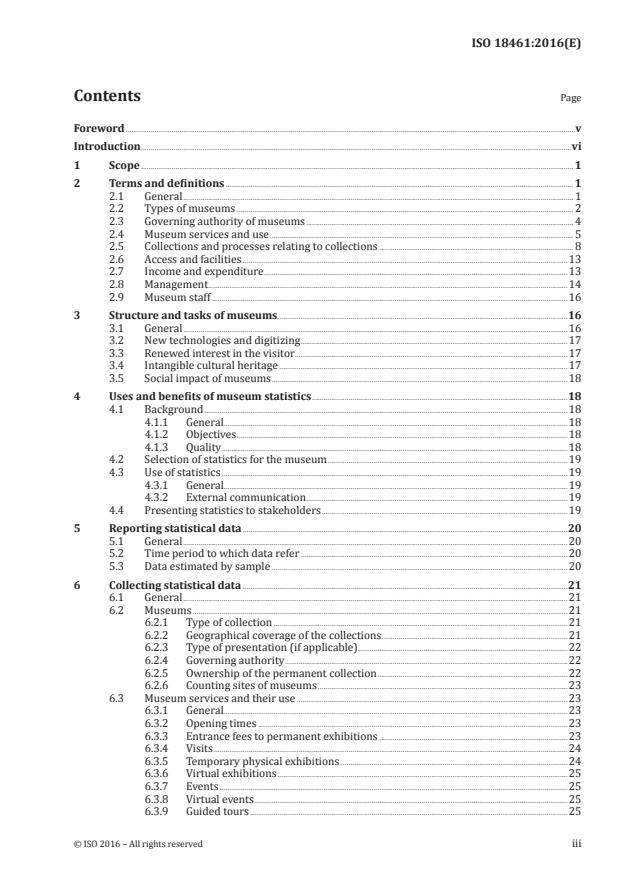
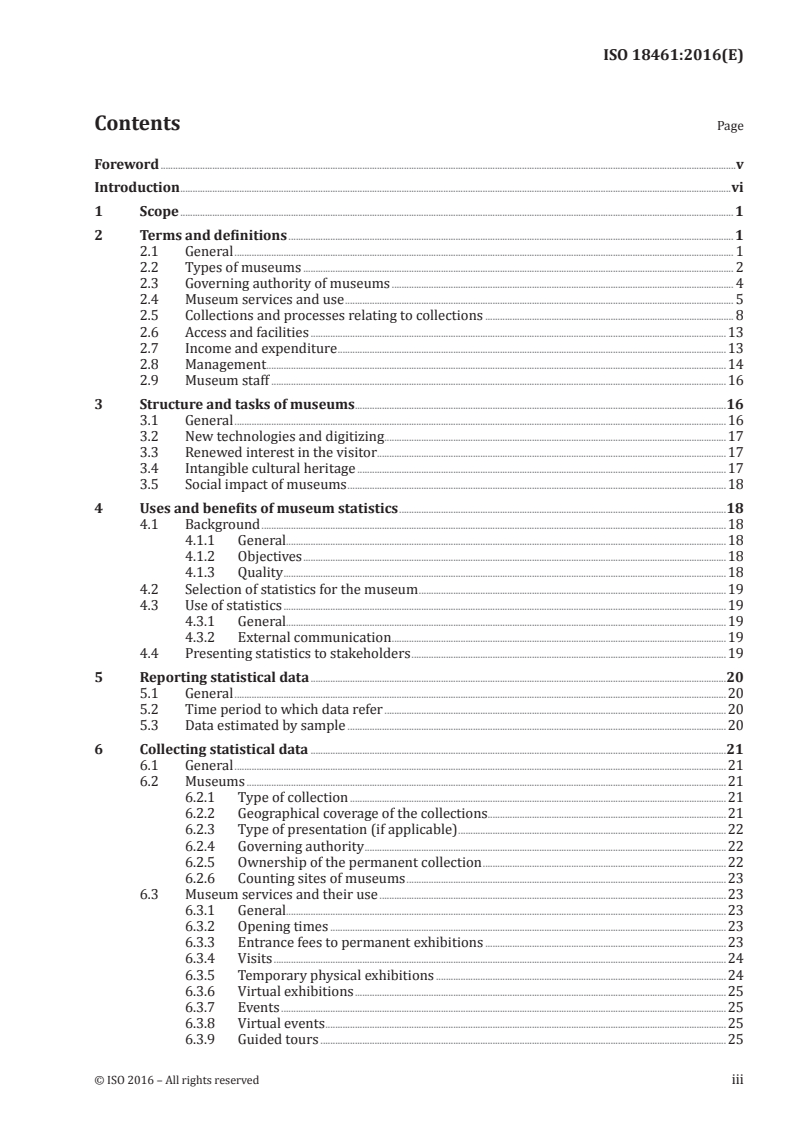
Contents Page
Foreword .v
Introduction .vi
1 Scope . 1
2 Terms and definitions . 1
2.1 General . 1
2.2 Types of museums . 2
2.3 Governing authority of museums . 4
2.4 Museum services and use . 5
2.5 Collections and processes relating to collections . 8
2.6 Access and facilities .13
2.7 Income and expenditure .13
2.8 Management .14
2.9 Museum staff .16
3 Structure and tasks of museums .16
3.1 General .16
3.2 New technologies and digitizing .17
3.3 Renewed interest in the visitor .17
3.4 Intangible cultural heritage .17
3.5 Social impact of museums .18
4 Uses and benefits of museum statistics .18
4.1 Background .18
4.1.1 General.18
4.1.2 Objectives .18
4.1.3 Quality .18
4.2 Selection of statistics for the museum .19
4.3 Use of statistics .19
4.3.1 General.19
4.3.2 External communication .19
4.4 Presenting statistics to stakeholders .19
5 Reporting statistical data .20
5.1 General .20
5.2 Time period to which data refer .20
5.3 Data estimated by sample .20
6 Collecting statistical data .21
6.1 General .21
6.2 Museums .21
6.2.1 Type of collection .21
6.2.2 Geographical coverage of the collections.21
6.2.3 Type of presentation (if applicable) .22
6.2.4 Governing authority .22
6.2.5 Ownership of the permanent collection .22
6.2.6 Counting sites of museums .23
6.3 Museum services and their use .23
6.3.1 General.23
6.3.2 Opening times .23
6.3.3 Entrance fees to permanent exhibitions .23
6.3.4 Visits .24
6.3.5 Temporary physical exhibitions .24
6.3.6 Virtual exhibitions .25
6.3.7 Events .25
6.3.8 Virtual events .25
6.3.9 Guided tours .25
6.3.10 Programmes .26
6.3.11 Virtual programmes .26
6.3.12 Publications .26
6.3.13 Museum website .26
6.3.14 Online services .27
6.3.15 Collection information available online (at the end of the reporting period) .27
6.3.16 Services for mobile devices offered by the museum.27
6.3.17 Social network services .27
6.3.18 Loans .27
6.3.19 Special services .27
6.4 Collections .28
6.4.1 Total collection at the end of the reporting period .28
6.4.2 Accessions.28
6.4.3 Deaccessions/withdrawals .28
6.4.4 Mode of acquisition .28
6.4.5 Percentage of objects in the collection on display .28
6.4.6 Documentary coverage of the collection .28
6.5 Income and expenditure .29
6.5.1 Operating (ordinary) expenditure .29
6.5.2 Capital expenditure .30
6.5.3 Income and funding .30
6.6 Space .30
6.6.1 Gross floor area .30
6.6.2 Net usable area for museum functions .30
6.6.3 Net usable area by function .31
6.6.4 Barrier-free access .31
6.7 Management .31
6.7.1 Preservation/conservation .31
6.7.2 Digitization.31
6.8 Museum staff (at the end of the reporting period) .32
6.8.1 Paid staff .32
6.8.2 Volunteers .32
6.8.3 Internships and trainees .32
6.8.4 Staff training .32
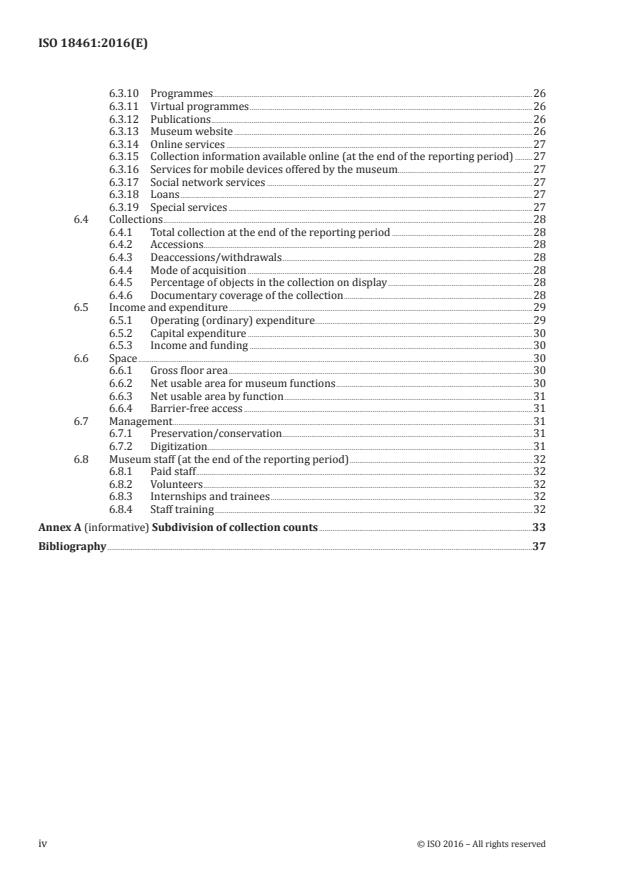
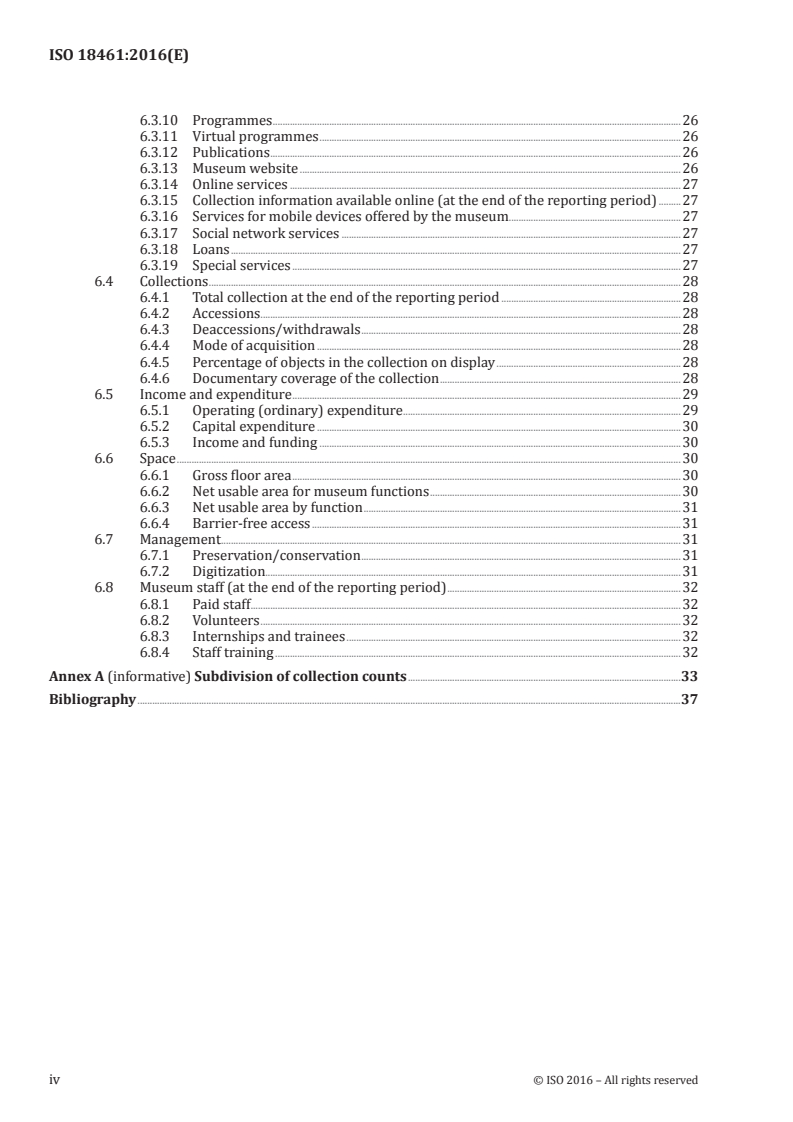
Annex A (informative) Subdivision of collection counts .33
Bibliography .37
iv © ISO 2016 – All rights reserved
Foreword
ISO (the International Organization for Standardization) is a worldwide federation of national standards
bodies (ISO member bodies). The work of preparing International Standards is normally carried out
through ISO technical committees. Each member body interested in a subject for which a technical
committee has been established has the right to be represented on that committee. International
organizations, governmental and non-governmental, in liaison with ISO, also take part in the work.
ISO collaborates closely with the International Electrotechnical Commission (IEC) on all matters of
electrotechnical standardization.
The procedures used to develop this document and those intended for its further maintenance are
described in the ISO/IEC Directives, Part 1. In particular the different approval criteria needed for the
different types of ISO documents should be noted. This document was drafted in accordance with the
editorial rules of the ISO/IEC Directives, Part 2 (see www.iso.org/directives).
Attention is drawn to the possibility that some of the elements of this document may be the subject of
patent rights. ISO shall not be held responsible for identifying any or all such patent rights. Details of
any patent rights identified during the development of the document will be in the Introduction and/or
on the ISO list of patent declarations received (see www.iso.org/patents).
Any trade name used in this document is information given for the convenience of users and does not
constitute an endorsement.
For an explanation on the meaning of ISO specific terms and expressions related to conformity
assessment, as well as information about ISO’s adherence to the WTO principles in the Technical
Barriers to Trade (TBT) see the following URL: Foreword - Supplementary information.
The committee responsible for this document is ISO/TC 46, Information and documentation,
Subcommittee SC 8, Quality — Statistics and performance evaluation.
Introduction
This International Standard provides guidance to the museum community on the collection and
reporting of statistics
— for the purpose of strategic planning and internal management of museums,
— for reporting to stakeholders such as funding institutions, politicians, or the public,
— to promote the museums’ role and value for learning and research, education and culture, social and
economic life, and
— for comparing and aggregating results at a regional, national or international level.
Clause 2 and Clause 6 form the core of this International Standard. Clause 2 provides definitions for
most of the elements which constitute a museum or museum service; these are for statistical purposes
only. Clause 6 recommends how each of these elements should be counted. Users will need to consult
both clauses for the complete information.
In order to show the setting in which the defined museum services appear, Clause 3 describes the
current structure and tasks of museums. Annex A gives a structure for differentiated collection counts.
Describing and publicizing museum activities consistently can only be realized if data collection in
museums follows the lines of this International Standard. As far as possible, museums should collect all
data named in this International Standard that concern their activities.
This International Standard will be maintained by a Working Group that will monitor developments
and incorporate additional statistical measures as needed.
This International Standard has been developed in close cooperation with International Council
on Museums (ICOM) and takes advantage of, particularly, the work of European Group on Museum
Statistics (EGMUS) and of the Institute of Museum and Library Services (US).
vi © ISO 2016 – All rights reserved
INTERNATIONAL STANDARD ISO 18461:2016(E)
International museum statistics
1 Scope
This International Standard specifies rules for the museum community on the collection and reporting
of statistics. It provides definitions and counting procedures for all types of resources and services that
museums offer to their users.
It is recognized that not all measures specified in this International Standard can be collected by
museums of different type and size. The aim is to ensure that, where a particular statistic is collected,
the same definitions and methods are used.
This International Standard is not intended to exclude the use of methods not specified in it. There
are many different types of museums, with different tasks and audiences, having a range of unique
characteristics (structure, funding, governance, etc.), and affected by a number of situational factors.
Since there is such a wide variation around the world, it is important to understand that not all methods
described in this International Standard may be required by or useful to all museums.
2 Terms and definitions
For the purposes of this document, the following terms and definitions apply.
2.1 General
2.1.1
archival records
record (2.8.11) of the same provenance accumulated by an organization or person in the course of the
conduct of affairs, and preserved because of their enduring value
2.1.2
archives
organization or part of an organization responsible for selection, acquisition (2.5.2), preservation (2.8.9)
and availability of one or more sets of archival documents
[SOURCE: ISO 5127:—, 4.2.3.01 — modified]
2.1.3
cultural heritage
legacy of physical objects and intangible attributes of a group or a society that are inherited from past
generations, maintained and protected in the present and preserved for future generations
2.1.4
library
organization, or part of an organization, the main aim of which is to facilitate the use of such information
resources, services and facilities as are required to meet the informational, research, educational,
cultural or recreational needs of its users
Note 1 to entry: The supply of the required information resources can be accomplished by building and
maintaining a collection (2.5.9) and/or by organizing access to information resources.
Note 2 to entry: These are the basic requirements for a library and do not exclude any additional resources and
services incidental to its main purpose.
[SOURCE: ISO 2789:2013, 2.1.6]
2.1.5
museum
non-profit, permanent institution in the service of society and its development, open to the public,
which acquires, conserves, researches, communicates and exhibits the tangible and intangible heritage
of humanity and its environment for the purposes of education, study and enjoyment
Note 1 to entry: Natural, archaeological and ethnographic monuments and sites and historical monuments and
sites of a museum nature are included, if they maintain a collection (2.5.9) similar to museums.
Note 2 to entry: Zoos (2.2.17), aquaria (2.2.1), arboreta (2.2.2) and botanic gardens (2.2.5) are included, but
should be reported separately.
Note 3 to entry: Collections in institutions of higher education that serve only the purposes of teaching and study
are excluded.
Note 4 to entry: Conservation institutes and exhibition galleries in libraries and archives centres are included if
they conform to the definition of museum.
Note 5 to entry: To conform to the definition it is not necessary that an institution be called a museum, but that it
has the role and function of a museum.
[SOURCE: ICOM, Museum definition, 2007]
2.1.6
museum site
location of a museum (2.1.5)
Note 1 to entry: Only sites operated by the museum itself are included.
2.2 Types of museums
2.2.1
aquarium
establishment that maintains a collection (2.5.9) of live aquatic animals and plants for display to the
public, study, and conservation
2.2.2
arboretum
botanic garden (2.2.5) devoted to trees
2.2.3
archaeology museum
museum (2.1.5) owing all or a part of its collections (2.5.9) to excavations
[SOURCE: UNESCO classification]
2.2.4
art museum
museum (2.1.5) concerned with works of visual art
Note 1 to entry: Includes museums of sculpture, picture galleries, museums of photography and cinema, and
museums of architecture.
Note 2 to entry: Commercial art galleries are excluded.
2.2.5
botanic garden
establishment where plants are grown for scientific study and display to the public
Note 1 to entry: Arboreta (2.2.2), herbaria (2.2.9), etc. are included.
2 © ISO 2016 – All rights reserved
2.2.6
ecomuseum
museum (2.1.5) which is managed by local communities and aims to showcase and protect important
elements of an area’s cultural and natural heritage
2.2.7
ethnography and anthropology museum
museum (2.1.5) concerned with subjects relating to culture, social structure, beliefs, customs,
traditional arts, etc.
Note 1 to entry: Adapted from the UNESCO classification.
2.2.8
general museum
museum (2.1.5) which has mixed collections (2.5.9) and cannot be identified by a predominant field
Note 1 to entry: “Universal museums” are considered “general museums”.
Note 2 to entry: Adapted from the UNESCO classification.
2.2.9
herbarium
establishment that maintains a collection (2.5.9) of dried plants for display to the public, study and
conservation
2.2.10
history museum
museum (2.1.5) concerned with the history of a defined geographic area or a cultural group of people
over a limited period or over the centuries
Note 1 to entry: Includes museums with collections (2.5.9) of historical objects, commemorative museums,
military museums, museums on historical persons, etc.
Note 2 to entry: Adapted from the UNESCO classification.
2.2.11
living history museum
museum (2.1.5) which recreates historical settings to simulate past time periods
2.2.12
natural history museum
museum (2.1.5) concerned with subjects relating to one or several disciplines such as biology, geology,
botany, zoology, palaeontology and ecology
Note 1 to entry: Adapted from the UNESCO classification.
2.2.13
open-air museum
museum (2.1.5) that exhibits buildings and objects out-of-doors, often in archaeological sites, past
industrial or mining heritage sites and settings of recreated landscapes of the past, and which includes
the site around the buildings
2.2.14
science and technology museum
museum (2.1.5) concerned with exact sciences or technologies such as astronomy, mathematics, physics,
chemistry, medical science, computing, engineering, and applied sciences
Note 1 to entry: Planetaria and science centres are included.
Note 2 to entry: Adapted from the UNESCO classification.
2.2.15
specialized museum
museum (2.1.5) concerned with all aspects of a single subject
Note 1 to entry: Examples for single subjects are “cats” or “Jonathan Swift”.
Note 2 to entry: Adapted from the UNESCO classification.
2.2.16
virtual museum
online-only museum (2.1.5) without physical building or physical collection (2.5.9)
Note 1 to entry: Physical museums with online presence are excluded.
Note 2 to entry: Virtual museums can also be denoted as online museum, hypermuseum, digital museum,
cybermuseum or web museum.
2.2.17
zoo
establishment that maintains a collection (2.5.9) of live animals, typically in a park or in gardens, for
display to the public, study, and conservation
2.3 Governing authority of museums
2.3.1
governing authority
body with legal and fiduciary responsibility for the museum (2.1.5) and for approving museum policy
Note 1 to entry: The governing authority can be represented by a Board of Trustees.
2.3.2
locally/regionally governed museum
museum (2.1.5) governed by local or regional authorities (province, county, city, town, etc.).
2.3.3
other public-governed museums
museum (2.1.5) governed by other public authorities
Note 1 to entry: Foundations or associations registered under private law but governed by the state are included.
Note 2 to entry: Museums governed by state universities are included.
2.3.4
private-governed museum
museum (2.1.5) governed by private entities (such as non-profit organisations registered under private
law), families or individuals
Note 1 to entry: Foundations or associations registered under private law but governed by the state are excluded.
2.3.5
public/private partnership museum
museum (2.1.5) governed jointly, in partnership of a public and a private institution
Note 1 to entry: Museums governed by private universities are included.
Note 2 to entry: Museums governed jointly by governmental and local/regional authorities are included.
2.3.6
state-governed museum
museum (2.1.5) governed by governmental authorities above local or regional level
4 © ISO 2016 – All rights reserved
2.4 Museum services and use
2.4.1
audio guide
hand-held device providing recorded audio information for visitors touring a museum (2.1.5), gallery, or
other place of interest
2.4.2
deposit
DEPRECATED: permanent loan
transfer of objects to an institution without change of ownership or legal title, or the objects acquired
by such a transfer
[SOURCE: ISO 5127:—, 4.6.2.2.09 — modified]
2.4.3
download
successful request of a content unit from a museum-provided online service or other Internet service
[SOURCE: ISO 2789:2013, 2.2.6 — modified]
2.4.4
electronic interactive service
museum (2.1.5) service with social software that facilitates a bidirectional exchange of information
among users or between users and the museum
Note 1 to entry: Examples are blogs and wikis.
[SOURCE: ISO 2789:2013, 2.2.15 — modified]
2.4.5
event
pre-arranged singular activity having an intent within the mission of the museum (2.1.5)
Note 1 to entry: The activity would usually be of a cultural, educational, social political or scholarly nature, and
would take the form of lectures, film screening, theatre performances, round table discussions, etc.
Note 2 to entry: Events can be organized inside or outside the museum premises.
Note 3 to entry: Events inside the museum premises organized by institutions outside the museum without the
museum’s participation should be counted separately.
Note 4 to entry: Guided tours, programmes, exhibitions (2.4.6) and virtual events (2.4.21) are excluded.
2.4.6
exhibition
curated display of museum (2.1.5) objects or other items of cultural heritage (2.1.3) on a clear concept
and communicating a message
Note 1 to entry: Exhibitions can take place inside or outside the museum premises.
Note 2 to entry: Exhibitions can be temporary or permanent.
Note 3 to entry: Virtual exhibitions (2.4.22) are excluded.
Note 4 to entry: Exhibitions inside the museum premises organized by institutions outside the museum without
the museum’s participation should be counted separately.
[SOURCE: ISO 2789:2013, 2.2.10 — modified]
2.4.7
loan
lending of an object in the museum’s (2.1.5) collection (2.5.9) to, or borrowing an object from, other
collecting organisations, private collectors, or agencies
Note 1 to entry: Deposits (permanent loans) (2.4.2) are counted separately.
2.4.8
mobile device
portable computing device, typically having a display screen with touch, pen and/or keyboard input
and Internet connection
[SOURCE: ISO 2789:2013, 2.2.20 — modified]
2.4.9
museum website
unique domain on the Internet consisting of a collection (2.5.9) of web pages that is published by a
museum (2.1.5) to provide access to the museum’s services and resources
Note 1 to entry: The pages of a website are usually interconnected by the use of hypertext links.
Note 2 to entry: Excludes documents that fit the definitions of “digitised collection” and “free Internet resources”
that are linked from the museum website.
[SOURCE: ISO 2789:2013, 2.2.18 — modified]
2.4.10
online access
successful request of a museum-provided online service
Note 1 to entry: An online access is one cycle of user activities that typically starts when a user connects to
a museum-provided online service and ends by a terminating activity that is either explicit (by leaving the
database through log-out or exit) or implicit (timeout due to user inactivity).
Note 2 to entry: Online accesses to the museum website (2.4.9) are counted as virtual visits (2.4.23).
Note 3 to entry: If possible, requests by robots/web crawlers should be excluded.
[SOURCE: ISO 2789:2013, 2.2.1 — modified]
2.4.11
online catalogue
database of records and images describing objects of one or more museums (2.1.5) presented for
public access
2.4.12
online image library
image collection (2.5.9) with an interface for downloading (2.4.3) and/or purchasing images
2.4.13
permanent exhibition
long-term exhibition
exhibition (2.4.6) showing, over a long period of time, objects which are in long-term custody of the
museum (2.1.5)
2.4.14
physical visit
act of entering into one or all of the parts of the museum (2.1.5) premises
6 © ISO 2016 – All rights reserved
2.4.15
programme
pre-arranged ongoing and repeatable activity having an intent within the mission of the museum (2.1.5)
Note 1 to entry: The activity would usually be of a cultural, educational, social political or scholarly nature, and
would take the form of workshops, travel programmes, courses for school classes, etc.
Note 2 to entry: Programmes can be organized inside or outside the museum premises.
Note 3 to entry: Programmes inside the museum premises organized by institutions outside the museum without
the museum’s participation should be counted separately.
Note 4 to entry: Events (2.4.5), guided tours, exhibitions (2.4.6) and virtual events (2.4.21) are excluded, but are
counted separately.
Note 5 to entry: Virtual programmes are included, but should be counted separately.
2.4.16
social network service
electronic service designed to allow users to establish a personal or organizational profile and contact
other individuals for the purpose of communicating, collaborating, and/or sharing content with them
Note 1 to entry: Users can be individual persons or institutions such as museums (2.1.5).
Note 2 to entry: Most services allow members to restrict the visibility of their profile information to registered
service members only, people on an established list of contacts, or particular groups of service users.
[SOURCE: ISO 2789:2013, 2.2.33 — modified]
2.4.17
target population
groups of actual and potential users appropriate to a museum (2.1.5) as the object of a specific service
or as the primary users of specific materials
Note 1 to entry: Such target groups can e.g. be children, schools, researchers, or educators.
[SOURCE: ISO 11620:2014, 3.49 — modified]
2.4.18
temporary exhibition
short-term exhibition
exhibition (2.4.6) shown during a limited period of time
Note 1 to entry: A temporary exhibition is counted only once, in the year it is started.
2.4.19
travelling exhibition
exhibition (2.4.6) that is shown consecutively in several locations
2.4.20
user
recipient of museum (2.1.5) services
Note 1 to entry: The recipient can be a person or an institution, including museums (2.1.5).
Note 2 to entry: Museum services include electronic services, physical services and visiting the museum premises.
[SOURCE: ISO 2789:2013, 2.2.36 — modified]
2.4.21
virtual event
event (2.4.5) in electronic format, specially designed for use via the Internet
[SOURCE: ISO 2789:2013, 2.2.38 — modified]
2.4.22
virtual exhibition
exhibition (2.4.6) in electronic format, specially designed for use via the Internet
2.4.23
virtual visit
one continuous cycle of user activities on the museum website (2.4.9), regardless of the number of pages
or elements viewed
Note 1 to entry: A virtual visit typically starts when a user accesses the museum website after visiting an
external page, and ends if no activity has been recorded for a defined period of time (a maximum of 30 min).
Another access after a longer interval initiates a new visit.
Note 2 to entry: A virtual visitor should at least be identified by a unique cookie and/or by a unique combination
of the user’s IP address and browser string (user agent). Known web spiders and harvesters should be excluded.
[SOURCE: ISO 2789:2013, 2.2.39 — modified]
2.4.24
visitor
person (individual) entering the museum (2.1.5) premises
[SOURCE: ISO 2789:2013, 2.2.40 — modified]
2.5 Collections and processes relating to collections
NOTE For certain collection management procedures, detailed instruction and advice is given in “SPECTRUM
The UK Museum Collections Management Standard” which is also available in several national language
translations.
2.5.1
accession
addition
formal act of entering an object into the collections (2.5.9) of a museum (2.1.5)
Note 1 to entry: Once an object has been accessioned, it has a status beyond that of merely being the property
of the organization and can only be disposed of by referring to the governing body of the organization, e.g. the
trustees or director.
2.5.2
acquisition
process of gaining legal possession of an object for a museum (2.1.5) collection (2.5.9), through purchase,
donation (2.5.17), bequest, transfer or fieldwork
2.5.3
art object
object made with an artistic intention or considered of artistic value
2.5.4
artefact
object made or shaped by a human, such as a tool or an art object (2.5.3)
Note 1 to entry: Objects created for their aesthetic value are considered art objects.
Note 2 to entry: Replicas are excluded.
8 © ISO 2016 – All rights reserved
2.5.5
audiovisual document
document (2.5.16) in which sound and/or pictures are prominent, and which requires the use of special
equipment to be seen and/or heard
Note 1 to entry: This includes audio documents such as phonographic records (2.5.27), tapes, cassettes, audio
compact discs, DVDs, files of digital audio recordings; visual documents such as slides, transparencies; and
combined audiovisual documents, such as motion pictures, video recordings, computer games, etc.
Note 2 to entry: Microforms are excluded.
[SOURCE: ISO 5127:—, 4.3.3.07 — modified]
Note 3 to entry:
2.5.6
book
non-serial printed document (2.5.16) in codex form
Note 1 to entry: Handwritten or typescript documents in codex form are called manuscripts.
[SOURCE: ISO 2789:2013, 2.3.4 — modified]
2.5.7
born digital object
object that has been created originally in digital form
Note 1 to entry: Documents are included.
2.5.8
cartographic document
conventional representation, on a reduced scale, of concrete or abstract phenomena which can be
localized in space and time
Note 1 to entry: This includes documents (2.5.16) such as two-dimensional and three-dimensional maps,
globes, plans, topographic models, tactile maps and aerial representations, but excludes atlases and any other
cartographic documents in codex form that are counted as books (2.5.6).
[SOURCE: ISO 5127:—, 4.4.7.58 — modified]
2.5.9
collection
body of acquired objects held in title by a museum (2.1.5)
2.5.10
collection management
all practices and procedures implemented by a museum (2.1.5) in acquiring, documenting, handling,
accessing, cataloguing, storing, securing, lending, conserving and disposing of collection objects
2.5.11
collection policy
museum’s (2.1.5) scope and its aims, practices and procedures of collection management (2.5.10)
Note 1 to entry: The collection policy also identifies the kinds of objects a museum will collect, the terms and
conditions governing acquisitions (2.5.2) and the deaccession (2.5.12) policy.
2.5.12
deaccession
withdrawal
object withdrawn from the museum (2.1.5) collection (2.5.9) during the reporting period
Note 1 to entry: Withdrawals can be affected, for example, by discarding, transferring, selling or, in the case of
electronic resources, by deletion of files.
Note 2 to entry: Losses and thefts are included, but should be counted separately.
[SOURCE: ISO 2789:2013, 2.3.51 — modified]
2.5.13
digital collection
all objects in digital form in the museum (2.1.5) collection (2.5.9), whether born digital or digitized
Note 1 to entry: Documents are included.
2.5.14
digital object
object that has been digitally created or digitized by the museum (2.1.5) or has been acquired in
digital form
Note 1 to entry: Documents are included.
2.5.15
digitized object
digitally reproduced object
Note 1 to entry: A two-dimensional or three-dimensional object is counted as digitized if its metadata and at
least one image of it are available in digital format.
Note 2 to entry: Documents such as autographs, books (2.5.6) or audiovisual documents (2.5.5) are counted as
digitized if their metadata and their contents are available in digital format.
Note 3 to entry: Documents are included.
2.5.16
document
recorded information which can be treated as a unit in a documentation process
Note 1 to entry: Documents can differ in form and characteristics.
[SOURCE: ISO 5127:—, 4.1.1.38 — modified]
2.5.17
donation
gift
acquisition (2.5.2) without payment from the museum’s (2.1.5) resources and with change of ownership
and legal title
[SOURCE: ISO 5127:—, 4.6.2.2.01 — modified]
2.5.18
drawing
picture made with a solid mineral substance or a pointed tool
[SOURCE: ISO 5127:—, 4.4.7.53 — modified]
2.5.19
film
series of pictures recorded on a strip of transparent material, or on an electronic data medium, which,
when projected or produced rapidly one after another on a screen, give the illusion of natural and
continuous movement
[SOURCE: ISO 5127:—, 4.4.5.1.08 — modified]
10 © ISO 2016 – All rights reserved
2.5.20
free Internet resource
Internet resource with unrestricted (open) access for which no payment is required
[SOURCE: ISO 2789:2013, 2.3.23]
2.5.21
graphic document
document (2.5.16) in which pictorial representation is the most prominent feature and which has been
produced by graphic techniques on a flat surface
Note 1 to entry: This is pictorial rather t
...
INTERNATIONAL ISO
STANDARD 18461
First edition
2016-03-01
International museum statistics
Statistiques internationales des musées
Reference number
©
ISO 2016
© ISO 2016, Published in Switzerland
All rights reserved. Unless otherwise specified, no part of this publication may be reproduced or utilized otherwise in any form
or by any means, electronic or mechanical, including photocopying, or posting on the internet or an intranet, without prior
written permission. Permission can be requested from either ISO at the address below or ISO’s member body in the country of
the requester.
ISO copyright office
Ch. de Blandonnet 8 • CP 401
CH-1214 Vernier, Geneva, Switzerland
Tel. +41 22 749 01 11
Fax +41 22 749 09 47
copyright@iso.org
www.iso.org
ii © ISO 2016 – All rights reserved
Contents Page
Foreword .v
Introduction .vi
1 Scope . 1
2 Terms and definitions . 1
2.1 General . 1
2.2 Types of museums . 2
2.3 Governing authority of museums . 4
2.4 Museum services and use . 5
2.5 Collections and processes relating to collections . 8
2.6 Access and facilities .13
2.7 Income and expenditure .13
2.8 Management .14
2.9 Museum staff .16
3 Structure and tasks of museums .16
3.1 General .16
3.2 New technologies and digitizing .17
3.3 Renewed interest in the visitor .17
3.4 Intangible cultural heritage .17
3.5 Social impact of museums .18
4 Uses and benefits of museum statistics .18
4.1 Background .18
4.1.1 General.18
4.1.2 Objectives .18
4.1.3 Quality .18
4.2 Selection of statistics for the museum .19
4.3 Use of statistics .19
4.3.1 General.19
4.3.2 External communication .19
4.4 Presenting statistics to stakeholders .19
5 Reporting statistical data .20
5.1 General .20
5.2 Time period to which data refer .20
5.3 Data estimated by sample .20
6 Collecting statistical data .21
6.1 General .21
6.2 Museums .21
6.2.1 Type of collection .21
6.2.2 Geographical coverage of the collections.21
6.2.3 Type of presentation (if applicable) .22
6.2.4 Governing authority .22
6.2.5 Ownership of the permanent collection .22
6.2.6 Counting sites of museums .23
6.3 Museum services and their use .23
6.3.1 General.23
6.3.2 Opening times .23
6.3.3 Entrance fees to permanent exhibitions .23
6.3.4 Visits .24
6.3.5 Temporary physical exhibitions .24
6.3.6 Virtual exhibitions .25
6.3.7 Events .25
6.3.8 Virtual events .25
6.3.9 Guided tours .25
6.3.10 Programmes .26
6.3.11 Virtual programmes .26
6.3.12 Publications .26
6.3.13 Museum website .26
6.3.14 Online services .27
6.3.15 Collection information available online (at the end of the reporting period) .27
6.3.16 Services for mobile devices offered by the museum.27
6.3.17 Social network services .27
6.3.18 Loans .27
6.3.19 Special services .27
6.4 Collections .28
6.4.1 Total collection at the end of the reporting period .28
6.4.2 Accessions.28
6.4.3 Deaccessions/withdrawals .28
6.4.4 Mode of acquisition .28
6.4.5 Percentage of objects in the collection on display .28
6.4.6 Documentary coverage of the collection .28
6.5 Income and expenditure .29
6.5.1 Operating (ordinary) expenditure .29
6.5.2 Capital expenditure .30
6.5.3 Income and funding .30
6.6 Space .30
6.6.1 Gross floor area .30
6.6.2 Net usable area for museum functions .30
6.6.3 Net usable area by function .31
6.6.4 Barrier-free access .31
6.7 Management .31
6.7.1 Preservation/conservation .31
6.7.2 Digitization.31
6.8 Museum staff (at the end of the reporting period) .32
6.8.1 Paid staff .32
6.8.2 Volunteers .32
6.8.3 Internships and trainees .32
6.8.4 Staff training .32
Annex A (informative) Subdivision of collection counts .33
Bibliography .37
iv © ISO 2016 – All rights reserved
Foreword
ISO (the International Organization for Standardization) is a worldwide federation of national standards
bodies (ISO member bodies). The work of preparing International Standards is normally carried out
through ISO technical committees. Each member body interested in a subject for which a technical
committee has been established has the right to be represented on that committee. International
organizations, governmental and non-governmental, in liaison with ISO, also take part in the work.
ISO collaborates closely with the International Electrotechnical Commission (IEC) on all matters of
electrotechnical standardization.
The procedures used to develop this document and those intended for its further maintenance are
described in the ISO/IEC Directives, Part 1. In particular the different approval criteria needed for the
different types of ISO documents should be noted. This document was drafted in accordance with the
editorial rules of the ISO/IEC Directives, Part 2 (see www.iso.org/directives).
Attention is drawn to the possibility that some of the elements of this document may be the subject of
patent rights. ISO shall not be held responsible for identifying any or all such patent rights. Details of
any patent rights identified during the development of the document will be in the Introduction and/or
on the ISO list of patent declarations received (see www.iso.org/patents).
Any trade name used in this document is information given for the convenience of users and does not
constitute an endorsement.
For an explanation on the meaning of ISO specific terms and expressions related to conformity
assessment, as well as information about ISO’s adherence to the WTO principles in the Technical
Barriers to Trade (TBT) see the following URL: Foreword - Supplementary information.
The committee responsible for this document is ISO/TC 46, Information and documentation,
Subcommittee SC 8, Quality — Statistics and performance evaluation.
Introduction
This International Standard provides guidance to the museum community on the collection and
reporting of statistics
— for the purpose of strategic planning and internal management of museums,
— for reporting to stakeholders such as funding institutions, politicians, or the public,
— to promote the museums’ role and value for learning and research, education and culture, social and
economic life, and
— for comparing and aggregating results at a regional, national or international level.
Clause 2 and Clause 6 form the core of this International Standard. Clause 2 provides definitions for
most of the elements which constitute a museum or museum service; these are for statistical purposes
only. Clause 6 recommends how each of these elements should be counted. Users will need to consult
both clauses for the complete information.
In order to show the setting in which the defined museum services appear, Clause 3 describes the
current structure and tasks of museums. Annex A gives a structure for differentiated collection counts.
Describing and publicizing museum activities consistently can only be realized if data collection in
museums follows the lines of this International Standard. As far as possible, museums should collect all
data named in this International Standard that concern their activities.
This International Standard will be maintained by a Working Group that will monitor developments
and incorporate additional statistical measures as needed.
This International Standard has been developed in close cooperation with International Council
on Museums (ICOM) and takes advantage of, particularly, the work of European Group on Museum
Statistics (EGMUS) and of the Institute of Museum and Library Services (US).
vi © ISO 2016 – All rights reserved
INTERNATIONAL STANDARD ISO 18461:2016(E)
International museum statistics
1 Scope
This International Standard specifies rules for the museum community on the collection and reporting
of statistics. It provides definitions and counting procedures for all types of resources and services that
museums offer to their users.
It is recognized that not all measures specified in this International Standard can be collected by
museums of different type and size. The aim is to ensure that, where a particular statistic is collected,
the same definitions and methods are used.
This International Standard is not intended to exclude the use of methods not specified in it. There
are many different types of museums, with different tasks and audiences, having a range of unique
characteristics (structure, funding, governance, etc.), and affected by a number of situational factors.
Since there is such a wide variation around the world, it is important to understand that not all methods
described in this International Standard may be required by or useful to all museums.
2 Terms and definitions
For the purposes of this document, the following terms and definitions apply.
2.1 General
2.1.1
archival records
record (2.8.11) of the same provenance accumulated by an organization or person in the course of the
conduct of affairs, and preserved because of their enduring value
2.1.2
archives
organization or part of an organization responsible for selection, acquisition (2.5.2), preservation (2.8.9)
and availability of one or more sets of archival documents
[SOURCE: ISO 5127:—, 4.2.3.01 — modified]
2.1.3
cultural heritage
legacy of physical objects and intangible attributes of a group or a society that are inherited from past
generations, maintained and protected in the present and preserved for future generations
2.1.4
library
organization, or part of an organization, the main aim of which is to facilitate the use of such information
resources, services and facilities as are required to meet the informational, research, educational,
cultural or recreational needs of its users
Note 1 to entry: The supply of the required information resources can be accomplished by building and
maintaining a collection (2.5.9) and/or by organizing access to information resources.
Note 2 to entry: These are the basic requirements for a library and do not exclude any additional resources and
services incidental to its main purpose.
[SOURCE: ISO 2789:2013, 2.1.6]
2.1.5
museum
non-profit, permanent institution in the service of society and its development, open to the public,
which acquires, conserves, researches, communicates and exhibits the tangible and intangible heritage
of humanity and its environment for the purposes of education, study and enjoyment
Note 1 to entry: Natural, archaeological and ethnographic monuments and sites and historical monuments and
sites of a museum nature are included, if they maintain a collection (2.5.9) similar to museums.
Note 2 to entry: Zoos (2.2.17), aquaria (2.2.1), arboreta (2.2.2) and botanic gardens (2.2.5) are included, but
should be reported separately.
Note 3 to entry: Collections in institutions of higher education that serve only the purposes of teaching and study
are excluded.
Note 4 to entry: Conservation institutes and exhibition galleries in libraries and archives centres are included if
they conform to the definition of museum.
Note 5 to entry: To conform to the definition it is not necessary that an institution be called a museum, but that it
has the role and function of a museum.
[SOURCE: ICOM, Museum definition, 2007]
2.1.6
museum site
location of a museum (2.1.5)
Note 1 to entry: Only sites operated by the museum itself are included.
2.2 Types of museums
2.2.1
aquarium
establishment that maintains a collection (2.5.9) of live aquatic animals and plants for display to the
public, study, and conservation
2.2.2
arboretum
botanic garden (2.2.5) devoted to trees
2.2.3
archaeology museum
museum (2.1.5) owing all or a part of its collections (2.5.9) to excavations
[SOURCE: UNESCO classification]
2.2.4
art museum
museum (2.1.5) concerned with works of visual art
Note 1 to entry: Includes museums of sculpture, picture galleries, museums of photography and cinema, and
museums of architecture.
Note 2 to entry: Commercial art galleries are excluded.
2.2.5
botanic garden
establishment where plants are grown for scientific study and display to the public
Note 1 to entry: Arboreta (2.2.2), herbaria (2.2.9), etc. are included.
2 © ISO 2016 – All rights reserved
2.2.6
ecomuseum
museum (2.1.5) which is managed by local communities and aims to showcase and protect important
elements of an area’s cultural and natural heritage
2.2.7
ethnography and anthropology museum
museum (2.1.5) concerned with subjects relating to culture, social structure, beliefs, customs,
traditional arts, etc.
Note 1 to entry: Adapted from the UNESCO classification.
2.2.8
general museum
museum (2.1.5) which has mixed collections (2.5.9) and cannot be identified by a predominant field
Note 1 to entry: “Universal museums” are considered “general museums”.
Note 2 to entry: Adapted from the UNESCO classification.
2.2.9
herbarium
establishment that maintains a collection (2.5.9) of dried plants for display to the public, study and
conservation
2.2.10
history museum
museum (2.1.5) concerned with the history of a defined geographic area or a cultural group of people
over a limited period or over the centuries
Note 1 to entry: Includes museums with collections (2.5.9) of historical objects, commemorative museums,
military museums, museums on historical persons, etc.
Note 2 to entry: Adapted from the UNESCO classification.
2.2.11
living history museum
museum (2.1.5) which recreates historical settings to simulate past time periods
2.2.12
natural history museum
museum (2.1.5) concerned with subjects relating to one or several disciplines such as biology, geology,
botany, zoology, palaeontology and ecology
Note 1 to entry: Adapted from the UNESCO classification.
2.2.13
open-air museum
museum (2.1.5) that exhibits buildings and objects out-of-doors, often in archaeological sites, past
industrial or mining heritage sites and settings of recreated landscapes of the past, and which includes
the site around the buildings
2.2.14
science and technology museum
museum (2.1.5) concerned with exact sciences or technologies such as astronomy, mathematics, physics,
chemistry, medical science, computing, engineering, and applied sciences
Note 1 to entry: Planetaria and science centres are included.
Note 2 to entry: Adapted from the UNESCO classification.
2.2.15
specialized museum
museum (2.1.5) concerned with all aspects of a single subject
Note 1 to entry: Examples for single subjects are “cats” or “Jonathan Swift”.
Note 2 to entry: Adapted from the UNESCO classification.
2.2.16
virtual museum
online-only museum (2.1.5) without physical building or physical collection (2.5.9)
Note 1 to entry: Physical museums with online presence are excluded.
Note 2 to entry: Virtual museums can also be denoted as online museum, hypermuseum, digital museum,
cybermuseum or web museum.
2.2.17
zoo
establishment that maintains a collection (2.5.9) of live animals, typically in a park or in gardens, for
display to the public, study, and conservation
2.3 Governing authority of museums
2.3.1
governing authority
body with legal and fiduciary responsibility for the museum (2.1.5) and for approving museum policy
Note 1 to entry: The governing authority can be represented by a Board of Trustees.
2.3.2
locally/regionally governed museum
museum (2.1.5) governed by local or regional authorities (province, county, city, town, etc.).
2.3.3
other public-governed museums
museum (2.1.5) governed by other public authorities
Note 1 to entry: Foundations or associations registered under private law but governed by the state are included.
Note 2 to entry: Museums governed by state universities are included.
2.3.4
private-governed museum
museum (2.1.5) governed by private entities (such as non-profit organisations registered under private
law), families or individuals
Note 1 to entry: Foundations or associations registered under private law but governed by the state are excluded.
2.3.5
public/private partnership museum
museum (2.1.5) governed jointly, in partnership of a public and a private institution
Note 1 to entry: Museums governed by private universities are included.
Note 2 to entry: Museums governed jointly by governmental and local/regional authorities are included.
2.3.6
state-governed museum
museum (2.1.5) governed by governmental authorities above local or regional level
4 © ISO 2016 – All rights reserved
2.4 Museum services and use
2.4.1
audio guide
hand-held device providing recorded audio information for visitors touring a museum (2.1.5), gallery, or
other place of interest
2.4.2
deposit
DEPRECATED: permanent loan
transfer of objects to an institution without change of ownership or legal title, or the objects acquired
by such a transfer
[SOURCE: ISO 5127:—, 4.6.2.2.09 — modified]
2.4.3
download
successful request of a content unit from a museum-provided online service or other Internet service
[SOURCE: ISO 2789:2013, 2.2.6 — modified]
2.4.4
electronic interactive service
museum (2.1.5) service with social software that facilitates a bidirectional exchange of information
among users or between users and the museum
Note 1 to entry: Examples are blogs and wikis.
[SOURCE: ISO 2789:2013, 2.2.15 — modified]
2.4.5
event
pre-arranged singular activity having an intent within the mission of the museum (2.1.5)
Note 1 to entry: The activity would usually be of a cultural, educational, social political or scholarly nature, and
would take the form of lectures, film screening, theatre performances, round table discussions, etc.
Note 2 to entry: Events can be organized inside or outside the museum premises.
Note 3 to entry: Events inside the museum premises organized by institutions outside the museum without the
museum’s participation should be counted separately.
Note 4 to entry: Guided tours, programmes, exhibitions (2.4.6) and virtual events (2.4.21) are excluded.
2.4.6
exhibition
curated display of museum (2.1.5) objects or other items of cultural heritage (2.1.3) on a clear concept
and communicating a message
Note 1 to entry: Exhibitions can take place inside or outside the museum premises.
Note 2 to entry: Exhibitions can be temporary or permanent.
Note 3 to entry: Virtual exhibitions (2.4.22) are excluded.
Note 4 to entry: Exhibitions inside the museum premises organized by institutions outside the museum without
the museum’s participation should be counted separately.
[SOURCE: ISO 2789:2013, 2.2.10 — modified]
2.4.7
loan
lending of an object in the museum’s (2.1.5) collection (2.5.9) to, or borrowing an object from, other
collecting organisations, private collectors, or agencies
Note 1 to entry: Deposits (permanent loans) (2.4.2) are counted separately.
2.4.8
mobile device
portable computing device, typically having a display screen with touch, pen and/or keyboard input
and Internet connection
[SOURCE: ISO 2789:2013, 2.2.20 — modified]
2.4.9
museum website
unique domain on the Internet consisting of a collection (2.5.9) of web pages that is published by a
museum (2.1.5) to provide access to the museum’s services and resources
Note 1 to entry: The pages of a website are usually interconnected by the use of hypertext links.
Note 2 to entry: Excludes documents that fit the definitions of “digitised collection” and “free Internet resources”
that are linked from the museum website.
[SOURCE: ISO 2789:2013, 2.2.18 — modified]
2.4.10
online access
successful request of a museum-provided online service
Note 1 to entry: An online access is one cycle of user activities that typically starts when a user connects to
a museum-provided online service and ends by a terminating activity that is either explicit (by leaving the
database through log-out or exit) or implicit (timeout due to user inactivity).
Note 2 to entry: Online accesses to the museum website (2.4.9) are counted as virtual visits (2.4.23).
Note 3 to entry: If possible, requests by robots/web crawlers should be excluded.
[SOURCE: ISO 2789:2013, 2.2.1 — modified]
2.4.11
online catalogue
database of records and images describing objects of one or more museums (2.1.5) presented for
public access
2.4.12
online image library
image collection (2.5.9) with an interface for downloading (2.4.3) and/or purchasing images
2.4.13
permanent exhibition
long-term exhibition
exhibition (2.4.6) showing, over a long period of time, objects which are in long-term custody of the
museum (2.1.5)
2.4.14
physical visit
act of entering into one or all of the parts of the museum (2.1.5) premises
6 © ISO 2016 – All rights reserved
2.4.15
programme
pre-arranged ongoing and repeatable activity having an intent within the mission of the museum (2.1.5)
Note 1 to entry: The activity would usually be of a cultural, educational, social political or scholarly nature, and
would take the form of workshops, travel programmes, courses for school classes, etc.
Note 2 to entry: Programmes can be organized inside or outside the museum premises.
Note 3 to entry: Programmes inside the museum premises organized by institutions outside the museum without
the museum’s participation should be counted separately.
Note 4 to entry: Events (2.4.5), guided tours, exhibitions (2.4.6) and virtual events (2.4.21) are excluded, but are
counted separately.
Note 5 to entry: Virtual programmes are included, but should be counted separately.
2.4.16
social network service
electronic service designed to allow users to establish a personal or organizational profile and contact
other individuals for the purpose of communicating, collaborating, and/or sharing content with them
Note 1 to entry: Users can be individual persons or institutions such as museums (2.1.5).
Note 2 to entry: Most services allow members to restrict the visibility of their profile information to registered
service members only, people on an established list of contacts, or particular groups of service users.
[SOURCE: ISO 2789:2013, 2.2.33 — modified]
2.4.17
target population
groups of actual and potential users appropriate to a museum (2.1.5) as the object of a specific service
or as the primary users of specific materials
Note 1 to entry: Such target groups can e.g. be children, schools, researchers, or educators.
[SOURCE: ISO 11620:2014, 3.49 — modified]
2.4.18
temporary exhibition
short-term exhibition
exhibition (2.4.6) shown during a limited period of time
Note 1 to entry: A temporary exhibition is counted only once, in the year it is started.
2.4.19
travelling exhibition
exhibition (2.4.6) that is shown consecutively in several locations
2.4.20
user
recipient of museum (2.1.5) services
Note 1 to entry: The recipient can be a person or an institution, including museums (2.1.5).
Note 2 to entry: Museum services include electronic services, physical services and visiting the museum premises.
[SOURCE: ISO 2789:2013, 2.2.36 — modified]
2.4.21
virtual event
event (2.4.5) in electronic format, specially designed for use via the Internet
[SOURCE: ISO 2789:2013, 2.2.38 — modified]
2.4.22
virtual exhibition
exhibition (2.4.6) in electronic format, specially designed for use via the Internet
2.4.23
virtual visit
one continuous cycle of user activities on the museum website (2.4.9), regardless of the number of pages
or elements viewed
Note 1 to entry: A virtual visit typically starts when a user accesses the museum website after visiting an
external page, and ends if no activity has been recorded for a defined period of time (a maximum of 30 min).
Another access after a longer interval initiates a new visit.
Note 2 to entry: A virtual visitor should at least be identified by a unique cookie and/or by a unique combination
of the user’s IP address and browser string (user agent). Known web spiders and harvesters should be excluded.
[SOURCE: ISO 2789:2013, 2.2.39 — modified]
2.4.24
visitor
person (individual) entering the museum (2.1.5) premises
[SOURCE: ISO 2789:2013, 2.2.40 — modified]
2.5 Collections and processes relating to collections
NOTE For certain collection management procedures, detailed instruction and advice is given in “SPECTRUM
The UK Museum Collections Management Standard” which is also available in several national language
translations.
2.5.1
accession
addition
formal act of entering an object into the collections (2.5.9) of a museum (2.1.5)
Note 1 to entry: Once an object has been accessioned, it has a status beyond that of merely being the property
of the organization and can only be disposed of by referring to the governing body of the organization, e.g. the
trustees or director.
2.5.2
acquisition
process of gaining legal possession of an object for a museum (2.1.5) collection (2.5.9), through purchase,
donation (2.5.17), bequest, transfer or fieldwork
2.5.3
art object
object made with an artistic intention or considered of artistic value
2.5.4
artefact
object made or shaped by a human, such as a tool or an art object (2.5.3)
Note 1 to entry: Objects created for their aesthetic value are considered art objects.
Note 2 to entry: Replicas are excluded.
8 © ISO 2016 – All rights reserved
2.5.5
audiovisual document
document (2.5.16) in which sound and/or pictures are prominent, and which requires the use of special
equipment to be seen and/or heard
Note 1 to entry: This includes audio documents such as phonographic records (2.5.27), tapes, cassettes, audio
compact discs, DVDs, files of digital audio recordings; visual documents such as slides, transparencies; and
combined audiovisual documents, such as motion pictures, video recordings, computer games, etc.
Note 2 to entry: Microforms are excluded.
[SOURCE: ISO 5127:—, 4.3.3.07 — modified]
Note 3 to entry:
2.5.6
book
non-serial printed document (2.5.16) in codex form
Note 1 to entry: Handwritten or typescript documents in codex form are called manuscripts.
[SOURCE: ISO 2789:2013, 2.3.4 — modified]
2.5.7
born digital object
object that has been created originally in digital form
Note 1 to entry: Documents are included.
2.5.8
cartographic document
conventional representation, on a reduced scale, of concrete or abstract phenomena which can be
localized in space and time
Note 1 to entry: This includes documents (2.5.16) such as two-dimensional and three-dimensional maps,
globes, plans, topographic models, tactile maps and aerial representations, but excludes atlases and any other
cartographic documents in codex form that are counted as books (2.5.6).
[SOURCE: ISO 5127:—, 4.4.7.58 — modified]
2.5.9
collection
body of acquired objects held in title by a museum (2.1.5)
2.5.10
collection management
all practices and procedures implemented by a museum (2.1.5) in acquiring, documenting, handling,
accessing, cataloguing, storing, securing, lending, conserving and disposing of collection objects
2.5.11
collection policy
museum’s (2.1.5) scope and its aims, practices and procedures of collection management (2.5.10)
Note 1 to entry: The collection policy also identifies the kinds of objects a museum will collect, the terms and
conditions governing acquisitions (2.5.2) and the deaccession (2.5.12) policy.
2.5.12
deaccession
withdrawal
object withdrawn from the museum (2.1.5) collection (2.5.9) during the reporting period
Note 1 to entry: Withdrawals can be affected, for example, by discarding, transferring, selling or, in the case of
electronic resources, by deletion of files.
Note 2 to entry: Losses and thefts are included, but should be counted separately.
[SOURCE: ISO 2789:2013, 2.3.51 — modified]
2.5.13
digital collection
all objects in digital form in the museum (2.1.5) collection (2.5.9), whether born digital or digitized
Note 1 to entry: Documents are included.
2.5.14
digital object
object that has been digitally created or digitized by the museum (2.1.5) or has been acquired in
digital form
Note 1 to entry: Documents are included.
2.5.15
digitized object
digitally reproduced object
Note 1 to entry: A two-dimensional or three-dimensional object is counted as digitized if its metadata and at
least one image of it are available in digital format.
Note 2 to entry: Documents such as autographs, books (2.5.6) or audiovisual documents (2.5.5) are counted as
digitized if their metadata and their contents are available in digital format.
Note 3 to entry: Documents are included.
2.5.16
document
recorded information which can be treated as a unit in a documentation process
Note 1 to entry: Documents can differ in form and characteristics.
[SOURCE: ISO 5127:—, 4.1.1.38 — modified]
2.5.17
donation
gift
acquisition (2.5.2) without payment from the museum’s (2.1.5) resources and with change of ownership
and legal title
[SOURCE: ISO 5127:—, 4.6.2.2.01 — modified]
2.5.18
drawing
picture made with a solid mineral substance or a pointed tool
[SOURCE: ISO 5127:—, 4.4.7.53 — modified]
2.5.19
film
series of pictures recorded on a strip of transparent material, or on an electronic data medium, which,
when projected or produced rapidly one after another on a screen, give the illusion of natural and
continuous movement
[SOURCE: ISO 5127:—, 4.4.5.1.08 — modified]
10 © ISO 2016 – All rights reserved
2.5.20
free Internet resource
Internet resource with unrestricted (open) access for which no payment is required
[SOURCE: ISO 2789:2013, 2.3.23]
2.5.21
graphic document
document (2.5.16) in which pictorial representation is the most prominent feature and which has been
produced by graphic techniques on a flat surface
Note 1 to entry: This is pictorial rather than linguistic, musical or cartographic in form. It includes art prints, art
originals, art reproductions, photographs (2.5.28), posters, study prints, technical drawings, etc., but excludes
graphic documents in codex form or in microform, audiovisual or electronic form.
[SOURCE: ISO 2789:2013, 2.3.25 — modified]
2.5.22
manuscript
original document (2.5.16) that is handwritten or in typescript
Note 1 to entry: Bound volumes and other units (fragments, rolls, autographs, papyri, scrolls, etc.) may be
counted separately.
[SOURCE: ISO 2789:2013, 2.3.29 — modified]
2.5.23
microform
photographic document (2.5.16) requiring magnification when used
Note 1 to entry: Microfiches and microfilms are included.
Note 2 to entry: Slides and similar documents are counted as audiovisual documents (2.5.5).
[SOURCE: ISO 2789:2013, 2.3.30 — modified]
2.5.24
object
item which forms part of a museum’s (2.1.5) collection
...
INTERNATIONAL ISO
STANDARD 18461
First edition
2016-03-01
International museum statistics
Statistiques internationales des musées
Reference number
©
ISO 2016
© ISO 2016, Published in Switzerland
All rights reserved. Unless otherwise specified, no part of this publication may be reproduced or utilized otherwise in any form
or by any means, electronic or mechanical, including photocopying, or posting on the internet or an intranet, without prior
written permission. Permission can be requested from either ISO at the address below or ISO’s member body in the country of
the requester.
ISO copyright office
Ch. de Blandonnet 8 • CP 401
CH-1214 Vernier, Geneva, Switzerland
Tel. +41 22 749 01 11
Fax +41 22 749 09 47
copyright@iso.org
www.iso.org
ii © ISO 2016 – All rights reserved
Contents Page
Foreword .v
Introduction .vi
1 Scope . 1
2 Terms and definitions . 1
2.1 General . 1
2.2 Types of museums . 2
2.3 Governing authority of museums . 4
2.4 Museum services and use . 5
2.5 Collections and processes relating to collections . 8
2.6 Access and facilities .13
2.7 Income and expenditure .13
2.8 Management .14
2.9 Museum staff .16
3 Structure and tasks of museums .16
3.1 General .16
3.2 New technologies and digitizing .17
3.3 Renewed interest in the visitor .17
3.4 Intangible cultural heritage .17
3.5 Social impact of museums .18
4 Uses and benefits of museum statistics .18
4.1 Background .18
4.1.1 General.18
4.1.2 Objectives .18
4.1.3 Quality .18
4.2 Selection of statistics for the museum .19
4.3 Use of statistics .19
4.3.1 General.19
4.3.2 External communication .19
4.4 Presenting statistics to stakeholders .19
5 Reporting statistical data .20
5.1 General .20
5.2 Time period to which data refer .20
5.3 Data estimated by sample .20
6 Collecting statistical data .21
6.1 General .21
6.2 Museums .21
6.2.1 Type of collection .21
6.2.2 Geographical coverage of the collections.21
6.2.3 Type of presentation (if applicable) .22
6.2.4 Governing authority .22
6.2.5 Ownership of the permanent collection .22
6.2.6 Counting sites of museums .23
6.3 Museum services and their use .23
6.3.1 General.23
6.3.2 Opening times .23
6.3.3 Entrance fees to permanent exhibitions .23
6.3.4 Visits .24
6.3.5 Temporary physical exhibitions .24
6.3.6 Virtual exhibitions .25
6.3.7 Events .25
6.3.8 Virtual events .25
6.3.9 Guided tours .25
6.3.10 Programmes .26
6.3.11 Virtual programmes .26
6.3.12 Publications .26
6.3.13 Museum website .26
6.3.14 Online services .27
6.3.15 Collection information available online (at the end of the reporting period) .27
6.3.16 Services for mobile devices offered by the museum.27
6.3.17 Social network services .27
6.3.18 Loans .27
6.3.19 Special services .27
6.4 Collections .28
6.4.1 Total collection at the end of the reporting period .28
6.4.2 Accessions.28
6.4.3 Deaccessions/withdrawals .28
6.4.4 Mode of acquisition .28
6.4.5 Percentage of objects in the collection on display .28
6.4.6 Documentary coverage of the collection .28
6.5 Income and expenditure .29
6.5.1 Operating (ordinary) expenditure .29
6.5.2 Capital expenditure .30
6.5.3 Income and funding .30
6.6 Space .30
6.6.1 Gross floor area .30
6.6.2 Net usable area for museum functions .30
6.6.3 Net usable area by function .31
6.6.4 Barrier-free access .31
6.7 Management .31
6.7.1 Preservation/conservation .31
6.7.2 Digitization.31
6.8 Museum staff (at the end of the reporting period) .32
6.8.1 Paid staff .32
6.8.2 Volunteers .32
6.8.3 Internships and trainees .32
6.8.4 Staff training .32
Annex A (informative) Subdivision of collection counts .33
Bibliography .37
iv © ISO 2016 – All rights reserved
Foreword
ISO (the International Organization for Standardization) is a worldwide federation of national standards
bodies (ISO member bodies). The work of preparing International Standards is normally carried out
through ISO technical committees. Each member body interested in a subject for which a technical
committee has been established has the right to be represented on that committee. International
organizations, governmental and non-governmental, in liaison with ISO, also take part in the work.
ISO collaborates closely with the International Electrotechnical Commission (IEC) on all matters of
electrotechnical standardization.
The procedures used to develop this document and those intended for its further maintenance are
described in the ISO/IEC Directives, Part 1. In particular the different approval criteria needed for the
different types of ISO documents should be noted. This document was drafted in accordance with the
editorial rules of the ISO/IEC Directives, Part 2 (see www.iso.org/directives).
Attention is drawn to the possibility that some of the elements of this document may be the subject of
patent rights. ISO shall not be held responsible for identifying any or all such patent rights. Details of
any patent rights identified during the development of the document will be in the Introduction and/or
on the ISO list of patent declarations received (see www.iso.org/patents).
Any trade name used in this document is information given for the convenience of users and does not
constitute an endorsement.
For an explanation on the meaning of ISO specific terms and expressions related to conformity
assessment, as well as information about ISO’s adherence to the WTO principles in the Technical
Barriers to Trade (TBT) see the following URL: Foreword - Supplementary information.
The committee responsible for this document is ISO/TC 46, Information and documentation,
Subcommittee SC 8, Quality — Statistics and performance evaluation.
Introduction
This International Standard provides guidance to the museum community on the collection and
reporting of statistics
— for the purpose of strategic planning and internal management of museums,
— for reporting to stakeholders such as funding institutions, politicians, or the public,
— to promote the museums’ role and value for learning and research, education and culture, social and
economic life, and
— for comparing and aggregating results at a regional, national or international level.
Clause 2 and Clause 6 form the core of this International Standard. Clause 2 provides definitions for
most of the elements which constitute a museum or museum service; these are for statistical purposes
only. Clause 6 recommends how each of these elements should be counted. Users will need to consult
both clauses for the complete information.
In order to show the setting in which the defined museum services appear, Clause 3 describes the
current structure and tasks of museums. Annex A gives a structure for differentiated collection counts.
Describing and publicizing museum activities consistently can only be realized if data collection in
museums follows the lines of this International Standard. As far as possible, museums should collect all
data named in this International Standard that concern their activities.
This International Standard will be maintained by a Working Group that will monitor developments
and incorporate additional statistical measures as needed.
This International Standard has been developed in close cooperation with International Council
on Museums (ICOM) and takes advantage of, particularly, the work of European Group on Museum
Statistics (EGMUS) and of the Institute of Museum and Library Services (US).
vi © ISO 2016 – All rights reserved
INTERNATIONAL STANDARD ISO 18461:2016(E)
International museum statistics
1 Scope
This International Standard specifies rules for the museum community on the collection and reporting
of statistics. It provides definitions and counting procedures for all types of resources and services that
museums offer to their users.
It is recognized that not all measures specified in this International Standard can be collected by
museums of different type and size. The aim is to ensure that, where a particular statistic is collected,
the same definitions and methods are used.
This International Standard is not intended to exclude the use of methods not specified in it. There
are many different types of museums, with different tasks and audiences, having a range of unique
characteristics (structure, funding, governance, etc.), and affected by a number of situational factors.
Since there is such a wide variation around the world, it is important to understand that not all methods
described in this International Standard may be required by or useful to all museums.
2 Terms and definitions
For the purposes of this document, the following terms and definitions apply.
2.1 General
2.1.1
archival records
record (2.8.11) of the same provenance accumulated by an organization or person in the course of the
conduct of affairs, and preserved because of their enduring value
2.1.2
archives
organization or part of an organization responsible for selection, acquisition (2.5.2), preservation (2.8.9)
and availability of one or more sets of archival documents
[SOURCE: ISO 5127:—, 4.2.3.01 — modified]
2.1.3
cultural heritage
legacy of physical objects and intangible attributes of a group or a society that are inherited from past
generations, maintained and protected in the present and preserved for future generations
2.1.4
library
organization, or part of an organization, the main aim of which is to facilitate the use of such information
resources, services and facilities as are required to meet the informational, research, educational,
cultural or recreational needs of its users
Note 1 to entry: The supply of the required information resources can be accomplished by building and
maintaining a collection (2.5.9) and/or by organizing access to information resources.
Note 2 to entry: These are the basic requirements for a library and do not exclude any additional resources and
services incidental to its main purpose.
[SOURCE: ISO 2789:2013, 2.1.6]
2.1.5
museum
non-profit, permanent institution in the service of society and its development, open to the public,
which acquires, conserves, researches, communicates and exhibits the tangible and intangible heritage
of humanity and its environment for the purposes of education, study and enjoyment
Note 1 to entry: Natural, archaeological and ethnographic monuments and sites and historical monuments and
sites of a museum nature are included, if they maintain a collection (2.5.9) similar to museums.
Note 2 to entry: Zoos (2.2.17), aquaria (2.2.1), arboreta (2.2.2) and botanic gardens (2.2.5) are included, but
should be reported separately.
Note 3 to entry: Collections in institutions of higher education that serve only the purposes of teaching and study
are excluded.
Note 4 to entry: Conservation institutes and exhibition galleries in libraries and archives centres are included if
they conform to the definition of museum.
Note 5 to entry: To conform to the definition it is not necessary that an institution be called a museum, but that it
has the role and function of a museum.
[SOURCE: ICOM, Museum definition, 2007]
2.1.6
museum site
location of a museum (2.1.5)
Note 1 to entry: Only sites operated by the museum itself are included.
2.2 Types of museums
2.2.1
aquarium
establishment that maintains a collection (2.5.9) of live aquatic animals and plants for display to the
public, study, and conservation
2.2.2
arboretum
botanic garden (2.2.5) devoted to trees
2.2.3
archaeology museum
museum (2.1.5) owing all or a part of its collections (2.5.9) to excavations
[SOURCE: UNESCO classification]
2.2.4
art museum
museum (2.1.5) concerned with works of visual art
Note 1 to entry: Includes museums of sculpture, picture galleries, museums of photography and cinema, and
museums of architecture.
Note 2 to entry: Commercial art galleries are excluded.
2.2.5
botanic garden
establishment where plants are grown for scientific study and display to the public
Note 1 to entry: Arboreta (2.2.2), herbaria (2.2.9), etc. are included.
2 © ISO 2016 – All rights reserved
2.2.6
ecomuseum
museum (2.1.5) which is managed by local communities and aims to showcase and protect important
elements of an area’s cultural and natural heritage
2.2.7
ethnography and anthropology museum
museum (2.1.5) concerned with subjects relating to culture, social structure, beliefs, customs,
traditional arts, etc.
Note 1 to entry: Adapted from the UNESCO classification.
2.2.8
general museum
museum (2.1.5) which has mixed collections (2.5.9) and cannot be identified by a predominant field
Note 1 to entry: “Universal museums” are considered “general museums”.
Note 2 to entry: Adapted from the UNESCO classification.
2.2.9
herbarium
establishment that maintains a collection (2.5.9) of dried plants for display to the public, study and
conservation
2.2.10
history museum
museum (2.1.5) concerned with the history of a defined geographic area or a cultural group of people
over a limited period or over the centuries
Note 1 to entry: Includes museums with collections (2.5.9) of historical objects, commemorative museums,
military museums, museums on historical persons, etc.
Note 2 to entry: Adapted from the UNESCO classification.
2.2.11
living history museum
museum (2.1.5) which recreates historical settings to simulate past time periods
2.2.12
natural history museum
museum (2.1.5) concerned with subjects relating to one or several disciplines such as biology, geology,
botany, zoology, palaeontology and ecology
Note 1 to entry: Adapted from the UNESCO classification.
2.2.13
open-air museum
museum (2.1.5) that exhibits buildings and objects out-of-doors, often in archaeological sites, past
industrial or mining heritage sites and settings of recreated landscapes of the past, and which includes
the site around the buildings
2.2.14
science and technology museum
museum (2.1.5) concerned with exact sciences or technologies such as astronomy, mathematics, physics,
chemistry, medical science, computing, engineering, and applied sciences
Note 1 to entry: Planetaria and science centres are included.
Note 2 to entry: Adapted from the UNESCO classification.
2.2.15
specialized museum
museum (2.1.5) concerned with all aspects of a single subject
Note 1 to entry: Examples for single subjects are “cats” or “Jonathan Swift”.
Note 2 to entry: Adapted from the UNESCO classification.
2.2.16
virtual museum
online-only museum (2.1.5) without physical building or physical collection (2.5.9)
Note 1 to entry: Physical museums with online presence are excluded.
Note 2 to entry: Virtual museums can also be denoted as online museum, hypermuseum, digital museum,
cybermuseum or web museum.
2.2.17
zoo
establishment that maintains a collection (2.5.9) of live animals, typically in a park or in gardens, for
display to the public, study, and conservation
2.3 Governing authority of museums
2.3.1
governing authority
body with legal and fiduciary responsibility for the museum (2.1.5) and for approving museum policy
Note 1 to entry: The governing authority can be represented by a Board of Trustees.
2.3.2
locally/regionally governed museum
museum (2.1.5) governed by local or regional authorities (province, county, city, town, etc.).
2.3.3
other public-governed museums
museum (2.1.5) governed by other public authorities
Note 1 to entry: Foundations or associations registered under private law but governed by the state are included.
Note 2 to entry: Museums governed by state universities are included.
2.3.4
private-governed museum
museum (2.1.5) governed by private entities (such as non-profit organisations registered under private
law), families or individuals
Note 1 to entry: Foundations or associations registered under private law but governed by the state are excluded.
2.3.5
public/private partnership museum
museum (2.1.5) governed jointly, in partnership of a public and a private institution
Note 1 to entry: Museums governed by private universities are included.
Note 2 to entry: Museums governed jointly by governmental and local/regional authorities are included.
2.3.6
state-governed museum
museum (2.1.5) governed by governmental authorities above local or regional level
4 © ISO 2016 – All rights reserved
2.4 Museum services and use
2.4.1
audio guide
hand-held device providing recorded audio information for visitors touring a museum (2.1.5), gallery, or
other place of interest
2.4.2
deposit
DEPRECATED: permanent loan
transfer of objects to an institution without change of ownership or legal title, or the objects acquired
by such a transfer
[SOURCE: ISO 5127:—, 4.6.2.2.09 — modified]
2.4.3
download
successful request of a content unit from a museum-provided online service or other Internet service
[SOURCE: ISO 2789:2013, 2.2.6 — modified]
2.4.4
electronic interactive service
museum (2.1.5) service with social software that facilitates a bidirectional exchange of information
among users or between users and the museum
Note 1 to entry: Examples are blogs and wikis.
[SOURCE: ISO 2789:2013, 2.2.15 — modified]
2.4.5
event
pre-arranged singular activity having an intent within the mission of the museum (2.1.5)
Note 1 to entry: The activity would usually be of a cultural, educational, social political or scholarly nature, and
would take the form of lectures, film screening, theatre performances, round table discussions, etc.
Note 2 to entry: Events can be organized inside or outside the museum premises.
Note 3 to entry: Events inside the museum premises organized by institutions outside the museum without the
museum’s participation should be counted separately.
Note 4 to entry: Guided tours, programmes, exhibitions (2.4.6) and virtual events (2.4.21) are excluded.
2.4.6
exhibition
curated display of museum (2.1.5) objects or other items of cultural heritage (2.1.3) on a clear concept
and communicating a message
Note 1 to entry: Exhibitions can take place inside or outside the museum premises.
Note 2 to entry: Exhibitions can be temporary or permanent.
Note 3 to entry: Virtual exhibitions (2.4.22) are excluded.
Note 4 to entry: Exhibitions inside the museum premises organized by institutions outside the museum without
the museum’s participation should be counted separately.
[SOURCE: ISO 2789:2013, 2.2.10 — modified]
2.4.7
loan
lending of an object in the museum’s (2.1.5) collection (2.5.9) to, or borrowing an object from, other
collecting organisations, private collectors, or agencies
Note 1 to entry: Deposits (permanent loans) (2.4.2) are counted separately.
2.4.8
mobile device
portable computing device, typically having a display screen with touch, pen and/or keyboard input
and Internet connection
[SOURCE: ISO 2789:2013, 2.2.20 — modified]
2.4.9
museum website
unique domain on the Internet consisting of a collection (2.5.9) of web pages that is published by a
museum (2.1.5) to provide access to the museum’s services and resources
Note 1 to entry: The pages of a website are usually interconnected by the use of hypertext links.
Note 2 to entry: Excludes documents that fit the definitions of “digitised collection” and “free Internet resources”
that are linked from the museum website.
[SOURCE: ISO 2789:2013, 2.2.18 — modified]
2.4.10
online access
successful request of a museum-provided online service
Note 1 to entry: An online access is one cycle of user activities that typically starts when a user connects to
a museum-provided online service and ends by a terminating activity that is either explicit (by leaving the
database through log-out or exit) or implicit (timeout due to user inactivity).
Note 2 to entry: Online accesses to the museum website (2.4.9) are counted as virtual visits (2.4.23).
Note 3 to entry: If possible, requests by robots/web crawlers should be excluded.
[SOURCE: ISO 2789:2013, 2.2.1 — modified]
2.4.11
online catalogue
database of records and images describing objects of one or more museums (2.1.5) presented for
public access
2.4.12
online image library
image collection (2.5.9) with an interface for downloading (2.4.3) and/or purchasing images
2.4.13
permanent exhibition
long-term exhibition
exhibition (2.4.6) showing, over a long period of time, objects which are in long-term custody of the
museum (2.1.5)
2.4.14
physical visit
act of entering into one or all of the parts of the museum (2.1.5) premises
6 © ISO 2016 – All rights reserved
2.4.15
programme
pre-arranged ongoing and repeatable activity having an intent within the mission of the museum (2.1.5)
Note 1 to entry: The activity would usually be of a cultural, educational, social political or scholarly nature, and
would take the form of workshops, travel programmes, courses for school classes, etc.
Note 2 to entry: Programmes can be organized inside or outside the museum premises.
Note 3 to entry: Programmes inside the museum premises organized by institutions outside the museum without
the museum’s participation should be counted separately.
Note 4 to entry: Events (2.4.5), guided tours, exhibitions (2.4.6) and virtual events (2.4.21) are excluded, but are
counted separately.
Note 5 to entry: Virtual programmes are included, but should be counted separately.
2.4.16
social network service
electronic service designed to allow users to establish a personal or organizational profile and contact
other individuals for the purpose of communicating, collaborating, and/or sharing content with them
Note 1 to entry: Users can be individual persons or institutions such as museums (2.1.5).
Note 2 to entry: Most services allow members to restrict the visibility of their profile information to registered
service members only, people on an established list of contacts, or particular groups of service users.
[SOURCE: ISO 2789:2013, 2.2.33 — modified]
2.4.17
target population
groups of actual and potential users appropriate to a museum (2.1.5) as the object of a specific service
or as the primary users of specific materials
Note 1 to entry: Such target groups can e.g. be children, schools, researchers, or educators.
[SOURCE: ISO 11620:2014, 3.49 — modified]
2.4.18
temporary exhibition
short-term exhibition
exhibition (2.4.6) shown during a limited period of time
Note 1 to entry: A temporary exhibition is counted only once, in the year it is started.
2.4.19
travelling exhibition
exhibition (2.4.6) that is shown consecutively in several locations
2.4.20
user
recipient of museum (2.1.5) services
Note 1 to entry: The recipient can be a person or an institution, including museums (2.1.5).
Note 2 to entry: Museum services include electronic services, physical services and visiting the museum premises.
[SOURCE: ISO 2789:2013, 2.2.36 — modified]
2.4.21
virtual event
event (2.4.5) in electronic format, specially designed for use via the Internet
[SOURCE: ISO 2789:2013, 2.2.38 — modified]
2.4.22
virtual exhibition
exhibition (2.4.6) in electronic format, specially designed for use via the Internet
2.4.23
virtual visit
one continuous cycle of user activities on the museum website (2.4.9), regardless of the number of pages
or elements viewed
Note 1 to entry: A virtual visit typically starts when a user accesses the museum website after visiting an
external page, and ends if no activity has been recorded for a defined period of time (a maximum of 30 min).
Another access after a longer interval initiates a new visit.
Note 2 to entry: A virtual visitor should at least be identified by a unique cookie and/or by a unique combination
of the user’s IP address and browser string (user agent). Known web spiders and harvesters should be excluded.
[SOURCE: ISO 2789:2013, 2.2.39 — modified]
2.4.24
visitor
person (individual) entering the museum (2.1.5) premises
[SOURCE: ISO 2789:2013, 2.2.40 — modified]
2.5 Collections and processes relating to collections
NOTE For certain collection management procedures, detailed instruction and advice is given in “SPECTRUM
The UK Museum Collections Management Standard” which is also available in several national language
translations.
2.5.1
accession
addition
formal act of entering an object into the collections (2.5.9) of a museum (2.1.5)
Note 1 to entry: Once an object has been accessioned, it has a status beyond that of merely being the property
of the organization and can only be disposed of by referring to the governing body of the organization, e.g. the
trustees or director.
2.5.2
acquisition
process of gaining legal possession of an object for a museum (2.1.5) collection (2.5.9), through purchase,
donation (2.5.17), bequest, transfer or fieldwork
2.5.3
art object
object made with an artistic intention or considered of artistic value
2.5.4
artefact
object made or shaped by a human, such as a tool or an art object (2.5.3)
Note 1 to entry: Objects created for their aesthetic value are considered art objects.
Note 2 to entry: Replicas are excluded.
8 © ISO 2016 – All rights reserved
2.5.5
audiovisual document
document (2.5.16) in which sound and/or pictures are prominent, and which requires the use of special
equipment to be seen and/or heard
Note 1 to entry: This includes audio documents such as phonographic records (2.5.27), tapes, cassettes, audio
compact discs, DVDs, files of digital audio recordings; visual documents such as slides, transparencies; and
combined audiovisual documents, such as motion pictures, video recordings, computer games, etc.
Note 2 to entry: Microforms are excluded.
[SOURCE: ISO 5127:—, 4.3.3.07 — modified]
Note 3 to entry:
2.5.6
book
non-serial printed document (2.5.16) in codex form
Note 1 to entry: Handwritten or typescript documents in codex form are called manuscripts.
[SOURCE: ISO 2789:2013, 2.3.4 — modified]
2.5.7
born digital object
object that has been created originally in digital form
Note 1 to entry: Documents are included.
2.5.8
cartographic document
conventional representation, on a reduced scale, of concrete or abstract phenomena which can be
localized in space and time
Note 1 to entry: This includes documents (2.5.16) such as two-dimensional and three-dimensional maps,
globes, plans, topographic models, tactile maps and aerial representations, but excludes atlases and any other
cartographic documents in codex form that are counted as books (2.5.6).
[SOURCE: ISO 5127:—, 4.4.7.58 — modified]
2.5.9
collection
body of acquired objects held in title by a museum (2.1.5)
2.5.10
collection management
all practices and procedures implemented by a museum (2.1.5) in acquiring, documenting, handling,
accessing, cataloguing, storing, securing, lending, conserving and disposing of collection objects
2.5.11
collection policy
museum’s (2.1.5) scope and its aims, practices and procedures of collection management (2.5.10)
Note 1 to entry: The collection policy also identifies the kinds of objects a museum will collect, the terms and
conditions governing acquisitions (2.5.2) and the deaccession (2.5.12) policy.
2.5.12
deaccession
withdrawal
object withdrawn from the museum (2.1.5) collection (2.5.9) during the reporting period
Note 1 to entry: Withdrawals can be affected, for example, by discarding, transferring, selling or, in the case of
electronic resources, by deletion of files.
Note 2 to entry: Losses and thefts are included, but should be counted separately.
[SOURCE: ISO 2789:2013, 2.3.51 — modified]
2.5.13
digital collection
all objects in digital form in the museum (2.1.5) collection (2.5.9), whether born digital or digitized
Note 1 to entry: Documents are included.
2.5.14
digital object
object that has been digitally created or digitized by the museum (2.1.5) or has been acquired in
digital form
Note 1 to entry: Documents are included.
2.5.15
digitized object
digitally reproduced object
Note 1 to entry: A two-dimensional or three-dimensional object is counted as digitized if its metadata and at
least one image of it are available in digital format.
Note 2 to entry: Documents such as autographs, books (2.5.6) or audiovisual documents (2.5.5) are counted as
digitized if their metadata and their contents are available in digital format.
Note 3 to entry: Documents are included.
2.5.16
document
recorded information which can be treated as a unit in a documentation process
Note 1 to entry: Documents can differ in form and characteristics.
[SOURCE: ISO 5127:—, 4.1.1.38 — modified]
2.5.17
donation
gift
acquisition (2.5.2) without payment from the museum’s (2.1.5) resources and with change of ownership
and legal title
[SOURCE: ISO 5127:—, 4.6.2.2.01 — modified]
2.5.18
drawing
picture made with a solid mineral substance or a pointed tool
[SOURCE: ISO 5127:—, 4.4.7.53 — modified]
2.5.19
film
series of pictures recorded on a strip of transparent material, or on an electronic data medium, which,
when projected or produced rapidly one after another on a screen, give the illusion of natural and
continuous movement
[SOURCE: ISO 5127:—, 4.4.5.1.08 — modified]
10 © ISO 2016 – All rights reserved
2.5.20
free Internet resource
Internet resource with unrestricted (open) access for which no payment is required
[SOURCE: ISO 2789:2013, 2.3.23]
2.5.21
graphic document
document (2.5.16) in which pictorial representation is the most prominent feature and which has been
produced by graphic techniques on a flat surface
Note 1 to entry: This is pictorial rather than linguistic, musical or cartographic in form. It includes art prints, art
originals, art reproductions, photographs (2.5.28), posters, study prints, technical drawings, etc., but excludes
graphic documents in codex form or in microform, audiovisual or electronic form.
[SOURCE: ISO 2789:2013, 2.3.25 — modified]
2.5.22
manuscript
original document (2.5.16) that is handwritten or in typescript
Note 1 to entry: Bound volumes and other units (fragments, rolls, autographs, papyri, scrolls, etc.) may be
counted separately.
[SOURCE: ISO 2789:2013, 2.3.29 — modified]
2.5.23
microform
photographic document (2.5.16) requiring magnification when used
Note 1 to entry: Microfiches and microfilms are included.
Note 2 to entry: Slides and similar documents are counted as audiovisual documents (2.5.5).
[SOURCE: ISO 2789:2013, 2.3.30 — modified]
2.5.24
object
item which forms part of a museum’s (2.1.5) collection
...