

SIST ISO 24617-12:2025
(Main)Language resource management - Semantic annotation framework (SemAF) - Part 12: Quantification
General Information
- Abstract
This document specifies a markup language called QuantML for annotating and representing semantic phenomena relating to quantification in natural language. QuantML comprises an extensible markup language (XML)-based representation format, an abstract syntax and a semantics.
- Status
- Published
- Publication Date
- 15-May-2025
- Technical Committee
- IDT - Information, documentation, language and terminology
- Current Stage
- 6060 - National Implementation/Publication (Adopted Project)
- Start Date
- 10-Apr-2025
- Due Date
- 15-Jun-2025
- Completion Date
- 16-May-2025
Buy Documents
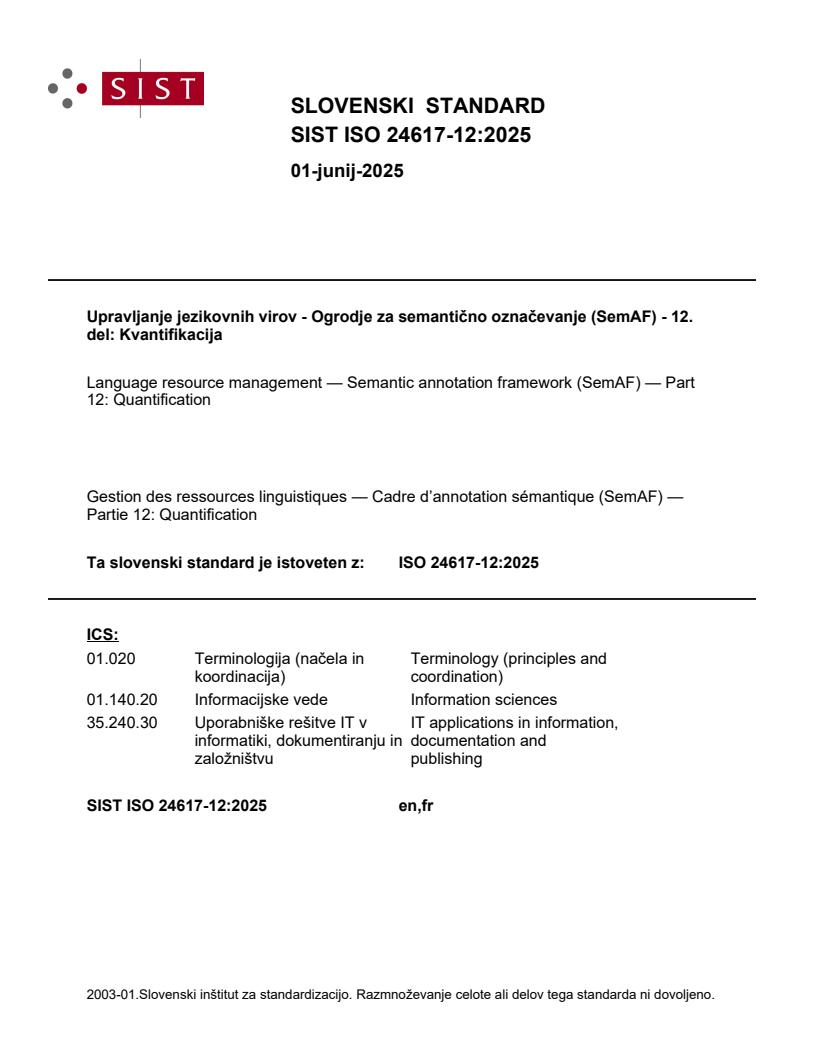



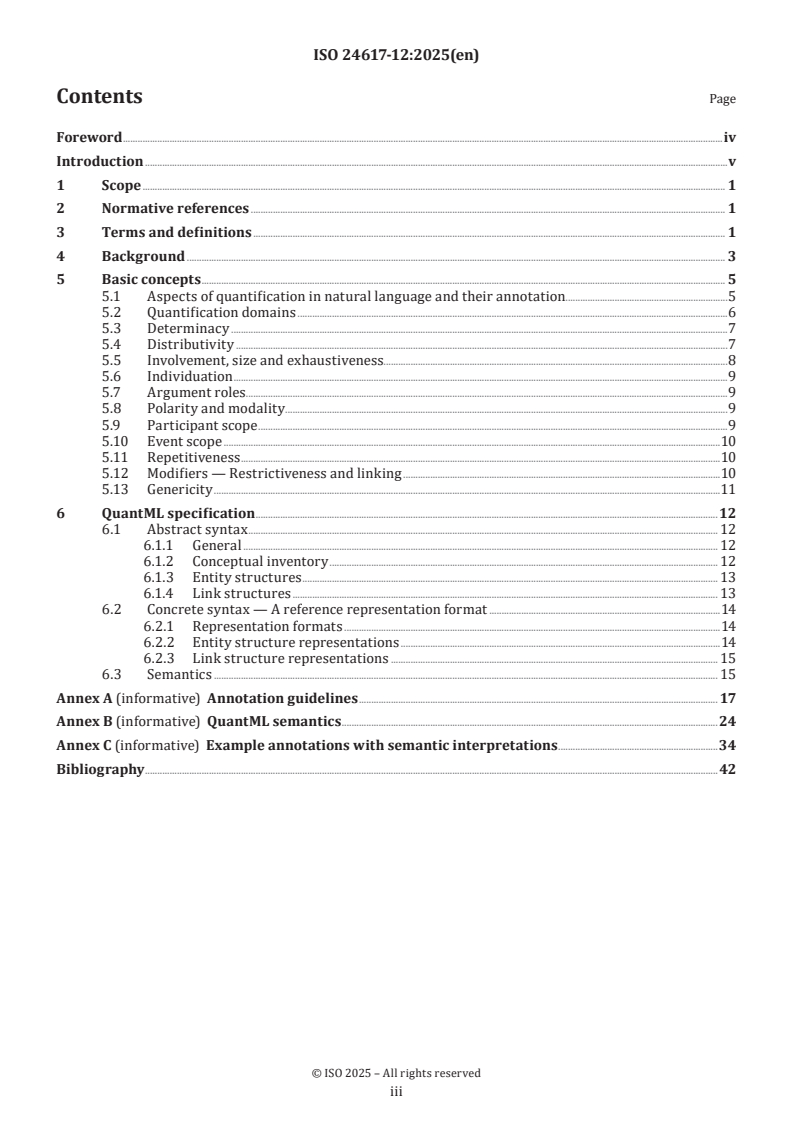
ISO 24617-12:2025 - Language resource management — Semantic annotation framework (SemAF) — Part 12: Quantification Released:8. 01. 2025

ISO 24617-12:2025 - Gestion des ressources linguistiques — Cadre d’annotation sémantique (SemAF) — Partie 12: Quantification Released:8. 01. 2025
Overview
ISO 24617-12:2025 - part of the ISO SemAF (Semantic Annotation Framework) series - specifies a markup language called QuantML for annotating quantification phenomena in natural language. QuantML provides an XML-based concrete syntax, an abstract syntax and a formal semantics to represent quantification aspects (e.g., determinacy, distributivity, scope) in an interoperable way. The standard is intended for language resource management and consistent semantic annotation across corpora and tools.
Key topics
- QuantML specification: an extensible XML representation, abstract syntax, and semantics for quantification annotation.
- Basic concepts covered: determinacy, definiteness, distributivity, individuation (count vs. mass), event sets, participant scope, event scope, exhaustivity, genericity, repetitiveness, modifiers (restrictiveness/linking), polarity and modality, inverse linking, argument roles.
- Annotation structures: entity structures and link structures for expressing quantified expressions and their relations.
- Representation formats: reference concrete syntax examples and guidelines for encoding annotations in XML.
- Semantics and guidelines: formal semantic definitions and informative annexes with annotation guidance and example annotations (including an explanatory Quantification Bank repository referenced by the standard).
Practical applications
- Corpus annotation: create interoperable, richly annotated corpora that capture quantification phenomena for training and evaluation.
- Natural Language Processing (NLP): improve tasks that rely on precise quantifier interpretation-information extraction, question answering, semantic parsing, coreference resolution, and dialogue understanding.
- Language resources and tools: standardize exchange formats for annotation tools, pipelines, and repositories to increase reusability and comparability.
- Research in semantics and linguistics: provide a reproducible annotation model for cross-linguistic studies of quantification, mass/count distinctions, and scope phenomena.
- Standards compliance and integration: apply SemAF principles to ensure annotations are consistent with other ISO 24617 parts.
Who should use it
- Computational linguists, corpus linguists, and annotation engineers
- NLP and AI teams building QA, IE, or dialogue systems needing robust quantifier handling
- Language technology tool developers and data curators seeking interoperable XML annotation formats
- Standardization bodies and academic researchers working on semantic annotation frameworks
Related standards
- ISO 24617 series (SemAF) - overarching semantic annotation framework
- ISO 24617-6 - principles for semantic annotation (referenced for compatibility)
Keywords: ISO 24617-12, QuantML, semantic annotation, quantification annotation, SemAF, XML annotation, language resource management, NLP annotation, quantifier scope.
Buy Documents
ISO 24617-12:2025 - Language resource management — Semantic annotation framework (SemAF) — Part 12: Quantification Released:8. 01. 2025
ISO 24617-12:2025 - Gestion des ressources linguistiques — Cadre d’annotation sémantique (SemAF) — Partie 12: Quantification Released:8. 01. 2025
Get Certified
Connect with accredited certification bodies for this standard

BSI Group
BSI (British Standards Institution) is the business standards company that helps organizations make excellence a habit.

NYCE
Mexican standards and certification body.
Sponsored listings
Frequently Asked Questions
SIST ISO 24617-12:2025 is a standard published by the Slovenian Institute for Standardization (SIST). Its full title is "Language resource management - Semantic annotation framework (SemAF) - Part 12: Quantification". This standard covers: This document specifies a markup language called QuantML for annotating and representing semantic phenomena relating to quantification in natural language. QuantML comprises an extensible markup language (XML)-based representation format, an abstract syntax and a semantics.
This document specifies a markup language called QuantML for annotating and representing semantic phenomena relating to quantification in natural language. QuantML comprises an extensible markup language (XML)-based representation format, an abstract syntax and a semantics.
SIST ISO 24617-12:2025 is classified under the following ICS (International Classification for Standards) categories: 01.020 - Terminology (principles and coordination); 01.140.20 - Information sciences; 35.240.30 - IT applications in information, documentation and publishing. The ICS classification helps identify the subject area and facilitates finding related standards.
SIST ISO 24617-12:2025 is available in PDF format for immediate download after purchase. The document can be added to your cart and obtained through the secure checkout process. Digital delivery ensures instant access to the complete standard document.
Standards Content (Sample)
SLOVENSKI STANDARD
01-junij-2025
Upravljanje jezikovnih virov - Ogrodje za semantično označevanje (SemAF) - 12.
del: Kvantifikacija
Language resource management — Semantic annotation framework (SemAF) — Part
12: Quantification
Gestion des ressources linguistiques — Cadre d’annotation sémantique (SemAF) —
Partie 12: Quantification
Ta slovenski standard je istoveten z: ISO 24617-12:2025
ICS:
01.020 Terminologija (načela in Terminology (principles and
koordinacija) coordination)
01.140.20 Informacijske vede Information sciences
35.240.30 Uporabniške rešitve IT v IT applications in information,
informatiki, dokumentiranju in documentation and
založništvu publishing
2003-01.Slovenski inštitut za standardizacijo. Razmnoževanje celote ali delov tega standarda ni dovoljeno.
International
Standard
ISO 24617-12
First edition
Language resource management —
2025-01
Semantic annotation framework
(SemAF) —
Part 12:
Quantification
Gestion des ressources linguistiques — Cadre d’annotation
sémantique (SemAF) —
Partie 12: Quantification
Reference number
© ISO 2025
All rights reserved. Unless otherwise specified, or required in the context of its implementation, no part of this publication may
be reproduced or utilized otherwise in any form or by any means, electronic or mechanical, including photocopying, or posting on
the internet or an intranet, without prior written permission. Permission can be requested from either ISO at the address below
or ISO’s member body in the country of the requester.
ISO copyright office
CP 401 • Ch. de Blandonnet 8
CH-1214 Vernier, Geneva
Phone: +41 22 749 01 11
Email: copyright@iso.org
Website: www.iso.org
Published in Switzerland
ii
Contents Page
Foreword .iv
Introduction .v
1 Scope . 1
2 Normative references . 1
3 Terms and definitions . 1
4 Background . 3
5 Basic concepts . 5
5.1 Aspects of quantification in natural language and their annotation . .5
5.2 Quantification domains .6
5.3 Determinacy .7
5.4 Distributivity .7
5.5 Involvement, size and exhaustiveness.8
5.6 Individuation .9
5.7 Argument roles .9
5.8 Polarity and modality . .9
5.9 Participant scope .9
5.10 Event scope .10
5.11 Repetitiveness .10
5.12 Modifiers — Restrictiveness and linking .10
5.13 Genericity .11
6 QuantML specification .12
6.1 Abstract syntax . 12
6.1.1 General . 12
6.1.2 Conceptual inventory . 12
6.1.3 Entity structures . 13
6.1.4 Link structures . 13
6.2 Concrete syntax — A reference representation format .14
6.2.1 Representation formats .14
6.2.2 Entity structure representations .14
6.2.3 Link structure representations . 15
6.3 Semantics . 15
Annex A (informative) Annotation guidelines . 17
Annex B (informative) QuantML semantics .24
Annex C (informative) Example annotations with semantic interpretations .34
Bibliography .42
iii
Foreword
ISO (the International Organization for Standardization) is a worldwide federation of national standards
bodies (ISO member bodies). The work of preparing International Standards is normally carried out through
ISO technical committees. Each member body interested in a subject for which a technical committee
has been established has the right to be represented on that committee. International organizations,
governmental and non-governmental, in liaison with ISO, also take part in the work. ISO collaborates closely
with the International Electrotechnical Commission (IEC) on all matters of electrotechnical standardization.
The procedures used to develop this document and those intended for its further maintenance are described
in the ISO/IEC Directives, Part 1. In particular, the different approval criteria needed for the different types
of ISO document should be noted. This document was drafted in accordance with the editorial rules of the
ISO/IEC Directives, Part 2 (see www.iso.org/directives).
ISO draws attention to the possibility that the implementation of this document may involve the use of (a)
patent(s). ISO takes no position concerning the evidence, validity or applicability of any claimed patent
rights in respect thereof. As of the date of publication of this document, ISO had not received notice of (a)
patent(s) which may be required to implement this document. However, implementers are cautioned that
this may not represent the latest information, which may be obtained from the patent database available at
www.iso.org/patents. ISO shall not be held responsible for identifying any or all such patent rights.
Any trade name used in this document is information given for the convenience of users and does not
constitute an endorsement.
For an explanation of the voluntary nature of standards, the meaning of ISO specific terms and expressions
related to conformity assessment, as well as information about ISO's adherence to the World Trade
Organization (WTO) principles in the Technical Barriers to Trade (TBT), see www.iso.org/iso/foreword.html.
This document was prepared by Technical Committee ISO/TC 37, Language and terminology, Subcommittee
SC 4, Language resource management.
A list of all parts in the ISO 24617 series can be found on the ISO website.
Any feedback or questions on this document should be directed to the user’s national standards body. A
complete listing of these bodies can be found at www.iso.org/members.html.
iv
Introduction
This document is an addition to the ISO 24617 series of standards for annotating various types of semantic
phenomena in natural language. Quantification phenomena are particularly important since quantifications
occur in every sentence in every language, except in trivial sentences such as “It is raining” in English, “det
regner” in Danish or “Llueve” in Spanish. Quantification phenomena are an essential component for the
understanding of spoken and textual language and multimodal messages. Annotating such phenomena in
an interoperable way improves the re-usability of language resources as a basis for understanding-based
applications of language technology, such as factually and contextually reliable information extraction and
question answering in human-computer dialogue.
The content of this document builds on earlier studies of aspects and annotation of quantification
phenomena, in particular References [3] and [5]. Based on these and other previous studies, this document
specifies an annotation scheme with a markup language, called QuantML, which allows a synthesized way of
treating a range of quantification phenomena.
This document provides support for the annotation of quantification phenomena in accordance with the
principles of semantic annotation laid down in ISO 24617-6, and in a way that is consistent with existing
and developing standards for the annotation of semantic information within the ISO semantic annotation
framework (SemAF, the ISO 24617 series).
NOTE The explanatory repository of annotated quantification phenomena in the Quantification Bank (see
Reference [37]), maintained at Tilburg University, provides background information about the basic concepts in
quantification annotation, plus a collection of annotated examples.
v
International Standard ISO 24617-12:2025(en)
Language resource management — Semantic annotation
framework (SemAF) —
Part 12:
Quantification
1 Scope
This document specifies a markup language called QuantML for annotating and representing semantic
phenomena relating to quantification in natural language. QuantML comprises an extensible markup
language (XML)-based representation format, an abstract syntax and a semantics.
2 Normative references
There are no normative references in this document.
3 Terms and definitions
For the purposes of this document, the following terms and definitions apply.
ISO and IEC maintain terminology databases for use in standardization at the following addresses:
— ISO Online browsing platform: available at https:// www .iso .org/ obp
— IEC Electropedia: available at https:// www .electropedia .org/
3.1
definiteness
language-dependent morphosyntactic feature of a noun phrase (NP) (3.12), marked in English and other
European languages by a definite or indefinite article or a nominal suffix, by a demonstrative, or by a
possessive expression
Note 1 to entry: The definiteness feature has two possible values: “definite” and “indefinite”. Being definite is often
regarded as an indication of determinacy, indefinite as an indication of indeterminacy.
Note 2 to entry: In some languages it is only possible to express that a NP is definite (NPs are by default indefinite) or
to express that an NP is indefinite (NPs are by default definite).
EXAMPLE al (definite article in Arabic languages), -e (suffix as definite article in Farsi), el/la (definite article
in Spanish), a/az (definite article in Hungarian, there is no indefinite article), yī (occasionally indefinite article in
Chinese; there is no definite article and the definiteness is definite unless an indefinite article or the context indicates
otherwise).
Note 3 to entry: For overviews of definite expressions, see References [1] and [44].
3.2
definite description
singular noun phrase with definiteness (3.1) ‘definite’, interpreted as referring to a (contextually) uniquely
determined entity
EXAMPLE Jimmy, the chairperson, my house, this idea.
3.3
determinacy
semantic property of referring to some particular and determinate entity or collection of entities
Note 1 to entry: Determinacy can be interpreted as specifying the relation between the reference domain (3.16) and
the source domain (3.18) of a quantification. The reference domain of a determinate quantification is a proper subset of
the source domain; for an indeterminate quantification the reference domain coincides with the source domain.
Note 2 to entry: Determinacy and definiteness (3.1) are not always clearly distinguished in the linguistic literature. For
a discussion of this issue, see Reference [9].
3.4
distributivity
distribution
specification of whether the entities of the reference domain (3.16) of a quantification (3.15) are individually
involved, or as a group (collectively), or as a mixture of the two
Note 1 to entry: Distributivity can be expressed by adverbs, such as “together”, “ensemble” (French) and “samen”
(Dutch), or by certain determiners, such as “each” in English, “chaque” in French and “ jeder” in German. Some
determiners, such as the English “each”, “all” and “both” can also be used as adverbs.
3.5
event
eventuality
something that can be said to obtain or hold true, to happen or occur
[SOURCE: ISO 24617-1:2012, 3.5, modified — Note 1 to entry deleted.]
3.6
event set
aspect of a quantification (3.15), specifying a set of events (3.5) in which the members of a certain participant
set (3.14) are involved
3.7
exhaustivity
semantic property of a quantification (3.15), indicating that no other individuals than the elements of the
participant set (3.14) are involved in elements of the event set (3.6)
3.8
genericity
specification of whether the sentence in which a quantification (3.15) occurs refers to a certain specific event
set (3.6) and participant set (3.14) or expresses a general statement or question
3.9
individuation
semantic property of the way a nominal expression is used to refer to its denotation as a collection of
individual entities, as parts of a homogenous mass, or as a collection of individual entities and their parts
Note 1 to entry: The distinction between referring to a collection of entities and referring to a part-whole structured
domain is expressed in many languages by the distinction between count terms and mass terms (3.11).
3.10
inverse linking
modification of a noun phrase head (3.13) that contains a quantifier with wider scope than the quantification
(3.15) of the noun phrase head
EXAMPLE Two students from every university participated in the meeting.
3.11
mass term
noun or nominal compound used in such a way that it does not individuate its reference
Note 1 to entry: Typical examples in English are “ footwear”, “water”, “cattle”, “music”, “luggage” and “ furniture”. By
contrast, expressions such as “shoe”, “drop of water”, “cow”, “sonata”, “suitcase” and “chair” are typically used as count
terms, i.e. in such a way that it is understood what counts as (for example) one shoe, as two shoes, etc. Some words are
commonly used either way, such as “rope” and “stone”. The two possible uses of nouns are also illustrated by: “There’s
no chicken in the pen”/“There’s no chicken in the stew.” See also Reference [6].
3.12
noun phrase
NP
group of words that function together syntactically as a noun
Note 1 to entry: An NP typically consist of a noun, one or more determiners, and head modifiers. Other cases include
NPs consisting of a personal pronoun, a proper name or a conjunction of nouns instead of a single noun.
3.13
noun phrase head
head
noun or a conjunction of nouns that forms the central element of a noun phrase (3.12)
3.14
participant set
set of entities involved in the event set (3.6) of a quantification (3.15)
EXAMPLE The parents gave all the teachers a present.
3.15
quantification
application of a predicate to a set of entities
Note 1 to entry: A particularly important type of predicate in the context of this document is involved in certain events
in a certain semantic role.
3.16
reference domain
contextually determined set of entities that a quantifying predicate is applied to
3.17
restrictor
part of a noun phrase (3.12) consisting of the head (3.13) and modifiers (if present)
3.18
source domain
explicitly mentioned maximal set of entities that a quantifying predicate is applicable to
Note 1 to entry: For a quantifier expressed by a noun phrase, the source domain is the extension of the restrictor
(3.17). Adverbial temporal and spatial quantifiers have their source domains (temporal and spatial entities), specified
as part of their lexical semantics.
4 Background
Quantification is linguistically, logically, and computationally highly complex, and has been studied for
centuries by logicians, linguists, formal semanticists and computational linguists, from Aristotle to present-
day scholars (see, for example, References [3], [4], [10], [11], [15], [17], [24], [25], [26], [30], [32], [34], [35],
[42] and [43]).
Partly inspired by studies of quantification in logic, analyses of the way quantifiers are expressed in natural
language has led to generalized quantifier theory (GQT) (see References [4], [5], and [26]). GQT interprets
quantifiers as properties of a set of entities. Quantifying expressions in natural language are ‘restricted' in
the sense of containing an indication of the entities to which the quantification is meant to apply. Natural
language quantifiers are thus not determiners such as “all” and “some”, but rather noun phrases (NPs) such
as “all students”, “some sonatas”, “quelques gens” and “mais que cinco melodias”.
[13]
The annotation scheme defined in this document combines GQT with neo-Davidsonian event semantics,
[33]
which views the combination of a verb and its arguments as the participation in a certain semantic role
of the entities denoted by the argument in the events denoted by the verb. This approach is also used in
other parts of the SemAF.
The scheme is designed according to the ISO principles of semantic annotation (see ISO 24617-6 and also
References [7] and [39]). The QuantML markup language therefore has a triple-layered definition consisting
of the following:
a) An abstract syntax, which specifies the class of well-defined annotation structures as pairs, triples and
other set-theoretical constructs containing quantification-related concepts. Annotation structures
consist of two kinds of substructures: entity structures, which contain information about a stretch of
primary data, and link structures, which contain information relating two (or more) entity structures.
The abstract syntax is visualized in a metamodel (see Figure 1).
b) A concrete syntax, which specifies a representation format for annotation structures. The QuantML
definition includes an XML-based reference format, again motivated mainly by the use of XML in other
standards.
c) A semantics, which specifies the meaning of the annotation structures defined by the abstract syntax.
QuantML has an interpretation-by-translation semantics which translates annotation structures
to discourse representation structures (DRSs), which have a well-established model-theoretic
[24]
semantics and which are also used in other parts of the SemAF.
Key
imu {individual, collective, unspecific} di {determinate, indeterminate}
SR semantic role set ru {restrictive, unrestrictive}
nw {narrow, wide} NR {greater, equal, less-or-equal}
mcp {mass, count, count+parts}
Figure 1 — QuantML metamodel for the annotation of quantification
5 Basic concepts
5.1 Aspects of quantification in natural language and their annotation
For annotating properties of quantification in natural language, QuantML takes the following categories of
semantic information into account:
a) domain;
b) determinacy;
c) distributivity;
d) involvement;
e) individuation;
f) argument role;
g) exhaustivity;
h) polarity;
i) participant scope;
j) event scope;
k) repetitiveness;
l) domain size;
m) restrictiveness of modifiers;
n) linking of modifiers;
o) modality;
p) genericity.
These categories correspond to elements of annotations. The categories 1 to 11 correspond to ‘core
attributes', which require a value whenever a quantification is annotated. Some of these attributes are
optional and have a default value. Additionally, QuantML has a number of attributes that are relevant only for
certain forms of quantification. The attributes 12 to 14 exemplify this: they apply only in case a quantifying
expression contains a specification of domain size or a modifier that can restrict the reference domain. The
items 15 to 16 are exceptional in that their semantic interpretation is undefined; they have been included
solely to allow corpus searches of instances of generic or modal quantification.
The QuantML metamodel, visualized in Figure 1, shows the roles of the categories 1 to 13 and the
corresponding attributes in annotations. The metamodel clearly brings out that three components play
centre stage in a QuantML annotation: events, participants and the participation relation that links them,
each with a number of features corresponding to the information categories 1 to 13. This is illustrated by
the annotation fragment in Example 2 in 5.2.
5.2 Quantification domains
NPs, expressing a generalized quantifier, typically consist of three parts:
a) a noun (the ‘head’);
b) one or more determiners such as “a”, “the”, “all”, “some” and “many”;
c) one or more adjectives, prepositional phrases, possessive phrases or other modifiers.
The head noun with its modifiers, the ‘restrictor’ of the quantifier, indicates a certain domain that the
quantification ranges over. The term source domain is used to refer to the set of entities indicated by the
restrictor. The domain that a quantification is intended to range over is often not the entire source domain,
but a certain part of it, determined by the context. For instance, the sentence in Example 1 is not meant to
put an obligation on every person, but only on the students in a certain class.
Example 1 Everybody must hand in his or her essay before Thursday next week.
[16][43]
This more limited domain is called the reference domain or ‘context set’ . It is determined by the
familiarity, salience, recent mention, physical presence, and other contextual considerations that make
certain elements of the source domain stand out as the intended referents. The annotation fragment in
Example 2 shows how this is annotated in QuantML.
Example 2 All the students protested.
Markables: m1 = "All the students", m2 = " the students", m3 = "students", m4 = "protested"
involvement="all"/>
5.3 Determinacy
The determinacy of a quantification expresses whether the reference domain is a proper subset of the
source domain or coincides with it. Determinacy is sometimes indicated by the morphosyntactic feature
of definiteness, which in Germanic and Romance languages is marked by the use of a definite article or a
nominal suffix, such as “the book” in English, and “bogen” in Danish.
NOTE See, for example, Reference [25] on the expression of definiteness in a large number of languages, and
References [1] and [40] for overviews of definite expressions in English.
Definite plural NPs are most often determinate and indefinite plural NPs indeterminate, but there is no
[12]
straightforward relation between definiteness and determinacy. To mark up determinacy in QuantML,
the attribute @determinacy in elements should be used and given either the value “det” or the
value “indet”.
5.4 Distributivity
The distributivity of a quantification expresses whether a predicate applies to a set of entities as a whole, or
to its individual members, or to certain of its subsets. The collective/individual (or ‘distributive’) distinction
is illustrated in Example 3.
Example 3 a) Two men carried a piano upstairs.
b) Two men carried some chairs upstairs.
Besides distributive and collective, QuantML also supports the annotation of distributivity as 'unspecific',
meaning that individuals as well as sets of individuals can be involved. The sentence in Example 4, for
instance, possibly describes a situation where the boys involved did not necessarily do all the carrying either
collectively or individually, but where they carried some boxes collectively and some individually.
Example 4 The boys carried all the boxes upstairs.
Distributivity is a property of the way entities participate in events, and is annotated using the @distr
attribute in elements. This is illustrated in Example 5 (slightly simplified), assuming that
each of the men individually had a beer and collectively carried the piano upstairs.
Example 5 The men had a beer before carrying the piano upstairs.
Markables: m1 = "The men", m2 = "men", m3 = "had a beer", m4 = "carrying upstairs",
m5 = "the piano", m6 = "piano"
involvement="all"/>
5.5 Involvement, size and exhaustiveness
The members of the reference domain of a quantification that are actually involved in the events of the event
set form the participant set. Proportional determiners, such as “many” and “most” and numerical determiners
such as “three” and “more than five”, indicate how many/much of the reference domain constitutes the
participant set. Proportional specifications of participant size should be indicated using
elements, numerical specifications using elements in the values of the @involvement attribute
of structures. Both are illustrated in Example (C1) in Annex C.
The use of a numerical determiner in focus, indicated by prosody in spoken language or by typography
in written text, gives rise to a partitive determinate interpretation, such as in Example 6 a), where “two
salesmen” means “two of the salesmen”, different from Example 6 b), where the stress is on “salesmen”.
Example 6 a) TWO salesmen came in. (The three others remained outside.)
b) Two SALESmen came in. (Two policemen as well.)
Numerical determiners may also indicate the cardinality of groups of elements from the reference domain
that collectively participate in certain events. This is annotated (slightly simplified) as in Example 7.
Example 7 This assembly machine combines twelve parts.
Markables: m1 = "This assembly machine", m2 = "assembly machine", m3 = "combines",
m4 = "twelve parts", m5 = "parts"
involvement="all" size="1"/>
individuation="count"/>
evScope="wide"/>
This annotation can be read as: ‘For this machine it is the case that there is a set of combine events in all of
which a collection of twelve parts is assembled’. See also Example (C3) in Annex C.
5.6 Individuation
The expression as well as the interpretation of the distributivity, involvement and domain size of a
quantification is different for mass NPs than for count NPs, hence this is a basic aspect of quantification. In
QuantML, the attribute @individuation in elements should be used for marking up this aspect,
with values ‘count’ and ‘mass’.
Besides these values, a third possibility is ‘cParts’, which should be used if the reference domain consists
of individual objects but parts of individual objects are also considered as potential participants. This
possibility is needed for cases such as Example 8 a), but it is also available in the case of Example 8 b), which
possibly describes a series of events where Louis had a pizza last Monday, one and a half pizzas last Tuesday,
etc., with a total of eight pizzas.
Example 8 a) Louis and Mary had two and a half pizzas.
b) Louis had eight pizzas last week.
Whether a quantification takes parts of individuals into account is a context-dependent matter, and therefore
a property of the participant set, represented by means of an attribute of structures.
For NPs with a mass head noun, the involvement specification requires the use of elements,
which have a @dimension (e.g. ‘volume’, ‘weight’), a @number and a @numRel and attribute, with values
such as ‘equal’ and ‘greater_than’.
5.7 Argument roles
The adoption of the neo-Davidsonian view on events and participants means that a certain set of argument
roles must be chosen for differentiating between the different arguments of a verb. The specific choice
of roles is as such not an issue for the annotation of quantification. For convenience and intra-SemAF
consistency, QuantML uses the role set defined in ISO 24617-4:2014.
5.8 Polarity and modality
The annotation scheme defined in this document specifies a way of marking up the relative scopes of
quantifications and negations. Example 9 shows the use of negation with wide scope (case b)) and narrow
scope (case c)), respectively, in two readings of the sentence in a).
Example 9 a) The unions do not accept the proposal.
b) It is not the case that the unions all accept the proposal.
c) Each of the unions does not accept the proposal.
Readings with wide and narrow negation scope should be distinguished in annotations by the @polarity
attribute in elements, using the values “neg-wide” and “neg-narrow”, respectively.
Modality is defined in ISO 24617-1 as expressing ‘different degrees of epistemic modality, deontic modality, etc.’
(see ISO 24617-1:2012, Table 1). It can be expressed prosodically or lexically by adverbs, such as “perhaps”
and “possibly” in English, or by modal verbs (“could”, “may”, “must”). Since no full semantic treatment of
a wide range of modalities is available, their interpretation is regarded as being outside the scope of the
annotation scheme defined in this document. QuantML does allow modal quantifications to be marked up as
such, using the @modality attribute in elements, which can be useful for corpus studies, but
does not offer a semantic interpretation in such cases.
5.9 Participant scope
[40][41]
The relative scoping of quantifications over sets of participants is a major source of ambiguity. .
A sentence with N noun phrases may have N! possible interpretations due to alternative scopings alone,
[18]
although syntactic constraints usually reduce this number. The relative scope of participants should be
represented in QuantML by means of the element, with attributes @arg1, @arg2 and @scopeRel.
There are cases where none of the quantifications has wider scope than the other, as in the ‘cumulative’
[39]
quantification in Example 10 on the reading where there is a set A of three breweries and a set B of
fifteen inns, such that the members of A supplied members of B, and the members of B were supplied by
members of A. In this case, the two quantifications can be said to mutually outscope each other. This should
be represented by giving the @scopeRel attribute the value ‘dual’.
Example 10 Three breweries supplied fifteen inns.
Scope under-specification is possible in QuantML by omitting one or more elements, resulting in
[38]
an annotation structure interpreted as an underspecified DRS (UDRS).
5.10 Event scope
Issues of scope in quantification also arise between sets of participants and events. The sentence in
Example 11 can be read to mean that everyone is mortal, but also read as a prediction of an apocalyptic
future event in which everyone will die.
NOTE The latter interpretation requires the consideration of events in which multiple participants occupy the
same role. The ISO approach to semantic role annotation (see ISO 24617-4) does allow this.
The latter reading should be annotated as shown in Example 11, with the @evScope value ‘wide’.
Example 11 Everyone will die.
evScope="wide"/>
5.11 Repetitiveness
The events set of a quantification may consist of repetitions of the same event, occurring more than once.
Some languages have lexical items for expressing this, such as “twice” and “thrice” in English, “tvisvar” in
Icelandic and “dreimal” in German. Other languages express this by a cardinal number and a noun denoting
times or turns, such as “deux fois” in French, “vier keer” in Dutch, and “três vezes” in Portuguese. The
annotation of quantifications with an indication of a repeating event should specify the number of repetitions
as a value of the attribute @repetitiveness in an element.
5.12 Modifiers — Restrictiveness and linking
Quantification in natural language has been studied mostly in relation to the semantics of NPs as arguments
of a verb, but quantification issues also take other forms, as in Example 12 a) and Example 13 a), where an
adjective is applied to a set of arguments. In both cases, the expression can be interpreted as saying that
“these books” as a whole are heavy (collective reading) or that each of “these books” individually is heavy
(distributive reading). To mark up this distinction, the @distr attribute in elements should be
used, as shown in Example 12 c) for the collective reading of the sentence in 12 a).
Example 12 a) (I’m carrying) these heavy books (to the library).
b) Markables: m1 = these heavy books, m2 = heavy, m3 = heavy books, m4 = books
c)
When an adjective is used predicatively in a quantifying copular construction, as in Example 13 a), an event-
based semantic analysis can be obtained by positing a ‘be’ state with the predicate and its argument as
participants, leading to an annotation as given in Example 13 b) for the distributive reading of the sentence
in Example 13 a). This approach has the advantage of generalizing to any copular verb (such as “appear”,
“seem”, “look”) and of going along seamlessly with other verbs in the semantics of annotation structures.
Example 13 a) These books are heavy.
b)
When a quantifier’s reference domain is restricted by an adjective, a noun, a prepositional phrase, a
possessive phrase or a relative clause (see Example 14), this is annotated by using the attribute @restrs
in structures. The possible values of this attribute are the modifier structures defined in
QuantML: , , , and .
Example 14 a) Alice showed me her archaeology books/ Timmy’s books.
b) Alice showed me two rare books from Chengdu/ that she’d bought in Chengdu.
The quantifier expressed by an NP in a prepositional phrase (PP) can have wider scope than a quantifier in
the main clause, as illustrated in Example 15. On the most plausible reading of this sentence, the quantifier
“every university in the country” takes scope over the quantifier “a student”. This phenomenon is known as
“inverse linking” (see, for example, References [2], [30], [31] and [37]).
Example 15 President Kay met with a student from every university in the country.
Modifiers can also be used in a non-restrictive way, which in English is sometimes indicated using commas,
as in “The children, who were having a jolly good time at the birthday party, didn’t notice the approaching
thunderstorm”. In such a case, the modifier, called a ‘qualifier’ in this document, does not restrict the reference
domain but provides additional information about the participant set. Occurrences of non-restrictive
modifiers should be annotated in QuantML as values of the attribute @qualifiers in structures; see
Example (C7) in Annex C.
5.13 Genericity
Generic quantification occurs in sentences that make general statements without referring to any specific
events at a particular time and place, as in Example 16.
Example 16 a) Tigers don’t eat tomatoes.
b) A self-respecting German businessman drives a Mercedes.
A fundamental question is whether such sentences do express quantifications. One view is that ‘generic’ NPs
do not quantify but refer to a single ‘prototypical’ individual (see, for example, Reference [14]). Alternatively,
generics have been analysed in terms of a special quantifier (see Reference [25]). Within the framework
of Discourse Representation Theory (DRT), the use of a special implication has been proposed that allows
[24]
exceptions.
Since there is no well-established, generally accepted semantic treatment of genericity, this is treated in
QuantML in a similar way as modality (see 5.8): it can be marked up, using the @genericity attribute, for
which no semantics is defined. This can be useful for corpus studies.
6 QuantML specification
6.1 Abstract syntax
6.1.1 General
An abstract syn
...
International
Standard
ISO 24617-12
First edition
Language resource management —
2025-01
Semantic annotation framework
(SemAF) —
Part 12:
Quantification
Gestion des ressources linguistiques — Cadre d’annotation
sémantique (SemAF) —
Partie 12: Quantification
Reference number
© ISO 2025
All rights reserved. Unless otherwise specified, or required in the context of its implementation, no part of this publication may
be reproduced or utilized otherwise in any form or by any means, electronic or mechanical, including photocopying, or posting on
the internet or an intranet, without prior written permission. Permission can be requested from either ISO at the address below
or ISO’s member body in the country of the requester.
ISO copyright office
CP 401 • Ch. de Blandonnet 8
CH-1214 Vernier, Geneva
Phone: +41 22 749 01 11
Email: copyright@iso.org
Website: www.iso.org
Published in Switzerland
ii
Contents Page
Foreword .iv
Introduction .v
1 Scope . 1
2 Normative references . 1
3 Terms and definitions . 1
4 Background . 3
5 Basic concepts . 5
5.1 Aspects of quantification in natural language and their annotation . .5
5.2 Quantification domains .6
5.3 Determinacy .7
5.4 Distributivity .7
5.5 Involvement, size and exhaustiveness.8
5.6 Individuation .9
5.7 Argument roles .9
5.8 Polarity and modality . .9
5.9 Participant scope .9
5.10 Event scope .10
5.11 Repetitiveness .10
5.12 Modifiers — Restrictiveness and linking .10
5.13 Genericity .11
6 QuantML specification .12
6.1 Abstract syntax . 12
6.1.1 General . 12
6.1.2 Conceptual inventory . 12
6.1.3 Entity structures . 13
6.1.4 Link structures . 13
6.2 Concrete syntax — A reference representation format .14
6.2.1 Representation formats .14
6.2.2 Entity structure representations .14
6.2.3 Link structure representations . 15
6.3 Semantics . 15
Annex A (informative) Annotation guidelines . 17
Annex B (informative) QuantML semantics .24
Annex C (informative) Example annotations with semantic interpretations .34
Bibliography .42
iii
Foreword
ISO (the International Organization for Standardization) is a worldwide federation of national standards
bodies (ISO member bodies). The work of preparing International Standards is normally carried out through
ISO technical committees. Each member body interested in a subject for which a technical committee
has been established has the right to be represented on that committee. International organizations,
governmental and non-governmental, in liaison with ISO, also take part in the work. ISO collaborates closely
with the International Electrotechnical Commission (IEC) on all matters of electrotechnical standardization.
The procedures used to develop this document and those intended for its further maintenance are described
in the ISO/IEC Directives, Part 1. In particular, the different approval criteria needed for the different types
of ISO document should be noted. This document was drafted in accordance with the editorial rules of the
ISO/IEC Directives, Part 2 (see www.iso.org/directives).
ISO draws attention to the possibility that the implementation of this document may involve the use of (a)
patent(s). ISO takes no position concerning the evidence, validity or applicability of any claimed patent
rights in respect thereof. As of the date of publication of this document, ISO had not received notice of (a)
patent(s) which may be required to implement this document. However, implementers are cautioned that
this may not represent the latest information, which may be obtained from the patent database available at
www.iso.org/patents. ISO shall not be held responsible for identifying any or all such patent rights.
Any trade name used in this document is information given for the convenience of users and does not
constitute an endorsement.
For an explanation of the voluntary nature of standards, the meaning of ISO specific terms and expressions
related to conformity assessment, as well as information about ISO's adherence to the World Trade
Organization (WTO) principles in the Technical Barriers to Trade (TBT), see www.iso.org/iso/foreword.html.
This document was prepared by Technical Committee ISO/TC 37, Language and terminology, Subcommittee
SC 4, Language resource management.
A list of all parts in the ISO 24617 series can be found on the ISO website.
Any feedback or questions on this document should be directed to the user’s national standards body. A
complete listing of these bodies can be found at www.iso.org/members.html.
iv
Introduction
This document is an addition to the ISO 24617 series of standards for annotating various types of semantic
phenomena in natural language. Quantification phenomena are particularly important since quantifications
occur in every sentence in every language, except in trivial sentences such as “It is raining” in English, “det
regner” in Danish or “Llueve” in Spanish. Quantification phenomena are an essential component for the
understanding of spoken and textual language and multimodal messages. Annotating such phenomena in
an interoperable way improves the re-usability of language resources as a basis for understanding-based
applications of language technology, such as factually and contextually reliable information extraction and
question answering in human-computer dialogue.
The content of this document builds on earlier studies of aspects and annotation of quantification
phenomena, in particular References [3] and [5]. Based on these and other previous studies, this document
specifies an annotation scheme with a markup language, called QuantML, which allows a synthesized way of
treating a range of quantification phenomena.
This document provides support for the annotation of quantification phenomena in accordance with the
principles of semantic annotation laid down in ISO 24617-6, and in a way that is consistent with existing
and developing standards for the annotation of semantic information within the ISO semantic annotation
framework (SemAF, the ISO 24617 series).
NOTE The explanatory repository of annotated quantification phenomena in the Quantification Bank (see
Reference [37]), maintained at Tilburg University, provides background information about the basic concepts in
quantification annotation, plus a collection of annotated examples.
v
International Standard ISO 24617-12:2025(en)
Language resource management — Semantic annotation
framework (SemAF) —
Part 12:
Quantification
1 Scope
This document specifies a markup language called QuantML for annotating and representing semantic
phenomena relating to quantification in natural language. QuantML comprises an extensible markup
language (XML)-based representation format, an abstract syntax and a semantics.
2 Normative references
There are no normative references in this document.
3 Terms and definitions
For the purposes of this document, the following terms and definitions apply.
ISO and IEC maintain terminology databases for use in standardization at the following addresses:
— ISO Online browsing platform: available at https:// www .iso .org/ obp
— IEC Electropedia: available at https:// www .electropedia .org/
3.1
definiteness
language-dependent morphosyntactic feature of a noun phrase (NP) (3.12), marked in English and other
European languages by a definite or indefinite article or a nominal suffix, by a demonstrative, or by a
possessive expression
Note 1 to entry: The definiteness feature has two possible values: “definite” and “indefinite”. Being definite is often
regarded as an indication of determinacy, indefinite as an indication of indeterminacy.
Note 2 to entry: In some languages it is only possible to express that a NP is definite (NPs are by default indefinite) or
to express that an NP is indefinite (NPs are by default definite).
EXAMPLE al (definite article in Arabic languages), -e (suffix as definite article in Farsi), el/la (definite article
in Spanish), a/az (definite article in Hungarian, there is no indefinite article), yī (occasionally indefinite article in
Chinese; there is no definite article and the definiteness is definite unless an indefinite article or the context indicates
otherwise).
Note 3 to entry: For overviews of definite expressions, see References [1] and [44].
3.2
definite description
singular noun phrase with definiteness (3.1) ‘definite’, interpreted as referring to a (contextually) uniquely
determined entity
EXAMPLE Jimmy, the chairperson, my house, this idea.
3.3
determinacy
semantic property of referring to some particular and determinate entity or collection of entities
Note 1 to entry: Determinacy can be interpreted as specifying the relation between the reference domain (3.16) and
the source domain (3.18) of a quantification. The reference domain of a determinate quantification is a proper subset of
the source domain; for an indeterminate quantification the reference domain coincides with the source domain.
Note 2 to entry: Determinacy and definiteness (3.1) are not always clearly distinguished in the linguistic literature. For
a discussion of this issue, see Reference [9].
3.4
distributivity
distribution
specification of whether the entities of the reference domain (3.16) of a quantification (3.15) are individually
involved, or as a group (collectively), or as a mixture of the two
Note 1 to entry: Distributivity can be expressed by adverbs, such as “together”, “ensemble” (French) and “samen”
(Dutch), or by certain determiners, such as “each” in English, “chaque” in French and “ jeder” in German. Some
determiners, such as the English “each”, “all” and “both” can also be used as adverbs.
3.5
event
eventuality
something that can be said to obtain or hold true, to happen or occur
[SOURCE: ISO 24617-1:2012, 3.5, modified — Note 1 to entry deleted.]
3.6
event set
aspect of a quantification (3.15), specifying a set of events (3.5) in which the members of a certain participant
set (3.14) are involved
3.7
exhaustivity
semantic property of a quantification (3.15), indicating that no other individuals than the elements of the
participant set (3.14) are involved in elements of the event set (3.6)
3.8
genericity
specification of whether the sentence in which a quantification (3.15) occurs refers to a certain specific event
set (3.6) and participant set (3.14) or expresses a general statement or question
3.9
individuation
semantic property of the way a nominal expression is used to refer to its denotation as a collection of
individual entities, as parts of a homogenous mass, or as a collection of individual entities and their parts
Note 1 to entry: The distinction between referring to a collection of entities and referring to a part-whole structured
domain is expressed in many languages by the distinction between count terms and mass terms (3.11).
3.10
inverse linking
modification of a noun phrase head (3.13) that contains a quantifier with wider scope than the quantification
(3.15) of the noun phrase head
EXAMPLE Two students from every university participated in the meeting.
3.11
mass term
noun or nominal compound used in such a way that it does not individuate its reference
Note 1 to entry: Typical examples in English are “ footwear”, “water”, “cattle”, “music”, “luggage” and “ furniture”. By
contrast, expressions such as “shoe”, “drop of water”, “cow”, “sonata”, “suitcase” and “chair” are typically used as count
terms, i.e. in such a way that it is understood what counts as (for example) one shoe, as two shoes, etc. Some words are
commonly used either way, such as “rope” and “stone”. The two possible uses of nouns are also illustrated by: “There’s
no chicken in the pen”/“There’s no chicken in the stew.” See also Reference [6].
3.12
noun phrase
NP
group of words that function together syntactically as a noun
Note 1 to entry: An NP typically consist of a noun, one or more determiners, and head modifiers. Other cases include
NPs consisting of a personal pronoun, a proper name or a conjunction of nouns instead of a single noun.
3.13
noun phrase head
head
noun or a conjunction of nouns that forms the central element of a noun phrase (3.12)
3.14
participant set
set of entities involved in the event set (3.6) of a quantification (3.15)
EXAMPLE The parents gave all the teachers a present.
3.15
quantification
application of a predicate to a set of entities
Note 1 to entry: A particularly important type of predicate in the context of this document is involved in certain events
in a certain semantic role.
3.16
reference domain
contextually determined set of entities that a quantifying predicate is applied to
3.17
restrictor
part of a noun phrase (3.12) consisting of the head (3.13) and modifiers (if present)
3.18
source domain
explicitly mentioned maximal set of entities that a quantifying predicate is applicable to
Note 1 to entry: For a quantifier expressed by a noun phrase, the source domain is the extension of the restrictor
(3.17). Adverbial temporal and spatial quantifiers have their source domains (temporal and spatial entities), specified
as part of their lexical semantics.
4 Background
Quantification is linguistically, logically, and computationally highly complex, and has been studied for
centuries by logicians, linguists, formal semanticists and computational linguists, from Aristotle to present-
day scholars (see, for example, References [3], [4], [10], [11], [15], [17], [24], [25], [26], [30], [32], [34], [35],
[42] and [43]).
Partly inspired by studies of quantification in logic, analyses of the way quantifiers are expressed in natural
language has led to generalized quantifier theory (GQT) (see References [4], [5], and [26]). GQT interprets
quantifiers as properties of a set of entities. Quantifying expressions in natural language are ‘restricted' in
the sense of containing an indication of the entities to which the quantification is meant to apply. Natural
language quantifiers are thus not determiners such as “all” and “some”, but rather noun phrases (NPs) such
as “all students”, “some sonatas”, “quelques gens” and “mais que cinco melodias”.
[13]
The annotation scheme defined in this document combines GQT with neo-Davidsonian event semantics,
[33]
which views the combination of a verb and its arguments as the participation in a certain semantic role
of the entities denoted by the argument in the events denoted by the verb. This approach is also used in
other parts of the SemAF.
The scheme is designed according to the ISO principles of semantic annotation (see ISO 24617-6 and also
References [7] and [39]). The QuantML markup language therefore has a triple-layered definition consisting
of the following:
a) An abstract syntax, which specifies the class of well-defined annotation structures as pairs, triples and
other set-theoretical constructs containing quantification-related concepts. Annotation structures
consist of two kinds of substructures: entity structures, which contain information about a stretch of
primary data, and link structures, which contain information relating two (or more) entity structures.
The abstract syntax is visualized in a metamodel (see Figure 1).
b) A concrete syntax, which specifies a representation format for annotation structures. The QuantML
definition includes an XML-based reference format, again motivated mainly by the use of XML in other
standards.
c) A semantics, which specifies the meaning of the annotation structures defined by the abstract syntax.
QuantML has an interpretation-by-translation semantics which translates annotation structures
to discourse representation structures (DRSs), which have a well-established model-theoretic
[24]
semantics and which are also used in other parts of the SemAF.
Key
imu {individual, collective, unspecific} di {determinate, indeterminate}
SR semantic role set ru {restrictive, unrestrictive}
nw {narrow, wide} NR {greater, equal, less-or-equal}
mcp {mass, count, count+parts}
Figure 1 — QuantML metamodel for the annotation of quantification
5 Basic concepts
5.1 Aspects of quantification in natural language and their annotation
For annotating properties of quantification in natural language, QuantML takes the following categories of
semantic information into account:
a) domain;
b) determinacy;
c) distributivity;
d) involvement;
e) individuation;
f) argument role;
g) exhaustivity;
h) polarity;
i) participant scope;
j) event scope;
k) repetitiveness;
l) domain size;
m) restrictiveness of modifiers;
n) linking of modifiers;
o) modality;
p) genericity.
These categories correspond to elements of annotations. The categories 1 to 11 correspond to ‘core
attributes', which require a value whenever a quantification is annotated. Some of these attributes are
optional and have a default value. Additionally, QuantML has a number of attributes that are relevant only for
certain forms of quantification. The attributes 12 to 14 exemplify this: they apply only in case a quantifying
expression contains a specification of domain size or a modifier that can restrict the reference domain. The
items 15 to 16 are exceptional in that their semantic interpretation is undefined; they have been included
solely to allow corpus searches of instances of generic or modal quantification.
The QuantML metamodel, visualized in Figure 1, shows the roles of the categories 1 to 13 and the
corresponding attributes in annotations. The metamodel clearly brings out that three components play
centre stage in a QuantML annotation: events, participants and the participation relation that links them,
each with a number of features corresponding to the information categories 1 to 13. This is illustrated by
the annotation fragment in Example 2 in 5.2.
5.2 Quantification domains
NPs, expressing a generalized quantifier, typically consist of three parts:
a) a noun (the ‘head’);
b) one or more determiners such as “a”, “the”, “all”, “some” and “many”;
c) one or more adjectives, prepositional phrases, possessive phrases or other modifiers.
The head noun with its modifiers, the ‘restrictor’ of the quantifier, indicates a certain domain that the
quantification ranges over. The term source domain is used to refer to the set of entities indicated by the
restrictor. The domain that a quantification is intended to range over is often not the entire source domain,
but a certain part of it, determined by the context. For instance, the sentence in Example 1 is not meant to
put an obligation on every person, but only on the students in a certain class.
Example 1 Everybody must hand in his or her essay before Thursday next week.
[16][43]
This more limited domain is called the reference domain or ‘context set’ . It is determined by the
familiarity, salience, recent mention, physical presence, and other contextual considerations that make
certain elements of the source domain stand out as the intended referents. The annotation fragment in
Example 2 shows how this is annotated in QuantML.
Example 2 All the students protested.
Markables: m1 = "All the students", m2 = " the students", m3 = "students", m4 = "protested"
involvement="all"/>
5.3 Determinacy
The determinacy of a quantification expresses whether the reference domain is a proper subset of the
source domain or coincides with it. Determinacy is sometimes indicated by the morphosyntactic feature
of definiteness, which in Germanic and Romance languages is marked by the use of a definite article or a
nominal suffix, such as “the book” in English, and “bogen” in Danish.
NOTE See, for example, Reference [25] on the expression of definiteness in a large number of languages, and
References [1] and [40] for overviews of definite expressions in English.
Definite plural NPs are most often determinate and indefinite plural NPs indeterminate, but there is no
[12]
straightforward relation between definiteness and determinacy. To mark up determinacy in QuantML,
the attribute @determinacy in elements should be used and given either the value “det” or the
value “indet”.
5.4 Distributivity
The distributivity of a quantification expresses whether a predicate applies to a set of entities as a whole, or
to its individual members, or to certain of its subsets. The collective/individual (or ‘distributive’) distinction
is illustrated in Example 3.
Example 3 a) Two men carried a piano upstairs.
b) Two men carried some chairs upstairs.
Besides distributive and collective, QuantML also supports the annotation of distributivity as 'unspecific',
meaning that individuals as well as sets of individuals can be involved. The sentence in Example 4, for
instance, possibly describes a situation where the boys involved did not necessarily do all the carrying either
collectively or individually, but where they carried some boxes collectively and some individually.
Example 4 The boys carried all the boxes upstairs.
Distributivity is a property of the way entities participate in events, and is annotated using the @distr
attribute in elements. This is illustrated in Example 5 (slightly simplified), assuming that
each of the men individually had a beer and collectively carried the piano upstairs.
Example 5 The men had a beer before carrying the piano upstairs.
Markables: m1 = "The men", m2 = "men", m3 = "had a beer", m4 = "carrying upstairs",
m5 = "the piano", m6 = "piano"
involvement="all"/>
5.5 Involvement, size and exhaustiveness
The members of the reference domain of a quantification that are actually involved in the events of the event
set form the participant set. Proportional determiners, such as “many” and “most” and numerical determiners
such as “three” and “more than five”, indicate how many/much of the reference domain constitutes the
participant set. Proportional specifications of participant size should be indicated using
elements, numerical specifications using elements in the values of the @involvement attribute
of structures. Both are illustrated in Example (C1) in Annex C.
The use of a numerical determiner in focus, indicated by prosody in spoken language or by typography
in written text, gives rise to a partitive determinate interpretation, such as in Example 6 a), where “two
salesmen” means “two of the salesmen”, different from Example 6 b), where the stress is on “salesmen”.
Example 6 a) TWO salesmen came in. (The three others remained outside.)
b) Two SALESmen came in. (Two policemen as well.)
Numerical determiners may also indicate the cardinality of groups of elements from the reference domain
that collectively participate in certain events. This is annotated (slightly simplified) as in Example 7.
Example 7 This assembly machine combines twelve parts.
Markables: m1 = "This assembly machine", m2 = "assembly machine", m3 = "combines",
m4 = "twelve parts", m5 = "parts"
involvement="all" size="1"/>
individuation="count"/>
evScope="wide"/>
This annotation can be read as: ‘For this machine it is the case that there is a set of combine events in all of
which a collection of twelve parts is assembled’. See also Example (C3) in Annex C.
5.6 Individuation
The expression as well as the interpretation of the distributivity, involvement and domain size of a
quantification is different for mass NPs than for count NPs, hence this is a basic aspect of quantification. In
QuantML, the attribute @individuation in elements should be used for marking up this aspect,
with values ‘count’ and ‘mass’.
Besides these values, a third possibility is ‘cParts’, which should be used if the reference domain consists
of individual objects but parts of individual objects are also considered as potential participants. This
possibility is needed for cases such as Example 8 a), but it is also available in the case of Example 8 b), which
possibly describes a series of events where Louis had a pizza last Monday, one and a half pizzas last Tuesday,
etc., with a total of eight pizzas.
Example 8 a) Louis and Mary had two and a half pizzas.
b) Louis had eight pizzas last week.
Whether a quantification takes parts of individuals into account is a context-dependent matter, and therefore
a property of the participant set, represented by means of an attribute of structures.
For NPs with a mass head noun, the involvement specification requires the use of elements,
which have a @dimension (e.g. ‘volume’, ‘weight’), a @number and a @numRel and attribute, with values
such as ‘equal’ and ‘greater_than’.
5.7 Argument roles
The adoption of the neo-Davidsonian view on events and participants means that a certain set of argument
roles must be chosen for differentiating between the different arguments of a verb. The specific choice
of roles is as such not an issue for the annotation of quantification. For convenience and intra-SemAF
consistency, QuantML uses the role set defined in ISO 24617-4:2014.
5.8 Polarity and modality
The annotation scheme defined in this document specifies a way of marking up the relative scopes of
quantifications and negations. Example 9 shows the use of negation with wide scope (case b)) and narrow
scope (case c)), respectively, in two readings of the sentence in a).
Example 9 a) The unions do not accept the proposal.
b) It is not the case that the unions all accept the proposal.
c) Each of the unions does not accept the proposal.
Readings with wide and narrow negation scope should be distinguished in annotations by the @polarity
attribute in elements, using the values “neg-wide” and “neg-narrow”, respectively.
Modality is defined in ISO 24617-1 as expressing ‘different degrees of epistemic modality, deontic modality, etc.’
(see ISO 24617-1:2012, Table 1). It can be expressed prosodically or lexically by adverbs, such as “perhaps”
and “possibly” in English, or by modal verbs (“could”, “may”, “must”). Since no full semantic treatment of
a wide range of modalities is available, their interpretation is regarded as being outside the scope of the
annotation scheme defined in this document. QuantML does allow modal quantifications to be marked up as
such, using the @modality attribute in elements, which can be useful for corpus studies, but
does not offer a semantic interpretation in such cases.
5.9 Participant scope
[40][41]
The relative scoping of quantifications over sets of participants is a major source of ambiguity. .
A sentence with N noun phrases may have N! possible interpretations due to alternative scopings alone,
[18]
although syntactic constraints usually reduce this number. The relative scope of participants should be
represented in QuantML by means of the element, with attributes @arg1, @arg2 and @scopeRel.
There are cases where none of the quantifications has wider scope than the other, as in the ‘cumulative’
[39]
quantification in Example 10 on the reading where there is a set A of three breweries and a set B of
fifteen inns, such that the members of A supplied members of B, and the members of B were supplied by
members of A. In this case, the two quantifications can be said to mutually outscope each other. This should
be represented by giving the @scopeRel attribute the value ‘dual’.
Example 10 Three breweries supplied fifteen inns.
Scope under-specification is possible in QuantML by omitting one or more elements, resulting in
[38]
an annotation structure interpreted as an underspecified DRS (UDRS).
5.10 Event scope
Issues of scope in quantification also arise between sets of participants and events. The sentence in
Example 11 can be read to mean that everyone is mortal, but also read as a prediction of an apocalyptic
future event in which everyone will die.
NOTE The latter interpretation requires the consideration of events in which multiple participants occupy the
same role. The ISO approach to semantic role annotation (see ISO 24617-4) does allow this.
The latter reading should be annotated as shown in Example 11, with the @evScope value ‘wide’.
Example 11 Everyone will die.
evScope="wide"/>
5.11 Repetitiveness
The events set of a quantification may consist of repetitions of the same event, occurring more than once.
Some languages have lexical items for expressing this, such as “twice” and “thrice” in English, “tvisvar” in
Icelandic and “dreimal” in German. Other languages express this by a cardinal number and a noun denoting
times or turns, such as “deux fois” in French, “vier keer” in Dutch, and “três vezes” in Portuguese. The
annotation of quantifications with an indication of a repeating event should specify the number of repetitions
as a value of the attribute @repetitiveness in an element.
5.12 Modifiers — Restrictiveness and linking
Quantification in natural language has been studied mostly in relation to the semantics of NPs as arguments
of a verb, but quantification issues also take other forms, as in Example 12 a) and Example 13 a), where an
adjective is applied to a set of arguments. In both cases, the expression can be interpreted as saying that
“these books” as a whole are heavy (collective reading) or that each of “these books” individually is heavy
(distributive reading). To mark up this distinction, the @distr attribute in elements should be
used, as shown in Example 12 c) for the collective reading of the sentence in 12 a).
Example 12 a) (I’m carrying) these heavy books (to the library).
b) Markables: m1 = these heavy books, m2 = heavy, m3 = heavy books, m4 = books
c)
When an adjective is used predicatively in a quantifying copular construction, as in Example 13 a), an event-
based semantic analysis can be obtained by positing a ‘be’ state with the predicate and its argument as
participants, leading to an annotation as given in Example 13 b) for the distributive reading of the sentence
in Example 13 a). This approach has the advantage of generalizing to any copular verb (such as “appear”,
“seem”, “look”) and of going along seamlessly with other verbs in the semantics of annotation structures.
Example 13 a) These books are heavy.
b)
When a quantifier’s reference domain is restricted by an adjective, a noun, a prepositional phrase, a
possessive phrase or a relative clause (see Example 14), this is annotated by using the attribute @restrs
in structures. The possible values of this attribute are the modifier structures defined in
QuantML: , , , and .
Example 14 a) Alice showed me her archaeology books/ Timmy’s books.
b) Alice showed me two rare books from Chengdu/ that she’d bought in Chengdu.
The quantifier expressed by an NP in a prepositional phrase (PP) can have wider scope than a quantifier in
the main clause, as illustrated in Example 15. On the most plausible reading of this sentence, the quantifier
“every university in the country” takes scope over the quantifier “a student”. This phenomenon is known as
“inverse linking” (see, for example, References [2], [30], [31] and [37]).
Example 15 President Kay met with a student from every university in the country.
Modifiers can also be used in a non-restrictive way, which in English is sometimes indicated using commas,
as in “The children, who were having a jolly good time at the birthday party, didn’t notice the approaching
thunderstorm”. In such a case, the modifier, called a ‘qualifier’ in this document, does not restrict the reference
domain but provides additional information about the participant set. Occurrences of non-restrictive
modifiers should be annotated in QuantML as values of the attribute @qualifiers in structures; see
Example (C7) in Annex C.
5.13 Genericity
Generic quantification occurs in sentences that make general statements without referring to any specific
events at a particular time and place, as in Example 16.
Example 16 a) Tigers don’t eat tomatoes.
b) A self-respecting German businessman drives a Mercedes.
A fundamental question is whether such sentences do express quantifications. One view is that ‘generic’ NPs
do not quantify but refer to a single ‘prototypical’ individual (see, for example, Reference [14]). Alternatively,
generics have been analysed in terms of a special quantifier (see Reference [25]). Within the framework
of Discourse Representation Theory (DRT), the use of a special implication has been proposed that allows
[24]
exceptions.
Since there is no well-established, generally accepted semantic treatment of genericity, this is treated in
QuantML in a similar way as modality (see 5.8): it can be marked up, using the @genericity attribute, for
which no semantics is defined. This can be useful for corpus studies.
6 QuantML specification
6.1 Abstract syntax
6.1.1 General
An abstract syntax is a formalization in set-theoretical terms of a metamodel. It provides a theoretical
basis for specifying various alternative representation format (by means of a concrete syntax), and for
providing a semantic interpretation of annotation structures in any representation format supported by
the same abstract syntax. Annotation structures consist of two types of substructure: entity structures and
link structures. An entity structure contains semantic information about a segment of primary data and is
formally a pair 〈m, s〉 consisting of a markable and certain semantic information. A link structure contains
information about the semantic relation between two or more segments of primary data.
6.1.2 Conceptual inventory
The basic components of annotation structures are instances of the concepts that make up the metamodel
and form a store of concepts called the ‘conceptual inventory’. The conceptual inventory of QuantML contains
the following concepts:
a) Predicates, including the following:
1) Predicates that correspond to (senses of) lexical items of the language of the primary data, notably
nouns, verbs, adjectives and prepositions. Such predicates are designated by canonical forms of
lexical items, such as verb stems. These predicates form an open class, the content of which depends
on the language of the primary data, the subject matter of the annotated material, and the use of
lexical resources such as WordNe
...
Norme
internationale
ISO 24617-12
Première édition
Gestion des ressources
2025-01
linguistiques — Cadre d’annotation
sémantique (SemAF) —
Partie 12:
Quantification
Language resource management — Semantic annotation
framework (SemAF) —
Part 12: Quantification
Numéro de référence
DOCUMENT PROTÉGÉ PAR COPYRIGHT
© ISO 2025
Tous droits réservés. Sauf prescription différente ou nécessité dans le contexte de sa mise en œuvre, aucune partie de cette
publication ne peut être reproduite ni utilisée sous quelque forme que ce soit et par aucun procédé, électronique ou mécanique,
y compris la photocopie, ou la diffusion sur l’internet ou sur un intranet, sans autorisation écrite préalable. Une autorisation peut
être demandée à l’ISO à l’adresse ci-après ou au comité membre de l’ISO dans le pays du demandeur.
ISO copyright office
Case postale 401 • Ch. de Blandonnet 8
CH-1214 Vernier, Genève
Tél.: +41 22 749 01 11
E-mail: copyright@iso.org
Web: www.iso.org
Publié en Suisse
ii
Sommaire Page
Avant-propos .iv
Introduction .v
1 Domaine d’application . 1
2 Références normatives . 1
3 Termes et définitions . 1
4 Contexte . . 3
5 Concepts de base . 5
5.1 Aspects de la quantification en langage naturel et leur annotation .5
5.2 Domaines de quantification .6
5.3 Détermination .7
5.4 Distributivité . .7
5.5 Implication, taille et exhaustivité .8
5.6 Individuation .9
5.7 Rôles d’argument .9
5.8 Polarité et modalité .10
5.9 Périmètre de participant .10
5.10 Périmètre d’événement .10
5.11 Répétitivité .11
5.12 Modificateurs — Caractère restrictif et lien .11
5.13 Généricité . 12
6 Spécification QuantML .12
6.1 QuantML . 12
6.1.1 Généralités . 12
6.1.2 Inventaire conceptuel . 13
6.1.3 Structures d’entité .14
6.1.4 Structures de lien .14
6.2 Syntaxe concrète — Un format de représentation de référence . 15
6.2.1 Formats de représentation . 15
6.2.2 Représentations des structures d’entité . 15
6.2.3 Représentations des structures de lien .16
6.3 Sémantique .16
Annexe A (informative) Lignes directrices pour l’annotation .18
Annexe B (informative) Sémantique QuantML .25
Annexe C (informative) Exemples d’annotations avec interprétations sémantiques .37
Bibliographie .45
iii
Avant-propos
L’ISO (Organisation internationale de normalisation) est une fédération mondiale d’organismes nationaux
de normalisation (comités membres de l’ISO). L’élaboration des Normes internationales est en général
confiée aux comités techniques de l’ISO. Chaque comité membre intéressé par une étude a le droit de faire
partie du comité technique créé à cet effet. Les organisations internationales, gouvernementales et non
gouvernementales, en liaison avec l’ISO participent également aux travaux. L’ISO collabore étroitement avec
la Commission électrotechnique internationale (IEC) en ce qui concerne la normalisation électrotechnique.
Les procédures utilisées pour élaborer le présent document et celles destinées à sa mise à jour sont
décrites dans les Directives ISO/IEC, Partie 1. Il convient, en particulier, de prendre note des différents
critères d’approbation requis pour les différents types de documents ISO. Le présent document a
été rédigé conformément aux règles de rédaction données dans les Directives ISO/IEC, Partie 2 (voir
www.iso.org/directives).
L’ISO attire l’attention sur le fait que la mise en application du présent document peut entraîner l’utilisation
d’un ou de plusieurs brevets. L’ISO ne prend pas position quant à la preuve, à la validité et à l’applicabilité de
tout droit de brevet revendiqué à cet égard. À la date de publication du présent document, l’ISO n’avait pas
reçu notification qu’un ou plusieurs brevets pouvaient être nécessaires à sa mise en application. Toutefois,
il y a lieu d’avertir les responsables de la mise en application du présent document que des informations
plus récentes sont susceptibles de figurer dans la base de données de brevets, disponible à l’adresse
www.iso.org/brevets. L’ISO ne saurait être tenue pour responsable de ne pas avoir identifié tout ou partie de
tels droits de propriété.
Les appellations commerciales éventuellement mentionnées dans le présent document sont données pour
information, par souci de commodité, à l’intention des utilisateurs et ne sauraient constituer un engagement.
Pour une explication de la nature volontaire des normes, la signification des termes et expressions
spécifiques de l’ISO liés à l’évaluation de la conformité, ou pour toute information au sujet de l’adhésion de
l’ISO aux principes de l’Organisation mondiale du commerce (OMC) concernant les obstacles techniques au
commerce (OTC), voir www.iso.org/avant-propos.
Le présent document a été élaboré par le comité technique ISO/TC 37, Langage et terminologie, sous-
comité SC 4, Gestion des ressources linguistiques.
Une liste de toutes les parties de la série ISO 24617 se trouve sur le site web de l’ISO.
Il convient que l’utilisateur adresse tout retour d’information ou toute question concernant le présent
document à l’organisme national de normalisation de son pays. Une liste exhaustive desdits organismes se
trouve à l’adresse www.iso.org/fr/members.html.
iv
Introduction
Le présent document est un ajout à la série de normes ISO 24617 pour l’annotation de divers types de
phénomènes sémantiques en langage naturel. Les phénomènes de quantification sont particulièrement
importants car les quantifications interviennent dans toutes les phrases dans toutes les langues, sauf dans
les phrases banales telles que «It is raining» en anglais, «det regner» en danois ou «Llueve» en espagnol.
Les phénomènes de quantification sont une composante essentielle à la compréhension du langage écrit ou
oral et des messages multimodaux. L’annotation de ces phénomènes d’une manière interopérable améliore
la réutilisabilité des ressources linguistiques servant de base aux applications de technologie linguistique
fondées sur la compréhension, telles que l’extraction d’informations factuellement et contextuellement
fiables et les réponses à des questions dans un dialogue homme‑machine.
Le contenu du présent document s’appuie sur des études antérieures concernant les aspects et l’annotation
des phénomènes de quantification, en particulier sur les Références [3] et [5]. Sur la base de ces études
et d’autres études antérieures, le présent document spécifie un schéma d’annotation avec un langage de
balisage, appelé QuantML, qui permet de fournir une méthode simple pour traiter un éventail de phénomènes
de quantification.
Le présent document fournit un support pour l’annotation des phénomènes de quantification conformément
aux principes d’annotation sémantique définis dans l’ISO 24617‑6, et d’une manière cohérente avec les
normes existantes et en développement pour l’annotation des informations sémantiques dans le cadre
d’annotation sémantique ISO (SemAF, la série ISO 24617).
NOTE Le référentiel explicatif de phénomènes de quantification annotés dans la Quantification Bank
(voir la Référence [37]), conservé à l’Université de Tilburg, fournit des informations contextuelles sur les concepts de
base de l’annotation de quantification ainsi qu’une collection d’exemples annotés.
v
Norme internationale ISO 24617-12:2025(fr)
Gestion des ressources linguistiques — Cadre d’annotation
sémantique (SemAF) —
Partie 12:
Quantification
1 Domaine d’application
Le présent document spécifie un langage de balisage appelé QuantML pour l’annotation et la représentation
de phénomènes sémantiques associés à une quantification en langage naturel. QuantML comprend un format
de représentation basé sur le langage de balisage extensible (XML), une syntaxe abstraite et une sémantique.
2 Références normatives
Le présent document ne contient aucune référence normative.
3 Termes et définitions
Pour les besoins du présent document, les termes et définitions suivants s’appliquent.
L’ISO et l’IEC tiennent à jour des bases de données terminologiques destinées à être utilisées en normalisation,
consultables aux adresses suivantes:
— ISO Online browsing platform: disponible à l’adresse https:// www .iso .org/ obp
— IEC Electropedia: disponible à l’adresse https:// www .electropedia .org/
3.1
définitude
caractéristique morphosyntaxique d’un groupe nominal (GN) (3.12) qui dépend de la langue, indiqué en
anglais et dans d’autres langues européennes par un article défini ou indéfini ou un suffixe nominal, ou par
une expression démonstrative ou possessive
Note 1 à l'article: La caractéristique définitude a deux valeurs possibles: «défini» et «indéfini». «Défini» est souvent
considéré comme une indication de détermination et «indéfini» comme une indication d’indétermination.
Note 2 à l'article: Dans certaines langues, il est seulement possible d’exprimer qu’un GN est défini (les GN sont par
défaut indéfinis) ou d’exprimer qu’un GN est indéfini (les GN sont par défaut définis).
EXEMPLE al (article défini en langues arabes), ‑e (suffixe servant d’article défini en persan), el/la (article défini
en espagnol), a/az (article défini en hongrois et pas d’article indéfini dans cette langue), yī (article parfois indéfini
en chinois et pas d’article défini dans cette langue, la définitude est définie sauf si un article indéfini ou le contexte
indique le contraire).
Note 3 à l'article: Pour des présentations d’expressions définies, voir les Références [1] et [44].
3.2
description définie
groupe nominal singulier ayant une définitude (3.1) «définie», interprété comme faisant référence à une
entité déterminée de manière univoque (contextuellement)
EXEMPLE Jimmy, le président, ma maison, cette idée.
3.3
détermination
propriété sémantique de référence à une certaine entité particulière et déterminée ou à une collection
d’entités
Note 1 à l'article: La détermination peut être interprétée comme spécifiant la relation entre le domaine de référence
(3.16) et le domaine source (3.18) d’une quantification. Le domaine de référence d’une quantification déterminée est
un sous‑ensemble strict du domaine source; pour une quantification indéterminée le domaine de référence coïncide
avec le domaine source.
Note 2 à l'article: La détermination et la définitude (3.1) ne sont pas toujours clairement différenciées dans la littérature
linguistique. Pour une discussion sur ce point, voir la Référence [9].
3.4
distributivité
distribution
spécification précisant si les entités du domaine de référence (3.16) d’une quantification (3.15) sont impliquées
individuellement ou en groupe (collectivement) ou les deux
Note 1 à l'article: La distributivité peut être exprimée par des adverbes tels que «ensemble» (en français), «together» (en
anglais) et «samen» (en néerlandais), ou par certains déterminants, tels que «chaque» (en français), «each» (en anglais)
et «jeder» (en allemand). Certains déterminants peuvent également être utilisés en tant qu’adverbes, comme par
exemple «each» (chacun), «all» (tous) et «both» (tous deux) en anglais.
3.5
événement
éventualité
quelque chose dont on peut dire qu’il se réalise ou reste vrai, qu’il se déroule ou se produit
[SOURCE: ISO 24617‑1:2012, 3.5, modifié — La Note 1 à l’article a été supprimée.]
3.6
ensemble d’événements
aspect d’une quantification (3.15), spécifiant un ensemble d’événements (3.5) dans lequel sont impliqués les
membres d’un certain ensemble de participants (3.14)
3.7
exhaustivité
propriété sémantique d’une quantification (3.15), indiquant qu’aucun autre individu que les éléments de
l’ensemble de participants (3.14) n’est impliqué dans les éléments de l’ensemble d’événements (3.6)
3.8
généricité
spécification précisant si la phrase dans laquelle figure une quantification (3.15) fait référence à un certain
ensemble d’événements (3.6) spécifique et à un certain ensemble de participants (3.14) spécifique ou si elle
exprime une déclaration générale ou une question
3.9
individuation
propriété sémantique de la manière dont une expression nominale est utilisée pour faire référence à
sa dénotation en tant que collection d’entités individuelles, en tant que parties d’une masse homogène,
ou en tant que collection d’entités individuelles et leurs parties
Note 1 à l'article: La distinction entre faire référence à une collection d’entités et faire référence à un domaine structuré
de type partie-tout, est exprimée dans de nombreuses langues par la distinction entre les termes dénombrables et les
termes massifs (3.11).
3.10
liaison inverse
modification d’un noyau du groupe nominal (3.13) qui contient un quantificateur ayant un périmètre plus
large que la quantification (3.15) du noyau du groupe nominal
EXEMPLE Deux étudiants de chaque université ont participé à la réunion.
3.11
terme massif
nom ou nom composé utilisé de sorte qu’il n’individue pas sa référence
Note 1 à l'article: Des exemples typiques en anglais sont «footwear» (chaussures), «water» (eau), «cattle» (bétail), «music»
(musique), «luggage»(bagages) et «furniture» (meubles). En revanche, les expressions telles que «shoe» (chaussure),
«drop of water» (goutte d’eau), «cow» (vache), «sonata» (sonate), «suitcase» (valise) et «chair» (chaise) sont généralement
utilisées comme termes dénombrables, c’est-à-dire des termes qui sont associés à une quantité, par exemple une
chaussure, deux chaussures, etc. Certains mots sont couramment utilisés des deux manières, tels que «corde» et
«pierre». Les deux usages possibles des noms sont également illustrés par: «Il n’y a pas de poulet dans l’enclos»/«Il n’y a
pas de poulet dans le ragoût.» Voir également la Référence [6].
3.12
groupe nominal
GN
groupe de mots qui ensemble ont la fonction syntaxique de nom
Note 1 à l'article: Un GN se compose généralement d’un nom, d’un ou plusieurs déterminants, et de modificateurs de
noyau. Les GN se composent dans d’autres cas d’un pronom personnel, d’un nom propre ou d’une conjonction de noms
à la place d’un seul nom.
3.13
noyau du groupe nominal
noyau
nom ou conjonction de noms qui forme l’élément central d’un groupe nominal (3.12)
3.14
ensemble de participants
ensemble d’entités impliquées dans l’ensemble d’événements (3.6) d’une quantification (3.15)
EXEMPLE Les parents ont offert un cadeau à tous les enseignants.
3.15
quantification
application d’un prédicat à un ensemble d’entités
Note 1 à l'article: Un type de prédicat particulièrement important dans le contexte du présent document est impliqué
dans certains événements dans un certain rôle sémantique.
3.16
domaine de référence
ensemble contextuellement déterminé d’entités auxquelles un prédicat de quantification s’applique
3.17
restricteur
partie d’un groupe nominal (3.12) composée du noyau (3.13) et des (éventuels) modificateurs
3.18
domaine source
ensemble maximal explicitement mentionné d’entités auxquelles un prédicat de quantification est applicable
Note 1 à l'article: Pour un quantificateur exprimé par un groupe nominal, le domaine source est l’extension du
restricteur (3.17). Les quantificateurs temporels et spatiaux adverbiaux ont leurs domaines source (entités temporelles
et spatiales) spécifiés comme partie de leur sémantique lexicale.
4 Contexte
La quantification est très complexe d’un point de vue linguistique, logique et informatique, et a été étudiée
pendant des siècles par des logiciens, des linguistes, des experts en sémantique formelle et des linguistes
informaticiens, depuis Aristote jusqu’aux chercheurs actuels (voir par exemple les Références [3], [4], [10],
[11], [15], [17], [24], [25], [26], [30], [32], [34], [35], [42] et [43]).
En partie inspirées par des études de quantification en logique, les analyses de la manière dont les
quantificateurs sont exprimés en langage naturel ont conduit à une théorie des quantificateurs
généralisés (TQG) (voir les Références [4], [5] et [26]). La TQG interprète les quantificateurs comme des
propriétés d’un ensemble d’entités. Les expressions de quantification en langage naturel sont «limitées»
dans le sens où elles contiennent une indication désignant les entités visées par la quantification.
Les quantificateurs du langage naturel ne sont donc pas des déterminants tels que «tous» et «certains», mais
plutôt des groupes nominaux (GN) tels que «tous les élèves», «certains sonates», «quelques gens» et «plus de
cinq mélodies».
Le schéma d’annotation défini dans le présent document combine la TQG avec la sémantique d’événement
[13][33]
néo-davidsonienne , qui considère la combinaison d’un verbe et de ses arguments comme la
participation à un certain rôle sémantique des entités désignées par l’argument dans les événements
désignés par le verbe. Cette approche est également utilisée dans d’autres parties du cadre d’annotation
sémantique (SemAF).
Le schéma est conçu selon les principes ISO d’annotation sémantique (voir l’ISO 24617-6 et également les
Références [7] et [39]). Le langage de balisage QuantML a donc une définition à trois couches comprenant les
éléments suivants:
a) une syntaxe abstraite, qui spécifie la classe de structures d’annotation bien définies sous forme de
paires, de triplets et d’autres concepts de la théorie des ensembles contenant des concepts liés à
la quantification. Les structures d’annotation sont constituées de sous‑structures de deux types:
les structures d’entité, qui contiennent des informations sur un tronçon de données primaires, et les
structures de lien, qui contiennent des informations reliant deux (ou plus) structures d’entité. La syntaxe
abstraite est présentée dans un métamodèle (voir la Figure 1);
b) une syntaxe concrète, qui spécifie un format de représentation pour les structures d’annotation.
La définition de QuantML inclut un format de référence basé sur XML, là encore principalement motivé
par l’utilisation de XML dans d’autres normes;
c) une sémantique, qui spécifie la signification des structures d’annotation définies par la syntaxe abstraite.
QuantML a une sémantique d’interprétation par traduction qui traduit les structures d’annotation en
structures de représentation de discours (DRS), qui ont une sémantique théorétique de modèle bien
[24]
établie et qui sont également utilisées dans d’autres parties du SemAF.
Légende
imu {individuel, collectif, non spécifique} di {déterminé, indéterminé}
SR ensemble de rôles sémantiques ru {restrictif, non restrictif}
nw {étroit, large} NR {supérieur, égal, inférieur‑ou‑égal}
mcp {massif, dénombrable, dénombrable+parties}
Figure 1 — Métamodèle QuantML pour l’annotation de la quantification
5 Concepts de base
5.1 Aspects de la quantification en langage naturel et leur annotation
Pour annoter les propriétés de quantification en langage naturel, QuantML prend en compte les catégories
d’informations sémantiques suivantes:
a) domaine;
b) détermination;
c) distributivité;
d) implication;
e) individuation;
f) rôle d’argument;
g) exhaustivité;
h) polarité;
i) périmètre de participant;
j) périmètre d’événement;
k) répétitivité;
l) taille de domaine;
m) caractère restrictif des modificateurs;
n) liaison des modificateurs;
o) modalité;
p) généricité.
Ces catégories correspondent à des éléments d’annotations. Les catégories 1 à 11 correspondent aux
«attributs de base», qui nécessitent une valeur chaque fois qu’une quantification est annotée. Certains de
ces attributs sont facultatifs et ont une valeur par défaut. De plus, QuantML possède un certain nombre
d’attributs qui ne sont pertinents que pour certaines formes de quantification. C’est le cas pour les attributs
12 à 14: ils ne s’appliquent que dans le cas où une expression de quantification contient une spécification
de taille de domaine ou un modificateur pouvant restreindre le domaine de référence. Les éléments 15
et 16 sont exceptionnels en ce sens que leur interprétation sémantique n’est pas définie; ils ont été inclus
uniquement pour permettre des recherches de corpus d’instances de quantification générique ou modale.
Le métamodèle QuantML, présenté sur la Figure 1, montre les rôles des catégories 1 à 13 et les attributs
correspondants dans les annotations. Le métamodèle met clairement en évidence que trois composants
jouent un rôle central dans une annotation QuantML: les événements, les participants et la relation de
participation qui les lie, chacun avec un certain nombre de caractéristiques correspondant aux catégories
d’informations 1 à 13. Ceci est illustré par le fragment d’annotation de l’Exemple 2 en 5.2.
5.2 Domaines de quantification
Les GN, exprimant un quantificateur généralisé, se composent généralement de trois parties:
a) un nom (le «noyau»);
b) un ou plusieurs déterminants tels que «un», «le», «tous», «certains» et «beaucoup»;
c) un ou plusieurs adjectifs, groupes prépositionnels, groupes possessifs ou autres modificateurs.
Le nom du noyau avec ses modificateurs, le «restricteur» du quantificateur, indique un certain domaine
couvert par la quantification. Le terme domaine source est utilisé pour désigner l’ensemble des entités
indiquées par le restricteur. Le domaine couvert par une quantification est rarement l’ensemble du domaine
source, mais une certaine partie de celui-ci, déterminée par le contexte. Par exemple, la phrase de l’Exemple 1
ne signifie pas que l’obligation concerne tout le monde, mais seulement les élèves d’une certaine classe.
Exemple 1 Tout le monde doit remettre sa dissertation avant jeudi prochain.
[16][43]
Ce domaine plus limité est appelé domaine de référence ou «ensemble de contexte» . Il est déterminé
par la familiarité, l’importance, la temporalité, la présence physique et d’autres considérations contextuelles
qui font que certains éléments du domaine source se démarquent comme les référents visés. Le fragment
d’annotation de l’Exemple 2 présente comment cela est annoté dans QuantML
Exemple 2 Tous les étudiants ont manifesté.
Marqueurs: m1 = "Tous les étudiants", m2 = "les étudiants", m3 = "étudiants", m4 = "ont
manifesté"
involvement="tous"/>
5.3 Détermination
La détermination d’une quantification exprime si le domaine de référence est un sous‑ensemble strict du
domaine source ou s’il coïncide avec celui‑ci. La détermination est parfois indiquée par la caractéristique
morphosyntaxique de la définitude, qui dans les langues germaniques et romanes est marquée par
l’utilisation d’un article défini ou d’un suffixe nominal, tel que «the book» en anglais, et «bogen» en danois.
NOTE Voir par exemple la Référence [25] sur l’expression de la définitude dans un grand nombre de langues, et les
Références [1] et [40] pour des présentations d’expressions définies en anglais.
Les GN pluriels définis sont le plus souvent déterminés et les GN pluriels indéfinis indéterminés, mais il
[12]
n’existe pas de relation directe entre la définitude et la détermination . Pour annoter la détermination
dans QuantML, il convient d’utiliser l’attribut @determinacy dans les éléments et de lui attribuer
soit la valeur «dét», soit la valeur «indét».
5.4 Distributivité
La distributivité d’une quantification exprime si un prédicat s’applique à un ensemble d’entités en tant que
tout, ou à ses membres individuels, ou à certains de ses sous-ensembles. La distinction entre caractère
collectif et caractère individuel (ou «distributif») est illustrée dans l’Exemple 3.
Exemple 3 a) Deux hommes ont transporté un piano à l’étage.
b) Deux hommes ont transporté des chaises à l’étage.
Outre les caractères distributif et collectif, QuantML permet également d’annoter la distributivité comme
étant «non spécifique», ce qui signifie que des individus ainsi que des ensembles d’individus peuvent
être impliqués. La phrase de l’Exemple 4, par exemple, décrit potentiellement une situation dans laquelle
les garçons impliqués n’ont pas nécessairement transporté tous les objets, que ce soit collectivement ou
individuellement, mais où ils ont transporté certaines boîtes collectivement et d’autres individuellement.
Exemple 4 Les garçons ont transporté toutes les boîtes à l’étage.
La distributivité est une propriété de la manière dont les entités participent aux événements et est annotée
en utilisant l’attribut @distr dans les éléments . Ceci est illustré dans l’Exemple 5 (légèrement
simplifié), en prenant pour hypothèse que chacun des hommes buvait individuellement une bière et
transportait collectivement le piano à l’étage.
Exemple 5 Les hommes ont bu une bière avant de transporter le piano à l’étage.
Marqueurs: m1 = "Les hommes", m2 = "hommes", m3 = "ont bu une bière",
m4 = "transporter à l’étage", m5 = "le piano", m6 = "piano"
involvement="tous"/>
5.5 Implication, taille et exhaustivité
Les membres du domaine de référence d’une quantification qui sont effectivement impliqués dans les
événements de l’ensemble d’événements forment l’ensemble de participants. Les déterminants quantitatifs,
tels que «plusieurs» et «la plupart» et les déterminants numéraux tels que «trois» et «plus de cinq», indiquent
quelle fraction/quelle quantité du domaine de référence constitue l’ensemble des participants. Il convient
d’indiquer les spécifications proportionnelles de taille de participants à l’aide d’éléments et
les spécifications numériques à l’aide d’éléments dans les valeurs de l’attribut @involvement
des structures . Les deux sont illustrées dans l’Exemple (C1) à l’Annexe C.
L’utilisation d’un déterminant numéral sur lequel l’accent est mis par la prosodie dans le langage parlé ou
par la typographie dans le texte écrit, donne lieu à une interprétation partitive déterminée, comme dans
l’Exemple 6 a), où «deux vendeurs» signifie «deux des vendeurs», contrairement à l’Exemple 6 b), où l’accent
est mis sur les «vendeurs».
Exemple 6 a) DEUX vendeurs sont entrés. (Les trois autres sont restés dehors.)
b) Deux VENDEURS sont entrés. (Deux policiers aussi.)
Les déterminants numéraux peuvent également indiquer la cardinalité de groupes d’éléments du domaine
de référence qui participent collectivement à certains événements. Ceci est annoté (de manière légèrement
simplifiée) comme dans l’Exemple 7.
Exemple 7 Cette machine d’assemblage combine douze pièces.
Marqueurs: m1 = "Cette machine-d’assemblage", m2 = "machine-d’assemblage",
m3 = "combine", m4 = "douze pièces", m5 = "pièces"
involvement="tous" size="1"/>
individuation="dénombrable"/>
evScope="large"/>
Cette annotation peut être interprétée de la manière suivante: «Pour cette machine, il s’agit du cas où il y a
un ensemble d’événements combinés au cours de tous lesquels une collection de douze pièces est assemblée».
Voir également l’Exemple (C3) à l’Annexe C.
5.6 Individuation
L’expression ainsi que l’interprétation de la distributivité, de l’implication et de la taille de domaine d’une
quantification sont différentes pour les GN massifs et les GN dénombrables. Il s’agit donc d’un aspect
fondamental de la quantification. Pour annoter cet aspect dans QuantML, il convient d’utiliser l’attribut
@individuation dans les éléments , avec les valeurs «dénombrable» et «massif».
Outre ces valeurs, il existe une troisième possibilité, «dénombrable+parties», qu’il convient d’utiliser si
le domaine de référence est constitué d’objets individuels mais que les parties d’objets individuels sont
également considérées comme des participants potentiels. Cette possibilité est nécessaire pour des cas tels
que l’Exemple 8 a), mais elle pourrait également être utilisée dans le cas de l’Exemple 8 b), qui potentiellement
décrit une série d’événements où Louis a mangé une pizza lundi dernier, une pizza et demie mardi dernier,
etc., avec un total de huit pizzas.
Exemple 8 a) Louis et Mary ont mangé deux pizzas et demie.
b) Louis a mangé huit pizzas la semaine dernière.
Le fait qu’une quantification prenne ou non en compte des parties d’individus est une question qui dépend du
contexte, et il s’agit donc d’une propriété de l’ensemble de participants, représentée au moyen d’un attribut
de structures .
Pour les GN avec un nom de noyau massif, la spécification d’implication nécessite l’utilisation d’éléments
, qui ont un @dimension (par exemple, «volume», «poids»), un @number et un @numRel, et un
attribut, avec des valeurs telles que «égal» et «supérieur_à».
5.7 Rôles d’argument
L’adoption de la vision néo‑davidsonienne sur les événements et les participants signifie qu’un certain
ensemble de rôles d’argument doit être choisi pour différencier les différents arguments d’un verbe. Le choix
spécifique des rôles n’est donc pas un problème pour l’annotation de la quantification. Pour des raisons de
commodité et de cohérence intra‑SemAF, QuantML utilise l’ensemble de rôles défini dans l’ISO 24617‑4:2014.
5.8 Polarité et modalité
Le schéma d’annotation défini dans le présent document spécifie une méthode d’annotation des périmètres
relatifs des quantifications et des négations. L’Exemple 9 présente l’utilisation de la négation avec un
périmètre large (cas b)) et un périmètre étroit (cas c)), respectivement, dans deux interprétations de la
phrase indiquée en a).
Exemple 9 a) Les syndicats n’acceptent pas la proposition.
b) Il n’est pas vrai que les syndicats acceptent tous la proposition.
c) Chacun des syndicats n’accepte pas la proposition.
Il convient de différencier les interprétations avec un périmètre de négation large et celles avec un
périmètre de négation étroit dans les annotations par l’attribut @polarity dans les éléments ,
en utilisant respectivement les valeurs «nég-large» et «nég-étroit».
La modalité est définie dans l’ISO 24617‑1 comme exprimant «différents degrés de modalité épistémique,
de modalité déontique, etc.» (voir l’ISO 24617-1:2012, Tableau 1). Elle peut être exprimée de manière
prosodique ou lexicale par des adverbes, tels que «perhaps» (peut-être) et «possibly» (éventuellement)
en anglais, ou par des verbes modaux («pouvoir» (possibilité), «pouvoir» (autorisation), «falloir»). Comme aucun
traitement sémantique complet d’un large éventail de modalités n’est disponible, leur interprétation est
considérée comme n’entrant pas dans le domaine d’application du schéma d’annotation défini dans le présent
document. QuantML permet d’annoter les quantifications modales en tant que telles, en utilisant l’attribut @
modality dans les éléments , ce qui peut être utile pour les études de corpus, mais n’offre pas
d’interprétation sémantique dans de tels cas.
5.9 Périmètre de participant
La définition de périmètre relatif de quantifications sur des ensembles de participants est une source
[40][41]
majeure d’ambiguïté. Une phrase avec N groupes nominaux peut avoir N interprétations possibles
uniquement en raison des diverses définitions de périmètre possibles, bien que les contraintes syntaxiques
[18]
réduisent généralement ce nombre. Il convient de représenter le périmètre relatif de participants dans
QuantML au moyen de l’élément , avec les attributs @arg1, @arg2 et @scopeRel.
Il existe des cas où aucune des quantifications n’a un périmètre plus large que l’autre, comme dans la
[39]
quantification «cumulative» de l’Exemple 10 pour l’interprétation selon laquelle il y a un ensemble A de
trois brasseries et un ensemble B de quinze auberges, de sorte que les membres de A ont approvisionné des
membres de B, et que les membres de B ont été approvisionnés par des membres de A. Dans ce cas, on peut
dire que les périmètres des deux quantifications se dépassent mutuellement. Il convient de représenter cela
en donnant à l’attribut @scopeRel la valeur «double».
Exemple 10 Trois brasseries ont approvisionné quinze auberges.
La sous‑spécification du périmètre est possible dans QuantML en omettant un ou plusieurs éléments
[38]
, ce qui donne une structure d’annotation interprétée comme une DRS sous‑spécifiée (UDRS).
5.10 Périmètre d’événement
Des problèmes de périmètre de quantification se posent également entre les ensembles de participants et
les événements. La phrase de l’Exemple 11 peut être interprétée dans le sens que tout le monde est mortel,
mais également comme une prédiction d’un futur événement apocalyptique dans lequel tout le monde mourra.
NOTE Cette dernière interprétation nécessite la prise en compte d’événements dans lesquels plusieurs participants
occupent le même rôle. L’approche ISO de l’annotation des rôles sémantiques (voir l’ISO 24617-4) le permet.
Il convient que cette dernière interprétation soit annotée comme présenté dans l’Exemple 11, avec la valeur
«large» pour @evScope.
Exemple 11 Tout le monde mourra.
evScope="large"/>
5.11 Répétitivité
L’ensemble d’événements d’une quantification peut consister en des répétitions du même événement,
survenant plusieurs fois. Certaines langues ont des éléments lexicaux pour exprimer cela, comme «twice»
et «thrice» en anglais, «tvisvar» en islandais et «dreimal» en allemand. D’autres langues expriment cela
par un nombre cardinal et un nom désignant des répétitions ou des cycles, comme «deux fois» en français,
«vier keer» en néerlandais et «três vezes» en portugais. Il convient que l’annotation des quantifications
avec une indication d’un événement répété spécifie le nombre de répétitions comme valeur de l’attribut @
repetitiveness dans un élément .
5.12 Modificateurs — Caractère restrictif et lien
La quantification en langage naturel a été étudiée principalement par rapport à la sémantique des GN
en tant qu’arguments d’un verbe, mais les questions de quantification prennent également d’autres
formes, comme dans l’Exemple 12 a) et l’Exemple 13 a), où un adjectif est appliqué à un ensemble
d’arguments. Dans les deux cas, l’expression peut être interprétée comme disant que «ces livres», en tant
que tout, sont lourds (interprétation collective) ou que chacun de «ces livres» individuellement est lourd
(interprétation distributive). Pour annoter cette distinction, il convient d’utiliser l’attribut @distr dans
les éléments , comme présenté dans l’Exemple 12 c) pour l’interprétation collective de la phrase
indiquée en 12 a).
Exemple 12 a) (Je porte) ces lourds livres (à la bibliothèque).
b) Marqueurs: m1 = ces lourds livres, m2 = lourds, m3 = lourds livres, m4 = livres
c)
Lorsqu’un adjectif est utilisé de manière prédicative dans une construction copulaire de quantification,
comme dans l’Exemple 13 a), une analyse sémantique basée sur l’événement peut être obtenue en positionnant
un état «être» avec le prédicat et son argument comme participants, conduisant à une annotation comme
présenté dans l’Exemple 13 b) pour l’interprétation distributive de la phrase de l’Exemple 13 a). Cette
approche a l’avantage d’être généralisable à n’importe quel verbe copulaire (comme «apparaître», «paraître»,
«regarder») tout en convenant aux autres verbes dans la sémantique des structures d’annotation.
Exemple 13 a) Ces livres sont lourds.
b)
...