

SIST ISO 11799:2025
(Main)Information and documentation - Document storage requirements for archive and library materials
General Information
- Abstract
This document specifies the required characteristics of repositories used for the long-term storage of archive and library materials. It covers the siting, construction and renovation of the storage facility, and the installation and equipment to be used both within and around the building.
This document applies to all archive and library materials held in repositories, where mixed media can be stored together with paper-based materials. It does not preclude the establishment of separate areas or compartments within individual repositories, where the environment can be controlled to create conditions suitable for the needs of specific archive materials.
This document does not specify exhibition or display guidelines.
- Status
- Published
- Publication Date
- 15-May-2025
- Technical Committee
- IDT - Information, documentation, language and terminology
- Current Stage
- 6060 - National Implementation/Publication (Adopted Project)
- Start Date
- 10-Apr-2025
- Due Date
- 15-Jun-2025
- Completion Date
- 16-May-2025
Buy Documents


ISO 11799:2024 - Information and documentation — Document storage requirements for archive and library materials Released:4. 09. 2024
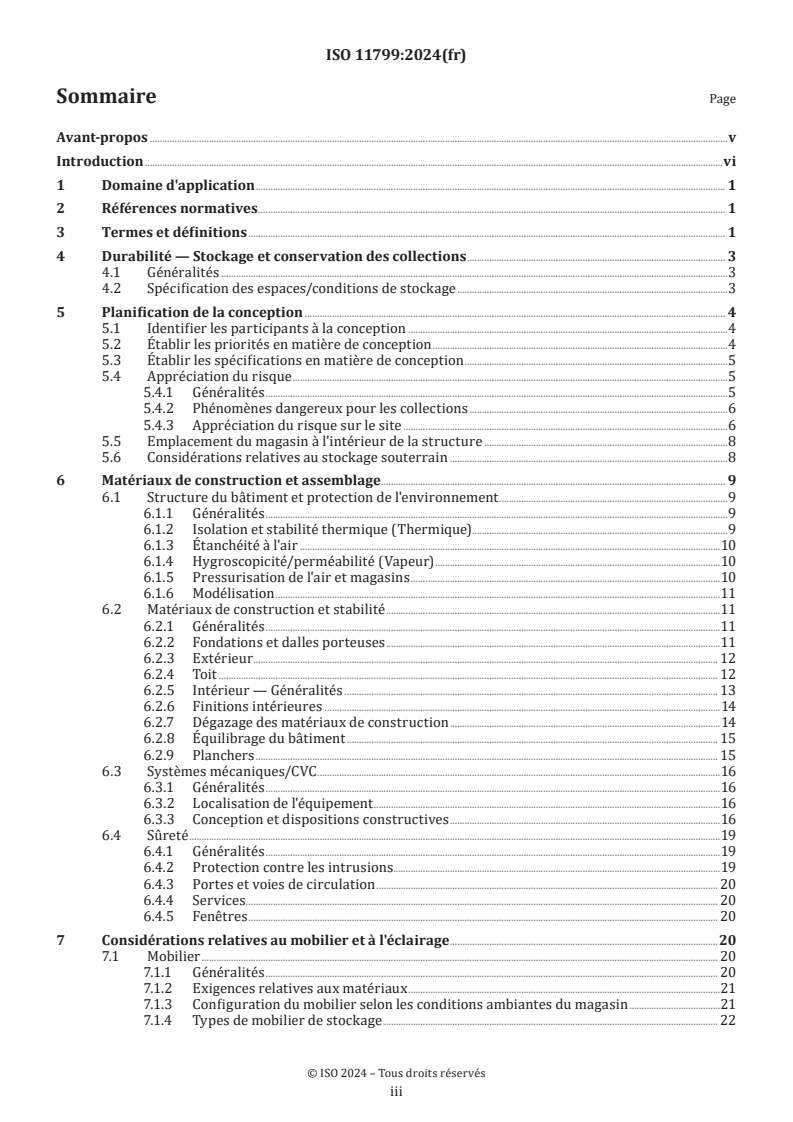
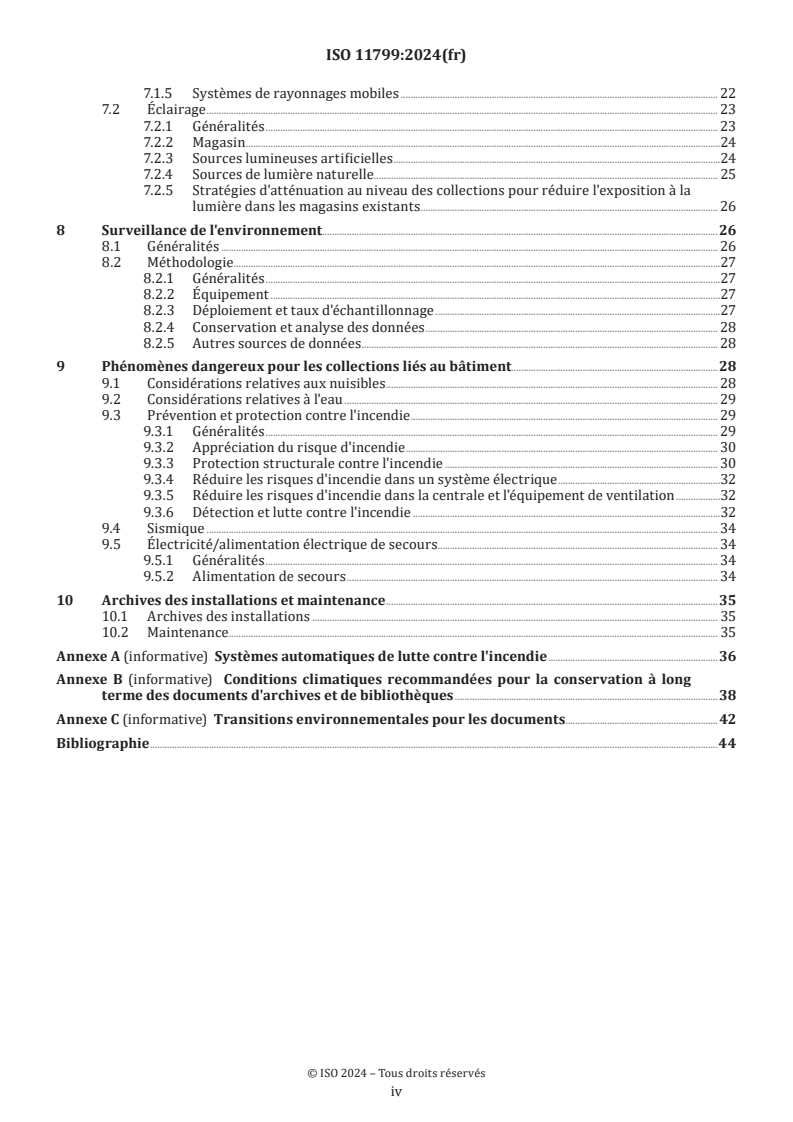
ISO 11799:2024 - Information et documentation — Exigences pour le stockage des documents d'archives et de bibliotheques Released:4. 09. 2024
Overview
ISO 11799:2024 - Information and documentation - Document storage requirements for archive and library materials - defines required characteristics for repositories used for the long-term storage of archive and library materials. The standard covers siting, construction, renovation, installation and equipment for storage facilities and applies where mixed media are stored together with paper-based materials. It supports sustainable collections storage and does not provide exhibition or display guidelines.
Key topics and technical requirements
ISO 11799:2024 addresses technical and operational aspects of repository design and management, including:
- Design planning and risk assessment
- Identify design participants, set priorities and establish specifications
- Conduct site and hazard risk assessments (fire, water, pests, seismic, access)
- Building materials and assembly
- Guidance on building fabric, insulation, airtightness, vapor behaviour and off-gassing of construction materials
- Considerations for foundations, roofs, interior finishes and floors
- Mechanical/HVAC systems
- Requirements for environmental control, equipment siting and design considerations to protect collections
- Security and services
- Protection against intruders, secure circulation routes, doors, windows and services management
- Furniture, shelving and lighting
- Selection of storage furniture (including mobile shelving systems) and lighting strategies to reduce light damage
- Environmental monitoring
- Methodology for monitoring, equipment deployment, data retention and analysis to maintain collection-friendly conditions
- Building-related hazards
- Measures for pest control, water ingress prevention, fire prevention and detection, seismic protection and emergency power
- Facility records and maintenance
- Documentation and maintenance planning for long-term repository performance
- Annexes
- Annex A: automatic fire-fighting systems (informative)
- Annex B: recommended climatic conditions for long-term storage (informative)
- Annex C: environmental transitions for materials (informative)
Applications
ISO 11799:2024 is practical for:
- New construction of archives and library repositories
- Renovation and retrofitting of existing storage spaces
- Specifying HVAC, building materials, shelving and monitoring systems
- Developing risk-based emergency preparedness and maintenance plans
- Creating sustainable collections storage strategies that balance preservation and building performance
Who should use this standard
- Archivists and librarians
- Collections managers and conservation professionals
- Architects and building designers for cultural heritage facilities
- HVAC and security engineers working on repository projects
- Facility managers responsible for long-term storage and preservation
Related standards
ISO 11799:2024 is part of the information and documentation family (ICS 01.140.20). Users should consider complementary standards on fire safety, environmental control and preservation practice when implementing repository solutions.
Relations
- Effective Date
- 01-Jun-2025
Buy Documents
ISO 11799:2024 - Information and documentation — Document storage requirements for archive and library materials Released:4. 09. 2024
ISO 11799:2024 - Information et documentation — Exigences pour le stockage des documents d'archives et de bibliotheques Released:4. 09. 2024
Frequently Asked Questions
SIST ISO 11799:2025 is a standard published by the Slovenian Institute for Standardization (SIST). Its full title is "Information and documentation - Document storage requirements for archive and library materials". This standard covers: This document specifies the required characteristics of repositories used for the long-term storage of archive and library materials. It covers the siting, construction and renovation of the storage facility, and the installation and equipment to be used both within and around the building. This document applies to all archive and library materials held in repositories, where mixed media can be stored together with paper-based materials. It does not preclude the establishment of separate areas or compartments within individual repositories, where the environment can be controlled to create conditions suitable for the needs of specific archive materials. This document does not specify exhibition or display guidelines.
This document specifies the required characteristics of repositories used for the long-term storage of archive and library materials. It covers the siting, construction and renovation of the storage facility, and the installation and equipment to be used both within and around the building. This document applies to all archive and library materials held in repositories, where mixed media can be stored together with paper-based materials. It does not preclude the establishment of separate areas or compartments within individual repositories, where the environment can be controlled to create conditions suitable for the needs of specific archive materials. This document does not specify exhibition or display guidelines.
SIST ISO 11799:2025 is classified under the following ICS (International Classification for Standards) categories: 01.140.20 - Information sciences. The ICS classification helps identify the subject area and facilitates finding related standards.
SIST ISO 11799:2025 has the following relationships with other standards: It is inter standard links to SIST ISO 11799:2018. Understanding these relationships helps ensure you are using the most current and applicable version of the standard.
SIST ISO 11799:2025 is available in PDF format for immediate download after purchase. The document can be added to your cart and obtained through the secure checkout process. Digital delivery ensures instant access to the complete standard document.
Standards Content (Sample)
SLOVENSKI STANDARD
01-junij-2025
Nadomešča:
SIST ISO 11799:2018
Informatika in dokumentacija - Zahteve za shranjevanje dokumentov za arhivsko in
knjižnično gradivo
Information and documentation — Document storage requirements for archive and
library materials
Information et documentation — Exigences pour le stockage des documents d'archives
et de bibliothèques
Ta slovenski standard je istoveten z: ISO 11799:2024
ICS:
01.140.20 Informacijske vede Information sciences
2003-01.Slovenski inštitut za standardizacijo. Razmnoževanje celote ali delov tega standarda ni dovoljeno.
International
Standard
ISO 11799
Third edition
Information and documentation —
2024-09
Document storage requirements for
archive and library materials
Information et documentation — Exigences pour le stockage des
documents d'archives et de bibliothèques
Reference number
© ISO 2024
All rights reserved. Unless otherwise specified, or required in the context of its implementation, no part of this publication may
be reproduced or utilized otherwise in any form or by any means, electronic or mechanical, including photocopying, or posting on
the internet or an intranet, without prior written permission. Permission can be requested from either ISO at the address below
or ISO’s member body in the country of the requester.
ISO copyright office
CP 401 • Ch. de Blandonnet 8
CH-1214 Vernier, Geneva
Phone: +41 22 749 01 11
Email: copyright@iso.org
Website: www.iso.org
Published in Switzerland
ii
Contents Page
Foreword .v
Introduction .vi
1 Scope . 1
2 Normative references . 1
3 Terms and definitions . 1
4 Sustainability — Collections storage and preservation . 2
4.1 General .2
4.2 Specifying storage spaces/conditions .3
5 Design planning . 3
5.1 Identify design participants .3
5.2 Establish design priorities .4
5.3 Establish design specifications .4
5.4 Risk assessment .5
5.4.1 General .5
5.4.2 Hazards to collections .5
5.4.3 Site risk assessment . .6
5.5 Location of repository within structure .7
5.6 Subgrade storage considerations .7
6 Building materials and assembly . 8
6.1 Building fabric and environmental protection .8
6.1.1 General .8
6.1.2 Insulation and thermal stability (Thermal) .8
6.1.3 Airtightness .9
6.1.4 Hygroscopicity/permeability (Vapor) .9
6.1.5 Air pressurization and repositories .9
6.1.6 Modelling .10
6.2 Building materials and stability .10
6.2.1 General .10
6.2.2 Foundations and ground-bearing slabs .10
6.2.3 Exterior .11
6.2.4 Roof .11
6.2.5 Interior — General . 12
6.2.6 Interior finishes . 12
6.2.7 Off gassing of construction materials . 12
6.2.8 Building equilibration . . 13
6.2.9 Floors . 13
6.3 Mechanical/HVAC systems .14
6.3.1 General .14
6.3.2 Equipment location .14
6.3.3 Design considerations .14
6.4 Security .17
6.4.1 General .17
6.4.2 Protection against intruders .17
6.4.3 Doors and circulation routes .17
6.4.4 Services .18
6.4.5 Windows .18
7 Furniture and lighting considerations .18
7.1 Furniture .18
7.1.1 General .18
7.1.2 Material requirements .18
7.1.3 Furniture configuration in the repository ambient conditions .18
7.1.4 Types of storage furniture .19
iii
7.1.5 Mobile shelving systems . 20
7.2 Lighting . 20
7.2.1 General . 20
7.2.2 Repository .21
7.2.3 Artificial light sources .21
7.2.4 Natural light sources . 22
7.2.5 Collection-level mitigation strategies for reducing light exposure in existing
repositories . 22
8 Environmental monitoring .23
8.1 General . 23
8.2 Methodology . 23
8.2.1 General . 23
8.2.2 Equipment . 23
8.2.3 Deployment and sample rates . 23
8.2.4 Data retention and analysis .24
8.2.5 Other data sources .24
9 Building-related hazards to collections.25
9.1 Pest considerations. 25
9.2 Water considerations . 25
9.3 Fire protection and prevention. 25
9.3.1 General . 25
9.3.2 Fire risk assessment . 26
9.3.3 Structural fire protection . 26
9.3.4 Minimizing fire hazard in an electrical system .27
9.3.5 Minimizing fire hazards in ventilation plant and equipment . 28
9.3.6 Fire detection and firefighting . 28
9.4 Seismic . 29
9.5 Power/Emergency power . 30
9.5.1 General . 30
9.5.2 Emergency power . 30
10 Facility records and maintenance .30
10.1 Facility records. 30
10.2 Maintenance . 30
Annex A (informative) Automatic fire-fighting systems .32
Annex B (informative) Recommended climatic conditions for the long-term storage of archive
and library materials .34
Annex C (informative) Environmental transitions for materials .37
Bibliography .38
iv
Foreword
ISO (the International Organization for Standardization) is a worldwide federation of national standards
bodies (ISO member bodies). The work of preparing International Standards is normally carried out through
ISO technical committees. Each member body interested in a subject for which a technical committee
has been established has the right to be represented on that committee. International organizations,
governmental and non-governmental, in liaison with ISO, also take part in the work. ISO collaborates closely
with the International Electrotechnical Commission (IEC) on all matters of electrotechnical standardization.
The procedures used to develop this document and those intended for its further maintenance are described
in the ISO/IEC Directives, Part 1. In particular, the different approval criteria needed for the different types
of ISO document should be noted. This document was drafted in accordance with the editorial rules of the
ISO/IEC Directives, Part 2 (see www.iso.org/directives).
ISO draws attention to the possibility that the implementation of this document may involve the use of (a)
patent(s). ISO takes no position concerning the evidence, validity or applicability of any claimed patent
rights in respect thereof. As of the date of publication of this document, ISO had not received notice of (a)
patent(s) which may be required to implement this document. However, implementers are cautioned that
this may not represent the latest information, which may be obtained from the patent database available at
www.iso.org/patents. ISO shall not be held responsible for identifying any or all such patent rights.
Any trade name used in this document is information given for the convenience of users and does not
constitute an endorsement.
For an explanation of the voluntary nature of standards, the meaning of ISO specific terms and expressions
related to conformity assessment, as well as information about ISO's adherence to the World Trade
Organization (WTO) principles in the Technical Barriers to Trade (TBT), see www.iso.org/iso/foreword.html.
This document was prepared by Technical Committee ISO/TC 46, Information and documentation
Subcommittee SC 10, Requirements for document storage and conditions for preservation.
This third edition cancels and replaces the second edition (ISO 11799:2015), which has been technically
revised.
The main changes are as follows:
— updated content to reflect ISO standards/technical reports published after the second edition, including
ISO/TR 19814 and ISO/TR 19815;
— increased detail and guidance on facility requirements and considerations.
Any feedback or questions on this document should be directed to the user’s national standards body. A
complete listing of these bodies can be found at www.iso.org/members.html.
v
Introduction
Archives and libraries are institutions established to collect, preserve and make materials intended for
consultation available.
Archive and library collections, wherever they are stored, normally contain a wide variety of materials
and formats. These are mainly documents on paper, parchment, palm leaves, papyrus and generally also
include photographic, audio-visual documents and digital formats on diverse types of carriers (mechanical,
photographic, magnetic, optical). All these materials ideally require specific storage conditions to ensure
their long-term preservation and access. Note that separation by media type is rarely possible in archive and
library storage settings, and that most collections will include a variety of materials.
[3] [1]
NOTE See ISO 18934 and ISO 18911 on storage of specific materials.
In a number of fields, national or local building regulations can encompass such matters as construction,
safety and security for public buildings and buildings in which valuable objects are stored (fire precautions,
emergency exits, security against earthquakes, theft, burglary, terrorist acts, etc.), as well as services and
equipment in professional use. This document therefore avoids detailed rules and regulations in these fields,
except when recommending what can be added to these requirements.
This document presents some facts and general rules to be considered when a purpose-built repository is
designed, when an old building originally designed for another use is converted, or when a building already
in use as repository is renovated, with respect to energy efficiency and sustainable development. The same
applies for underground storage facilities which are intended to function as or are already in use as storage
facilities.
This document applies to the long-term storage of archive and library materials. It takes into account that
the materials are stored and must allow active usage as well. Note that this document is about the design and
[7] [8]
construction requirements for archive and libraries storage spaces. ISO/TR 19814 and ISO/TR 19815
serve as companion documents which guide program activities and operations once the physical structure
of the store is in place. As such, this document also does not specifically address the design or construction
requirements of support spaces to collections storage areas (e.g. supplies storage, receiving areas, and
quarantine spaces). Throughout this document, the term “repository” is used to refer specifically to a
collection’s storage space, as opposed to a broader facility which may include a repository as well as other
support spaces.
Depending on the climate and economic situation of individual institutions, it can be difficult to create and
maintain optimal conditions for the long-term storage of archive and library materials. In these cases, it is
expected that the institution will choose a path that meets the most appropriate compromise given needs
and resources. Information that factors into these decisions should be documented with overall project
documentation (see 5.3) to inform future professionals as to the decisions made and why.
vi
International Standard ISO 11799:2024(en)
Information and documentation — Document storage
requirements for archive and library materials
1 Scope
This document specifies the required characteristics of repositories used for the long-term storage of
archive and library materials. It covers the siting, construction and renovation of the storage facility, and the
installation and equipment to be used both within and around the building.
This document applies to all archive and library materials held in repositories, where mixed media can be
stored together with paper-based materials. It does not preclude the establishment of separate areas or
compartments within individual repositories, where the environment can be controlled to create conditions
suitable for the needs of specific archive materials.
This document does not specify exhibition or display guidelines.
2 Normative references
There are no normative references in this document.
3 Terms and definitions
For the purposes of this document, the following terms and definitions apply.
ISO and IEC maintain terminology databases for use in standardization at the following addresses:
— ISO Online browsing platform: available at https:// www .iso .org/ obp
— IEC Electropedia: available at https:// www .electropedia .org/
3.1
archive and library material
all types of documents kept in archives and libraries regardless of their physical format, mainly books,
manuscripts, files, maps, graphic collections and other documents consisting of paper, but also parchment,
papyrus, films, photographic materials, audiovisual recordings, magnetic and optical media, as well as
bindings and protective material
3.2
building fabric
materials that enclose the interior of a building, separating the interior from the exterior (walls, floor and
roof) and includes a number of different materials that collectively form the external envelope of the building
3.3
document
recorded information or material object which can be treated as a unit in a documentation process
3.4
environmental monitoring
recording and analysis of various environmental conditions – including temperature, relative humidity,
light, vibration, or other factors – which impact the long-term preservation of collections materials
3.5
hazard
source of potential harm to collections
Note 1 to entry: Broad examples may include events such as earthquakes, fires, theft, or others.
[SOURCE: ISO 21110:2019, 3.7, modified — Collections was specified in the definition; Note 1 to entry was
replaced.]
3.6
integrated design
collaborative method for designing buildings which emphasizes viewing the building as an interconnected
and interdependent whole rather than an accumulation of its separate components
Note 1 to entry: For cultural heritage, this includes the involvement of collections and facilities specialists as part of
the design team.
3.7
life expectancy
length of time that information is predicted to be retrievable in a system under extended storage conditions
Note 1 to entry: Life expectancy designation (LED) is a rating in years for the life expectancy of records, e. g., LE-1000,
indicates that the records are expected to be usable for 1 000 years.
[SOURCE: NISO TR01-1995]
3.8
long-term storage
storage, for a period of undefined length, of material kept for permanent retention
[SOURCE: ISO/TR 19815:2018, 3.22]
3.9
maintenance
actions of prevention or correction to support long-term functionality of repositories and the systems that
support them.
[SOURCE: EN 13306:2010]
3.10
repository
building, room, or space designed or arranged and used specifically and exclusively for long-term storage of
archive and library materials (3.1)
3.11
risk
effect of uncertainty on objectives; the potential for damage occurring to collections materials from a
particular hazard based on likelihood, frequency, or progress
[4] [51]
Note 1 to entry: Adapted from ISO 21110:2019 and Preventive Conservation: Collection Storage
4 Sustainability — Collections storage and preservation
4.1 General
Conserving archival and library heritage for generations to come includes sustaining protective storage
that presents very low risks to collections. Understanding and minimizing the running costs, energy use
and carbon emission potential of maintaining collections in good condition indefinitely is essential to their
long-term conservation, in order not to contribute to wider ecological and environmental hazards which
themselves would threaten to undermine the practice and purpose of conserving collections. Institutions
should strive to invest in building structures that will last for a minimum 100+ years, while recognizing that
internal systems (mechanical, lighting, sustainable technologies) will by necessity require reinvestment on
~30 year cycles. This reinvestment cycle also allows for the inclusion of new technologies and new scientific
knowledge on a periodic basis.
4.2 Specifying storage spaces/conditions
In setting out to design or review the qualities of a storage facility intended to hold archival and library
materials, the nature and use of these materials shall be defined and the range of safe storage conditions shall
be identified accordingly. Note that recent research has shown that many archival materials can tolerate
certain seasonal ranges of environmental conditions without adversely affecting longevity (see Annex B).
Using these environmental ranges, in conjunction with proper housing/packaging for materials (such as
archival quality boxes, folders, and sleeves where appropriate) can reduce the overall energy consumption,
and improve the long-term sustainability, of the storage facility.
Temperature-sensitive materials that profit from or require storage at especially low temperatures
(e.g. cellulose acetate film and colour media) and acutely moisture sensitive materials that require dry
microclimate packaging (e. g. polyester-base magnetic tape) shall be identified, packaged and stored
accordingly in microenvironments so that there is no need for the constant operation of specialized
environments throughout the year for the entire archive and library collection. Please note that this standard
does not address specific design requirements for frozen collections storage facilities, but that envelope and
mechanical specifications for these environments will differ from standard storage construction. Frozen
storage facilities for long-term preservation shall always be kept separate from frozen environments for
quarantine (pests, mould, etc.) purposes.
An organization planning a new or renovated collections storage facility shall explore the potential for
designs which incorporate the following characteristics:
— envelope designs and site/facility layouts which mitigate or buffer the majority of external energy loads;
— the possibility for a non-mechanically-controlled (or primarily non-mechanically-controlled)
environment that can maintain appropriate conditions throughout the course of a year (whether in a
seasonal or steady climate);
— a high material volume percentage storage design (i.e., an efficient storage design where the volume of
material in the space is significantly higher than free air volume);
— the use of uninsulated ground-contact floor slabs which provide a heat/energy sink that mitigates energy
loads on an upper structure;
— appropriate and effective vapor control layers or seals in all structural elements.
5 Design planning
5.1 Identify design participants
All construction projects involving the storage of archives and library collections shall utilize an “integrated
design” approach that includes:
— the participation of staff from the organization, including preservation and/or collections management
staff and facilities/operations staff;
— applicable external experts in the design and operation of collections preservation environments
(beyond the general architecture/engineering team);
— relevant architectural and engineering disciplines to the specific project.
This team involvement should initiate as part of predesign and establishment of program requirements and
continue through to construction and final building/mechanical commissioning.
The nature and needs of collections storage facilities, whether new facilities, renovation projects, or adaptive
reuse, require careful consideration of appropriate design requirements for both collections and sustainable
operation; while this standard provides general requirements and guidance, these cannot be applied
universally. Relevant staff and external experts, who are intimately familiar with any existing conditions
as well as future needs for collections objects, shall be included to inform the appropriate balance between
facility design for preservation, sustainability, historic preservation concerns, or other factors.
Note that the design of a storage space is often subject to local regulatory body review and approval.
5.2 Establish design priorities
Design priorities for archive and library storage facilities will vary depending on the institution and its
specific needs and resources. Before jointly addressing design specifications as a team, the institution shall
carefully define its expectations relative to a series of factors to guide the design and construction process.
Those factors should include:
— available budget or budget limitations;
— expected preservation quality/collection longevity;
— need for specialized storage environments (frozen, dry, high security, etc.);
— size/extent of collections to be stored in each storage environment;
— sustainability requirements (including construction materials, operation, etc);
— achievement of target environmental conditions;
— expected building longevity;
— aesthetic architectural requirements;
— occupancy expectations and access requirements (public or staff only, etc.);
— future collections growth requirements;
— disaster risk prevention.
5.3 Establish design specifications
The institution shall, with the assistance of external consultants and designers as appropriate, establish an
initial set of design specifications and program requirements to guide the design and construction process.
These are to serve as an initial informative document to the broader design team to establish expectations
for the finished facility, and should include factors as addressed in Clause 6, including:
— design environmental ranges for storage zone(s);
— any preferred systems or requirements for:
— building envelope;
— mechanical systems;
— lighting;
— fire suppression;
— security;
— flooring;
— storage furniture;
— planned occupancy patterns and storage capacity;
— preferred operational or control characteristics.
Design specifications and program requirements may be updated throughout the course of the design
and construction project, based on the findings and decisions of the integrated design team. Original and
successive versions shall be preserved as part of the project documentation to record original intent versus
the negotiated final design and construction.
5.4 Risk assessment
5.4.1 General
A risk assessment shall be carried out when deciding where to locate a new building or collection space
intended to house cultural heritage collections, whether for storage, display or other use. Existing sites,
buildings or rooms, vaults, or caves housing collections shall be re-assessed against risks periodically,
particularly when new hazards are known to have emerged. Information and data shall be gathered and
assessed in order to formulate site and design requirements to meet applicable environment, security, fire,
flood, earthquake, landslide and other protection standards and regulations in any new or renovated facility.
As part of the risk assessment, the methodology and steps below shall be included. The risks set out in the
following clauses shall be considered when:
— planning, constructing or adapting the building or collection space (including risks associated with the
construction works themselves, in an existing building),
— equipping the building, and
— managing the building once in use.
[4] [6]
NOTE For details, consult ISO 21110 and ISO 31000 .
5.4.2 Hazards to collections
The nature and use of the collections to be housed shall define requirements for the qualities and design of
a building or room in which they are to be placed. The organization shall identify the hazards that affect its
collections and evaluate the likelihood and impact of those hazards occurring. The following hazards are
common to cultural heritage collections and shall be assessed:
— fires;
— water (fresh water supply and wastewater);
— natural events (torrential rain, strong winds, flooding, landslide, snowslide, earthquake, wildfire,
lightning, etc.);
— environment (internal and external): unsuitable/inappropriate temperature, humidity, light and
pollution including gaseous and particulate (see Annex B and Annex C for examples of guidance
information regarding environmental risks and sensitivities of collection materials),
— load-bearing capacity;
— bio-deterioration (pests and mould, endogenous decomposition);
— theft, robbery;
— risk of war or conflict;
— vandalism (including arson).
The hazards associated with the location of a building shall be identified in accordance with local and
national guidance (i.e. flood zones, expected sea rise, etc.). The location within a building of activities and
services that may create a hazard, e.g. kitchens, laboratories, water storage tanks, oil tanks, combustion
equipment, HVAC systems, and electrical switchgear shall be taken into account in the risk assessment.
Handwash and sanitary installations within storage areas should be avoided and internal water pipe runs
should be avoided.
5.4.3 Site risk assessment
5.4.3.1 Hazards identification
When selecting a site for a new construction or reviewing an existing building (above- or below-ground)
a risk assessment shall be undertaken to identify and document the hazards of each potential site and the
likelihood of each of the identified hazards causing damage. Specific hazards may include those that result in
the sudden loss of, or extensive damage to collections (e.g. the collapse of the building, fire, flood or landslide)
or those hazards that can result in damage over time (e.g. insect attack, pollution or climate).
Correlations of individual risks should also be taken into consideration. When selecting spaces within an
existing building (whether part or whole) for re-use for heritage collections, a risk assessment shall be
undertaken with reference to the strategy outlined in 5.4.1. It is recognised that in many cases natural
hazards due to the local climate (e.g. high temperature and relative humidity, risk of hurricanes or cyclones)
or geology (e.g. risk of seismic activity) cannot be eliminated and must be accepted and mitigated as far as
possible.
Local planning and environmental regulations will always influence where a building is located. No site can
be completely free from hazards, but when selecting and planning for a new construction, the probability of
the hazards identified causing loss or damage to heritage materials, and the potential cost of mitigation or
recovery, is to be assessed and taken into account.
The risk assessment shall include but does not have to be limited to more common hazards associated with
the following:
— natural hazards
— flooding, water penetration (from the sea, rivers and lakes, rainwater and snowmelt), including
current and projected water/sea levels/rainfall rates;
— landslides, avalanches, sink holes, uplift, seismic and volcanic activity;
— wildfire (from nearby dry vegetation, lightning)
— hurricanes, tornados or cyclones;
— solar flares or other events impacting magnetic fields;
— underground radioactive materials, such as radon.
— human-made hazards
— road, rail, mining or similar tunnels under or close to the building or elevated roadways, railways or
tramways (e.g. risk of collapse or excessive and regular vibration);
— sites or areas used for the storage or processing of highly flammable materials (e.g. petro-chemicals,
explosives, paint and tyres) at risk from fire or explosions, or at risk from water or chemicals used to
deal with such hazards;
— sites on or adjacent to a place emitting harmful gases, pollutants, smoke, dust, etc. or vibration
sources, such as open cast mining, incinerator, cement works, etc.;
— sites adjacent to a place or activity that will attract rodents, insects and other pests, such as food
storage or processing, waste management, landfills, etc.;
— nuclear power stations, plants or other radioactive facilities (including waste and storage sites);
— airports and their associated flight paths;
— high voltage power lines and substations (risk of e.g. collapse or fire);
— defence and other target establishments;
— buildings and places that may become the focus of civil disturbances;
— strong magnetic fields (artificial).
In order to minimize the harmful effects of exposure to sunlight and strong winds that affect air infiltration,
careful attention shall be paid to orientation, landscaping and the site's microclimate. Selection of a new
site that is below the 1 % (‘100 year’) flood level shall be avoided, if possible. Where a history of springs and
underground watercourses exists, these shall be taken into account as heavy and prolonged rainfall may
reactivate them.
5.4.3.2 Accessibility of site
In addition to assessing the likelihood and impact of the above, an assessment shall be made of the
accessibility of the site to emergency services at all times. The accessibility to the site includes the likely call
out time of fire and other emergency services. This is especially important if the building site is remote or
accessible only through dense traffic or narrow streets. For example, remote buildings may need additional
...
International
Standard
ISO 11799
Third edition
Information and documentation —
2024-09
Document storage requirements for
archive and library materials
Information et documentation — Exigences pour le stockage des
documents d'archives et de bibliothèques
Reference number
© ISO 2024
All rights reserved. Unless otherwise specified, or required in the context of its implementation, no part of this publication may
be reproduced or utilized otherwise in any form or by any means, electronic or mechanical, including photocopying, or posting on
the internet or an intranet, without prior written permission. Permission can be requested from either ISO at the address below
or ISO’s member body in the country of the requester.
ISO copyright office
CP 401 • Ch. de Blandonnet 8
CH-1214 Vernier, Geneva
Phone: +41 22 749 01 11
Email: copyright@iso.org
Website: www.iso.org
Published in Switzerland
ii
Contents Page
Foreword .v
Introduction .vi
1 Scope . 1
2 Normative references . 1
3 Terms and definitions . 1
4 Sustainability — Collections storage and preservation . 2
4.1 General .2
4.2 Specifying storage spaces/conditions .3
5 Design planning . 3
5.1 Identify design participants .3
5.2 Establish design priorities .4
5.3 Establish design specifications .4
5.4 Risk assessment .5
5.4.1 General .5
5.4.2 Hazards to collections .5
5.4.3 Site risk assessment . .6
5.5 Location of repository within structure .7
5.6 Subgrade storage considerations .7
6 Building materials and assembly . 8
6.1 Building fabric and environmental protection .8
6.1.1 General .8
6.1.2 Insulation and thermal stability (Thermal) .8
6.1.3 Airtightness .9
6.1.4 Hygroscopicity/permeability (Vapor) .9
6.1.5 Air pressurization and repositories .9
6.1.6 Modelling .10
6.2 Building materials and stability .10
6.2.1 General .10
6.2.2 Foundations and ground-bearing slabs .10
6.2.3 Exterior .11
6.2.4 Roof .11
6.2.5 Interior — General . 12
6.2.6 Interior finishes . 12
6.2.7 Off gassing of construction materials . 12
6.2.8 Building equilibration . . 13
6.2.9 Floors . 13
6.3 Mechanical/HVAC systems .14
6.3.1 General .14
6.3.2 Equipment location .14
6.3.3 Design considerations .14
6.4 Security .17
6.4.1 General .17
6.4.2 Protection against intruders .17
6.4.3 Doors and circulation routes .17
6.4.4 Services .18
6.4.5 Windows .18
7 Furniture and lighting considerations .18
7.1 Furniture .18
7.1.1 General .18
7.1.2 Material requirements .18
7.1.3 Furniture configuration in the repository ambient conditions .18
7.1.4 Types of storage furniture .19
iii
7.1.5 Mobile shelving systems . 20
7.2 Lighting . 20
7.2.1 General . 20
7.2.2 Repository .21
7.2.3 Artificial light sources .21
7.2.4 Natural light sources . 22
7.2.5 Collection-level mitigation strategies for reducing light exposure in existing
repositories . 22
8 Environmental monitoring .23
8.1 General . 23
8.2 Methodology . 23
8.2.1 General . 23
8.2.2 Equipment . 23
8.2.3 Deployment and sample rates . 23
8.2.4 Data retention and analysis .24
8.2.5 Other data sources .24
9 Building-related hazards to collections.25
9.1 Pest considerations. 25
9.2 Water considerations . 25
9.3 Fire protection and prevention. 25
9.3.1 General . 25
9.3.2 Fire risk assessment . 26
9.3.3 Structural fire protection . 26
9.3.4 Minimizing fire hazard in an electrical system .27
9.3.5 Minimizing fire hazards in ventilation plant and equipment . 28
9.3.6 Fire detection and firefighting . 28
9.4 Seismic . 29
9.5 Power/Emergency power . 30
9.5.1 General . 30
9.5.2 Emergency power . 30
10 Facility records and maintenance .30
10.1 Facility records. 30
10.2 Maintenance . 30
Annex A (informative) Automatic fire-fighting systems .32
Annex B (informative) Recommended climatic conditions for the long-term storage of archive
and library materials .34
Annex C (informative) Environmental transitions for materials .37
Bibliography .38
iv
Foreword
ISO (the International Organization for Standardization) is a worldwide federation of national standards
bodies (ISO member bodies). The work of preparing International Standards is normally carried out through
ISO technical committees. Each member body interested in a subject for which a technical committee
has been established has the right to be represented on that committee. International organizations,
governmental and non-governmental, in liaison with ISO, also take part in the work. ISO collaborates closely
with the International Electrotechnical Commission (IEC) on all matters of electrotechnical standardization.
The procedures used to develop this document and those intended for its further maintenance are described
in the ISO/IEC Directives, Part 1. In particular, the different approval criteria needed for the different types
of ISO document should be noted. This document was drafted in accordance with the editorial rules of the
ISO/IEC Directives, Part 2 (see www.iso.org/directives).
ISO draws attention to the possibility that the implementation of this document may involve the use of (a)
patent(s). ISO takes no position concerning the evidence, validity or applicability of any claimed patent
rights in respect thereof. As of the date of publication of this document, ISO had not received notice of (a)
patent(s) which may be required to implement this document. However, implementers are cautioned that
this may not represent the latest information, which may be obtained from the patent database available at
www.iso.org/patents. ISO shall not be held responsible for identifying any or all such patent rights.
Any trade name used in this document is information given for the convenience of users and does not
constitute an endorsement.
For an explanation of the voluntary nature of standards, the meaning of ISO specific terms and expressions
related to conformity assessment, as well as information about ISO's adherence to the World Trade
Organization (WTO) principles in the Technical Barriers to Trade (TBT), see www.iso.org/iso/foreword.html.
This document was prepared by Technical Committee ISO/TC 46, Information and documentation
Subcommittee SC 10, Requirements for document storage and conditions for preservation.
This third edition cancels and replaces the second edition (ISO 11799:2015), which has been technically
revised.
The main changes are as follows:
— updated content to reflect ISO standards/technical reports published after the second edition, including
ISO/TR 19814 and ISO/TR 19815;
— increased detail and guidance on facility requirements and considerations.
Any feedback or questions on this document should be directed to the user’s national standards body. A
complete listing of these bodies can be found at www.iso.org/members.html.
v
Introduction
Archives and libraries are institutions established to collect, preserve and make materials intended for
consultation available.
Archive and library collections, wherever they are stored, normally contain a wide variety of materials
and formats. These are mainly documents on paper, parchment, palm leaves, papyrus and generally also
include photographic, audio-visual documents and digital formats on diverse types of carriers (mechanical,
photographic, magnetic, optical). All these materials ideally require specific storage conditions to ensure
their long-term preservation and access. Note that separation by media type is rarely possible in archive and
library storage settings, and that most collections will include a variety of materials.
[3] [1]
NOTE See ISO 18934 and ISO 18911 on storage of specific materials.
In a number of fields, national or local building regulations can encompass such matters as construction,
safety and security for public buildings and buildings in which valuable objects are stored (fire precautions,
emergency exits, security against earthquakes, theft, burglary, terrorist acts, etc.), as well as services and
equipment in professional use. This document therefore avoids detailed rules and regulations in these fields,
except when recommending what can be added to these requirements.
This document presents some facts and general rules to be considered when a purpose-built repository is
designed, when an old building originally designed for another use is converted, or when a building already
in use as repository is renovated, with respect to energy efficiency and sustainable development. The same
applies for underground storage facilities which are intended to function as or are already in use as storage
facilities.
This document applies to the long-term storage of archive and library materials. It takes into account that
the materials are stored and must allow active usage as well. Note that this document is about the design and
[7] [8]
construction requirements for archive and libraries storage spaces. ISO/TR 19814 and ISO/TR 19815
serve as companion documents which guide program activities and operations once the physical structure
of the store is in place. As such, this document also does not specifically address the design or construction
requirements of support spaces to collections storage areas (e.g. supplies storage, receiving areas, and
quarantine spaces). Throughout this document, the term “repository” is used to refer specifically to a
collection’s storage space, as opposed to a broader facility which may include a repository as well as other
support spaces.
Depending on the climate and economic situation of individual institutions, it can be difficult to create and
maintain optimal conditions for the long-term storage of archive and library materials. In these cases, it is
expected that the institution will choose a path that meets the most appropriate compromise given needs
and resources. Information that factors into these decisions should be documented with overall project
documentation (see 5.3) to inform future professionals as to the decisions made and why.
vi
International Standard ISO 11799:2024(en)
Information and documentation — Document storage
requirements for archive and library materials
1 Scope
This document specifies the required characteristics of repositories used for the long-term storage of
archive and library materials. It covers the siting, construction and renovation of the storage facility, and the
installation and equipment to be used both within and around the building.
This document applies to all archive and library materials held in repositories, where mixed media can be
stored together with paper-based materials. It does not preclude the establishment of separate areas or
compartments within individual repositories, where the environment can be controlled to create conditions
suitable for the needs of specific archive materials.
This document does not specify exhibition or display guidelines.
2 Normative references
There are no normative references in this document.
3 Terms and definitions
For the purposes of this document, the following terms and definitions apply.
ISO and IEC maintain terminology databases for use in standardization at the following addresses:
— ISO Online browsing platform: available at https:// www .iso .org/ obp
— IEC Electropedia: available at https:// www .electropedia .org/
3.1
archive and library material
all types of documents kept in archives and libraries regardless of their physical format, mainly books,
manuscripts, files, maps, graphic collections and other documents consisting of paper, but also parchment,
papyrus, films, photographic materials, audiovisual recordings, magnetic and optical media, as well as
bindings and protective material
3.2
building fabric
materials that enclose the interior of a building, separating the interior from the exterior (walls, floor and
roof) and includes a number of different materials that collectively form the external envelope of the building
3.3
document
recorded information or material object which can be treated as a unit in a documentation process
3.4
environmental monitoring
recording and analysis of various environmental conditions – including temperature, relative humidity,
light, vibration, or other factors – which impact the long-term preservation of collections materials
3.5
hazard
source of potential harm to collections
Note 1 to entry: Broad examples may include events such as earthquakes, fires, theft, or others.
[SOURCE: ISO 21110:2019, 3.7, modified — Collections was specified in the definition; Note 1 to entry was
replaced.]
3.6
integrated design
collaborative method for designing buildings which emphasizes viewing the building as an interconnected
and interdependent whole rather than an accumulation of its separate components
Note 1 to entry: For cultural heritage, this includes the involvement of collections and facilities specialists as part of
the design team.
3.7
life expectancy
length of time that information is predicted to be retrievable in a system under extended storage conditions
Note 1 to entry: Life expectancy designation (LED) is a rating in years for the life expectancy of records, e. g., LE-1000,
indicates that the records are expected to be usable for 1 000 years.
[SOURCE: NISO TR01-1995]
3.8
long-term storage
storage, for a period of undefined length, of material kept for permanent retention
[SOURCE: ISO/TR 19815:2018, 3.22]
3.9
maintenance
actions of prevention or correction to support long-term functionality of repositories and the systems that
support them.
[SOURCE: EN 13306:2010]
3.10
repository
building, room, or space designed or arranged and used specifically and exclusively for long-term storage of
archive and library materials (3.1)
3.11
risk
effect of uncertainty on objectives; the potential for damage occurring to collections materials from a
particular hazard based on likelihood, frequency, or progress
[4] [51]
Note 1 to entry: Adapted from ISO 21110:2019 and Preventive Conservation: Collection Storage
4 Sustainability — Collections storage and preservation
4.1 General
Conserving archival and library heritage for generations to come includes sustaining protective storage
that presents very low risks to collections. Understanding and minimizing the running costs, energy use
and carbon emission potential of maintaining collections in good condition indefinitely is essential to their
long-term conservation, in order not to contribute to wider ecological and environmental hazards which
themselves would threaten to undermine the practice and purpose of conserving collections. Institutions
should strive to invest in building structures that will last for a minimum 100+ years, while recognizing that
internal systems (mechanical, lighting, sustainable technologies) will by necessity require reinvestment on
~30 year cycles. This reinvestment cycle also allows for the inclusion of new technologies and new scientific
knowledge on a periodic basis.
4.2 Specifying storage spaces/conditions
In setting out to design or review the qualities of a storage facility intended to hold archival and library
materials, the nature and use of these materials shall be defined and the range of safe storage conditions shall
be identified accordingly. Note that recent research has shown that many archival materials can tolerate
certain seasonal ranges of environmental conditions without adversely affecting longevity (see Annex B).
Using these environmental ranges, in conjunction with proper housing/packaging for materials (such as
archival quality boxes, folders, and sleeves where appropriate) can reduce the overall energy consumption,
and improve the long-term sustainability, of the storage facility.
Temperature-sensitive materials that profit from or require storage at especially low temperatures
(e.g. cellulose acetate film and colour media) and acutely moisture sensitive materials that require dry
microclimate packaging (e. g. polyester-base magnetic tape) shall be identified, packaged and stored
accordingly in microenvironments so that there is no need for the constant operation of specialized
environments throughout the year for the entire archive and library collection. Please note that this standard
does not address specific design requirements for frozen collections storage facilities, but that envelope and
mechanical specifications for these environments will differ from standard storage construction. Frozen
storage facilities for long-term preservation shall always be kept separate from frozen environments for
quarantine (pests, mould, etc.) purposes.
An organization planning a new or renovated collections storage facility shall explore the potential for
designs which incorporate the following characteristics:
— envelope designs and site/facility layouts which mitigate or buffer the majority of external energy loads;
— the possibility for a non-mechanically-controlled (or primarily non-mechanically-controlled)
environment that can maintain appropriate conditions throughout the course of a year (whether in a
seasonal or steady climate);
— a high material volume percentage storage design (i.e., an efficient storage design where the volume of
material in the space is significantly higher than free air volume);
— the use of uninsulated ground-contact floor slabs which provide a heat/energy sink that mitigates energy
loads on an upper structure;
— appropriate and effective vapor control layers or seals in all structural elements.
5 Design planning
5.1 Identify design participants
All construction projects involving the storage of archives and library collections shall utilize an “integrated
design” approach that includes:
— the participation of staff from the organization, including preservation and/or collections management
staff and facilities/operations staff;
— applicable external experts in the design and operation of collections preservation environments
(beyond the general architecture/engineering team);
— relevant architectural and engineering disciplines to the specific project.
This team involvement should initiate as part of predesign and establishment of program requirements and
continue through to construction and final building/mechanical commissioning.
The nature and needs of collections storage facilities, whether new facilities, renovation projects, or adaptive
reuse, require careful consideration of appropriate design requirements for both collections and sustainable
operation; while this standard provides general requirements and guidance, these cannot be applied
universally. Relevant staff and external experts, who are intimately familiar with any existing conditions
as well as future needs for collections objects, shall be included to inform the appropriate balance between
facility design for preservation, sustainability, historic preservation concerns, or other factors.
Note that the design of a storage space is often subject to local regulatory body review and approval.
5.2 Establish design priorities
Design priorities for archive and library storage facilities will vary depending on the institution and its
specific needs and resources. Before jointly addressing design specifications as a team, the institution shall
carefully define its expectations relative to a series of factors to guide the design and construction process.
Those factors should include:
— available budget or budget limitations;
— expected preservation quality/collection longevity;
— need for specialized storage environments (frozen, dry, high security, etc.);
— size/extent of collections to be stored in each storage environment;
— sustainability requirements (including construction materials, operation, etc);
— achievement of target environmental conditions;
— expected building longevity;
— aesthetic architectural requirements;
— occupancy expectations and access requirements (public or staff only, etc.);
— future collections growth requirements;
— disaster risk prevention.
5.3 Establish design specifications
The institution shall, with the assistance of external consultants and designers as appropriate, establish an
initial set of design specifications and program requirements to guide the design and construction process.
These are to serve as an initial informative document to the broader design team to establish expectations
for the finished facility, and should include factors as addressed in Clause 6, including:
— design environmental ranges for storage zone(s);
— any preferred systems or requirements for:
— building envelope;
— mechanical systems;
— lighting;
— fire suppression;
— security;
— flooring;
— storage furniture;
— planned occupancy patterns and storage capacity;
— preferred operational or control characteristics.
Design specifications and program requirements may be updated throughout the course of the design
and construction project, based on the findings and decisions of the integrated design team. Original and
successive versions shall be preserved as part of the project documentation to record original intent versus
the negotiated final design and construction.
5.4 Risk assessment
5.4.1 General
A risk assessment shall be carried out when deciding where to locate a new building or collection space
intended to house cultural heritage collections, whether for storage, display or other use. Existing sites,
buildings or rooms, vaults, or caves housing collections shall be re-assessed against risks periodically,
particularly when new hazards are known to have emerged. Information and data shall be gathered and
assessed in order to formulate site and design requirements to meet applicable environment, security, fire,
flood, earthquake, landslide and other protection standards and regulations in any new or renovated facility.
As part of the risk assessment, the methodology and steps below shall be included. The risks set out in the
following clauses shall be considered when:
— planning, constructing or adapting the building or collection space (including risks associated with the
construction works themselves, in an existing building),
— equipping the building, and
— managing the building once in use.
[4] [6]
NOTE For details, consult ISO 21110 and ISO 31000 .
5.4.2 Hazards to collections
The nature and use of the collections to be housed shall define requirements for the qualities and design of
a building or room in which they are to be placed. The organization shall identify the hazards that affect its
collections and evaluate the likelihood and impact of those hazards occurring. The following hazards are
common to cultural heritage collections and shall be assessed:
— fires;
— water (fresh water supply and wastewater);
— natural events (torrential rain, strong winds, flooding, landslide, snowslide, earthquake, wildfire,
lightning, etc.);
— environment (internal and external): unsuitable/inappropriate temperature, humidity, light and
pollution including gaseous and particulate (see Annex B and Annex C for examples of guidance
information regarding environmental risks and sensitivities of collection materials),
— load-bearing capacity;
— bio-deterioration (pests and mould, endogenous decomposition);
— theft, robbery;
— risk of war or conflict;
— vandalism (including arson).
The hazards associated with the location of a building shall be identified in accordance with local and
national guidance (i.e. flood zones, expected sea rise, etc.). The location within a building of activities and
services that may create a hazard, e.g. kitchens, laboratories, water storage tanks, oil tanks, combustion
equipment, HVAC systems, and electrical switchgear shall be taken into account in the risk assessment.
Handwash and sanitary installations within storage areas should be avoided and internal water pipe runs
should be avoided.
5.4.3 Site risk assessment
5.4.3.1 Hazards identification
When selecting a site for a new construction or reviewing an existing building (above- or below-ground)
a risk assessment shall be undertaken to identify and document the hazards of each potential site and the
likelihood of each of the identified hazards causing damage. Specific hazards may include those that result in
the sudden loss of, or extensive damage to collections (e.g. the collapse of the building, fire, flood or landslide)
or those hazards that can result in damage over time (e.g. insect attack, pollution or climate).
Correlations of individual risks should also be taken into consideration. When selecting spaces within an
existing building (whether part or whole) for re-use for heritage collections, a risk assessment shall be
undertaken with reference to the strategy outlined in 5.4.1. It is recognised that in many cases natural
hazards due to the local climate (e.g. high temperature and relative humidity, risk of hurricanes or cyclones)
or geology (e.g. risk of seismic activity) cannot be eliminated and must be accepted and mitigated as far as
possible.
Local planning and environmental regulations will always influence where a building is located. No site can
be completely free from hazards, but when selecting and planning for a new construction, the probability of
the hazards identified causing loss or damage to heritage materials, and the potential cost of mitigation or
recovery, is to be assessed and taken into account.
The risk assessment shall include but does not have to be limited to more common hazards associated with
the following:
— natural hazards
— flooding, water penetration (from the sea, rivers and lakes, rainwater and snowmelt), including
current and projected water/sea levels/rainfall rates;
— landslides, avalanches, sink holes, uplift, seismic and volcanic activity;
— wildfire (from nearby dry vegetation, lightning)
— hurricanes, tornados or cyclones;
— solar flares or other events impacting magnetic fields;
— underground radioactive materials, such as radon.
— human-made hazards
— road, rail, mining or similar tunnels under or close to the building or elevated roadways, railways or
tramways (e.g. risk of collapse or excessive and regular vibration);
— sites or areas used for the storage or processing of highly flammable materials (e.g. petro-chemicals,
explosives, paint and tyres) at risk from fire or explosions, or at risk from water or chemicals used to
deal with such hazards;
— sites on or adjacent to a place emitting harmful gases, pollutants, smoke, dust, etc. or vibration
sources, such as open cast mining, incinerator, cement works, etc.;
— sites adjacent to a place or activity that will attract rodents, insects and other pests, such as food
storage or processing, waste management, landfills, etc.;
— nuclear power stations, plants or other radioactive facilities (including waste and storage sites);
— airports and their associated flight paths;
— high voltage power lines and substations (risk of e.g. collapse or fire);
— defence and other target establishments;
— buildings and places that may become the focus of civil disturbances;
— strong magnetic fields (artificial).
In order to minimize the harmful effects of exposure to sunlight and strong winds that affect air infiltration,
careful attention shall be paid to orientation, landscaping and the site's microclimate. Selection of a new
site that is below the 1 % (‘100 year’) flood level shall be avoided, if possible. Where a history of springs and
underground watercourses exists, these shall be taken into account as heavy and prolonged rainfall may
reactivate them.
5.4.3.2 Accessibility of site
In addition to assessing the likelihood and impact of the above, an assessment shall be made of the
accessibility of the site to emergency services at all times. The accessibility to the site includes the likely call
out time of fire and other emergency services. This is especially important if the building site is remote or
accessible only through dense traffic or narrow streets. For example, remote buildings may need additional
fire protection measures to allow for additional time for fire service response. The site should include safe
and secure transportation spaces, unobstructed access to the building for larger vehicles while at the same
time meeting security standards. Sites should have multiple access points; in the aftermath of natural
disasters or other events, single-point entry may be blocked, leaving the facility inaccessible.
5.5 Location of repository within structure
For new facilities, the repository location in relation to other aspects of the facility (occupied work areas,
receiving areas, etc.) shall ideally be located in one of two areas:
— Central to the facility, surrounded on all sides by other environments/zones which buffer the repository
from the exterior environment. Depending on exterior conditions, this can both reduce overall energy
loads on the repository, as well as protect it from any failures of the exterior envelope.
— Away from direct sun exposure; in the northern hemisphere this may be on the
...
Norme
internationale
ISO 11799
Troisième édition
Information et documentation —
2024-09
Exigences pour le stockage des
documents d'archives et de
bibliothèques
Information and documentation — Document storage
requirements for archive and library materials
Numéro de référence
DOCUMENT PROTÉGÉ PAR COPYRIGHT
© ISO 2024
Tous droits réservés. Sauf prescription différente ou nécessité dans le contexte de sa mise en œuvre, aucune partie de cette
publication ne peut être reproduite ni utilisée sous quelque forme que ce soit et par aucun procédé, électronique ou mécanique,
y compris la photocopie, ou la diffusion sur l’internet ou sur un intranet, sans autorisation écrite préalable. Une autorisation peut
être demandée à l’ISO à l’adresse ci-après ou au comité membre de l’ISO dans le pays du demandeur.
ISO copyright office
Case postale 401 • Ch. de Blandonnet 8
CH-1214 Vernier, Genève
Tél.: +41 22 749 01 11
E-mail: copyright@iso.org
Web: www.iso.org
Publié en Suisse
ii
Sommaire Page
Avant-propos .v
Introduction .vi
1 Domaine d'application . 1
2 Références normatives . 1
3 Termes et définitions . 1
4 Durabilité — Stockage et conservation des collections . 3
4.1 Généralités .3
4.2 Spécification des espaces/conditions de stockage .3
5 Planification de la conception . 4
5.1 Identifier les participants à la conception .4
5.2 Établir les priorités en matière de conception .4
5.3 Établir les spécifications en matière de conception .5
5.4 Appréciation du risque .5
5.4.1 Généralités .5
5.4.2 Phénomènes dangereux pour les collections .6
5.4.3 Appréciation du risque sur le site .6
5.5 Emplacement du magasin à l'intérieur de la structure .8
5.6 Considérations relatives au stockage souterrain .8
6 Matériaux de construction et assemblage . 9
6.1 Structure du bâtiment et protection de l'environnement .9
6.1.1 Généralités .9
6.1.2 Isolation et stabilité thermique (Thermique) . .9
6.1.3 Étanchéité à l'air .10
6.1.4 Hygroscopicité/perméabilité (Vapeur) .10
6.1.5 Pressurisation de l'air et magasins .10
6.1.6 Modélisation .11
6.2 Matériaux de construction et stabilité .11
6.2.1 Généralités .11
6.2.2 Fondations et dalles porteuses .11
6.2.3 Extérieur . 12
6.2.4 Toit . 12
6.2.5 Intérieur — Généralités . 13
6.2.6 Finitions intérieures .14
6.2.7 Dégazage des matériaux de construction .14
6.2.8 Équilibrage du bâtiment . 15
6.2.9 Planchers . 15
6.3 Systèmes mécaniques/CVC .16
6.3.1 Généralités .16
6.3.2 Localisation de l'équipement .16
6.3.3 Conception et dispositions constructives .16
6.4 Sûreté .19
6.4.1 Généralités .19
6.4.2 Protection contre les intrusions .19
6.4.3 Portes et voies de circulation . 20
6.4.4 Services . 20
6.4.5 Fenêtres . 20
7 Considérations relatives au mobilier et à l'éclairage .20
7.1 Mobilier . 20
7.1.1 Généralités . 20
7.1.2 Exigences relatives aux matériaux .21
7.1.3 Configuration du mobilier selon les conditions ambiantes du magasin .21
7.1.4 Types de mobilier de stockage . 22
iii
7.1.5 Systèmes de rayonnages mobiles . 22
7.2 Éclairage . 23
7.2.1 Généralités . 23
7.2.2 Magasin .24
7.2.3 Sources lumineuses artificielles .24
7.2.4 Sources de lumière naturelle. 25
7.2.5 Stratégies d'atténuation au niveau des collections pour réduire l'exposition à la
lumière dans les magasins existants . 26
8 Surveillance de l'environnement.26
8.1 Généralités . 26
8.2 Méthodologie . .27
8.2.1 Généralités .27
8.2.2 Équipement .27
8.2.3 Déploiement et taux d'échantillonnage .27
8.2.4 Conservation et analyse des données . 28
8.2.5 Autres sources de données . . 28
9 Phénomènes dangereux pour les collections liés au bâtiment .28
9.1 Considérations relatives aux nuisibles . 28
9.2 Considérations relatives à l'eau . 29
9.3 Prévention et protection contre l'incendie . 29
9.3.1 Généralités . 29
9.3.2 Appréciation du risque d'incendie . 30
9.3.3 Protection structurale contre l'incendie . 30
9.3.4 Réduire les risques d'incendie dans un système électrique .32
9.3.5 Réduire les risques d'incendie dans la centrale et l'équipement de ventilation .32
9.3.6 Détection et lutte contre l'incendie .32
9.4 Sismique . 34
9.5 Électricité/alimentation électrique de secours. 34
9.5.1 Généralités . 34
9.5.2 Alimentation de secours . 34
10 Archives des installations et maintenance .35
10.1 Archives des installations . 35
10.2 Maintenance . 35
Annexe A (informative) Systèmes automatiques de lutte contre l'incendie .36
Annexe B (informative) Conditions climatiques recommandées pour la conservation à long
terme des documents d'archives et de bibliothèques .38
Annexe C (informative) Transitions environnementales pour les documents.42
Bibliographie .44
iv
Avant-propos
L'ISO (Organisation internationale de normalisation) est une fédération mondiale d'organismes nationaux
de normalisation (comités membres de l'ISO). L'élaboration des Normes internationales est en général
confiée aux comités techniques de l'ISO. Chaque comité membre intéressé par une étude a le droit de faire
partie du comité technique créé à cet effet. Les organisations internationales, gouvernementales et non
gouvernementales, en liaison avec l'ISO participent également aux travaux. L'ISO collabore étroitement avec
la Commission électrotechnique internationale (IEC) en ce qui concerne la normalisation électrotechnique.
Les procédures utilisées pour élaborer le présent document et celles destinées à sa mise à jour sont
décrites dans les Directives ISO/IEC, Partie 1. Il convient, en particulier, de prendre note des différents
critères d'approbation requis pour les différents types de documents ISO. Le présent document
a été rédigé conformément aux règles de rédaction données dans les Directives ISO/IEC, Partie 2
(voir www.iso.org/directives).
L'ISO attire l'attention sur le fait que la mise en application du présent document peut entraîner l'utilisation
d'un ou de plusieurs brevets. L'ISO ne prend pas position quant à la preuve, à la validité et à l'applicabilité
de tout droit de propriété revendiqué à cet égard. À la date de publication du présent document, l'ISO
n'avait pas reçu notification qu'un ou plusieurs brevets pouvaient être nécessaires à sa mise en application.
Toutefois, il y a lieu d'avertir les responsables de la mise en application du présent document que des
informations plus récentes sont susceptibles de figurer dans la base de données de brevets, disponible à
l'adresse www.iso.org/brevets. L'ISO ne saurait être tenue pour responsable de ne pas avoir identifié de tels
droits de propriété et averti de leur existence.
Les appellations commerciales éventuellement mentionnées dans le présent document sont données pour
information, par souci de commodité, à l'intention des utilisateurs et ne sauraient constituer un engagement.
Pour une explication de la nature volontaire des normes, la signification des termes et expressions
spécifiques de l'ISO liés à l'évaluation de la conformité, ou pour toute information au sujet de l'adhésion de
l'ISO aux principes de l'Organisation mondiale du commerce (OMC) concernant les obstacles techniques au
commerce (OTC), voir www.iso.org/avant-propos.
Le présent document a été élaboré par le comité technique ISO/TC 46, Information et documentation, sous-
comité SC 10, Exigences pour le stockage et la conservation des documents.
Cette troisième édition annule et remplace la deuxième édition (ISO 11799:2015), qui a fait l'objet d'une
révision technique.
Les principales modifications sont les suivantes:
— contenu actualisé afin de refléter les normes/rapports techniques ISO publiés après la deuxième édition,
dont l'ISO/TR 19814 et l'ISO/TR 19815;
— plus de détails et de recommandations concernant les exigences et des considérations relatives aux
bâtiments.
Il convient que l'utilisateur adresse tout retour d'information ou toute question concernant le présent
document à l'organisme national de normalisation de son pays. Une liste exhaustive desdits organismes se
trouve à l'adresse www.iso.org/fr/members.html.
v
Introduction
Les archives et les bibliothèques sont des institutions mises en place pour rassembler, conserver et rendre
accessibles les documents en vue de leur consultation.
Quel que soit leur lieu de stockage, les fonds d'archives et de bibliothèques contiennent généralement des
documents et des formats de nature variée. Ces collections sont principalement constituées de documents
sur support papier, parchemins, feuilles de palmier, papyrus, et incluent généralement aussi des documents
photographiques, audiovisuels et numériques sur différents types de support (mécaniques, photographiques,
magnétiques, optiques). Tous ces documents requièrent des conditions de stockage spécifiques pour assurer
leur conservation à long terme et leur accès. Il est à noter que la séparation par type de support est rarement
possible dans les contextes de conservation d'archives et de bibliothèques, et que la plupart des fonds
regrouperont un large éventail de matériaux.
[3] [1]
NOTE Voir l'ISO 18934 et l'ISO 18911 au sujet du stockage de documents spécifiques.
Sur un certain nombre de points, les réglementations nationales ou régionales en matière de construction
peuvent couvrir des sujets tels que la construction, la sécurité et la sûreté des bâtiments publics et des
bâtiments abritant des objets de valeur (précautions contre l'incendie, issues de secours, sûreté face aux
risques sismiques, vols, cambriolages, actes terroristes, etc.), ainsi que les services et équipements à usage
professionnel. Pour cette raison, le présent document évite de donner des règles et des règlements détaillés
sur ces aspects, excepté pour recommander ce qui peut être ajouté à ces exigences.
Le présent document présente certains faits et règles générales à prendre en considération lors de la
conception d'un magasin destiné à cet usage, de la transformation d'un ancien bâtiment prévu à l'origine
pour un autre usage ou de la rénovation d'un bâtiment déjà utilisé comme magasin, notamment en termes
d'efficacité énergétique et de développement durable. Il en va de même pour les locaux enterrés destinés à
devenir des espaces de conservation ou qui sont déjà utilisés comme tels.
Le présent document s'applique à la conservation à long terme des documents d'archives et de bibliothèques.
Il prend également en compte le fait que les documents sont stockés et doivent aussi pouvoir être consultés
à tout moment. Il est à noter que le présent document porte sur les exigences en matière de conception et de
[7] [8]
construction des espaces de stockage d'archives et de bibliothèques. L'ISO/TR 19814 et l'ISO/TR 19815
font office de documents complémentaires qui guident les activités et les opérations du programme une
fois la structure physique du magasin en place. En tant que tel, le présent document ne traite pas non plus
spécifiquement des exigences de conception ou de construction des espaces auxiliaires des zones de stockage
des collections (par exemple: stockage des fournitures, zones de réception et espaces de quarantaine).
Tout au long du présent document, le terme «magasin» est utilisé pour désigner spécifiquement le local de
conservation d'une collection, par opposition à un espace plus large qui peut comprendre un magasin ainsi
que d'autres locaux auxiliaires.
Selon la situation climatique et économique des différentes institutions, il peut être difficile de créer et
de maintenir des conditions optimales pour la conservation à long terme des documents d'archives et de
bibliothèques. Dans ces cas, il est attendu que l'institution choisisse une voie qui réponde au compromis le
plus approprié compte tenu des besoins et des ressources. Il convient que les informations qui entrent en
ligne de compte dans ces décisions soient fournies avec la documentation générale du projet (voir 5.3) afin
d'informer les futurs professionnels des décisions prises et des raisons qui les ont motivées.
vi
Norme internationale ISO 11799:2024(fr)
Information et documentation — Exigences pour le stockage
des documents d'archives et de bibliothèques
1 Domaine d'application
Le présent document spécifie les caractéristiques requises des magasins utilisés pour la conservation à long
terme des documents d'archives et de bibliothèques. Il traite de l'implantation, de la construction et de la
rénovation des espaces de conservation, ainsi que des installations et des équipements à utiliser aussi bien à
l'intérieur qu'autour du bâtiment.
Le présent document est applicable à tous les documents d'archives et de bibliothèques rangés dans des
magasins où des documents sur divers supports peuvent être stockés avec des formats sur support papier.
Il n'exclut pas la création de zones ou de compartiments séparés à l'intérieur de magasins individuels,
où l'environnement peut être contrôlé afin de créer des conditions adaptées aux besoins de documents
d'archives spécifiques.
Le présent document ne spécifie pas de lignes directrices relatives à l'exposition ou à la présentation.
2 Références normatives
Le présent document ne contient aucune référence normative.
3 Termes et définitions
Pour les besoins du présent document, les termes et définitions suivants s'appliquent.
L'ISO et l'IEC tiennent à jour des bases de données terminologiques destinées à être utilisées en normalisation,
consultables aux adresses suivantes:
— ISO Online browsing platform: disponible à l'adresse https:// www .iso .org/ obp
— IEC Electropedia: disponible à l'adresse https:// www .electropedia .org/
3.1
document d'archives et de bibliothèques
tout type de document conservé dans les archives et les bibliothèques, quel que soit son format physique,
principalement les livres, les manuscrits, les dossiers, les cartes et plans, les collections graphiques et
d'autres documents composés de papier, mais aussi les parchemins, les papyrus, les films, les documents
photographiques, les documents audiovisuels, les documents sur support magnétique et optique, de même
que les reliures et les matériaux de protection
3.2
structure du bâtiment
matériaux qui renferment l'intérieur d'un bâtiment, séparent l'intérieur de l'extérieur (murs, plancher et
toit) et qui comprennent un certain nombre de matériaux différents qui, ensemble, forment l'enveloppe
extérieure du bâtiment
3.3
document
information portée sur un support, ou objet matériel, qui peut être traité(e) comme une unité dans un
processus de traitement documentaire
3.4
surveillance de l'environnement
enregistrement et analyse des diverses conditions environnementales – y compris la température, l'humidité
relative, la lumière, les vibrations ou d'autres facteurs – qui ont une incidence sur la conservation à long
terme des documents des collections
3.5
phénomène dangereux
source de dommage potentiel pour les collections
Note 1 à l'article: Il peut s'agir, à titre d'exemple, de tremblements de terre, d'incendies, de vols ou d'autres événements.
[SOURCE: ISO 21110:2019, 3.7, modifié — «collections» a été spécifié dans la définition; la Note 1 à l'article a
été remplacée.]
3.6
conception intégrée
méthode collaborative de conception des bâtiments qui met l'accent sur la prise en compte du bâtiment
comme un ensemble interconnecté et interdépendant plutôt que comme une accumulation de composants
distincts
Note 1 à l'article: Pour le patrimoine culturel, cela inclut la participation de spécialistes des collections et des espaces
en tant que membres de l'équipe de conception.
3.7
espérance de vie
durée pendant laquelle il est prévu que l'information pourra être récupérée dans un système dans des
conditions de stockage prolongées
Note 1 à l'article: L'indicateur d'espérance de vie (LED) est une évaluation de la durée de vie des archives exprimée en
années, par exemple, «LE-1000» indique qu'il est attendu que les archives soient utilisables pendant 1 000 ans.
[SOURCE: NISO TR01-1995]
3.8
conservation à long terme
stockage, pour une période indéfinie, d'un document à des fins de conservation permanente
[SOURCE: ISO/TR 19815:2018, 3.22]
3.9
maintenance
actions préventives ou correctives permettant d'assurer la fonctionnalité à long terme des magasins et des
systèmes qui les maintiennent
[SOURCE: EN 13306:2010]
3.10
magasin
bâtiment, pièce ou espace conçu ou aménagé et utilisé spécifiquement et exclusivement pour la conservation
à long terme des documents d'archives et de bibliothèques (3.1)
3.11
risque
effet de l'incertitude sur l'atteinte des objectifs; potentiel de dommages causés aux documents des collections
par un phénomène dangereux particulier, en fonction de la vraisemblance, de la fréquence ou de l'évolution
[4] [51]
Note 1 à l'article: Adapté de l'ISO 21110:2019 et de Preventive Conservation: Collection Storage
4 Durabilité — Stockage et conservation des collections
4.1 Généralités
Conserver le patrimoine d'archives et de bibliothèques pour les générations futures implique des conditions
de conservation durables qui présentent très peu de risques pour les collections. Comprendre et réduire
autant que possible les coûts d'exploitation, la consommation d'énergie et le potentiel d'émission de carbone
liés au maintien indéfini des collections en bon état est essentiel pour leur conservation à long terme, afin de
ne pas contribuer à aggraver des phénomènes écologiques et environnementaux dangereux qui risqueraient
eux-mêmes de compromettre la pratique et la finalité de la conservation des collections. Il convient que les
institutions s'efforcent d'investir dans la construction de structures qui dureront au moins 100 ans, tout
en reconnaissant que les systèmes internes (mécanique, éclairage, technologies durables) nécessiteront
forcément des réinvestissements sur des cycles d'environ 30 ans. Ce cycle de réinvestissement permet
également d'inclure de façon périodique de nouvelles technologies et de nouvelles connaissances
scientifiques.
4.2 Spécification des espaces/conditions de stockage
Dans le cadre de la conception ou de l'examen des qualités d'un espace de conservation à accueillir des
documents d'archives et de bibliothèques, il faut définir la nature et l'usage de ces documents et identifier
en conséquence l'éventail de conditions de conservation sûres. Il est à noter que des recherches récentes
ont montré que de nombreux documents d'archives peuvent tolérer certaines plages saisonnières de
conditions environnementales sans nuire à leur longévité (voir l'Annexe B). L'utilisation de ces plages
environnementales, associée à un magasinage/emballage approprié des documents (tels que des boîtes, des
chemises et des pochettes de qualité archives, le cas échéant), peut réduire la consommation énergétique
globale et améliorer la durabilité des espaces de conservation sur le long terme.
Les documents sensibles à la température qui bénéficient de ou nécessitent une conservation à des
températures particulièrement basses (par exemple: les supports couleur et films en acétate de cellulose)
et les documents très sensibles à l'humidité qui nécessitent un emballage en microclimat sec (par exemple:
les bandes magnétiques à base de polyester) doivent être identifiés, emballés et conservés en conséquence
dans des micro-environnements de sorte qu'il ne soit pas nécessaire de maintenir constamment des
environnements spécifiques tout au long de l'année pour l'ensemble de la collection d'archives et de
bibliothèques. Il est à noter que la présente norme ne traite pas des exigences spécifiques liées à la conception
des espaces de stockage froids des collections, mais que les spécifications liées à l'enveloppe et au traitement
mécanique de ces environnements seront différentes de celles des installations de conservation standard.
Les espaces de stockage froids pour la conservation à long terme doivent toujours être séparés de ceux
utilisés à des fins de quarantaine (nuisibles, moisissures, etc.).
Une institution qui prévoit de rénover un espace de conservation de collections ou d'en construire un
nouveau doit étudier la possibilité de recourir à des conceptions qui intègrent les caractéristiques suivantes:
— des conceptions d'enveloppe et des agencements des sites/espaces qui atténuent ou amortissent la
majorité des charges énergétiques externes;
— la possibilité d'un environnement non contrôlé mécaniquement (ou majoritairement non contrôlé
mécaniquement) pouvant maintenir des conditions appropriées tout au long de l'année (que ce soit dans
un climat saisonnier ou stable);
— une conception offrant un taux de remplissage de collections élevé (c'est-à-dire une conception permettant
un stockage optimisé où le volume de documents dans l'espace est significativement plus élevé que le
volume d'air libre);
— l'utilisation de dalles en contact avec le sol non isolées qui offrent un puits d'énergie/thermique qui
atténue les charges énergétiques des parties hautes;
— des pare-vapeur et joints appropriés et efficaces dans tous les éléments structurels.
5 Planification de la conception
5.1 Identifier les participants à la conception
Tous les projets de construction impliquant la conservation de collections d'archives et de bibliothèques
doivent utiliser une approche de «conception intégrée» qui inclut:
— la participation du personnel de l'institution, y compris le personnel chargé de la conservation et/ou de
la gestion des collections et le personnel chargé des bâtiments/de l'exploitation;
— des experts externes qualifiés en matière de conception et d'exploitation d'environnements de
conservation des collections (au-delà de l'équipe générale d'architecture/ingénierie);
— les disciplines d'architecture et d'ingénierie pertinentes pour le projet concerné.
Il convient que cette implication de l'équipe débute lors de la préconception et de l'établissement des
exigences de programmation et se poursuive jusqu'à la construction et à la mise en service finale du
bâtiment/des systèmes mécaniques.
La nature et les besoins des espaces de conservation des collections, qu'il s'agisse de nouveaux espaces,
de projets de rénovation ou de reconversion, nécessitent un examen attentif des exigences en matière de
conception qui soient appropriées aux collections et à un fonctionnement durable; bien que la présente
norme fournisse des exigences et des recommandations générales, celles-ci ne peuvent pas être appliquées
de façon universelle. Le personnel et les experts externes, qui connaissent parfaitement le contexte existant
ainsi que les futurs besoins en matière d'objets de collections, doivent être inclus afin qu'un bon équilibre
soit défini entre la conception des espaces de conservation, les questions de durabilité, celles liées à l'intérêt
historique ou d'autres paramètres.
Il est à noter que la conception d'un espace de stockage est souvent soumise à l'examen et à l'approbation
d'un organisme réglementaire local.
5.2 Établir les priorités en matière de conception
Les priorités en matière de conception des espaces de conservation des archives et des bibliothèques
varieront en fonction de l'institution et de ses besoins et ressources spécifiques. Avant que les équipes
définissent, ensemble, les spécifications de conception, l'institution doit définir avec soin ses attentes par
rapport à différents éléments afin de guider le processus de conception et de construction. Il convient que
ces éléments incluent:
— le budget disponible ou les limites budgétaires;
— la qualité des conditions de conservation/longévité de la collection attendue;
— la nécessité d'adopter des environnements de stockage spécifiques (froid, atmosphère sèche, haute
sécurité, etc.);
— la taille/l'ampleur des collections à stocker dans chaque environnement de stockage;
— les exigences en matière de durabilité (y compris les matériaux de construction, exploitation, etc.);
— l'atteinte des conditions environnementales cibles;
— la longévité attendue du bâtiment;
— les exigences esthétiques architecturales;
— les attentes en matière d'occupation et les exigences en matière d'accès (public ou réservé au personnel, etc.);
— les exigences en matière de croissance des futures collections;
— la prévention des risques de catastrophes naturelles.
5.3 Établir les spécifications en matière de conception
L'institution doit, avec l'aide de consultants externes et de concepteurs le cas échéant, établir un ensemble
initial de spécifications de conception et d'exigences de programmation pour guider le processus de
conception et de construction. Cet ensemble doit servir à l'équipe de conception élargie de document
d'information initial pour établir les attentes concernant l'installation finie, et il convient qu'il inclue les
facteurs abordés à l'Article 6, y compris:
— les plages environnementales de conception de l'espace de conservation ou des espaces de conservation;
— tout système ou exigence à privilégier en matière de:
— enveloppe du bâtiment;
— systèmes mécaniques;
— l'éclairage;
— suppression du feu;
— sûreté;
— plancher;
— meubles de rangement;
— plan d'implantation et la capacité de stockage prévus;
— caractéristiques opérationnelles ou de contrôle à privilégier.
Les spécifications de conception et les exigences de programmation peuvent être mises à jour tout au
long du projet de conception et de construction, sur la base des constatations et des décisions de l'équipe
de conception intégrée. La version originale et les versions successives doivent être conservées dans le
cadre de la documentation du projet afin d'enregistrer l'intention initiale par rapport à la conception et à la
construction finales négociées.
5.4 Appréciation du risque
5.4.1 Généralités
Une appréciation du risque doit être effectuée lors du choix de l'emplacement d'un nouveau bâtiment ou d'un
nouvel espace abritant des collections patrimoniales, que ce soit à des fins de conservation, d'exposition
ou autre. Les sites, bâtiments ou locaux, caves ou souterrains existants qui abritent des collections doivent
être réévalués périodiquement en matière d'exposition aux risques, en particulier lorsqu'il est établi que de
nouveaux phénomènes dangereux sont apparus. Des informations et des données doivent être recueillies
afin de formuler des exigences relatives à l'implantation et à la conception de bâtiments neufs ou rénovés, qui
répondent aux normes et réglementations applicables en matière d'environnement, de sûreté, de protection
contre les incendies, les inondations, les séismes et les glissements de terrain ainsi qu'en matière d'autres
types de protection. Dans le cadre de l'appréciation du risque, il faut inclure la méthodologie et les étapes ci-
dessous. Les risques décrits dans les paragraphes suivants doivent être pris en compte lors de:
— la planification, la construction ou la reconversion du bâtiment ou de l'espace abritant des collections (y
compris les risques liés aux travaux de construction eux-mêmes, lorsqu'il s'agit d'un bâtiment existant);
— l'équipement du bâtiment; et
— la gestion du bâtiment une fois en service.
[4] [6]
NOTE Pour des détails, consulter les normes ISO 21110 et ISO 31000 .
5.4.2 Phénomènes dangereux pour les collections
La nature et l'usage des collections à accueillir doivent définir les exigences relatives aux qualités et à la
conception d'un bâtiment ou d'un local où elles sont appelées à être installées. L'institution doit identifier les
phénomènes dangereux qui affectent ses collections et évaluer la vraisemblance et l'impact de la survenue
de ces phénomènes dangereux. Les phénomènes dangereux suivants sont communs aux collections
patrimoniales et doivent être évalués:
— incendies;
— eau (approvisionnement en eau potable et évacuation des eaux usées);
— catastrophes naturelles (pluies torrentielles, vents violents, inondations, glissements de terrain,
avalanches, tremblements de terre, incendies de forêt, foudre, etc.);
— environnement (interne et externe): température inadaptée/inappropriée, humidité, lumière et pollution,
y compris gazeuse et particulaire (voir l'Annexe B et l'Annexe C pour des exemples de recommandations
relatives aux risques environnementaux et la sensibilité des documents des collections);
— capacité portante;
— biodétérioration (nuisibles et moisissures, décomposition endogène);
— vol, cambriolage;
— risque de guerre ou de conflit;
— vandalisme (y compris les incendies volontaires).
Les phénomènes dangereux associés à l'emplacement d'un bâtiment doivent être identifiés conformément
aux recommandations locales et nationales (par exemple: zones inondables, élévation prévue du niveau de
la mer, etc.). L'emplacement, à l'intérieur d'un bâtiment, des activités et des services pouvant être à l'origine
d'un phénomène dangereux, par exemple les cuisines, laboratoires, réservoirs de stockage d'eau, réservoirs
de combustible, équipements de combustion, systèmes CVC et appareillages électriques, doit être pris en
compte dans l'appréciation du risque. Il convient d'éviter les lave-mains et les installations sanitaires dans
les zones de stockage, ainsi que les canalisations d'eau courante internes.
5.4.3 Appréciation du risque sur le site
5.4.3.1 Identification des phénomènes dangereux
Lors du choix d'un site pour une nouvelle construction ou de l'examen d'un bâtiment existant (en surface ou
souterrain), une appréciation du risque doit être effectuée afin d'identifier et de documenter les phénomènes
dangereux de chaque site potentiel et la vraisemblance que chacun des phénomènes dangereux identifiés
occasionne des dommages. Les phénomènes dangereux spécifiques peuvent inclure ceux qui entraînent la
perte soudaine de collections ou leur occasionnent des dommages importants (par exemple: effondrement
du bâtiment, incendie, inondation ou glissement de terrain) ou les phénomènes dangereux qui peuvent
entraîner des dommages au fil du temps (par exemple: une attaque d'insectes, la pollution ou le climat).
Il convient également de prendre en compte les corrélations entre les différents risques. Lors du choix
des espaces à l'intérieur d'un bâtiment existant (qu'il s'agisse d'une partie ou de la totalité) en vue d'une
réutilisation pour des collections patrimoniales, une appréciation du risque doit être effectuée en se référant
à la stratégie décrite en 5.4.1. Il est reconnu que dans de nombreux cas, les phénomènes dangereux d'origine
naturelle dus au climat local (par exemple: température et humidité relative élevées, risque d'ouragans ou
de cyclones) ou à la géologie (par exemple: risque d'activité sismique) ne peuvent être éliminés et doivent
être acceptés et atténués dans la mesure du possible.
Les réglementations locales en matière d'urbanisme et d'environnement influenceront toujours
l'emplacement d'un bâtiment. Aucun
...