


kSIST-TP FprCEN/TR 17011-2-3:2026
(Main)Electronic Public Procurement - Innovation guideline - Part 2-3: Legislation and regulations to enable and support innovative developments in procurement
Electronic Public Procurement - Innovation guideline - Part 2-3: Legislation and regulations to enable and support innovative developments in procurement
This document identifies regulations and legislation that are relevant for the implementation and standardisation of innovative developments in procurement, as identified in CEN/TR 17011-2-1. This document outlines legislation and regulations that may need adaptation, that may block developments and that are needed to stimulate innovative developments in procurement, as identified in CEN/TR 17011-2-1.
Elektronische öffentliche Beschaffung - Innovationsleitfaden - Teil 2-3: Gesetze und Vorschriften zur Ermöglichung und Unterstützung innovativer Entwicklungen im Beschaffungswesen
Marchés publics électroniques - Lignes directrices sur l'innovation - Partie 2-3: Législation et réglementation pour permettre et soutenir les développements innovants en matière de marchés publics
Elektronska javna naročila - Smernice za inovacije - 2-3. del: Zakonodaja in predpisi za omogočanje in podporo inovativnemu razvoju v naročanju
Ta dokument opredeljuje predpise in zakonodajo, ki so pomembni za izvajanje in standardizacijo inovativnih razvojnih dosežkov pri javnem naročanju, kot je opredeljeno v CEN/TR 17011-2-1. Ta dokument navaja zakonodajo in predpise, ki jih bo morda treba prilagoditi, ki lahko ovirajo razvoj in ki so potrebni za spodbujanje inovativnih razvojnih dosežkov pri javnem naročanju, kot je opredeljeno v CEN/TR 17011-2-1.
General Information
- Status
- Not Published
- Public Enquiry End Date
- 09-Jul-2026
- Technical Committee
- ITC - Information technology
- Current Stage
- 5520 - Unique Acceptance Procedure (UAP) (Adopted Project)
- Start Date
- 18-May-2026
- Due Date
- 05-Oct-2026

Get Certified
Connect with accredited certification bodies for this standard

BSI Group
BSI (British Standards Institution) is the business standards company that helps organizations make excellence a habit.

Bureau Veritas
Bureau Veritas is a world leader in laboratory testing, inspection and certification services.

DNV
DNV is an independent assurance and risk management provider.
Sponsored listings
Frequently Asked Questions
kSIST-TP FprCEN/TR 17011-2-3:2026 is a draft published by the Slovenian Institute for Standardization (SIST). Its full title is "Electronic Public Procurement - Innovation guideline - Part 2-3: Legislation and regulations to enable and support innovative developments in procurement". This standard covers: This document identifies regulations and legislation that are relevant for the implementation and standardisation of innovative developments in procurement, as identified in CEN/TR 17011-2-1. This document outlines legislation and regulations that may need adaptation, that may block developments and that are needed to stimulate innovative developments in procurement, as identified in CEN/TR 17011-2-1.
This document identifies regulations and legislation that are relevant for the implementation and standardisation of innovative developments in procurement, as identified in CEN/TR 17011-2-1. This document outlines legislation and regulations that may need adaptation, that may block developments and that are needed to stimulate innovative developments in procurement, as identified in CEN/TR 17011-2-1.
kSIST-TP FprCEN/TR 17011-2-3:2026 is classified under the following ICS (International Classification for Standards) categories: 03.100.10 - Purchasing. Procurement. Logistics; 03.160 - Law. Administration; 35.240.63 - IT applications in trade. The ICS classification helps identify the subject area and facilitates finding related standards.
kSIST-TP FprCEN/TR 17011-2-3:2026 is available in PDF format for immediate download after purchase. The document can be added to your cart and obtained through the secure checkout process. Digital delivery ensures instant access to the complete standard document.
Standards Content (Sample)
SLOVENSKI STANDARD
01-julij-2026
Elektronska javna naročila - Smernice za inovacije - 2-3. del: Zakonodaja in
predpisi za omogočanje in podporo inovativnemu razvoju v naročanju
Electronic Public Procurement - Innovation guideline - Part 2-3: Legislation and
regulations to enable and support innovative developments in procurement
Elektronische öffentliche Beschaffung - Innovationsleitfaden - Teil 2-3: Gesetze und
Vorschriften zur Ermöglichung und Unterstützung innovativer Entwicklungen im
Beschaffungswesen
Marchés publics électroniques - Lignes directrices sur l'innovation - Partie 2-3:
Législation et réglementation pour permettre et soutenir les développements innovants
en matière de marchés publics
Ta slovenski standard je istoveten z: FprCEN/TR 17011-2-3
ICS:
03.100.10 Nabava. Dobava. Logistika Purchasing. Procurement.
Logistics
03.160 Pravo. Uprava Law. Administration
35.240.63 Uporabniške rešitve IT v IT applications in trade
trgovini
2003-01.Slovenski inštitut za standardizacijo. Razmnoževanje celote ali delov tega standarda ni dovoljeno.
FINAL DRAFT
TECHNICAL REPORT
RAPPORT TECHNIQUE
TECHNISCHER REPORT
April 2026
ICS 03.100.10; 03.160; 35.240.63
English Version
Electronic Public Procurement - Innovation guideline -
Part 2-3: Legislation and regulations to enable and support
innovative developments in procurement
Marchés publics électroniques - Lignes directrices sur Elektronische öffentliche Beschaffung -
l'innovation - Partie 2-3: Législation et réglementation Innovationsleitfaden - Teil 2-3: Gesetze und
pour permettre et soutenir les développements Vorschriften zur Ermöglichung und Unterstützung
innovants en matière de marchés publics innovativer Entwicklungen im Beschaffungswesen
This draft Technical Report is submitted to CEN members for Vote. It has been drawn up by the Technical Committee CEN/TC
440.
CEN members are the national standards bodies of Austria, Belgium, Bulgaria, Croatia, Cyprus, Czech Republic, Denmark, Estonia,
Finland, France, Germany, Greece, Hungary, Iceland, Ireland, Italy, Latvia, Lithuania, Luxembourg, Malta, Netherlands, Norway,
Poland, Portugal, Republic of North Macedonia, Romania, Serbia, Slovakia, Slovenia, Spain, Sweden, Switzerland, Türkiye and
United Kingdom.
Recipients of this draft are invited to submit, with their comments, notification of any relevant patent rights of which they are
aware and to provide supporting documentation.
Warning : This document is not a Technical Report. It is distributed for review and comments. It is subject to change without
notice and shall not be referred to as a Technical Report.
EUROPEAN COMMITTEE FOR STANDARDIZATION
COMITÉ EUROPÉEN DE NORMALISATION
EUROPÄISCHES KOMITEE FÜR NORMUNG
CEN-CENELEC Management Centre: Rue de la Science 23, B-1040 Brussels
© 2026 CEN All rights of exploitation in any form and by any means reserved Ref. No. FprCEN/TR 17011-2-3:2026 E
worldwide for CEN national Members.
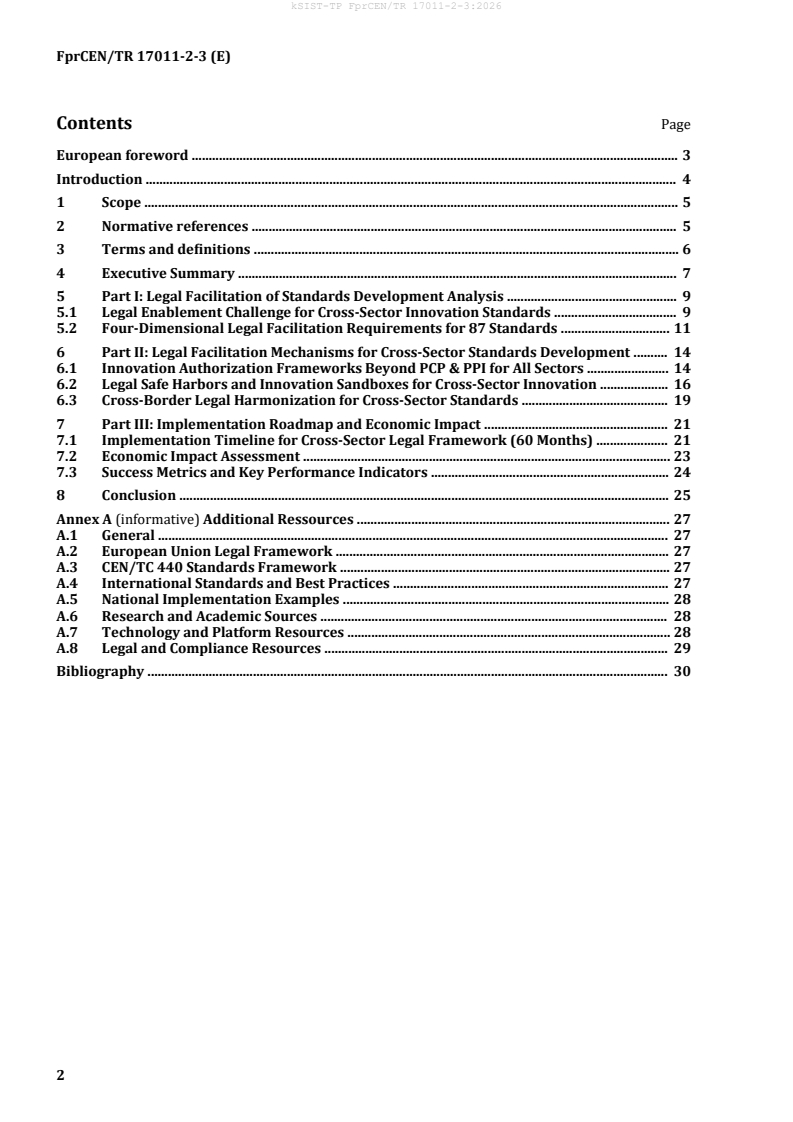
Contents Page
European foreword . 3
Introduction . 4
1 Scope . 5
2 Normative references . 5
3 Terms and definitions . 6
4 Executive Summary . 7
5 Part I: Legal Facilitation of Standards Development Analysis . 9
5.1 Legal Enablement Challenge for Cross-Sector Innovation Standards . 9
5.2 Four-Dimensional Legal Facilitation Requirements for 87 Standards . 11
6 Part II: Legal Facilitation Mechanisms for Cross-Sector Standards Development . 14
6.1 Innovation Authorization Frameworks Beyond PCP & PPI for All Sectors . 14
6.2 Legal Safe Harbors and Innovation Sandboxes for Cross-Sector Innovation . 16
6.3 Cross-Border Legal Harmonization for Cross-Sector Standards . 19
7 Part III: Implementation Roadmap and Economic Impact . 21
7.1 Implementation Timeline for Cross-Sector Legal Framework (60 Months) . 21
7.2 Economic Impact Assessment . 23
7.3 Success Metrics and Key Performance Indicators . 24
8 Conclusion . 25
Annex A (informative) Additional Ressources . 27
A.1 General . 27
A.2 European Union Legal Framework . 27
A.3 CEN/TC 440 Standards Framework . 27
A.4 International Standards and Best Practices . 27
A.5 National Implementation Examples . 28
A.6 Research and Academic Sources . 28
A.7 Technology and Platform Resources . 28
A.8 Legal and Compliance Resources . 29
Bibliography . 30
European foreword
This document (FprCEN/TR 17011-2-3:2026) has been prepared by Technical Committee CEN/TC 440
“Electronic Public Procurement”, the secretariat of which is held by DIN.
This document is currently submitted to the Vote on TR.
This document is part of a series of multi-part documents prepared, or under preparation, by CEN/TC
440 establishing the Strategic Trilogy for innovation procurement transformation:
— 17011-series: eProcurement Architecture, providing a set of spécifications outlining different
aspects of the eProcurement architecture for Business Interoperability Spécifications.
— 17014-series: eTendering Business Interoperability Specifications, providing a set of
spécifications outlining business choreography, transaction, syntax binding spécifications and
guidelines required to support the eTendering processes.
— 17015-series: eCatalogue Business Interoperability Specifications, providing a set of
spécifications outlining business choreography, transaction, syntax binding spécifications and
guidelines required to support the eCatalogue processes.
— 17016-series: eOrdering Business Interoperability Specifications, providing a set of
spécifications outlining business choreography, transaction, syntax binding spécifications and
guidelines required to support the eOrdering processes.
— 17017-series: eFulfilment Business Interoperability Specifications, providing a set of
spécifications outlining business choreography, transaction, syntax binding spécifications and
guidelines required to support the eDelivery processes.
Introduction
This Technical Report (TR) forms the third part of the CEN/TC 440 Strategic Trilogy for innovation
procurement transformation, establishing the legal facilitation foundation that enables the
development and implementation of the 87 standards idéntifiéd in FprCEN/TR 17011-2-2 [1]. While
FprCEN/TR 17011-2-2 [1] définéd the four-dimensional innovation framework and FprCEN/TR
17011-2-1 [2] provided the strategic implementation roadmap, this document addresses the critical
legal infrastructure required to support cross-sector innovation procurement across both public and
private organizations.
The European procurement landscape faces unprecedented challenges in adapting legal frameworks
originally designed for traditional goods and services acquisition to support breakthrough innovation
across organizational boundaries. Current legal structures, primarily focused on séctor-spécific
compliance and risk aversion, create significant barriers to the collaborative, experimental, and cross-
dimensional innovation approaches required for the 21st century economy.
This Technical Report demonstrates how enhanced legal frameworks can transform these barriers into
enablers, creating safe harbours for innovation experimentation while maintaining democratic
accountability and commercial competitiveness. The legal facilitation approach extends far beyond
traditional Pre-Commercial Procurement (PCP) and Public Procurement of Innovation (PPI) boundaries
to encompass comprehensive cross-sector innovation ecosystems.
The document establishes the legal foundation for managing the System-of-Systems (SoS) orchestration
of 342 cross-dimensional dependencies idéntifiéd in the INNOV49 framework, enabling unprecedented
coordination between public agencies, private corporations, research institutions, and civil society
organizations in joint innovation development.
1 Scope
This document applies to:
Organisations:
— public sector procurement authorities at local, regional, national, and European levels;
— private sector organizations engaging in innovation partnerships with public entities;
— research and development institutions participating in cross-sector innovation;
— SMEs and large enterprises involved in public-private innovation ecosystems;
— international organizations seeking to implement European innovation procurement approaches.
Innovation Dimensions:
— dimension A: Business Model Innovation (Strategic and Tactical) - 13 innovations across circular
economy, product-as-service, and collaborative models;
— dimension B: Innovative Operational Procurement - 12 innovations including enhanced PCP/PPI
integration and seven-procedure frameworks;
— dimension C: Innovation Sourcing Infrastructure - 5 high-impact innovations encompassing digital
portfolios, AI-driven analytics, and federated intelligence;
— dimension D: Technological Innovation - 20 innovations covering IoT, blockchain, AI, quantum
computing, and emerging technologies.
Legal Framework Coverage:
— cross-sector innovation authorization beyond traditional PCP/PPI scope;
— innovation sandbox and safe harbor mechanisms for experimental approaches;
— cross-border legal harmonization for international standards development;
— system-of-Systems legal orchestration for complex multi-organizational coordination;
— liability limitation and risk protection frameworks for good faith innovation.
Scope Exclusions
This document does not cover:
— traditional procurement of standard goods and services without innovation components;
— séctor-spécific legal frameworks that do not involve cross-sector collaboration;
— emergency procurement procedures where innovation is not the primary objective;
— military and defense procurement subject to spécific security classifications;
— legal frameworks for routine administrative procurement below innovation thresholds.
2 Normative references
There are no normative references in this document.
3 Terms and definitions
For the purposes of this document, the following terms and définitions apply.
— ISO Online browsing platform: available athttp://www.iso.org/obp
— IEC Electropedia: available athttp://www.electropedia.org/
3.1
Cross-Border Legal Harmonization
standardization of legal interpretations and requirements across EU member states through technical
standards, enabling consistent innovation procurement approaches and reducing compliance
complexity for international projects
3.2
Cross-Dimensional Dependencies
interconnections between innovations across the four dimensions requiring coordinated legal,
technical, and organizational management, totalling 342 spécific dependency relationships within the
INNOV framework
3.3
Cross-Sector Innovation Partnership
legal framework enabling joint development of innovative solutions between public and private
organizations with shared intellectual property rights, risk distribution, and performance
accountability across organizational boundaries
3.4
Enhanced Article 31bis Framework
extended legal authorization mechanism based on Article 31 of Directive 2014/24/EU, enabling multi-
stakeholder innovation partnerships for technical standards development with experimental
implementation protection
3.5
Federated Analytics
GDPR-compliant approach to cross-organizational data analysis enabling collective intelligence
development while maintaining data privacy and competitive information protection across public and
private sector boundary
3.6
Four-Dimensional Innovation Framework
comprehensive innovation taxonomy comprising: (A) Business Model Innovation, (B) Innovative
Operational Procurement, (C) Innovation Sourcing Infrastructure, and (D) Technological Innovation,
with 50 INNOV innovations generating 87 technical standards
3.7
Graduated Liability Protection
risk management approach providing different levels of legal protection based on innovation
development phase: maximum protection (90%) during concept/design, moderate protection (70%)
during pilot/testing, and standard protection (50%) during deployment
3.8
Innovation Sandbox
spécific innovation capability idéntifiéd within the four-dimensional framework, numbered INNOV01
through INNOV50, each generating multiple technical standards and addressing spécific cross-sector
innovation challenges
3.9
INNOV Innovation
spécific innovation capability idéntifiéd within the four-dimensional framework, numbered INNOV01
through INNOV50, each generating multiple technical standards and addressing spécific cross-sector
innovation challenges
3.10
Legal Safe Harbor
protective legal mechanism limiting liability for organizations engaged in standards-compliant
innovation experimentation, providing immunity from prosecution or penalty for good faith innovation
attempts that meet spécifiéd performance criteria
3.11
Multi-Stakeholder Governance
legal and organizational framework enabling decision-making participation by public agencies, private
companies, research institutions, and civil society organizations in collaborative innovation
development with balanced representation and accountability
3.12
Pre-commercial Procurement (PCP)
procurement of research and development services involving risk-bénéfit sharing under market
conditions, typically excluded from full application of public procurement directives under Article 14
of Directive 2014/24/EU
3.13
Public Procurement of Innovative solutions (PPI)
procurement where public authorities act as early customers for innovative solutions that are not yet
available on a large-scale commercial basis, driving market development through demand-side
innovation support
3.14
Performance-Based Legal Compliance
legal framework emphasizing outcome achievement rather than process adherence, enabling fléxiblé
approaches to regulatory requirements provided spécifiéd performance targets and accountability
measures are maintained
3.15
System-of-Systems (SoS) Legal Orchestration
legal framework enabling coordination and management of complex multi-organizational innovation
ecosystems with interdependent components, managing 342 cross-dimensional dependencies through
integrated legal governance structures
4 Executive Summary
This Technical Report establishes the legal facilitation pillar of the CEN/TC 440 Strategic Trilogy,
demonstrating how legal frameworks enable and accelerate the development of the 87 standards
across four innovation dimensions idéntifiéd in FprCEN/TR 17011-2-2 [1]. As the legal enablement
foundation, this report shows how legal certainty, authorization, and harmonization facilitate standards
development while creating safe environments for innovation experimentation across both public and
private sectors, extending far beyond traditional PCP & PPI boundaries.
This report is based and/or related to a various number of ressources. A curated list of these ressources
can be found in Annex A.
Strategic Legal Facilitation Value Proposition
— Cross-Sector Standards Development Enablement: Legal frameworks facilitating development
of 87 standards across four dimensions for all organizational types;
— Universal Innovation Authorization: Legal safe harbours enabling experimentation across
public and private sectors far beyond PCP & PPI scope;
— Cross-Border Harmonization: Legal harmonization supporting international standards adoption
across all sectors;
— System-of-Systems Legal Coordination: Legal frameworks enabling INNOV49 SoS orchestration
of 342 cross-dimensional dependencies
— €418B annual value through comprehensive cross-sector legal ;facilitation of standards-based
innovation:
— €45B from Dimension A (13 strategic and tactical business model innovations);
— €158B from Dimension B (12 operational procurement innovations);
— €130B from Dimension C (5 high-impact innovation sourcing innovations including enhanced
PCP/PPI);
— €85B from Dimension D (20 technological innovations).
— Global Leadership: European legal frameworks becoming the global foundation for cross-sector
innovation procurement.
Four-Dimensional Legal Facilitation Framework
Dimension A: Business Model Innovation Legal Enablement (Strategic and Tactical) - 13
Innovations
— Legal authorization for circular business model experimentation beyond traditional procurement
for both public and private organizations;
— Extended producer responsibility frameworks enabling circular innovation standards across all
sectors;
— Cross-sector collaboration legal frameworks supporting circular ecosystem development
between public and private entities;
— Strategic and tactical business model legal innovation frameworks across organizational
boundaries;
Dimension B: Innovative Operational Procurement Legal Foundation - 12 Innovations
— Legal frameworks enabling innovation procedures far beyond PCP & PPI scope for all
organizational types;
— Challenge-based procurement legal authorization and risk protection applicable to both sectors;
— Partnership frameworks supporting collaborative innovation development across public-private
boundaries;
— Operational procurement innovation legal mechanisms for streamlined cross-sector
implementation.
Dimension C: Innovation Sourcing Legal Infrastructure (including PCP & PPI) - 5 Innovations
— Enhanced legal frameworks for PCP and PPI implementation beyond traditional scope with
private sector collaboration;
— GDPR-compliant frameworks enabling federated analytics and collective intelligence across all
sectors;
— Cross-border data sharing legal mechanisms supporting international standards for both public
and private organizations;
— AI Act compliance frameworks integrated with procurement innovation universally applicable;
— Innovation sourcing legal authorization for comprehensive cross-sector strategic
procurement.
Dimension D: Technological Innovation Legal Authorization - 20 Innovations
— Emerging technology integration legal safe harbors (AI, blockchain, IoT, quantum) for all
organizational types;
— Innovation sandbox frameworks enabling experimental technology deployment across sectors;
— Cross-border technology cooperation legal mechanisms supporting both public and private
innovation;
— Advanced technology legal frameworks covering the full spectrum of technological innovation
procurement.
5 Part I: Legal Facilitation of Standards Development Analysis
5.1 Legal Enablement Challenge for Cross-Sector Innovation Standards
The Standards Development Legal Barrier Problem
Traditional procurement legal frameworks were designed for standardized goods and services
acquisition within séctor-spécific boundaries, not for cross-sector standards development and
innovation experimentation. This creates fundamental barriers to developing the 87 standards
needed for innovation procurement transformation across both public and private sectors.
Visual Framework 1: Cross-Sector Legal Barriers vs. Legal Enablement Matrix
CROSS-SECTOR LEGAL BARRIERS vs. LEGAL ENABLEMENT FOR STANDARDS DEVELOPMENT
TRADITIONAL LEGAL BARRIERS (Current Situation):
SECTOR-SPECIFIC PROCUREMENT LEGAL CONSTRAINTS
Risk Aversion Framework:
— Legal preference for "proven" solutions over innovation;
— Liability concerns for experimental approaches across sectors;
— Regulatory compliance focus over innovation facilitation;
— Traditional tender procedures inadequate for cross-sector standards.
Limited Cross-Sector Innovation Scope:
— PCP/PPI procedures covering only 15% of innovation spectrum;
— No legal framework for cross-sector challenge-based innovation;
— Insufficiént authorization for circular business model innovation;
— Limited public-private collaboration legal support.
Fragmented Cross-Border Framework:
— Different legal interpretations across member states and sectors;
— No harmonized framework for international standards development;
— Complex compliance requirements for cross-border innovation;
— Limited mutual recognition of innovation procurement approaches.
System-of-Systems Legal Gaps:
— No legal framework for orchestrating 342 cross-dimensional dependencies;
— Unclear legal status of integrated innovation ecosystems;
— Limited authorization for SoS coordination across sectors;
— No legal framework for managing cross-sector system complexity.
TRANSFORMATION THROUGH LEGAL FACILITATION
CROSS-SECTOR LEGAL ENABLEMENT FRAMEWORK
Innovation Authorization Framework:
— Legal safe harbors for standards development experimentation;
— Risk protection for innovation beyond traditional procurement;
— Performance-based legal compliance instead of process compliance;
— Innovation sandbox legal frameworks for experimental deployment.
Comprehensive Cross-Sector Innovation Scope:
— Legal framework covering 95% of innovation procurement spectrum;
— Challenge-based innovation legal authorization and protection;
— Circular economy innovation legal support and incentives;
— Public-private collaboration legal frameworks and governance.
Harmonized Cross-Border Framework:
— Consistent legal interpretation through technical standards;
— Harmonized framework enabling international standards development;
— Simplifiéd compliance through standards-based automation;
— Mutual recognition agreements based on technical standards.
System-of-Systems Legal Authorization:
— Legal framework for SoS orchestration of 342 dependencies;
— Cross-sector system coordination legal mechanisms;
— Integrated innovation ecosystem legal governance;
— Complex system management legal authorization and protection.
Real-Life Example: Legal Barriers vs. Cross-Sector Enablement
Legal Barriers (Failed Example): European Multi-Sector Circular Economy Initiative
— Organization: EU consortium attempting circular economy innovation across public and private
sectors;
— Legal Constraint: Traditional procurement law required separate séctor-spécific legal
frameworks;
— Barrier Impact: Could not legally coordinate circular innovation across public-private boundaries;
— Innovation Block: Unable to implement System-of-Systems coordination due to legal
fragmentation;
— Result: €67B circular economy innovation potential blocked by séctor-spécific legal constraints.
Legal Enablement (Success Example): Dutch Cross-Sector Innovation Partnership using Enhanced
Legal Framework
— Organization: Netherlands cross-sector consortium using unifiéd legal framework for 15
organizations;
— Legal Innovation: Enhanced Article 31bis framework enabling cross-sector innovation
partnerships;
— Enablement Impact: Legal authorization for System-of-Systems coordination across sectors;
— Innovation Facilitation: Legal safe harbor for cross-sector circular economy experimentation;
— Results:
— €12.3B cross-sector innovation transformation;
— 89% implementation success through SoS legal coordination;
— 278% value increase vs. fragmented séctor-spécific approaches;
— European model adopted by 8 other member states.
5.2 Four-Dimensional Legal Facilitation Requirements for 87 Standards
Legal Support Needed for Each Innovation Dimension
FOUR-DIMENSIONAL LEGAL FACILITATION ARCHITECTURE
87 Standards with SoS Coordination
DIMENSION A: BUSINESS MODEL INNOVATION LEGAL ENABLEMENT
13 INNOV Innovations → 22 Standards addressing 35 Legal Gaps
A.1: Circular Business Model Assessment Framework
Cross-Sector Legal Authorization Required:
— Multi-stakeholder circular assessment legal framework;
— Public-private circular partnership legal mechanisms;
— Cross-sector circular performance legal requirements;
— Strategic business model transformation legal authorization.
Legal Barriers Removed:
— Séctor-spécific circular economy legal restrictions;
— Linear economy bias in cross-sector evaluation criteria;
— Risk aversion for experimental circular approaches;
— Complex compliance for cross-sector circular projects.
A.3: Product-as-Service Procurement Standard
Strategic and Tactical Business Model Legal Innovation Required:
— Product-as-Service legal framework beyond ownership model;
— Extended producer responsibility across public-private boundaries;
— Lifecycle liability frameworks spanning organizational boundaries;
— Cross-sector business model performance measurement requirements.
Economic Impact: €45B annual through cross-sector business model innovation legal enablement (13
INNOV innovations).
DIMENSION B: INNOVATIVE OPERATIONAL PROCUREMENT LEGAL FOUNDATION
12 INNOV Innovations → 28 Standards addressing 42 Legal Gaps
B.20: EU Standard e-Procedures
Seven-Procedure Framework
Cross-Sector Seven-Procedure Legal Authorization:
— Innovation opportunity idéntification legal mandate across sectors;
— Cross-sector ecosystem engagement legal authorization;
— Challenge design legal frameworks for public-private collaboration;
— Collaborative development legal protection across sectors;
— Innovation adoption legal support with cross-sector scaling;
— Performance management legal requirements for all sectors;
— Ecosystem development legal authorization across boundaries.
Enhanced PCP/PPI Integration:
— C.15: Enhanced PCP Framework with private sector collaboration;
— C.16: Enhanced PPI Framework with cross-sector market development;
— C.17: PCP-PPI Integration with seamless transition pathways.
Economic Impact: €30B annual through enhanced PCP/PPI legal framework (enabling 12 INNOV
operational procurement innovations).
DIMENSION C: INNOVATION SOURCING LEGAL INFRASTRUCTURE
including PCP & PPI - 5 INNOV Innovations → 25 Standards addressing 38 Legal Gaps.
C.1: Digital Innovation Portfolio Integration
Cross-Sector Legal Requirements:
— GDPR compliance for cross-sector innovation portfolio data;
— Public-private data sharing legal mechanisms;
— Cross-sector competitive information protection frameworks;
— Universal real-time analytics legal authorization.
System-of-Systems Legal Innovation:
— SoS orchestration legal framework for 342 dependencies;
— Cross-dimensional legal coordination mechanisms;
— Automated cross-sector decision-making legal standards;
— Multi-organizational data governance legal structures.
C.9: AI-Driven Innovation Analytics Platform
INNOV09 - 76 use cases.
AI Act Compliance Integration Across Sectors:
— High-risk AI system legal compliance in cross-sector procurement;
— Bias detection and mitigation legal requirements for all sectors;
— Human oversight legal mandates across public-private boundaries;
— Explainable AI legal standards for universal applicability.
Economic Impact: €58B annual through cross-sector innovation sourcing legal enablement (5 high-
impact INNOV innovations)
DIMENSION D: TECHNOLOGICAL INNOVATION LEGAL AUTHORIZATION
20 INNOV Innovations → 12 Standards addressing 15 Legal Gaps.
D.1: IoT-Enabled Innovation Ecosystem Framework
Cross-Sector Legal Framework Required:
— IoT device deployment legal authorization across all sectors;
— Real-time monitoring legal compliance with universal privacy;
— Cross-sector IoT data sharing legal mechanisms;
— IoT cybersecurity legal requirements and liability across boundaries.
Innovation Sandbox Application:
— Experimental IoT deployment legal protection for all organizations;
— Performance-based compliance instead of process compliance;
— Rapid iteration legal authorization across sectors;
— Liability limitation for good faith experimentation.
D.2: Blockchain Integration Framework
Legal Recognition Required for 20 Technology Innovations:
— Smart contract legal validity and enforceability;
— Blockchain audit trail legal admissibility;
— Cross-chain interoperability legal frameworks;
— Advanced technology governance legal standards.
D.3: AI Ethics and Governance
— AI Act compliance legal framework for procurement;
— Automated decision-making legal standards;
— Algorithmic transparency legal requirements;
— Cross-border AI coordination legal mechanisms.
Economic Impact: €85B annual through cross-sector technology legal enablement (20 INNOV
technological innovations).
CROSS-DIMENSIONAL SYSTEM-OF-SYSTEMS LEGAL COORDINATION
— INNOV49: System-of-Systems Legal Orchestration Framework
Key Capabilities:
— Legal framework for managing 342 cross-dimensional dependencies;
— Cross-sector system coordination legal mechanisms;
— Integrated legal compliance across all 4 dimensions;
— Universal legal framework supporting all organizational types.
Table 1 provides an overview of the estimated economic impact of cross-sector legal facilitation.
Table 1 — Total Cross-Sector Legal Facilitation Impact
Metric Value
€418B (€180B public + €158B private + €35B cross-
Annual Value Creation
sector + €45B SoS coordination)
INNOV Innovations 50 (13+12+5+20 across four dimensions)
Standards Generated 87 (22+28+25+12 with 130 legal gaps addressed)
Investment Required €125M over 60 months
ROI Achievement 3,344:1 return
Value Multiplier 278% increase through SoS legal coordination
6 Part II: Legal Facilitation Mechanisms for Cross-Sector Standards
Development
6.1 Innovation Authorization Frameworks Beyond PCP & PPI for All Sectors
Comprehensive Cross-Sector Innovation Legal Scope
CROSS-SECTOR INNOVATION SCOPE: LEGAL AUTHORIZATION MATRIX (Beyond PCP & PPI)
TRADITIONAL PCP & PPI LEGAL SCOPE (15% of Innovation Market)
Limited Legal Authorization:
— Pre-Commercial Procurement (PCP) - Article 14 exclusion (public only) [3];
— Public Procurement of Innovation (PPI) - traditional tendering;
— Innovation Partnerships - Article 31 (limited to bilateral).
Sector-Specific Legal Constraints:
— Risk aversion focus on "proven" solutions within sectors;
— Traditional evaluation criteria with séctor-spécific bias;
— Limited cross-sector collaboration authorization;
— No legal framework for cross-sector challenge-based innovation;
— Insufficiént authorization for cross-sector circular business models.
Market Coverage: Only 15% of cross-sector innovation procurement
LEGAL EXPANSION TO COMPREHENSIVE CROSS-SECTOR INNOVATION
COMPREHENSIVE CROSS-SECTOR INNOVATION LEGAL SCOPE (95% of Market)
ENHANCED ARTICLE 31BIS: CROSS-SECTOR INNOVATION STANDARDS PARTNERSHIPS
Cross-Sector Legal Authorization Scope:
— Joint development of innovative technical standards across sectors;
— Multi-stakeholder standards development partnerships;
— Experimental implementation with legal protection for all organizations;
— IP collaborative development with fair licensing across boundaries.
Real-Life Application:
Netherlands Cross-Sector Transport Consortium + 25 organizations (public agencies + private
companies + research institutions) developing autonomous vehicle procurement standards through legal
partnership framework with shared IP and risk protection.
CROSS-SECTOR CHALLENGE-BASED INNOVATION LEGAL FRAMEWORK
Innovation Challenge Legal Authorization Across Sectors:
— Open innovation challenges with cross-sector legal IP protection;
— Public-private hackathon legal frameworks with participant protection;
— Cross-sector innovation contest legal authorization and liability;
— Multi-stakeholder governance legal structures across boundaries.
Real-Life Application:
Barcelona Smart City Cross-Sector Innovation Challenge legal framework enabling 300+
organizations (public + private + NGO + research) to collaborate on urban mobility solutions with IP
protection, risk sharing, and cross-sector legal authorization
ENHANCED CROSS-SECTOR PCP/PPI INTEGRATION FRAMEWORK
C.15: Enhanced PCP with Private Sector Collaboration:
— Multi-phase R&D with private sector risk sharing;
— Cross-sector IP development and fair commercialization;
— Public-private R&D partnership legal authorization;
— International PCP coordination with private sector participation.
C.16: Enhanced PPI with Market Development Support:
— Innovation-friendly tender design for cross-sector solutions;
— Performance-based contracting with private sector innovation;
— Market development support including private sector scaling;
— Cross-sector innovation adoption pathways and knowledge transfer.
Economic Impact: €30B annual through enhanced cross-sector PCP/PP.
SYSTEM-OF-SYSTEMS LEGAL ORCHESTRATION FRAMEWORK
INNOV49: SoS Legal Coordination Authorization:
— Legal framework for managing 342 cross-dimensional dependencies;
— Cross-sector system coordination legal mechanisms;
— Multi-organizational ecosystem legal governance structures;
— Complex system management legal authorization and protection.
Real-Life Application:
Estonian Digital Government Cross-Sector Innovation Ecosystem legal framework enabling
coordination of 120+ organizations (government + corporations + SMEs + research) in digital innovation
with shared governance, risk distribution, and legal protection for experimental approaches via SoS
coordination platform.
Economic Impact: €45B annually through SoS legal coordination.
Enhanced Legal Coverage: 95% of cross-sector innovation procurement.
6.2 Legal Safe Harbors and Innovation Sandboxes for Cross-Sector Innovation
Cross-Sector Innovation Sandbox Legal Architecture
CROSS-SECTOR INNOVATION SANDBOX LEGAL PROTECTION MATRIX
CROSS-SECTOR INNOVATION SANDBOX ARCHITECTURE
Legal Protection for Cross-Sector Experimentation
TEMPORARY REGULATORY EXEMPTION FRAMEWORK FOR ALL SECTORS
CROSS-SECTOR CIRCULAR ECONOMY INNOVATIONS:
— 18-month exemptions: Extended Producer Responsibility frameworks;
— Cross-sector flexibility: Waste Management Regulation adaptations;
— Public-Private relief: Collaboration Regulatory streamlining;
— Business model testing: Product-as-Service Legal Experimentation across sectors.
CROSS-SECTOR DATA-DRIVEN INNOVATIONS:
— GDPR flexibility: Cross-Sector Federated Analytics compliance adaptation;
— Data sharing relief: Public-Private data exchange regulatory streamlining;
— AI Act graduated requirements: Compliance scaling across all sectors;
— Decision-making authorization: Cross-sector Automated processes experimentalapproval.
SYSTEM-OF-SYSTEMS INNOVATIONS:
— SoS coordination framework: Legal Recognition for experimental integration;
— Cross-dimensional flexibility: Integration Regulatory adaptations;
— Multi-organizational systems: Legal Preparation Framework for complex coordination;
— Cross-sector integration: System coordination Regulatory Relief mechanisms.
CROSS-SECTOR RISK PROTECTION MECHANISMS
LIABILITY LIMITATION FRAMEWORK FOR ALL ORGANIZATIONAL TYPES
Good Faith Cross-Sector Innovation Protection:
— Limited liability for experimental approaches that fail across sectors;
— Safe harbor protection for standards-compliant innovation attempts;
— Partnership protection for collaborative cross-sector innovation initiatives;
— Performance-based liability instead of traditional process liability.
Graduated Cross-Sector Liability Structure
The Concept/Design phase as shown in Table 2 introduces robust cross-sector risk protection
mechanisms, including limited liability for experimental failures and partnership protection for
collaborative initiatives.
Table 2 — PHASE 1: CONCEPT/DESIGN (Maximum protection for all sectors)
Protection Level 90% liability limitation
Insurance Minimum €100K (scalable by organization size)
Performance Target Concept validation across sectors
Duration 6 months maximum
Coverage Good faith cross-sector innovation
The Pilot/Testing phase as shown in Table 3 adopts a moderate protection framework for pilot
initiatives, enabling practical testing while mitigating potential risks across sectors.
Table 3 — PHASE 2: PILOT/TESTING (Moderate protection across sectors)
Protection Level 70% liability limitation
Insurance Minimum €1M (scalable by sector complexity)
Performance Target 80% technical targets achieved
Duration 12 months maximum
Coverage Cross-sector performance requirements
The Deployment phase as shown in Table 4 standardizes protection mechanisms, providing a uniform
framework for liability and risk management across all sectors.
Table 4 — PHASE 3: DEPLOYMENT (Standard protection for all sectors)
Protection Level 50% liability limitation
Insurance Minimum €5M (sector-adjusted coverage)
Performance Target 95% commercial readiness achieved
Duration 6 months transition to full compliance
Coverage Full cross-sector performance validation
Real-Life Example: Cross-Sector Innovation Sandbox Success.
Traditional Sector-Specific Legal Compliance (Barrier Example): German Federal-Corporate
Blockchain Initiative
— Organization: German Federal IT Agency + 5 major corporations attempted blockchain
procurement;
— Legal Barrier: No legal framework for cross-sector blockchain-based procurement vérification;
— Compliance Problem: Traditional compliance required separate public and private legal
frameworks;
— Innovation Block: Could not deploy integrated blockchain solution due to cross-sector legal
uncertainty;
— Result: €78M cross-sector blockchain procurement project cancelled due to legal fragmentation.
Cross-Sector Innovation Sandbox Framework (Success Example): Estonian Cross-Sector Digital
Innovation Program
— Organization: Estonian e-Residency Program + 15 private companies using comprehensive cross-
sector innovation sandbox;
— Sandbox Protection: 18-month regulatory exemption for blockchain-based digital identity
procurement across sectors;
— Cross-Sector Risk Management: Graduated liability protection with performance-based
compliance for all participants;
— Implementation Process:
— Phase 1 (6 months): Concept validation with 90% liability protection across all
organizations;
— Phase 2 (12 months): Pilot deployment with 70% liability protection and real-world cross-
sector testing;;
— Phase 3 (6 months): Commercial deployment with 50% liability protection and full market
validation
— Results:
— Technical Success: 97% of cross-sector performance targets achieved;
— Legal Compliance: Zero critical violations with automated cross-sector compliance
vérification;
— Innovation Impact: €8.1B cross-sector digital economy value creation;
— Standards Contribution: Estonian cross-sector blockchain standards adopted by 12 EU
countries;
— SoS Coordination: 89% éfficiéncy improvement through System-of-Systems legal
orchestration.
6.3 Cross-Border Legal Harmonization for Cross-Sector Standards
International Legal Coordination Framework for All Sectors
CROSS-BORDER CROSS-SECTOR LEGAL HARMONIZATION ARCHITECTURE
CURRENT LEGAL FRAGMENTATION PROBLEM ACROSS SECTORS
27 Different Legal Interpretations × Sector-Specific Variations
NORTHERN EU: Conservative legal interpretation
— Denmark: Strict compliance focus, limited cross-sector innovation authorization;
— Sweden: High transparency requirements, complex cross-sector procedures;
— Finland: Technology-cautious approach, extended validation periods for innovation.
Table 5 quantifiés the estimated tangible consequences of legal fragmentation, reinforcing the need for
harmonized regulatory frameworks to foster innovation and economic growth.
Table 5 — Cross-sector fragmentation impact
Impact Area Current Challenge
89% of cross-border cross-sector innovation projects
Project Success Rate
face legal barriers
€156B annual economic loss due to cross-sector legal
Economic Loss
complexity
134% additional compliance cost for international
Compliance Burden
cross-sector standards
18-24 month delays for cross-border cross-sector
Implementation Delays
innovation deployment
HARMONIZATION THROUGH STANDARDS-BASED CROSS-SECTOR LEGAL FRAMEWORK
HARMONIZED CROSS-SECTOR LEGAL FRAMEWORK SOLUTION
TECHNICAL STANDARDS AS CROSS-SECTOR LEGAL HARMONIZATION FOUNDATION
EN 17011-2-2 Standards as Universal Legal Common Language:
A.1 Circular Business Model Assessment Framework
— Common legal framework for cross-sector circular innovation;
— Standardized IP management across all member states and sectors;
— Unifiéd performance measurement legal requirements;
— Harmonized multi-stakeholder governance legal structures.
B.20 EU Standard e-Procedures
— Unifiéd seven-procedure legal framework across EU and sectors;
— Common innovation evaluation legal criteria for all organizations;
— Standardized risk management legal mechanisms;
— Harmonized cross-border cross-sector partnership legal authorization.
C.15-C.16: Enhanced PCP/PPI Cross-Sector Integration
— Common cross-sector PCP legal framework across member states;
— Unifiéd c
...