

SIST EN 12670:2019
(Main)Natural stone - Terminology
General Information
- Abstract
This document defines the recommended terminology covering scientific and technical terms, test methods, products, and the classification of Natural Stones. This document does not cover roofing slate, for roofing slate see EN 12326-1 and EN 12326-2.
- Status
- Published
- Publication Date
- 16-Jul-2019
- Technical Committee
- IKER - Ceramics
- Current Stage
- 6060 - National Implementation/Publication (Adopted Project)
- Start Date
- 10-Jul-2019
- Due Date
- 14-Sep-2019
- Completion Date
- 17-Jul-2019
- Ref Project
EN 12670:2019 - Natural stone - Terminology

Overview
SIST EN 12670:2019 - Natural stone: Terminology is the CEN-adopted standard that establishes recommended terminology for the natural stone sector. It defines scientific and technical terms used across geology, quarrying, processing, testing, products and classification of natural stones. The standard clarifies commercial, quarrymen and scientific vocabulary so stakeholders can consistently name, classify and document stone types. Roofing slate is excluded (see EN 12326‑1/2).
Key topics and technical content
The standard focuses on terminology and classification rather than prescriptive performance limits. Major technical topics include:
- Scope and normative references - establishes applicability and references (notably EN 12326‑1 and EN 12326‑2 for roofing slate).
- Terms and definitions (Clause 3) divided into:
- 3.1 Geological terms - minerals, rock types, textures and geological concepts (e.g., igneous, sedimentary, metamorphic terms).
- 3.2 Quarrying terms - extraction and in-situ rock definitions.
- 3.3 Processing terms - cutting, finishing and processing vocabulary.
- 3.4 Products and installation terms - product names and installation-related terminology.
- Scientific classifications (Clause 4) including:
- Geological time scale (informative).
- Classification charts for igneous, sedimentary and metamorphic rocks to support correct scientific naming.
- Guidance to classify a stone by its three main mineralogical components when a variety is not listed.
- Informative annexes - petrographical family examples, an alphabetical index and bibliography to aid lookup and cross-reference.
Practical applications and who uses it
SIST EN 12670:2019 is intended for anyone needing a reliable, harmonized vocabulary for natural stone. Typical users:
- Architects, specifiers and engineers - to write clear material specifications and tender documents.
- Quarry operators and stone processors - to label products and communicate quality and type.
- Testing laboratories and certification bodies - to align reports and test descriptions.
- Manufacturers, distributors and buyers - to avoid ambiguity in commerce and product sheets.
- Geologists and educators - for consistent teaching and research terminology.
- Standards writers and regulators - to harmonize related product and test standards.
Benefits include improved communication across supply chains, consistent product labelling, clearer technical documentation and easier comparison of lab and classification results.
Related standards and keywords
- Related: EN 12326‑1, EN 12326‑2 (roofing slate specifications and test methods)
- Useful SEO keywords: SIST EN 12670:2019, EN 12670, natural stone terminology, natural stone classification, stone industry glossary, geological terms, quarrying terminology, stone processing, product standards, stone testing.
Relations
- Effective Date
- 01-Sep-2019
- Effective Date
- 28-Jan-2026
- Effective Date
- 28-Jan-2026
- Effective Date
- 28-Jan-2026
- Effective Date
- 28-Jan-2026
- Effective Date
- 28-Jan-2026
- Effective Date
- 28-Jan-2026
- Effective Date
- 28-Jan-2026
Get Certified
Connect with accredited certification bodies for this standard

DIBt (Deutsches Institut für Bautechnik)
German Institute for Building Technology.
DIN CERTCO
DIN Group product certification.

Aboma Certification B.V.
Specialized in construction, metal, and transport sectors.
Sponsored listings
Frequently Asked Questions
SIST EN 12670:2019 is a standard published by the Slovenian Institute for Standardization (SIST). Its full title is "Natural stone - Terminology". This standard covers: This document defines the recommended terminology covering scientific and technical terms, test methods, products, and the classification of Natural Stones. This document does not cover roofing slate, for roofing slate see EN 12326-1 and EN 12326-2.
This document defines the recommended terminology covering scientific and technical terms, test methods, products, and the classification of Natural Stones. This document does not cover roofing slate, for roofing slate see EN 12326-1 and EN 12326-2.
SIST EN 12670:2019 is classified under the following ICS (International Classification for Standards) categories: 01.040.73 - Mining and minerals (Vocabularies); 01.040.91 - Construction materials and building (Vocabularies); 73.020 - Mining and quarrying; 91.100.15 - Mineral materials and products. The ICS classification helps identify the subject area and facilitates finding related standards.
SIST EN 12670:2019 has the following relationships with other standards: It is inter standard links to SIST EN 12670:2002, SIST EN 12326-2:2011, SIST EN 12326-1:2014, SIST EN 12407:2019, SIST EN 12407:2007, SIST EN 1467:2022, SIST EN 1925:2000, SIST-TP CEN/TR 17024:2017. Understanding these relationships helps ensure you are using the most current and applicable version of the standard.
SIST EN 12670:2019 is available in PDF format for immediate download after purchase. The document can be added to your cart and obtained through the secure checkout process. Digital delivery ensures instant access to the complete standard document.
Standards Content (Sample)
SLOVENSKI STANDARD
01-september-2019
Nadomešča:
SIST EN 12670:2002
Naravni kamen - Terminologija
Natural stone - Terminology
Naturstein - Terminologie
Pierre naturelle - Terminologie
Ta slovenski standard je istoveten z: EN 12670:2019
ICS:
01.040.73 Rudarstvo in rudnine Mining and minerals
(Slovarji) (Vocabularies)
01.040.91 Gradbeni materiali in gradnja Construction materials and
(Slovarji) building (Vocabularies)
73.020 Rudarstvo in kamnolomsko Mining and quarrying
izkopavanje
91.100.15 Mineralni materiali in izdelki Mineral materials and
products
2003-01.Slovenski inštitut za standardizacijo. Razmnoževanje celote ali delov tega standarda ni dovoljeno.
EN 12670
EUROPEAN STANDARD
NORME EUROPÉENNE
June 2019
EUROPÄISCHE NORM
ICS 01.040.91; 91.100.15 Supersedes EN 12670:2001
English Version
Natural stone - Terminology
Pierre naturelle - Terminologie Naturstein - Terminologie
This European Standard was approved by CEN on 15 April 2019.
CEN members are bound to comply with the CEN/CENELEC Internal Regulations which stipulate the conditions for giving this
European Standard the status of a national standard without any alteration. Up-to-date lists and bibliographical references
concerning such national standards may be obtained on application to the CEN-CENELEC Management Centre or to any CEN
member.
This European Standard exists in three official versions (English, French, German). A version in any other language made by
translation under the responsibility of a CEN member into its own language and notified to the CEN-CENELEC Management
Centre has the same status as the official versions.
CEN members are the national standards bodies of Austria, Belgium, Bulgaria, Croatia, Cyprus, Czech Republic, Denmark, Estonia,
Finland, France, Germany, Greece, Hungary, Iceland, Ireland, Italy, Latvia, Lithuania, Luxembourg, Malta, Netherlands, North
Macedonia, Norway, Poland, Portugal, Romania, Serbia, Slovakia, Slovenia, Spain, Sweden, Switzerland, Turkey and United
Kingdom.
EUROPEAN COMMITTEE FOR STANDARDIZATION
COMITÉ EUROPÉEN DE NORMALISATION
EUROPÄISCHES KOMITEE FÜR NORMUNG
CEN-CENELEC Management Centre: Rue de la Science 23, B-1040 Brussels
© 2019 CEN All rights of exploitation in any form and by any means reserved Ref. No. EN 12670:2019 E
worldwide for CEN national Members.
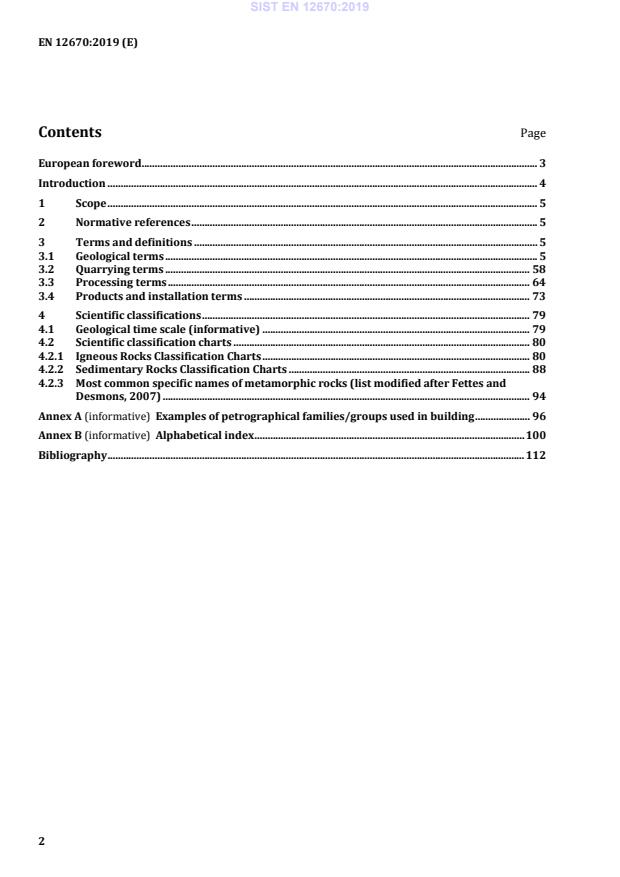
Contents Page
European foreword . 3
Introduction . 4
1 Scope . 5
2 Normative references . 5
3 Terms and definitions . 5
3.1 Geological terms . 5
3.2 Quarrying terms . 58
3.3 Processing terms . 64
3.4 Products and installation terms . 73
4 Scientific classifications . 79
4.1 Geological time scale (informative) . 79
4.2 Scientific classification charts . 80
4.2.1 Igneous Rocks Classification Charts . 80
4.2.2 Sedimentary Rocks Classification Charts . 88
4.2.3 Most common specific names of metamorphic rocks (list modified after Fettes and
Desmons, 2007) . 94
Annex A (informative) Examples of petrographical families/groups used in building . 96
Annex B (informative) Alphabetical index . 100
Bibliography . 112
European foreword
This document (EN 12670:2019) has been prepared by Technical Committee CEN/TC 246 “Natural
stones”, the secretariat of which is held by UNI.
This European Standard shall be given the status of a national standard, either by publication of an
identical text or by endorsement, at the latest by December 2019, and conflicting national standards
shall be withdrawn at the latest by December 2019.
Attention is drawn to the possibility that some of the elements of this document may be the subject of
patent rights. CEN shall not be held responsible for identifying any or all such patent rights.
This document supersedes EN 12670:2001.
In comparison with the precious edition, the following changes have been made:
— the changes concern essentially the proper scientific definitions, terminology, and diagrams.
This document is one of a series of standards for natural stone products including denomination, test
methods and product standards.
According to the CEN-CENELEC Internal Regulations, the national standards organisations of the
following countries are bound to implement this European Standard: Austria, Belgium, Bulgaria,
Croatia, Cyprus, Czech Republic, Denmark, Estonia, Finland, Former Yugoslav Republic of Macedonia,
France, Germany, Greece, Hungary, Iceland, Ireland, Italy, Latvia, Lithuania, Luxembourg, Malta,
Netherlands, Norway, Poland, Portugal, Romania, Serbia, Slovakia, Slovenia, Spain, Sweden, Switzerland,
Turkey and the United Kingdom.
Introduction
The term Natural Stone groups several rock types with marked geological differences. The extraction,
elaboration and commerce of Natural Stone have set a very particular vocabulary. Many of these terms
have been taken from the popular or quarrymen language, which sometimes is far from scientific
definitions. This document establishes the terminological bases for geological and petrologic definitions
of Natural Stone and its classification. References to definitions of natural stone products, defined in
other European Standards, are provided when necessary. It also incorporates most of the popular or
commercial terminology.
The terminology covers the fields of geology, mining, processing, marketing and products of Natural
Stone. The included scientific classifications allow setting the scientific name of the stone varieties. If
the stone variety is not included in this document, the rock should be classified using its three main
mineralogical components.
1 Scope
This document defines the recommended terminology covering scientific and technical terms, test
methods, products, and the classification of Natural Stones. This document does not cover roofing slate,
for roofing slate see EN 12326-1 and EN 12326-2.
2 Normative references
The following documents are referred to in the text in such a way that some or all of their content
constitutes requirements of this document. For dated references, only the edition cited applies. For
undated references, the latest edition of the referenced document (including any amendments) applies.
EN 12326-1, Slate and stone for discontinuous roofing and external cladding - Part 1: Specifications for
slate and carbonate slate
EN 12326-2, Slate and stone for discontinuous roofing and external cladding - Part 2: Methods of test for
slate and carbonate slate
3 Terms and definitions
For the purposes of this document, the following terms and definitions apply.
ISO and IEC maintain terminological databases for use in standardization at the following addresses:
• IEC Electropedia: available at http://www.electropedia.org/
• ISO Online browsing platform: available at http://www.iso.org/obp
3.1 Geological terms
3.1.1
accessory minerals
rock forming minerals that occur in such small amounts that they are not relevant in the classification
or nomenclature of the rock
3.1.2
acid rock
igneous rock that contains more than 66 % vol. of silica
3.1.3
actinolite
Ca-Mg-Fe-amphibole (see amphibole formula)
3.1.4
agate
distinctly banded variety of chalcedony
3.1.5
age
fourth order geological time unit
Note 1 to entry: See Table 2.
3.1.6
agglomerate
pyroclastic rock in which bombs (with diameters greater than 64 mm) > 75 % vol.
3.1.7
agglutinate
welded splatter, commonly of basaltic composition, deposited ballistically in strombolian or fire
fountain volcanic eruptions
3.1.8
alabaster
fine grained, compact variety of gypsum, usually white or pale coloured and translucent
3.1.9
albite
sodium plagioclase, formula Na(AlSi O ) (see plagioclase)
3 8
3.1.10
alkali feldspar
alkali rich feldspars microcline, orthoclase, sanidine, albite, with less than 5 % vol. anorthite
Note 1 to entry: See feldspar and plagioclase.
3.1.11
allochems
coarser framework grains in most mechanically deposited limestones in the basin of sedimentation
Note 1 to entry: Allochems include: intraclasts, ooids, skeletal particles, pellets (including peloids).
3.1.12
allotriomorphic
anhedral
xenomorphic
mineral which shows in thin sections no characteristic or rational faces, suggested by its crystalline
structure
3.1.13
alteration
post-formational change of the mineralogical and or chemical composition of a rock brought about by
physical, chemical, or biological means, including actions of hydrothermal solutions and weathering
processes, excluding metasomatic and metamorphic changes
3.1.14
alumina
Al O
2 3
chemical compound used in fine polishing
3.1.15
amorphous
phase that does not have a crystalline structure
3.1.16
amphibole
family of dark ferromagnesian silicate minerals, general formula A B (Si,Al) O (OH) , where A = Mg,
2-3 5 8 22 2
2+ 2+ 3+
Fe , Ca, Na; B = Mg, Fe , Fe , Al
3.1.17
amphibolite
gneissose or granofelsic metamorphic rock mainly consisting of green, brown, or black amphibole and
plagioclase
Note 1 to entry: A gneissose/granofelsic mesostructure is typical of true amphibolites, in contrast with
schistose, green amphibole-albite greenschists.
3.1.18
amygdaloidal
texture of volcanic rocks where almond-shaped vesicles are, fully or partially, filled with secondary
minerals
3.1.19
analcime
mineral, Na(AlSi O )H O of the zeolite group
2 6 2
Note 1 to entry: See zeolite, secondary minerals.
3.1.20
andalusite
mineral, Al SiO polymorphous with sillimanite and kyanite
2 5
3.1.21
andesite
volcanic rock of intermediate composition mainly composed of plagioclase (oligoclase - andesine) and
one or more of the mafic minerals amphibole, pyroxene, and biotite
Note 1 to entry: See 4.2.1.5
3.1.22
anhedral
(see allotriomorphic, 3.1.12)
3.1.23
anhydrite
mineral with CaSO formula
3.1.24
anisotropy
vectorial behaviour of physical and mechanical properties in minerals and rocks, i.e. hardness in
kyanite, thermal expansion in calcite, flexural resistance in slate
3.1.25
ankerite
mineral of dolomite group with calcium and iron
3.1.26
anorthite
calcic plagioclase, Ca (Al Si O )
2 2 8
Note 1 to entry: See plagioclase.
3.1.27
anorthoclase
sodium-rich mineral of the alkali feldspar group, formula (Na,K)AlSi O
3 8
Note 1 to entry: Its composition, in terms of the mole fraction of the orthoclase component (or) and the albite
component (ab) is or ab to or ab (see feldspar, microcline, plagioclase, orthoclase).
40 60 10 90
3.1.28
anorthosite
plutonic rock mainly composed of anorthite – rich plagioclase and little or no mafic minerals
Note 1 to entry: See 4.2.1.2.
3.1.29
antiperthite
perthitic intergrowth of plagioclase host and subsidiary K-rich feldspar
3.1.30
apatite
group of minerals, of which the formula is Ca (PO ,CO ) (F,OH,Cl)
5 4 3 3
3.1.31
aphanitic
of or relating to an igneous rock in which the crystals are so fine that individual minerals cannot be
distinguished with the naked eye
Note 1 to entry: Aphanitic rocks are extrusive rocks that cooled so quickly that crystal growth was inhibited.
3.1.32
aplite
fine grained igneous rock of granitic composition with allotriomorphic texture and, commonly,
leucogranitic composition
3.1.33
aragonite
mineral, polymorphous with calcite, of which the formula is CaCO
3.1.34
Archaean
the older eon of the Precambrian ranging from the formation of the Earth at ~4 000 Ma to 2 500 Ma
Note 1 to entry: See Table 1.
3.1.35
arenite
loose soil or consolidated sedimentary rock, mainly composed of sand size detrital lithic fragments or
mineral grains (between 1/16 mm and 2 mm)
Note 1 to entry: Usually the term is used with a prefix that refers to its composition or genesis, e.g.
quartzarenite (see 4.2.2.5).
3.1.36
argillite
layered or not-layered consolidated sedimentary rock mainly composed of detrital clay size particles or
clay minerals
3.1.37
arkose
sedimentary detrital rock with less than 75 % vol. quartz and a high content of feldspar grains
Note 1 to entry: See 4.2.2.5.
3.1.38
arkosic wacke
sandstone comprising >5 % vol. of sand grade particles, with the feldspar content exceeding that of rock
fragments and >15 % vol. of mud matrix (material <30 µm in diameter)
3.1.39
ash
fine-grained volcanic material
3.1.40
augen fabric
fabric in some rocks, usually metamorphic, consisting of ellipsoidal or lens shaped porphyroblasts,
crystals, or fragments, rounded and enveloped by the foliation, resembling eyes (augen) in a cross
section
3.1.41
augen mylonite
mylonite containing distinctive large crystals or lithic fragments around which the foliated fine-grained
matrix is wrapped, often forming symmetric or asymmetric trails
3.1.42
augite
clinopyroxene
mineral of the pyroxene group (clinopyroxenes), the general formula of which is
2+ 3+
(Ca,Na)(Mg,Fe ,Al)(Si,Al) O with minor amounts of Na, Fe , Al, Ti admitted, the colour of which is dark
2 6
green to black, and which is an essential constituent in basic igneous rocks such as basalts and gabbros
3.1.43
bafflestone
autochthonous carbonate rock whose original components were bound organically during deposition,
the organisms forming baffles to trap finer matrix material
3.1.44
banded
rock having alternating nearly parallel layers that differ in colour, fabric or mineral composition, and
because of that it shows alternating bands in a cross section
3.1.45
basalt
volcanic rock consisting essentially of plagioclase (labradorite-bytownite) and pyroxene with variable
amount of phenocrysts set in a fine-grained matrix
Note 1 to entry: Commercially natural stone as per the scientific definition of basalt and other rocks such as,
picrites, diabases, dolerites and microgabbros.
Note 2 to entry: See 4.2.1.5.
3.1.46
basanite
silica-undersaturated alkali olivine basalt containing olivine, clinopyroxene and plagioclase feldspar
with >10 % vol. feldspathoids in the form of nepheline or leucite, which is found in association with
other alkaline igneous rocks
3.1.47
basic
Mg,- Fe- and Ca-rich igneous rock with more than 45 % vol. and less than 52 % vol. of silica
3.1.48
bed of blocks
unweathered rock beneath unconsolidated material formed by blocks
3.1.49
bedding plane
a) planar or nearly planar surface that visibly separates the individual beds, layers or strata, in
sedimentary rocks;
b) any surface, even when conspicuously bent or deformed by folding
3.1.50
benmoreite
alkali lava intermediate in composition between mugearite and trachyte
3.1.51
bindstone
autochthonous carbonate rock whose original components were bound organically during deposition,
with the organisms binding finer matrix material together
3.1.52
bioclastic rock
sedimentary rock consisting of fragments and broken remains of organisms; e.g. limestone composed of
shell fragments
3.1.53
biolithite
limestone essentially constituted of reef structures, animal or plant
3.1.54
biotite
2+ 3+
mafic rock forming mineral of the mica group with general formula K(Mg,Fe ) (Al,Fe ) Si O (OH)
3 3 10 2
3.1.55
black granite
commercial term for black or dark coloured plutonic rocks
Note 1 to entry: See e.g. gabbro, diabase, basalt.
3.1.56
blasto-
prefix used to describe the metamorphic rock fabrics denoting the presence of primary crystals or pre-
existing fabric modified by metamorphism, but still recognized; e.g. blastogranular, blastomylonitic,
blastopsephitic
3.1.57
blastomylonite
mylonite which displays a significant degree of grain growth related to or following deformation
3.1.58
block
angular fragment of rock with a diameter >256 mm
3.1.59
blue schist
schist whose bluish colour is due to the presence of sodic amphibole
3.1.60
bomb
mass of liquid lava thrown through the air which rotates and takes on a characteristic shape and
structure
3.1.61
boundstone
limestone, in which the grain were bound by an organism or organisms
3.1.62
breccia
a) coarse grained clastic sedimentary rock composed by angular rock fragments held together by a
mineral cement or in a fine grained matrix;
b) clastic rock consisting of highly angular gravel-size fragments, of sedimentary, tectonic or volcanic
origin
3.1.63
calc silicate marble
marble with calcium and silicate minerals
Note 1 to entry: See marble, ophicalcite.
3.1.64
calcarenite
limestone consisting predominantly of recycled detrital calcite grains of sand size (1/16 mm – 2 mm)
3.1.65
calcareous
containing calcium carbonate
3.1.66
calcilutite
limestone consisting predominantly of detrital calcite grains or fragments of silt or clay size (<1/16
mm)
3.1.67
calciphyre
metacarbonate rock containing a conspicuous amount of calcium- and/or magnesium-silicate minerals
3.1.68
calcirudite
limestone consisting predominantly of detrital calcite grains or fragments larger than sand size
Note 1 to entry: See rudite.
3.1.69
calcisiltite
limestone consisting predominantly of detrital calcite grains or fragments of silt size
3.1.70
calcite
mineral, the formula of which is CaCO ; trimorphous with aragonite and vaterite
Note 1 to entry: Very common in some sedimentary and metamorphic rocks.
3.1.71
calcitic dolomite
carbonate rock which 50 % vol. to 89 % vol. of the mineral dolomite
Note 1 to entry: See also 4.2.2.11.
3.1.72
calcitic marble
marble containing more than 50 % vol. of calcite
3.1.73
calc-schist
carbonate silicate-schist
metamorphosed argillaceous limestone containing calcite as a substantial component and with a
schistose structure produced by parallelism of platy minerals
Note 1 to entry: The term carbonate-silicate schist should be used when the non-carbonate mineral content is
>50 % vol. See schist, 4.2.3.
3.1.74
Cambrian
oldest system and period into which the Palaeozoic is divided
Note 1 to entry: See Table 1.
3.1.75
carbonate
2-
mineral containing CO ; calcite, dolomite, magnesite, and siderite, etc. which are frequent rock forming
carbonate minerals
3.1.76
carbonate rock
rock consisting chiefly of carbonate minerals, especially a sedimentary rock; limestone, dolomite, and
carbonatite are examples of carbonate rocks
Note 1 to entry: See 4.2.2.8, 4.2.2.9, 4.2.2.10 and 4.2.2.11.
3.1.77
carbonate-silicate rock
metamorphic rock mainly composed of silicate minerals (including calcium-silicate minerals) and
containing between 5 % vol. vol and 50 % vol. vol of carbonate minerals
3.1.78
Carboniferous
period and system of the Palaeozoic
Note 1 to entry: See Table 1.
3.1.79
cataclasite
fault rock which is cohesive with a poorly developed or absent schistosity, or which is incohesive,
characterised by generally angular porphyroclasts and lithic fragments in a finer-grained matrix of
similar composition
Note 1 to entry: Generally, no preferred orientation of grains of individual fragments is present as a result of the
deformation, but fractures may have a preferred orientation. A foliation is not generated unless the fragments are
drawn out or new minerals grow during the deformation. Plastic deformation may be present but is always
subordinate to some combination of fracturing, rotation and frictional sliding of particles. Cataclasite may be
subdivided according to the relative proportion of finer-grained matrix into protocataclasite, mesocataclasite and
ultracataclasite
3.1.80
cataclastic
pertaining to the structure and texture produced in a rock by severe mechanical stress during dynamic
metamorphism; bending, breaking, and fragmentation of the mineral grains are characteristic features;
also said of the rocks exhibiting such structure
Note 1 to entry: See breccia.
3.1.81
cement
mineral material, usually chemically precipitated during the rock compaction that occurs in the
interstitial spaces among the individual grains of a sedimentary rock, thereby binding the grains
together as a rigid mass; silica, carbonates and iron oxides are common cements
3.1.82
Cenozoic
youngest era of geologic time
Note 1 to entry: See Table 1.
3.1.83
chalcedony
group name for the compact varieties of silica composed of minute crystals of quartz with sub
microscopic pores
3.1.84
chalcopyrite
sulphide mineral, the formula of which is CuFeS2
3.1.85
chalk
soft fine grained limestone, usually white consisting mostly of calcitic remains from microorganisms,
and minor silt and clay
3.1.86
charnockite
orthopyroxene-bearing rock of granitoid composition
3.1.87
chert
fine-grained, hard, compact and dense sedimentary rock, consisting dominantly of the SiO minerals
quartz, chalcedony and opal. cryptocrystalline and/or amorphous silica
Note 1 to entry: Flint is a variety of chert.
3.1.88
chlorite Group
2+ 3+
group of phyllosilicates, some of them of green colour, with general formula (Mg, Fe , Fe )
AlSi O (OH)
3 10 8
3.1.89
chloritoid
micaceous mineral, the formula of which is Fe Al Si O (OH)
2 4 2 10 4
3.1.90
chromite
mineral, the formula of which is (Fe,Mg)(Cr,Al) O
2 4
3.1.91
chronostratigraphic unit
stage or zone which, independent of facies, represents a layer of specific age
3.1.92
cipollino marble
impure marble with band coloured structure, consisting in layers of calcite or dolomite grains mixed
with variable quantities of silicate minerals
3.1.93
clast
mineral or rock fragment composing clastic sedimentary rocks
3.1.94
cisuralian
oldest epoch of the Permian
Note 1 to entry: See Table 1.
3.1.95
clastic
pertaining to a rock or sediment composed principally of broken fragments that are derived from pre-
existing minerals, rocks or organic structures and that have been transported some distance from its
original place
3.1.96
clay minerals
group of minerals, essentially hydrous silicates of aluminium with a layered crystalline structure; iron,
magnesium, potassium, and other cations are also present in their formula; the most common of which
belong to illite, montmorillonite, and kaolinite mineral subgroups
3.1.97
clay slate
shale
weakly metamorphosed clay stone with intermediate character between a clay stone and a true slate
3.1.98
clay
loose, extremely fine grained sediment or soft rock composed of particles with diameters less than
0,002 mm, mainly of clay minerals and other minerals, especially quartz, feldspars, and carbonates
3.1.99
clay stone
rock with more than 67 % vol. clay sized minerals
3.1.100
cleavage
a) property of a rock to split along closely spaced planar surfaces (see slaty cleavage, crenulation
cleavage, schistosity, and rough cleavage);
b) splitting of a mineral along its crystallographic planes, thus reflecting crystal structure
3.1.101
clinopyroxene
monoclinic pyroxene exhibiting non-parallel extinction
3.1.102
columnar
structure of some volcanic rocks, such as basalt, consisting of parallel, prismatic columns, polygonal in
cross section, nearly perpendicular to the top and the bottom of the flow unit
3.1.103
comb layering
fabric of igneous rocks consisting of bands of elongated crystals with nearly vertical mineral-elongation
relative to the border of the bands
3.1.104
concretion
collective term applied loosely to various primary and secondary segregations of diverse origin,
including irregular nodules, spherulites, crystalline aggregates, geodes, septarias and related bodies
3.1.105
conglomerate
coarse grained sedimentary rock composed of rounded to sub angular fragments (pebbles, cobbles,
boulders), set in a fine grained matrix of sand or clay, and commonly cemented
3.1.106
consertal
fabric of rocks showing toothed border lines between adjoining crystals
3.1.107
contact (between grains)
mode of relation between grains of rock-forming minerals; i.e. by points, by lines, within the matrix
3.1.108
coral rock
coral reef limestone
3.1.109
cordierite
silicate mineral, common in some metamorphic and rare in magmatic rocks, the formula of which is
(Mg,Fe) Al Si O
2 4 5 18
3.1.110
corona
fabric of igneous or metamorphic rocks where minerals are surrounded by a seam of one or more other
minerals
Note 1 to entry: Particular examples are the rapakivi fabric and kelyphitic rims.
3.1.111
Cretaceous
youngest of the periods/ and systems included in the Mesozoic era/erathem
Note 1 to entry: See Table 1.
3.1.112
cross bedding
cross stratification with thick individual beds
3.1.113
crossed twinning
lamellae of mineral twins after two laws making in thin sections a grid as seen in microcline
3.1.114
cryptocrystalline
composed of crystals so fine that they cannot be recognized even under polarizing microscope
3.1.115
crystal zoning
texture of igneous crystals with concentric layers made by inclusions or variations in chemical
composition e.g. in plagioclases
3.1.116
dacite
volcanic rock with quartz, plagioclase, alkali feldspar, and often mafic components
Note 1 to entry: See 4.2.1.5.
3.1.117
dark mineral
mafic mineral
Fe-Mg rock forming minerals, e.g. olivine, pyroxenes, amphiboles and biotite
3.1.118
decussate
metamorphic fabric of randomly oriented unequidimensional grains (e.g. pyroxenes, micas)
3.1.119
dedolomitization
partial or complete calcification of dolomite
3.1.120
deformation fabric
tectonic fabric
rock fabric resulting from deformation, as lineation, cleavages, schistosity, folds, preferred orientations
of crystals etc.
Note 1 to entry: See fabric.
3.1.121
devitrification
process of nucleation and growth of crystals in glasses at sub solidus temperatures
3.1.122
Devonian
system of the Palaeozoic Erathem above the Silurian and below the Carboniferous
Note 1 to entry: See Table 1.
3.1.123
diabase
medium grained rock of basaltic composition used in two ways: altered basaltic rocks (British) and
ophitic texture (French, German and American)
3.1.124
diagenesis
process of mineralogical changes in sediments after deposition which result in a consolidated rock
3.1.125
diamictite
terrigenous sedimentary rock with particle sizes ranging from clay to boulder size
3.1.126
diatomite
fine-grained, hydrated rock silica formed by the accumulation of the tests of diatoms
3.1.127
diorite
plutonic rock mainly composed of plagioclase (-andesine), hornblende, and/or biotite
3.1.128
dip
inclination of a bed to the horizontal; the dip is at a right angle to the strike
3.1.129
dolerite
igneous rock with basaltic composition, commonly with ophitic fabric
Note 1 to entry: See diabase.
3.1.130
dolomite mineral
mineral, the formula of which is CaMg(CO )
3 2
3.1.131
dolomite rock
carbonate rock with high percentage (90 % to 100 % of the mineral dolomite
3.1.132
dolomitic limestone
carbonate rock with 10 % vol. to 49 vol % vol. of the mineral dolomite
Note 1 to entry: See Table 6.
3.1.133
dolomitic marble
magnesian marble
marble containing more than 90 vol % vol. dolomite
3.1.134
dolostone
sedimentary rock made up of dolomite
Note 1 to entry: See Figure 15.
3.1.135
dunite
peridotite
medium - to coarse - grained ultramafic rock comprising >90 % vol. olivine, often of mantle origin
3.1.136
dyke
dike
tabular or nearly tabular body of igneous rock that cuts across the geological structure of surrounding
rocks
3.1.137
eclogite
plagioclase-free coarsed-grained metamorphic rocks composed of ≥75 % vol. of omphacite and garnet
3.1.138
elongate fabric
fabric of granoblastic metamorphic rocks in which the crystals tend to be elongated with preferred
orientation
3.1.139
Eocene
epoch of Paleogene
Note 1 to entry: See Table 1.
3.1.140
eon
large division of geological time
Note 1 to entry: See Table 2.
3.1.141
eonothem
largest chronostratigraphic unit
Note 1 to entry: See Table 2.
3.1.142
epi-
upon, above
3.1.143
epiclastic
descriptive of sedimentary material redeposited from an existing sediment
3.1.144
epidote
mineral Ca (Fe,Al)Al [O(OH)(SiO )(Si O)], which is an igneous accessory, common in some
2 2 4 2 7
metamorphic rocks
3.1.145
epoch
third order geological time unit
Note 1 to entry: See Table 2.
3.1.146
equigranular fabric
rock made of crystals of a similar relative size
3.1.147
era
first order geological time unit
Note 1 to entry: See Table 2.
3.1.148
erathem
first order chronostratigraphic unit, which consists of several adjacent systems
Note 1 to entry: See Table 2.
3.1.149
essential mineral
mineral that in a rock is used for its classification in main petrographic families or classes
Note 1 to entry: See quartz, alkali feldspar, plagioclase, feldspathoids, micas, amphiboles, pyroxenes, olivine,
calcite, dolomite. See also EN 12407, main minerals.
3.1.150
essexite
plutonic rock corresponding to nepheline monzogabbro or nepheline monzodiorite composed
essentially of labradorite plagioclase, minor alkali feldspar, feldspathoids (e.g. nepheline), and dark
mafic minerals as titanian augite, kaersutite, and / or biotite
3.1.151
euhedral
idiomorphic
crystal with well-developed crystal faces
3.1.152
exfoliation
process by which concentric or parallel scales of rock are spalled out from the surface of a large rock
mass
3.1.153
extrusive rocks
(see volcanic rock, 3.1.526)
3.1.154
fabric element
rock component that acts as a unit in deformation
3.1.155
fabric, depositional
fabric resulting from deposition of sediments
3.1.156
fabric, (growth)
fabric grown without stress and movement
3.1.157
fabric
relative orientation of parts of a rock mass; hence mega-, meso-, microfabric depending on scale
Note 1 to entry: See structure and texture.
3.1.158
facies
general appearance or nature of a rock mass, differentiating it from adjacent or associated ones
3.1.158.1
sedimentary facies
sum of lithological and paleontological characters exhibited by a sediment or sedimentary rock body
and related to a given depositional environment
3.1.158.2
igneous facies
varieties of a single igneous body that differ in structure or composition from the normal rock type of
the mass
3.1.158.3
metamorphic facies
set of metamorphic mineral assemblages repeatedly found in terranes of all ages around the world and
showing a regular relationships between mineral composition and bulk chemical composition, so that
different metamorphic facies can be related to different p-t conditions
3.1.159
fault gouge
incohesive, clay-rich fine- to ultrafine-grained cataclasite which may contain a schistosity
Note 1 to entry: Lithic clasts may be present.
3.1.160
fault rock
rock formed as a result of deformation in a fault zone
3.1.161
fault
fault zone
planar dislocation along which there has been displacement of the rocks on one side relative to those on
the other side
Note 1 to entry: This includes fracture zones and shear zones or a fracture surface or zone along which rocks
have moved relative to each other. A zone of sheared, crushed of foliated rock, in which numerous small
dislocations have occurred, adding up to an appreciable total offset of the undeformed walls, is a fault zone
3.1.162
feldspar
group of silicate minerals with the chemical composition KAlSi O (orthoclase, microcline), NaAlSi O
3 8 3 8
(albite), CaAl Si O (anorthite) with certain miscibility of these components (see anorthite, microcline,
2 2 8
orthoclase, sanidine, plagioclase)
3.1.163
feldspathic sandstone
subarkose
sandstone rich in feldspar; intermediate in composition between arkosic sandstone and quartz
sandstone
Note 1 to entry: See 4.2.2.5.
3.1.164
feldspathic
containing feldspar in a considerable amount
3.1.165
feldspathoids
foid
group of alumino-silicate minerals with a variety of framework structures, similar to the feldspar but
containing less silica, which is a characteristic of undersaturated alkaline igneous rock
3.1.166
felsic
containing feldspar, feldspathoids and other light-coloured silicates like quartz
3.1.167
ferruginous
2+ 3+
containing iron or one of its components ferrous Fe or ferric Fe
3.1.168
fissile bedding
bedding with laminae less than 2 mm in thickness
3.1.169
fissility
property of splitting easily along closely spaced parallel planes
3.1.170
fissure
visible crack or fracture in the rocks
3.1.171
flint
nodular form of grey / black chert
Note 1 to entry: Term restricted to nodules of chert present in Cretaceous chalk.
3.1.172
flow fabric
alignment of inequidimensional mineral grains in an igneous rock in response to laminar flow
3.1.173
fluorite
mineral, the formula of which is CaF2
3.1.174
foidite
feldspathoidite
general term for volcanic rocks containing more than 60 % vol. foids in total light – coloured
constituents
3.1.175
foidolite
feldspatoidolite
general term for plutonic rocks containing more than 60 % vol. foids in total light – coloured
constituents
3.1.176
fold
bend in formerly planar or tabular rock bodies
3.1.177
foliation
repetitively occurring or penetrative planar feature in a rock body (see cleavage)
3.1.178
formation
basic stratigraphic unit identified by lithological characteristics and fossils
3.1.179
fossil
remains or marks of animals or plants in sedimentary rocks
3.1.180
framestone
authochthonous organically bound limestone in which the organisms formed a framework during
deposition
3.1.181
Furongian
youngest epoch of the Cambrian
Note 1 to entry: See Table 1.
3.1.182
gabbro
coarse grained plutonic rock consisting of plagioclase (labradorite-anorthite), and mafic minerals as
clinopyroxene, orthopyroxene, hornblende and olivine
Note 1 to entry: See 4.2.1.2 and 4.2.1.3.
3.1.183
garnet
2+ 2+ 3+ 3+ 3+
group of minerals of formula X Y (SiO ) where X = Ca,Mg,Fe ,Mn and Y = Al,Fe ,Mn ,V ,Cr
3 2 4 3
3.1.184
geode
globular bodies in sediments or igneous rocks often containing fossils and crystals
3.1.185
geological structure
a) macroscopic feature of a rock mass or rock unit, e.g. columnar structure, blocky fracture, platy
parting, bedding;
b) general disposition, attitude, arrangement or relative positions of the rock units of a region or area,
resulting from such geological processes as sedimentation, faulting, folding, igneous intrusion, etc.
3.1.186
glass
congealed melt which failed to crystallize, but which is polymerized to some degree
3.1.187
glassy rock
rock consisting partly or wholly of glass, usually formed when magma is quenched too rapidly for
crystallization to occur, but also forming in a fault rock by dynamic metamorphism (pseudotachylite) or
by thermal metamorphism (buchite)
3.1.188
glauconite
green mineral of the phyllosilicates group originated in sedimentary rocks, formula
3+
(K,Na)(Al,Fe ,Mg) (Al,Si) O (OH)
2 4 10 2
3.1.189
gneiss
metamorphic rock mainly consisting of quartz, feldspar and mica, in which bands rich in granular
minerals such as feldspar and quartz, alternate with bands of planar minerals like mica
Note 1 to entry: Might derive from an igneous rock (Orthogneiss) or from a sedimentary rock (Paragneiss) (see
Leptite and 4.2.3).
3.1.190
gneissose
gneissic fabric
a) structure characterized by a poorly or well developed schistosity through the rock, so that it splits
on a scale of more than one centimetre
b) fabric in metamorphic rocks in which bands rich in granular minerals alternate with bands of
planar minerals
3.1.191
goethite
“rust-like” hydrated oxide of iron produced by the weathering of iron metal, with formula α-FeO.OH
3.1.192
graded bedding
stratification in which each stratum shows a gradation in grain size from coarse to fine
3.1.193
grain size
predominant diameter of particles in a rock as observed
3.1.194
grain
particle of a rock e.g. the crystals in a granite
3.1.195
grainstone
carbonated sedimentary rock with joined grains without finely crystalline cement
3.1.196
granite
plutonic rock consisting essentially of quartz, alkali feldspar and sodic plagioclase in variable amounts,
usually with biotite and/or hornblende
Note 1 to entry Commercially compact and polishable natural stone, used in decoration and building, mainly
consisting of minerals with a hardness between 5 and 7 on the Mohs scale, such as quartz and feldspar, e.g. granite
as per the scientific definition, other plutonic rocks, volcanic rocks with porphyritic structure, metamorphic rocks
with mineralogical composition similar to granitoids such as gneiss, black granites (see 3.1.55) and limestone in
some regions of Europe (see hardness scale).
Note 2 to entry: See 4.2.1.2.
3.1.197
granitoid
term for any granitic rock
3.1.198
granoblastic
mosaic fabric of more or less equidimensional and even sized crystals
3.1.199
granodiorite
plutonic rock consisting essentially of quartz, sodic plagioclase, and less amounts of hornblende and
biotite
3.1.200
granofels
granular metamorphic rock under any metamorphic grade
3.1.201
granofelsic structure
type of metamorphic structure resulting from the absence of schistosity such that the mineral grains
and aggregates of mineral grains are equant, or if inequant have a random orientation
3.1.202
granophyric
intergrowth of quartz and K-Na-feldspar of intermediate composition
3.1.203
granular
rocks with all crystals approximately of equal size
3.1.204
granulite
high grade metamorphic rock with K-feldspar, quartz and garnet and/or different other mafic minerals
and no primary muscovite
3.1.205
graphic
fabric of igneous rocks resulting from intergrowth quartz and either K-rich or Na-rich feldspar
3.1.206
graphite
mineral, one of the two naturally occurring forms of crystalline carbon, the other being diamond
3.1.207
greenschist
schistose metamorphic rock with albite chlorite, epidote, or actinolite
3.1.208
greenstone
old field term indicating an altered igneous rock with chlorite, hornblende, epidote
3.1.209
greywacke
detritic sedimentary rock with a fairly abundant cement rich in clay minerals
Note 1 to entry: See 4.2.2.6.
3.1.210
grit
sedimentary rock with coarse and angular grains
3.1.211
groundmass
fine-grained and/or glassy material surrounding the phenocrysts in a porphyritic volcanic rock
3.1.212
growth fabric
crystal arrangement determined by more or less free growth from a surface or an edge
3.1.213
Guadalupian
middle epoch of the Permian
Note 1 to entry: See Table 1.
3.1.214
gypsum
mineral CaSO ·2H O also called selenite; the dense varieties are called alabaster
4 2
3.1.215
habit
characteristic crystal form or combination of forms of a mineral, including characteristic irregularities
when idiomorphic
3.1.216
Hadean
era of the Precambrian
Note 1 to entry: See Table 1.
3.1.217
harzburgite
ultramafic/ultrabasic rock composed of >40 % vol. olivine, 5-60 % vol. orthopyroxene and <5 % vol.
clinopyroxene. Forms the residue when basaltic magma is derived from mantle lherzolite, so it is found
in ultramafic xenoliths in alkali basalts and in the mantle part of ophiolites
3.1.218
hawaiite
alkaline volcanic rock containing andesine plagioclase (An ), pyroxene, iron-titanium-oxide ± minor
30-50
quartz or nepheline
3.1.219
heavy minerals
accessory minerals with a density greater than 2,9 g/cm
3.1.220
hematite
major ore mineral of iron, also found as an accessory mineral in many rocks, with formula Fe O
2 3
3.1.221
heteroblastic fabric
metamorphic rock composed of crystals with a range of sizes
3.1.222
Holocene
youngest epoch of the Quaternary
Note 1 to entry: See Table 1.
3.1.223
holocrystalline
rock consisting entirely of crystalline phases
3.1.224
holohyaline
rock consisting entirely of glass
3.1.225
homeoblastic
metamorphic rock composed of crystals of approximately equal size
3.1.226
hornblende
monoclinic Ca-amphibole with Al O and Fe O
2 3 2 3
Note 1 to entry: See amphibolite.
3.1.227
hornblendite
plutonic igneous rock composed almost completely of hornblende
3.1.228
hornfels
hard, compact contact-metamorphic rock of any grain size, dominantly composed of silicate + oxid
...