

SIST EN 300 676-1 V1.5.2:2011
(Main)Ground-based VHF hand-held, mobile and fixed radio transmitters, receivers and transceivers for the VHF aeronautical mobile service using amplitude modulation - Part 1: Technical characteristics and methods of measurement
- Abstract
The present document states the minimum performance requirements for radio transmitters, receivers and transceivers at ground-based aeronautical stations operating in the VHF band (118 MHz to 136,975 MHz) allocated to the aeronautical mobile service.
In situations where transmitters and receivers are located in close proximity there is the possibility of interference. In such cases, external filters and isolators may be necessary as part of the installation to achieve an isolation performance in excess of the minima defined in the present document to overcome the interference. The present document applies to DSB AM systems, with channel separations of 8,33 kHz or 25 kHz intended for analogue speech and ground base stations with a channel spacing of 25 kHz intended for ACARS data communication.
NOTE: The test methods and procedures in the present document may also be used to show technical acceptance for radio transmitters, receivers and transceivers at ground based aeronautical stations operating with 25 kHz channel spacing in the extended VHF bands (108 MHz to 117,975 MHz and 137 MHz to 155,975 MHz). The scope of the present document is limited to ground base stations, ground mobile and hand held radios for ground use.
- Status
- Published
- Publication Date
- 13-Mar-2011
- Technical Committee
- MOC - Mobile Communications
- Current Stage
- 6060 - National Implementation/Publication (Adopted Project)
- Start Date
- 10-Mar-2011
- Due Date
- 15-May-2011
- Completion Date
- 14-Mar-2011
Buy Documents
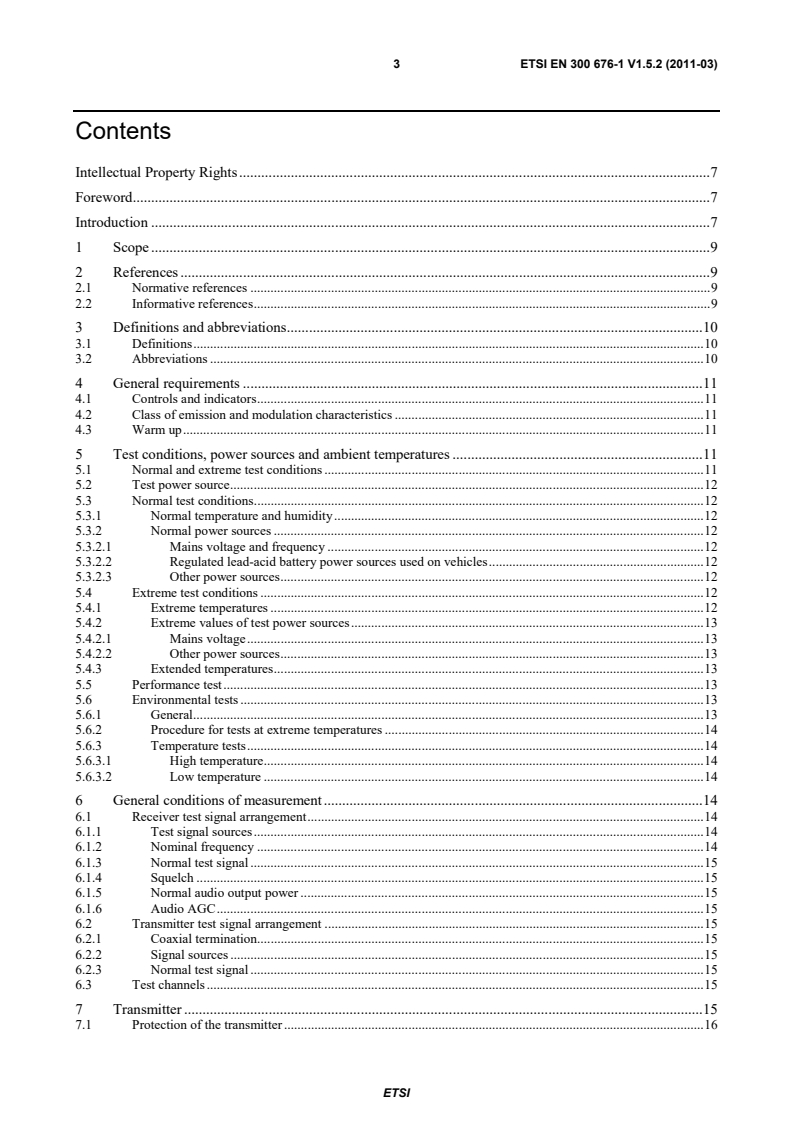
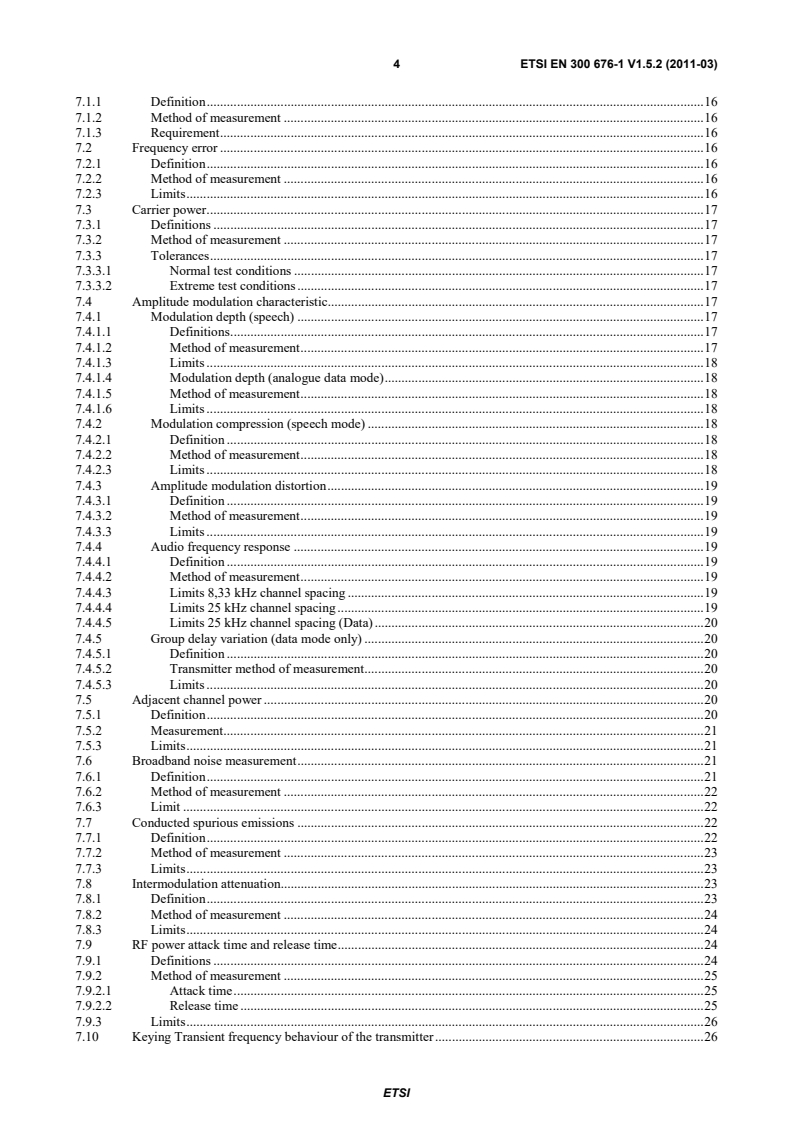
en_30067601v010502p - Ground-based VHF hand-held, mobile and fixed radio transmitters, receivers and transceivers for the VHF aeronautical mobile service using amplitude modulation; Part 1: Technical characteristics and methods of measurement

SIST EN 300 676-1 V1.5.2:2011 is the SIST adoption of an ETSI standard for ground-based VHF aeronautical radio transmitters, receivers and transceivers. It specifies minimum technical characteristics and methods of measurement for DSB AM equipment used in the aeronautical mobile service, mainly for analogue speech and ACARS data in the 118 MHz to 136,975 MHz band.
What does SIST EN 300 676-1 V1.5.2:2011 specify?
SIST EN 300 676-1 V1.5.2:2011 sets the technical performance requirements and measurement methods for ground-based aeronautical radio equipment. It applies to ground base stations, ground mobile radios and hand-held radios for ground use, and it also notes how the same test methods can be used for technical acceptance in the extended VHF bands with 25 kHz channel spacing.
The document is organized into scope, references, definitions, general requirements, test conditions, measurement conditions, transmitter requirements, receiver requirements, measurement uncertainty and annexes.
| Annex | What it covers |
|---|---|
| Annex A | Auxiliary cable arrangement for reproducible measurements |
| Annex B | Adjacent channel power measurement arrangement and power measuring receiver specification |
| Annex C | Bibliography |
What are the key requirements of SIST EN 300 676-1 V1.5.2:2011?
Operating conditions and test setup
The standard requires the equipment to operate on the relevant ICAO channel plan for 8,33 kHz or 25 kHz spacing, and it requires safeguards so the transmitter cannot radiate while the synthesizer is out of lock or during channel switching. In practice, this means the equipment must be stable and safe to key only when tuned correctly.
Clause 4 also requires basic controls and indications such as power-on indication, a way to disable squelch for testing, and a carrier-on indication. The warm-up clause gives the reader a clear rule for when the equipment is expected to meet the specification after switch-on.
Clause 5 defines normal, extreme and extended test conditions, including temperature, humidity and supply conditions. This matters because laboratories must test equipment in repeatable conditions and record any special environmental state in the report.
Transmitter performance
Clause 7 covers transmitter protection, frequency error, carrier power, modulation behaviour, adjacent channel power, broadband noise, spurious emissions, intermodulation attenuation, RF power timing, keying transients, sidetone and cabinet radiation. In practice, this tells a tester what to measure to prove the transmitter stays on frequency, stays within output-power tolerance, and does not create unwanted emissions that could interfere with nearby channels.
Several transmitter checks are specifically done with a coaxial termination at the output, while others use spectrum analysis or modulation analysis. The standard also distinguishes speech mode from data mode, so the laboratory must select the correct test condition for the equipment’s intended use.
Receiver performance
Clause 8 covers sensitivity, harmonic distortion, audio response, noise, effective acceptance bandwidth, adjacent channel rejection, spurious response rejection, intermodulation response rejection, blocking, conducted spurious emissions, squelch, cross modulation rejection, dynamic range, AGC and cabinet radiation. In practice, these tests show whether the receiver can hear weak wanted signals, reject nearby or unwanted signals, and keep audio output stable.
Several receiver methods use SINAD with psophometric filtering. That matters because the measurements are based on speech-quality performance, not just raw RF level.
Clause 9 requires the measurement uncertainty for each result to be calculated and recorded, and it sets maximum uncertainty values for transmitter and receiver measurements. This is important for type testing because the result must be interpreted together with the uncertainty in the test report.
What terms does SIST EN 300 676-1 V1.5.2:2011 define?
- Aeronautical mobile service - a mobile service between aeronautical stations and aircraft stations, with survival craft stations also able to participate.
- Ground base station - aeronautical station equipment intended for fixed-location use with an external antenna.
- Hand held - radio equipment with integral batteries designed to be carried and operated by hand.
- Portable station - equipment with an integral battery for independent hand-carried use, with possible accessories for antenna, microphone or charger.
- Conducted measurements - measurements made through a direct RF connection to the equipment under test.
- Radiated measurements - measurements made on the radiated field from the equipment.
- SINAD - signal plus noise and distortion divided by noise and distortion, used here to judge receiver quality.
Who uses SIST EN 300 676-1 V1.5.2:2011?
Manufacturers of aeronautical ground radios use this standard to design equipment and prepare type-test samples. Accredited test laboratories use it to run performance tests and report measurement uncertainty.
Authorities and certification bodies use it when assessing technical acceptance or type approval for ground-based aeronautical radio equipment. Buyers, integrators and maintenance teams use it to understand what performance a station radio must meet before installation or acceptance.
What changed in SIST EN 300 676-1 V1.5.2:2011 from the previous edition?
SIST EN 300 676-1 V1.5.2:2011 is the March 2011 publication of Part 1 in the EN 300 676 series and follows V1.5.1 from July 2010.
Which standards are used with SIST EN 300 676-1 V1.5.2:2011?
- ITU-T Recommendation O.41 - provides the psophometric filtering used in SINAD and audio-noise measurements.
- ICAO Annex 10 Volume V - provides the aeronautical frequency plan and channel labelling used by the standard.
- ETSI EN 300 113-1 - provides the cabinet radiation requirements referenced for both transmitter and receiver.
- ETSI EN 300 676-1 Part 2 - is the companion part covering the harmonized essential requirements of the R&TTE Directive.
- ETSI TR 100 028 - supports the calculation and reporting of measurement uncertainty.
- ISO 7637 - is referenced for vehicle power-supply disturbance requirements on equipment intended for vehicle installation.
What does the SIST EN 300 676-1 V1.5.2:2011 document contain?
The document contains detailed test methods for transmitter and receiver measurements, including coaxial and radiated setups, modulation tests, RF power timing, spectral measurements and audio-performance checks. It also includes figures for broadband noise, intermodulation, attack and release timing, and group delay measurements.
Annex B provides the special measurement arrangement and receiver specification needed for adjacent channel power testing. Annex A gives practical cable arrangement guidance so measurements stay reproducible in the laboratory.
The document also gives transmitter and receiver uncertainty tables and explains how measured results are to be interpreted in a test report.
Buy Documents
en_30067601v010502p - Ground-based VHF hand-held, mobile and fixed radio transmitters, receivers and transceivers for the VHF aeronautical mobile service using amplitude modulation; Part 1: Technical characteristics and methods of measurement
Get Certified
Connect with accredited certification bodies for this standard

BUREAU VERITAS Certification Germany
Bureau Veritas certification in Germany.

Element Materials Technology
Materials testing and product certification.

ANCE
Mexican certification and testing association.
Sponsored listings
Frequently Asked Questions
SIST EN 300 676-1 V1.5.2:2011 is a standard published by the Slovenian Institute for Standardization (SIST). Its full title is "Ground-based VHF hand-held, mobile and fixed radio transmitters, receivers and transceivers for the VHF aeronautical mobile service using amplitude modulation - Part 1: Technical characteristics and methods of measurement". This standard covers: The present document states the minimum performance requirements for radio transmitters, receivers and transceivers at ground-based aeronautical stations operating in the VHF band (118 MHz to 136,975 MHz) allocated to the aeronautical mobile service. In situations where transmitters and receivers are located in close proximity there is the possibility of interference. In such cases, external filters and isolators may be necessary as part of the installation to achieve an isolation performance in excess of the minima defined in the present document to overcome the interference. The present document applies to DSB AM systems, with channel separations of 8,33 kHz or 25 kHz intended for analogue speech and ground base stations with a channel spacing of 25 kHz intended for ACARS data communication. NOTE: The test methods and procedures in the present document may also be used to show technical acceptance for radio transmitters, receivers and transceivers at ground based aeronautical stations operating with 25 kHz channel spacing in the extended VHF bands (108 MHz to 117,975 MHz and 137 MHz to 155,975 MHz). The scope of the present document is limited to ground base stations, ground mobile and hand held radios for ground use.
The present document states the minimum performance requirements for radio transmitters, receivers and transceivers at ground-based aeronautical stations operating in the VHF band (118 MHz to 136,975 MHz) allocated to the aeronautical mobile service. In situations where transmitters and receivers are located in close proximity there is the possibility of interference. In such cases, external filters and isolators may be necessary as part of the installation to achieve an isolation performance in excess of the minima defined in the present document to overcome the interference. The present document applies to DSB AM systems, with channel separations of 8,33 kHz or 25 kHz intended for analogue speech and ground base stations with a channel spacing of 25 kHz intended for ACARS data communication. NOTE: The test methods and procedures in the present document may also be used to show technical acceptance for radio transmitters, receivers and transceivers at ground based aeronautical stations operating with 25 kHz channel spacing in the extended VHF bands (108 MHz to 117,975 MHz and 137 MHz to 155,975 MHz). The scope of the present document is limited to ground base stations, ground mobile and hand held radios for ground use.
SIST EN 300 676-1 V1.5.2:2011 is classified under the following ICS (International Classification for Standards) categories: 33.060.20 - Receiving and transmitting equipment; 49.090 - On-board equipment and instruments. The ICS classification helps identify the subject area and facilitates finding related standards.
SIST EN 300 676-1 V1.5.2:2011 is available in PDF format for immediate download after purchase. The document can be added to your cart and obtained through the secure checkout process. Digital delivery ensures instant access to the complete standard document.
Standards Content (Sample)
European Standard
Ground-based VHF hand-held, mobile and fixed radio
transmitters, receivers and transceivers for the VHF
aeronautical mobile service using amplitude modulation;
Part 1:Technical characteristics and
methods of measurement
2 ETSI EN 300 676-1 V1.5.2 (2011-03)
Reference
REN/ERM-JTFEA-008
Keywords
aeronautical, AM, DSB, radio, testing, VHF
ETSI
650 Route des Lucioles
F-06921 Sophia Antipolis Cedex - FRANCE
Tel.: +33 4 92 94 42 00 Fax: +33 4 93 65 47 16
Siret N° 348 623 562 00017 - NAF 742 C
Association à but non lucratif enregistrée à la
Sous-Préfecture de Grasse (06) N° 7803/88
Important notice
Individual copies of the present document can be downloaded from:
http://www.etsi.org
The present document may be made available in more than one electronic version or in print. In any case of existing or
perceived difference in contents between such versions, the reference version is the Portable Document Format (PDF).
In case of dispute, the reference shall be the printing on ETSI printers of the PDF version kept on a specific network drive
within ETSI Secretariat.
Users of the present document should be aware that the document may be subject to revision or change of status.
Information on the current status of this and other ETSI documents is available at
http://portal.etsi.org/tb/status/status.asp
If you find errors in the present document, please send your comment to one of the following services:
http://portal.etsi.org/chaircor/ETSI_support.asp
Copyright Notification
No part may be reproduced except as authorized by written permission.
The copyright and the foregoing restriction extend to reproduction in all media.
© European Telecommunications Standards Institute 2011.
All rights reserved.
TM TM TM TM
DECT , PLUGTESTS , UMTS , TIPHON , the TIPHON logo and the ETSI logo are Trade Marks of ETSI registered
for the benefit of its Members.
TM
3GPP is a Trade Mark of ETSI registered for the benefit of its Members and of the 3GPP Organizational Partners.
LTE™ is a Trade Mark of ETSI currently being registered
for the benefit of its Members and of the 3GPP Organizational Partners.
GSM® and the GSM logo are Trade Marks registered and owned by the GSM Association.
ETSI
3 ETSI EN 300 676-1 V1.5.2 (2011-03)
Contents
Intellectual Property Rights . 7
Foreword . 7
Introduction . 7
1 Scope . 9
2 References . 9
2.1 Normative references . 9
2.2 Informative references . 9
3 Definitions and abbreviations . 10
3.1 Definitions . 10
3.2 Abbreviations . 10
4 General requirements . 11
4.1 Controls and indicators . 11
4.2 Class of emission and modulation characteristics . 11
4.3 Warm up . 11
5 Test conditions, power sources and ambient temperatures . 11
5.1 Normal and extreme test conditions . 11
5.2 Test power source . 12
5.3 Normal test conditions . 12
5.3.1 Normal temperature and humidity . 12
5.3.2 Normal power sources . 12
5.3.2.1 Mains voltage and frequency . 12
5.3.2.2 Regulated lead-acid battery power sources used on vehicles . 12
5.3.2.3 Other power sources . 12
5.4 Extreme test conditions . 12
5.4.1 Extreme temperatures . 12
5.4.2 Extreme values of test power sources . 13
5.4.2.1 Mains voltage . 13
5.4.2.2 Other power sources . 13
5.4.3 Extended temperatures . 13
5.5 Performance test . 13
5.6 Environmental tests . 13
5.6.1 General . 13
5.6.2 Procedure for tests at extreme temperatures . 14
5.6.3 Temperature tests . 14
5.6.3.1 High temperature . 14
5.6.3.2 Low temperature . 14
6 General conditions of measurement . 14
6.1 Receiver test signal arrangement . 14
6.1.1 Test signal sources . 14
6.1.2 Nominal frequency . 14
6.1.3 Normal test signal . 15
6.1.4 Squelch . 15
6.1.5 Normal audio output power . 15
6.1.6 Audio AGC . 15
6.2 Transmitter test signal arrangement . 15
6.2.1 Coaxial termination. 15
6.2.2 Signal sources . 15
6.2.3 Normal test signal . 15
6.3 Test channels . 15
7 Transmitter . 15
7.1 Protection of the transmitter . 16
ETSI
4 ETSI EN 300 676-1 V1.5.2 (2011-03)
7.1.1 Definition . 16
7.1.2 Method of measurement . 16
7.1.3 Requirement . 16
7.2 Frequency error . 16
7.2.1 Definition . 16
7.2.2 Method of measurement . 16
7.2.3 Limits . 16
7.3 Carrier power . 17
7.3.1 Definitions . 17
7.3.2 Method of measurement . 17
7.3.3 Tolerances . 17
7.3.3.1 Normal test conditions . 17
7.3.3.2 Extreme test conditions . 17
7.4 Amplitude modulation characteristic. 17
7.4.1 Modulation depth (speech) . 17
7.4.1.1 Definitions . 17
7.4.1.2 Method of measurement . 17
7.4.1.3 Limits . 18
7.4.1.4 Modulation depth (analogue data mode) . 18
7.4.1.5 Method of measurement . 18
7.4.1.6 Limits . 18
7.4.2 Modulation compression (speech mode) . 18
7.4.2.1 Definition . 18
7.4.2.2 Method of measurement . 18
7.4.2.3 Limits . 18
7.4.3 Amplitude modulation distortion . 19
7.4.3.1 Definition . 19
7.4.3.2 Method of measurement . 19
7.4.3.3 Limits . 19
7.4.4 Audio frequency response . 19
7.4.4.1 Definition . 19
7.4.4.2 Method of measurement . 19
7.4.4.3 Limits 8,33 kHz channel spacing . 19
7.4.4.4 Limits 25 kHz channel spacing . 19
7.4.4.5 Limits 25 kHz channel spacing (Data) . 20
7.4.5 Group delay variation (data mode only) . 20
7.4.5.1 Definition . 20
7.4.5.2 Transmitter method of measurement . 20
7.4.5.3 Limits . 20
7.5 Adjacent channel power . 20
7.5.1 Definition . 20
7.5.2 Measurement. 21
7.5.3 Limits . 21
7.6 Broadband noise measurement . 21
7.6.1 Definition . 21
7.6.2 Method of measurement . 22
7.6.3 Limit . 22
7.7 Conducted spurious emissions . 22
7.7.1 Definition . 22
7.7.2 Method of measurement . 23
7.7.3 Limits . 23
7.8 Intermodulation attenuation. 23
7.8.1 Definition . 23
7.8.2 Method of measurement . 24
7.8.3 Limits . 24
7.9 RF power attack time and release time . 24
7.9.1 Definitions . 24
7.9.2 Method of measurement . 25
7.9.2.1 Attack time . 25
7.9.2.2 Release time . 25
7.9.3 Limits . 26
7.10 Keying Transient frequency behaviour of the transmitter . 26
ETSI
5 ETSI EN 300 676-1 V1.5.2 (2011-03)
7.10.1 Definitions . 26
7.10.2 Method of measurement . 26
7.10.3 Limits . 26
7.11 Sidetone . 27
7.11.1 Limits . 27
7.12 Cabinet Radiation . 27
8 Receiver . . 27
8.1 Sensitivity . 27
8.1.1 Definition . 27
8.1.2 Method of measurement . 27
8.1.3 Limits . 27
8.2 Harmonic distortion . 28
8.2.1 Definition . 28
8.2.2 Method of measurement . 28
8.2.3 Limits . 28
8.3 Audio frequency response . 28
8.3.1 Definition . 28
8.3.2 Method of measurement . 28
8.3.3 Limits . 28
8.3.4 Limit for DATA operation . 28
8.4 Audio noise . 29
8.4.1 Definition . 29
8.4.2 Method of measurement . 29
8.4.3 Limits . 29
8.5 Effective acceptance bandwidth . 29
8.5.1 Definition . 29
8.5.2 Method of measurement . 29
8.5.3 Limits . 29
8.6 Adjacent channel rejection . 30
8.6.1 Definition . 30
8.6.2 Method of measurement . 30
8.6.3 Limits . 30
8.7 Spurious response rejection . 30
8.7.1 Definition . 31
8.7.2 Introduction to the method of measurement . 31
8.7.3 Method of search of the limited frequency range . 31
8.7.4 Method of measurement . 31
8.7.5 Limit . 32
8.8 Intermodulation response rejection . 32
8.8.1 Definition . 32
8.8.2 Method of measurement . 32
8.8.3 Limit . 32
8.9 Blocking or desensitization . 33
8.9.1 Definition . 33
8.9.2 Method of measurement . 33
8.9.3 Limit . 33
8.10 Conducted spurious emissions . 33
8.10.1 Definition . 33
8.10.2 Method of measuring the power level . 33
8.10.3 Limits . 34
8.11 Squelch operation . 34
8.11.1 Definition . 34
8.11.2 Method of measurement . 34
8.11.3 Limits . 34
8.12 Cross modulation rejection . 35
8.12.1 Definition . 35
8.12.2 Method of measurement . 35
8.12.3 Limits . 35
8.13 Receiver dynamic range . 35
8.13.1 Definition . 35
8.13.2 Method of measurement . 35
ETSI
6 ETSI EN 300 676-1 V1.5.2 (2011-03)
8.13.3 Limit . 36
8.14 AGC attack time and release time (data mode only) . 36
8.14.1 Definitions . 36
8.14.2 Method of measurement . 36
8.14.2.1 Attack time . 36
8.14.2.2 AGC Decay time . 36
8.14.3 Limits . 36
8.15 AF AGC . 37
8.15.1 Definition . 37
8.15.2 Method of measurement . 37
8.15.3 Limit . 37
8.16 Group delay variation (data mode only) . 37
8.16.1 Definition . 37
8.16.2 Receiver method of measurement . 37
8.16.3 Limits . 38
8.17 Cabinet Radiation . 38
9 Measurement uncertainty and interpretation of the measured results . 38
9.1 Maximum measurement uncertainties . 38
9.2 Interpretation of the measurement results . 39
Annex A (normative): Auxiliary cables . 40
Annex B (normative): Specification for adjacent channel power measurement
arrangements . 41
B.1 Power measuring receiver specification . 41
B.1.1 IF filter . 41
B.1.2 Attenuation indicator . 42
B.1.3 RMS value indicator . 42
B.1.4 Oscillator and amplifier . 42
Annex C (informative): Bibliography . 43
History . 44
ETSI
7 ETSI EN 300 676-1 V1.5.2 (2011-03)
Intellectual Property Rights
IPRs essential or potentially essential to the present document may have been declared to ETSI. The information
pertaining to these essential IPRs, if any, is publicly available for ETSI members and non-members, and can be found
in ETSI SR 000 314: "Intellectual Property Rights (IPRs); Essential, or potentially Essential, IPRs notified to ETSI in
respect of ETSI standards", which is available from the ETSI Secretariat. Latest updates are available on the ETSI Web
server (http://webapp.etsi.org/IPR/home.asp).
Pursuant to the ETSI IPR Policy, no investigation, including IPR searches, has been carried out by ETSI. No guarantee
can be given as to the existence of other IPRs not referenced in ETSI SR 000 314 (or the updates on the ETSI Web
server) which are, or may be, or may become, essential to the present document.
Foreword
This European Standard (EN) has been produced by ETSI Technical Committee Electromagnetic compatibility and
Radio spectrum Matters (ERM).
The present document is part 1 of a multi-part deliverable covering the Ground-based VHF hand-held, mobile and fixed
radio transmitters, receivers and transceivers for the VHF aeronautical mobile service using amplitude modulation, as
identified below:
Part 1: "Technical characteristics and methods of measurement";
Part 2: "Harmonized EN covering essential requirements of article 3.2 of the R&TTE Directive".
National transposition dates
Date of latest announcement of this EN (doa): 30 June 2011
Date of latest publication of new National Standard
or endorsement of this EN (dop/e): 31 December 2011
Date of withdrawal of any conflicting National Standard (dow): 31 December 2011
Introduction
The present document states the minimum performance requirements for ground based radio transmitters, transceivers
and receivers for the aeronautical mobile service operating in the VHF band (118 MHz to 136,975 MHz), using Double
Sideband Amplitude Modulation with 8,33 kHz or 25 kHz channel spacing.
NOTE: For equipment designed to cover the extended VHF frequency bands 108 MHz to 117,975 MHz and
137 MHz to 155,975 MHz the same test methods and procedures may be applied to show technical
acceptance of the product in the band 108 MHz to 155,975 MHz.
Additional requirements, outside the scope of the present document, may be required to ensure operation
in the 108 MHz to 117,975 MHz band does not cause interference to the FM broadcast band.
The present document may be used by accredited test laboratories for the assessment of the performance of the
equipment. The performance of the equipment submitted for type testing should be representative for the performance
of the corresponding production model.
ETSI
8 ETSI EN 300 676-1 V1.5.2 (2011-03)
The present document has been written on the assumption that:
- the type test measurements will be performed only once, in an accredited test laboratory and the measurements
accepted by the various authorities in order to grant type approval;
- if equipment available on the market is required to be checked it will be tested in accordance with the methods
of measurement specified in the present document.
ETSI
9 ETSI EN 300 676-1 V1.5.2 (2011-03)
1 Scope
The present document states the minimum performance requirements for radio transmitters, receivers and transceivers
at ground-based aeronautical stations operating in the VHF band (118 MHz to 136,975 MHz) allocated to the
aeronautical mobile service.
In situations where transmitters and receivers are located in close proximity there is the possibility of interference. In
such cases, external filters and isolators may be necessary as part of the installation to achieve an isolation performance
in excess of the minima defined in the present document to overcome the interference.
The present document applies to DSB AM systems, with channel separations of 8,33 kHz or 25 kHz intended for
analogue speech and ground base stations with a channel spacing of 25 kHz intended for ACARS data communication.
NOTE: The test methods and procedures in the present document may also be used to show technical acceptance
for radio transmitters, receivers and transceivers at ground based aeronautical stations operating with
25 kHz channel spacing in the extended VHF bands (108 MHz to 117,975 MHz and 137 MHz to
155,975 MHz).
The scope of the present document is limited to ground base stations, ground mobile and hand held radios for ground
use.
2 References
References are either specific (identified by date of publication and/or edition number or version number) or
non-specific. For specific references, only the cited version applies. For non-specific references, the latest version of the
reference document (including any amendments) applies.
Referenced documents which are not found to be publicly available in the expected location might be found at
http://docbox.etsi.org/Reference.
NOTE: While any hyperlinks included in this clause were valid at the time of publication ETSI cannot guarantee
their long term validity.
2.1 Normative references
The following referenced documents are necessary for the application of the present document.
[1] ITU-T Recommendation O.41: "Psophometer for use on telephone-type circuits".
[2] ICAO Annex 10 Volume V (July 2001, including amendments up to amendment 84):
"Aeronautical Radio Frequency Spectrum Utilization".
[3] ETSI EN 300 113-1: "Electromagnetic compatibility and Radio spectrum Matters (ERM); Land
mobile service; Radio equipment intended for the transmission of data (and/or speech) using
constant or non-constant envelope modulation and having an antenna connector; Part 1: Technical
characteristics and methods of measurement".
2.2 Informative references
The following referenced documents are not necessary for the application of the present document but they assist the
user with regard to a particular subject area.
[i.1] ETSI TR 100 028 (all parts): "Electromagnetic compatibility and Radio spectrum Matters (ERM);
Uncertainties in the measurement of mobile radio equipment characteristics".
[i.2] ISO 7637 (parts 1 and 2): "Road vehicles - Electrical disturbances from conduction and coupling".
ETSI
10 ETSI EN 300 676-1 V1.5.2 (2011-03)
[i.3] Directive 1999/5/EC of the European Parliament and of the Council of 9 March 1999 on radio
equipment and telecommunications terminal equipment and the mutual recognition of their
conformity (R&TTE Directive).
3 Definitions and abbreviations
3.1 Definitions
For the purposes of the present document, the following terms and definitions apply:
aeronautical mobile service: mobile service between aeronautical stations and aircraft stations, or between aircraft
stations, in which survival craft stations may participate
conducted measurements: measurements which are made using a direct RF connection to the equipment under test
ground base station: aeronautical station equipment, in the aeronautical mobile service, for use with an external
antenna and intended for use at a fixed location
hand held: radio equipment with integral batteries, designed to be hand portable and operated hand held
integral antenna equipment: radio communications equipment with an antenna integrated into the equipment without
the use of an external connector and considered to be part of the equipment
NOTE: An integral antenna may be internal or external to the equipment. In equipment of this type, a 50 Ω RF
connection point should be provided for test purposes. A connection point for an AF modulating input
and for AF output measurements should also be provided.
mobile station: radio equipment designed for permanent or temporary vehicle installation and operation, including
provision for vehicle DC power supply, and connections for external antenna, PTT key, microphone, speaker and/or
headphone
non-integral antenna equipment: radio communications equipment with a connector intended for connection to an
antenna
portable station: radio equipment with integral battery for independent hand-carried use
NOTE: Provisions may be made for connections of an external antenna, PTT key, microphone, headphone and
charger, but principally to be operated as a self contained unit.
radiated measurements: measurements which involve the measurement of a radiated field
3.2 Abbreviations
For the purposes of the present document, the following abbreviations apply:
ACARS Aircraft Communications Addressing and Reporting System
AF Audio Frequency
AGC Automatic Gain Control
AM Amplitude Modulation
dBc dB relative to the carrier power
DSB Double Side Band
ICAO International Civil Aviation Organization
IF Intermediate Frequency
ppm parts per million
RF Radio Frequency
rms root mean square
SINAD (Signal + Noise + Distortion)/(Noise + Distortion)
VSWR Voltage Standing Wave Ratio
ETSI
11 ETSI EN 300 676-1 V1.5.2 (2011-03)
4 General requirements
8,33 kHz equipm
...
2003-01.Slovenski inštitut za standardizacijo. Razmnoževanje celote ali delov tega standarda ni dovoljeno.LWXGQR49.090On-board equipment and instruments33.060.20Sprejemna in oddajna opremaReceiving and transmitting equipmentICS:Ta slovenski standard je istoveten z:EN 300 676-1 Version 1.5.2SIST EN 300 676-1 V1.5.2:2011en01-april-2011SIST EN 300 676-1 V1.5.2:2011SLOVENSKI
STANDARD
ETSI ETSI EN 300 676-1 V1.5.2 (2011-03) 2
Reference REN/ERM-JTFEA-008 Keywords aeronautical, AM, DSB, radio, testing, VHF ETSI 650 Route des Lucioles F-06921 Sophia Antipolis Cedex - FRANCE
Tel.: +33 4 92 94 42 00
Fax: +33 4 93 65 47 16
Siret N° 348 623 562 00017 - NAF 742 C Association à but non lucratif enregistrée à la Sous-Préfecture de Grasse (06) N° 7803/88
Important notice Individual copies of the present document can be downloaded from: http://www.etsi.org The present document may be made available in more than one electronic version or in print. In any case of existing or perceived difference in contents between such versions, the reference version is the Portable Document Format (PDF). In case of dispute, the reference shall be the printing on ETSI printers of the PDF version kept on a specific network drive within ETSI Secretariat. Users of the present document should be aware that the document may be subject to revision or change of status. Information on the current status of this and other ETSI documents is available at http://portal.etsi.org/tb/status/status.asp If you find errors in the present document, please send your comment to one of the following services: http://portal.etsi.org/chaircor/ETSI_support.asp Copyright Notification No part may be reproduced except as authorized by written permission. The copyright and the foregoing restriction extend to reproduction in all media.
© European Telecommunications Standards Institute 2011. All rights reserved.
DECTTM, PLUGTESTSTM, UMTSTM, TIPHONTM, the TIPHON logo and the ETSI logo are Trade Marks of ETSI registered for the benefit of its Members. 3GPPTM is a Trade Mark of ETSI registered for the benefit of its Members and of the 3GPP Organizational Partners. LTE™ is a Trade Mark of ETSI currently being registered for the benefit of its Members and of the 3GPP Organizational Partners. GSM® and the GSM logo are Trade Marks registered and owned by the GSM Association. SIST EN 300 676-1 V1.5.2:2011
ETSI ETSI EN 300 676-1 V1.5.2 (2011-03) 3 Contents Intellectual Property Rights . 7 Foreword . 7 Introduction . 7 1 Scope . 9 2 References . 9 2.1 Normative references . 9 2.2 Informative references . 9 3 Definitions and abbreviations . 10 3.1 Definitions . 10 3.2 Abbreviations . 10 4 General requirements . 11 4.1 Controls and indicators . 11 4.2 Class of emission and modulation characteristics . 11 4.3 Warm up . 11 5 Test conditions, power sources and ambient temperatures . 11 5.1 Normal and extreme test conditions . 11 5.2 Test power source . 12 5.3 Normal test conditions . 12 5.3.1 Normal temperature and humidity . 12 5.3.2 Normal power sources . 12 5.3.2.1 Mains voltage and frequency . 12 5.3.2.2 Regulated lead-acid battery power sources used on vehicles . 12 5.3.2.3 Other power sources . 12 5.4 Extreme test conditions . 12 5.4.1 Extreme temperatures . 12 5.4.2 Extreme values of test power sources . 13 5.4.2.1 Mains voltage . 13 5.4.2.2 Other power sources . 13 5.4.3 Extended temperatures . 13 5.5 Performance test . 13 5.6 Environmental tests . 13 5.6.1 General . 13 5.6.2 Procedure for tests at extreme temperatures . 14 5.6.3 Temperature tests . 14 5.6.3.1 High temperature . 14 5.6.3.2 Low temperature . 14 6 General conditions of measurement . 14 6.1 Receiver test signal arrangement . 14 6.1.1 Test signal sources . 14 6.1.2 Nominal frequency . 14 6.1.3 Normal test signal . 15 6.1.4 Squelch . 15 6.1.5 Normal audio output power . 15 6.1.6 Audio AGC . 15 6.2 Transmitter test signal arrangement . 15 6.2.1 Coaxial termination. 15 6.2.2 Signal sources . 15 6.2.3 Normal test signal . 15 6.3 Test channels . 15 7 Transmitter . 15 7.1 Protection of the transmitter . 16 SIST EN 300 676-1 V1.5.2:2011
ETSI ETSI EN 300 676-1 V1.5.2 (2011-03) 4 7.1.1 Definition . 16 7.1.2 Method of measurement . 16 7.1.3 Requirement . 16 7.2 Frequency error . 16 7.2.1 Definition . 16 7.2.2 Method of measurement . 16 7.2.3 Limits . 16 7.3 Carrier power . 17 7.3.1 Definitions . 17 7.3.2 Method of measurement . 17 7.3.3 Tolerances . 17 7.3.3.1 Normal test conditions . 17 7.3.3.2 Extreme test conditions . 17 7.4 Amplitude modulation characteristic. 17 7.4.1 Modulation depth (speech) . 17 7.4.1.1 Definitions . 17 7.4.1.2 Method of measurement . 17 7.4.1.3 Limits . 18 7.4.1.4 Modulation depth (analogue data mode) . 18 7.4.1.5 Method of measurement . 18 7.4.1.6 Limits . 18 7.4.2 Modulation compression (speech mode) . 18 7.4.2.1 Definition . 18 7.4.2.2 Method of measurement . 18 7.4.2.3 Limits . 18 7.4.3 Amplitude modulation distortion . 19 7.4.3.1 Definition . 19 7.4.3.2 Method of measurement . 19 7.4.3.3 Limits . 19 7.4.4 Audio frequency response . 19 7.4.4.1 Definition . 19 7.4.4.2 Method of measurement . 19 7.4.4.3 Limits 8,33 kHz channel spacing . 19 7.4.4.4 Limits 25 kHz channel spacing . 19 7.4.4.5 Limits 25 kHz channel spacing (Data) . 20 7.4.5 Group delay variation (data mode only) . 20 7.4.5.1 Definition . 20 7.4.5.2 Transmitter method of measurement . 20 7.4.5.3 Limits . 20 7.5 Adjacent channel power . 20 7.5.1 Definition . 20 7.5.2 Measurement. 21 7.5.3 Limits . 21 7.6 Broadband noise measurement . 21 7.6.1 Definition . 21 7.6.2 Method of measurement . 22 7.6.3 Limit . 22 7.7 Conducted spurious emissions . 22 7.7.1 Definition . 22 7.7.2 Method of measurement . 23 7.7.3 Limits . 23 7.8 Intermodulation attenuation. 23 7.8.1 Definition . 23 7.8.2 Method of measurement . 24 7.8.3 Limits . 24 7.9 RF power attack time and release time . 24 7.9.1 Definitions . 24 7.9.2 Method of measurement . 25 7.9.2.1 Attack time . 25 7.9.2.2 Release time . 25 7.9.3 Limits . 26 7.10 Keying Transient frequency behaviour of the transmitter . 26 SIST EN 300 676-1 V1.5.2:2011
ETSI ETSI EN 300 676-1 V1.5.2 (2011-03) 5 7.10.1 Definitions . 26 7.10.2 Method of measurement . 26 7.10.3 Limits . 26 7.11 Sidetone . 27 7.11.1 Limits . 27 7.12 Cabinet Radiation . 27 8 Receiver . 27 8.1 Sensitivity . 27 8.1.1 Definition . 27 8.1.2 Method of measurement . 27 8.1.3 Limits . 27 8.2 Harmonic distortion . 28 8.2.1 Definition . 28 8.2.2 Method of measurement . 28 8.2.3 Limits . 28 8.3 Audio frequency response . 28 8.3.1 Definition . 28 8.3.2 Method of measurement . 28 8.3.3 Limits . 28 8.3.4 Limit for DATA operation . 28 8.4 Audio noise . 29 8.4.1 Definition . 29 8.4.2 Method of measurement . 29 8.4.3 Limits . 29 8.5 Effective acceptance bandwidth . 29 8.5.1 Definition . 29 8.5.2 Method of measurement . 29 8.5.3 Limits . 29 8.6 Adjacent channel rejection . 30 8.6.1 Definition . 30 8.6.2 Method of measurement . 30 8.6.3 Limits . 30 8.7 Spurious response rejection . 30 8.7.1 Definition . 31 8.7.2 Introduction to the method of measurement . 31 8.7.3 Method of search of the limited frequency range . 31 8.7.4 Method of measurement . 31 8.7.5 Limit . 32 8.8 Intermodulation response rejection . 32 8.8.1 Definition . 32 8.8.2 Method of measurement . 32 8.8.3 Limit . 32 8.9 Blocking or desensitization . 33 8.9.1 Definition . 33 8.9.2 Method of measurement . 33 8.9.3 Limit . 33 8.10 Conducted spurious emissions . 33 8.10.1 Definition . 33 8.10.2 Method of measuring the power level . 33 8.10.3 Limits . 34 8.11 Squelch operation . 34 8.11.1 Definition . 34 8.11.2 Method of measurement . 34 8.11.3 Limits . 34 8.12 Cross modulation rejection . 35 8.12.1 Definition . 35 8.12.2 Method of measurement . 35 8.12.3 Limits . 35 8.13 Receiver dynamic range . 35 8.13.1 Definition . 35 8.13.2 Method of measurement . 35 SIST EN 300 676-1 V1.5.2:2011
ETSI ETSI EN 300 676-1 V1.5.2 (2011-03) 6 8.13.3 Limit . 36 8.14 AGC attack time and release time (data mode only) . 36 8.14.1 Definitions . 36 8.14.2 Method of measurement . 36 8.14.2.1 Attack time . 36 8.14.2.2 AGC Decay time . 36 8.14.3 Limits . 36 8.15 AF AGC . 37 8.15.1 Definition . 37 8.15.2 Method of measurement . 37 8.15.3 Limit . 37 8.16 Group delay variation (data mode only) . 37 8.16.1 Definition . 37 8.16.2 Receiver method of measurement . 37 8.16.3 Limits . 38 8.17 Cabinet Radiation . 38 9 Measurement uncertainty and interpretation of the measured results . 38 9.1 Maximum measurement uncertainties . 38 9.2 Interpretation of the measurement results . 39 Annex A (normative): Auxiliary cables . 40 Annex B (normative): Specification for adjacent channel power measurement arrangements . 41 B.1 Power measuring receiver specification . 41 B.1.1 IF filter . 41 B.1.2 Attenuation indicator . 42 B.1.3 RMS value indicator . 42 B.1.4 Oscillator and amplifier . 42 Annex C (informative): Bibliography . 43 History . 44
ETSI ETSI EN 300 676-1 V1.5.2 (2011-03) 7 Intellectual Property Rights IPRs essential or potentially essential to the present document may have been declared to ETSI. The information pertaining to these essential IPRs, if any, is publicly available for ETSI members and non-members, and can be found in ETSI SR 000 314: "Intellectual Property Rights (IPRs); Essential, or potentially Essential, IPRs notified to ETSI in respect of ETSI standards", which is available from the ETSI Secretariat. Latest updates are available on the ETSI Web server (http://webapp.etsi.org/IPR/home.asp). Pursuant to the ETSI IPR Policy, no investigation, including IPR searches, has been carried out by ETSI. No guarantee can be given as to the existence of other IPRs not referenced in ETSI SR 000 314 (or the updates on the ETSI Web server) which are, or may be, or may become, essential to the present document. Foreword This European Standard (EN) has been produced by ETSI Technical Committee Electromagnetic compatibility and Radio spectrum Matters (ERM). The present document is part 1 of a multi-part deliverable covering the Ground-based VHF hand-held, mobile and fixed radio transmitters, receivers and transceivers for the VHF aeronautical mobile service using amplitude modulation, as identified below: Part 1: "Technical characteristics and methods of measurement"; Part 2: "Harmonized EN covering essential requirements of article 3.2 of the R&TTE Directive".
National transposition dates Date of latest announcement of this EN (doa): 30 June 2011 Date of latest publication of new National Standard or endorsement of this EN (dop/e):
31 December 2011 Date of withdrawal of any conflicting National Standard (dow): 31 December 2011
Introduction The present document states the minimum performance requirements for ground based radio transmitters, transceivers and receivers for the aeronautical mobile service operating in the VHF band (118 MHz to 136,975 MHz), using Double Sideband Amplitude Modulation with 8,33 kHz or 25 kHz channel spacing. NOTE: For equipment designed to cover the extended VHF frequency bands 108 MHz to 117,975 MHz and 137 MHz to 155,975 MHz the same test methods and procedures may be applied to show technical acceptance of the product in the band 108 MHz to 155,975 MHz.
Additional requirements, outside the scope of the present document, may be required to ensure operation in the 108 MHz to 117,975 MHz band does not cause interference to the FM broadcast band. The present document may be used by accredited test laboratories for the assessment of the performance of the equipment. The performance of the equipment submitted for type testing should be representative for the performance of the corresponding production model. SIST EN 300 676-1 V1.5.2:2011
ETSI ETSI EN 300 676-1 V1.5.2 (2011-03) 8 The present document has been written on the assumption that: - the type test measurements will be performed only once, in an accredited test laboratory and the measurements accepted by the various authorities in order to grant type approval; - if equipment available on the market is required to be checked it will be tested in accordance with the methods of measurement specified in the present document. SIST EN 300 676-1 V1.5.2:2011
ETSI ETSI EN 300 676-1 V1.5.2 (2011-03) 9 1 Scope The present document states the minimum performance requirements for radio transmitters, receivers and transceivers at ground-based aeronautical stations operating in the VHF band (118 MHz to 136,975 MHz) allocated to the aeronautical mobile service. In situations where transmitters and receivers are located in close proximity there is the possibility of interference. In such cases, external filters and isolators may be necessary as part of the installation to achieve an isolation performance in excess of the minima defined in the present document to overcome the interference. The present document applies to DSB AM systems, with channel separations of 8,33 kHz or 25 kHz intended for analogue speech and ground base stations with a channel spacing of 25 kHz intended for ACARS data communication. NOTE: The test methods and procedures in the present document may also be used to show technical acceptance for radio transmitters, receivers and transceivers at ground based aeronautical stations operating with 25 kHz channel spacing in the extended VHF bands (108 MHz to 117,975 MHz and 137 MHz to 155,975 MHz). The scope of the present document is limited to ground base stations, ground mobile and hand held radios for ground use. 2 References References are either specific (identified by date of publication and/or edition number or version number) or non-specific. For specific references, only the cited version applies. For non-specific references, the latest version of the reference document (including any amendments) applies. Referenced documents which are not found to be publicly available in the expected location might be found at http://docbox.etsi.org/Reference. NOTE: While any hyperlinks included in this clause were valid at the time of publication ETSI cannot guarantee their long term validity. 2.1 Normative references The following referenced documents are necessary for the application of the present document. [1] ITU-T Recommendation O.41: "Psophometer for use on telephone-type circuits". [2] ICAO Annex 10 Volume V (July 2001, including amendments up to amendment 84): "Aeronautical Radio Frequency Spectrum Utilization". [3] ETSI EN 300 113-1: "Electromagnetic compatibility and Radio spectrum Matters (ERM); Land mobile service; Radio equipment intended for the transmission of data (and/or speech) using constant or non-constant envelope modulation and having an antenna connector; Part 1: Technical characteristics and methods of measurement". 2.2 Informative references The following referenced documents are not necessary for the application of the present document but they assist the user with regard to a particular subject area. [i.1] ETSI TR 100 028 (all parts): "Electromagnetic compatibility and Radio spectrum Matters (ERM); Uncertainties in the measurement of mobile radio equipment characteristics". [i.2] ISO 7637 (parts 1 and 2): "Road vehicles - Electrical disturbances from conduction and coupling". SIST EN 300 676-1 V1.5.2:2011
ETSI ETSI EN 300 676-1 V1.5.2 (2011-03) 10 [i.3] Directive 1999/5/EC of the European Parliament and of the Council of 9 March 1999 on radio equipment and telecommunications terminal equipment and the mutual recognition of their conformity (R&TTE Directive). 3 Definitions and abbreviations 3.1 Definitions For the purposes of the present document, the following terms and definitions apply: aeronautical mobile service: mobile service between aeronautical stations and aircraft stations, or between aircraft stations, in which survival craft stations may participate conducted measurements: measurements which are made using a direct RF connection to the equipment under test ground base station: aeronautical station equipment, in the aeronautical mobile service, for use with an external antenna and intended for use at a fixed location hand held: radio equipment with integral batteries, designed to be hand portable and operated hand held integral antenna equipment: radio communications equipment with an antenna integrated into the equipment without the use of an external connector and considered to be part of the equipment NOTE: An integral antenna may be internal or external to the equipment. In equipment of this type, a 50 Ω RF connection point should be provided for test purposes. A connection point for an AF modulating input and for AF output measurements should also be provided. mobile station: radio equipment designed for permanent or temporary vehicle installation and operation, including provision for vehicle DC power supply, and connections for external antenna, PTT key, microphone, speaker and/or headphone non-integral antenna equipment: radio communications equipment with a connector intended for connection to an antenna portable station: radio equipment with integral battery for independent hand-carried use NOTE: Provisions may be made for connections of an external antenna, PTT key, microphone, headphone and charger, but principally to be operated as a self contained unit. radiated measurements: measurements which involve the measurement of a radiated field 3.2 Abbreviations For the purposes of the present document, the following abbreviations apply: ACARS Aircraft Communications Addressing and Reporting System AF Audio Frequency AGC Automatic Gain Control AM Amplitude Modulation dBc dB relative to the carrier power DSB Double Side Band ICAO International Civil Aviation Organization IF Intermediate Frequency ppm parts per million RF Radio Frequency rms root mean square SINAD (Signal + Noise + Distortion)/(Noise + Distortion) VSWR Voltage Standing Wave Ratio SIST EN 300 676-1 V1.5.2:2011
ETSI ETSI EN 300 676-1 V1.5.2 (2011-03) 11 4 General requirements 8,33 kHz equipment shall be able to operate on all channels in the List of Assignable Frequencies defined in Appendix 2, chapter 4, Group F (see clause 4.1.8.1.2) of the ICAO Annex 10 Volume V [2]. The channel labelling used for 8,33 kHz channel spacing is
...