

SIST EN 13707:2013
(Main)Flexible sheets for waterproofing - Reinforced bitumen sheets for roof waterproofing - Definitions and characteristics
General Information
- Abstract
This European Standard specifies definitions and characteristics for flexible reinforced bitumen sheets for which the intended use is roofing. This covers sheets used as top layers, intermediate layers and underlayers. It does not cover reinforced bitumen sheets for waterproofing used as underlays for discontinuous roofing.
This European Standard does not cover waterproofing sheets which are intended to be used fully bonded under bituminous products (e.g. asphalt) directly applied at high temperature, specified by EN 14695.
- Status
- Published
- Public Enquiry End Date
- 19-Aug-2012
- Publication Date
- 19-Nov-2013
- Technical Committee
- VLA - Water proofing
- Current Stage
- 6060 - National Implementation/Publication (Adopted Project)
- Start Date
- 26-Sep-2013
- Due Date
- 01-Dec-2013
- Completion Date
- 20-Nov-2013



Overview
EN 13707:2013 is a European standard published by CEN (European Committee for Standardization) that defines terms and specifies the characteristics of flexible reinforced bitumen sheets for roof waterproofing. It covers factory-made roofing sheets supplied in rolls for use as top layers, intermediate layers and underlayers on roofs. The standard clarifies scope boundaries - it does not apply to reinforced bitumen underlays for discontinuous roofing nor to sheets intended to be fully bonded beneath high‑temperature applied bituminous products (see EN 14695).
Key Topics
EN 13707:2013 sets out definitions, product characteristics, system-related characteristics and conformity assessment requirements. Major technical topics include:
- Definitions and terminology for roofing sheets, carriers, backing, surfacing, batches, manufacturer’s limiting/declaration values.
- Product characteristics and test attributes such as:
- Visible defects, dimensions, tolerances and mass per unit area
- Watertightness and watertightness after low-temperature stretching
- Effects of water and water vapour properties
- Tensile properties, joint strength (peel and shear), resistance to tearing (nail shank)
- Resistance to impact and static loading, resistance to hail
- Dimensional stability, form stability under cyclical temperature change
- Flexibility (pliability) at low temperature and flow resistance at elevated temperature
- Artificial ageing behaviour, adhesion of granules, resistance to root penetration
- Fire performance and reaction/external fire exposure classifications (cross-referenced to EN 13501 series)
- Conformity and assessment requirements:
- Initial Type Testing (ITT), Factory Production Control (FPC), test frequencies and reporting
- Product data sheet content, marking, labelling and packaging provisions
- Annex ZA: relationship to EU directives and CE marking procedures
Normative test methods referenced include standards such as EN 1107‑1, EN 12311‑1, EN 1928, EN 12691, EN 12730 and others commonly used by manufacturers and test houses.
Applications
EN 13707:2013 is intended for:
- Manufacturers of reinforced bitumen roofing membranes (product specification and FPC framework)
- Specifiers and consultants drafting performance-based roof waterproofing requirements
- Contractors and installers who need to verify product suitability for roofs (top, intermediate, underlayers)
- Testing laboratories and certification bodies conducting initial type testing and factory surveillance
- Authorities and building control for compliance and CE marking checks
Practical applications include flat roofs, low‑slope roofs, roof gardens and vehicle roof decks (when not trafficable by vehicles unless specified elsewhere).
Related standards
- EN 14695 - reinforced bitumen sheets for concrete bridge decks / fully bonded under high temperature
- EN 13501‑1 / EN 13501‑5 - fire classification
- EN 1848‑1, EN 1849‑1, EN 1928, EN 12311‑1 - referenced test methods used to assess the characteristics listed in EN 13707:2013
Keywords: EN 13707:2013, reinforced bitumen sheets, roof waterproofing, flexible sheets for waterproofing, CEN, tensile properties, watertightness, factory production control, CE marking.
Relations
- Effective Date
- 01-Dec-2013
- Effective Date
- 04-Feb-2026
- Effective Date
- 28-Jan-2026
- Effective Date
- 28-Jan-2026
- Effective Date
- 28-Jan-2026
- Effective Date
- 28-Jan-2026
- Effective Date
- 28-Jan-2026
- Effective Date
- 28-Jan-2026
- Effective Date
- 28-Jan-2026
- Effective Date
- 28-Jan-2026
- Effective Date
- 28-Jan-2026
- Effective Date
- 28-Jan-2026
- Effective Date
- 28-Jan-2026
- Effective Date
- 28-Jan-2026
- Effective Date
- 28-Jan-2026
Get Certified
Connect with accredited certification bodies for this standard

DIBt (Deutsches Institut für Bautechnik)
German Institute for Building Technology.
DIN CERTCO
DIN Group product certification.

Aboma Certification B.V.
Specialized in construction, metal, and transport sectors.
Sponsored listings
Frequently Asked Questions
SIST EN 13707:2013 is a standard published by the Slovenian Institute for Standardization (SIST). Its full title is "Flexible sheets for waterproofing - Reinforced bitumen sheets for roof waterproofing - Definitions and characteristics". This standard covers: This European Standard specifies definitions and characteristics for flexible reinforced bitumen sheets for which the intended use is roofing. This covers sheets used as top layers, intermediate layers and underlayers. It does not cover reinforced bitumen sheets for waterproofing used as underlays for discontinuous roofing. This European Standard does not cover waterproofing sheets which are intended to be used fully bonded under bituminous products (e.g. asphalt) directly applied at high temperature, specified by EN 14695.
This European Standard specifies definitions and characteristics for flexible reinforced bitumen sheets for which the intended use is roofing. This covers sheets used as top layers, intermediate layers and underlayers. It does not cover reinforced bitumen sheets for waterproofing used as underlays for discontinuous roofing. This European Standard does not cover waterproofing sheets which are intended to be used fully bonded under bituminous products (e.g. asphalt) directly applied at high temperature, specified by EN 14695.
SIST EN 13707:2013 is classified under the following ICS (International Classification for Standards) categories: 01.040.91 - Construction materials and building (Vocabularies); 91.060.20 - Roofs; 91.100.50 - Binders. Sealing materials. The ICS classification helps identify the subject area and facilitates finding related standards.
SIST EN 13707:2013 has the following relationships with other standards: It is inter standard links to SIST EN 13707:2005+A2:2009, SIST EN ISO 11925-2:2026, SIST EN 1108:2000, SIST EN 1850-1:2000, SIST EN 12311-1:2000, SIST EN 1296:2001, SIST EN 13897:2005, SIST EN 13416:2001, SIST EN 12691:2006, SIST EN 12730:2015, SIST EN 12039:2016, SIST EN 1109:2013, SIST EN 12316-1:2000, SIST EN 1110:2011, SIST EN 1928:2001. Understanding these relationships helps ensure you are using the most current and applicable version of the standard.
SIST EN 13707:2013 is associated with the following European legislation: EU Directives/Regulations: 305/2011, 89/106/EEC; Standardization Mandates: M/102, M/122. When a standard is cited in the Official Journal of the European Union, products manufactured in conformity with it benefit from a presumption of conformity with the essential requirements of the corresponding EU directive or regulation.
SIST EN 13707:2013 is available in PDF format for immediate download after purchase. The document can be added to your cart and obtained through the secure checkout process. Digital delivery ensures instant access to the complete standard document.
Standards Content (Sample)
2003-01.Slovenski inštitut za standardizacijo. Razmnoževanje celote ali delov tega standarda ni dovoljeno.Abdichtungsbahnen - Bitumenbahnen mit Trägereinlage für Dachabdichtungen - Definitionen und EigenschaftenFeuilles souples d'étanchéité - Feuilles bitumineuses armées pour l'étanchéité de toiture - Définitions et caractéristiquesFlexible sheets for waterproofing - Reinforced bitumen sheets for roof waterproofing - Definitions and characteristics91.100.50Veziva. Tesnilni materialiBinders. Sealing materials91.060.20StreheRoofs01.040.91Gradbeni materiali in gradnja (Slovarji)Construction materials and building (Vocabularies)ICS:Ta slovenski standard je istoveten z:EN 13707:2013SIST EN 13707:2013en,fr,de01-december-2013SIST EN 13707:2013SLOVENSKI
STANDARDSIST EN 13707:2005+A2:20091DGRPHãþD
EUROPEAN STANDARD NORME EUROPÉENNE EUROPÄISCHE NORM
EN 13707
October 2013 ICS 91.100.50; 01.040.91 Supersedes EN 13707:2004+A2:2009English Version
Flexible sheets for waterproofing - Reinforced bitumen sheets for roof waterproofing - Definitions and characteristics
Feuilles souples d'étanchéité - Feuilles bitumineuses armées pour l'étanchéité de toiture - Définitions et caractéristiques
Abdichtungsbahnen - Bitumenbahnen mit Trägereinlage für Dachabdichtungen - Definitionen und Eigenschaften This European Standard was approved by CEN on 12 November 2012.
CEN members are bound to comply with the CEN/CENELEC Internal Regulations which stipulate the conditions for giving this European Standard the status of a national standard without any alteration. Up-to-date lists and bibliographical references concerning such national standards may be obtained on application to the CEN-CENELEC Management Centre or to any CEN member.
This European Standard exists in three official versions (English, French, German). A version in any other language made by translation under the responsibility of a CEN member into its own language and notified to the CEN-CENELEC Management Centre has the same status as the official versions.
CEN members are the national standards bodies of Austria, Belgium, Bulgaria, Croatia, Cyprus, Czech Republic, Denmark, Estonia, Finland, Former Yugoslav Republic of Macedonia, France, Germany, Greece, Hungary, Iceland, Ireland, Italy, Latvia, Lithuania, Luxembourg, Malta, Netherlands, Norway, Poland, Portugal, Romania, Slovakia, Slovenia, Spain, Sweden, Switzerland, Turkey and United Kingdom.
EUROPEAN COMMITTEE FOR STANDARDIZATION
COMITÉ EUROPÉEN DE NORMALISATION EUROPÄISCHES KOMITEE FÜR NORMUNG
CEN-CENELEC Management Centre:
Avenue Marnix 17,
B-1000 Brussels © 2013 CEN All rights of exploitation in any form and by any means reserved worldwide for CEN national Members. Ref. No. EN 13707:2013: ESIST EN 13707:2013
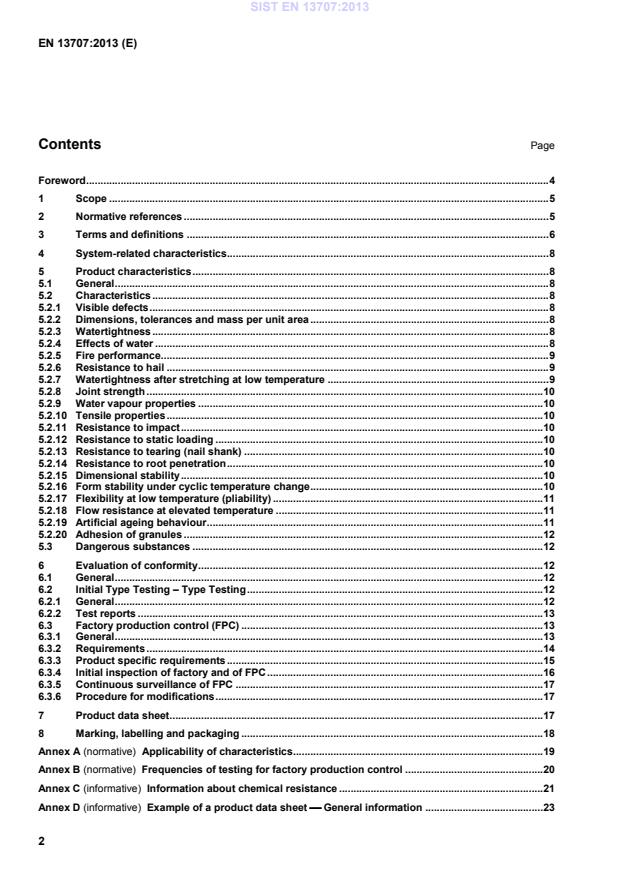
Page Foreword . 4 1 Scope . 5 2 Normative references . 5 3 Terms and definitions . 6 4 System-related characteristics . 8 5 Product characteristics . 8 5.1 General . 8 5.2 Characteristics . 8 5.2.1 Visible defects . 8 5.2.2 Dimensions, tolerances and mass per unit area . 8 5.2.3 Watertightness . 8 5.2.4 Effects of water . 8 5.2.5 Fire performance. 9 5.2.6 Resistance to hail . 9 5.2.7 Watertightness after stretching at low temperature . 9 5.2.8 Joint strength . 10 5.2.9 Water vapour properties . 10 5.2.10 Tensile properties . 10 5.2.11 Resistance to impact . 10 5.2.12 Resistance to static loading . 10 5.2.13 Resistance to tearing (nail shank) . 10 5.2.14 Resistance to root penetration . 10 5.2.15 Dimensional stability . 10 5.2.16 Form stability under cyclic temperature change . 10 5.2.17 Flexibility at low temperature (pliability) . 11 5.2.18 Flow resistance at elevated temperature . 11 5.2.19 Artificial ageing behaviour . 11 5.2.20 Adhesion of granules . 12 5.3 Dangerous substances . 12 6 Evaluation of conformity . 12 6.1 General . 12 6.2 Initial Type Testing – Type Testing . 12 6.2.1 General . 12 6.2.2 Test reports . 13 6.3 Factory production control (FPC) . 13 6.3.1 General . 13 6.3.2 Requirements . 14 6.3.3 Product specific requirements . 15 6.3.4 Initial inspection of factory and of FPC . 16 6.3.5 Continuous surveillance of FPC . 17 6.3.6 Procedure for modifications . 17 7 Product data sheet. 17 8 Marking, labelling and packaging . 18 Annex A (normative)
Applicability of characteristics . 19 Annex B (normative)
Frequencies of testing for factory production control . 20 Annex C (informative)
Information about chemical resistance . 21 Annex D (informative)
Example of a product data sheet General information . 23 SIST EN 13707:2013
Wind-uplift properties of mechanically fixed bituminous membranes General information . 25 Annex ZA (informative)
Clauses of this European Standard addressing essential requirements or other provisions of EU Directives . 26 ZA.1 Scope and relevant characteristics . 26 ZA.2 Procedure for attestation of conformity of the bitumen sheets . 28 ZA.2.1 Systems of attestation of conformity . 28 ZA.2.2 EC Certificate and Declaration of conformity . 34 ZA.3 CE marking and labelling. 36 Bibliography . 39
This European Standard specifies definitions and characteristics for flexible reinforced bitumen sheets for which the intended use is roofing. This covers sheets used as top layers, intermediate layers and underlayers. It does not cover reinforced bitumen sheets for waterproofing used as underlays for discontinuous roofing. This European Standard does not cover waterproofing sheets which are intended to be used fully bonded under bituminous products (e.g. asphalt) directly applied at high temperature, specified by EN 14695. 2 Normative references The following documents, in whole or in part, are normatively referenced in this document and are indispensable for its application. For dated references, only the edition cited applies. For undated references, the latest edition of the referenced document (including any amendments) applies. EN 1107-1, Flexible sheets for waterproofing — Part 1: Bitumen sheets for roof waterproofing — Determination of dimensional stability EN 1108, Flexible sheets for waterproofing — Bitumen sheets for roof waterproofing — Determination of form stability under cyclical temperature changes EN 1109, Flexible sheets for waterproofing — Bitumen sheets for roof waterproofing — Determination of flexibility at low temperature EN 1110, Flexible sheets for waterproofing — Bitumen sheets for roof waterproofing — Determination of flow resistance at elevated temperature EN 1296, Flexible sheets for waterproofing — Bitumen, plastic and rubber sheets for roofing — Method of artificial ageing by long term exposure to elevated temperature EN 1297, Flexible sheets for waterproofing — Bitumen, plastic and rubber sheets for roof waterproofing — Method of artificial ageing by long term exposure to the combination of UV radiation, elevated temperature and water EN 1848-1, Flexible sheets for waterproofing — Determination of length, width and straightness — Part 1: Bitumen sheets for roof waterproofing EN 1849-1, Flexible sheets for waterproofing — Determination of thickness and mass per unit area — Part 1: Bitumen sheets for roof waterproofing EN 1850-1, Flexible sheets for waterproofing — Determination of visible defects — Part 1: Bitumen sheets for roof waterproofing EN 1928:2000, Flexible sheets for waterproofing — Bitumen, plastic and rubber sheets for roof waterproofing — Determination of watertightness EN 12039, Flexible sheets for waterproofing — Bitumen sheets for roof waterproofing — Determination of adhesion of granules EN 12310-1, Flexible sheets for waterproofing — Part 1: Bitumen sheets for waterproofing — Determination of resistance to tearing (nail shank) EN 12311-1, Flexible sheets for waterproofing — Part 1: Bitumen sheets for roof waterproofing — Determination of tensile properties EN 12316-1, Flexible sheets for waterproofing — Part 1: Bitumen sheets for roof waterproofing — Determination of peel resistance of joints SIST EN 13707:2013
amount of product manufactured to the same specification within a maximum period of 24 h 3.9 manufacturer's limiting value
MLV value which is stated by the manufacturer to be met during testing and which can be a minimum or a maximum value according to statements made under product characteristics of this document 3.10 manufacturer's declared value
MDV value declared by the manufacturer accompanied by a declared tolerance 3.11 reinforced bitumen sheet factory made flexible layer of bitumen with internal or external incorporation of one or more carriers, supplied in roll form ready for use 3.12 oxidised bitumen straight run petroleum bitumen or a fluxed bitumen which has been hardened and rendered less temperature susceptible by blowing with air at high temperature with or without the use of a catalyst 3.13 elastomeric bitumen petroleum bitumen and/or oxidised bitumen modified by the addition of thermo-plastic rubbers 3.14 plastomeric bitumen petroleum bitumen and/or oxidised bitumen modified by the addition of polyolefin or polyolefin copolymer compound 3.15 sampling procedure used to select or constitute a sample 3.16 sample sheet from which a test piece is taken 3.17 test piece part of the sample from which test specimens are taken SIST EN 13707:2013
5.2.5.2 Reaction to fire Where required, the product shall be tested and classified in accordance with EN 13501-1:2007+A1:2009, Table 1. When tested according to EN ISO 11925-2, the products shall be tested under conditions of surface flame attack. NOTE It is currently considered that the Euroclasses Classification system at Classes D and above requires investigation to determine its appropriateness to the products covered by this document (the SBI test may be inappropriate for products covered by the standard). Pending results of such an investigation and discussions in the Fire Regulators Group, products covered by this document are tested to EN ISO 11925-2. If and when a new fire test scenario and test method are developed for the products, this document will be amended to refer to them.
Reaction to fire is by definition a product test, as distinct from Resistance to fire, which is a system test. Therefore, it is considered important to provide guidance in order to reduce the number of tests required. According to EN ISO 11925-2, the test is required to be undertaken on the exposed surface without any substrate, in one direction only, and the reinforcement has to be stated by the manufacturer as “organic” or “inorganic”. a) Test results from EN ISO 11925-2 for a product with a given reinforcement and a bituminous compound having a certain percentage of organic content shall apply to the same product having a lower organic content. b) Test results from EN ISO 11925-2 for a product with a given organic reinforcement and a bituminous compound shall apply to a product having the same bituminous compound and an inorganic reinforcement. c) Test results from EN ISO 11925-2 for a product with a given reinforcement and bituminous compound, with a thickness of above 2 mm or a mass per unit area of above 2 kg/m², shall apply to any product with the same type of reinforcement and the same type of bituminous compound but lower thickness or mass per unit area, down to a limit of 2 mm or 2 kg/m² respectively. d) Test results from EN ISO 11925-2 for a product with a given reinforcement and bituminous compound with a thickness or mass per unit area below 2 mm or 2kg/m², shall apply to any product with the same type of reinforcement and the same type of bituminous compound but with higher thickness or mass per unit area, up to a limit of 2 mm or 2 kg/m² respectively. 5.2.6 Resistance to hail Not specified. NOTE Experience has shown that hail has little or no effect upon the in-service performance of reinforced bitumen sheets. 5.2.7 Watertightness after stretching at low temperature Where required, the watertightness after stretching at low temperature shall only be determined for mechanically fastened single layer applications in accordance with EN 13897 and the results shall be greater than or equal to the manufacturer's limiting value. SIST EN 13707:2013
The method(s) used shall be stated in the product data sheet. 5.2.12 Resistance to static loading The resistance to static loading shall be determined in accordance with EN 12730:2001, method A and shall be greater than or equal to the manufacturer's limiting value. 5.2.13 Resistance to tearing (nail shank) The resistance to tearing (nail shank) shall be determined in accordance with EN 12310-1 and the results shall lie within the declared tolerance of the manufacturer's declared value. 5.2.14 Resistance to root penetration The resistance to root penetration shall be determined only for products used as root barriers in roof gardens in accordance with EN 13948 and shall give a pass result. 5.2.15 Dimensional stability The dimensional stability shall be determined in accordance with EN 1107-1 and shall be less than or equal to the manufacturer's limiting value. This test shall only be carried out on sheets containing organic fibres or synthetic fibres (e.g. jute, hessian, polyester, polyolefines). 5.2.16 Form stability under cyclic temperature change The form stability under cyclic temperature change shall be determined only for sheets with metal foil surfacing in accordance with EN 1108 and shall be less than or equal to the manufacturer's limiting value. SIST EN 13707:2013
If the upper surface is covered with a non-woven (e.g. tissue, fleece, etc.) or metal facing, the test shall be performed on the bottom side only. If the sheet on the upper surface is covered with permanent light surface protection and where the reinforcement is placed in the cross section visually closer to the upper surface, the test shall be performed on the bottom side only. 5.2.18 Flow resistance at elevated temperature The flow resistance at elevated temperature shall be determined in accordance with EN 1110 and shall be greater than or equal to the manufacturer's limiting value. 5.2.19 Artificial ageing behaviour 5.2.19.1 Top layers and single layers with permanent light surface protection In order to verify the artificial ageing behaviour of the product, characteristics shall be determined before and after exposure in accordance with EN 1296 for a period of 12 weeks. The relevant characteristics are the flexibility at low temperature or the flow resistance at elevated temperature. The flexibility at low temperature shall be determined in accordance with EN 1109 (see 5.2.17) and the results shall lie within the declared tolerance of the manufacturer’s declared value. The flow resistance at elevated temperature shall be determined in accordance with EN 1110 (see 5.2.18) and the results shall lie within the declared tolerance of the manufacturer’s declared value. The purpose of testing in accordance with EN 1296 is to characterise the long-term thermal stability of elastomeric or plastomeric bitumen. The test does not give results corresponding to the service conditions in practice. Results should only be used to compare products of similar thickness, construction and composition, and they cannot be used for general durability classification. The chosen exposure duration for artificial ageing in accordance to EN 1296 has no relevance to a real product lifetime. NOTE When reinforced oxidised bitumen roofing sheets are tested as described in this sub-clause, they become brittle and have poor low temperature flexibility. However, experience shows that when they are reinforced and protected properly, they perform satisfactorily in the long term. 5.2.19.2 Top layers and single layers without surface protection Materials used as top layers without permanent surface protection (e.g. mineral granules, metal foil, gravel or any additional protection) shall be tested in addition with EN 1296 according to 5.2.19.1 by the method for artificial ageing by long-term exposure to the combination of UV radiation, elevated temperature and water in accordance with EN 1297 for a period of 1 000 h UV exposure and evaluated for visual defects in accordance with EN 1850-1. 5.2.19.3 Top layers with permanent heavy surface protection, underlayers and intermediate layers Top layers with permanent heavy surface protection (e.g. with loose-fill gravel), underlayers and intermediate layers are not subject to testing of artificial ageing behaviour. SIST EN 13707:2013
The manufacturer shall establish procedures to ensure that the stated values of the characteristics he declares are maintained. The characteristics and the means of control are given in Table B.1. 6.3.2.7 Non-complying products The manufacturer shall have written procedures which specify how non-complying products shall be dealt with. Any such events shall be recorded as they occur and these records shall be kept for the period defined in the manufacturer’s written procedures. 6.3.2.8 Corrective action The manufacturer shall have documented procedures that instigate action to eliminate the cause of non-conformities in order to prevent recurrence.
6.3.2.9 Handling, storage and packaging The manufacturer shall have procedures providing methods of product handling and shall provide suitable storage areas preventing damage or deterioration. 6.3.3 Product specific requirements The FPC system shall: address this European Standard and ensure that the products placed on the market comply with the declared performance characteristics. SIST EN 13707:2013
...