

SIST EN ISO 28017:2026
(Main)Rubber hoses and hose assemblies, wire or textile reinforced, for dredging applications - Specification (ISO 28017:2026)
General Information
- Abstract
This document specifies requirements for two types, seven classes and three grades of wire- or textile-reinforced dredging hoses with nominal sizes ranging from 100 to 1 300. Such hoses are suitable for the delivery or suction of seawater or freshwater mixed with silt, sand, coral and small stones with a specific gravity in the range from 1,0 to 2,3 at ambient temperature ranging from -10 °C to +40 °C or for low-temperature hoses (designated -LT) ranging from -20 °C to +40 °C.
This document covers two types of hose, as follows:
type 1: floating type, for delivery only, which includes flotation material to give the hose buoyancy;
type 2: submarine type for delivery and suction.
- Status
- Published
- Public Enquiry End Date
- 20-Apr-2025
- Publication Date
- 08-Apr-2026
- Technical Committee
- IPMA - Polimer materials and products
- Current Stage
- 6060 - National Implementation/Publication (Adopted Project)
- Start Date
- 27-Mar-2026
- Due Date
- 01-Jun-2026
- Completion Date
- 09-Apr-2026

Overview
SIST EN ISO 28017:2026 sets out the specifications for rubber hoses and hose assemblies, either wire- or textile-reinforced, for use in dredging applications. Developed by CEN in cooperation with ISO, this international standard covers hoses with nominal sizes from 100 to 1,300 mm. The hoses are designed for transporting seawater or freshwater mixed with silt, sand, coral, and small stones, with a specific gravity from 1.0 to 2.3, at temperatures between -10°C and +40°C or -20°C to +40°C for low-temperature variants. SIST EN ISO 28017:2026 ensures safety, reliability, and product compatibility for floating and submarine dredging hoses.
Key Topics
Scope and Classification
- Two primary types:
- Type 1 (Floating Hoses): Equipped with flotation material for delivery applications where buoyancy is necessary.
- Type 2 (Submarine Hoses): Designed for both delivery and suction, suitable for submerged use.
- Seven classes defined by maximum working pressure (from 5 to 40 bar).
- Type 2 hoses further categorized by grades based on reinforcing helical wires, enhancing structural integrity for demanding dredging tasks.
- Two primary types:
Performance and Material Requirements
- Specifies physical and mechanical properties for abrasion resistance, tear strength, ozone resistance, and temperature brittleness.
- Details hydrostatic performance, change in length under pressure, bending radius, adhesion between components, and minimum tensile strength.
- Outlines requirements for the construction of linings, reinforcement, covers, and flotation materials to ensure robustness in harsh environments.
Testing, Marking, and Documentation
- Prescribes type and routine testing for quality assurance, including hydrostatic, bending, vacuum resistance, and flotation recovery.
- Requirements for clear marking of hoses with type, size, pressure rating, temperature class, and manufacturing information.
- Mandates the provision of test certificates or reports upon request.
Applications
SIST EN ISO 28017:2026 is vital for sectors that rely on the safe and efficient movement of slurry and aggregate materials via rubber hoses in dredging operations. Typical applications include:
- Dredging of Harbors, Rivers, and Waterways: Ensuring the safe transit of sediment-laden water for maintenance and expansion of navigable channels.
- Land Reclamation Projects: Transferring sand and sediments from dredged areas to land reclamation sites.
- Mining and Aggregate Handling: Moving abrasive mixtures in mining, quarries, or similar industries.
- Environmental Remediation: Removing contaminated sediments from water bodies.
- Infrastructure Construction: Supporting foundation work where underwater material transport is necessary.
By adhering to SIST EN ISO 28017:2026, producers, specifiers, and users ensure hose assemblies offer proven performance, safety, and interoperability in demanding marine and industrial environments.
Related Standards
- ISO 1402 - Hydrostatic testing of rubber and plastics hoses
- ISO 4649 - Determination of abrasion resistance for rubber
- ISO 812 - Low-temperature brittleness of rubber materials
- ISO 1431-1 - Ozone cracking resistance testing for rubber hoses
- ISO 8033 - Adhesion testing between hose components
- ISO 7233 - Vacuum resistance testing for hoses
- ISO 8330 - Vocabulary for rubber and plastics hoses and assemblies
- ISO 4671 - Dimensional measurement of hoses and assemblies
- EN ISO 28017:2018 - Previous version, superseded by this standard
Implementing SIST EN ISO 28017:2026 enhances operational safety, ensures regulatory compliance, and promotes consistent quality in dredging hose manufacturing and usage worldwide.
Relations
- Effective Date
- 01-May-2024
Get Certified
Connect with accredited certification bodies for this standard

DIN CERTCO
DIN Group product certification.

Smithers Quality Assessments
US management systems and product certification.
Sponsored listings
Frequently Asked Questions
SIST EN ISO 28017:2026 is a standard published by the Slovenian Institute for Standardization (SIST). Its full title is "Rubber hoses and hose assemblies, wire or textile reinforced, for dredging applications - Specification (ISO 28017:2026)". This standard covers: This document specifies requirements for two types, seven classes and three grades of wire- or textile-reinforced dredging hoses with nominal sizes ranging from 100 to 1 300. Such hoses are suitable for the delivery or suction of seawater or freshwater mixed with silt, sand, coral and small stones with a specific gravity in the range from 1,0 to 2,3 at ambient temperature ranging from -10 °C to +40 °C or for low-temperature hoses (designated -LT) ranging from -20 °C to +40 °C. This document covers two types of hose, as follows: type 1: floating type, for delivery only, which includes flotation material to give the hose buoyancy; type 2: submarine type for delivery and suction.
This document specifies requirements for two types, seven classes and three grades of wire- or textile-reinforced dredging hoses with nominal sizes ranging from 100 to 1 300. Such hoses are suitable for the delivery or suction of seawater or freshwater mixed with silt, sand, coral and small stones with a specific gravity in the range from 1,0 to 2,3 at ambient temperature ranging from -10 °C to +40 °C or for low-temperature hoses (designated -LT) ranging from -20 °C to +40 °C. This document covers two types of hose, as follows: type 1: floating type, for delivery only, which includes flotation material to give the hose buoyancy; type 2: submarine type for delivery and suction.
SIST EN ISO 28017:2026 is classified under the following ICS (International Classification for Standards) categories: 53.100 - Earth-moving machinery; 83.140.40 - Hoses. The ICS classification helps identify the subject area and facilitates finding related standards.
SIST EN ISO 28017:2026 has the following relationships with other standards: It is inter standard links to SIST EN ISO 28017:2018. Understanding these relationships helps ensure you are using the most current and applicable version of the standard.
SIST EN ISO 28017:2026 is available in PDF format for immediate download after purchase. The document can be added to your cart and obtained through the secure checkout process. Digital delivery ensures instant access to the complete standard document.
Standards Content (Sample)
SLOVENSKI STANDARD
01-maj-2026
Gumene cevi in cevni priključki, ojačeni z žicami ali tekstilom, za uporabo v
vodnem bagru - Specifikacija (ISO 28017:2026)
Rubber hoses and hose assemblies, wire or textile reinforced, for dredging applications -
Specification (ISO 28017:2026)
Gummischläuche und Schlauchleitungen, draht- oder textilverstärkt für
Nassbaggeranwendungen - Anforderung (ISO 28017:2026)
Tuyaux et flexibles en caoutchouc, à armature textile ou métallique, pour des
applications de dragage - Spécifications (ISO 28017:2026)
Ta slovenski standard je istoveten z: EN ISO 28017:2026
ICS:
53.100 Stroji za zemeljska dela Earth-moving machinery
83.140.40 Gumene cevi Hoses
2003-01.Slovenski inštitut za standardizacijo. Razmnoževanje celote ali delov tega standarda ni dovoljeno.
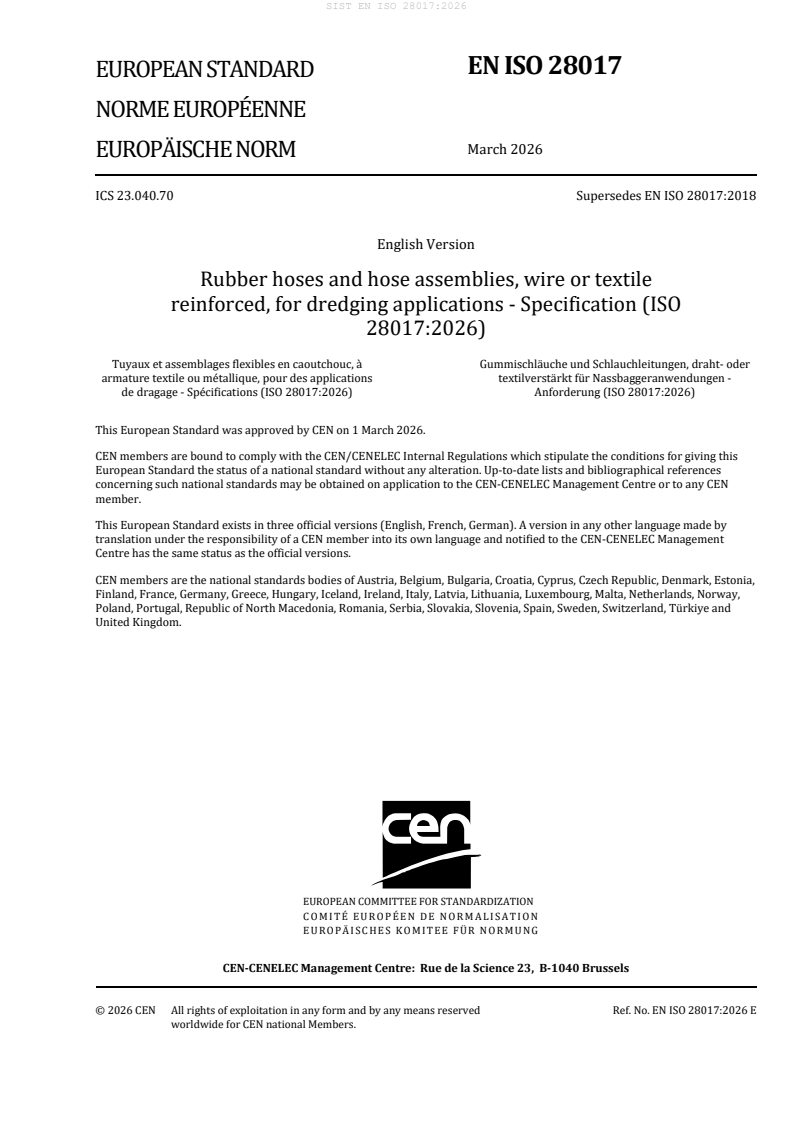
EN ISO 28017
EUROPEAN STANDARD
NORME EUROPÉENNE
March 2026
EUROPÄISCHE NORM
ICS 23.040.70 Supersedes EN ISO 28017:2018
English Version
Rubber hoses and hose assemblies, wire or textile
reinforced, for dredging applications - Specification (ISO
28017:2026)
Tuyaux et assemblages flexibles en caoutchouc, à Gummischläuche und Schlauchleitungen, draht- oder
armature textile ou métallique, pour des applications textilverstärkt für Nassbaggeranwendungen -
de dragage - Spécifications (ISO 28017:2026) Anforderung (ISO 28017:2026)
This European Standard was approved by CEN on 1 March 2026.
CEN members are bound to comply with the CEN/CENELEC Internal Regulations which stipulate the conditions for giving this
European Standard the status of a national standard without any alteration. Up-to-date lists and bibliographical references
concerning such national standards may be obtained on application to the CEN-CENELEC Management Centre or to any CEN
member.
This European Standard exists in three official versions (English, French, German). A version in any other language made by
translation under the responsibility of a CEN member into its own language and notified to the CEN-CENELEC Management
Centre has the same status as the official versions.
CEN members are the national standards bodies of Austria, Belgium, Bulgaria, Croatia, Cyprus, Czech Republic, Denmark, Estonia,
Finland, France, Germany, Greece, Hungary, Iceland, Ireland, Italy, Latvia, Lithuania, Luxembourg, Malta, Netherlands, Norway,
Poland, Portugal, Republic of North Macedonia, Romania, Serbia, Slovakia, Slovenia, Spain, Sweden, Switzerland, Türkiye and
United Kingdom.
EUROPEAN COMMITTEE FOR STANDARDIZATION
COMITÉ EUROPÉEN DE NORMALISATION
EUROPÄISCHES KOMITEE FÜR NORMUNG
CEN-CENELEC Management Centre: Rue de la Science 23, B-1040 Brussels
© 2026 CEN All rights of exploitation in any form and by any means reserved Ref. No. EN ISO 28017:2026 E
worldwide for CEN national Members.
Contents Page
European foreword . 3
European foreword
This document (EN ISO 28017:2026) has been prepared by Technical Committee ISO/TC 45 "Rubber
and rubber products" in collaboration with Technical Committee CEN/TC 218 “Rubber and plastics
hoses and hose assemblies” the secretariat of which is held by BSI.
This European Standard shall be given the status of a national standard, either by publication of an
identical text or by endorsement, at the latest by September 2026, and conflicting national standards
shall be withdrawn at the latest by September 2026.
Attention is drawn to the possibility that some of the elements of this document may be the subject of
patent rights. CEN shall not be held responsible for identifying any or all such patent rights.
This document supersedes EN ISO 28017:2018.
Any feedback and questions on this document should be directed to the users’ national standards
body/national committee. A complete listing of these bodies can be found on the CEN website.
According to the CEN-CENELEC Internal Regulations, the national standards organizations of the
following countries are bound to implement this European Standard: Austria, Belgium, Bulgaria,
Croatia, Cyprus, Czech Republic, Denmark, Estonia, Finland, France, Germany, Greece, Hungary, Iceland,
Ireland, Italy, Latvia, Lithuania, Luxembourg, Malta, Netherlands, Norway, Poland, Portugal, Republic of
North Macedonia, Romania, Serbia, Slovakia, Slovenia, Spain, Sweden, Switzerland, Türkiye and the
United Kingdom.
Endorsement notice
The text of ISO 28017:2026 has been approved by CEN as EN ISO 28017:2026 without any modification.
International
Standard
ISO 28017
Fourth edition
Rubber hoses and hose assemblies,
2026-02
wire or textile reinforced,
for dredging applications —
Specification
Tuyaux et assemblages flexibles en caoutchouc, à armature textile
ou métallique, pour des applications de dragage — Spécifications
Reference number
ISO 28017:2026(en) © ISO 2026
ISO 28017:2026(en)
© ISO 2026
All rights reserved. Unless otherwise specified, or required in the context of its implementation, no part of this publication may
be reproduced or utilized otherwise in any form or by any means, electronic or mechanical, including photocopying, or posting on
the internet or an intranet, without prior written permission. Permission can be requested from either ISO at the address below
or ISO’s member body in the country of the requester.
ISO copyright office
CP 401 • Ch. de Blandonnet 8
CH-1214 Vernier, Geneva
Phone: +41 22 749 01 11
Email: copyright@iso.org
Website: www.iso.org
Published in Switzerland
ii
ISO 28017:2026(en)
Contents Page
Foreword .iv
1 Scope . 1
2 Normative references . 1
3 Terms and definitions . 1
4 Classification . 2
4.1 Classes .2
4.2 Grades .2
5 Materials and construction . 3
5.1 Hoses .3
5.2 Flotation material .4
5.3 End fittings and end connections .4
6 Dimension and tolerances . 5
6.1 Diameters .5
6.2 Hose assembly length .5
7 Physical properties . 5
7.1 Rubber compounds .5
7.2 Performance requirements .6
7.2.1 Hydrostatic requirements .6
7.2.2 Change in length .7
7.2.3 Bending test .7
7.2.4 Leakage of hose assemblies (proof pressure test) .8
7.2.5 Minimum reserve buoyancy .8
7.2.6 Flotation material recovery .8
7.2.7 Adhesion between components .9
7.2.8 Adhesion between end fitting and lining .9
7.2.9 Minimum tensile strength of empty hose assemblies . .9
7.2.10 Vacuum resistance .9
7.2.11 Dimensions of flange and other connections .9
7.2.12 Visual examination .9
7.3 Frequency of testing .9
8 Test certificate or report . 10
9 Marking . .10
10 Recommendations for packaging and storage . 10
Annex A (normative) Type tests and routine tests .11
Annex B (normative) Measurement of adhesion between end fitting and lining.13
Annex C (normative) Hose assembly tensile-strength test .16
Bibliography .18
iii
ISO 28017:2026(en)
Foreword
ISO (the International Organization for Standardization) is a worldwide federation of national standards
bodies (ISO member bodies). The work of preparing International Standards is normally carried out through
ISO technical committees. Each member body interested in a subject for which a technical committee
has been established has the right to be represented on that committee. International organizations,
governmental and non-governmental, in liaison with ISO, also take part in the work. ISO collaborates closely
with the International Electrotechnical Commission (IEC) on all matters of electrotechnical standardization.
The procedures used to develop this document and those intended for its further maintenance are described
in the ISO/IEC Directives, Part 1. In particular, the different approval criteria needed for the different types
of ISO document should be noted. This document was drafted in accordance with the editorial rules of the
ISO/IEC Directives, Part 2 (see www.iso.org/directives).
ISO draws attention to the possibility that the implementation of this document may involve the use of (a)
patent(s). ISO takes no position concerning the evidence, validity or applicability of any claimed patent
rights in respect thereof. As of the date of publication of this document, ISO had not received notice of (a)
patent(s) which may be required to implement this document. However, implementers are cautioned that
this may not represent the latest information, which may be obtained from the patent database available at
www.iso.org/patents. ISO shall not be held responsible for identifying any or all such patent rights.
Any trade name used in this document is information given for the convenience of users and does not
constitute an endorsement.
For an explanation of the voluntary nature of standards, the meaning of ISO specific terms and expressions
related to conformity assessment, as well as information about ISO's adherence to the World Trade
Organization (WTO) principles in the Technical Barriers to Trade (TBT), see www.iso.org/iso/foreword.html.
This document was prepared by Technical Committee ISO/TC 45, Rubber and rubber products, Subcommittee
SC 1, Rubber and plastics hoses and hose assemblies, in collaboration with the European Committee for
Standardization (CEN) Technical Committee CEN/TC 218, Rubber and plastics hoses and hose assemblies, in
accordance with the Agreement on technical cooperation between ISO and CEN (Vienna Agreement).
This fourth edition cancels and replaces the third edition (ISO 28017:2018), which has been technically
revised.
The main changes are as follows:
— revision of the ambient temperature range in Clause 1;
— addition of a nominal size of 1 300 in Table 1;
— addition of requirements for low-temperature brittleness in Table 6.
Any feedback or questions on this document should be directed to the user’s national standards body. A
complete listing of these bodies can be found at www.iso.org/members.html.
iv
International Standard ISO 28017:2026(en)
Rubber hoses and hose assemblies, wire or textile reinforced,
for dredging applications — Specification
1 Scope
This document specifies requirements for two types, seven classes and three grades of wire- or textile-
reinforced dredging hoses with nominal sizes ranging from 100 to 1 300. Such hoses are suitable for the
delivery or suction of seawater or freshwater mixed with silt, sand, coral and small stones with a specific
gravity in the range from 1,0 to 2,3 at ambient temperature ranging from -10 °C to +40 °C or for low-
temperature hoses (designated -LT) ranging from -20 °C to +40 °C.
This document covers two types of hose, as follows:
— type 1: floating type, for delivery only, which includes flotation material to give the hose buoyancy;
— type 2: submarine type for delivery and suction.
2 Normative references
The following documents are referred to in the text in such a way that some or all of their content constitutes
requirements of this document. For dated references, only the edition cited applies. For undated references,
the latest edition of the referenced document (including any amendments) applies.
ISO 34-2:2022, Rubber, vulcanized or thermoplastic — Determination of tear strength — Part 2: Small (Delft)
test pieces
ISO 812:2017, Rubber, vulcanized or thermoplastic — Determination of low-temperature brittleness
ISO 1402, Rubber and plastics hoses and hose assemblies — Hydrostatic testing
ISO 1431-1, Rubber, vulcanized or thermoplastic — Resistance to ozone cracking — Part 1: Static and dynamic
strain testing
ISO 4649:2024, Rubber, vulcanized or thermoplastic — Determination of abrasion resistance using a rotating
cylindrical drum device
ISO 4662, Rubber, vulcanized or thermoplastic — Determination of rebound resilience
ISO 4671, Rubber and plastics hoses and hose assemblies — Methods of measurement of the dimensions of hoses
and the lengths of hose assemblies
ISO 7233:2021, Rubber and plastics hoses and hose assemblies — Determination of resistance to vacuum
ISO 8033:2016, Rubber and plastics hoses — Determination of adhesion between components
ISO 8330, Rubber and plastics hoses and hose assemblies — Vocabulary
ISO 10619-1, Rubber and plastics hoses and tubing — Measurement of flexibility and stiffness — Part 1: Bending
tests at ambient temperature
3 Terms and definitions
For the purposes of this document, the terms and definitions given in ISO 8330 apply.
ISO and IEC maintain terminology databases for use in standardization at the following addresses:
ISO 28017:2026(en)
— ISO Online browsing platform: available at https://www.iso.org/obp
— IEC Electropedia: available at https://www.electropedia.org/
4 Classification
4.1 Classes
Seven classes of hose are specified, distinguished by their maximum working pressure, of nominal sizes
from 100 to 1 300, as shown in Table 1.
Table 1 — Classes and corresponding maximum working pressures and nominal sizes
Class
5 10 15 20 25 30 40
Maximum working pressure, MWP
Nominal size bar
5 10 15 20 25 30 40
MPa
0,5 1,0 1,5 2,0 2,5 3,0 4,0
100 X X X X X X X
150 X X X X X X X
200 X X X X X X X
250 X X X X X X N/A
300 X X X X X X N/A
350 X X X X X X N/A
400 X X X X X X N/A
450 X X X X X X N/A
500 X X X X X X N/A
550 X X X X X X N/A
600 X X X X X X N/A
650 X X X X X X N/A
700 X X X X X X N/A
750 X X X X X X N/A
800 X X X X X X N/A
850 X X X X X X N/A
900 X X X X X X N/A
1 000 X X X X X X N/A
1 100 X X X X X X N/A
1 200 X X X X X N/A N/A
1 300 X X X X N/A N/A N/A
X: Applicable
N/A: Not applicable
4.2 Grades
Type 2 hoses are classified into three grades, A, B and C, according to their construction (number of
reinforcing helical wires), as shown in Table 2.
Type 1 hoses are not divided into grades.
ISO 28017:2026(en)
Table 2 — Grades
Construction and purpose
Type Grade
Number of reinforcing
Purpose
wires
1 N/A 0 Delivery only
A 2 Delivery or suction
2 B 1 Delivery or suction
C 0 Delivery only
The types and grades available in each class (i.e. for each maximum working pressure) are as shown in
Table 3.
Table 3 — Types and grades available in each class
Class
5 10 15 20 25 30 40
Maximum working pressure, MWP
Type Grade bar
5 10 15 20 25 30 40
MPa
0,5 1,0 1,5 2,0 2,5 3,0 4,0
1 N/A X X X X X X X
A X X X N/A N/A N/A N/A
2 B X X X N/A N/A N/A N/A
C X X X X X X X
X: Applicable
N/A: Not applicable
5 Materials and construction
5.1 Hoses
Type 1 hose assemblies shall consist of the following:
a) an abrasion-resistant rubber lining;
b) one or more layers of steel or textile reinforcement;
c) a textile-reinforced rubber undercover;
d) a flexible closed-cell flotation material integrally fitted round the hose body as specified in 5.2;
e) an abrasion- and weather-resistant rubber or thermoplastic outer cover (which, in the case of a rubber
cover, can include one or two textile breaker layers);
f) end fittings as specified in 5.3 on both ends.
Type 2 hose assemblies shall consist of the following:
1) an abrasion-resistant rubber lining;
2) one or more layers of steel or textile reinforcement;
3) a textile-reinforced rubber;
ISO 28017:2026(en)
4) a rubber or thermoplastic cover;
5) end fittings as specified in 5.3 on both ends.
The thickness of the lining or cover shall be measured in accordance with the most appropriate method in
ISO 4671. The thickness of both shall be not less than the values given in Table 4.
Table 4 — Minimum thickness of the lining and cover
Lining thickness Cover thickness
Nominal size
mm mm
150 8
12 10
1 000
1 100 12
1 200
1 300
5.2 Flotation material
The closed-cell flotation material used in type 1 hose assemblies shall adhere firmly both to the hose body
and to the outer cover so that it cannot move or tend to become detached in service. At the ends of the hose,
a space shall be provided to facilitate the insertion of connection bolts and to allow the use of mechanical
tools for tightening nuts on the bolts. The flotation material shall be distributed over the whole length of the
hose assembly in such a manner that the hose assembly floats evenly when connected to other assemblies in
a string. This does not apply to hose assemblies for special applications (e.g. the end of a string, tapered hose,
etc.).
5.3 End fittings and end connections
End fittings shall be mechanically and chemically bonded to the hose body. With hoses intended for delivery
use only, clamped-on and swaged-on nipples are not acceptable, but such nipples may be utilized with hoses
intended for suction use. Alternatively, flanged end connections built up of hose reinforcement, lining and
cover material are acceptable provided they are additionally reinforced by steel stiffening rings to avoid
distortion when the connection bolts are tightened. All hose assemblies shall be fitted with either end
fittings or flanged end connections unless otherwise required by the end user.
ISO 28017:2026(en)
6 Dimension and tolerances
6.1 Diameters
The inside and outside diameter shall be measured in accordance with the most appropriate method in ISO
4671.
The inside diameter of hoses shall conform to the values given in Table 5.
The outside diameter of hoses shall conform to the values specified by the customer.
NOTE For hoses manufactured on mandrels with diameters in inches, the tolerances on the inside diameter are
the same as the closest inside diameter in metric units in Table 5.
Table 5 — Inside diameter and tolerance
Inside diameter Tolerance
Nominal size
mm
mm
100 100,0
150 150,0 ±3
200 200,0
250 250,0
±4
300 300,0
350 350,0
400 400,0
450 450,0
500 500,0
550 550,0 ±5
600 600,0
650 650,0
700 700,0
750 750,0
800 800,0
850 850,0
±6
900 900,0
1 000 1 000,0
1 100 1 100,0
1 200 1 200,0 ±7
1 300 1 300,0
6.2 Hose assembly length
The hose assembly length shall be determined according to the conditions of use. Unless otherwise agreed
between the customer and the manufacturer, the tolerances on the measured length hose assembly shall be
±2 %.
7 Physical properties
7.1 Rubber compounds
7.1.1 When determined by the methods listed in Table 6, the physical properties of the compounds used
for the lining and cover shall conform to the values specified in Table 6.
...