

oSIST prEN 303-2:2023
(Main)Heating boilers - Part 2: Heating boilers with forced draught burners - Special requirements for boilers with atomizing oil burners
General Information
- Abstract
This document is applicable to boilers used for central heating in accordance with EN 303-1 up to a nominal heat output of 1 000 kW and EN 303-4 up to a nominal heat output of 70 kW with forced draught burners in accordance with EN 267 that are designed for operating with liquid fuels.
The performance requirements of this document apply to type testing to heating boilers (standard, low temperature and condensing boilers) which are tested on a test rig in accordance with the test code given in EN 304.
This document applies also to room sealed boilers as defined in EN 15035 regarding efficiency and emissions.
This document can also be used as the basis for evaluation of boiler-/burner units.
- Status
- Not Published
- Public Enquiry End Date
- 02-Apr-2023
- Technical Committee
- PLN - Gas appliances for domestic use
- Current Stage
- 4020 - Public enquire (PE) (Adopted Project)
- Start Date
- 19-Jan-2023
- Due Date
- 08-Jun-2023
- Completion Date
- 02-Jun-2023



Overview
The oSIST prEN 303-2:2023 standard outlines special requirements for heating boilers equipped with forced draught atomizing oil burners. Developed by CEN (European Committee for Standardization), this document updates and supersedes the previous EN 303-2:2017. It applies to boilers used for central heating with nominal heat outputs up to 1,000 kW for standard and condensing boilers, and up to 70 kW for room sealed boilers, designed specifically for operation with liquid fuels. The standard provides comprehensive performance, efficiency, emission, and testing requirements for forced draught burners in line with EN 267.
This document is essential for manufacturers, testers, and regulatory bodies to ensure boilers meet the latest energy efficiency, emissions, and safety expectations within the European market. It also supports eco-design and energy labelling regulations, enhancing sustainable heating solutions.
Key Topics
Scope and Applicability
Focuses on heating boilers with forced draught atomizing oil burners covering:- Nominal heat output: up to 1,000 kW (standard, low temperature, condensing boilers)
- Room sealed boilers per EN 15035 for emissions and efficiency
- Boilers operating on liquid fuels per EN 267 combustion systems.
Performance Requirements
Sets mandatory criteria such as:- Boiler efficiency thresholds based on Gross Calorific Value (GCV)
- ≤ 70 kW: Minimum 86% seasonal space heating efficiency
70 kW to 400 kW: Nominal output efficiency ≥ 86%, part load ≥ 94%
- 400 kW to 1,000 kW: Defined full and part load efficiencies per boiler type (standard, low temperature, condensing)
- Emission limits for pollutants like CO, NOx, unburnt hydrocarbons, and smoke number maximum of 1
- Draught and flue gas resistance specifications under load conditions
- Limits on standby heat loss and auxiliary electricity consumption
- Boiler efficiency thresholds based on Gross Calorific Value (GCV)
Testing Protocols
Requires type testing in compliance with EN 304 test codes and EN 267 burner standards, ensuring:- Accurate measurement of efficiency, emissions, and electrical consumption
- Use of test rigs for replicable and consistent evaluation
- Tests on multi-stage and modulating burners within their operational output ranges
Marking and Documentation
Boilers must include:- Clear instructions for disassembly, recycling, and disposal
- Detailed product data to support eco-design compliance and energy labelling requirements
- Annual energy consumption information, including space heating and water heating modes for combination boilers
Updated Annexes
Incorporates new informative annexes related to EU regulations on eco-design (813/2013) and energy labelling (811/2013) to ensure full regulatory compliance.
Applications
The oSIST prEN 303-2:2023 standard serves as a benchmark for manufacturers and testing authorities for:
Boiler Design and Manufacturing
Enables development of high-efficiency atomizing oil burner boilers that comply with strict emission and performance standards, improving energy savings and reducing environmental impact.Product Certification and Compliance
Supports conformity assessment necessary for CE marking and market access in European countries, ensuring boilers meet regulatory requirements.Heating System Installation and Operation
Guides installation practices regarding forced draught burner operation, air ratio settings, and flue gas management to optimize performance and emissions.Eco-Design and Energy Labelling
Provides technical bases for evaluating boilers under EU energy directives, promoting transparency and consumer information on energy consumption and environmental characteristics.Research and Development
Assists in testing new boiler technologies and burner configurations under standardized conditions to innovate more sustainable heating solutions.
Related Standards
- EN 303-1: Heating boilers with forced draught burners - Terminology, general requirements, testing, and marking.
- EN 303-4: Boilers with forced draught burners ≤ 70 kW - Special requirements for forced draught oil burners.
- EN 267: Forced draught burners for liquid fuels - Burner design and performance requirements.
- EN 304: Heating boilers test code specific to atomizing oil burners for standardized performance and emissions testing.
- EN 15036-1: Regulations for airborne noise emissions from heat generators.
- EN 303-3, EN 303-5, EN 303-6: Cover gas-fired boilers, solid fuel boilers, and domestic hot water operations respectively.
- EN 15316-4-1: Methodology for calculating system energy requirements and combustion system efficiencies in building heating.
For compliance with EU Eco-design Directive 813/2013 and Energy Labelling Regulation 811/2013, this standard incorporates essential definitions, testing methods, and product information requirements, making it indispensable for stakeholders in the heating boiler sector.
Keywords: heating boilers, forced draught burners, atomizing oil burners, boiler efficiency, emissions standards, central heating boilers, liquid fuel burners, boiler testing, EN 303-2, CEN standard, energy labeling, eco-design compliance, European heating regulations.
Relations
- Effective Date
- 01-Mar-2023
Get Certified
Connect with accredited certification bodies for this standard

DNV
DNV is an independent assurance and risk management provider.

Lloyd's Register
Lloyd's Register is a global professional services organisation specialising in engineering and technology.

DIBt (Deutsches Institut für Bautechnik)
German Institute for Building Technology.
Sponsored listings
Frequently Asked Questions
oSIST prEN 303-2:2023 is a draft published by the Slovenian Institute for Standardization (SIST). Its full title is "Heating boilers - Part 2: Heating boilers with forced draught burners - Special requirements for boilers with atomizing oil burners". This standard covers: This document is applicable to boilers used for central heating in accordance with EN 303-1 up to a nominal heat output of 1 000 kW and EN 303-4 up to a nominal heat output of 70 kW with forced draught burners in accordance with EN 267 that are designed for operating with liquid fuels. The performance requirements of this document apply to type testing to heating boilers (standard, low temperature and condensing boilers) which are tested on a test rig in accordance with the test code given in EN 304. This document applies also to room sealed boilers as defined in EN 15035 regarding efficiency and emissions. This document can also be used as the basis for evaluation of boiler-/burner units.
This document is applicable to boilers used for central heating in accordance with EN 303-1 up to a nominal heat output of 1 000 kW and EN 303-4 up to a nominal heat output of 70 kW with forced draught burners in accordance with EN 267 that are designed for operating with liquid fuels. The performance requirements of this document apply to type testing to heating boilers (standard, low temperature and condensing boilers) which are tested on a test rig in accordance with the test code given in EN 304. This document applies also to room sealed boilers as defined in EN 15035 regarding efficiency and emissions. This document can also be used as the basis for evaluation of boiler-/burner units.
oSIST prEN 303-2:2023 is classified under the following ICS (International Classification for Standards) categories: 27.060.10 - Liquid and solid fuel burners; 91.140.10 - Central heating systems; 97.100.40 - Liquid fuel heaters. The ICS classification helps identify the subject area and facilitates finding related standards.
oSIST prEN 303-2:2023 has the following relationships with other standards: It is inter standard links to SIST EN 303-2:2017. Understanding these relationships helps ensure you are using the most current and applicable version of the standard.
oSIST prEN 303-2:2023 is associated with the following European legislation: EU Directives/Regulations: 811/2013, 813/2013; Standardization Mandates: M/535. When a standard is cited in the Official Journal of the European Union, products manufactured in conformity with it benefit from a presumption of conformity with the essential requirements of the corresponding EU directive or regulation.
oSIST prEN 303-2:2023 is available in PDF format for immediate download after purchase. The document can be added to your cart and obtained through the secure checkout process. Digital delivery ensures instant access to the complete standard document.
Standards Content (Sample)
SLOVENSKI STANDARD
01-marec-2023
Kotli za ogrevanje - 2. del: Kotli za ogrevanje z ventilatorskimi gorilniki - Posebne
zahteve za kotle z razprševalnimi oljnimi gorilniki
Heating boilers - Part 2: Heating boilers with forced draught burners - Special
requirements for boilers with atomizing oil burners
Heizkessel - Heizkessel mit Gebläsebrennern - Teil 2: Spezielle Anforderungen an
Heizkessel mit Ölzerstäubungsbrennern
Chaudières de chauffage - Chaudières avec brûleurs à air soufflé - Partie 2 :
Prescriptions spéciales pour chaudières avec brûleurs fioul à pulvérisation
Ta slovenski standard je istoveten z: prEN 303-2
ICS:
27.060.10 Gorilniki na tekoče in trdo Liquid and solid fuel burners
gorivo
91.140.10 Sistemi centralnega Central heating systems
ogrevanja
97.100.40 Grelniki na tekoče gorivo Liquid fuel heaters
2003-01.Slovenski inštitut za standardizacijo. Razmnoževanje celote ali delov tega standarda ni dovoljeno.
DRAFT
EUROPEAN STANDARD
prEN 303-2
NORME EUROPÉENNE
EUROPÄISCHE NORM
March 2023
ICS 91.140.10 Will supersede EN 303-2:2017
English Version
Heating boilers - Part 2: Heating boilers with forced
draught burners - Special requirements for boilers with
atomizing oil burners
Chaudières de chauffage - Chaudières avec brûleurs à Heizkessel - Heizkessel mit Gebläsebrennern - Teil 2:
air soufflé - Partie 2 : Prescriptions spéciales pour Spezielle Anforderungen an Heizkessel mit
chaudières avec brûleurs fioul à pulvérisation Ölzerstäubungsbrennern
This draft European Standard is submitted to CEN members for enquiry. It has been drawn up by the Technical Committee
CEN/TC 57.
If this draft becomes a European Standard, CEN members are bound to comply with the CEN/CENELEC Internal Regulations
which stipulate the conditions for giving this European Standard the status of a national standard without any alteration.
This draft European Standard was established by CEN in three official versions (English, French, German). A version in any other
language made by translation under the responsibility of a CEN member into its own language and notified to the CEN-CENELEC
Management Centre has the same status as the official versions.
CEN members are the national standards bodies of Austria, Belgium, Bulgaria, Croatia, Cyprus, Czech Republic, Denmark, Estonia,
Finland, France, Germany, Greece, Hungary, Iceland, Ireland, Italy, Latvia, Lithuania, Luxembourg, Malta, Netherlands, Norway,
Poland, Portugal, Republic of North Macedonia, Romania, Serbia, Slovakia, Slovenia, Spain, Sweden, Switzerland, Türkiye and
United Kingdom.
Recipients of this draft are invited to submit, with their comments, notification of any relevant patent rights of which they are
aware and to provide supporting documentation.
Warning : This document is not a European Standard. It is distributed for review and comments. It is subject to change without
notice and shall not be referred to as a European Standard.
EUROPEAN COMMITTEE FOR STANDARDIZATION
COMITÉ EUROPÉEN DE NORMALISATION
EUROPÄISCHES KOMITEE FÜR NORMUNG
CEN-CENELEC Management Centre: Rue de la Science 23, B-1040 Brussels
© 2023 CEN All rights of exploitation in any form and by any means reserved Ref. No. prEN 303-2:2023 E
worldwide for CEN national Members.
prEN 303-2:2023 (E)
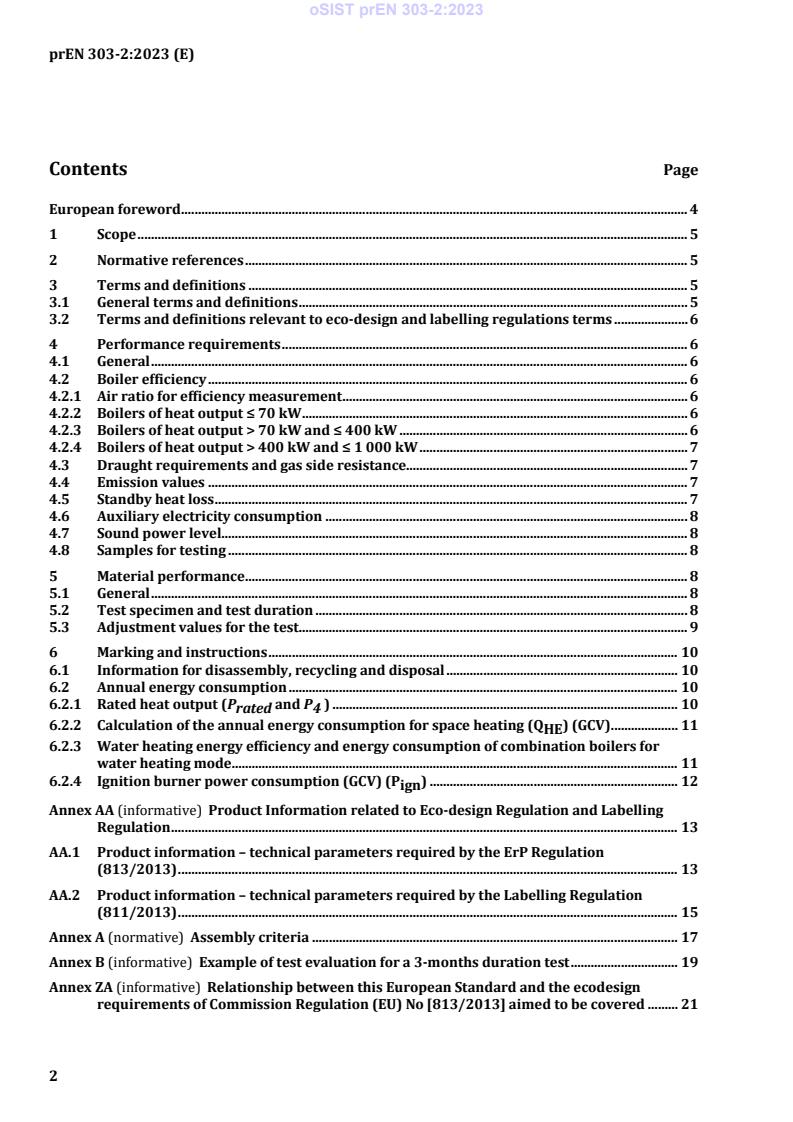
Contents Page
European foreword . 4
1 Scope . 5
2 Normative references . 5
3 Terms and definitions . 5
3.1 General terms and definitions . 5
3.2 Terms and definitions relevant to eco-design and labelling regulations terms . 6
4 Performance requirements . 6
4.1 General . 6
4.2 Boiler efficiency . 6
4.2.1 Air ratio for efficiency measurement . 6
4.2.2 Boilers of heat output ≤ 70 kW . 6
4.2.3 Boilers of heat output > 70 kW and ≤ 400 kW . 6
4.2.4 Boilers of heat output > 400 kW and ≤ 1 000 kW . 7
4.3 Draught requirements and gas side resistance. 7
4.4 Emission values . 7
4.5 Standby heat loss . 7
4.6 Auxiliary electricity consumption . 8
4.7 Sound power level . 8
4.8 Samples for testing . 8
5 Material performance . 8
5.1 General . 8
5.2 Test specimen and test duration . 8
5.3 Adjustment values for the test. 9
6 Marking and instructions . 10
6.1 Information for disassembly, recycling and disposal . 10
6.2 Annual energy consumption . 10
6.2.1 Rated heat output (P and P ) . 10
rated 4
6.2.2 Calculation of the annual energy consumption for space heating (Q ) (GCV) . 11
HE
6.2.3 Water heating energy efficiency and energy consumption of combination boilers for
water heating mode. 11
6.2.4 Ignition burner power consumption (GCV) (P ) . 12
ign
Annex AA (informative) Product Information related to Eco-design Regulation and Labelling
Regulation . 13
AA.1 Product information – technical parameters required by the ErP Regulation
(813/2013) . 13
AA.2 Product information – technical parameters required by the Labelling Regulation
(811/2013) . 15
Annex A (normative) Assembly criteria . 17
Annex B (informative) Example of test evaluation for a 3-months duration test . 19
Annex ZA (informative) Relationship between this European Standard and the ecodesign
requirements of Commission Regulation (EU) No [813/2013] aimed to be covered . 21
prEN 303-2:2023 (E)
Annex ZB (informative) Relationship between this European Standard and the energy
labelling requirements of Commission Delegated Regulation (EU) No 811/2013
aimed to be covered . 22
Bibliography . 25
prEN 303-2:2023 (E)
European foreword
This document (prEN 303-2:2023) has been prepared by Technical Committee CEN/TC 57 “Central
heating boilers”, the secretariat of which is held by DIN.
This document has been prepared under a Standardization Request given to CEN by the European
Commission and the European Free Trade Association, and supports essential requirements of EU
Directive(s) / Regulation(s).
For relationship with EU Directive(s) / Regulation(s), see informative Annexes ZA and ZB, which is an
integral part of this document.
This document supersedes EN 303-2:2017.
The main technical changes compared to EN 303-2:2017 are the following:
a) new Annex AA for information in regard to the labelling was added;
b) new clause marking and instructions was added;
c) technical and editorial changes related to ecotest were introduced in order to bring in more clarity
and less deviations of test results;
d) updated references;
e) updated normative references.
The following structure is intended for the standards for heating boilers:
— EN 303-1, Heating boilers — Part 1: Heating boilers with forced draught burners — Terminology,
general requirements, testing and marking
— EN 303-2, Heating boilers — Part 2: Heating boilers with forced draught burners — Special
requirements for boilers with atomizing oil burners
— EN 303-3, Heating boilers — Part 3: Gas fired central heating boilers — Assembly comprising a boiler
body and a forced draught burner
— EN 303-4, Heating boilers — Part 4: Heating boilers with forced draught burners — Special
requirements for boilers with forced draught oil burners with outputs up to 70 kW and a maximum
operating pressure of 3 bar — Terminology, special requirements, testing and marking
— EN 303-5, Heating boilers — Part 5: Heating boilers for solid fuels, manually and automatically stoked,
— nominal heat output of up to 500 kW - Terminology, requirements, testing and marking
— EN 304, Heating boilers — Test code for heating boilers for atomizing oil burners
— EN 303-6, Heating boilers — Part 6: Heating boilers with forced draught burners; specific requirements
for the domestic hot water operation of combination boilers with atomizing oil burners of nominal heat
input not exceeding 70 kW
prEN 303-2:2023 (E)
1 Scope
This document is applicable to boilers used for central heating in accordance with EN 303-1:2017 up to
a nominal heat output of 1 000 kW and EN 303-4:1999 up to a nominal heat output of 70 kW with forced
draught burners in accordance with EN 267:2020 that are designed for operating with liquid fuels.
The performance requirements of this document apply to type testing to heating boilers (standard, low
temperature and condensing boilers) which are tested on a test rig in accordance with the test code given
in EN 304:2017.
This document applies also to room sealed boilers as defined in EN 15035 regarding efficiency and
emissions.
This document can also be used as the basis for evaluation of boiler-/burner units.
2 Normative references
The following documents, in whole or in part, are normatively referenced in this document and are
indispensable for its application. For dated references, only the edition cited applies. For undated
references, the latest edition of the referenced document (including any amendments) applies.
EN 267:2020, Forced draught burners for liquid fuels
EN 303-1:2017, Heating boilers — Part 1: Heating boilers with forced draught burners - Terminology,
general requirements, testing and marking
EN 304:2017, Heating boilers — Test code for heating boilers for atomizing oil burners
EN 15036-1:2006, Heating boilers — Test regulations for airborne noise emissions from heat generators —
Part 1: Airborne noise emissions from heat generators
EN 15316-4-1:2017, Energy performance of buildings — Method for calculation of system energy
requirements and system efficiencies — Part 4-1: Space heating and DHW generation systems, combustion
systems (boilers, biomass), Module M3-8-1, M8-8-1
3 Terms and definitions
For the purposes of this document, the terms and definitions given in EN 303-1:2017 and the following
apply.
3.1 General terms and definitions
3.1.1
range rated boiler
appliance where the heat output is fixed in a given range
3.1.2
modulating boiler
appliance where the heat output is varying in a given range automatically
3.1.3
standby heat loss
P
stby
heat loss of a boiler space heater, boiler combination heater in operating mode without heat demand,
expressed in kW
prEN 303-2:2023 (E)
3.1.4
combination boiler (combi boiler)
boiler designed both for central heating and for the production of domestic hot water
Note 1 to entry: Depending on its type of domestic hot water production, the combination boiler is classified in
accordance with the manufacturer's declaration as instantaneous type or storage type.
3.2 Terms and definitions relevant to eco-design and labelling regulations terms
3.2.1
sound power level
L
WA
A-weighted sound power level, indoors, expressed in dB(A)
3.2.2
package
unit of boilers or combination boilers, temperature control and/or solar devices means a package offered
to the end-user containing one or more boilers or combination boilers combined with one or more
temperature controls and/or one or more solar devices
Note 1 to entry: Definition based on Labelling Regulation 811/2013 Article 2 - (19) and (20).
Note 2 to entry: Informative Annex AA (and its Tables AA.1 and AA.2) provides a copy of table 1 of Annex II of
COMMISSION REGULATION (EU) No 813/2013 that uses many of the definitions given in this document.
4 Performance requirements
4.1 General
All the following performance tests are carried out using an oil forced draught burner in accordance with
EN 267:2020.
Multi-stage or modulating burners shall operate within the output range of the boiler.
If the boiler was already tested with a forced draught burner for gaseous fuels in accordance with
EN 303-1:2017 and EN 303-3:2006, the tests described in 4.2 and 4.6 need not be performed.
For assembly criteria see Annex A.
4.2 Boiler efficiency
4.2.1 Air ratio for efficiency measurement
The air ratio λ for the efficiency measurement shall comply with the following:
— less than 100 kW: with the requirements of Figure 1 in the tolerance ± 10 % of λ;
— from 100 kW up to 1 000 kW: 1,18 ≤ λ ≤ 1,22.
4.2.2 Boilers of heat output ≤ 70 kW
The seasonal space heating energy efficiency (η ) shall not fall below 86 % based on GCV.
s
4.2.3 Boilers of heat output > 70 kW and ≤ 400 kW
The useful efficiency at nominal heat output (η ) shall not fall below 86 % based on GCV, and the useful
efficiency at 30 % of the nominal heat output (η ) shall not fall below 94 % based on GCV.
prEN 303-2:2023 (E)
4.2.4 Boilers of heat output > 400 kW and ≤ 1 000 kW
Table 1 — Efficiency requirements for boilers above 400 kW
a a b
Full load efficiency (%) Part load efficiency (%)
η η
4 1
Type of boiler NCV GCV NCV GCV
Standard 89,2 84,2 87,8 82,8
Low temperature 91,4 86,2 91,4 86,2
Condensing 93,6 88,3 96,6 91,1
a
The efficiency based on GCV is equal to the efficiency based on NCV divided by 1,06.
b
Part load efficiency is measured at 30 % of the nominal heat output
4.3 Draught requirements and gas side resistance
The gas side resistance and draught shall be determined during the efficiency performance test at
nominal load.
For boilers which operate with negative pressure in the combustion chamber, the values of draught
requirements shown in Figure 2 shall be met or the corresponding technical documentation and/or
manual shall be made available.
For boilers which are operated with positive pressure in the combustion chamber, the values for the flue
gas resistance shown in Figure 3 shall be met or the corresponding technical documentation and/or
manual shall be made available.
4.4 Emission values
The emission values in this clause are taken from EN 267:2020.
During the tests in accordance with 4.2 (at nominal heat output) the smoke number shall not exceed 1.
The concentration of unburnt hydrocarbons in the flue gases shall not exceed 10 ppm, except during the
first 20 s after release of the fuel. The measurement shall be carried out by a flame ionization detector
(FID).
The emissions of CO while operating the boiler at minimum continuous output and nominal output, shall
not exceed 60 mg/kWh on NCV or 56 mg/kWh on GCV.
The emissions of nitrogen oxides, expressed in nitrogen dioxide, shall not exceed:
— for boilers with P ≤ 400 kW: 120 mg/kWh fuel input in terms of GCV;
N
— for boilers with P > 400 kW: 250 mg/kWh fuel input in terms of NCV.
N
4.5 Standby heat loss
If the default value of EN 15316-4-1:2017 is not used the standby heat loss for boilers shall be measured
in accordance with EN 304:2017.
NOTE For boilers up to 70 kW, the value is used in the calculation of the seasonal space heating energy
efficiency.
prEN 303-2:2023 (E)
4.6 Auxiliary electricity consumption
If the default values of EN 15316-4-1:2017 are not used the auxiliary electricity consumption for boilers
shall be measured in accordance with EN 304:2017.
The auxiliary electricity consumption at nominal heat output (el ), the auxiliary electricity
max
consumption at 30 % part load (el ) and auxiliary electricity consumption in standby mode (P ) shall
min SB
be measured according EN 304:2017.
4.7 Sound power level
The sound power level L shall be measured at nominal heat output according to EN 15036-1:2006.
WA
4.8 Samples for testing
The type test determines whether the individual boilers sizes of a type or range meet the requirements
laid down in this document. During the type test the boiler shall be representative of production in its
design and equipment.
For boilers in a product range which has the same constructional design it is sufficient to test only the
smallest and largest boiler provided the ratio in heat output of the smallest to the largest boiler is less
than or equal to 1:2. If, however, within the same product range, this ratio is larger than 1:2 then so many
intermediate sizes shall be tested so that the ratio of 1:2 is not exceeded.
The characteristics according to this document for non-tested boilers are determined by linear
interpolation based on the nominal heat output.
5 Material performance
5.1 General
— Material according to EN 303-1:2017, 4.1.1.3.3 have sufficient resistance regarding corrosion
resistance, heat resistance and mechanical stability for non-condensing boilers.
— Materials classified as corrosion resistant in Table 2 of EN 303-1:2017 are sufficient resistant as state
of the art for low temperature or condensing boilers. Materials not listed as corrosion resistant in
Table 2 of EN 303-1:2017 or materials with coating may be tested regarding corrosion resistance
according to Annex B (Table B.1, Figure B.1 and B.2) and 5.2 and 5.3.
5.2 Test specimen and test duration
At least two serial-production test specimens with the intended minimum equipment are to be selected
from the boiler series to be tested and subjected to fatigue tests according to the following provisions.
Before beginning the test, the test specimens shall be subje
...