

SIST EN 16820:2026
(Main)Rubber and plastics hoses and hose assemblies for use in the pharmaceutical and biotechnological industry - Bonded elastomeric hoses with or without a lining
General Information
- Abstract
This document is applicable to type D and type SD hose assemblies with hoses made of elastomers and bonded plastics for the transport of gaseous, vaporous, liquid or powdery substances in the pharmaceutical and the biotechnological industries. It specifies the classification, manufacturing and testing of as well as the materials, requirements and quality surveillance for hose assemblies.
These hose assemblies are intended to be used with the relevant substances at temperatures in the range from −30 °C to +100 °C, depending on the medium, and at operating pressures from −0,9 bar (vacuum) to 10 bar (see Table 2 and Table 3). For hoses with a lining made of PTFE and derivatives, temperatures from −30 °C to +140 °C are permissible.
Hose assemblies in accordance with this document are classified into four types, A – D, A – SD. B – D, B – SD.
- Status
- Published
- Public Enquiry End Date
- 18-Feb-2025
- Publication Date
- 08-Apr-2026
- Technical Committee
- IPMA - Polimer materials and products
- Current Stage
- 6060 - National Implementation/Publication (Adopted Project)
- Start Date
- 07-Apr-2026
- Due Date
- 12-Jun-2026
- Completion Date
- 09-Apr-2026

Overview
SIST EN 16820:2026 is a European standard developed by CEN that specifies the requirements for rubber and plastics hoses and hose assemblies for use in the pharmaceutical and biotechnological industry. This standard focuses on bonded elastomeric hoses with or without a lining, ensuring their suitability for transporting a wide range of substances, including gaseous, vaporous, liquid, or powdery materials commonly handled in these industries.
SIST EN 16820:2026 outlines the classification, manufacturing, materials, testing, and quality surveillance for type D and type SD hose assemblies made of elastomers and bonded plastics. The hoses covered are intended to operate across a temperature range from −30 °C to +100 °C and pressures from −0.9 bar (vacuum) to 10 bar. When hoses are linings made of PTFE or derivatives, their operational range extends up to +140 °C. The standard emphasizes the importance of hygiene, mechanical integrity, electrical properties, and traceability in hose assemblies used for pharmaceutical and biotechnology applications.
Key Topics
Hose Classification:
- Four main types: A–D, A–SD, B–D, B–SD
- Differentiation based on structure, application limits, and conformity of materials to pharmaceutical and biotechnological requirements
Operational Parameters:
- Temperature range: −30 °C to +100 °C (and up to +140 °C for PTFE-lined hoses)
- Pressure range: −0.9 bar (vacuum) to 10 bar
Material Requirements:
- Hoses and liners are made from high-grade elastomers or plastics (e.g., EPDM, PTFE)
- Fittings use stainless steels and other corrosion-resistant metals compliant with sector hygiene demands
Electrical Properties:
- Hose assemblies can be electrically insulated, bonded, or conductive
- Markings such as "I", "M", "Ω", "M/T", "Ω/T" indicate electrical characteristics
- Ensures suitability for applications in explosive atmospheres
Testing and Quality Control:
- Defined routines for physical, chemical, and mechanical tests (e.g., tensile strength, elongation, bursting pressure, electrical resistance, ozone resistance)
- Specific test frequencies, marking, and traceability requirements
- Detailed assessment of surface roughness and connection hygiene classes
Marking and Traceability:
- Comprehensive marking requirements for hoses, fittings, and assemblies
- Ensures clear identification, operational data, and compliance during lifecycle management
Applications
SIST EN 16820:2026 is essential for facilities and manufacturers operating in the pharmaceutical and biotechnological industries. Typical applications include:
- Conveyance of sensitive or high-purity materials: Safely transporting liquids, gases, and powders essential for drug manufacturing and bioprocessing.
- Sterile and hygiene-critical processes: Hose assemblies are autoclavable and compatible with cleaning and sterilization routines.
- Controlled environments: Ensures hoses meet the requirements for cleanrooms, GMP areas, and other regulated settings.
- ATEX and hazardous zones: Specified electrical properties support applications in potentially explosive atmospheres.
Facilities benefit from improved product safety, quality assurance, and regulatory compliance by adhering to this standard. It supports risk management, extends hose service life, and simplifies the audit and validation process.
Related Standards
SIST EN 16820:2026 references or is used alongside several other relevant European and international standards, including:
- EN 12115 – Rubber and thermoplastics hoses for chemical transfer
- EN ISO 1402 – Hydrostatic testing of hoses and hose assemblies
- EN ISO 8031 – Electrical resistance and conductivity of hoses
- EN ISO 4671 – Measurement of hose dimensions
- EN ISO 5817 – Quality levels for imperfections in welded joints
- EN 1092-1 – Flanges for pipes and fittings
- ISO 37, ISO 188, ISO 1817 – Physical property testing of rubbers and plastics
Adhering to SIST EN 16820:2026 ensures compatibility with these standards, facilitating consistent quality, safety, and regulatory alignment in pharmaceutical and biotechnological hose applications.
Keywords: pharmaceutical hoses, biotechnological hose assemblies, bonded elastomeric hoses, SIST EN 16820:2026, CEN standard, hose classification, sterilizable hoses, hygienic hose fittings, industrial hose testing.
Relations
- Effective Date
- 08-Apr-2026
- Effective Date
- 08-Apr-2026
- Effective Date
- 08-Apr-2026
- Effective Date
- 08-Apr-2026
- Effective Date
- 08-Apr-2026
- Effective Date
- 08-Apr-2026
- Effective Date
- 08-Apr-2026
- Effective Date
- 08-Apr-2026
- Effective Date
- 08-Apr-2026
- Effective Date
- 08-Apr-2026
- Effective Date
- 08-Apr-2026
- Effective Date
- 08-Apr-2026
- Effective Date
- 08-Apr-2026
- Effective Date
- 08-Apr-2026
- Effective Date
- 08-Apr-2026
Get Certified
Connect with accredited certification bodies for this standard

BSI Group
BSI (British Standards Institution) is the business standards company that helps organizations make excellence a habit.

TÜV Rheinland
TÜV Rheinland is a leading international provider of technical services.

TÜV SÜD
TÜV SÜD is a trusted partner of choice for safety, security and sustainability solutions.
Sponsored listings
Frequently Asked Questions
SIST EN 16820:2026 is a standard published by the Slovenian Institute for Standardization (SIST). Its full title is "Rubber and plastics hoses and hose assemblies for use in the pharmaceutical and biotechnological industry - Bonded elastomeric hoses with or without a lining". This standard covers: This document is applicable to type D and type SD hose assemblies with hoses made of elastomers and bonded plastics for the transport of gaseous, vaporous, liquid or powdery substances in the pharmaceutical and the biotechnological industries. It specifies the classification, manufacturing and testing of as well as the materials, requirements and quality surveillance for hose assemblies. These hose assemblies are intended to be used with the relevant substances at temperatures in the range from −30 °C to +100 °C, depending on the medium, and at operating pressures from −0,9 bar (vacuum) to 10 bar (see Table 2 and Table 3). For hoses with a lining made of PTFE and derivatives, temperatures from −30 °C to +140 °C are permissible. Hose assemblies in accordance with this document are classified into four types, A – D, A – SD. B – D, B – SD.
This document is applicable to type D and type SD hose assemblies with hoses made of elastomers and bonded plastics for the transport of gaseous, vaporous, liquid or powdery substances in the pharmaceutical and the biotechnological industries. It specifies the classification, manufacturing and testing of as well as the materials, requirements and quality surveillance for hose assemblies. These hose assemblies are intended to be used with the relevant substances at temperatures in the range from −30 °C to +100 °C, depending on the medium, and at operating pressures from −0,9 bar (vacuum) to 10 bar (see Table 2 and Table 3). For hoses with a lining made of PTFE and derivatives, temperatures from −30 °C to +140 °C are permissible. Hose assemblies in accordance with this document are classified into four types, A – D, A – SD. B – D, B – SD.
SIST EN 16820:2026 is classified under the following ICS (International Classification for Standards) categories: 11.120.99 - Other standards related to pharmaceutics; 23.040.70 - Hoses and hose assemblies; 83.140.40 - Hoses. The ICS classification helps identify the subject area and facilitates finding related standards.
SIST EN 16820:2026 has the following relationships with other standards: It is inter standard links to SIST EN ISO 10619-2:2021, SIST EN ISO 10619-1:2018, SIST EN 1092-1:2018, SIST EN 12115:2021, SIST EN ISO 5817:2023, SIST EN 10244-2:2023, SIST EN 10204:2004, SIST EN ISO 7326:2016, SIST EN ISO 4671:2022, SIST EN 10270-2:2012, SIST EN 10270-1:2024, SIST EN ISO 1402:2021, SIST EN ISO 8033:2017, SIST EN ISO 8031:2020, SIST EN ISO 7233:2021. Understanding these relationships helps ensure you are using the most current and applicable version of the standard.
SIST EN 16820:2026 is available in PDF format for immediate download after purchase. The document can be added to your cart and obtained through the secure checkout process. Digital delivery ensures instant access to the complete standard document.
Standards Content (Sample)
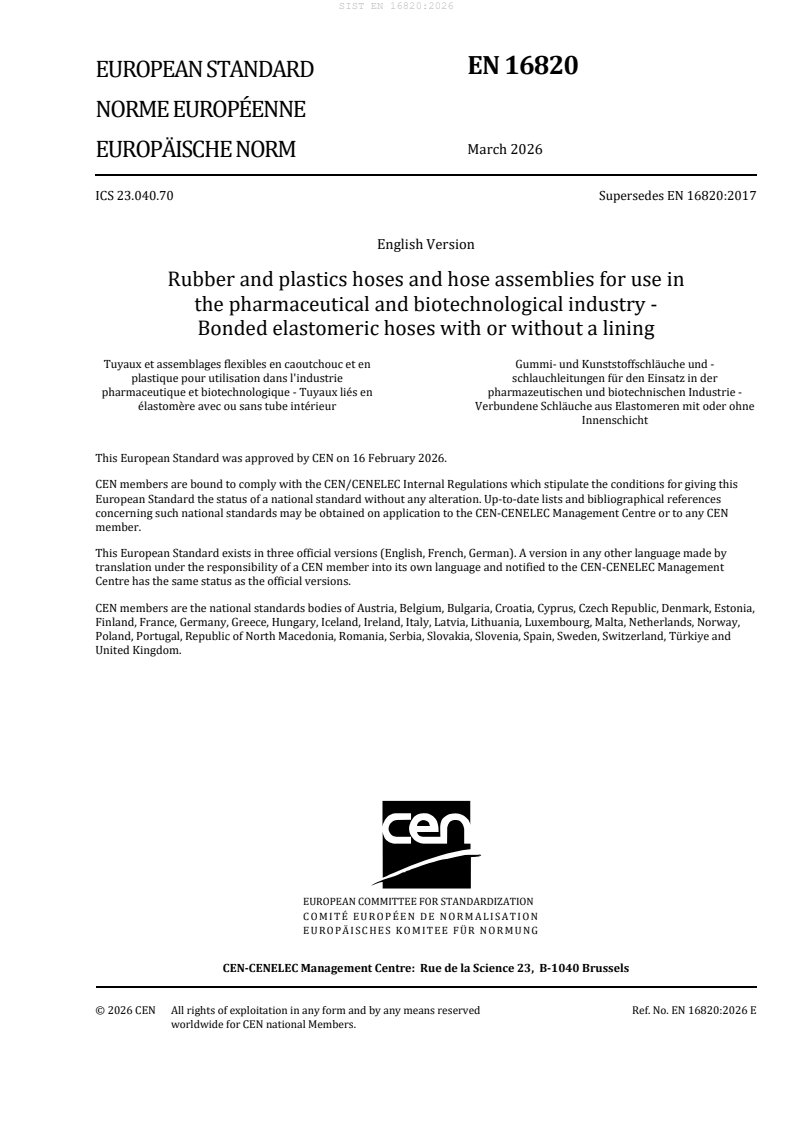
SLOVENSKI STANDARD
01-maj-2026
Gumene in polimerne cevi in cevni priključki za uporabo v farmacevtski in
biotehnološki industriji - Vezane elastomerne cevi s podlogo ali brez nje
Rubber and plastics hoses and hose assemblies for use in the pharmaceutical and
biotechnological industry - Bonded elastomeric hoses with or without a lining
Gummi- und Kunststoffschläuche und -schlauchleitungen für den Einsatz in der
pharmazeutischen und biotechnischen Industrie - Verbundene Schläuche aus
Elastomeren mit oder ohne Innenschicht
Tuyaux et flexibles en caoutchouc et en plastique pour utilisation dans l'industrie
pharmaceutique et biotechnologique - Tuyaux liés en élastomère avec ou sans tube
intérieur
Ta slovenski standard je istoveten z: EN 16820:2026
ICS:
11.120.99 Drugi standardi v zvezi s Other standards related to
farmacijo pharmaceutics
83.140.40 Gumene cevi Hoses
2003-01.Slovenski inštitut za standardizacijo. Razmnoževanje celote ali delov tega standarda ni dovoljeno.
EN 16820
EUROPEAN STANDARD
NORME EUROPÉENNE
March 2026
EUROPÄISCHE NORM
ICS 23.040.70 Supersedes EN 16820:2017
English Version
Rubber and plastics hoses and hose assemblies for use in
the pharmaceutical and biotechnological industry -
Bonded elastomeric hoses with or without a lining
Tuyaux et assemblages flexibles en caoutchouc et en Gummi- und Kunststoffschläuche und -
plastique pour utilisation dans l'industrie schlauchleitungen für den Einsatz in der
pharmaceutique et biotechnologique - Tuyaux liés en pharmazeutischen und biotechnischen Industrie -
élastomère avec ou sans tube intérieur Verbundene Schläuche aus Elastomeren mit oder ohne
Innenschicht
This European Standard was approved by CEN on 16 February 2026.
CEN members are bound to comply with the CEN/CENELEC Internal Regulations which stipulate the conditions for giving this
European Standard the status of a national standard without any alteration. Up-to-date lists and bibliographical references
concerning such national standards may be obtained on application to the CEN-CENELEC Management Centre or to any CEN
member.
This European Standard exists in three official versions (English, French, German). A version in any other language made by
translation under the responsibility of a CEN member into its own language and notified to the CEN-CENELEC Management
Centre has the same status as the official versions.
CEN members are the national standards bodies of Austria, Belgium, Bulgaria, Croatia, Cyprus, Czech Republic, Denmark, Estonia,
Finland, France, Germany, Greece, Hungary, Iceland, Ireland, Italy, Latvia, Lithuania, Luxembourg, Malta, Netherlands, Norway,
Poland, Portugal, Republic of North Macedonia, Romania, Serbia, Slovakia, Slovenia, Spain, Sweden, Switzerland, Türkiye and
United Kingdom.
EUROPEAN COMMITTEE FOR STANDARDIZATION
COMITÉ EUROPÉEN DE NORMALISATION
EUROPÄISCHES KOMITEE FÜR NORMUNG
CEN-CENELEC Management Centre: Rue de la Science 23, B-1040 Brussels
© 2026 CEN All rights of exploitation in any form and by any means reserved Ref. No. EN 16820:2026 E
worldwide for CEN national Members.
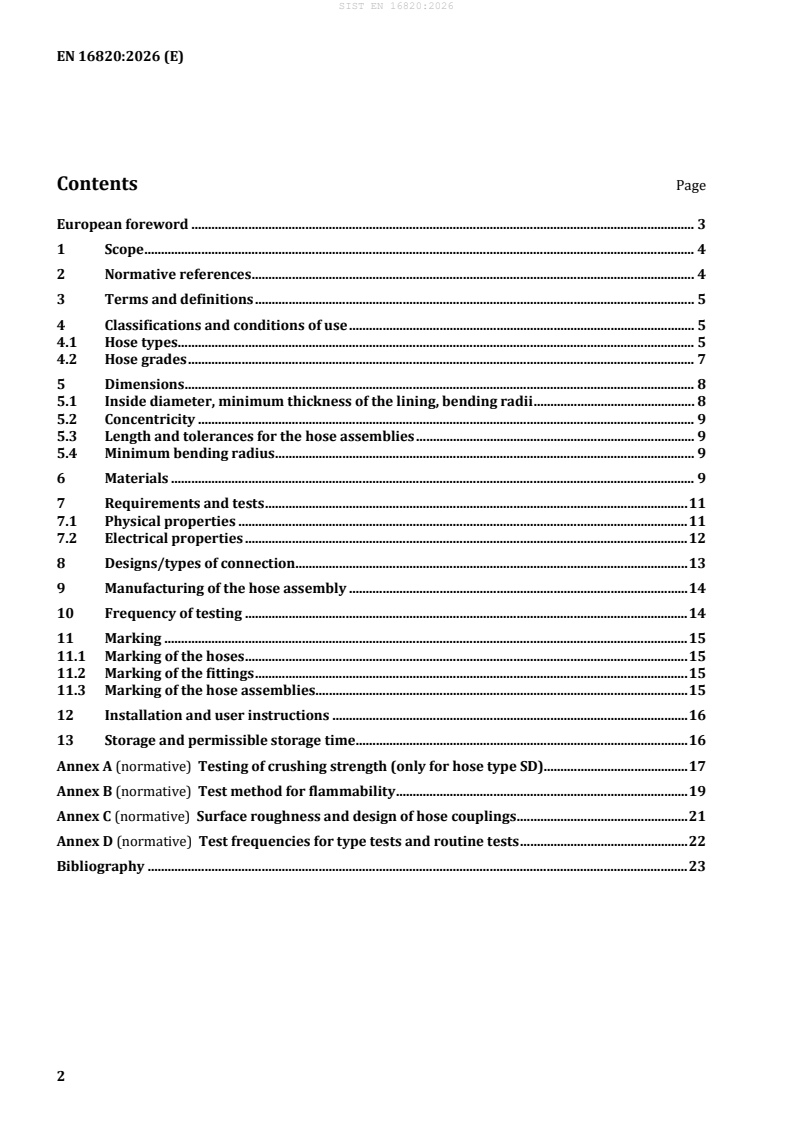
Contents Page
European foreword . 3
1 Scope . 4
2 Normative references . 4
3 Terms and definitions . 5
4 Classifications and conditions of use . 5
4.1 Hose types . 5
4.2 Hose grades . 7
5 Dimensions. 8
5.1 Inside diameter, minimum thickness of the lining, bending radii . 8
5.2 Concentricity . 9
5.3 Length and tolerances for the hose assemblies . 9
5.4 Minimum bending radius . 9
6 Materials . 9
7 Requirements and tests . 11
7.1 Physical properties . 11
7.2 Electrical properties . 12
8 Designs/types of connection. 13
9 Manufacturing of the hose assembly . 14
10 Frequency of testing . 14
11 Marking . 15
11.1 Marking of the hoses . 15
11.2 Marking of the fittings . 15
11.3 Marking of the hose assemblies . 15
12 Installation and user instructions . 16
13 Storage and permissible storage time . 16
Annex A (normative) Testing of crushing strength (only for hose type SD). 17
Annex B (normative) Test method for flammability . 19
Annex C (normative) Surface roughness and design of hose couplings . 21
Annex D (normative) Test frequencies for type tests and routine tests . 22
Bibliography . 23
European foreword
This document (EN 16820:2026) has been prepared by Technical Committee CEN/TC 218 “Rubber and
plastics hoses and hose assemblies”, the secretariat of which is held by BSI.
This European Standard shall be given the status of a national standard, either by publication of an
identical text or by endorsement, at the latest by September 2026, and conflicting national standards shall
be withdrawn at the latest by September 2026.
Attention is drawn to the possibility that some of the elements of this document may be the subject of
patent rights. CEN shall not be held responsible for identifying any or all such patent rights.
This document supersedes EN 16820:2017.
This document includes the following significant technical changes with respect to EN 16820:2017:
— In 4.1, Table 1 the term “design” has been changed to “type”;
— In 4.2, an error in the value for electrical volume resistance has been corrected;
— In Clause 6 the reference to EU Regulation 1935/2004 has been removed;
— In Clause 8, Figure 1 has been corrected;
— Normative Annex A “Test procedure to determine the electrical resistance through the wall of hoses”
has been deleted.
Any feedback and questions on this document should be directed to the users’ national standards body.
A complete listing of these bodies can be found on the CEN website.
According to the CEN-CENELEC Internal Regulations, the national standards organisations of the
following countries are bound to implement this European Standard: Austria, Belgium, Bulgaria, Croatia,
Cyprus, Czech Republic, Denmark, Estonia, Finland, France, Germany, Greece, Hungary, Iceland, Ireland,
Italy, Latvia, Lithuania, Luxembourg, Malta, Netherlands, Norway, Poland, Portugal, Republic of North
Macedonia, Romania, Serbia, Slovakia, Slovenia, Spain, Sweden, Switzerland, Türkiye and the United
Kingdom.
1 Scope
This document is applicable to type D and type SD hose assemblies with hoses made of elastomers and
bonded plastics for the transport of gaseous, vaporous, liquid or powdery substances in the
pharmaceutical and the biotechnological industries. It specifies the classification, manufacturing and
testing of as well as the materials, requirements and quality surveillance for hose assemblies.
These hose assemblies are intended to be used with the relevant substances at temperatures in the range
from −30 °C to +100 °C, depending on the medium, and at operating pressures from −0,9 bar (vacuum)
to 10 bar (see Table 2 and Table 3). For hoses with a lining made of PTFE and derivatives, temperatures
from −30 °C to +140 °C are permissible.
Hose assemblies in accordance with this document are classified into four types, A – D, A – SD. B – D, B –
SD.
2 Normative references
The following documents are referred to in the text in such a way that some or all of their content
constitutes requirements of this document. For dated references, only the edition cited applies. For
undated references, the latest edition of the referenced document (including any amendments) applies.
EN 1092-1, Flanges and their joints — Circular flanges for pipes, valves, fittings and accessories, PN
designated — Part 1: Steel flanges
EN 10204, Metallic products — Types of inspection documents
EN 10244-2, Steel wire and wire products — Non-ferrous metallic coatings on steel wire — Part 2: Zinc or
zinc alloy coatings
EN 10270-1, Steel wire for mechanical springs — Part 1: Patented cold drawn unalloyed spring steel wire
EN 10270-2, Steel wire for mechanical springs — Part 2: Oil hardened and tempered spring steel wire
EN 12115, Rubber and thermoplastics hoses and hose assemblies for liquid or gaseous chemicals —
Specification
EN ISO 1402, Rubber and plastics hoses and hose assemblies — Hydrostatic testing (ISO 1402)
EN ISO 4671, Rubber and plastics hoses and hose assemblies — Methods of measurement of the dimensions
of hoses and the lengths of hose assemblies (ISO 4671)
EN ISO 5817:2023, Welding — Fusion-welded joints in steel, nickel, titanium and their alloys (beam welding
excluded) — Quality levels for imperfections (ISO 5817:2023)
EN ISO 7233, Rubber and plastics hoses and hose assemblies — Determination of resistance to vacuum
(ISO 7233)
EN ISO 7326, Rubber and plastics hoses — Assessment of ozone resistance under static conditions
(ISO 7326)
EN ISO 8031:2020, Rubber and plastics hoses and hose assemblies — Determination of electrical resistance
and conductivity (ISO 8031:2020)
EN ISO 8033, Rubber and plastics hoses — Determination of adhesion between components (ISO 8033)
EN ISO 10619-1, Rubber and plastics hoses and tubing — Measurement of flexibility and stiffness — Part 1:
Bending tests at ambient temperature (ISO 10619-1)
EN ISO 10619-2:2021, Rubber and plastics hoses and tubing — Measurement of flexibility and stiffness —
Part 2: Bending tests at sub-ambient temperatures (ISO 10619-2:2021)
ISO 37, Rubber, vulcanized or thermoplastic — Determination of tensile stress-strain properties
ISO 188, Rubber, vulcanized or thermoplastic — Accelerated ageing and heat resistance tests
ISO 1817, Rubber, vulcanized or thermoplastic — Determination of the effect of liquids
3 Terms and definitions
No terms and definitions are listed in this document.
ISO and IEC maintain terminology databases for use in standardization at the following addresses:
— ISO Online browsing platform: available at https://www.iso.org/obp
— IEC Electropedia: available at https://www.electropedia.org/
4 Classifications and conditions of use
4.1 Hose types
Due to the operational requirements and the manufacturing conditions, the structural design of hose
assemblies in accordance with this document can vary considerably. A selection of possible hose/hose
assembly types is given in Table 1 and Table 2.
d
Table 1 — Hose types
Type Conformity Structure Application
limits/operational
data
rubber hose with or without a
plastics lining and with one or
a
A – D
several reinforcement(s)
(pressure carrier)
Conformity of all components
of the hose with the
rubber hose with or without a
requirements of the
plastics lining and with one or
pharmaceutical and
several reinforcement(s)
c
b biotechnology industry
A – SD (pressure carrier) offering
sufficient form stability for suction
application or with one or several
integrated helix(es), respectively
see Table 3 and
Table 4
rubber hose with or without a
plastics lining and with one or
a
B – D
several reinforcement(s)
Conformity of all components
(pressure carrier)
of the lining of the hose, which
rubber hose with or without a
is in contact with the product,
plastics lining and with one or
with the requirements of the
several reinforcement(s)
pharmaceutical and
b
B – SD (pressure carrier) offering
c
biotechnology industry
sufficient form stability for suction
application or with one or several
integrated helix(es), respectively
a
D is a pressure hose.
b
SD is a suction and discharge hose.
c
e.g. FDA, USP Class VI or EN ISO 10993-5according Clause 6
d
marking of the hose according 11.1
d, e
Table 2 — Hose assembly types
Type Conformity Structure Application limits/
opertational data
rubber hose with or
without a plastics lining
a
A – D and with one or several
reinforcement(s)
(pressure carrier)
Conformity of all
components of the hose
rubber hose with or
and end fittings with the
without a plastics lining
requirements of the
and with one or several
pharmaceutical and
reinforcement(s)
c
biotechnology industry
b
A – SD (pressure carrier) offering
sufficient form stability for
suction application or with
one or several integrated
helix(es), respectively
see Table 3 and Table 4
rubber hose with or
without a plastics lining
B – D and with one or several
reinforcement(s)
Conformity of all
(pressure carrier)
components of the inner
hose liner and end fittings,
rubber hose with or
which is in contact with the
without a plastics lining
product, with the
and with one or several
requirements of the
reinforcement(s)
b pharmaceutical and
B – SD (pressure carrier) offering
c
biotechnology industry
sufficient form stability for
suction application or with
one or several integrated
helix(es), respectively
a
D is a pressure hose.
b
SD is a suction and discharge hose.
c
e.g. FDA, USP Class VI or EN ISO 10993-5according Clause 6
d
marking of the hose according 11.1
e
marking of the fitting according 11.3
Hose assemblies in accordance with this document shall be autoclavable (vapour sterilization) for at least
30 min at 130 °C.
Pressures and temperatures other than those given in the scope can be agreed upon between the
manufacturer and the user.
4.2 Hose grades
Hoses and hose assemblies for this application shall be classified into five grades:
— grade I: electrically insulated (no electrical bonding AND no static-dissipative layers);
— grade M: electrically bonded without static-dissipative lining or cover;
— grade Ω: electrically conductive;
— grade M/T: electrically bonded and with an electrical volume resistance through the hose wall not
exceeding 10 Ω;
— grade Ω/T: electrically conductive and with an electrical volume resistance through the hose wall not
exceeding 10 Ω.
5 Dimensions
5.1 Inside diameter, minimum thickness of the lining, bending radii
Depending on the type, the following shall conform to the values in Table 3 and Table 4:
— the inside diameter of hoses;
— the minimum thickness of the lining;
— the minimum bending radius.
Table 3 — Dimensions and bending radii for hose type A – D / B – D
Minimum Minimum Vacuum
Inside diameter Outside diameter
thickness bending stability
b
radius
Nominal
mm mm mm
size
Hose
a
Dimensions Tolerances Dimensions Tolerances Lining mm bar
cover
13 13,0 23,0 90
16 16 26,0 100 −0,5
19 19,0 31,0 125
±0,5 ±1,0 2,0 1,6
25 25,0 37,0 150
32 32,0 44,0 175 −0,4
38 38,0 51,0 225
50 50,0 66,0 275
±0,7 −0,3
51 51,0 67,0 275
63 63,0 79,0 ±1,2 300
c
75 75,0 91,0 2,0 2,0 350
c
76 76,0 ±0,8 92,0 350 —
c
100 100,0 116,0 450
±1,6
c
101,5 101,5 118,0 450
a
The dimensions for the minimum thickness of the lining are not applicable for hoses made of PE-X/UPE and fluoro-plastics.
The thickness of these materials shall be at least 0,4 mm.
b
The bending radii given are not applicable for hoses made of PE-X/UPE and fluoro-plastics; in these cases they shall be
1,5 times as large.
c
Only applicable for operation at minimum 1 bar, otherwise the hose will kink.
Table 4 — Dimensions and bending radii for hose type A – SD / B – SD
Minimum Minimum Vacuum
Inside diameter Outside diameter
thickness bending stability
radius
Nominal
mm mm mm
size
Hose
a b
Dimensions Tolerances Dimensions Tolerances Lining mm bar
cover
19 19,0 31,0 125
25 25,0 37,0 150
±0,5 ±1,0 1,6 1,6
32 32,0 44,0 175
38 38,0 51,0 225
50 50,0 66,0 275
±0,7 ±1,2 1,7 1,7
51 51,0 67,0 275 −0,8
63 63,0 79,0 300
75 75,0 91,0 ±1,2 1,7 350
76 76,0 ±0,8 92,0 1,8 350
100 100,0 116,0 450
±1,6 2,0
101,5 101,5 118,0 450
a
The dimensions for the minimum thickness of the lining are not applicable for hoses made of PE-X/UPE and fluoro-plastics.
The thickness of these materials shall be at least 0,4 mm.
b
The bending radii given are not applicable for hoses made of PE-X/UPE and fluoro-plastics; in these cases they shall be
1,5 times as large.
5.2 Concentricity
When determined in accordance with EN ISO 4671 on the basis of all readings of the dial gauge between
the inside diameter and the surface of the cover, the concentricity shall be ≤ 1,0 mm for hoses with a
nominal size ≤ 50 and ≤ 1,5 mm for hoses with a nominal size > 50.
5.3 Length and tolerances for the hose assemblies
The length of the hose assembly is considered to be the installation length measured between the sealing
surfaces of the end fittings.
+15
The permissible tolerance is mm for hose assemblies with a length of up to and including 1 000 mm.
−10
+15,
The permissible tolerance is % for hose assemblies with a length of more than 1 000 mm.
−1,0
5.4 Minimum bending radius
The dimensions given in Table 2 and Table 3 apply to the minimum bending radius
...