

SIST EN 50172:2024
(Main)Emergency escape lighting systems
General Information
- Abstract
New edition of EN 50172
- Status
- Published
- Public Enquiry End Date
- 31-Jul-2022
- Publication Date
- 13-Aug-2024
- Technical Committee
- IESV - Lamps and related equipment
- Current Stage
- 6060 - National Implementation/Publication (Adopted Project)
- Start Date
- 24-Jul-2024
- Due Date
- 28-Sep-2024
- Completion Date
- 14-Aug-2024

Overview
EN 50172:2024 - published by CLC/CENELEC - is the revised European standard for emergency escape lighting systems. It specifies electrical installation requirements, verification, documentation, operation and maintenance for systems that provide illumination for escape routes, open areas (anti‑panic), and high‑risk task areas. EN 50172:2024 supersedes EN 50172:2004 and is to be read alongside EN 1838 (lighting applications - emergency lighting).
Key topics and technical requirements
The 2024 edition expands and clarifies requirements across the emergency escape lighting lifecycle. Major topics include:
- System scope and definitions: Emergency escape lighting, escape route lighting, open area (anti‑panic) lighting, high‑risk task area lighting, emergency luminaires, self‑contained luminaires, and central safety power supply systems.
- Installation requirements: Electrical wiring practices and specific provisions for emergency lighting circuits (see normative Annex D for wiring system requirements).
- Equipment requirements: New requirements for emergency escape lighting equipment, including luminaires and controlgear.
- Design and documentation: Requirements for system design, plans of premises, identification marking and handover documentation.
- Verification and testing:
- Initial verification requirements added to ensure correct installation and functionality before handover.
- Periodic inspection and testing procedures for ongoing performance checks.
- Guidance on on‑site illuminance and luminance measurement methods (informative Annex B).
- Maintenance and records: Requirements for a logbook (reporting) and modified maintenance/verification obligations to ensure continued availability.
- Operational considerations: Recommendations for system durations and activation times (Annex A), and guidance for systems after prolonged power disconnection or lockdowns (Annex C).
- Interfaces with power supplies: References to central safety power supply systems (EN 50171) and emergency power sources.
Practical applications and users
EN 50172:2024 is intended for professionals involved in safety lighting across buildings and facilities:
- Electrical designers and specifiers of emergency lighting systems
- Lighting manufacturers and luminaire suppliers
- Installation contractors and commissioning engineers
- Facility managers, building owners and safety officers responsible for maintenance and compliance
- Fire safety engineers, insurers and regulatory authorities
Use cases include design and commissioning of escape route lighting, documenting handover for new builds or refurbishments, establishing testing regimes and logbooks for regulatory compliance, and selecting appropriate equipment and system durations for specific occupancies.
Related standards
- EN 1838 - Lighting applications: emergency lighting (luminance/illuminance requirements)
- EN 50171 - Central safety power supply systems
- EN IEC 60598‑2‑22 - Luminaires for emergency lighting
- Relevant HD 60364 parts (electrical installations and verification)
Keywords: EN 50172:2024, emergency escape lighting systems, emergency lighting standard, installation requirements, maintenance and testing, emergency luminaires, escape route lighting.
Relations
- Effective Date
- 01-Sep-2024
- Effective Date
- 09-Feb-2026
- Effective Date
- 09-Feb-2026
- Effective Date
- 09-Feb-2026
- Effective Date
- 09-Feb-2026
- Effective Date
- 09-Feb-2026
- Referred By
SIST-TS CEN/TS 17951:2024 - Lighting Applications - Adaptive Emergency Escape Lighting Systems - Effective Date
- 09-Feb-2026
Get Certified
Connect with accredited certification bodies for this standard

DIBt (Deutsches Institut für Bautechnik)
German Institute for Building Technology.
DIN CERTCO
DIN Group product certification.

Aboma Certification B.V.
Specialized in construction, metal, and transport sectors.
Sponsored listings
Frequently Asked Questions
SIST EN 50172:2024 is a standard published by the Slovenian Institute for Standardization (SIST). Its full title is "Emergency escape lighting systems". This standard covers: New edition of EN 50172
New edition of EN 50172
SIST EN 50172:2024 is classified under the following ICS (International Classification for Standards) categories: 91.160 - Lighting; 91.160.10 - Interior lighting. The ICS classification helps identify the subject area and facilitates finding related standards.
SIST EN 50172:2024 has the following relationships with other standards: It is inter standard links to SIST EN 50172:2006, SIST EN 13814-1:2019, SIST EN 17064:2019, SIST EN 1838:2013, SIST EN 1838:2025, SIST EN 13814-1:2019+A1:2024, SIST-TS CEN/TS 17951:2024. Understanding these relationships helps ensure you are using the most current and applicable version of the standard.
SIST EN 50172:2024 is available in PDF format for immediate download after purchase. The document can be added to your cart and obtained through the secure checkout process. Digital delivery ensures instant access to the complete standard document.
Standards Content (Sample)
SLOVENSKI STANDARD
01-september-2024
Sistemi za zasilno razsvetljavo evakuacijskih poti
Emergency escape lighting systems
Sicherheitsbeleuchtungsanlagen
Systèmes d'éclairage de sécurité
Ta slovenski standard je istoveten z: EN 50172:2024
ICS:
91.160.10 Notranja razsvetljava Interior lighting
2003-01.Slovenski inštitut za standardizacijo. Razmnoževanje celote ali delov tega standarda ni dovoljeno.
EUROPEAN STANDARD EN 50172
NORME EUROPÉENNE
EUROPÄISCHE NORM July 2024
ICS 91.160 Supersedes EN 50172:2004
English Version
Emergency escape lighting systems
Systèmes d'éclairage de sécurité Sicherheitsbeleuchtungsanlagen
This European Standard was approved by CENELEC on 2024-05-27. CENELEC members are bound to comply with the CEN/CENELEC
Internal Regulations which stipulate the conditions for giving this European Standard the status of a national standard without any alteration.
Up-to-date lists and bibliographical references concerning such national standards may be obtained on application to the CEN-CENELEC
Management Centre or to any CENELEC member.
This European Standard exists in three official versions (English, French, German). A version in any other language made by translation
under the responsibility of a CENELEC member into its own language and notified to the CEN-CENELEC Management Centre has the
same status as the official versions.
CENELEC members are the national electrotechnical committees of Austria, Belgium, Bulgaria, Croatia, Cyprus, the Czech Republic,
Denmark, Estonia, Finland, France, Germany, Greece, Hungary, Iceland, Ireland, Italy, Latvia, Lithuania, Luxembourg, Malta, the
Netherlands, Norway, Poland, Portugal, Republic of North Macedonia, Romania, Serbia, Slovakia, Slovenia, Spain, Sweden, Switzerland,
Türkiye and the United Kingdom.
European Committee for Electrotechnical Standardization
Comité Européen de Normalisation Electrotechnique
Europäisches Komitee für Elektrotechnische Normung
CEN-CENELEC Management Centre: Rue de la Science 23, B-1040 Brussels
© 2024 CENELEC All rights of exploitation in any form and by any means reserved worldwide for CENELEC Members.
Ref. No. EN 50172:2024 E
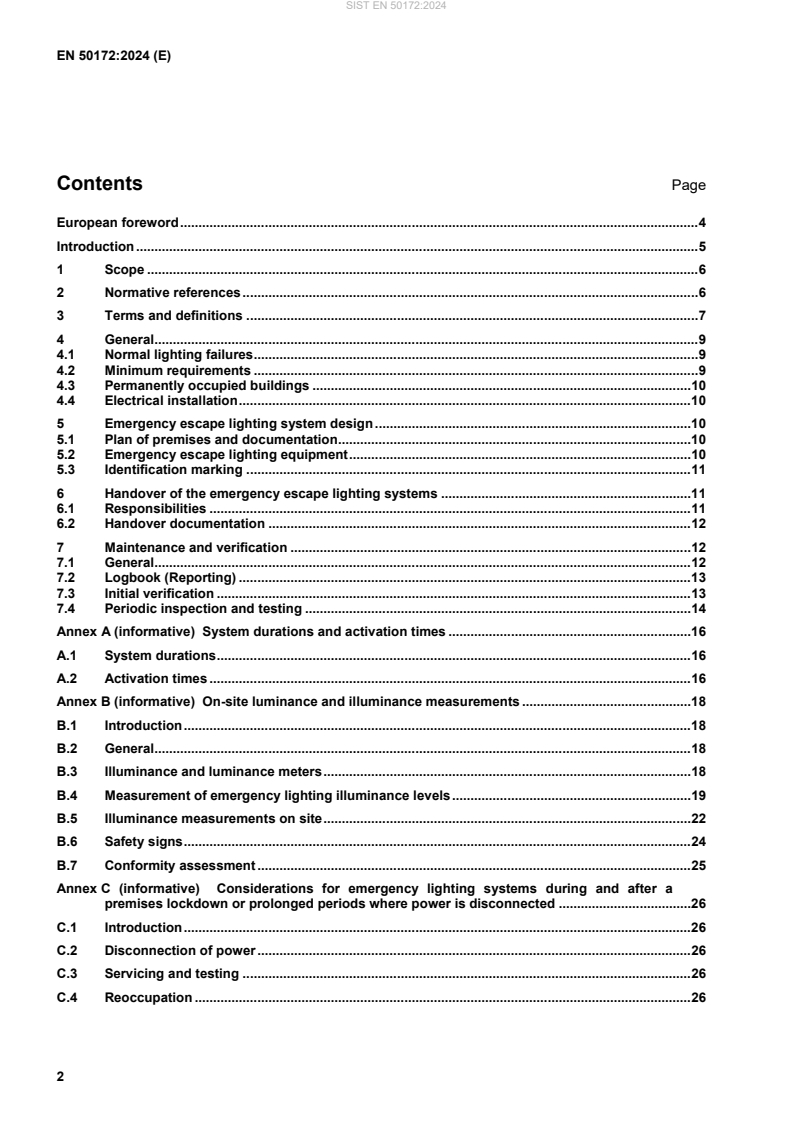
Contents Page
European foreword . 4
Introduction . 5
1 Scope . 6
2 Normative references . 6
3 Terms and definitions . 7
4 General . 9
4.1 Normal lighting failures . 9
4.2 Minimum requirements . 9
4.3 Permanently occupied buildings . 10
4.4 Electrical installation . 10
5 Emergency escape lighting system design . 10
5.1 Plan of premises and documentation . 10
5.2 Emergency escape lighting equipment . 10
5.3 Identification marking . 11
6 Handover of the emergency escape lighting systems . 11
6.1 Responsibilities . 11
6.2 Handover documentation . 12
7 Maintenance and verification . 12
7.1 General . 12
7.2 Logbook (Reporting) . 13
7.3 Initial verification . 13
7.4 Periodic inspection and testing . 14
Annex A (informative) System durations and activation times . 16
A.1 System durations . 16
A.2 Activation times . 16
Annex B (informative) On-site luminance and illuminance measurements . 18
B.1 Introduction . 18
B.2 General . 18
B.3 Illuminance and luminance meters . 18
B.4 Measurement of emergency lighting illuminance levels . 19
B.5 Illuminance measurements on site . 22
B.6 Safety signs . 24
B.7 Conformity assessment . 25
Annex C (informative) Considerations for emergency lighting systems during and after a
premises lockdown or prolonged periods where power is disconnected . 26
C.1 Introduction . 26
C.2 Disconnection of power . 26
C.3 Servicing and testing . 26
C.4 Reoccupation . 26
Annex D (normative) Wiring system . 27
D.1 Introduction . 27
D.2 General . 27
Annex E (informative) A-deviations . 28
Bibliography . 29
European foreword
This document (EN 50172:2024) has been prepared by CLC/TC 34” Lighting”.
The following dates are fixed:
• latest date by which this document has to be (dop) 2025-05-27
implemented at national level by publication of
an identical national standard or by
endorsement
• latest date by which the national standards (dow) 2027-05-27
conflicting with this document have to be
withdrawn
This document supersedes EN 50172:2004 and all of its amendments and corrigenda (if any).
— Requirements for emergency escape lighting equipment have been added
— Requirements for the initial verification have been added
— Requirements for the handover documentation have been added
— Requirements to the logbook have been added
— Requirements to maintenance and verification of emergency escape lighting systems have been modified
— Guidance for the selection of appropriate system durations and activation times for various use cases
have been added as Annex A
— Recommendations how the onsite measurement should be carried out have been added as Annex B
— Considerations for emergency lighting systems during and after a premises lockdown or prolonged
periods where power is disconnected have been added as Annex C
— Requirements how the system wiring should be carried out have been added as Annex D
Attention is drawn to the possibility that some of the elements of this document may be the subject of patent
rights. CENELEC shall not be held responsible for identifying any or all such patent rights.
This document is read in conjunction with EN 1838.
Any feedback and questions on this document should be directed to the users’ national committee. A
complete listing of these bodies can be found on the CENELEC website.
Introduction
Table 1 shows an overview of the different forms of emergency lighting. For more details see EN 1838.
Table 1 — Forms of emergency lighting
Emergency lighting
Emergency escape lighting
Escape route Open area (anti- High-risk task area Local area Standby
lighting panic) lighting lighting lighting lighting
Safety signs including adaptive safety signs
While EN 1838 includes luminous requirements for emergency escape lighting systems (and stand-by lighting
systems), this document provides electrical installation requirements specific for emergency escape lighting
systems together with verification, operation and maintenance documentation and test requirements for such
systems. Emergency lighting is a key element of building safety and of utmost importance to prevent harm
and save lives in emergency situations. Such situations are rare, but their rarity is also the reason why issues
may remain undetected and the functionality of the emergency lighting system may thus be impaired just in
the very moment that emergency lighting is actually required. Such issues may be related to building layout
updates or changes in use pattern, or simply the ageing of emergency lighting equipment over time, for
instance. Therefore, maintenance of emergency lighting systems is just as essential as its initial proper
installation.
Hence, this document does contain detailed requirements not only for the initial verification of emergency
escape lighting systems, but also for its continuous monitoring and maintenance which is the only way to
ensure that emergency escape lighting will adequately be provided whenever required.
Note that legal requirements throughout Europe are not limited to the initial installation of emergency lighting,
but also comprise requirements related to continuous monitoring and maintenance.
1 Scope
This document specifies electrical installation requirements specific for emergency escape lighting systems
together with verification, operation and maintenance documentation and test requirements for such systems.
NOTE 1 Emergency escape lighting includes escape route lighting, open area (anti-panic) lighting and high-risk task
area lighting. Escape route safety signs are part of emergency escape lighting.
NOTE 2 Emergency escape lighting systems include adaptive and non-adaptive systems, as well as high and low-
mounted systems.
This document does not cover stand-by lighting requirements.
NOTE 3 Systems used for stand-by lighting can also be used for emergency escape lighting, given the corresponding
requirements are fulfilled, see EN 1838.
2 Normative references
The following documents are referred to in the text in such a way that some or all of their content constitutes
requirements of this document. For dated references, only the edition cited applies. For undated references,
the latest edition of the referenced document (including any amendments) applies.
EN 1838:—, Lighting applications - Emergency lighting
ISO 8528-12, Reciprocating internal combustion engine driven alternating current generating sets — Part 12:
Emergency power supply to safety services
EN 50171:2021, Central safety power supply systems
HD 60364-5-51:2009, Electrical installations of buildings - Part 5-51: Selection and erection of electrical
equipment - Common rules
HD 60364-5-56:2018, Low-voltage electrical installations - Part 5-56: Selection and erection of electrical
equipment - Safety services
HD 60364-6:2016, Low-voltage electrical installations - Part 6: Verification
EN IEC 60598-2-22:2022, Luminaires - Part 2-22: Particular requirements - Luminaires for emergency lighting
(IEC 60598-2-22)
EN 62034, Automatic test systems for battery powered emergency escape lighting
ISO 3864-1, Graphical symbols — Safety colours and safety signs — Part 1: Design principles for safety signs
and safety markings
EN IEC 62485-2, Safety requirements for secondary batteries and battery installations - Part 2: Stationary
batteries (IEC 62485-2)
EN IEC 62485-5, Safety requirements for secondary batteries and battery installations - Part 5: Safe operation
of stationary lithium ion batteries
A new edition of EN 1838 is under preparation by CEN TC 169. Stage at the time of publication:
FprEN 1838:2024.
As amended by HD 60364-5-51:2009/A11:2013 and HD 60364-5-51:2009/A12:2017.
3 Terms and definitions
For the purposes of this document, the terms and definitions given in EN 1838:— and the following apply.
3.1
emergency lighting
lighting provided for use when the power supply to the normal electric lighting fails
[SOURCE: IEC 60050-845:2020, 845-29-010, modified: Note 1 to entry has been deleted]
3.2
emergency escape lighting
part of emergency lighting that provides illumination for visibility of the escape route and of safety signage for
fire-fighting and safety equipment and for the guidance and the safety of people leaving a location to a place
of safety or attempting to terminate a potentially hazardous process or situation before doing so
[SOURCE: EN 12665:2024, 3.5.36]
3.3
emergency escape lighting system
set of items functioning together in order to provide emergency escape lighting
Note 1 to entry: This includes luminaires, controlgear, central safety power supply systems, wiring etc.
3.4
stand-by lighting
part of emergency lighting provided to enable normal activities to continue substantially unchanged
[SOURCE: IEC 60050-845:2020, 845-29-013, modified]
3.5
escape route lighting
part of emergency escape lighting provided to ensure that the escape route can be effectively identified and
safely used when the location is occupied
[SOURCE: EN 12665:2024, 3.5.44]
3.6
escape route
designated route, used to evacuate in case of an emergency, to a place of safety
[SOURCE: EN 12665:2024, 3.5.43]
3.7
open area (anti-panic) lighting
part of emergency escape lighting provided to avoid panic and provide illumination allowing people to reach a
place where an escape route can be identified
[SOURCE: EN 12665:2024, 3.5.64]
3.8
local area lighting
part of emergency lighting that provides illumination for people allowed to remain temporarily in a premise
during a mains supply failure if it is risk assessed for the activities that are allowed to be performed
[SOURCE: EN 12665:2024, 3.5.101]
3.9
high-risk task area lighting
part of emergency escape lighting that provides illumination for the safety of people involved in a potentially
dangerous process or situation and to enable proper shut down procedures for the safety of the operator and
other occupants of the building
[SOURCE: EN 12665:2024, 3.5.50]
3.10
emergency luminaire
luminaire for emergency lighting
Note 1 to entry: Emergency luminaires include internally illuminated safety signs and luminaires providing light for
externally illuminated safety signs.
Note 2 to entry: Emergency luminaires can be supplied by an internal or external electrical source for safety services.
3.11
self-contained emergency luminaire
luminaire providing maintained or non-maintained emergency lighting in which all the elements, such as the
electric source for safety services (ESSS), the lamp, the control unit and the test and monitoring facilities,
where provided, are contained within the luminaire or adjacent to it (that is, within 1 m cable length)
[SOURCE: EN IEC 60598-2-22:2022]
3.12
safety sign
sign that gives a general safety message, conveyed by a combination of colour and geometric shape and
which, by the addition of a graphical symbol, gives a particular safety message
[SOURCE: ISO 3864-1]
3.13
internally illuminated safety sign
safety sign that is illuminated, when it is required, by an internal light source
[SOURCE: EN 12665:2024, 3.5.54]
3.14
externally illuminated safety sign
safety sign that is illuminated, when it is required, by an external emergency luminaire
[SOURCE: EN 12665:2024, 3.5.48]
3.15
central safety power supply system
central power supply system which supplies the required power to essential safety equipment with any rated
power output
[SOURCE: EN 50171:2021]
3.16
electrical source for safety services
ESSS
electrical source intended to be used as part of an electrical supply system for safety services
[SOURCE: IEC 60364-5-56:2018, modified – “ESSS” has been added as admitted term.]
3.17
automatic test system
ATS
automated test system that may be manually initiated, consisting of parts (such as timers, current detectors,
light detectors, changeover switches) which, when connected together, make a system that can carry out the
routine testing requirements of emergency luminaires, and indicate the test results
[SOURCE: IEC 62034:2012, modified – “emergency lighting luminaires” was replaced by “emergency
luminaires”]
3.18
system duration
minimum period of time for which the luminous requirements of the
emergency lighting system are met
Note 1 to entry: A system can consist of a single luminaire.
[SOURCE: EN 1838:—]
3.19
activation time
time between failure of the supply to the normal lighting and
emergency lighting reaching the required level of illuminance
[SOURCE: EN 1838:—]
4 General
4.1 Normal lighting failures
Emergency escape lighting shall be provided promptly, automatically and for a suitable time in a specified
area when the power supply to the normal lighting fails.
This further includes:
— operation/tripping of circuit protection devices. However, where an area is served by multiple lighting
circuits, monitoring of all circuits or circuit protection devices may not be required, if the failure of one or
more circuits or operation of circuit protection devices is not expected to cause the normal lighting in this
specified area to fall below the illuminance levels required for emergency escape lighting.
— Failures of the lighting control system where this is expected to cause the normal lighting in this specified
area to fail.
NOTE 1 Normal lighting supply failures include interruptions of the power supply from the electricity supplier.
NOTE 2 Required illuminance levels are given in EN 1838.
NOTE 3 Lighting control system refers to a networked system of devices related to lighting control only, that
incorporates communication between various system inputs and outputs, with the use of one or more central computing
device(s).
4.2 Minimum requirements
To facilitate the evacuation of a building during emergency operation, sufficient minimum illuminance, an
adequate system activation time and system duration are required.
NOTE According to EN 1838 a minimum system duration of 1 h is required for all emergency escape lighting
installations. Furthermore, Annex A provides guidance for the selection of appropriate system durations and activation
times for various use cases.
Compliance is checked by designing and installing the emergency escape lighting system in accordance with
the applicable standards and according to the requirements in this document including maintenance and
verifications.
NOTE National regulations can also be applicable.
4.3 Permanently occupied buildings
For permanently occupied buildings that provide sleeping accommodation and for which a system duration,
exceeding the recommendation in Annex A has been chosen, the duration may be reduced to three hours or
less where the emergency escape lighting is not required continuously in all areas, under the following
conditions:
— The risk assessment, if required, and national regulation allows for such a reduction.
— In case of a power failure, the emergency escape lighting shall be activated for at least the time required
for the evacuation of the building after which it shall switch off automatically.
— Emergency escape lighting can be reactivated for at least the time required to escape the building by
permanently illuminated push buttons, powered from the electrical source for safety services (ESSS),
which shall be installed as local switching devices in such a way that at least one button can be discerned
from any location.
NOTE 1 Requirements for system durations of more than three hours can originate from national or regional legislation.
NOTE 2 Above requirements do not allow that emergency escape lighting is manually switched off.
NOTE 3 Above requirements are not confused with the rest and remote inhibiting mode of emergency luminaires
where responsible persons can switch off the emergency escape lighting.
4.4 Electrical installation
The electrical installation shall comply with installation rules for electrical supply systems for safety services in
accordance with HD 60364-5-56 and Annex D.
NOTE National regulations can also be applicable.
5 Emergency escape lighting system design
5.1 Plan of premises and documentation
Plans of the building layout which include the location of all existing or proposed escape routes, fire alarm call
points, fire fighting equipment, emergency equipment (e.g. first aid posts, defibrillators, escape equipment
provided for the disabled) and the positions of all structural items that might be an obstruction to escape,
should be available before commencing the design of the system.
NOTE 1 In many countries such a plan is legally required for specific premises.
NOTE 2 Documentation requirements are given in HD 60364-5-56:2018, 560.7.8 to 560.7.11 and
HD 60364-5-51:2009, 514.5.
5.2 Emergency escape lighting equipment
5.2.1 General
The rated luminous flux of the emergency luminaire in emergency mode shall be not less than the luminous
flux used in the design calculations.
The intended interoperability of all devices shall be ensured, such as central safety power supply systems with
all connected emergency luminaires and/or controlgear, monitoring- and all communication devices, including,
but not limited to the supply range (AC and/or DC), inrush current, ramp up and stability of the power
consumption.
5.2.2 Emergency luminaires
Emergency luminaires shall comply with EN IEC 60598-2-22. They shall be selected in consideration of their
location.
NOTE 1 In areas with potentially explosive atmospheres, refer to the relevant standards. Directive 2014/34/EU has
additional information.
Emergency luminaires shall be installed and connected to any power supply in such a way that accidental
disconnection is prevented.
EXAMPLE Plug and socket systems within arm’s reach do not typically provide any protection against accidental
disconnection.
The conditions of the electrical source for safety services (“ready for operation”, “under fault conditions”,
“feeding from the electrical source for safety services”) shall be monitored and displayed at an appropriate
location.
NOTE 2 “Under fault conditions” in this context refers to the failure of the electrical source for safety services, not a
fault condition of the luminaire.
Self-contained emergency luminaires provided with an indicator as required by EN IEC 60598-2-22 are
deemed to comply with this requirement, if the indicator status is easily identifiable in normal use.
Central monitoring systems and automatic test systems are recommended, especially for such installations in
which it is difficult to access the emergency luminaires, e.g. when installed at high level.
5.2.3 Central safety power supply systems
Battery powered central safety power supply systems shall comply with EN 50171 and the battery safety
requirements of EN IEC 62485-2 or EN IEC 62485-5, as appropriate.
The conditions of the emergency escape lighting system (“ready for operation”, “under fault conditions”,
“feeding from the electrical source for safety services”) shall be monitored and displayed at an appropriate
location
5.2.4 Automatic test systems
Automatic test systems shall comply with EN 62034.
5.3 Identification marking
The distribution board number, the circuit number and the luminaire number shall be indicated next to each
emergency luminaire. For the purpose of this document “next” means within 20 cm.
NOTE Identification of emergency luminaires is covered in HD 60364-5-56.
6 Handover of the emergency escape lighting systems
6.1 Responsibilities
The moment of system handover means the end of the planning and construction phase. The responsibility for
the operation, maintenance and verification of the emergency escape lighting system is passed on to the
person having legal responsibility for the building.
The person responsible for the emergency escape lighting system may delegate maintenance and verification
tasks to a duly qualified person or service contractor, but remains responsible for the emergency escape
lighting system in any case.
6.2 Handover documentation
The handover documentation after design, installation, and commissioning of the emergency escape lighting
system (or any part thereof) shall comply with the following:
— a general schematic overview diagram shall be available
— Drawings of the installed emergency escape lighting system shall be provided showing the exact location
of escape routes, of emergency luminaires, of electrical source for safety services (if applicable) and of
other emergency escape lighting system relevant devices including a unique identification reference for
each device
— to facilitate identification of each individual device of the emergency escape lighting system, a list of all
the current-using equipment, the type of power supply (self-contained or centrally supplied) and locations
shall be provided
— mode of operation and configuration for each device (e.g. maintained/non-maintained)
— Operating and maintenance instructions for the emergency escape lighting system and each associated
device shall be available, e.g. automatic test systems (ATS) according to EN 62034, if such automatic
test systems are used
— details of replacement parts and components (e.g. light sources, fuses, controlgear, batteries or other
electrical sources for safety services etc.) as provided by the corresponding manufacturer
— date of the commissioning and all certification required in relation to the emergency escape lighting
system
— initial verification results (see Clause 7)
With the above, HD 60364-5-56 documentation requirements are considered to be complied with as far as the
emergency escape lighting system is covered.
The handover documentation shall be made available at all reasonable times for examination by a duly
authorized person.
The handover documentation shall be regularly updated with any subsequent changes to the system.
The handover documentation may be in a hardcopy or electronic format. Electronic formats shall be readily
accessible and shall remain recognizable.
NOTE Remaining recognizable typically requires proper back-up and long-term file recognition.
The handover documentation shall include details of the individuals responsible for the design, installation and
commissioning of the emergency escape lighting system. It shall be signed by the duly authorized person(s).
7 Maintenance and verification
7.1 General
Regular servicing and testing shall be carried out.
The qualification of the inspection personnel shall comply with the relevant standards for carrying out this
work.
NOTE Additional national requirements to the qualification of the inspection personal can also be applicable.
The duly authorized person shall be responsible for the logbook and the maintenance and verification.
7.2 Logbook (Reporting)
A logbook shall be kept to document the periodic checks, tests, faults and any subsequent changes made to
the emergency escape lighting system.
The logbook shall be maintained by the party having legal responsibility for the building and shall be made
available for examination by a duly authorized person.
NOTE 1 Legal responsibility is typically subject to national regulations and can include the owner, tenant or operator of
the building.
The logbook may be in a hardcopy or electronic format. The logbook may include results from automatic test
systems, as far as applicable. Electronic formats shall be readily accessible and shall remain recognizable.
NOTE 2 Remaining recognizable typically requires proper back-up and long-term file recognition.
The logbook shall be used to record at least the following information:
a) date of commissioning of the system
b) date and brief details of each service, checks or test carried out, including but not limited to the
verifications according to 7.3 and 7.4;
c) date and brief details of any defects and corrective actions taken;
NOTE 3 Corrective actions can include the replacement of a luminaire or components, such as light sources, fuses,
batteries or other electrical sources for safety services.
d) date and brief details of any subsequent change or alterations to the emergency escape lighting system;
e) identification of the duly authorized person(s) for performing any of the items a) to d)
NOTE 4 The logbook can also include pages relating to other safety records, e.g. fire alarms.
7.3 Initial verification
The initial verification consists of operations that allow checks of the correct function of the system
(emergency luminaires, electrical source for safety services – both for systems with self-contained emergency
luminaires and for central safety power supply systems) and compliance with the lighting design requirements.
Initial verification of the emergency escape lighting system shall include at least the following tests and/or
measurements:
a) Initial verification of the emergency escape lighting system according to HD 60364-6:2016, 6.4 as far as
the emergency escape lighting system is concerned; in particular, when carrying out the visual inspection
according HD 60364-6:2016, 6.4.2 it shall be ensured that:
– all devices of the emergency escape lighting system are in accordance with the design, including the
size of safety signs in relation to viewing distances;
– all emergency luminaires and externally illuminated safety signs are correctly located and oriented,
clean and functioning correctly;
– emergency luminaires and externally illuminated safety signs are located and oriented in accordance
with the handover documentation.
b) The emergency mode of each emergency luminaire shall be activated by simulating a failure of the
supply to the normal lighting for the system duration.
All emergency luminaires and externally illuminated safety signs shall be checked to ensure that they are
present and functioning correctly.
At the end of the full system duration test, the supply to the normal lighting shall be restored and any
indicator shall be checked to verify that it is showing that the normal supply has been restored.
If an automatic test system is used, the status of the indicator(s) or remote displays shall be checked to
verify correct operation.
c) For central safety power supply systems, additionally the correct operation of system monitors shall be
checked.
d) Emergency luminaires and externally illuminated safety signs shall be checked to verify that they are
undamaged and that their intended function is not impaired due to the presence of dirt or dust or visible
material degradation.
e) Verification of the correct operation of the inhibition mode and rest mode of emergency luminaires, where
applicable.
f) Verification of the absence of obstacles of any nature that could compromise the effectiveness and
visibility of safety signs (for example furniture that prevent the correct identification of a safety sign);
verification of the integrity and legibility of the internally illuminated safety signs and the absence of
obstacles between externally illuminated safety signs and the corresponding emergency luminaire.
g) Photometric requirements according to EN 1838 shall be checked in order to verify the corresponding
luminous requirements.
NOTE National regulation can also provide such requirements.
Compliance can be checked by measurements according to Annex B or by validation of the installation in
accordance with the design.
7.4 Periodic inspection and testing
7.4.1 General
Regular servicing is essential. The occupier/owner of the premises shall appoint a duly authorized person to
supervise servicing of the system. This person shall be given sufficient authority to ensure the carrying out of
any work necessary to maintain the system in correct operation.
Because of the possibility of a failure of the supply to the normal lighting occurring shortly after a period of
testing of the emergency escape lighting system or during the subsequent recharge period, all system
duration tests shall wherever possible be undertaken preceding time of low risk to allow for battery recharge.
Alternatively, suitable temporary arrangements shall be made until the batteries have been recharged.
NOTE 1 The typical recharge time of the ESSS of central power supply systems according to EN 50171 is 12 h to
reach up 80 % of the system duration. The ESSS of self-contained luminaires are typically recharged within 24 h
according to EN IEC 60598-2-22. Shorter charging periods can be applicable.
For reciprocal internal combustion engine driven alternating current generating sets used as electrical source
for safety services, periodic verifications and tests according to ISO 8528-12 shall be complied with.
The requirements of 7.4.2 to 7.4.6 shall be met.
NOTE 2 National or local regulations can require otherwise.
NOTE 3 The documentation can be inspected by the regulatory authority and more specific tests can be required.
7.4.2 Daily inspection
Status indicators of central safety power supply systems shall be visually inspected for correct operation, i.e.
visual inspection of indicators to identify that the system is in a ready condition and does not require a test of
operation.
Central monitoring and daily verification is also recommended for systems with self-contained emergency
luminaires.
Only faults and corrective actions from the daily inspection are required to be recorded.
NOTE ATS systems with additional included automatic alert systems like pager, mail, general alarms on the building
management system or alike potentially comply with this requirement.
7.4.3 Monthly inspection and testing
Additionally, to 7.4.2, the following tests and inspections shall be carried out:
a) The emergency mode of each emergency luminaire shall be activated by simulating a failure of the
supply to the normal lighting. The period shall be long enough to ensure that each light source is
illuminated.
The period of simulated failure should be sufficient for the purpose of this clause whilst minimizing
damage to the system components e.g. fluorescent lamps.
All emergency luminaires and externally illuminated safety signs shall be checked to ensure that they are
present and functioning correctly.
At the end of the test period, the supply to the normal lighting shall be restored and any indicator lamp or
indicator device shall be checked to verify that it is showing that the normal supply has been restored.
If an automatic test system is used, the requirements of item a) are deemed to be fulfilled by checking the
status of the indicator(s) or remote displays.
b) Correct operation of system monitors shall be checked.
The date of the test and its results shall be recorded in the logbook kept for the system.
7.4.4 Annual verification
Inspections and tests according to 7.3 b) to f) shall be carried out.
The date of the annual verification and its results shall be recorded in the system logbook.
7.4.5 Five-year verification
Additionally to 7.4.4, illuminance measurements shall be performed once every five years in order to verify the
corresponding luminous requirements according to EN 1838.
NOTE 1 National regulations can also provide such requirements.
The illuminance levels shall comply with the minimum requirements used for the system design.
NOTE 2 Compliance can be checked by measurements according to Annex B.
Annex A
(informative)
System durations and activation times
A.1 System durations
In designing an emergency escape lighting system for a building, based on a risk assessment it may be
appropriate to select a system duration for the system that is greater than 1 h.
NOTE 1 According to EN 1838 a minimum system duration of 1 h is required for all emergency escape lighting
installations.
A risk assessment should be carried out to determine a system duration that is appropriate to the building
type. The following factors should be considered during the design process and risk assessment:
— Is sleeping accommodation provided?
— Do the intended occupants have any impairments?
— Will the building be used by people who will be unfamiliar with the layout?
— Is the layout of the building complex?
— Will the building employ a delayed or staged evacuation strategy?
— Will the occupants remain in the building during a failure of the supply system?
— Will the occupants remain in the building during an emergency?
— Will the emergency escape lighting be used to assist emergency services in search and rescue
operations?
— Is rest mode and inhibition mode of emergency luminaires according to EN IEC 60598-2-22 applied?
NOTE 2 This list is non-exhaustive.
System duration should meet the recommended values as given in Table A.1 if no national legislation applies.
A.2 Activation times
An activation time below 2 s is recommended for escape route lighting and open area (anti-panic) lighting, as
this further reduces the risk of panic to occupants by providing the required levels of illumination within a faster
period, for example at stairs.
NOTE 1 With the development of new technology, corresponding products are broadly available.
NOTE 2 EN 1838 specifies the following maximum system activation times:
— Escape route lighting and open area (anti-panic): lighting shall reach 50 % of the required illuminance within 5 s and
full required illuminance within 60 s.
— High-risk task areas: lighting shall provide full required illuminance permanently or within 0,5 s depending upon
application.
Table A.1 — System durations by application type
Examples of applications system durations
(h)
Assembly halls / rooms (except temporary
a
buildings), theatres, cinemas
Temporary buildings used as assembly
rooms
Exhibitions halls 3
Sales areas 3
Restaurants 1
b
Hospitals, 3
Hotels, guest houses / accommodation
facilities, residential care homes
Spa/care/therapy/treatment centres/facilities 3
a
Schools 1
Enclosed car parks, underground car parks 3
f
Airports, railway stations 3
e
High-rise buildings 3
a c
Workplaces 1
d
Workplaces for high-risk task 1
Stages 1
a
Sports-Stadium 1
a
3h If evacuation will not be started directly after a power failure occurs.
b
In case there is no backup system for at least 24h installed in a hospitals for stand-by lighting the
system duration should be 24h.
c
Where “Workplaces” also comes under another category e.g. High Rise Buildings, then the
category with the highest system duration shall be used.
d
The minimum duration shall be the system duration of the system and the period for which the risk
exists to people.
e
Typically high-rise refers to seven floors or more.
f
For above ground areas of railway stations 1 h is also permitted depending on the evacuation
strategy.
Annex B
(informative)
On-site luminance and illuminance measurements
B.1 Introduction
This annex has been prepared by Technical Committee CLC/TC 34 “Lighting” together CEN/TC 169 “Light
and Lighting”. The responsibility for the contents and possible future revisions lies within CEN/TC 169 and not
within CLC.
B.2 General
Compliance of emergency escape lighting systems with the photometric requirements of EN 1838 should be
complemented by on-site measurements. This annex provides guidance for the corresponding initial and five-
year verification.
The assumptions made for the light calculations usually only roughly meet the real lighting conditions after
installation. Therefore, there can be discrepancies between the design results and the actual situation: for
instance, in typical calculations reflections which can be present
...