

oSIST prEN 15011:2007
Cranes - Bridge and gantry cranes
General Information
- Abstract
This European standard specifies the safety requirements for the bridge and gantry cranes. This standard is not applicable to runways and other supporting structures.
The standard deals with all significant hazards, hazardous situations and events relevant to bridge and gantry cranes, when used as intended and under conditions foreseen by the manufacturer (see clause 4).
The specific hazards due to potentially explosive atmospheres, underground work, ionizing radiation, and operation in electromagnetic fields beyond the range of EN 50082-2 are not covered by this standard. Also the additional loads due to mounting on a floating or tilting basement are not covered by this standard.
This standard includes requirements for the lifting of persons.
NOTE The use of cranes for lifting of persons may be subject to specific national regulations.
This European Standard is applicable to bridge and gantry cranes which are manufactured after the date of approval by CEN of this standard.
- Status
- Not Published
- Technical Committee
- DTN - Lift and transport appliances
- Current Stage
- 98 - Abandoned project (Adopted Project)
- Start Date
- 02-Jul-2010
- Due Date
- 07-Jul-2010
- Completion Date
- 02-Jul-2010


Overview
oSIST prEN 15011:2007, Cranes - Bridge and Gantry Cranes, is a vital European standard developed by SIST that specifies comprehensive safety requirements for bridge and gantry cranes. It applies to new bridge and gantry cranes manufactured after the standard's approval and focuses on addressing all significant hazards, hazardous situations, and hazardous events that may arise throughout the operating lifecycle when cranes are used as intended by the manufacturer. Notably, this standard does not apply to runways or other supporting structures and excludes hazards from potentially explosive atmospheres, underground work, ionizing radiation, and electromagnetic fields beyond certain limits.
This document forms an essential foundation for crane manufacturers, safety engineers, and facility managers concerned with compliance and operational safety in material handling and lifting operations, especially in industries and facilities using overhead or gantry cranes.
Key Topics
- Scope and Applicability: Defines the types of cranes covered, and identifies exclusions such as runways, supporting structures, and environments outside normal manufacturing use.
- Significant Hazards: Details a wide variety of mechanical, electrical, thermal, noise, and process-related hazards typically associated with bridge and gantry crane operation, including hazards linked to the lifting of persons.
- Safety Requirements: Provides requirements and protective measures to mitigate risks, including mechanical and structural integrity, safe design features, electrical protection, and ergonomic considerations.
- Operator and Site Safety: Covers aspects like operator access, stability, prevention of unauthorized use, proper marking and labeling, and ensuring adequate visibility and instructions for use.
- Lifting of Persons: Addresses additional requirements for cranes used to lift people, with attention to potential specific national regulations and critical risk mitigation steps.
- Risk Assessments: Includes informative annexes on risk assessment-particularly for anti-collision systems-and guidance for evaluating load-person interface safety.
- Verification and Testing: Outlines methods for verifying that safety requirements and protective measures are effectively implemented, and offers guidance for safe installation and maintenance.
Applications
The standard is fundamentally relevant wherever bridge cranes and gantry cranes are integral to operations, including:
- Manufacturing Facilities: For moving heavy components or materials over large working areas.
- Warehouses and Distribution Centers: Ensuring safe, efficient load handling and storage.
- Ports and Shipyards: Where gantry cranes play a key role in loading and unloading containers and cargo.
- Building and Construction Sites: For material lifts and precise placement in infrastructure and construction projects.
- Maintenance and Repair Halls: Used for servicing large machinery or assembling structures.
- Sites Requiring Person Lifting: Where cranes are adapted to safely elevate individuals for inspection, maintenance, or assembly tasks-subject to national regulations.
By establishing robust safety requirements, oSIST prEN 15011:2007 supports organizations in reducing accident risks, ensuring compliance with the European Machinery Directive, and protecting operators, site personnel, and bystanders.
Related Standards
Implementation of oSIST prEN 15011:2007 is supported by several related standards and safety references, including:
- EN 292 - Safety of machinery: General principles for design
- EN 13001 Series - General design of cranes and load actions
- EN 13135 Series - Crane equipment, both electrotechnical and non-electrotechnical
- EN 60204-32 - Electrical equipment of hoisting machines
- EN ISO 12100 - Risk assessment and risk reduction for machinery
- EN 12644 Series - Information for use and marking for cranes
- ISO 7752-5 - Controls for overhead and portal bridge cranes
Leveraging these standards in conjunction with oSIST prEN 15011:2007 streamlines compliance, harmonizes safe crane operations across Europe, and ensures the highest levels of health and safety in material handling environments.
Keywords: bridge crane safety, gantry crane requirements, European crane standards, crane hazard assessment, lifting persons with cranes, material handling safety, oSIST prEN 15011 compliance.
Relations
- Effective Date
- 09-Feb-2026
- Effective Date
- 09-Feb-2026
- Effective Date
- 09-Feb-2026
- Effective Date
- 09-Feb-2026
- Referred By
SIST EN IEC 60079-0:2018 - Explosive atmospheres - Part 0: Equipment - General requirements - Effective Date
- 09-Feb-2026
- Effective Date
- 09-Feb-2026
- Effective Date
- 09-Feb-2026
- Effective Date
- 28-Jan-2026
- Effective Date
- 28-Jan-2026
- Effective Date
- 28-Jan-2026
- Effective Date
- 28-Jan-2026
- Effective Date
- 28-Jan-2026
- Effective Date
- 28-Jan-2026
- Effective Date
- 28-Jan-2026
- Effective Date
- 28-Jan-2026
Frequently Asked Questions
oSIST prEN 15011:2007 is a draft published by the Slovenian Institute for Standardization (SIST). Its full title is "Cranes - Bridge and gantry cranes". This standard covers: This European standard specifies the safety requirements for the bridge and gantry cranes. This standard is not applicable to runways and other supporting structures. The standard deals with all significant hazards, hazardous situations and events relevant to bridge and gantry cranes, when used as intended and under conditions foreseen by the manufacturer (see clause 4). The specific hazards due to potentially explosive atmospheres, underground work, ionizing radiation, and operation in electromagnetic fields beyond the range of EN 50082-2 are not covered by this standard. Also the additional loads due to mounting on a floating or tilting basement are not covered by this standard. This standard includes requirements for the lifting of persons. NOTE The use of cranes for lifting of persons may be subject to specific national regulations. This European Standard is applicable to bridge and gantry cranes which are manufactured after the date of approval by CEN of this standard.
This European standard specifies the safety requirements for the bridge and gantry cranes. This standard is not applicable to runways and other supporting structures. The standard deals with all significant hazards, hazardous situations and events relevant to bridge and gantry cranes, when used as intended and under conditions foreseen by the manufacturer (see clause 4). The specific hazards due to potentially explosive atmospheres, underground work, ionizing radiation, and operation in electromagnetic fields beyond the range of EN 50082-2 are not covered by this standard. Also the additional loads due to mounting on a floating or tilting basement are not covered by this standard. This standard includes requirements for the lifting of persons. NOTE The use of cranes for lifting of persons may be subject to specific national regulations. This European Standard is applicable to bridge and gantry cranes which are manufactured after the date of approval by CEN of this standard.
oSIST prEN 15011:2007 is classified under the following ICS (International Classification for Standards) categories: 53.020.20 - Cranes. The ICS classification helps identify the subject area and facilitates finding related standards.
oSIST prEN 15011:2007 has the following relationships with other standards: It is inter standard links to SIST EN 60079-1:2015, SIST EN 60079-0:2009, SIST EN 60079-1:2004, SIST EN 60079-31:2010, SIST EN IEC 60079-0:2018, SIST EN 60079-1:2007, SIST EN 60079-0:2012, SIST EN ISO 10642:2004, SIST EN ISO 10440-1:2008, SIST EN ISO 4026:2004, SIST EN ISO 10442:2004, SIST EN ISO 898-5:2012, SIST EN ISO 4027:2004, SIST EN ISO 21670:2004, SIST EN ISO 10437:2004. Understanding these relationships helps ensure you are using the most current and applicable version of the standard.
oSIST prEN 15011:2007 is associated with the following European legislation: EU Directives/Regulations: 2006/42/EC, 98/37/EC; Standardization Mandates: M/396, M/BC/CEN/91/1. When a standard is cited in the Official Journal of the European Union, products manufactured in conformity with it benefit from a presumption of conformity with the essential requirements of the corresponding EU directive or regulation.
oSIST prEN 15011:2007 is available in PDF format for immediate download after purchase. The document can be added to your cart and obtained through the secure checkout process. Digital delivery ensures instant access to the complete standard document.
Standards Content (Sample)
SLOVENSKI OSIST prEN 15011:2004
PREDSTANDARD
november 2004
Cranes - Bridge and gantry cranes
ICS 53.020.20 Referenčna številka
OSIST prEN 15011:2004(en)
© Standard je založil in izdal Slovenski inštitut za standardizacijo. Razmnoževanje ali kopiranje celote ali delov tega dokumenta ni dovoljeno
EUROPEAN STANDARD
DRAFT
NORME EUROPÉENNE
EUROPÄISCHE NORM
September 2004
ICS
English version
Cranes - Bridge and gantry cranes
Appareils de levage à charge suspendue - Portiques et Kräne - Brücken und Portalkräne
ponts roulants
This draft European Standard is submitted to CEN members for enquiry. It has been drawn up by the Technical Committee CEN/TC 147.
If this draft becomes a European Standard, CEN members are bound to comply with the CEN/CENELEC Internal Regulations which
stipulate the conditions for giving this European Standard the status of a national standard without any alteration.
This draft European Standard was established by CEN in three official versions (English, French, German). A version in any other language
made by translation under the responsibility of a CEN member into its own language and notified to the Management Centre has the same
status as the official versions.
CEN members are the national standards bodies of Austria, Belgium, Cyprus, Czech Republic, Denmark, Estonia, Finland, France,
Germany, Greece, Hungary, Iceland, Ireland, Italy, Latvia, Lithuania, Luxembourg, Malta, Netherlands, Norway, Poland, Portugal, Slovakia,
Slovenia, Spain, Sweden, Switzerland and United Kingdom.
Warning : This document is not a European Standard. It is distributed for review and comments. It is subject to change without notice and
shall not be referred to as a European Standard.
EUROPEAN COMMITTEE FOR STANDARDIZATION
COMITÉ EUROPÉEN DE NORMALISATION
EUROPÄISCHES KOMITEE FÜR NORMUNG
Management Centre: rue de Stassart, 36 B-1050 Brussels
© 2004 CEN All rights of exploitation in any form and by any means reserved Ref. No. prEN 15011:2004: E
worldwide for CEN national Members.
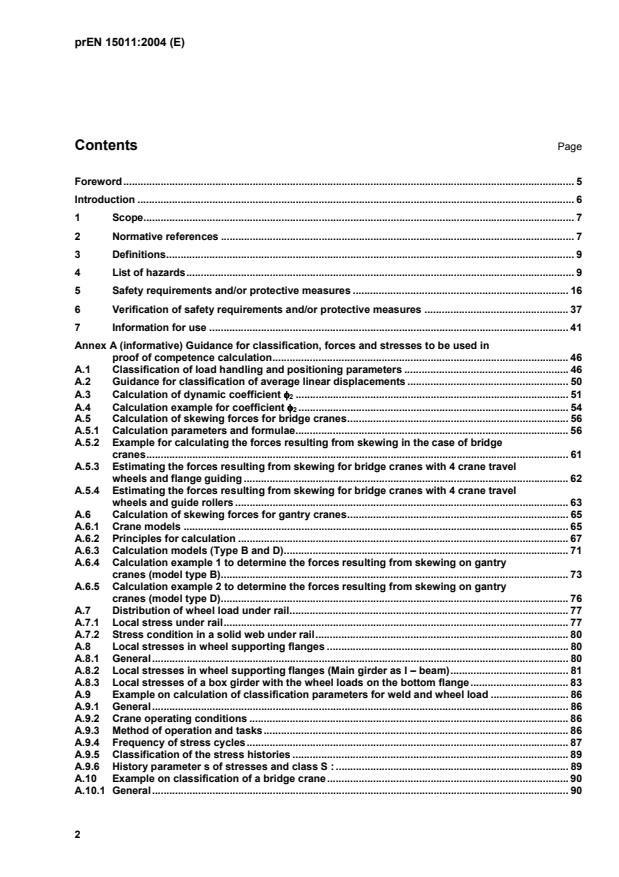
Contents Page
Foreword. 5
Introduction . 6
1 Scope. 7
2 Normative references . 7
3 Definitions. 9
4 List of hazards. 9
5 Safety requirements and/or protective measures . 16
6 Verification of safety requirements and/or protective measures . 37
7 Information for use . 41
Annex A (informative) Guidance for classification, forces and stresses to be used in
proof of competence calculation. 46
A.1 Classification of load handling and positioning parameters . 46
A.2 Guidance for classification of average linear displacements . 50
A.3 Calculation of dynamic coefficient φφ . 51
φφ
A.4 Calculation example for coefficient φφφφ . 54
A.5 Calculation of skewing forces for bridge cranes. 56
A.5.1 Calculation parameters and formulae. 56
A.5.2 Example for calculating the forces resulting from skewing in the case of bridge
cranes. 61
A.5.3 Estimating the forces resulting from skewing for bridge cranes with 4 crane travel
wheels and flange guiding . 62
A.5.4 Estimating the forces resulting from skewing for bridge cranes with 4 crane travel
wheels and guide rollers . 63
A.6 Calculation of skewing forces for gantry cranes. 65
A.6.1 Crane models . 65
A.6.2 Principles for calculation . 67
A.6.3 Calculation models (Type B and D). 71
A.6.4 Calculation example 1 to determine the forces resulting from skewing on gantry
cranes (model type B). 73
A.6.5 Calculation example 2 to determine the forces resulting from skewing on gantry
cranes (model type D). 76
A.7 Distribution of wheel load under rail. 77
A.7.1 Local stress under rail. 77
A.7.2 Stress condition in a solid web under rail. 80
A.8 Local stresses in wheel supporting flanges . 80
A.8.1 General. 80
A.8.2 Local stresses in wheel supporting flanges (Main girder as I – beam). 81
A.8.3 Local stresses of a box girder with the wheel loads on the bottom flange. 83
A.9 Example on calculation of classification parameters for weld and wheel load . 86
A.9.1 General. 86
A.9.2 Crane operating conditions . 86
A.9.3 Method of operation and tasks. 86
A.9.4 Frequency of stress cycles. 87
A.9.5 Classification of the stress histories . 89
A.9.6 History parameter s of stresses and class S : . 89
A.10 Example on classification of a bridge crane. 90
A.10.1 General. 90
A.10.2 Crane specification. 90
A.10.3 Crane duty . 91
A.10.4 Results of the preliminary strength analysis of the girder. 92
A.10.5 Classification. 92
A.11 Guidance on recommended maximum deflection of girders. 102
A.12 Guidance on recommended minimum frequencies of girders. 103
A.13 Accelerations and dynamic factors φφφφ (informative) . 104
Annex B (informative) Guide for selection of rail wheels . 106
B.1 Rail wheel size. 106
B.1.1 General. 106
B.1.2 Determining the mean load. 107
B.1.3 Determining the useful rail width b. 107
B.1.4 Determining the limiting pressure P . 108
L
B.1.5 Determining the coefficient c . 108
B.1.6 Determining the coefficient c . 109
B.2 Determination of the class of mechanism of the travel wheel . 110
Annex C (informative) Risk assessment for the evaluation of the requirements for the
anti-collision system. 111
C.1 Principles of risk assessment . 111
C.1.1 General. 111
C.1.2 Probability of a collision. 111
C.1.3 Effects of a collision . 111
C.2 Probability of a collision. 111
C.2.1 Probability Factors. 111
C.2.2 Speed Factor . 112
C.2.3 Visibility Factor . 112
C.2.4 Environmental factor . 113
C.2.5 Number of cranes Factor. 113
C.3 Effects of a collision . 114
C.3.1 General. 114
C.3.2 Effects on crane factor . 114
C.3.3 Load form factor, E . 114
l
C.3.4 Injury potential factor . 116
C.3.5 Injury type factor . 116
C.4 Action required. 117
Annex D (informative) Scoring system for risk assessment on load-person interference. 118
Annex E (normative) Noise test code . 119
E.1 Scope. 119
E.2 References. 120
E.3 Definitions. 120
E.4 Description of machinery family . 120
E.5 Calculation method. 120
E.5.1 Principle of the method . 120
E.5.2 Calculation. 120
E.6 Sound pressure level determination at control stations by measurement. 122
E.6.1 Measurement points . 122
E.6.2 Installation and mounting conditions. 122
E.6.3 Operating conditions. 123
E.7 Uncertainties . 124
E.8 Information to be recorded . 124
E.9 Information to be reported . 124
E.10 Declaration and verification of noise emission values. 124
Annex F (normative) Particular requirements valid for the cranes during lifting of persons. 125
Annex G (Informative) Actions on crane supporting structures induced by cranes. 126
G.1 Actions induced by cranes . 126
G.2 Dynamic factors . 127
Annex H (informative) Information labels. 128
Annex I (informative) Selection of a suitable set of crane standards for a given application . 130
Annex ZA (informative) Relationship of this European Standard with EU Directives. 132
Bibliography . 133
Foreword
This document (prEN 15011:2004) has been prepared by Technical Committee CEN/TC 147 “Cranes
- Safety”, the secretariat of which is held by BSI.
This document is currently submitted to the CEN Enquiry.
This document has been prepared under a mandate given to CEN by the European Commission and
the European Free Trade Association, and supports essential requirements of EU Directive(s).
For relationship with EU Directive(s), see informative Annex ZA, which is an integral part of this
document.
Introduction
This document is a harmonized European Standard to provide one means for bridge and gantry
cranes to conform with the Essential Health and Safety Requirements of the Machinery Directive
98/37/EEC .
This European Standard is a type C standard as stated in EN 1070.
The machinery concerned and the extent to which hazards, hazardous situations and events are
covered are indicated in the scope of this document.
When provisions of this type C standard are different from those which are stated in a B standard, the
provisions of this type C standard take precedence over the provisions of the other standards, for
machines that have been designed and built according to the provisions of this type C standard.
Absolute safety of the crane cannot be ensured by design, as operation depends on the skills of the
operators, maintenance personnel and inspectors as well as on numerous technical parameters in the
crane or its environment which may have large scatter. Therefore selections provided by this standard
reflect only the state of the art at the time of writing.
As many hazards related to bridge and gantry cranes depend on the place and use of the crane, it is
assumed that the correct information has been exchanged between the manufacturer and user (as
suggested in the ISO 9374-1 and 5), e.g:
Clearances
Requirements concerning protection against hazardous environment
Processed materials, such as potentially flammable or explosive material (e.g. coal, powder type
materials).
1 Scope
This European standard specifies the safety requirements for the bridge and gantry cranes. This
standard is not applicable to runways and other supporting structures.
The standard deals with all significant hazards, hazardous situations and events relevant to bridge
and gantry cranes, when used as intended and under conditions foreseen by the manufacturer (see
clause 4).
The specific hazards due to potentially explosive atmospheres, underground work, ionizing radiation,
and operation in electromagnetic fields beyond the range of EN 50082-2 are not covered by this
standard. Also the additional loads due to mounting on a floating or tilting basement are not covered
by this standard.
This standard includes requirements for the lifting of persons.
NOTE The use of cranes for lifting of persons may be subject to specific national regulations.
This European Standard is applicable to bridge and gantry cranes which are manufactured after the
date of approval by CEN of this standard.
2 Normative references
The following referenced documents are indispensable for the application of this document.
For dated references, only the edition cited applies. For undated references, the latest edition
of the referenced document (including any amendments) applies.
EN 292-1: 1991, Safety of machinery — Basic concepts, general principles for design — Part 1: Basic
terminology, methodology
EN 292-2: 1991/A1: 1995, Safety of machinery — Basic concepts, general principles for design —
Part 2: Technical principles and specifications
EN 294: 1992, Safety of machinery - Safety distance to prevent danger zones being reachedby the
upper limbs
EN 547-1, Safety of machinery — Human body measurements — Part 1: Principles for determining
the dimensions required for openings for whole body access into machinery
EN 547-2, Safety of machinery — Human body measurements — Part 2: Principles for determining
the dimensions required for access openings
EN 614-1, Safety of machinery — Ergonomic design principles — Part 1: Terminology and general
principles
EN 894-1, Safety of machinery — Ergonomics requirements for the design of displays and control
actuators — Part 1: General principles for human interactions with displays and control actuators
EN 894-2, Safety of machinery — Ergonomics requirements for the design of displays and control
actuators — Part 2: Displays
prEN 894-3, Safety of machinery — Ergonomics requirements for the design of displays and control
actuators — Part 3: Control actuators
EN 953, Safety of machinery — Guards — General requirements for the design and construction of
fixed and movable guards
EN 954-1, Safety of machinery — Safety-related parts of control systems — Part 1: General principles
for design
prEN 1005-3, Safety of machinery — Human physical performance — Part 3: Recommended force
limits for machinery operation
EN 1070, Safety of machinery — Terminology
EN 10002-1:1990, Metallic materials — Tensile testing — Part 1: Method of test (at ambient
temperature)
EN 12077-2: 1998, Cranes safety — Requirements for health and safety — Part 2: Limiting and
indicating devices
EN 12644-1: 2001, Cranes — Information for use and testing — Part 1: Instructions
EN 12644-2: 2000, Cranes — Information for use and testing — Part 2: Marking
prEN 13001-1, Cranes — General Design — Part 1: General principles and requirements
prEN 13001-2, Cranes — General Design — Part 2: Load actions
prCEN/TS 13001-3.1, Cranes — General Design — Part 3.1: Limit States and Proof of Competence
of Steel Structures
prEN 13135-1, Cranes — Equipment — Part 1: Electrotechnical equipment
prEN 13135-2, Cranes — Equipment — Part 2: Non-electrotechnical equipment
EN 13202, Ergonomics of the thermal environment — Temperatures of touchable hot surfaces —
Guidance for establishing surface temperature limit values in production standards with the aid of
EN 563
prEN 13557, Cranes — Controls and control stations
,
prEN 13586 Cranes — Access
prEN 14492-2 Cranes — Power driven winches and hoists — Part 2: Power driven hoists
EN 60073, Basic and safety principles for man-machine interface, marking and identification —
Coding principles for indication devices and actuators
EN 60204-32, Safety of machinery — Electrical equipment of machines — Part 32: Requirements for
hoisting machines
EN 60825-1, Safety of laser products — Part 1: Equipment classification, requirements and user's
guide
EN 61310-2, Safety of machinery — Indicating, marking and actuation —- Part 2: Requirements for
marking
ISO 3864, Safety colours and safety signs
ISO 7752-5, Lifting appliances — Controls — Layout and characteristics — Part 5: Overhead
travelling cranes and portal bridge cranes
ISO 8566-5, Lifting appliances — Cabin — Part 5: Overhead travelling cranes and portal bridge
cranes
ISO 10245-5, Cranes — Limiting and indicating devices — Part 5: Overhead travelling and portal
bridge cranes
ISO/FDIS 11660-5, Cranes — Access, guards and restraints — Part 5: Bridge and Gantry Cranes
ISO/CD 12488-1, Cranes — Tolerances of cranes and tracks — Travel and Traverse —
Part 1: General
ISO 1680: 1999, Acoustics — Test code for the measurement of airborne noise emitted by rotating
electrical machines
EN ISO 3744: 1995, Acoustics — Determination of sound power levels of noise sources using sound
pressure — Engineering method in an essentially free field over a reflecting plane
EN ISO 11202: 1995, Acoustics — Noise emitted by machinery and equipment — Measurement of
emission sound pressure levels at a work station and at other specified positions — Survey method in
situ
EN ISO 11203: 1995, Acoustics — Noise emitted by machinery and equipment — Determination of
emission sound pressure levels at a work station and at other specified positions from the sound
power level
EN ISO 11204: 1995, Acoustics — Noise emitted by machinery and equipment — Measurement of
emission sound pressure levels at a work station and at other specified positions — Method requiring
environmental
3 Definitions
For the purposes of this document, the terms and definitions of EN 1070, ISO 1680, EN ISO 3744, EN
ISO 11202, EN ISO 11203, and EN ISO 11204 apply together with the following.
3.1
bridge crane
a crane having at least one primarily horizontal girder moving along tracks on which is mounted at
least one hand, or power driven, hoist
3.2
gantry crane
a crane having at least one essentially horizontal girder supported by at least one leg moving along
tracks and equipped with at least one hand, or power driven, hoist
3.3
limit of the crane
the contact point between the crane and fixed environment
4 List of hazards
Table 1 contains all the significant hazards, hazardous situations and events, as far as they are dealt
with in this standard, identified by risk assessment as significant for this type of machinery and which
require action to eliminate or reduce the risk.
Table 1 — List of significant hazards and associated requirements
No. Hazard (as listed in EN 1050:1997) EN EN 292-2 Other EN- Relevant
292-1 standars clause(s) in this
and ISO- standard
standards
1 Mechanical hazards 4.2
1.1 Generated by machine parts or 4.2 3.1, 3.2, 4
workpieces, e.g. by:
1.1.1 Shape
1.1.2 relative location 5.4.2
1.1.3 mass and stability EN 13001 5.2
1.1.4 mass and velocity EN 13135-2 5.3.3, 5.4.2.5
1.1.5 inadequacy of mechanical. .strength EN 13001 5.2
1.2 Accumulation of energy inside the 4.2 3.8, 6.2.2
machinery, e.g. by:
1.2.1 elastic elements (springs)
1.2.2 fluids under pressure EN 13135-2 5.3.1
5.7
1.2.3 the effect of vacuum
1.3 Elementary forms of mechanical 4.2.1
hazards
1.3.1 Crushing 4.2.1, 3.2 EN 294, EN 5.1, 5.4.2,
4.2.2 349 7.1.1.1
1.3.2 Shearing 4.2.1, 3.2, 4.1.1 EN 13586 5.4.2.4, 5.4.2.6
4.2.2
1.3.3 Cutting or severing 4.2.1, 3.2 ISO 8566-1
4.2.2 6.3,
EN 13557
1.3.4 Entanglement hazard 4.2.1,
4.2.2
1.3.5 Drawing-in or trapping hazard 4.2.1 3.11, 4.1.1, EN 953 5.4.2.7 to 5.4.2.9
- moving transmission parts 6.1.2 EN 294
1.3.6 Impact 4.2.1 5.3.3.5, 5.4.1.5
7.2.1.1.4
1.3.7 Stabbing or puncture hazard 4.2.1
1.3.8 Friction or abrasion hazard 4.2.1 3.3.b
1.3.9 High pressure fluid injection or 4.2.1 3.3.a EN13135-2 7.2.2.2
ejection hazard
2 Electrical hazards due to: EN13135-1 5.1
2.1 Contact of persons with live parts 4.3 EN 60204-32
(direct contact)
2.2 Contact of persons with parts which 4.3 EN 60204-32
have become live under faulty
conditions (indirect contact)
2.3 Approach to live parts under high EN 60204-32
voltage
2.4 Electrostatic phenomena 4.3 EN 60204-32
2.5 Thermal radiation or other 4.3 EN 60204-32
phenomena such as the projection of
molten particles and chemical effects
from short-circuits, overloads, etc.
Table 1 — List of significant hazards and associated requirements (Continued)
No. Hazard (as listed in EN 1050:1997) EN EN 292-2 Other EN- Relevant
292-1 standars clause(s) in this
and ISO- standard
standards
3 Thermal hazards, resulting in:
3.1 burns and scalds, by possible 4.4 3.6.3 EN 563, 5.3.5.1, 7.2.3.3.
contact of persons with objects or EN 13135-2
materials with an extreme
temperature, by flames, by radiation,
etc.
3.2 Hot or cold working environment. 4.4 EN 13557
4 Hazards generated by noise, 4.5 3.2, 3.6.3, 4
resulting in:
4.1 Hearing losses 5.4.4
4.2 Interference with speech 5.4.4, 7.2.1.2.2
communication, signals,.
5 Hazards generated by vibration 4.6 3.2, 3.6.3
5.1 Use of hand-held machines. -
5.2 Whole body vibration, particularly 5.2.2.6
when combined with poor postures
6 Radiation
6.0 External radiation See introduction
6.1 Low frequency , radio frequency 4.7 5.3.5.2.1
radiation, micro waves
6.2 Infrared, visible, UV-light 5.3.5.2.2
6.3 X and gamma rays -
6.4 Alpha, beta rays, electron or ion 4.7 3.7.3, 3.7.11
beams; neutrons
6.5 Lasers 4.7 EN 60825-1 5.3.5.2.3
7 Processed materials and
substances, used materials, fuels
7.1 Hazards from contact with harmful 4.8 3.3.b, 3.4 EN 60204-1: 5.3.5.3
fluids, gases, mists, fumes and dusts cl. 14.3 See Introduction
7.2 Fire or explosion hazard 4.8 3.4 See Introduction
7.3 Biological and micro-biological 4.8 -
hazards.
8 Neglected ergonomic principles in 4.9 3.6
machine design e.g. hazards from:
8.1 Unhealthy postures or excessive 4.9 3.6.1, 3.6.4, EN 547-1. -2 5.4.1.6 to 5.4.1.7
efforts 6.2.1-6
8.2 Inadequate consideration of hand- 4.9 3.6.2, 3.6.9 EN 614-1
arm or foot-leg anatomy
8.3 Neglected use of personal protection 5.5 3.6.6, 5.4, 5.5.3.1.3
equipment 5.5.1d
8.4 Inadequate local lighting 3.6.5 5.4.3
8.5 Mental overload or underload, stress 4.9 3.6.4 5.4.1.3, 7.2.1.2.7
Table 1 — List of significant hazards and associated requirements (Continued)
No. Hazard (as listed in EN 1050:1997) EN EN 292-2 Other EN- Relevant
292-1 standars clause(s) in this
and ISO- standard
standards
8.6 Human errors, human behaviour 4.9 3.6, 3.7.8, 5.3.3.4, 5.4.1,
3.7.9, 5, 7.2.1
6.1.1
8.7 Inadequate design, location or 3.6.6, 3.7.8 ISO 7752-5 5.4.1
identification of manual controls
8.8 Inadequate design or location of 3.6.7, 5.2 EN 894-1, - 5.5.2
visual display units 2, -3
9 Combination of hazards 4.10 EN 13001-2 5.6
Hazardous events
(Events which may result in risk from one or several of the basic hazards)
10 Unexpected start-up, unexpected
overrun/overspeed (or any similar
malfunction) from:
10.1 Failure/ disorder of control systems 3.17, 3.7, 6.2.2 EN 60204-32 5.4.1
3.15, EN 954,
3.16 EN 418
10.2 Restoration of energy supply after an 3.7.2
interruption
10.3 External influences on electrical 4.3 3.4, 3.7.11
equipment
10.4 Other external influences (gravity, 3.7.3
wind, etc.)
10.5 Errors in the software 3.7.7
10.6 Errors made by the operator (due to 4.9 3.6, 3.7.8,
mismatch of machinery with human 3.7.9, 5,
characteristics and abilities, see No. 6.1.1
8.6)
11 Impossibility of stopping the 3.7, 3.7.1, 5.3.3.1
machine in the best possible
6.1.1
conditions
12 Variation in the rotational speed of 3.2, 3.3 -
tools
13 Failure of the power supply 3.16 3.7, 3.7.2 EN 60204-32 5.3.1.1
14 Failure of the control circuit 3.7, 6.2.2 EN 60204-32 5.3.1.1
15 Errors of fitting
4.9 5.5, 6.2.1
16 Break-up during operation 4.2.2 3.3 5.2, 7.2.2,
7.2.3.1 to 7.2.3.2
16.1 Thermal effect on the crane 5.3.1.1
17 Falling or ejected object. or fluid 1.3.6, 3.3, 3.8 EN 13586 5.3.1.1, 5.4.2.1,
1.3.9, 7.2.2.2
4.2.2
18 Loss of stability / overturning of 4.2.2 6.2.5
machinery
Loss of rigid body stability 4.2.2 3.3, 6.2.5 EN13001-2 5.2.3
19 Slip, trip and falling of persons 4.2.3 6.2.4 EN 13586 5.4.2
(related to machinery)
Table 1 — List of significant hazards and associated requirements (Continued)
No. Hazard (as listed in EN 1050:1997) EN EN 292-2 Other EN- Relevant clause(s)
292-1 standars in this standard
and ISO-
standards
Additional hazards and hazardous events due to mobility
20 Relating to the travelling function
20.1 Uncontrolled movement of crane A1:Annex.A,
when starting the engine 3.3.2, 3.3.4
20.2 Movement without a driver at the A1:Annex.A, 5.3.1.1
driving position 3.3.2
20.3 Movement without all parts in a safe A1:Annex.A,
position 3.3.2
20.4 Excessive speed of pedestrian A1:Annex.A, EN 13557
controlled machinery 3.3.4
20.5 Excessive oscillations when moving 5.3.3.2, 5.4.1.4
20.6 Insufficient ability of machinery to be 5.3.1.1, 5.3.3.1,
slowed down, stopped and 5.3.3.3, 7.2.1.2.3,
immobilized 7.2.1.2.6
21 Linked to the work position
(including driving station) on the
machine
21.1 Fall of persons during access to (or EN 13586, 5.4.2.1
at/from) the work position ISO 11660-5
21.2 Exhaust gases / lack of oxygen at the 5.3.5.3.2
work position
21.3 Fire (flammability of the cab, lack of EN 13557
extinguishing means)
21.4 Mechanical hazards at the work
position
- contact with the wheels 5.4.2.5,
- fall of objects, penetration by object 5.4.2.7
- contact of persons with machine
parts or tools (pedestrian control.)
21.5 Insufficient visibility from the working EN 13557 5.4.1.1, 5.4.1.6
position
21.6 Inadequate lighting 5.4.3
21.7 Inadequate seating A1:Annex.A, EN 13557,
3.2.2 ISO 8566-5
21.8 Noise at the driving position See item 4. 5.4.4.2
21.9 Vibration at the driving position See item 5. 5.2.2.6
21.10 Insufficient means of A1:Annex.A, EN 13586, 5.3.5.3.1
evacuation/emergency exit 3.2.1 EN 60204-32
22 Due to the control system 5.4.1
22.1 Inadequate location of controls See 8.1, 8.2
/control devices
22.2 Inadequate design of the actuation ISO 7752-1, 5.3.1.1, 5.4.1.1-2
mode and/or action mode of controls -5
23 From handling the machine (lack of A1:Annex.A, 5.3.3.3
stability) 3.1.3
24 Due to the power source and to
the transmission of power
24.1 Hazards from the engine and the A1:Annex.A,
batteries 3.4.8, 3.5.1
Table 1 — List of significant hazards and associated requirements (Continued)
No. Hazard (as listed in EN 1050:1997) EN EN 292-2 Other EN- Relevant clause(s)
292-1 standars in this standard
and ISO-
standards
25 From/to third persons
25.1 Unauthorized start-up/use A1:Annex.A, EN 60204-32
3.3.2 5.4
25.2 Drift of a part, away from its stopping
position
25.3 Lack or inadequacy of visual or A1:Annex.A, 5.5
acoustic warning means 1.7.4, 3.6.1
26 Insufficient instructions for the
driver / operator
26.1 Movement into prohibited area 7.2.1.2.4
26.2 Tipping - Swinging 7.2.1.1.6, 7.2.1.2.5
26.3 Collision: machines-machine. ISO 10245-5 7.2.1.1.4-5,
7.2.1.2.9
26.4 Collision: machines-persons 7.2.1.1.4-5,
26.5 Ground conditions 7.2.1.2.3
26.6 Supporting conditions 7.2.1.2.10
Additional hazards and hazardous events due to load lifting
27 Mechanical hazards. and events
27.1 from load falls, collision, machine
tipping caused by:
27.1.1 lack of stability A1:Annex.A, 5.2.3
4.1.2.1
27.1.2 Uncontrolled loading -overloading – A1:Annex.A, 5.3.2.1
overturning moment exceeded 4.2.1.4
27.1.3 Uncontrolled amplitude of A1:Annex.A, 5.4.1.4
movements 4.1.2.6a
27.1.4 Unexpected/unintended movement A1:Annex.A, EN 13135-1, 5.4.1.1
of loads 4.1.2.6c -2
27.1.5 Inadequate holding devices / A1:Annex.A, EN 13135-2 5.3.1.1
accessories 4.1.2.6e,
4.4.1
27.1.6 Collision of more than one machine A1:Annex.A, 5.3.3.6
4.1.2.6b
27.1.7 Two-block of hook to hoist 5.3.2.2
27.2 From access of persons to load A1:Annex.A, 7.2.1.1.8
support
27.3 From derailment A1:Annex.A, EN 13135-2 5.3.3.7-8
27.4 From insufficient mechanical strength
of parts
Loss of mechanical strength, or 4.2 3, 5.2, 5.3.4, 7.2.2
inadequate mechanical strength A1:Annex.A,
4.1.2.3
27.5 From inadequate design of pulleys, A1:Annex.A, EN 13135-2 5.3.1.1
drums 4.1.2.4
27.6 From inadequate selection/ A1:Annex.A, EN 13135-2 5.3.1.1,
integration into the machine of 4.1.2.4-5, 5.2.1.1.2(4)
chains, ropes, lifting accessories 4.3.1-2
Table 1 — List of significant hazards and associated requirements (Continued)
No. Hazard (as listed in EN 1050:1997) EN EN 292-2 Other EN- Relevant clause(s)
292-1 standars in this standard
and ISO-
standards
27.7 From lowering of the load by A1:Annex.A, EN 13135-2
friction brake 4.1.2.6d
27.8 From abnormal conditions of A1:Annex.A, 5.6, 7.1, 7.2.1.2.8
assembly/ testing/ use/ maintenance 4.4.1, 4.4.2d
27.9 Load-person interference (impact by A1:Annex.A, 5.4.1.5
load) 4.1.2.6b,
4.1.2.7,
4.2.3
28 Electrical hazard
28.1 from lightning A1:Annex.A, EN 13135-1 7.2.2.3
4.1.2.8
29 Hazards generated by neglecting
ergonomic principles
29.1 insufficient visibility from the driving A1:Annex.A, EN 13557 5.4.1.6
position 4.1.2.7,
4.4.2c
Additional hazards, hazardous situations and events due to lifting or moving of persons
34 Mechanical hazards and
hazardous events due to:
34.1 Inadequate working coefficients A1:Annex.A, 5.7
6.1.2
34.2 Failing of load control A1:Annex.A, 5.7
6.1.3
34.3 Failing of controls in person carrier A1:Annex.A, 5.7
(function, priority) 6.2.1
34.4 Overspeed of person carrier A1:Annex.A, 5.7
6.2.3
35 Falling of person from person A1:Annex.A,
carrier 6.3.1-3
36 Falling or overturning of person
A1:Annex.A,
carrier 6.4.1-2
37 Human error, human behaviour A1:Annex.A,
6.5
5 Safety requirements and/or protective measures
5.1 General
For those hazards which are relevant, though not significant, bridge and gantry cranes shall conform
to EN 292 in addition to the requirements of this clause.
Bridge and gantry cranes shall be in accordance with the following standards:
prEN 13001-1, Crane safety — General design — Part 1: General principles and requirements;
prEN 13001-2, Crane safety — General design — Part 2: Load actions;
prEN 13001-3-1, Cranes — General design — Part 3: Limit states and proof of competence of
steel structures;
prEN 13135-1, Cranes — Equipment — Part 1: Electrotechnical equipment;
prEN 13135-2, Cranes — Equipment — Part 2: Non-electrotechnical equipment;
prEN 13557, Cranes — Controls and control stations;
EN 12077-2, Cranes safety — Requirements for health and safety — Part 2: Limiting and
indicating devices;
prEN 13586, Cranes — Access;
EN 12644-1, Cranes — Information for use and testing — Part 1: Instructions;
EN 12644-2, Cranes — Information for use and testing — Part 2: Marking;
prEN 12644-3, Cranes — Information for use and testing — Part 3: Fitness for purpose;
prEN 14492-2, Cranes — Power driven winches and hoists — Part 2: Power driven hoists.
This standard provides more detailed requirements and selections of parameters for bridge and
gantry cranes in cases which the above mentioned standards have left open or where the provisions
of the above mentioned standards do not apply. Therefore those provisions have been modified in this
standard in accordance with the specific characteristics of bridge and gantry cranes.
5.2 Requirements for strength and stability
5.2.1 Load actions
5.2.1.1 Selection of service conditions
5.2.1.1.1 Selection of classification parameters
The service conditions that are selected and used as the basis of design, in accordance with EN
13001-1, shall be specified in the technical file of the crane.
NOTE 1 Two examples on estimation of classification parameters are given in A.11. Also support in
classification is provided by ISO 9374-5: Cranes — Information to be provided — Part 5 : Overhead travelling
cranes and portal bridge cranes.
NOTE 2 If the classification parameters cannot be adequately derived or estimated on the basis of the
foreseen use guidance for selection is given in Annex A
5.2.1.1.2 Multiple lifting points
NOTE For cranes which are equipped with multiple reeving systems for lifting single loads the loading on
the individual reeving system will depend on the position of the load centre of gravity with respect to the lifting
points.
Normal case
The design of the rope reeving system shall be based on the maximum load expected in the system
based on the rated load and load eccentricity which shall be specified in the technical file and in the
operating instructions.
Special case
The reeving system design may be based on the rated load divided by the number of systems, when
the following conditions are met:
1) A load limiter is fitted on each rope system which limits the maximum load to not greater than
75 % of the total load in one rope system. This load limiting system shall allow the full speed
performance of the crane to be achieved.
2) The eccentricity of loading shall be equally distributed in average and not permanently
skewed to one rope system. Examples of such loading are ISO Containers, steel products
lifted with slings or magnet hooks.
3) The total load limiting system shall prevent the lifting of more than 100 % of the rated load at
the rated speeds and accelerations.
4) The selection of the rope, reeving components and the attached structures and mechanisms
shall comply with the specified classifications of the load spectrum, Q , number of working
x
cycles, U , and number of positioning movements, P , with evenly distributed rated load of
y z
the whole system. Each rope system shall comply with one step lower load spectrum class,
Q , with maximum eccentric loading, while other classifications remain the same.
x-1
5.2.1.2 Determination of factor φφφφ
5.2.1.2.1 Selection of φφφφ
The dynamic load factor φ shall be determined in one of the following ways:
on the basis of the hoist class, HC, (see EN 13001-2),
by direct calculation in accordance with A.3 in Annex A
experimentally
When the determination of factor φ is based on the hoist class (HC to HC ) the elasticity proporties
1 4
of the crane shall correspond to the selected hoist class in accordance with the tables 2 and 3 in
clause 4.1.2.2.1 of EN 13001-2.
When φ is calculated in accordance with A.3 in Annex A, the hoisting speed shall be based on the
relevant type of hoist drive, see Table 3 in EN 13001-2.
When the hoist mechanism is equipped with a hoist force limiter, φ determined for load
combination C1 shall be replaced by the limiter factor φ or φ depending on the type of the limiter.
DAL IAL
5.2.1.2.2 Effect of lifting force limiter
Lifting force limiters may be used for controlling the loading of electrically, pneumatically or
hydraulically powered hoists.
Lifting force limiters act automatically by:
limiting the force flow (direct lifting force limitation), or
switching off and stopping the lifting drive (indirect force limitation).
Direct acting lifting force limiters act directly in the chain of drive elements and limit the transmitted
force. Limiters may be, for example, slipping clutches, pressure limiting valves, etc. Direct acti
...