

SIST EN 16604-10:2024
(Main)Space sustainability - Space debris mitigation requirements (ISO 24113:2023, modified)
General Information
- Abstract
This document defines the primary space debris mitigation requirements applicable to all elements of unmanned systems launched into, or passing through, near-Earth space, including launch vehicle orbital stages, operating spacecraft and any objects released as part of normal operations.
- Status
- Published
- Public Enquiry End Date
- 01-Aug-2023
- Publication Date
- 15-Jan-2024
- Technical Committee
- I13 - Imaginarni 13
- Current Stage
- 6060 - National Implementation/Publication (Adopted Project)
- Start Date
- 03-Jan-2024
- Due Date
- 09-Mar-2024
- Completion Date
- 16-Jan-2024

Overview
EN 16604-10:2023 - Space sustainability - Space debris mitigation requirements (ISO 24113:2023, modified) is a CEN-adopted European standard that translates the international ISO 24113:2023 space-debris requirements into a European/ECSS context. It defines high-level, mandatory requirements for reducing the creation and long‑term presence of space debris for all unmanned elements launched into or passing through near‑Earth space, including launch vehicle orbital stages, operating spacecraft and objects released during normal operations.
Key Topics
- Scope and definitions: Clear terminology for end of mission, end of life, disposal, controlled re‑entry, break‑up and other lifecycle terms used in space sustainability and space debris mitigation.
- Protected regions: Identification and special considerations for commonly used protected regions (e.g., LEO and GEO) and their implications for disposal planning.
- Technical requirements (Clauses 7.x):
- Restricting intentional release of debris during normal operations, including sources such as pyrotechnics and solid rocket motors.
- Avoiding break‑ups: requirements addressing intentional and accidental break‑ups from onboard energy sources and collision risk management.
- Disposal after end of mission: provisions to minimize long‑term interference with protected regions, including guidance for GEO and LEO disposal and re‑entry approaches.
- Planning requirements (Clause 8): obligation to produce a space debris mitigation plan and to include post‑launch lifecycle considerations (Annex A).
- Standards lineage & modifications: Adoption of ISO 24113:2023 with ECSS-related clarifications and delta‑requirements to reflect European practice and regulatory context.
Applications
EN 16604-10:2023 is used to ensure compliance with Europe‑level space debris mitigation expectations and to operationalize space sustainability objectives. Typical users include:
- Satellite and spacecraft designers integrating debris mitigation into system requirements and design reviews.
- Launch service providers and launch vehicle stage designers managing release and post‑mission disposal.
- Mission planners and operations teams responsible for end‑of‑life maneuvers, collision avoidance, and controlled re‑entry planning.
- National licensing and regulatory authorities, space agencies and approving agents that assess conformity with debris mitigation obligations.
- Procurement and program managers embedding contractual requirements for space sustainability.
Practical uses include creating debris mitigation plans, defining disposal manoeuvre strategies for LEO/GEO, reducing break‑up risk through energy management, and documenting compliance for licensing or certification.
Related Standards
- ISO 24113:2023 - Space systems - Space debris mitigation requirements (primary international reference)
- ECSS documents (source of some EU modifications)
- IADC, ITU and UN space debris and re‑entry guidance (contextual guidance referenced in the standard)
Keywords: space sustainability, space debris mitigation, EN 16604-10:2023, ISO 24113:2023, protected regions, LEO, GEO, disposal, controlled re‑entry, spacecraft design.
Relations
- Effective Date
- 15-Mar-2023
Get Certified
Connect with accredited certification bodies for this standard

BUREAU VERITAS Certification Germany
Bureau Veritas certification in Germany.

Element Materials Technology
Materials testing and product certification.

AQMS Ltd.
AQMS provides ISO certification to SMEs across the UK.
Sponsored listings
Frequently Asked Questions
SIST EN 16604-10:2024 is a standard published by the Slovenian Institute for Standardization (SIST). Its full title is "Space sustainability - Space debris mitigation requirements (ISO 24113:2023, modified)". This standard covers: This document defines the primary space debris mitigation requirements applicable to all elements of unmanned systems launched into, or passing through, near-Earth space, including launch vehicle orbital stages, operating spacecraft and any objects released as part of normal operations.
This document defines the primary space debris mitigation requirements applicable to all elements of unmanned systems launched into, or passing through, near-Earth space, including launch vehicle orbital stages, operating spacecraft and any objects released as part of normal operations.
SIST EN 16604-10:2024 is classified under the following ICS (International Classification for Standards) categories: 13.030.99 - Other standards related to wastes; 49.140 - Space systems and operations. The ICS classification helps identify the subject area and facilitates finding related standards.
SIST EN 16604-10:2024 has the following relationships with other standards: It is inter standard links to SIST EN 16604-10:2019. Understanding these relationships helps ensure you are using the most current and applicable version of the standard.
SIST EN 16604-10:2024 is associated with the following European legislation: Standardization Mandates: M/496. When a standard is cited in the Official Journal of the European Union, products manufactured in conformity with it benefit from a presumption of conformity with the essential requirements of the corresponding EU directive or regulation.
SIST EN 16604-10:2024 is available in PDF format for immediate download after purchase. The document can be added to your cart and obtained through the secure checkout process. Digital delivery ensures instant access to the complete standard document.
Standards Content (Sample)
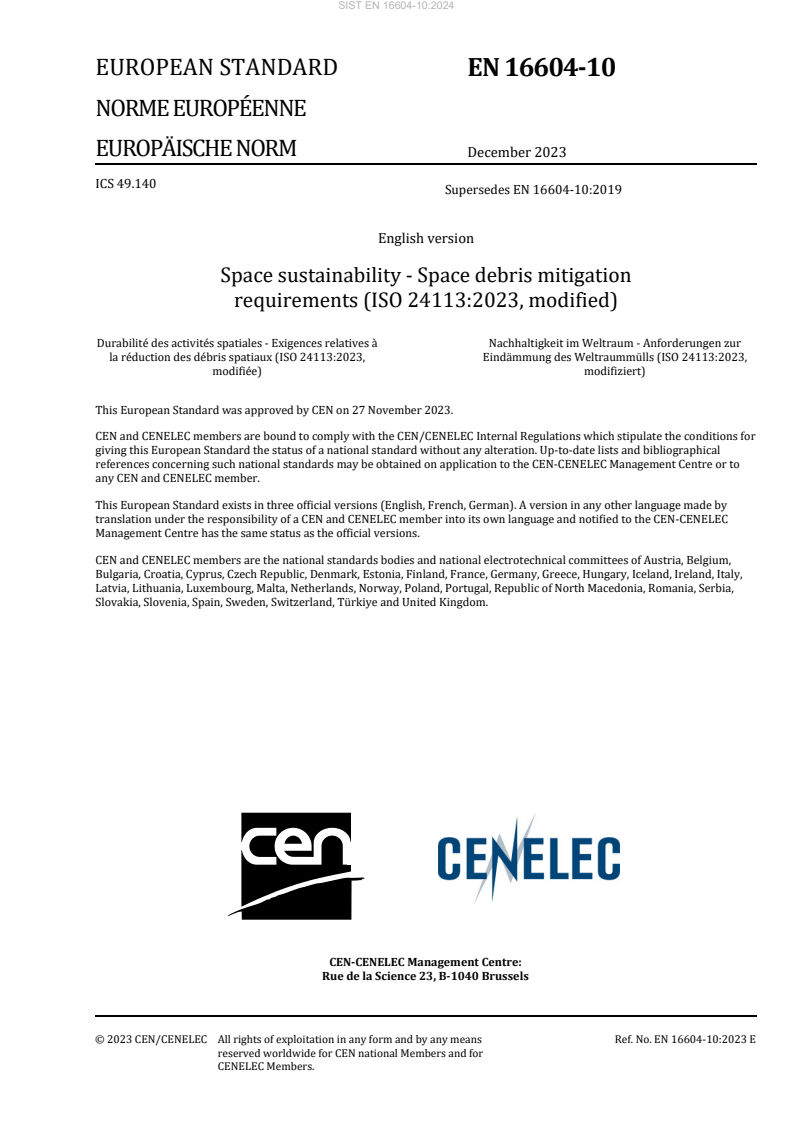
SLOVENSKI STANDARD
01-februar-2024
Vesoljska vzdržljivost - Zahteve za zmanjšanje količine vesoljskih odpadkov (ISO
24113:2019, spremenjen)
Space sustainability - Space debris mitigation requirements (ISO 24113:2023, modified)
Nachhaltigkeit im Weltraum - Anforderungen zur Eindämmung des Weltraummülls (ISO
24113:2023, modifiziert)
Durabilité des activités spatiales - Exigences relatives à la réduction des débris spatiaux
(ISO 24113:2023, modifiée)
Ta slovenski standard je istoveten z: EN 16604-10:2023
ICS:
13.030.99 Drugi standardi v zvezi z Other standards related to
odpadki wastes
49.140 Vesoljski sistemi in operacije Space systems and
operations
2003-01.Slovenski inštitut za standardizacijo. Razmnoževanje celote ali delov tega standarda ni dovoljeno.
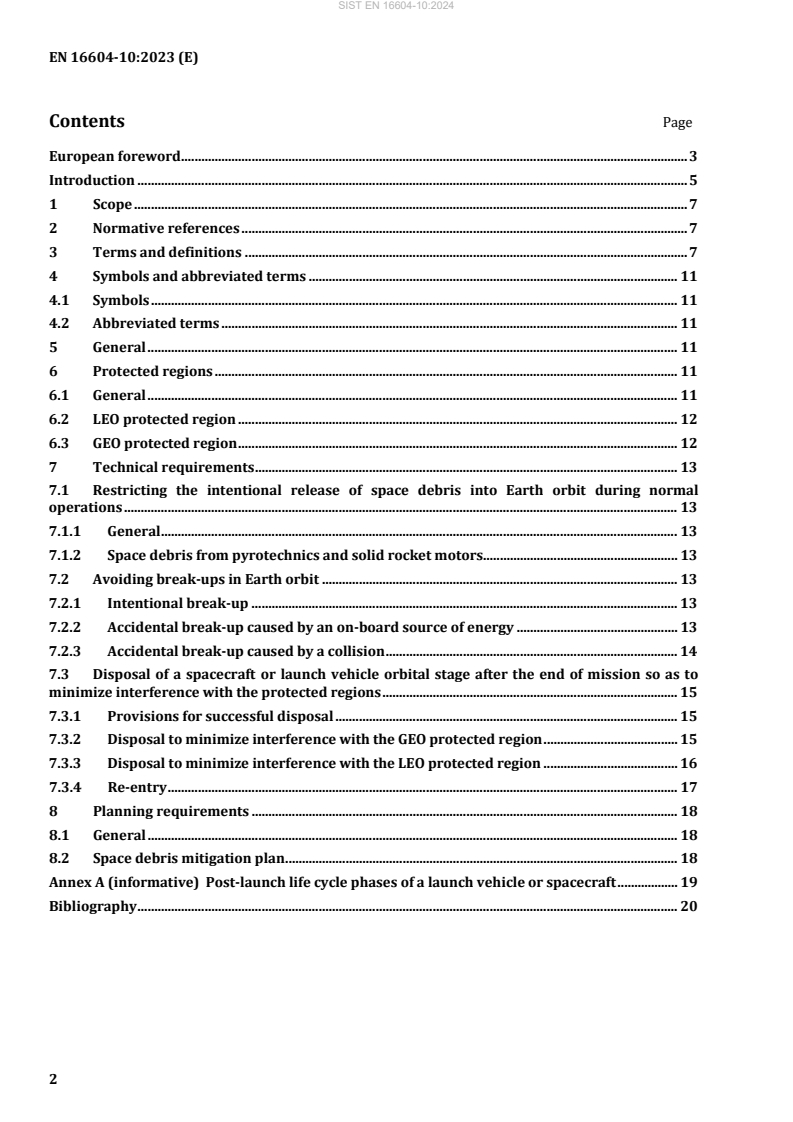
EUROPEAN STANDARD EN 16604-10
NORME EUROPÉENNE
EUROPÄISCHE NORM
December 2023
ICS 49.140
Supersedes EN 16604-10:2019
English version
Space sustainability - Space debris mitigation
requirements (ISO 24113:2023, modified)
Durabilité des activités spatiales - Exigences relatives à Nachhaltigkeit im Weltraum - Anforderungen zur
la réduction des débris spatiaux (ISO 24113:2023, Eindämmung des Weltraummülls (ISO 24113:2023,
modifiée) modifiziert)
This European Standard was approved by CEN on 27 November 2023.
CEN and CENELEC members are bound to comply with the CEN/CENELEC Internal Regulations which stipulate the conditions for
giving this European Standard the status of a national standard without any alteration. Up-to-date lists and bibliographical
references concerning such national standards may be obtained on application to the CEN-CENELEC Management Centre or to
any CEN and CENELEC member.
This European Standard exists in three official versions (English, French, German). A version in any other language made by
translation under the responsibility of a CEN and CENELEC member into its own language and notified to the CEN-CENELEC
Management Centre has the same status as the official versions.
CEN and CENELEC members are the national standards bodies and national electrotechnical committees of Austria, Belgium,
Bulgaria, Croatia, Cyprus, Czech Republic, Denmark, Estonia, Finland, France, Germany, Greece, Hungary, Iceland, Ireland, Italy,
Latvia, Lithuania, Luxembourg, Malta, Netherlands, Norway, Poland, Portugal, Republic of North Macedonia, Romania, Serbia,
Slovakia, Slovenia, Spain, Sweden, Switzerland, Türkiye and United Kingdom.
CEN-CENELEC Management Centre:
Rue de la Science 23, B-1040 Brussels
© 2023 CEN/CENELEC All rights of exploitation in any form and by any means
Ref. No. EN 16604-10:2023 E
reserved worldwide for CEN national Members and for
CENELEC Members.
Contents Page
European foreword . 3
Introduction . 5
1 Scope . 7
2 Normative references . 7
3 Terms and definitions . 7
4 Symbols and abbreviated terms . 11
4.1 Symbols . 11
4.2 Abbreviated terms . 11
5 General . 11
6 Protected regions . 11
6.1 General . 11
6.2 LEO protected region . 12
6.3 GEO protected region . 12
7 Technical requirements . 13
7.1 Restricting the intentional release of space debris into Earth orbit during normal
operations . 13
7.1.1 General . 13
7.1.2 Space debris from pyrotechnics and solid rocket motors. 13
7.2 Avoiding break-ups in Earth orbit . 13
7.2.1 Intentional break-up . 13
7.2.2 Accidental break-up caused by an on-board source of energy . 13
7.2.3 Accidental break-up caused by a collision . 14
7.3 Disposal of a spacecraft or launch vehicle orbital stage after the end of mission so as to
minimize interference with the protected regions . 15
7.3.1 Provisions for successful disposal . 15
7.3.2 Disposal to minimize interference with the GEO protected region . 15
7.3.3 Disposal to minimize interference with the LEO protected region . 16
7.3.4 Re-entry . 17
8 Planning requirements . 18
8.1 General . 18
8.2 Space debris mitigation plan . 18
Annex A (informative) Post-launch life cycle phases of a launch vehicle or spacecraft . 19
Bibliography . 20
European foreword
This document (EN 16604-10:2023) has been prepared by the Joint Technical Committee CEN-
CENELEC/JTC 5 “Space”, the secretariat of which is held by DIN.
This standard (EN 16604-10:2023) originates from ECSS-U-AS-10C Rev.2.
This European Standard shall be given the status of a national standard, either by publication of an
identical text or by endorsement, at the latest by June 2024, and conflicting national standards shall be
withdrawn at the latest by June 2024.
Attention is drawn to the possibility that some of the elements of this document may be the subject of
patent rights. CEN-CENELEC shall not be held responsible for identifying any or all such patent rights.
This document supersedes EN 16604-10:2019.
The main changes with respect to EN 16604-10:2019 are listed below:
— adoption of ISO 24113, Space systems — Space debris mitigation requirements, 4th edition 2023
(referred to as ISO 24113:2023) with following additional changes from ECSS:
— addition of “Context information” w.r.t. ECSS
— update of “Scope” with ECSS related information
— replacement of “operation” by “normal operations” in definition 3.13 “launch vehicle orbital
stage”
— addition of Note 4 to definition 3.20 “probability of successful disposal”
— modification of requirements 7.1.1.3, 7.1.2.2, 7.2.2.6, 7.2.3.1, 7.3.1.2, 7.3.2.3 and 8.2.2
— addition of Note to requirement 7.2.1 and 7.3.3.2
— addition of requirements 7.2.3.5, 7.2.3.6 and 7.3.3.3
This document has been prepared under a standardization request addressed to CEN-CENELEC by the
European Commission. The Standing Committee of the EFTA States subsequently approves these
requests for its Member States.
This document has been developed to cover specifically space systems and has therefore precedence over
any EN covering the same scope but with a wider domain of applicability (e.g.: aerospace).
Any feedback and questions on this document should be directed to the users’ national standards
body/national committee. A complete listing of these bodies can be found on the CEN and CENELEC
websites.
According to the CEN-CENELEC Internal Regulations, the national standards organisations of the
following countries are bound to implement this European Standard: Austria, Belgium, Bulgaria, Croatia,
Cyprus, Czech Republic, Denmark, Estonia, Finland, France, Germany, Greece, Hungary, Iceland, Ireland,
Italy, Latvia, Lithuania, Luxembourg, Malta, Netherlands, Norway, Poland, Portugal, Republic of North
Macedonia, Romania, Serbia, Slovakia, Slovenia, Spain, Sweden, Switzerland, Türkiye and the United
Kingdom.
Context information
This document outlines the clauses and the requirements of the standard ISO 24113, Space systems —
Space debris mitigation requirements, 4th edition 2023 (referred to as ISO 24113:2023) with
modifications, additions, notes and clarifications implemented for application in ECSS.
The standard ISO 24113, Space systems — Space debris mitigation requirements has been developed by
ISO TC20/SC14. The key space debris mitigation requirements have been thoroughly discussed at
international level, agreed by the ISO members and published as standard ISO 24113.
Aiming at the development of worldwide implementation standards dealing with space debris mitigation,
ECSS has proactively contributed to the preparation of ISO 24113.
ECSS decided to adopt and apply ISO 24133 with a few modifications, identified in the present document,
to account for the reference and applicable space debris mitigation documents existing in Europe and for
the needs of the ECSS members, with the addition of a set of delta-requirements.
In 2012, ECSS adopted ISO 24113:2011 with a minimum set of modifications (as per ECSS-U-AS-10C),
which have been mostly incorporated in ISO 24113:2019. Therefore, in 2019, ECSS decided to adopt and
apply ISO 24113:2019 as it was, without any modifications of the requirements. ISO 24113:2023 has
recently been published and is adopted with this document. However, in the present document a few
modifications and delta-requirements with respect to ISO 24113:2023 are included.
Introduction
Space debris comprises all objects of human origin in Earth orbit or re-entering the atmosphere, including
fragments and elements thereof, that no longer serve a useful purpose. The growing population of these
objects poses an increasing hazard to mankind’s use of space. In response to this problem, there is
international consensus that space activities need to be managed to minimize collision risks among space
objects and casualty risks associated with atmospheric re-entry of such objects. This consensus is
embodied in space debris mitigation guidelines published by organizations such as the International
[1] [2][3]
Telecommunication Union (ITU), the Inter-Agency Space Debris Coordination Committee (IADC)
[4]
and the United Nations (UN). The transformation of debris mitigation guidelines into engineering
practice is a key purpose of this document.
[5]
The importance of this document can be seen within the context of four UN treaties that were
established under the United Nations Committee on the Peaceful Uses of Outer Space (UNCOPUOS) to
govern the involvement of nations in space activities. These are the Outer Space Treaty, the Liability
Convention, the Registration Convention and the Rescue Agreement. Through some of these treaties, a
launching State has total liability for damage caused by its spacecraft or launch vehicle orbital stages (or
any parts thereof) on the surface of the Earth or to aircraft in flight, as well as in outer space where fault
can be proven.
All countries are encouraged to abide by these international agreements in order not to endanger or
constrain existing and future activities in space. A launching State can choose to appoint licensing or
regulatory authorities to administer its approach for complying with the above-mentioned UN treaties.
In several launching States, these authorities have implemented national legislation to enforce the UN
treaties. Such legislation can include the mitigation of space debris. Some launching States meet their
obligations by appointing non-regulatory government bodies, such as national space agencies, to provide
the necessary guidelines or requirements, including those for space debris mitigation.
The general aim of space debris mitigation is to reduce the growth of space debris by ensuring that
spacecraft and launch vehicle orbital stages are designed, operated and disposed of in a manner that
prevents them from generating debris throughout their orbit lifetime. Another aim of space debris
mitigation is to ensure that space objects re-entering the Earth’s atmosphere cause no harm. These aims
are achieved by the following actions:
a) avoiding the intentional release of space debris into Earth orbit during normal operations;
b) avoiding break-ups in Earth orbit;
c) removing spacecraft and launch vehicle orbital stages from protected orbital regions after the end of
mission;
d) performing the necessary actions to minimize the risk of collision with other space objects;
e) reducing the risks associated with re-entry, e.g. to people, property and the Earth's environment.
Such actions are especially important for a spacecraft or launch vehicle orbital stage that has one or more
of the following characteristics:
— has a large collision cross-section;
— remains in orbit for many years;
— operates near manned mission orbital regions;
— operates in highly utilized regions, such as protected regions;
— operates in regions of high debris population.
This document transforms these objectives into a set of high-level debris mitigation requirements.
Methods and processes to enable conformance with these requirements are provided in a series of lower-
level implementation standards.
1 Scope
This document defines the primary space debris mitigation requirements applicable to all elements of
unmanned systems launched into, or passing through, near-Earth space, including launch vehicle orbital
stages, operating spacecraft and any objects released as part of normal operations.
2 Normative references
There are no normative references in this document.
3 Terms and definitions
For the purposes of this document, the following terms and definitions apply.
ISO and IEC maintain terminology databases for use in standardization at the following addresses:
— ISO Online browsing platform: available at https://www.iso.org/obp
— IEC Electropedia: available at https://www.electropedia.org/
3.1
approving agent
entity from whom approval is sought for the implementation of space debris (3.23) mitigation
requirements with respect to the procurement of a spacecraft (3.25), or its launch, or its operations in
outer space, or its safe re-entry (3.22), or a combination of those activities
EXAMPLE Regulatory or licensing authorities; national or international space agencies; other delegated
organizations.
3.2
break-up
event that completely or partially destroys an object and generates space debris (3.23)
3.3
controlled re-entry
type of re-entry (3.22) where the time of re-entry is sufficiently controlled so that the impact of any
surviving debris on the surface of the Earth is confined to a designated area
Note 1 to entry: The designated area is usually an uninhabited region such as an ocean.
3.4
disposal
actions performed by a spacecraft (3.25) or launch vehicle orbital stage (3.13) to permanently reduce its
chance of accidental break-up (3.2) and to achieve its required long-term clearance of the protected
regions (3.21)
Note 1 to entry: Actions can include removing stored energy and performing post-mission orbital manoeuvres.
3.5
disposal manoeuvre
action of moving a spacecraft (3.25) or launch vehicle orbital stage (3.13) to a different orbit as part of its
disposal (3.4)
3.6
disposal phase
interval between the end of mission (3.9) of a spacecraft (3.25) or launch vehicle orbital stage (3.13) and
its end of life (3.8)
3.7
Earth orbit
bound or unbound Keplerian orbit with Earth at a focal point, or Lagrange point orbit which includes
Earth as one of the two main bodies
3.8
end of life
instant when a spacecraft (3.25) or launch vehicle orbital stage (3.13)
a) is permanently turned off, nominally as it completes its disposal phase (3.6),
b) completes its manoeuvres to perform a controlled re-entry (3.3), or
c) can no longer be controlled by the operator
Note 1 to entry: See Annex A.
3.9
end of mission
instant when a spacecraft (3.25) or launch vehicle orbital stage (3.13)
a) completes the tasks or functions for which it has been designed, other than its disposal (3.4),
b) becomes incapable of accomplishing its mission (3.15), or
c) has its mission permanently halted through a voluntary decision
Note 1 to entry: See Annex A.
3.10
expected number of casualties per re-entry
DEPRECATED: re-entry casualty risk
number of people who are predicted to be killed or seriously injured by the re-entry (3.22) of a space
object (3.24)
Note 1 to entry: The medical profession has defined a number of different injury scoring systems to distinguish the
severity of an injury. Broadly, a serious injury is one of such severity that hospitalization is required.
3.11
geostationary Earth orbit
GEO
Earth orbit (3.7) having zero inclination, zero eccentricity, and an orbital period equal to the Earth's
sidereal rotation period
3.12
launch vehicle
DEPRECATED: launcher
system designed to transport one or more payloads into outer space
3.13
launch vehicle orbital stage
complete element of a launch vehicle (3.12) that is designed to deliver a defined thrust during a dedicated
phase of the launch vehicle’s normal operations and achieve orbit
Note 1 to entry: Non-propulsive elements of a launch vehicle, such as jettisonable tanks, multiple payload structures
or dispensers, are considered to be part of a launch vehicle orbital stage while they are attached.
3.14
launching state
state that launches or procures the launching of a spacecraft (3.25), or state from whose territory or
facility a spacecraft is launched
[5]
Note 1 to entry: This definition is consistent with the definition in the UN Liability Convention and the UN General
[6]
Assembly’s Resolution 59/115 on the notion of the launching State .
3.15
mission
set of tasks or functions to be accomplished by a spacecraft (3.25) or launch vehicle orbital stage (3.13),
other than its disposal (3.4)
3.16
mission lifetime extension
postponement of the previously defined end of mission (3.9)
3.17
normal operations
execution of the planned tasks or functions for which a spacecraft (3.25) or launch vehicle orbital stage
(3.13) was designed
Note 1 to entry: Normal operations include the disposal phase (3.6).
3.18
orbit lifetime
elapsed time between an orbiting space object’s (3.24) initial or reference position and its re-entry (3.22)
Note 1 to entry: Examples of “initial position” are the injection into orbit of a spacecraft (3.25) or launch vehicle
orbital stage (3.13), or the instant when space debris (3.23) is generated. An example of a “reference position” is the
orbit of a spacecraft or launch vehicle orbital stage at the end of mission (3.9).
3.19
passivate
act of permanently depleting, irreversibly deactivating, or making safe all on-
board sources of stored energy capable of causing an accidental break-up (3.2)
Note 1 to entry: Passivation is an effective measure for significantly reducing the chance of an accidental explosion
that can generate space debris (3.23).
Note 2 to entry: Propellant tanks, batteries, high-pressure vessels, self-destruct devices, flywheels and momentum
wheels are examples of on-board sources of stored energy capable of causing an accidental break-up. It is preferable
to passivate such items as soon as they are no longer required for mission operations or post-mission disposal (3.4).
Note 3 to entry: A safe level of passivation is reached when any remaining stored energy cannot be expected to
cause an accidental break-up.
Note 4 to entry: In the event of a collision, a passivated space object (3.24) is likely to create less space debris than
a non-passivated space object.
3.20
probability of successful disposal
probability that a spacecraft (3.25) or launch vehicle orbital stage (3.13) is able to complete all of the
actions associated with its disposal (3.4)
Note 1 to entry: This probability is usually assessed before the launch of a spacecraft or launch vehicle orbital stage.
It can also be reassessed after launch taking into consideration any changes in the operational status of hardware.
This is particularly important when deciding whether to extend the mission (3.15) lifetime or postpone the end of
life (3.8).
Note 2 to entry: The assessment of this probability includes consideration of uncertainties in the availability of
resources, such as propellant, required for the disposal.
Note 3 to entry: The assessment of this probability can include consideration of the inherent reliability of equipment
that is necessary to conduct the disposal, monitoring of the equipment, and operational remediation of any observed
degradation or failure of the equipment.
Note 4 to entry: The calculation of this probability can be b
...